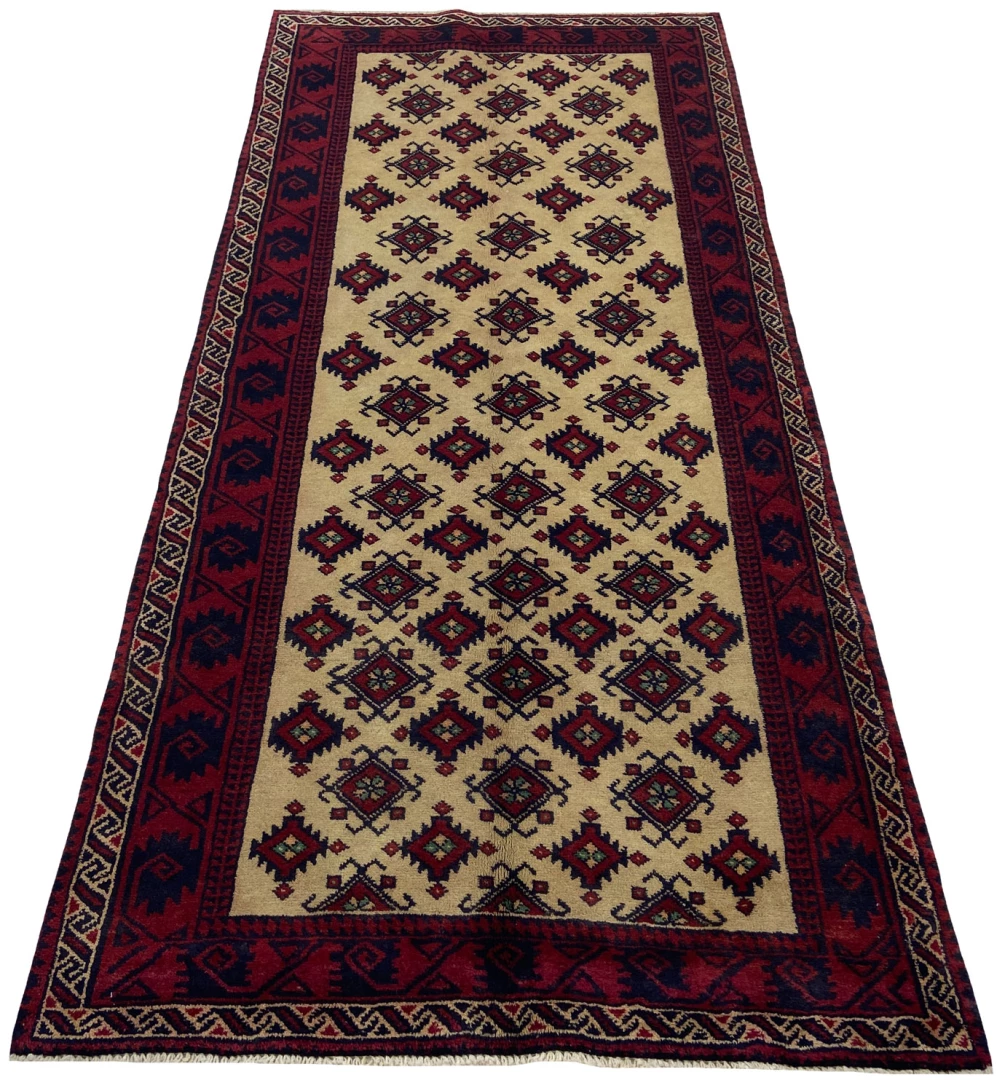
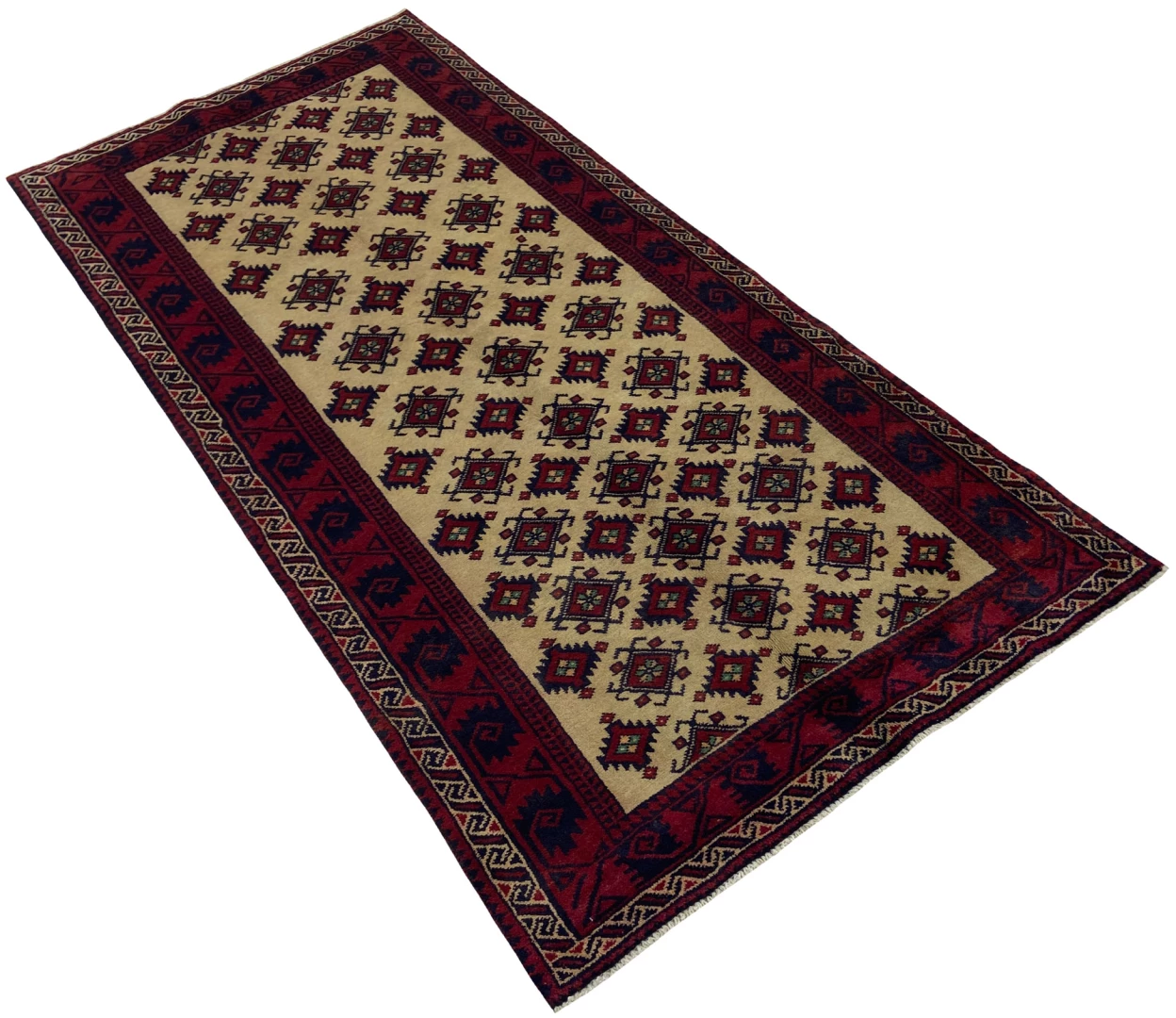
Hand-knotted Belutsch Oriental rug | Knot density: 120.000 – 250.000 knots/m² | Material: pile natural wool from own production | Size: 227 x 102 cm | Pattern: geometric and floral designs | Condition: very good
This Belutsch Oriental rug is hand-knotted and made from natural wool produced in-house. These two points define its material and construction: natural wool forms the pile, while the traditional knotting method gives the rug its handmade structure. Each knot is part of a process in which the design is built directly into the textile rather than applied to a finished surface. The result is an individual piece of rug craftsmanship.
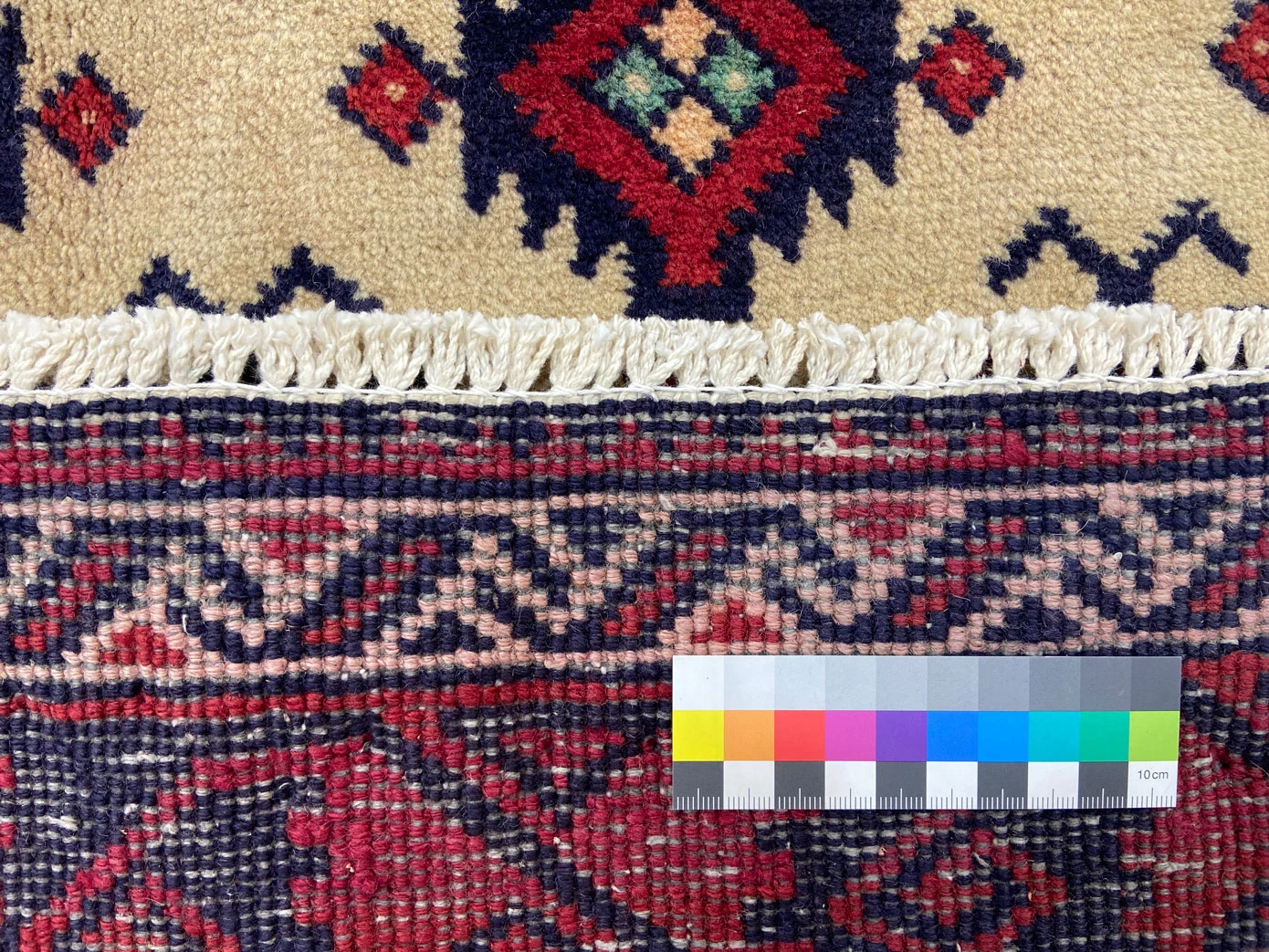
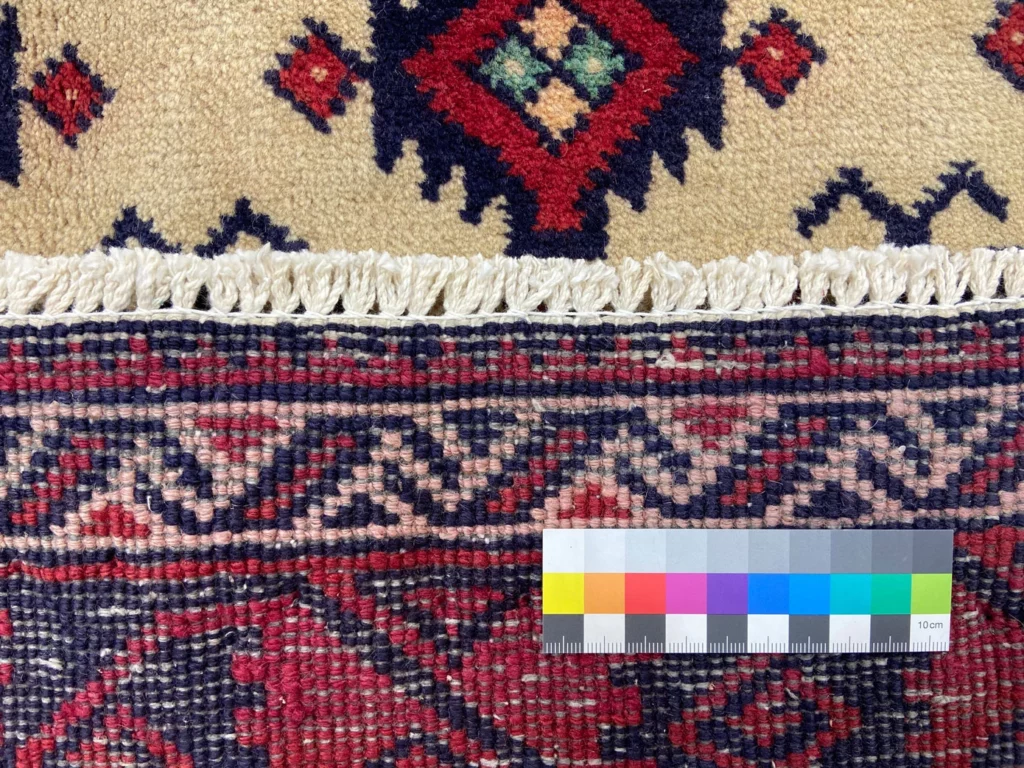
The rug has a knot density ranging from 120.000 to 250.000 knots per square metre. This range is part of its technical description and indicates how densely the handwork is arranged across the pile. Knotting is a gradual process. The maker follows the intended arrangement of the design and creates the field, borders and ornaments through repeated manual work. The density therefore belongs together with the construction method when describing the rug’s make.
Natural wool from the makers’ own production is central to the stated material composition. Wool has long been used for knotted rugs because it provides a substantial textile pile and a tactile surface. Its character is experienced together with the knots: the material and the construction are not separate decorative additions, but the basis of the rug itself. No additional pile material or particular warp material is specified for this piece.
Origin and Tradition
The rug is identified with the Balutsch region. The Baluch are an Indigenous people living at the meeting point of Afghanistan, Persia and Pakistan. This location has allowed cultural influences to meet across a broad historical area, while the community has retained its own textile language. The term Belutsch therefore describes a regional and cultural rug tradition rather than simply naming one modern national border.
In Baluch communities, textile work has traditionally been closely connected with everyday life. Rugs could serve practical purposes while also carrying a visual identity through their arrangement of forms, borders and colours. Knowledge of wool, knotting, pattern construction and colour relationships was passed through families and communities. Such continuity does not require every rug to look alike. Instead, it allows established ideas to be reinterpreted in the hands of individual makers.
The origin information for this rug names Afghanistan, Persia and Pakistan. That wording reflects the wider cultural area in which Balutsch rug making is rooted. It does not turn this specific piece into a Persian rug; its classification here is Oriental rug because the stated Belutsch origin reaches across several countries. The historical geography helps explain why motifs and working traditions can show related influences without belonging to one narrowly defined national school.
Balutsch weaving and knotting are commonly associated with a practical yet distinctive approach to ornament. The work combines the need to create a useful textile with the need to express a recognisable local design vocabulary. A pattern must be translated into a repeatable structure while the hand-knotting process preserves the character of the individual rug. This relationship between inherited knowledge and manual execution is an important part of the tradition.
The wider world of Oriental rugs includes many other regional approaches. Gabbeh rugs are often associated with simpler, more rustic designs, while Kerman rugs are known for finely worked patterns and lively colour combinations. Nain and Isfahan represent further Persian traditions with their own histories and visual systems. These are useful points of comparison in rug culture, but they do not change the origin designation of this particular Belutsch Oriental rug.
Design and Pattern
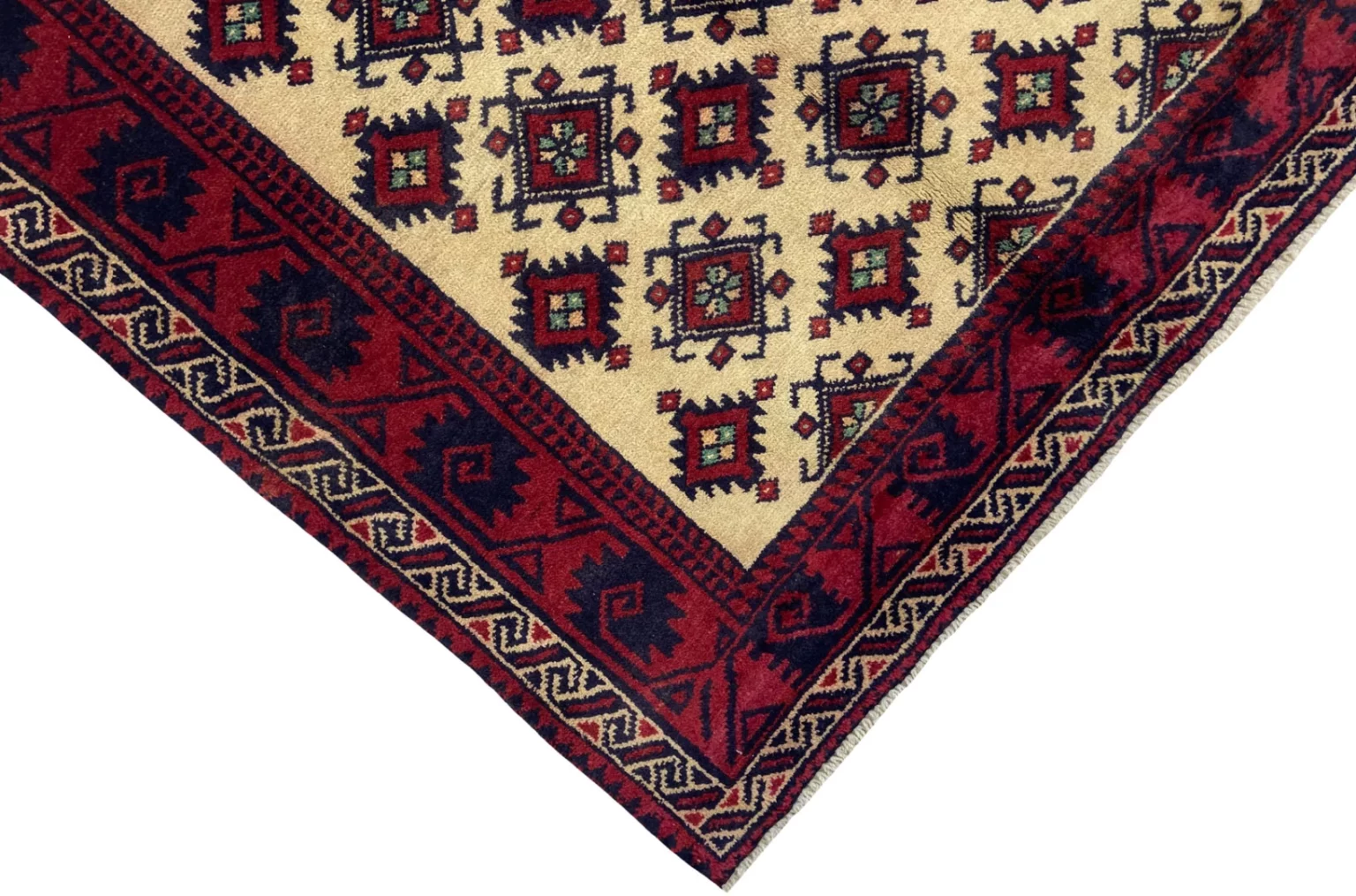
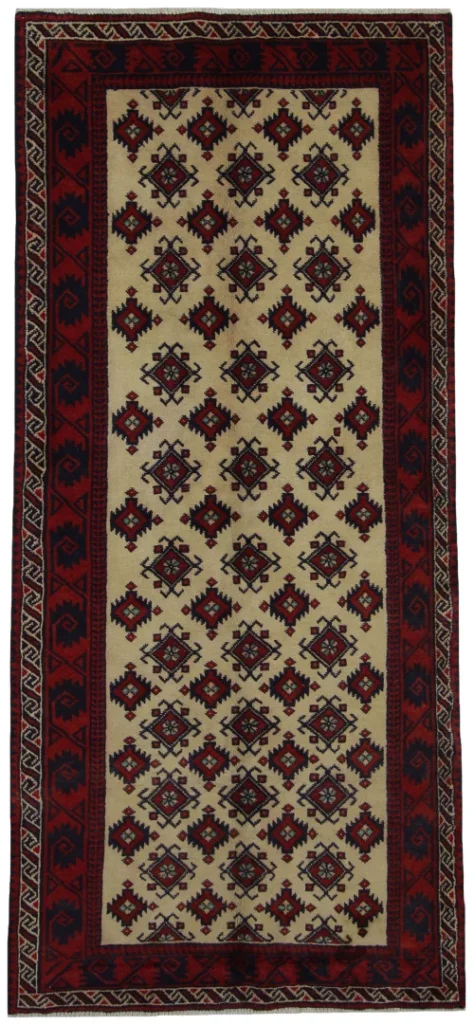
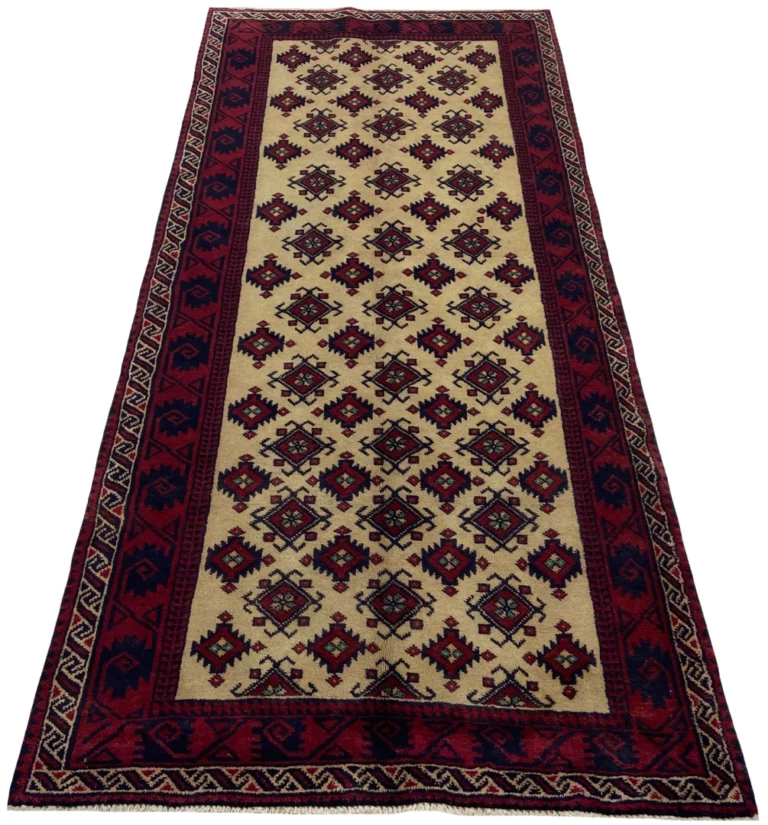
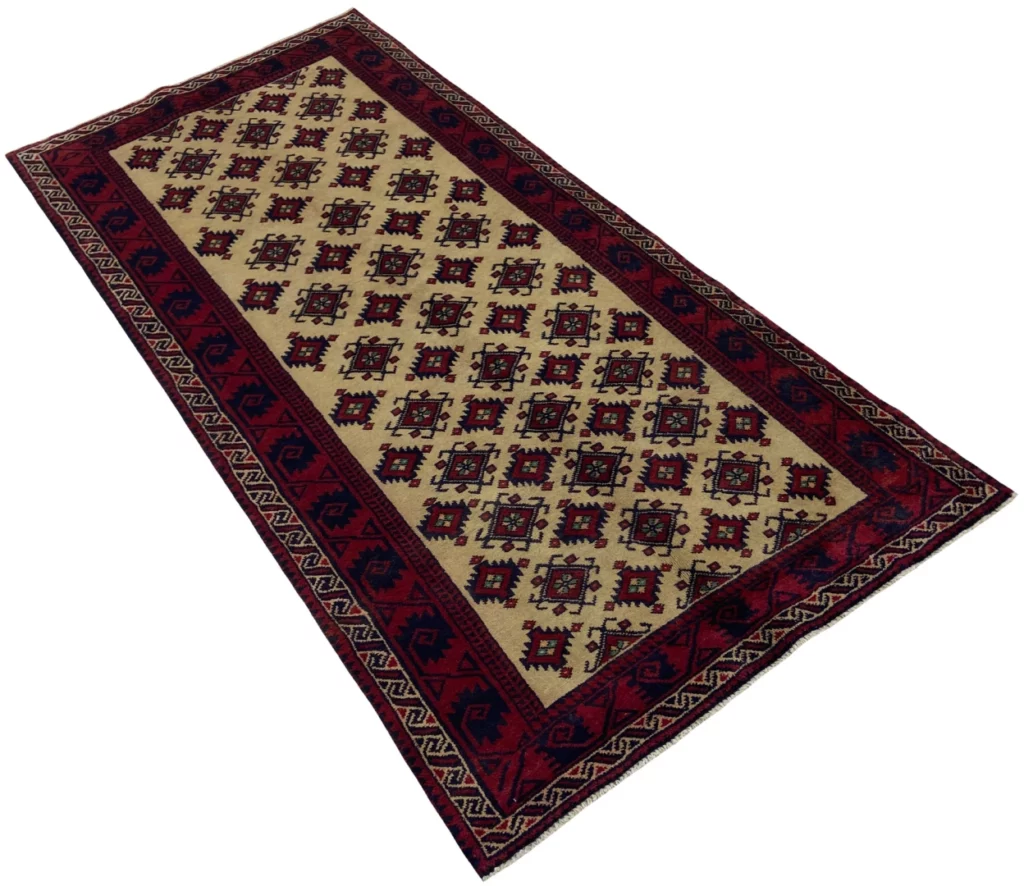
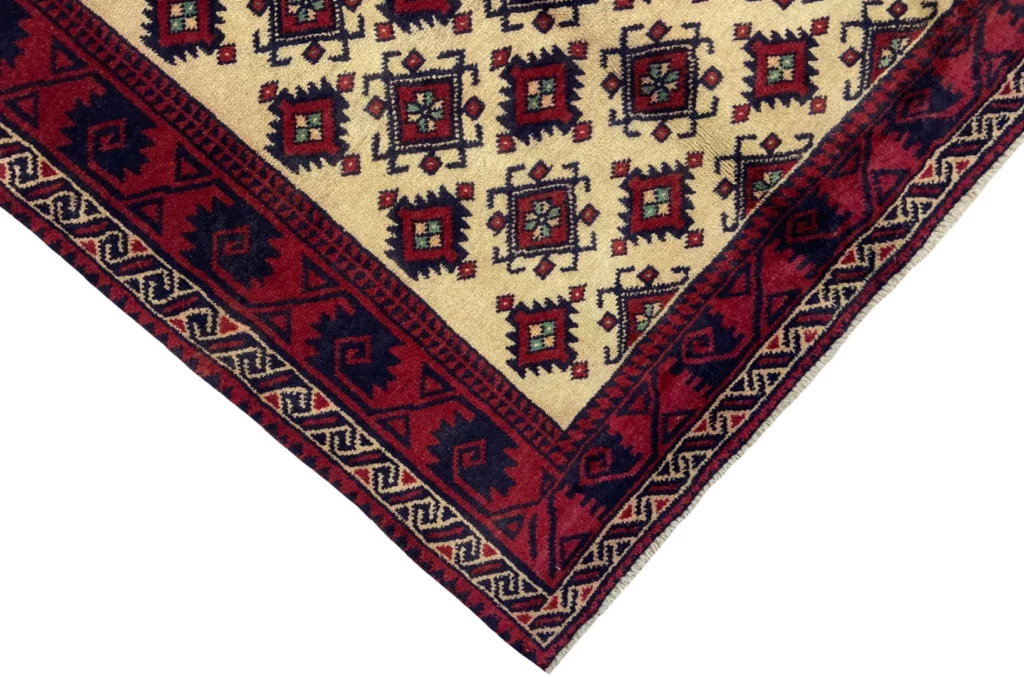
The design is described as a combination of geometric and floral patterns. Geometric elements give the composition a clear framework through lines, repeated shapes and ordered areas. Floral elements introduce stylised leaves, blossoms or plant-inspired forms. Together, the two approaches create a pattern language that can be structured and decorative at the same time. The description identifies both pattern families without assigning the rug to a separate named design.
Geometric ornament is one of the enduring tools of Oriental rug design. Diamonds, stepped outlines, hooked forms, bands and repeated compartments can organise a field and establish a visual rhythm. Repetition provides continuity, while the hand-knotted execution allows small variations in the way forms are rendered. A geometric motif is therefore not only an isolated shape; it can also define the relationship between the centre, surrounding areas and border structure.
Floral ornament works through a more organic vocabulary. Leaves and flowers may be simplified, mirrored, repeated or arranged so that they fit within a border or central field. In traditional rug design, a floral motif does not have to imitate a plant with naturalistic precision. It can function as a stylised sign whose proportions and repetition support the overall composition. When placed beside geometric forms, it softens the structure without removing its sense of order.
The colours are described as lively, with deep reds, gentle blues and earthy browns named as examples of the palette. These colour groups can distinguish one area from another, bring out individual ornaments and organise the relationship between field and borders. Colour in a hand-knotted wool rug is read through a textured surface rather than a flat printed one. The interaction of wool, knots and colour contributes to the appearance of the pattern.
Pattern and colour also carry cultural meaning in a broad sense. Repeated ornaments reflect ways of arranging visual information that have developed within communities and across neighbouring regions. A rug can therefore communicate a sense of place through its forms even when the individual motifs are not given a separate name. In this piece, the stated geometric and floral designs provide the identifiable pattern information, while the handmade execution gives that information its individual form.
The combination of structured geometry and floral detail can sit alongside both contemporary and traditional interiors. In a modern room, the repeated forms can introduce a defined textile structure. In a more classical setting, the ornament can relate to the longer history of Oriental rug design. This is a description of the design tradition and its possible visual context, not an additional claim about the rug’s origin, age or provenance.
Special Features
The rug is in very good condition. Its stated features are the hand-knotted construction, natural wool from own production and the specified knot-density range. Wool and traditional knotting are associated with a durable, abrasion-resistant rug structure, which also makes this type of textile suitable in principle for areas with regular use. No further condition details or restoration information are given.
Regular vacuuming is recommended for care. If more extensive cleaning is needed, professional cleaning is appropriate. Direct sunlight should be avoided because it can contribute to colour fading. These measures support careful preservation of the wool pile and help maintain the rug’s very good condition over time.
FAQ
What makes a Belutsch Oriental rug distinctive?
Its character comes from the combination of regional tradition, hand knotting and natural wool. Belutsch rugs are connected with the Baluch people and the cultural area between Afghanistan, Persia and Pakistan. Geometric and floral designs bring together ordered shapes and stylised botanical forms. For this rug, the stated knot density is another technical feature. It describes the density of the hand-knotted construction, while natural wool from own production is the material of the pile.
How should this wool rug be cared for?
Vacuum the rug regularly to remove dust and loose dirt from the surface. When a more thorough treatment is necessary, professional cleaning is recommended. Direct sunlight should be avoided because prolonged exposure may cause colours to fade. Careful handling helps protect the hand-knotted wool pile and supports the rug’s very good condition. The cleaning approach should remain suitable for a handmade wool rug rather than treating it like a washable industrial textile.
Where do Belutsch rugs come from?
Belutsch rugs come from the cultural region of the Baluch people, located at the intersection of Afghanistan, Persia and Pakistan. The Baluch are an Indigenous people with an established textile tradition. The origin information for this rug names Afghanistan, Persia and Pakistan, so it is described as a Belutsch Oriental rug rather than a Persian rug. Nain, Isfahan and Kerman belong to other rug traditions and are not the origin stated for this individual piece.
To provide the best experiences, we use technologies like cookies to store and/or access device information. Consenting to these technologies will allow us to process data such as browsing behavior or unique IDs on this site. Not consenting or withdrawing consent, may adversely affect certain features and functions.
Functional Always active
The technical storage or access is strictly necessary for the legitimate purpose of enabling the use of a specific service explicitly requested by the subscriber or user, or for the sole purpose of carrying out the transmission of a communication over an electronic communications network.
Preferences
The technical storage or access is necessary for the legitimate purpose of storing preferences that are not requested by the subscriber or user.
Statistics
The technical storage or access that is used exclusively for statistical purposes.The technical storage or access that is used exclusively for anonymous statistical purposes. Without a subpoena, voluntary compliance on the part of your Internet Service Provider, or additional records from a third party, information stored or retrieved for this purpose alone cannot usually be used to identify you.
Marketing
The technical storage or access is required to create user profiles to send advertising, or to track the user on a website or across several websites for similar marketing purposes.

 SECURE PAYMENT
 SHIPPING PARTNERS


