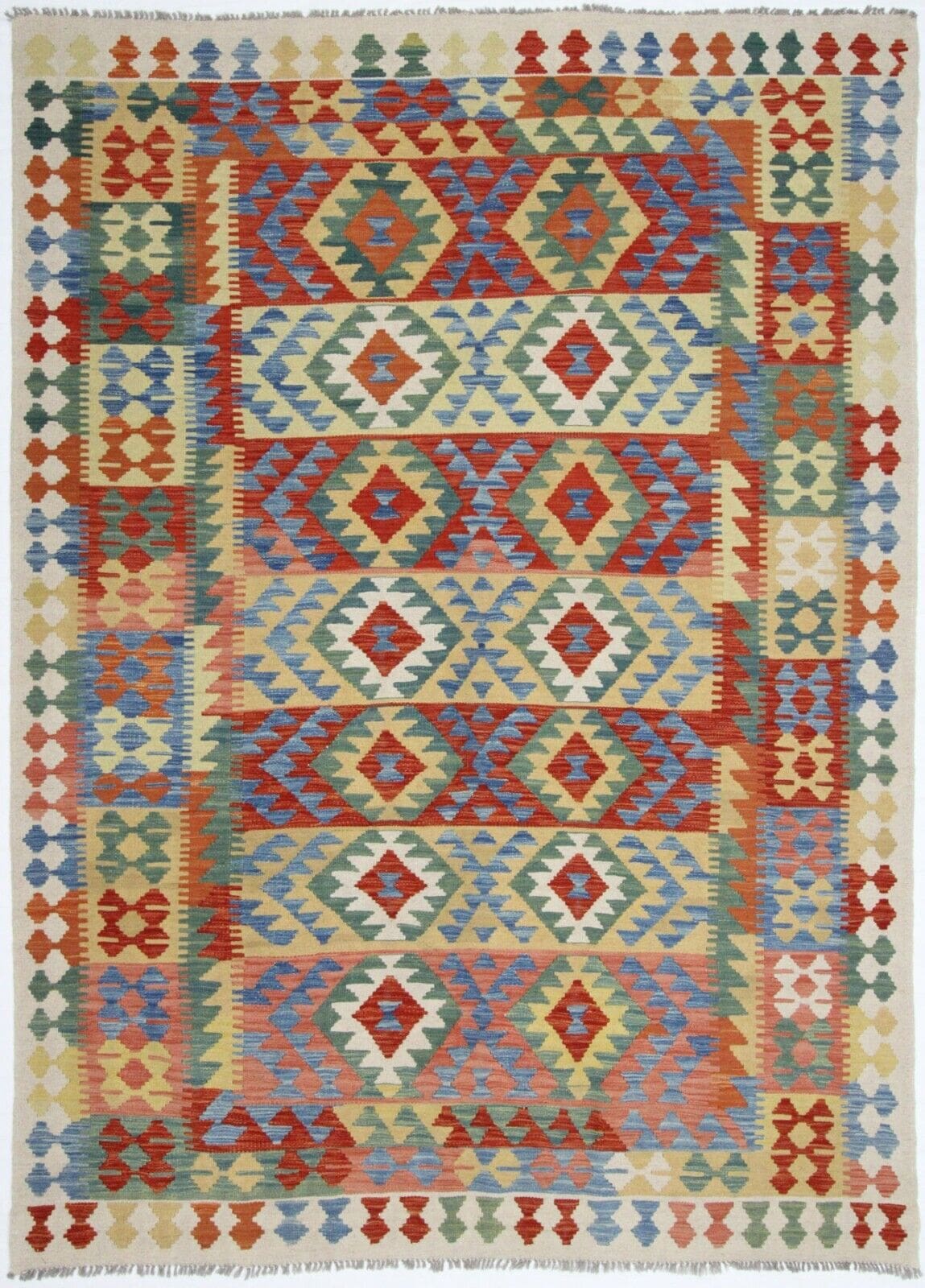
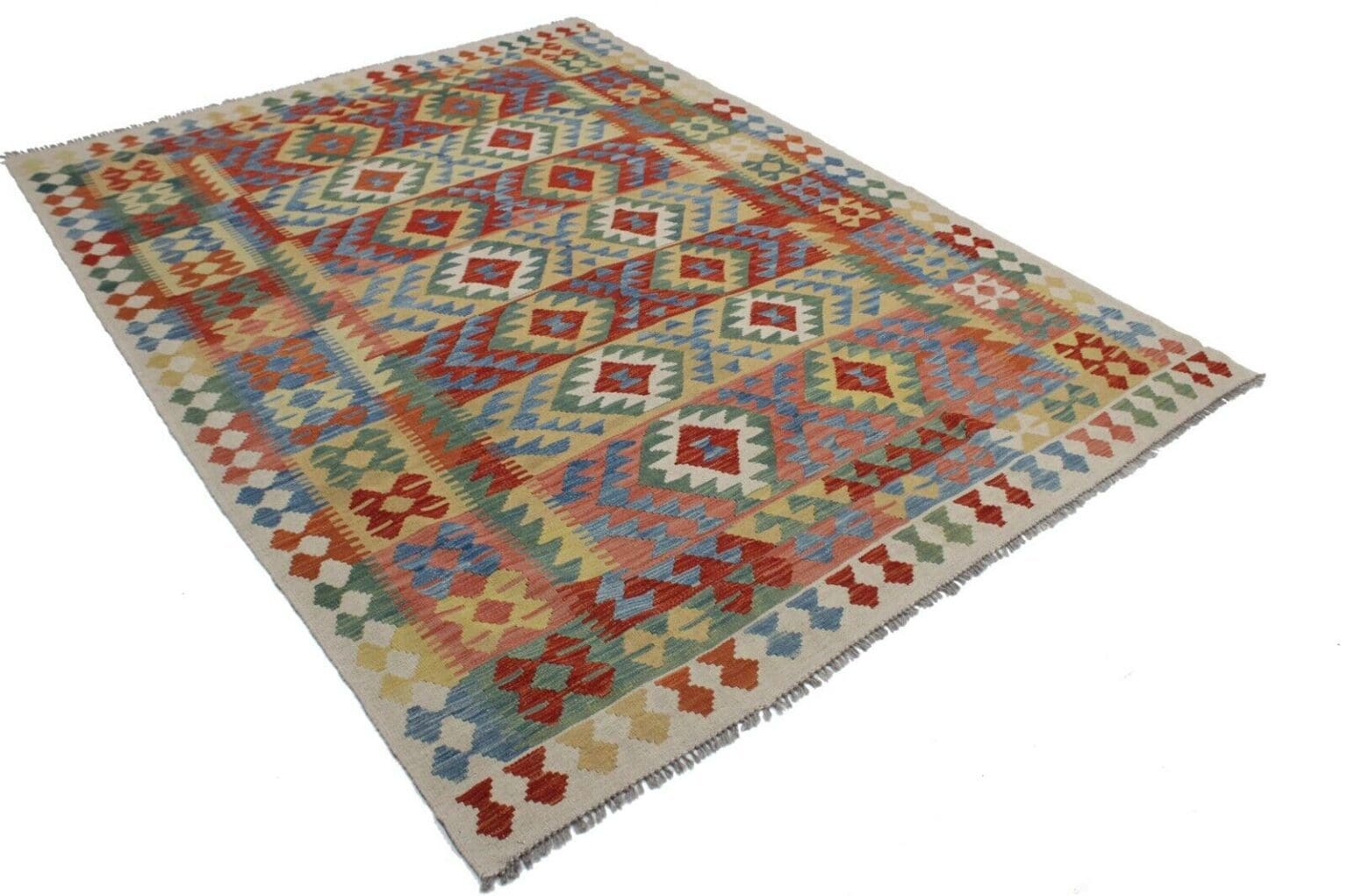
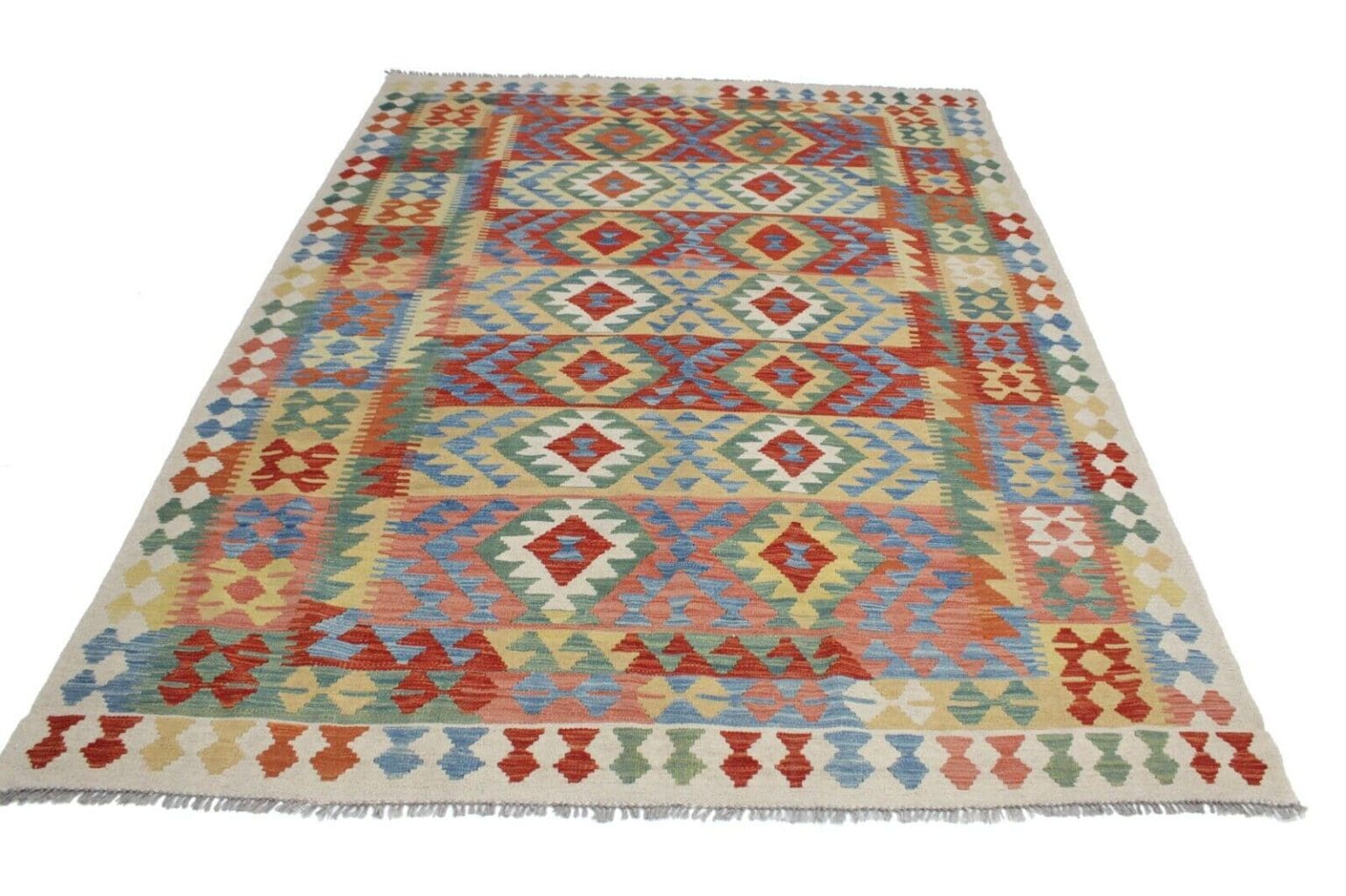
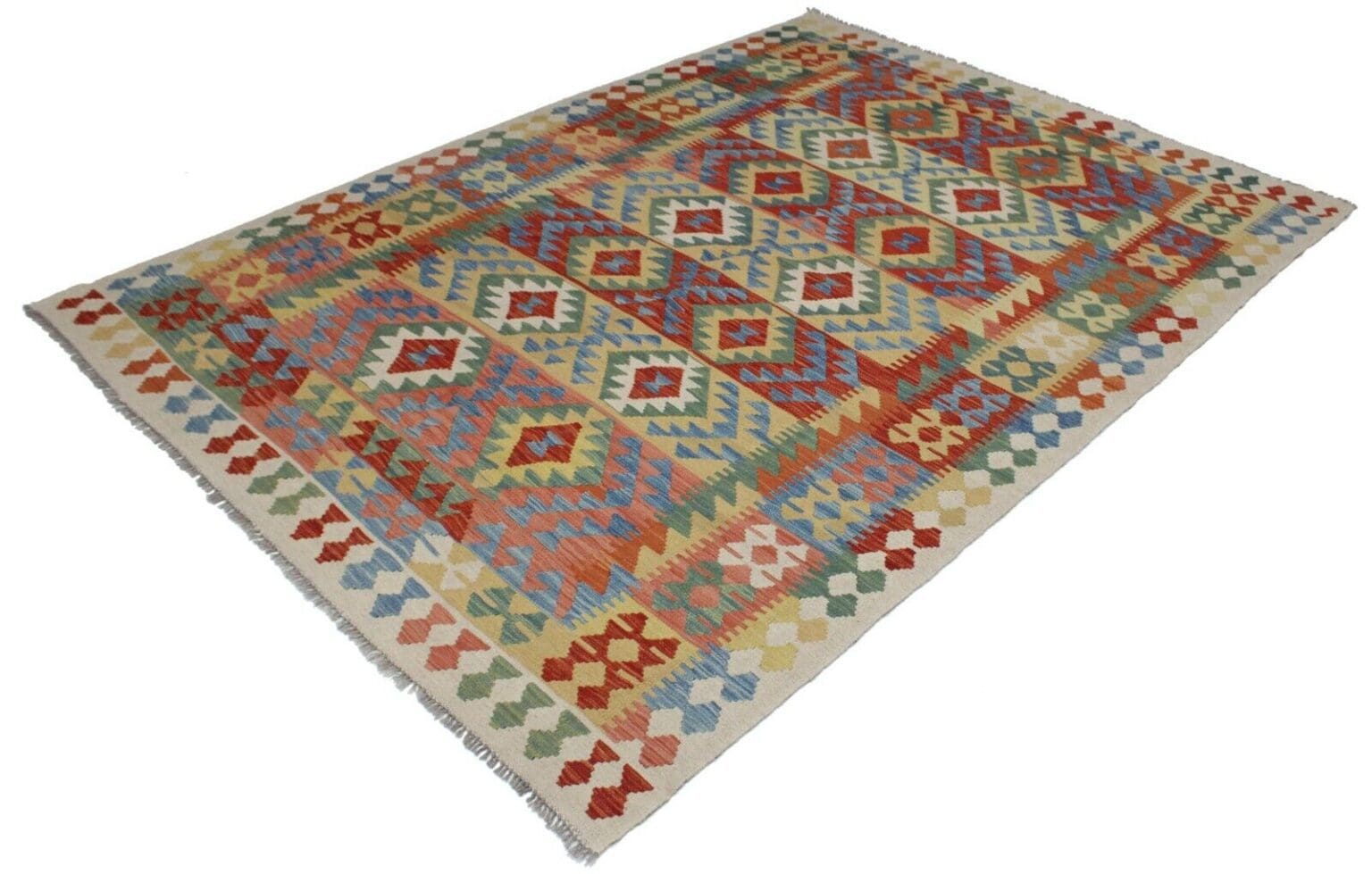
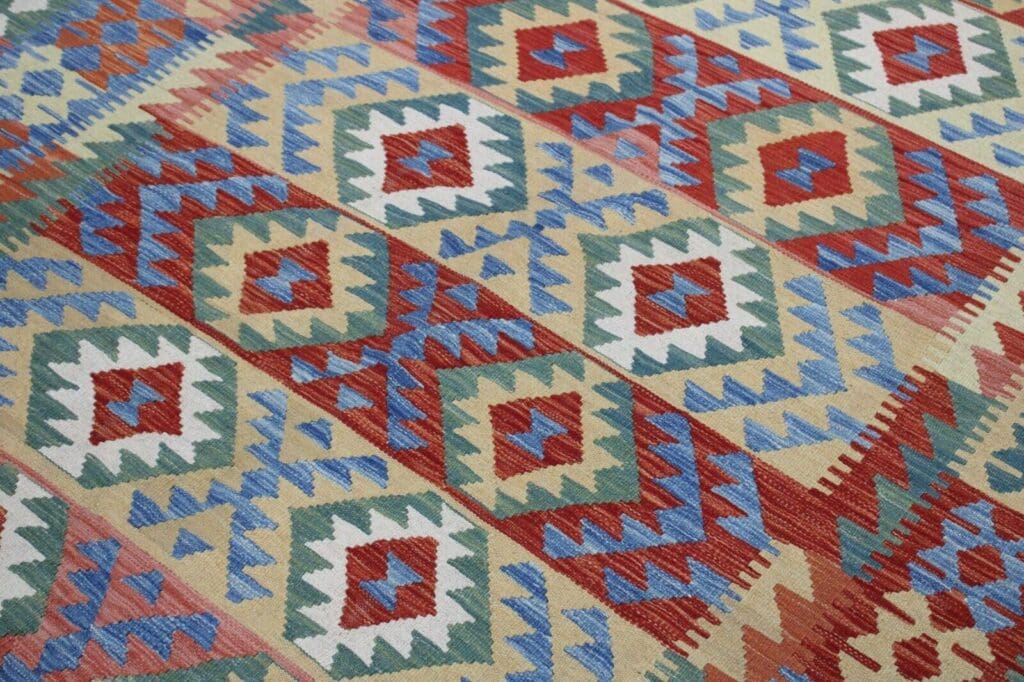
This Oriental rug is a hand-woven Kelim made in Afghanistan. Its material is specified as 100% wool. In a Kelim, the surface is created by weaving rather than by inserting individual pile knots into a foundation. The character of the textile therefore comes from the relationship between warp and weft, the tension of the threads, and the way coloured sections are built into the woven field. The technique is visible in the flat construction and in the direct connection between structure and pattern.
Unlike a conventional high-pile rug, a hand-woven Kelim does not have an upright pile surface. The wool forms part of the woven textile itself, producing two usable faces. This rug is specifically described as reversible. That feature belongs to the construction of the piece and allows either side to be placed on the floor. It does not indicate that the two sides carry separate designs; it describes the practical use of the woven surface.
The stated composition is 100% wool. No additional material is identified for this rug, so no further fibre is added to the description. Wool has long been used in woven rug traditions because it can be spun into threads of different weights and worked into a firm textile plane. In a Kelim, wool is not presented as a raised pile. Instead, it is part of the interlaced structure through which the geometric design is formed.
The condition is given as new without label. This distinguishes the rug from an item described as used, restored, antique, or aged. The product information does not provide details about cleaning, repairs, previous use, or treatment, so none of those points are assigned to this individual piece. It also states that the rug is suitable for underfloor heating. That is a specified use characteristic alongside the material, technique, and condition.
Hand-woven Kelims are read differently from densely knotted rugs. Their appearance depends less on a raised surface and more on the organisation of the woven field. Changes in colour, the direction of the threads, and the meeting of shaped sections establish the visual structure. In this rug, the wool, the Kelim method, the reversible construction, and the geometric pattern form a coherent description of a flat-woven textile.
Origin and Tradition
The rug is from Afghanistan. Afghanistan has a broad and varied history of woven and knotted textile production. Different landscapes, communities, and local craft practices have contributed to distinct approaches to colour, rhythm, and the division of a textile field. Kelims belong to this wider tradition because they combine a useful woven construction with patterns that can function as independent designs on a flat surface.
In an Afghan Kelim, the woven plane is central. The warp establishes the lengthwise order, while the weft builds the body of the textile and carries the colour arrangement. Depending on the weaving method, a design may be made from adjoining colour areas, narrow transitions, stepped outlines, or clearly separated shapes. These principles are particularly suitable for geometric compositions, where lines, angles, diamonds, and repeated borders can be organised into a rhythmic surface.
Afghan weaving is not limited to one visual style. Regional environments and different groups have developed varied ways of combining colours, structures, and pattern systems. The origin Afghanistan therefore identifies the cultural and manufacturing context rather than a single workshop or a single named motif. For this rug, the pattern is described only as geometric. A more specific province, tribe, village, or workshop is not provided.
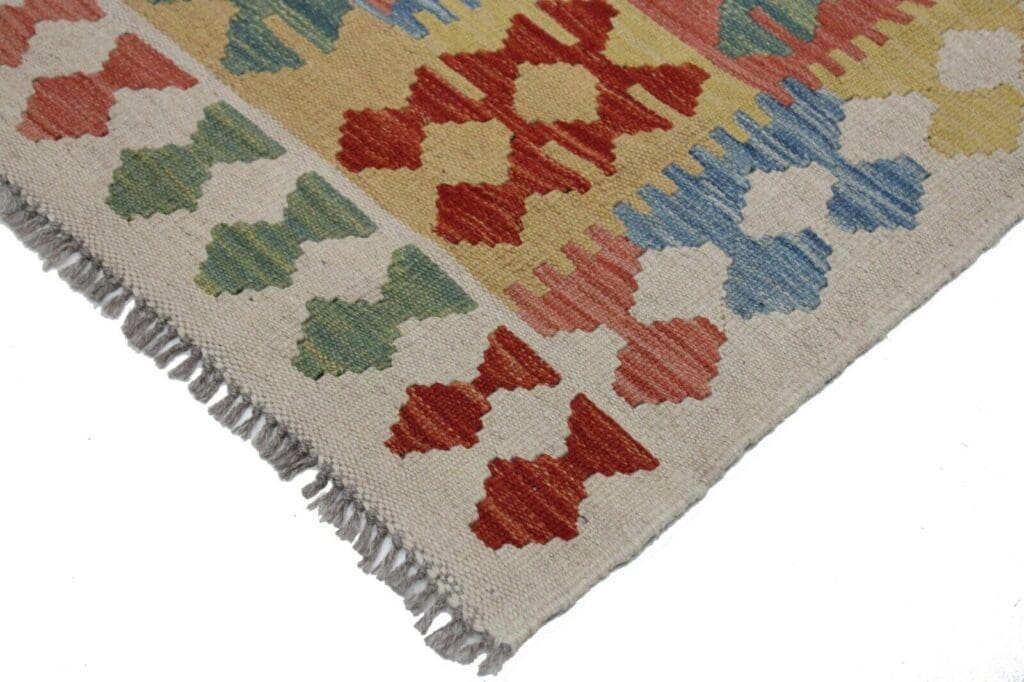
Kelim weaving depends on knowledge passed through practical work. Skill can be seen in the preparation of the warp, the handling of the weft, the control of tension, and the way changes in a pattern are carried across the width. Geometric designs make this process especially legible because their contours follow the logic of the woven structure. Straight lines may become stepped, and angled forms may be assembled from successive sections. The result is both a functional textile and an ordered visual field.
The manufacturing period of this rug is stated as from 2020 onward. It therefore belongs to contemporary production and is not described as historic or antique. Its Afghan origin still connects it with methods and design principles that have been maintained and adapted over long periods. A contemporary Kelim can reflect established textile knowledge without allowing a specific age, historical source, or workshop to be assigned to this individual item.
Wool has an established place in Afghan textile traditions. It can be prepared as threads with different degrees of thickness and used to create a durable woven surface. Its role in this rug is specifically recorded as 100% wool. In a flat-woven Kelim, that material is experienced through the textile structure rather than through a high pile. This helps explain the direct, construction-led appearance associated with the form.
Afghan Kelims have been used in practical and domestic settings as well as valued for their pattern work. The flat construction and reversible use are important functional qualities of the category. For this rug, reversible use and suitability for underfloor heating are explicitly stated. The description does not identify a historic model, a particular Afghan region, or a named cultural motif, so those details are not attached to the piece.
Design and Pattern
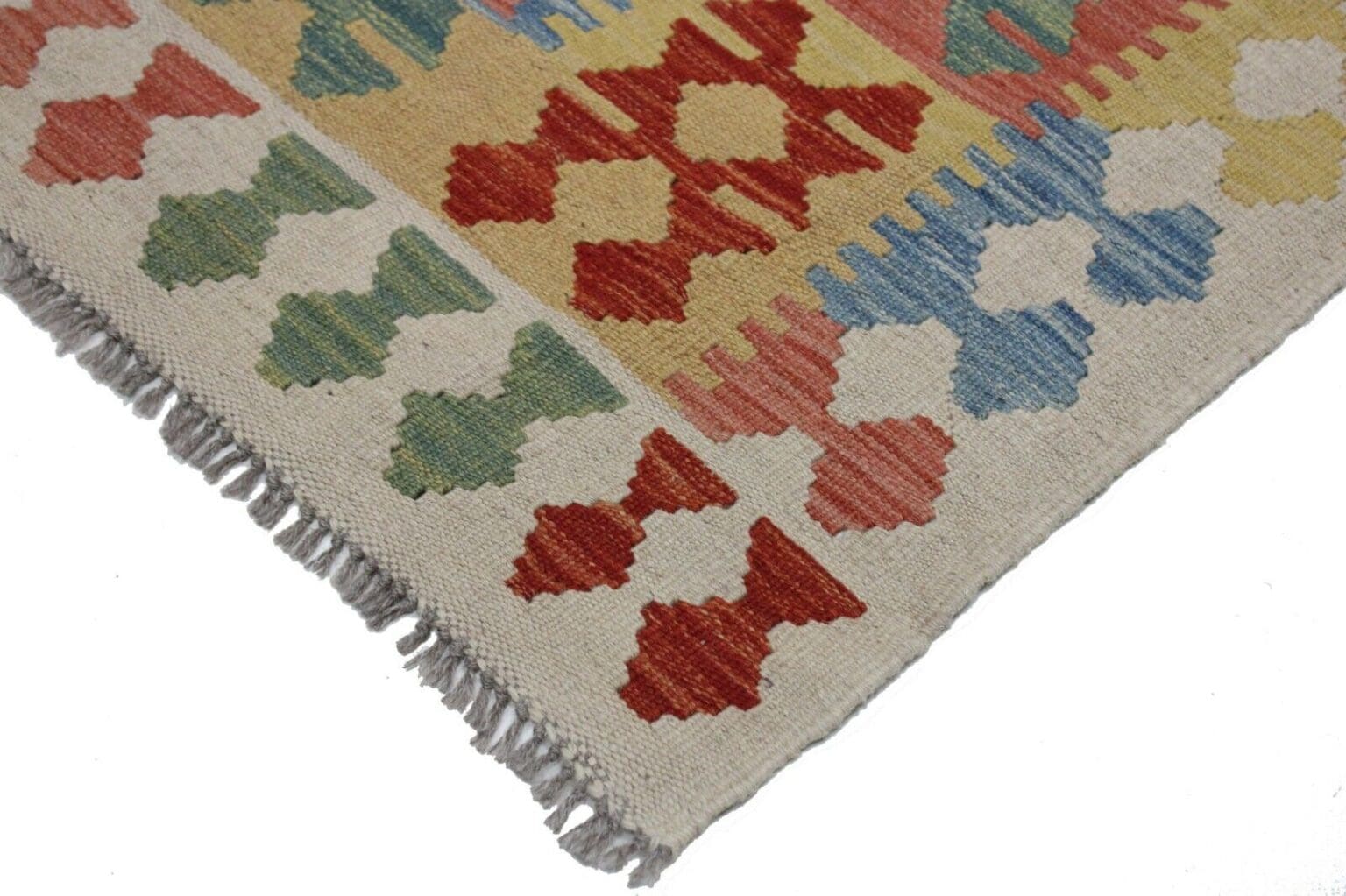
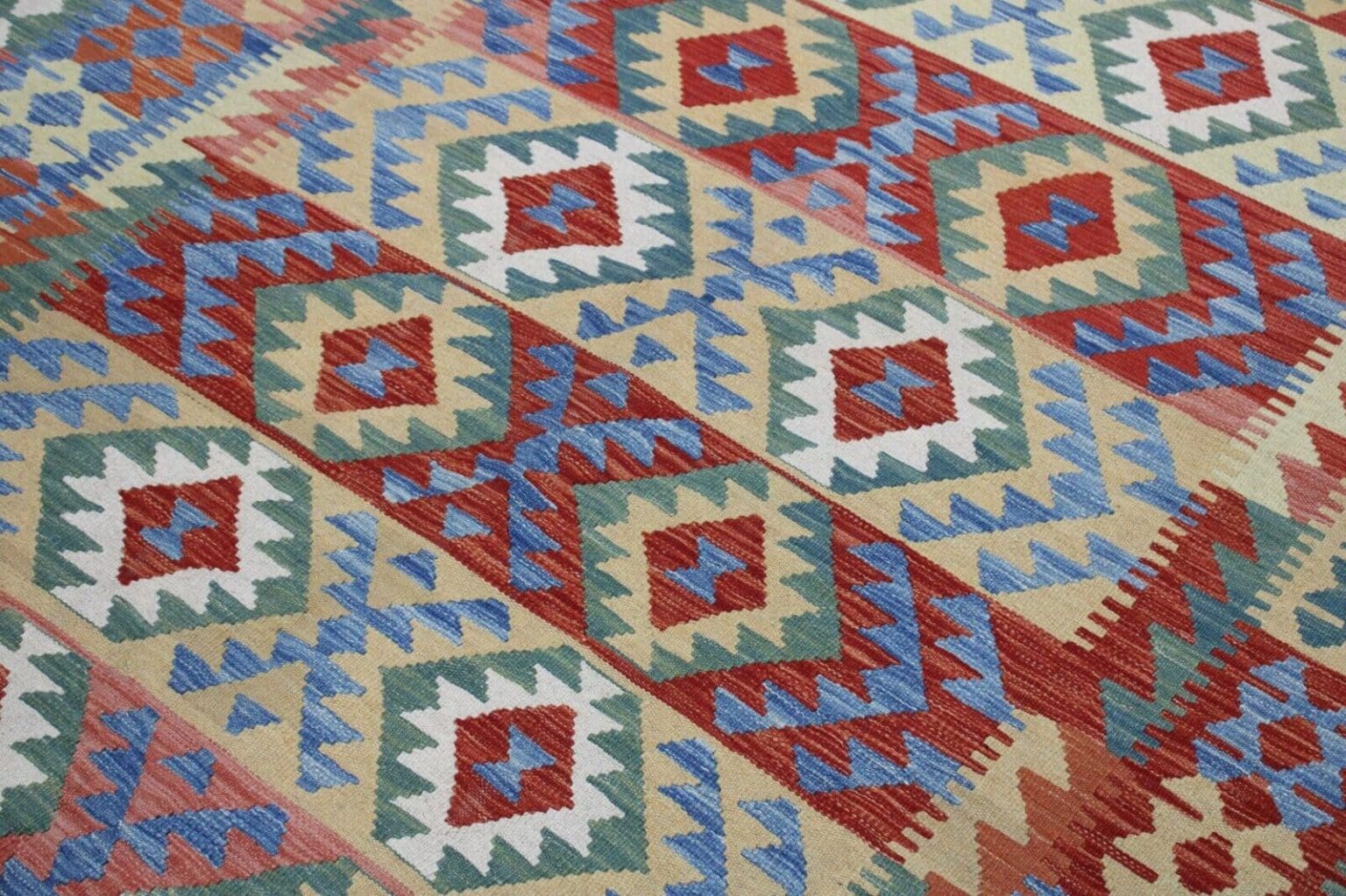
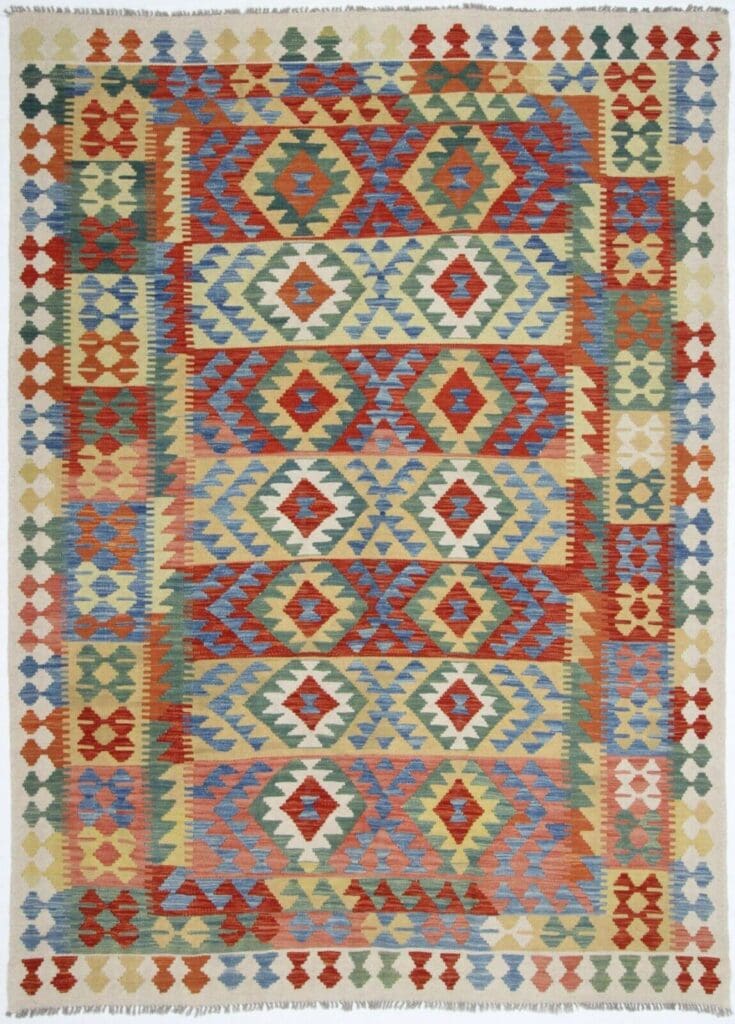
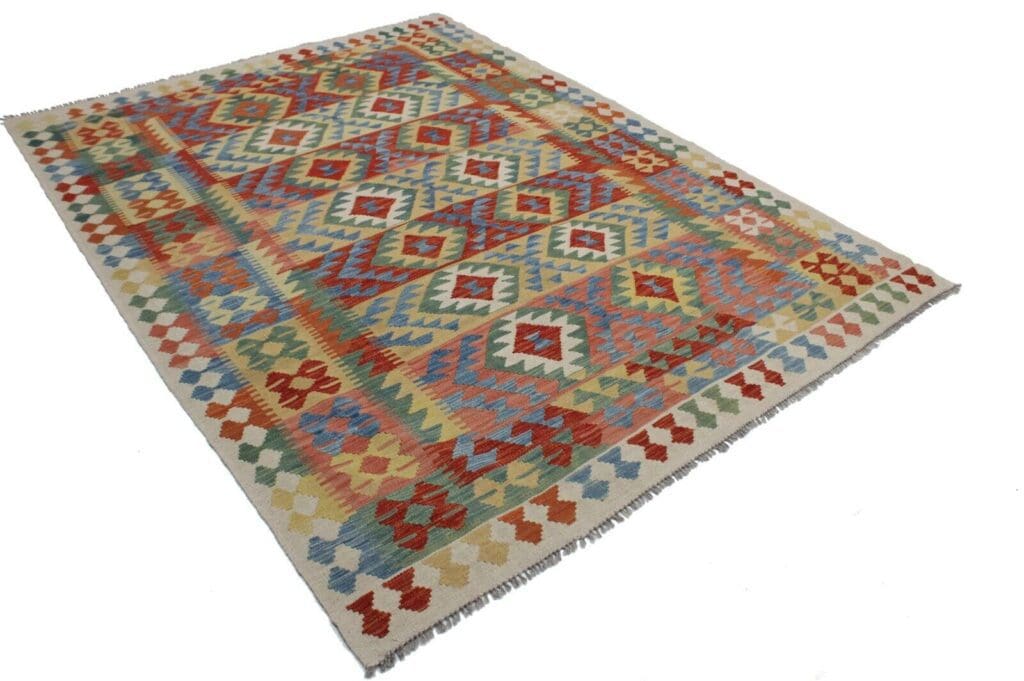
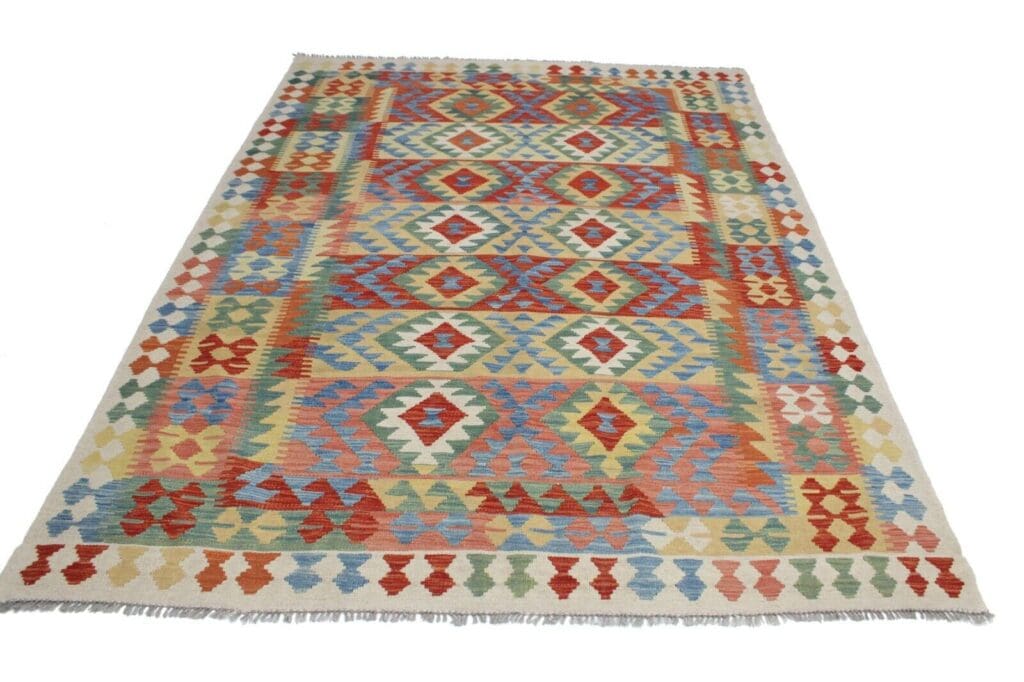
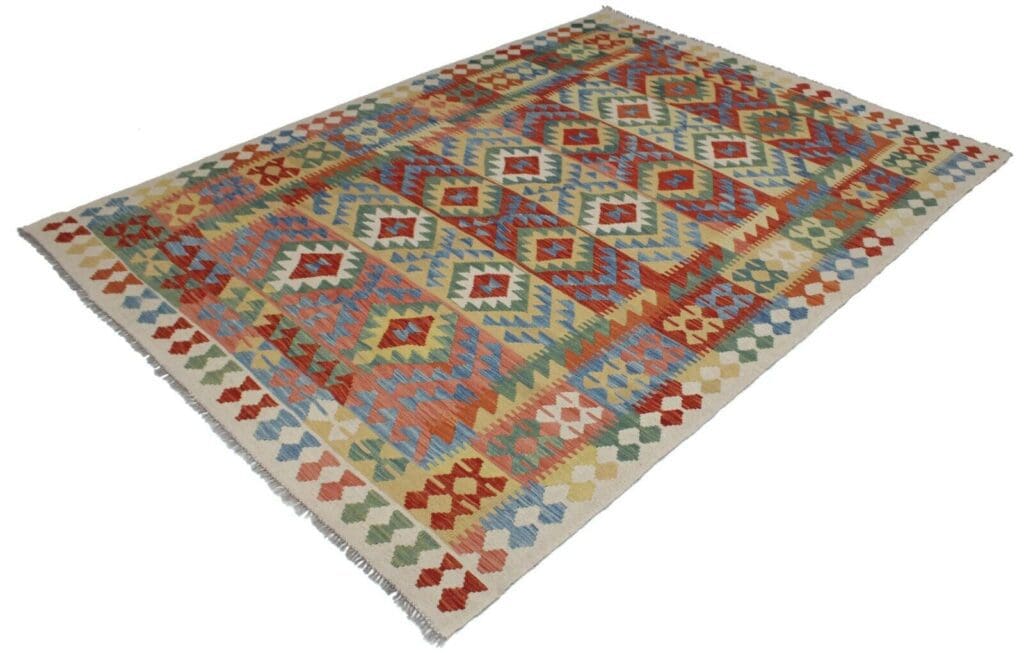
The pattern of this Kelim is geometric. Geometric rug designs are built from forms such as lines, angles, diamonds, rectangles, stepped edges, and repeated outlines. They do not depend on a naturalistic depiction of plants, animals, or landscapes. Instead, their visual order comes from repetition, balance, interruption, and the relationship between areas of different scale. A flat-woven surface provides a direct setting for this kind of structured composition.
In a hand-woven Kelim, the design is made as part of the textile rather than applied afterward. Coloured weft threads work with the warp to create the visible arrangement. Slight shifts in tension or in the sequence of weaving can give a contour a stepped or assembled appearance. This is part of the logic of handmade weaving. The geometric character is consequently expressed through the meeting of threads and fields, not through a printed or separately attached decoration.
Geometric compositions may be arranged around a central field, divided into repeated compartments, or framed by borders. Straight and stepped lines can separate areas, while repeated shapes can establish a sense of rhythm across the rug. The description of this piece does not specify which of these arrangements is present. It confirms the geometric category, but it does not name a border sequence, a central medallion, a colour palette, or an individual motif.
The rhythm of a geometric Kelim often determines how the eye moves across its surface. Repeated elements can create continuity, while larger areas can provide a pause within the arrangement. Horizontal and vertical directions may establish a clear framework, and angled forms can introduce movement without creating naturalistic depth. In a woven rug, these effects result from the structure of the textile and the order of the coloured sections.
This rug is explicitly described as reversible. Its design is therefore tied to a woven surface that can be used from either side. Reversible use should not be read as evidence of a second, different pattern. It is a practical description of how the flat-woven textile may be laid out. The geometric pattern remains the confirmed design category, while the particular shapes and colour relationships are not described in greater detail.
Geometric Afghan weaving traditions often use a simplified visual language. Forms can be mirrored, repeated, divided into compartments, or arranged in stepped sequences. Such methods allow a design to remain legible across a flat textile without relying on perspective or detailed modelling. This general background explains the character of geometric Kelims, but it does not establish a particular decorative scheme for this rug beyond the stated geometric pattern.
No individual colours or named design elements are supplied for this piece. It is therefore described accurately as a geometric Kelim without adding a boteh, medallion, floral, tribal, or other specific motif. This distinction matters because a general pattern category is not the same as an identified design. The confirmed features remain the Afghan origin, hand-woven construction, wool material, reversible use, and geometric classification.
Special Features
The specified features of this rug are its hand-woven Kelim technique, Afghan origin, 100% wool material, and geometric pattern. It is reversible and suitable for underfloor heating. Its condition is recorded as new without label. Together, these details describe a contemporary flat-woven Afghan textile without assigning an unlisted province, workshop, signature, or historical provenance.
Reversible use is a practical feature of a flat-woven Kelim. It provides flexibility when the textile is laid out and reflects the fact that the construction creates two usable faces. Suitability for underfloor heating is also expressly included in the product information. No further technical specifications are given, such as a backing, non-slip treatment, care system, or temperature limit, so those properties are not added.
The manufacturing period is listed as from 2020 onward. The rug is therefore placed within a contemporary production period rather than described as antique, old, or restored. The phrase new without label gives a condition statement but does not identify a production season, a particular maker, or a previous owner. No additional provenance is established for this individual rug.
As a one-off hand-woven textile, the rug brings together Afghan origin, wool construction, a flat Kelim surface, reversible use, and geometric design. Information about knot density, individual colours, repairs, signature, warp composition, or a named workshop is not provided. Those details are consequently left open rather than inferred.
FAQ
What is an Afghan Kelim?
An Afghan Kelim is a flat-woven rug from Afghanistan. Its surface is made by interlacing warp and weft threads rather than by inserting individual knots into a foundation to create a pile. This gives the textile a different construction from a traditional hand-knotted pile rug. Geometric forms can be built directly into the woven field through coloured sections, lines, and repeated contours. For this rug, the origin is Afghanistan, the technique is hand-woven Kelim, the material is 100% wool, and the pattern is geometric. The rug is also specifically described as reversible.
Can this rug be used over underfloor heating?
Yes. This rug is described as suitable for underfloor heating. The statement applies to this particular hand-woven Kelim and complements its other recorded features: Afghan origin, 100% wool, geometric pattern, and reversible use. For everyday installation, the heating system should be operated in line with the general requirements of the floor and heating system. The product information does not specify a backing, a non-slip coating, or a maximum temperature. Those additional technical characteristics therefore cannot be attributed to the rug.
What does new without label mean?
New without label means that the rug is offered in new condition, while no label is present. It is not described as used, antique, aged, or restored. Together with the stated manufacturing period from 2020 onward, this places it within contemporary production. The condition statement does not provide information about a particular workshop, a signature, prior use, or cleaning. The documented features remain the Afghan origin, hand-woven Kelim technique, 100% wool material, geometric pattern, and reversible construction.
To provide the best experiences, we use technologies like cookies to store and/or access device information. Consenting to these technologies will allow us to process data such as browsing behavior or unique IDs on this site. Not consenting or withdrawing consent, may adversely affect certain features and functions.
Functional Always active
The technical storage or access is strictly necessary for the legitimate purpose of enabling the use of a specific service explicitly requested by the subscriber or user, or for the sole purpose of carrying out the transmission of a communication over an electronic communications network.
Preferences
The technical storage or access is necessary for the legitimate purpose of storing preferences that are not requested by the subscriber or user.
Statistics
The technical storage or access that is used exclusively for statistical purposes.The technical storage or access that is used exclusively for anonymous statistical purposes. Without a subpoena, voluntary compliance on the part of your Internet Service Provider, or additional records from a third party, information stored or retrieved for this purpose alone cannot usually be used to identify you.
Marketing
The technical storage or access is required to create user profiles to send advertising, or to track the user on a website or across several websites for similar marketing purposes.
 SECURE PAYMENT
 SHIPPING PARTNERS


