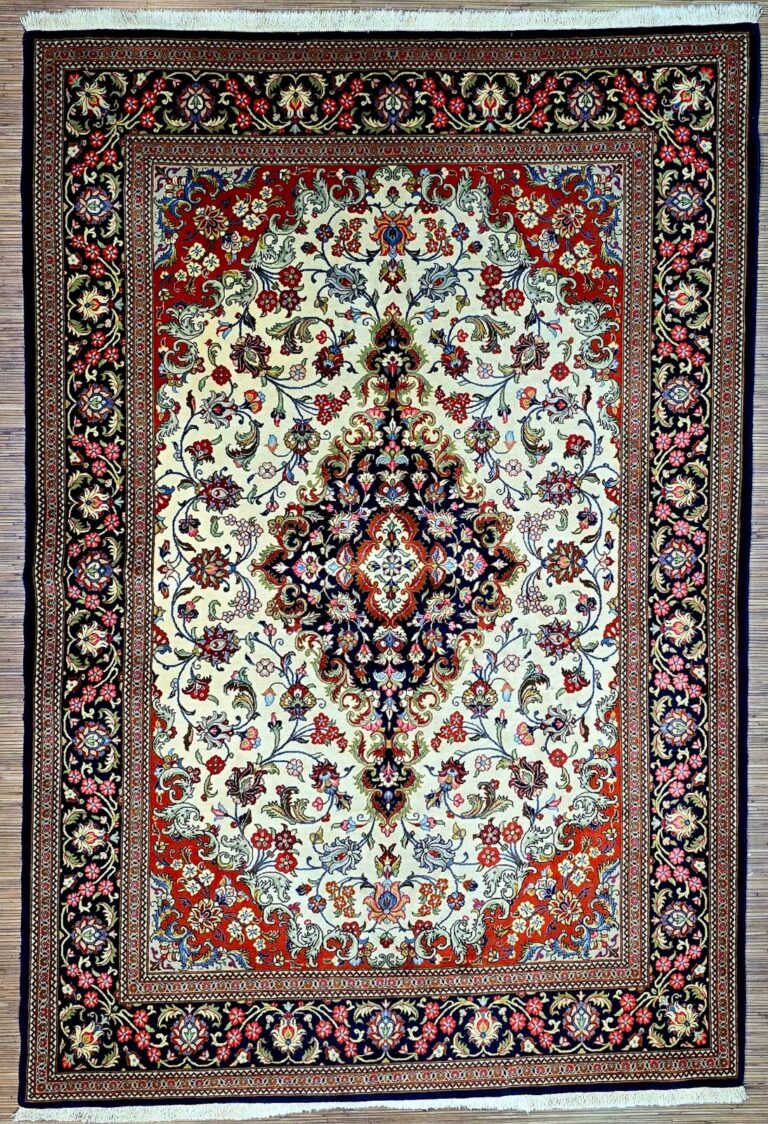
This Turkman Persian rug is hand-knotted and has a pile made of high-quality wool. In a hand-knotted rug, individual knots are worked by hand into the foundation, so the visible textile surface is built gradually through many separate steps. The wool forms the pile that carries the pattern and brings the stated red, violet and brown colours into the design.
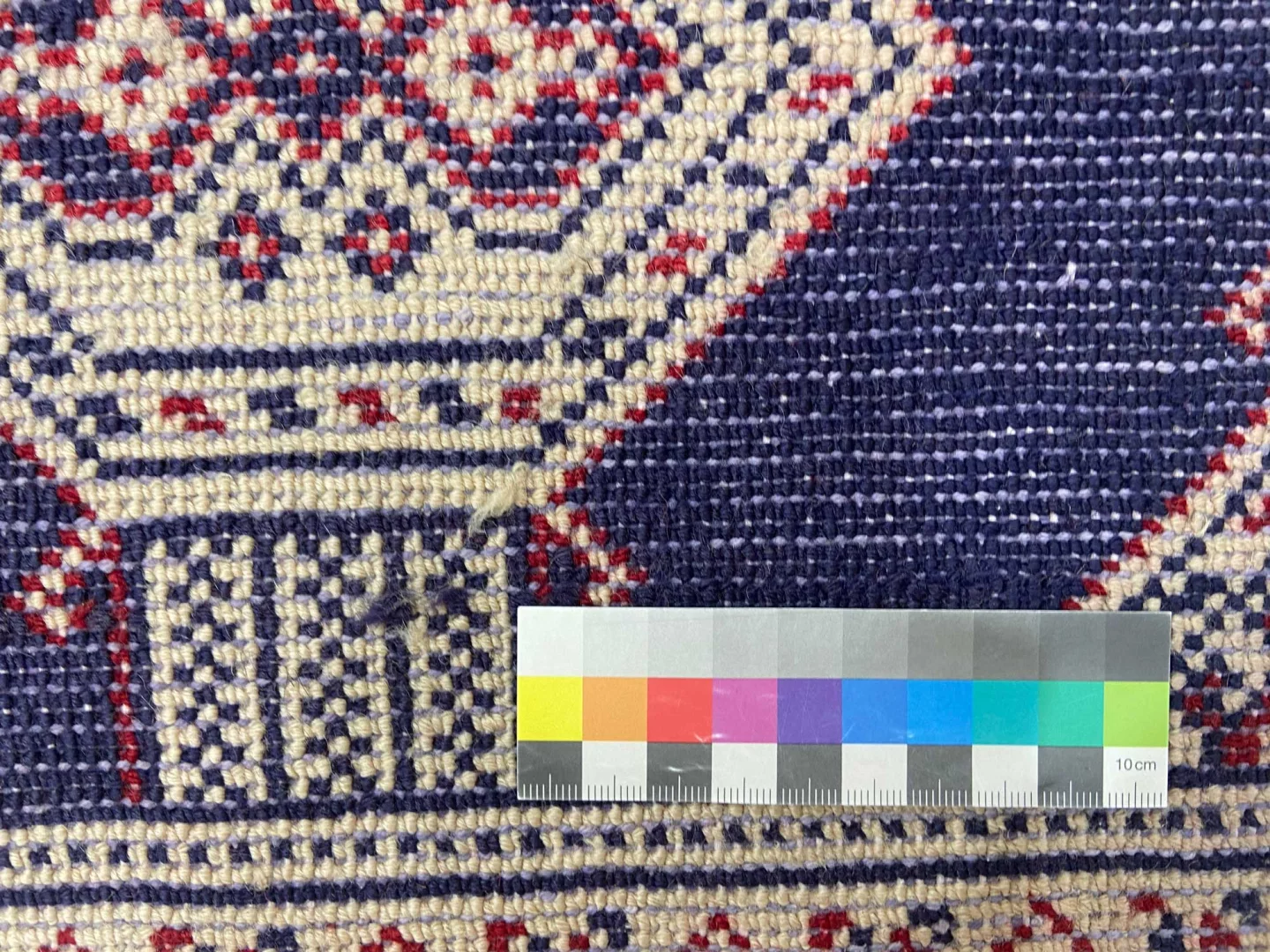
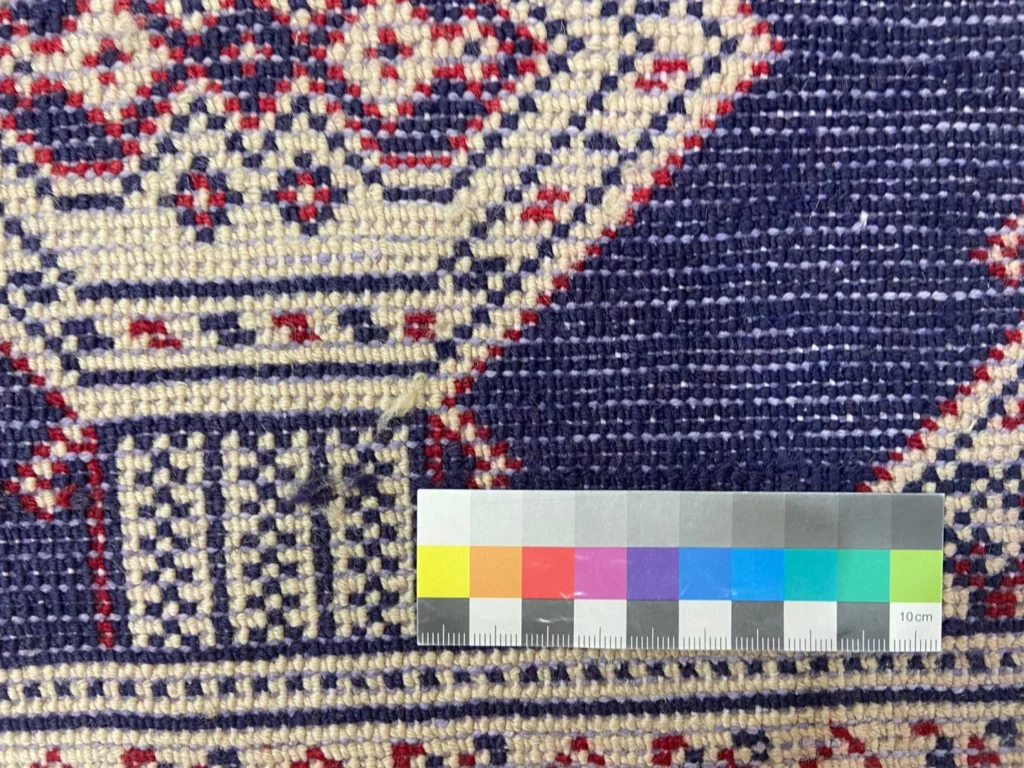
The knot density is approximately 200,000 knots per square metre. Knot density records how many knots are present within a defined area and provides an important technical description of a hand-knotted rug. It is considered together with the wool, the construction and the pattern when the character of a rug is assessed. Here, the dense structure supports the differentiated outlines and repeated ornamentation of the Göl motifs.
Wool is used for rug piles because it is durable and sufficiently workable for detailed hand construction. It is the explicitly stated pile material of this rug. The pattern is formed through the placement of coloured wool knots rather than being printed onto the finished surface. Each knot is therefore part of the making process and contributes to the individual appearance of this one-off piece. The hand-knotted technique also connects the material directly with the regional design tradition.
Origin and Tradition
This rug comes from northern Persia and is identified as a Turkman Persian rug. Turkman rugs are traditionally associated with the mountains of northern Persia, close to the border with Turkmenistan. The region represents a meeting point between Persian rug-making traditions and forms associated with Turkmen culture. Its designation therefore describes both a geographical setting and a recognisable textile heritage.
Rug weaving in northern Persia developed in a range of local settings. Wool was a practical material for weavers because it could be used to create a resilient pile and was suited to hand production. A hand-knotted rug is made slowly, with the design built knot by knot while colour sequences, ornament groups and surrounding areas are coordinated. This method explains why regional rugs combine practical textile use with a carefully structured decorative language.
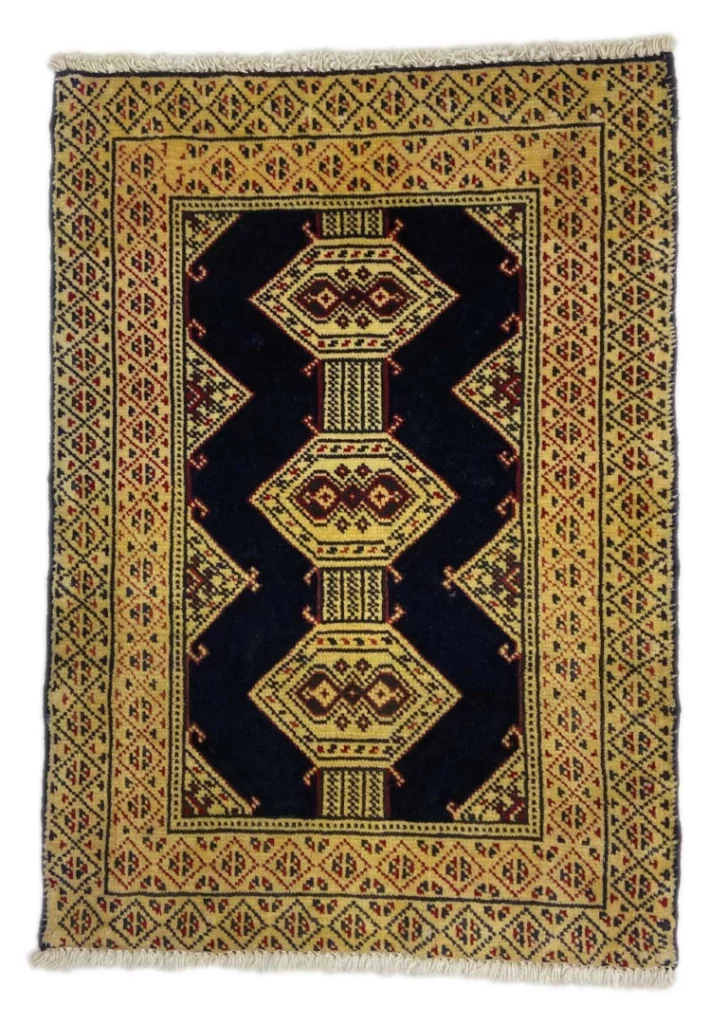
Turkman rugs are particularly associated with Göl motifs. The term Göl refers to a distinctive ornament, generally structured in a geometric manner, which can appear as a repeated emblem within a rug design. Göl forms may be arranged in rows, placed as individual medallions or connected into a broader pattern system. Their visual character comes from repetition, symmetry and the relationship between ornament, ground and colour. In the cultural history of Turkmen communities, such motifs are connected with inherited signs and with the life of nomadic groups.
The tradition can also be understood by comparing it with other Persian rug types. Heriz and Bidjar rugs from the wider region are likewise known for robust materials and pronounced patterns, but their local drawing and construction represent different traditions. Isfahan and Kashan rugs are often associated with finer, more highly detailed or floral designs. These names describe separate rug-making centres and should not be confused with the northern Persian origin of this Turkman rug.
Regional rugs from northern Persia often reflect the relationship between daily life, the natural environment and inherited forms. In Turkman designs, this connection is especially visible through recurring Göl ornaments. The patterns are therefore more than random decoration: they belong to a regional visual vocabulary. At the same time, each hand-knotted rug is an individual interpretation, since the placement of motifs, distribution of colour and execution by hand can vary from one piece to another.
Design and Pattern
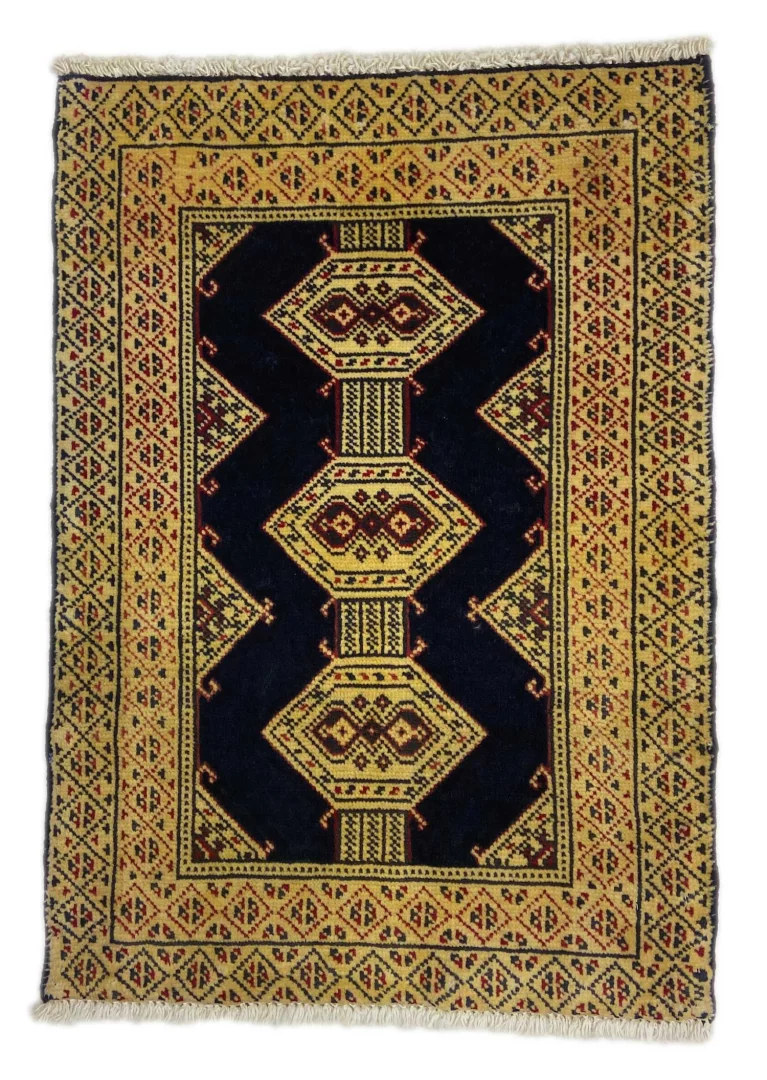
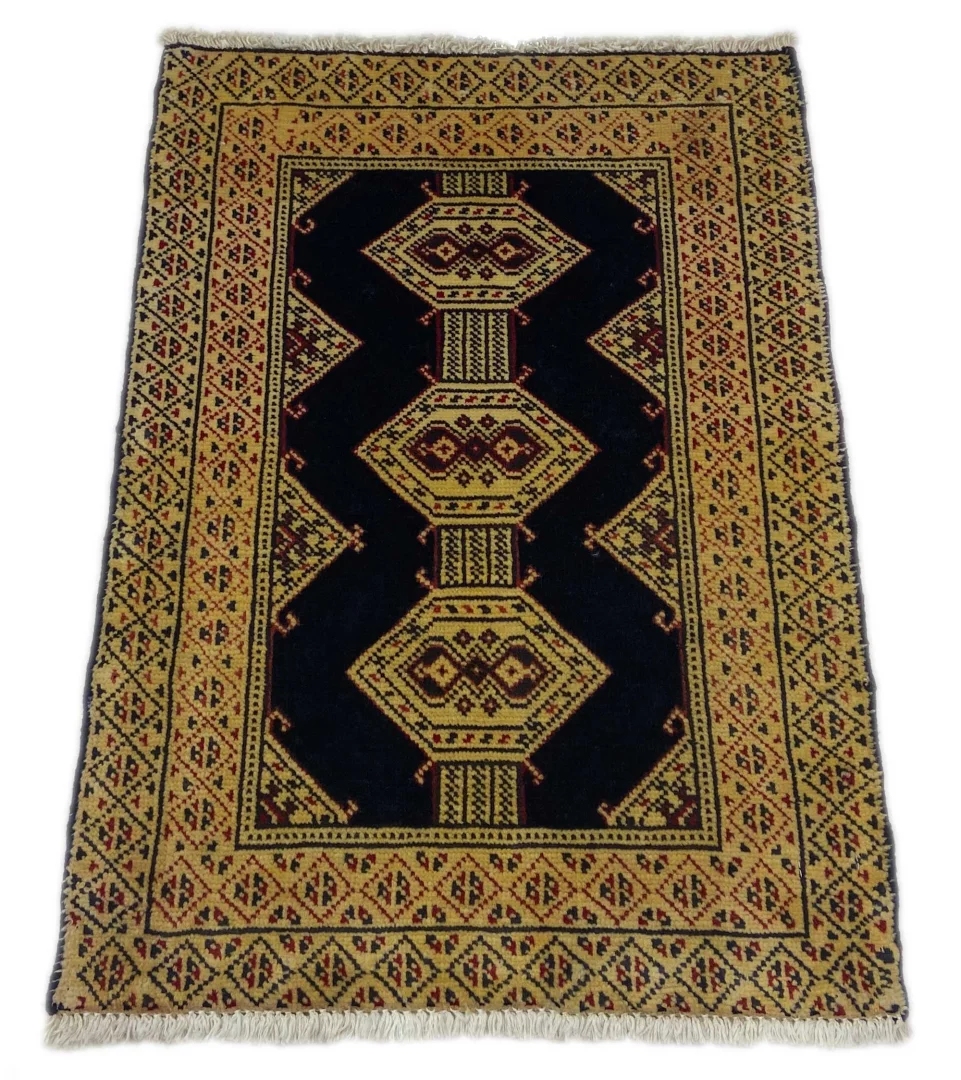
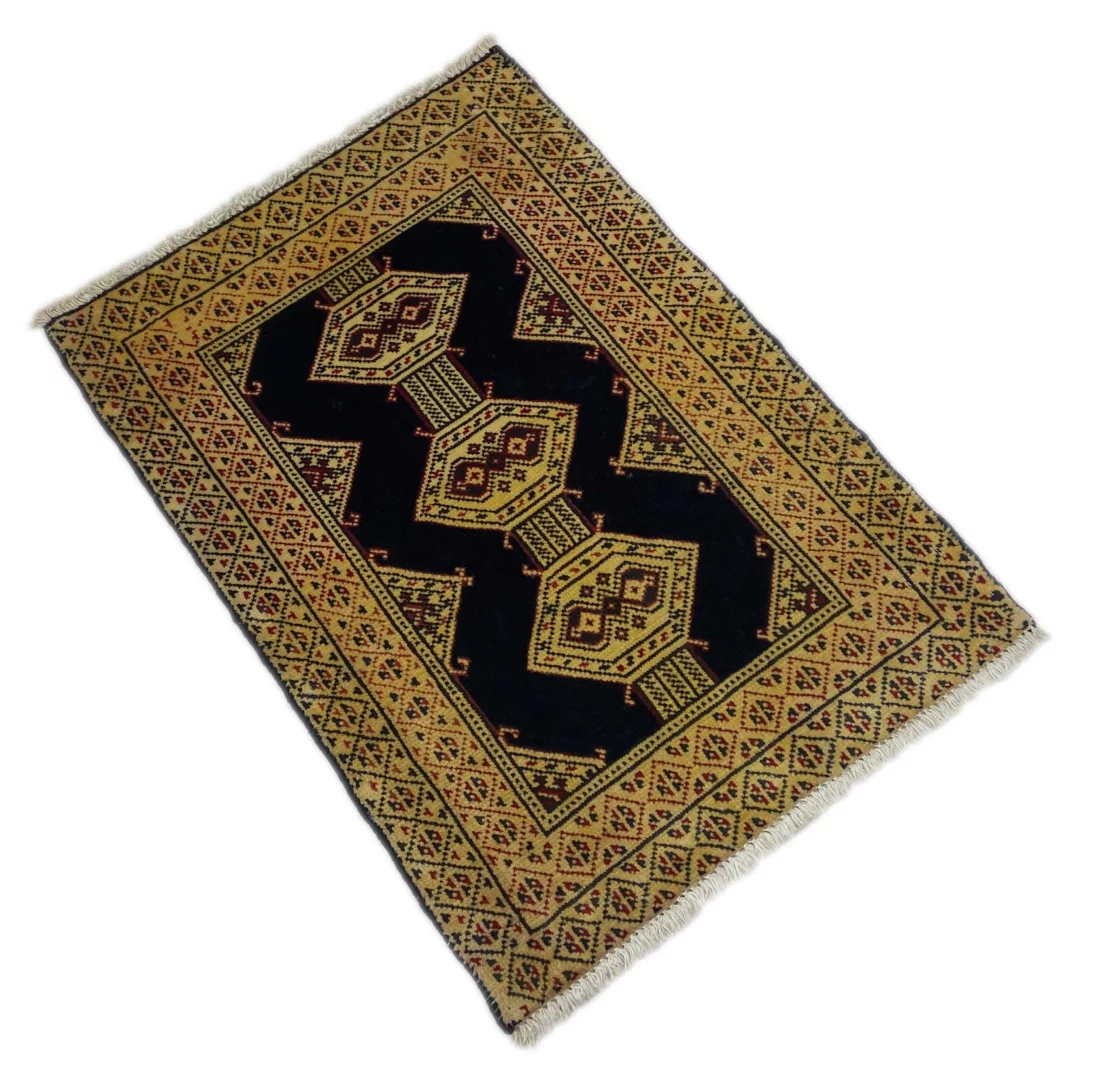
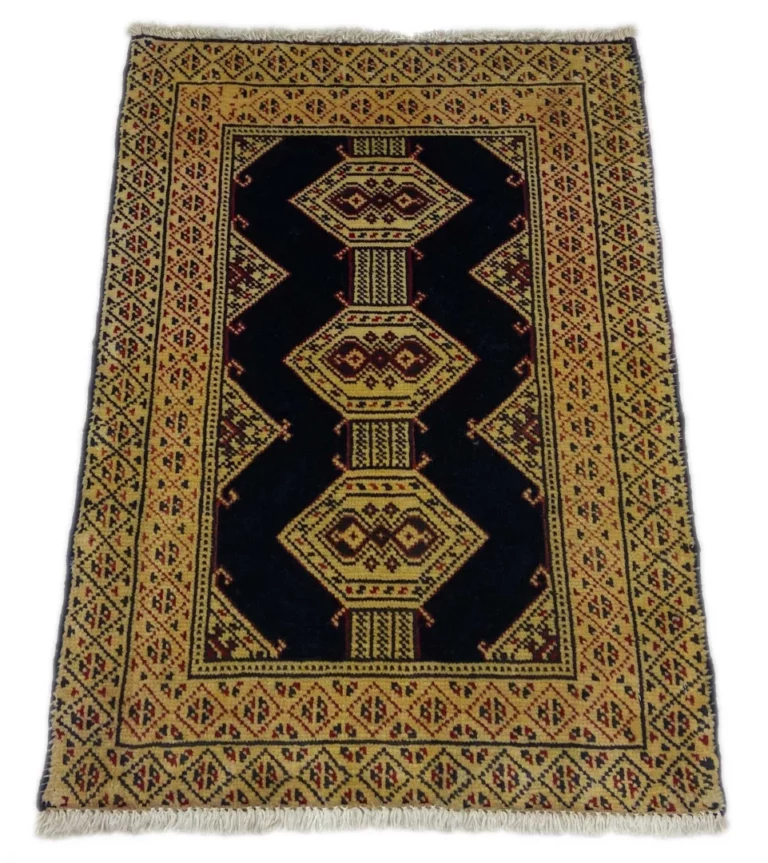
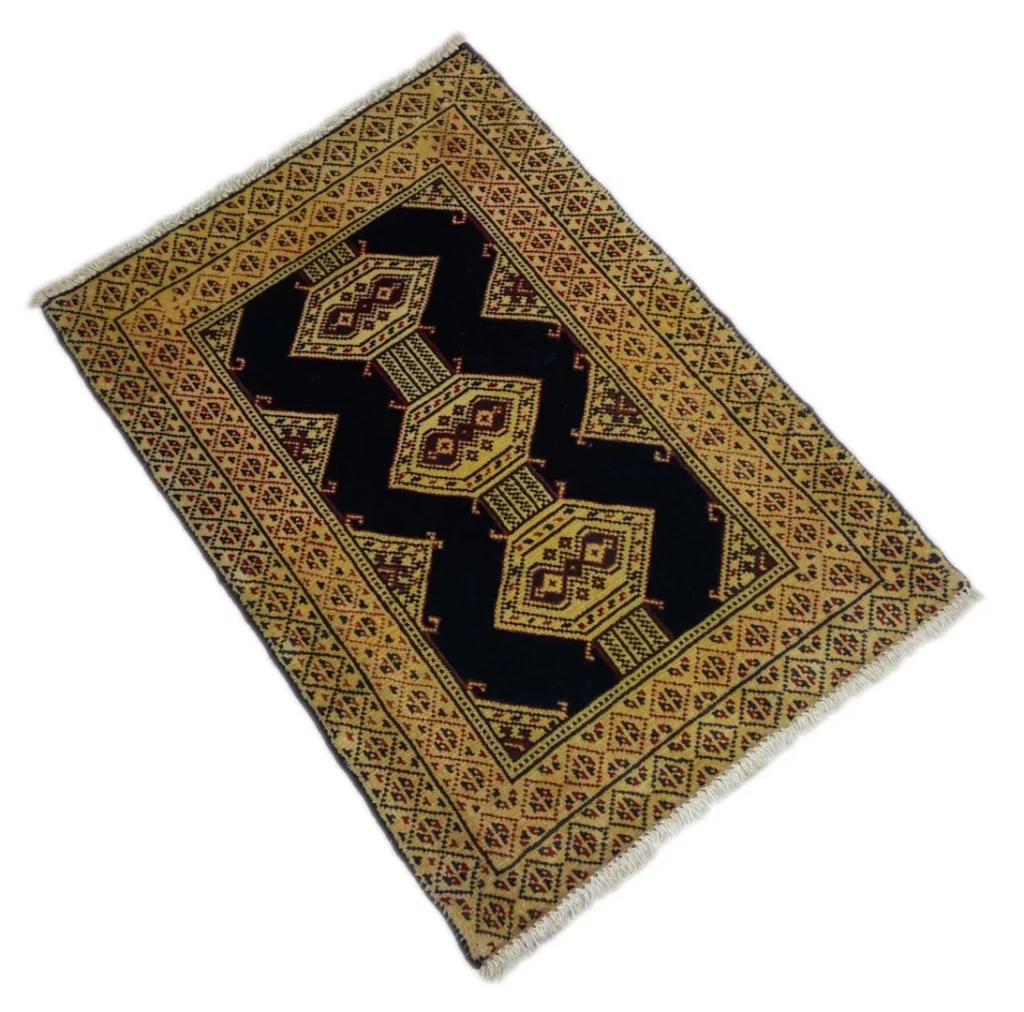
The design of this rug is defined by varied Göl motifs. This means that recognisable ornamental forms provide the main structure of the composition. Göl motifs may be drawn as clearly segmented geometric units, repeated medallions or linked shapes. Their defining feature is the recurrence of a particular sign within an organised field. The precise arrangement differs from rug to rug, while the present piece is described specifically through the variety of its Göl ornamentation.
The colour palette consists of red, violet and brown. Red may serve as a dominant ground or ornament colour in Persian and Turkmen rug design. Violet introduces a contrasting accent, while brown gives the composition an earthy register. In a hand-knotted rug, these colours are not applied as uniform printed areas. They are created through individual wool knots, and the resulting appearance can change subtly with the direction of the pile and the available light.
Geometric Göl forms differ from strictly naturalistic depictions of flowers, landscapes or figures. They reduce a motif to organised lines, fields and repeated contours. This abstraction keeps the design legible while allowing smaller ornaments to be integrated into a larger system. In Turkman rugs, these forms can reflect the region’s cultural inheritance and the influence of Turkmen nomadic life. The result is both decorative and connected to a specific tradition of visual expression.
A pattern is shaped not only by separate motifs but also by the space and rhythm between them. Repetition creates continuity across the rug, while changes in colour can distinguish one Göl from the next or bring selected forms forward. A high knot density allows outlines and transitions to be worked with greater differentiation. Craft and design are consequently interdependent: the knotting carries the drawing, and the drawing gives direction to the handwork.
Turkman rugs are used in both traditionally furnished and more contemporary interiors because geometric ornament can be placed in different settings. This is a general feature of the pattern tradition, not a claim about a particular room. Göl designs can act as a defined textile accent beside restrained furniture or be combined with a more traditional interior. The red, violet and brown palette gives this rug the colour character stated for the piece, while its northern Persian origin places the design within the Turkman tradition.
Special Features
The defining features of this rug are its hand-knotted construction, wool pile, approximate knot density of 200,000 knots per square metre and varied Göl motifs. Together, these details describe its material, technique and visual language. The red, violet and brown palette completes the stated design information. Its origin in northern Persia places the rug within the regional Turkman tradition.
A hand-knotted rug is distinguished by the many individual operations required to build its surface. In this piece, the particular combination of dense knotting, high-quality wool and regionally recognisable ornament forms its principal character. The Göl motifs provide the cultural and stylistic reference, while the colour selection structures the visual impression. No information is provided for this rug about a signature, an age or an individual condition, so none of those details is added here.
FAQ
How should I care for a Turkman Persian rug?
A Turkman Persian rug should be vacuumed regularly and gently so that dust and loose particles do not remain in the wool pile. Cleaning should take account of the hand-knotted construction and the material. If more extensive cleaning is needed, professional rug cleaning is appropriate because the wool, colours and knot structure can then be treated correctly. Direct, strong sunlight should be avoided to help limit fading of the red, violet and brown colours. Careful use and avoiding unnecessary moisture support the long-term maintenance of the pile.
Where do the patterns on Turkman rugs come from?
The patterns come from the rich cultural tradition of northern Persia and are connected with forms associated with Turkmen culture and the life of nomadic communities. Göl motifs are especially characteristic. They are recurring ornamental signs, often arranged in a geometric and ordered composition. Göl designs can be understood as inherited cultural symbols, although their precise drawing may vary according to the individual rug and weaver. On this rug, varied Göl motifs together with red, violet and brown define the stated pattern and colour scheme.
What distinguishes Turkman rugs from other Persian rugs?
Turkman rugs are distinguished by their characteristic Göl motifs, their particular colour combinations and, in this piece, the stated knot density. The feel of a rug is also influenced by its material, knotting and workmanship. By comparison, Isfahan and Kashan rugs are often described as finer and more highly detailed, while Heriz and Bidjar rugs are known for robust materials and pronounced designs. These comparisons refer to the respective traditions. This rug is defined by its northern Persian origin, wool pile, hand-knotted construction and Turkman ornament.
To provide the best experiences, we use technologies like cookies to store and/or access device information. Consenting to these technologies will allow us to process data such as browsing behavior or unique IDs on this site. Not consenting or withdrawing consent, may adversely affect certain features and functions.
Functional Always active
The technical storage or access is strictly necessary for the legitimate purpose of enabling the use of a specific service explicitly requested by the subscriber or user, or for the sole purpose of carrying out the transmission of a communication over an electronic communications network.
Preferences
The technical storage or access is necessary for the legitimate purpose of storing preferences that are not requested by the subscriber or user.
Statistics
The technical storage or access that is used exclusively for statistical purposes.The technical storage or access that is used exclusively for anonymous statistical purposes. Without a subpoena, voluntary compliance on the part of your Internet Service Provider, or additional records from a third party, information stored or retrieved for this purpose alone cannot usually be used to identify you.
Marketing
The technical storage or access is required to create user profiles to send advertising, or to track the user on a website or across several websites for similar marketing purposes.
 SECURE PAYMENT
 SHIPPING PARTNERS