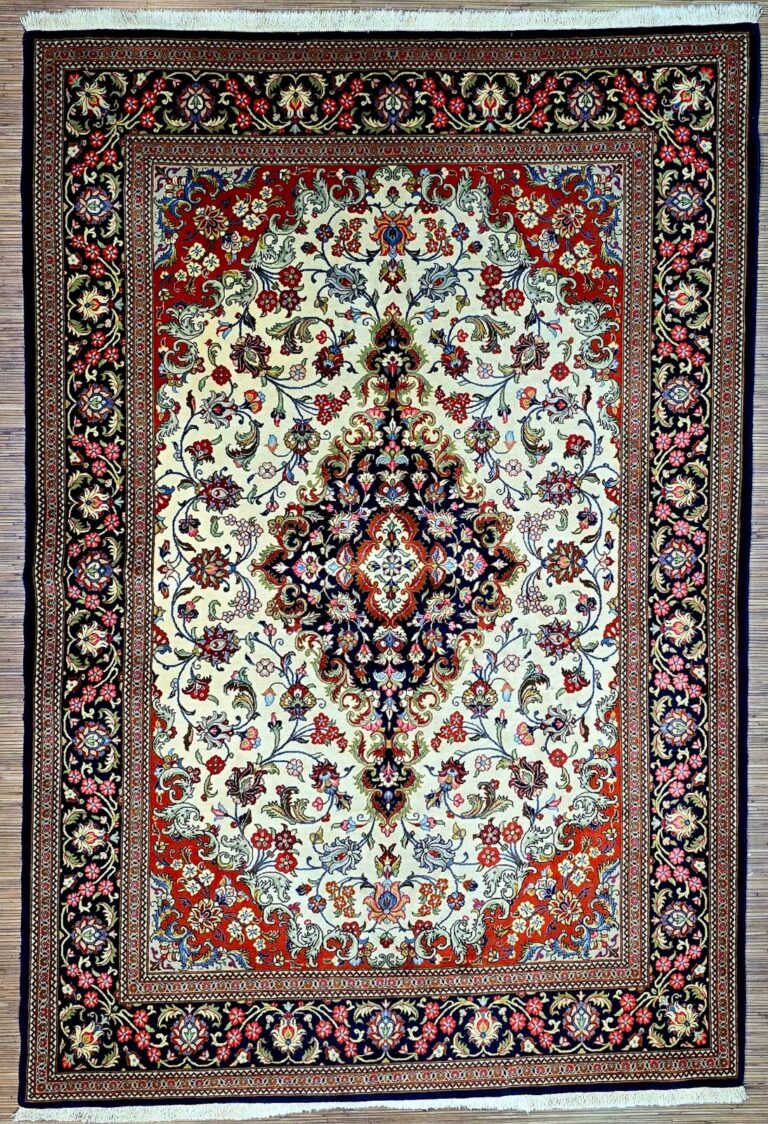
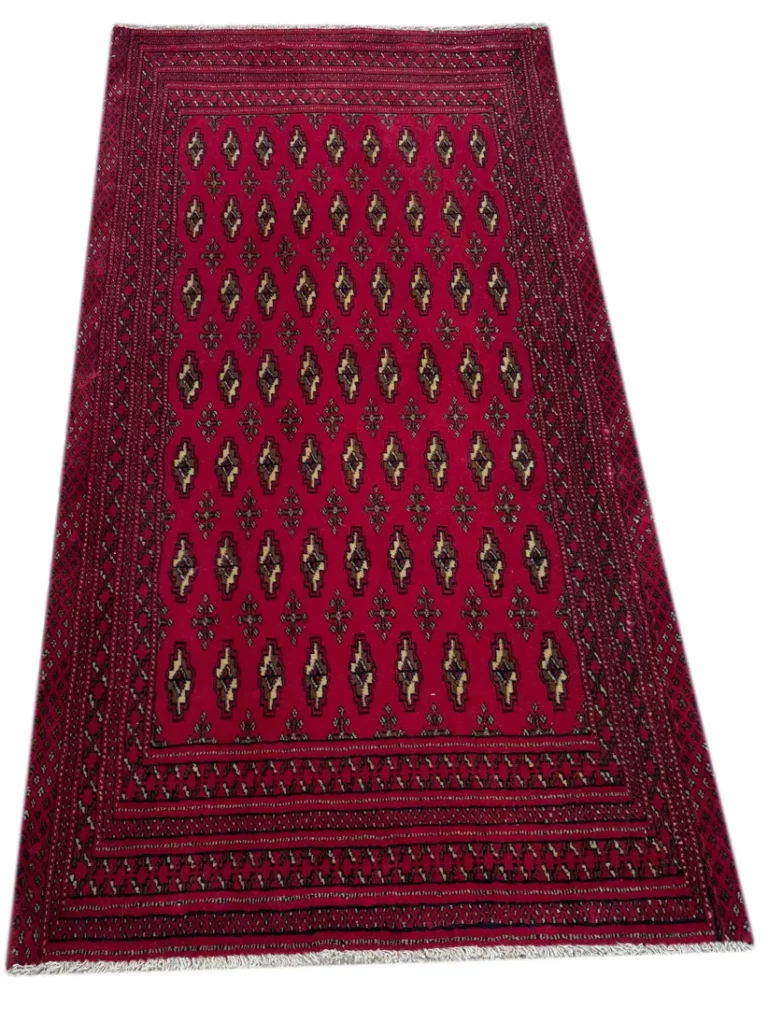
This Turkman Persian rug is hand-knotted and made from high-quality wool. Hand-knotting is one of the defining features of this type of rug: individual knots are worked into the foundation one by one, allowing the design to develop gradually across the surface. Unlike a mechanically produced floor covering, its structure comes from a traditional textile process in which pattern and colour placement are built directly into the weave.
The high-quality wool gives the rug a soft, pleasant handle. Wool is also valued in Turkman rugs for its durability and long service life. The material therefore combines a comfortable surface with practical suitability for living spaces. It takes up colour clearly and supports the visual relationship between the red, violet and brown areas described for this rug.
This rug has a knot density of 200,000 knots per square metre. A dense knot structure allows small ornaments to be rendered with greater differentiation and helps keep the pattern legible. In a hand-knotted rug, the final appearance depends not only on knot density but also on the regularity of the work, the choice of wool and the careful distribution of colour.
The term hand-knotted also describes the character of the surface. Each row is built during the making process, while the Göl elements and their surrounding details are incorporated into the larger composition. The result joins a wool surface with a labour-intensive technique in which the ornament is created through repeated, deliberate work rather than applied afterwards.
Origin and Tradition
This Turkman Persian rug comes from Northern Persia, near the border with Turkmenistan. The area belongs to a cultural landscape in which Persian and Turkmen textile traditions have influenced one another over time. Rugs from this setting combine Persian knotting practices with a distinctive ornamental vocabulary, particularly the repeated medallion forms associated with Göl designs.
Northern Persia includes varied landscapes and historic routes of exchange. Wool preparation, dyeing practices, knotting methods and patterns were passed on within the region and adapted to local working traditions. The designation Turkman therefore points to a particular design and craft tradition within the broader production of Northern Persia. Origin and pattern should be kept separate: Northern Persia identifies the regional context of this rug, while its Göl motifs identify its decorative language.
Hand-knotted rug making has long been connected with both domestic and professional textile work in Persia. A design is not printed onto a finished surface. Instead, the drawing is formed through successive knots, rows and coloured areas. Small variations can occur in this process without disturbing the overall order of the composition. A high knot density supports the precise rendering of the ornament, while the hand-made method gives the surface its textile character.
Turkman rugs are known for designs built from numerous Göl or medallion forms. These forms may be arranged in rows, distributed across the field or linked by smaller ornaments and framing elements. In Northern Persian traditions, repeated signs are often organised so that a clear rhythm extends over the whole surface. The pattern can therefore remain ordered without relying on one single central image.
Persian rug production includes many regional expressions. Kerman, for example, is associated with delicate floral designs and lively colours, while Isfahan is often recognised for elaborate medallions and complex compositions. Qom is associated with silk rugs and highly detailed patterns. Sarough, in turn, is known for durable and colourful rugs. These names provide points of comparison within Persian rug history, but they are not the origin of this Turkman rug.
The history of Northern Persian rugs is also connected with practical use in the home. Rugs were made to furnish living spaces and had to provide a durable surface as well as an expressive design. The combination of wool, handwork and repeated ornament helps explain why Turkman patterns can be used in both traditional and contemporary interiors. This rug belongs to that Northern Persian tradition of textile craftsmanship.
Design and Pattern
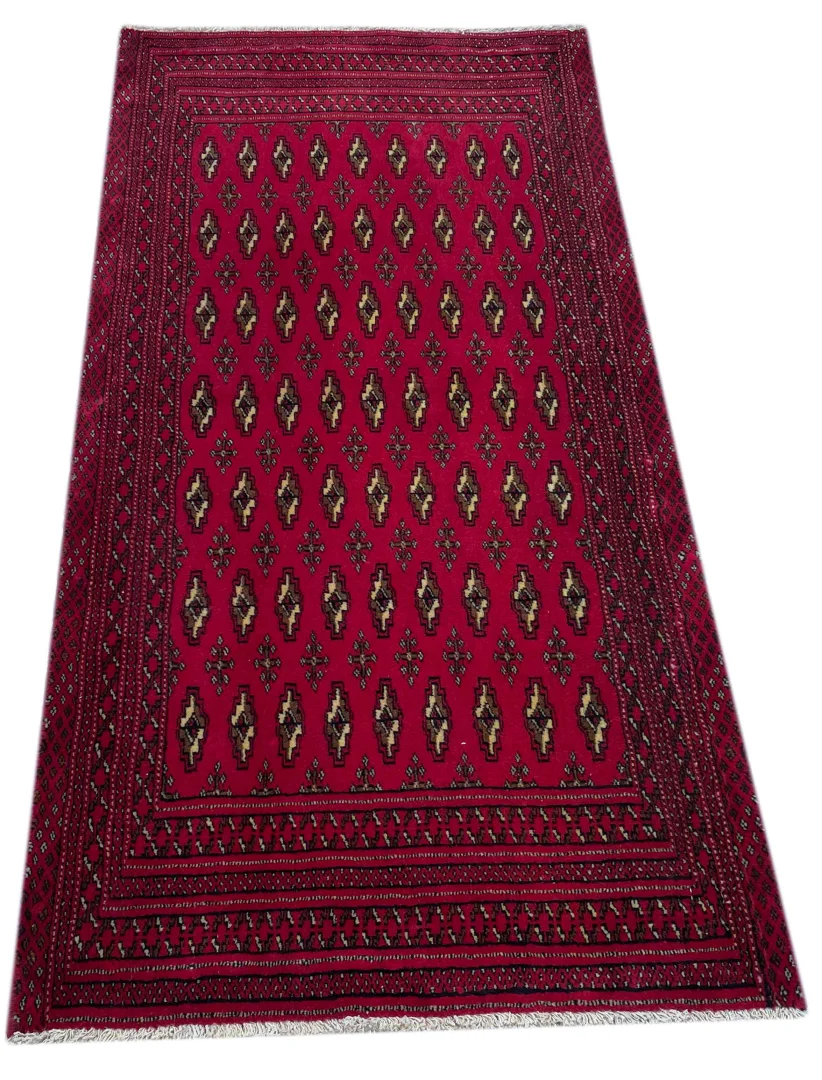
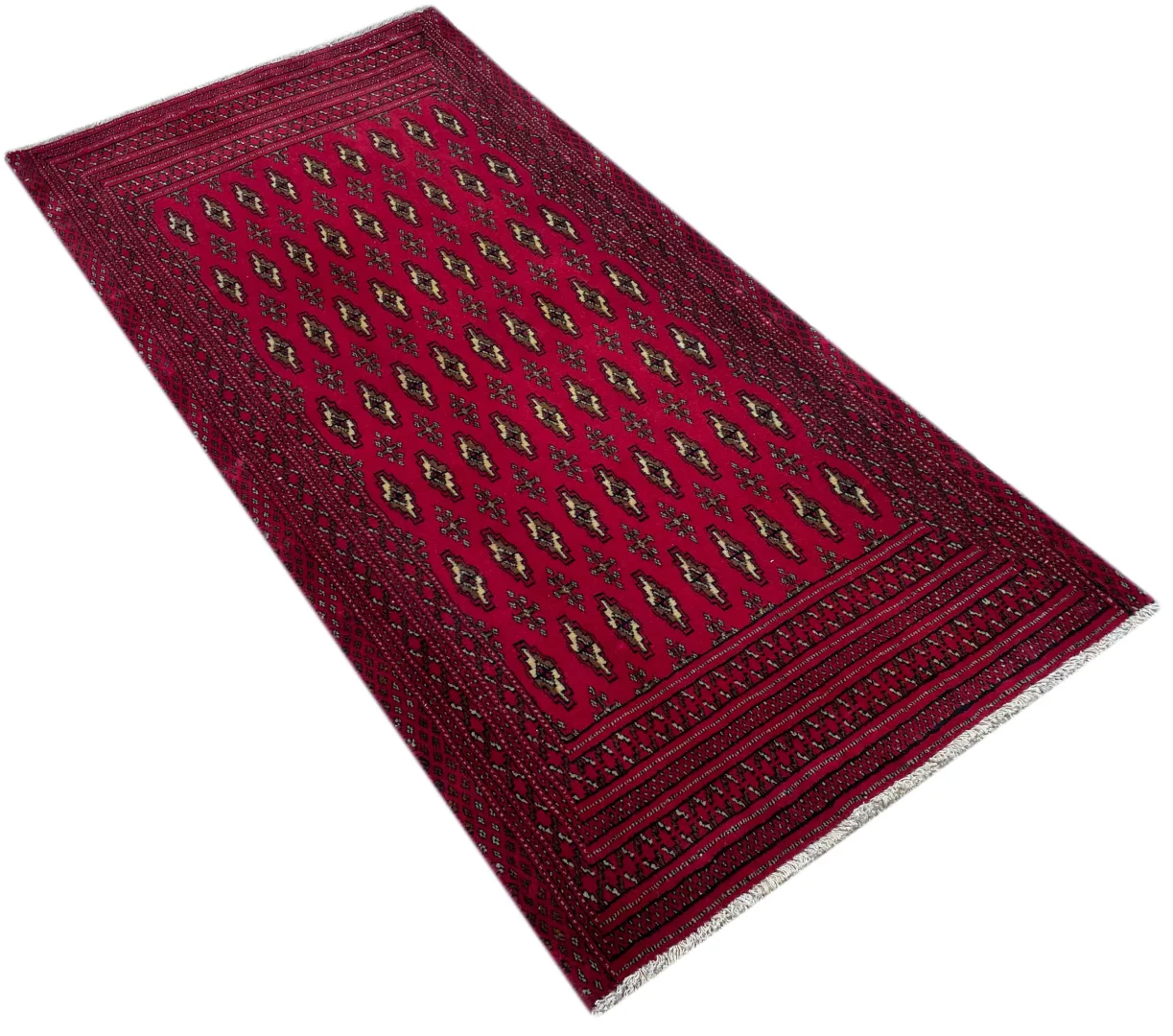
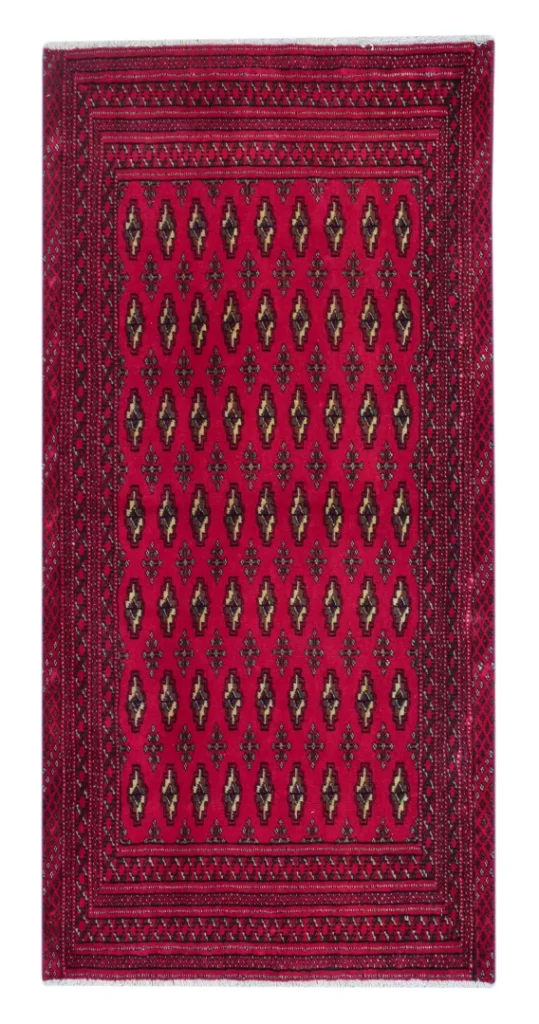
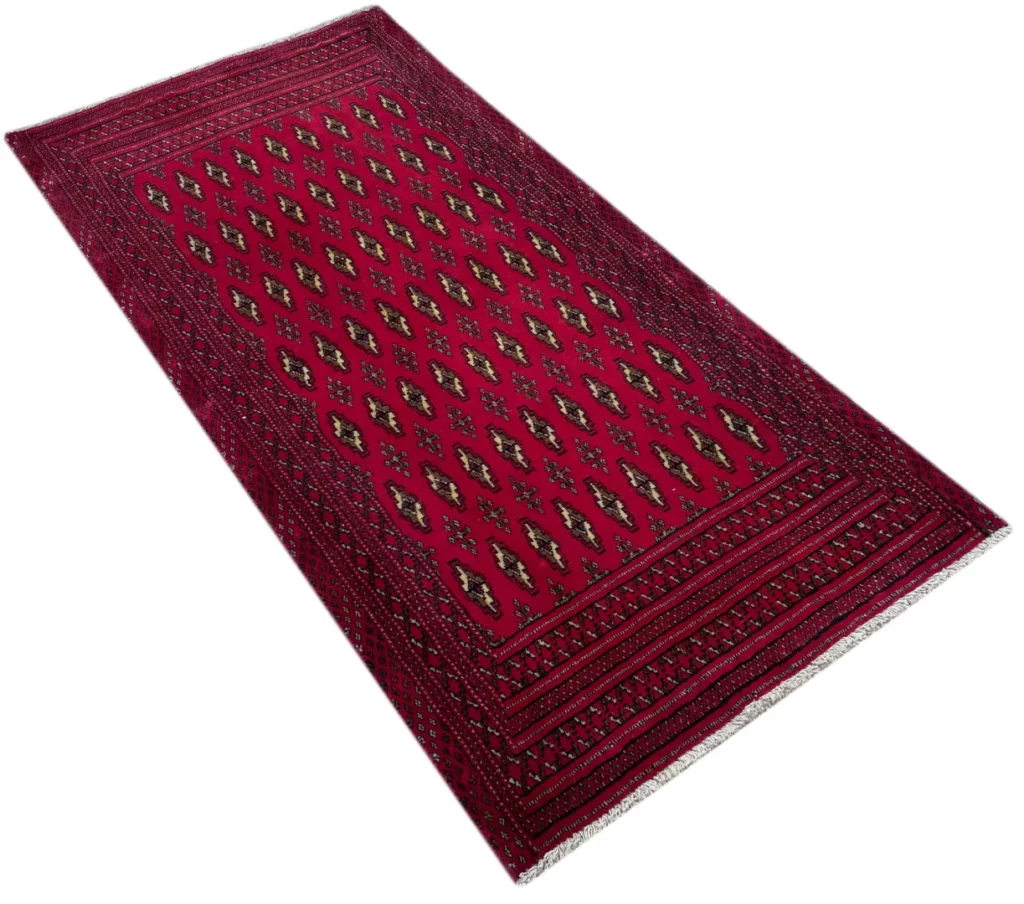
The pattern of this rug consists of varied Göl designs. In rug terminology, a Göl is generally a geometric or stylised medallion. In Turkman-influenced designs, such forms often appear repeatedly, creating a structured field rather than a single isolated emblem. The medallions may stand apart or be connected visually by smaller marks, lines and borders.
The composition is organised around a sequence of recurring motifs rather than one dominant focal point. The eye moves from one Göl element to the next and recognises the shared vocabulary of their shapes. This serial arrangement is a characteristic principle in many Turkmen-influenced patterns. Individual medallions may be compact, elongated, polygonal or more strongly stylised; the design of this rug is described as varied in its use of Göl forms.
Red, violet and brown dominate the colour scheme. Red gives the field a strong and warm foundation. Violet introduces a distinct contrasting note, while brown provides an earthy link between the ornaments. Together, these colours make the Göl elements read as parts of one composition while retaining the identity of the individual motifs.
Colour performs several functions in rug design. It separates motif from ground, establishes rhythm and gives weight to different sections of the pattern. In a Göl composition, related tones can recur in several areas, creating visual continuity across the field. Contrast keeps the medallions readable, while earthy shades help balance the overall surface.
The pattern tradition of Turkmen-influenced rugs is associated with clear repetition and strong ornamental order. Geometric shapes are often arranged so that they remain recognisable across a broad field. At the same time, smaller internal motifs and border details can distinguish one repeated Göl from another. The character of these designs comes from the relationship between regular structure and close attention to detail.
A Göl-patterned rug can therefore be placed in different kinds of interiors. In a traditional setting it can echo existing ornament. In a more contemporary room, the repeated geometry can provide a structured textile accent. This is a general description of the pattern tradition, not an additional claim about this individual rug. Its stated colours and varied Göl designs remain the defining details of its decoration.
Special Features
The notable features of this rug are its hand-knotted construction, high-quality wool and knot density of 200,000 knots per square metre. Its Northern Persian origin and varied Göl designs are further defining points. Red, violet and brown give the design a colour character that is warm, earthy and clearly marked.
The combination of traditional knotting, a wool surface and repeated medallions brings together a recognisable regional vocabulary and a carefully made textile object. The rug can serve as a focal point in a living room, a decorative element in a hallway or a textile foundation in a bedroom. These uses reflect the versatility described in the source text.
FAQ
How should I care for my Turkman Persian rug?
Regular vacuuming is recommended for routine care. Spills and dirt should be removed promptly so that they do not remain in the wool surface. If more extensive cleaning is needed, professional rug cleaning can be considered. Gentle, consistent care supports the long service life of the high-quality wool and helps preserve the clarity of the Göl pattern.
How can I tell whether my Persian rug is authentic?
Knotting technique, materials and certificates of origin are important points when assessing authenticity. A genuine Turkman rug is hand-knotted and made from high-quality wool. Northern Persian origin and the characteristic use of Göl designs also form part of its classification. Examining the knots carefully and checking the material information can help make the description of the rug easier to evaluate.
Are Turkman Persian rugs suitable for underfloor heating?
Turkman Persian rugs are suitable for underfloor heating because of their robust wool. The material provides comfortable underfoot use and is resistant to changes in temperature. The rug should still be laid correctly, and an unsuitable underlay should not obstruct the heat from the heating system. Its wool surface thus combines textile comfort with the durability described in the source text.
To provide the best experiences, we use technologies like cookies to store and/or access device information. Consenting to these technologies will allow us to process data such as browsing behavior or unique IDs on this site. Not consenting or withdrawing consent, may adversely affect certain features and functions.
Functional Always active
The technical storage or access is strictly necessary for the legitimate purpose of enabling the use of a specific service explicitly requested by the subscriber or user, or for the sole purpose of carrying out the transmission of a communication over an electronic communications network.
Preferences
The technical storage or access is necessary for the legitimate purpose of storing preferences that are not requested by the subscriber or user.
Statistics
The technical storage or access that is used exclusively for statistical purposes.The technical storage or access that is used exclusively for anonymous statistical purposes. Without a subpoena, voluntary compliance on the part of your Internet Service Provider, or additional records from a third party, information stored or retrieved for this purpose alone cannot usually be used to identify you.
Marketing
The technical storage or access is required to create user profiles to send advertising, or to track the user on a website or across several websites for similar marketing purposes.

 SECURE PAYMENT
 SHIPPING PARTNERS