This Turkman Persian rug is made from high-quality wool and was hand-knotted. The wool combines a soft handle with a robust character. It is therefore suited to a rug intended for everyday use while retaining the distinctive feel of a wool surface. Wool has long been used in hand-knotted rugs because it offers resilience and a pleasant tactile quality. Its natural structure also receives colour with variation, helping the individual knotted elements remain legible.
The construction uses a large number of fine knots. A high knot density of approximately 200,000 knots per square metre allows the patterns to be worked with considerable detail. In a hand-knotted rug, each design element is built progressively by inserting individual knots. This differs from machine production because the surface is formed through a sequence of manual textile operations rather than by a mechanically repeated printed or woven image.
The wool is used for the pile and consequently determines much of the rug’s texture, appearance and practical character. The material is described as easy to care for while also being soft and hard-wearing. This combination allows the rug to be used in different living areas. Its hand-knotted construction and fine knot structure provide the technical basis for the detailed Göl motifs found across the design.
Origin and Tradition
The rug comes from northern Persia and belongs to the Turkman tradition. The northern Persian regions lie close to the border with Turkmenistan and have a long history of carpet weaving. Textile knowledge in these areas has been passed down through generations. A Turkman rug therefore combines the practical role of a floor covering with an established visual language shaped by regional weaving practice.
The name Turkman refers to a tradition in which geometric organisation, repeated ornamental forms and a distinctive colour effect play an important part. The designs are not distributed at random. They are assembled from individual shapes and their repetition, creating a rhythm across the woven field. This structure makes it possible to organise a larger surface clearly, while hand production leaves room for the fine variations associated with one-of-a-kind knotted rugs.
Northern Persia is home to several carpet traditions. Regional pieces differ according to origin, material, knotting method and the way their patterns are arranged. Turkman rugs form a distinct group within Persian carpet culture. Their design language is connected with the textile traditions of northern Iran and with cultural exchange in areas near the Turkmen border. Northern Persia is therefore an essential part of this rug’s classification.
The wider Persian carpet world also includes Kerman and Tabriz rugs. Kerman pieces are often associated with floral compositions and vivid colours, while Tabriz rugs frequently feature complex medallions and a broad range of colours and forms. Isfahan rugs are known for detailed workmanship and the use of silk. These are separate regional traditions and do not change the origin of this rug. This piece is a hand-knotted Turkman rug from northern Persia.
Names such as Haji Jalili or Persian Rugs are also mentioned in connection with high-quality carpets and the preservation of traditional knotting methods. Such names refer to further areas of carpet culture and do not establish a maker attribution for this individual rug. The importance of the Turkman tradition lies in the transmission of knowledge about wool, knots, colour and pattern structure. That combination of utility and inherited craft shapes the rug’s cultural context.
The regional tradition is also reflected in the balance between a durable wool material and a carefully organised surface design. The rug is not defined only by its origin, nor only by its colours. Its classification results from the combination of northern Persian provenance, Turkman pattern language and hand-knotting. This allows the rug to be understood within the history of Persian weaving without assigning it to another named province or workshop.
Design and Pattern
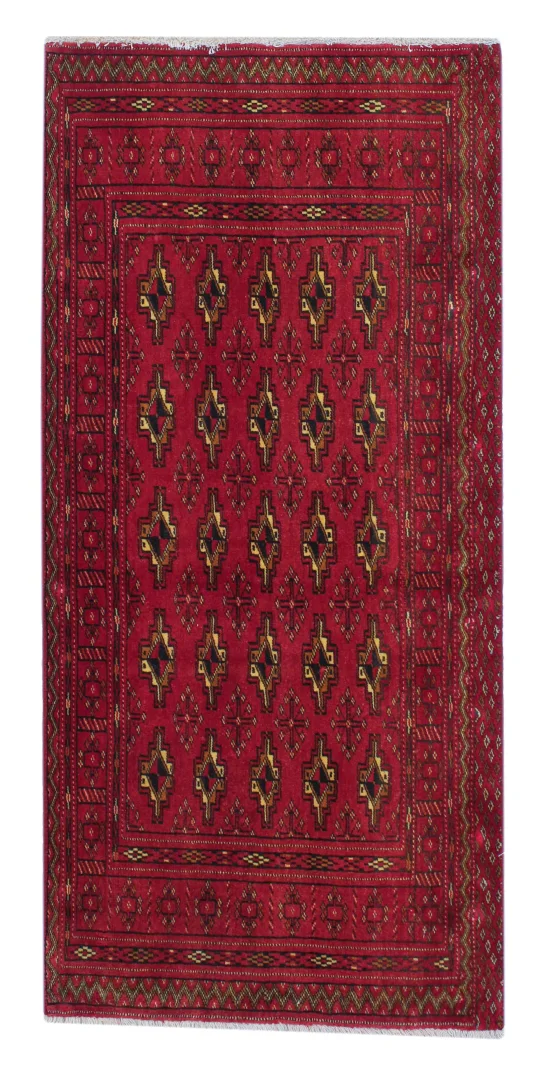
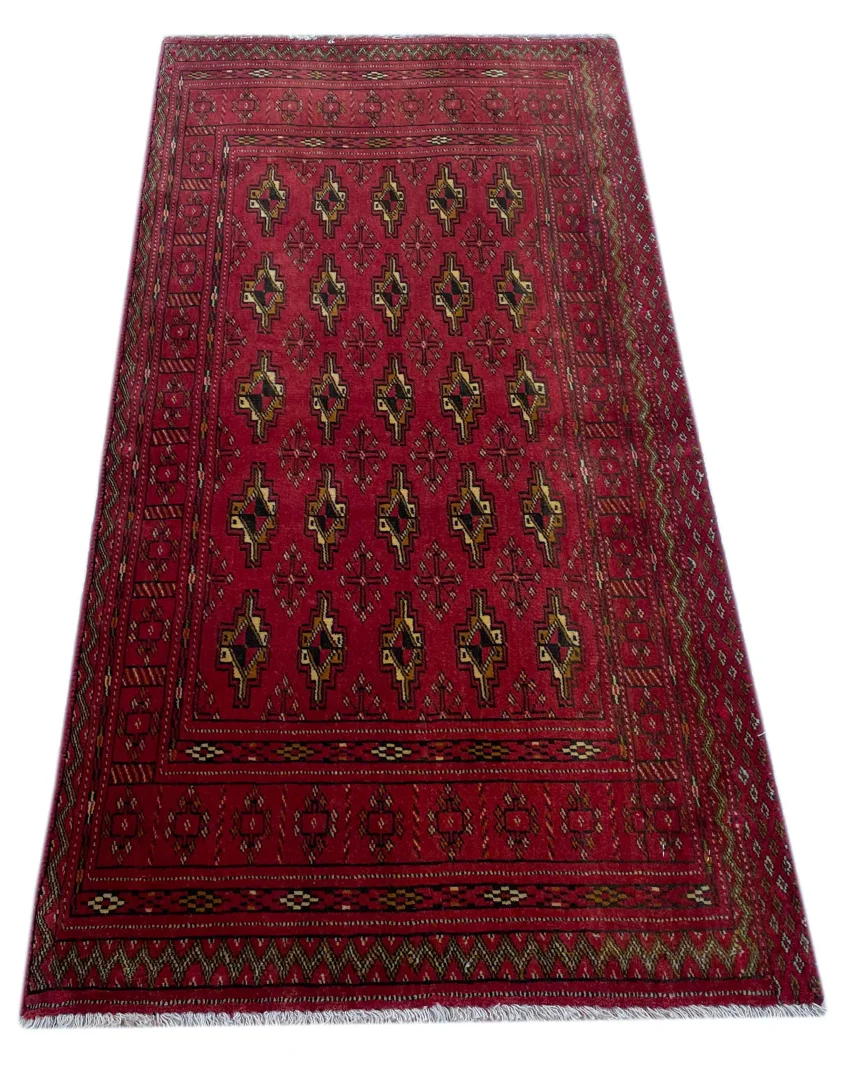
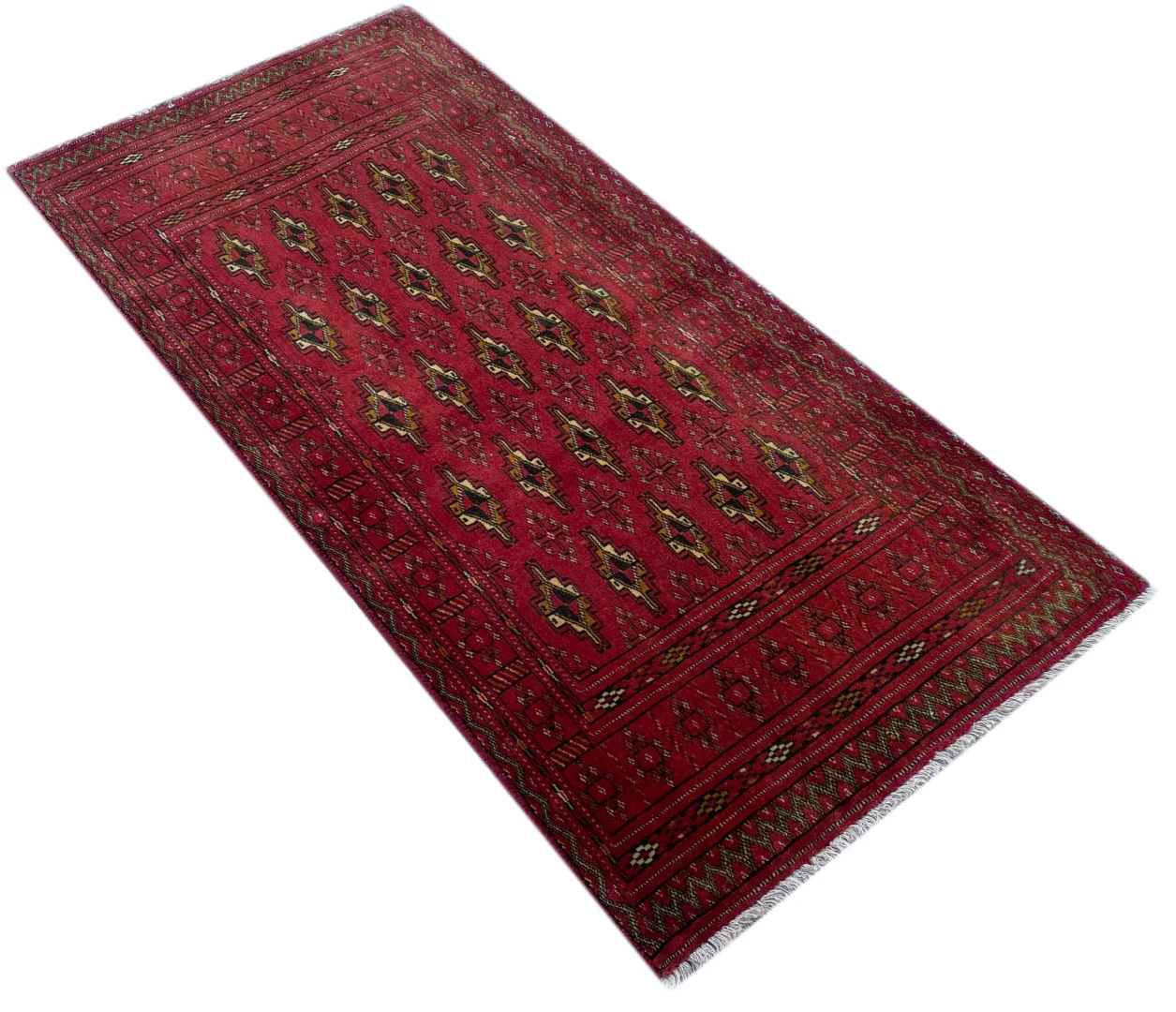
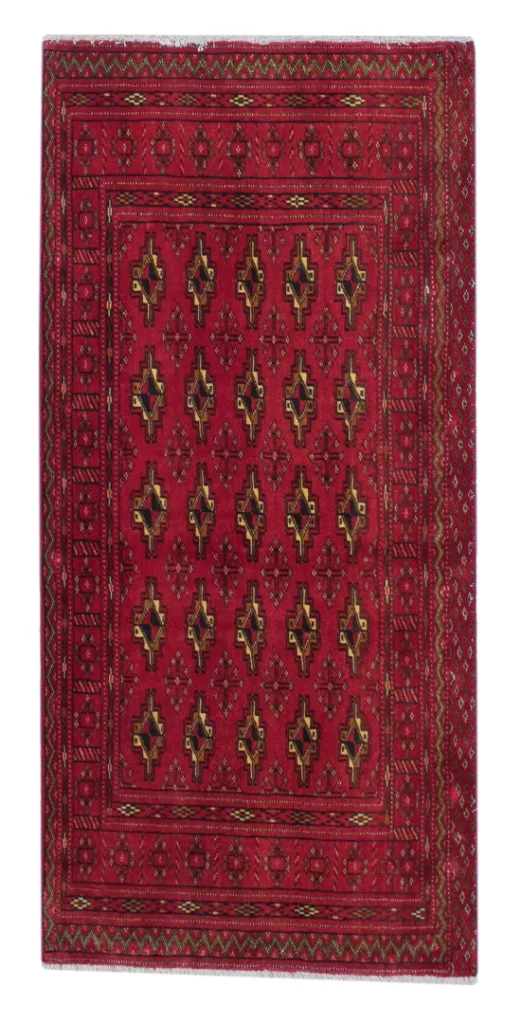
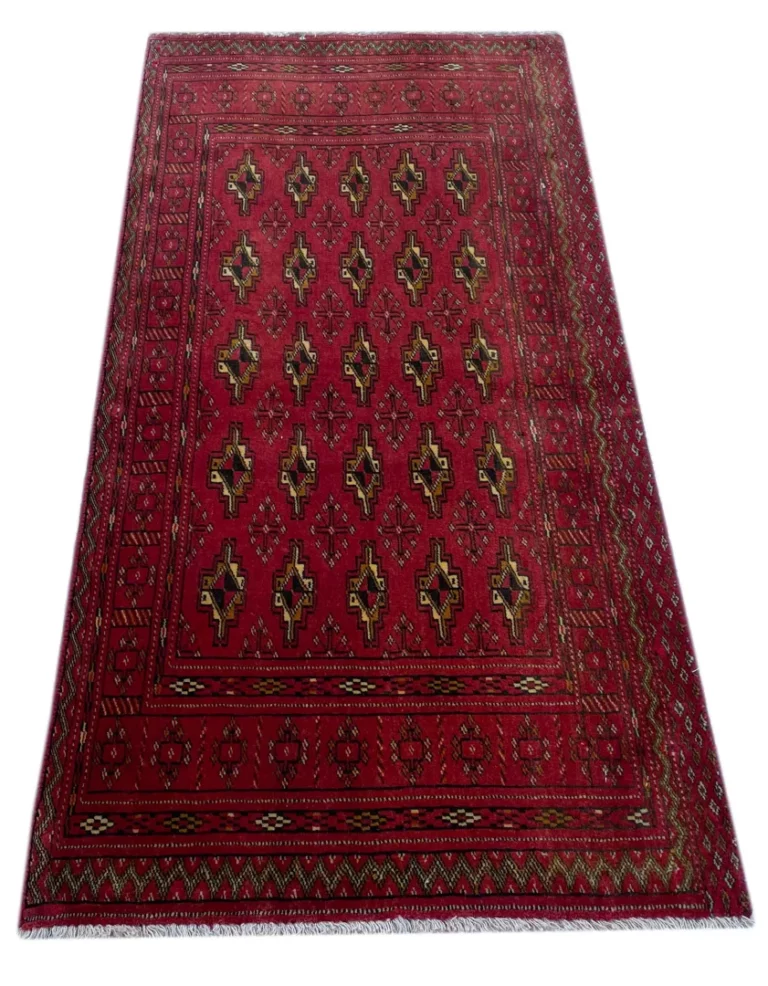
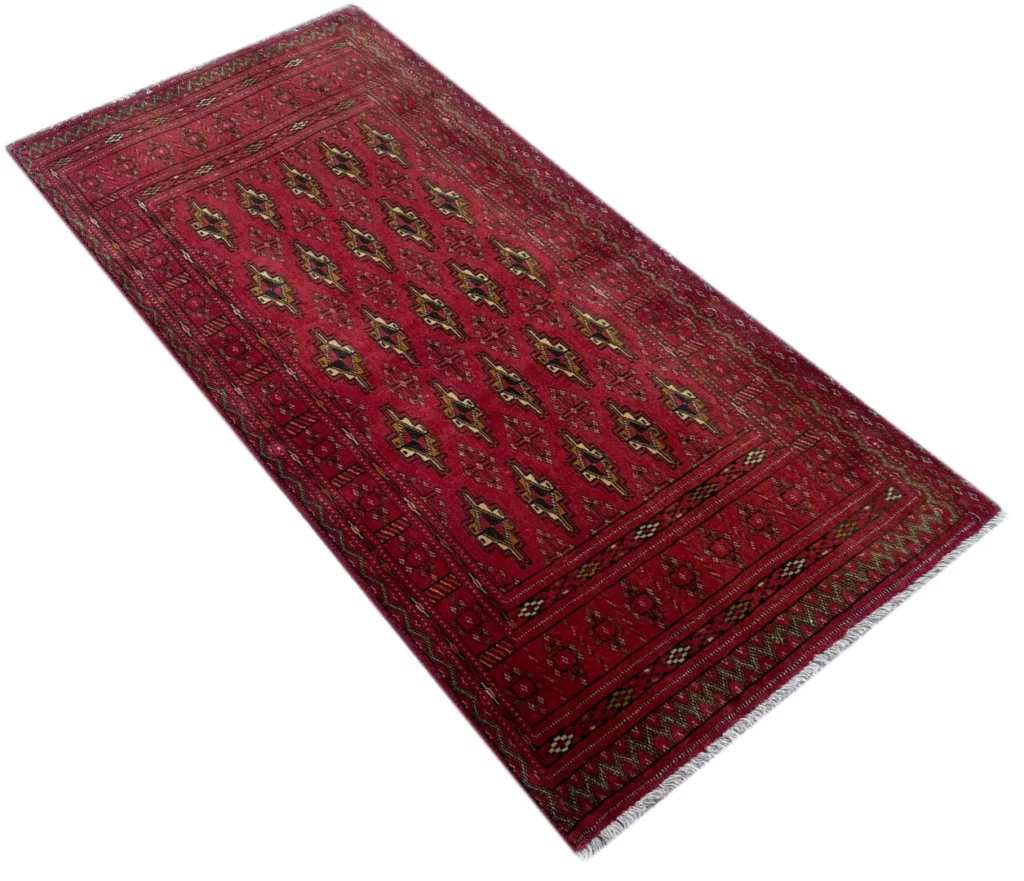
The surface is characterised by varied Göl motifs. In carpet design, the term Göl describes a clearly defined ornamental form that is often repeated. Such forms may be arranged in rows, fields or rhythmic sequences, giving the rug an ordered structure. Göl motifs are characteristic elements of Turkman carpets. They make the design recognisable through repetition while still allowing a fine range of details within the individual ornaments.
Göl designs are marked by geometric clarity. Their effect comes from outlines, intervals and the relationship between the separate motifs. In a hand-knotted version, these forms are built knot by knot. A high knot density supports the precise rendering of lines and transitions. The pattern can therefore appear as a differentiated succession of related ornamental fields rather than as a simple, flat repetition.
The colour scheme centres on red, violet and brown. Red provides a warm and traditional foundation, while violet introduces a distinct accent. Brown adds an earthy note to the palette. The interaction of these colours affects how the Göl motifs are read: contrast makes the ornamental shapes easier to recognise, while related tones bring adjoining areas together. The palette remains focused on the stated warm and deep colour range.
Göl motifs should not be confused with a design based solely on floral vines or with one central medallion. Their arrangement relies on repeated ornaments and rhythmic division of the field. This can create a continuous pattern effect across the rug. In the Turkman tradition, repeated forms are used to organise textile surfaces and to give them a recognisable regional identity.
The pattern can work in different interior settings. Deep red, violet and brown tones may relate to traditional furnishings and natural materials. At the same time, the geometric order and restrained colour selection can sit alongside a more contemporary, reduced interior. This describes the visual interaction of the stated colours and forms, not a particular room or furnishing style. The defining point remains the composition of varied Göl motifs, developed through hand-knotting.
When examining a rug of this type, attention can be given to the rhythm of the repeated forms, the transitions between colour areas and the fineness of the outlines. The design is the result of a textile construction, not simply a printed decoration. In this way, the rug joins the visual language of the Turkman tradition with the technical precision of a hand-knotted surface.
The colours also influence the balance between pattern and field. Red, violet and brown can create clearly separated areas, but they can also work together within the repeated ornament. Because the Göl forms return across the surface, the eye encounters both order and variation. The result is a design that communicates its regional tradition through geometry, repetition and a warm, concentrated palette.
Special Features
The notable features of this rug are its high-quality wool, hand-knotted construction, high knot density and varied Göl motifs. The clearly defined palette of red, violet and brown is another identifying characteristic. Together, material, technique, pattern and colour place the rug within the Turkman Persian tradition of northern Persia.
The wool is described as soft, robust and easy to care for. This makes the rug suitable for living areas with different levels of use, including rooms that are used frequently. Its condition is described as generally very good. The combination of durable wool and hand-knotting also reflects the practical orientation found in many rugs from the region.
FAQ
How should I care for my Turkman rug?
For regular care, vacuum gently without using a brush attachment. This removes everyday dust while avoiding unnecessary mechanical stress on the pile. The rug may also be beaten outdoors from time to time. If something is spilled or dirt gets onto the surface, it should be treated promptly with a damp cloth and a mild cleaning product. The affected area should not be soaked or rubbed aggressively. Although the high-quality wool is described as easy to care for, a gentle approach helps preserve its texture and appearance.
Where does the Turkman rug come from?
The Turkman rug comes from northern Persia, from regions close to the border with Turkmenistan. The area has a long-standing carpet-weaving tradition. Knowledge of knotting, wool, pattern construction and colour use is passed from one generation to the next. Northern Persian origin and the Turkman tradition are therefore the regional context of this hand-knotted Persian rug.
What are the typical features of a Turkman rug?
Typical features include a high knot density, high-quality wool and characteristic Göl motifs. In this rug, the design is complemented by a palette of red, violet and brown. The Göl ornaments create a recurring geometric order, while hand-knotting builds the individual forms in detail. Combined with its origin in northern Persia, these characteristics give the rug the recognisable appearance associated with a Turkman Persian rug.
To provide the best experiences, we use technologies like cookies to store and/or access device information. Consenting to these technologies will allow us to process data such as browsing behavior or unique IDs on this site. Not consenting or withdrawing consent, may adversely affect certain features and functions.
Functional Always active
The technical storage or access is strictly necessary for the legitimate purpose of enabling the use of a specific service explicitly requested by the subscriber or user, or for the sole purpose of carrying out the transmission of a communication over an electronic communications network.
Preferences
The technical storage or access is necessary for the legitimate purpose of storing preferences that are not requested by the subscriber or user.
Statistics
The technical storage or access that is used exclusively for statistical purposes.The technical storage or access that is used exclusively for anonymous statistical purposes. Without a subpoena, voluntary compliance on the part of your Internet Service Provider, or additional records from a third party, information stored or retrieved for this purpose alone cannot usually be used to identify you.
Marketing
The technical storage or access is required to create user profiles to send advertising, or to track the user on a website or across several websites for similar marketing purposes.
 SECURE PAYMENT
 SHIPPING PARTNERS


