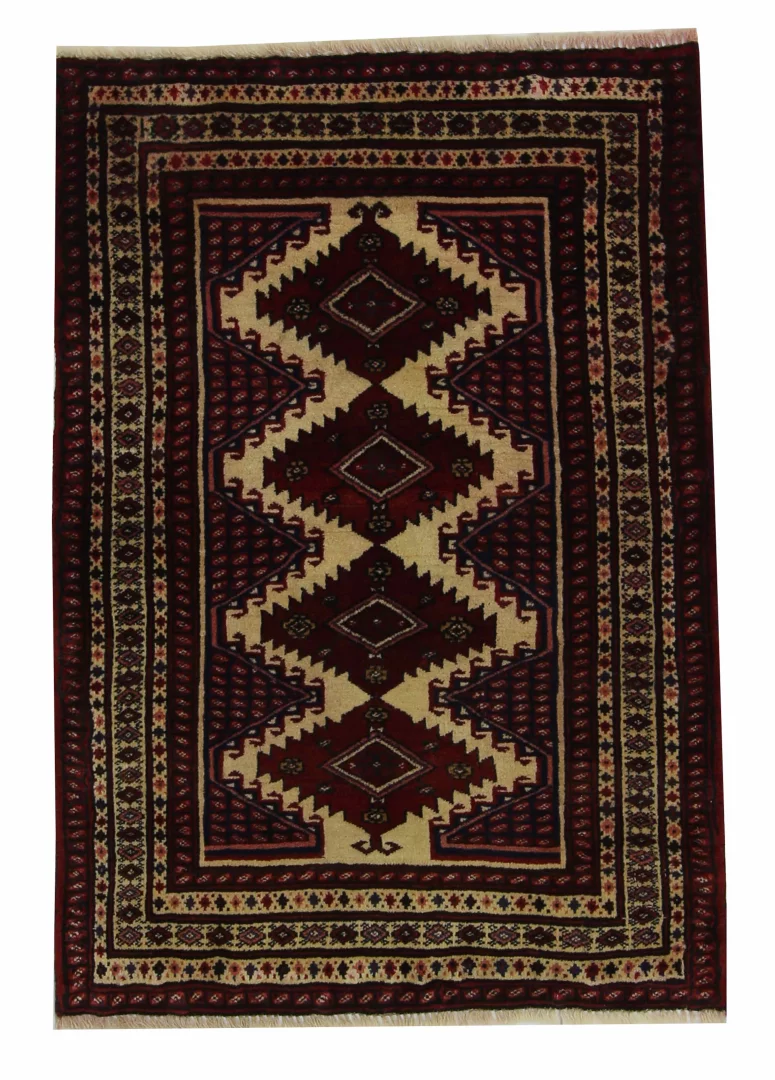
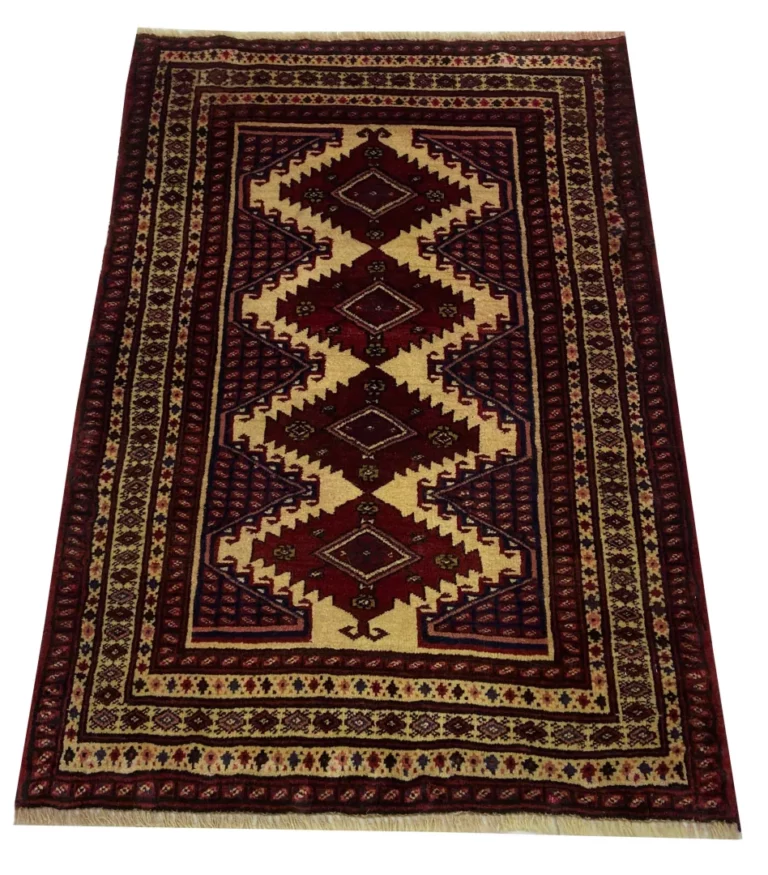
Hand-knotted Turkman Persian Rug | Knot density: 200,000 knots per square meter | Material: pile wool | Size: 117 x 82 cm | Pattern: distributed göl motifs
This Turkman Persian rug is hand-knotted and made with a wool pile. Its craftsmanship is expressed through fine knotting and the careful construction associated with Turkman rugs from northern Persia. Wool is a traditional material for Persian rugs because it combines a soft surface with the resilience needed for regular use. The source describes the wool used for Turkman rugs as high quality, and identifies the dense knotting as an important part of their character.
Hand-knotting is a method in which individual knots are tied by hand around the warp before the pile is secured and the rug is finished. The process allows the weaver to build motifs gradually and to give definition to small elements within the design. It also means that each rug carries the practical marks of the person or workshop that made it. In Turkman weaving, the relationship between wool, knotting and pattern is especially important: the material provides the working surface, while the knot structure gives the ornament its clarity.
The rug has a knot density of 200,000 knots per square meter. A dense construction can support finely articulated ornament and is one reason Turkman rugs are associated with detailed designs. The wool pile is also described as durable, soft and capable of retaining its appearance and sheen with intensive use. These qualities belong to the material and construction traditionally associated with this type of rug and are stated here as part of the description of the piece.
Origin and Tradition
Turkman rugs are associated with northern Persia, in the area close to the border with Turkmenistan. This geographical setting connects the weaving tradition with a wider cultural region in which Persian and Turkmen influences meet. The name Turkman identifies the rug tradition and its characteristic visual language. It does not refer simply to a modern decorative style; it points to a regional textile culture shaped by repeated motifs, handwork and inherited methods.
Many small workshops and family businesses in the region have preserved this craft across generations. Knowledge is commonly passed from one generation to the next through practical work: selecting and preparing wool, arranging the foundation, tying the knots and developing the pattern row by row. Such continuity helps explain why regional rugs can retain a recognizable identity even when individual pieces differ in colour, scale and ornament. The source emphasizes that every rug bears the hand of its knotter, so the finished object reflects both a shared tradition and the decisions of the person who made it.
The history of northern Persian weaving is closely connected with useful household textiles as well as with decorative rugs. A hand-knotted rug had to provide a serviceable surface, while its ornament communicated belonging, memory and local taste. In this context, the repeating göl is more than a formal device. Göl motifs are traditionally associated with cultural identity and regional tradition, and they form an important part of the visual vocabulary linked with Turkman rugs.
Persian rug production includes many distinct regional languages. Kerman is known for floral patterns, Isfahan for elegant designs and fine workmanship, and Tabriz for detailed compositions and colour. These traditions are related through the broader history of Persian weaving, but they are not interchangeable. The Turkman identity of this rug is expressed through its northern Persian association, its göl-based ornament and the hand-knotted wool construction described for it.
Regional rug traditions also developed through networks of local makers rather than through a single uniform design system. Variations in workshop practice, available wool and inherited motifs can produce differences from one Turkman rug to another. The tradition therefore includes both continuity and variation. A recurring motif may be recognized across the region, while its arrangement, scale and surrounding field reveal the individual approach of a particular weaver.
Design and Pattern
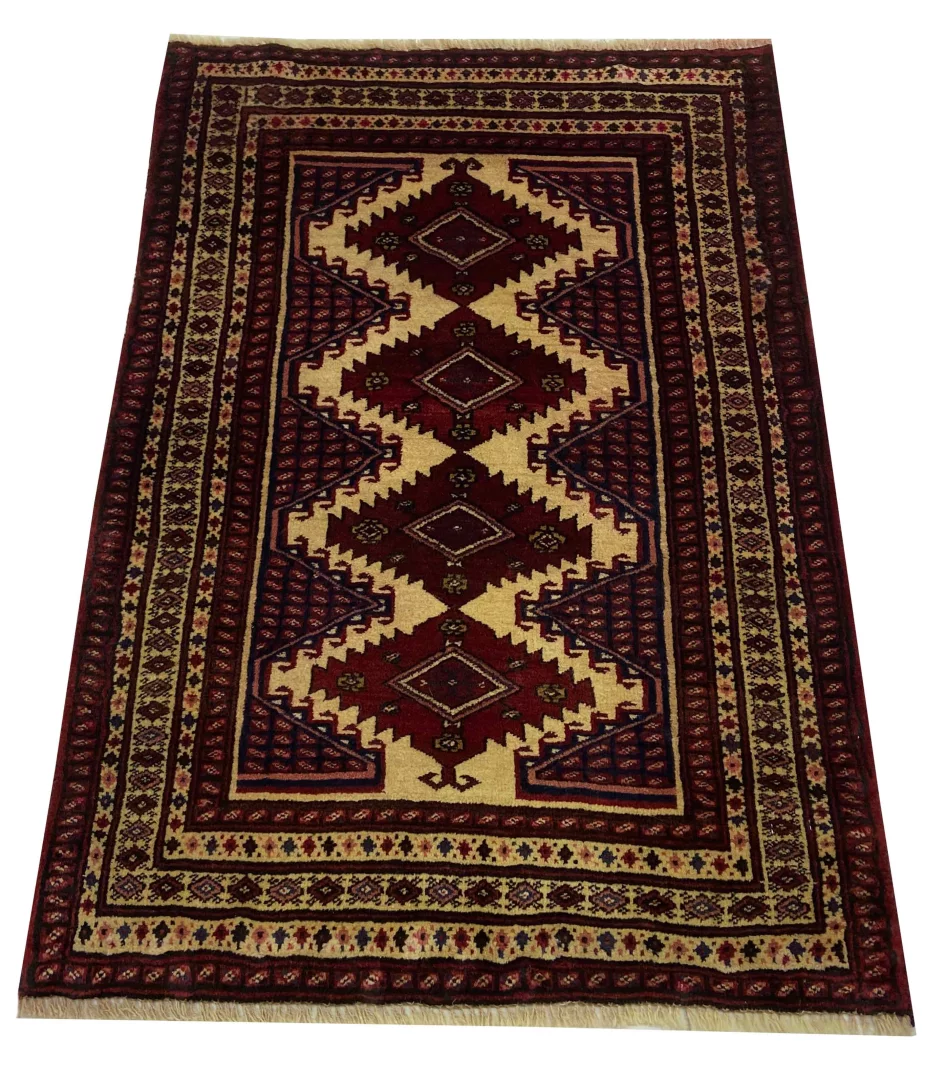
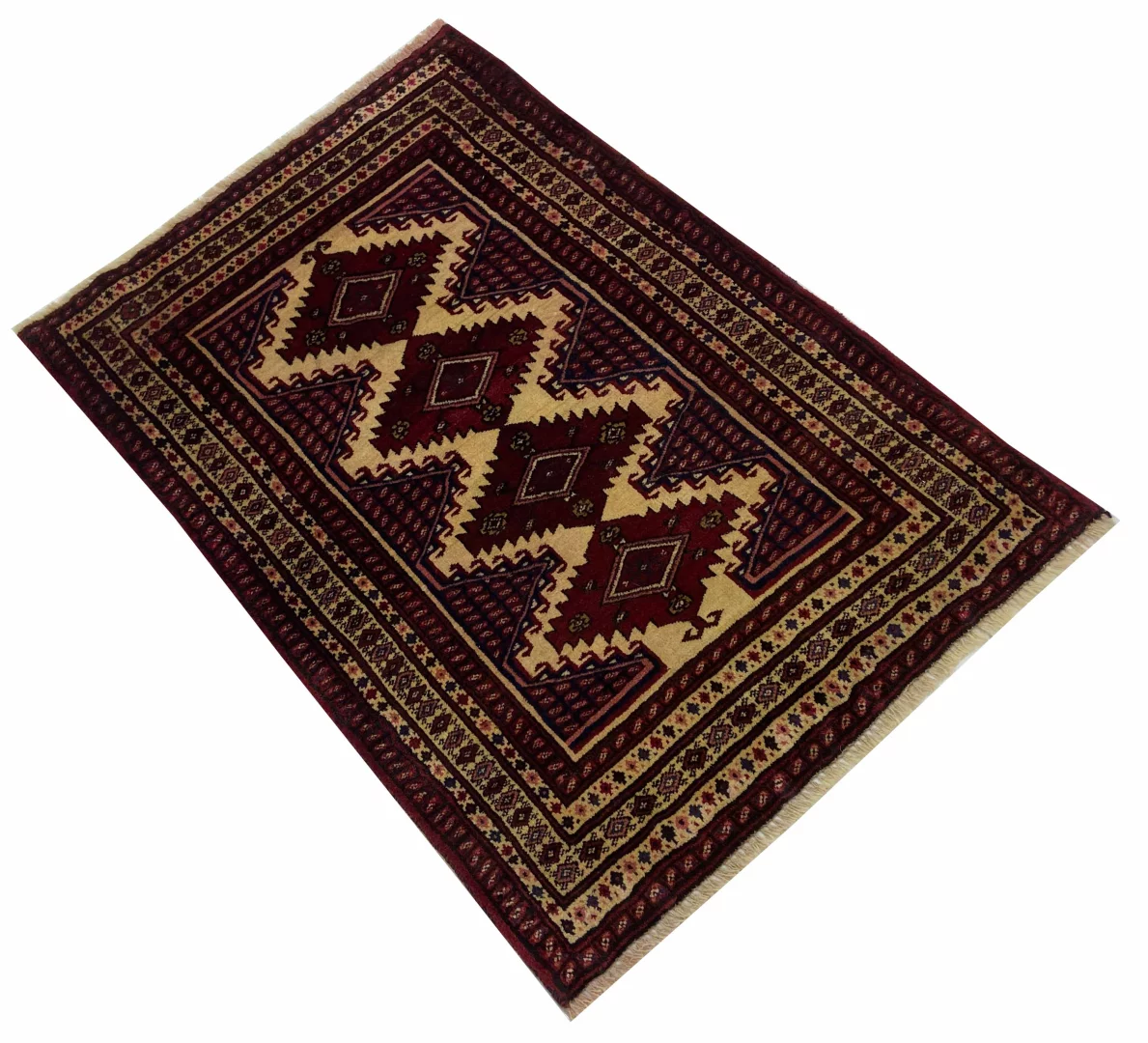
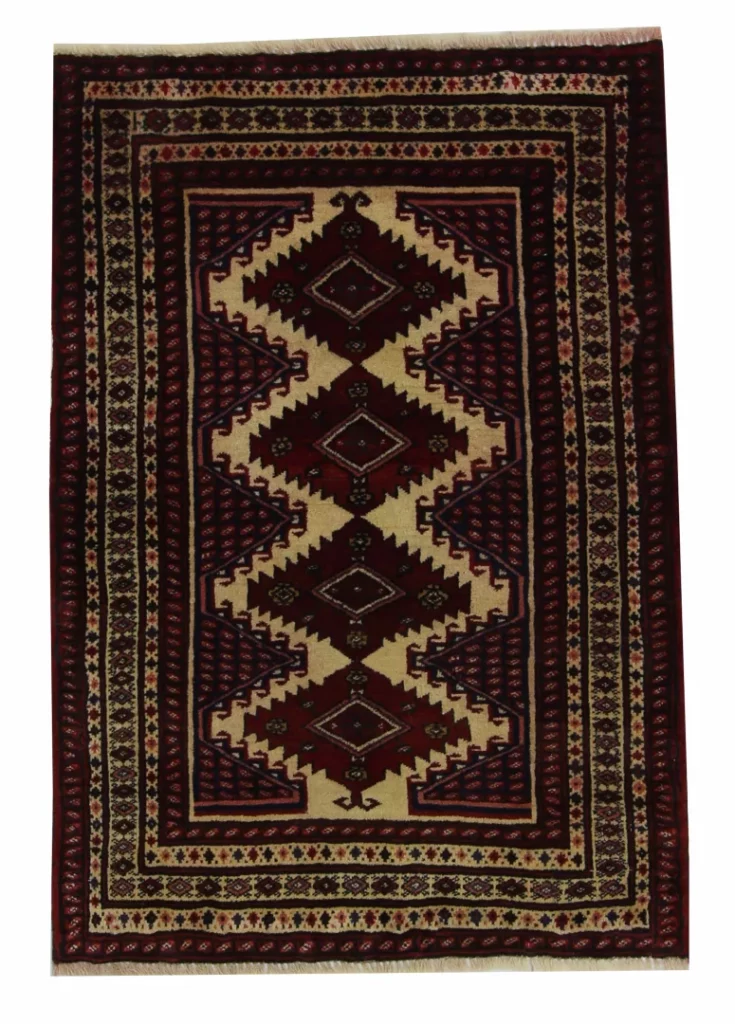
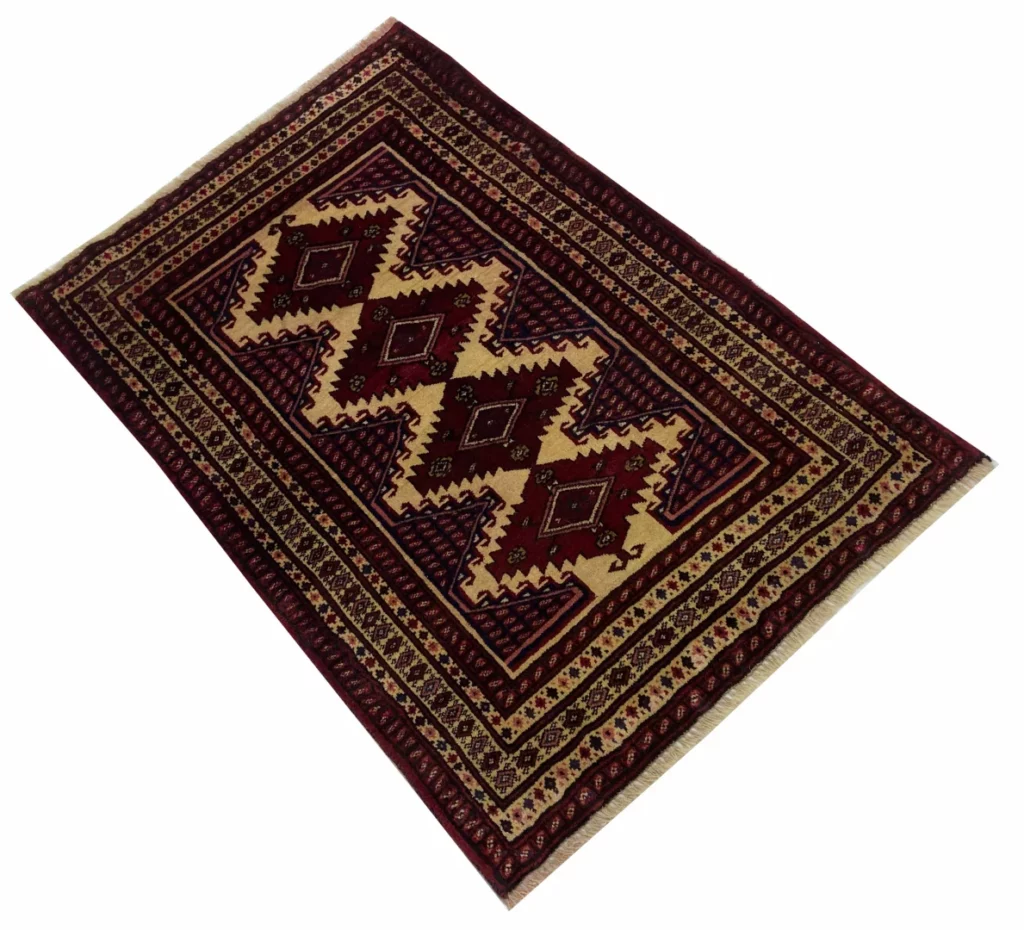
The design of this Turkman rug is based on a number of distributed göl motifs. A göl is a recognizable ornament associated with Turkman carpet design and is often understood as a symbol connected with the culture and tradition of the region. Repeated medallion-like forms create a rhythm across the field, allowing the eye to move from one motif to the next. Their distribution gives the composition an organized structure without depending on a single central image.
Traditional göl compositions are significant because they combine visual order with cultural meaning. The repeated form can be read as part of a design vocabulary inherited through generations, while variations in contour and placement allow a weaver to interpret the motif in an individual way. In a hand-knotted rug, each change in outline or internal detail is built knot by knot. This makes the pattern a direct record of the technical process as well as an expression of regional ornament.
The dominant colours described for this rug are deep red, soft violet and earthy brown. Deep red gives the composition a strong traditional foundation, while violet introduces a cooler contrast. Earthy brown connects the palette with natural, subdued tones. Together these colours create a warm and balanced visual impression. The combination can work with both modern and classical interiors because it contains strong traditional colour while avoiding a design based on a single bright tone.
Colour in Persian rugs is not separate from construction. The clarity of a motif depends on the way coloured wool is placed within the knot structure, and the relationship between field and ornament determines how the design is read. In a göl-based composition, colour helps distinguish the repeated forms and gives the overall pattern its sense of rhythm. The wool pile provides the surface on which these contrasts appear, while the hand-knotting supports the detailed character of the design.
Motifs in Turkman weaving are often discussed as carriers of memory and meaning. Their significance can relate to the history, culture and identity of the people who use and make them. This does not require every individual motif to have one fixed interpretation. Rather, the repeated forms belong to a shared visual tradition in which pattern, colour and craft communicate regional affiliation. The göl motifs on this rug are therefore both decorative elements and signs of the tradition from which the design comes.
The composition also illustrates why regional pattern names should be understood in context. A rug can use a motif associated with a wider cultural area without becoming a different regional rug. Here, the pattern remains part of the Turkman tradition: the distributed göl forms and the stated northern Persian origin belong together. The design is not described as a Kerman, Isfahan or Tabriz pattern, even though those regions represent important Persian weaving traditions in their own right.
Special Features
The defining features of this rug are its hand-knotted construction, wool pile, dense knotting and distributed göl pattern. The source describes the wool as soft and durable, with the capacity to preserve its appearance and sheen during intensive use. These material qualities complement the practical character of a hand-knotted floor covering while the detailed ornament gives it a distinct regional identity.
The colour palette of deep red, soft violet and earthy brown is another notable feature. It gives the rug a warm presence and allows it to sit within different furnishing schemes. Its cultural character comes from the combination of northern Persian Turkman tradition, hand craftsmanship and göl ornament rather than from a decorative effect added independently of the weaving method.
Care helps preserve the surface and colours of a wool rug. Regular vacuuming is recommended, and professional cleaning can be used when deeper cleaning is needed. Direct sunlight should be avoided because it can cause colours to fade. These measures are straightforward and support the long-term preservation of the pile, pattern and colour balance.
FAQ
What makes a Turkman Persian rug distinctive?
A Turkman rug is distinguished by its connection with northern Persia, its hand-knotted wool construction and its characteristic göl motifs. The source also identifies dense knotting and high-quality wool as important features. The motifs are linked with the culture and tradition of the region, so the rug combines a recognizable visual language with the practical qualities of a durable wool pile.
How should a Turkman rug be cared for?
Vacuum the rug regularly to remove everyday dust and loose particles. If more thorough cleaning is required, professional cleaning is recommended. Keep the rug away from direct sunlight, since prolonged exposure can fade its colours. These care practices help protect the wool pile, the visible sheen and the contrast between the deep red, soft violet and earthy brown tones.
Where do the patterns on Turkman rugs come from?
The patterns are based on traditional motifs such as the göl. These forms are deeply connected with the culture and history of the region and are often interpreted as symbols of Turkman tradition. Their repetition and distribution create the characteristic rhythm of the design, while each weaver can leave an individual mark through the arrangement, detail and execution of the motifs.
To provide the best experiences, we use technologies like cookies to store and/or access device information. Consenting to these technologies will allow us to process data such as browsing behavior or unique IDs on this site. Not consenting or withdrawing consent, may adversely affect certain features and functions.
Functional Always active
The technical storage or access is strictly necessary for the legitimate purpose of enabling the use of a specific service explicitly requested by the subscriber or user, or for the sole purpose of carrying out the transmission of a communication over an electronic communications network.
Preferences
The technical storage or access is necessary for the legitimate purpose of storing preferences that are not requested by the subscriber or user.
Statistics
The technical storage or access that is used exclusively for statistical purposes.The technical storage or access that is used exclusively for anonymous statistical purposes. Without a subpoena, voluntary compliance on the part of your Internet Service Provider, or additional records from a third party, information stored or retrieved for this purpose alone cannot usually be used to identify you.
Marketing
The technical storage or access is required to create user profiles to send advertising, or to track the user on a website or across several websites for similar marketing purposes.
 SECURE PAYMENT
 SHIPPING PARTNERS


