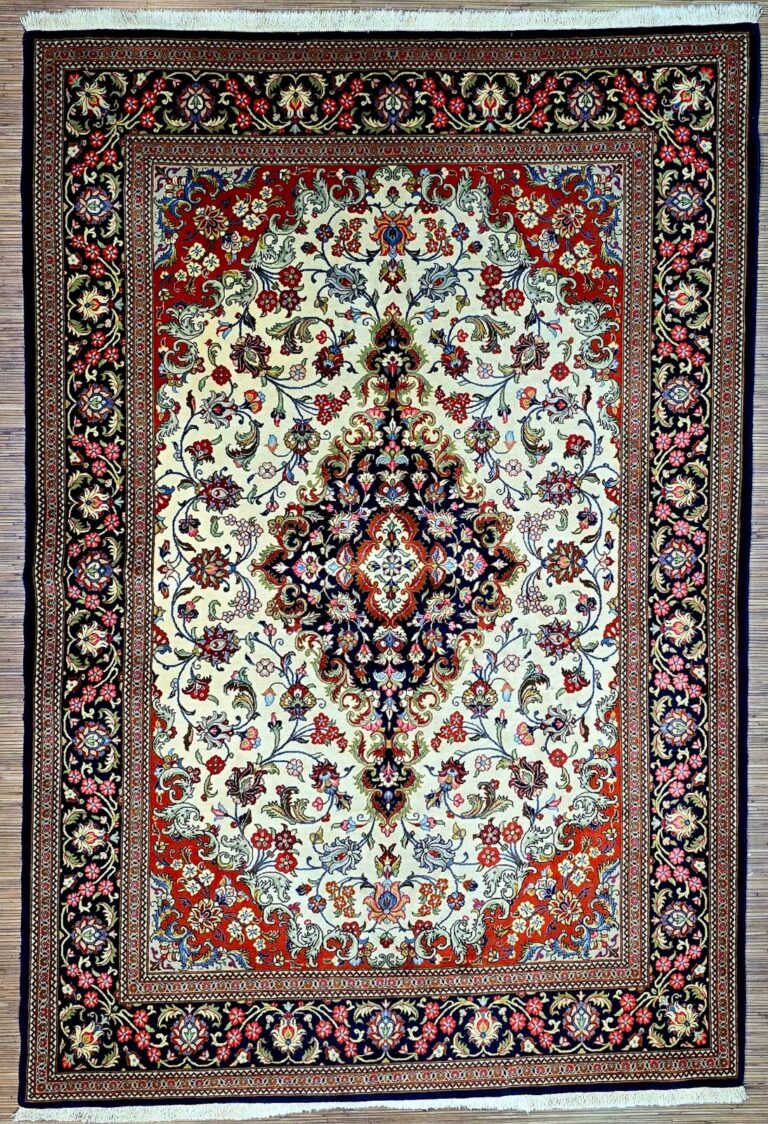
This Persian rug from Shiraz is hand-knotted with a pile made of natural virgin wool. Its construction is formed knot by knot rather than through an industrial reproduction process. The result is a one-off textile whose particular arrangement of colour, line and ornament belongs to this individual piece.
The recorded knot density ranges from 100,000 to 250,000 knots per square metre. A dense knot structure supports the precise development of a design and contributes to the resilience of the woven surface. Virgin wool is traditionally used for Persian rug pile because its natural fibre structure is durable, pleasant to handle and suitable for regular domestic use.
In the Shiraz region, rug making is traditionally associated with nomadic tribes as well as with other local forms of production. Weaving may take place outdoors or in tents rather than in a fixed industrial setting. This working environment is part of the region’s craft tradition and helps explain the direct, handmade character associated with Shiraz rugs. For this rug, the stated material is natural virgin wool, the technique is hand-knotting, and the condition is described as excellent.
Origin and Tradition
This rug originates in Shiraz, Iran. Shiraz belongs to a region with a long history of textile production and carpet making. Urban workshops, rural communities and nomadic groups have all contributed to the wider Persian weaving tradition. Their work combines practical knowledge with visual forms that have been passed through generations of makers.
Shiraz rugs are therefore not limited to one rigid pattern formula. Designs can differ according to the weavers’ background, the wool available to them and the conventions of a particular community. Geometric ornaments are a recurring feature of the regional vocabulary. They can be arranged in borders, central fields, medallion-like structures or repeated smaller units. Floral elements are also found in Shiraz traditions and may be placed beside or within more angular compositions.
The nomadic background is important to the history of the region’s rug production. A weaving practice connected to mobile communities had to function with portable equipment and locally available materials rather than the fixed infrastructure of a large manufactory. Wool was a practical fibre in this setting: it is workable, naturally resilient and capable of being formed into a firm pile. The resulting rugs preserve a link to a textile culture in which skills were taught directly from one generation to the next.
Shiraz is part of the broader history of Iranian Persian rugs, while remaining a distinct place of origin. Other Iranian centres developed their own recognisable approaches. Tabriz is often associated with fine detail and intricate compositions, and Isfahan with elegant designs and bright colour. Nain and Kashan also represent important branches of Persian carpet art. These names describe separate traditions and do not change the origin of this rug, which is Shiraz.
Persian rug making joins regional identity with technical continuity. A rug is defined not only by its fibre, but also by the relationship between knotting, pile, colour and drawing. In a Shiraz rug, that relationship may be seen in the hand-knotted construction, the use of virgin wool and an ornament vocabulary capable of combining clear geometry with references to plant forms. Each regional tradition gives these shared techniques a different visual character.
Design and Pattern
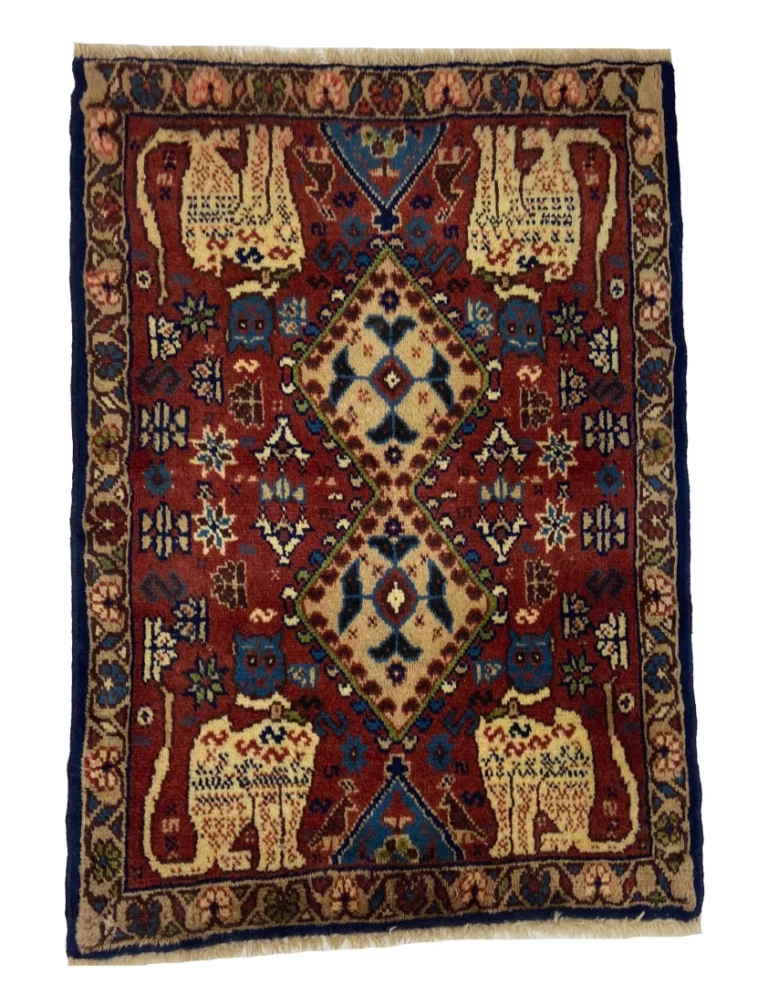
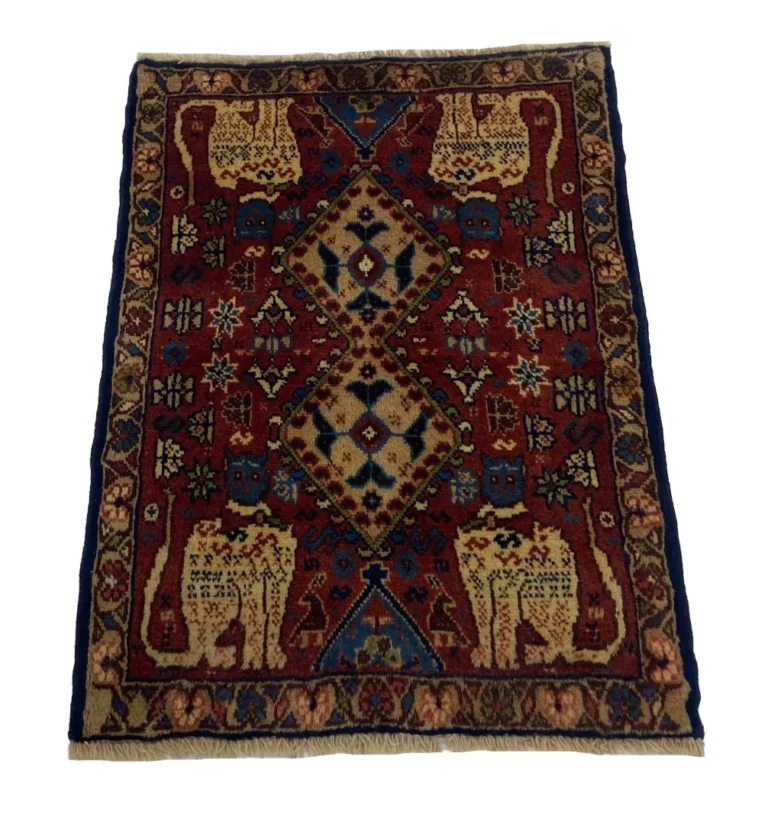
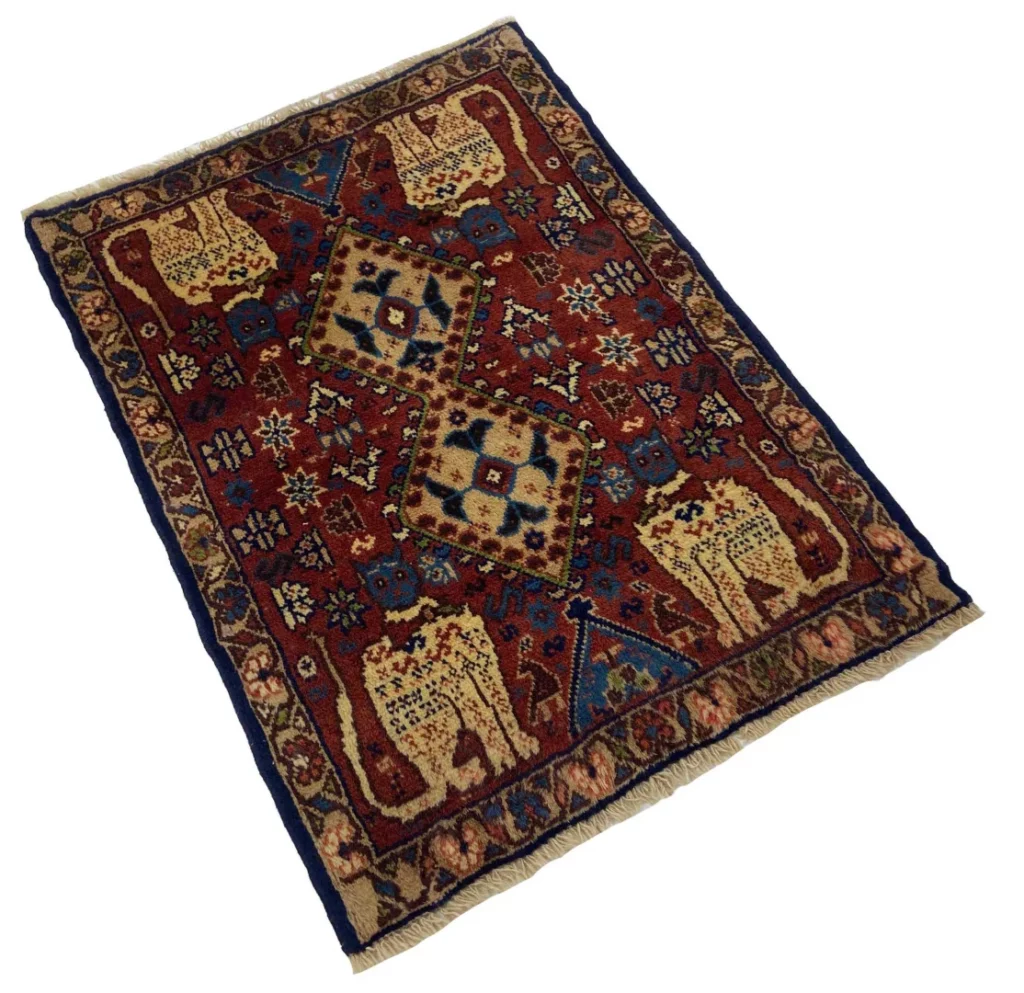
The pattern of this rug is described as geometric ornaments. Geometric design uses lines, angles, repetition and carefully divided areas to create visual order. These elements may form borders, inner fields, corner arrangements or repeated motifs. A structured pattern can remain clearly legible while still allowing the handmade execution to give the individual rug its own variations.
Shiraz rugs are frequently linked with colourful compositions in red and brown tones. Red may serve as a dominant ground or as a strong accent, while brown can give definition to lines and provide a visual connection between separate ornaments. Together, these colours are associated with a warm and welcoming interior effect. The exact balance of tones always depends on the arrangement in the individual rug.
Floral designs are also part of the wider Shiraz pattern tradition. Blossoms, vines and simplified plant shapes can accompany geometric signs or soften an otherwise angular field. The pattern recorded for this particular rug is geometric ornamentation. The reference to floral forms describes a broader regional tradition and does not add unrecorded floral details to this one-off piece.
A high knot density is suited to the development of detailed ornament. Narrow lines, changes in direction and repeated small forms can be rendered with greater clarity in a dense knotted surface than in a coarser structure. At the same time, the design remains the product of handwork rather than a printed or mechanically repeated image. Each part of the pattern is integrated into the knotting process.
Geometric ornament has more than one role in Persian and nomadic textile traditions. Repetition creates rhythm, borders frame an inner field, and simplified shapes make a composition readable across a broad surface. Individual symbols may carry different interpretations in different communities. No specific symbolic meaning is assigned to this rug; its recorded pattern is geometric ornamentation and its regional connection is Shiraz.
Special Features
The specific characteristics of this one-off rug are its origin in Shiraz, Iran, its hand-knotted construction, its pile of natural virgin wool, its recorded knot density and its geometric ornamentation. Its condition is described as excellent. These details identify the offered rug and should be distinguished from general descriptions of other rugs made in the Shiraz tradition.
Virgin wool gives the pile a natural surface and a fibre structure suited to everyday use. The hand-knotted construction and dense knotting contribute to the rug’s tactile depth. The warm red and brown palette associated with Shiraz rugs can work in living rooms, dining areas, hallways or bedrooms. For care, regular vacuuming is recommended. When necessary, the surface may be cleaned with a damp cloth. Harsh cleaning products and direct sunlight should be avoided so that the colours remain well preserved.
FAQ
What are the defining features of a Shiraz Persian rug?
A Shiraz Persian rug is connected with an Iranian origin and with a regional craft tradition maintained by local makers and nomadic communities. Geometric ornaments are a characteristic design element, while floral forms also occur in the broader Shiraz vocabulary. Natural virgin wool is traditionally valued for its pleasant handle and resilience. In this particular rug, the concrete features are the Shiraz origin, the wool pile, the hand-knotted technique, the high knot density and the excellent condition.
How should I care for this Shiraz Persian rug?
Regular, gentle vacuuming is suitable for routine care. If the surface needs additional cleaning, a damp cloth may be used. Harsh cleaning products should be avoided because they can affect the fibre and the appearance of the colours. The rug should also be protected from prolonged direct sunlight. These measures provide a careful way to maintain the surface and colour in everyday use.
Which rooms suit a Shiraz Persian rug?
A Shiraz rug can be used in living rooms, dining areas, hallways or bedrooms. Geometric ornaments create a clearly structured textile area, while red and brown tones bring a warm quality to the room. The best placement depends on the furniture and the intended use of the space. Its hand-knotted construction and virgin-wool pile combine a decorative regional design with qualities appropriate for a domestic setting.
To provide the best experiences, we use technologies like cookies to store and/or access device information. Consenting to these technologies will allow us to process data such as browsing behavior or unique IDs on this site. Not consenting or withdrawing consent, may adversely affect certain features and functions.
Functional Always active
The technical storage or access is strictly necessary for the legitimate purpose of enabling the use of a specific service explicitly requested by the subscriber or user, or for the sole purpose of carrying out the transmission of a communication over an electronic communications network.
Preferences
The technical storage or access is necessary for the legitimate purpose of storing preferences that are not requested by the subscriber or user.
Statistics
The technical storage or access that is used exclusively for statistical purposes.The technical storage or access that is used exclusively for anonymous statistical purposes. Without a subpoena, voluntary compliance on the part of your Internet Service Provider, or additional records from a third party, information stored or retrieved for this purpose alone cannot usually be used to identify you.
Marketing
The technical storage or access is required to create user profiles to send advertising, or to track the user on a website or across several websites for similar marketing purposes.
 SECURE PAYMENT
 SHIPPING PARTNERS