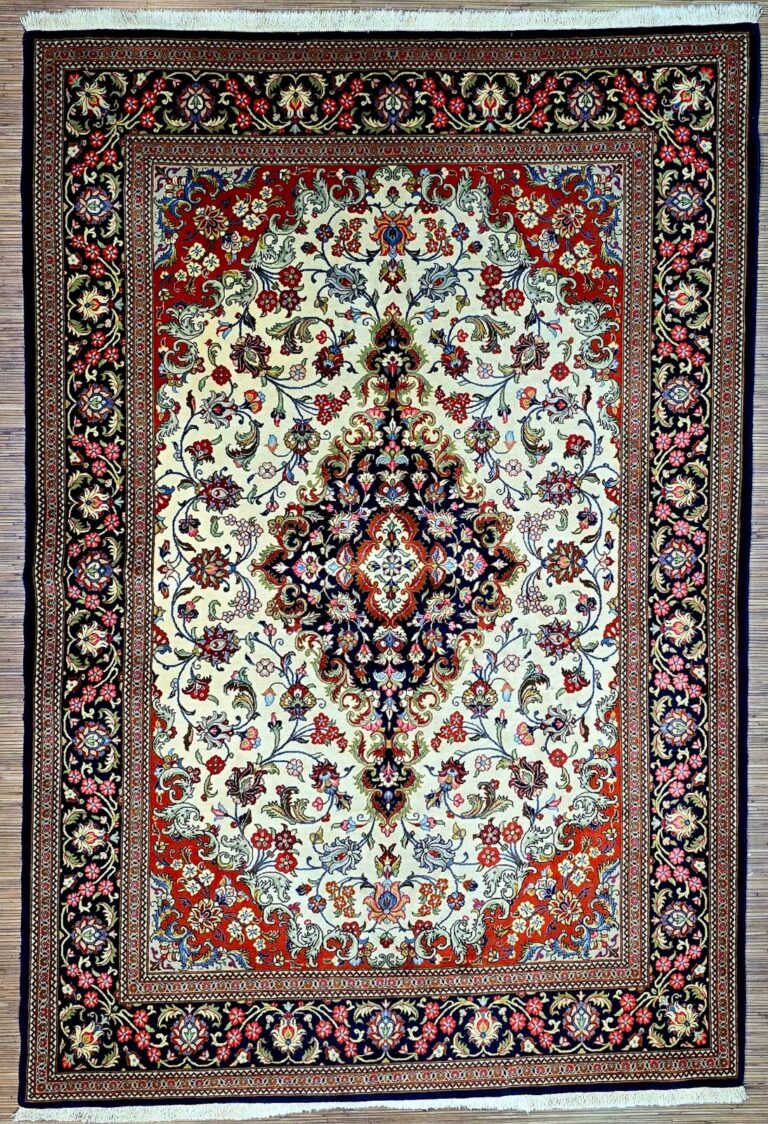
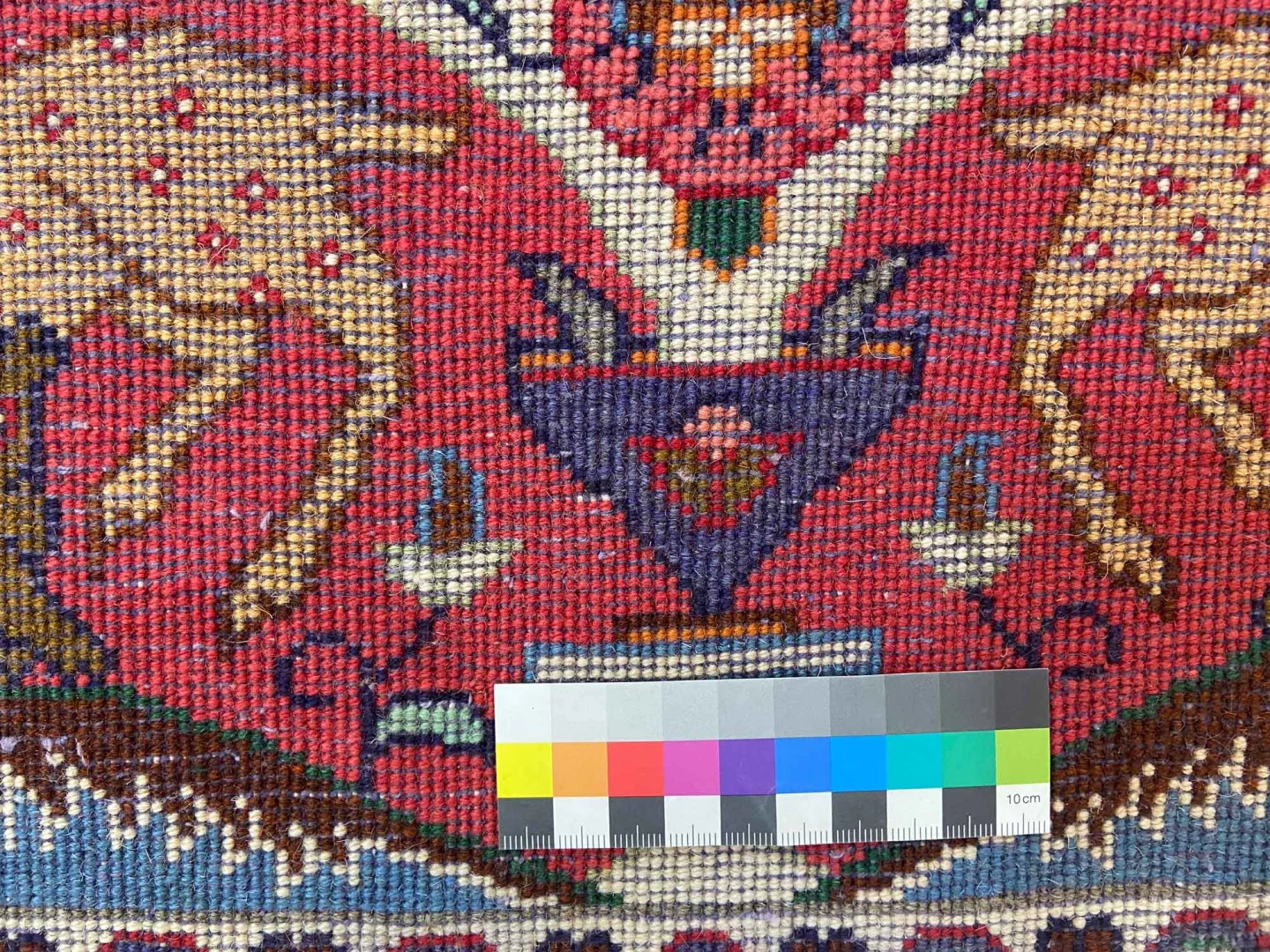
This Persian rug from Sarough is hand-knotted and has a pile made of high-quality wool. Hand-knotting is one of the defining methods of Persian rug making: individual knots are tied into the prepared foundation, allowing the design to emerge gradually through the structure of the textile. Unlike a mechanically produced floor covering, a hand-knotted rug is shaped detail by detail through the work of the weaver.
Wool has been used in rug making for centuries because it can be formed into a resilient pile while retaining a natural textile character. Depending on its preparation, it can hold outlines clearly and provide a pleasantly firm surface. High-quality wool is specified here as the pile material. The short material description does not identify the warp, so no additional claim about the foundation is made.
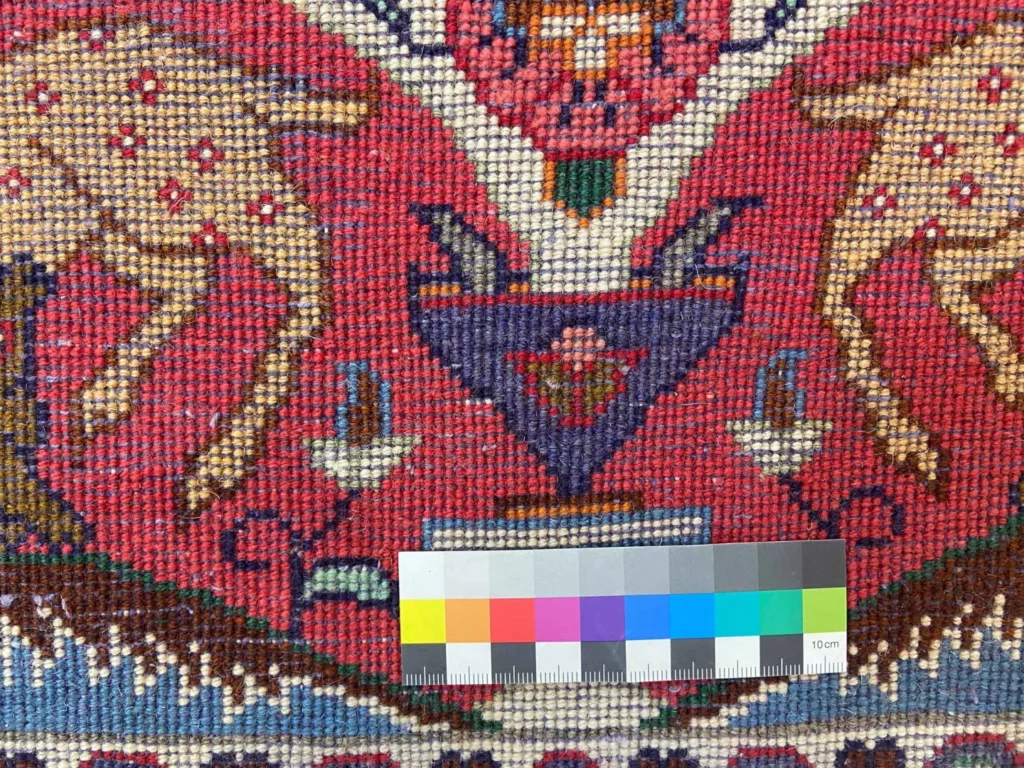
The stated knot density is between 200,000 and 400,000 knots per square metre. This figure records the number of individual knots within a defined area and provides an important indication of technical construction. A greater number of knots can allow finer transitions and smaller pattern elements, although the appearance and performance of a rug also depend on pile height, yarn, knotting method and finishing. Knot density is therefore a meaningful technical characteristic, not a complete measure of quality by itself.
Origin and Tradition
Sarough lies in northern Persia and is known as an area associated with hand-knotted rugs. The name Sarough refers to a regional tradition rather than to one single pattern formula. Workshops connected with this tradition combine inherited knotting knowledge with designs that are often shaped by floral compositions. This rug is described as a Sarough from northern Persia.
Persian rug culture developed through the interaction of nomadic, village and urban textile practices. Different regions formed their own approaches to field structure, borders, colour relationships and proportions. Within this broad variety, Sarough is associated with careful workmanship and a clearly organised appearance that often includes floral ornament. The place name consequently indicates a developed regional language of design and a tradition of making rugs by hand.
In northern Persia, rugs have traditionally served both as useful household textiles and as woven surfaces for elaborate visual compositions. The pattern had to be integrated into a durable structure, making yarn selection and the regular placement of knots important parts of the process. Wool is suitable for this work because it can be made into a dense pile using a natural fibre. The exact density of an individual rug depends on its workshop, its design and the level of detail intended by the maker.
Sarough designs are often linked with Persian flowers and scrolling vegetal motifs. This tradition belongs to the wider history of Persian ornament, where blossoms, leaves and curving stems are arranged into ordered compositions. A floral motif does not necessarily imitate nature literally. It may consist of stylised flowers, palmettes, vines and repeated elements arranged according to a planned drawing. The design is set out in a pattern and then translated into rows of individual knots.
The history of Persian weaving also shows how regional identity can be expressed through technique rather than through one fixed visual formula. A rug’s place name can refer to the community, workshop tradition or production area in which its visual and technical conventions were established. Small differences in drawing, spacing and execution are part of the character of handmade production. Sarough therefore has to be understood as a regional tradition within Persian weaving, while each hand-knotted rug remains an individual textile object.
Design and Pattern
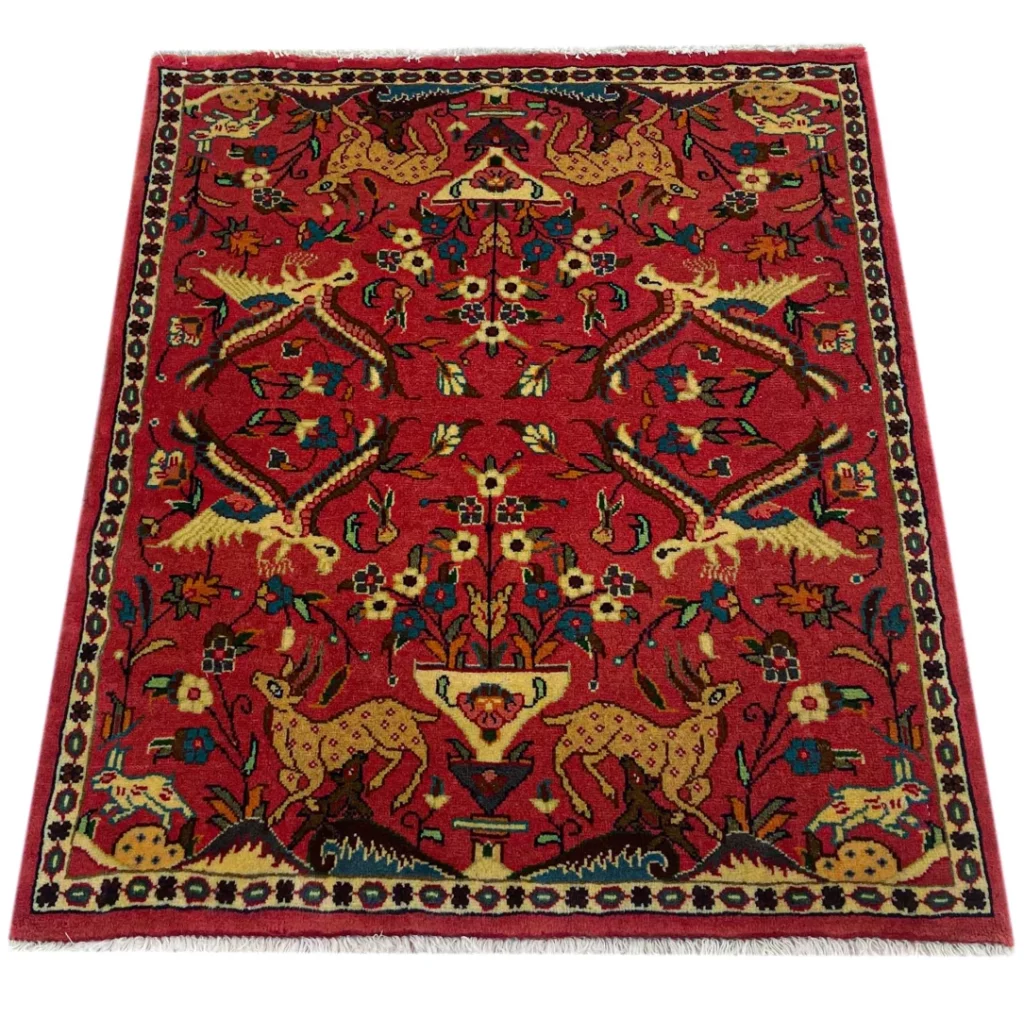
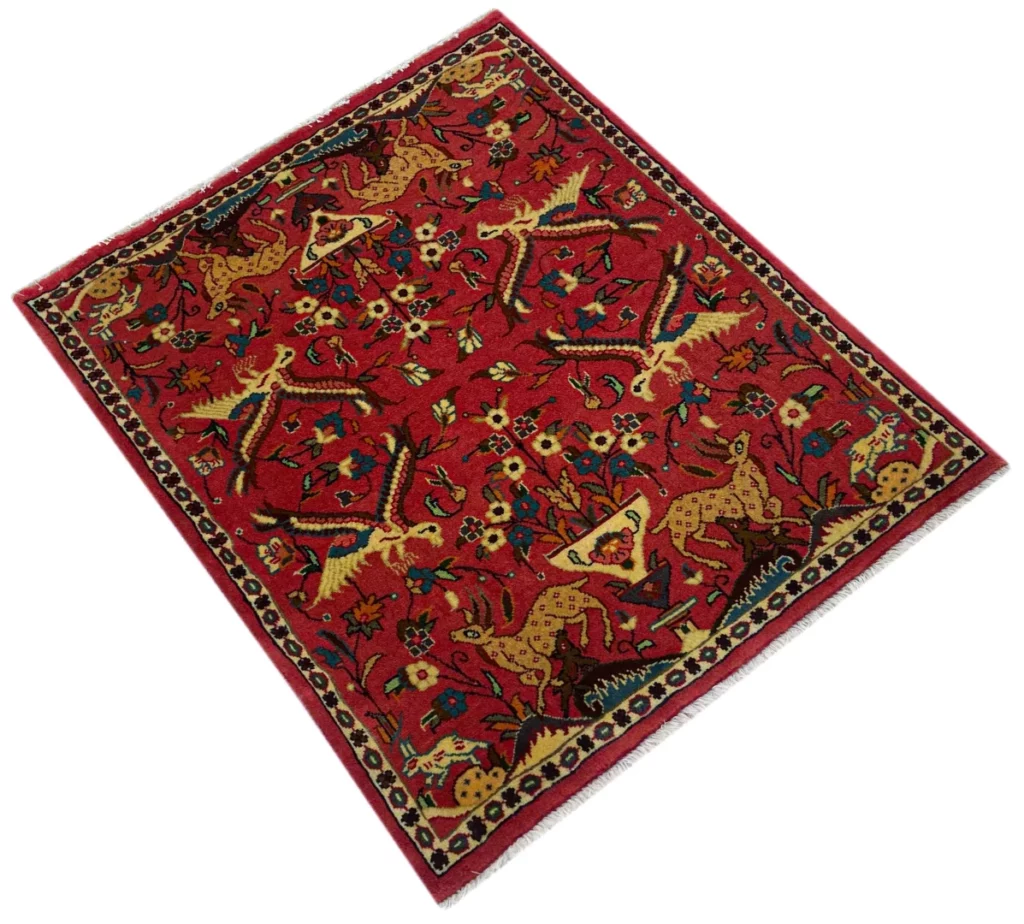
The pattern of this rug is described as floral. Floral rugs use plant-based forms that may appear in the central field, in the borders, or across both areas. Common elements include blossoms, leaves, vines and palmettes. Depending on the drawing, these forms may be placed individually, arranged around a central axis, or linked into a repeating system. The term “floral” identifies the motif family without assuming a particular layout that has not been stated.
In many Persian rugs, the central field provides the principal continuous pattern area. A border may frame it and create a visual transition toward the edge. Narrower secondary borders can separate the main border from the field or from the outer edge. This structure lets the eye distinguish between centre and frame. A Sarough composition may connect floral elements densely or space them more openly; the exact arrangement belongs to the individual design and cannot be inferred from the place name alone.
Persian floral ornament is closely related to the idea of nature brought into order. Flowers and scrolling stems are not distributed randomly but repeated through rhythm, balance and measured spacing. Symmetry, axes and variations in scale help create a coherent surface. In a hand-knotted rug, the drawing is converted into coloured knots, giving the design a woven depth that differs from a printed or mechanically reproduced image.
Sarough is often associated with warm red and brown ground colours and lively floral compositions. These colour groups belong to the wider regional design tradition, but they are not added here as specific colours of this individual rug. The documented description is limited to its floral design. Its visual language is therefore best understood through the relationship between outlines, repeated botanical forms, knot density and the colour arrangement established by the original design.
Floral Sarough rugs can be placed alongside other Persian traditions while remaining distinct from them. Nain is widely associated with finely drawn ornament and the use of lighter grounds, whereas Tabriz often develops complex arrangements containing many different motifs. These are general characteristics of those regional styles; they do not change the origin of this rug. The piece described here is a Sarough from northern Persia, with a floral design.
Special Features
The specific features are its hand-knotted construction, high-quality wool pile, knot density of 200,000 to 400,000 knots per square metre and floral design. Its condition is described as very good. Together, these details identify a rug with a named northern Persian origin, a documented technical density and a pattern language rooted in regional floral ornament.
The knot-density range makes the labour involved in building the textile visible: the surface contains a large number of individually tied knots. Combined with a floral drawing, this type of construction can support the rendering of varied lines and small ornamental details. High-quality wool identifies the pile material, while “hand-knotted” identifies the production method. These are separate characteristics that complement one another.
A Sarough with a floral design can be used in different interiors when its format and setting are suitable. The rug described here has a compact shape and can form a defined textile area in a smaller room or a selected part of a larger room. Its description, however, rests on the documented features of material, technique, origin, pattern and condition rather than on general promises about how it must be used.
FAQ
How should I care for a Sarough Persian rug?
Regular, gentle vacuuming is suitable for routine care. The pile should not be subjected to unnecessarily aggressive brushing or treatment. If liquid is spilled, it should be absorbed promptly and carefully rather than rubbed forcefully into the fibres. Occasional professional cleaning can remove deeper soiling with methods appropriate to a hand-knotted construction. Strong, direct sunlight should be limited because prolonged exposure can cause colours to fade. For a hand-knotted rug, cleaning should always take the material and structure into account.
What makes this Sarough Persian rug distinctive?
Its distinguishing combination is a northern Persian Sarough origin, hand-knotted manufacture, high-quality wool pile and a knot density of 200,000 to 400,000 knots per square metre. The floral design adds the characteristic pattern category associated with many Sarough rugs. The condition is described as very good. These concrete features provide a precise description of the piece without attributing any additional qualities that have not been documented.
How does a Sarough rug differ from other Persian rugs?
Sarough rugs are often connected with warm colour schemes and floral designs. Compared with Nain or Tabriz, they may have a somewhat coarser structure and therefore occupy a distinct position within Persian rug traditions. Nain is commonly known for finely detailed patterns, while Tabriz often presents more complex compositions with a broad range of motifs. These statements describe general regional tendencies. The rug presented here remains a Sarough from northern Persia and should not be assigned to another place of origin.
To provide the best experiences, we use technologies like cookies to store and/or access device information. Consenting to these technologies will allow us to process data such as browsing behavior or unique IDs on this site. Not consenting or withdrawing consent, may adversely affect certain features and functions.
Functional Always active
The technical storage or access is strictly necessary for the legitimate purpose of enabling the use of a specific service explicitly requested by the subscriber or user, or for the sole purpose of carrying out the transmission of a communication over an electronic communications network.
Preferences
The technical storage or access is necessary for the legitimate purpose of storing preferences that are not requested by the subscriber or user.
Statistics
The technical storage or access that is used exclusively for statistical purposes.The technical storage or access that is used exclusively for anonymous statistical purposes. Without a subpoena, voluntary compliance on the part of your Internet Service Provider, or additional records from a third party, information stored or retrieved for this purpose alone cannot usually be used to identify you.
Marketing
The technical storage or access is required to create user profiles to send advertising, or to track the user on a website or across several websites for similar marketing purposes.

 SECURE PAYMENT
 SHIPPING PARTNERS