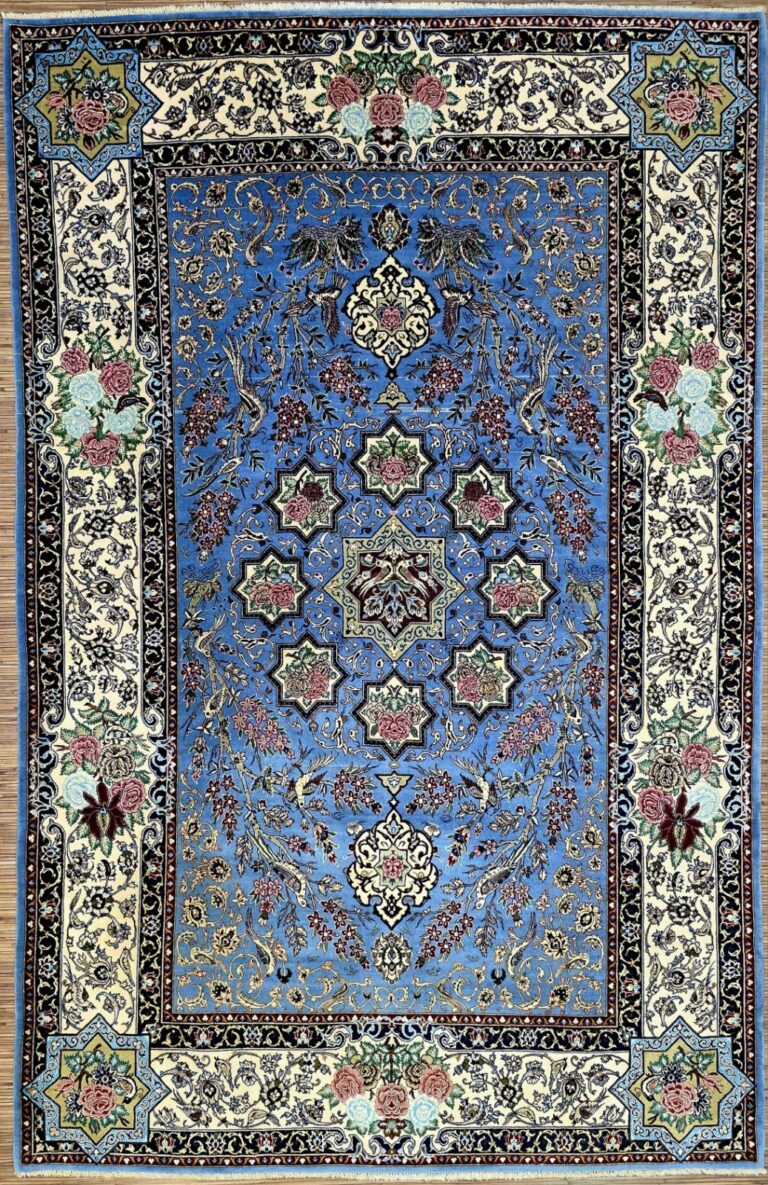
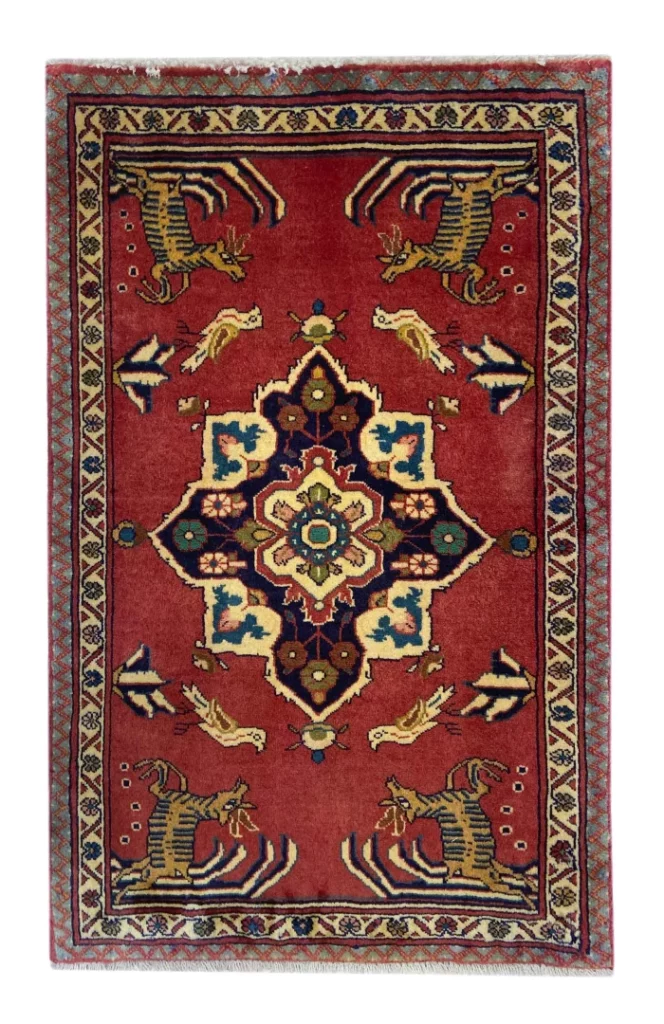
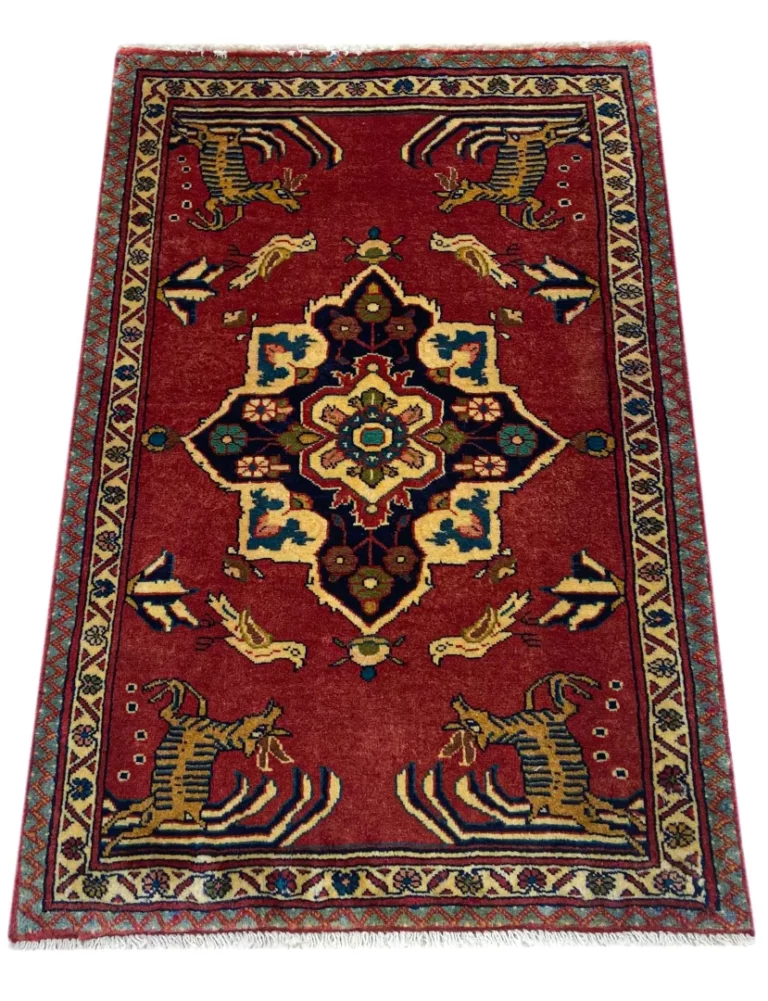
Hand-knotted Sarough Persian rug | Knot density: 200,000 – 400,000 knots/m² | Material: Wool pile | Size: 105 x 68 cm | Pattern: Floral design on a red ground
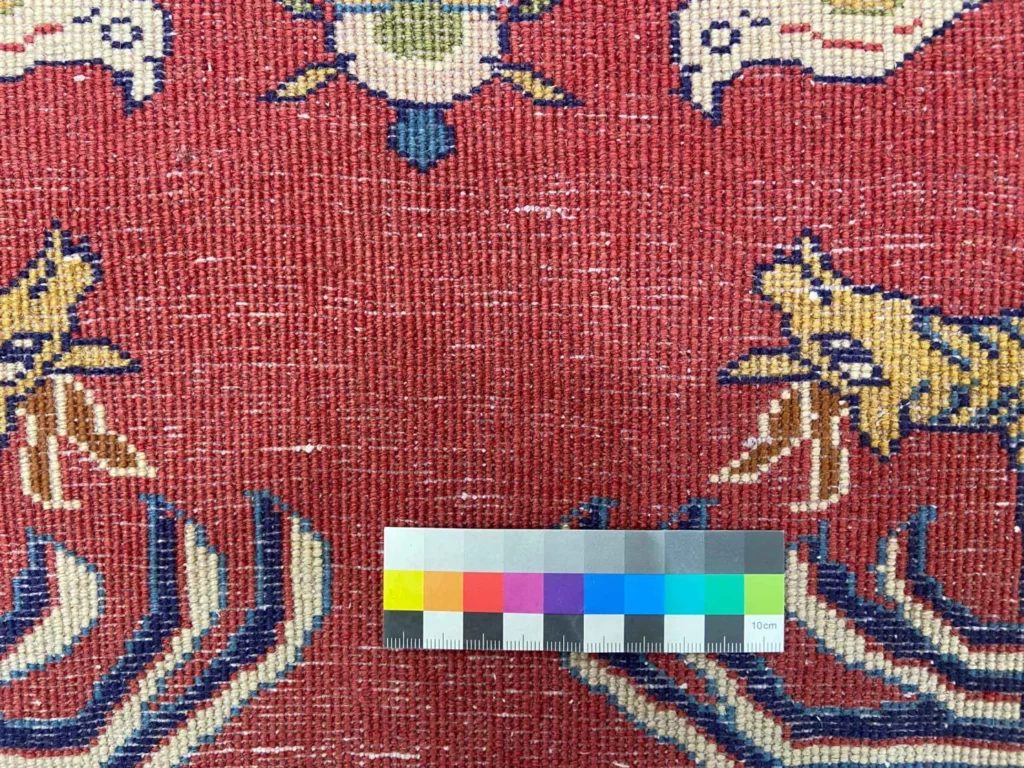
This Sarough Persian rug is hand-knotted and has a wool pile. Its knot density is 200,000 to 400,000 knots per square metre. Such construction is created by placing individual knots row by row rather than by using a machine-made process. The knotting method allows a floral composition to be built from controlled outlines, repeated elements and carefully separated areas of colour.
Wool is a traditional material in Oriental rug making. It can be spun, dyed and worked into a pile with varying degrees of density and texture. In a hand-knotted rug, the pile gives the surface its tactile character while also carrying the visible drawing. Wool is the pile material identified for this piece; no further material specification is given. The stated knot density counts the knots within a square metre and indicates the fineness of the hand-knotted construction.
Making a knotted rug combines structural work with the execution of a design. The foundation is prepared first, then the knots are tied and secured with the intervening textile elements. The surface is subsequently finished so that the design can be read clearly. In a floral Sarough composition, this sequence is important because flowers, leaves and connecting forms must retain their relationship across the field. Density is therefore only one part of the workmanship; the consistency of the drawing and the transitions between motifs also matter.
Origin and Tradition
Sarough is a Persian rug region whose name is closely associated with a distinctive tradition of floral design. Sarough rugs are commonly linked with balanced ornamental compositions and careful hand craftsmanship. The region belongs to the western and central Persian rug landscape, where different weaving communities developed regional preferences in structure, colour and pattern over many generations.
Persian rugs are shaped by local design traditions rather than by one single universal pattern. A composition may be organised around a field, a border and smaller framing elements, with recurring ornaments creating visual continuity. Designs are transmitted through drawn plans, established examples and the practical knowledge of weavers. Within this wider tradition, Sarough is especially connected with floral arrangements that bring individual botanical forms into a cohesive ornamental scheme.
Rug making in Sarough forms part of a broader Persian cultural history. Rugs served as practical textiles, interior furnishings and expressions of regional design. As trade expanded, particular weaving centres became recognised well beyond their original surroundings. Sarough rugs consequently entered international markets and came to be collected and used in many different countries.
This rug was originally made for the American market. In European trade, the term American Sarough is also used for rugs connected with this market history. The expression refers to the intended sales destination and does not establish a different weaving origin. It therefore supplements the name Sarough rather than replacing it. The rug remains a Sarough Persian rug within the regional classification of Persian hand-knotted rugs.
Sarough has attracted collectors and rug enthusiasts around the world. This appreciation is connected with the combination of regional identity, hand-knotting and a recognisable floral language. Every hand-knotted rug results from a particular relationship between a design, a colour arrangement and the decisions made during production. Even rugs that share a regional style are individual textile works rather than mechanically identical products.
Other Persian centres provide useful points of comparison without changing the origin of this rug. Tabriz is associated with highly varied classical compositions and detailed pattern work. Kashan is also known for elaborate floral designs and rich colour relationships. Nain represents another tradition, often recognised for lighter palettes and finely organised ornament. These names refer to separate regional traditions; they do not describe this Sarough rug.
Design and Pattern
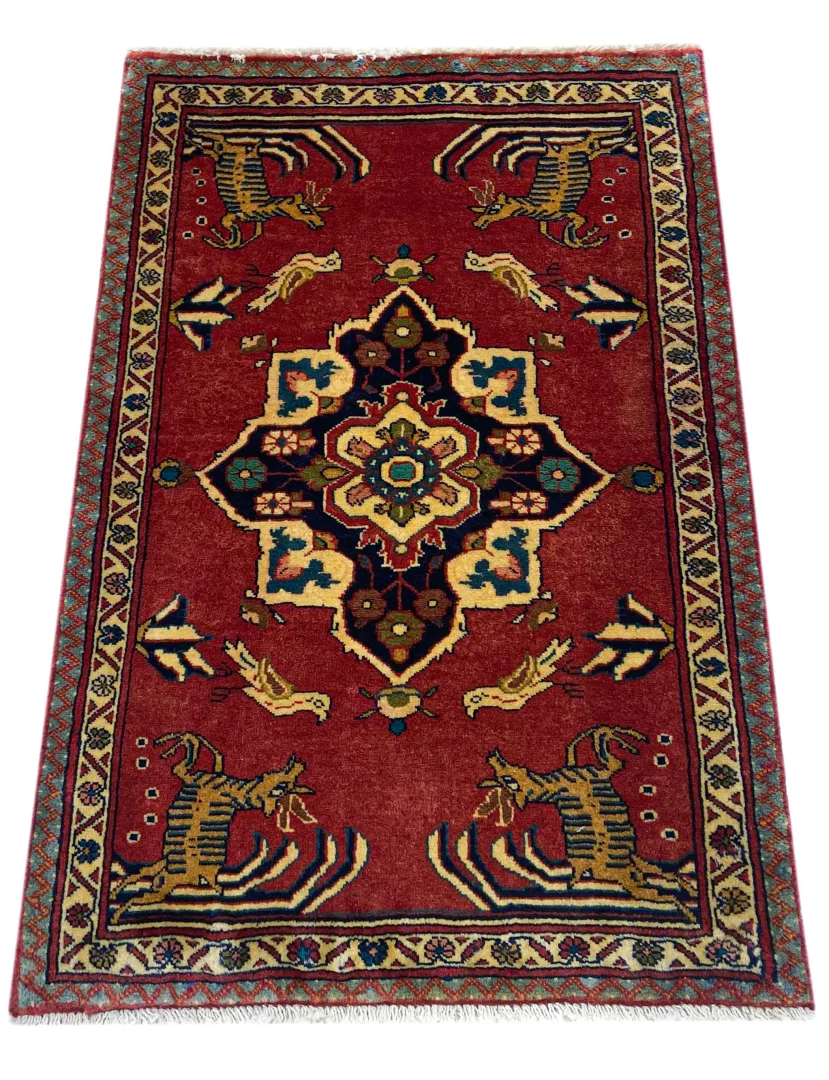
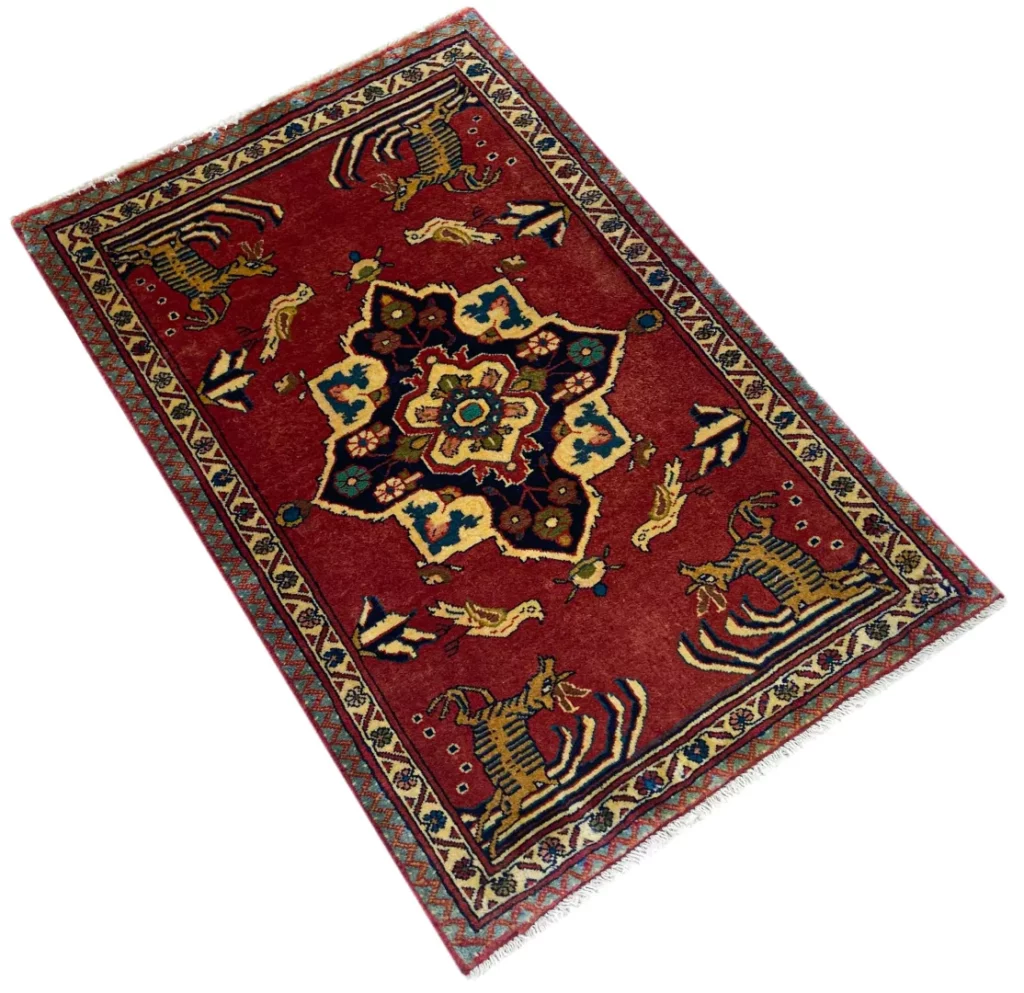
The design of this rug is floral and is set against a red ground. This colour forms the principal visual field from which the ornamental drawing emerges. A red ground can give flowers, leaves and connecting lines a clear presence, while the arrangement of the motifs leads the eye across the surface. Repetition and variation allow the design to remain unified without making every element identical.
Floral patterns are among the central forms of Persian rug art. They may suggest natural plants, but in a rug they are normally transformed into an ordered ornamental language. Flowers are stylised, leaves are given recurring contours and vines or related forms connect separate motifs. The result is not a random botanical image. It is a planned system of shapes, intervals and colour relationships adapted to a woven or knotted surface.
A floral rug can be read through the relationship between its central field and its framing areas. A border may contain the main design and establish the outer edge, while narrower borders can mediate between the field and the perimeter. The specific border structure of this piece is not described. What is established is its floral design on a red ground. The stated pattern should therefore be understood as the defining design information without adding unconfirmed individual motifs.
Knotting technique affects how a design is perceived. A finer knot density can support smaller turns, narrower outlines and more gradual changes in a drawn motif. It does not, by itself, create a pattern; the design still depends on proportion, repetition and the distribution of empty space. Sarough traditions generally use these elements to create a composed decorative field in which floral forms remain connected rather than appearing as isolated pictures.
Red is a frequent ground colour in Persian rug compositions. Its effect depends on the surrounding colours, the darkness of the outlines and the balance between ornament and open space. Deeper or more muted reds can produce different visual readings from brighter tones. This rug is described as having a red ground and a floral design. Specific secondary colours and individual flower types are not stated, so they are not assigned here.
Floral Persian designs also demonstrate how organic references can be organised through geometry. Leaves and blossoms may look natural in outline, yet their repetition, spacing and alignment are controlled. Symmetry or balanced distribution can give the field stability, while small variations prevent the composition from seeming mechanically repetitive. This interaction between botanical suggestion and disciplined ornament is a significant part of the Persian design tradition.
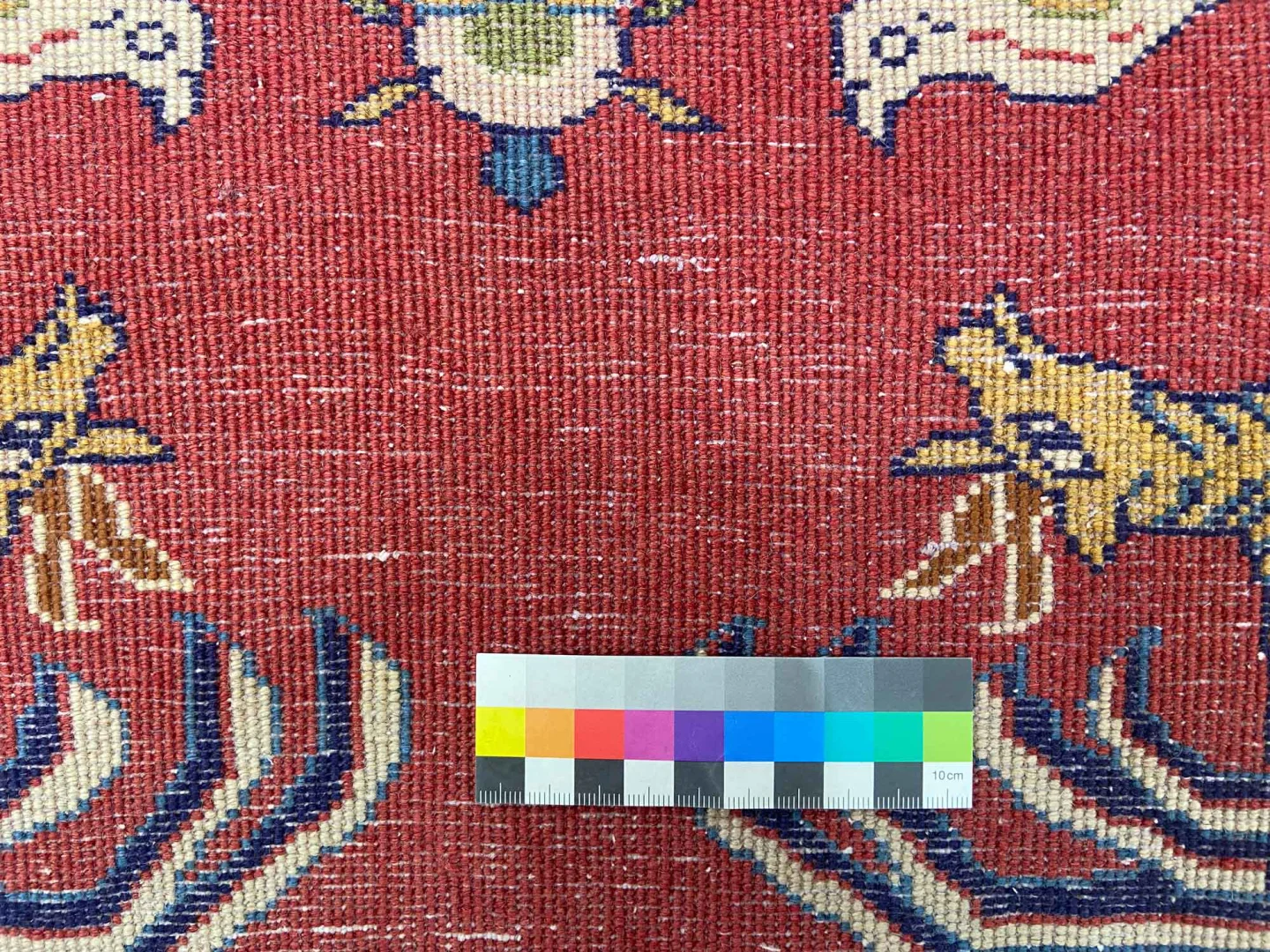
Viewing distance changes the way a hand-knotted floral rug is understood. Close observation reveals individual knots, outlines and the relationship between adjacent colour areas. From farther away, these details merge into a coherent field of colour and rhythm. The rug can therefore be read both as a detailed piece of textile craftsmanship and as a unified interior pattern. In this Sarough, the red floral field remains the central design feature at both levels.
Special Features
A notable feature of this individual rug is its original connection with the American market. In European commerce, Sarough rugs associated with that history are sometimes called American Sarough. The term describes the intended market and adds context to the regional name Sarough. It reflects the international circulation of Persian rugs and the fact that weaving centres produced pieces for particular export destinations as well as for nearby use.
The rug is also described as highly appreciated by collectors and enthusiasts worldwide. Its identifiable profile consists of Sarough origin, hand-knotted construction, wool pile, a floral design and a red ground. These characteristics belong together in the description of this one-off piece. They provide a clear account without assigning an age, condition, signature or additional material that has not been specified.
FAQ
How should I care for a Sarough Persian rug?
Regular, careful vacuuming helps remove loose dirt from the surface. The cleaning method should take account of the hand-knotted construction and wool pile. If deeper cleaning is needed, professional rug cleaning is advisable. Direct sunlight should be avoided because prolonged exposure can cause colours to fade. Strong household detergents and intensive do-it-yourself wet cleaning should not be used without appropriate specialist advice.
Where can I buy an authentic Sarough Persian rug?
Authentic Sarough Persian rugs can be found through specialist rug dealers and trustworthy online platforms that focus on handmade rugs. A reliable description should distinguish clearly between origin, technique, material, pattern and market history. For a Sarough originally made for the American market, the commercial term American Sarough should be read as a reference to the intended destination, not as evidence of a different origin.
What are the advantages of a hand-knotted Persian rug?
A hand-knotted Persian rug is an individually made textile. Because the knots are placed one at a time, each rug has its own relationship between design, colour placement and execution. Hand-knotted rugs are regarded as durable and can remain in use for a long time when properly cared for. In this Sarough, the wool pile, floral drawing and stated knot density are additional defining characteristics. Its distinction lies in the combination of traditional technique and an individual pattern arrangement.
To provide the best experiences, we use technologies like cookies to store and/or access device information. Consenting to these technologies will allow us to process data such as browsing behavior or unique IDs on this site. Not consenting or withdrawing consent, may adversely affect certain features and functions.
Functional Always active
The technical storage or access is strictly necessary for the legitimate purpose of enabling the use of a specific service explicitly requested by the subscriber or user, or for the sole purpose of carrying out the transmission of a communication over an electronic communications network.
Preferences
The technical storage or access is necessary for the legitimate purpose of storing preferences that are not requested by the subscriber or user.
Statistics
The technical storage or access that is used exclusively for statistical purposes.The technical storage or access that is used exclusively for anonymous statistical purposes. Without a subpoena, voluntary compliance on the part of your Internet Service Provider, or additional records from a third party, information stored or retrieved for this purpose alone cannot usually be used to identify you.
Marketing
The technical storage or access is required to create user profiles to send advertising, or to track the user on a website or across several websites for similar marketing purposes.

 SECURE PAYMENT
 SHIPPING PARTNERS