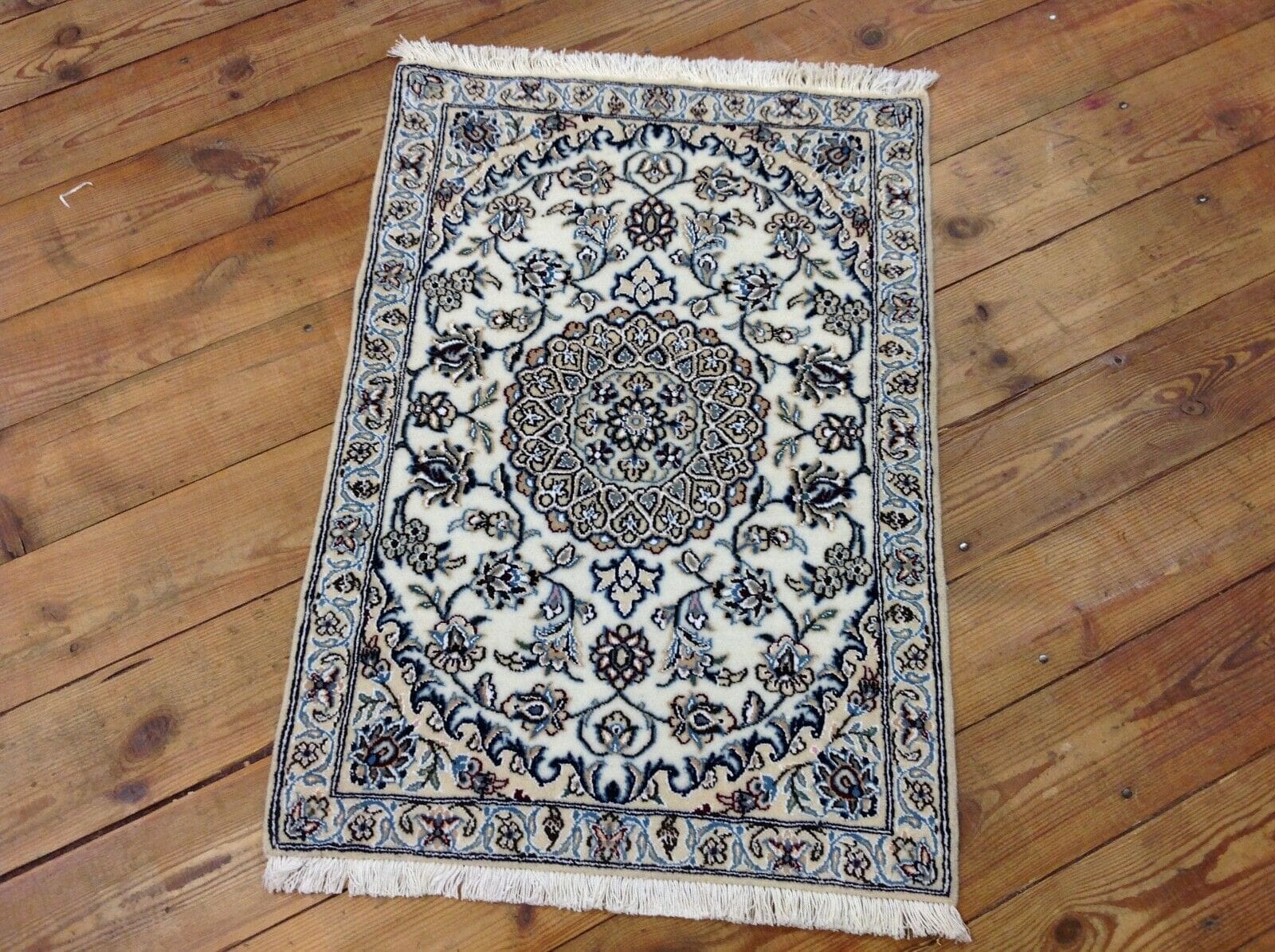
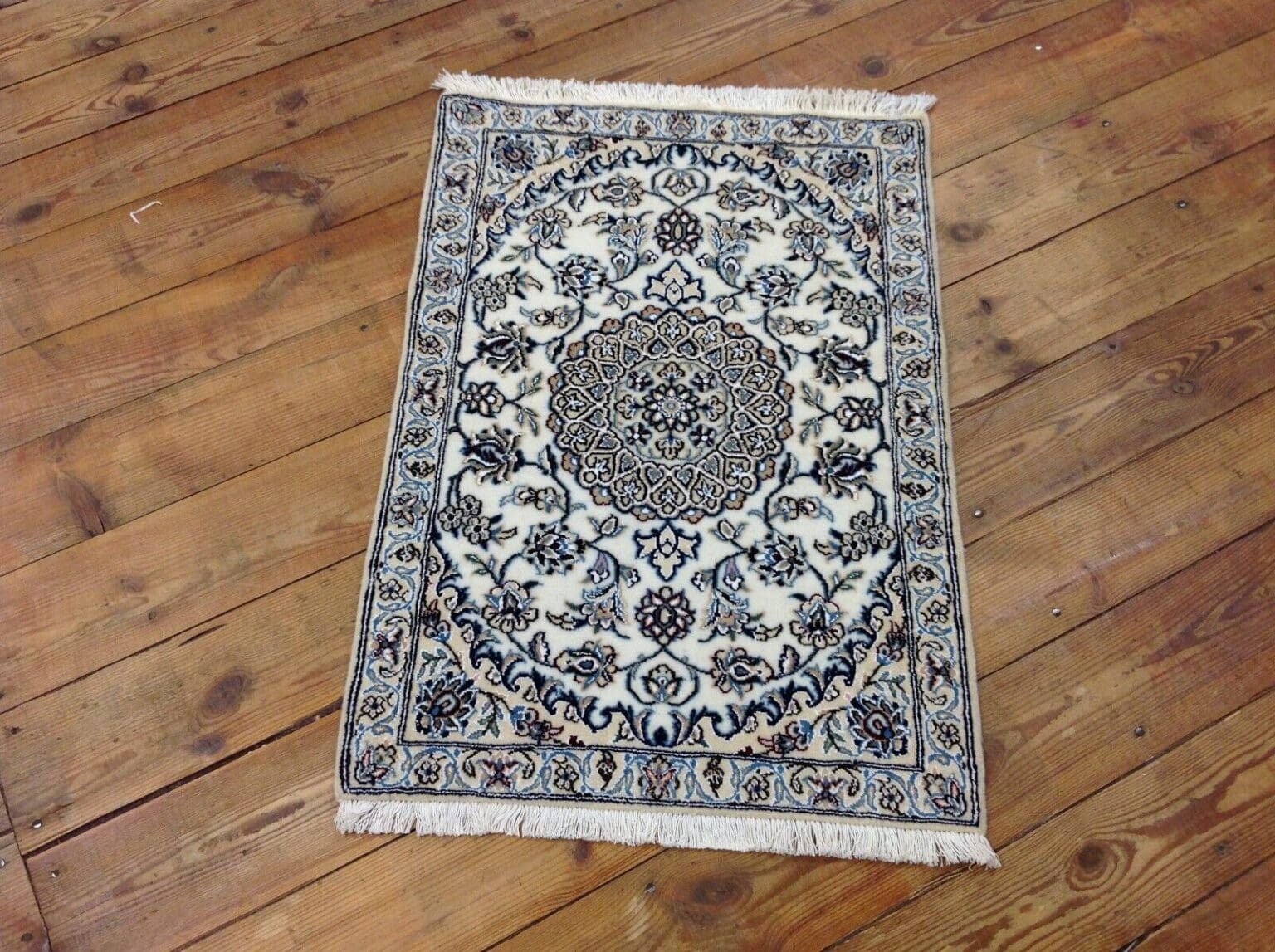
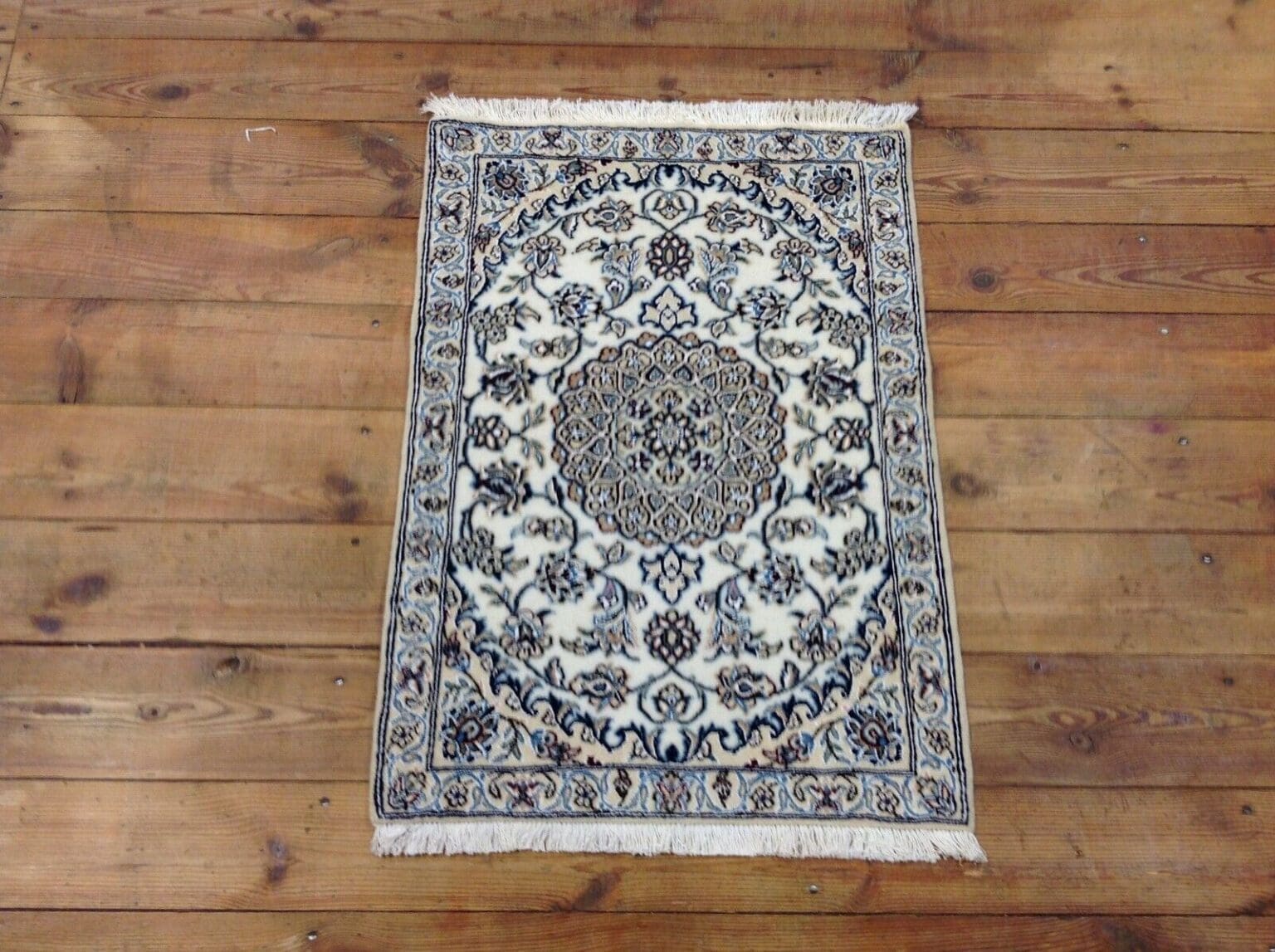
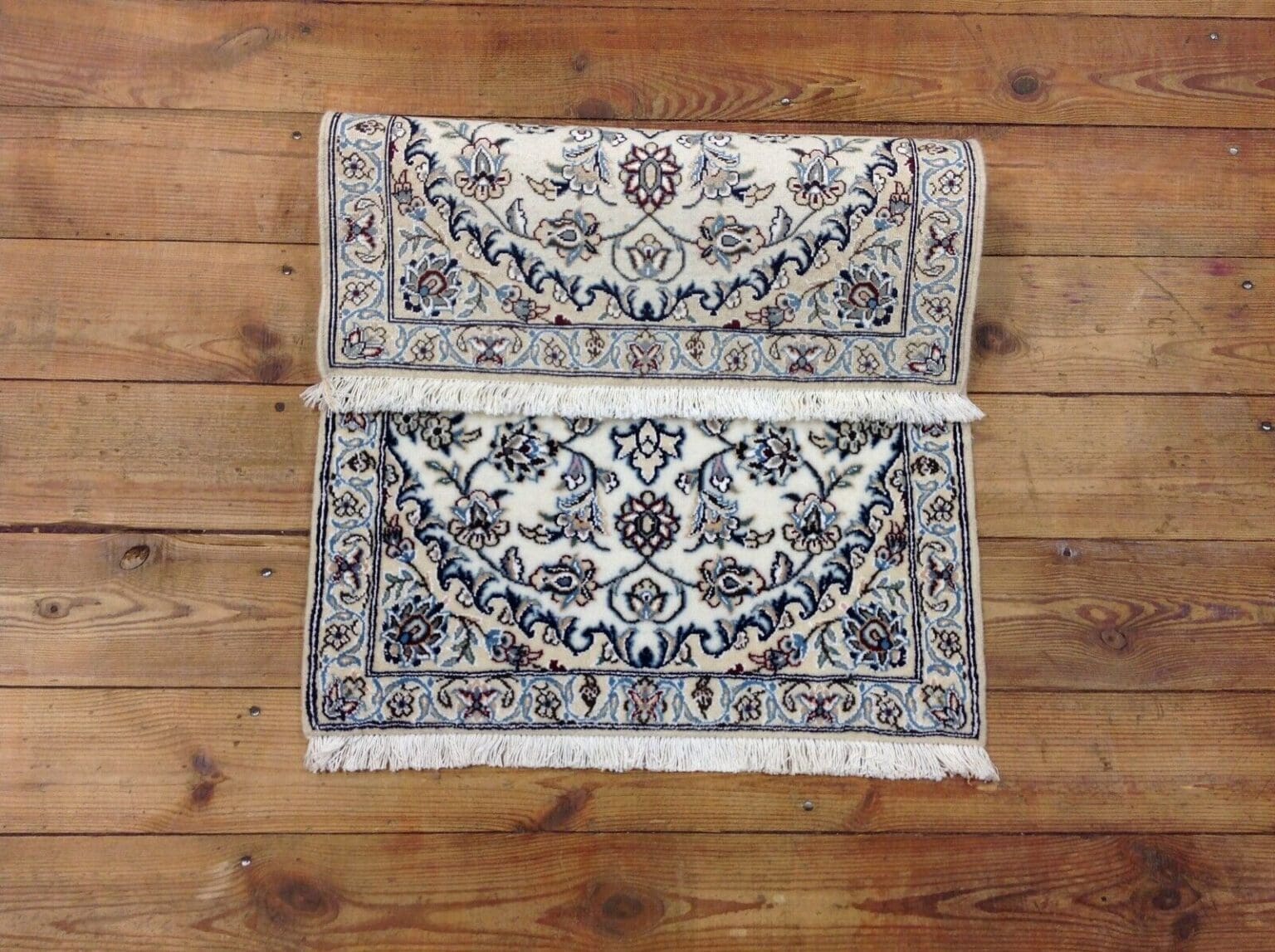
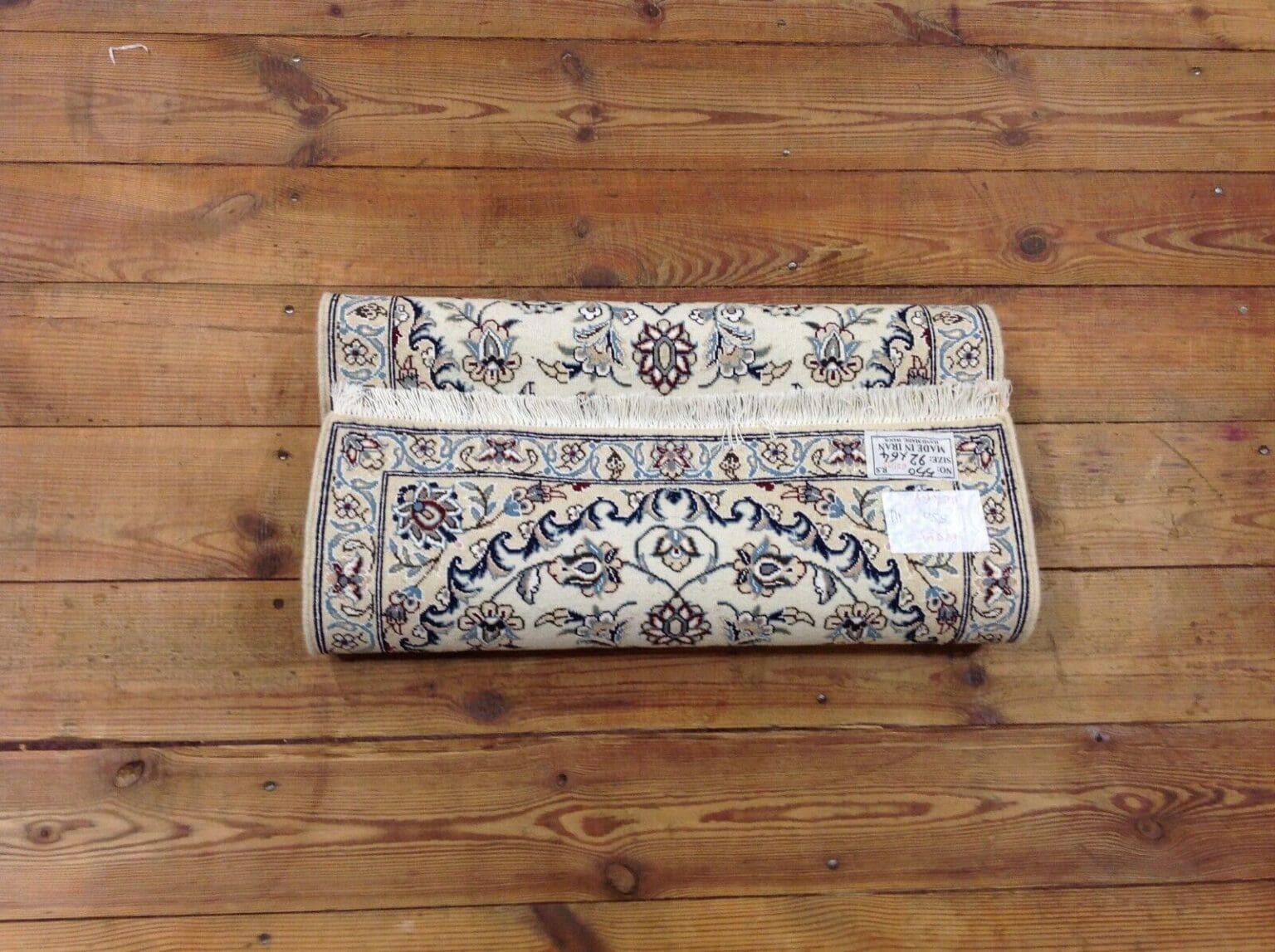
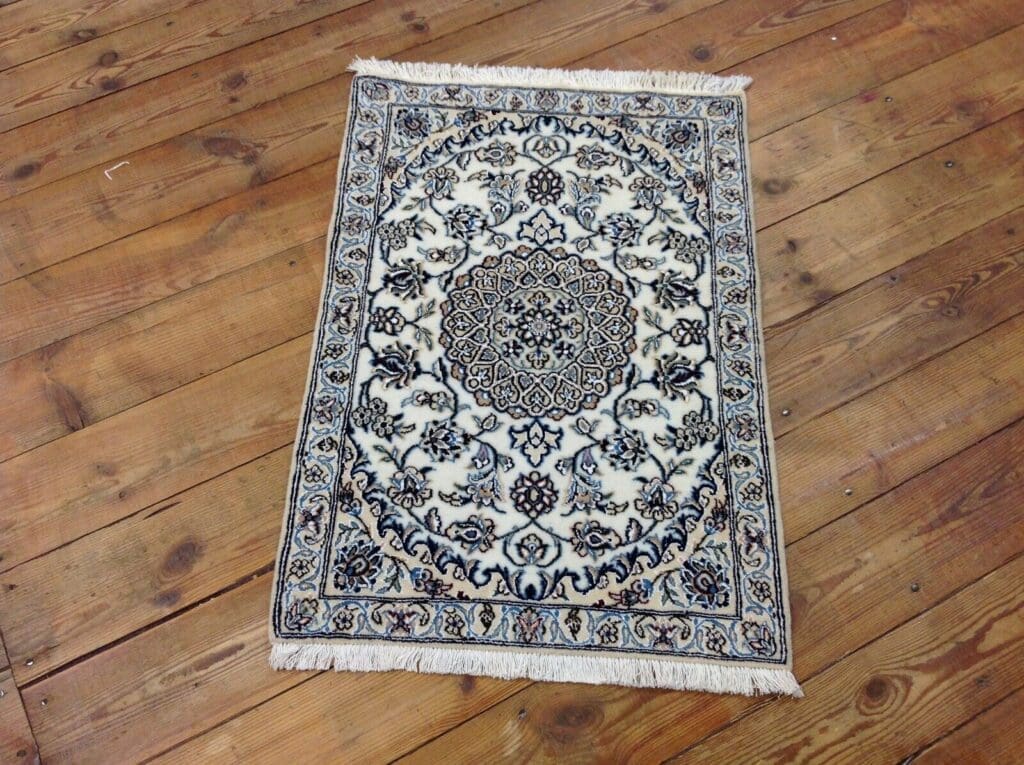
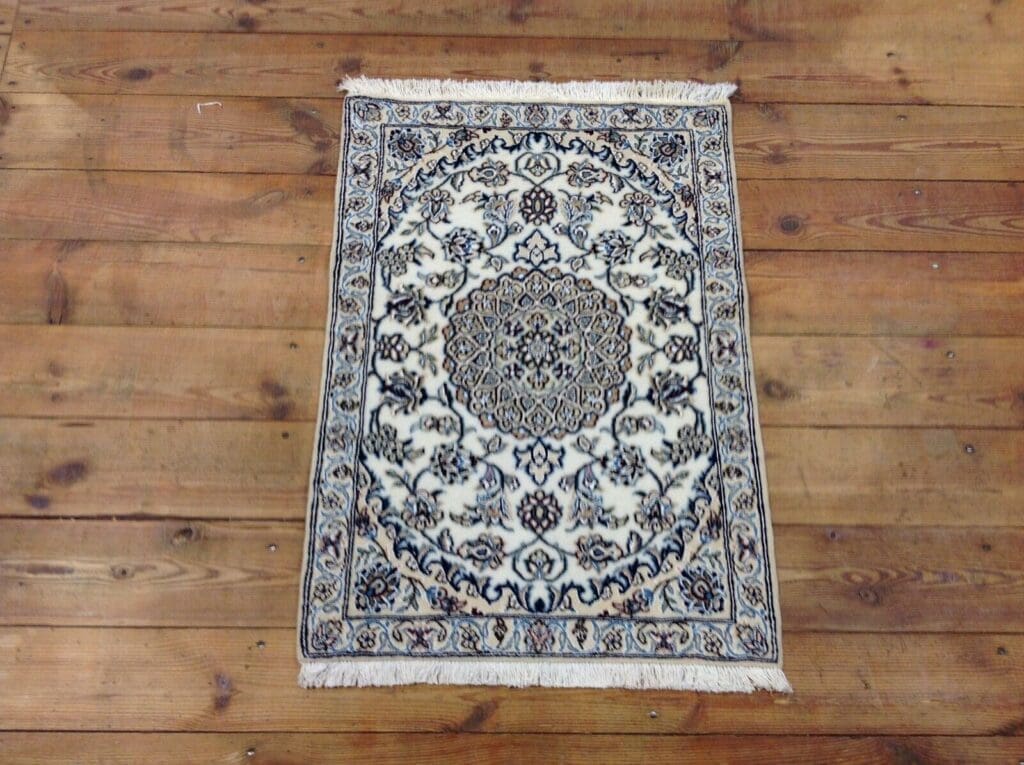
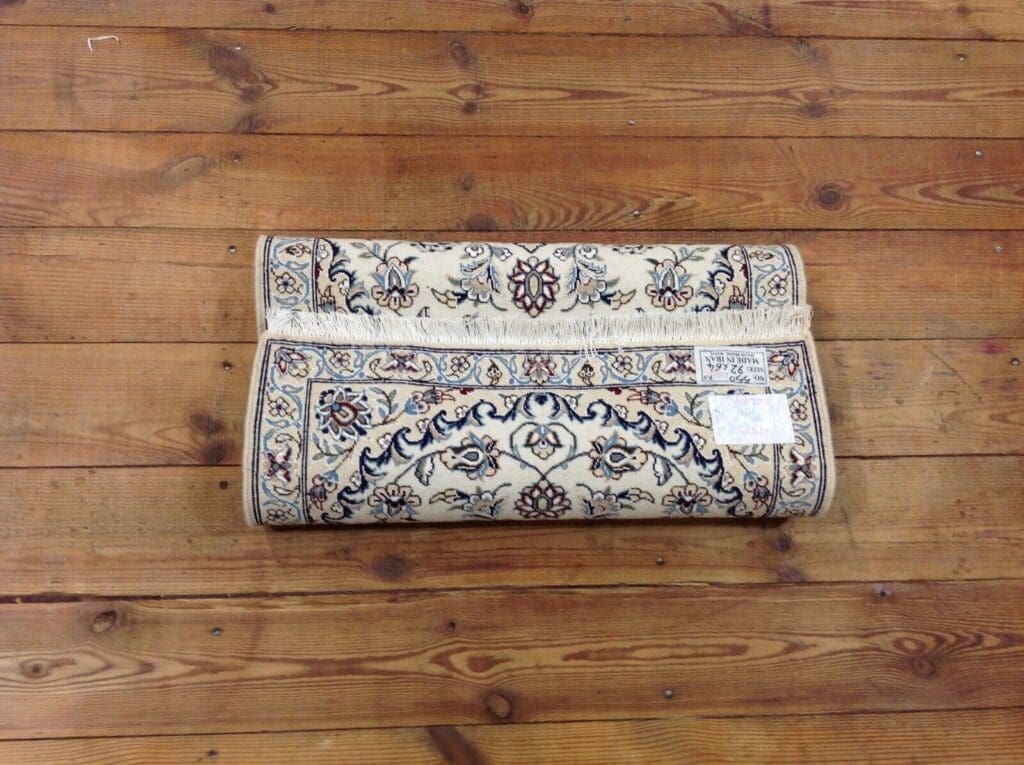
Hand-knotted Nain Persian rug | Knot density: approx. 500,000 knots/m² | Material: 90% virgin wool and 10% silk pile, 100% cotton warp | Size: 92 x 64 cm | Pattern: traditional Oriental and Persian | Condition: new, very good / perfect
This Nain Persian rug has a hand-knotted pile made from 90% virgin wool and 10% silk. Its warp is made from 100% cotton. The stated composition brings together the softness and warmth associated with wool and the fine surface sheen associated with silk. Wool forms the larger part of the pile and gives the rug a substantial textile character. The silk content adds a distinct way of reflecting light, so the surface can appear subtly different as the light changes.
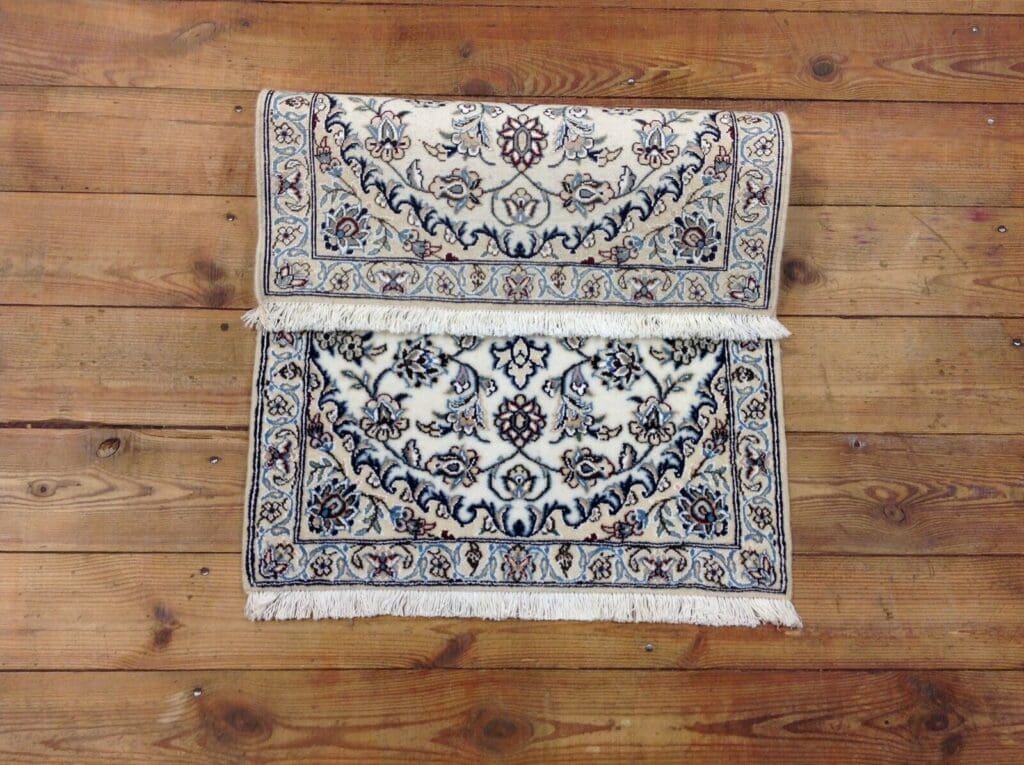
Hand-knotting means that the pile is built knot by knot on a prepared foundation. The work proceeds across the rug in successive rows, with each knot placed by hand and secured within the structure. A knot density of approximately 500,000 knots per square metre requires careful and consistent work. Fine outlines, small ornamental elements and transitions between colour areas can be rendered with considerable definition when the design is translated into such a dense field of knots.
The cotton warp provides the lengthwise foundation, while wool and silk are used in the visible pile. This combination is established in the production of fine Persian rugs. The wool contributes a soft, comfortable feel and the silk introduces a restrained lustre. Because the rug is hand-knotted, the finished piece is an individual textile rather than a mass-produced floor covering. It is identified as a one-off and comes with a rug certificate.
Origin and Tradition
The rug comes from Persia, present-day Iran, and is assigned to Nain. Nain is a city in Isfahan Province and is recognised as one of the established centres of Persian rug making. The region developed a distinctive weaving culture in which careful drawing, fine knotting and balanced ornament play an important role. Its historical position within Iran connected local workshops with wider traditions of Persian textile design and craftsmanship.
Nain rugs are associated with precise workmanship and clearly organised compositions. The knowledge required to produce them includes the preparation of the foundation, the selection of yarn, the reading of a design and the controlled placement of each knot. These skills were developed and transmitted through workshop practice over generations. A finished rug therefore reflects more than a surface pattern: it records a sequence of technical decisions, from the warp and foundation to the final treatment of the pile.
The regional tradition is also known for its measured use of ornament. Nain designs often make individual motifs easy to read instead of filling every area with equal visual weight. Floral details, scrolling vines and geometric ordering can work together within a disciplined layout. Borders frame the central field, while smaller bands help establish transitions between the main design and the outer edge. This gives the composition a calm and structured character associated with Nain production.
Persian rug making combines drawing and structure. Before the knotting begins, a design establishes the arrangement of the field, borders, colours and repeating elements. The weaver then interprets that plan row by row. The foundation must remain stable while the pile is built, and the tension must be kept consistent throughout the work. Hand-knotting is consequently both a design process and a technical process. In Nain, this method is used to achieve detailed ornament with a clean, ordered appearance.
The designation Nain refers to the rug’s regional origin and tradition, while Persian rug identifies its Iranian provenance. It should not be confused with a general Oriental design label. Oriental rug traditions include many different weaving regions, but each area has its own methods, drawing conventions and material practices. Nain belongs specifically to the Persian branch of this wider textile history. The combination of a fine hand-knotted construction and a carefully arranged pattern is central to that identity.
Regional rug traditions also depend on the relationship between use and design. A rug must be constructed as a durable textile, yet its surface is developed as an ornamental composition. In Nain work, this balance is expressed through a compact knot structure and detailed pattern drawing. The result is a textile that can be read from a distance as an ordered whole and from close range through its smaller lines and motifs. This relationship between practical construction and decorative design is a lasting feature of Persian rug culture.
Design and Pattern
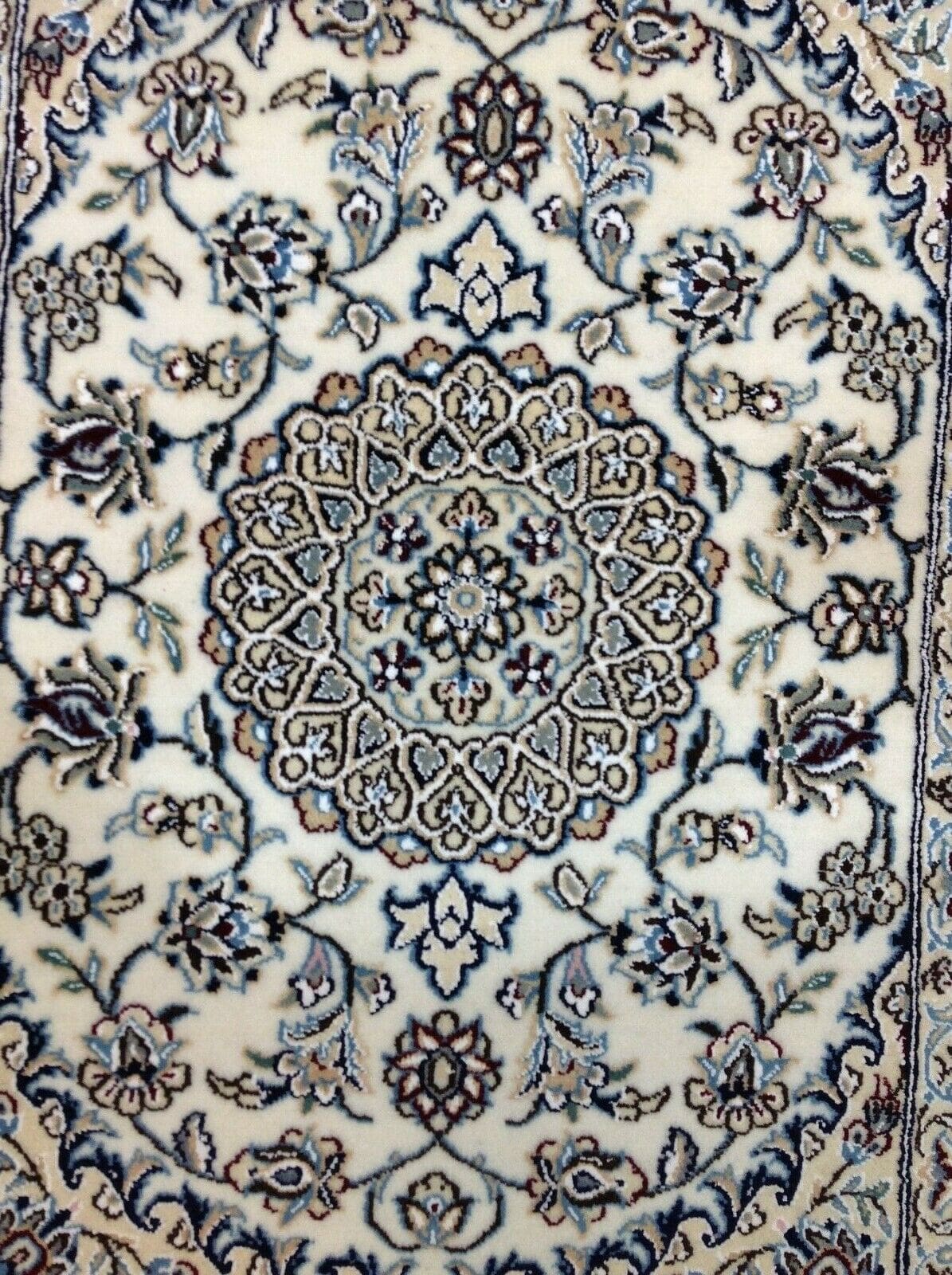
This rug is described as traditional Oriental and Persian in style. That classification places it within a design language built from floral ornament, geometric organisation and repeated relationships. Nain patterns are known for fine detail and controlled drawing. Flowers, leaves, vines and arabesque forms may be arranged around a central organisation, while geometric lines provide proportion and structure. The design is created by the interaction of all these elements rather than by one isolated motif.
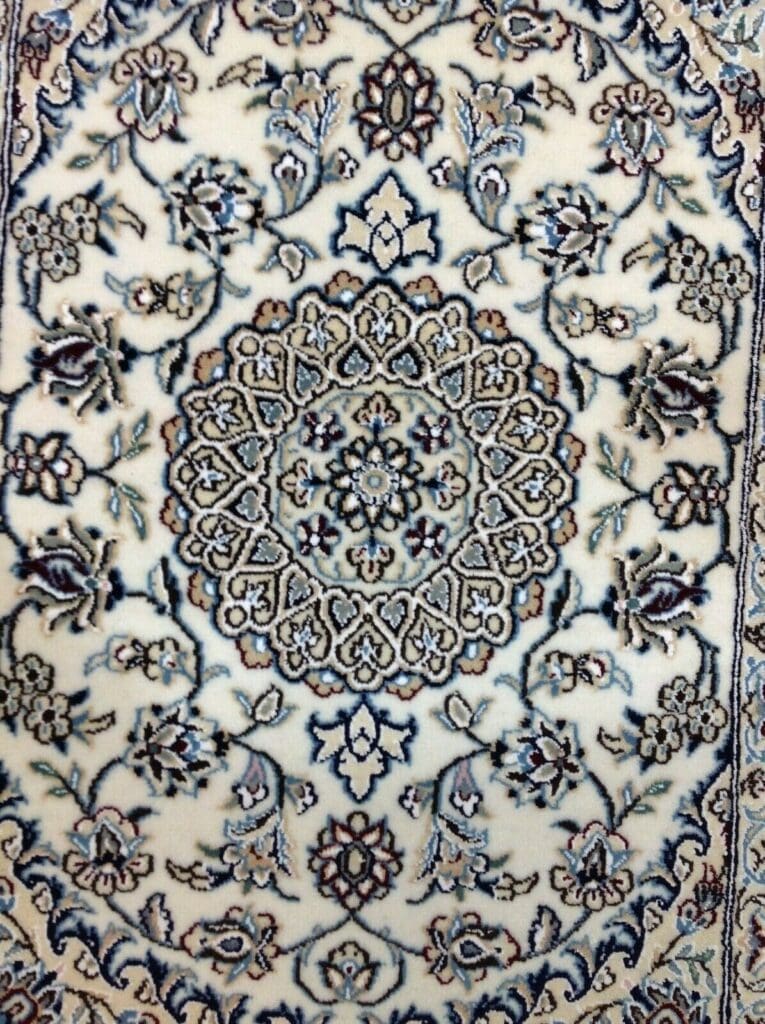
Floral Persian ornament is generally based on stylised natural forms. A blossom can be reduced to a measured group of petals, and a vine can be transformed into a continuous line that links several motifs. Leaves may be mirrored, repeated or placed along a scrolling stem. Such forms are not copied as botanical illustrations; they are adapted to the geometry of the rug. This makes it possible for the pattern to flow across a field while retaining balance and visual order.
Fine knotting supports the presentation of detailed pattern work. At a high knot density, narrow contours and small areas of colour can be placed closely together. The silk in the pile can add a slight change in surface reflection, while the wool gives the ornament visual body. Together, these materials allow the design to show both line and texture. The effect is especially relevant to Nain’s tradition of legible, finely drawn Persian decoration.
Many Persian compositions are organised through a central field and one or more borders. The field carries the principal ornament, and the border establishes a visual frame. Secondary bands can repeat or simplify elements from the main design, creating continuity between the centre and the edges. Other Persian patterns use an all-over arrangement in which motifs are distributed across the field. These design principles provide a flexible vocabulary for Nain workshops and help explain the ordered character of their traditional patterns.
Colour in Nain design is often discussed in terms of harmony and restraint. Soft, coordinated tones can separate the field from its border without breaking the continuity of the composition. Light interacts with wool and silk differently, so the same colour may reveal a varied surface depending on the viewing angle. The pattern therefore depends not only on drawn lines but also on the way yarn, knot density and light work together.
The pattern tradition has a long connection with Persian art. Floral scrolls, arabesques and geometric divisions have appeared in architecture, manuscripts, textiles and carpets, where they have been adapted to different surfaces. In a hand-knotted rug, the design becomes a durable woven image made from thousands of individual knots. This transformation gives the ornament a tactile quality and makes the structure of the textile part of its visual language.
Special Features
The rug is hand-knotted, making its construction a manual process in which the pile is formed one knot at a time. It is described as a one-off and is supplied with a rug certificate. The pile consists of 90% virgin wool and 10% silk, with a 100% cotton warp. Its Nain assignment connects the individual piece to a recognised Persian weaving tradition.
The rug is new and described as being in very good or perfect condition. It is therefore presented as a new hand-knotted piece rather than a used rug with documented signs of age. Its distinguishing features are the Iranian origin, the Nain tradition, the stated fibre composition and the fine hand-crafted construction.
FAQ
How should I care for this Oriental rug?
Vacuum regularly using a low setting to remove dust and loose dirt without placing unnecessary stress on the pile. Avoid direct sunlight, since prolonged exposure can cause colours to fade. Blot spills promptly with a damp cloth rather than rubbing them into the fibres. Do not use harsh cleaning products. For more serious soiling, professional rug cleaning is the appropriate approach.
Where can the rug be placed?
The Nain Persian rug can be used in a living room or dining room, and it is also suitable for a bedroom or hallway. It can serve as a textile element within the room’s layout and help define a particular area. To support long-term preservation, place it where it will not receive excessive wear. A suitable rug pad can help keep it stable and support everyday use.
What size works best in my home?
Begin by measuring the available floor area and considering the position of furniture and walking routes. Smaller rugs can function as accent pieces or work well in an entrance, while larger formats can organise a living or dining area. The right choice depends on the proportions of the room and the space that should remain visible around the rug. A balanced relationship between rug, furniture and open floor creates a coherent arrangement.
To provide the best experiences, we use technologies like cookies to store and/or access device information. Consenting to these technologies will allow us to process data such as browsing behavior or unique IDs on this site. Not consenting or withdrawing consent, may adversely affect certain features and functions.
Functional Always active
The technical storage or access is strictly necessary for the legitimate purpose of enabling the use of a specific service explicitly requested by the subscriber or user, or for the sole purpose of carrying out the transmission of a communication over an electronic communications network.
Preferences
The technical storage or access is necessary for the legitimate purpose of storing preferences that are not requested by the subscriber or user.
Statistics
The technical storage or access that is used exclusively for statistical purposes.The technical storage or access that is used exclusively for anonymous statistical purposes. Without a subpoena, voluntary compliance on the part of your Internet Service Provider, or additional records from a third party, information stored or retrieved for this purpose alone cannot usually be used to identify you.
Marketing
The technical storage or access is required to create user profiles to send advertising, or to track the user on a website or across several websites for similar marketing purposes.
 SECURE PAYMENT
 SHIPPING PARTNERS