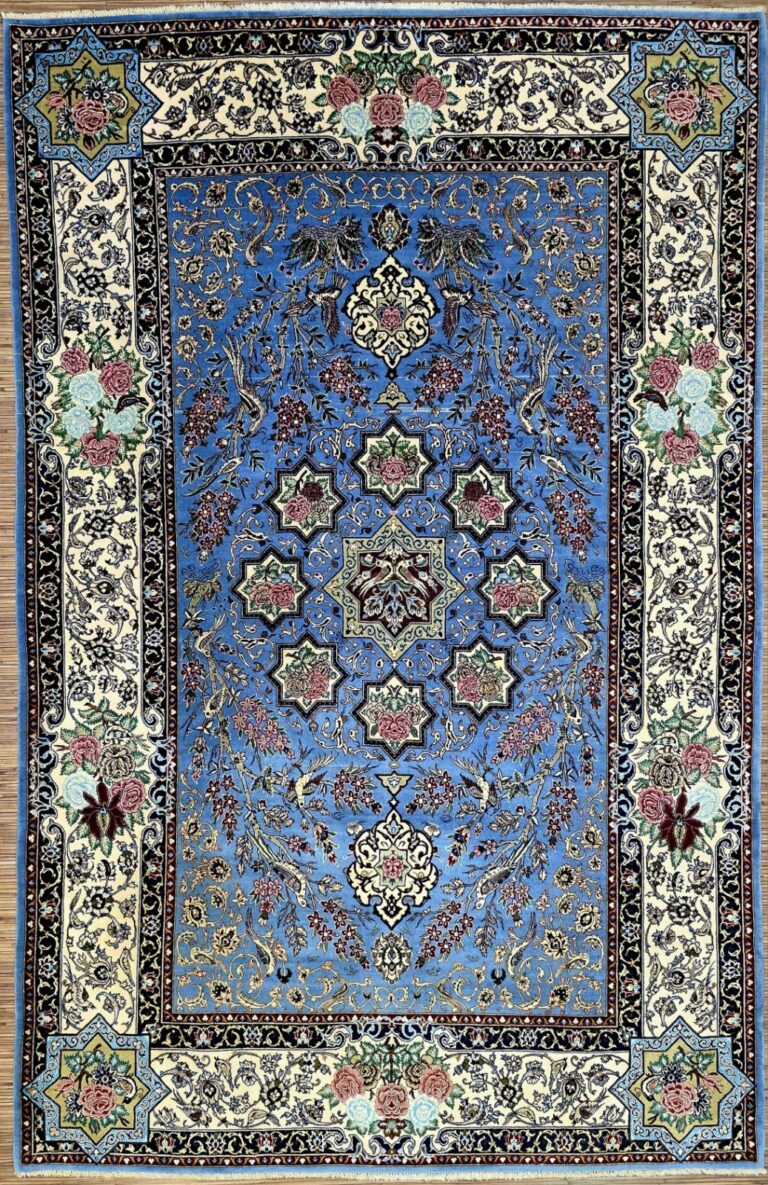
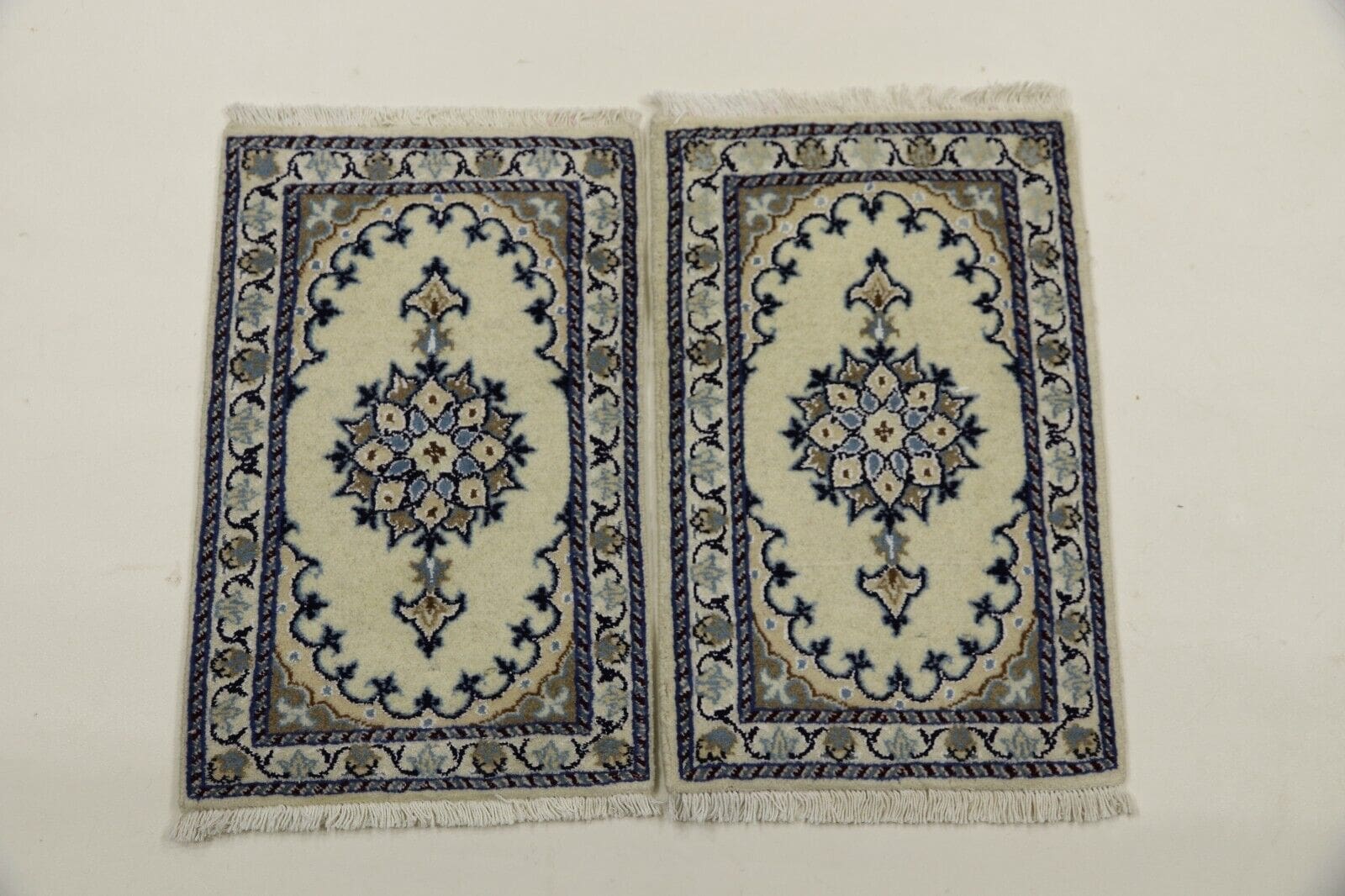
This Nain Persian Rug is hand-knotted with a pile made of 95% virgin wool and 5% silk. Virgin wool has long been used in oriental rugs because it creates a resilient surface with a pleasant textile feel. In a knotted pile, individual knots are placed closely together and held within the foundation. This construction allows outlines, small ornaments and transitions in the design to be worked out with precision. Wool forms the principal pile material in this rug, while silk is present as a complementary fibre that adds a finer character and a smoother handle.
The rug is made entirely by hand. In hand-knotting, each knot is placed separately and secured as the subsequent rows are built. This is different from a machine-made rug, where the design is produced through mechanically repeated processes. A knot density of approximately 300,000 knots per square metre permits a detailed rendering of the design and reflects the considerable amount of manual work involved in a finely knotted Persian rug. The result is not produced by printing or by applying a pattern to a finished surface; the design is formed within the structure of the pile itself.
The character of such a rug comes from the relationship between knotting, pile and the selected fibres. Wool provides the main body of the pile, while silk contributes to the stated material combination. The hand-worked structure gives the surface its own textile presence. The description of the rug as a one-off identifies it as an individual piece rather than a replaceable item from a uniform series. Its craftsmanship can therefore be understood through both the traditional technique and the particular execution of this single rug.
Origin and Tradition
This rug comes from Persia and is identified as a Nain Persian Rug. Nain is a city in Iran known for its fine rugs. The town belongs to the wider Persian weaving tradition, while its rugs are associated with a recognisable approach to delicate drawing, ordered composition and careful workmanship. In Persian rug culture, origin refers to more than a point on a map. It also relates to the local knowledge of preparing the foundation, arranging colours, interpreting ornaments and building a coherent design through hand-knotting.
The tradition of rug making in Nain reaches back to the sixteenth century. Skills connected with knotting, tension, colour arrangement and pattern drawing were passed on through generations of craft practice. A rug is developed through a sequence of related tasks: the foundation is prepared, knots are inserted, weft threads help secure the rows, and the pile is later evened and finished. The visible surface is therefore the result of many stages rather than one isolated act. Hand-knotting preserves the connection between the maker, the drawing and the physical structure of the rug.
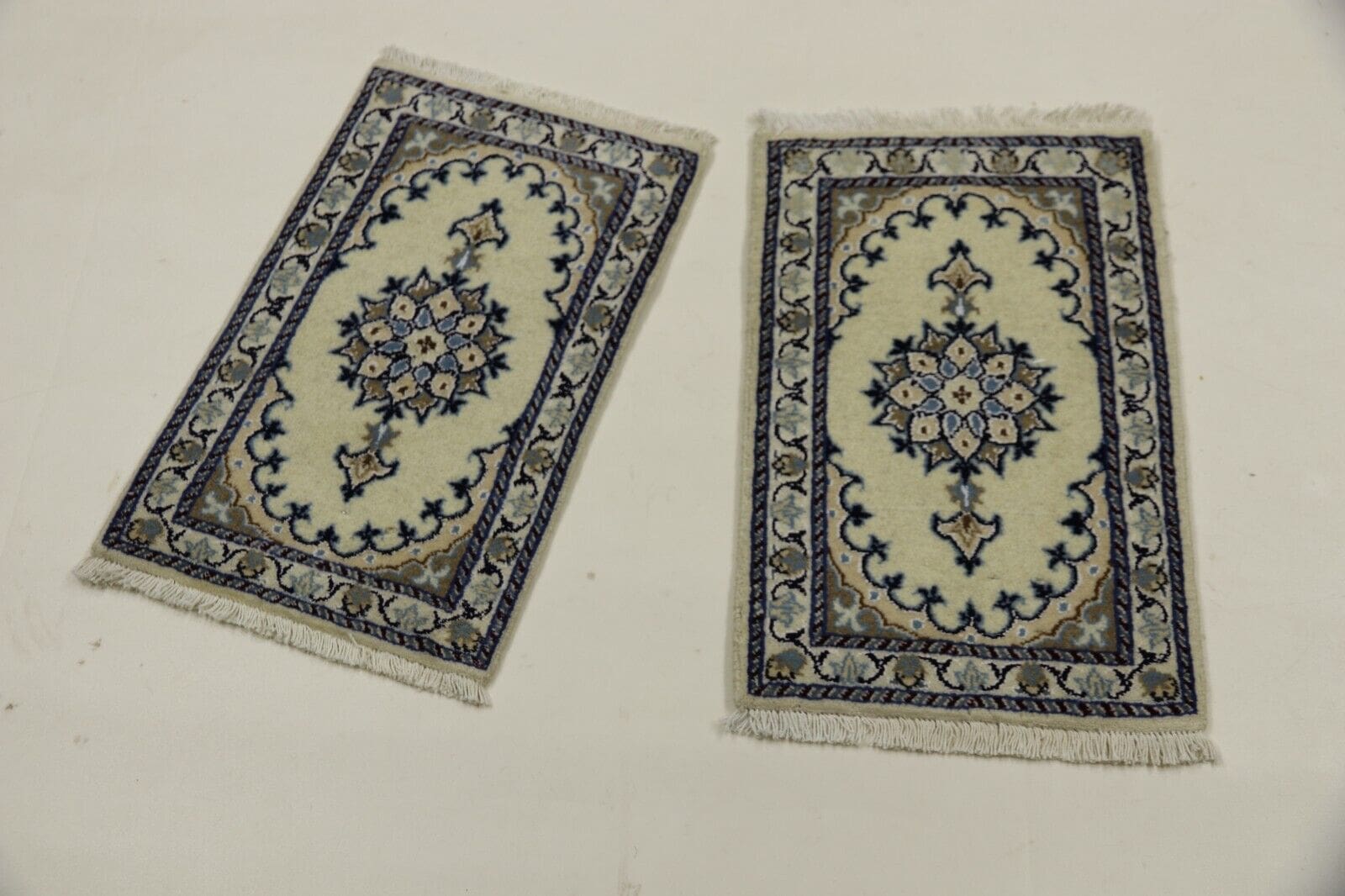
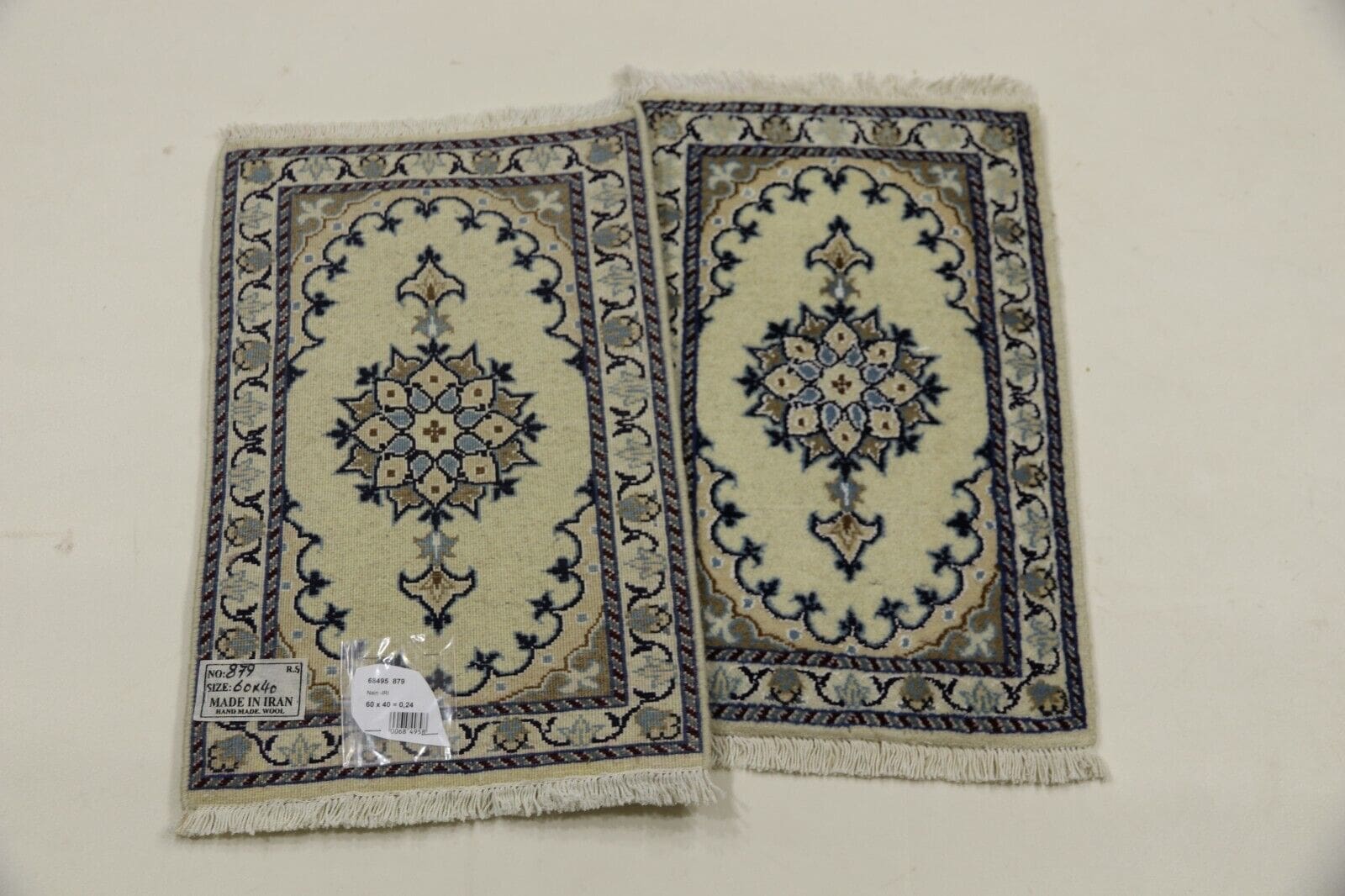
Nain rugs are often associated with floral motifs and geometric patterns. They are also known for light, harmonious colour palettes and fine details. These qualities create a visual language in which carefully arranged plant forms, balanced borders and geometric organisation can work together. Many ornaments draw on symbols from Persian culture and art. Their meaning may be understood through the long history of Persian decorative design, in which natural forms are stylised, repeated and placed within a balanced field.
Persian weaving includes many regional centres, each with its own methods and design preferences. Nain occupies a distinct place within this tradition. Fine knotting supports a high level of detail, while the manual process ensures that each finished rug remains an individually made textile object. Regional identity does not mean that every rug has exactly the same pattern. Rather, it describes a group of established technical and artistic conventions that can be interpreted in different individual compositions.
The use of virgin wool and silk connects this rug to the material practice of fine hand-knotted weaving. The knotting method, the close surface structure and the regional design language all belong to the heritage of Persian rugs. At the same time, the designation as a one-off is important: this particular piece is offered as a single work, not as a duplicated product. Its origin and tradition are therefore present both in the Nain attribution and in the hand-made method by which the rug has been produced.
Design and Pattern
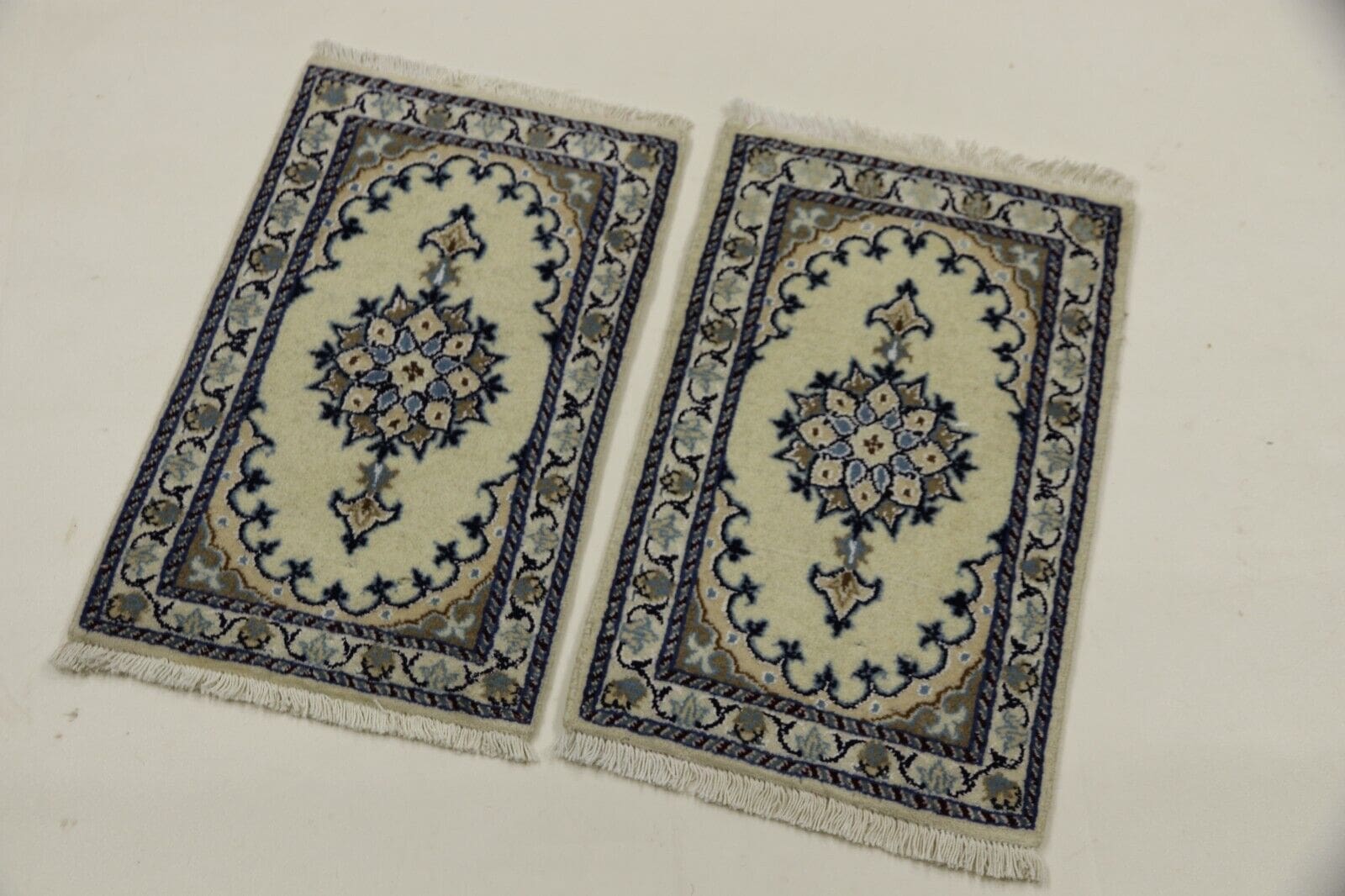
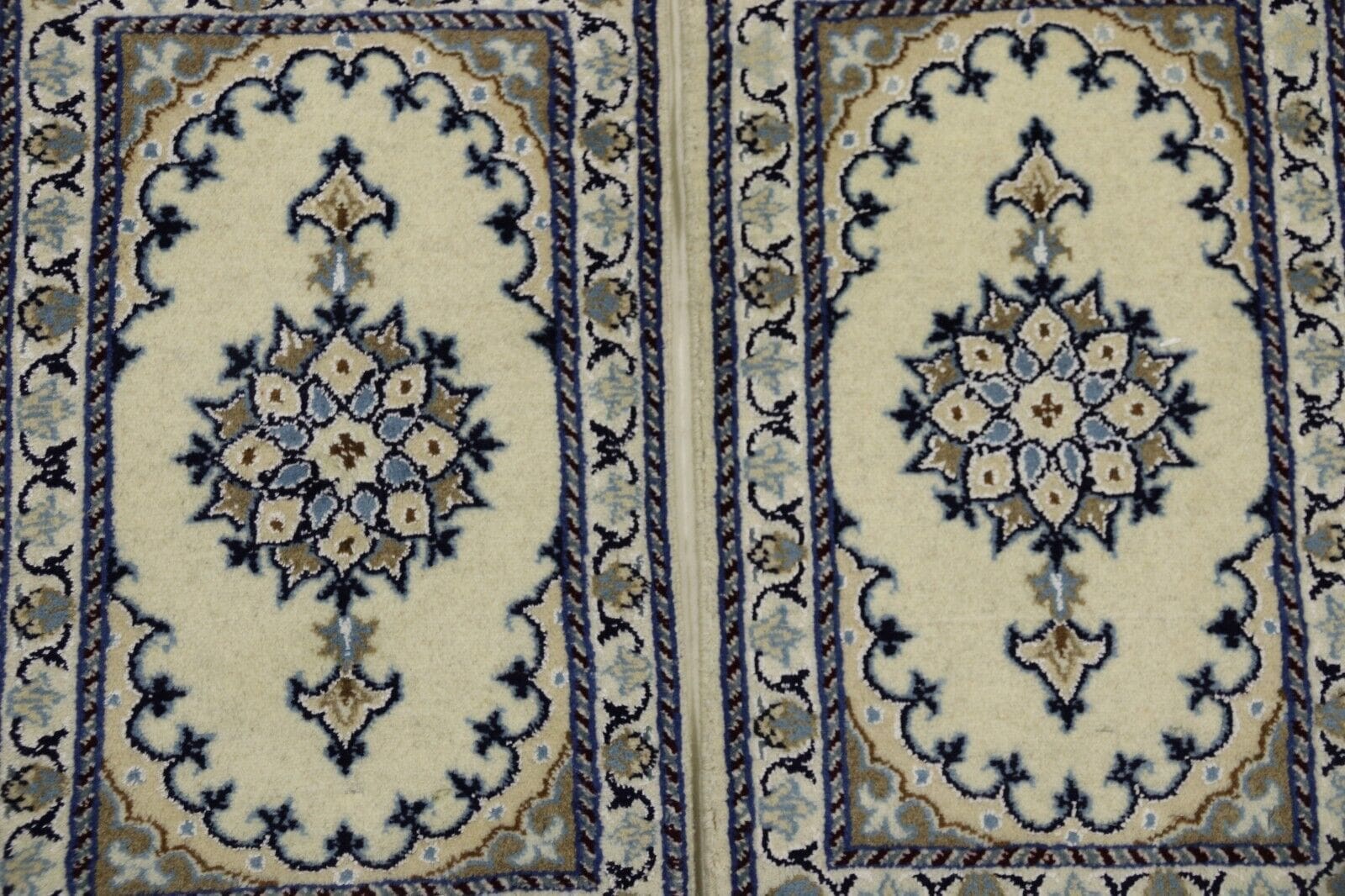
The design vocabulary associated with Nain includes classical medallions, floral compositions and geometric elements. A medallion may establish a central point within the field, while floral branches and leaves guide the eye across the surrounding space. Geometric forms introduce measured lines, repeated intervals and clear boundaries. Persian ornament often transforms natural shapes into stylised motifs, allowing flowers, leaves and vines to become part of a rhythmic surface rather than a literal botanical image.
Many Persian rugs are organised through a relationship between a central field and surrounding borders. The field carries the main composition, while the border frames it and gives the design a visual conclusion. Narrower guard borders can mediate between the centre and the outer edge. This arrangement creates order across the textile and helps separate individual motifs without isolating them from the overall composition. It is a general principle of Persian rug design and can accommodate both floral detail and geometric structure.
Floral patterns often use repeated vines, blossoms and leaves. These may be arranged symmetrically, reflected around an axis or distributed in a balanced all-over design. Geometric details provide definition and help establish the rhythm of the composition. The fine knotting associated with this rug supports the rendering of small ornamental parts and precise contours. It allows a design to move beyond broad colour blocks into a more articulated drawing of lines, spaces and repeated forms.
This rug is described as having a timeless design. That description indicates a composition intended to remain compatible with both modern and traditional interiors rather than being tied solely to a short-lived decorative trend. Its Persian character remains visible through the regional design vocabulary and the hand-knotted technique. The combination of wool and silk, the fine knotting and the balanced approach to ornament give the piece a clearly defined textile identity.
A rug pattern is read as a complete arrangement, not only as a collection of separate symbols. The centre, field, border, colour areas and contours must work together to create rhythm and orientation. Persian design traditions use these components to combine calm structure with decorative detail. Floral and geometric elements can therefore appear together while retaining their different visual roles. As a one-off, this rug represents one individual interpretation within the broader Nain tradition.
Special Features
The rug is new and is described as being in very good, top condition. It is stated to be unused and flawless. It is also a one-off and comes with a certificate of authenticity. The certificate accompanies the rug as documentation of its authenticity. Another specifically stated feature is suitability for underfloor heating. This makes that installation option part of the product information. The hand-knotted construction, the pile composition of virgin wool and silk, and the fine knot density complete the defining features of this individual Nain rug.
FAQ
What is the best way to clean and care for my Nain Persian Rug?
Regular vacuuming on a low setting is recommended for removing loose dust while treating the pile gently. If a spill occurs, the mark should be addressed immediately with a damp cloth and a suitable carpet cleaner. Vigorous rubbing can put unnecessary stress on the pile and may disturb the surface, so careful dabbing is preferable. Professional rug cleaning every few years is also recommended. Because this rug has a hand-knotted pile made from virgin wool and silk, a specialist service is appropriate for choosing a method that respects both fibres and the construction.
Why do Persian rugs have a high knot density?
A high knot density results from placing a large number of individual knots within the foundation through a slow, careful process. This rug has approximately 300,000 knots per square metre. Closely set knots make it possible to render small motifs, fine outlines and intricate transitions with greater precision. Knot density is therefore an important technical indication of the work invested in a hand-knotted rug. It is not the only factor that defines quality, however: fibre, colour arrangement, drawing, condition, origin and overall workmanship also matter. In Nain rugs, fine knotting supports the detailed regional style for which these pieces are known.
Why can Persian rugs be considered a good investment?
Persian rugs combine practical use, design and traditional manual work. Their significance is connected with the making process, the materials and the regional history associated with places such as Nain. A hand-knotted rug can function as a durable furnishing textile while also representing a distinct form of textile craftsmanship. Whether its financial value changes over time depends on several factors, including workmanship, fibre, pattern, condition, origin and demand. This particular rug is new, in very good condition, presented as a one-off and accompanied by a certificate of authenticity. Those features give it the character of an individual collectible with documented authenticity and a clear place within the Nain Persian rug tradition.
To provide the best experiences, we use technologies like cookies to store and/or access device information. Consenting to these technologies will allow us to process data such as browsing behavior or unique IDs on this site. Not consenting or withdrawing consent, may adversely affect certain features and functions.
Functional Always active
The technical storage or access is strictly necessary for the legitimate purpose of enabling the use of a specific service explicitly requested by the subscriber or user, or for the sole purpose of carrying out the transmission of a communication over an electronic communications network.
Preferences
The technical storage or access is necessary for the legitimate purpose of storing preferences that are not requested by the subscriber or user.
Statistics
The technical storage or access that is used exclusively for statistical purposes.The technical storage or access that is used exclusively for anonymous statistical purposes. Without a subpoena, voluntary compliance on the part of your Internet Service Provider, or additional records from a third party, information stored or retrieved for this purpose alone cannot usually be used to identify you.
Marketing
The technical storage or access is required to create user profiles to send advertising, or to track the user on a website or across several websites for similar marketing purposes.
 SECURE PAYMENT
 SHIPPING PARTNERS