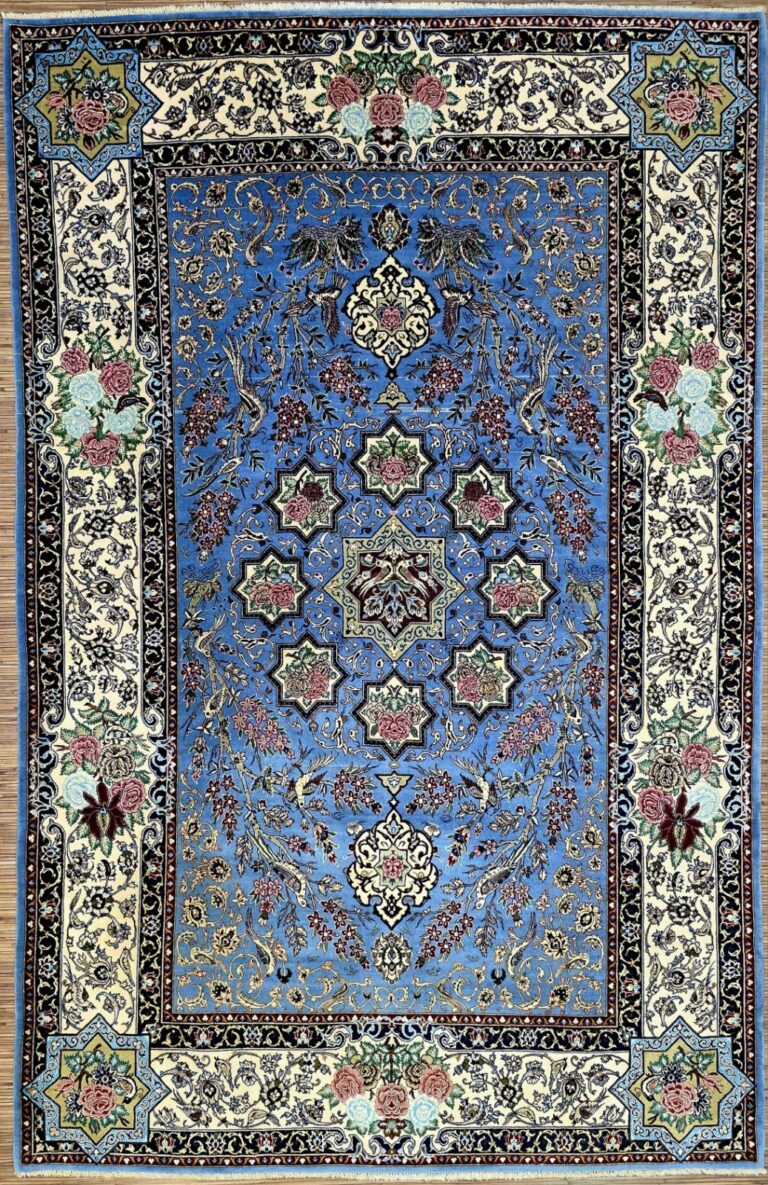
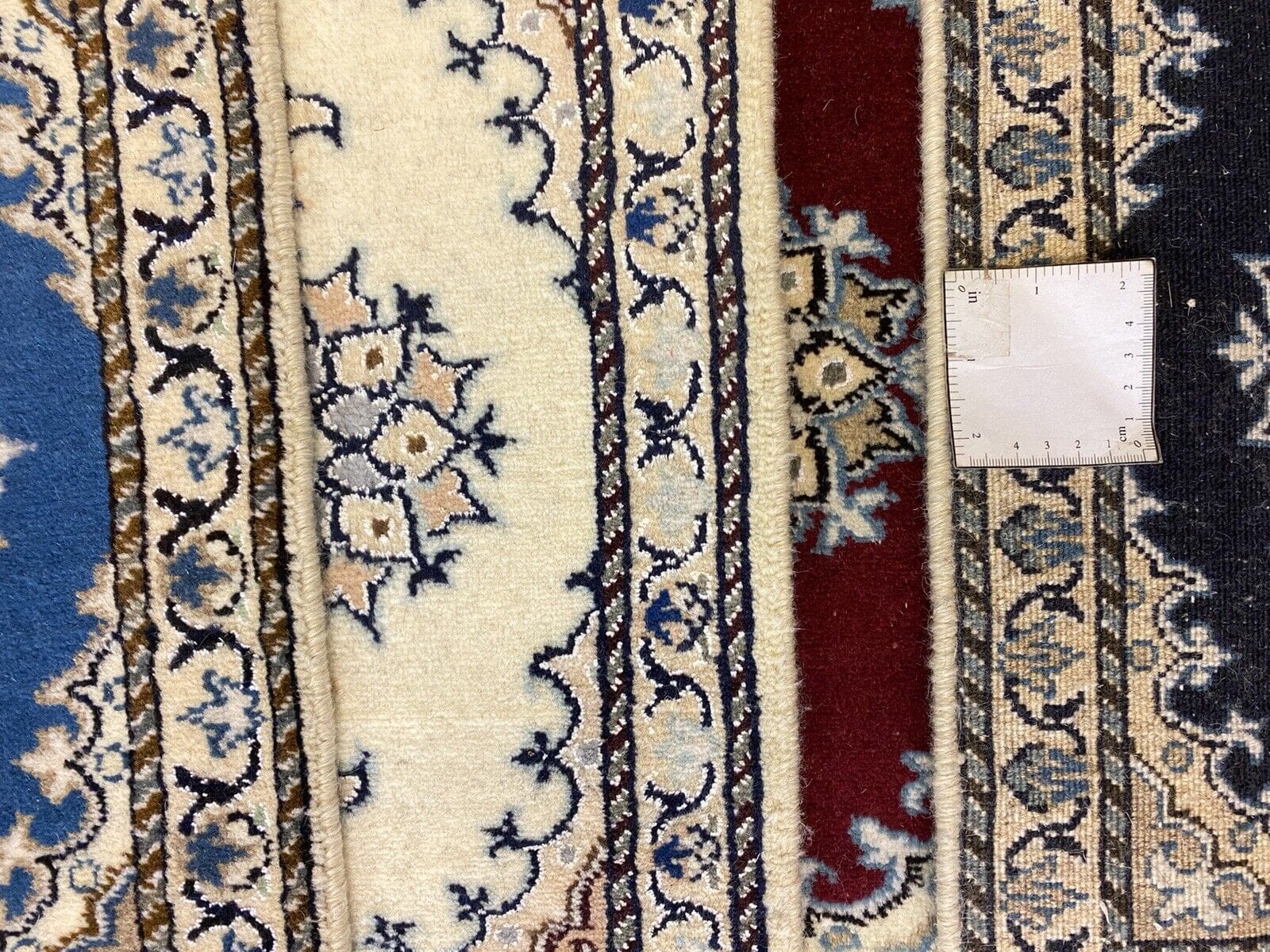
This Nain Persian rug is hand-knotted with a pile made from 100% new wool. Its warp is made from 100% cotton. The two materials therefore have distinct roles within the rug: new wool forms the visible and tactile pile, while cotton is used for the warp that supports the construction. New wool is one of the established materials in hand-knotted Persian rug making. For this piece, it is described as soft, hard-wearing and able to retain warmth.
In hand-knotting, individual knots are worked into a prepared warp. Row after row, this creates the finished textile surface and gives the rug its characteristic structure. The process requires time and practical weaving skill. The wool pile retains the natural feel associated with the fibre, while the cotton warp forms part of the underlying framework. The listed knot density is high and reflects a closely executed construction.
Hand-knotted production makes this rug a one-off, or individual piece. It is not the result of an industrial process intended to produce a set of completely identical items. Each knot contributes to the final surface and to the particular character of the finished rug. The traditional technique combines the stated properties of wool with a regional method of Persian rug production.
Origin and Tradition
Nain is a city in central Iran and one of the recognised centres of Persian rug production. The area is associated with carefully organised designs and skilled workmanship. Nain’s rug-making history reaches back to the nineteenth century. Over time, weavers in the region developed a distinct approach to proportion, line and the relationship between floral and geometric elements.
The Nain tradition places importance on the relationship between the central field, the border and the ornaments within them. Many compositions are arranged symmetrically. This order gives the eye a clear path through the design and allows separate pattern areas to read as parts of one composition. Floral details may be combined with more structured geometric forms, creating a balanced visual language that is characteristic of the regional tradition.
The knowledge associated with Nain includes more than the act of tying knots. It also covers preparing the warp, planning the pattern and maintaining the sequence of rows during the work. Such knowledge has traditionally been passed from one generation to the next. Practical experience and a recognisable vocabulary of forms therefore come together in the region’s weaving culture. The name Nain refers to an Iranian place of origin with its own rug-making history, rather than only to a decorative style.
Nain Persian rugs are often associated with calm, balanced compositions. Soft and harmonious colour families are common in the regional design tradition, as are finely divided ornaments. The tradition nevertheless allows for different colour arrangements and pattern structures. This individual rug is described as Oriental and multicoloured. Its regional classification remains Nain in Iran and is not changed by the presence of particular floral or geometric motifs.
The development of Nain rugs illustrates how a region can express its identity through both technique and design. In this tradition, a rug is understood as a useful textile as well as a product of inherited craft knowledge. The combination of an ordered composition, hand-knotting and selected natural fibres forms the broader context in which Nain rugs are made and recognised.
Design and Pattern
The design of this rug is Oriental and multicoloured. Nain rugs are traditionally known for clear, symmetrical compositions. Their designs often combine floral motifs with geometric forms. Curving leaves, flowers and vines can be arranged alongside lines, axes and defined ornamental fields. The result is a pattern structure in which decorative detail remains connected to an overall sense of order.
Floral Nain motifs are often finely drawn and placed within a regular arrangement. They may surround a central medallion, extend through the field or appear as repeated elements within a border. Geometric features provide structure to these arrangements. They mark transitions, establish rhythmic repetition and help separate decorative areas while keeping the whole composition visually coherent.
Symmetry is an important principle in the Nain design vocabulary. A composition may be organised around a central axis or balanced through recurring shapes. This approach creates a unified surface without requiring every detail to be identical. Small individual variations are part of the character of a hand-knotted work and help distinguish one one-off piece from another.
Nain designs are frequently associated with gentle, coordinated colour schemes. Cream, blue and red are among the colours found in the broader regional design tradition. These examples describe the established Nain vocabulary; the rug itself is identified simply as multicoloured. It is therefore accurate to describe its overall Oriental, multicoloured character without assigning an exact colour distribution that is not specified.
The pattern of a Nain rug has more than a purely decorative role. Repeated botanical forms, framing borders and geometric order reflect the visual language of Persian rugs. Natural references are combined with abstraction, allowing the surface to be read as one continuous ornamental structure. The measured effect of such compositions comes from repetition, balance and the controlled movement of the eye across the field.
Hand-knotting gives the design a textile depth that is individual to each finished piece. The Oriental, multicoloured composition can therefore be placed within the Nain tradition without assigning the rug to another origin or provenance. Pattern and origin remain separate descriptions: Nain identifies the Persian place of origin, while the floral and geometric elements belong to the region’s design vocabulary.
Special Features
The notable features of this rug include its high knot density, hand-knotted construction and pile made from 100% new wool. It is new and unused. The rug is also described as a one-off, or individual piece. Its construction includes a cotton warp and a wool pile. The new wool is characterised in the offer as soft, hard-wearing and able to retain warmth.
The rug is suitable for use with underfloor heating. This provides a specific stated option for use in a living space. The wool is also described as environmentally friendly and hypoallergenic. These are listed material characteristics of the rug. Its condition is defined by the absence of previous use, and there is no stated need to describe repairs or extensive cleaning before it is used.
The combination of Nain origin, traditional hand-knotting, a new-wool pile, cotton warp and a multicoloured Oriental design summarises the main features of this individual piece. It brings together a clearly identified Iranian origin, a craft-based production method and the stated suitability for underfloor heating.
FAQ
How should I care for my hand-knotted Persian rug?
Regular vacuuming is part of the routine care of a hand-knotted Persian rug. Direct sunlight should be avoided in order to protect the textile surface and its colour appearance. If a more thorough cleaning is needed, professional rug cleaning is recommended. The hand-knotted construction and new-wool pile should be treated with a method suitable for these materials. Consistent, appropriate care helps prevent avoidable wear and supports the preservation of the rug’s new and unused condition.
Where does the Nain Persian rug come from?
The rug comes from Nain in Iran. Nain is located in central Iran and is known for traditional weaving and knotting techniques as well as Persian rugs. Rug production in the area reaches back to the nineteenth century. Nain designs are commonly associated with clearly organised and often symmetrical compositions in which floral motifs and geometric forms work together. The name Nain therefore identifies the Iranian place of origin, not merely a pattern name.
Can the rug be used in a high-traffic area?
Yes. Its high knot density and robust material are described as making the rug hard-wearing, so it is also suitable for high-traffic areas in the home. The pile is made from new wool, which is identified as durable in the product description. Regular care remains important when a rug is placed where it receives heavier use. The rug is also suitable for underfloor heating, which is another stated use characteristic.
To provide the best experiences, we use technologies like cookies to store and/or access device information. Consenting to these technologies will allow us to process data such as browsing behavior or unique IDs on this site. Not consenting or withdrawing consent, may adversely affect certain features and functions.
Functional Always active
The technical storage or access is strictly necessary for the legitimate purpose of enabling the use of a specific service explicitly requested by the subscriber or user, or for the sole purpose of carrying out the transmission of a communication over an electronic communications network.
Preferences
The technical storage or access is necessary for the legitimate purpose of storing preferences that are not requested by the subscriber or user.
Statistics
The technical storage or access that is used exclusively for statistical purposes.The technical storage or access that is used exclusively for anonymous statistical purposes. Without a subpoena, voluntary compliance on the part of your Internet Service Provider, or additional records from a third party, information stored or retrieved for this purpose alone cannot usually be used to identify you.
Marketing
The technical storage or access is required to create user profiles to send advertising, or to track the user on a website or across several websites for similar marketing purposes.
 SECURE PAYMENT
 SHIPPING PARTNERS