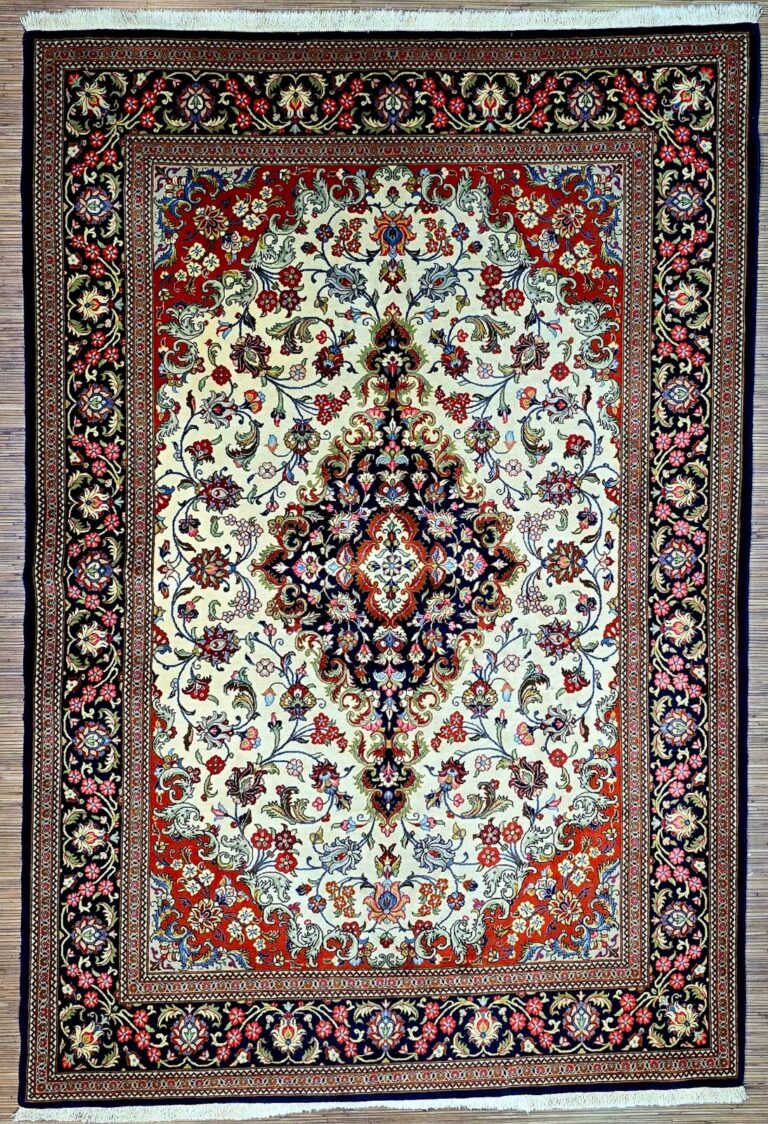
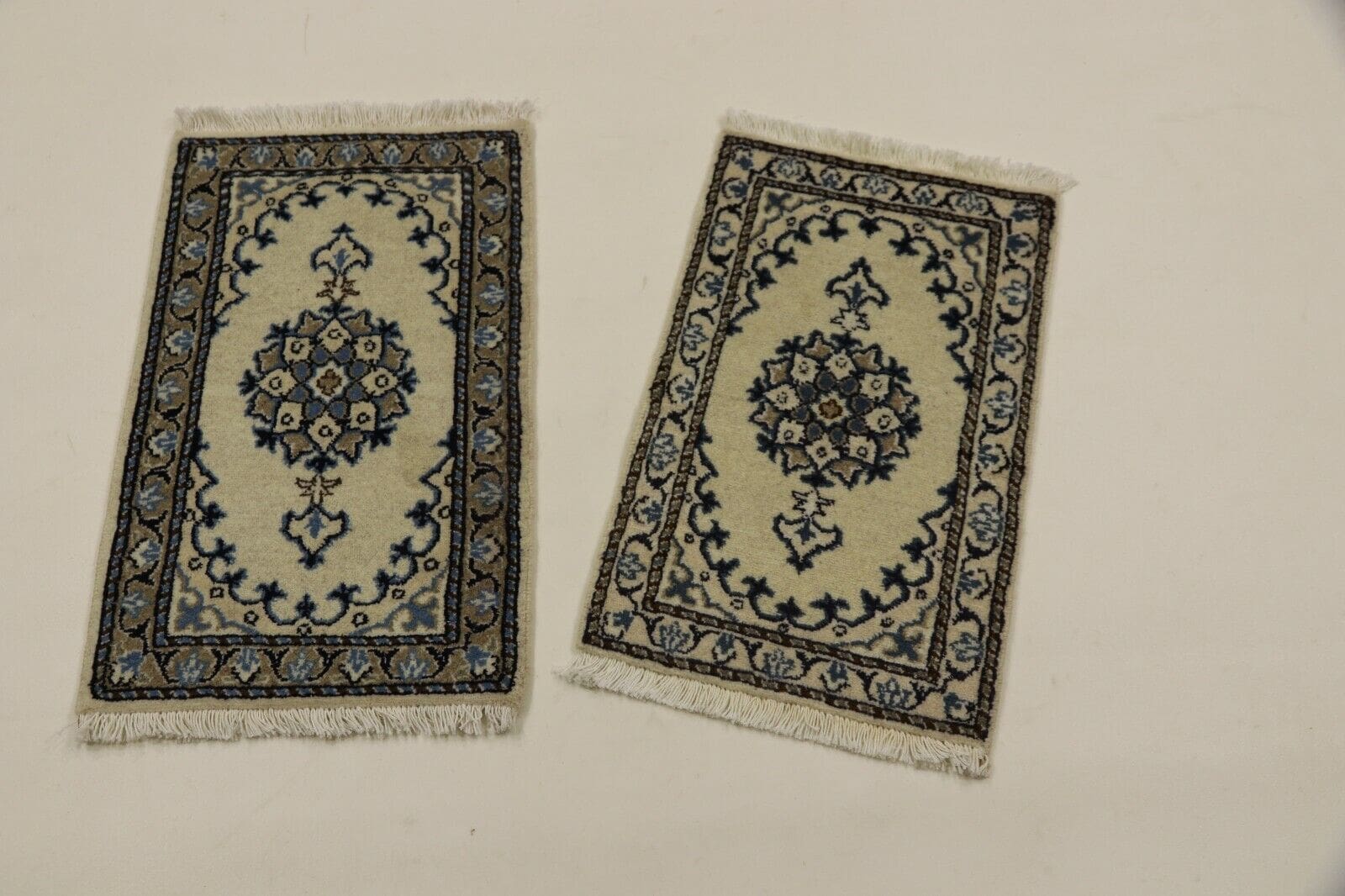
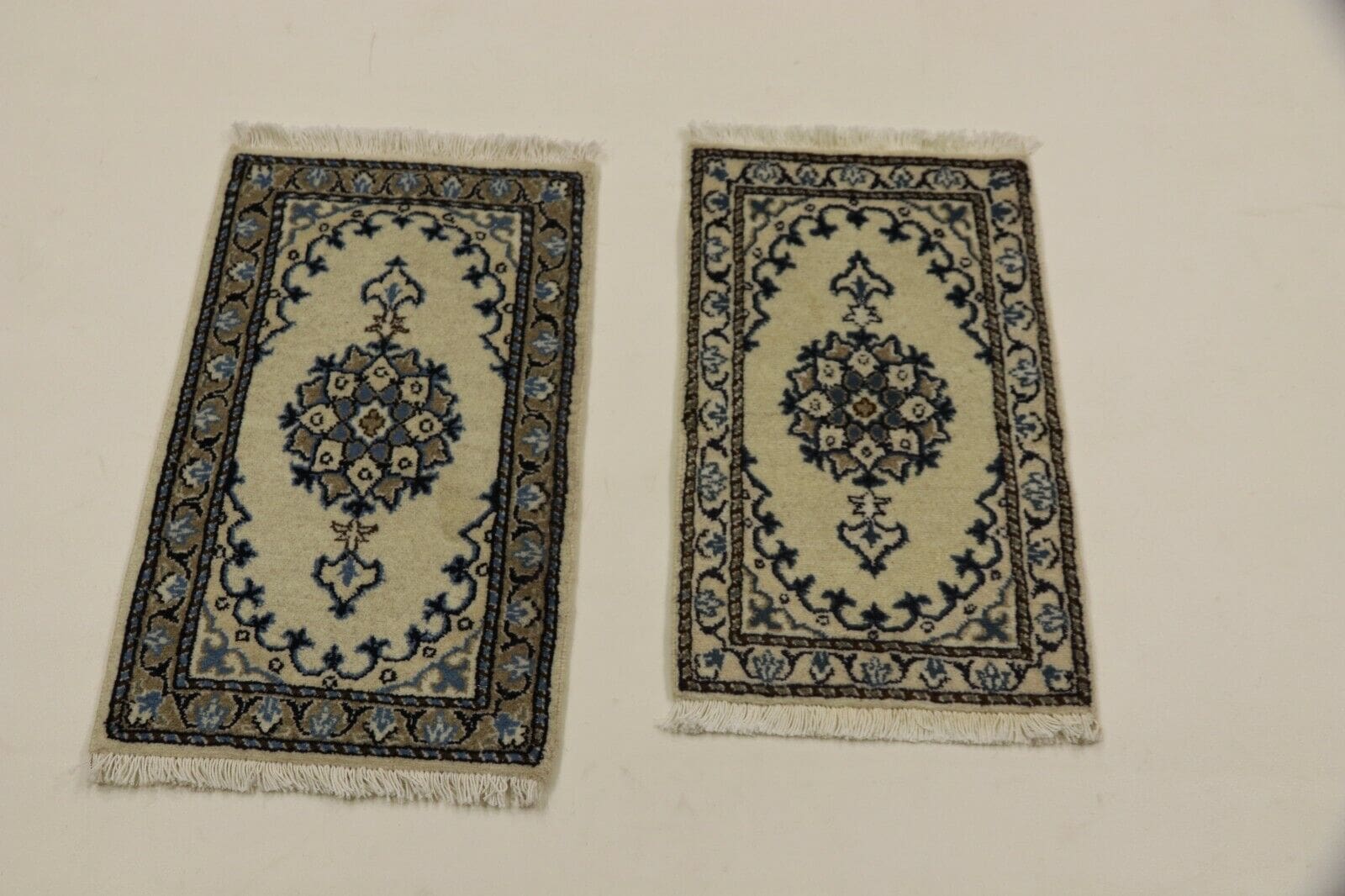
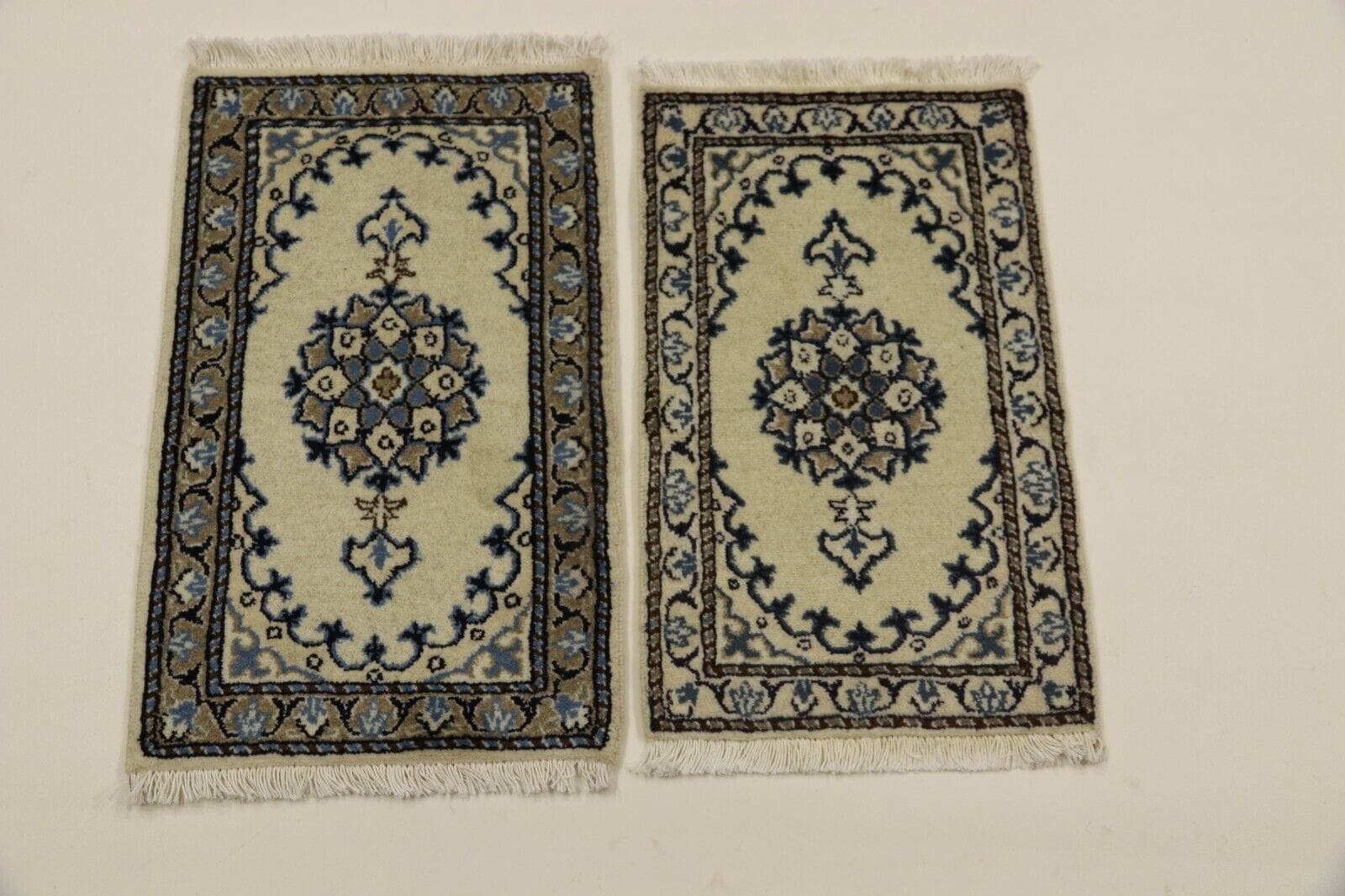
Hand-knotted Nain Persian Rug | Knot density: approx. 300,000 knots/m² | Material: pile 95% virgin wool, 5% silk, warp and weft 100% cotton | Size: 60 x 40 cm | Pattern: traditional Persian Oriental, floral and geometric | Condition: New, very good
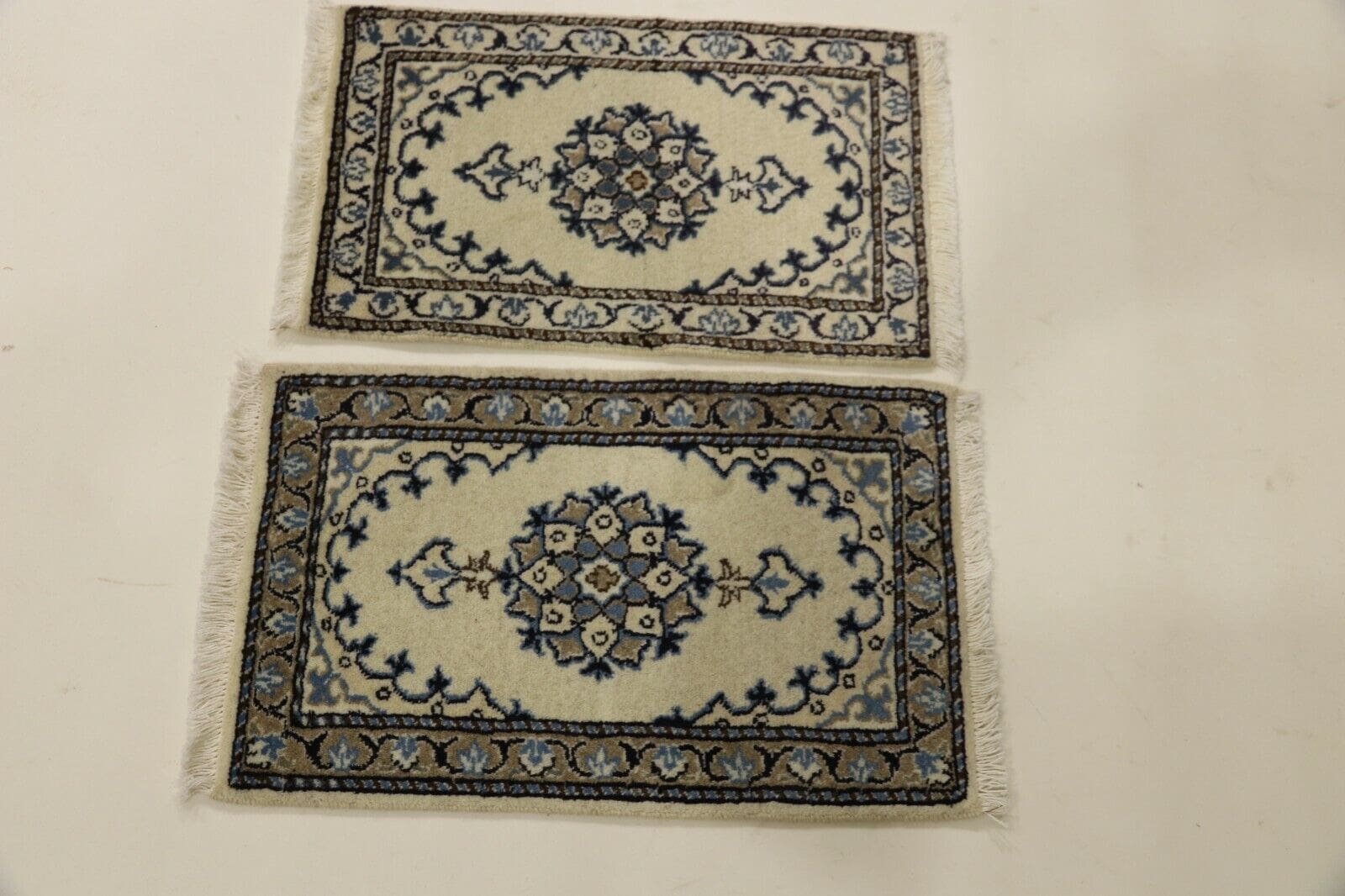
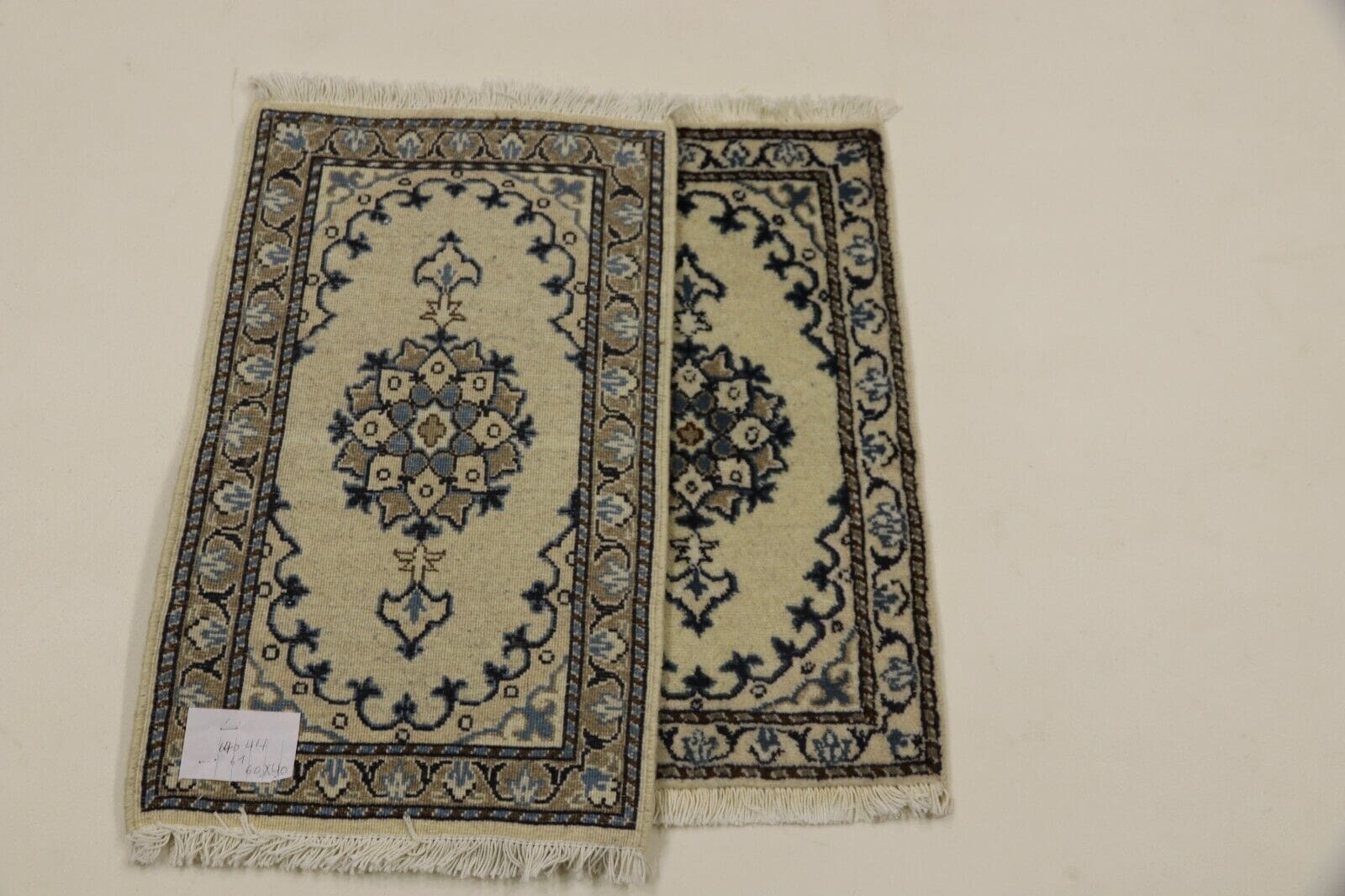
These two hand-knotted Nain Persian rugs have a pile made from 95% virgin wool and 5% silk. Their warp and weft are 100% cotton. The combination gives the pile two distinct material qualities: wool provides the main textile body and a soft feel, while silk contributes a subtle sheen to the surface. Cotton forms the structural basis of the warp and weft.
Both rugs were made by hand. With this method, the design is built knot by knot rather than printed or produced as a machine-made surface. The catalogue gives a knot density of approximately 300,000 knots per square metre, indicating a very fine construction. This allows floral details, geometric shapes and narrow borders to be rendered with clarity. Each of the two rugs is a one-off piece.
The stated materials and the hand-knotted technique bring together traditional construction and a finely worked surface. Virgin wool supplies the substance of the pile, while silk introduces an additional accent within it. The rugs are new and in very good condition.
Origin and Tradition
Nain is a city in Iran with a distinct Persian carpet-making tradition. Nain rugs are known for fine designs, careful workmanship and the use of high-quality materials. Their development belongs to a long history of carpet production reaching back to the nineteenth century. Nain lies in Isfahan Province, an important area of Persian cultural and craft heritage.
The Nain tradition combines precise knotting with compositions that are clearly organised. Many designs are arranged symmetrically, guiding the eye from the centre through the secondary motifs and towards the border. This sense of order is an important part of the regional vocabulary. It makes it possible to place numerous small ornaments within a unified composition without making the design appear unsettled.
Persian rugs from Nain are often designed with floral motifs and geometric forms. The tradition is concerned not only with individual ornaments, but also with how the elements relate to one another. A balanced relationship between field, border and transitional areas is characteristic of traditional design. Fine knotting supports this structure by allowing small changes in line and ornament to remain legible.
The region’s carpet art also carries cultural and historical associations. In Oriental rug design, patterns are not understood solely as decoration. They may express ideas connected with order, nature and prosperity. In Nain work, this background appears in the combination of careful handwork, differentiated ornament and a clearly readable overall arrangement.
These two pieces are offered as hand-knotted Oriental rugs from Nain and are described as originating in Persia. The name Nain therefore identifies their regional tradition within the wider history of Persian rugs. Their origin provides the cultural and craft context, while each individual rug remains a one-off through its own knotting and design.
Design and Pattern
The two Nain rugs are characterised by very fine patterns and harmonious colour combinations. Their traditional Persian Oriental style is expressed through floral motifs, geometric shapes and elegant outlining borders. These elements may be repeated or balanced across the central field, adjoining areas and border. The fine knotting supports a clear presentation of the smaller ornaments.
Floral decoration is one of the central forms of expression in Persian carpet art. Blossoms, leafy scrolls and plant-like lines bring movement and rhythm to a composition. In the symbolic language associated with Oriental rug design, floral motifs are often linked with fertility and prosperity. This cultural meaning exists alongside their decorative role.
Geometric forms provide a recognisable framework. They can appear as contained ornaments, recurring lines or transitional structures between different parts of the design. Together with floral elements, they create a dialogue between organic shapes and clear geometry. The borders enclose the composition and provide a visual conclusion between the patterned field and the outer edge.
Harmony in colour is another part of the described Nain character. It helps balance the detailed individual motifs with the appearance of the rug as a whole. A traditional Persian Oriental design can therefore work in a classically furnished room as well as alongside a more modern interior. Its visual language remains connected to Nain tradition, its ornament and its hand-crafted execution.
The patterns are not simply industrial repeats. On a hand-knotted rug, the design is translated into the work of the knotter. Minor variations and individual execution are consequently part of the nature of a one-off piece. The two rugs offered here are separate works with a fine floral and geometric vocabulary, framed by decorative borders.
Special Features
Important features of this offering are the hand-knotted construction, a pile of 95% virgin wool and 5% silk, and warp and weft made from 100% cotton. The knot density is given as approximately 300,000 knots per square metre. This fine knotting accounts for the detailed execution of the designs and the finely worked surface.
The two rugs are new and in very good condition. They are offered as one-off pieces with certificates of authenticity. The certificates accompany the rugs and document their authenticity and the quality of their workmanship. This makes the pieces relevant to collectors and to those who value hand-knotted rugs with documented construction.
FAQ
How should I care for my Nain Persian rug?
For routine care, vacuum the rug carefully to remove dust from the pile. Treat spills promptly with a damp cloth. Professional cleaning at intervals of several years can help preserve the colours and textile texture. Because the surface is hand-knotted, cleaning should be carried out with appropriate care for the construction and materials.
Are these rugs suitable for underfloor heating?
Yes, the hand-knotted Nain rugs are generally suitable for use with underfloor heating. They provide good thermal insulation and are not excessively thick, allowing heat to pass through the rug. The specific requirements of the heating system and the room should still be considered when positioning the rug.
How can I identify an authentic Oriental rug?
A certificate of authenticity is a useful indication of a rug’s authenticity and quality. Knot density, material composition and design also help with classification. Hand-knotted rugs often have a fine, detailed execution that differs clearly from machine-made rugs, making construction an important part of the assessment.
To provide the best experiences, we use technologies like cookies to store and/or access device information. Consenting to these technologies will allow us to process data such as browsing behavior or unique IDs on this site. Not consenting or withdrawing consent, may adversely affect certain features and functions.
Functional Always active
The technical storage or access is strictly necessary for the legitimate purpose of enabling the use of a specific service explicitly requested by the subscriber or user, or for the sole purpose of carrying out the transmission of a communication over an electronic communications network.
Preferences
The technical storage or access is necessary for the legitimate purpose of storing preferences that are not requested by the subscriber or user.
Statistics
The technical storage or access that is used exclusively for statistical purposes.The technical storage or access that is used exclusively for anonymous statistical purposes. Without a subpoena, voluntary compliance on the part of your Internet Service Provider, or additional records from a third party, information stored or retrieved for this purpose alone cannot usually be used to identify you.
Marketing
The technical storage or access is required to create user profiles to send advertising, or to track the user on a website or across several websites for similar marketing purposes.
 SECURE PAYMENT
 SHIPPING PARTNERS