This Nain Persian rug is hand-knotted with a pile made from 100% wool. Its warp and weft are made from 100% cotton. The construction therefore combines a natural wool surface with a cotton foundation, a structure central to the making of a knotted rug. In hand-knotting, each knot is inserted by hand around the warp threads. Weft threads secure the completed rows and help form the continuous textile body. Once the knotting is finished, the pile is worked so that the surface has a coherent and clearly defined appearance.
Wool has been used in rug making for centuries because the fibre is durable and pleasantly resilient. It can take up moisture from the surrounding air and release it again, helping to support a balanced indoor climate without feeling immediately damp. Wool also has a natural resistance to dirt. Regular, appropriate care is therefore important for maintaining the pile and supporting the long-term serviceability of the rug.
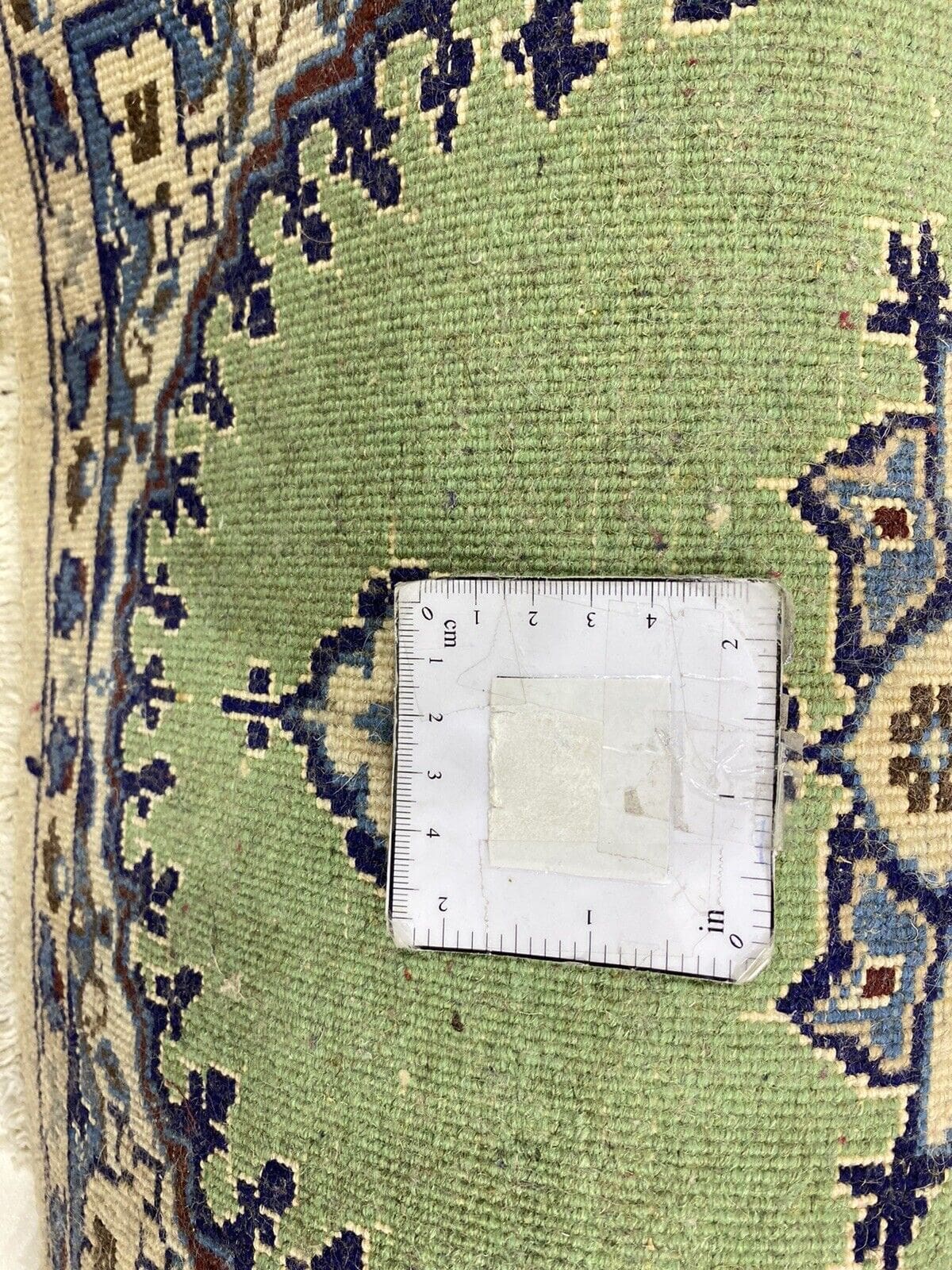
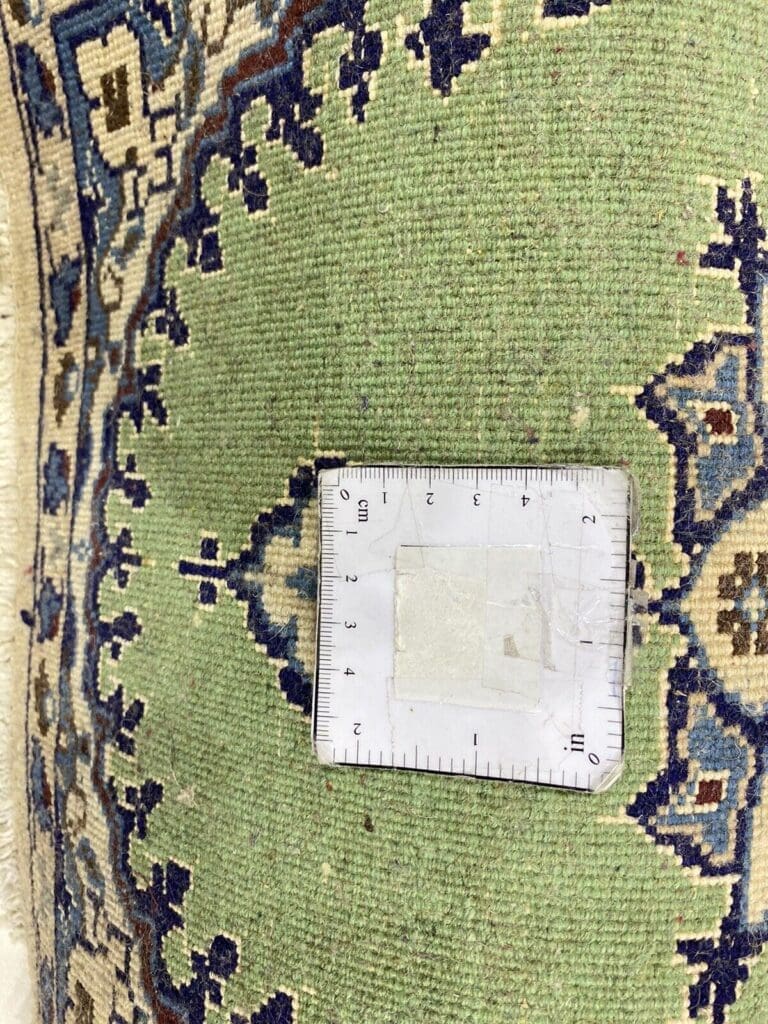
Hand-knotting is fundamentally different from industrial production. A rug develops row by row, and the relationship between the knots, pile, warp and weft determines the character of the finished textile. The product information gives this rug a knot density of approximately 200,000 knots per square metre. That density allows a finely worked surface and supports the clear rendering of small areas of ornament. The result depends on material knowledge, experience and careful execution throughout the process.
A pile of pure wool is suited to practical use in living spaces. Wool can also help soften room noise because its fibrous surface absorbs part of the sound. The rug may therefore contribute to a calmer acoustic environment. The stated cotton warp and weft make the textile structure of this piece clear as well. Its production remains firmly connected with the traditional craft of hand-knotting rather than with a mechanically repeated surface.
The material description is precise: wool forms the pile, while cotton forms the warp and weft. These components perform different tasks within the rug. The pile provides the visible and tactile surface; the foundation supports the rows and gives the textile its shape. Together they create the basis for the traditional construction associated with a Persian rug from Nain. Care should always be adapted to natural fibres and to the condition of the individual piece.
Origin and Tradition
Nain is a city in Iran and a recognised centre of Persian rug weaving. It lies in Isfahan Province. Nain rugs therefore belong to an Iranian, or Persian, weaving tradition whose regional characteristics have developed over a long period. The craft combines the practical purpose of a floor textile with a carefully planned arrangement of field, border, ornament and colour. The name Nain refers to this regional tradition and is not merely a decorative label for a pattern.
Iranian rug culture includes many local workshops, inherited designs and different technical approaches. Nain developed a distinctive visual language often associated with balanced symmetry, fine drawing and carefully ordered ornament. The city is situated in an arid landscape where textile work has traditionally held cultural and economic importance. Knowledge of fibres, dyeing, pattern planning and knotting is passed through craft practice and adapted by individual workshops over time.
A Persian rug is traditionally considered through more than its visible design. The preparation of the warp, the choice of fibre, the regularity of the rows and the finishing of the pile are all part of the craft. Designs are commonly organised around an axis, a central arrangement or a repeated field. This gives the composition a sense of proportion and rhythm rather than an accidental distribution of motifs. The Nain designation connects this planned design process with a particular Iranian place of weaving.
Iranian rug traditions developed many forms for medallions, vines, blossoms, palmettes and geometric divisions. In Nain designs, these elements are often linked with fine transitions. The visual effect comes from the relationship between the ground, the borders and the smaller internal ornaments. Even a small-format rug depends on the organisation of its surface. Hand-knotting then translates the design into individual knots, turning a drawn plan into a durable textile.
Nain rugs are used in both classical and contemporary interiors because their regional design language can appear ordered and decorative at the same time. They may serve as an independent textile element or complement an existing arrangement. The tradition remains visible in the technique: a hand-knotted rug records a process in which fibre, pattern and workmanship are joined together. This piece is identified as a Nain from Persia and belongs to the traditional Persian-Oriental style world.
The history of Persian rug making is also a history of visual transmission. Motifs are copied, adjusted, simplified and recombined, while the basic principles of symmetry, rhythm and framing remain recognisable. A workshop may interpret a familiar composition through changes in line, scale or colour. Such variation is part of the living nature of the craft. It does not remove the regional identity of Nain; instead, it shows how a tradition can continue through individual woven and knotted works.
Design and Pattern
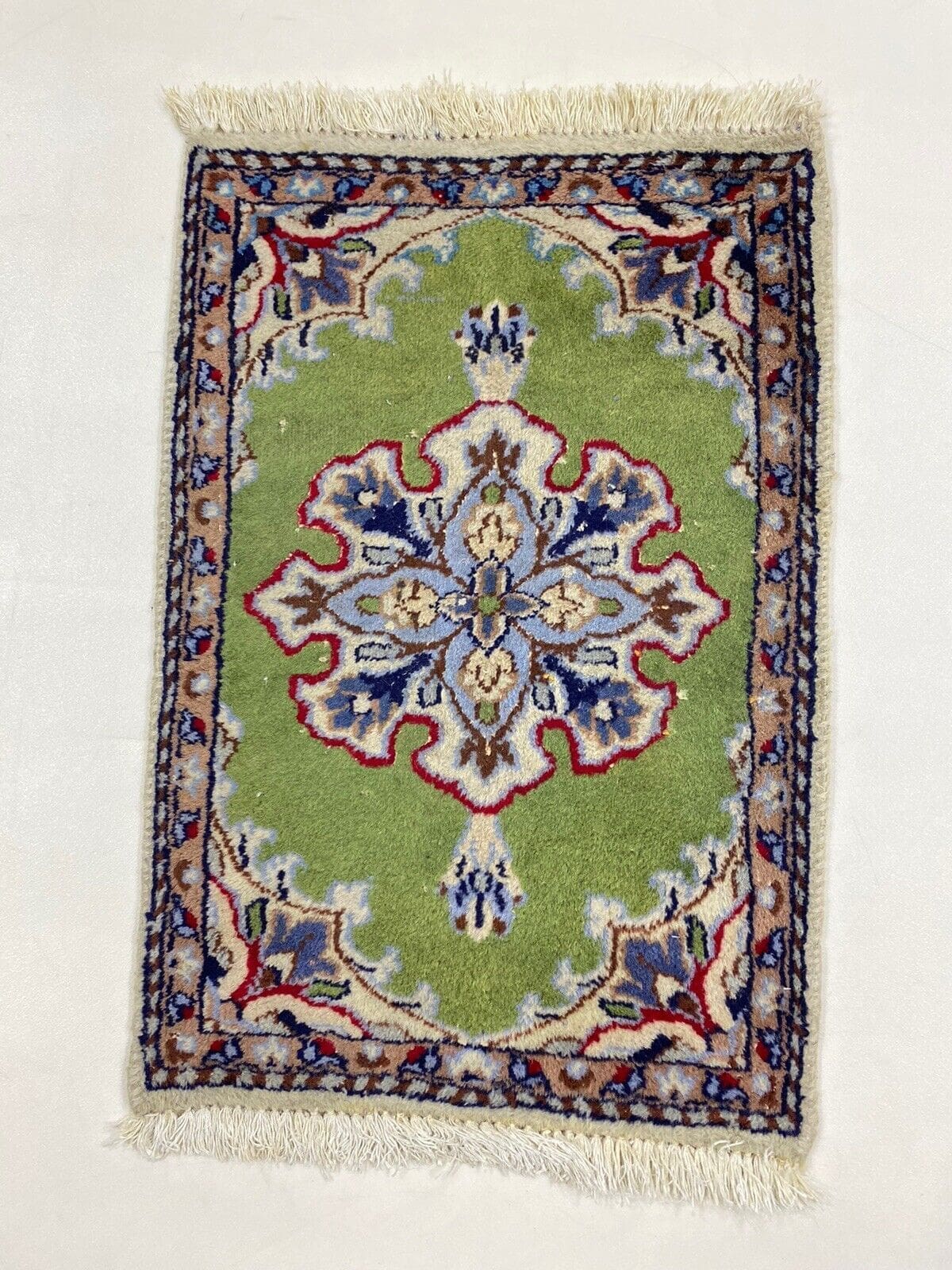
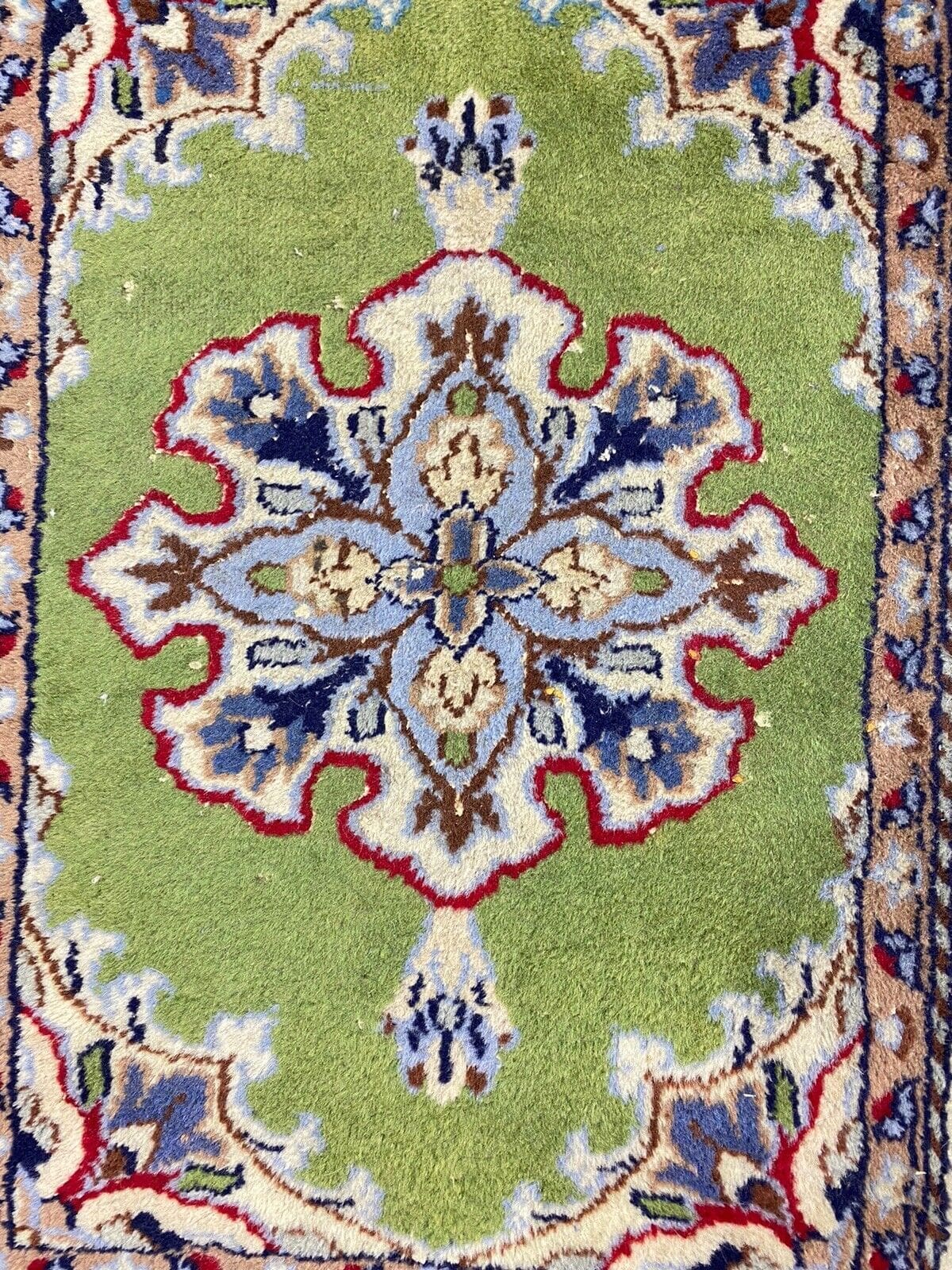
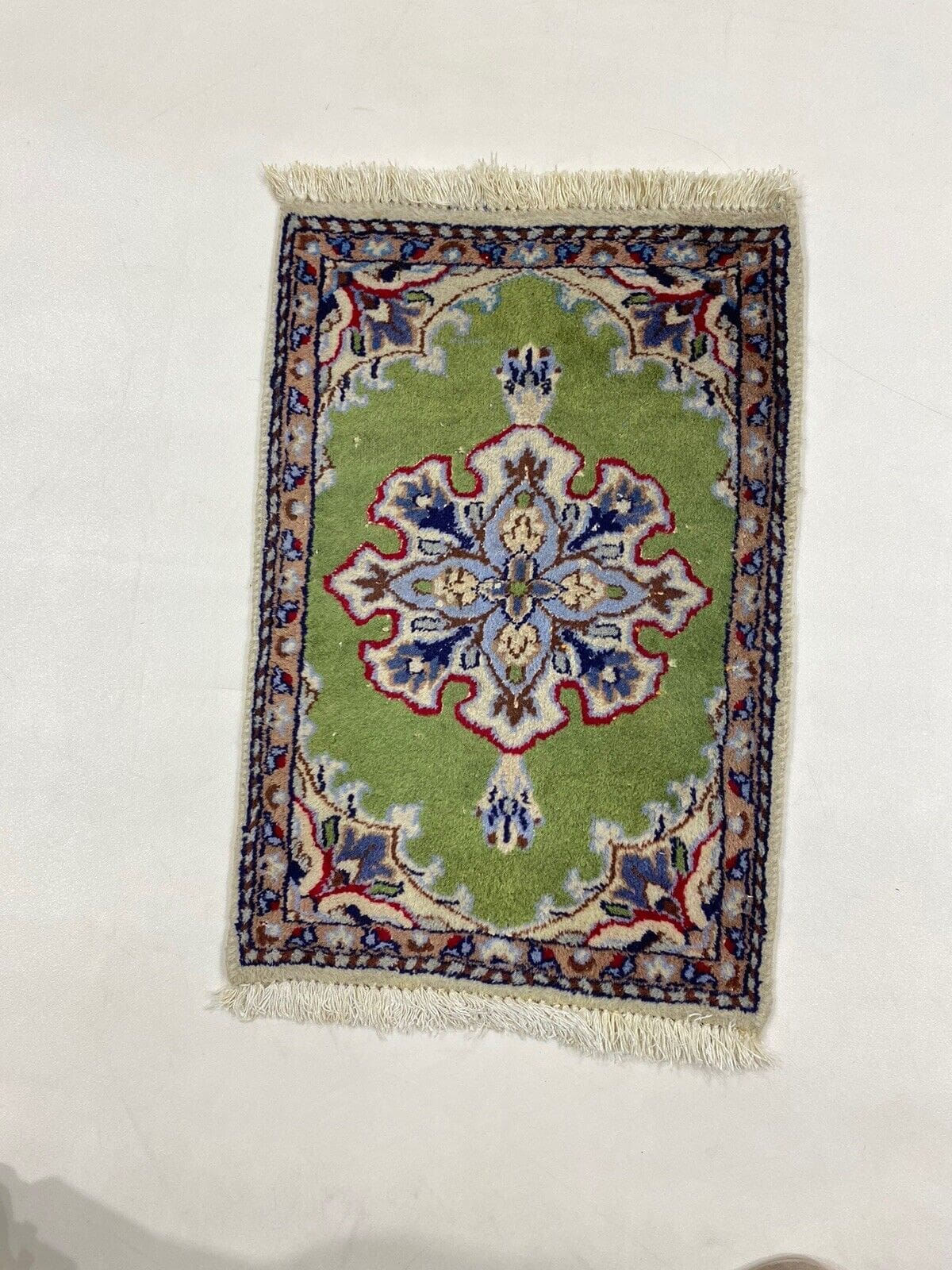
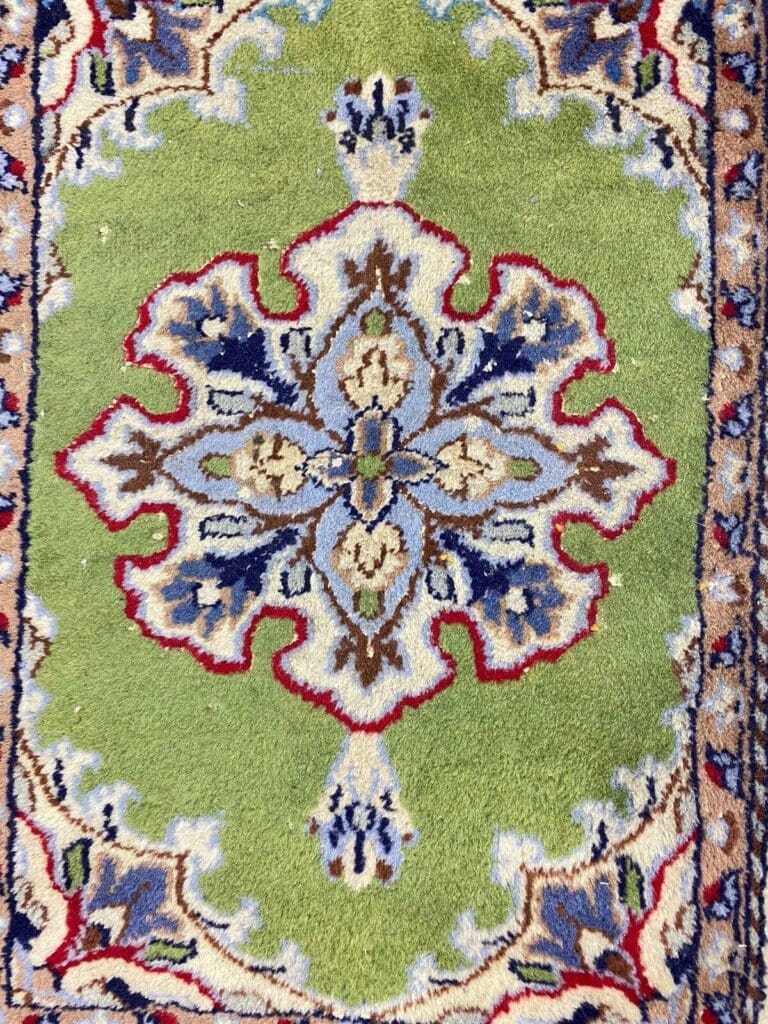
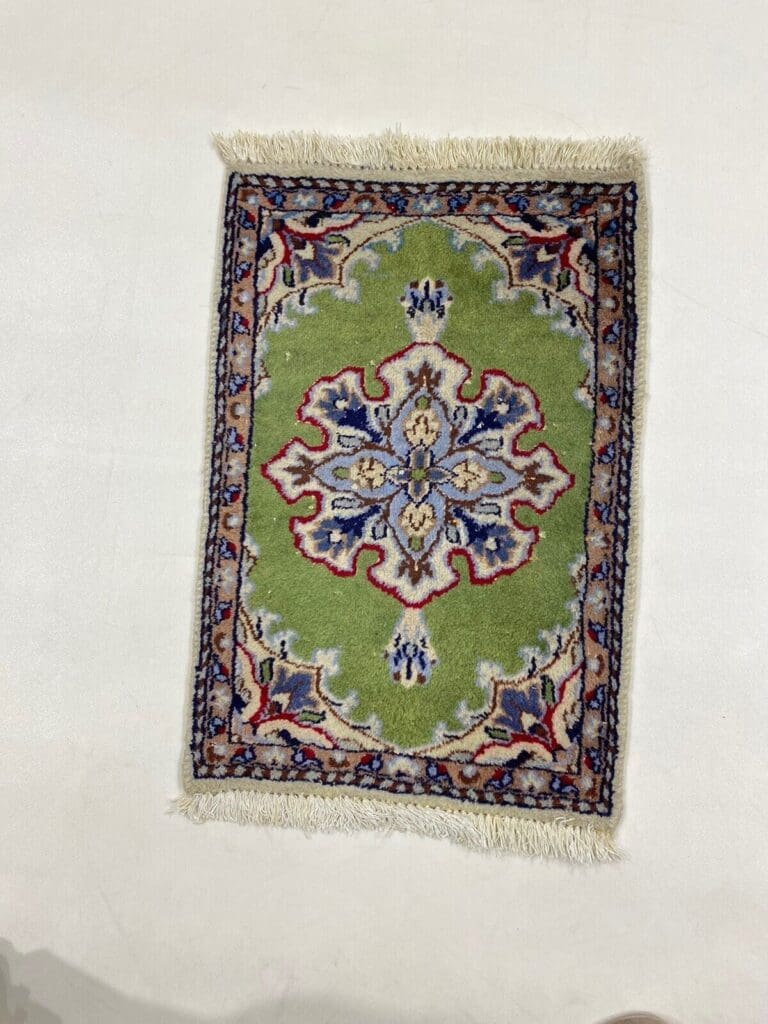
The pattern of this rug is described as traditional Persian-Oriental. Nain designs are often associated with floral and geometric elements. Floral motifs may include leaves, blossoms, vines and stylised plant forms. Geometric details bring order to the composition and can divide the surface into a central field, border and smaller ornamental areas. These two visual languages can be combined so that flowing plant forms are held within a clearly structured layout.
Many Nain compositions rely on a measured relationship between densely drawn ornament and quieter areas of ground. A central arrangement may be framed by one or more borders. The border encloses the field and leads the eye along the outer edge. In a floral design, vines and blossoms may repeat in a controlled rhythm, while smaller details enrich the transitions between the principal motifs. The overall effect depends on balance rather than on a single isolated image.
Floral ornament in Persian weaving is not usually intended as a literal botanical illustration. Leaves and flowers are stylised, mirrored, repeated or integrated into scrolling vines. Their purpose is to create a decorative system suited to textile repetition and proportion. Geometric lines may define the softer shapes or add another layer of structure. The resulting pattern can be read as a unified composition both close up and from across the room.
Nain rugs are often linked with gentle pastel colours. Such colour areas can give the composition a restrained and elegant appearance while leaving the ornament legible. The effect comes from the relationship between ground, outlines and pattern details, not from one colour alone. Contrasts clarify the drawing, while related shades create continuity. The high knot density recorded for this rug supports the rendering of fine lines and differentiated ornamental areas.
The complexity of a Persian rug pattern lies in the connection between the main motif, secondary elements and frame. A medallion, a continuous vine or an all-over floral arrangement can establish the visual centre. Repeated forms create rhythm, while small variations prevent the surface from appearing mechanically empty. At the same time, the composition remains directed toward an ordered whole. This is how the Nain design tradition joins decorative detail with the practical function of a textile furnishing.
Hand-knotting influences how the design is seen. Each knot occupies a particular place within the drawing, allowing contours, fine lines and transitions to become part of the textile surface. Pattern is therefore communicated not only by colour but also by the density and order of the knots. The traditional Persian-Oriental design can be placed in a classically furnished room or used as a quieter contrast within a more modern setting. Its regional vocabulary remains visible without requiring a literal reproduction of nature.
Good pattern composition also depends on scale. Larger shapes establish the main reading of the field, while smaller motifs provide detail and visual continuity. Borders help contain the arrangement and create a transition between rug and surrounding floor. These principles are common in Persian design traditions and explain why a carefully planned rug can remain coherent even when it contains many individual elements. The Nain character is expressed through this combination of precision, floral vocabulary and balanced organisation.
Special Features
This piece is described as a one-off and is in good condition. Its distinguishing features are its Nain origin, hand-knotted construction and pile of 100% wool. The warp and weft are made from 100% cotton. The recorded knot density of approximately 200,000 knots per square metre points to a finely structured handmade surface. As an individual rug, it is not presented as an industrially identical series item, but as a single textile with its own execution.
Wool brings practical qualities to an interior. The fibre is resilient, can contribute to room acoustics and has natural temperature-regulating properties. It can absorb moisture without immediately feeling clammy. Over time, a wool rug may develop a patina. Proper care remains important, however: gentle vacuuming and attentive use help protect the pile and preserve the appearance. More substantial soiling should be handled by a professional cleaner familiar with natural fibres.
The rug is described as approximately 6 mm thick and 6 years old. The product description places it in living spaces or as an accent piece in refined offices. Its textile surface can serve a decorative function while also influencing the acoustic character and sense of comfort in a room. The combination of Persian origin, natural materials and individual handwork defines the main features of this Nain rug.
The one-off character is also relevant to its place in an interior. A handmade rug is shaped by the interaction of its design and the decisions made during knotting. Even when a traditional composition provides the framework, the finished surface belongs to one specific piece. Here, that individual character is combined with a traditional Persian-Oriental style and the material structure of wool pile on a cotton foundation.
FAQ
How should I care for my Nain Persian rug?
Vacuum the rug regularly to remove dust and loose dirt from the wool pile. Use a gentle setting and avoid unnecessary pressure or aggressive brushing. If a spill occurs, blot it as soon as possible with a damp cloth. Do not rub vigorously, since rubbing can stress the fibres and work the soil further into the pile. For thorough maintenance, professional cleaning every few years is recommended. A specialist cleaner can take the natural wool structure into account and reduce the risk of damage. Prompt attention to stains and careful routine cleaning help maintain the rug’s appearance.
Can I use the rug over underfloor heating?
Yes, this Nain Persian rug can be used over underfloor heating. Wool is a natural insulator and can retain warmth without overloading the heating system beneath it. The temperature should not be set too high. Moderate, even heat is the more careful choice for a natural-fibre rug. Make sure the rug lies flat and that no unsuitable underlay completely blocks the heated surface. If the heating system has specific technical requirements, follow the instructions supplied by its manufacturer. These precautions help combine the comfort of underfloor heating with responsible use of the wool rug.
How can I identify an authentic Persian rug?
Authentic Persian rugs are generally hand-knotted and have a recognisable textile construction. A high knot density and quality materials such as wool or silk may provide useful indications, but they do not replace a professional assessment. Check the label or any certification supplied with the rug, as such documentation can confirm authenticity and origin. For a Nain, the connection with the city of Nain in Iran is also relevant. If a binding opinion is required, consult an experienced rug dealer or an independent specialist. Examination of the construction, materials, pattern and documentation together provides a more reliable assessment than any single feature alone.
To provide the best experiences, we use technologies like cookies to store and/or access device information. Consenting to these technologies will allow us to process data such as browsing behavior or unique IDs on this site. Not consenting or withdrawing consent, may adversely affect certain features and functions.
Functional Always active
The technical storage or access is strictly necessary for the legitimate purpose of enabling the use of a specific service explicitly requested by the subscriber or user, or for the sole purpose of carrying out the transmission of a communication over an electronic communications network.
Preferences
The technical storage or access is necessary for the legitimate purpose of storing preferences that are not requested by the subscriber or user.
Statistics
The technical storage or access that is used exclusively for statistical purposes.The technical storage or access that is used exclusively for anonymous statistical purposes. Without a subpoena, voluntary compliance on the part of your Internet Service Provider, or additional records from a third party, information stored or retrieved for this purpose alone cannot usually be used to identify you.
Marketing
The technical storage or access is required to create user profiles to send advertising, or to track the user on a website or across several websites for similar marketing purposes.
 SECURE PAYMENT
 SHIPPING PARTNERS


