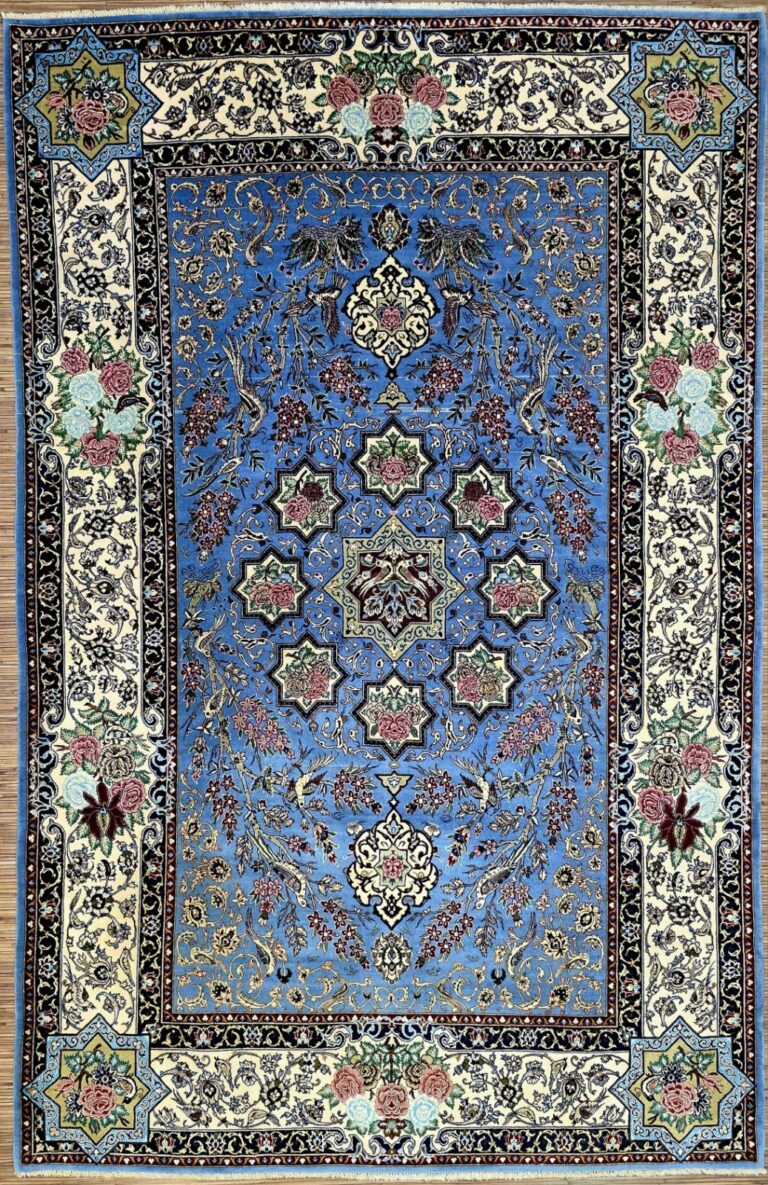
This Nain Persian rug is hand-knotted and made from virgin wool and silk. Its pile consists of 90 percent virgin wool and 10 percent silk. The combination defines both the tactile character and the visual surface of the rug. Virgin wool is valued in rug making for its robust and hard-wearing nature. It is also known for being lightfast and resistant to dirt, qualities that make wool suitable for a pile intended to remain practical in everyday use.
The silk component adds a smooth and fine fibre to the wool. Silk can lend the pile a gentle sheen and make the colours appear more vivid. Combined with wool, it creates a surface that feels soft while retaining a durable character. The use of wool and silk is associated with Nain rugs, which are known for finely made textiles. In this piece, the material pairing is worked into a hand-knotted pile rather than a mechanically uniform surface.
Hand knotting calls for patience, skill and close attention throughout the process. Each knot becomes part of the rug’s structure. The rug’s high knot density allows for a fine, detailed pile and supports the precise rendering of small pattern areas. It also contributes to the distinctive construction of the surface. A hand-knotted rug is not made through an identical, repetitive industrial process; it combines technical accuracy with the individual work of the craftsperson.
The rug is new. It is suitable for underfloor heating. Its wool and silk composition, handwork and dense knotting are the defining elements of its construction. The rug is also described as a one-off, or single unique piece. That designation refers to this individual hand-knotted object and to the fact that it is not presented as one interchangeable item within a uniform series.
Origin and Tradition
The rug comes from Nain, a city in Isfahan Province in Iran. Nain is known for its rug production and for a long-established tradition of carpet knotting. Within the Persian rug world, the city is associated with finely made hand-knotted rugs. These are often connected with careful workmanship, a fine pile, and the use of wool and silk. The name Nain therefore identifies more than a visual reference: it points to a regional craft tradition and its established approach to materials and design.
The source description traces Nain’s carpet-knotting tradition back to the sixteenth century. Over time, the region developed a distinctive relationship between inherited Persian pattern ideas, precise handwork and selected fibres. Nain rugs form part of Iran’s cultural and craft history. Alongside their practical use, they represent the continuation of design knowledge, production methods and ornamental conventions from one generation to the next.
Persian rugs are made in many regions, each with its own working methods and visual language. Nain is one of the places where fine, complex designs have particular importance. Making such a rug requires knowledge of its structure, an understanding of the fibres and control over the knotting process. The loom, the placement of the knots and the repeated checking of the design sequence all influence the finished surface. Hand production makes the development of the rug a process of sustained, deliberate craftsmanship.
The stated origin of this rug is Nain in Iran, so it is a Persian rug rather than an Oriental rug made elsewhere with a Persian-inspired pattern. This distinction matters when describing rugs: a design name and a place of manufacture are not automatically the same thing. Here, Nain identifies the origin and regional tradition, while Persia and Iran identify the broader geographical setting. The two references belong together in the description of this particular piece.
Nain’s traditional vocabulary includes Persian patterns with nature-inspired motifs and geometric forms. Such a vocabulary does not require every rug from the region to look identical. Instead, it provides a set of forms that can be arranged, repeated and adapted within an individual design. The regional identity remains visible through the type of ornament and the manner of execution, while each hand-knotted rug retains its own interpretation and surface character.
The tradition also places importance on the relationship between fine workmanship and visual order. A pattern may be built from small floral elements, larger ornaments and geometric transitions. The knitter must preserve the intended relationship between these parts as the work progresses. This connection between design planning and manual execution is central to understanding Nain rugs. It explains why the regional name refers both to a place and to a recognisable approach to carpet making.
Design and Pattern
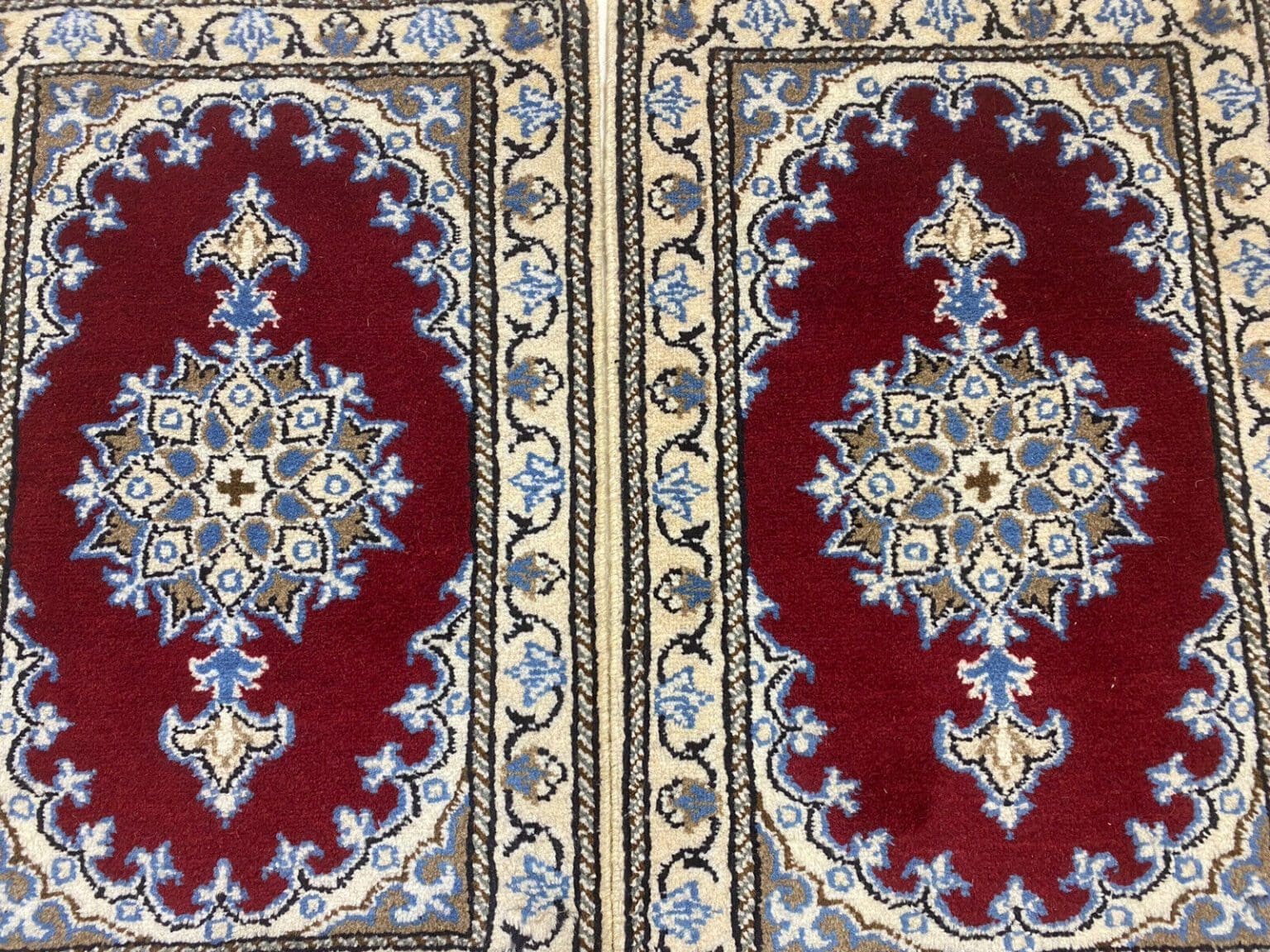
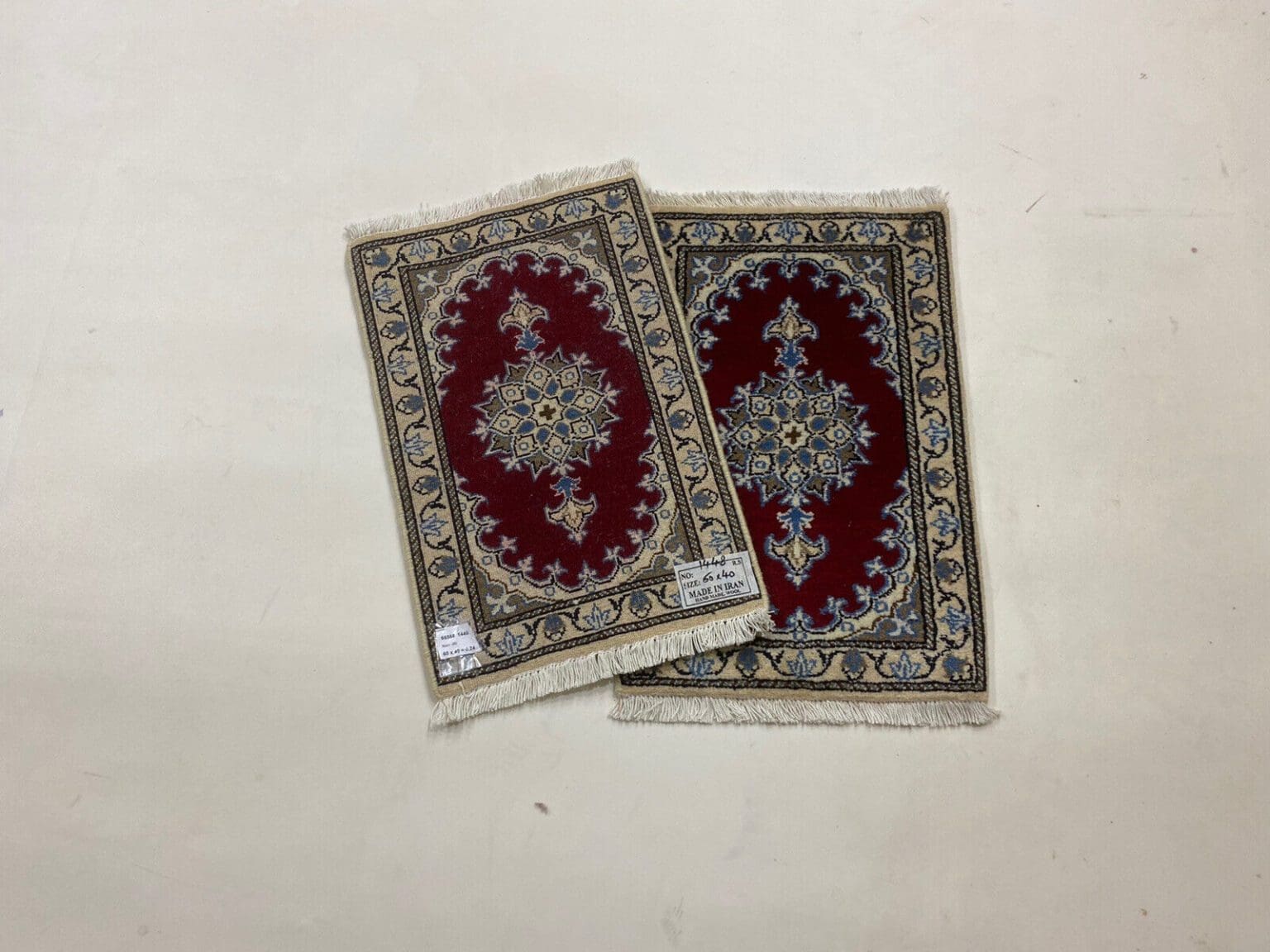
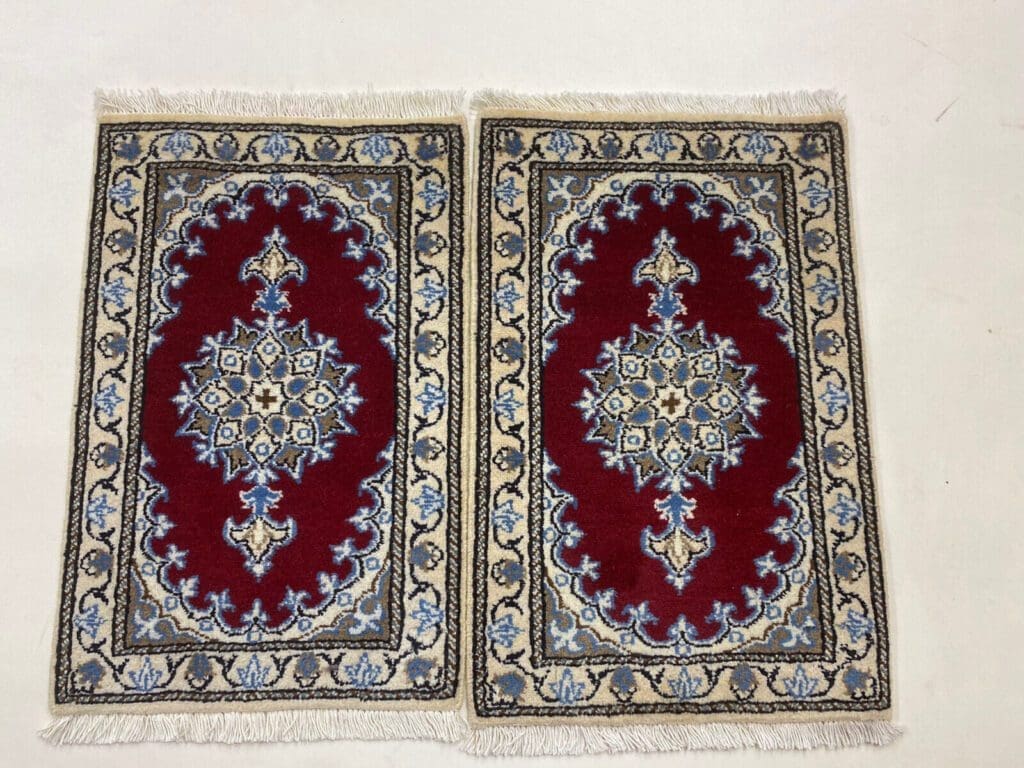
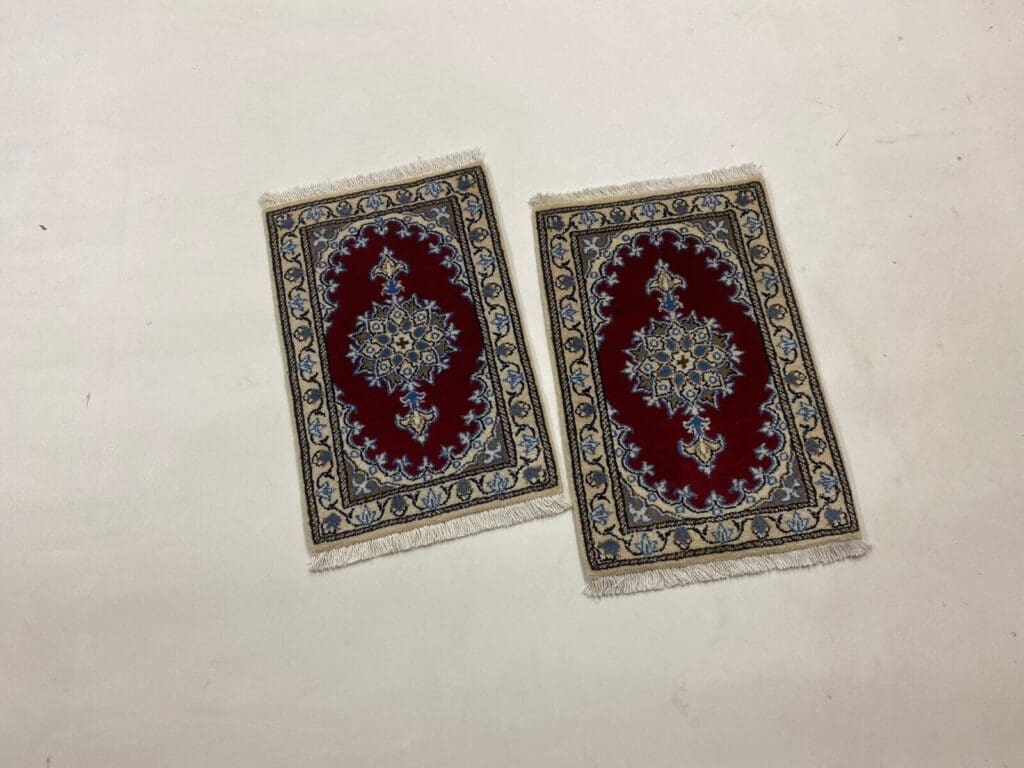
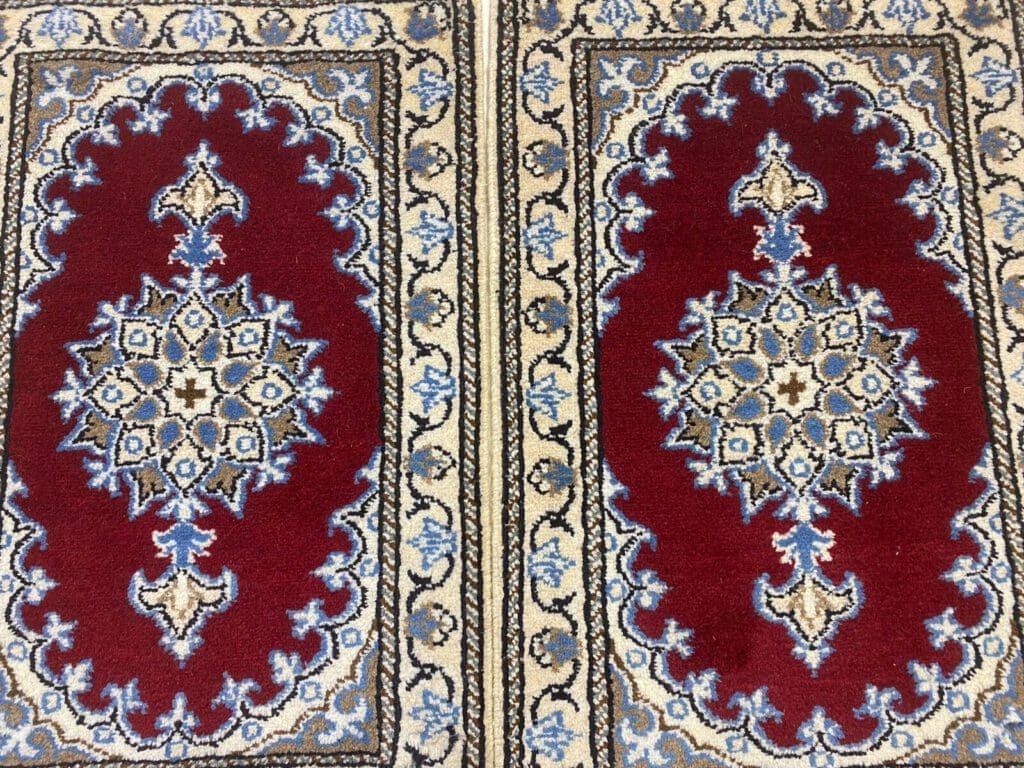
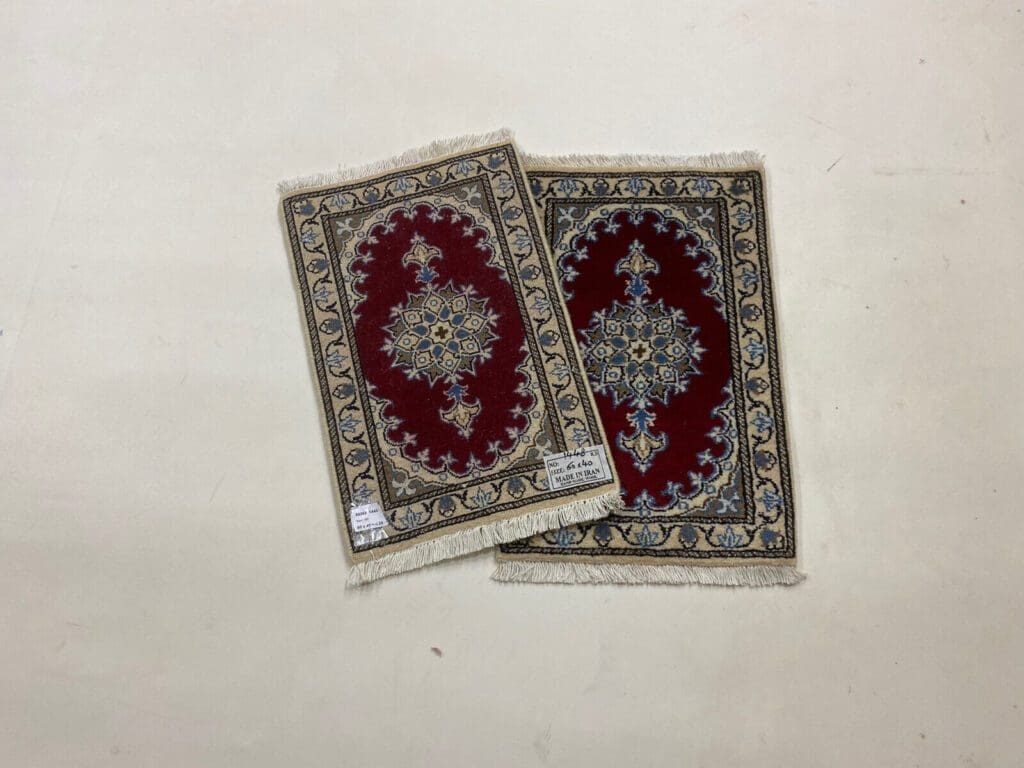
This rug is described as having an Oriental pattern. Its design is characterised by floral and ornamental elements, with geometric forms also belonging to the pattern language described for Nain. Floral motifs may suggest blossoms, leaves and flowing plant forms, while ornamental details establish a structured decorative rhythm. Geometric shapes can supply clear lines, divisions and transitions between the different areas of the composition.
The effect of a Nain design does not depend on one isolated motif. It comes from the relationship between fine details, larger ornaments and the overall arrangement of the surface. A densely knotted pile can carry numerous small design components and keep their outlines legible. The high knot density of this rug supports its detailed execution. It is a technical characteristic of the pile, however, rather than the name of a particular motif or pattern type.
Oriental rug designs often draw on forms found in nature and organise them into a stylised, repeatable structure. Flowers and leaves may appear as interpreted symbols instead of botanical illustrations. Ornaments can be mirrored, repeated in a rhythm or arranged around a central point. Geometric elements provide a framework and help connect different groups of motifs. The resulting pattern can therefore combine decorative clarity with a surface that rewards close observation.
Nain is associated with elegant, complex and finely worked designs. Colour selection is an important part of this visual tradition. The source description notes that shades in Nain are chosen carefully and are often obtained from natural dyes. Colour is not simply applied as an isolated field; it helps establish the relationship between ground, ornament and outline. A considered palette makes floral and geometric details easier to distinguish and helps the composition retain its internal balance.
The floral and ornamental character allows the rug to function in several interior settings without losing its regional identity. It can be used in a living room or dining room, as an accent rug in a hallway, or in a representative room. These possible placements describe how an Oriental design may be used in an interior. They do not alter the rug’s origin, its Nain classification or its hand-knotted construction.
On a hand-knotted rug, the design is transferred into the surface by hand. Small variations in execution are therefore part of the making process. In this one-off piece, Nain’s traditional vocabulary is combined with an individual interpretation by the craftsperson. The floral, ornamental and geometric references work together with the dense knotting, the wool and silk pile and the careful selection of shades. Its pattern is thus the result of material, design and manual technique considered as one process.
Special Features
A notable feature of this rug is its high knot density. It creates a fine, detailed pile and supports a precise rendering of the design. Dense knotting is one of the technical characteristics that can be observed when examining a hand-knotted rug. In this piece it is combined with the Nain pattern tradition and with a pile made from virgin wool and silk.
The rug is new, suitable for underfloor heating and supplied with a certificate of authenticity. It is offered as a one-off, single unique piece. It is therefore not described as an interchangeable mass-produced item, but as one individual hand-knotted rug. Its classification as a Nain Persian rug, its material composition and its Oriental pattern description remain part of the same product identity.
The suggested uses include living rooms, dining rooms, hallways and representative spaces. Direct sunlight should be avoided so that the colours do not fade. Regular vacuuming without a brush attachment is recommended for care. If a stain occurs, it should be blotted immediately with a dry cloth rather than rubbed. Professional cleaning is recommended to help preserve the rug’s quality over time.
FAQ
How should I care for the Nain Persian rug?
Regular vacuuming without a brush attachment removes dust and dirt while avoiding unnecessary stress on the fine fibres. Any stain should be blotted immediately with a dry cloth. Rubbing should be avoided because it can affect the fibres and the appearance of the colours. Professional cleaning is recommended to help maintain the rug’s quality over the long term. Direct sunlight should also be avoided so that the colours retain their visual effect.
Where can the rug be placed?
The Nain Persian rug can be placed in a living room, dining room or hallway as an accent rug. Its floral and ornamental design also makes it suitable for representative spaces. It should be positioned where it is not exposed to direct sunlight for extended periods, helping to reduce the risk of fading. The rug is suitable for underfloor heating and can therefore be used in rooms with that type of heating system.
What makes a hand-knotted rug special?
A hand-knotted rug is made with patience and craft skill. The knots are inserted individually, allowing the pile and design to be worked out with close attention. Each rug is a one-off or single unique piece and may show fine individual differences in pattern and colour that reflect the manual process. In this Nain Persian rug, handwork, high knot density, virgin wool and silk, and the traditional Oriental design are brought together in one individual execution.
To provide the best experiences, we use technologies like cookies to store and/or access device information. Consenting to these technologies will allow us to process data such as browsing behavior or unique IDs on this site. Not consenting or withdrawing consent, may adversely affect certain features and functions.
Functional Always active
The technical storage or access is strictly necessary for the legitimate purpose of enabling the use of a specific service explicitly requested by the subscriber or user, or for the sole purpose of carrying out the transmission of a communication over an electronic communications network.
Preferences
The technical storage or access is necessary for the legitimate purpose of storing preferences that are not requested by the subscriber or user.
Statistics
The technical storage or access that is used exclusively for statistical purposes.The technical storage or access that is used exclusively for anonymous statistical purposes. Without a subpoena, voluntary compliance on the part of your Internet Service Provider, or additional records from a third party, information stored or retrieved for this purpose alone cannot usually be used to identify you.
Marketing
The technical storage or access is required to create user profiles to send advertising, or to track the user on a website or across several websites for similar marketing purposes.
 SECURE PAYMENT
 SHIPPING PARTNERS