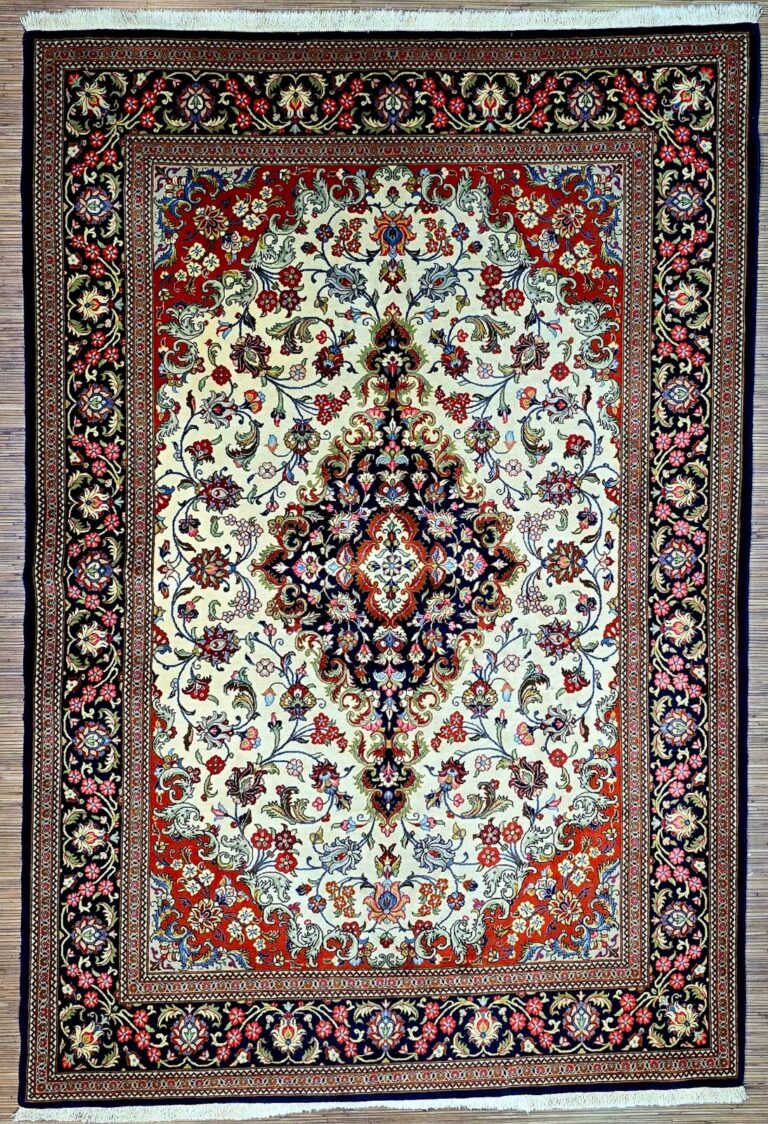
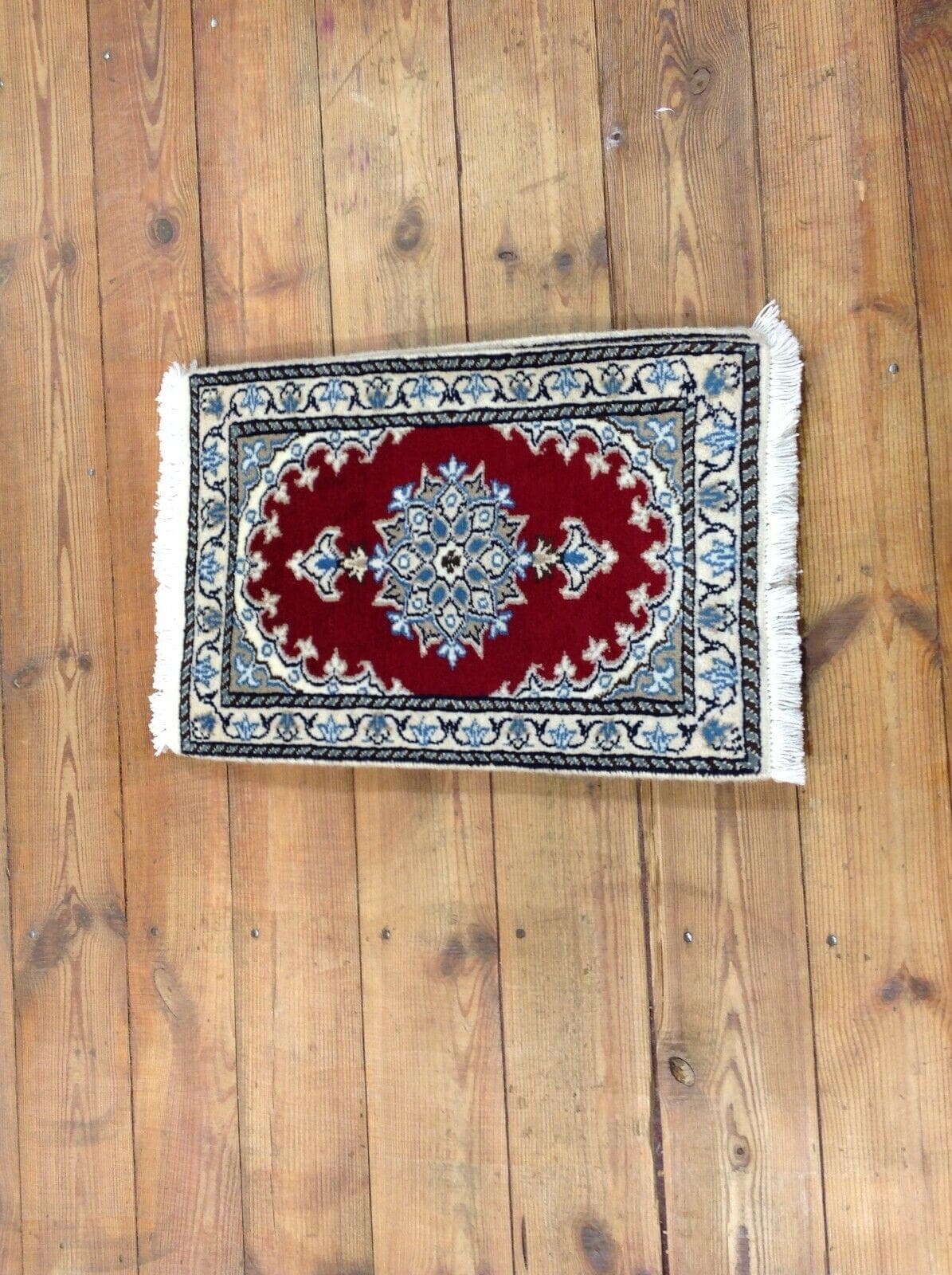
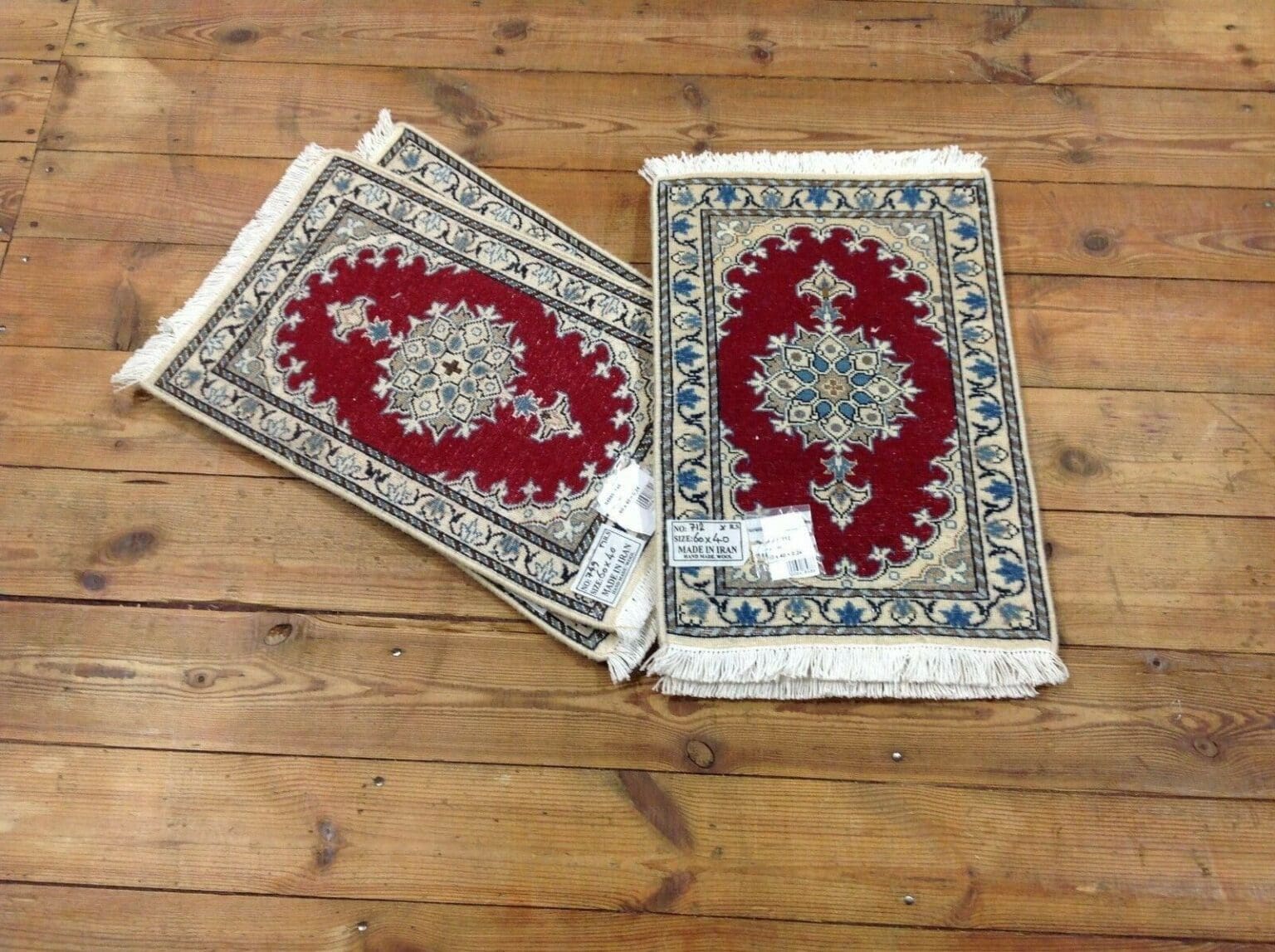
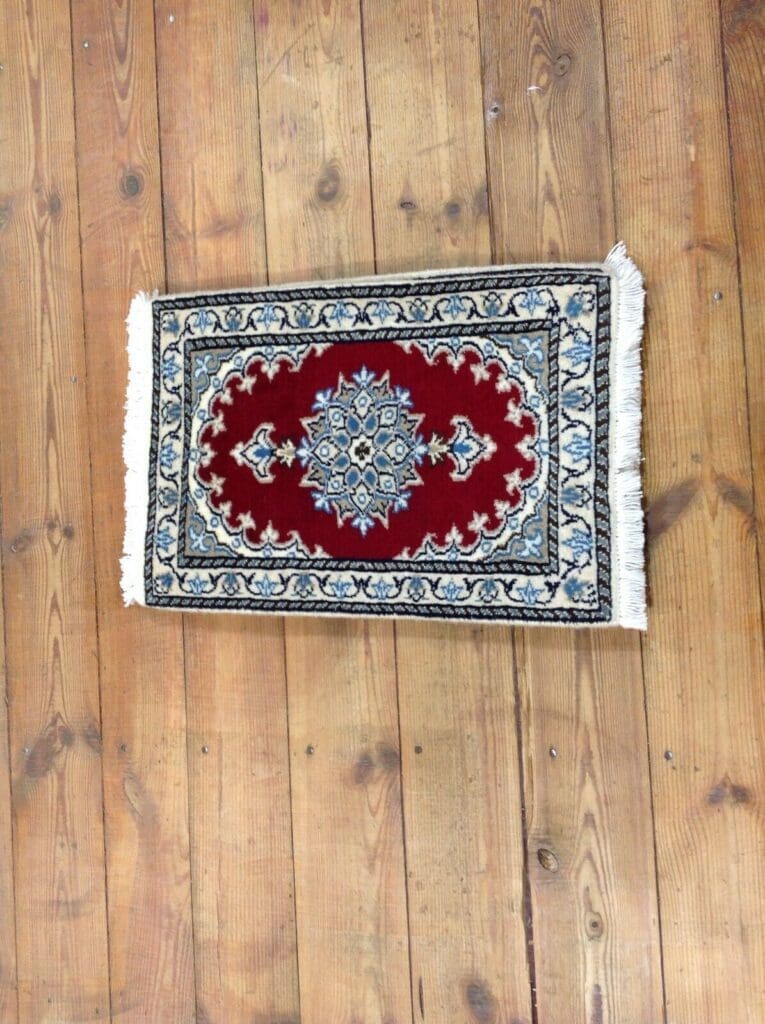
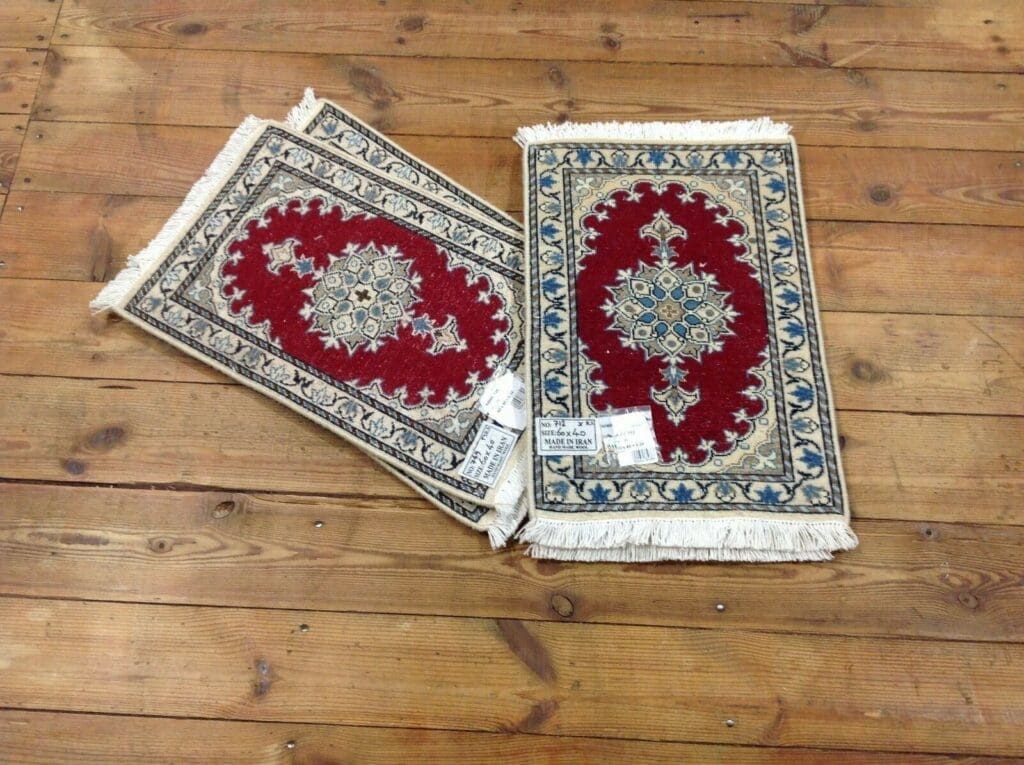
This Nain Persian rug is made from virgin wool. Wool is valued in rug making for its durable nature, soft surface and pleasant tactile quality. As a natural fibre, it can retain warmth and can also help dampen sound. These properties make wool suitable for a floor covering intended to contribute to a comfortable living environment. The material also gives the rug a refined appearance and a surface that feels agreeable underfoot.
The rug is hand-knotted rather than industrially manufactured. In hand-knotting, the pile is formed knot by knot through manual work, so the construction depends on the careful placement of many individual knots. The source describes this rug with a knot density of 300,000 knots per square metre. Such detailed manual work is associated with the precise lines and fine ornamentation found in Nain rug making. Each individually produced rug has its own character as a result of this process.
Hand-knotted construction is a traditional method in which the weaver builds the design progressively instead of applying a pattern through a mechanical production process. The work requires attention to the relation between colour, outline and decorative detail. In Nain weaving, this technical care supports the finely drawn appearance for which the type is known. The wool contributes both visual depth and a soft hand, while the manual technique gives the finished textile its crafted structure.
Origin and Tradition
Nain is a city in Iran, in Isfahan province, and the rug is identified as a Nain Persian rug. The region has a long carpet-making tradition reaching back to the sixteenth century. Nain became known for carpets with elegant, carefully developed designs and a strong emphasis on detail. Its weaving culture belongs to the wider Iranian tradition, in which carpet production combines practical textile knowledge with ornamental composition and inherited craft skills.
The name Nain refers to a recognised Iranian rug tradition rather than simply to a colour scheme or a decorative idea. Weavers associated with this tradition work within established principles of drawing, arrangement and proportion, while individual carpets can still differ in their precise design. This balance between continuity and variation is an important feature of hand production. A Nain rug therefore connects a particular object with the broader history of carpet making in Isfahan province and Iran.
Iranian carpet traditions developed through the transmission of skills between generations. Knowledge of knotting, wool preparation, colour use and pattern drawing was preserved through practice and adapted by successive makers. Nain is part of this history. Its carpets are described as combining traditional techniques with innovative design, allowing a familiar regional vocabulary to remain relevant in changing interiors. The craft is therefore both historical and active: inherited methods provide the foundation, while the arrangement of details gives each finished work its own visual identity.
Nain rugs are generally associated with restrained colours and detailed compositions. Their appearance is often light and orderly, with decoration that can include floral and geometric elements. This connection with Isfahan province is important because Iranian rug traditions are not uniform across the country. Different centres developed their own approaches to drawing, colour and construction. Nain is recognised for an elegant, fine treatment within that larger Persian carpet culture.
The history of Nain weaving also illustrates the cultural role of the Iranian carpet. A rug can serve as a useful household textile while carrying regional knowledge in its structure and ornament. Floral forms, geometric organisation and the discipline of hand-knotting bring together function, craft and visual language. The Nain tradition is thus connected not only with the production of floor coverings but also with the preservation of Iranian artistic practice.
Design and Pattern
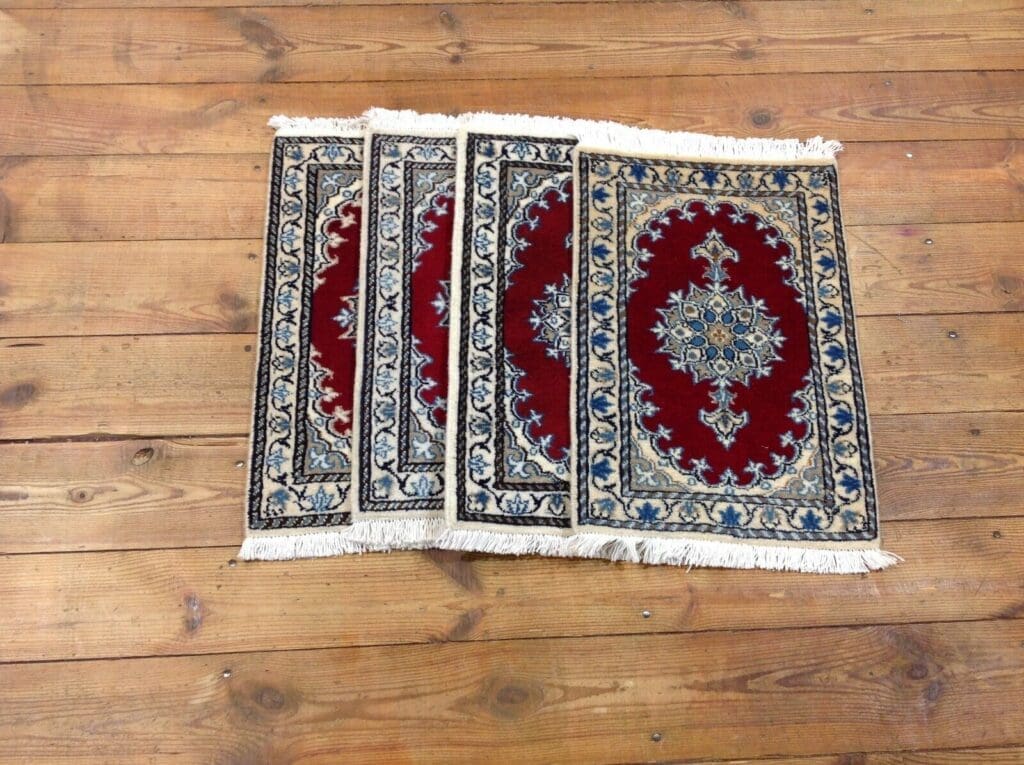
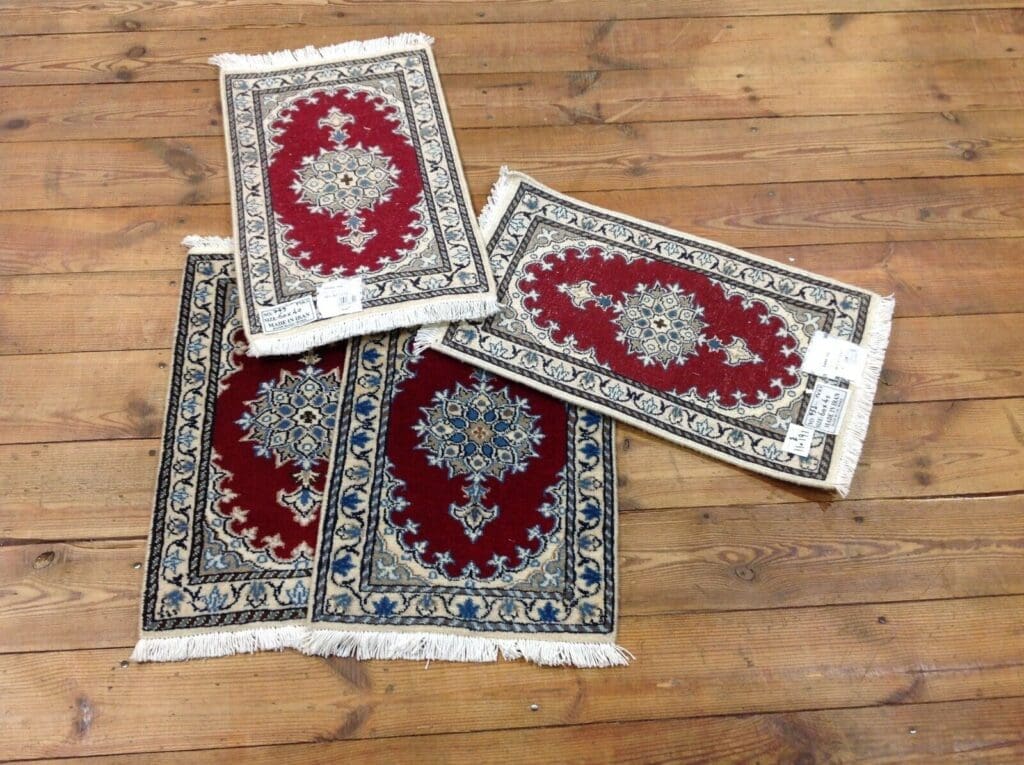
Nain designs are commonly associated with fine and graceful ornament inspired by the natural world. Floral motifs, leaves and related botanical forms may be arranged in a balanced composition. Such decoration is not necessarily a direct depiction of a single plant or scene. Instead, natural forms are stylised into an ordered vocabulary that can be repeated, mirrored or distributed across the field and border. This treatment gives Nain carpets their characteristic sense of detail and compositional control.
Geometric patterns also have an established place in Oriental rug design. Lines, divisions and repeated shapes help organise a textile and create a visual framework for floral ornament. In Iranian carpet culture, geometry can provide rhythm and structure while organic motifs add movement and variation. The two approaches can appear together, allowing a design to feel both controlled and animated. The source describes Nain carpets as frequently featuring floral and geometric patterns, but it does not assign a specific pattern to this individual rug.
Colour is another important aspect of the Nain tradition. Nain rugs are generally made in gentle shades, and pastel tones are often associated with their light appearance. A restrained palette can make the drawing easier to read and can give the overall composition a calm, bright character. Colour relationships matter as much as the individual shades: a field, border and motifs must remain distinct while still forming a coherent whole.
Floral designs are often given symbolic associations in Oriental decorative traditions. They may suggest growth, fertility and the beauty of nature. These interpretations belong to the broader cultural background of the motifs and should not be read as a literal statement about a particular design unless that design is identified. In Nain weaving, botanical ornament is valued for both its visual grace and its place within an inherited Iranian pattern language.
The fine appearance of Nain decoration is closely related to the hand-knotted method. A carefully placed knot allows the weaver to build small changes in outline and shading across the design. This is why technical construction and visual pattern cannot be considered separately in a traditional rug. The drawing emerges through the making process, and the making process preserves the clarity of the drawing. Nain carpets demonstrate how detailed ornament can be developed through patient textile work rather than industrial printing.
The restrained palette and elegant pattern vocabulary also explain why Nain rugs are described as adaptable to both modern and traditional interiors. This is a general characteristic of the design tradition, not a claim that the individual rug has a particular room or furnishing style. Its Persian identity remains rooted in Iranian craft, while the clarity of the forms allows the type to be used in varied interior settings.
Special Features
The rug combines virgin wool with hand-knotted construction, two features presented in the source as central to its character. The material is described as durable, soft and comfortable, while the manual workmanship gives the piece the status of an individually made textile rather than an industrially produced model. Wool is also described as easy to clean and maintain when cared for appropriately. Together, these qualities make the rug both a practical household object and an example of traditional craft.
The source further describes natural fibres such as virgin wool as suitable for allergy-conscious households, stating that they can have an antiallergic character and filter pollutants from the air. These properties form part of the material background given for the rug. As with any textile used in a home, regular care remains important. The rug is also presented as an object that can retain its appearance for many years when properly maintained, reflecting the durability associated with its material and hand-knotted construction.
A hand-knotted Nain rug carries the visual evidence of its making in its detailed ornament and carefully formed surface. Its significance lies in the combination of Iranian regional tradition, wool and manual workmanship. It is therefore described not only as a floor covering but also as a piece of textile art that brings a crafted, elegant quality to an interior.
FAQ
How should I clean a Nain Persian rug?
Regular vacuuming is recommended to help keep the rug free from everyday dust. Occasional professional cleaning can support its long-term care. If a spill occurs, remove it promptly with a mild cleaning agent and a damp cloth, working carefully rather than applying harsh chemicals. Strong chemical products should be avoided because they may affect the wool and its appearance. The rug should also be kept out of direct sunlight, which can influence textile colours over time.
How long can a Nain Persian rug last?
With good care, a high-quality Nain Persian rug can last for generations. Its longevity is associated with the use of wool and with hand-knotted construction. Proper maintenance, prompt attention to spills and suitable placement all contribute to preserving the textile. A rug’s continued use should nevertheless be accompanied by sensible care, including regular cleaning and protection from conditions that may unnecessarily stress its fibres or colours.
Can I use a Nain rug in any room?
Yes. Nain Persian rugs are described as suitable for a range of interior styles and can be used in nearly any room. Possible settings include a living room, bedroom or hallway. Their generally gentle colours and elegant patterns allow them to work with both modern and traditional furnishings. The appropriate placement should still take account of normal household use and the cleaning guidance for wool, but the Nain design tradition itself is considered versatile across different residential spaces.
To provide the best experiences, we use technologies like cookies to store and/or access device information. Consenting to these technologies will allow us to process data such as browsing behavior or unique IDs on this site. Not consenting or withdrawing consent, may adversely affect certain features and functions.
Functional Always active
The technical storage or access is strictly necessary for the legitimate purpose of enabling the use of a specific service explicitly requested by the subscriber or user, or for the sole purpose of carrying out the transmission of a communication over an electronic communications network.
Preferences
The technical storage or access is necessary for the legitimate purpose of storing preferences that are not requested by the subscriber or user.
Statistics
The technical storage or access that is used exclusively for statistical purposes.The technical storage or access that is used exclusively for anonymous statistical purposes. Without a subpoena, voluntary compliance on the part of your Internet Service Provider, or additional records from a third party, information stored or retrieved for this purpose alone cannot usually be used to identify you.
Marketing
The technical storage or access is required to create user profiles to send advertising, or to track the user on a website or across several websites for similar marketing purposes.
 SECURE PAYMENT
 SHIPPING PARTNERS