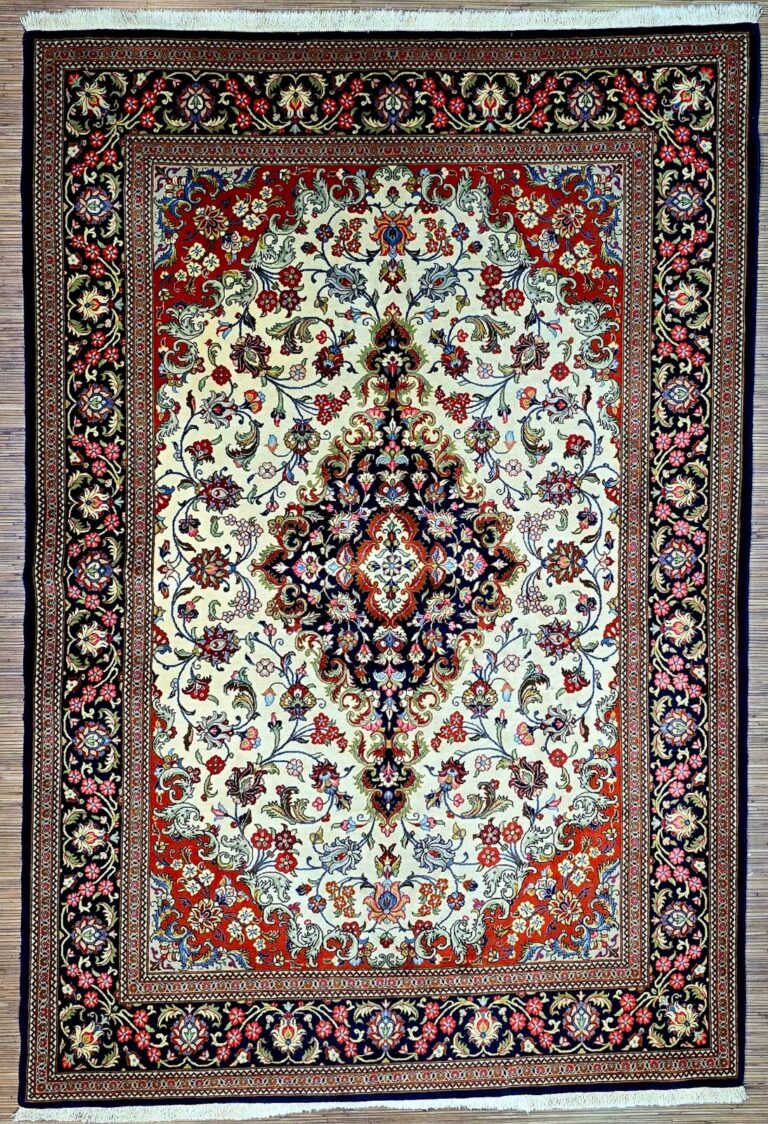
This Nain Persian rug is hand-knotted, with a pile made from 100% virgin wool. The warp and weft are made from 100% cotton. The combination of a wool surface and a cotton foundation is part of the established material language of Persian rug making. Wool is valued for its natural resilience, pleasant feel and warmth underfoot. It is both durable and comparatively easy to care for, making it suitable for use in a living environment.
In hand-knotting, every knot is placed individually by hand. Unlike a machine-made floor covering, this method creates a distinct textile structure in which the work of the weaver remains part of the object. The dense construction supports a finely worked surface and allows lines, blossoms and geometric forms to be rendered with clarity. The yarn is dyed and contributes to the rug’s vivid colour tones.
The workmanship combines traditional technique with a demanding level of execution. Virgin wool provides a soft but hard-wearing pile, while cotton forms the textile basis through the warp and weft. The result is a hand-knotted Oriental rug with a recognisable structure and the fine appearance associated with Nain. This rug is also suitable for use with underfloor heating.
Origin and Tradition
Nain is a city in Iran known for its Persian rugs. The city and its surrounding area have a long rug-making tradition reaching back to the eighteenth century. Over time, a distinctive approach developed there, bringing together fine textile structures, careful knotting and balanced ornamental compositions. Nain is therefore associated with an elegant and precisely made form of Persian rug craftsmanship.
Rug making in Nain is deeply rooted in the culture of the region. Knowledge of materials, dyeing, knotting and pattern design has been passed down through generations. The individual knot is the basis of the entire design: countless hand-placed knots build up fields, outlines and repeating ornaments. This makes production time-consuming and gives each finished rug its own textile identity.
A defining feature of the Nain tradition is the combination of fine execution with a calm, ordered overall effect. Floral ornaments may be combined with geometric forms without losing the clarity of the composition. This approach reflects a rug culture in which function, material and ornament belong together. The rug is not viewed only as a floor covering, but also as a handmade expression of a regional craft tradition.
Persian rugs from Nain are often made with natural materials and inherited techniques. The use of virgin wool and cotton, together with hand-knotting, represents this connection between raw material, skill and tradition. The Iranian origin is an essential part of the classification as a Persian rug. Nain rugs can complement both traditional rooms and contemporary interiors because their design vocabulary is rooted in established forms while remaining versatile.
The history of the region shows how a local craft developed over a long period into a recognised rug-making tradition. In workshops and family settings, skills were transmitted through the preparation of wool, the setting up of the foundation and the placement of the knots. This care is not tied to industrial serial production. Each hand-knotted piece consequently remains an individual work with its own structure and execution.
Design and Pattern
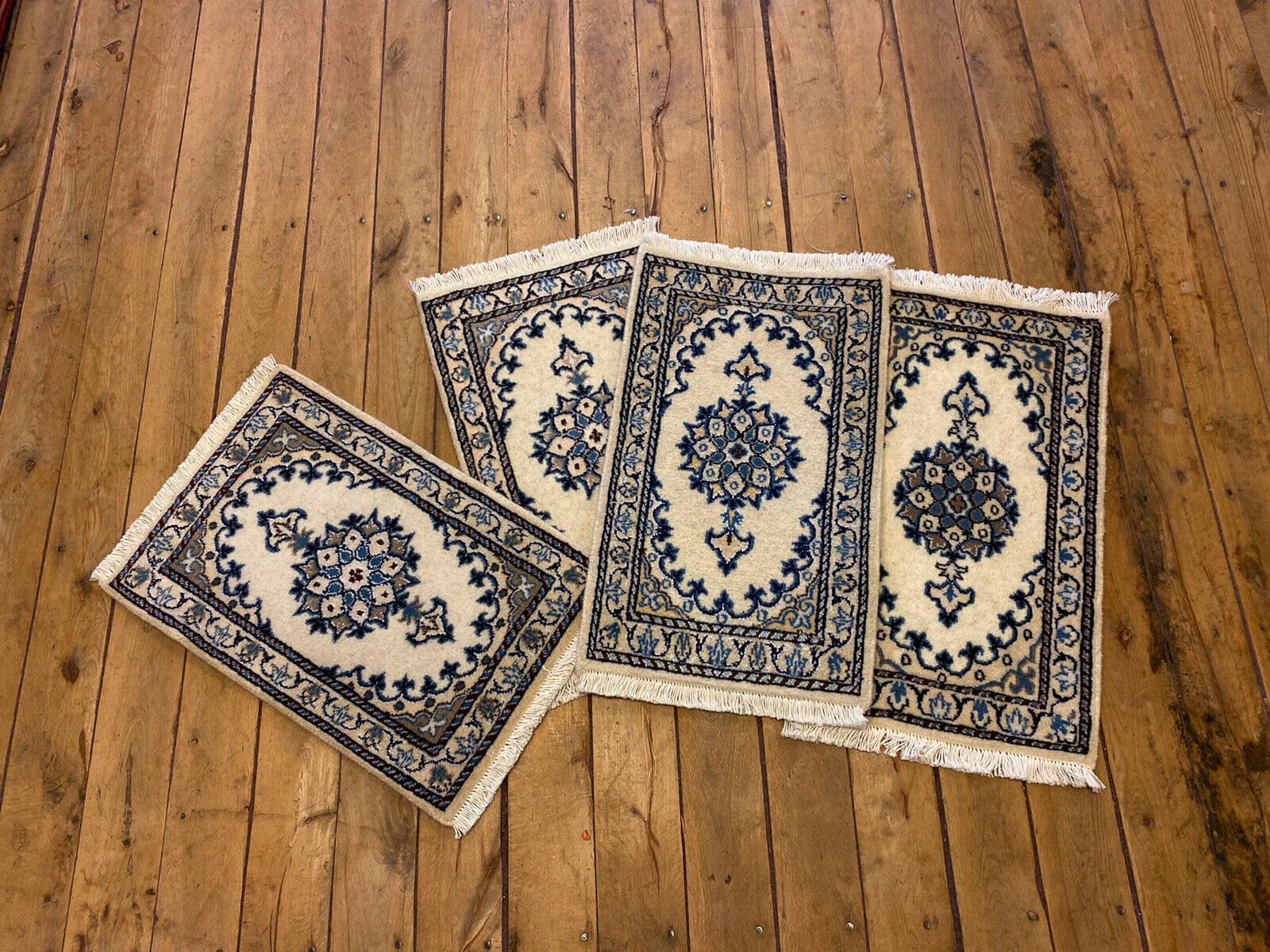
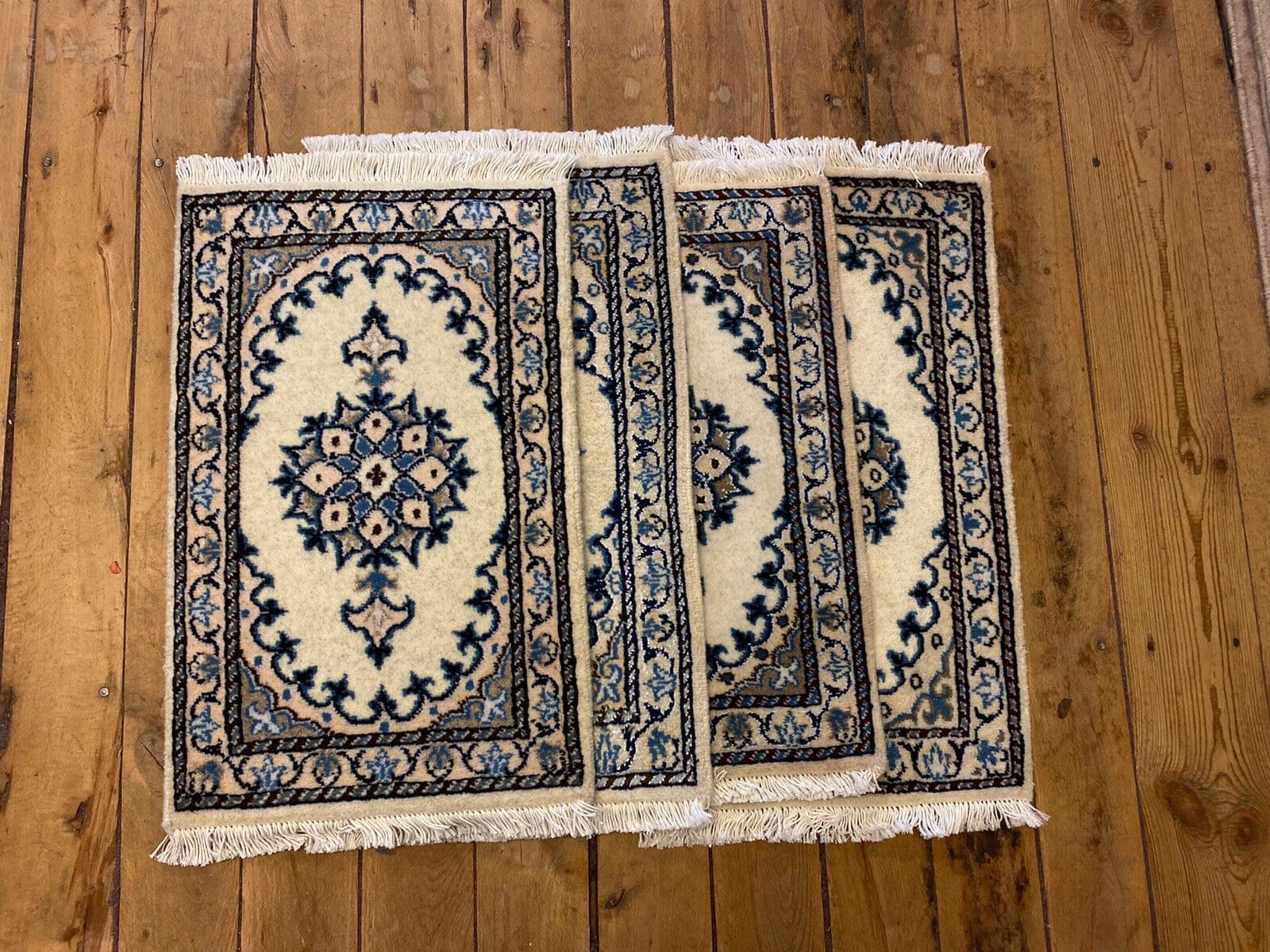
The design of this Nain Persian rug combines floral motifs with complex geometric forms. Floral ornaments bring blossoms and plant shapes into the composition, while geometric elements provide order, rhythm and a clearly structured arrangement. In Persian pattern traditions, these forms are often interwoven: lines frame motifs, repetition creates cohesion, and finely worked details enliven the surface.
Floral patterns have a long history of meaning in Oriental ornament. They are associated with beauty, life and the connection with nature. These interpretations belong to the cultural background of the motifs and are not limited to a particular interior. Geometric forms add clear axes and organising elements to this visual language. Together, the two pattern families create a design that is decorative while remaining ordered.
Nain rugs are known for elegant designs and finely woven or finely knotted structures. Their compositions may include a central order, floral framing and recurring ornaments. The relationship between contour and field is important: individually placed knots permit a differentiated rendering of smaller details, while the overall arrangement remains legible. This produces the characteristic Nain balance between detailed workmanship and harmonious design.
The colour selection described for this rug is harmonious and based on gentle tones. Such colours can be combined with a range of furnishings and support the quiet effect of the floral and geometric ornaments. Dyed yarn provides vivid colour tones. Colour is not separate from the pattern; it emphasises lines, flower shapes and the geometric order within the composition.
As a Persian rug from Nain, this piece can complement classic and modern interiors. In a living room, bedroom or representative setting, floral motifs can create a homely note, while geometric forms give the appearance structure. The traditional pattern language remains recognisable without being restricted to one type of room. The design can therefore be read either as an ornamental field or as a deliberately placed accent.
Oriental rug patterns also carry cultural ideas of harmony and good fortune. In many Orientalising cultures, ornaments are understood as signs with symbolic meaning. For this rug, those cultural references form the background to the floral and geometric design. The concrete description remains focused on the stated forms: floral motifs, complex geometry, harmonious colouring and fine hand-knotted workmanship.
Special Features
A notable feature of this rug is its high knot density of approximately 300,000 knots per square metre. Dense knotting allows ornaments to be worked in detail and indicates a labour-intensive handmade process. It also supports the fine structure associated with Nain rugs. Knot density is therefore both a technical characteristic and an indication of the care invested in the design.
The rug is new and in very good condition. It is identified as a unique one-off piece. This means that its particular execution is not presented as an identical serial product. Other stated features include suitability for underfloor heating, a pile of 100% virgin wool and cotton in the warp and weft. Together, these details define a clearly described hand-knotted individual rug from Nain.
The rug weighs approximately 6 kg. This is another product characteristic alongside its hand-knotted construction and high knot density. It brings together traditional workmanship, natural materials, a finely patterned surface and a new, very good condition. Its classification as a Nain Persian rug refers to the Iranian tradition of origin, rather than merely to a decorative pattern name.
FAQ
How should I care for my Nain Persian rug?
Regular vacuuming helps remove dust and loose particles from the pile. It should be done carefully so that the knots are not damaged. For stains, use a damp cloth with mild soap. Rubbing aggressively and soaking the rug should be avoided in order to protect the pile, colours and foundation. Professional cleaning every few years helps preserve the colours and materials. If a particular stain requires more treatment, a cleaner experienced with Oriental rugs is the appropriate choice.
Where is the best place to position the Nain Persian rug?
The rug is suitable for living rooms, bedrooms and representative spaces. On smooth surfaces such as parquet or tiles, its floral motifs, geometric forms and fine structure can be seen particularly clearly. Since it is suitable for underfloor heating, it can also be used in rooms equipped with that system. Direct sunlight should be avoided so that the colours do not fade. The final position depends on the existing furnishings and the decorative effect desired.
What makes a rug from Nain special?
Persian rugs from Nain are known for fine structures, carefully worked patterns and high knot densities. The Nain tradition combines handcraft with floral ornament and complex geometric forms. This piece also has hand-knotted construction, a pile of 100% virgin wool and 100% cotton in the warp and weft. It is identified as a unique one-off and is new and in very good condition. The combination of Iranian origin, natural materials and artistic workmanship defines its particular character.
To provide the best experiences, we use technologies like cookies to store and/or access device information. Consenting to these technologies will allow us to process data such as browsing behavior or unique IDs on this site. Not consenting or withdrawing consent, may adversely affect certain features and functions.
Functional Always active
The technical storage or access is strictly necessary for the legitimate purpose of enabling the use of a specific service explicitly requested by the subscriber or user, or for the sole purpose of carrying out the transmission of a communication over an electronic communications network.
Preferences
The technical storage or access is necessary for the legitimate purpose of storing preferences that are not requested by the subscriber or user.
Statistics
The technical storage or access that is used exclusively for statistical purposes.The technical storage or access that is used exclusively for anonymous statistical purposes. Without a subpoena, voluntary compliance on the part of your Internet Service Provider, or additional records from a third party, information stored or retrieved for this purpose alone cannot usually be used to identify you.
Marketing
The technical storage or access is required to create user profiles to send advertising, or to track the user on a website or across several websites for similar marketing purposes.
 SECURE PAYMENT
 SHIPPING PARTNERS