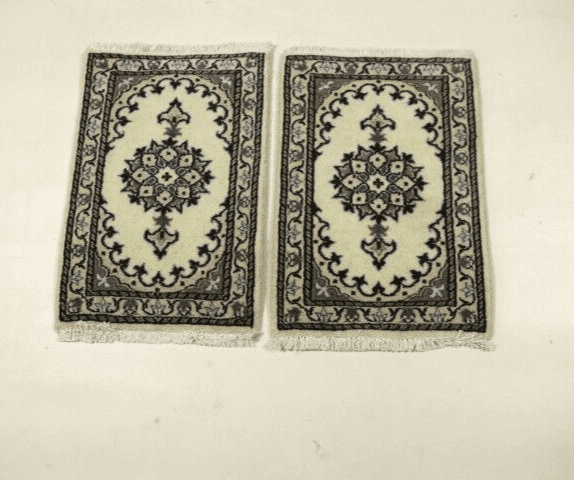
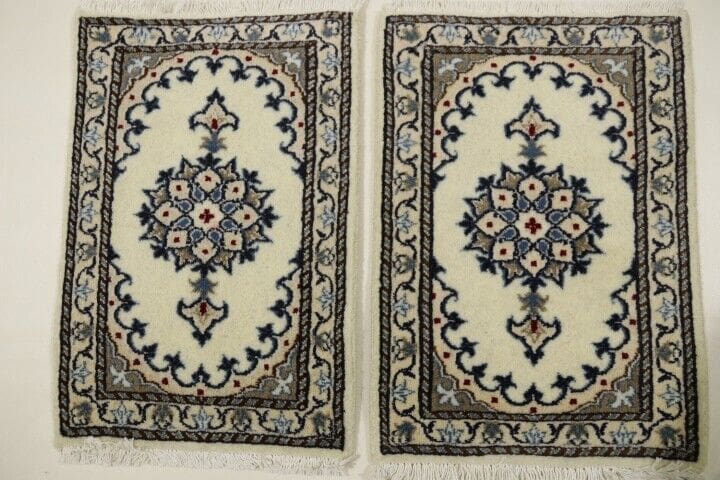
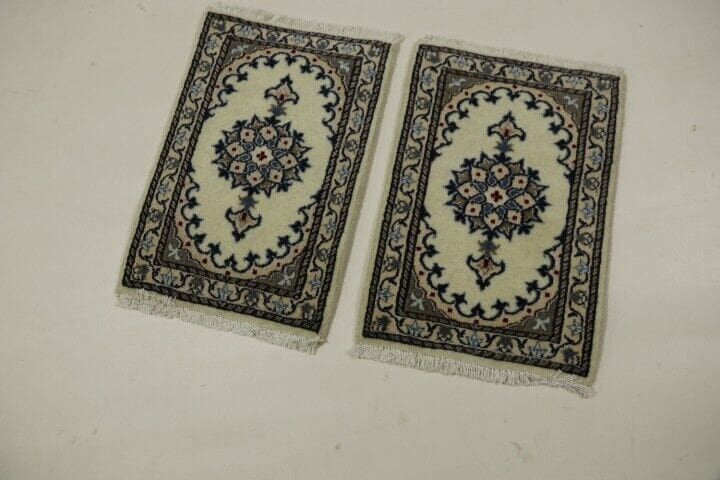
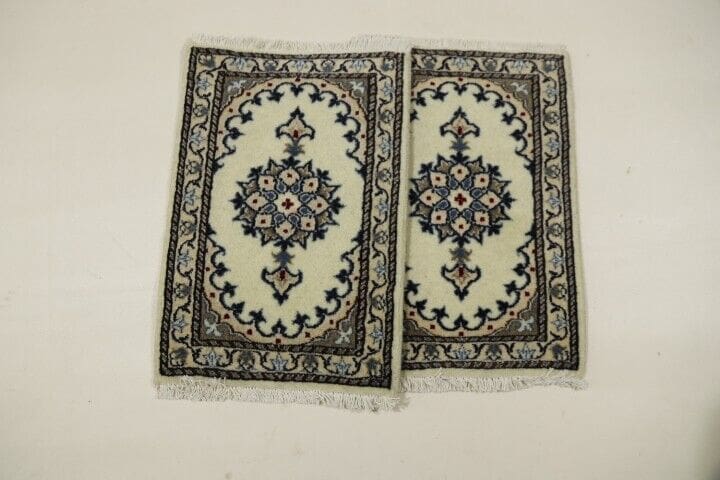
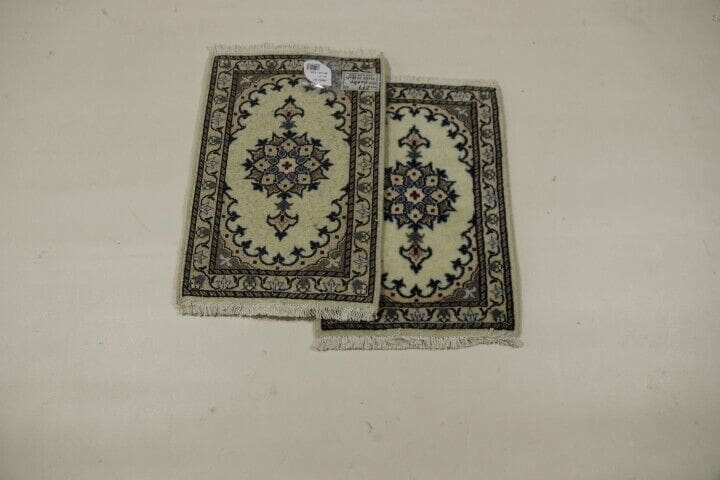
Hand-knotted Nain Persian rug | Knot density: approx. 300,000 knots/m² | Material: pile 95% new wool, 5% silk, warp and weft 100% cotton | Size: 60 x 40 cm | Condition: New, very good
This Nain Persian rug is hand-knotted. Its pile is made from new wool and silk, while both the warp and weft are cotton. Wool forms the principal pile material and gives the surface a substantial, pleasantly soft feel together with the resilience associated with the fibre. Silk is used as a finer pile fibre and may create a smoother touch and more varied reflections of light. The cotton warp and weft provide the textile structure into which the pile knots are tied.
In hand-knotting, each knot is made individually around the warp. The knots are secured as the work advances, and rows are built up until the planned pile surface is complete. The result is not an industrially repeated printed image, but a textile surface shaped by the work of the knotter. The stated knot density indicates a finely and closely constructed weave. Such construction supports the rendering of small forms and a consistent handle, although regular care remains part of the use of any rug.
The mixture of wool and silk brings together different material qualities. Wool generally has a fuller, more subdued surface, while silk can introduce finer highlights and a smoother visual accent. Cotton in the warp and weft forms the foundation of the knotting process. This piece is described as a one-off and is supplied with a certificate of authenticity. Its condition is given as new, very good. The hand-knotted construction is stated to make it suitable for all rooms, including residential and business interiors.
Origin and Tradition
Nain belongs to the tradition of Persian rugs. Persian rugs are made in Iran, and Nain is both the name of a city and the name used for an important rug-producing area in Isfahan Province. The city lies within the central Iranian landscape and is associated with a distinctive, precise school of rug making. Nain rugs are commonly linked with the development of a refined urban workshop tradition. Their production depends on knowledge shared among knotters, designers and workshop teams, with practical skills passed on through sustained work at the loom.
Iranian rug culture contains many regional schools, each with its own approaches to structure, ornament, fibre and colour. Nain is often associated with carefully drawn compositions, delicate outlines and closely worked detail. A place name in rug terminology therefore refers not only to geography, but also to a technical and visual tradition. Isfahan and the surrounding areas have long been important centres of Persian art and craft, where textile design developed alongside architecture, manuscript ornament and other forms of decorative art.
Traditional Nain designs are often developed on a clearly organised ground. A central field, one or more borders and connecting ornament lines may establish the composition. Floral forms, curling vines and geometrically ordered elements are part of the wider Persian design vocabulary. In a finely knotted rug, the drawing is planned so that small details remain legible within the whole. This sense of order is produced by the relationship between the design and the knotting method, rather than by surface decoration alone.
Knowledge in Persian rug production is transmitted through practical training and repeated work at the loom. A drawn design is converted into knots, row by row, and the completed rug is then shaped through finishing processes such as trimming and washing. The regional tradition remains connected to its place of origin even though individual workshops may use different layouts, colours and material combinations. This rug is identified as a Nain from Persia and is therefore placed within that regional context.
The history of Oriental rugs is also a history of local resources, workshop organisation and changing artistic exchange. Designs could be preserved, adapted or combined as they moved between generations and regions. Nain developed its own position within this broader Persian field through the preference for controlled drawing and fine workmanship associated with the area. The name does not by itself determine every detail of an individual rug; it identifies the documented regional tradition to which the piece belongs.
Design and Pattern
The Nain tradition is known for balanced, finely articulated designs. In many Nain compositions, floral ornament is combined with carefully controlled geometry. Vines connect blossoms, leaves and medallion forms, while borders organise the transition between the central field and the outer edge. Such arrangements establish a visual hierarchy: a principal form gains definition from smaller supporting elements, open spaces and repeated lines.
Persian ornament often relies on symmetry, rhythm and reflection. A design may develop around a central axis or place a medallion within a finely divided field. The spaces between motifs are equally important. They keep the drawing readable and allow contours, leaves and scrolling vines to retain their shape. Close knotting can reproduce these relationships with considerable delicacy. Curves, pointed leaves and small floral details can be differentiated through the sequence of knots and the contrast between the pile fibres.
The source description associates this rug with the typical Nain aesthetic, including floral motifs and complex geometric forms. It does not specify an individual colour palette or a particular motif for this one-off piece. No single colour, medallion or ornament is therefore presented here as a documented feature of the rug itself. What is established is its Nain classification and its place within a tradition often characterised by calm organisation and detailed drawing. Workshops may create different pattern variations while remaining within that tradition.
The appearance of an Oriental rug depends on more than one isolated symbol. Field, border, outline, repetition and open ground work together to create the composition. In Persian rugs, dyes, fibre and finishing also affect how a design is seen. Wool accepts colour differently from silk, so the same drawn form may contain varied degrees of depth and light. This general material effect helps explain why Nain designs can appear restrained in one execution and more strongly differentiated in another, without changing the underlying regional vocabulary.
Oriental rugs have also been understood as textile images carrying cultural associations. Their ornament may draw on plants, geometry, architecture and inherited systems of visual symbolism. The meaning is not identical in every rug and cannot be established from a place name alone. For this rug, Nain is the documented regional designation and no individual pattern name is provided. The description consequently remains with the recorded origin and the broader Nain design tradition.
Special Features
This rug is identified as a one-off and is offered with a certificate of authenticity. It is hand-knotted and has a fine knot density. New wool and silk are specified for the pile, with cotton used for the warp and weft. The condition is described as new, very good. These details distinguish the piece as an individually offered, certified example within the Nain tradition. The source also states that it is suitable for all rooms, so its intended use is not limited to one particular living area.
With a hand-knotted one-off, the individual execution is part of the character of the piece. Minor variations in tension, contour or surface can result from manual work and are not the same as the uniform repeat of an industrial product. The combination of close knotting and different pile fibres connects the technical construction with the way the surface handles light and touch. No additional claim about a particular colour nuance or named ornament is made, because those details are not described for this rug.
FAQ
How should I care for a Persian rug?
For routine care, vacuum on a low setting to remove loose dust and dirt without placing unnecessary stress on the pile. If liquid is spilled, blot it promptly with a damp cloth. Do not scrub, since rubbing can affect fibres and colour. Professional rug cleaning is appropriate when the rug needs a more thorough refresh. Specialist treatment is particularly useful for a pile containing both wool and silk, as it can help protect the surface, the fibres and the appearance of the colours.
How can I tell whether a rug is genuine?
The back of a hand-knotted rug offers useful clues. Knots and the design created on the front can generally be seen from the reverse side. A high knot density may indicate fine knotting, but it is not by itself a complete proof of authenticity. The materials are also relevant. This piece is specified as having new wool and silk in the pile, cotton in the warp and weft, and a certificate of authenticity. For a thorough assessment, the workmanship, the certificate details and an examination by a qualified rug specialist can be considered together.
How do Persian rugs differ from other Oriental rugs?
Persian rugs originate in Iran and are often distinguished by regional weaving traditions. Nain identifies a place and a design tradition within Persian rug making. Other Oriental rugs, including examples from Turkey or the Caucasus, may use different knotting methods, fibres, colours and systems of ornament. Persian workshops are widely associated with fine drawing, detailed floral forms and complex compositions. The precise characteristics always depend on the individual area, workshop and rug, so a comparison should consider the actual construction and design rather than relying on a general label alone.
To provide the best experiences, we use technologies like cookies to store and/or access device information. Consenting to these technologies will allow us to process data such as browsing behavior or unique IDs on this site. Not consenting or withdrawing consent, may adversely affect certain features and functions.
Functional Always active
The technical storage or access is strictly necessary for the legitimate purpose of enabling the use of a specific service explicitly requested by the subscriber or user, or for the sole purpose of carrying out the transmission of a communication over an electronic communications network.
Preferences
The technical storage or access is necessary for the legitimate purpose of storing preferences that are not requested by the subscriber or user.
Statistics
The technical storage or access that is used exclusively for statistical purposes.The technical storage or access that is used exclusively for anonymous statistical purposes. Without a subpoena, voluntary compliance on the part of your Internet Service Provider, or additional records from a third party, information stored or retrieved for this purpose alone cannot usually be used to identify you.
Marketing
The technical storage or access is required to create user profiles to send advertising, or to track the user on a website or across several websites for similar marketing purposes.
 SECURE PAYMENT
 SHIPPING PARTNERS


