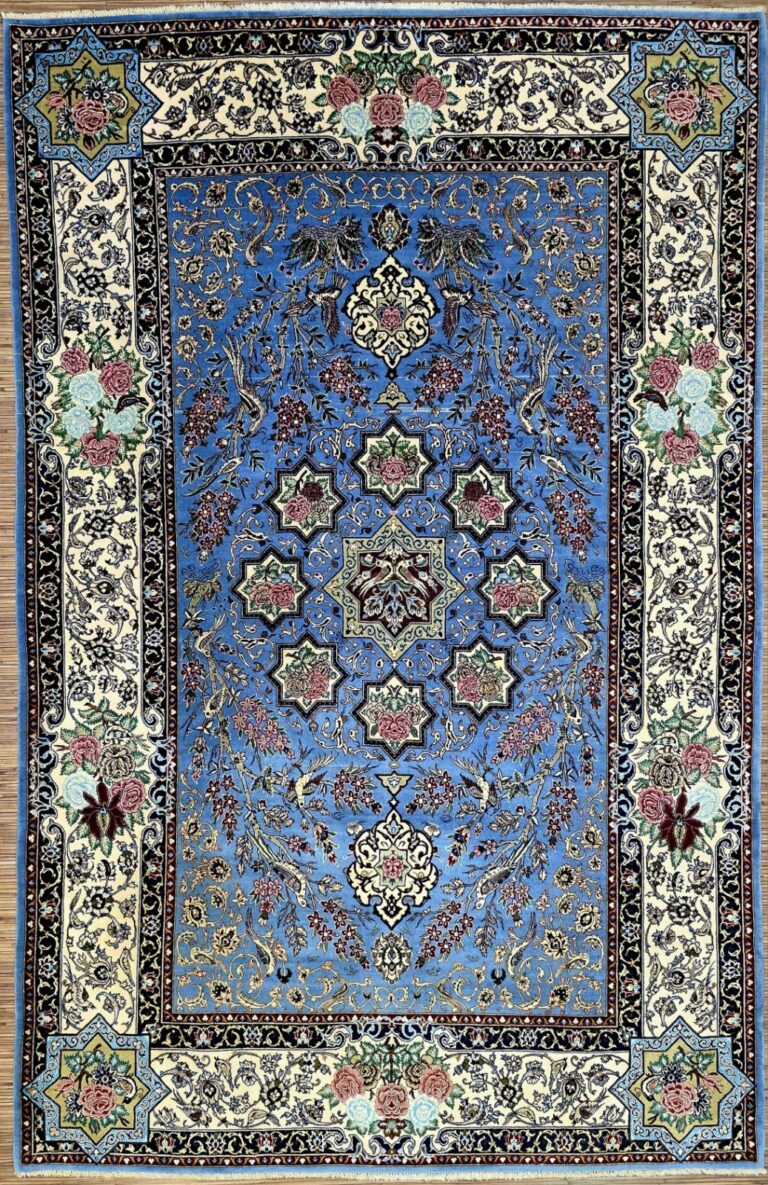
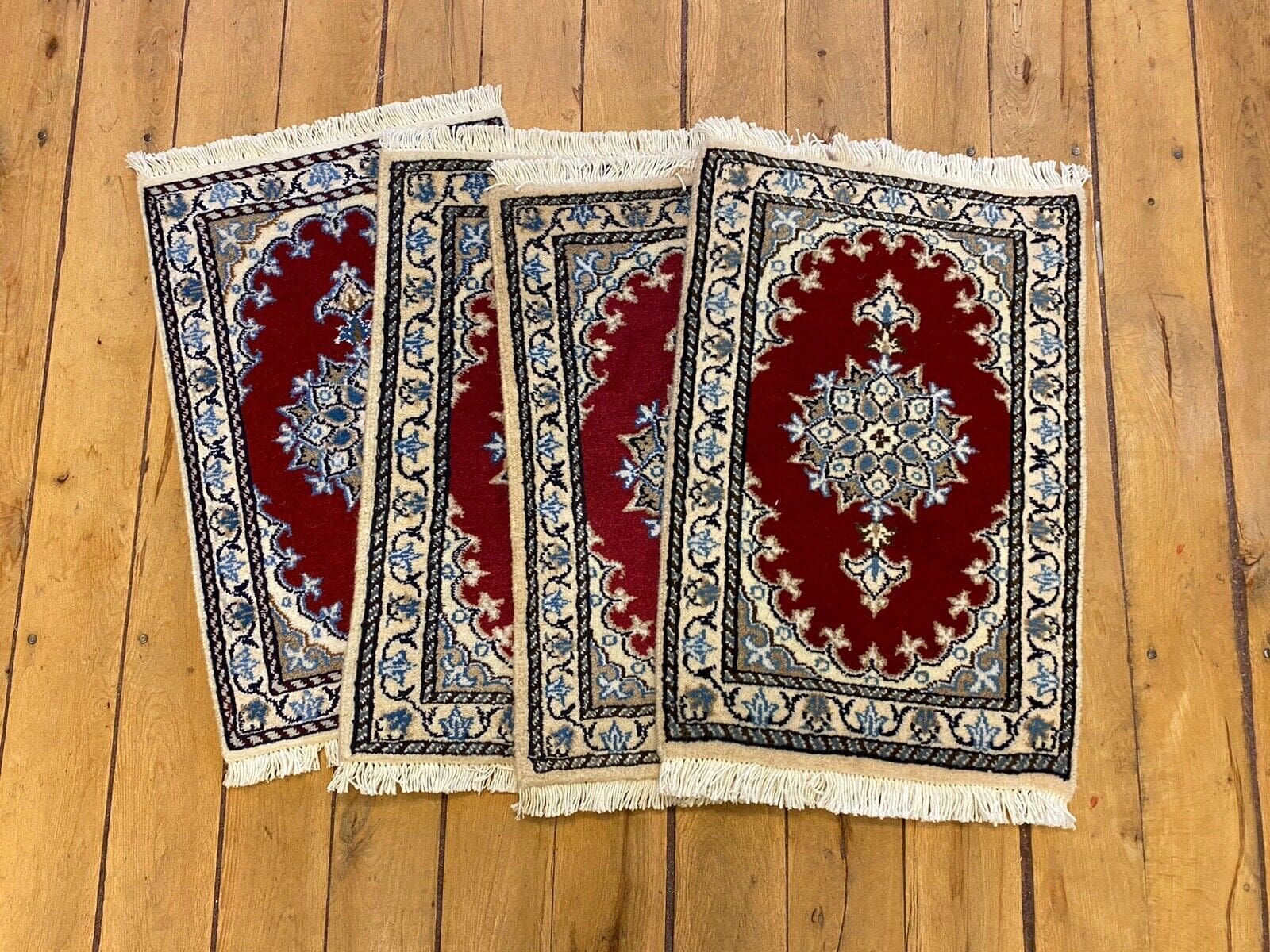
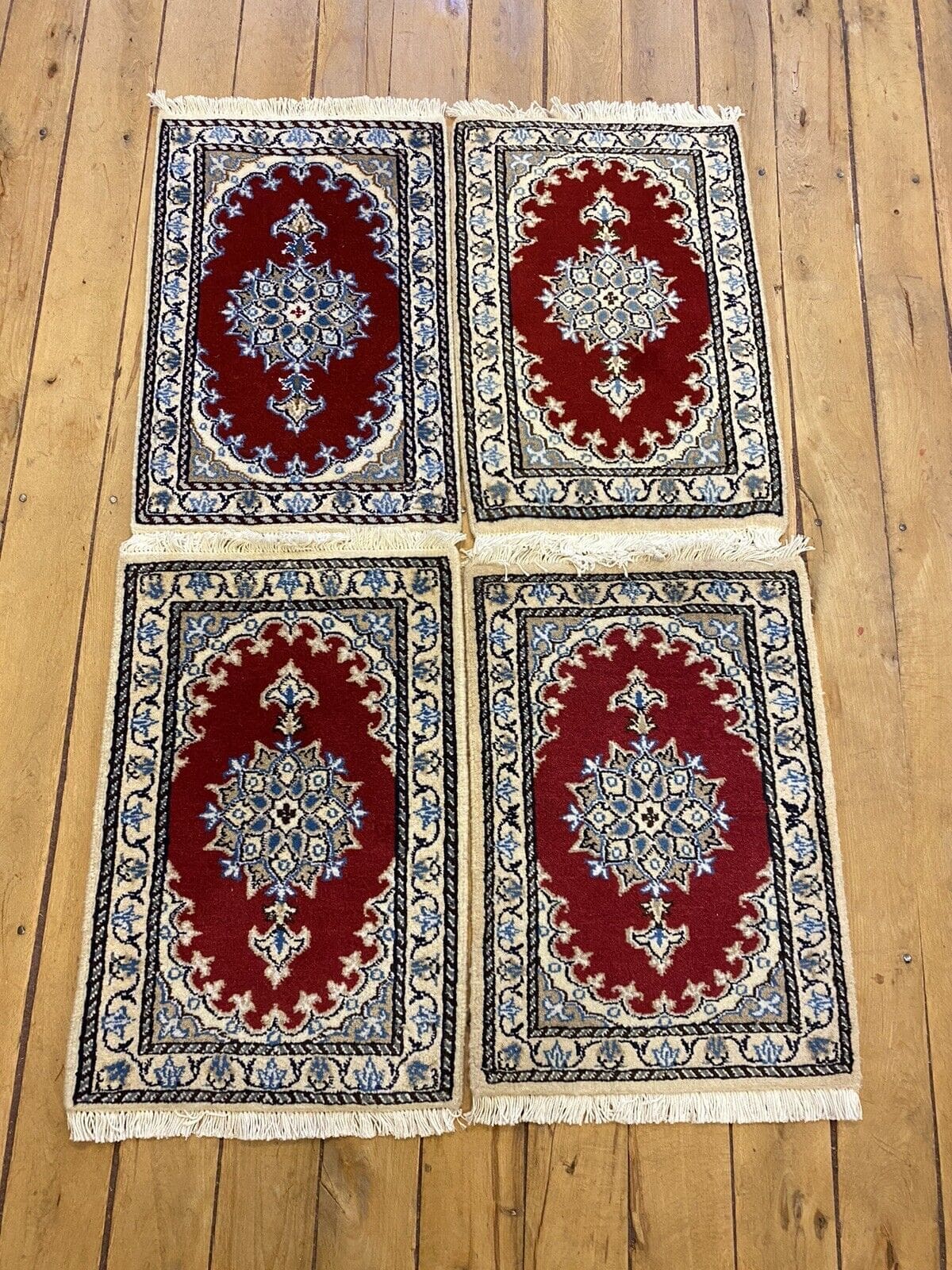
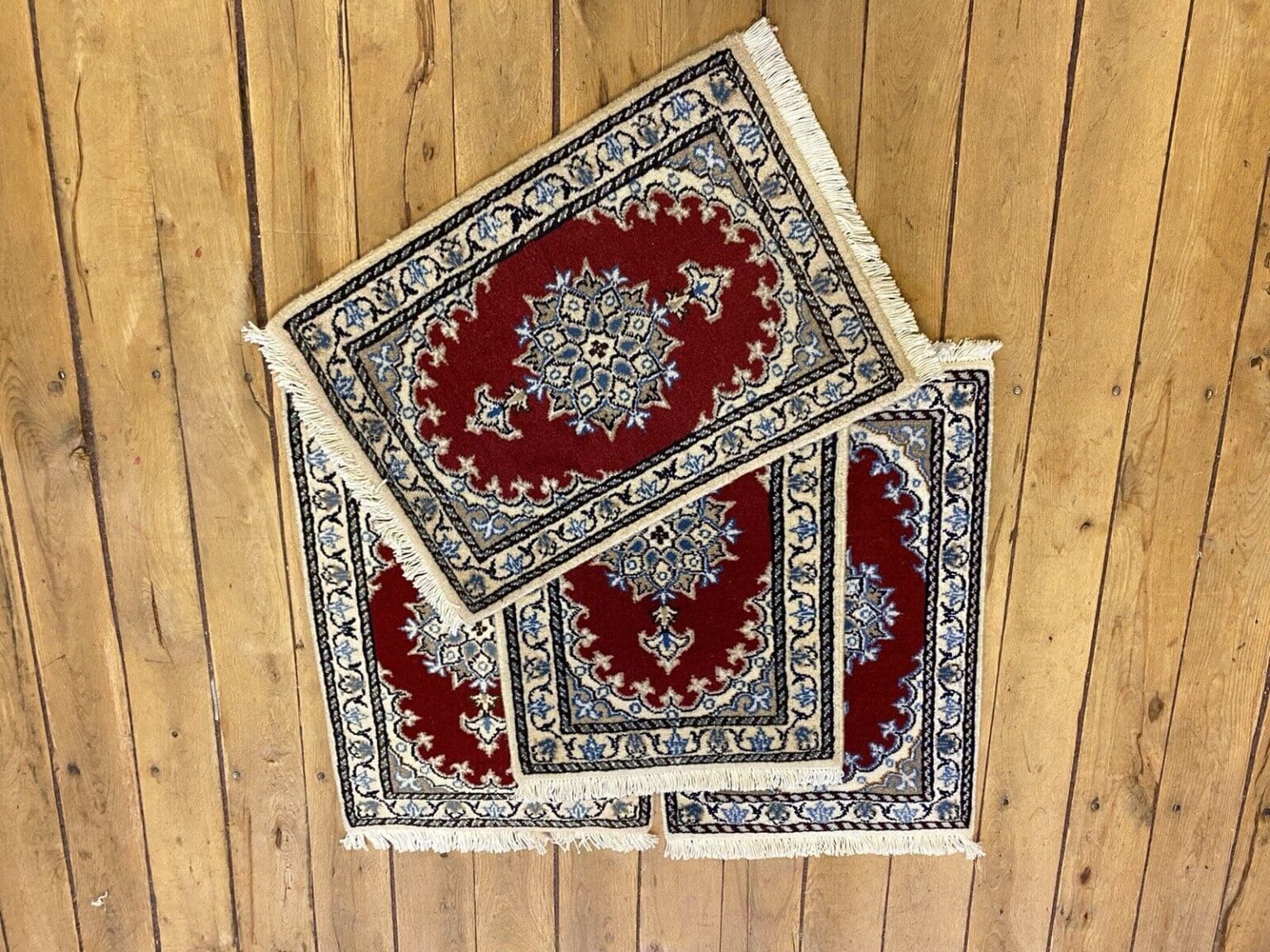
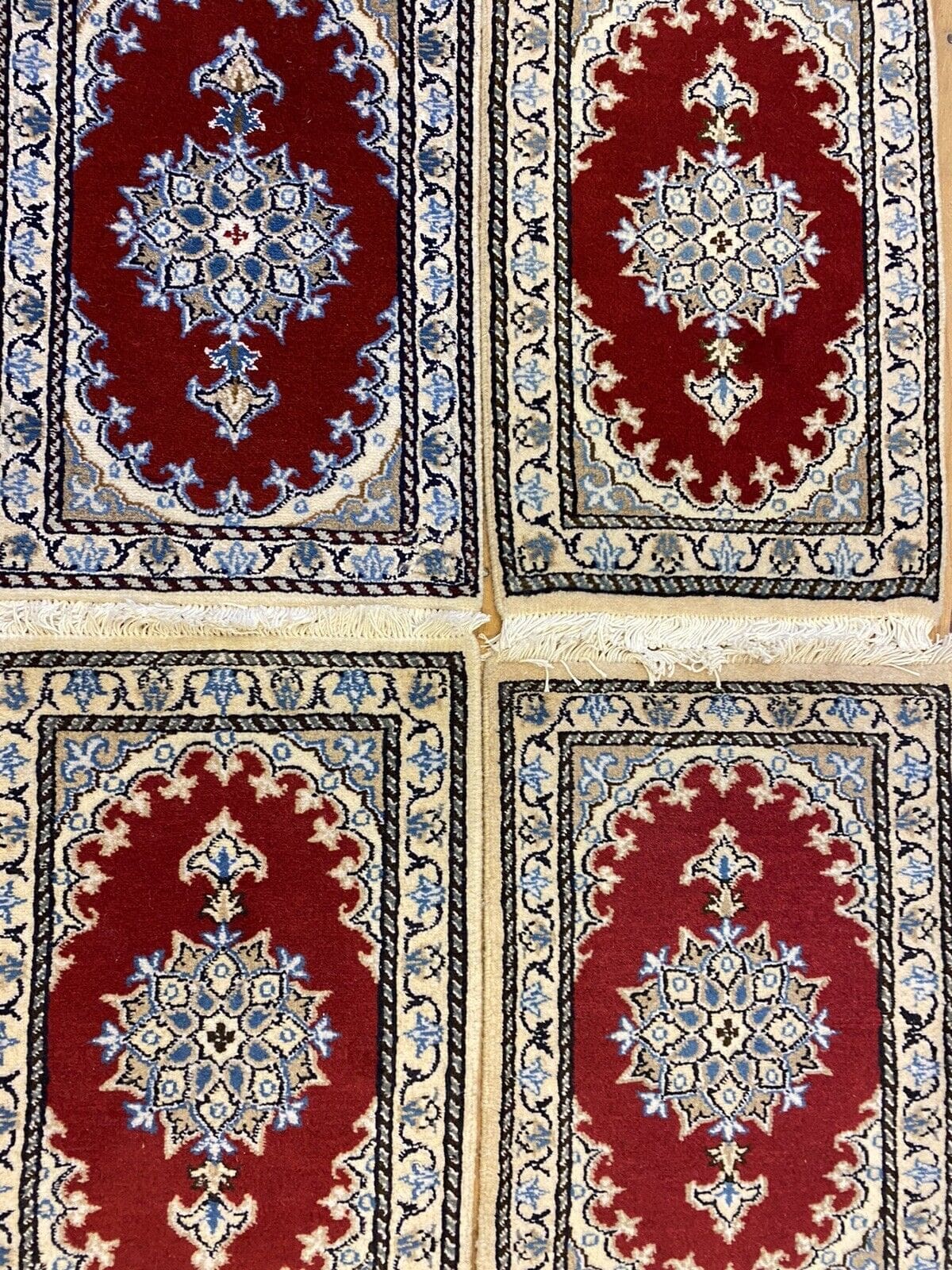
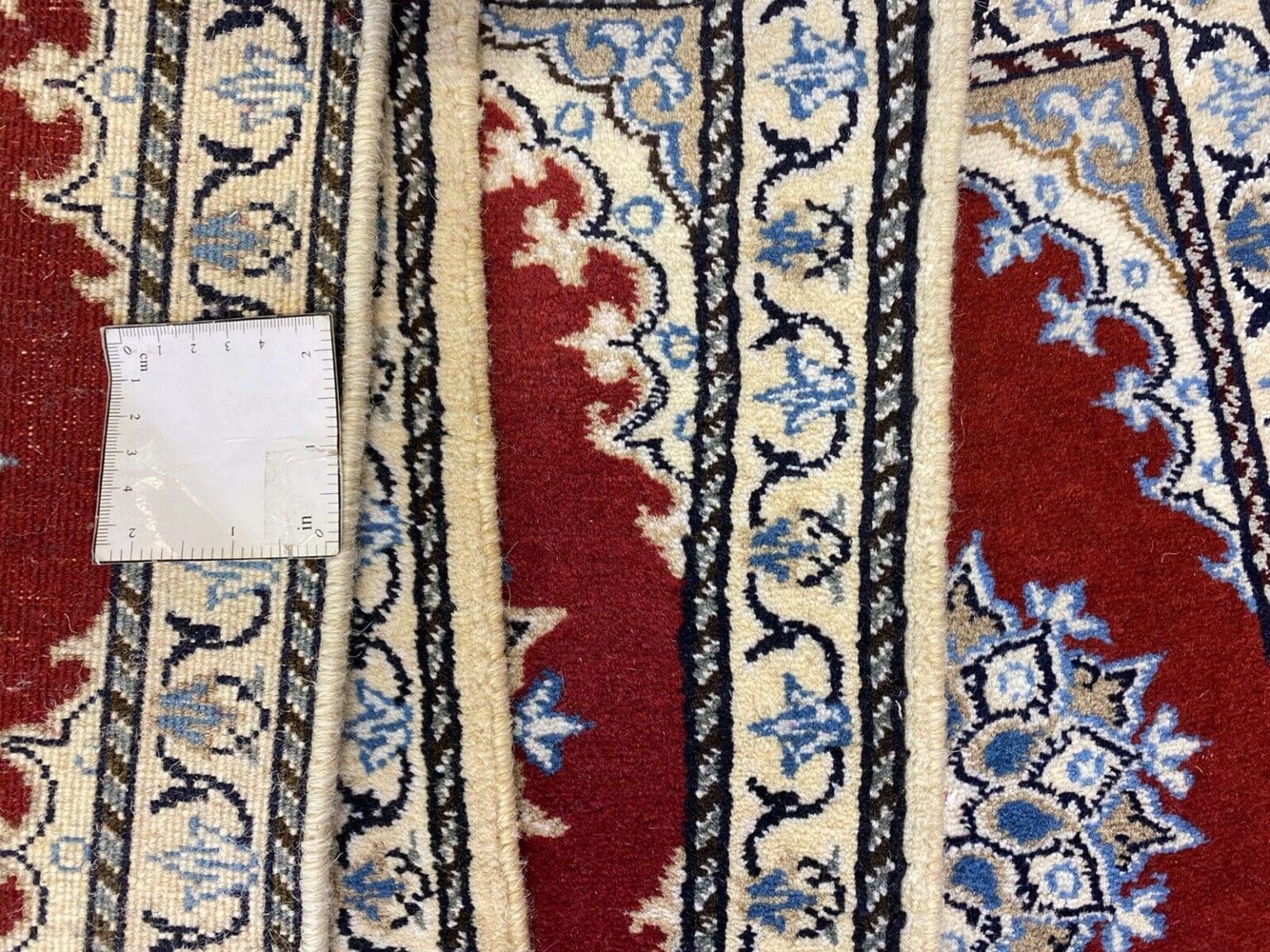
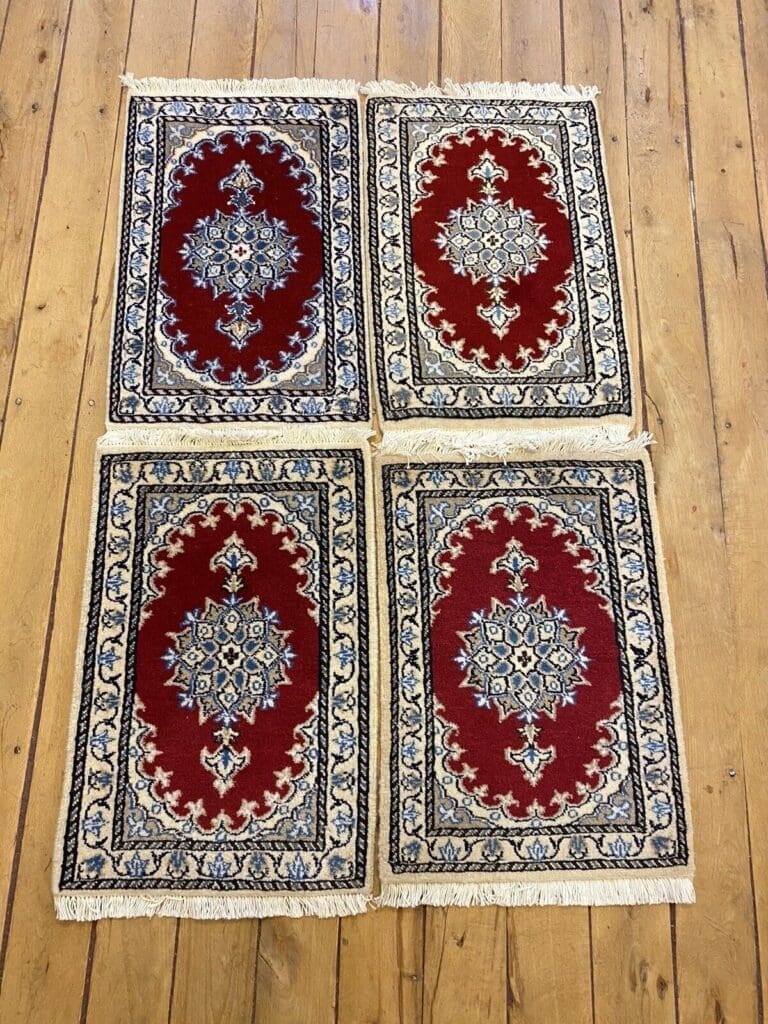
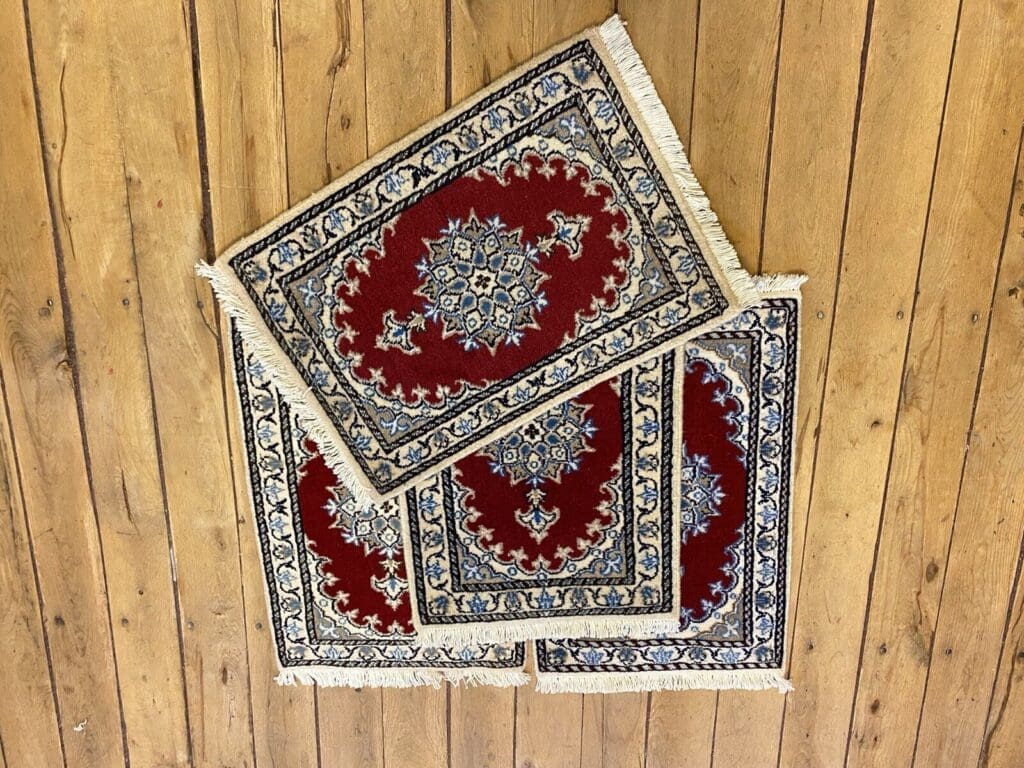
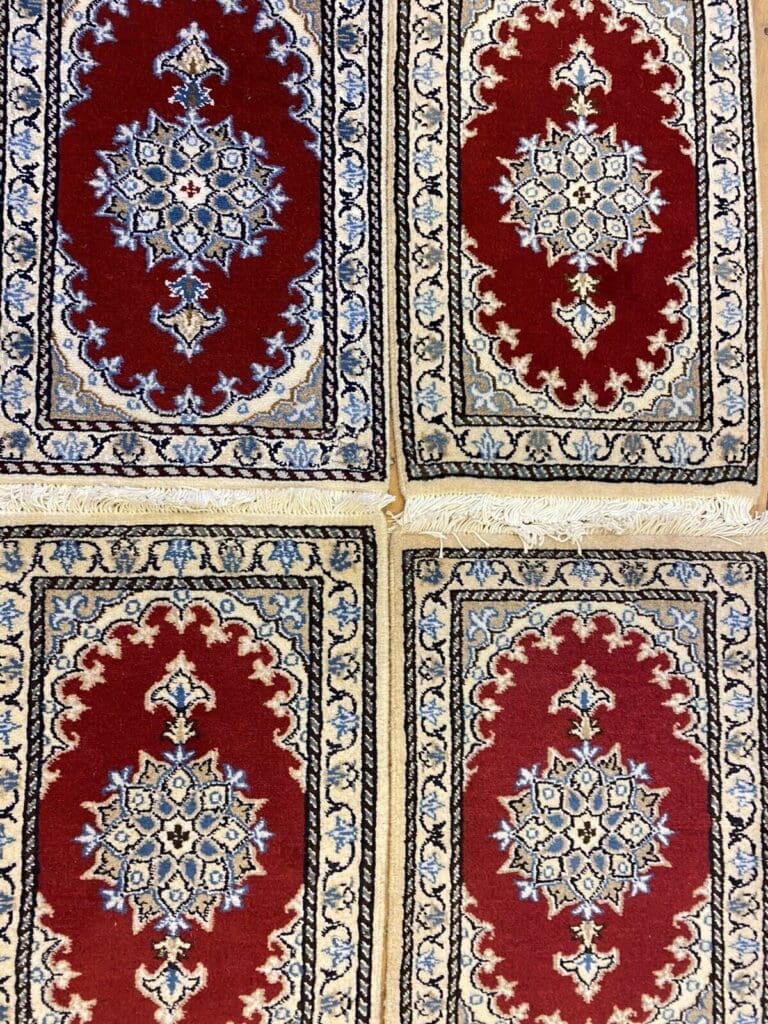
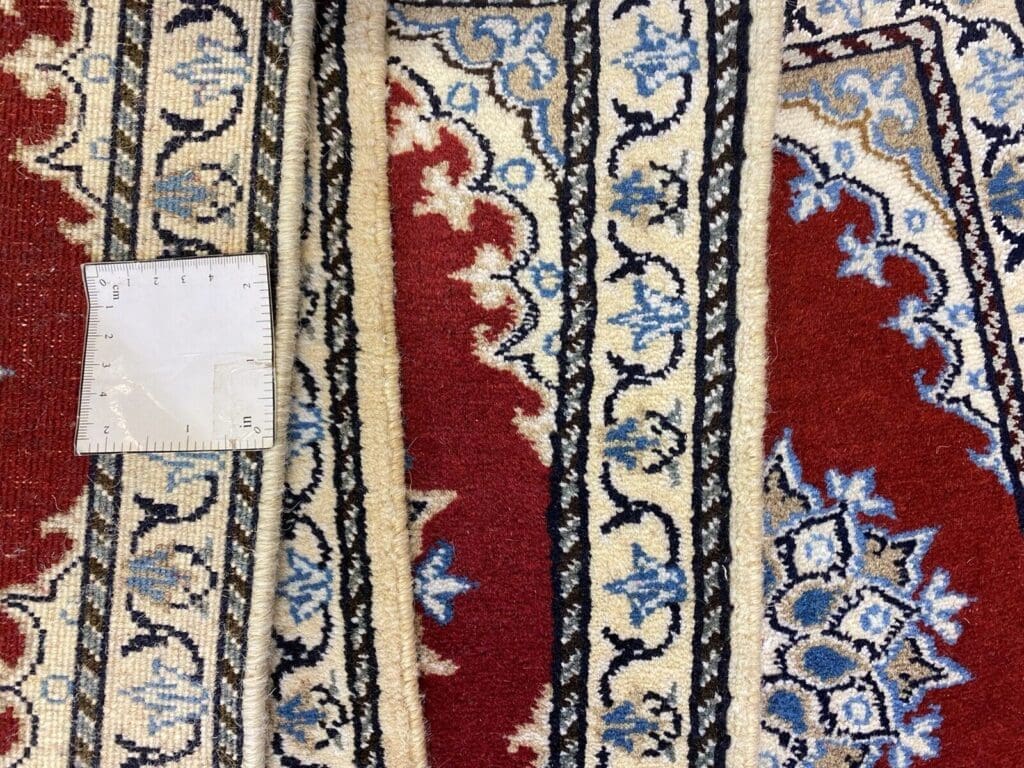
Hand-knotted Nain Persian rug | Knot density: approx. 300,000 knots/m² | Material: 100% new wool and 100% cotton | Size: 60 x 40 cm | Condition: New, very good
This Nain Persian rug is hand-knotted and made from new wool and cotton. Handmade knotting is a defining method in traditional Oriental rug production. The textile is built gradually rather than produced in one continuous machine process. Individual knots are inserted row by row, with the weaver maintaining an even structure and following the intended design. Each stage calls for control of the foundation, the tension and the arrangement of the emerging pattern.
New wool is valued in rug making for its resilient and flexible fibres. Its natural structure gives the pile a degree of spring and helps it withstand ordinary use. Wool also has natural thermal properties and can absorb and release some moisture from the surrounding air. Cotton is another long-established material in Iranian rug construction. It is valued for its firm, regular textile qualities and is used in combination with wool in many traditional weaving contexts. Both new wool and cotton are specified for this rug.
Hand knotting involves repeated manual checks during production. The weaver must keep the rows aligned, maintain suitable tension and translate the design accurately into the textile. After the knotting itself, rugs may undergo finishing operations such as securing the edges, trimming the surface and completing the ends. These processes contribute to the final structure of the piece. The listed density of approximately 300,000 knots per square metre indicates finely executed knotting and supports the rendering of small motifs and precise outlines.
Different fibres can serve different purposes within a rug. Wool is particularly suitable for a durable visible surface because its fibres are resilient and flexible. Cotton is valued for the stability and consistency it can provide within a textile foundation. Since the source does not assign each material to a specific part of this rug, the material description remains limited to the stated combination of new wool and cotton.
The rug is suitable for use with underfloor heating. As with hand-knotted textiles generally, an even temperature and appropriate care help protect the structure over time. Its construction is identified as hand-knotted. No information is provided about a particular workshop, an individual weaver or a production year.
Origin and Tradition
Nain is a city in central Iran and an established centre within Iranian rug culture. It stands in an arid landscape between important historical areas of the country. Its position on routes linking different regions encouraged exchanges of goods, skills and artistic ideas. In this setting, Nain developed a distinctive weaving tradition that remains associated with carefully executed rugs and a refined approach to composition.
The history of rug production in Nain reaches back to the sixteenth century. As in other Iranian weaving centres, knowledge was passed through families, workshops and practical instruction. The craft included much more than tying knots. Weavers learned how to prepare fibres, work with dyes, organise the foundation, read a design and maintain tension throughout production. These skills were transmitted primarily through observation and direct practice, allowing experienced craftspeople to guide the next generation.
The name Nain consequently refers both to a location and to a regional craft tradition. Rugs from Iran are not all made according to one uniform method. Different towns and districts developed their own preferences regarding proportion, ornament, colour relationships and technical execution. Nain is commonly associated with controlled compositions, fine detail and a balanced combination of floral and geometric forms. These characteristics form part of the regional background and do not constitute additional unrecorded details about the precise design of this individual rug.
The development of Nain rugs also belongs to the broader history of Persian art and commerce. Rugs were made for domestic use, formal interiors and trade. Designs could draw on older ornamental traditions while being adapted within a particular workshop or for a particular commission. A design plan was not necessarily an industrially fixed image. It served as a guide that the weaver interpreted through the rhythm of knotting, the available materials and the proportions of the textile.
Regional names are useful for placing a rug within the history of Iranian weaving, but they should not be confused with unsupported claims about a specific workshop or provenance. This rug is identified as Nain and is offered as a Persian rug, placing it within the Persian and Iranian tradition. The source does not provide a signature, a named workshop, an exact production date or a more detailed historical ownership record. Those details therefore do not form part of its description.
The continuity of Nain craftsmanship depends on the transmission of practical knowledge. It includes preparing the working materials, setting up the foundation, interpreting the pattern and finishing the woven surface. Each task affects the way the completed rug presents its ornament and texture. Regional identity is therefore created by several elements working together: the place, the inherited knowledge, the choice of materials and the manual process.
Iranian rugs are often named after cities, villages or wider landscapes. Such names indicate a regional vocabulary rather than a claim that every rug from that area looks exactly the same. Nain has a recognisable place within this vocabulary. The rug offered here is described as a Nain Persian rug, with Persia given as its origin and hand knotting given as its construction. No further statement about a specific locality within the region is made.
Design and Pattern
Nain rugs are traditionally known for combining floral and geometric elements in an ordered composition. Floral forms may include stylised blossoms, leaves, vines and branching stems. Geometric shapes can establish axes, boundaries and repeated relationships across the field. When these systems are combined, the design can appear finely articulated while retaining an overall sense of structure. This explains the regional design language associated with Nain; it is not a claim that an unlisted motif appears on this particular rug.
A central field surrounded by borders is a frequent principle in Iranian rug design. The field may be organised around a medallion, a vine arrangement or a repeated ornamental sequence. The border contains the composition and separates it visually from the surrounding room. Narrow guard bands may be placed between the main field and the principal border. These elements create a hierarchy within the pattern and guide the eye from the centre towards the edges.
Fine line work is important to the visual character traditionally associated with Nain. Small leaves, flowers and branches can be arranged as parts of a closely related ornamental network. Curved lines introduce movement, while repeated motifs establish rhythm and regularity. Geometric outlines provide a counterpoint to organic forms and can clarify the limits of individual sections. Proportion and spacing are as important as the motifs themselves, because they determine whether the design reads as open, dense, calm or animated.
Harmonious colour relationships are also frequently discussed in connection with Nain design. In Persian rug making, colour is understood through the relationship between ground, ornament and border. A measured contrast can make an outline more visible, while related shades can connect separate parts of a composition. The final appearance depends on the interaction of dye, fibre, knotting, surface trimming and light. No specific colour list is supplied for this rug, so individual colours are not stated as facts about the piece.
The patterns of Iranian rugs belong to an inherited visual language rather than being purely decorative additions. Vines can connect separate areas, borders can define the perimeter, and repeated forms can create visual cadence. At the same time, hand production allows small decisions in spacing, line and emphasis. A hand-knotted rug is therefore shaped by the relationship between a design plan, regional knowledge and the person carrying out the work. Traditional forms remain present, but their textile expression is created manually.
The Nain tradition demonstrates how technical precision and ornament can support one another. A well-organised design depends on accurate transfer of the pattern, while a fine knot structure allows delicate forms to be represented. The regional background explains the connection of Nain with floral detail, geometric order and balanced composition. It does not supply a missing exact pattern description. For this rug, the confirmed facts remain its Nain designation, Persian classification and hand-knotted construction.
Special Features
The rug is described as new and in very good condition. It is offered as a unique piece or one-off, meaning that this particular hand-knotted rug is available only once. Its suitability for underfloor heating is also specified. The listed materials are new wool and cotton, and the construction is hand-knotted. These are the stated characteristics of the piece.
Routine care should be gentle. Regular vacuuming with a soft brush can remove loose dust and dirt without placing unnecessary strain on the pile. Spilled liquid should be absorbed promptly rather than rubbed into the surface. Harsh products and vigorous scrubbing can affect fibres and dyes. For a thorough wash, professional treatment by a cleaner experienced with hand-knotted rugs is preferable. This rug should not be cleaned in a washing machine.
FAQ
How long can a Nain Persian rug last?
A well-made hand-knotted Nain Persian rug can remain usable for several decades when it receives suitable care and is used appropriately. New wool has resilient, flexible fibres that are well suited to rug production. Actual longevity depends on traffic, cleaning, the surface beneath the rug and the way it is handled. Many hand-knotted Iranian rugs are passed through families when they are maintained properly. No precise lifespan or previous usage history is given for this rug.
Can the rug be washed?
Machine washing is not recommended. For regular maintenance, the rug should be vacuumed carefully, preferably with a soft brush attachment. If liquid is spilled, it should be blotted with an absorbent cloth instead of being rubbed forcefully into the pile. A complete wash is best entrusted to a professional cleaner who works with hand-knotted rugs. The material, construction and type of soiling can then be considered before a suitable cleaning method is selected.
Is new wool suitable for allergy sufferers?
New wool is generally considered suitable for allergy sufferers because it attracts less dust and can help regulate moisture. This general characteristic does not replace personal medical advice. Anyone with a known allergy or particular sensitivity should consult an allergy specialist before using the rug. Regardless of individual sensitivity, regular gentle care is important so that dust and dirt do not remain in the pile over time.
To provide the best experiences, we use technologies like cookies to store and/or access device information. Consenting to these technologies will allow us to process data such as browsing behavior or unique IDs on this site. Not consenting or withdrawing consent, may adversely affect certain features and functions.
Functional Always active
The technical storage or access is strictly necessary for the legitimate purpose of enabling the use of a specific service explicitly requested by the subscriber or user, or for the sole purpose of carrying out the transmission of a communication over an electronic communications network.
Preferences
The technical storage or access is necessary for the legitimate purpose of storing preferences that are not requested by the subscriber or user.
Statistics
The technical storage or access that is used exclusively for statistical purposes.The technical storage or access that is used exclusively for anonymous statistical purposes. Without a subpoena, voluntary compliance on the part of your Internet Service Provider, or additional records from a third party, information stored or retrieved for this purpose alone cannot usually be used to identify you.
Marketing
The technical storage or access is required to create user profiles to send advertising, or to track the user on a website or across several websites for similar marketing purposes.
 SECURE PAYMENT
 SHIPPING PARTNERS