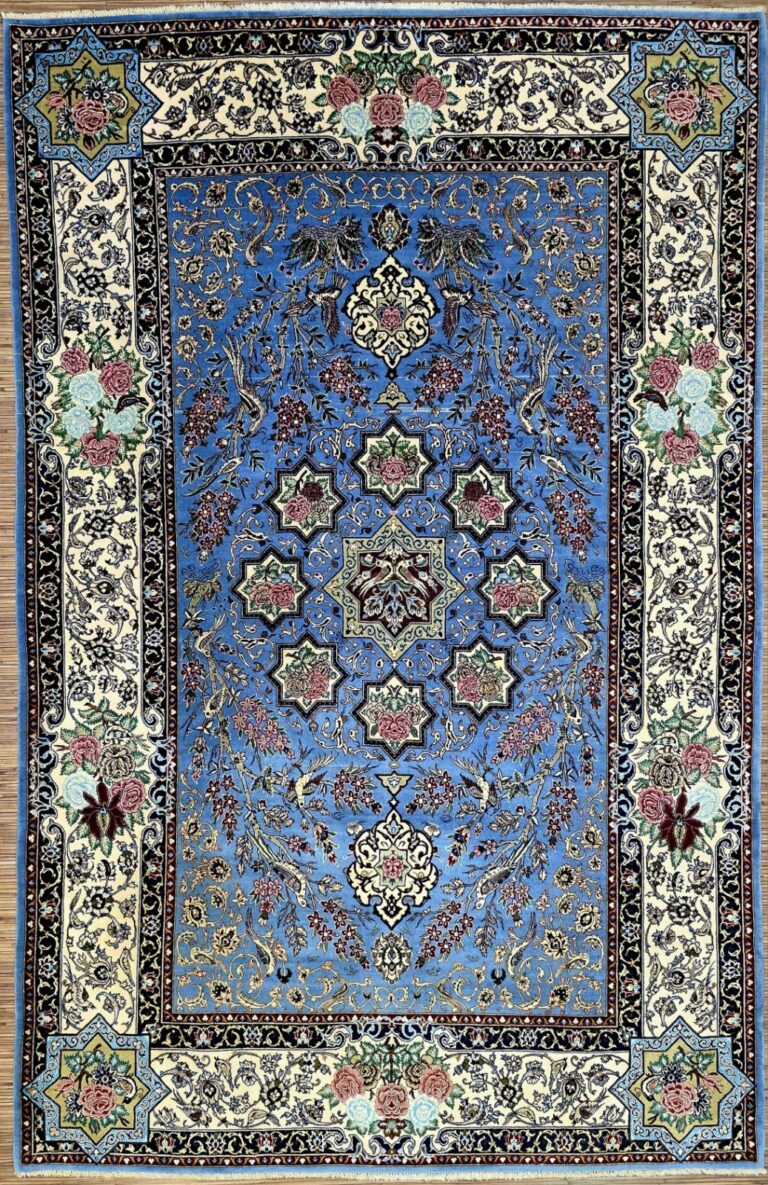
This Nain Persian rug is hand-knotted and made of 90% virgin wool and 10% silk. The combination gives the rug a wool-dominant textile structure with silk as a defined component of its construction. The silk is described as contributing a soft, gently lustrous appearance and a pleasant tactile quality. Virgin wool accounts for the larger share of the material composition and forms the principal textile basis of the rug.
Hand-knotting means that the knots are placed individually by hand rather than produced as a uniform machine-made surface. This process makes each rug a one-off piece. The stated density of approximately 300,000 knots per square metre indicates a fine construction and supports detailed pattern work. In a hand-knotted rug, the design is built gradually through the sequence of individual knots. The resulting surface is therefore directly connected to the work of the maker and to the arrangement of the design during weaving.
The wool-and-silk composition, the hand-knotted technique and the fine knot density define the character of this rug. It is described as new and in very good condition. An authenticity certificate is included, accompanying its status as a unique piece. These details distinguish the rug as a single hand-crafted object rather than a repeated industrial product.
Origin and Tradition
The rug comes from Nain in Iran. Nain is one of the established centres of Iranian carpet making and is particularly associated with finely worked hand-knotted rugs. Carpet production in the city belongs to a long regional craft tradition in which knowledge of materials, knotting methods and pattern construction has been passed from one generation to the next. The work involves more than placing knots: it also includes preparing the materials, following the design, maintaining the structure and finishing the completed rug.
Nain rugs are often associated with fine wool and silk. This material combination allows weavers to create clear outlines and carefully defined ornamental details. Silk may be used to give selected areas a more delicate surface presence and a subtle sheen, while wool provides the principal textile substance. The use of these materials belongs to the broader history of Iranian rug making, where fibre, knotting and pattern are considered together rather than as separate decorative decisions.
The carpet-making history of Nain is linked with a long development of Iranian textile art reaching back to the Safavid dynasty. The Safavid period is regarded as an important era in Persian carpet history because court workshops, artistic designs and regional weaving traditions gained lasting influence. Within this wider tradition, Nain rugs are known for careful handwork and for compositions that retain established Oriental ornament while presenting it in an ordered, finely drawn manner.
A regional rug tradition is shaped not only by geography but also by workshop practice and the transmission of designs. In Nain, practical knowledge is handed down through generations. This preserves traditional methods while allowing individual workshops to develop their own handling of line, detail and the relationship between wool and silk. The present rug is identified as a Nain rug from Iran and therefore belongs to the tradition of Iranian Persian rugs. Its hand-knotted construction connects it with that regional craft history.
Design and Pattern
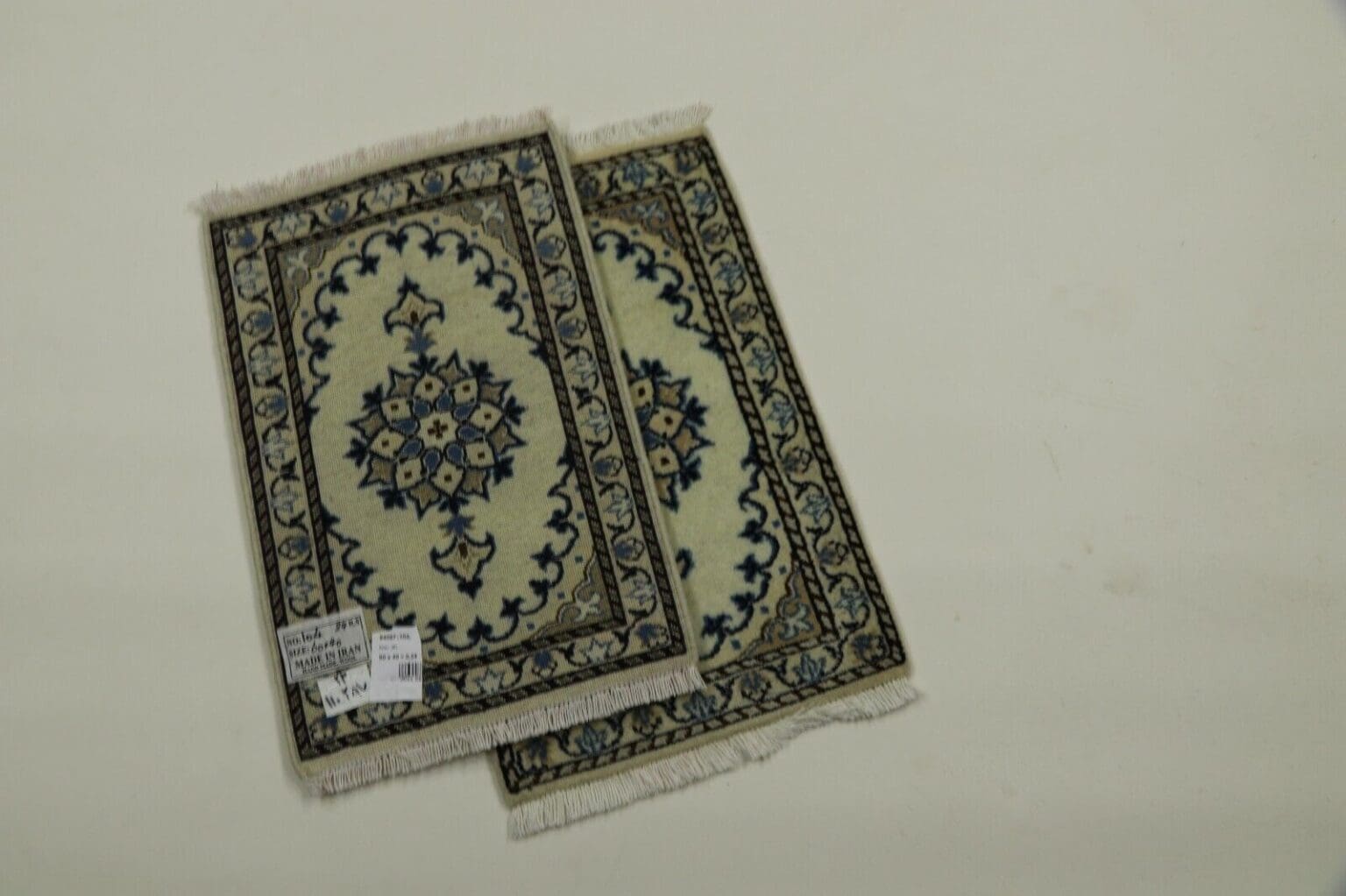
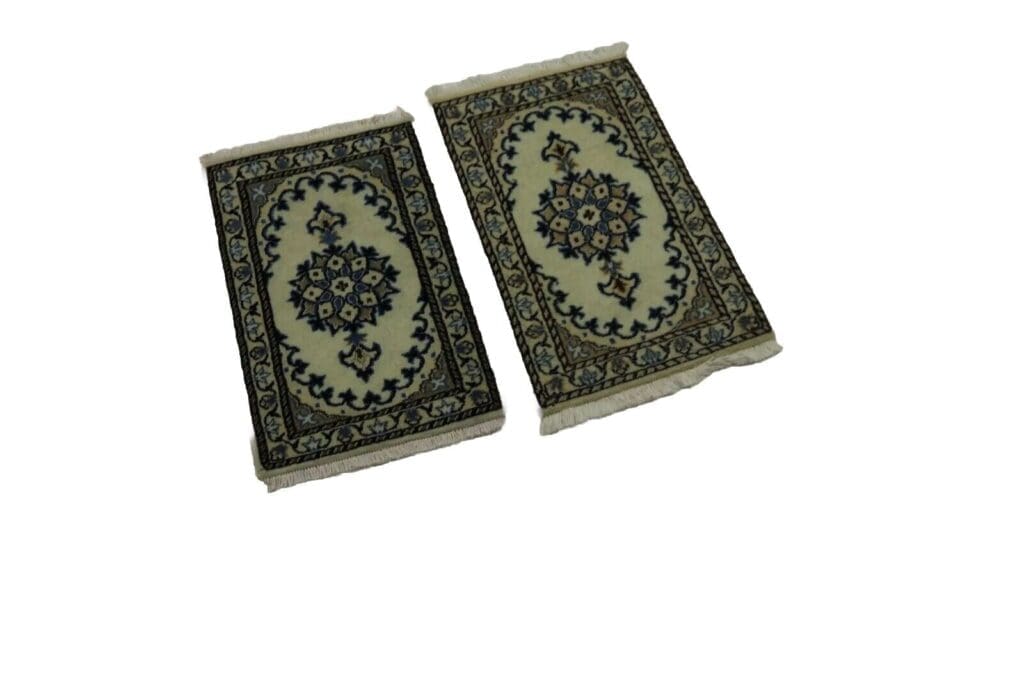
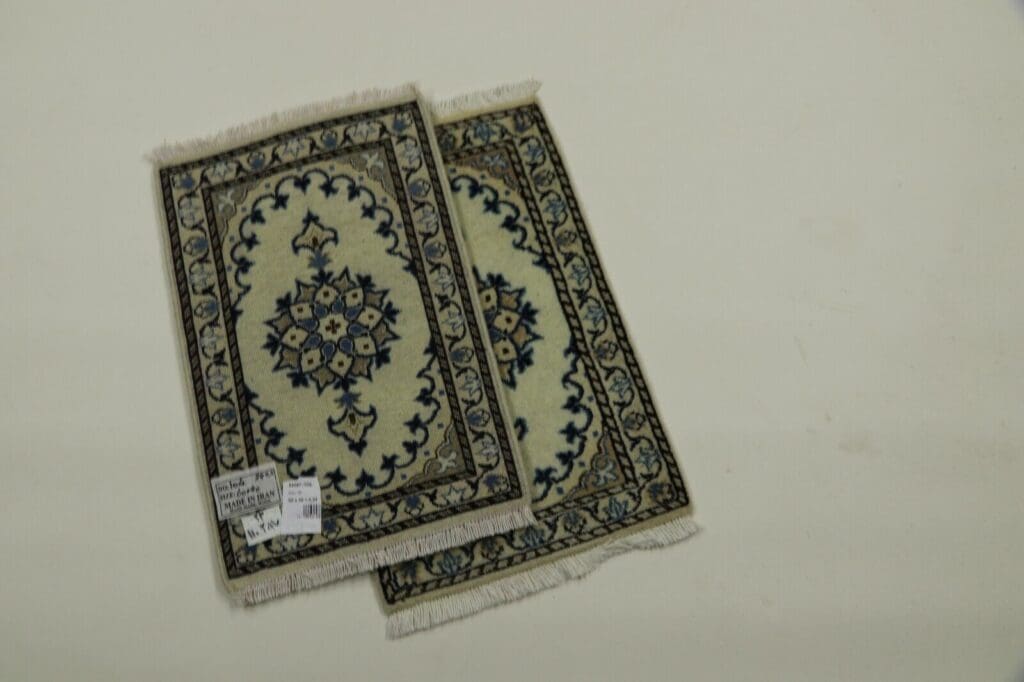
The design is described as traditional Oriental and combines classical Oriental motifs with fine detail and a harmonious selection of colours. Nain rugs commonly use floral and geometric elements. Floral forms may include stylised blossoms, leaves or scrolling vines, while geometric forms provide order, symmetry and clear division. In traditional rug design, these elements are arranged as part of a balanced composition, often through repetition and carefully maintained relationships between the ornaments.
The visual structure of such a design depends on the relationship between the field, the ornaments and the outlining lines. Fine contours can separate leaves, flowers, scrolling forms or geometric borders. Repetition creates rhythm, while smaller details prevent the surface from appearing undifferentiated. A dense knotting structure supports the precise rendering of these features. The source description connects this rug’s high knot density with detailed pattern work and a pronounced visual effect.
The described design also combines established ornament with a timeless, elegant overall impression. It is not tied to a short-lived fashion. Traditional Nain compositions may be highly organised while remaining lively through delicate lines and carefully worked details. The silk component contributes to the way selected areas are perceived across the surface. As the light changes, those areas may appear different from one another; the source describes this as a three-dimensional effect in the pattern.
In a hand-knotted rug, the design is created through the arrangement of knots rather than printed onto the finished surface. Lines, transitions and small ornamental sections are consequently part of the rug’s construction. Nain designs often allow floral and geometric forms to correspond within a coherent composition. For this piece, the recorded design characteristics are its traditional Oriental style, fine detailing, harmonious colour selection and the described three-dimensional pattern effect.
Special Features
This rug is a one-off and comes with an authenticity certificate. Its condition is stated as new and very good. The description also identifies its fine knotting, its use of virgin wool and silk, and its suitability for different rooms such as a living room or bedroom. It can therefore function both as a rug and as a decorative element within an interior.
Regular vacuuming is recommended for everyday care, helping to remove dust and surface dirt from the pile. If dirt reaches deeper into the pile, professional cleaning can be used. Direct sunlight should be avoided in order to help preserve the colours. The description further notes that a well-maintained Nain rug can remain in use for a long period and may be passed on to future generations.
FAQ
How should I care for this Nain Persian rug?
Regular vacuuming is suitable for removing dust and everyday dirt from the pile. The rug should be treated gently during routine care. When a more thorough cleaning is needed, professional rug cleaning is recommended, particularly for dirt that has settled deeper in the pile. This also helps maintain the colours. Direct sunlight should be avoided because prolonged exposure can contribute to fading. Careful, consistent maintenance supports the rug’s condition over time.
Which rooms are suitable for the rug?
The rug can be used in a range of living areas. The description specifically names the living room and bedroom, while the dining room or hallway are also mentioned as possible settings. In these spaces it can serve as a decorative feature as well as a floor covering. The placement should allow for careful treatment of the pile, and direct sunlight should be avoided so that the colours remain as stable as possible.
How can the quality of a Persian rug be assessed?
Several factors contribute to the quality of a Persian rug, including knot density, materials and craftsmanship. This Nain rug is described with a density of approximately 300,000 knots per square metre. Its material composition is 90% virgin wool and 10% silk, and it is hand-knotted. The fine construction supports detailed pattern work. Together with the authenticity certificate and its status as a one-off, these details describe the craftsmanship and composition of this individual rug.
To provide the best experiences, we use technologies like cookies to store and/or access device information. Consenting to these technologies will allow us to process data such as browsing behavior or unique IDs on this site. Not consenting or withdrawing consent, may adversely affect certain features and functions.
Functional Always active
The technical storage or access is strictly necessary for the legitimate purpose of enabling the use of a specific service explicitly requested by the subscriber or user, or for the sole purpose of carrying out the transmission of a communication over an electronic communications network.
Preferences
The technical storage or access is necessary for the legitimate purpose of storing preferences that are not requested by the subscriber or user.
Statistics
The technical storage or access that is used exclusively for statistical purposes.The technical storage or access that is used exclusively for anonymous statistical purposes. Without a subpoena, voluntary compliance on the part of your Internet Service Provider, or additional records from a third party, information stored or retrieved for this purpose alone cannot usually be used to identify you.
Marketing
The technical storage or access is required to create user profiles to send advertising, or to track the user on a website or across several websites for similar marketing purposes.
 SECURE PAYMENT
 SHIPPING PARTNERS