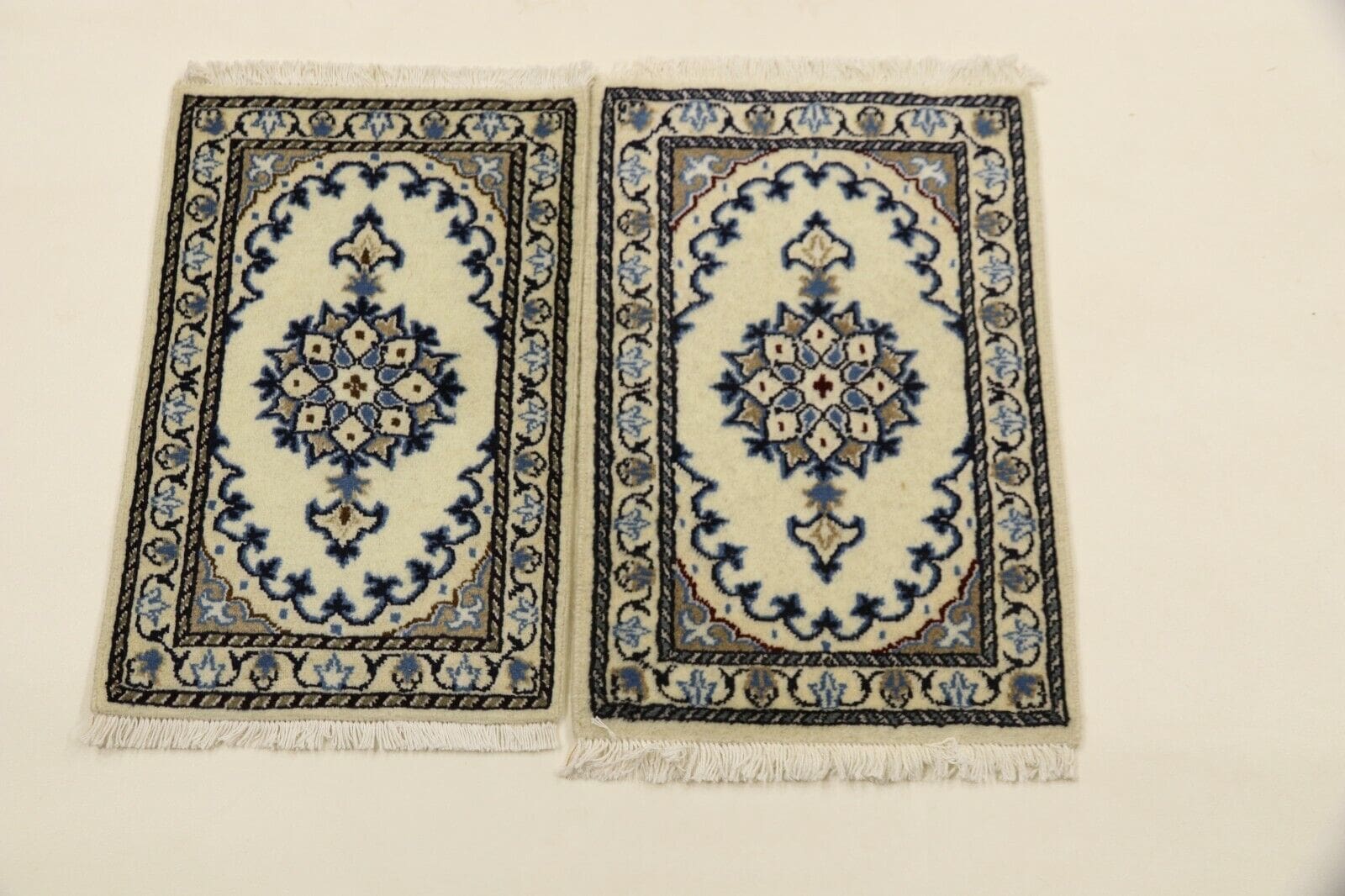
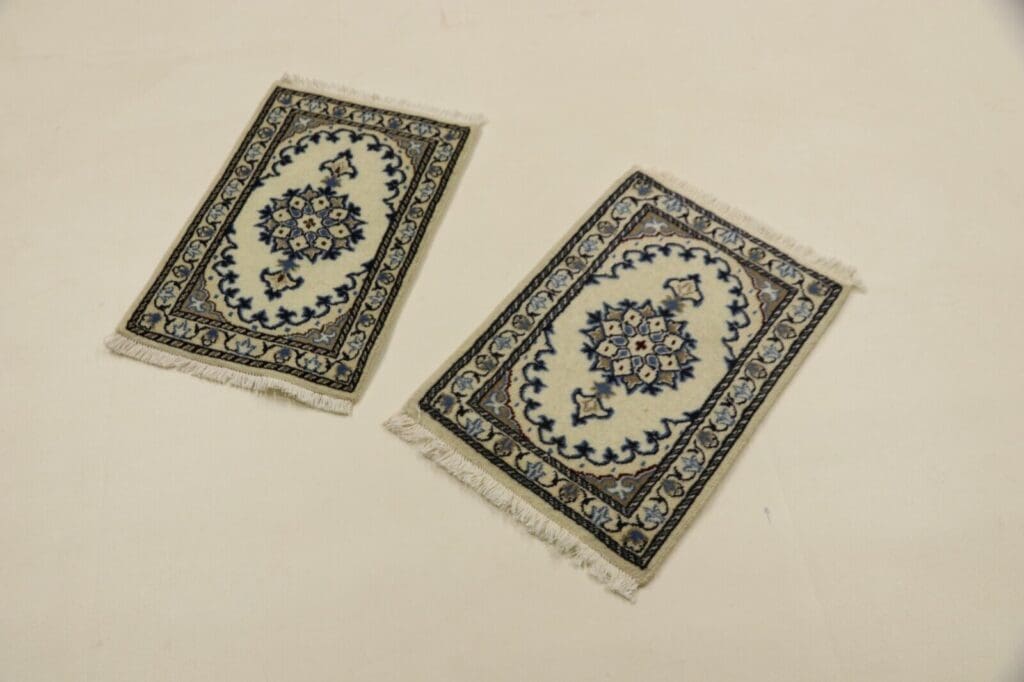
This Nain Persian rug is hand-knotted and has a pile made from virgin wool and silk. The wool provides the principal textile body, with a soft handle and the natural resilience associated with wool fibre. Silk is incorporated as a finer complementary material. Its smooth surface and restrained sheen can make colours appear clearer and more vivid. Together, the two fibres give the pile a balanced tactile character, visible depth of colour and a more refined surface effect.
Hand-knotting means that the knots are inserted individually into the foundation by hand. The surface is built gradually rather than produced as a uniform machine-made fabric. Every part of the design therefore depends on the knotted structure and on the care taken during production. The high knot density supports precise drawing and allows fine transitions within the pattern. It also reflects the detailed workmanship traditionally associated with finely made Nain rugs.
Wool and silk contribute different qualities. Wool gives the pile substance, warmth and durability, while silk adds smoothness and a gentle lustre. Silk can also help selected details catch the light without replacing the fuller character of the wool pile. The combination influences both the appearance and the feel of the rug. Because the work is carried out by hand, the finished piece remains an individual example of textile craftsmanship rather than a repeated industrial product.
Origin and Tradition
This rug comes from Nain in Iran and belongs to the Persian tradition of hand-knotted carpet making. Nain is located in Isfahan Province and is known for refined carpets with carefully controlled drawing. The town has developed a distinct identity within the wider Isfahan weaving landscape. Nain rugs are commonly associated with elegant compositions, fine lines and a disciplined relationship between field and border.
The Nain tradition places emphasis on technical precision as well as on a composed visual structure. Weavers use an ordered foundation so that floral details, geometric accents and border lines remain legible. A high knot density can assist in rendering narrow outlines and small ornaments with greater definition. Technical quality, however, is not simply a matter of knot count. It also depends on consistency, tension, colour placement and the ability to translate the design accurately into the woven surface.
Persian carpets from the Isfahan region express a long-established culture of drawing, colour and manual production. Nain occupies its own place within that culture. Its designs may combine floral and geometric elements, with symmetry and repeated ornament helping to organise the composition. Traditional designs are transmitted through workshops and practice, yet each hand-knotted rug is shaped by its particular drawing and by the individual work of the people who made it.
The use of wool and silk also belongs to the broader history of Persian textile production. Wool is well suited to a pile because it offers resilience and a pleasant hand. Silk can be used when a smoother texture, greater delicacy or a subtle reflective effect is wanted. In a Nain rug, the combination can support the region’s characteristic balance of crisp detail and restrained elegance.
Origin in Nain therefore refers to more than a place name. It identifies a regional tradition in which material, knotting method and design are considered together. The heritage of the town is visible in the preference for orderly compositions and carefully articulated ornament. At the same time, no two hand-knotted rugs are identical. The precise distribution of colour, the movement of the lines and the execution of the details belong to the individual piece.
Design and Pattern
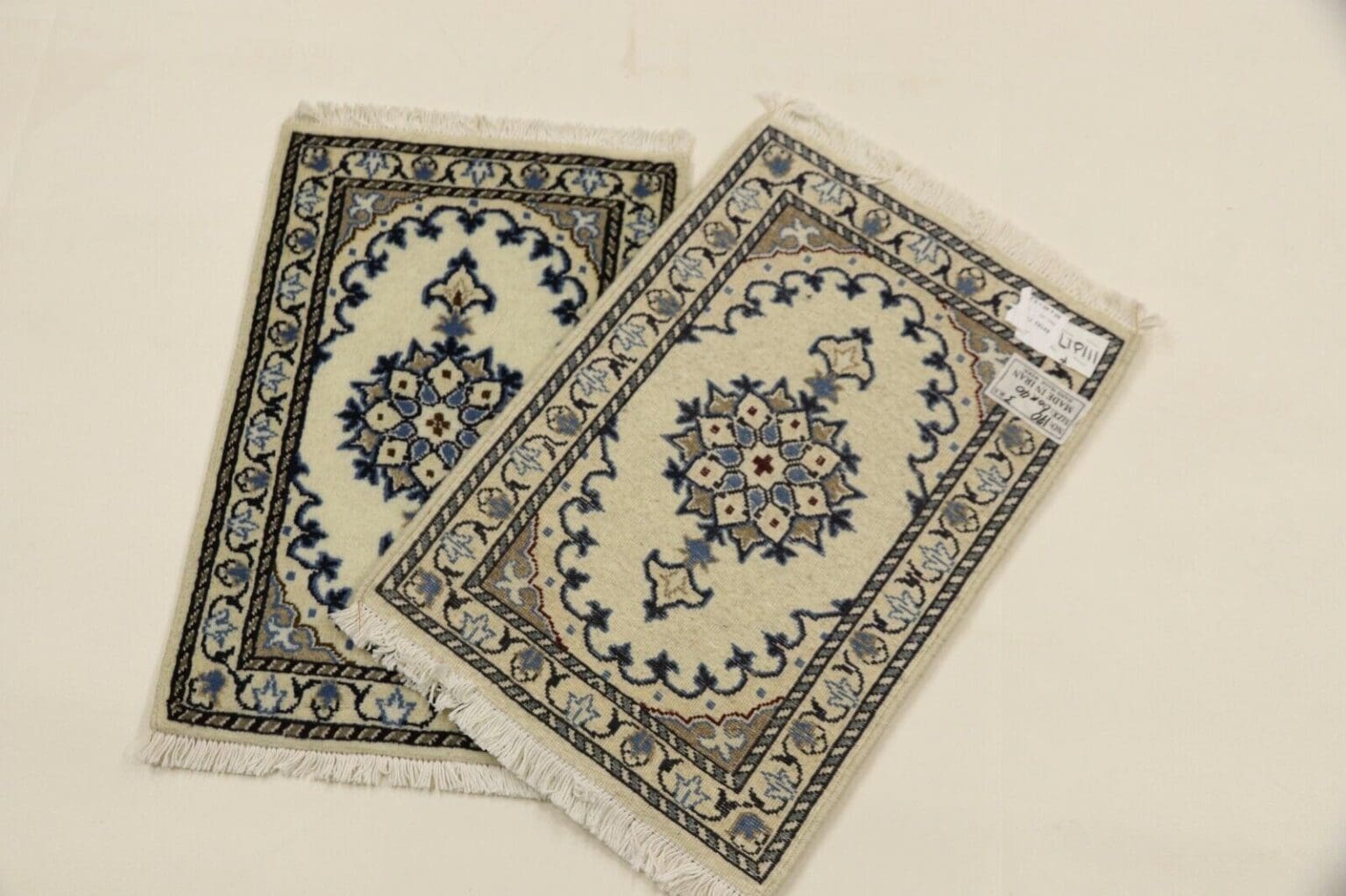
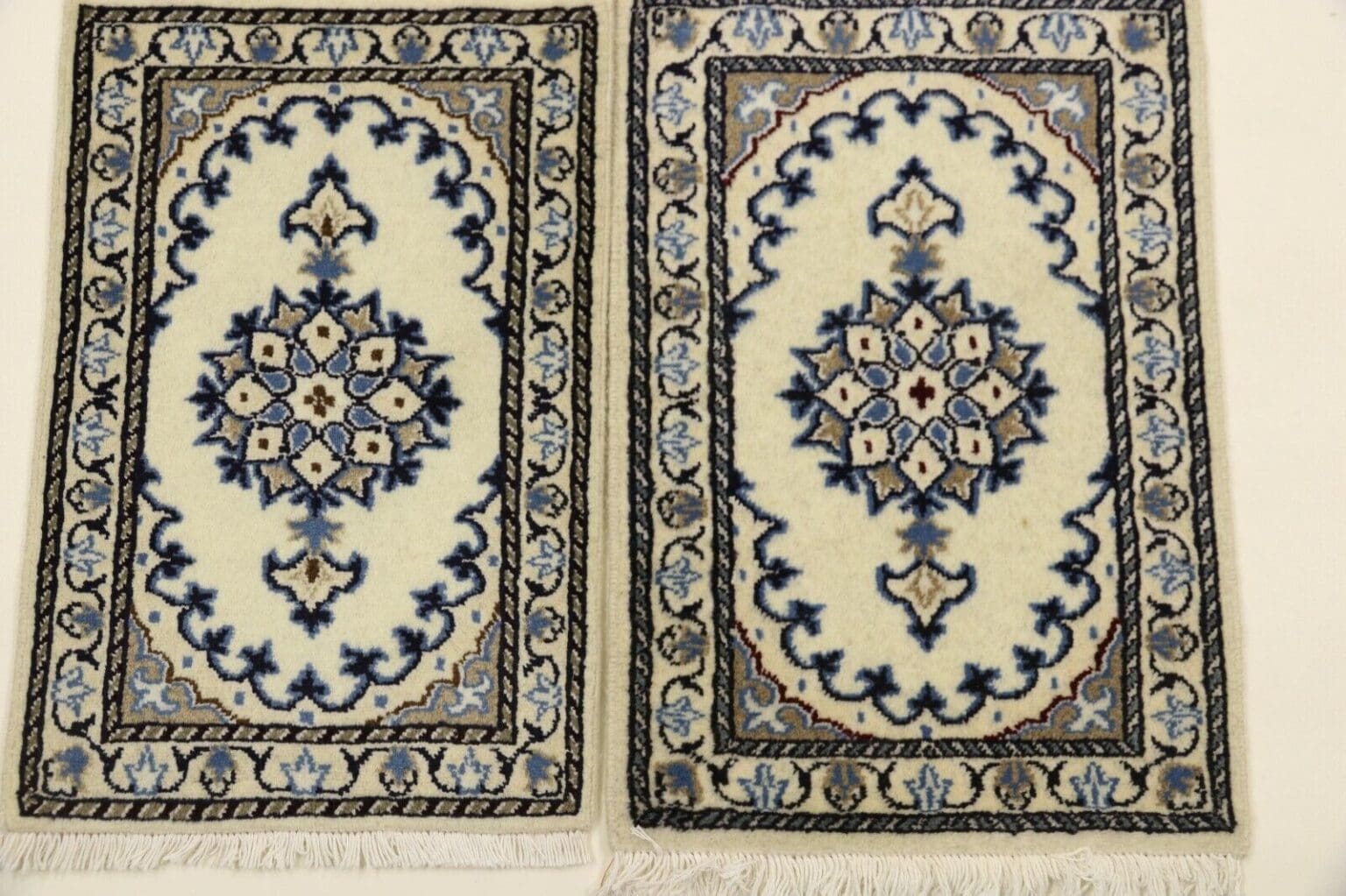
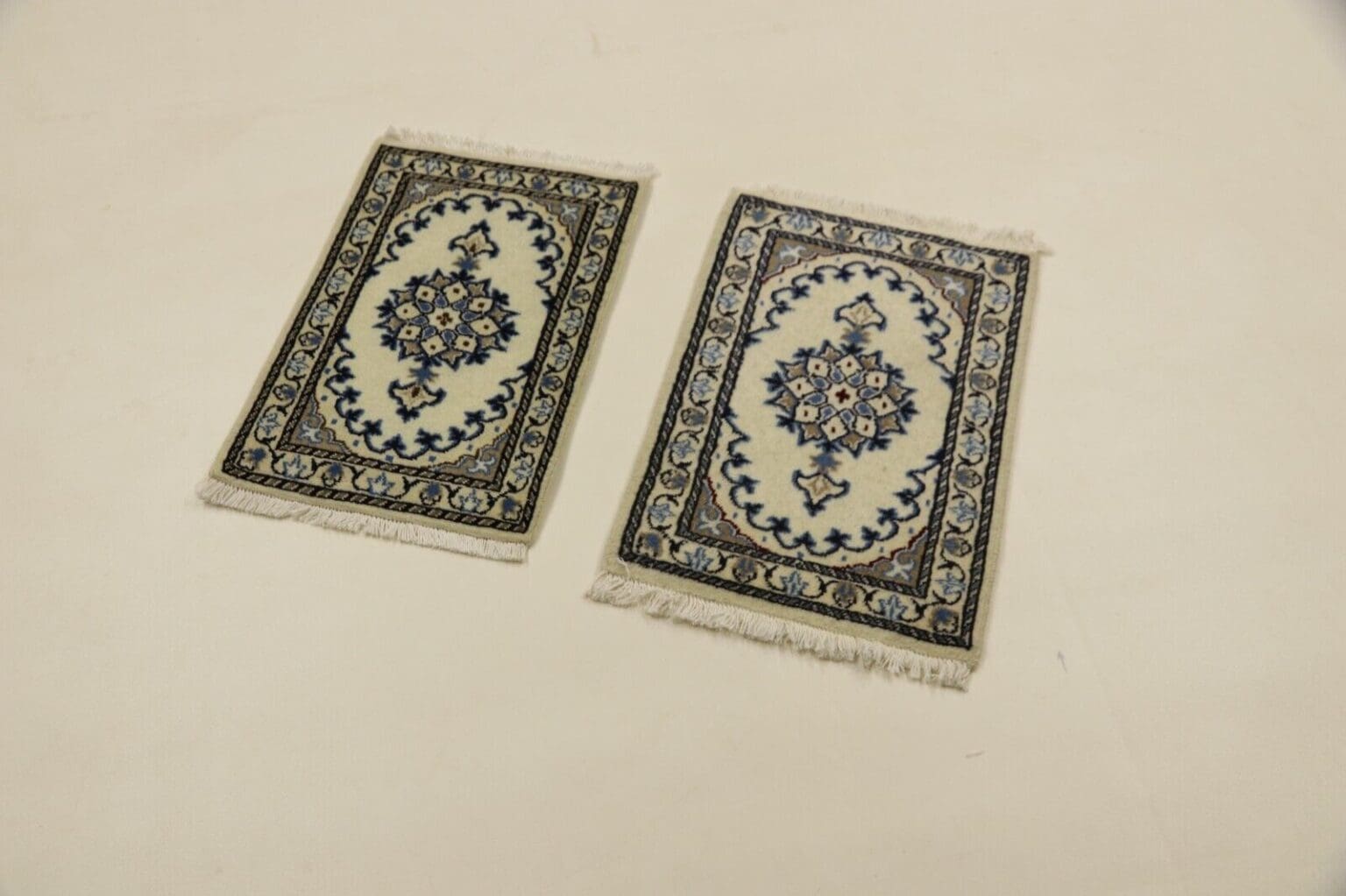
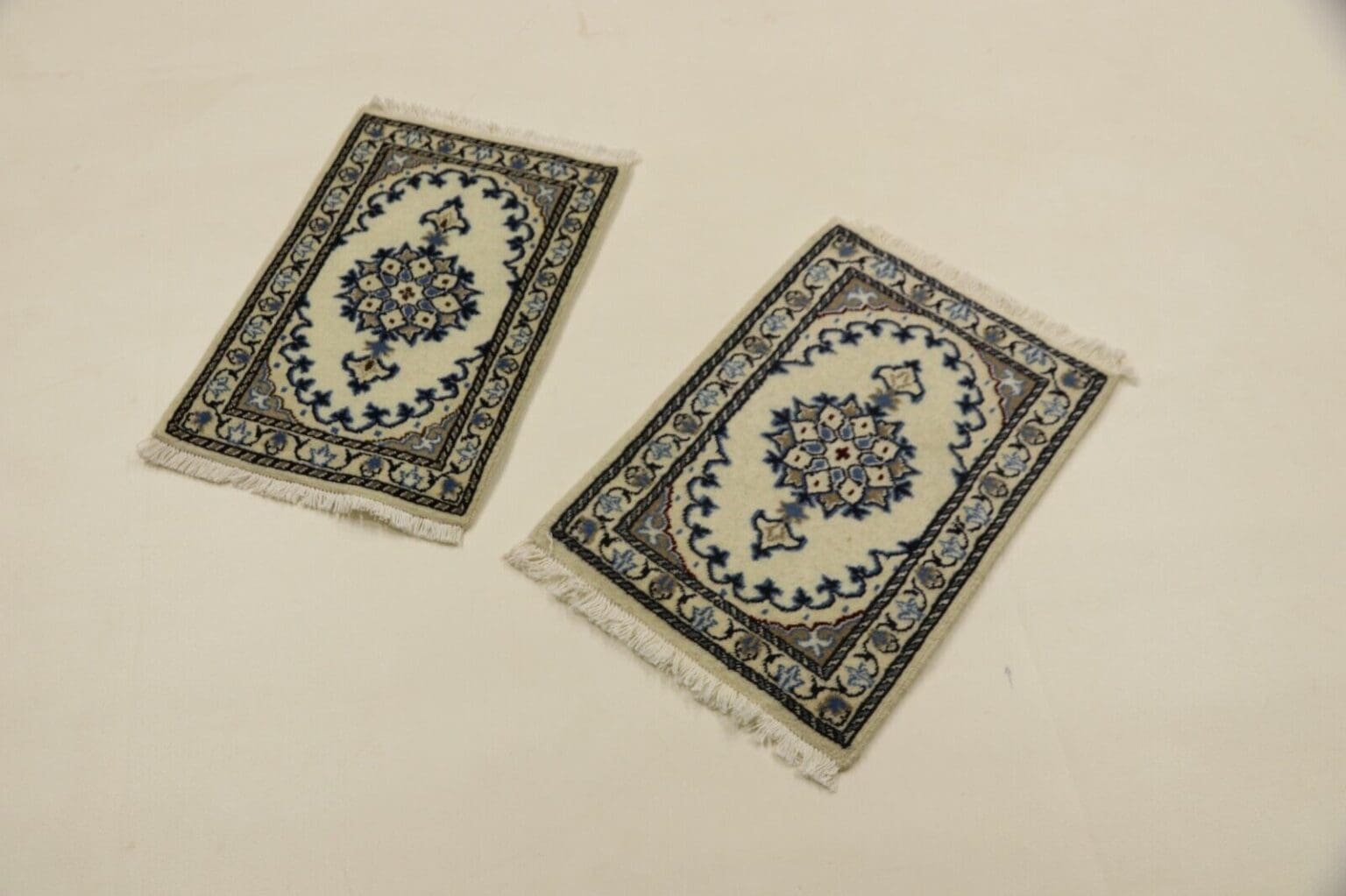
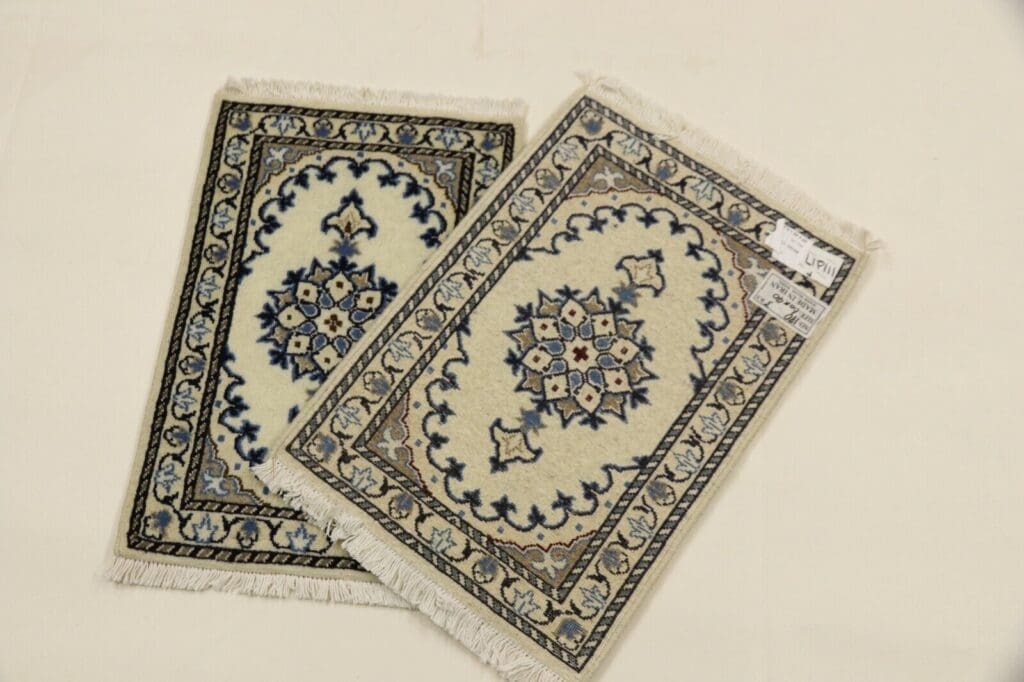
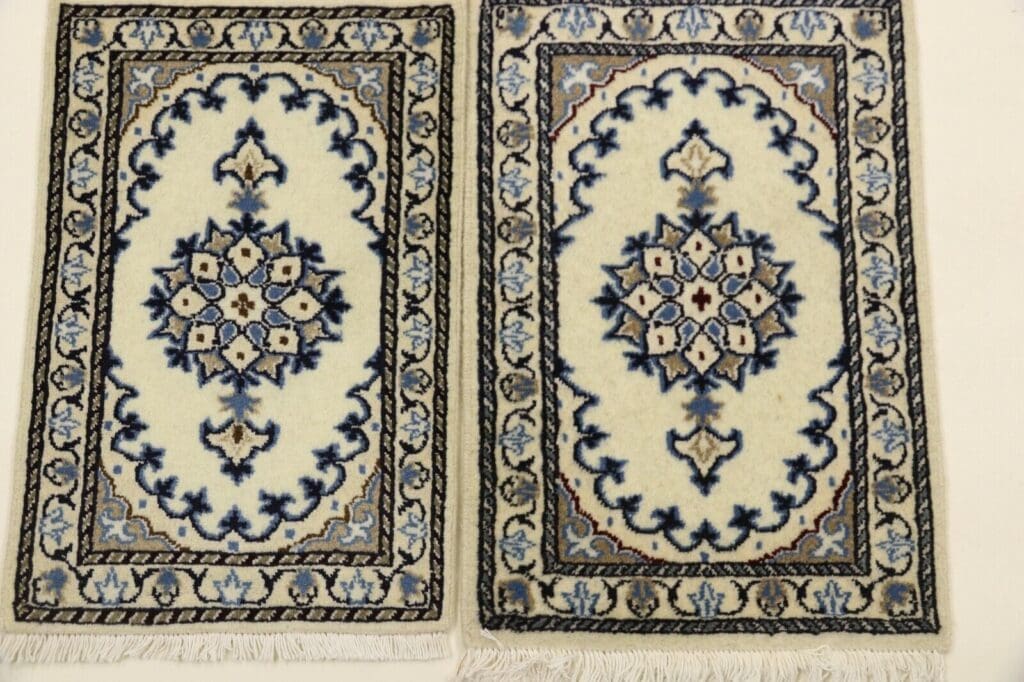
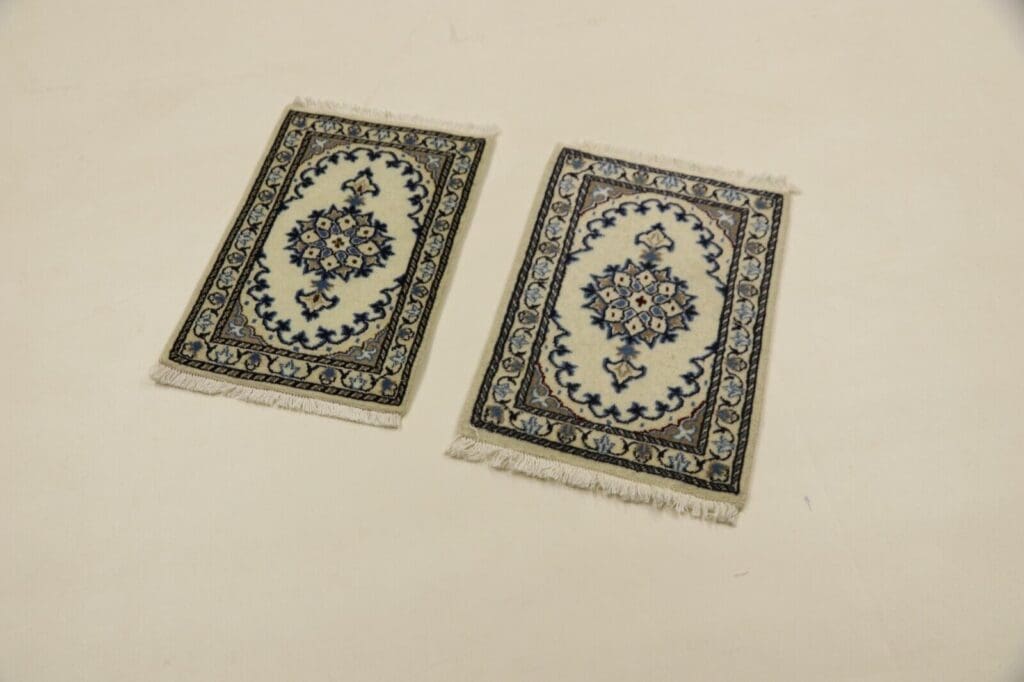
The rug is described as colourful and Oriental in pattern. This indicates a lively colour impression together with the ornamental vocabulary associated with Persian carpets. Nain designs often feature delicate floral forms, curling lines and clearly arranged motifs. Flowers, leaves and vines may be combined into balanced compositions, while geometric details provide structure and rhythm.
A traditional Nain composition may be organised around a clearly defined centre. Central medallions are among the possible elements, as are symmetrical floral arrangements and continuous scrolling vines. The inner field is often accompanied by several borders. Borders frame the design, establish transitions between the central area and the edge, and give the rug a firm visual boundary. Nain weaving includes several design variations, so the presence of any particular motif depends on the individual drawing.
Fine knotting helps such patterns remain readable. Small flowers, narrow outlines and interlaced vines can be placed close together while retaining an ordered appearance. Silk may bring a discreet highlight to individual passages, changing their visibility as the light moves across the pile. The wool balances that effect with a fuller, softer surface. The result is a relationship between line, texture and colour rather than a pattern that exists independently of its materials.
Colour and ornament work together in Oriental carpet design. A colourful palette can animate floral motifs and guide the eye across the field. Traditional Nain compositions frequently depend on a measured relationship between ground, ornament and border. Even a richly detailed arrangement can remain calm when its elements are mirrored or repeated with discipline. This combination of decorative variety and formal control is an important feature of the regional design language.
The vocabulary of Persian carpets includes many inherited forms. Floral motifs can recall vegetation and growth, geometric shapes can stabilise the composition, and repeated vines can connect separate areas into one continuous design. These elements are normally understood as parts of a complete arrangement rather than as isolated symbols. Their effect comes from the interaction of contour, colour, repetition and the exactness of the hand-knotting.
Special Features
The rug is listed as new and comes with a certificate of authenticity. Its rectangular shape makes it straightforward to place in a range of interiors. It is also suitable for use with underfloor heating. This stated suitability expands its practical setting while leaving its defining qualities unchanged: Persian origin, hand-knotting, a pile combining virgin wool and silk, and a colourful Oriental pattern.
Another notable feature is the combination of regional origin and fine manual construction with a vivid decorative design. Silk contributes a smoother, more lustrous effect to the wool pile, while the high knot density supports detailed execution. These elements are closely connected: the material affects the surface, the knotting defines the structure, and the pattern determines the visual rhythm. The accompanying certificate provides additional documentation for the individual rug.
FAQ
How should I care for a Nain Persian rug?
Vacuum the rug regularly and gently to remove dust and loose particles. If staining or heavier soiling occurs, professional cleaning is advisable because a hand-knotted pile made from wool and silk requires treatment appropriate to both fibres. Strong, direct sunlight should be avoided where possible so that the colours remain even over time. Cleaning products should not be applied without first checking their suitability for the materials and testing them carefully.
Can the rug be used in a busy area?
The virgin-wool pile and hand-knotted construction provide a durable basis, and the high knot density reflects careful workmanship. Even so, this Nain rug is best suited to areas with lighter traffic or to use as a decorative feature. Living rooms and entrance areas are identified as possible locations. Where daily use is particularly heavy, an appropriate underlay, regular care and considerate handling are important for preserving the pile and the clarity of the design.
How can I assess the authenticity of a Nain Persian rug?
Knotted construction and materials are important points to examine. On the reverse, a hand-knotted rug often has a structure that is not completely uniform, with individual knots that can be recognised. Provenance information and certification should also be considered. This rug is supplied with a certificate of authenticity, which provides relevant documentation. A sound assessment should bring together the visible knotting, the material composition and the information identifying its Nain origin.
To provide the best experiences, we use technologies like cookies to store and/or access device information. Consenting to these technologies will allow us to process data such as browsing behavior or unique IDs on this site. Not consenting or withdrawing consent, may adversely affect certain features and functions.
Functional Always active
The technical storage or access is strictly necessary for the legitimate purpose of enabling the use of a specific service explicitly requested by the subscriber or user, or for the sole purpose of carrying out the transmission of a communication over an electronic communications network.
Preferences
The technical storage or access is necessary for the legitimate purpose of storing preferences that are not requested by the subscriber or user.
Statistics
The technical storage or access that is used exclusively for statistical purposes.The technical storage or access that is used exclusively for anonymous statistical purposes. Without a subpoena, voluntary compliance on the part of your Internet Service Provider, or additional records from a third party, information stored or retrieved for this purpose alone cannot usually be used to identify you.
Marketing
The technical storage or access is required to create user profiles to send advertising, or to track the user on a website or across several websites for similar marketing purposes.
 SECURE PAYMENT
 SHIPPING PARTNERS


