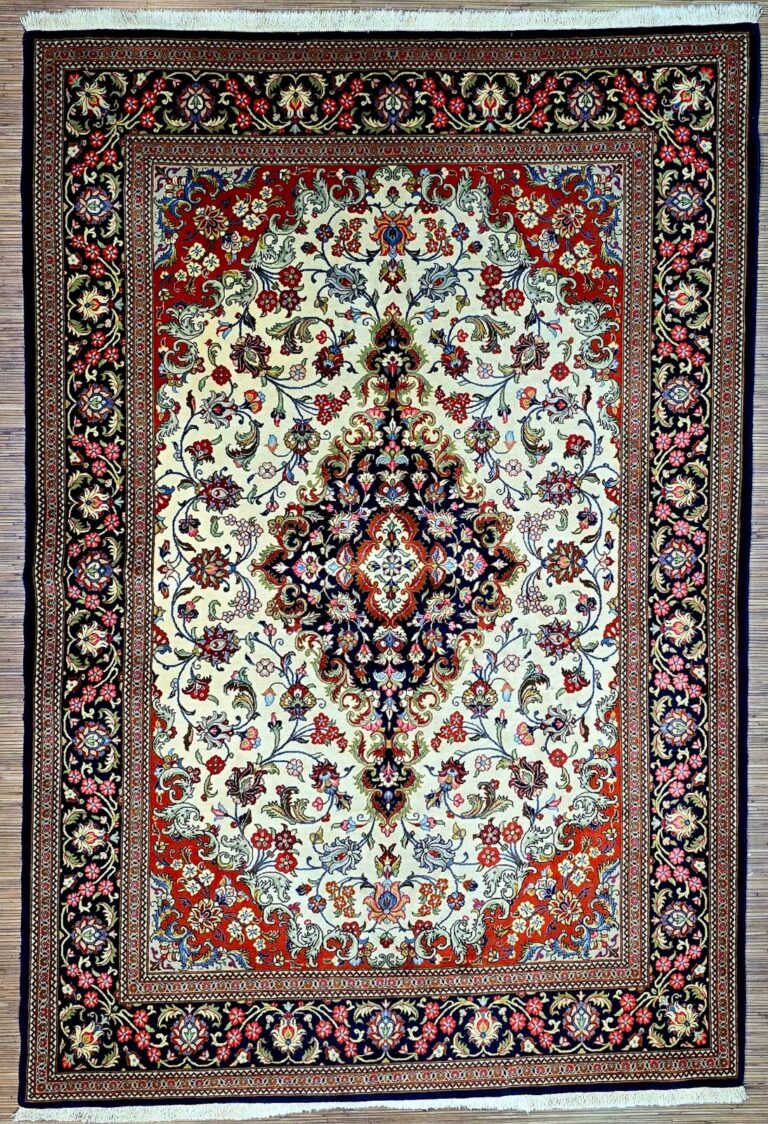
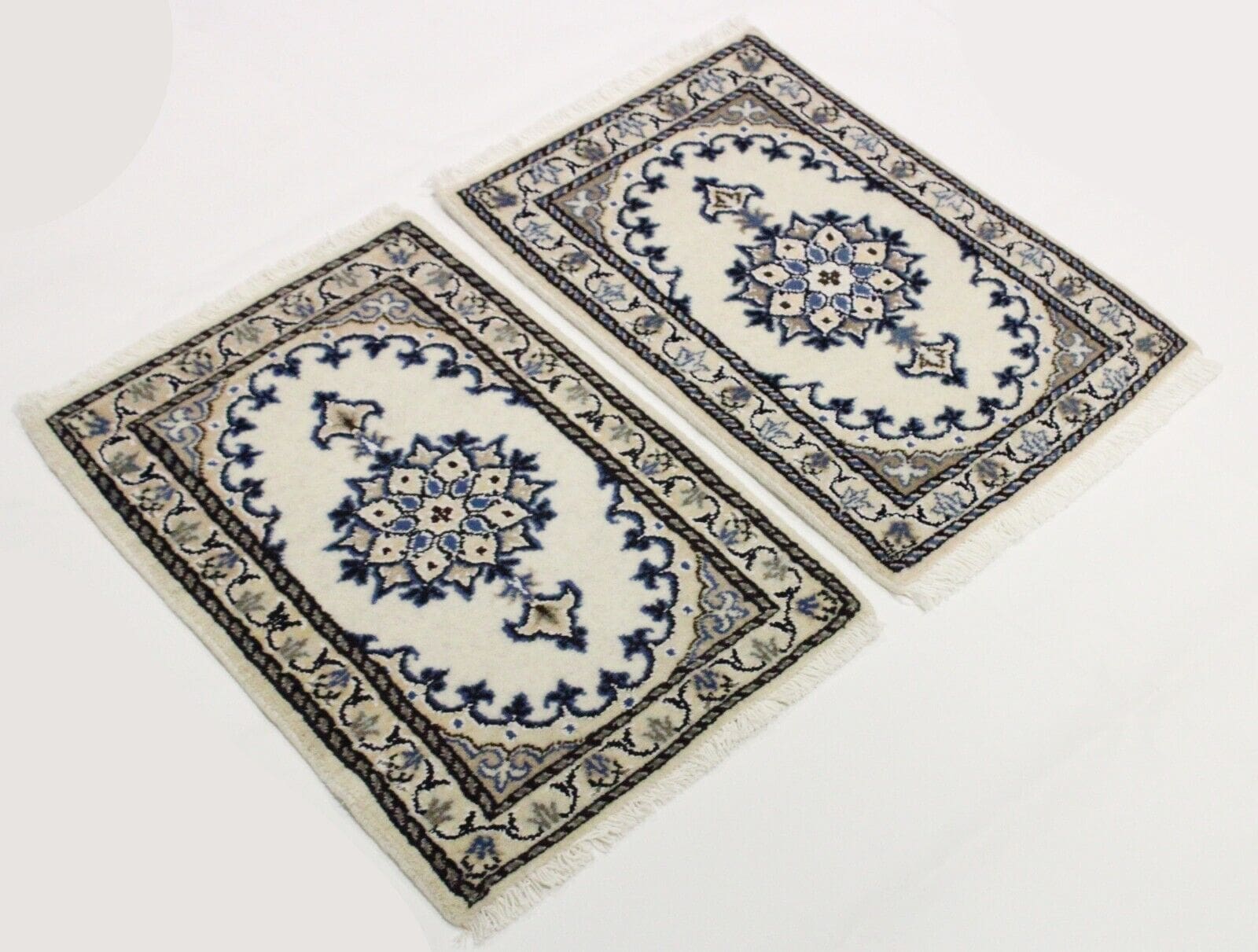
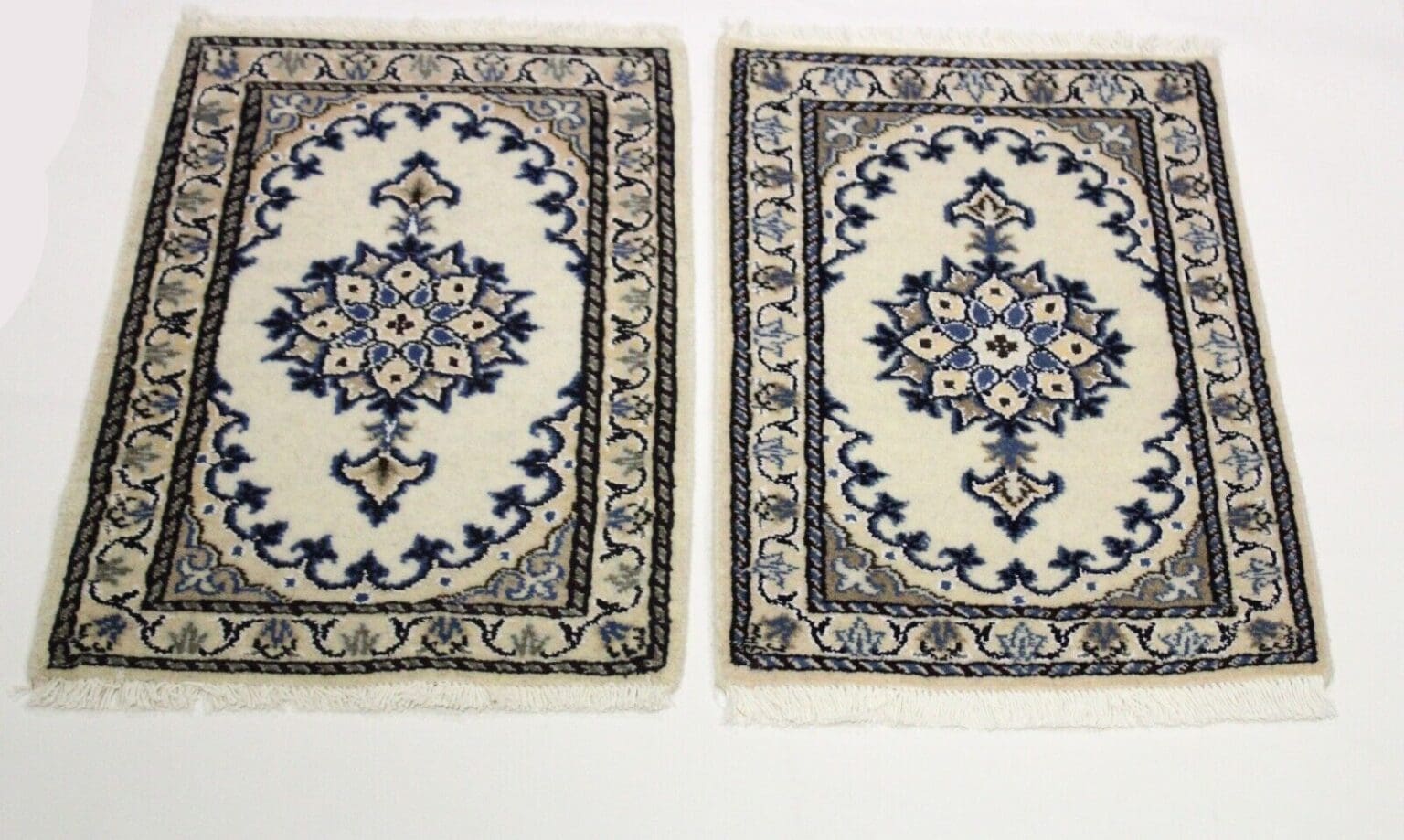
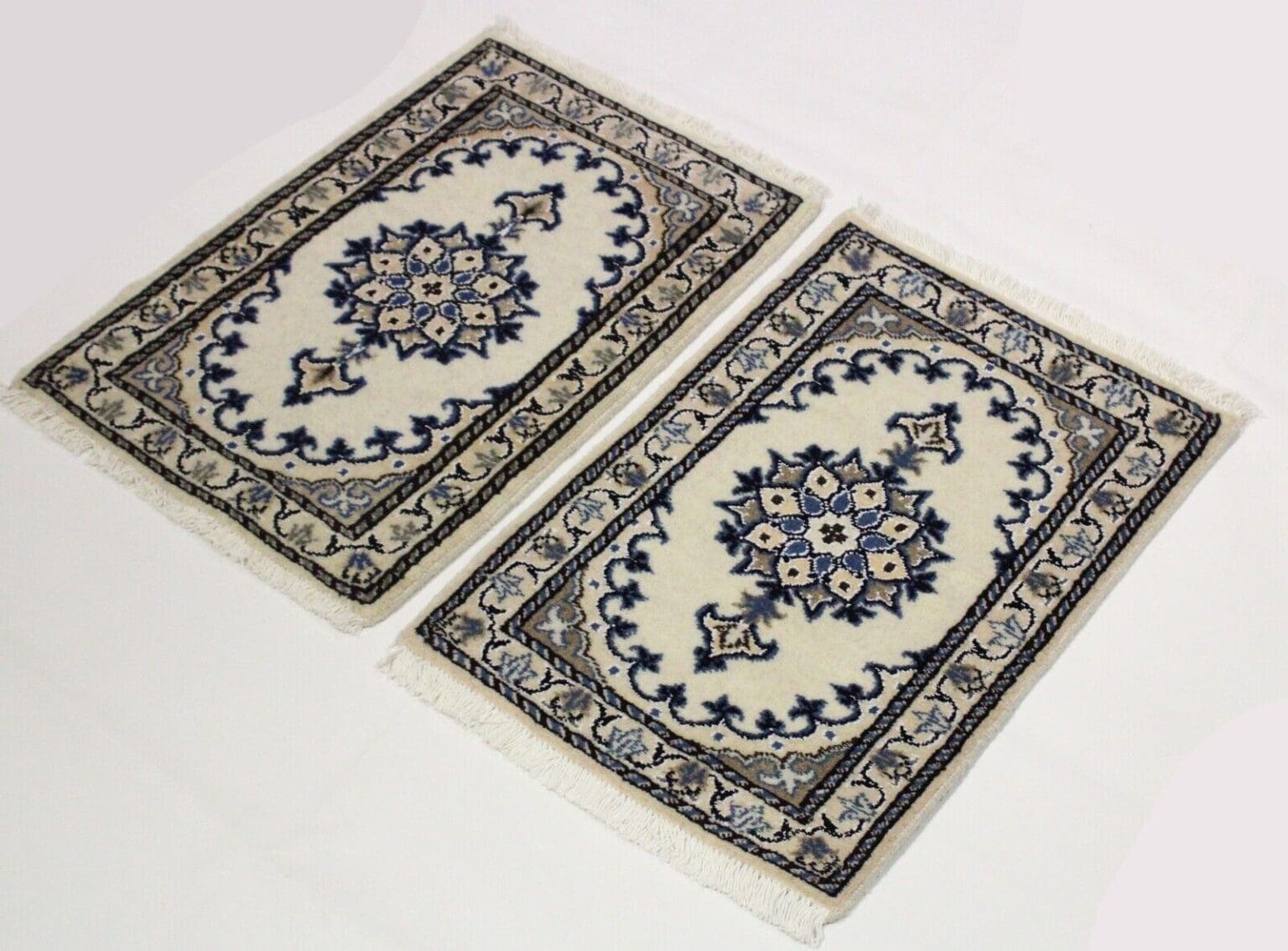
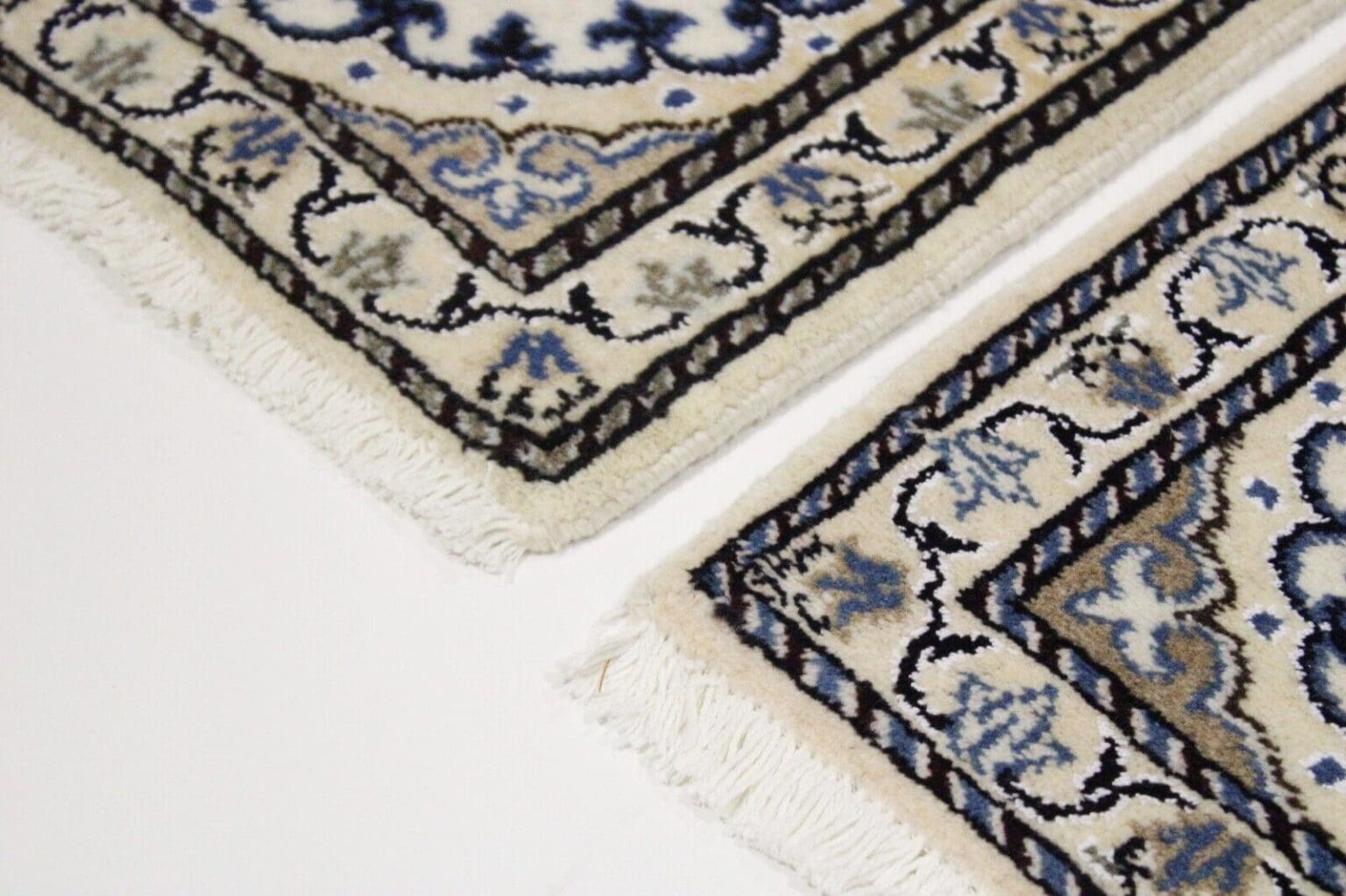
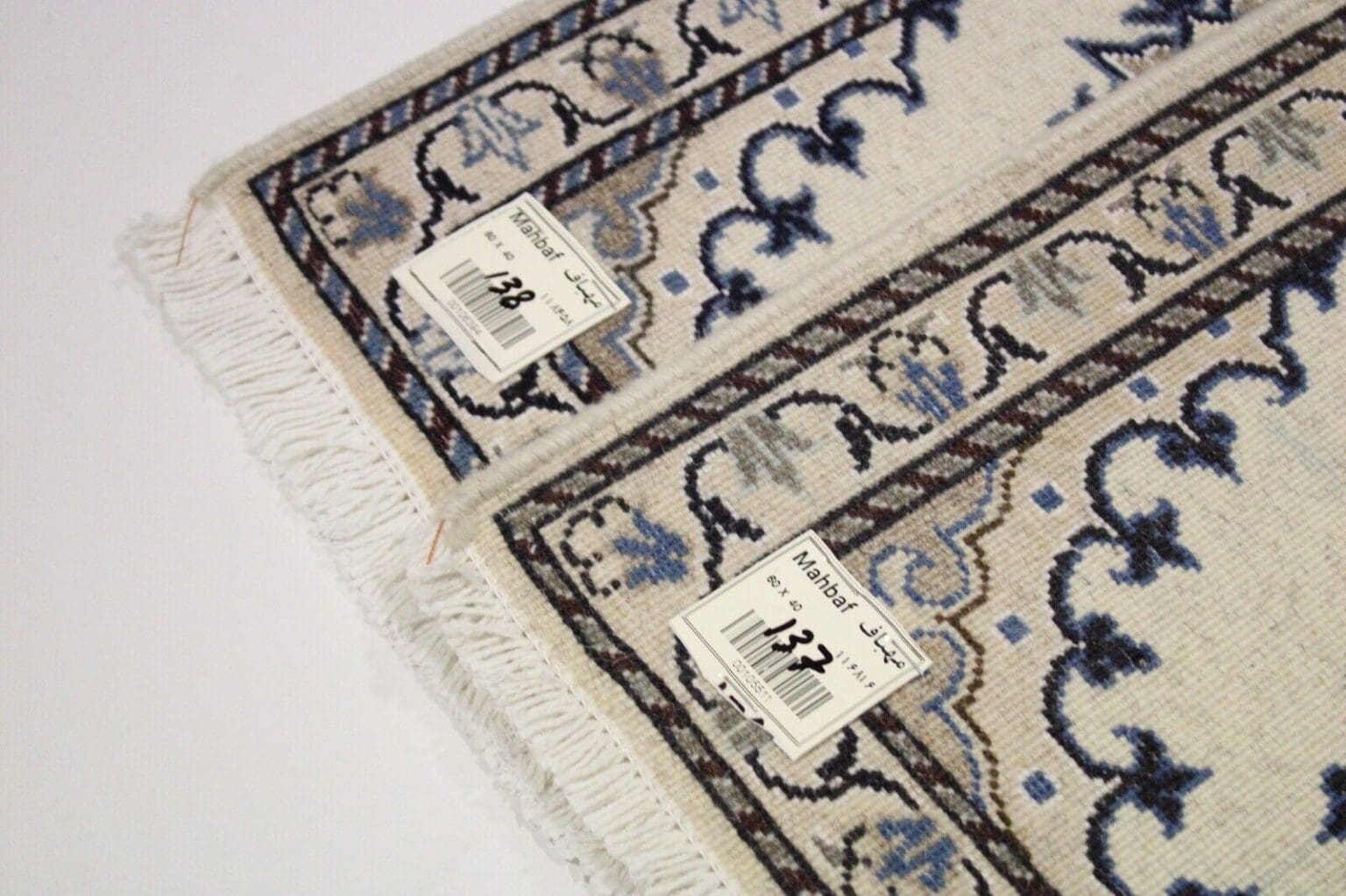
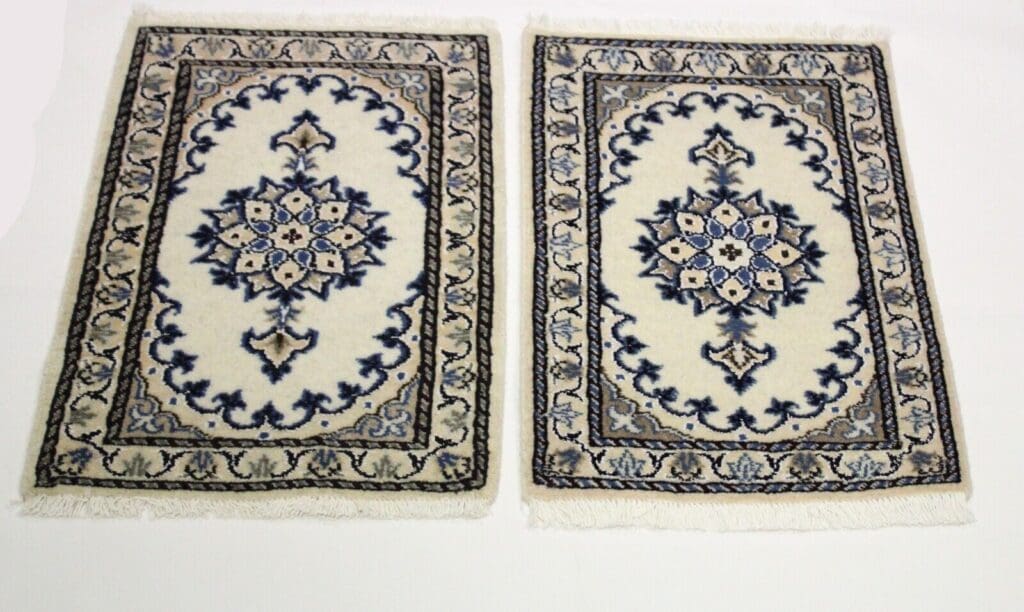
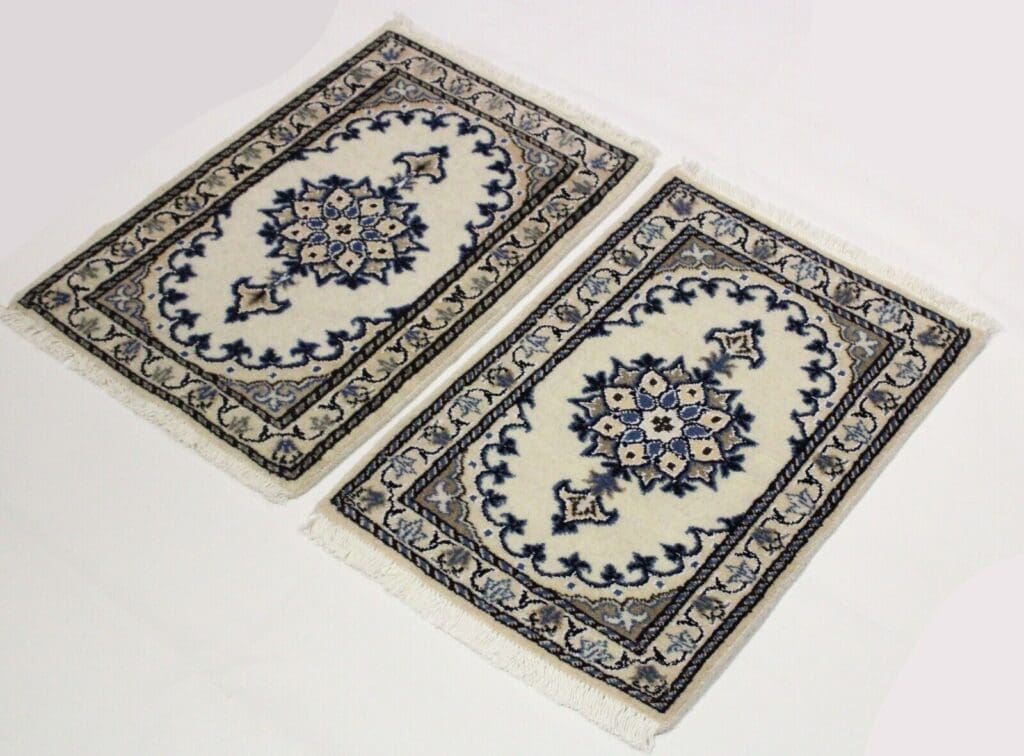
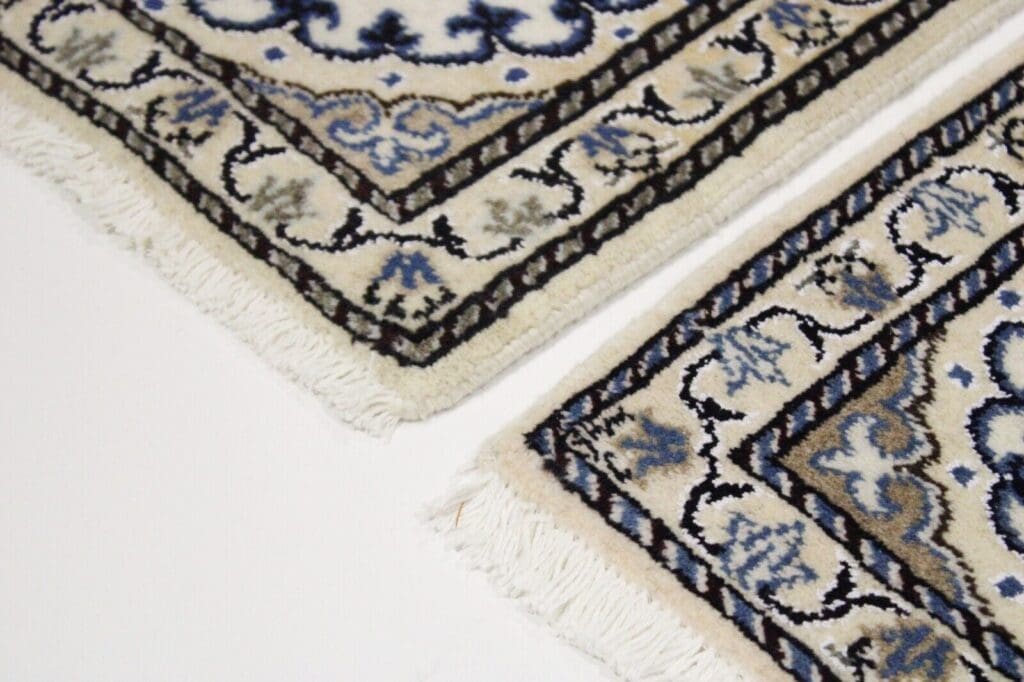
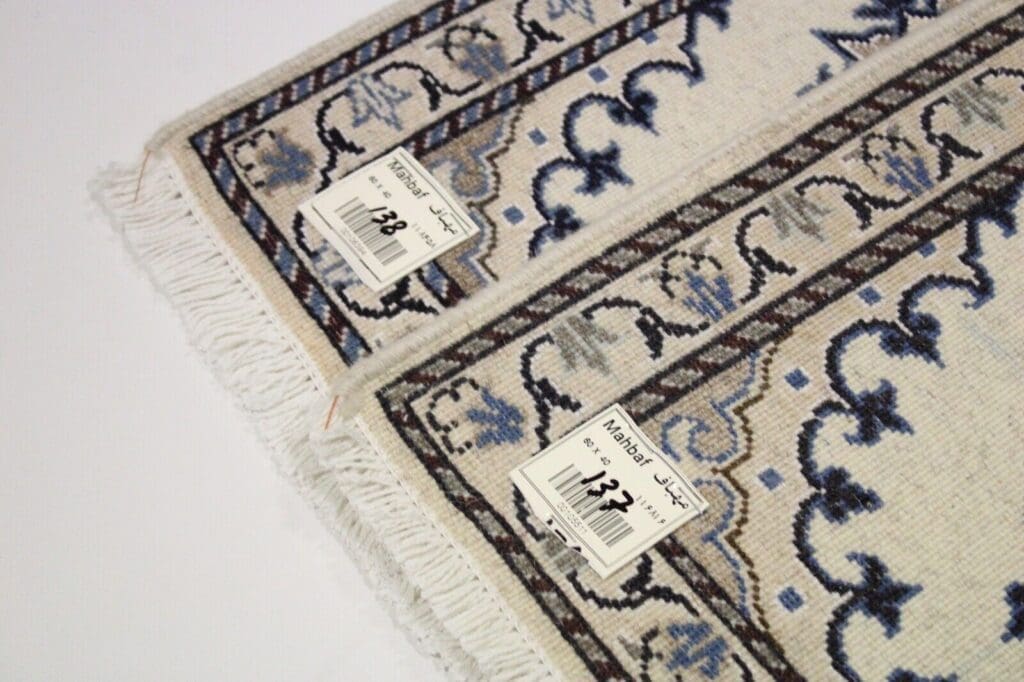
Hand-knotted Nain Persian Rug | Knot density: High pile | Material: Wool and cotton pile | Size: 60 x 40 cm | Pattern: Oriental | Condition: New without label, top condition
This Nain Persian rug is hand-knotted. Its construction belongs to a Persian carpet tradition that has been refined through generations of practical knowledge. Each knot is placed by hand, so the rug is not a uniform machine-made product. The work is built up gradually and gives the finished textile its own individual execution. Hand knotting is a method in which the maker follows a planned design while creating the surface knot by knot, rather than applying a pattern through an automated process.
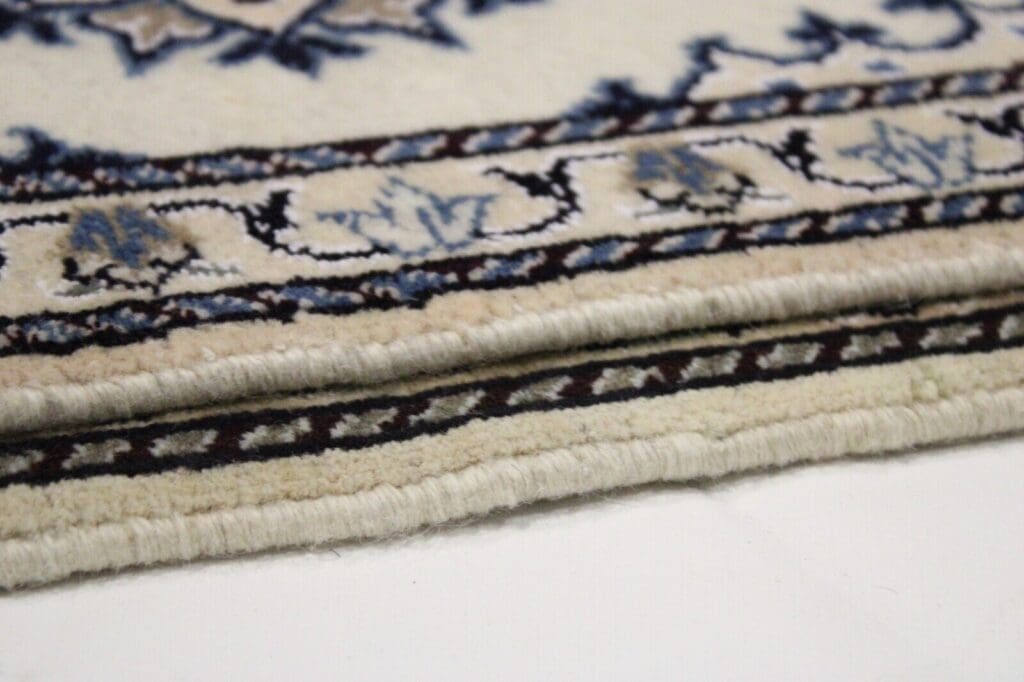
The listed materials are wool and cotton. Wool has long been used in Persian carpets because its fibres are resilient and comfortable to the touch. It also accepts colour well and creates a textile surface with a distinct feel. Cotton is another established material in carpet making and forms part of the stated material description for this rug. No additional fibres or material proportions are specified, so the description remains limited to wool and cotton.
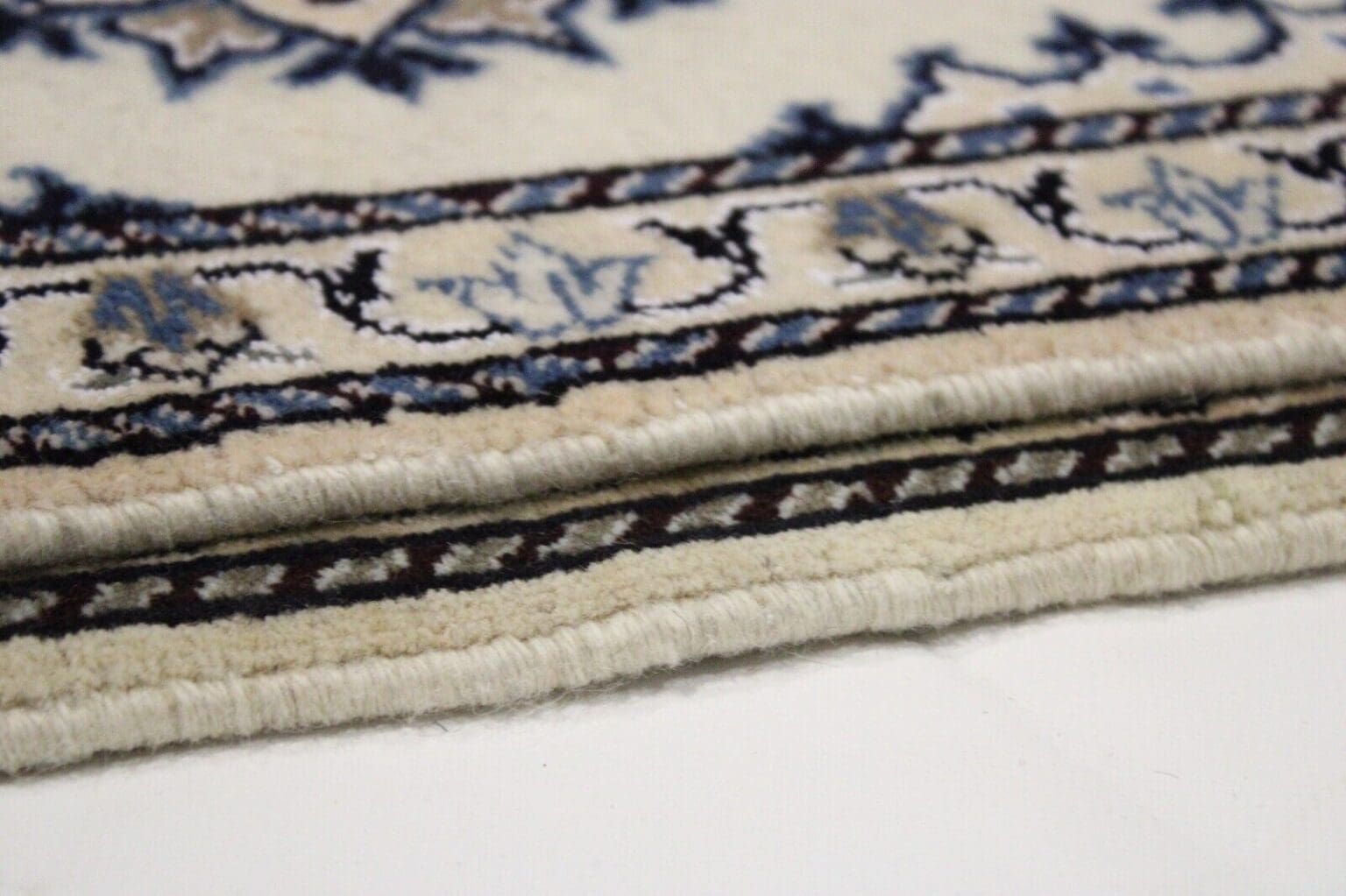
The source describes the knot density as high pile. High pile refers to a visibly raised, full-looking pile surface. It affects the way the rug feels under the hand and the way light moves across the fibres. A raised pile can give the pattern a changing appearance as the viewing angle changes. Here, high pile is the stated description of the rug’s pile structure; it is not replaced by an invented numerical knot count.
Hand-knotted carpets are assembled in successive rows. The knotting process requires the maker to maintain the planned motifs, build the structure consistently and finish the surface so that the pile can be arranged. This combines technical repetition with close attention to the pattern. The hand-knotted technique, the named materials and the high-pile description together explain the basic construction of this rug. It is identified as a Nain Persian rug and therefore belongs to the Iranian Persian carpet tradition.
Origin and Tradition
Nain is a recognised carpet centre in Iran. The city is situated in central Iran and has developed a distinct place within the country’s carpet-making history. Nain rugs are associated with carefully ordered compositions and a refined regional approach to ornament. Skills relating to preparation, knotting, colour use and pattern structure have traditionally been passed through workshops and families. The name Nain therefore indicates both a place of origin and a particular branch of Persian carpet culture.
Persian carpet making has developed over many centuries. Rugs served practical purposes as floor coverings, while their patterns also expressed the visual language of the region where they were made. Different weaving centres established their own preferences for layout, borders, ornament and colour relationships. Nain is one of those centres. Its tradition is part of the wider Persian heritage, yet it remains distinguishable from the traditions of Isfahan, Tabriz, Kashan and other Iranian carpet regions.
Nain designs are often discussed in connection with a balanced composition and clearly organised drawing. Central medallions, floral scrolls, small blossoms and structured borders are motifs associated with the regional tradition. Not every Nain rug uses every one of these elements, so they describe the background of the rug type rather than adding an unlisted detail to this particular piece. The broader principle is the careful relationship between the central field, repeated ornament and surrounding border.
The history of Persian carpets is also a history of transmitted technical knowledge. Makers learn how to prepare the foundation, position knots, compact rows, preserve the intended outlines and arrange the pile after knotting. These actions are repeated many times, but they are not merely mechanical. The knotter must read the design and maintain its proportions while converting a drawn composition into a textile surface.
Nain’s place in this tradition is connected to a preference for controlled patterning. Fine lines and repeated floral forms can be arranged so that the surface remains ordered rather than random. The result belongs to a long regional vocabulary in which symmetry, rhythm and framed areas are important. Such general characteristics explain why Nain is treated as a recognised Persian rug origin and why the regional name carries meaning for collectors and carpet buyers.
The origin should not be confused with the names of other Persian design traditions. Isfahan, Tabriz and Kashan are separate Iranian carpet centres, each with its own history. This rug is identified as Nain. Its regional designation is therefore Nain, while its wider cultural classification is Persian. The hand-knotted construction connects the individual object to this tradition without suggesting an unrecorded workshop, date, signature or specific maker.
Design and Pattern
The pattern is described as oriental. Oriental is a broad stylistic term rather than the name of one single motif. It can include floral ornaments, geometric forms, scrolling vines, rosettes, medallions and framed borders. These elements may be used separately or combined in many different ways. The term places this rug within a traditional decorative vocabulary, but it does not provide a reason to add a particular flower, colour or central figure that has not been stated.
Persian compositions are often organised through a central field and one or more borders. A medallion may provide a visual centre, while smaller motifs and scrolling lines support it. In an all-over arrangement, the ornament extends across the field without one dominant centre. A border frames the interior and creates a transition toward the edge. These are established design principles found across Persian carpet traditions, although the exact arrangement varies from one rug to another.
The Nain tradition is frequently associated with fine drawing and measured distribution of motifs. Small ornaments can be placed close together while remaining part of a coherent overall structure. Repeated blossoms or vine forms create visual rhythm, and lines guide the eye through the field. The effect comes from the interaction of many small details rather than from one isolated emblem. This is why the study of an oriental carpet considers balance, repetition, symmetry and the relationship between field and border.
Persian ornament is based on a long visual language in which natural forms are stylised. Leaves, flowers and vines can be transformed into controlled curves and repeated patterns. Geometric lines may define the edges of a motif or provide a framework for floral decoration. During knotting, these designs are translated into individual colour areas and rows of knots. The pattern therefore becomes part of the structure of the carpet rather than being applied as a separate printed surface.
The pile also influences how a pattern is perceived. With a high-pile surface, individual fibres can reflect light in different directions. One area may appear lighter or darker as the surface is viewed or touched, even though the underlying design has not changed. This creates a tactile dimension alongside the drawn ornament. It is a general feature of pile construction and does not establish any additional colour information for this particular Nain rug.
The product is also described as traditionally Persian and oriental in style. That wording places it within a historic Persian design context, where floral and geometric forms have been used for a very long time. The specific information supplied for this rug is its Nain origin, oriental pattern, hand-knotted technique, wool and cotton material description and high-pile surface. Details such as exact colours, a named medallion or a particular border arrangement are not added here.
Special Features
The rug combines a Nain origin with hand-knotted construction. It is identified as an original Persian rug and is marked as second choice. That classification is part of the product information and is retained alongside the description of its condition. The rug is described as new without a label and in top condition. These statements distinguish the sales classification from the condition description: the piece is listed as second choice while its stated condition is new without a label and top condition.
It is suitable for underfloor heating. This makes the rug compatible with rooms where a textile floor covering is used above a heated floor system. The suitability is a stated product characteristic. Installation and care should still follow the instructions for the particular heating system and the rug, since no further technical limitations are given in the product information.
The rug’s small format allows it to be used as a textile accent in a variety of interiors. The source does not prescribe a particular room or placement. Its oriental pattern gives it a traditional Persian design direction, while the Nain origin identifies its regional context. The actual location and arrangement depend on the surrounding furniture and the intended use.
The stated combination of wool and cotton, high pile, hand knotting, Nain origin and oriental pattern summarises the documented features. No age, signature, exact colour scheme, numerical knot count or additional condition detail is supplied. Those points are therefore not presented as properties of this individual rug.
FAQ
How should I care for this Persian rug?
Regular vacuuming without a brush attachment is a suitable basic measure for keeping the surface free from loose dust. Avoiding the brush helps reduce unnecessary mechanical stress on the pile. If a liquid is spilled, it should be absorbed promptly with a damp cloth rather than rubbed vigorously. Rubbing can work a stain further into the textile and can disturb the raised fibres. A mild cleaning product may be used sparingly when appropriate. For heavier soiling or a complete wash, professional carpet cleaning is recommended. A specialist can take the wool and cotton material description, the hand-knotted construction and the high-pile surface into account when selecting a method. Care should be carried out gently so that the pile remains orderly and the pattern is not placed under avoidable strain.
What makes a Nain Persian rug distinctive?
A Nain Persian rug is distinctive because regional origin, Persian design tradition and hand craftsmanship come together in one textile. Nain is an Iranian carpet centre with its own place in the history of Persian rug making. The name is therefore more specific than the general term oriental rug. This particular piece is hand-knotted, meaning that its surface was built through individual manual knots rather than machine production. Wool and cotton are the listed materials, and the pile is described as high pile. Its oriental pattern places it within a long-established decorative language of floral and geometric forms. The rug is also identified as an original Persian rug, listed as second choice, described as new without a label and in top condition, and stated to be suitable for underfloor heating. Together, these documented points define the character of the offered piece without requiring an unrecorded date, workshop or motif.
How can I assess the quality of a Persian rug?
Assessment normally considers several aspects together: the consistency of the hand knotting, the clarity of the pattern, the materials, the structure of the foundation and the condition of the pile. Knot density can influence how finely outlines and small motifs are represented, but quality is not established by a single figure alone. The knots should be considered in relation to the design and the overall construction. Wool and cotton are traditional carpet materials, and their characteristics affect the feel and structure of the finished textile. For this rug, the pile is described as high pile, which refers to the raised surface rather than giving a numerical knot count. The Nain origin, hand-knotted technique, oriental pattern and stated new condition without a label are additional points to include in an overall assessment. A careful inspection of the front, back, edges and pile is the most reliable way to evaluate an individual hand-knotted rug, while the documented product details provide its basic classification.
To provide the best experiences, we use technologies like cookies to store and/or access device information. Consenting to these technologies will allow us to process data such as browsing behavior or unique IDs on this site. Not consenting or withdrawing consent, may adversely affect certain features and functions.
Functional Always active
The technical storage or access is strictly necessary for the legitimate purpose of enabling the use of a specific service explicitly requested by the subscriber or user, or for the sole purpose of carrying out the transmission of a communication over an electronic communications network.
Preferences
The technical storage or access is necessary for the legitimate purpose of storing preferences that are not requested by the subscriber or user.
Statistics
The technical storage or access that is used exclusively for statistical purposes.The technical storage or access that is used exclusively for anonymous statistical purposes. Without a subpoena, voluntary compliance on the part of your Internet Service Provider, or additional records from a third party, information stored or retrieved for this purpose alone cannot usually be used to identify you.
Marketing
The technical storage or access is required to create user profiles to send advertising, or to track the user on a website or across several websites for similar marketing purposes.
 SECURE PAYMENT
 SHIPPING PARTNERS