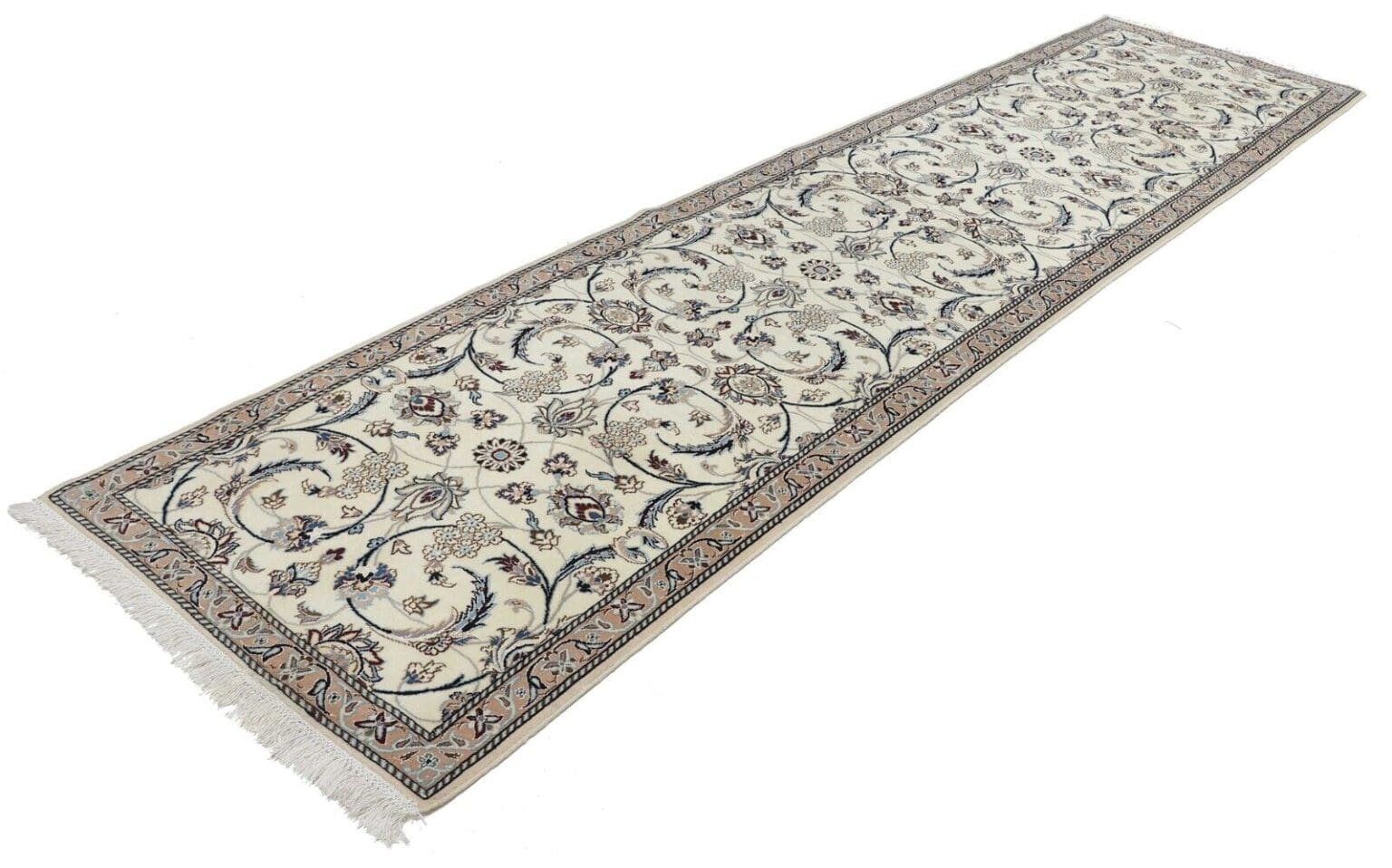
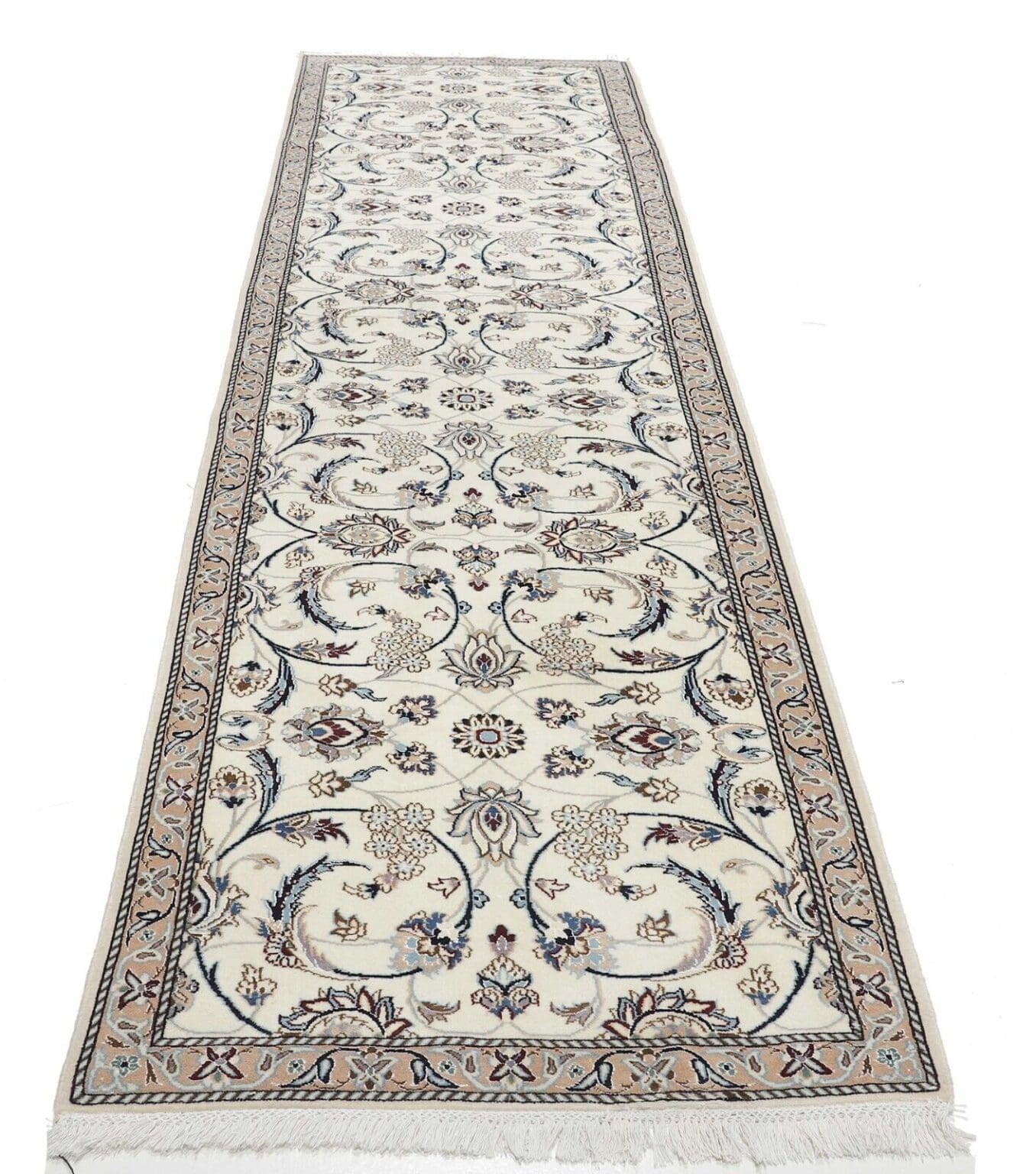
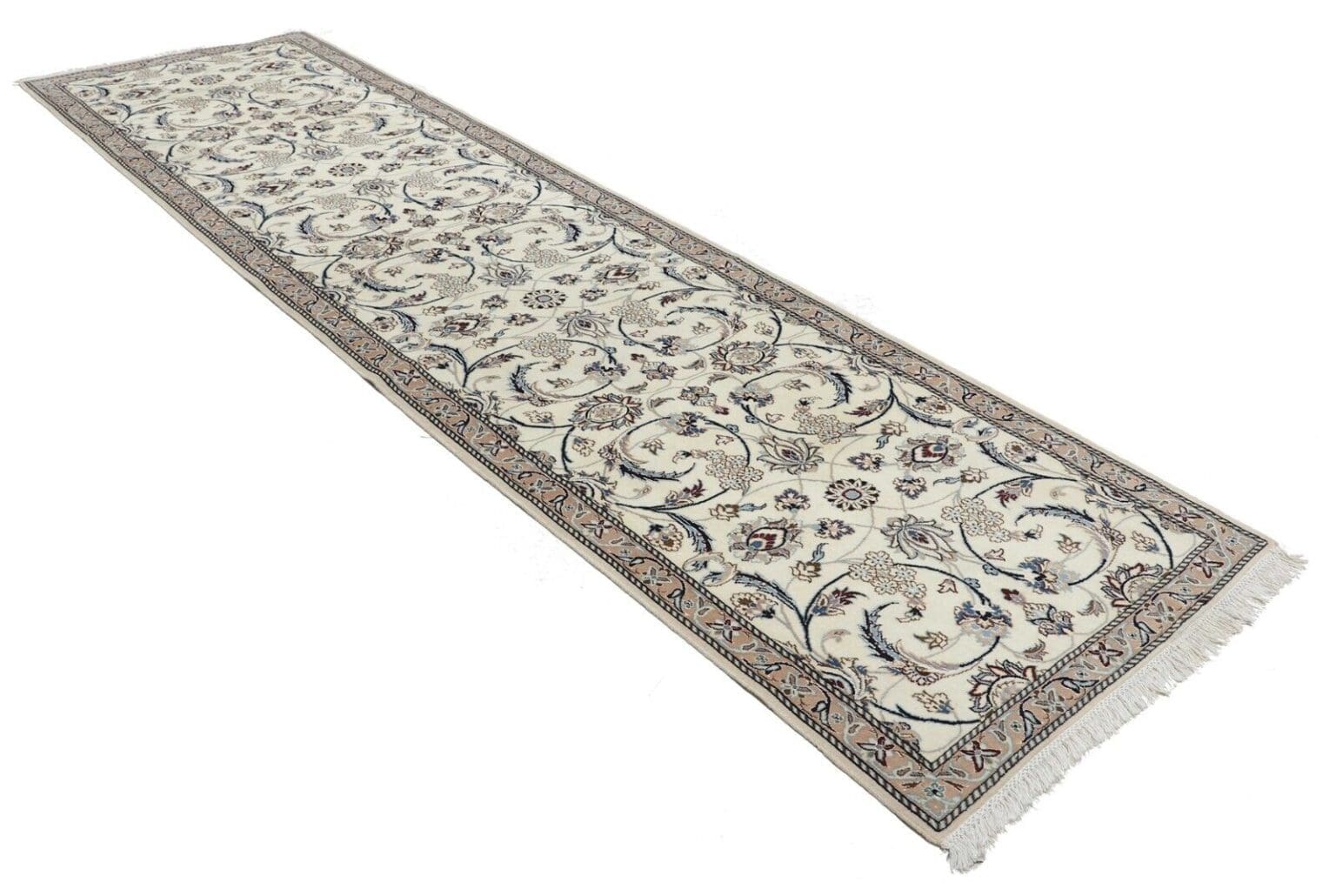
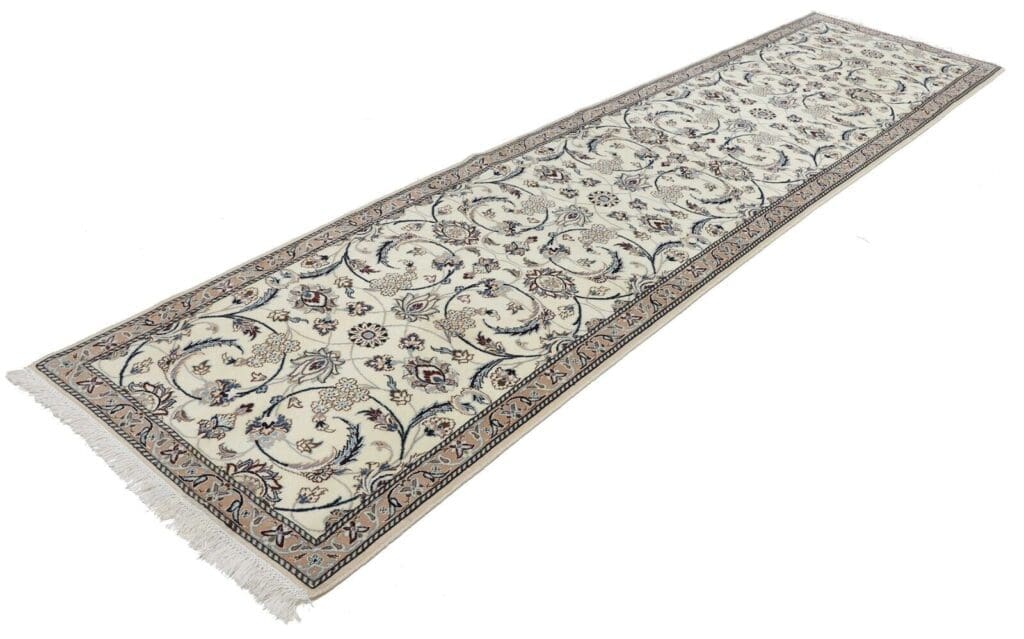
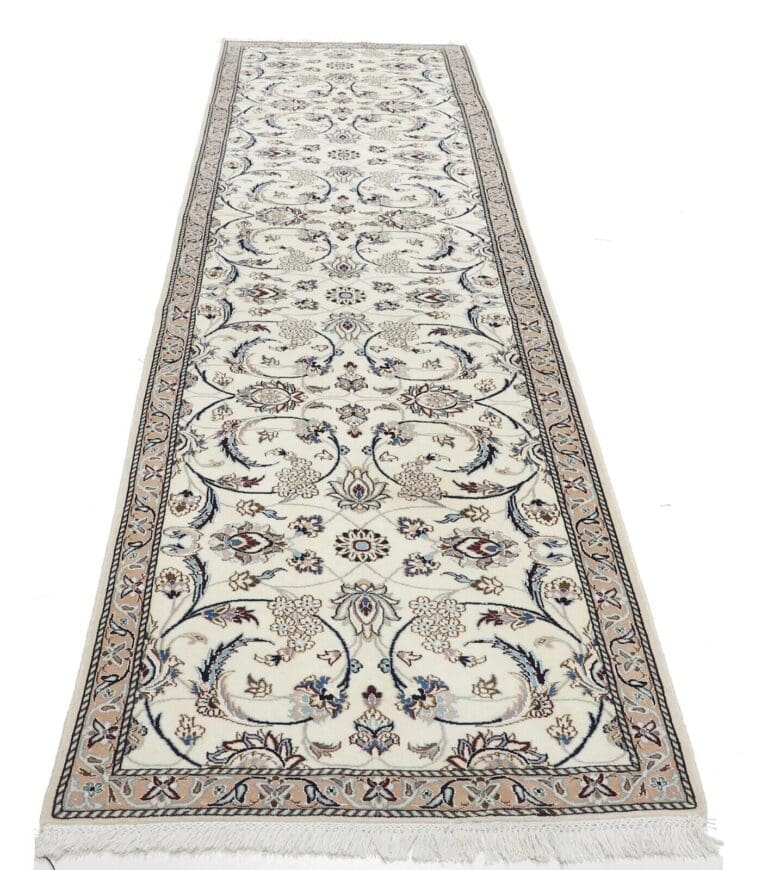
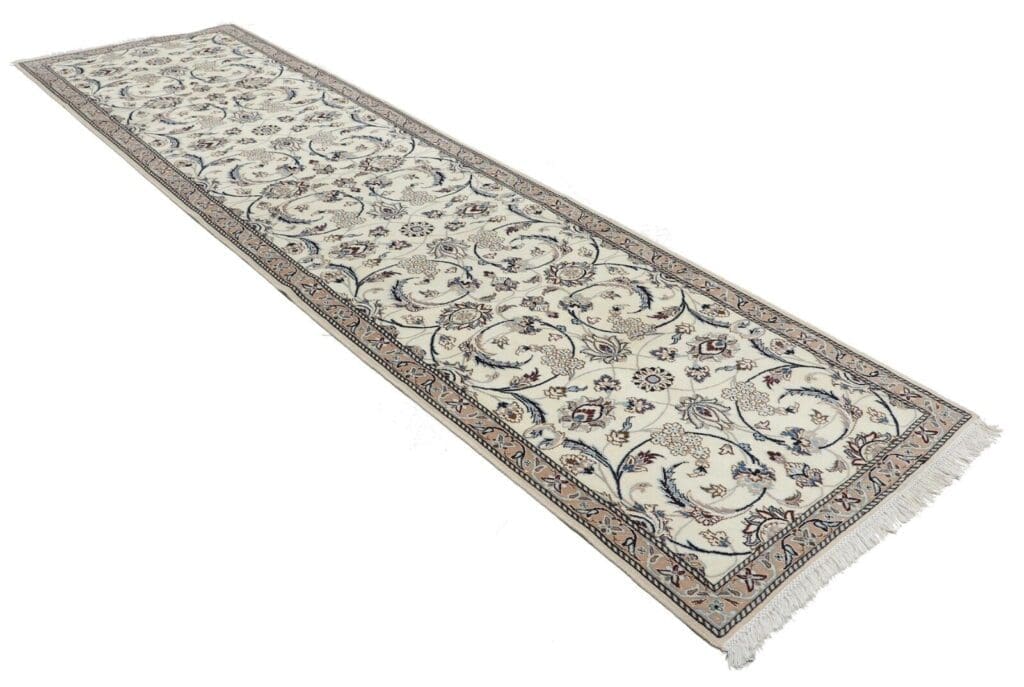
Hand-knotted Nain Persian Rug | Knot density: high | Material: silk, cotton, wool | Size: 394 cm x 98 cm | Pattern: oriental with floral motifs | Condition: top, as new
This Nain Persian rug is hand-knotted and comes from Iran. Its listed materials are 100% silk, cotton, and wool. These fibres bring different textile qualities to a traditional rug: silk is associated with a fine, smooth surface and a clear response to colour, while wool is traditionally valued for its resilience and ability to retain its shape. Cotton is often used as a structural element in oriental rugs. The source does not assign each listed fibre to a particular part of this rug; the documented material information is silk, cotton, and wool.
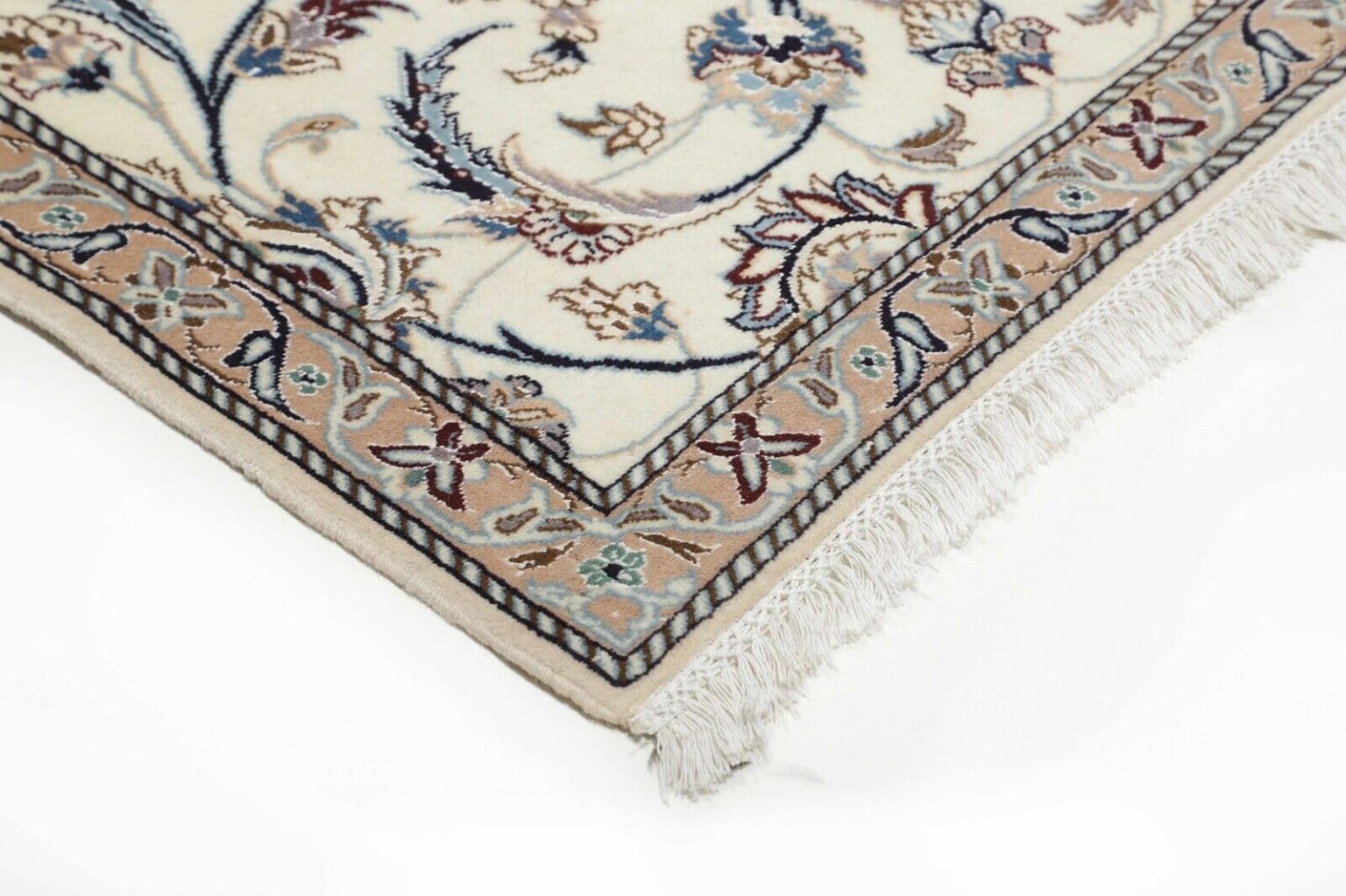
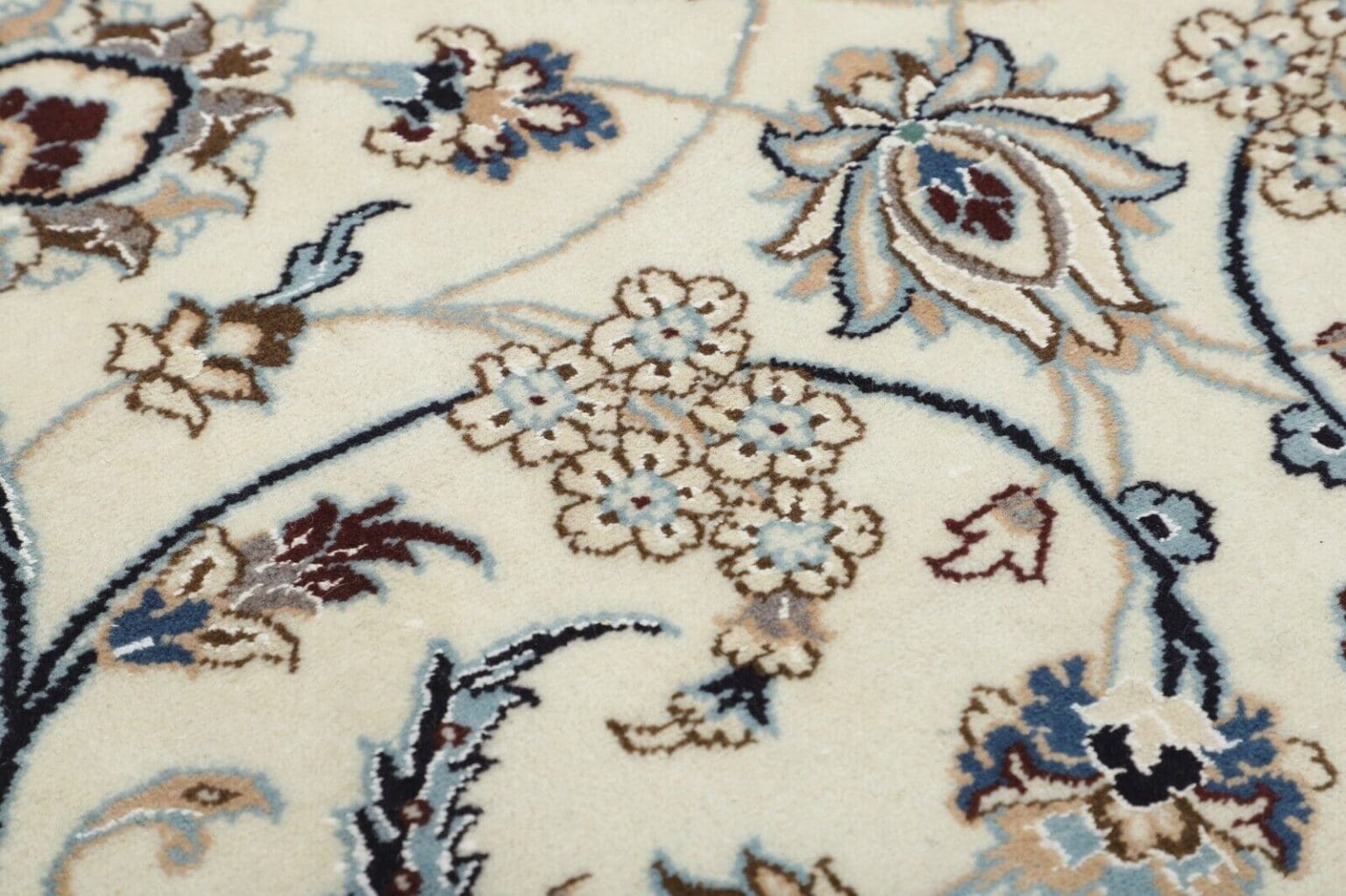
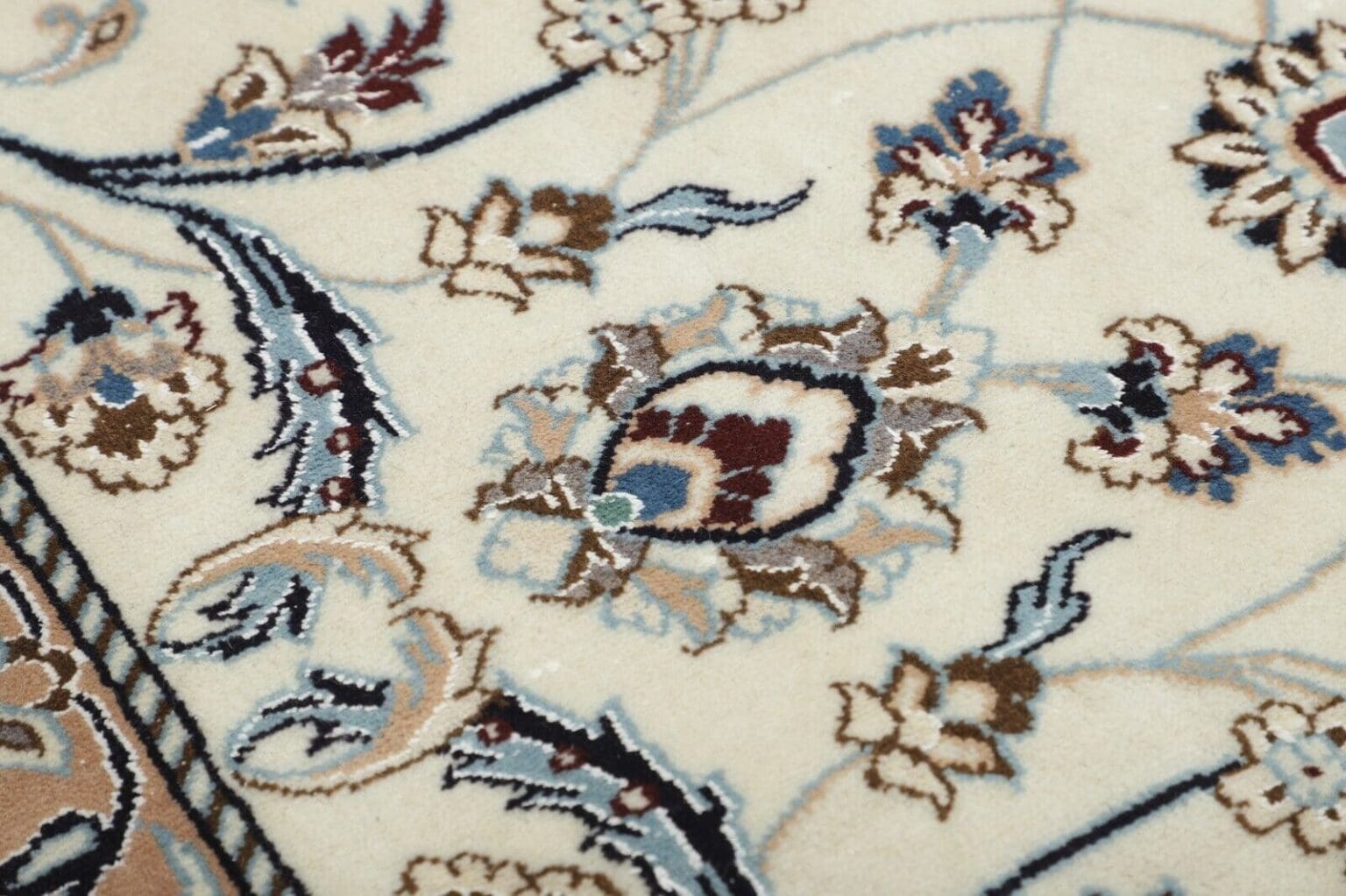
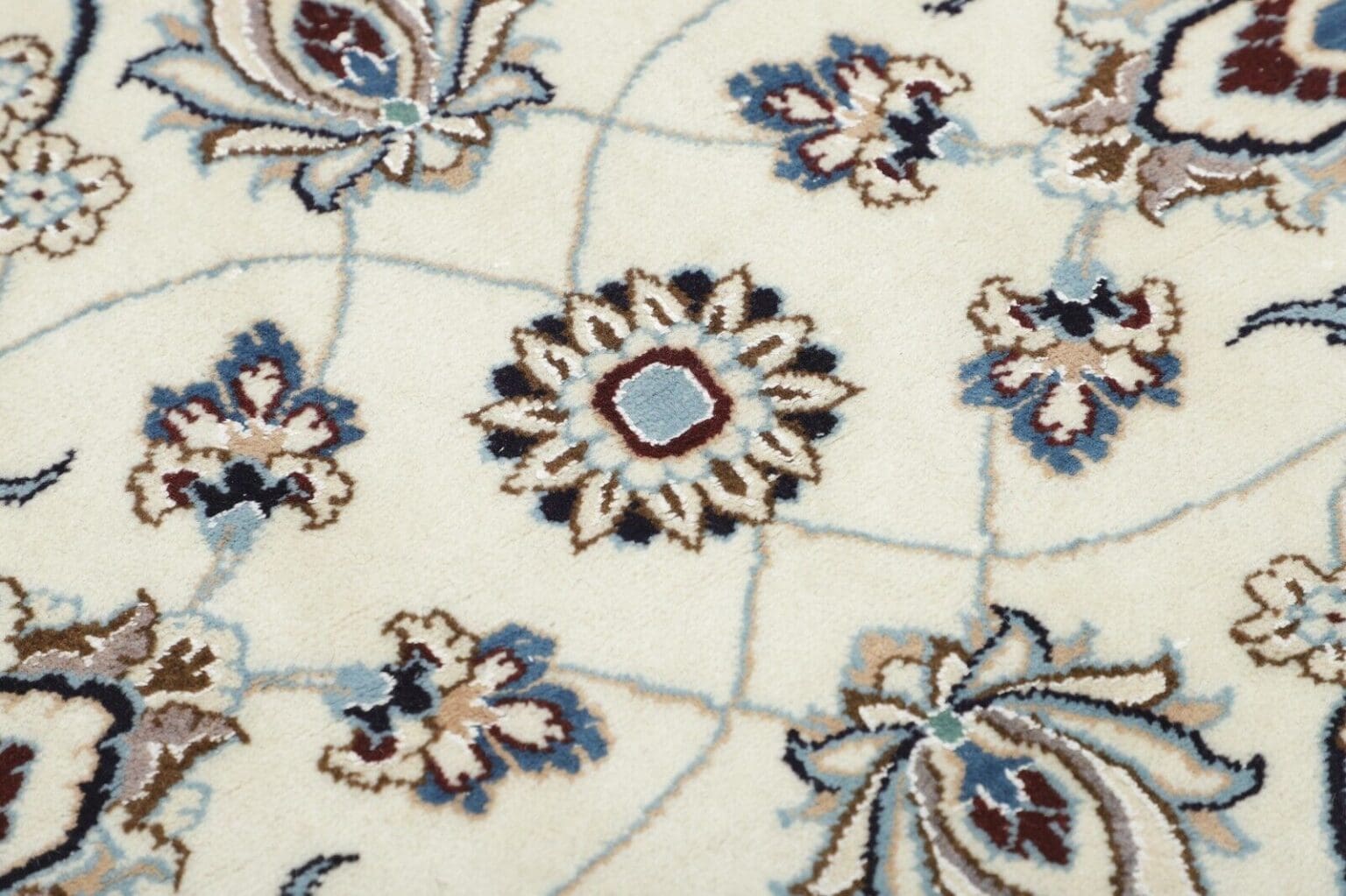
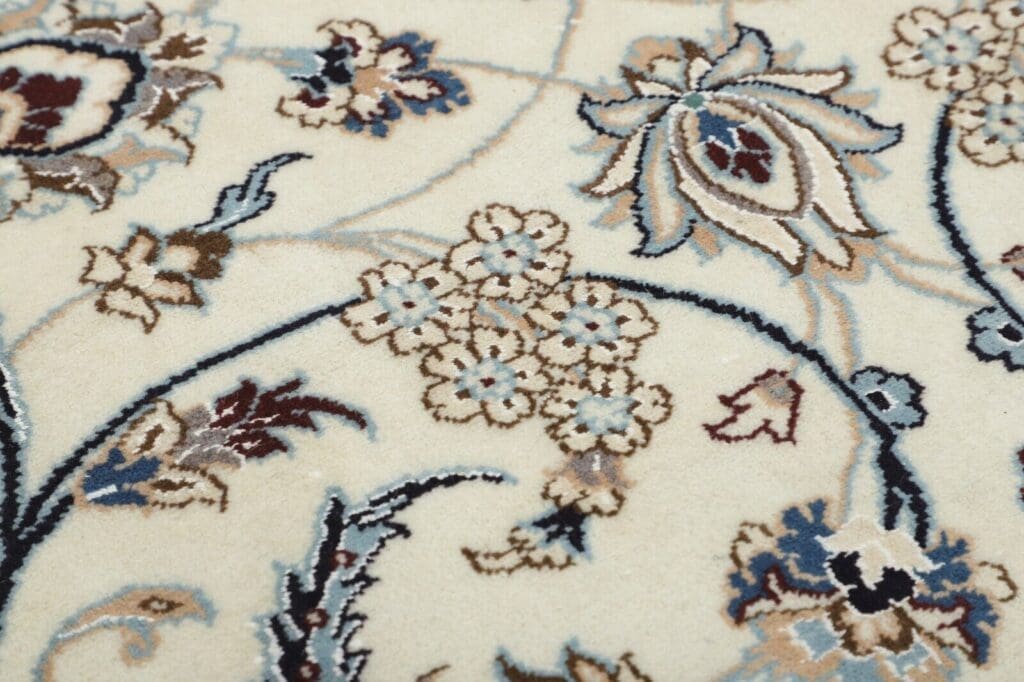
The rug is described as having a high knot density. In a hand-knotted rug, each knot is inserted by hand into the prepared warp. Rows of knots are secured with weft threads and then shaped into an even pile. A high knot density permits fine outlines, small floral forms, and carefully differentiated ornamental transitions. It is also an important part of the precise surface character commonly associated with finely made Nain rugs.
Nain weaving is traditionally connected with controlled pile construction and clearly organised pattern layouts. The surface is created by the relationship between knots, warp, weft, and pile rather than by printing a design onto a finished textile. This gives every hand-knotted rug its own woven structure. For this example, the documented construction is hand-knotting with a high knot density. Its condition is described as top and as new.
Origin and Tradition
Nain is a historic city in Iran known for the production of finely made Persian rugs. It is located in Isfahan Province, a region with a long-established carpet tradition. Nain rugs are associated with clear drawing, delicate ornament, and a restrained colour language. Their place within Persian weaving reflects an approach in which a carpet is both a practical textile and a carefully organised work of craftsmanship.
Carpet production in Nain has a history of more than one hundred years. Across that period, knowledge of design structure, colour arrangement, and knotting technique has been passed from one generation to the next. Regional weaving depends on the close relationship between a design and the method used to execute it. A pattern must be planned so that it can be translated into rows of knots while retaining its symmetry, rhythm, and fine transitions. This is especially relevant when floral and geometric elements are brought together.
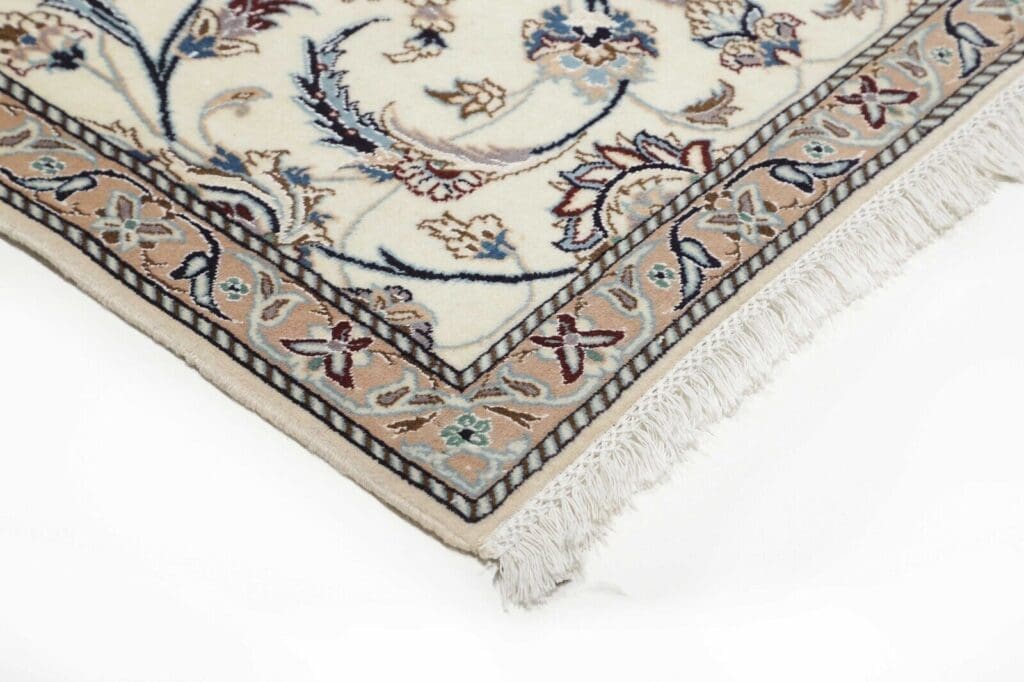
Nain rugs are often recognised for delicate colouring, frequently including shades of blue and cream. These colours may define the ground, outline an ornament, or provide a measured accent. The visual balance comes not only from individual colours but also from the relationship between field, border, and decoration. Many Nain designs maintain a calm order in which individual forms remain legible while contributing to a coherent whole.
The weaving tradition of Nain carries cultural and technical knowledge beyond the production of a floor covering. Knotting preserves regional skills and makes manual work visible through the arrangement of line, colour, and ornament. Persian rugs from this tradition therefore continue elements of an established visual vocabulary: floral forms, geometric organisation, and deliberate treatment of open and decorated areas. The designation Nain identifies this rug with its Iranian origin and places it within that regional tradition.
As a Persian rug from Iran, this piece also belongs to the wider history of Persian carpet making. Different Iranian centres developed their own combinations of materials, patterns, and technical emphasis. Nain is particularly connected with fine drawing, restrained elegance, and detailed execution. That background describes the weaving region rather than adding unrecorded details to this individual rug. Its specific information remains its Iranian Nain origin, hand-knotted construction, high knot density, listed materials, floral oriental pattern, and as-new condition.
The history of Nain weaving is also a history of adaptation within a recognisable regional language. Traditional motifs can be repeated, balanced, enlarged, or reduced while retaining their connection to the local style. The weaver must maintain consistent tension and proportion as the design develops across the field. Such work requires attention to the sequence of colours and the placement of each knot. These general characteristics explain why Nain is regarded as an important Iranian weaving centre without making an unsupported claim about the individual hands involved in this rug.
Design and Pattern
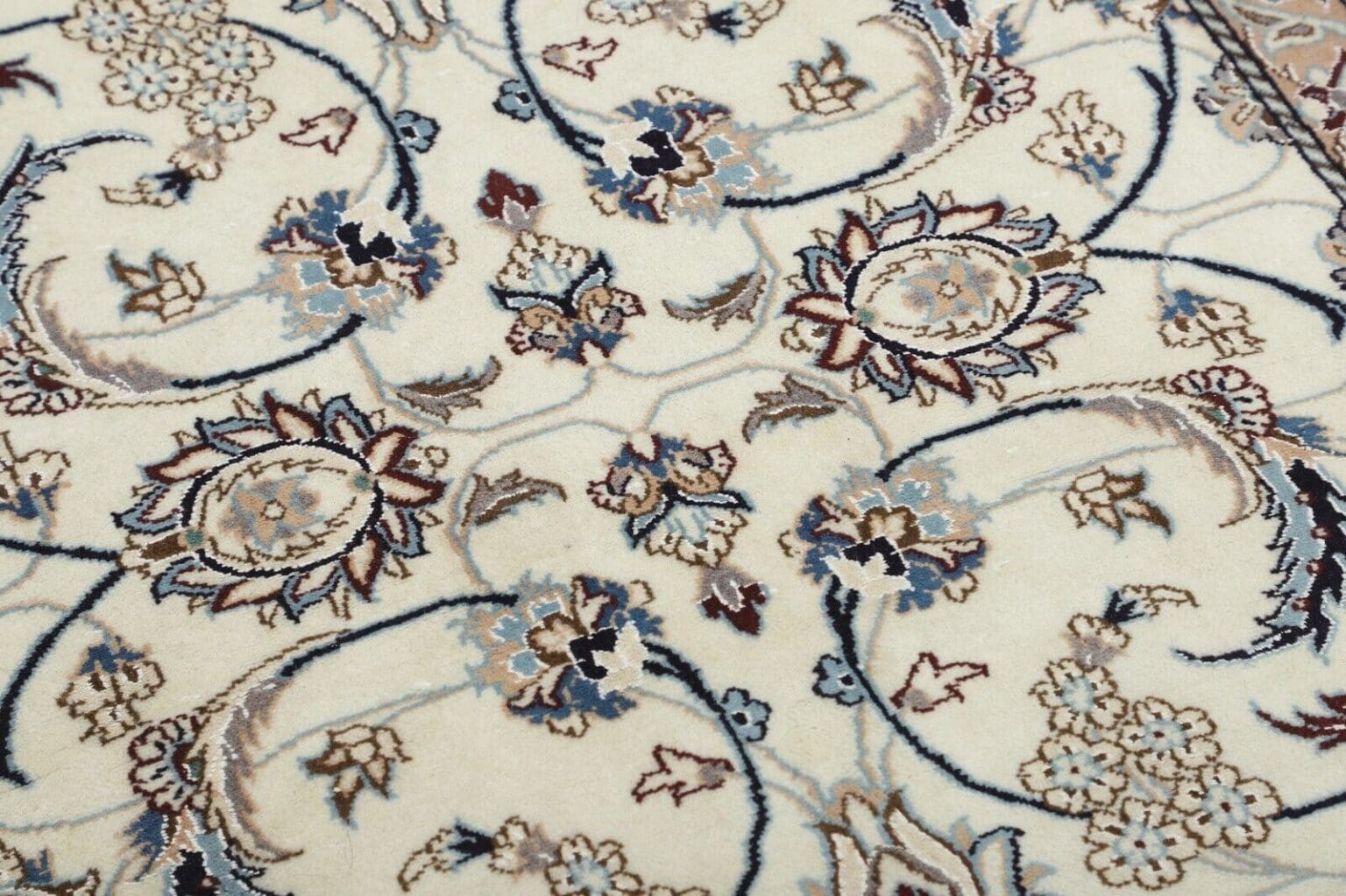
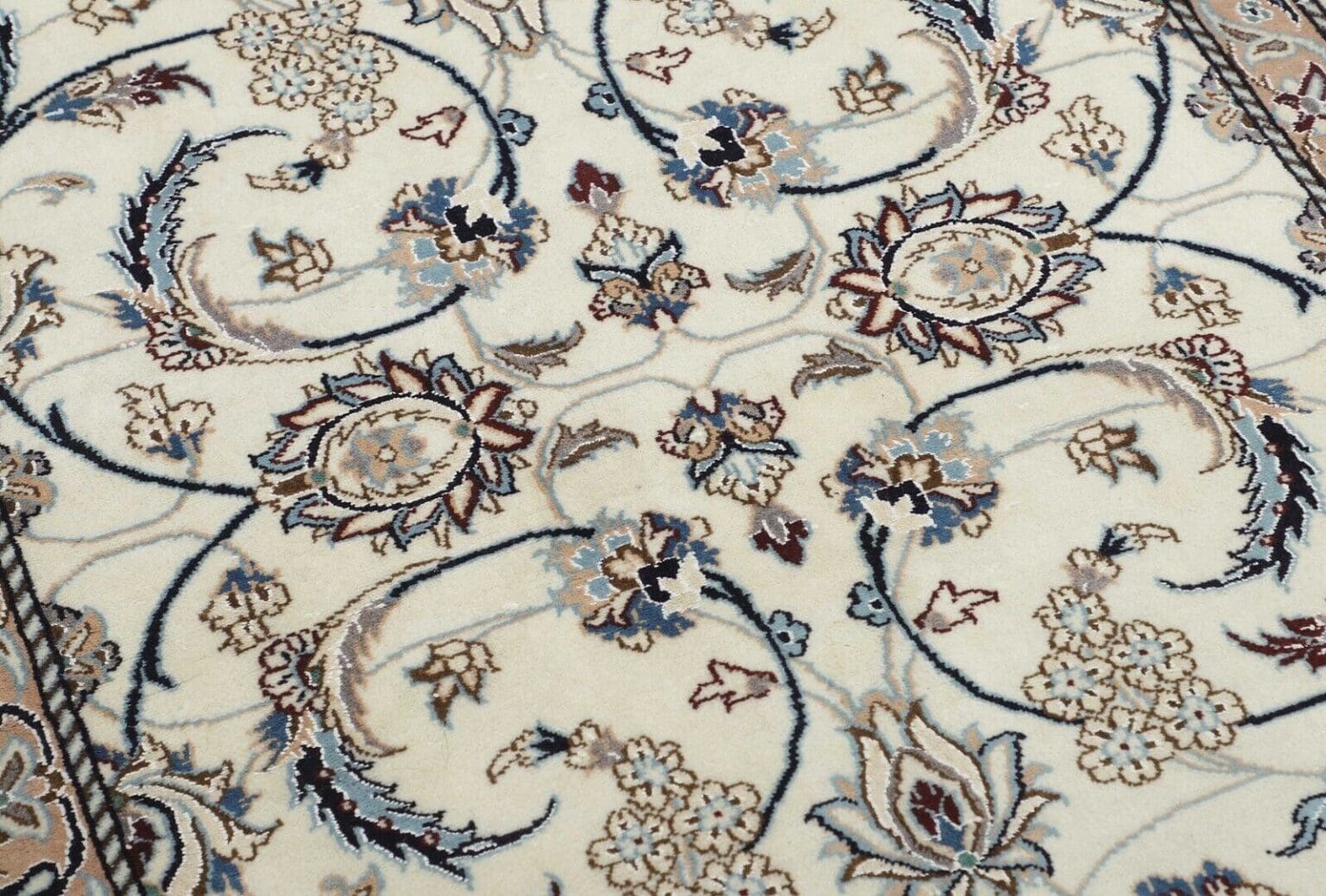
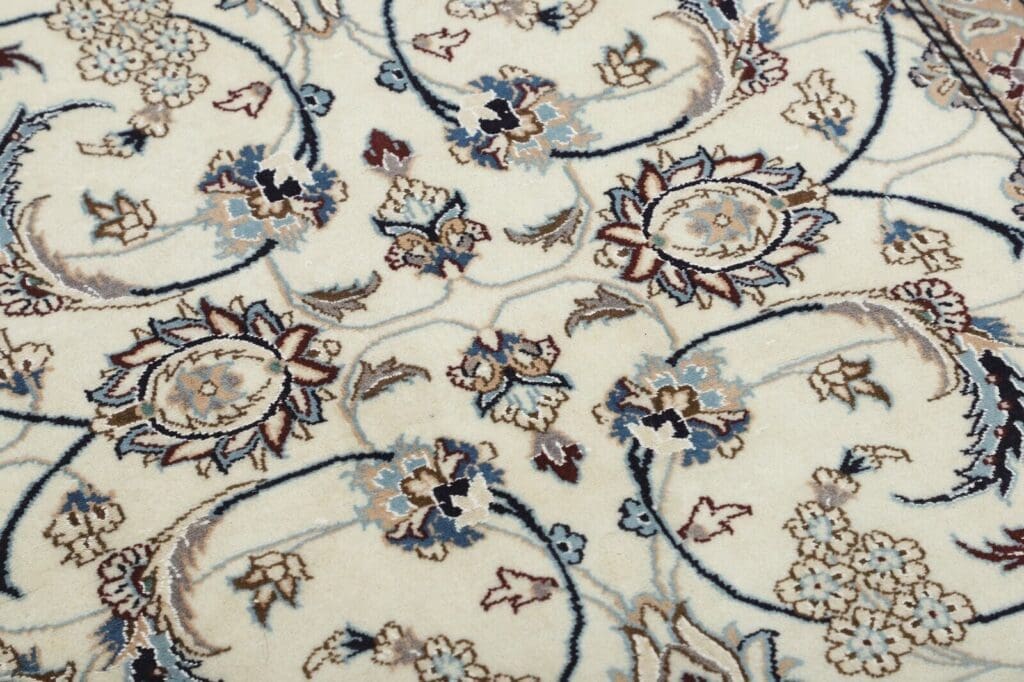
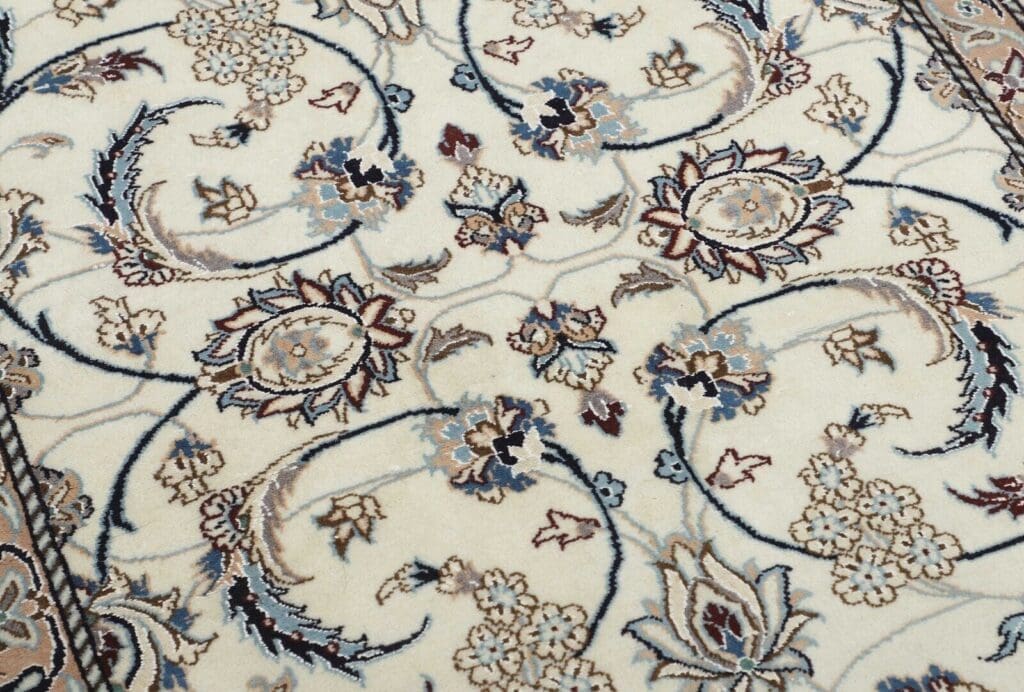
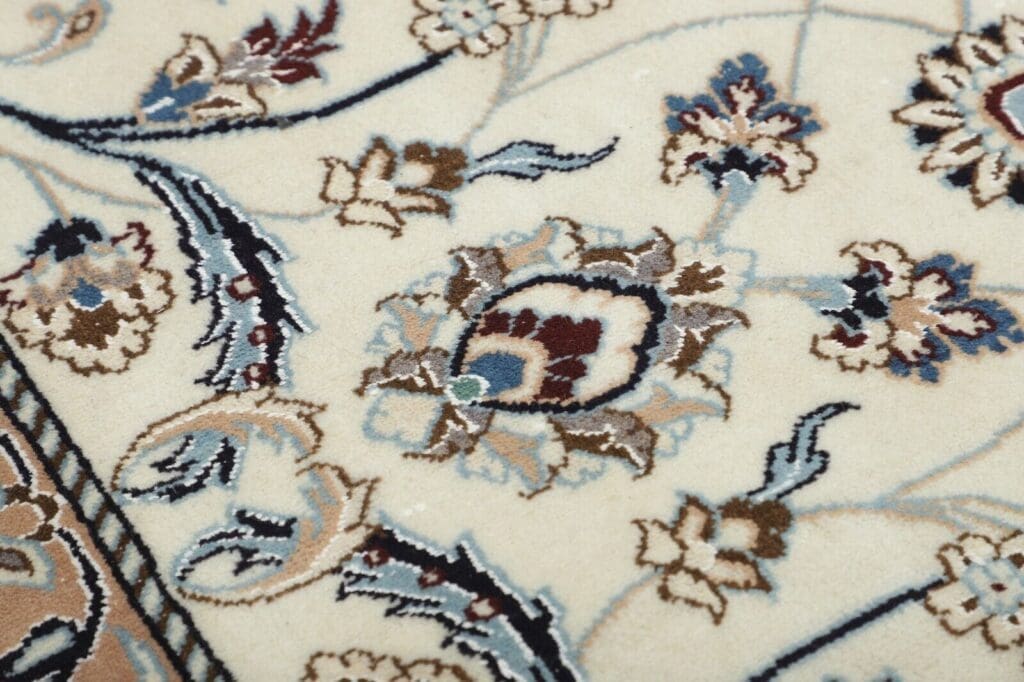
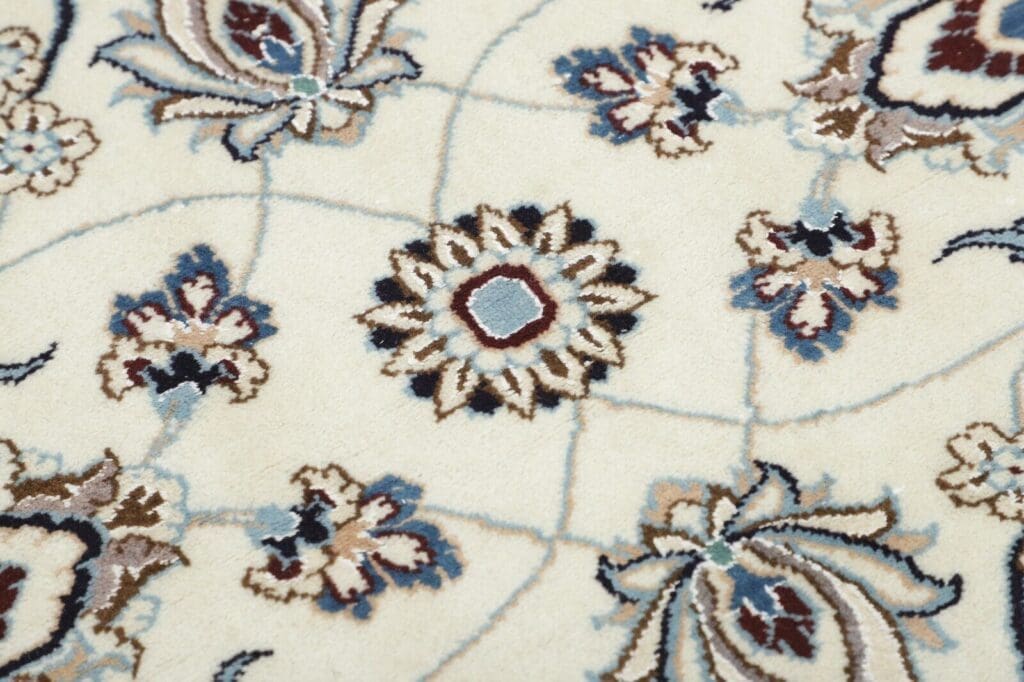
The pattern of this rug is described as oriental with floral motifs. Flowers, leaves, and curved stems are recurring elements in Persian carpet design. They may appear as separate ornaments or be linked into flowing arrangements. In the Nain tradition, such forms are often drawn with fine lines and placed within a clearly structured field. For this rug, the documented design statement is the oriental floral pattern; no more specific description of its exact repeat or medallion structure is provided.
Many Nain compositions use a relationship between a central order and an enclosing border. Some designs place a principal focus in the middle and arrange surrounding ornaments around it, while others create a repeated floral field framed by bands. These are established principles of the regional design tradition and are not presented here as additional details of this particular piece. What is recorded for the rug itself is its oriental character and its use of floral motifs.
Floral patterning gains its effect through the interaction of line, repetition, and scale. Small blossoms can create a dense and delicate drawing, while larger flowers establish clearer points of emphasis. Vines and stems provide connections between individual elements and help unify the field. Geometric order may support such an arrangement even when the specific product description mentions only oriental floral motifs. The high knot density is suited to the precise rendering of small details, although the exact drawing of this rug is not further itemised.
Nain designs are frequently associated with blue and cream tones together with other restrained, harmonious colours. A carefully balanced palette allows ornament to remain distinct without making the entire field appear unsettled. The relationship between lighter and darker areas affects the visibility of flowers and connecting lines. The precise colour sequence of this rug is not stated, so the description remains with the recorded floral pattern and the established colour background of Nain weaving.
An oriental floral design can work within different interior settings because its visual language is not tied to a single type of furniture or room. Traditional Persian ornament can sit alongside classically arranged interiors as well as more reduced surroundings. This describes the general adaptability of the pattern type, not a special intended room for this rug. The rug itself is described as traditional Persian and oriental in style.
Persian carpet design is built from families of recognisable ornaments that weavers interpret in varied compositions. Minor differences in knot placement, line, and colour distribution are part of the hand-made process. A hand-knotted rug is therefore not produced like a printed textile. For this Nain, the defining design information is the oriental composition with floral motifs. A particular medallion, border layout, or set of colour codes should not be added without documentation.
Special Features
The notable features of this rug are its Nain origin in Iran, hand-knotted construction, high knot density, and listed combination of silk, cotton, and wool. Its condition is given as top and as new. The combination of regional design, manual workmanship, and floral ornament places the piece within the Persian carpet tradition without extending its individual product information beyond the recorded facts.
The rug is described as allergy-friendly and suitable for underfloor heating. With underfloor heating, excessive temperatures should be avoided, and regular ventilation supports stable textile use. Sound-dampening properties are also stated. Textile floor coverings can reduce reflected sound and contribute to a quieter room acoustic.
Care consists of regular vacuuming with a gentle brush. Spills and other marks should be treated promptly with a damp cloth and mild cleaning agent. Professional cleaning is recommended every few years. The rug is intended primarily for indoor use. Weather exposure and direct sunlight can damage fine materials, so a protected and dry environment is recommended.
FAQ
How should I care for the Nain Persian rug?
Regular vacuuming with a gentle brush helps remove loose dirt from the pile. Spills and other soiling should be treated immediately with a damp cloth and a mild cleaning agent. Vigorous rubbing should be avoided in order to protect the pile and colours. Professional cleaning is recommended every few years. Because the rug contains fine materials, cleaning should be carried out carefully and with attention to its textile surface.
Is the rug suitable for underfloor heating?
Yes, the Nain Persian rug is suitable for underfloor heating. The heat should not be set unnecessarily high, so that the materials are not placed under avoidable stress. Regular ventilation supports a dry and balanced environment. When positioning the rug, it should also lie flat without disruptive folds. Suitability for underfloor heating is a stated product feature.
Can the rug be used indoors and outdoors?
The rug is designed primarily for indoor use. It is not intended for outdoor placement because weather exposure and direct sunlight can damage its fine materials. A protected, dry environment is recommended. This helps shield the textile surface from moisture and strong external influences. Indoor use corresponds to the intended application of this hand-knotted Persian rug.
To provide the best experiences, we use technologies like cookies to store and/or access device information. Consenting to these technologies will allow us to process data such as browsing behavior or unique IDs on this site. Not consenting or withdrawing consent, may adversely affect certain features and functions.
Functional Always active
The technical storage or access is strictly necessary for the legitimate purpose of enabling the use of a specific service explicitly requested by the subscriber or user, or for the sole purpose of carrying out the transmission of a communication over an electronic communications network.
Preferences
The technical storage or access is necessary for the legitimate purpose of storing preferences that are not requested by the subscriber or user.
Statistics
The technical storage or access that is used exclusively for statistical purposes.The technical storage or access that is used exclusively for anonymous statistical purposes. Without a subpoena, voluntary compliance on the part of your Internet Service Provider, or additional records from a third party, information stored or retrieved for this purpose alone cannot usually be used to identify you.
Marketing
The technical storage or access is required to create user profiles to send advertising, or to track the user on a website or across several websites for similar marketing purposes.

 SECURE PAYMENT
 SHIPPING PARTNERS


