
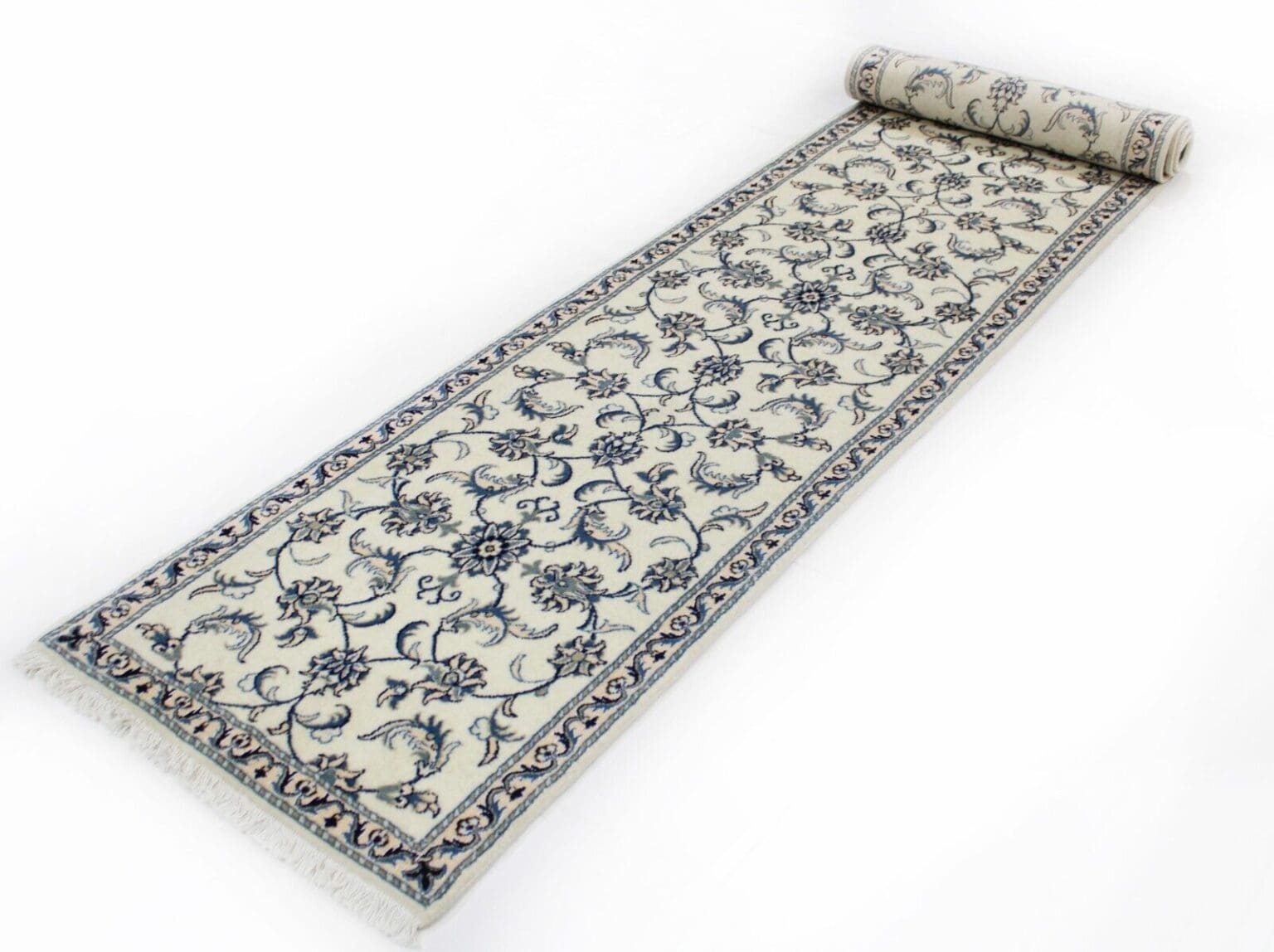
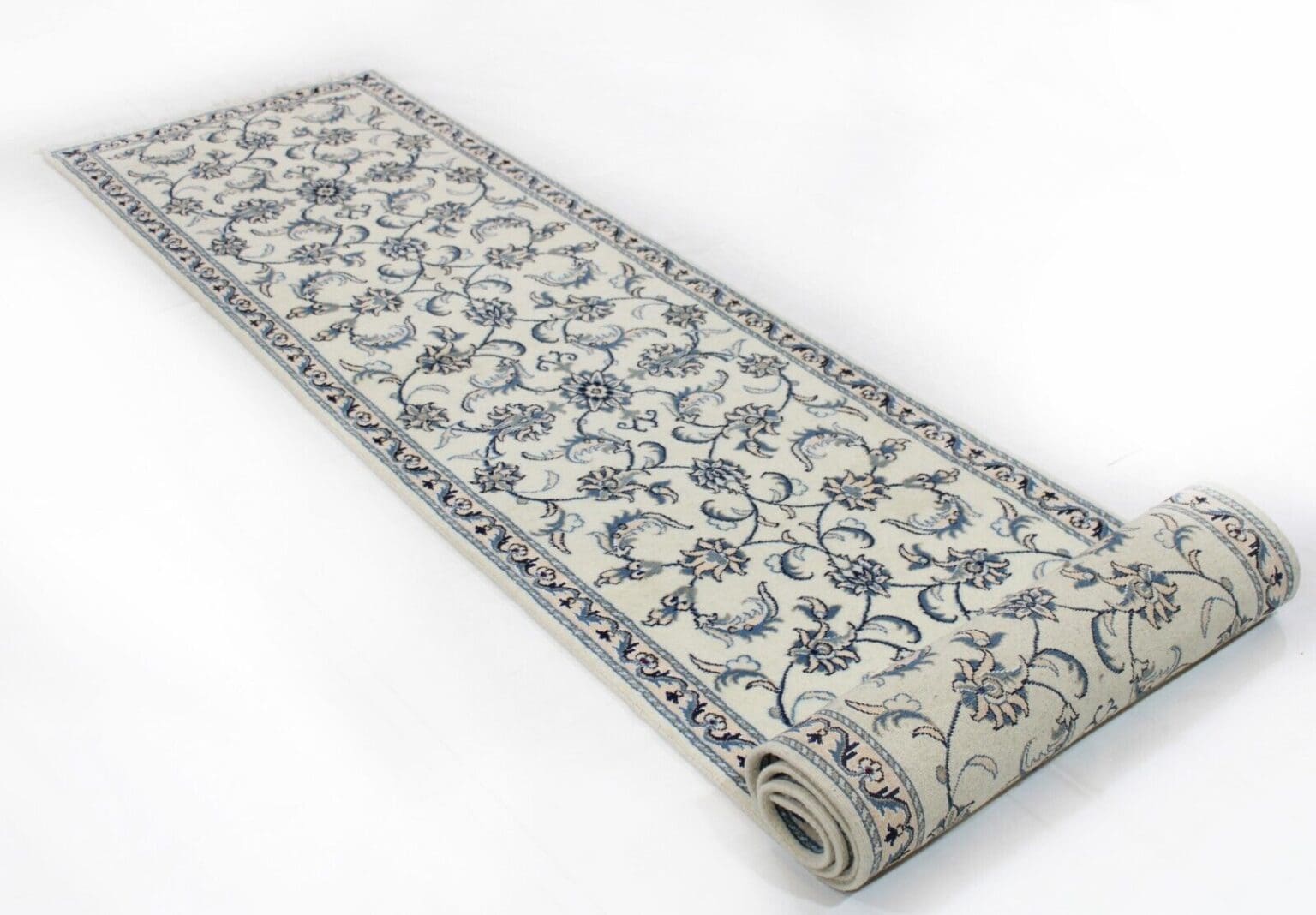
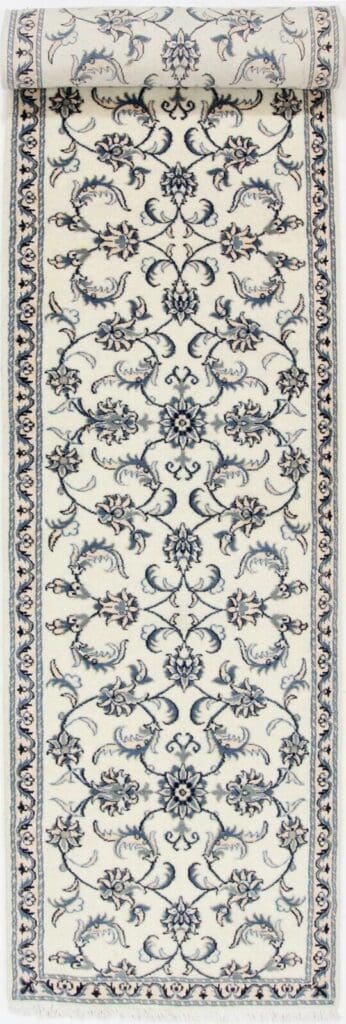
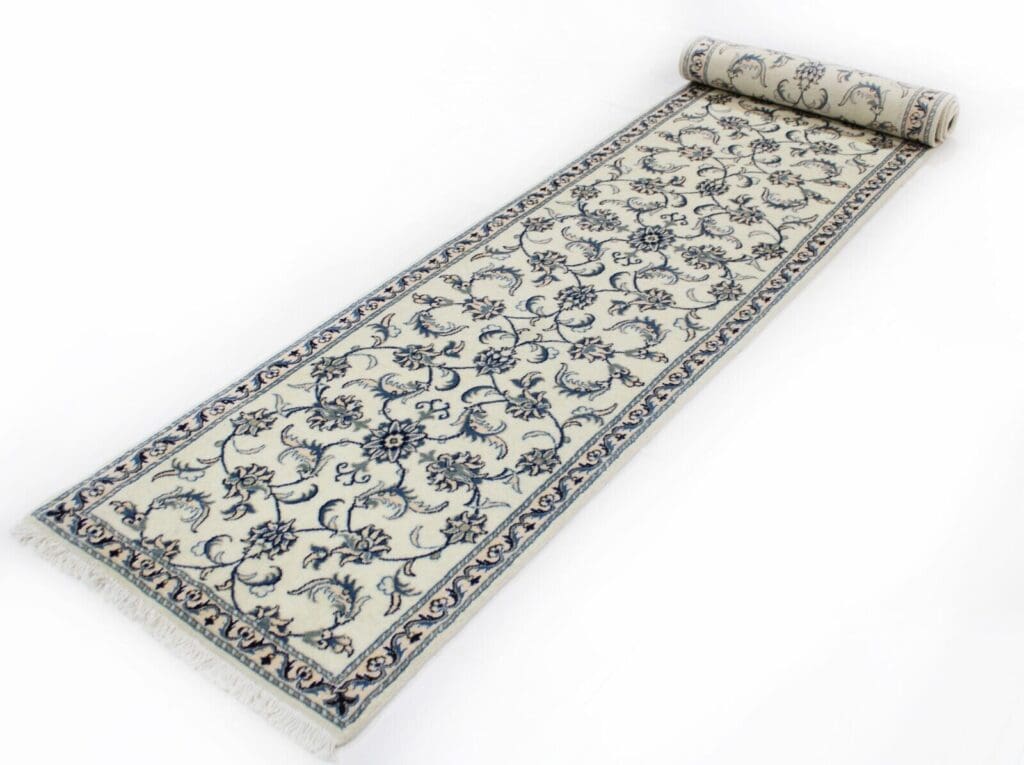
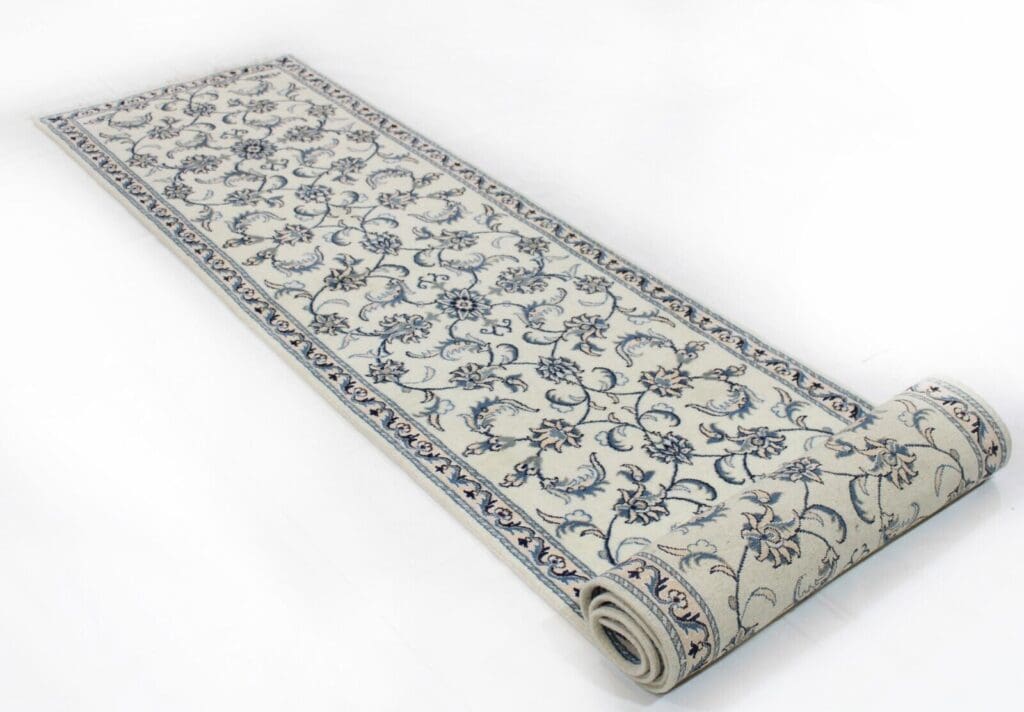
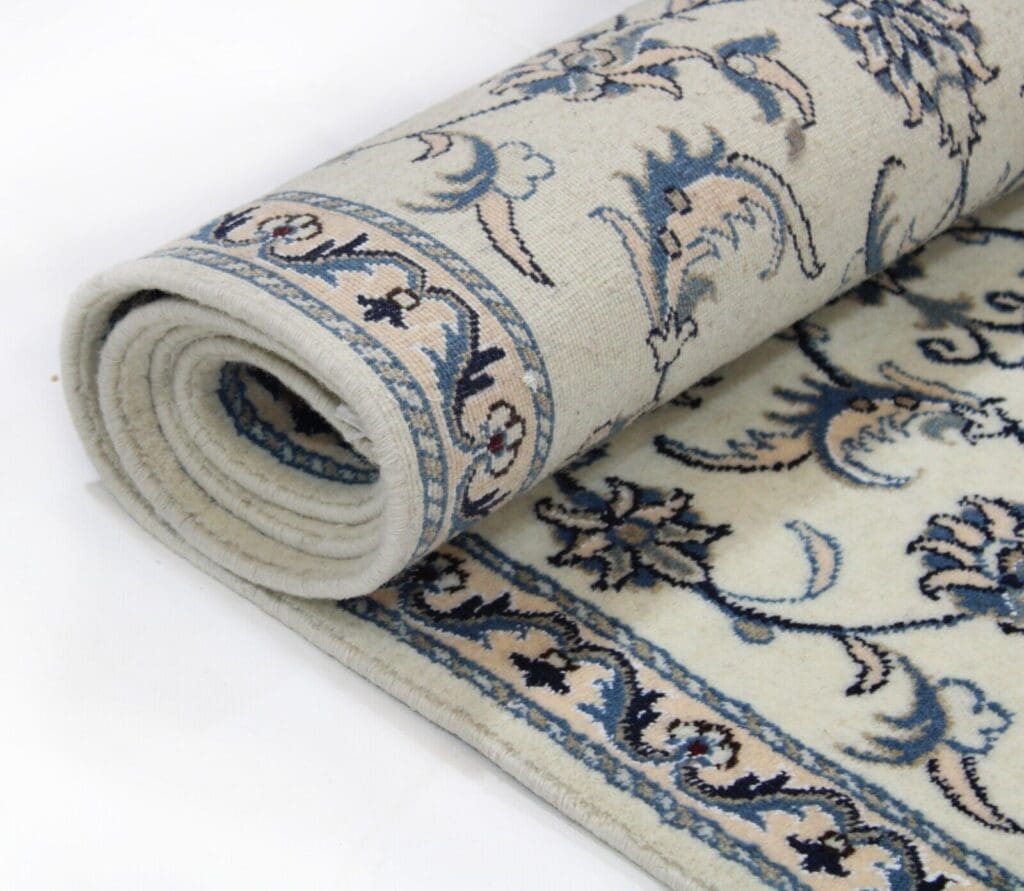
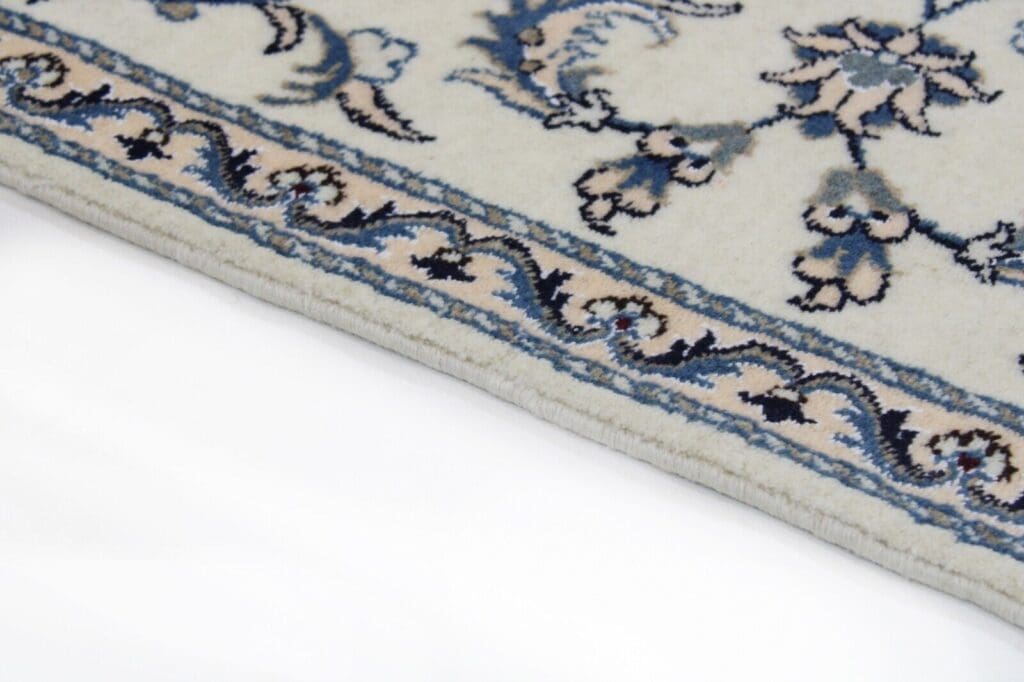
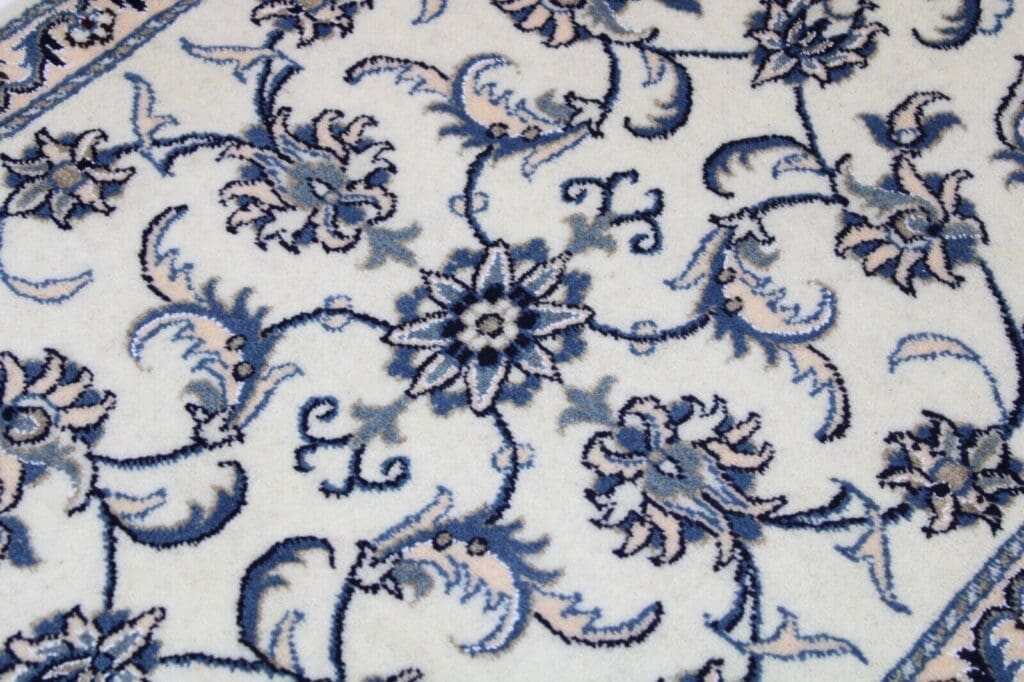
Persian Rug Nain 382 x 77 cm Wool Hand-knotted
€ 1515
Hand-knotted Nain Persian rug | Knot density: Hand-knotted | Material: High-quality wool and cotton | Size: 382 x 77 cm | Pattern: Oriental with floral motif | Condition: New without label
1 available
- ✓Free Shipping in EU
- ✓2-5 Business Days Delivery
- ✓14-Day Return Policy
- ✓Worldwide Shipping on request
 SECURE PAYMENT
 SHIPPING PARTNERS
Inventory number: 42DDDB51
Description
Nain Persian Rug
Material and Craftsmanship
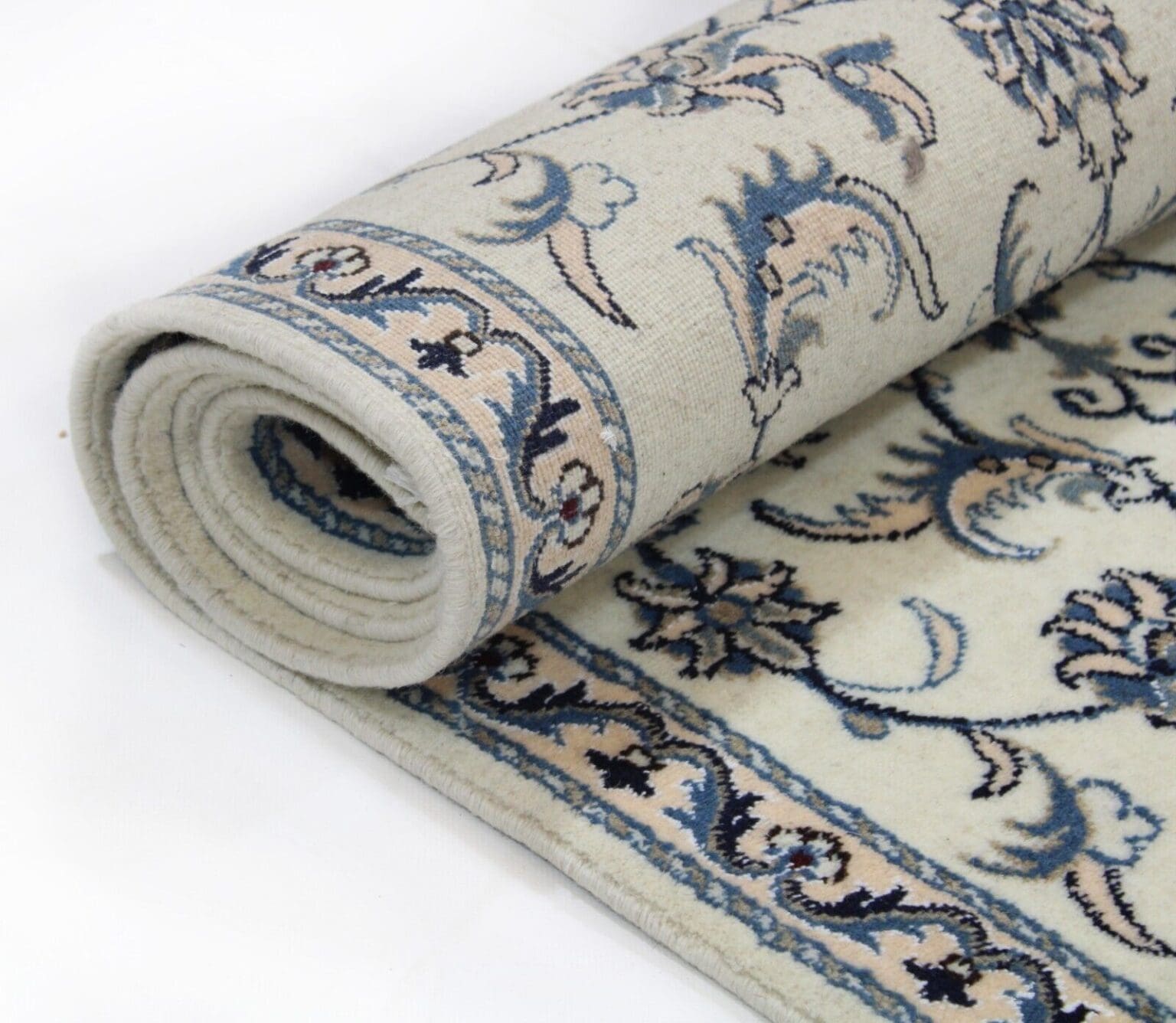
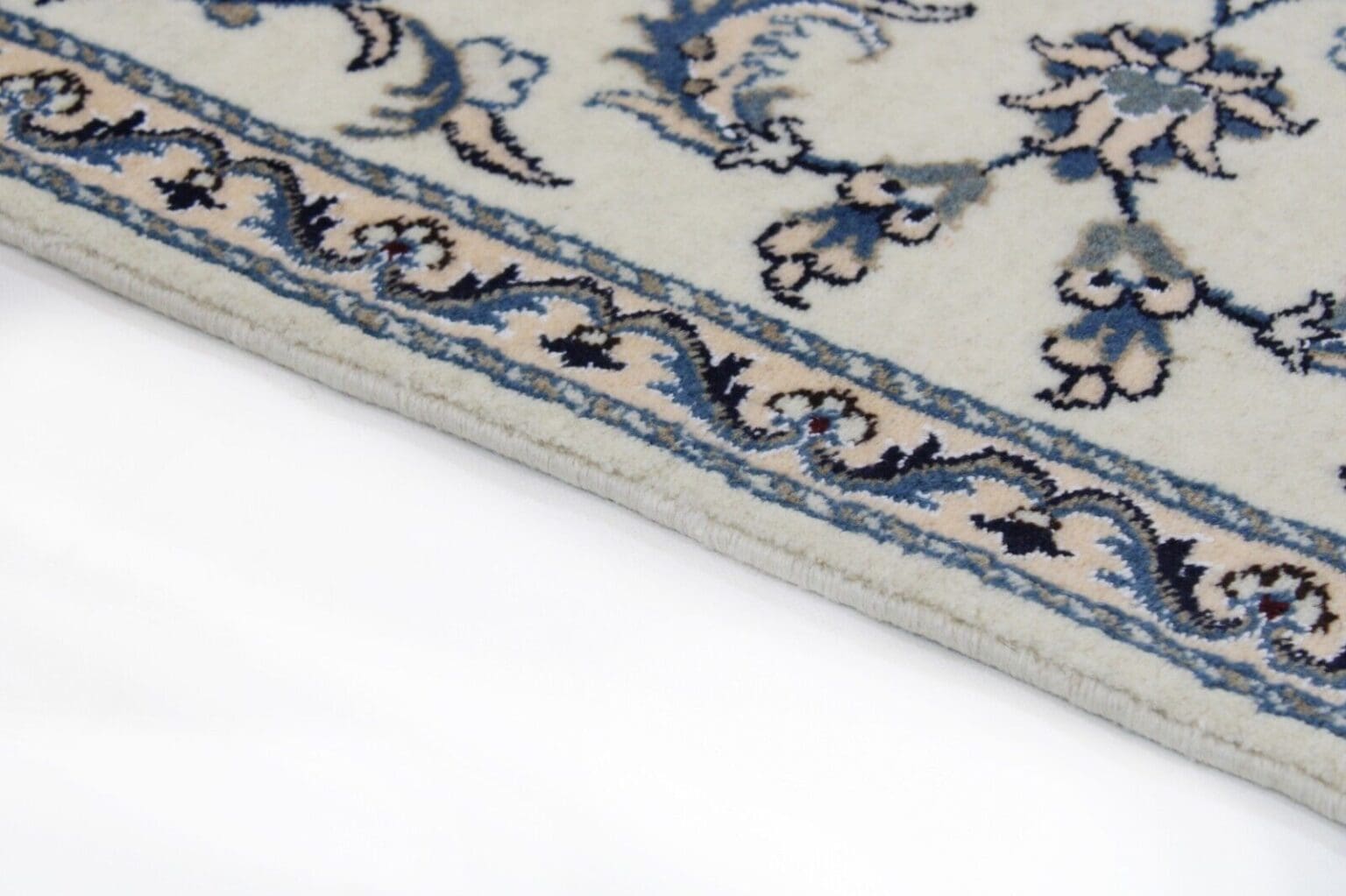
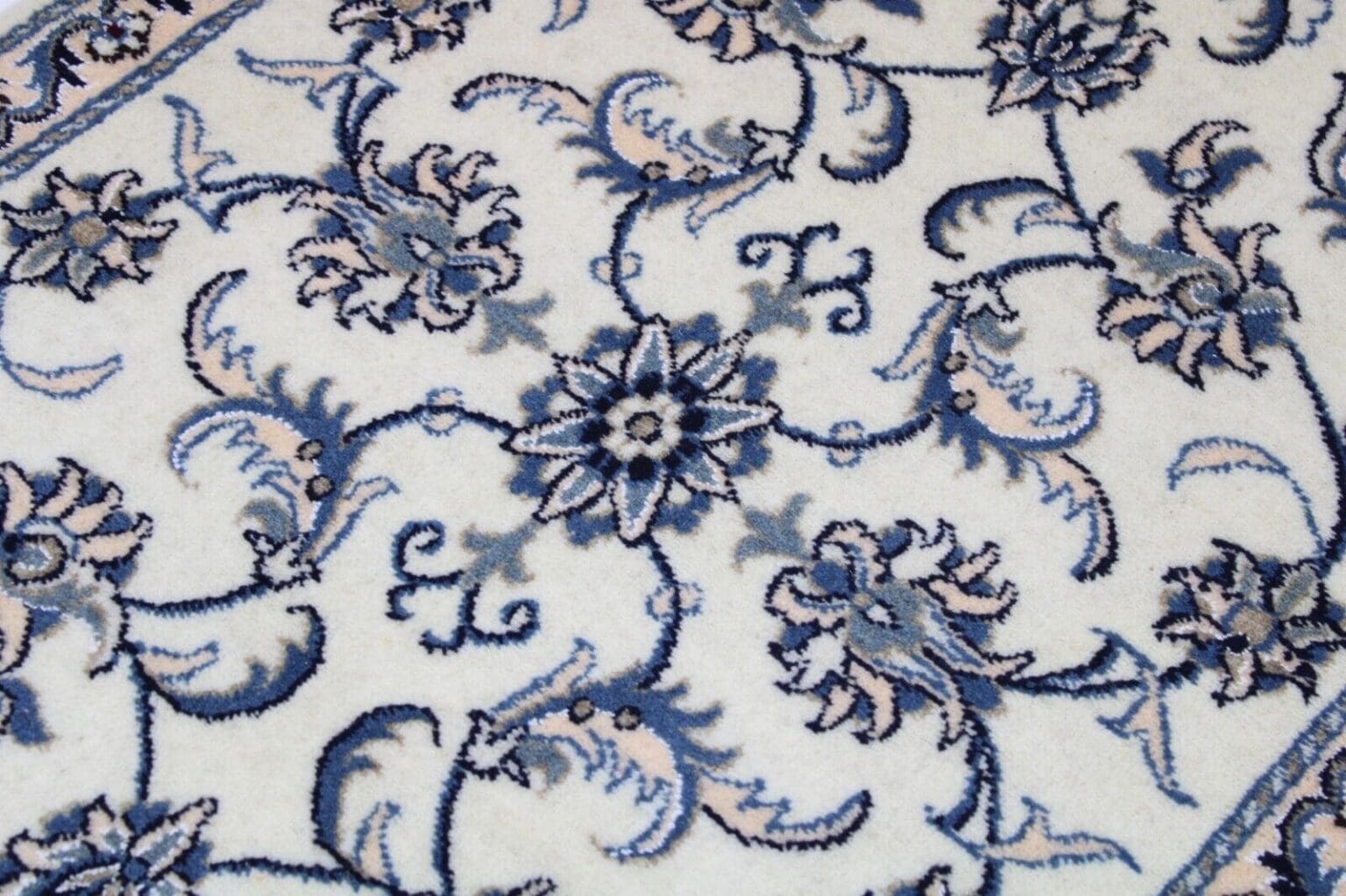
The Nain Kashmari is a hand-knotted Persian rug made from high-quality wool and cotton. These natural fibres define its textile character and bring together a tactile surface with the material tradition associated with Persian rugs. Its pile is described as high pile. This creates a visibly and noticeably soft surface, allowing the floral design to appear with a more pronounced textile relief and giving the runner a distinct presence.
Hand knotting means that the knots are placed individually into the rug’s structure. Unlike a machine-made floor covering, a hand-knotted rug is built progressively through the relationship between the planned design, the knotting process and the subsequent finishing of the pile. The source describes the knot density as hand-knotted rather than providing a numerical density. The stated technique therefore identifies the traditional method of manufacture, while no additional numerical claim is made.
Wool is widely used in oriental rugs for its resilience, natural flexibility and pleasant handle. Cotton is also part of the material description of this piece. The source does not specify which fibre serves which structural purpose, so wool and cotton are presented together as the stated materials rather than assigning cotton to the warp. The high pile is likewise recorded as a surface characteristic; no further technical pile measurement is supplied.
This rug is suitable for use with underfloor heating. That suitability is an expressly listed feature of this particular piece. As with any high-pile textile, regular and appropriate care helps preserve an even surface and prevents unnecessary strain on the pile. Hand-knotted construction, natural fibres and high pile are the documented elements of its material and workmanship profile.
Origin and Tradition
Nain is a city in Iran and a recognised region of Persian rug production. Its weaving tradition developed within the wider Iranian craft culture and is associated with carefully organised rugs and finely worked ornament. Nain rugs are often discussed in terms of balanced compositions in which the field, border and decorative elements relate clearly to one another. The name Nain identifies a regional tradition; it does not by itself prescribe one single colour scheme or one fixed pattern.
Persian rug making brings design and manual skill together. A motif is not printed onto a completed surface. Instead, it is formed as the knot sequence is built row by row and the pile is subsequently finished so that the design can be read. This process requires attention to the placement of ornaments, the continuity of lines and the balance of the overall composition. That relationship between a planned drawing and its manual execution is central to the traditional understanding of a Persian rug.
Nain designs are frequently associated with restrained compositions, ordered ornament and detailed floral work. Regional examples may combine flowers, leaves, scrolling vines and geometric framing. Such elements can organise a surface while retaining the decorative character of the design. This rug is identified as a Nain Kashmari and its origin is Iran. The product information does not state a workshop, weaver, date of manufacture or signature, so none of those details are attributed to it.
The Iranian rug tradition is sustained through the transmission of drawing practices, weaving skills and methods of construction. Designs can be adapted over time while retaining principles such as the relationship between a central field and its surrounding border, the rhythmic repetition of plant forms and the careful treatment of transitions. A hand-knotted Nain Persian rug belongs to this regional craft context. That context explains the style classification without suggesting that every Nain rug has an identical layout or colour effect.
The term Persian rug is appropriate here because the piece is stated to originate in Iran and to belong to the Nain region. It describes the Iranian origin and the connection with Persian rug tradition. Kashmari is part of the product name and is not treated here as a separate place of origin. Keeping regional origin and product or design wording distinct is important in rug descriptions, since a place name within a model name does not automatically establish another provenance.
Manual production also means that hand-knotted rugs are not completely standardised industrial products. Minor variations are part of the nature of individual workmanship. The condition of this example is stated as new without a label. Its Iranian origin and Nain classification remain separate facts, placing the rug within the Persian weaving landscape without adding an unrecorded date, maker or certificate.
Design and Pattern
The pattern of this Nain Kashmari is described as oriental with a floral motif. Floral decoration is one of the established visual languages of Persian rug design. Flowers, leaves and vines may appear as separate ornaments or be linked into a continuous arrangement. They give a surface rhythm and provide a decorative structure without requiring the design to reproduce one specific natural object.
In regional Nain design, clear organisation can meet fine ornament. A floral motif may be arranged within a central field, developed along scrolling vines or connected with a border. The exact arrangement, colour sequence and border construction of this rug are not stated. What is documented is its oriental pattern classification and its floral character. These facts support the design description without introducing details absent from the product information.
Floral patterns have a long history in Persian decorative arts. Plant forms may suggest growth, natural order and the way individual elements can be joined into a harmonious whole. Their interpretation depends on the particular design and cultural context. No specific symbolic explanation is given for this rug, so the description remains with the visible pattern category: an oriental design with a floral motif, executed in the language of a hand-knotted Nain rug.
The effect of a floral rug pattern depends on more than the individual flowers. Repetition, spacing, line movement and the distribution of open ground all contribute to the composition. With hand knotting, this organisation is translated into the rug one knot at a time. The high pile also affects how the surface is perceived: light and shadow may emphasise its height, while the contours of the motif remain readable through the finishing and direction of the pile. This is general technical context, not an additional colour claim about this piece.
Nain rugs are often considered adaptable in design because their ordered ornament can sit alongside both traditional and contemporary interiors. That is background to the regional style rather than a claim about a particular room. For this Nain Kashmari, the recorded style is Persian, the form is rectangular and the pattern is oriental with a floral motif. No specific colour list, named central medallion or defined border design is supplied, so those features are not assigned.
A floral oriental runner can accompany a long area and help define a transition between parts of a room. This follows from the runner format and the decorative role of a rug; it is not an additional statement about origin or material. The rectangular form supports a straightforward linear placement. Whether the rug is used in a hallway, living room or bedroom depends on the surrounding interior and the intended arrangement.
The design tradition of Persian rugs combines recognisable forms with individual execution. Even where a regional style establishes certain principles, every hand-knotted piece is worked separately. In the Nain Kashmari, the recorded Nain classification, oriental character and floral motif therefore meet a surface built through manual knotting. Other pattern details remain open because they are not described in the source information.
Special Features
The expressly listed special features are the hand-knotted technique, high pile, suitability for underfloor heating and the condition new without a label. The rug is rectangular and described as a runner. Its Nain Kashmari designation, Iranian origin and oriental floral motif place it within a clear regional and design context. Because a hand-knotted rug is made by hand, each piece is a one-off and cannot be completely identical to another example.
The combination of high-quality wool and cotton, hand-knotted workmanship and high pile defines the documented profile of this rug. No signature, age, restoration or certification is stated. Nor is a numerical knot count given; the source identifies the knot density with the term hand-knotted. Keeping these points separate ensures that the description remains limited to the features recorded for this particular piece.
FAQ
How should I care for the Nain Kashmari?
Regular vacuuming without a brush attachment is recommended. This cleans the surface while avoiding unnecessary stress on the high pile. If a stain occurs, treat it promptly with a damp cloth and a mild cleaning agent. Professional rug cleaning is advisable for deeper soiling. Because this is a hand-knotted rug made from wool and cotton, cleaning should be carried out carefully and in a manner suitable for the materials and pile.
Can the rug be used with underfloor heating?
Yes. The Nain Kashmari is suitable for use with underfloor heating. This suitability is specifically listed for the rug. Wool is described as providing useful thermal insulation while also contributing to comfortable underfoot texture. The rug should nevertheless be laid flat and checked periodically so that folds or unnecessary pressure do not develop in the high pile. These are practical handling measures and do not alter the stated heating suitability.
Where can the rug be used?
As a rectangular runner, the Persian rug is suited to elongated areas and can, for example, be placed in a hallway. It may also be used in a living room or as an accent piece in a bedroom. The oriental floral pattern can work with a range of interior styles. The most suitable position depends on the room, the furniture arrangement and the desired visual effect. Its shape, high pile and suitability for underfloor heating broaden the possible areas of use.
Additional information
| Design Style | |
|---|---|
| Color | |
| Size | |
| Shape | |
| Origin | |
| Material |
Related products

Oriental Rug Kashmir 285 x 185 cm Silk Hand-knotted
€ 1230
Persian Rug Tabriz 353 x 253 cm Wool & Silk Hand-knotted
€ 4200
Persian Rug Tabriz 293 x 203 cm Wool & Silk Hand-knotted
€ 3300
Persian Rug Tabriz 355 x 252 cm Wool Hand-knotted
€ 4890
Oriental Rug Kashmir 405 x 299 cm Silk Hand-knotted
€ 3300
Persian Rug Kashan 211 x 140 cm Wool Hand-knotted
€ 900
Persian Rug Rosenbidjar 222 x 131 cm Wool Hand-knotted
€ 1530
Persian Rug Kashan 198 x 128 cm Silk Hand-knotted Antique
€ 7249