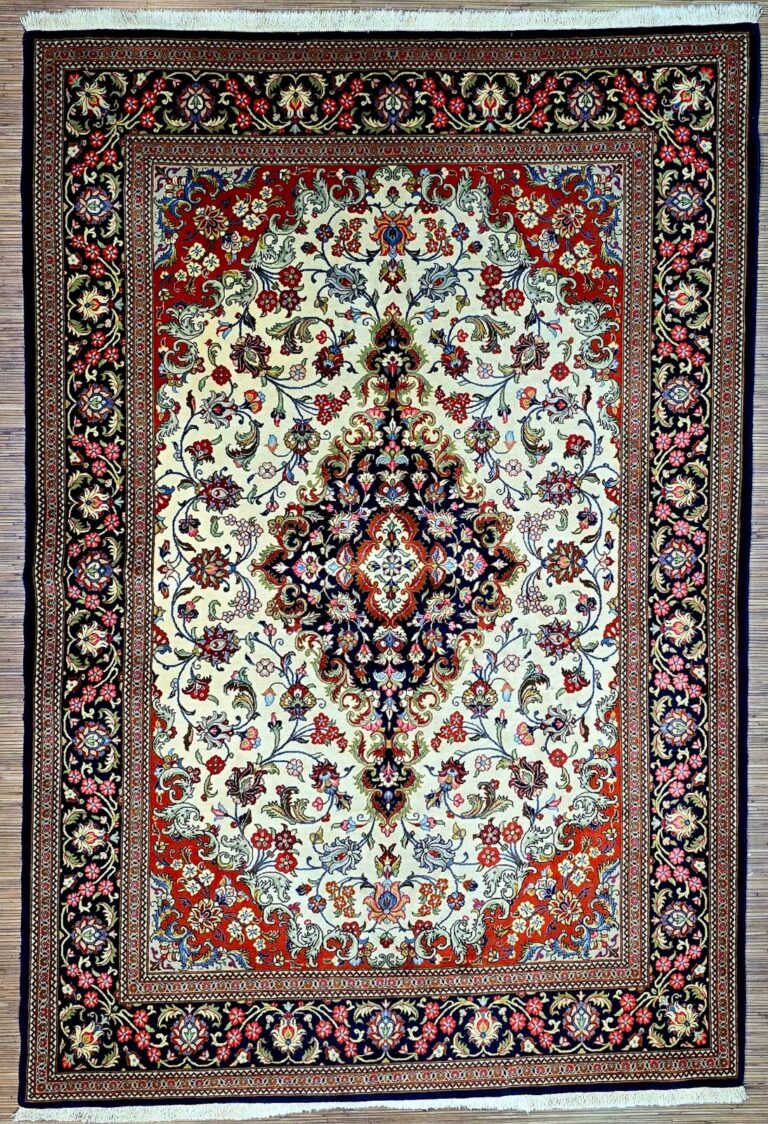
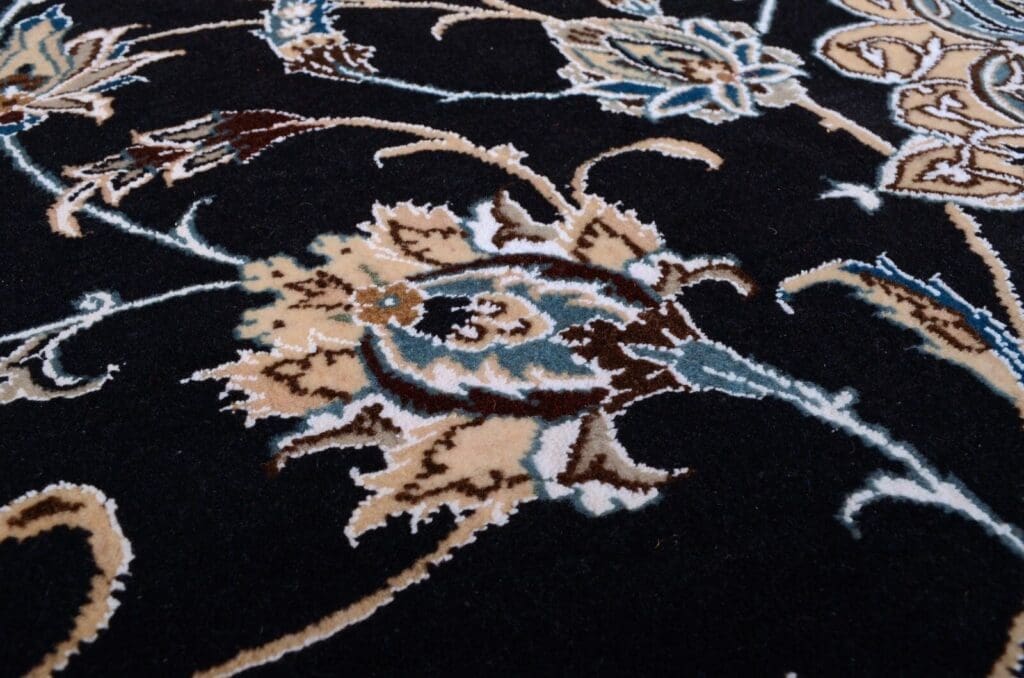
This Nain rug is hand-knotted from fine virgin wool. The wool forms the pile and gives the surface a soft, velvety handle that is pleasant underfoot. Virgin wool has long been used in rug making because it offers warmth while also providing a durable natural fibre for regular interior use. Its texture contributes to a comfortable room environment and gives the rug the tactile quality associated with traditionally made floor coverings.
A hand-knotted rug is built one knot at a time. The person making it follows a planned design and places the individual colours into the textile structure by hand. Each row requires attention to the direction of the lines, the position of the motifs, and the density of the pile. The process calls for patience, coordination, and precision. Unlike a machine-produced covering, the finished surface remains directly connected to the decisions and movements involved in its making.
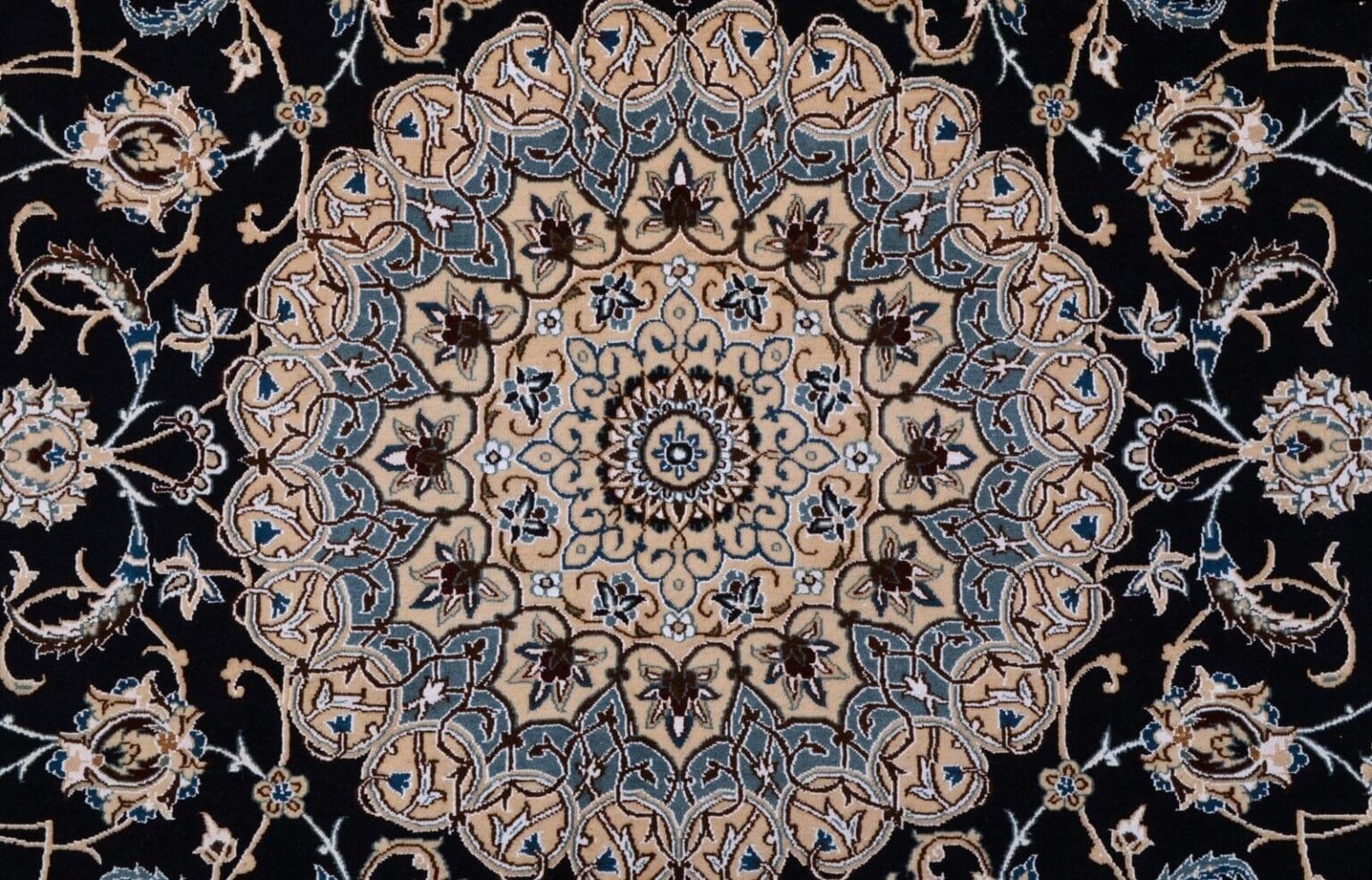
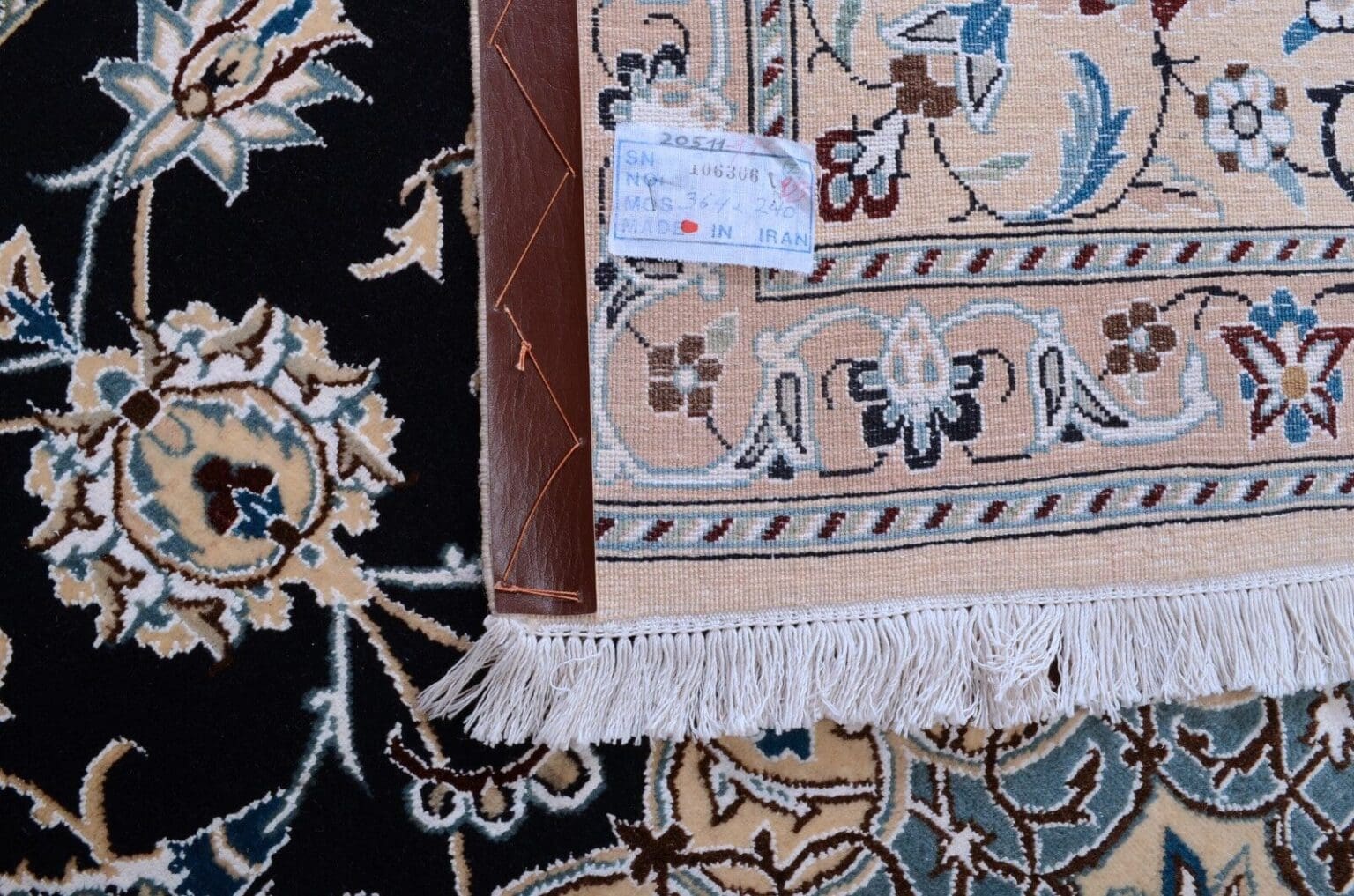
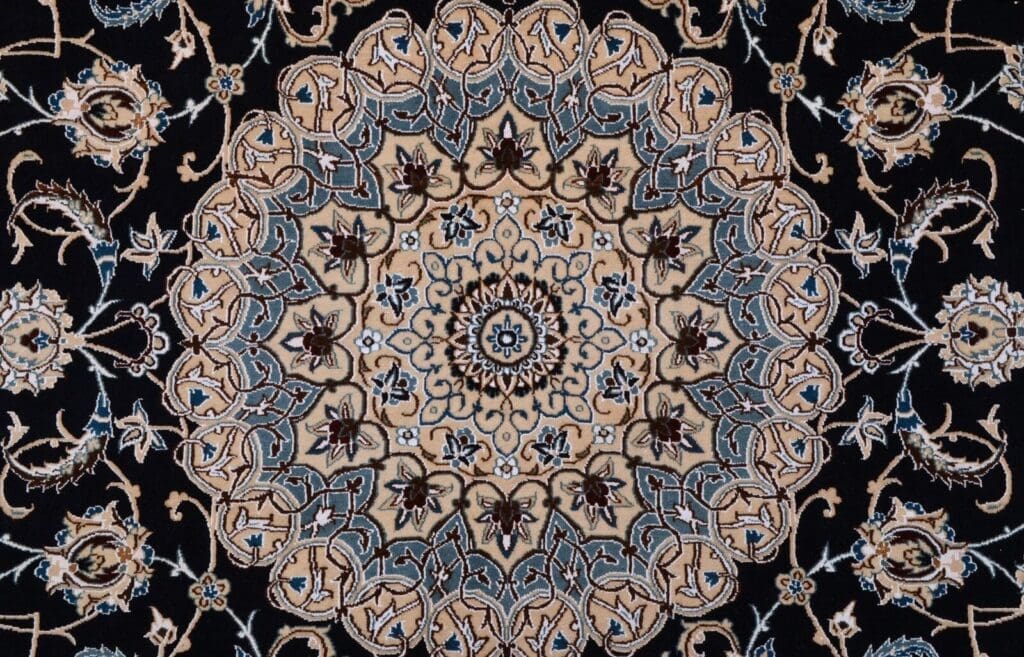
The high knot density supports the detailed rendering of the design. Floral and geometric forms can be worked with narrow outlines, small decorative units, and carefully controlled transitions. A dense construction also creates a compact surface in which the pattern remains clearly defined. Knot density is therefore both a technical characteristic and an important part of the visual result. The colours and motifs are not applied afterwards; they are formed through the arrangement of the knots themselves.
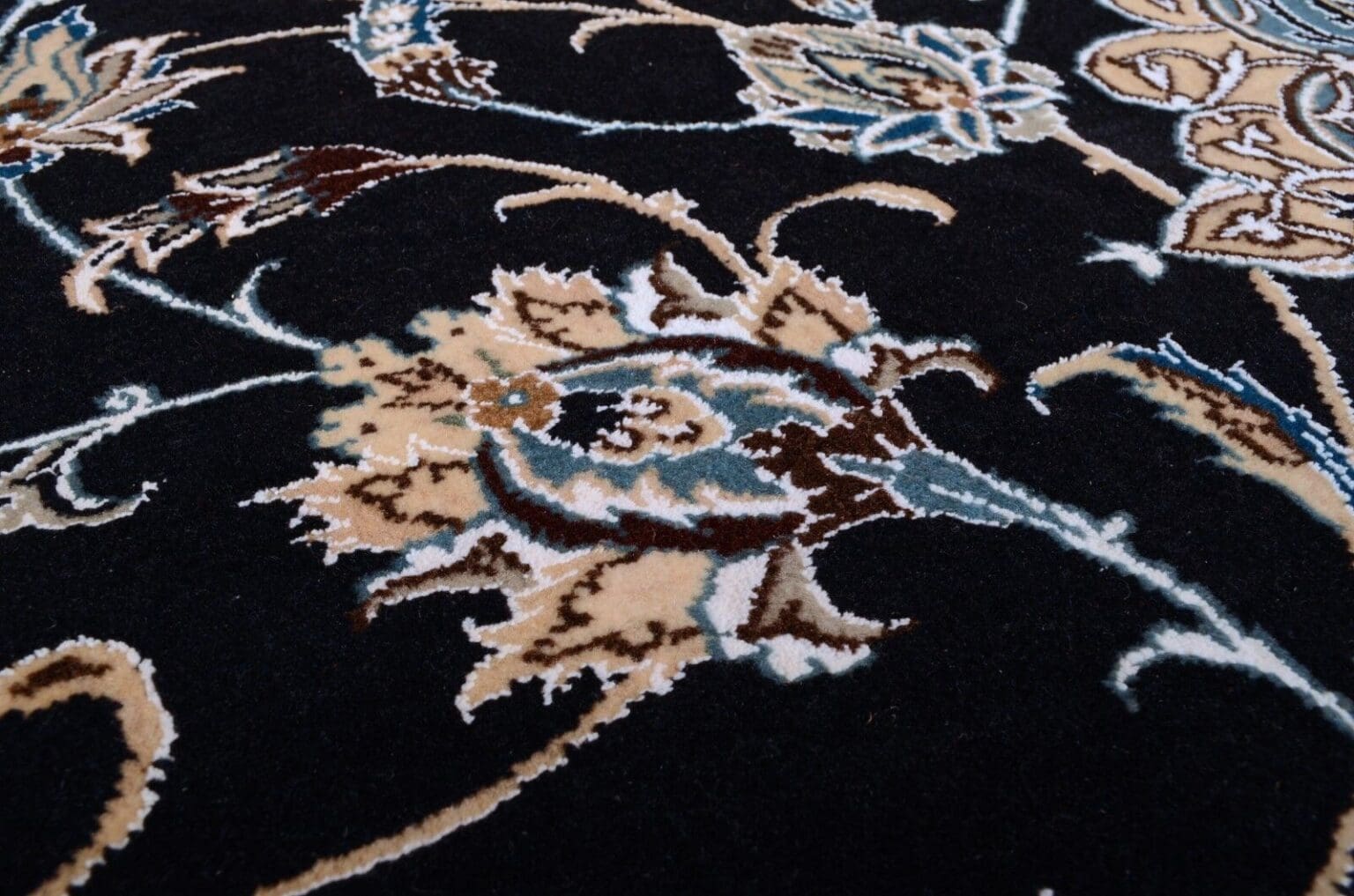
The pile is made from 100% virgin wool. Its stated pile height is 10 mm. Wool combines a soft surface with the qualities for which it has traditionally been valued in Oriental rugs. It can provide warmth and a comfortable feel underfoot while remaining a resilient material when used and cared for appropriately. In a hand-knotted rug, the fibre is integrated into the construction, so material, structure, and pattern belong to the same manufacturing process.
This rug is in perfect, unused condition. That condition describes a surface that has not previously been exposed to use. The rug is also suitable for underfloor heating. This feature places a traditional hand-knotting technique within a contemporary domestic setting. Correct installation and suitable care remain important when a rug is used over heated flooring, so that it lies evenly and its textile structure is treated with consideration.
Virgin wool requires regular but gentle care. Careful vacuuming removes dust and loose particles from the surface. Shaking the rug out is another maintenance measure specified for this type of rug. Stains should be treated with suitable rug cleaners so that the fibres and colours are protected as far as possible. More difficult soiling is best handled by a professional cleaner. Appropriate maintenance helps preserve the pile, colour, and structure of a hand-knotted wool rug.
The technical qualities of this piece work together. The wool determines the feel of the pile, the knots create the construction, and the sequence of colours forms the visible pattern. The hand-made process allows these aspects to be coordinated throughout the surface. This is why the material and the craftsmanship cannot be considered separately when describing a Nain rug.
Origin and Tradition
Nain is a city in Iran and the name of an established Persian rug tradition. Rugs from Nain are associated with fine workmanship, carefully drawn designs, and the use of quality materials. The name therefore identifies a regional tradition within Persian rug making, not simply a general decorative look. It refers to a connection between place, craft knowledge, construction, and design that has developed over a long period.
Persian rug production developed in many cities and regions, each of which formed its own preferences in layout, colour, borders, and ornament. Nain is especially associated with controlled drawing and a fine level of detail. Designs are often planned so that the overall field remains balanced while many smaller elements can still be distinguished. This relationship between order and detail is central to how the Nain tradition is commonly understood.
The work begins before the first knot is tied. The wool must be selected and prepared for use, while the intended colours and pattern need to be organised into a workable sequence. During knotting, the design is transferred gradually into the textile surface. Rows have to be kept consistent so that lines, colour areas, and repeated motifs remain connected. The finished rug brings together several stages of knowledge: material preparation, tension, knotting, trimming, and the control of the pattern across the whole field.
Persian rugs have historically served as useful floor coverings and as carriers of a visual language. Their ornaments, colours, and arrangements reflect design knowledge passed through generations. Patterns could be retained, adapted, or reinterpreted by different workshops and makers. Tradition is therefore not a single rigid template. It is a set of recognisable principles that can be applied differently from one hand-made rug to another. The individual character comes from the particular execution of those principles.
In the Nain tradition, the drawn design and the technical construction are closely linked. A pattern must be planned with the knotting method, the distribution of colour, and the available surface in mind. The maker has to maintain proportions while working through many repeated rows. Small inconsistencies can affect a line or a motif, which is why concentration and experience matter. The craft is both visual and structural: the design is created by the same knots that hold the rug together.
Nain is located in Iran and belongs to the historical geography of Persian carpet making. The region is internationally associated with finely executed rugs and a careful approach to materials. Knowledge of wool preparation, colour placement, knotting, and pattern control is part of a wider culture of skilled textile production. Such knowledge is transmitted through practice. It includes not only the physical act of tying knots, but also the ability to keep a complex drawing coherent throughout the work.
A Nain design may draw on classical Persian principles while being given a particular appearance through the maker’s treatment of line, spacing, and colour. Floral forms can provide an organic vocabulary, while geometric structures establish rhythm and visual order. The two approaches can be combined in a single composition. The regional identity remains legible through the method and design tradition, even though the details of individual rugs may vary.
The history of Persian rug making also explains why the craft is considered a form of cultural knowledge. The work requires repeated, precise movements over an extended period. A maker must understand how a small unit relates to the larger field and how a colour change affects the balance of the whole. A hand-knotted rug records both the intended design and the process by which it was produced. In Nain rugs, this process is associated with a refined, detail-conscious surface.
The origin of a rug should be distinguished from the name of a motif. A floral or geometric form may appear in several regional traditions, while the designation Nain refers to the rug tradition associated with the Iranian city. This distinction is useful when discussing Oriental rugs accurately. In this case, the Persian origin and the Nain designation belong to the same regional context described for the piece.
Design and Pattern
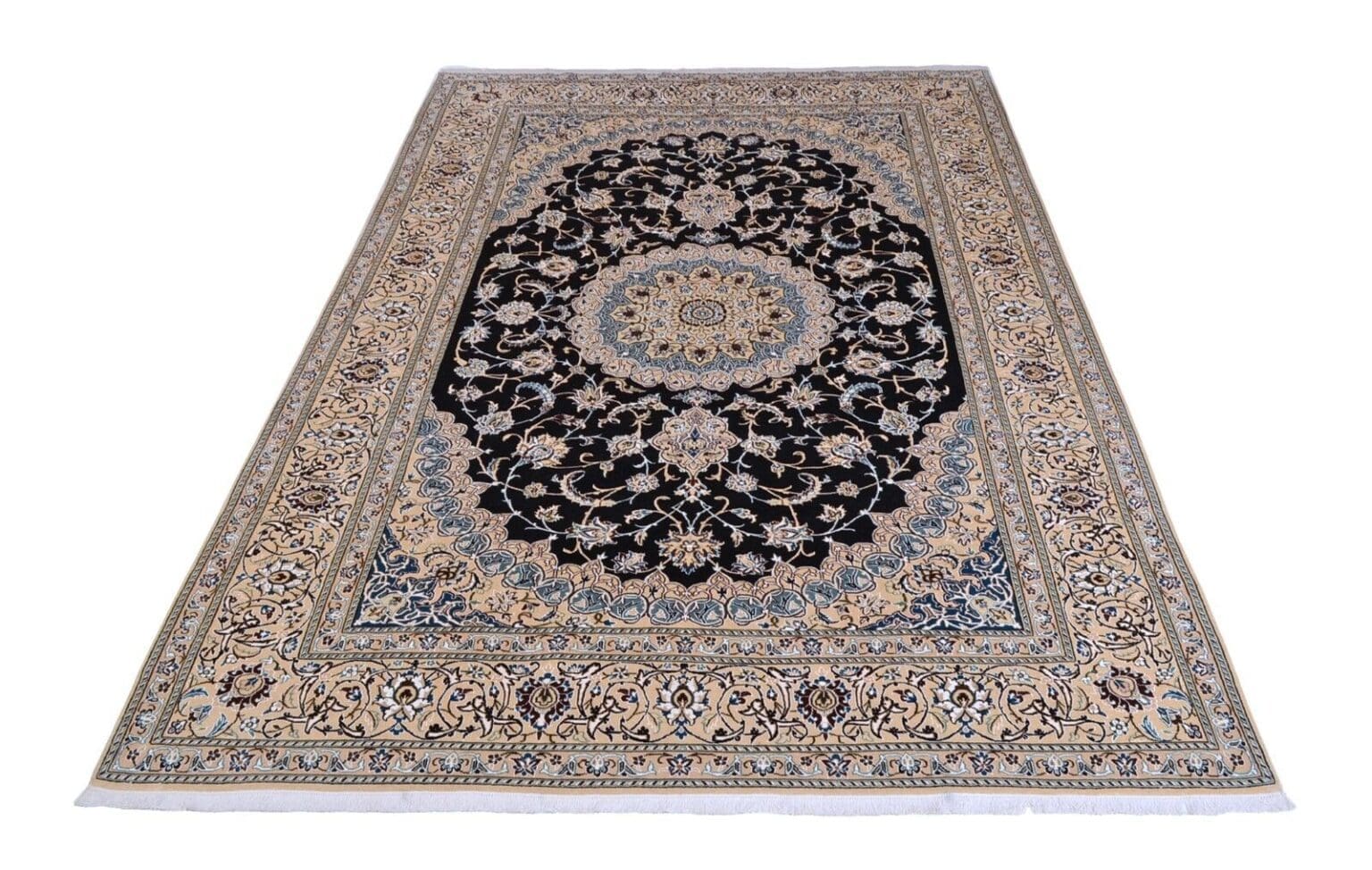
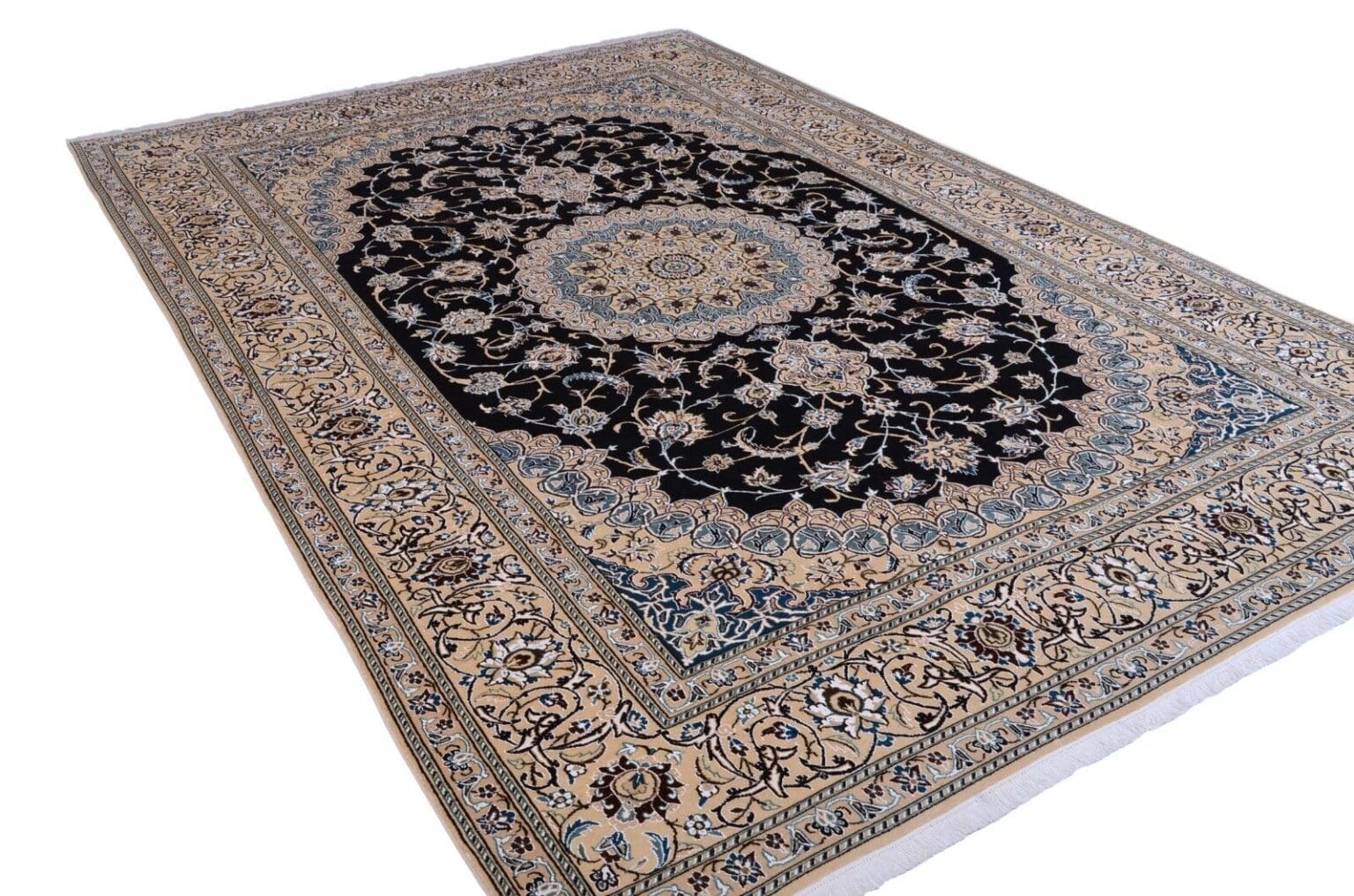
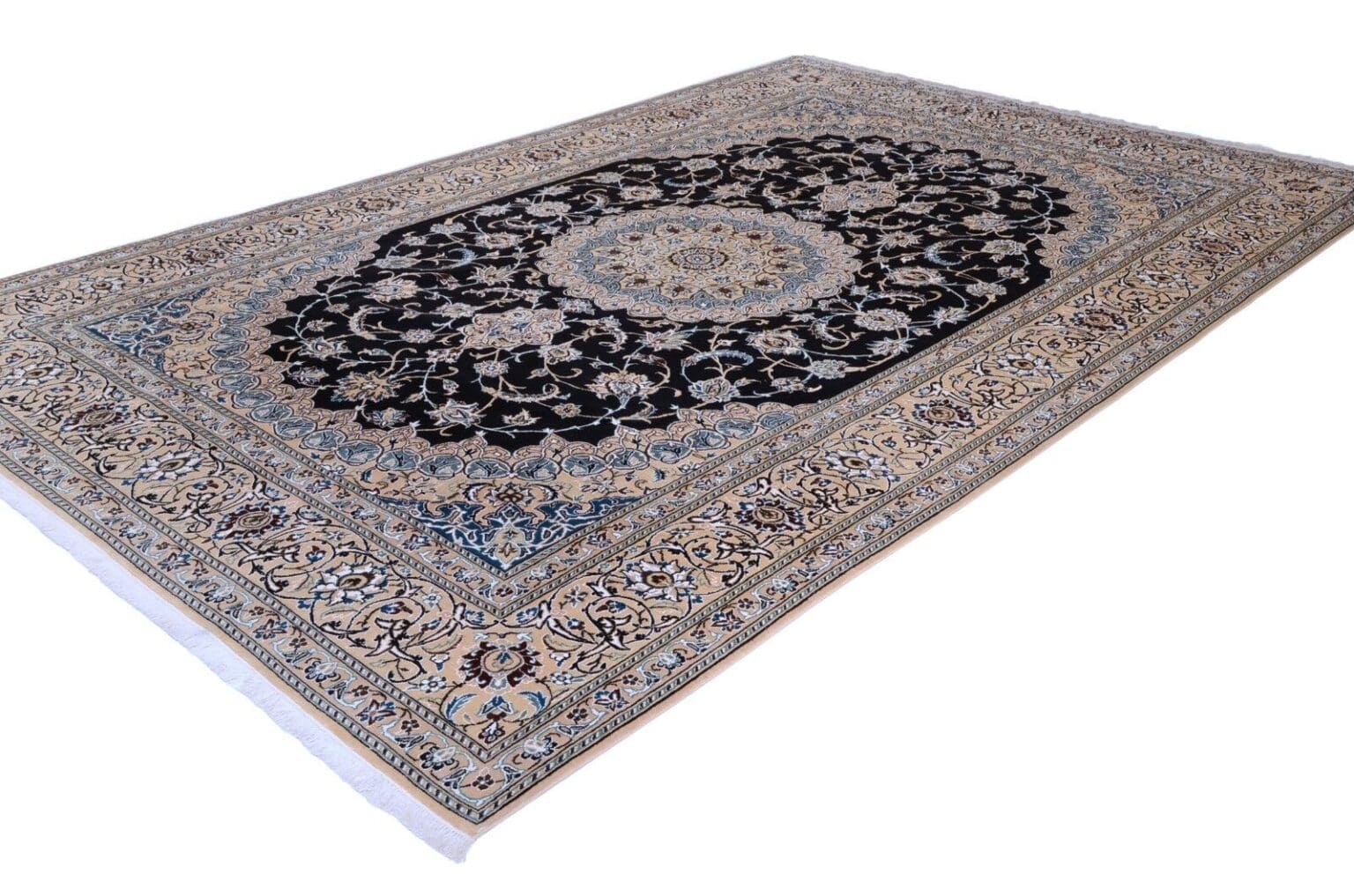
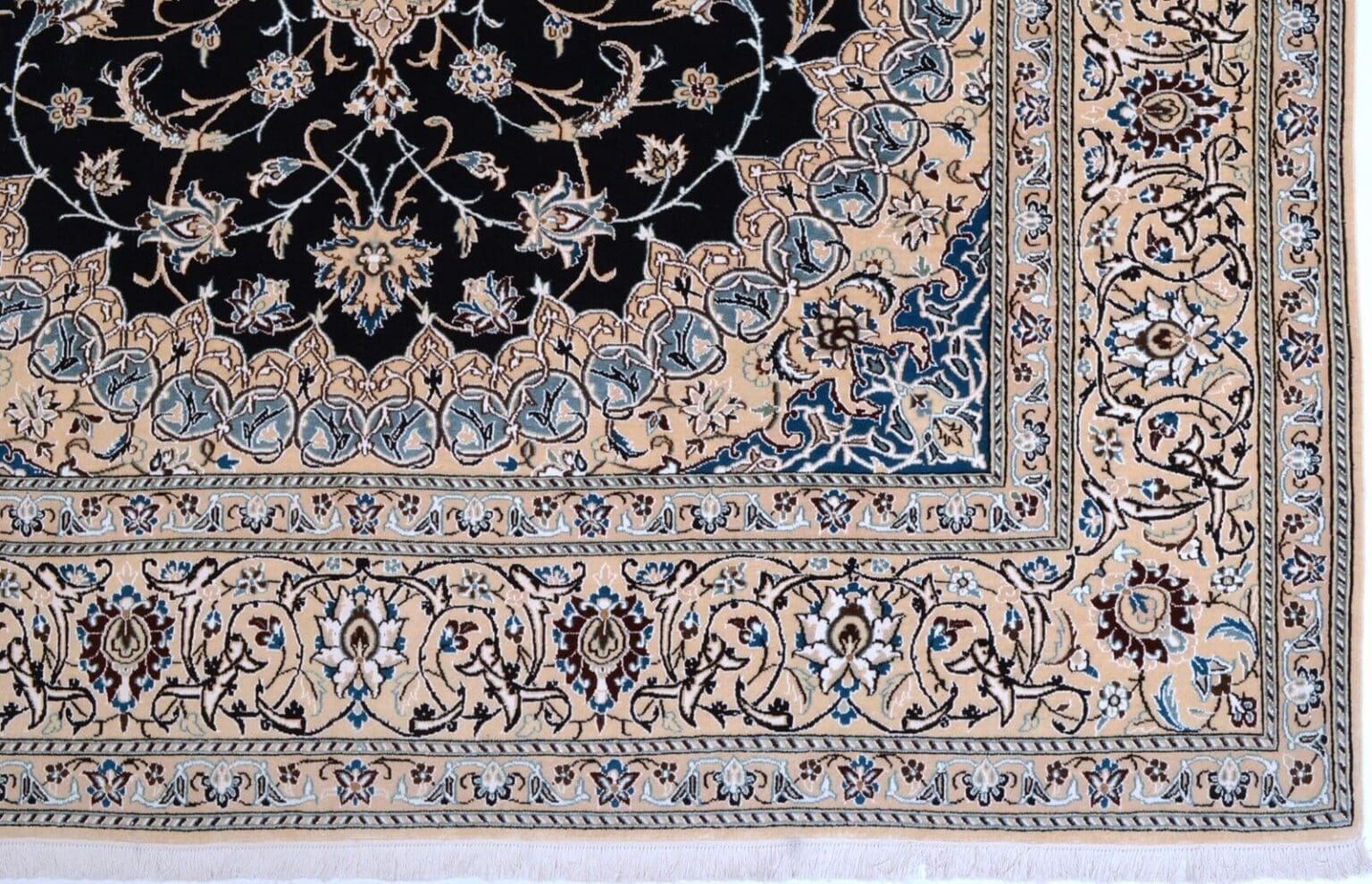
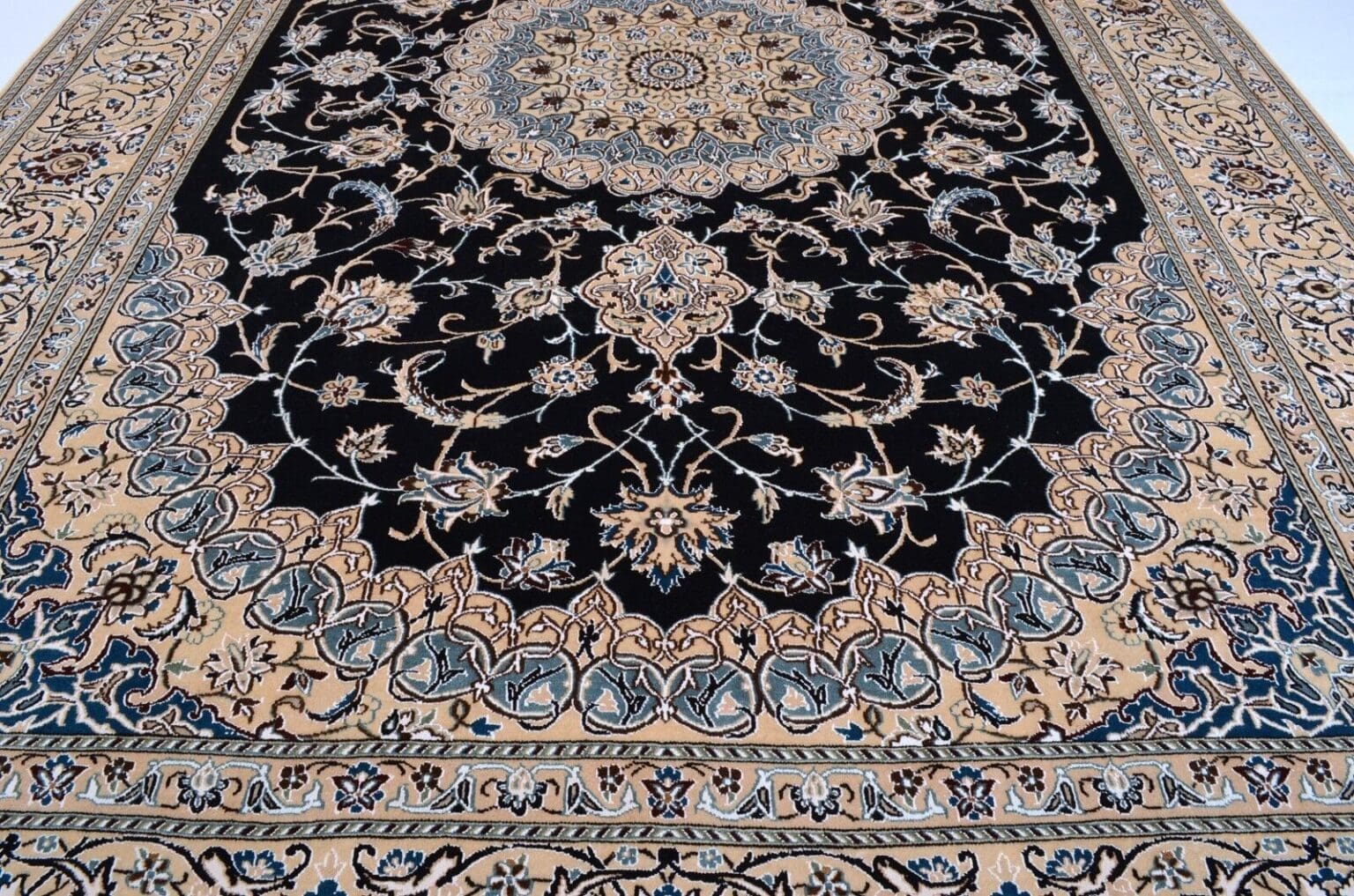
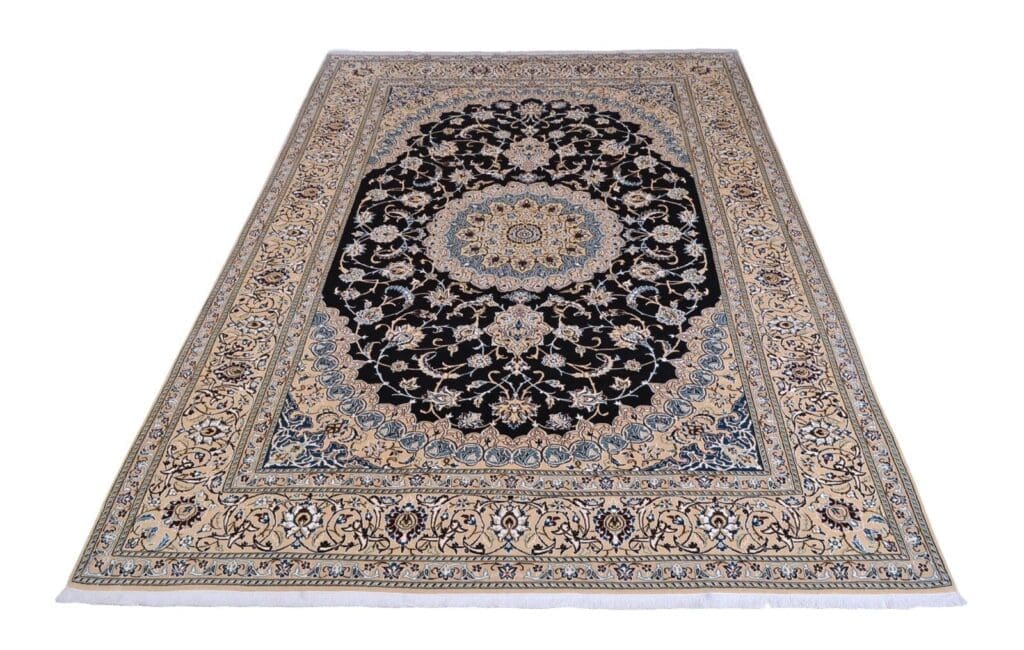
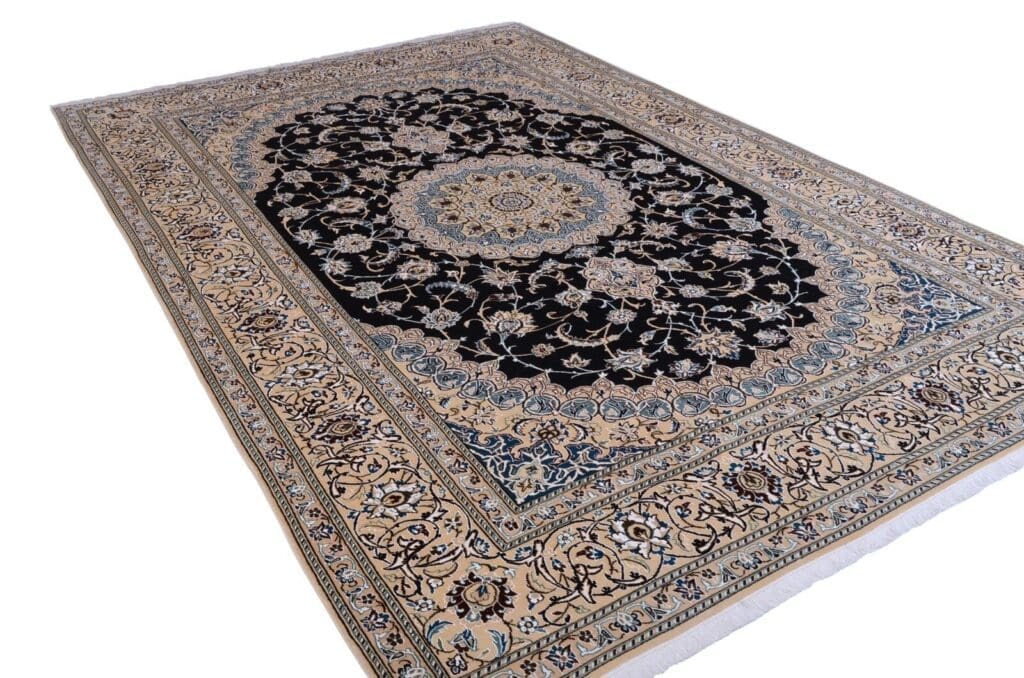
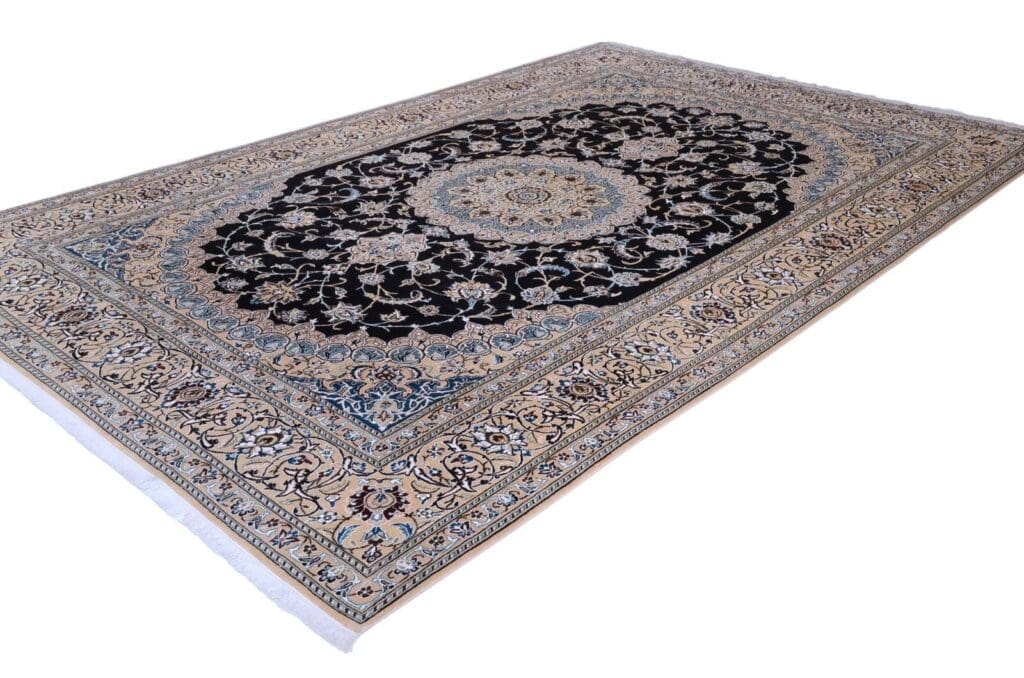
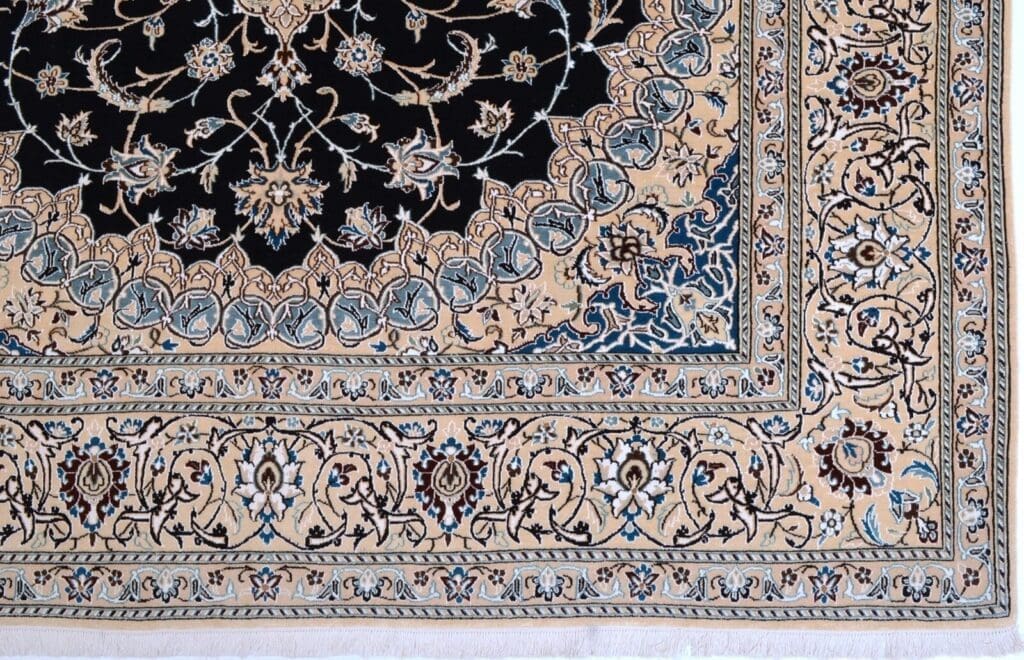
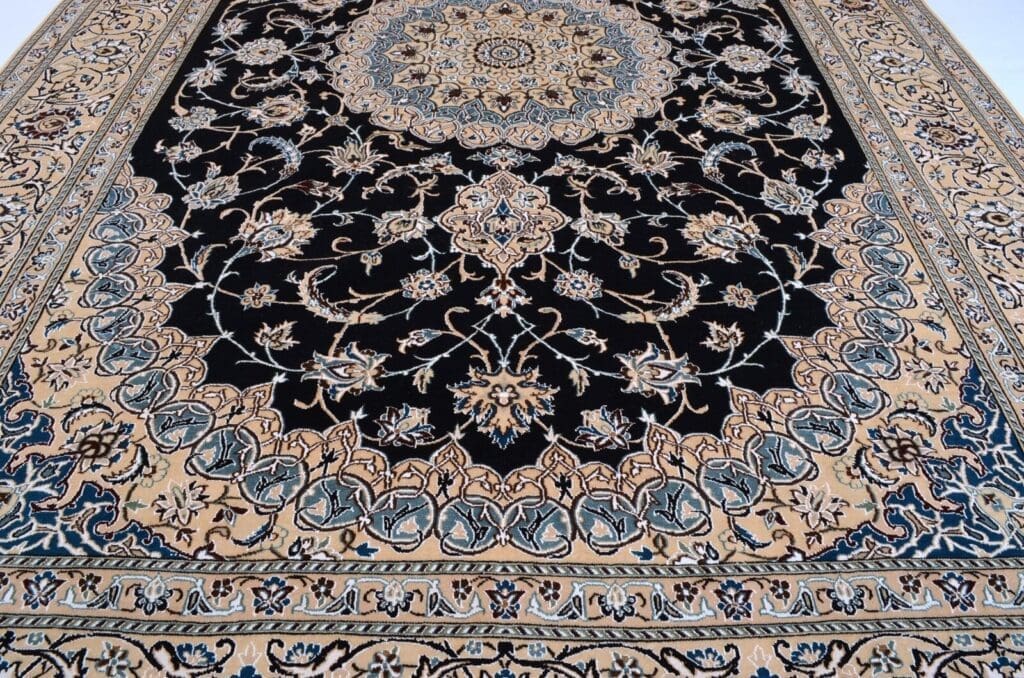
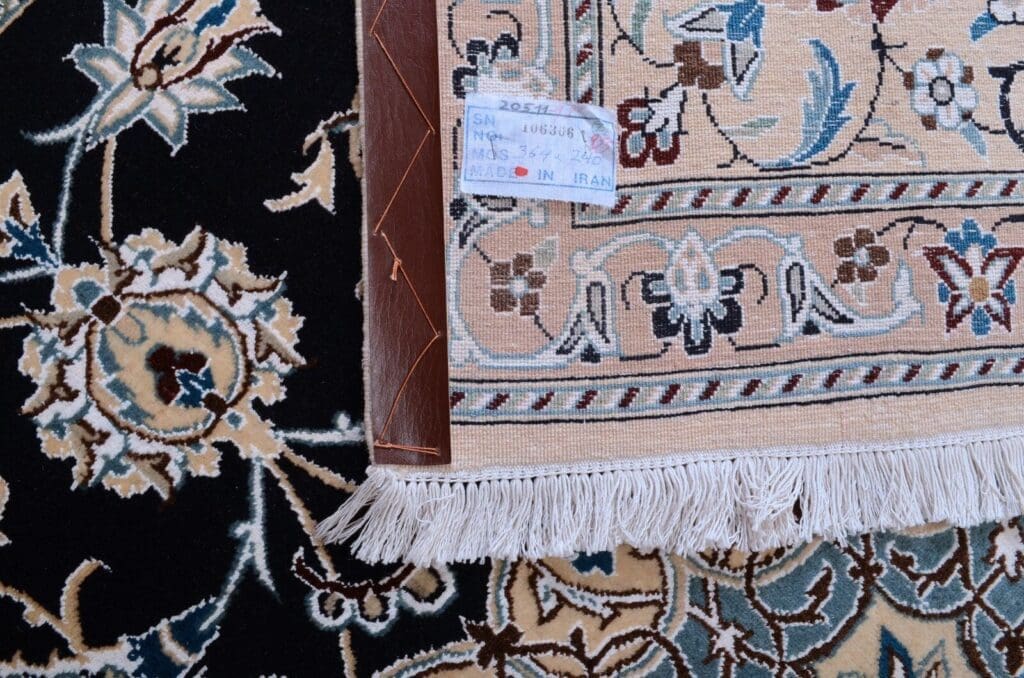
The colour of this rug is blue. Fine floral and geometric patterns appear against the blue ground. The intense blue provides a defined setting for the ornament and creates a visible contrast with the detailed drawing. The surface is therefore organised through a relationship between a strong field colour and smaller patterned elements. The colour is part of the design structure, since it affects how the motifs are separated, connected, and perceived across the rug.
Floral ornament is one of the recurring design languages of Persian rugs. Leaves, blossoms, stems, and scrolling lines can be arranged in repeated sequences or incorporated into a larger formal scheme. Their organic shapes bring movement to the surface. Geometric lines and repeated units introduce direction, balance, and rhythm. When these two types of form are combined, the design can appear both lively and ordered.
The fine character associated with Nain is well suited to designs made from many small elements. A high knot density allows narrow contours and detailed decorative passages to be represented with greater definition. The pattern is not printed onto a smooth field; it is built into a textured pile. As a result, the surface may show subtle changes in how colour and line are perceived from different angles. The underlying organisation of the floral and geometric pattern remains continuous.
The stated style is traditional Oriental/Persian. This describes a design rooted in established Persian forms rather than an entirely modern or unstructured arrangement. Symmetry, repetition, and proportion are common ways of organising a traditional rug field. A design may use a central organisation, framed areas, or repeating ornamental relationships. The exact arrangement must be read from the particular rug; the facts established here are its blue ground, floral and geometric pattern, and traditional Oriental/Persian style.
Geometric ornament in a hand-knotted rug is created from individual knots rather than drawn as a perfectly mechanical line. This can give apparently straight forms a subtle textile character. Floral motifs may sit within a geometric framework or soften it through curved lines and branching forms. The relationship between the two allows a design to create structure without becoming visually rigid. It also demonstrates how the pattern is shaped by the technique used to make it.
Blue has a long history in Persian textile and rug design. It may be used as a ground colour, as an accent, or as one part of a larger colour system. Its effect depends on intensity, distribution, and the colours placed beside it. Here, the blue ground is described as intense. It forms the dominant visual setting for the fine motifs and gives the composition its defined colour identity. The detailed pattern remains legible against this ground.
A rug pattern is created through the interaction of field, outline, repetition, and framing elements. Borders can contain the central area, while smaller motifs organise transitions and establish a rhythm. Within a field, floral forms may be repeated or linked through stems and lines. Geometric units can regulate spacing and direction. The hand-knotting gives this arrangement a textile depth, so that the pattern is at once an image, a colour system, and the result of a technical construction.
Persian ornaments have been preserved and transformed through long periods of use and production. Their meaning is not always limited to one fixed interpretation; it can depend on context, arrangement, and the relationship between motifs. For this Nain, the relevant design facts are the traditional Persian/Oriental style, the blue colour, and the floral and geometric drawing. The high knot density supports the fine appearance of these elements without requiring assumptions about a specific named motif or symbolic programme.
The contrast between blue and the detailed ornament also affects the way the rug occupies a room. A stronger ground colour can give the patterned field a clear visual boundary, while fine motifs prevent the surface from appearing empty. The design can therefore be considered at two levels: from a distance as an ordered blue composition, and more closely as a field of smaller floral and geometric details. This distinction between overall structure and close detail is characteristic of finely drawn rug design in general.
Special Features
The notable features of this rug are its fine virgin wool, hand-knotted construction, and high knot density. The knot density is 400,000 knots per square metre. It supports the detailed appearance of the floral and geometric pattern and contributes to the controlled definition of the design. The pile is 10 mm high and made entirely from virgin wool. The rug is in perfect, unused condition, so its surface has not been altered by previous wear.
Suitability for underfloor heating is another stated feature. It allows the rug to be considered for a room equipped with this heating system. Proper placement and suitable care remain important in practical use. Regular shaking out and careful vacuuming help remove dust. Special rug cleaners should be used for stains so that the wool and colours are treated appropriately. These measures support the preservation of the pile, colour, and textile structure.
The combination of material, construction, and design explains the character of this individual Nain. The virgin wool provides the soft pile, the hand-knotting creates the durable textile body, and the dense arrangement of knots makes detailed ornament possible. The blue ground gives the pattern its colour setting. None of these features exists independently: together they describe how the rug looks, feels, and has been made.
Because the rug is unused and described as perfect, its condition is a specific part of its identity. It should not be confused with a statement about the age of the rug. The source gives an age of 10-15 years, while also describing the condition as perfect and unused. These are separate pieces of information. The rug’s age identifies its period, and its condition describes its lack of previous use.
FAQ
How do Nain rugs differ from other Oriental rugs?
Oriental rugs differ in origin, materials, knotting methods, colours, and pattern structures. Nain rugs are particularly associated with fine knotting, quality materials, and precise workmanship. Their designs often place delicate floral ornament together with geometric order in a clearly organised composition. Other Oriental rug traditions may use larger motifs, simpler drawing, different colour relationships, or another construction method. The distinction therefore lies in the combination of regional tradition, technical approach, and design language rather than in a single decorative feature. In this particular rug, the Nain classification is reflected in the high knot density, fine virgin wool, blue ground, and detailed floral and geometric pattern.
Is a hand-knotted rug made from virgin wool easy to care for?
Yes. With suitable handling, a hand-knotted virgin-wool rug is generally straightforward to maintain. Regular shaking out and careful vacuuming are appropriate for routine care and help remove dust from the pile. The surface should not be subjected to unnecessary force. Spills should be absorbed promptly instead of being rubbed deeply into the fibres. For stains, specially formulated rug cleaners are recommended so that the wool and colours are treated with care. Larger or persistent marks are best dealt with by a professional rug cleaner. Appropriate maintenance helps preserve the pile, colour, and structure and supports the continued preservation of this rug’s perfect, unused condition.
How long can a hand-knotted Oriental rug last?
A hand-knotted Oriental rug can last for several decades and potentially an entire century when it is properly cared for. Its actual service life depends on the material, the quality of the knotting, the amount of use, the level of traffic, and the way cleaning is carried out. Virgin wool is valued for its robust and insulating qualities, while careful handwork creates a stable textile structure. Regular removal of dust, sensible use, and suitable treatment of stains all support long-term preservation. Hand-knotted rugs have traditionally been made as enduring furnishings as well as practical floor coverings. This Nain is perfect and unused, so it begins its further use in a particularly well-preserved condition.
To provide the best experiences, we use technologies like cookies to store and/or access device information. Consenting to these technologies will allow us to process data such as browsing behavior or unique IDs on this site. Not consenting or withdrawing consent, may adversely affect certain features and functions.
Functional Always active
The technical storage or access is strictly necessary for the legitimate purpose of enabling the use of a specific service explicitly requested by the subscriber or user, or for the sole purpose of carrying out the transmission of a communication over an electronic communications network.
Preferences
The technical storage or access is necessary for the legitimate purpose of storing preferences that are not requested by the subscriber or user.
Statistics
The technical storage or access that is used exclusively for statistical purposes.The technical storage or access that is used exclusively for anonymous statistical purposes. Without a subpoena, voluntary compliance on the part of your Internet Service Provider, or additional records from a third party, information stored or retrieved for this purpose alone cannot usually be used to identify you.
Marketing
The technical storage or access is required to create user profiles to send advertising, or to track the user on a website or across several websites for similar marketing purposes.

 SECURE PAYMENT
 SHIPPING PARTNERS