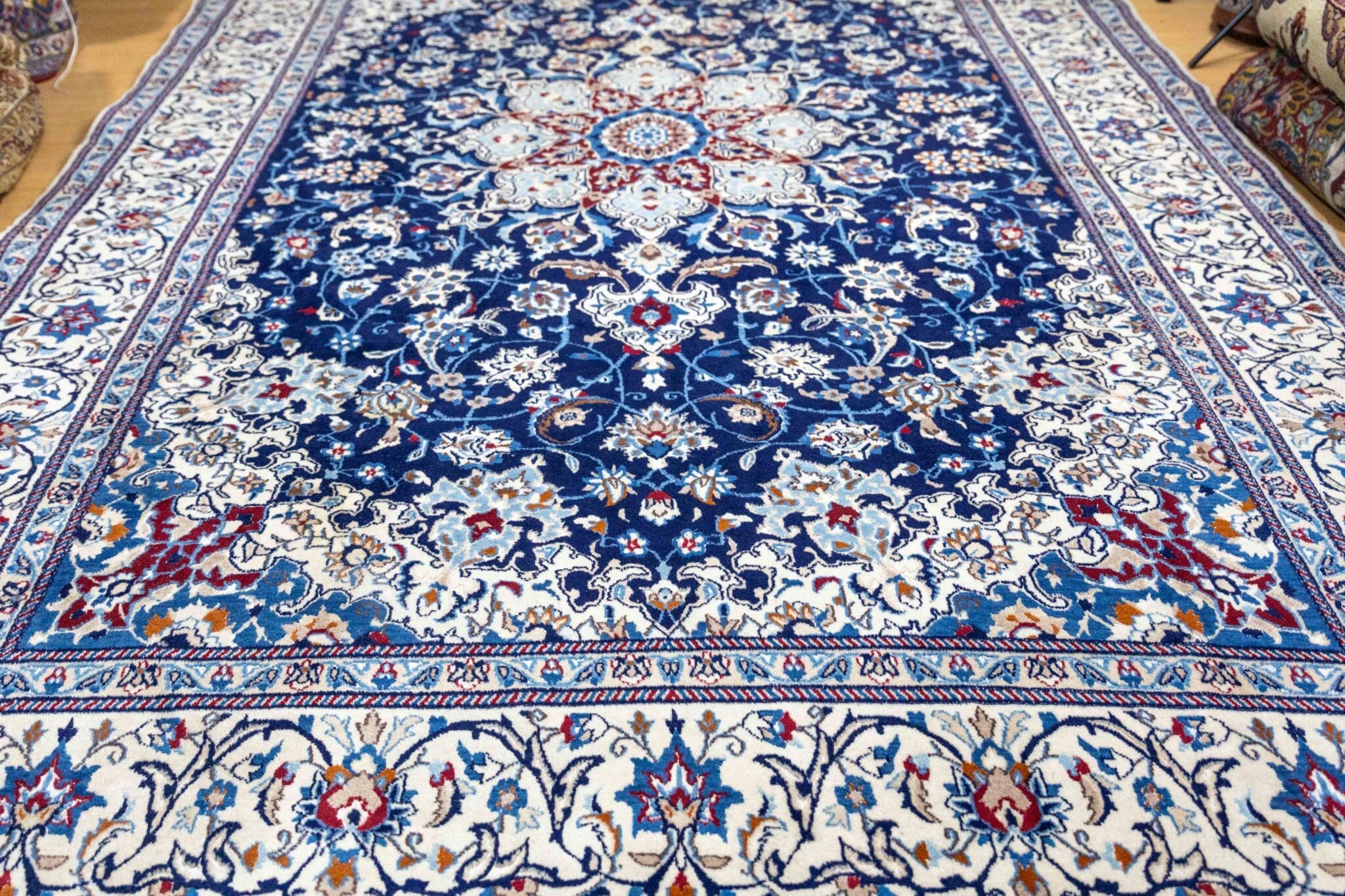
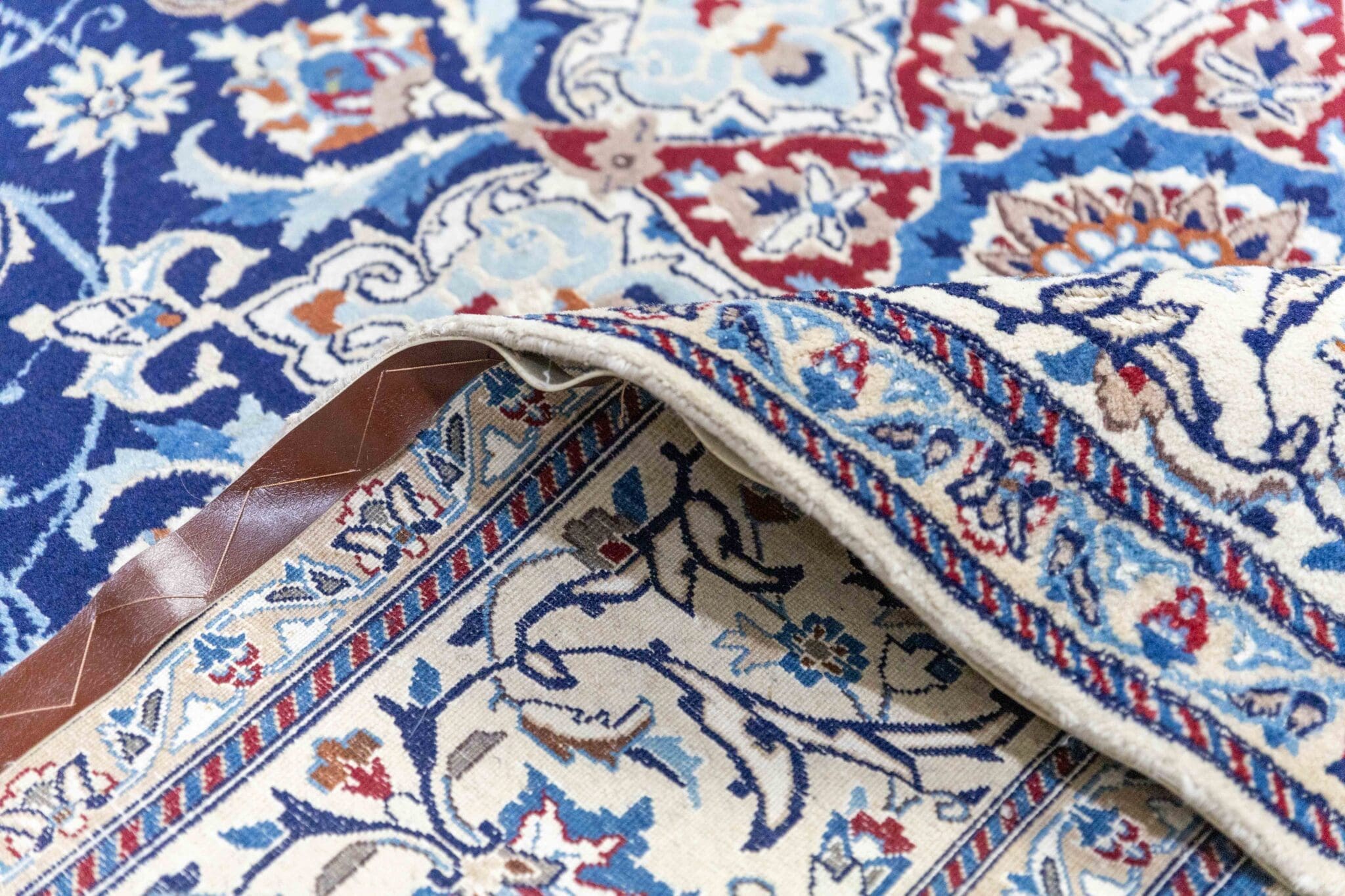
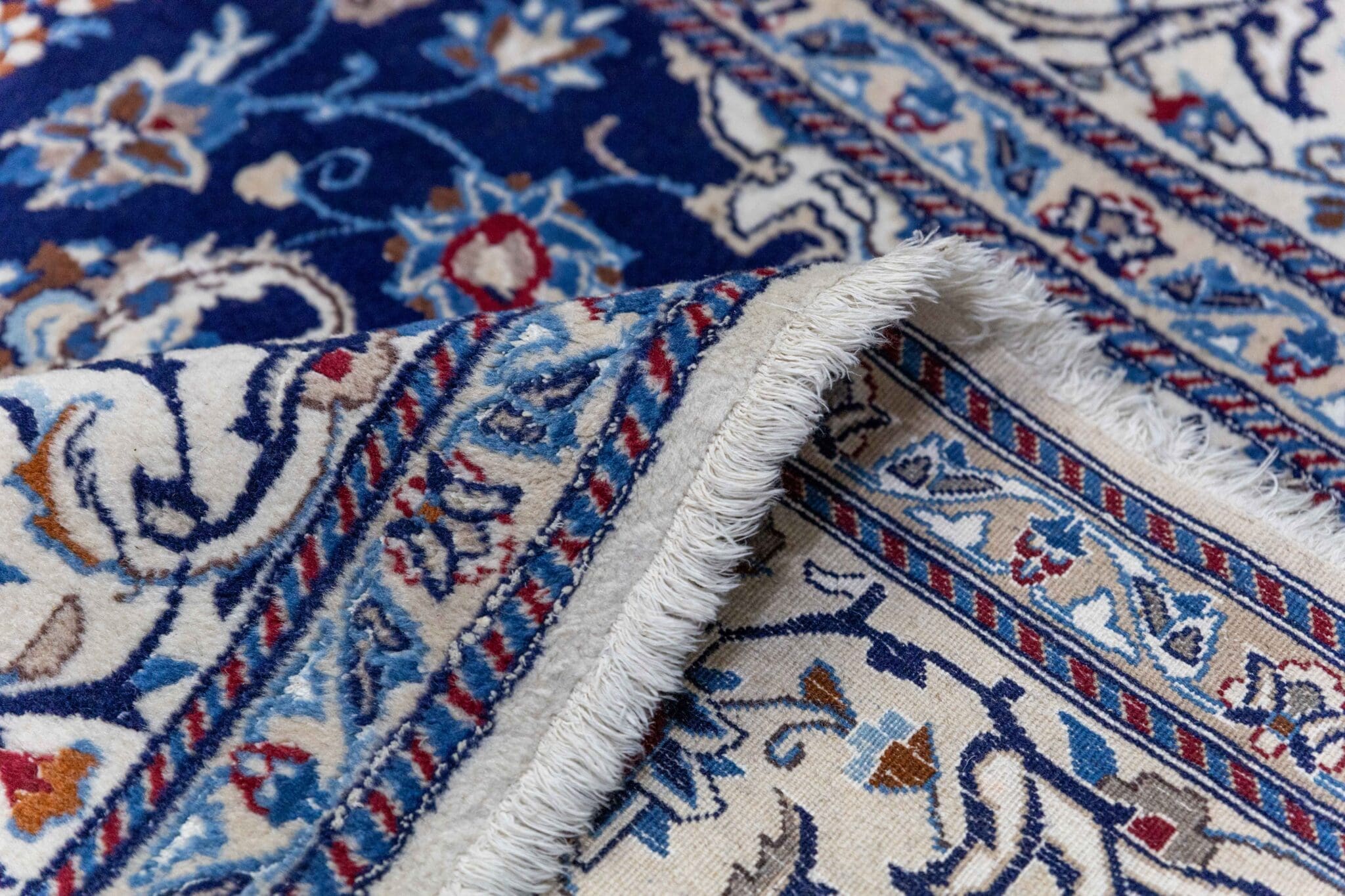
This Nain Persian rug is hand-knotted with a pile made of 100% wool with silk. Its warp is 100% cotton. The combination of wool and silk determines both the handle and the visual character of the surface. Wool is a durable and resilient fibre commonly used for the pile of hand-knotted rugs. Silk adds a smoother touch and a distinct sheen to the wool pile. The result is a textile surface in which the practical qualities of wool are combined with the refined appearance of silk.
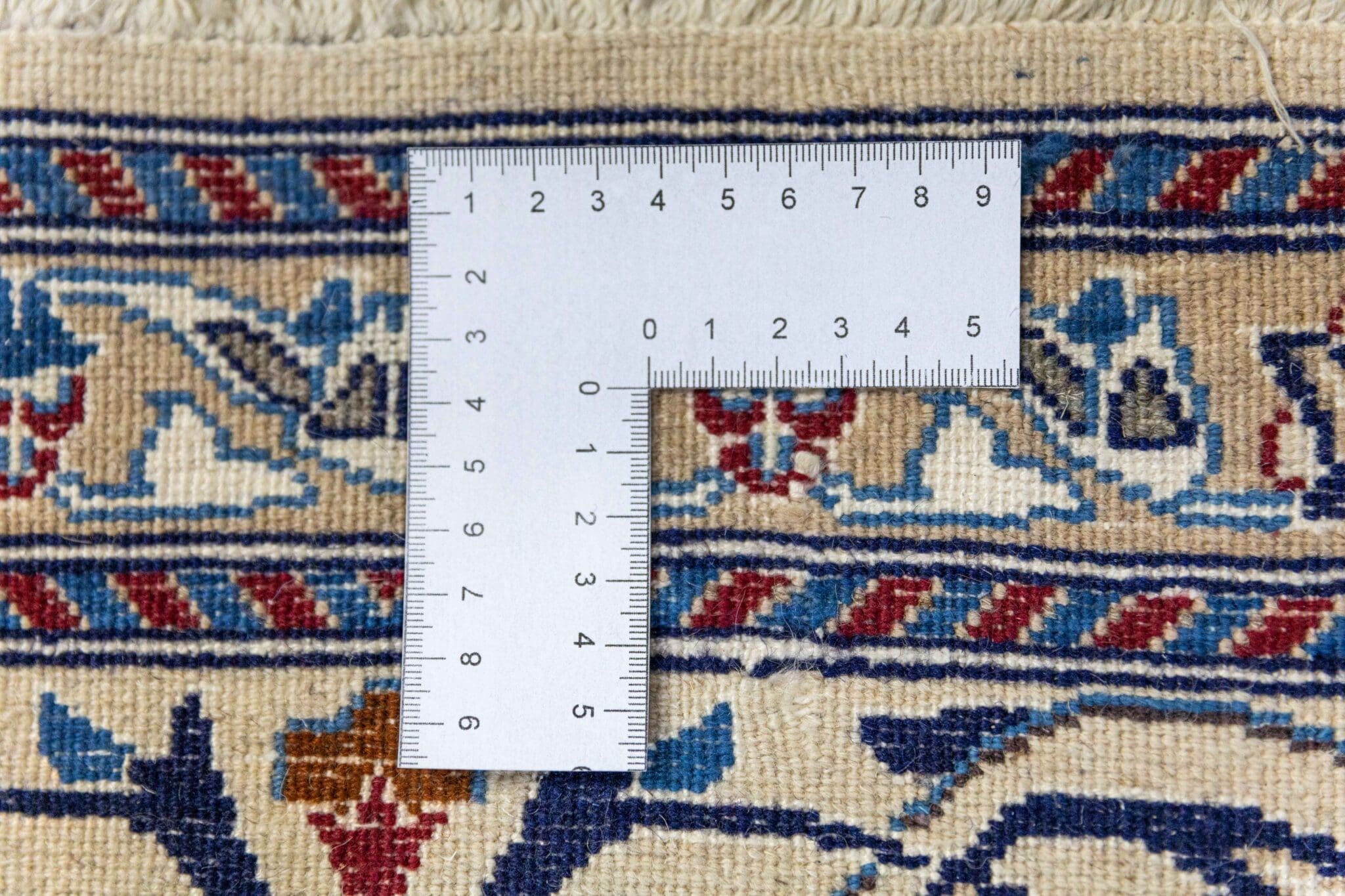
The knot density is given as 12La, at approximately 200,000 knots per square metre. Such a fine construction requires careful and precise work. In hand-knotting, individual knots are tied into the prepared warp and secured with weft threads. The pattern develops gradually, row by row, as the knotting progresses. The cotton warp forms the structural foundation, while the pile creates the visible surface and carries the design. Every part of the process contributes to the final clarity of the woven image.
Hand-knotting also means that each individual rug is one of a kind. Even when a traditional design is followed, the execution of a handmade piece retains the character of the weaver’s work. Here, wool makes up the principal pile material, silk provides contrasting lustre within the pile, and cotton forms the warp. These materials are not interchangeable details; each has a defined role in the construction of the rug. Together they create the structure described for this Nain.
The fine knotting supports a detailed pattern while preserving the hand-produced nature of the rug. A knotted design is built directly into the textile rather than printed onto a finished surface. This is why the relationship between the warp, the weft, the knots and the pile is central to the identity of a hand-knotted rug. The material composition and the careful construction give the piece its particular tactile and visual qualities.
Origin and Tradition
This rug comes from the city of Nain in Persia. Nain is one of the recognised centres of Persian rug weaving and is associated with finely worked hand-knotted rugs, orderly compositions and detailed ornament. The local tradition is known for combining a precise drawing with carefully selected materials. Nain rugs are often connected with the use of wool and silk, allowing a durable pile to be enriched with areas of subtle reflection. The Nain identity of this rug is expressed through its fine knotting, its wool pile with silk and its Lachak-Toranj medallion.
The weaving tradition of Nain belongs to the wider history of Persian textile arts. A rug represents more than a sequence of knots: the design must first be organised, the warp prepared and the relationship between colours and motifs planned. Weavers then translate that structure into a textile one knot at a time. Knowledge of fibre preparation, tension, pattern rhythm and finishing is passed through generations. Regional traditions retain recognisable features while allowing individual workshops and weavers to interpret the established vocabulary with their own precision.
Nain’s position in Iran also connected the city with historical routes of travel and trade. Contact with other areas brought the exchange of techniques, materials and decorative ideas. Persian rug traditions could therefore develop through both local continuity and outside influence. Nain formed its own identifiable approach within that broader culture, with an emphasis on finely drawn ornament, balanced medallion designs and the controlled use of wool and silk. The result is a regional tradition that can be distinguished without being separated from the history of Persian weaving as a whole.
The natural and economic setting of the region has also been relevant to rug production. Water and cultivable land supported agriculture and sheep husbandry, which helped maintain access to wool. Wool has long been central to Persian rug making because it can be spun, dyed and worked into a resilient pile. Silk can be introduced where a finer surface and a more reflective accent are desired. Cotton is well suited to a regular warp that provides a stable basis for knotting. The material arrangement of this rug therefore relates to established technical practices within Persian carpet making.
Nain is a place of origin, not merely a name for a decorative motif. The designation refers to the city’s weaving culture and its accumulated knowledge of structure, pattern and finishing. Calling this piece a Persian rug places it within the Iranian tradition of hand-knotted carpets. That tradition includes both highly formal designs and the practical knowledge needed to turn raw fibres into a lasting textile. The rug’s regional name, technique and materials are consequently connected parts of its identity.
Persian rugs have historically served practical, decorative and cultural purposes. They could define an interior, provide a durable floor covering and preserve a local visual language. In Nain, the measured arrangement of medallion, corner forms and surrounding ornament reflects a preference for coherent composition. The tradition remains legible in the way a central design is related to the borders and in the careful balance between fine detail and open areas. This historical context explains why a Nain rug is recognised through both its origin and its way of organising the design.
Design and Pattern
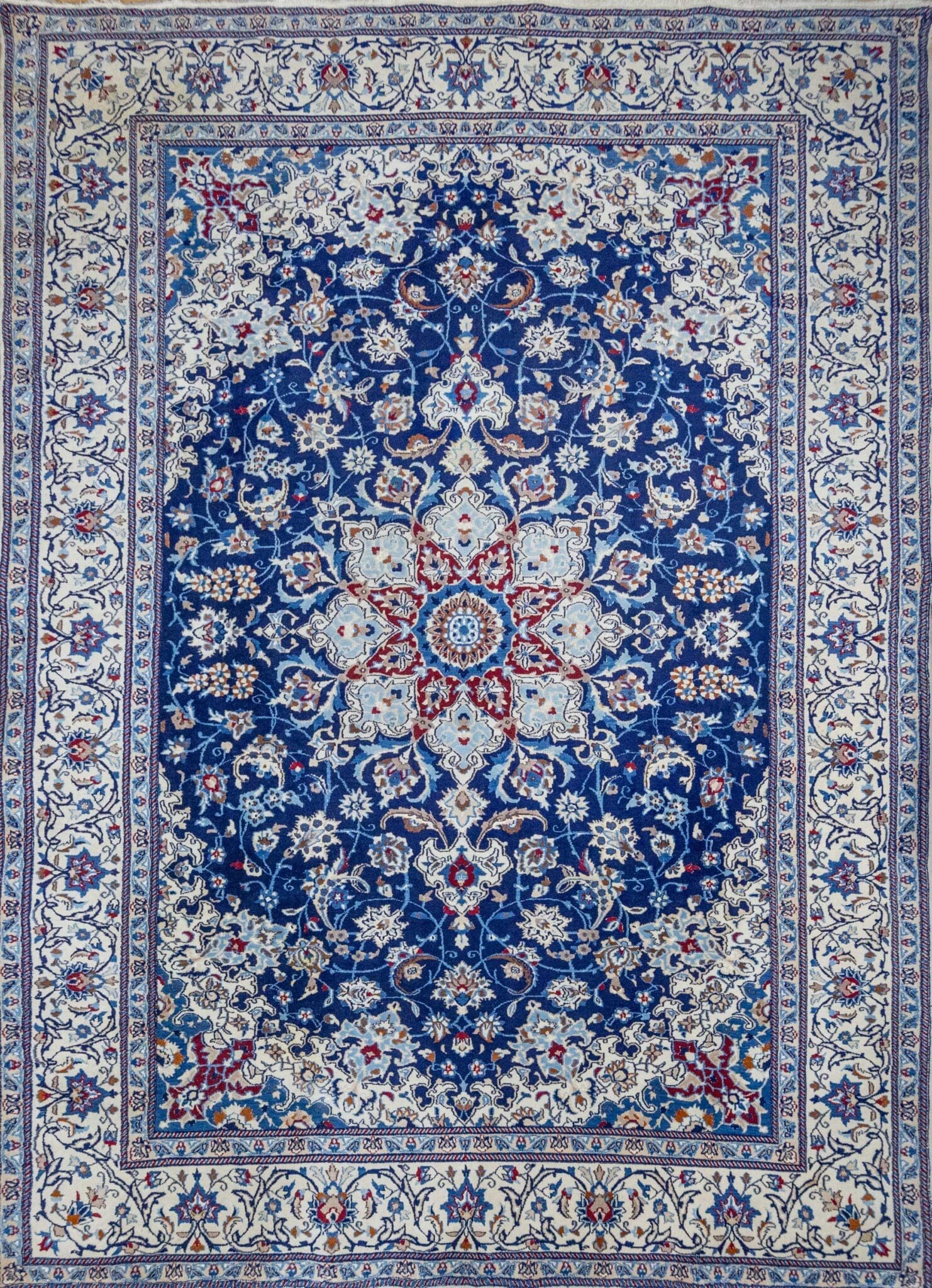
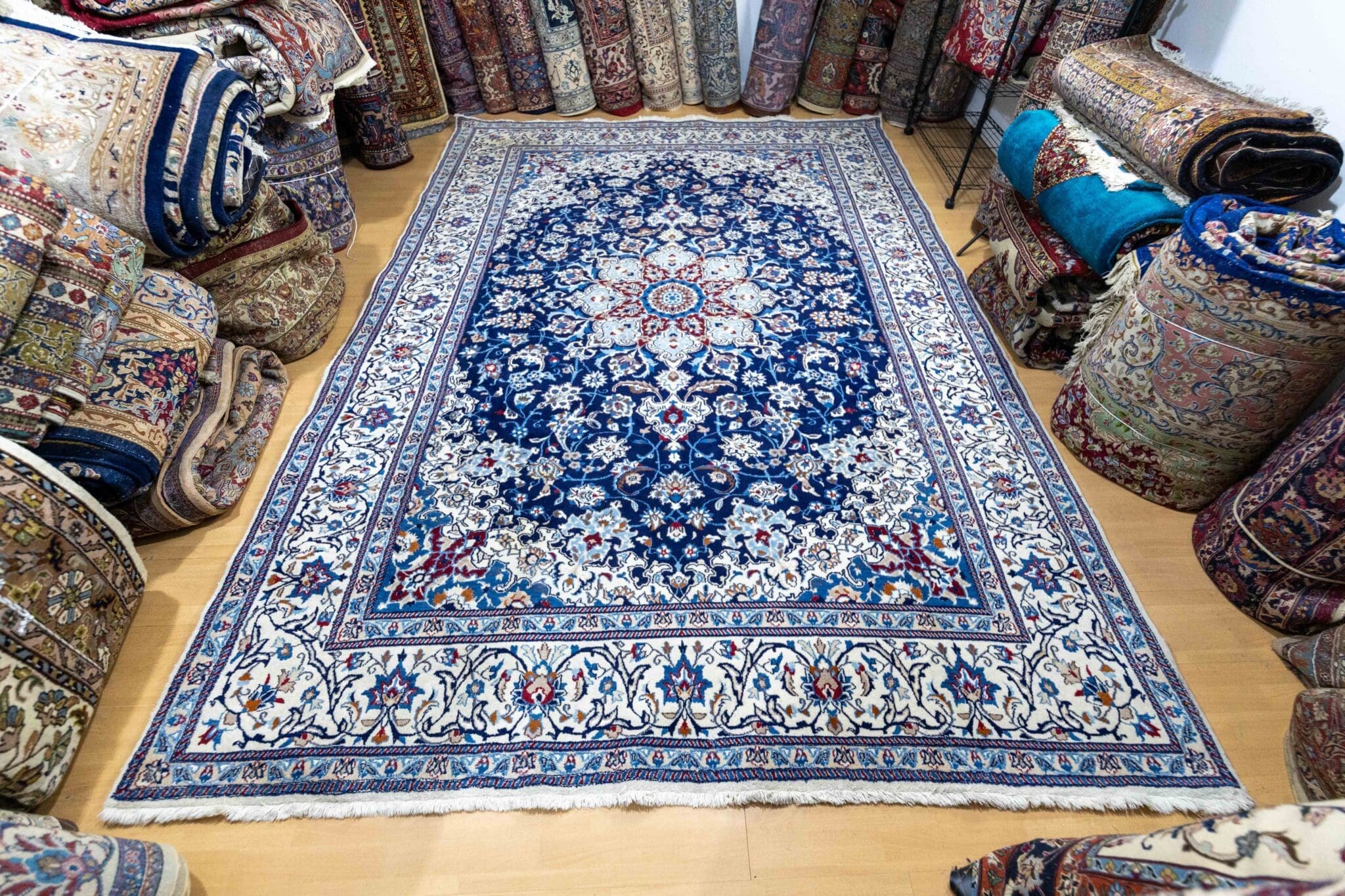
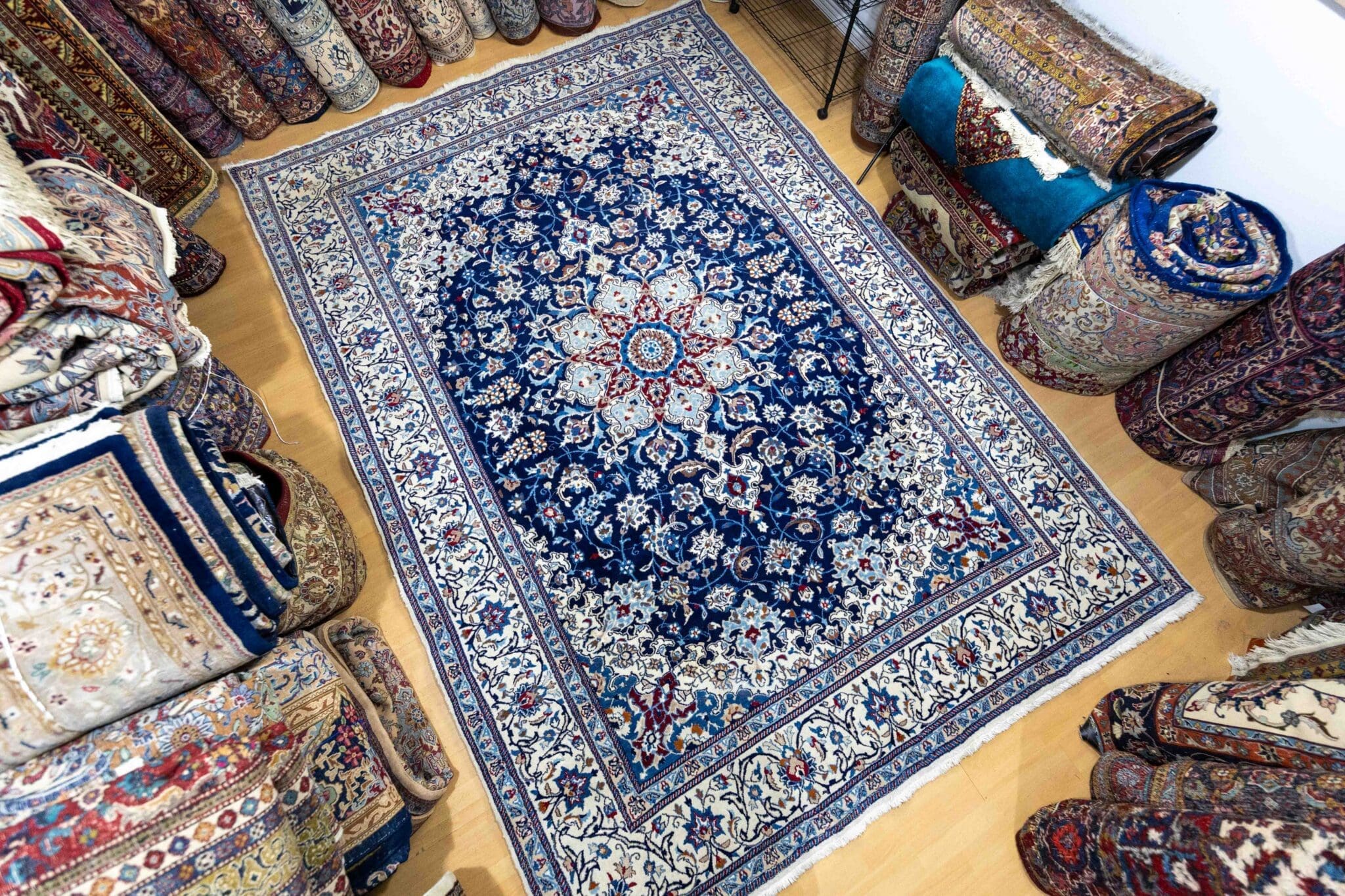
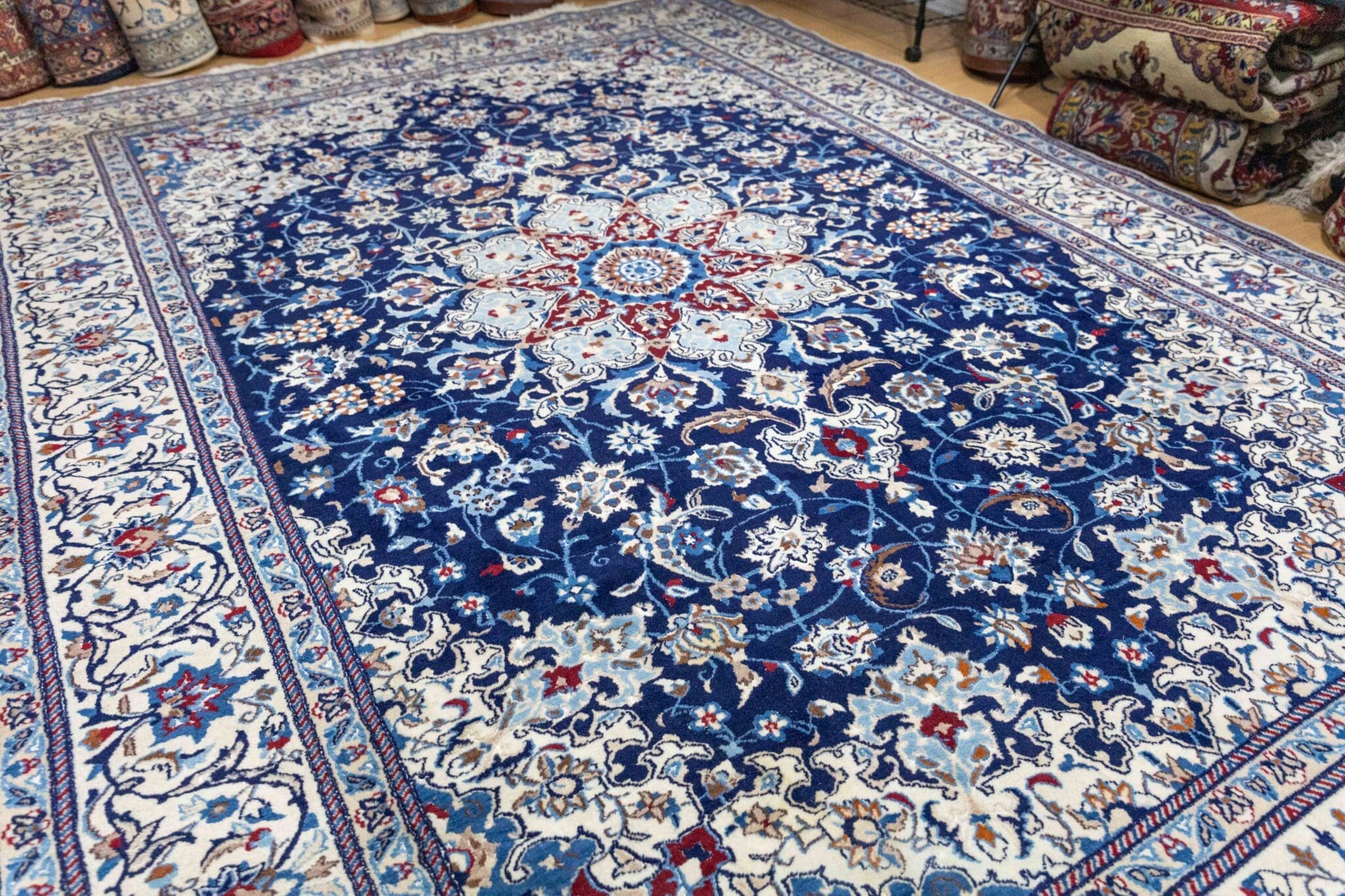
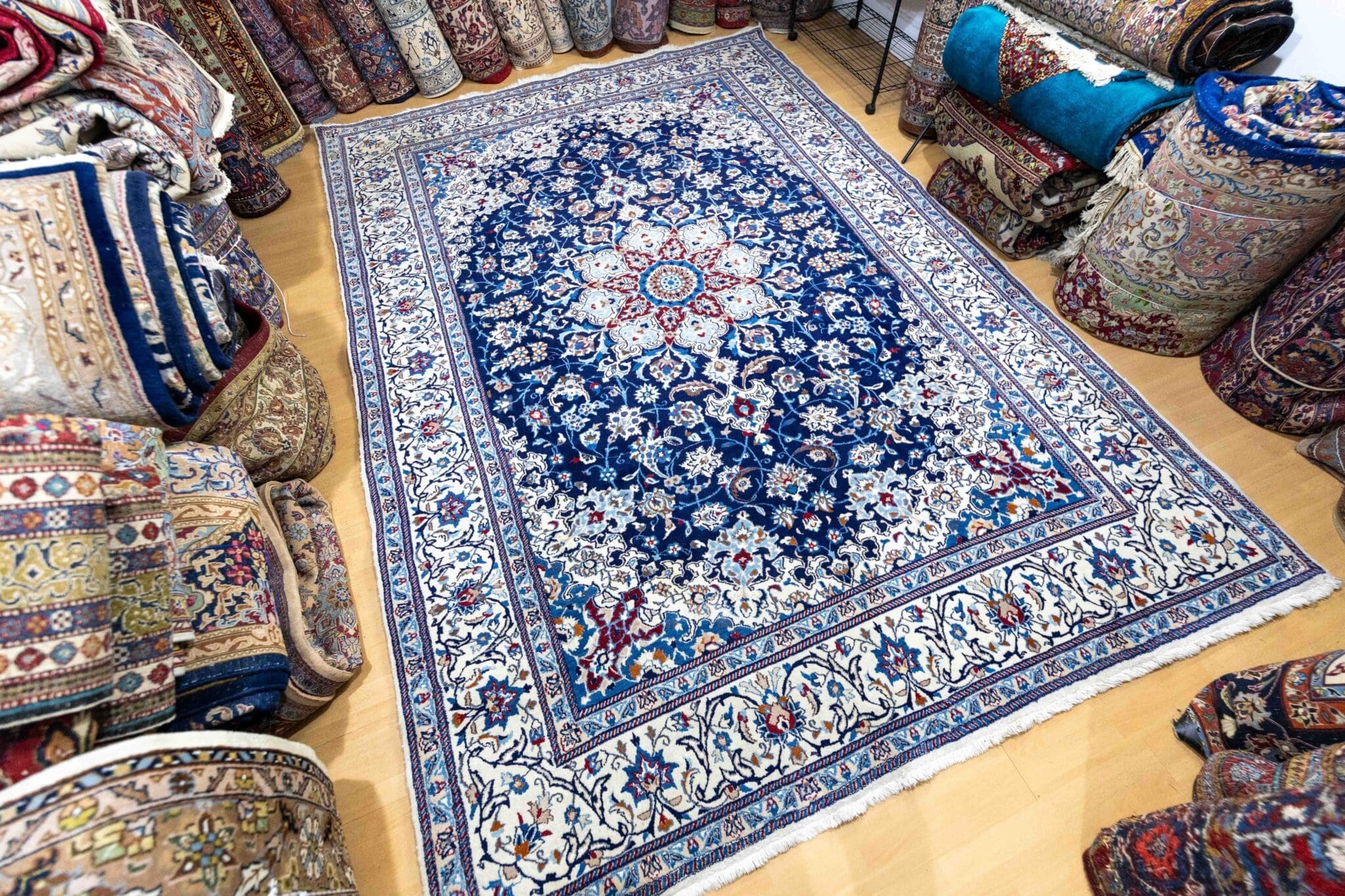
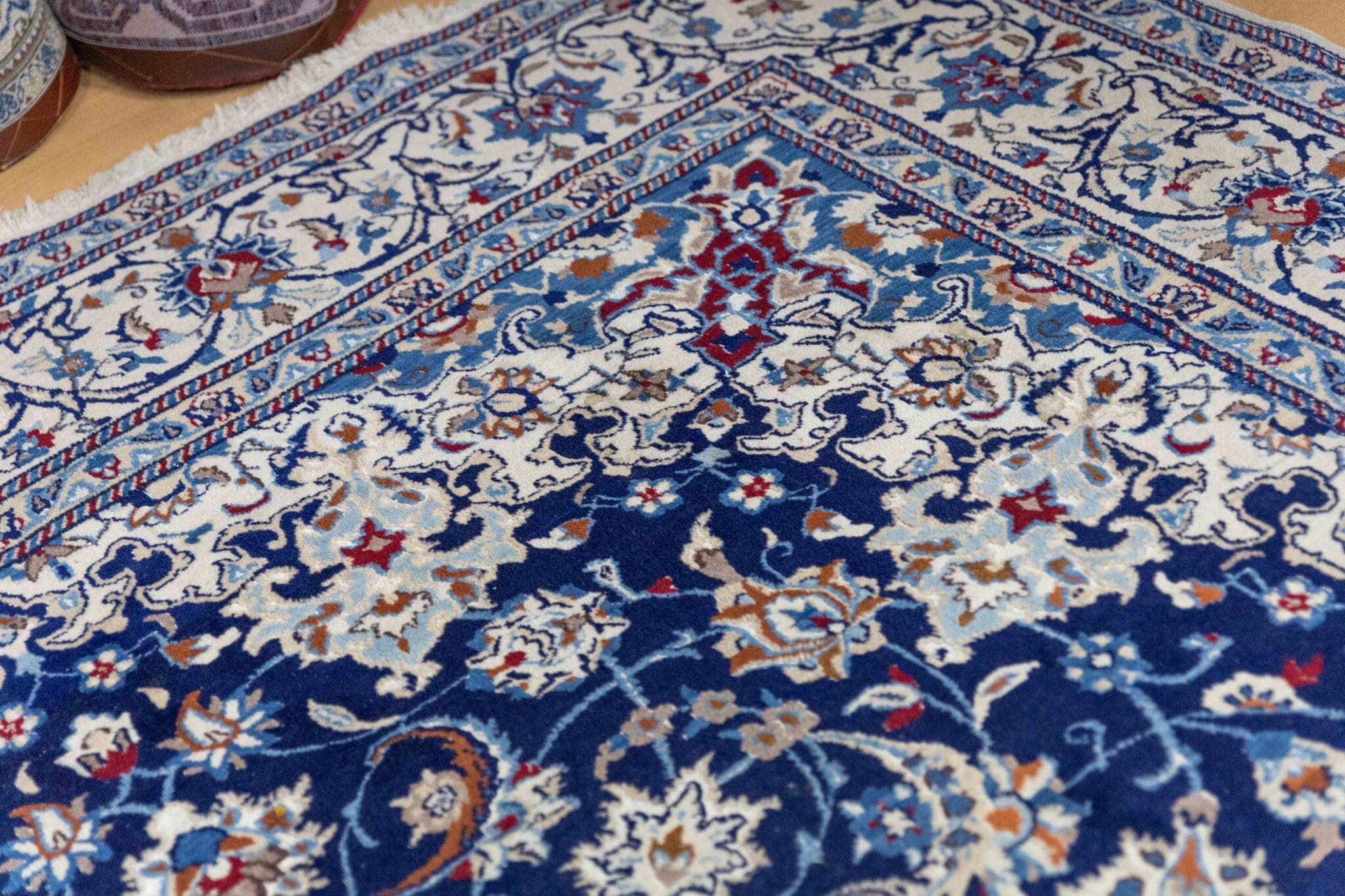
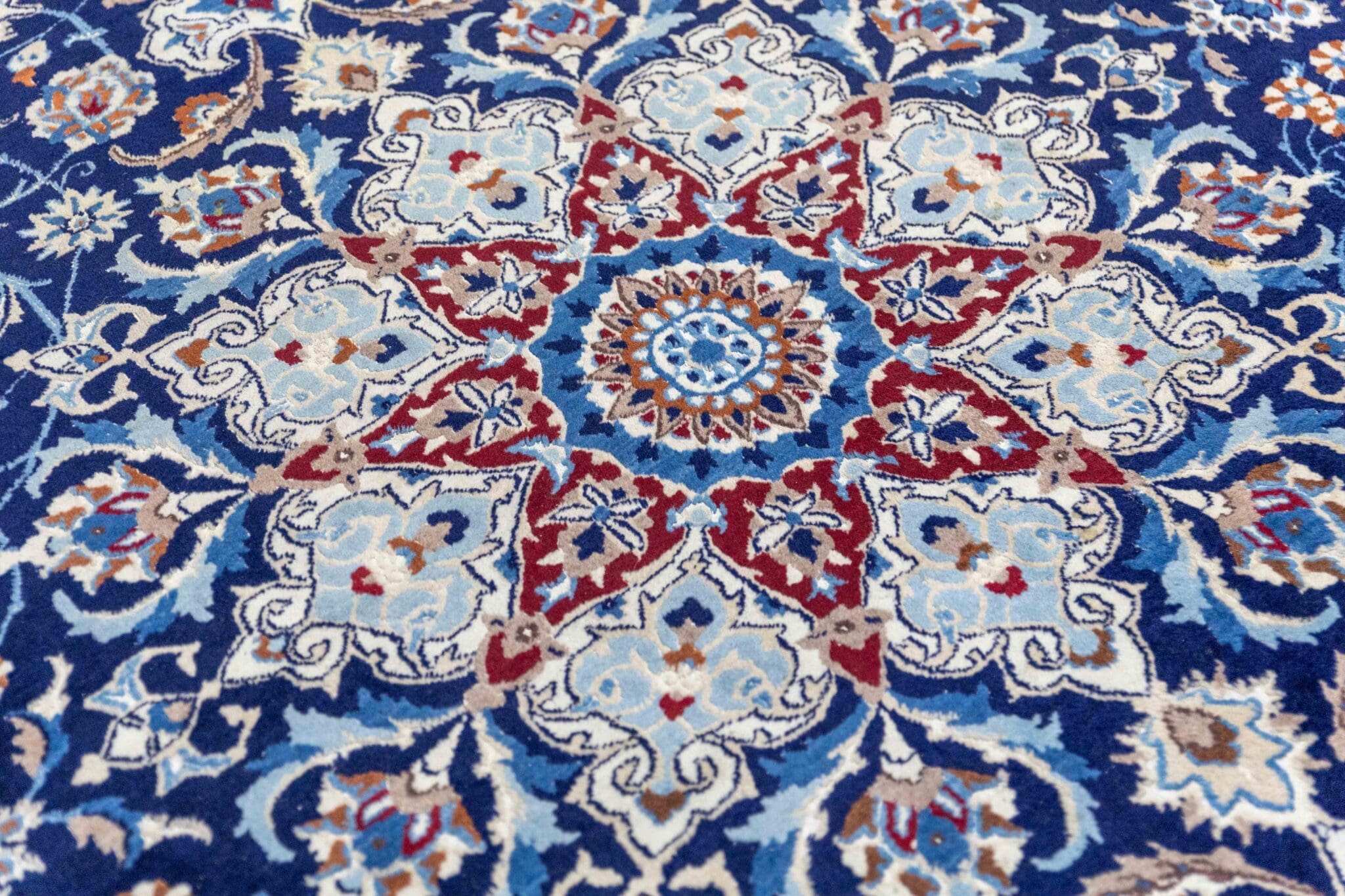
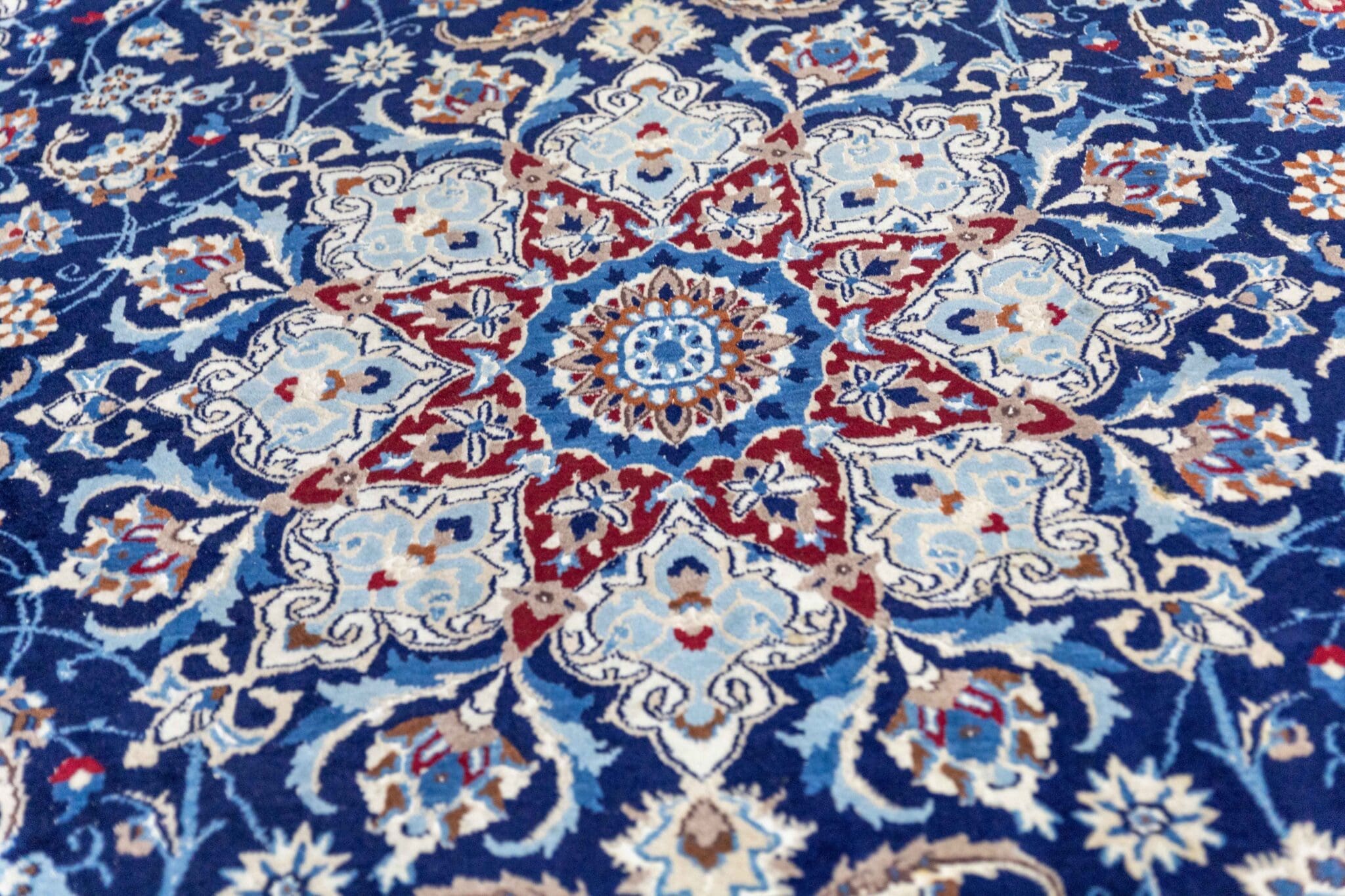
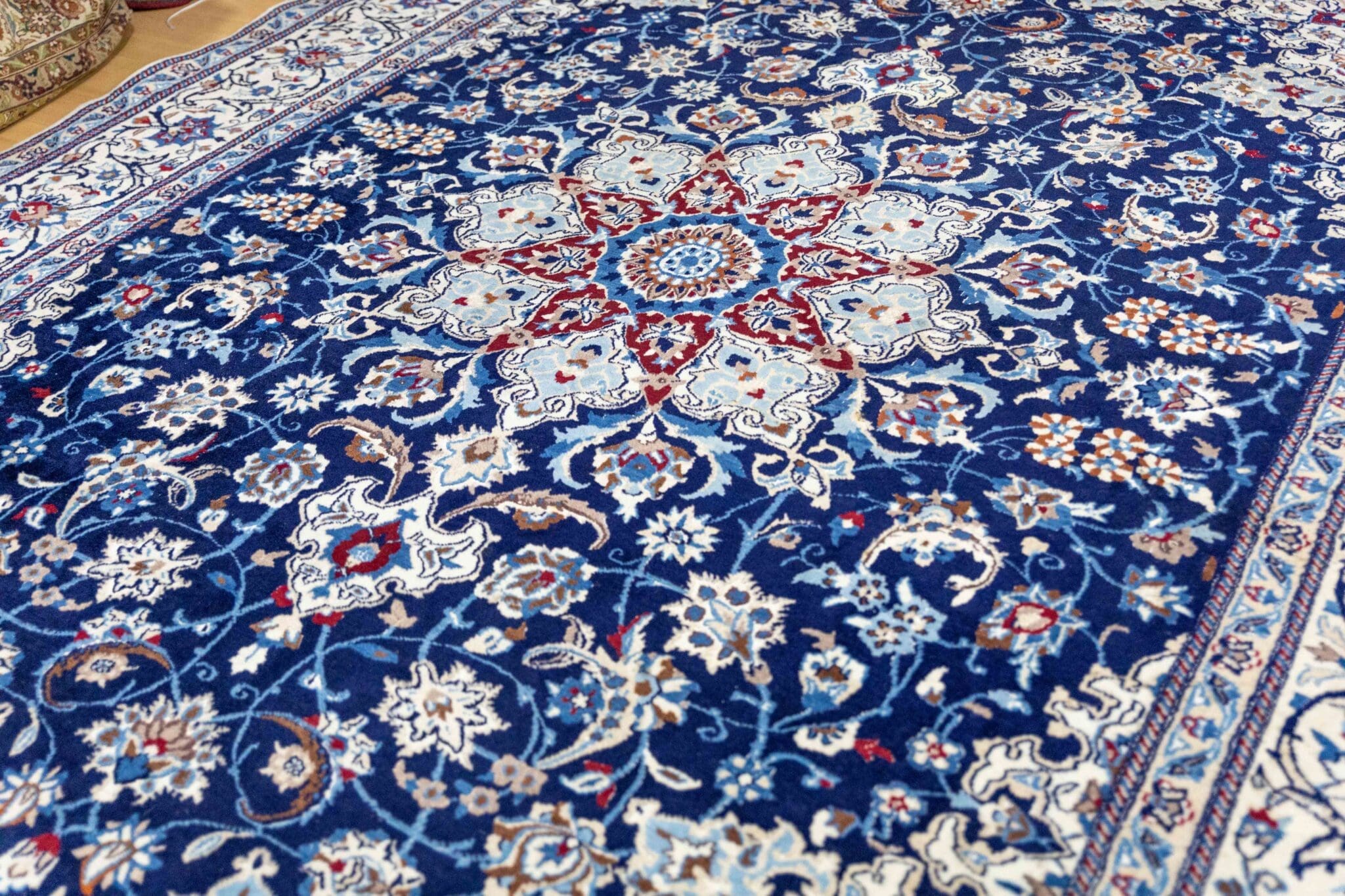
The pattern of this rug is identified as a Lachak-Toranj Nain medallion. A toranj is a central medallion that gives the composition its main point of focus. Lachak refers to the associated corner forms, which establish a visual relationship between the centre and the four corners. Together, the medallion and corner pieces create an organised field rather than a collection of unrelated ornaments. This arrangement is a familiar design approach in Nain weaving and gives the rug a clearly structured appearance.
In Persian carpet design, a medallion has an ordering function. It concentrates the composition at the centre while providing a point from which surrounding floral lines, leaves and other ornaments can be arranged. The corner forms echo or balance the central structure, helping the eye move across the field. A Lachak-Toranj design thus combines central emphasis with lateral balance. The pattern can appear symmetrical and controlled while still allowing fine variations in the drawing of individual motifs.
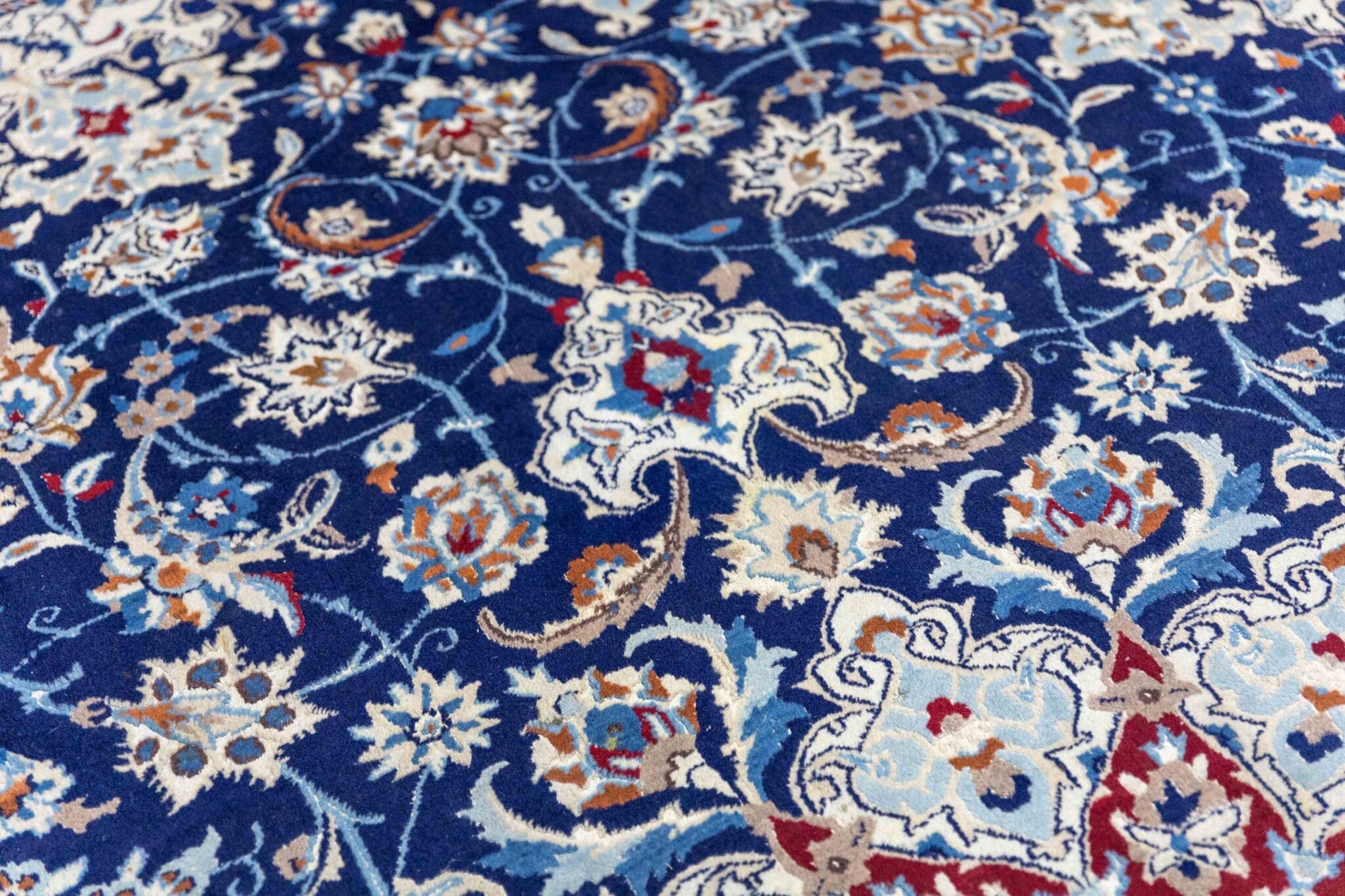
Floral and geometric elements are often used together in Nain patterns. Floral forms can suggest growth, nature and the beauty of vegetation, while geometric outlines give them definition and rhythm. Persian ornament does not treat these elements as isolated decoration. They are placed in repeated sequences and connected by lines, branches or framed sections so that the whole field remains coherent. The design language depends on proportion, repetition and a hierarchy between the principal medallion and the smaller details around it.
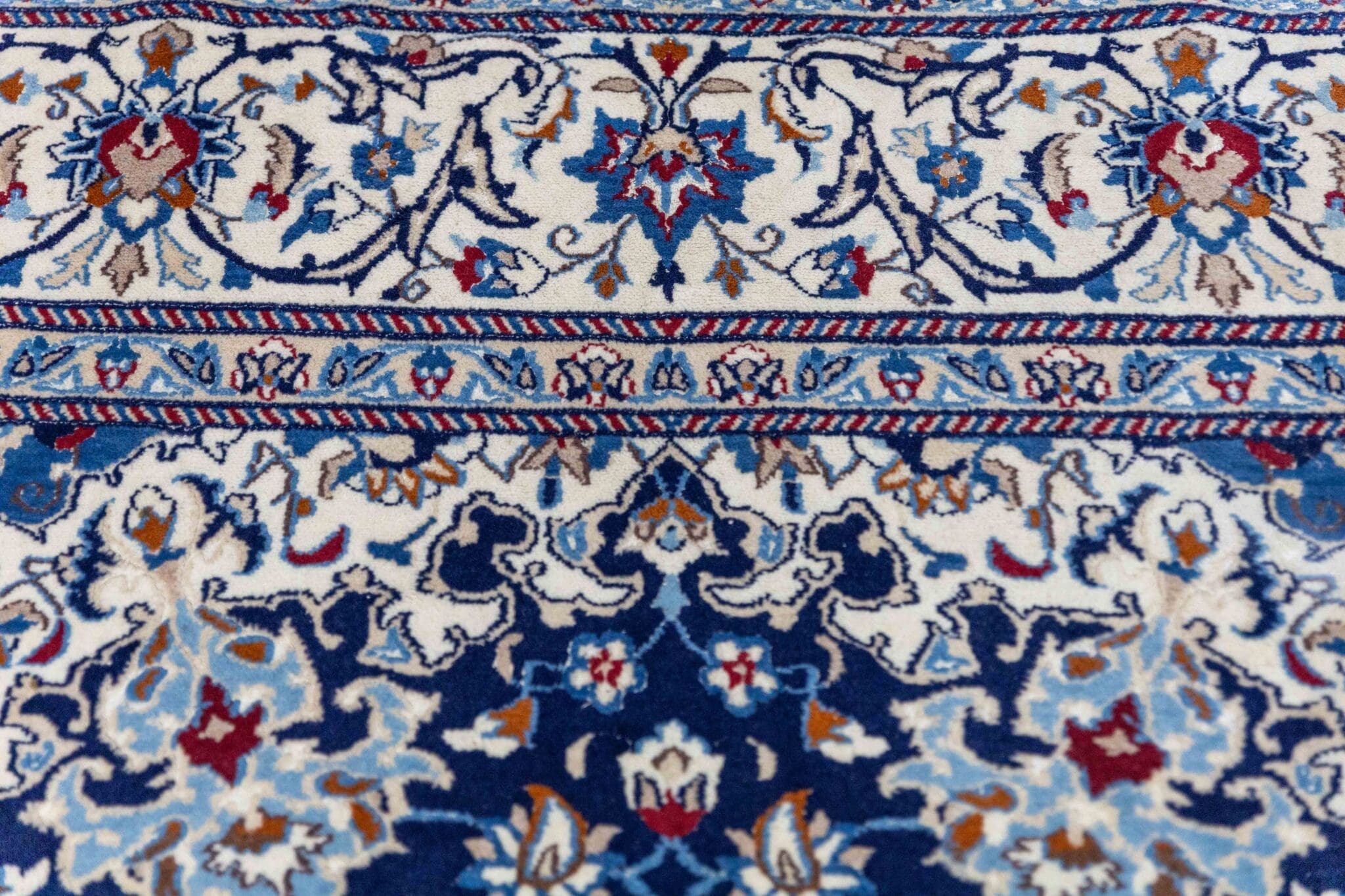
The colour description for this rug centres on a harmonious combination of blue, red and earth tones. Blue can provide a cool depth and clear contrast within a Persian composition. Red may strengthen the presence of central or floral areas, while earth tones create a quieter, natural connection between the stronger colours. The effect depends on the balance of the palette rather than on one colour alone. Together, these tones support the distinction between the medallion, the corner forms, the floral details and the framing areas.
Silk within the pile can add another layer to the reading of the pattern. Its smoother fibres reflect light differently from wool, so selected contours and details may appear with a gentle change in surface brightness. This contrast between the softer visual quality of wool and the more reflective quality of silk is one of the reasons the material combination is valued in Nain weaving. It can make fine lines easier to distinguish while preserving the traditional arrangement of the design.
A medallion rug is also read through the relationship between its inner field and its borders. The borders contain and frame the central arrangement, while transitional ornament connects the centre to the edges. Repeated leaves, floral lines and geometric boundaries create movement without breaking the overall order. In a Lachak-Toranj composition, the corners are particularly important because they complete the dialogue between the central toranj and the surrounding field. The pattern therefore has both a focal centre and a balanced perimeter.
The symbolism of floral ornament is part of the broader Persian design tradition, where plants and organic forms may be associated with life, growth and natural beauty. These meanings belong to the motif vocabulary rather than to a personal story attached to this individual rug. Its design remains grounded in the established Nain language of medallion composition, floral detail, geometric definition and measured colour relationships. The result is a pattern that can be understood both as a decorative arrangement and as an example of a long-standing regional tradition.
Special Features
The product description highlights the rug’s ease of care and its high-quality combination of wool and silk. It is described as durable and relatively resistant to stains and wear. For that reason, it is presented as suitable for living rooms, dining rooms and other areas that receive frequent use. Its practical qualities stand alongside the fine hand-knotting and the decorative character of the Lachak-Toranj medallion.
The condition is stated as very good. The fine knot density, hand-knotted construction and silk content are notable features of the piece. High-quality rugs are also often kept for a long time and passed from one generation to the next. This Nain therefore combines its everyday role as a floor covering with the character of a handmade object rooted in the craft tradition of Persia.
FAQ
How should I care for my Nain rug?
Regular, thorough vacuuming helps remove dust and loose dirt from the pile. Direct sunlight should be avoided because prolonged exposure can cause colours to fade. For stubborn stains, a professional should be consulted rather than using unsuitable cleaning products or aggressive treatment at home. A specialist can take the wool-and-silk pile and the fine hand-knotted construction into account. Gentle, appropriate care helps preserve both the surface and the colours.
Where is the best place for a Nain rug?
The rug is suitable for a living room, dining room or as a focal point in an elegant hallway. Its Lachak-Toranj medallion and balanced combination of blue, red and earth tones can provide a clear visual reference for an interior. A position where the central pattern remains visible allows the composition to be appreciated rather than hidden beneath furniture. It is also sensible to limit direct sunlight in the chosen location.
How can I recognise an authentic Nain rug?
The listed characteristics of an authentic Nain rug include a high knot density, hand-knotted edges and the typical combination of floral motifs and medallions. The use of wool together with silk is also identified as an important feature. Assessment should therefore consider the construction, the edges, the pattern and the materials together. If there is any doubt, consulting an expert is advisable so that the origin and workmanship can be examined professionally.
To provide the best experiences, we use technologies like cookies to store and/or access device information. Consenting to these technologies will allow us to process data such as browsing behavior or unique IDs on this site. Not consenting or withdrawing consent, may adversely affect certain features and functions.
Functional Always active
The technical storage or access is strictly necessary for the legitimate purpose of enabling the use of a specific service explicitly requested by the subscriber or user, or for the sole purpose of carrying out the transmission of a communication over an electronic communications network.
Preferences
The technical storage or access is necessary for the legitimate purpose of storing preferences that are not requested by the subscriber or user.
Statistics
The technical storage or access that is used exclusively for statistical purposes.The technical storage or access that is used exclusively for anonymous statistical purposes. Without a subpoena, voluntary compliance on the part of your Internet Service Provider, or additional records from a third party, information stored or retrieved for this purpose alone cannot usually be used to identify you.
Marketing
The technical storage or access is required to create user profiles to send advertising, or to track the user on a website or across several websites for similar marketing purposes.
 SECURE PAYMENT
 SHIPPING PARTNERS


