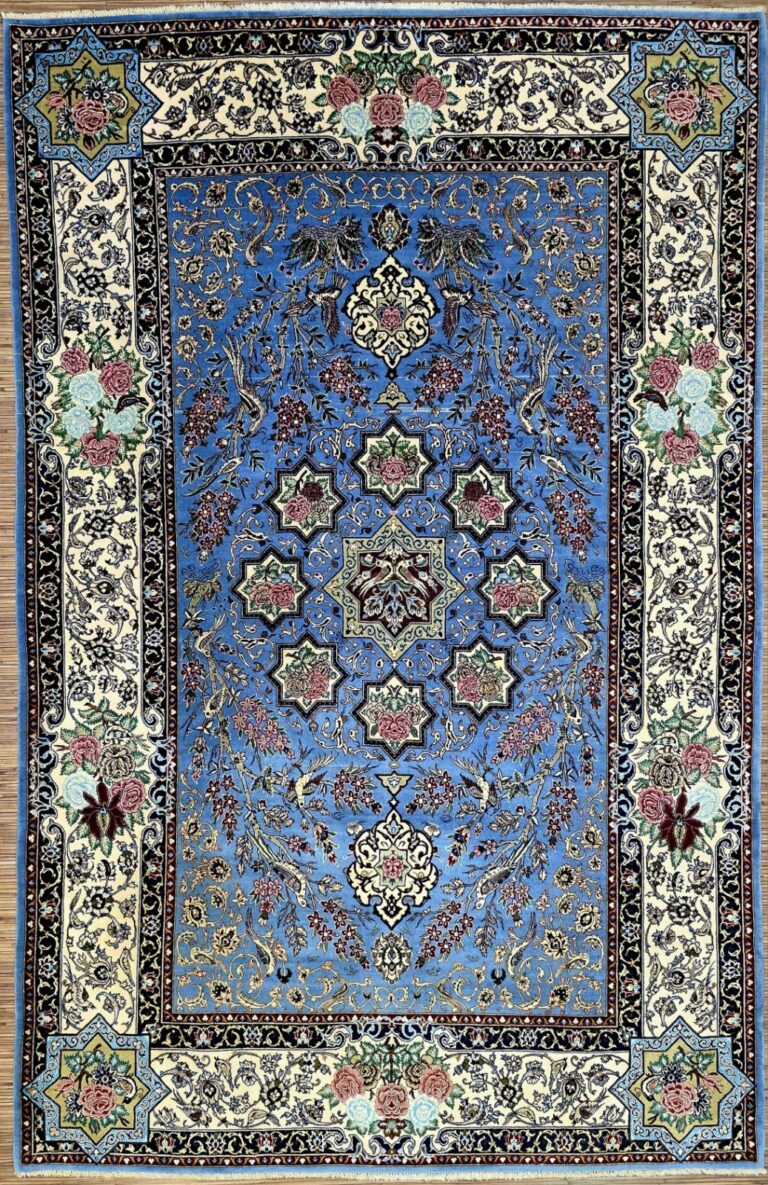
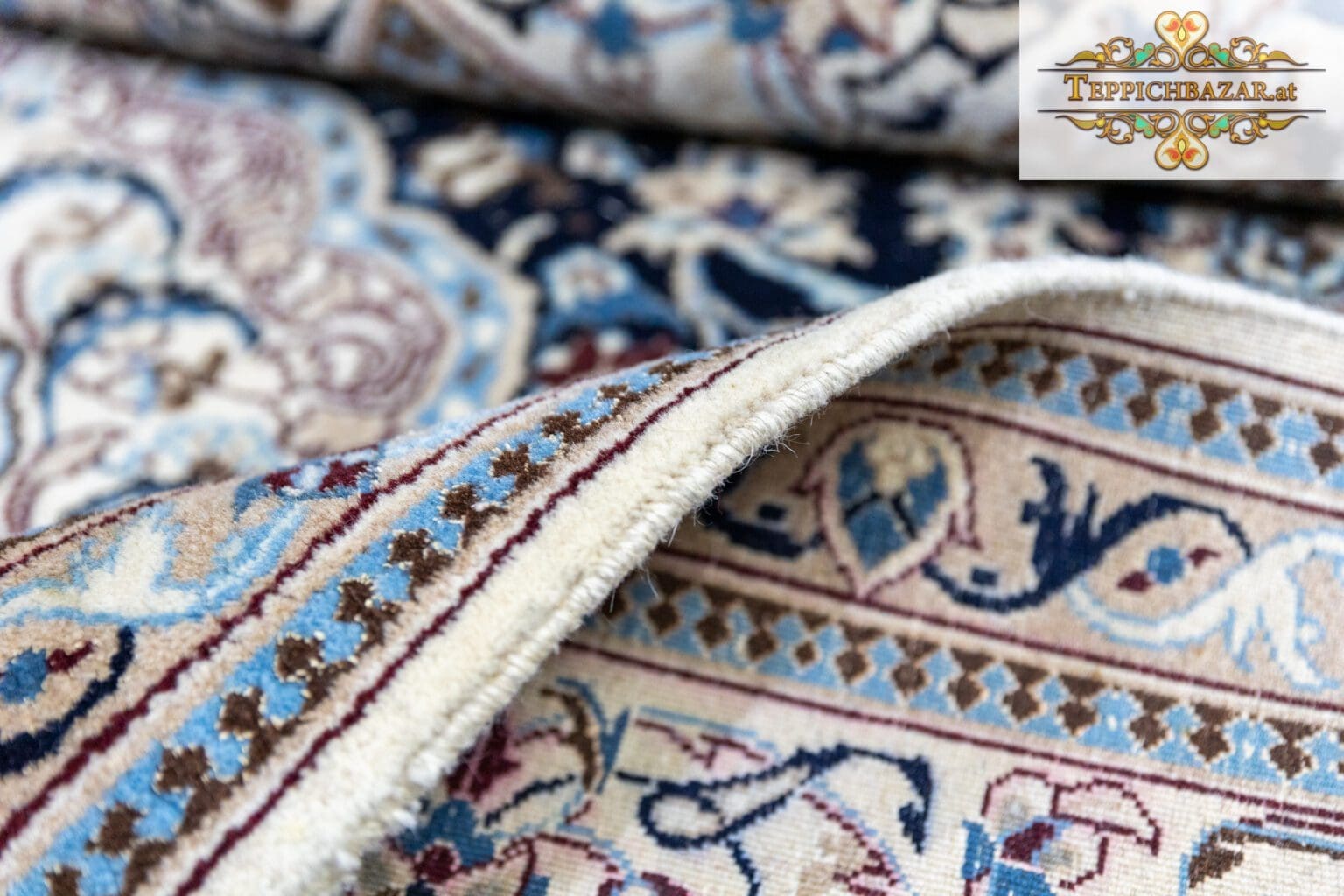
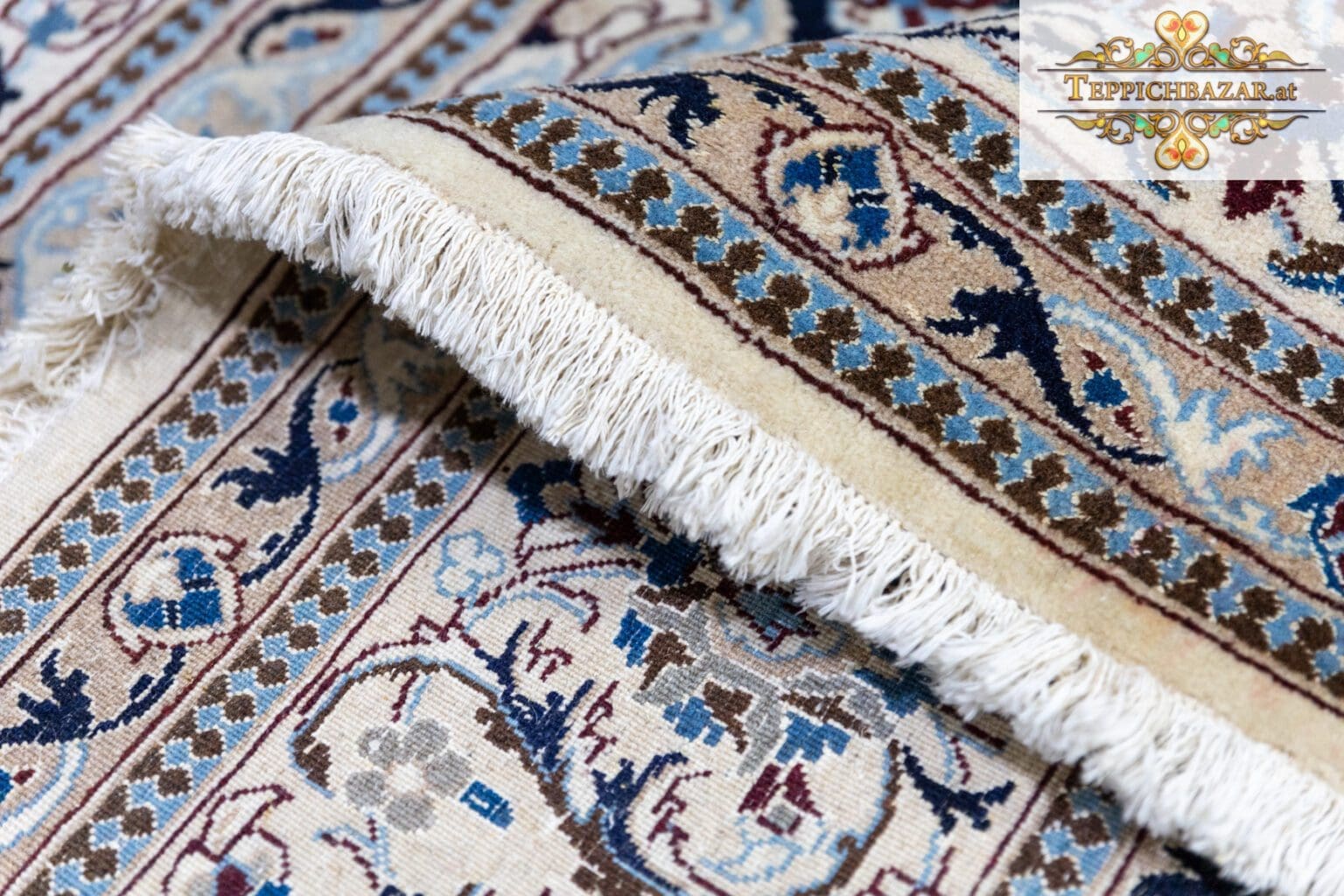
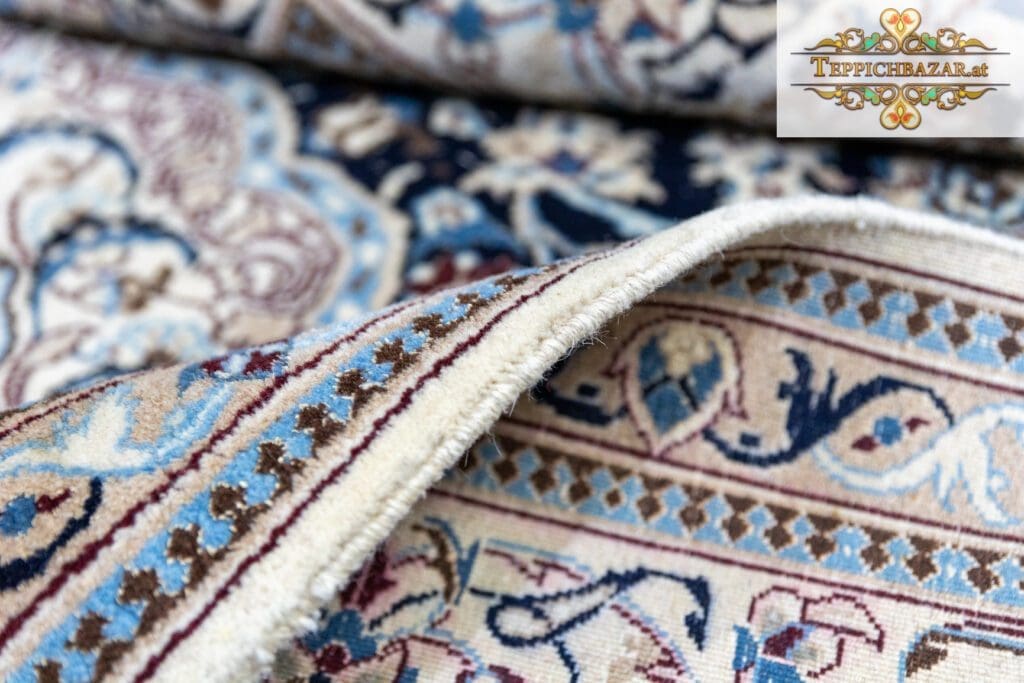
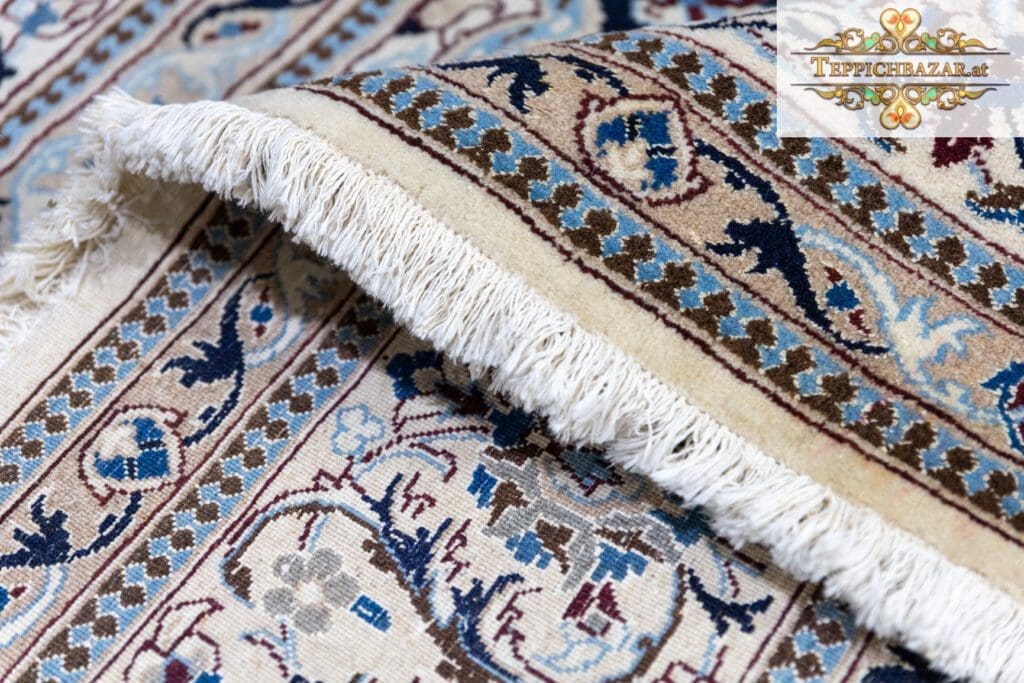
This Nain Persian rug is hand-knotted with a pile made of 100% wool with silk and a warp made of 100% cotton. These materials describe the construction of the rug: wool forms the basis of the pile, while silk is incorporated into that pile and contributes to the fine rendering of the design. The cotton warp provides the supporting framework to which the knots are attached. Pile and foundation therefore perform different functions within one carefully assembled textile structure.
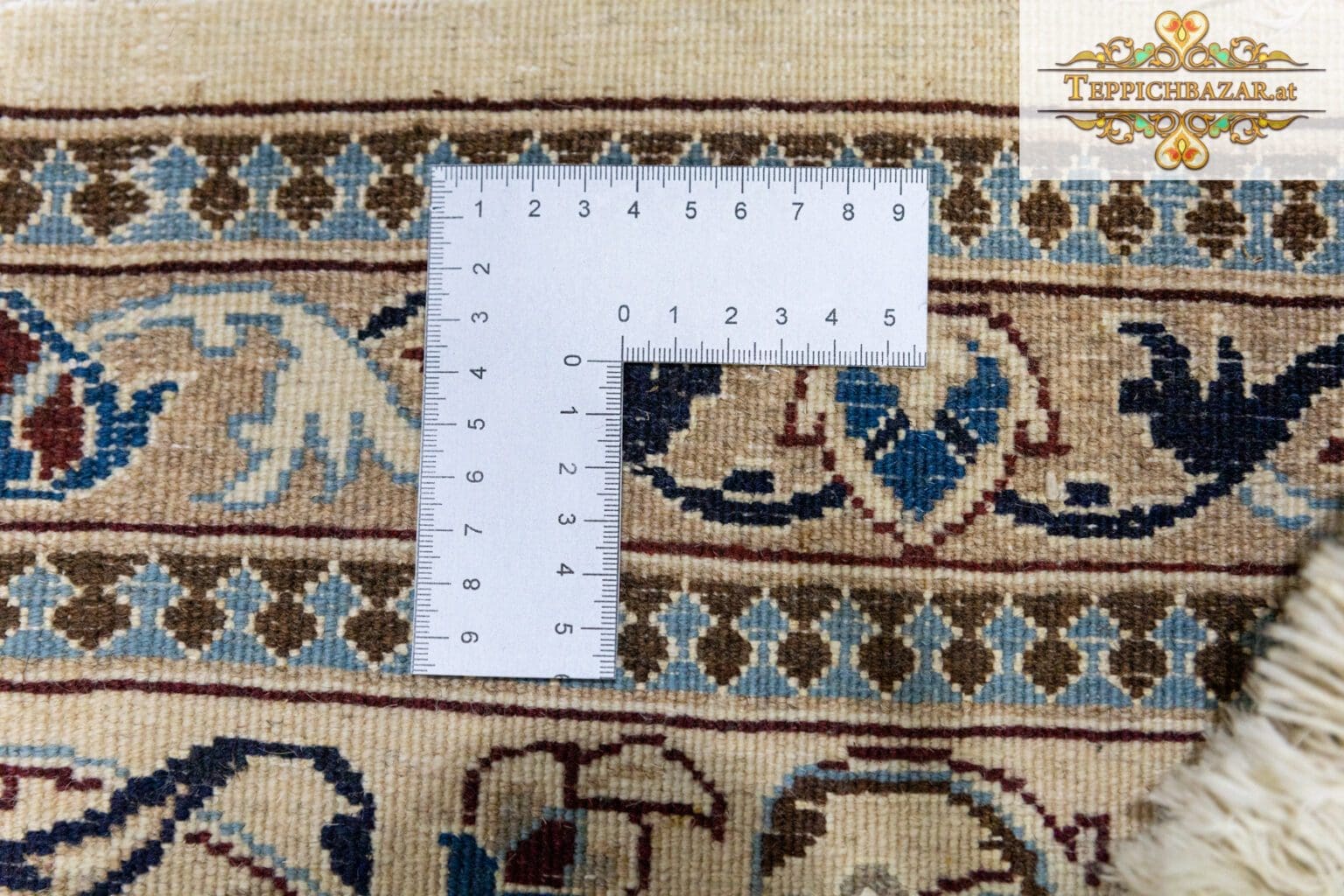
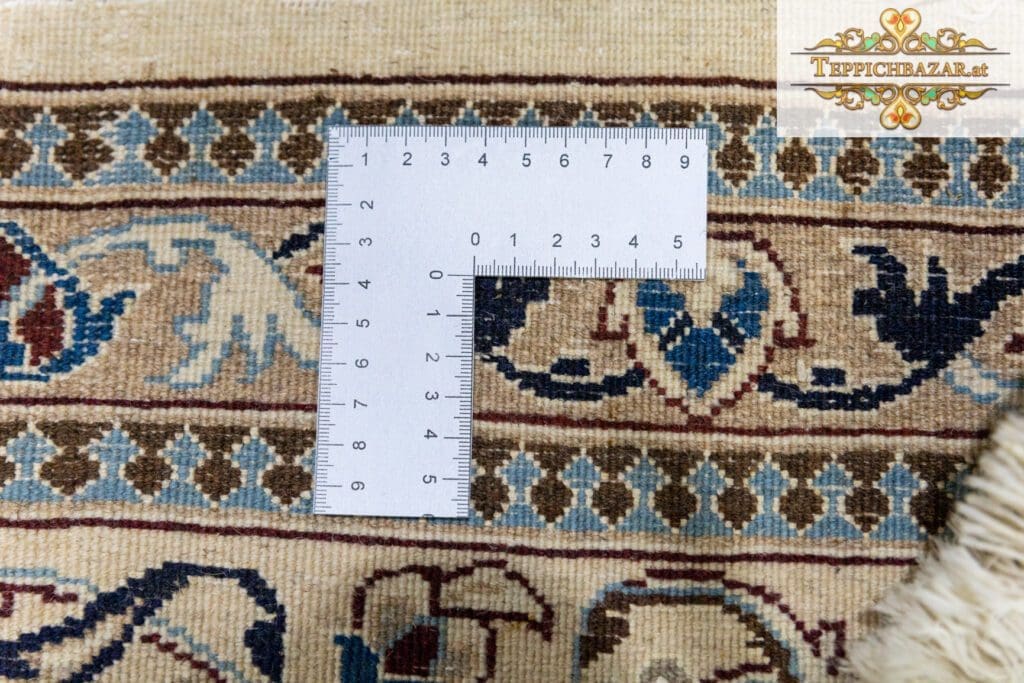
The 12La designation identifies a fine Nain knotting. The stated knot density is approximately 250,000 knots per square metre. Such knotting allows contours, floral details and transitions within a medallion to be worked with precision. In a hand-knotted rug, each knot is tied individually around the warp. Row by row, this creates a dense pile whose image is formed by the arrangement of the knots rather than by a printed surface.
Wool is valued in rug making for its resilient yet comfortable fibre. It accepts colour well and provides a dependable pile for regular use. Silk adds a finer fibre quality and its characteristic soft sheen. In this rug, silk is explicitly part of the wool pile. The cotton warp gives the knotting a precise foundation and helps the weaver keep the outlines and proportions of the pattern clearly defined.
Hand production makes every rug a unique object. A Nain medallion follows an established design vocabulary, yet handwork, knot placement and the distribution of colour create individual nuances in each example. The combination of fine Nain knotting, a wool pile with silk and a cotton warp represents a traditional textile craft in which material selection and technique are closely connected.
Origin and Tradition
This rug comes from the city of Nain in Persia. Nain is located in Isfahan Province in central Iran and is known as an important centre of Persian rug weaving. The region’s weaving tradition reaches back to the sixteenth century. Over time, Nain developed a distinctive approach in which fine execution is combined with balanced, ordered compositions. The city name therefore refers both to the place of manufacture and to a recognised weaving tradition.
Nain lies in a landscape where craft production and trade have historically been closely related. Rug making depends on more than the final drawing. Preparing the warp, selecting and spinning fibres, preparing colours and planning the knot sequence all influence the finished textile. These stages provide the practical basis for translating a design into the structure of the loom. Nain’s tradition is consequently built on the relationship between technical control and decorative order.
Nain weavers use techniques passed from one generation to the next. This transmission includes the handling of the loom, the preparation of the materials and the reading of traditional patterns. It also involves the ability to arrange delicate outlines, symmetrical forms and floral details within a precise knotting system. Weaving is therefore not merely a production method in Nain; it is also a form of cultural knowledge maintained within the community.
Fine knotting is one of the qualities associated with Nain rugs. As a general regional guide, Nain rugs commonly fall within a range of 300,000 to 800,000 knots per square metre. This background helps explain the association between Nain and detailed drawing. The knot density of this particular rug is listed separately in the product information as approximately 250,000 knots per square metre; the regional range describes the broader tradition and does not replace the specific product detail.
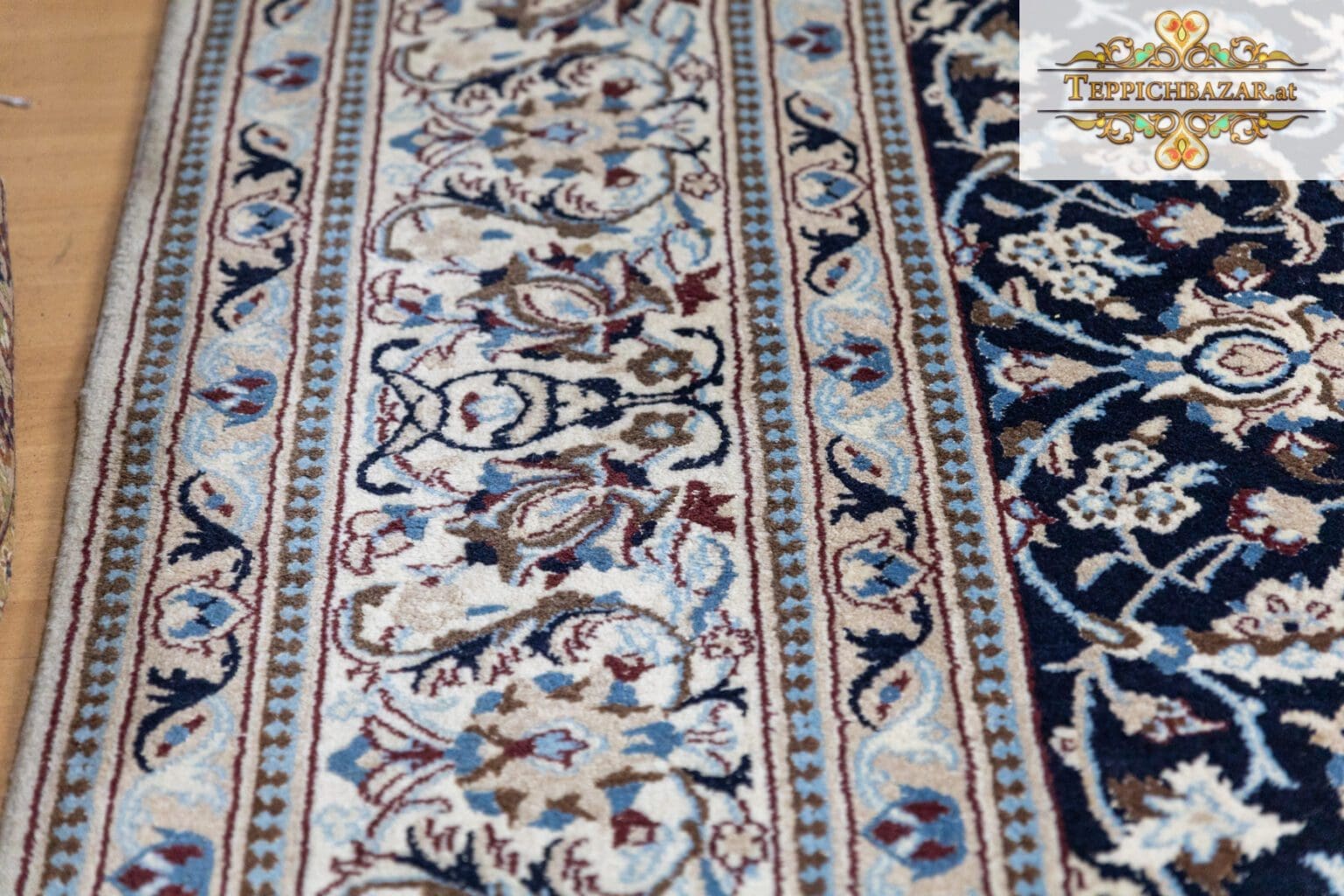
The colours used in Nain weaving can range from quiet earth tones to vivid shades. Bright overall impressions, carefully balanced contrasts and clearly structured borders are recurring features of the tradition. Floral and geometric elements are often brought together within one ordered composition. Nain thus signifies more than a geographical label: it points to a long-established Iranian craft culture, a disciplined approach to knotting and a recognisable Persian design heritage.
Design and Pattern
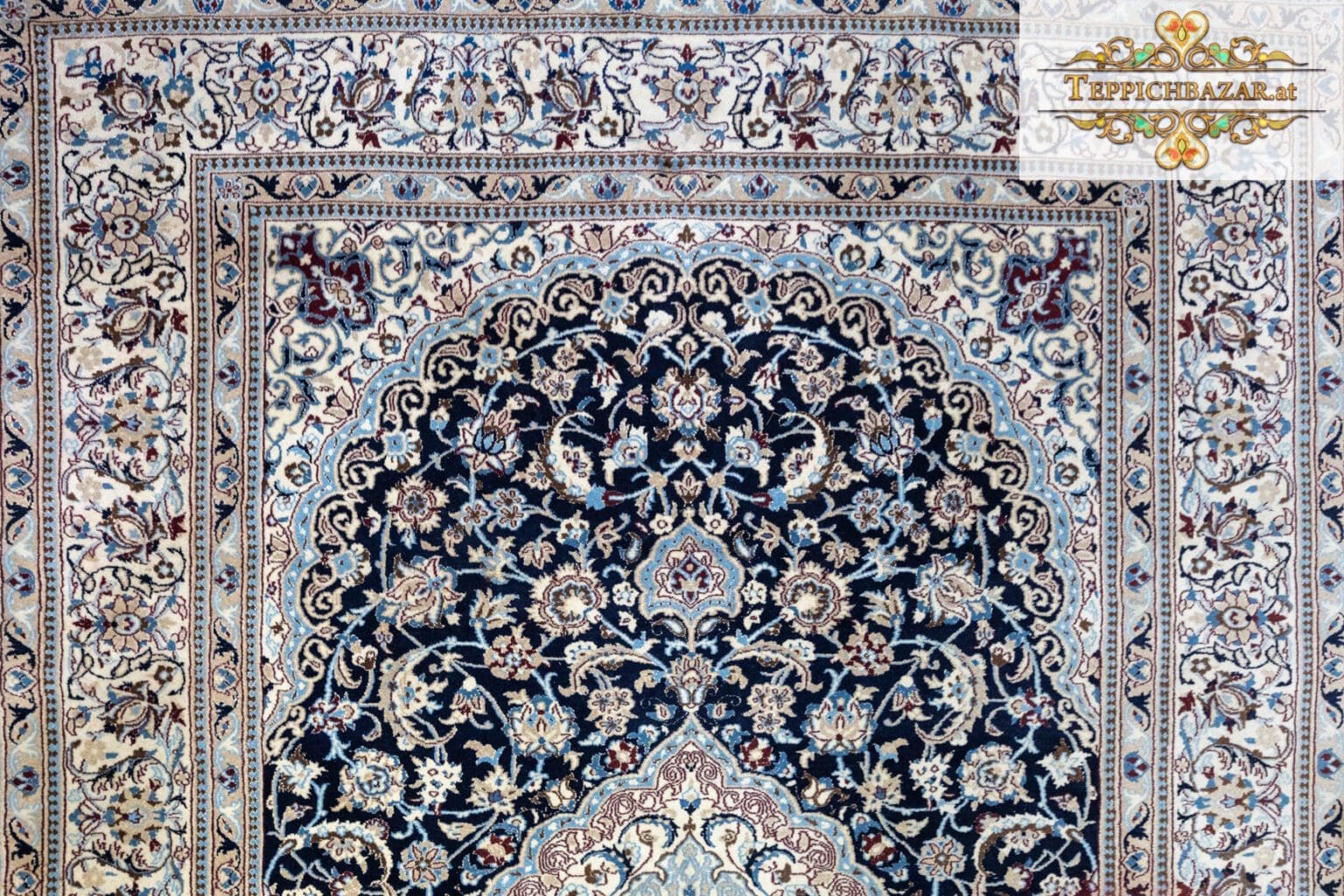
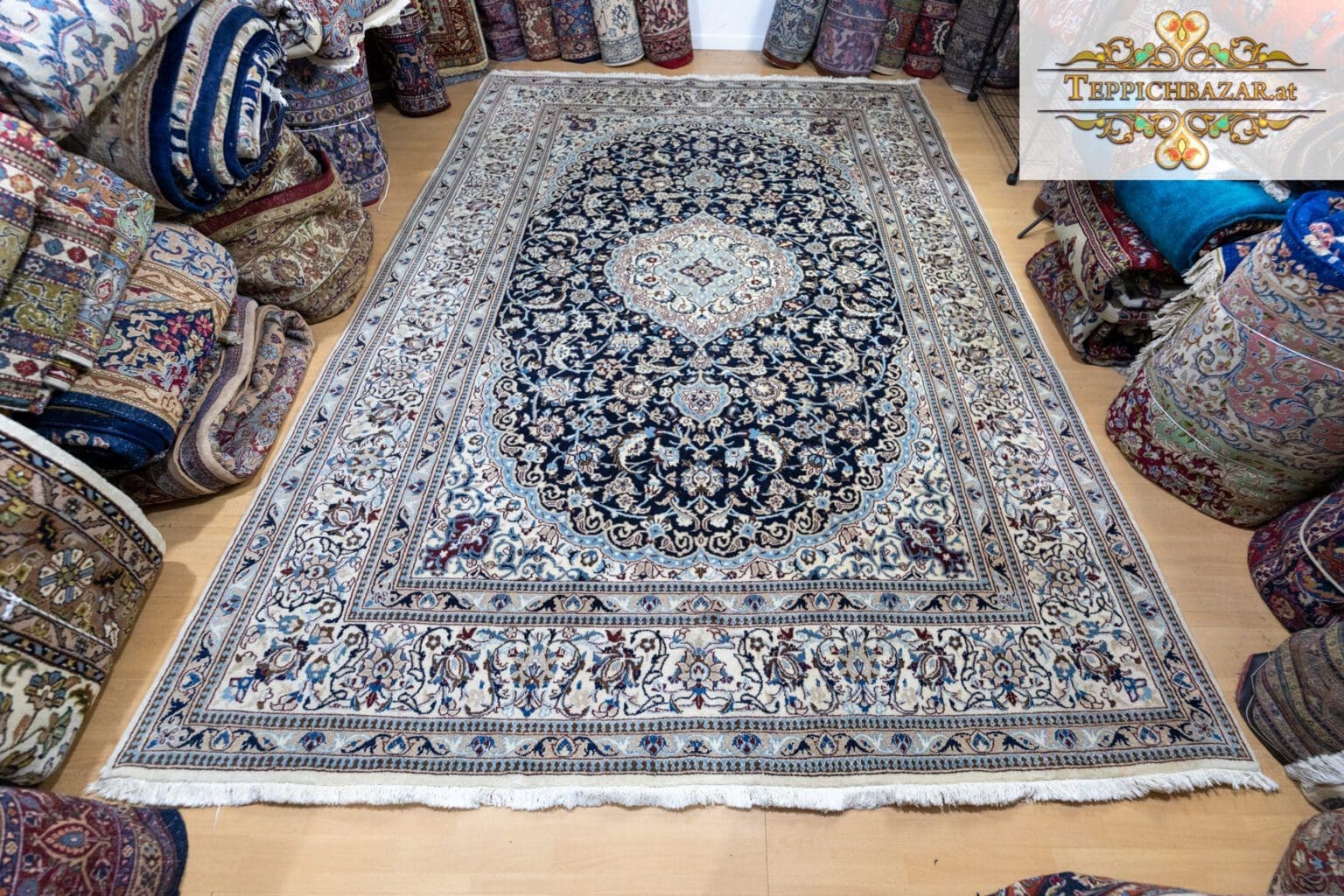
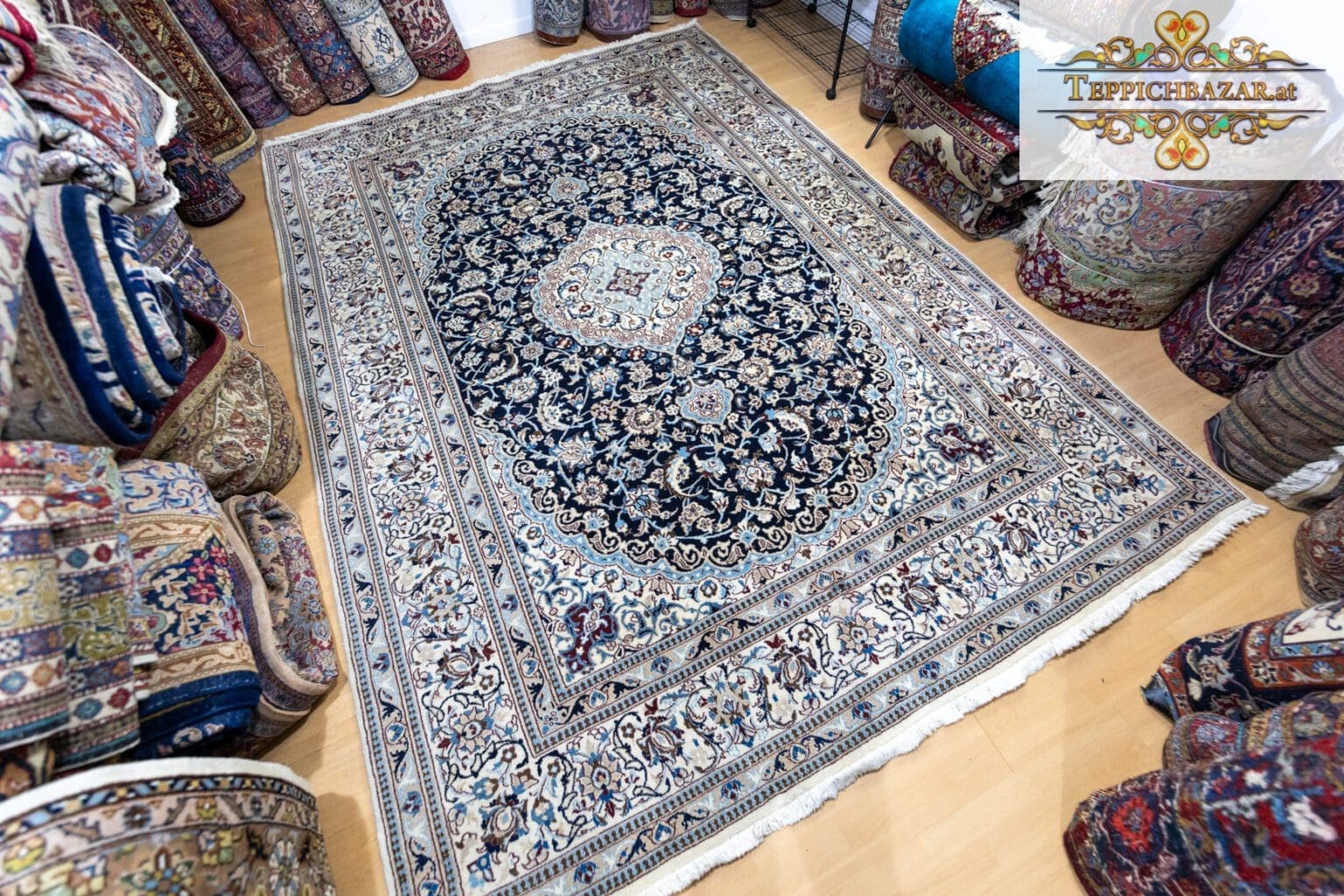
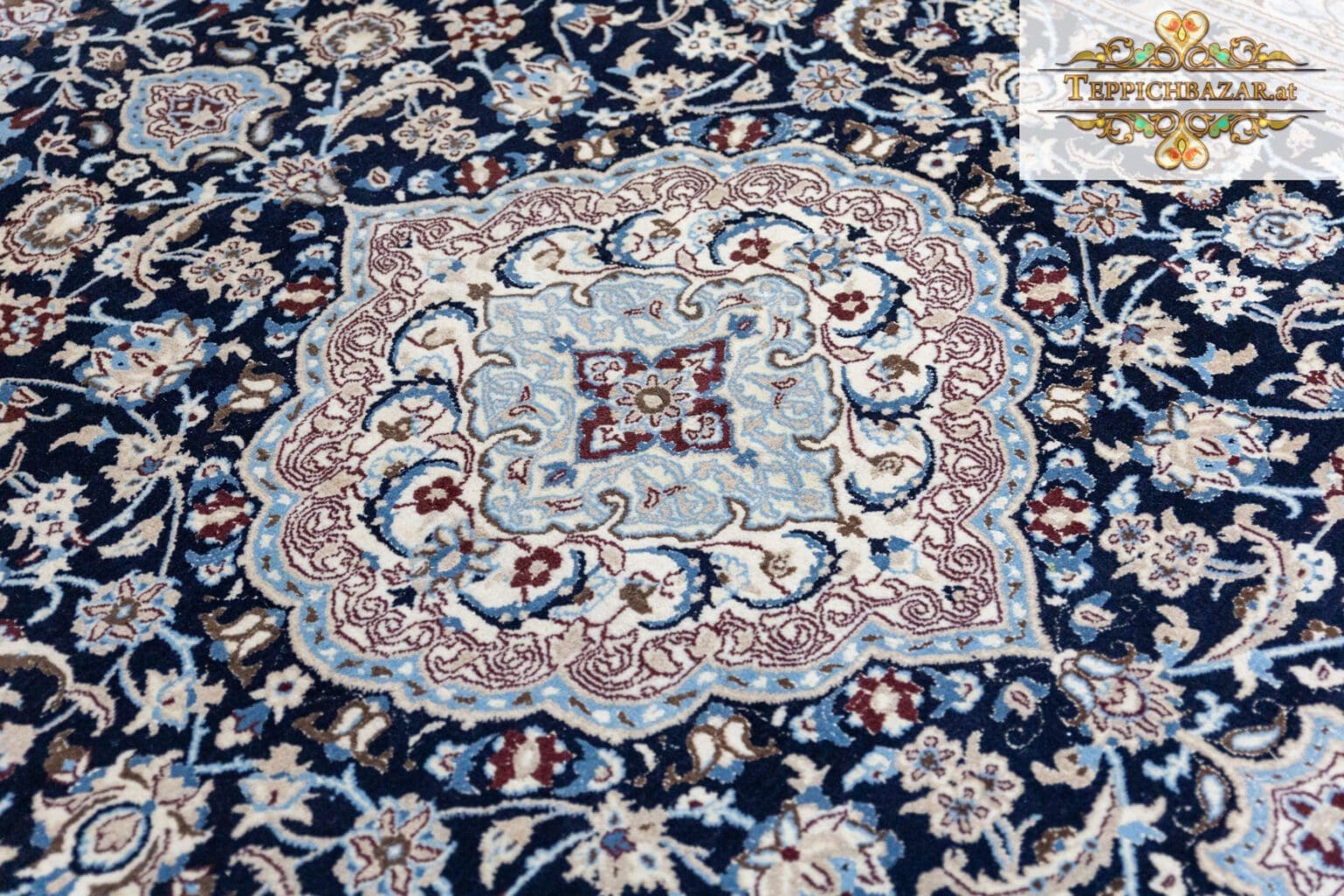
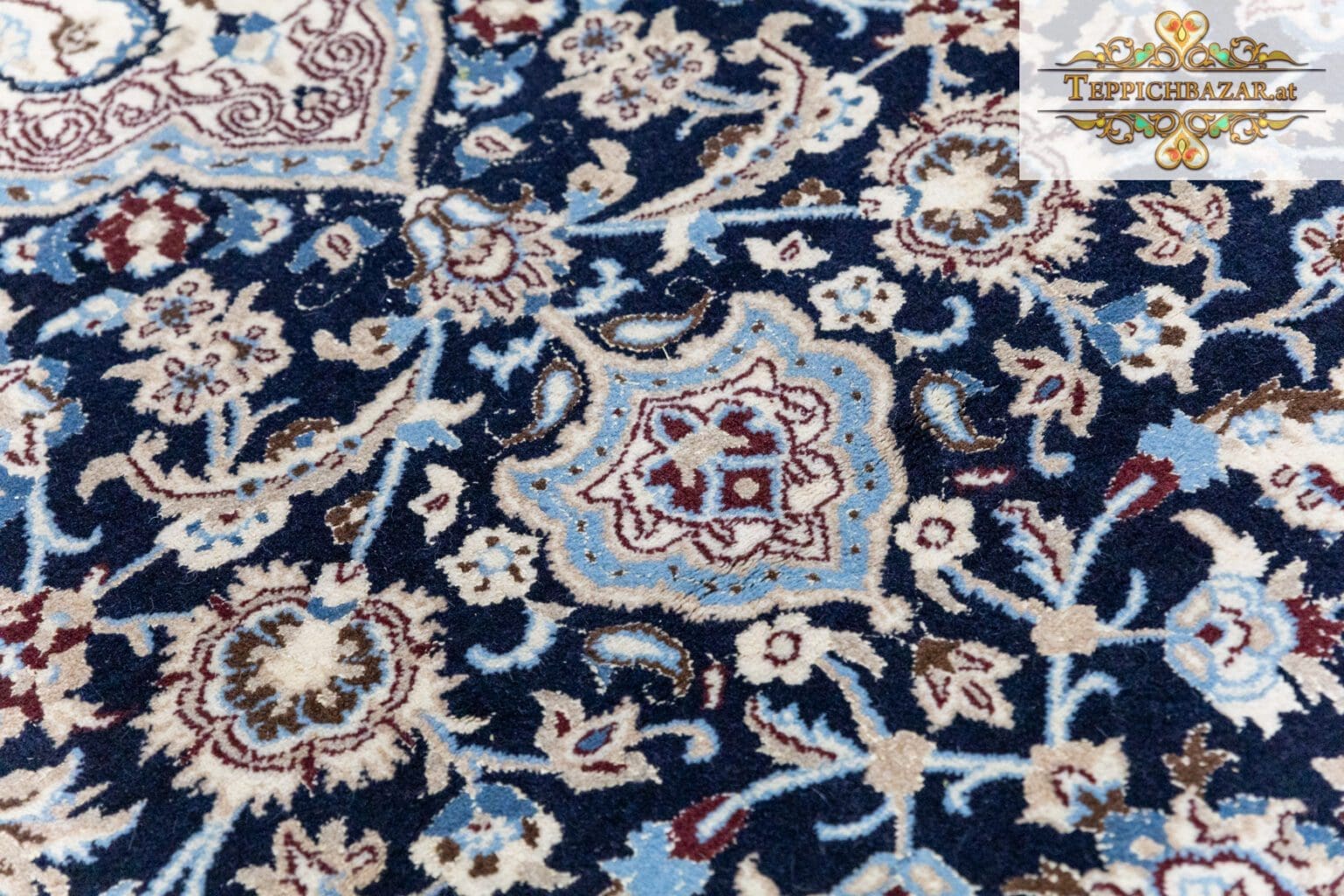
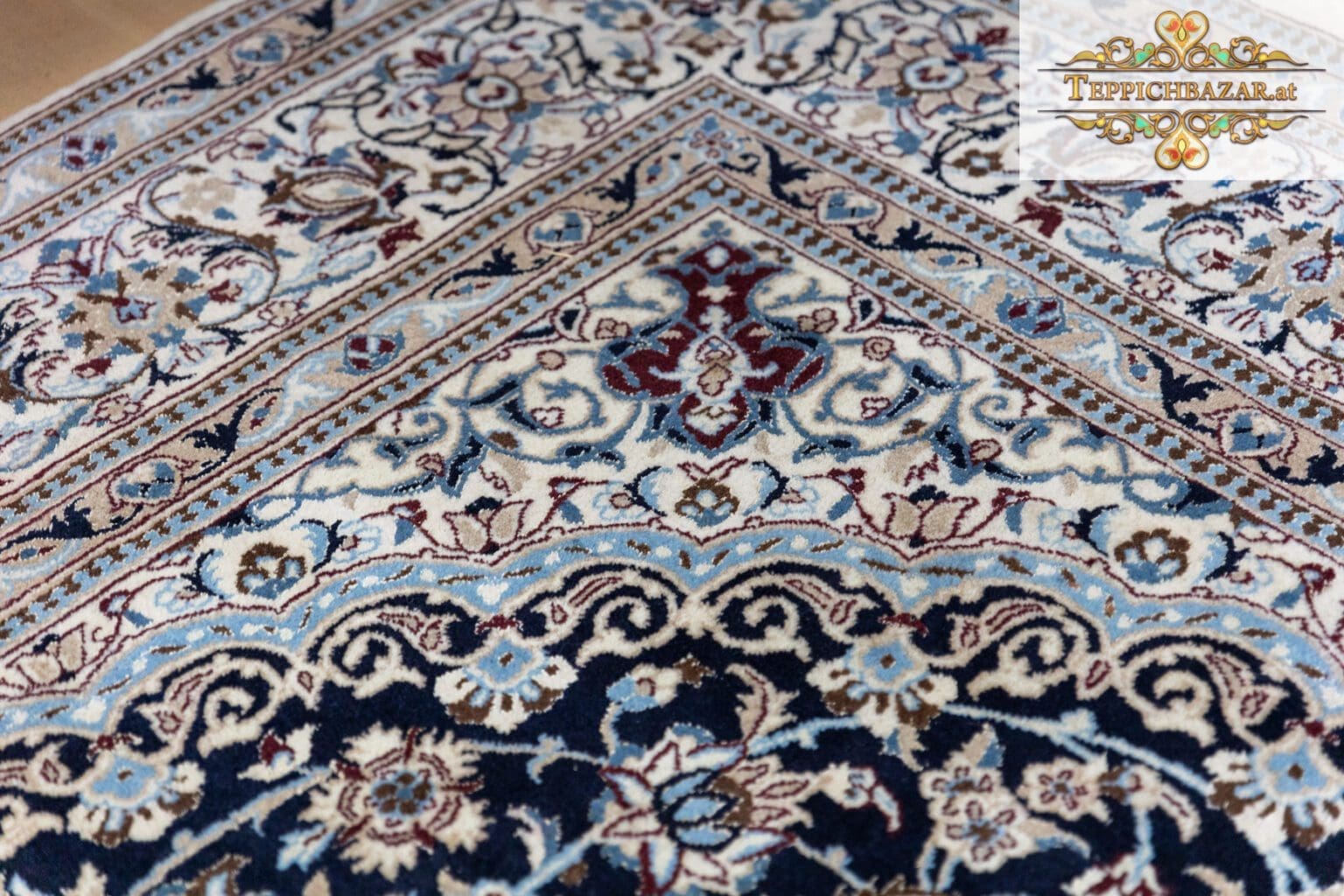
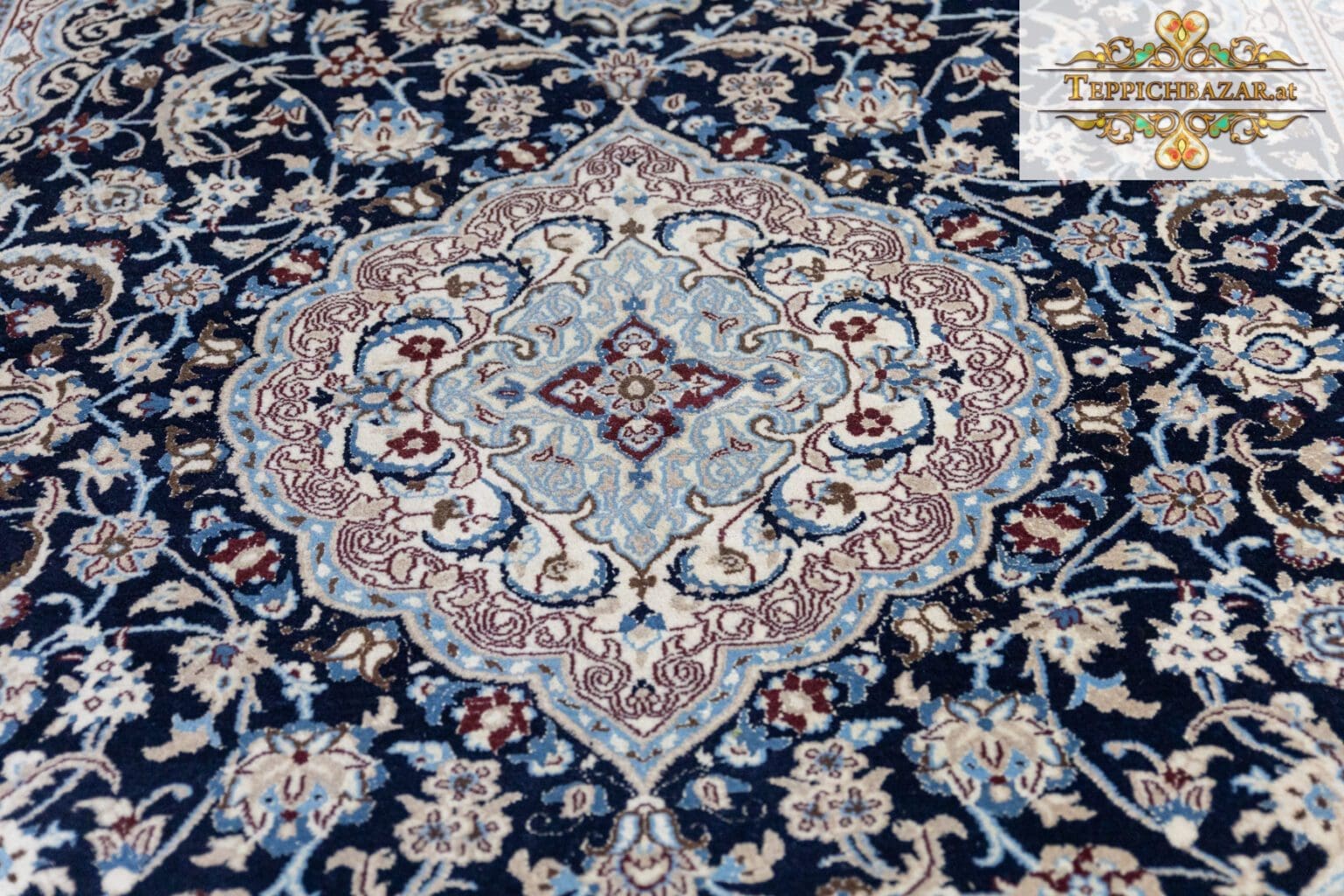
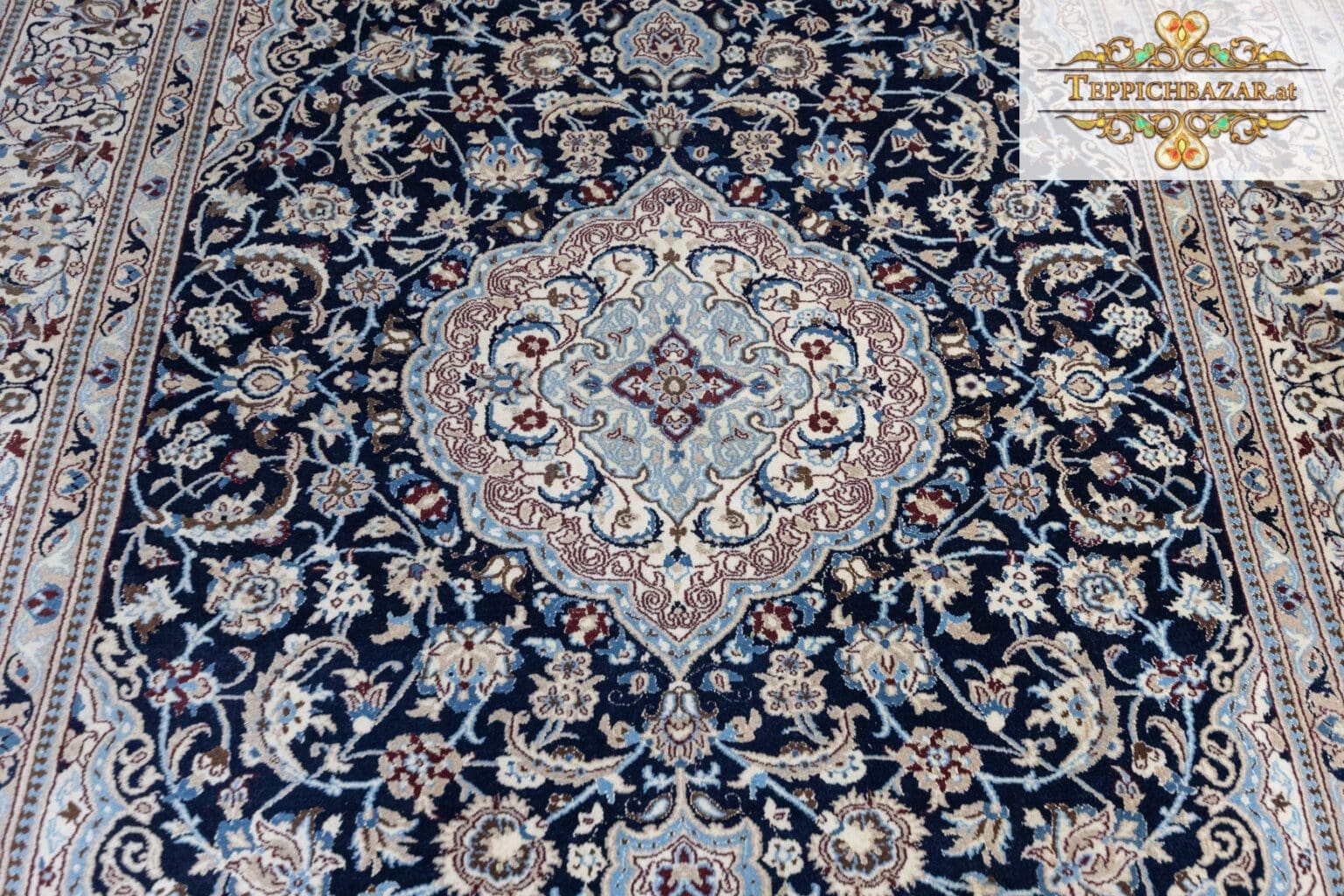
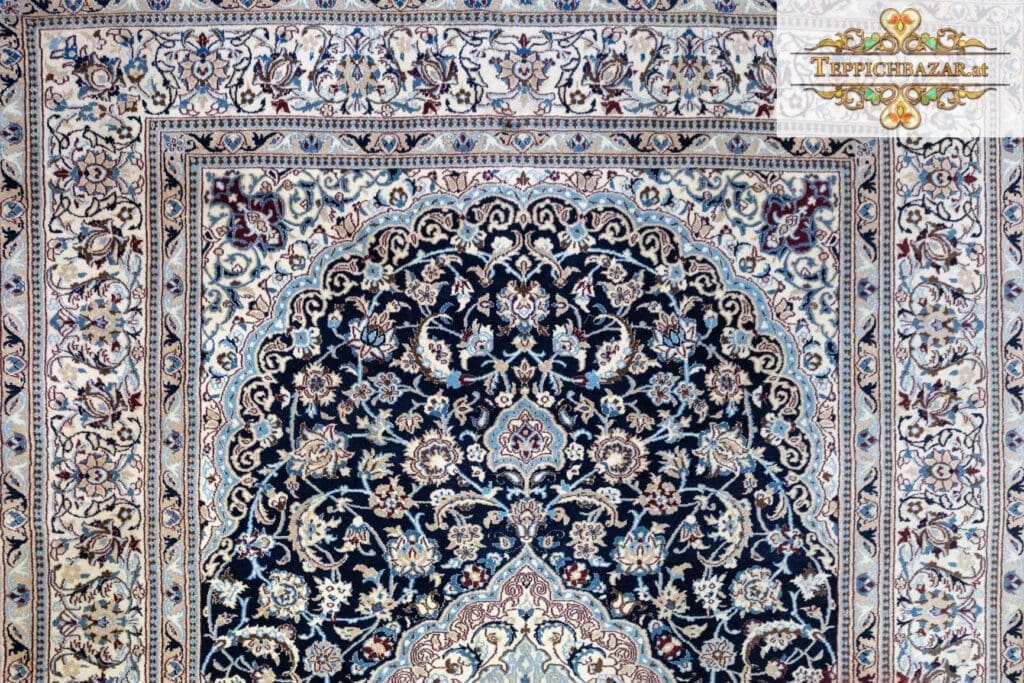
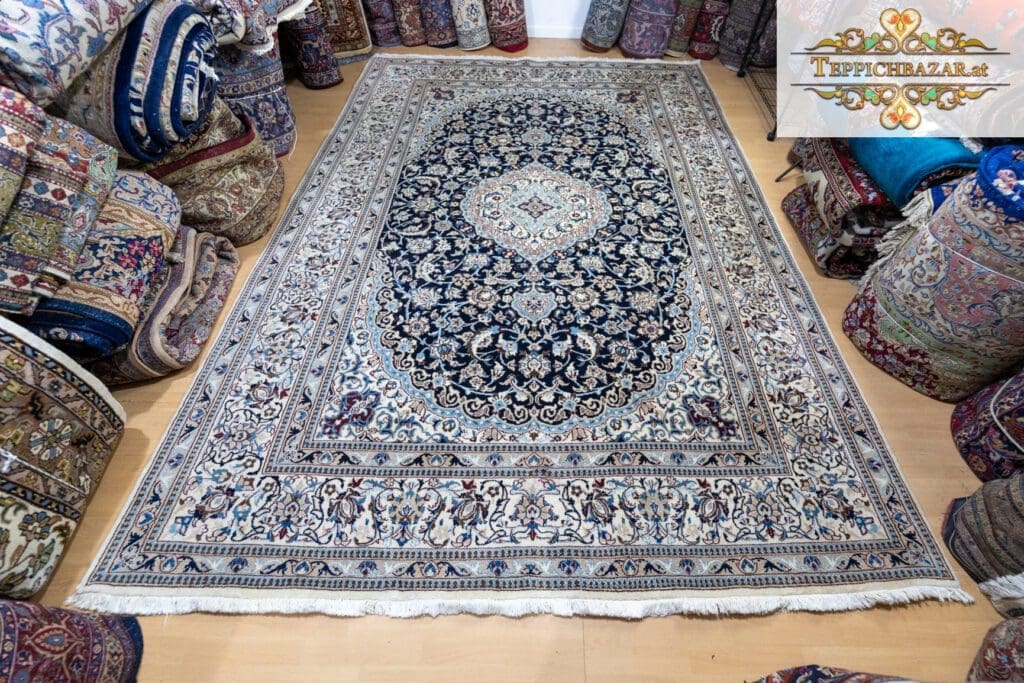
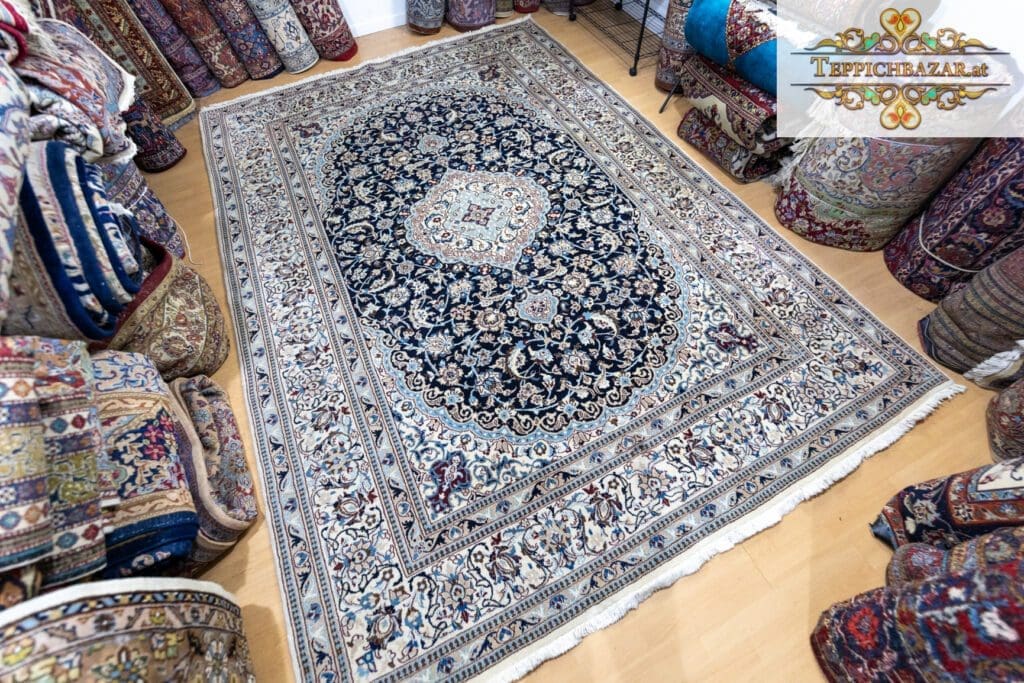
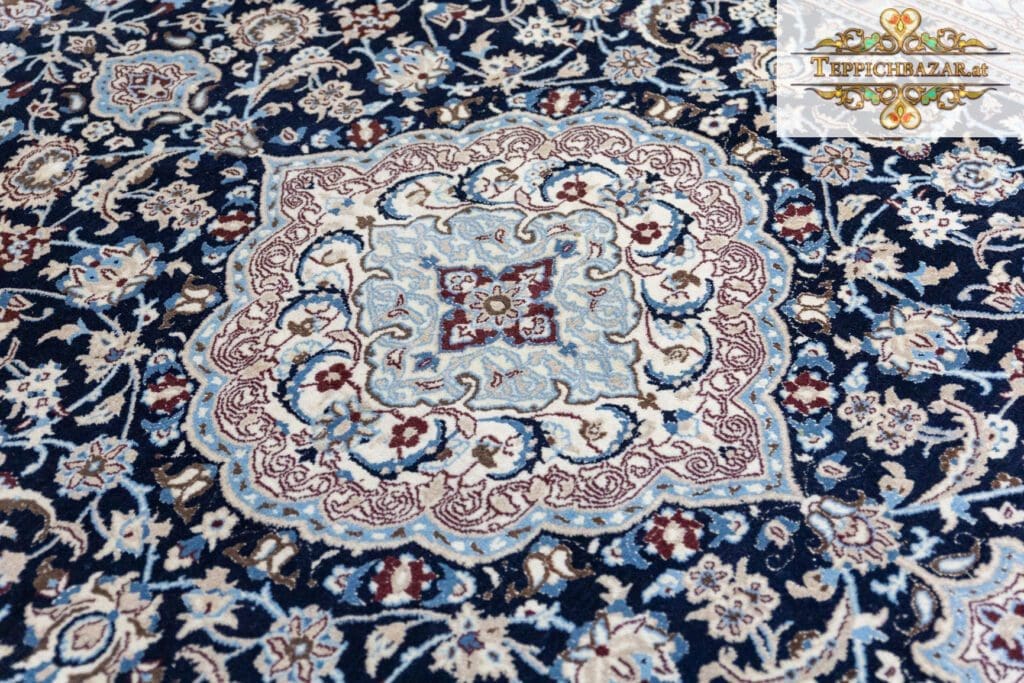
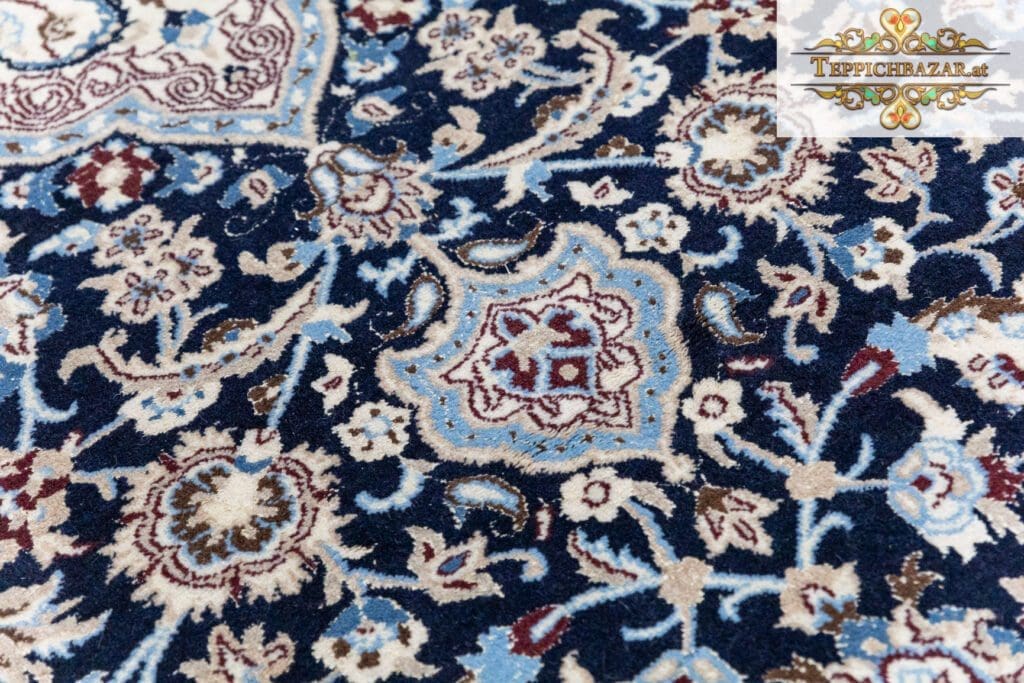
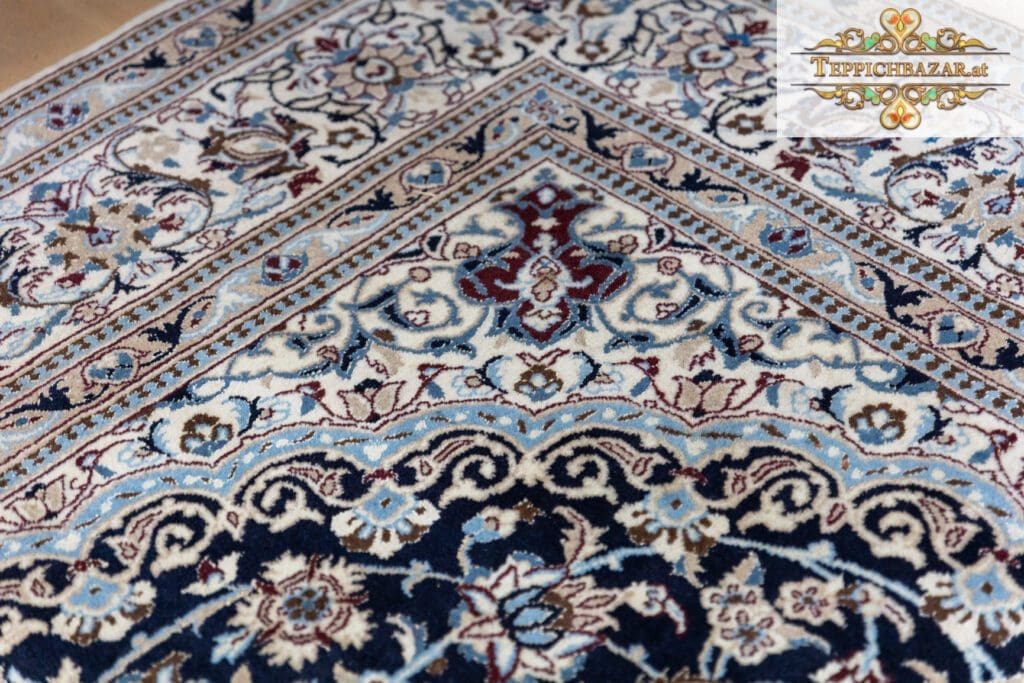
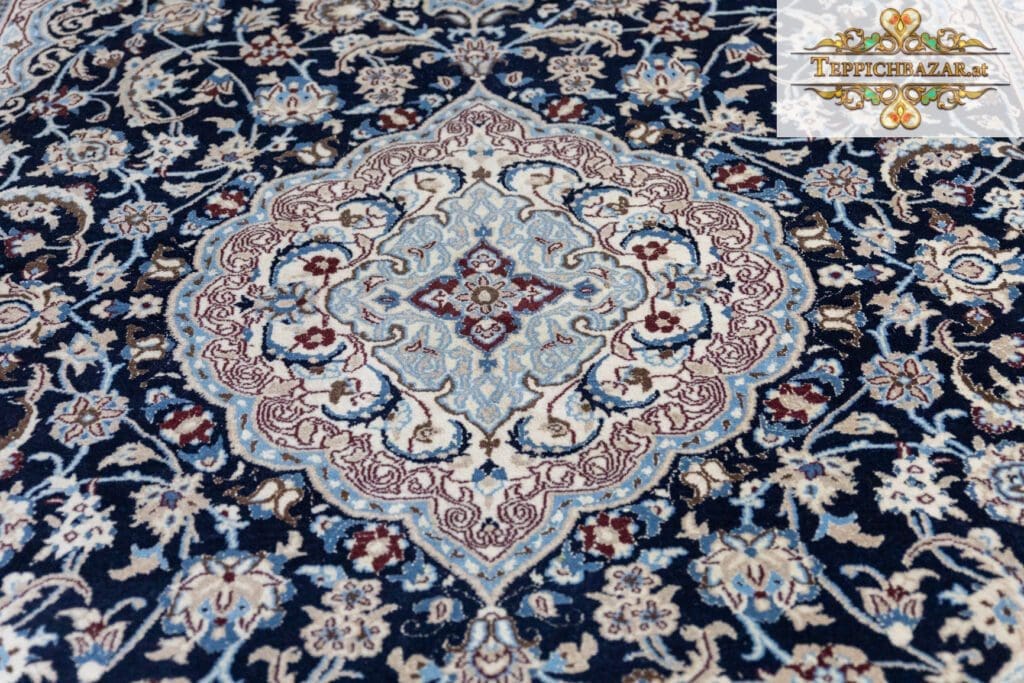
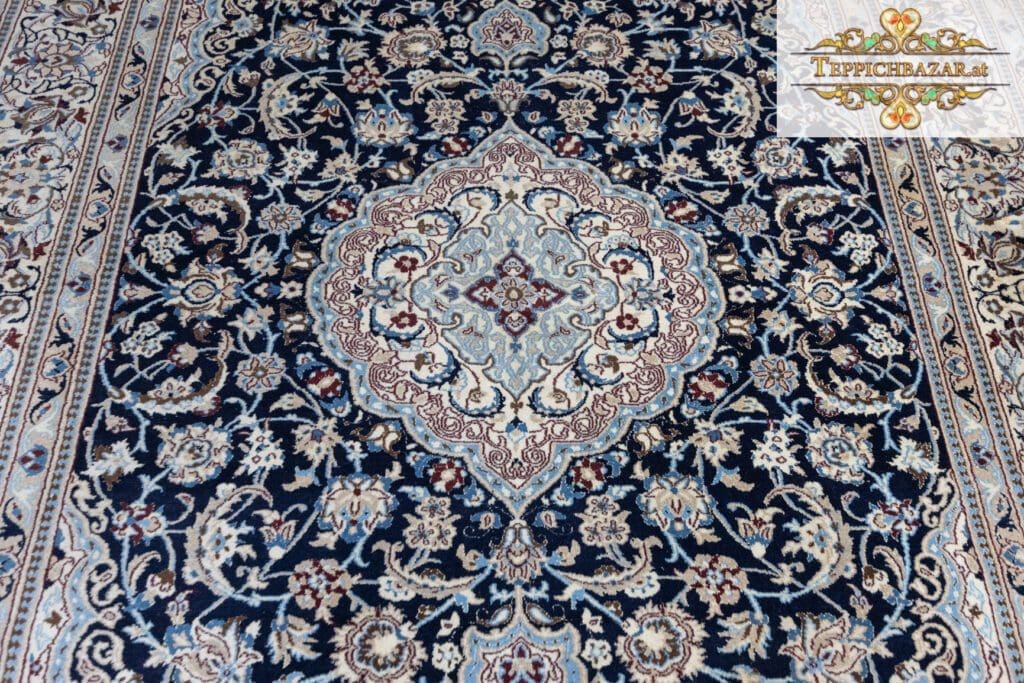
The pattern of this rug is identified as a Lachak-Toranj Nain medallion. Lachak-Toranj describes a classic medallion arrangement used in Nain rugs. At its centre is a toranj, or medallion, with surrounding ornaments and a composition organised around that central form. The term Lachak-Toranj refers to the relationship between the central medallion and the corner areas that lead the eye towards the border.
A medallion gives the field a clear visual centre. From that centre, floral vines, blossoms and stylised forms can extend into the surrounding space. The design remains controlled and legible while retaining fine detail. Nain pattern language often brings floral and geometric elements together. Floral forms provide movement, while geometric structure gives the composition rhythm, balance and definition.
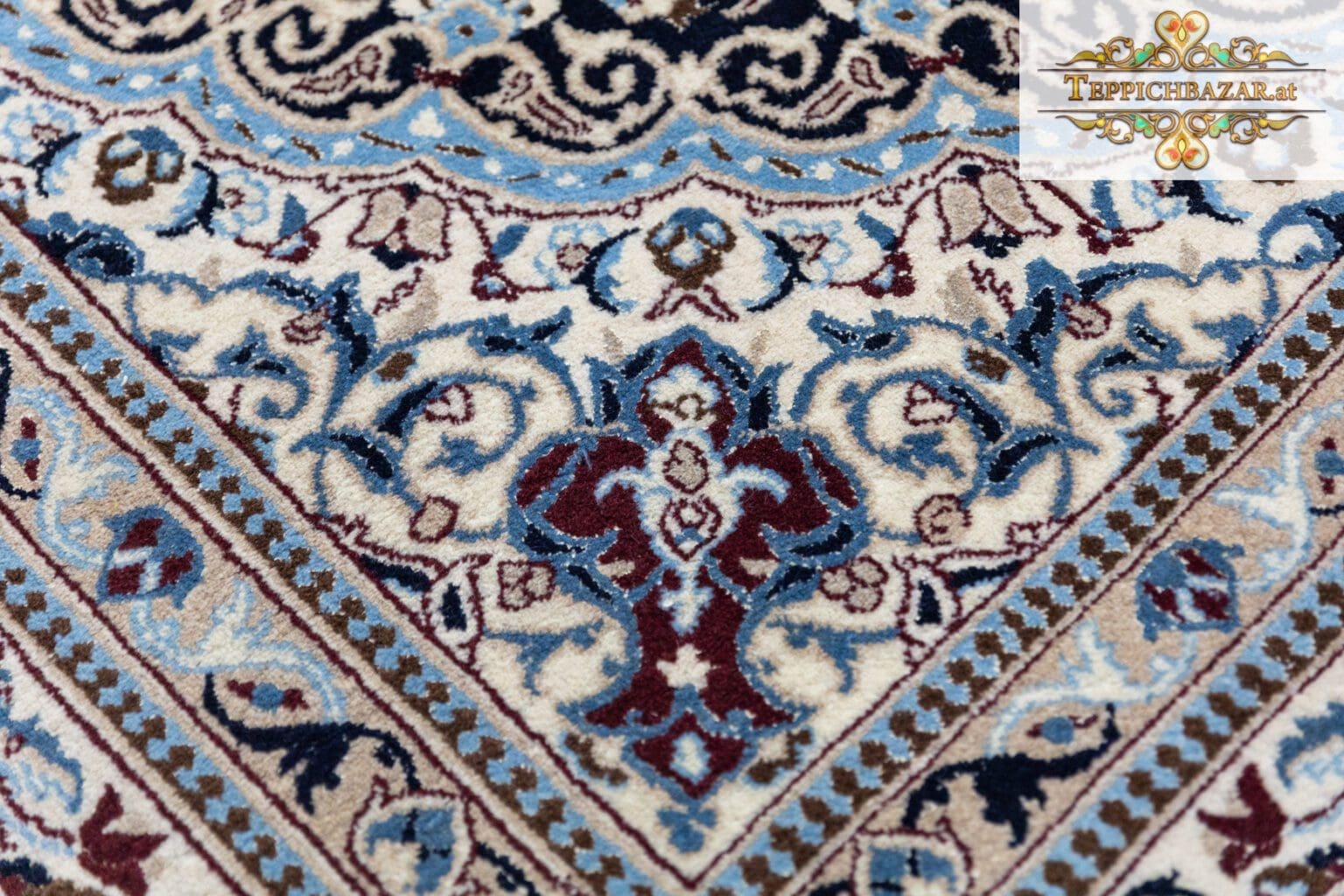
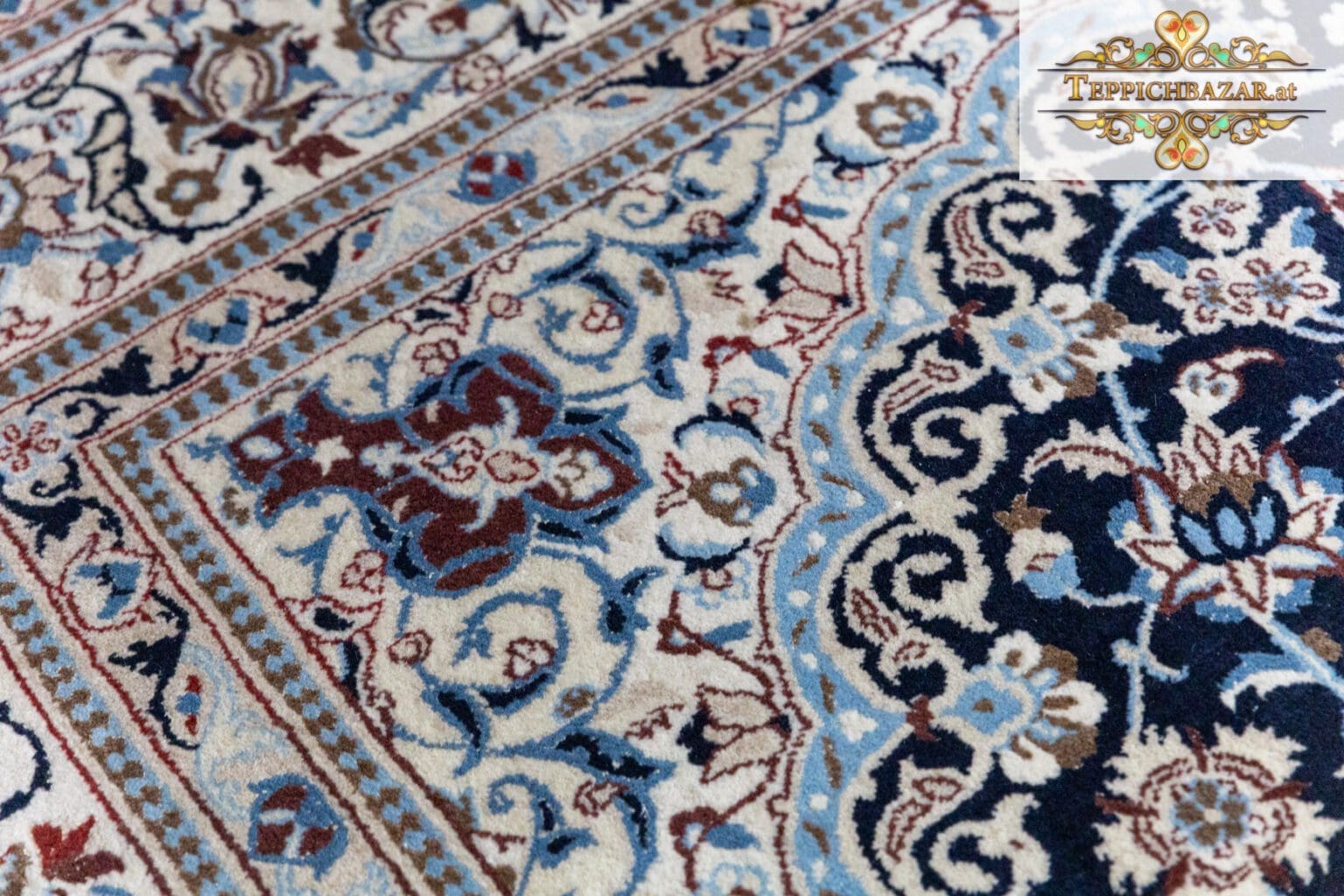
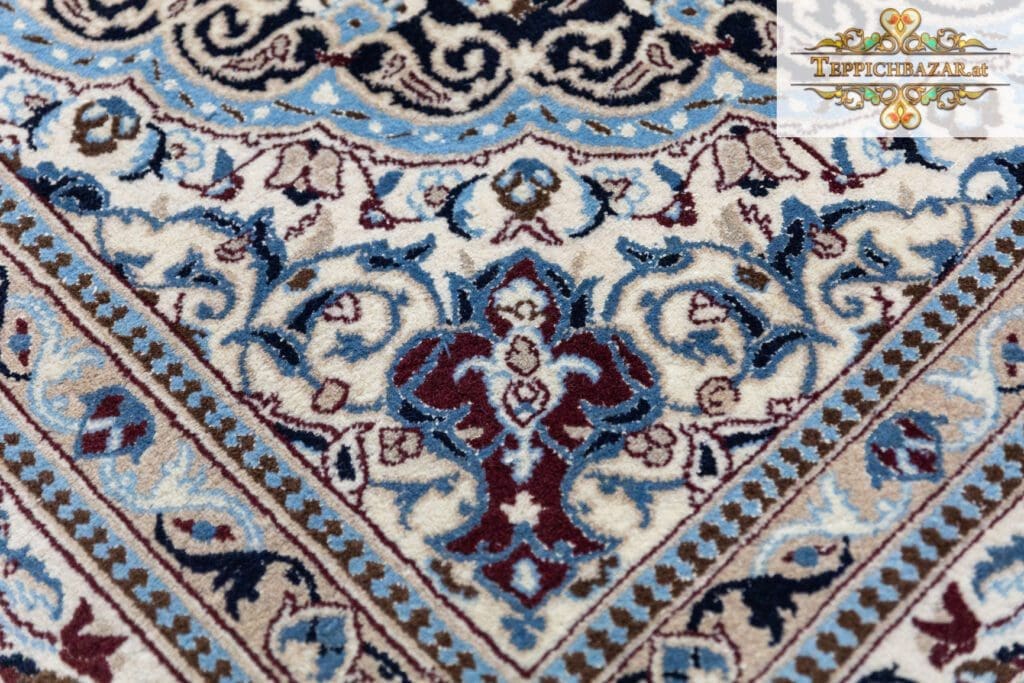
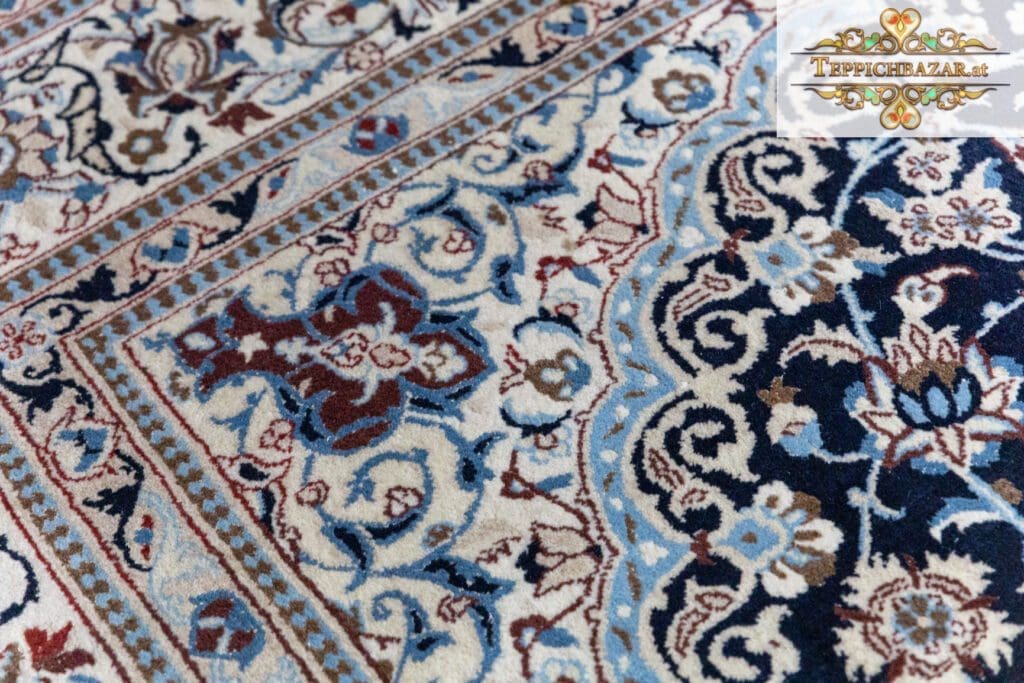
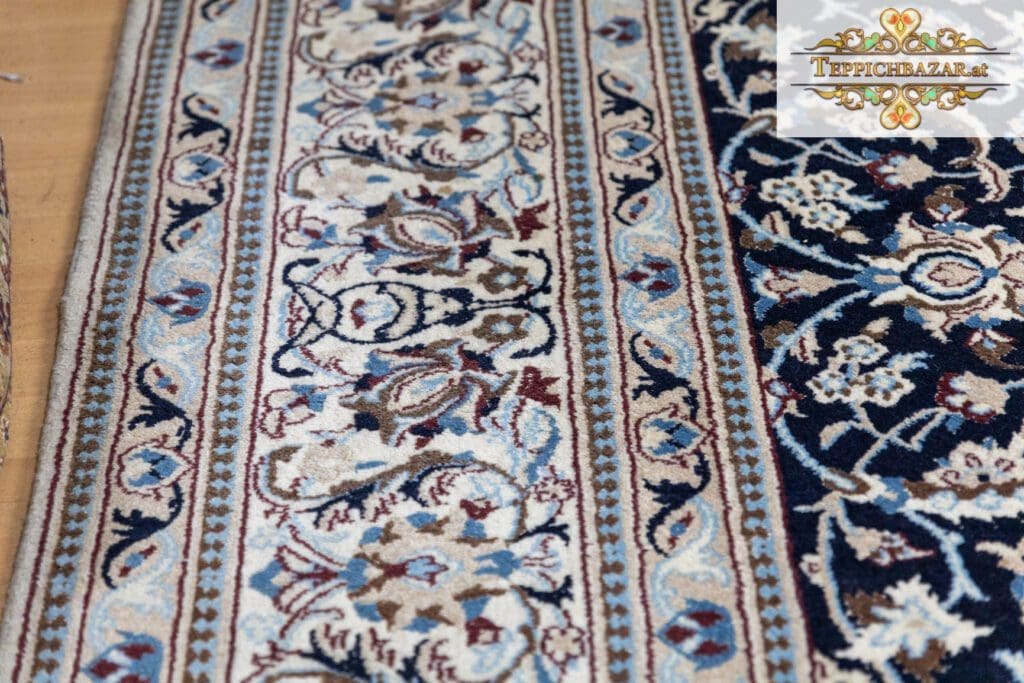
The four corners of a medallion composition relate to the central toranj. They echo its lines and motifs and guide the design outwards towards the border. The border frames the field and creates a transition between the central area and the outer edge. In a hand-knotted rug, these relationships are built knot by knot. Small variations are part of the nature of handwork, while the overall order of the design remains intact.
Floral ornaments may suggest leaves, blossoms, vines and stylised plant forms. Geometric details give these forms contour and rhythm. In Persian pattern traditions, ornaments are often understood as more than surface decoration; they can also carry elements of a wider cultural visual language. The product designation remains Lachak-Toranj Nain medallion, describing the design without changing the rug’s stated Nain origin.
The silk in the pile reinforces the differentiated effect of the design. Its fine fibre can make individual lines and ornaments appear especially clear and introduces a soft sheen into the patterned surface. That sheen changes with the direction of light and the viewer’s position. Together with wool, it creates a balance between quieter matte areas and subtly lustrous passages. The medallion’s formal character is thereby emphasised while the traditional Nain composition remains distinct.
This design combines an established Persian medallion format with a finely detailed execution. It can therefore be read in both a classical interior and a more restrained modern setting. This concerns the design language of the pattern, not an invented feature of the individual rug. The exact distribution of colour and the precise arrangement of its ornaments remain the particular characteristics of this hand-knotted one-off piece.
Special Features
The rug’s notable features include its Nain origin, fine 12La knotting and Lachak-Toranj medallion. Its pile is made of 100% wool with silk, while the warp is 100% cotton. Different natural fibres therefore come together in one hand-knotted construction. Silk contributes a fine sheen to the pile, while wool defines its main surface character. The central medallion gives the rug a clearly recognisable structure.
The condition is described as TOP CONDITION. The product description also presents the rug as suitable for different interior settings, including a classic living room, an elegant office or a modern apartment. The stated durability of the materials is linked with suitability for everyday use. For care, regular vacuuming without a brush attachment is recommended. Stains should be dabbed with a damp cloth rather than rubbed, and professional cleaning at longer intervals may be appropriate.
The product description states that the rug can also be used over underfloor heating. The heating level should not be set too high. For checking authenticity, the fine knotting, the use of natural materials and a manufacturer’s label or certificate are named as useful indications. If there is uncertainty, an expert examination is the appropriate way to assess the rug.
FAQ
How should I care for my Nain rug?
Regular vacuuming helps remove loose dust and everyday dirt from the pile. Use a vacuum cleaner without a brush attachment so that the knots and fine fibres are not subjected to unnecessary mechanical stress. If a spill occurs, dab it as soon as possible with a damp cloth. Rubbing can work the mark further into the fibres and place additional strain on the surface. Professional cleaning every few years may also be useful when the rug requires a more thorough treatment.
Can the rug be used over underfloor heating?
Yes. This hand-knotted Nain rug can be used over underfloor heating. Wool and silk are described in the product information as materials that provide good temperature regulation. The heating level should nevertheless remain moderate and should not be set too high, so that heat does not place unnecessary stress on the fibres or on the hand-knotted construction. Even, moderate heating is the gentler approach for the rug.
How can I tell whether my rug is genuine?
Fine knotting and the use of natural materials are important indications of an authentic Nain rug. A manufacturer’s label or certificate can also provide evidence about origin and material composition. Authenticity should not be judged from one visual feature alone, since handmade patterns and regional designations can be interpreted in different ways. If any doubt remains, an experienced specialist can examine the knotting, materials and stated origin and provide a more reliable assessment.
To provide the best experiences, we use technologies like cookies to store and/or access device information. Consenting to these technologies will allow us to process data such as browsing behavior or unique IDs on this site. Not consenting or withdrawing consent, may adversely affect certain features and functions.
Functional Always active
The technical storage or access is strictly necessary for the legitimate purpose of enabling the use of a specific service explicitly requested by the subscriber or user, or for the sole purpose of carrying out the transmission of a communication over an electronic communications network.
Preferences
The technical storage or access is necessary for the legitimate purpose of storing preferences that are not requested by the subscriber or user.
Statistics
The technical storage or access that is used exclusively for statistical purposes.The technical storage or access that is used exclusively for anonymous statistical purposes. Without a subpoena, voluntary compliance on the part of your Internet Service Provider, or additional records from a third party, information stored or retrieved for this purpose alone cannot usually be used to identify you.
Marketing
The technical storage or access is required to create user profiles to send advertising, or to track the user on a website or across several websites for similar marketing purposes.

 SECURE PAYMENT
 SHIPPING PARTNERS