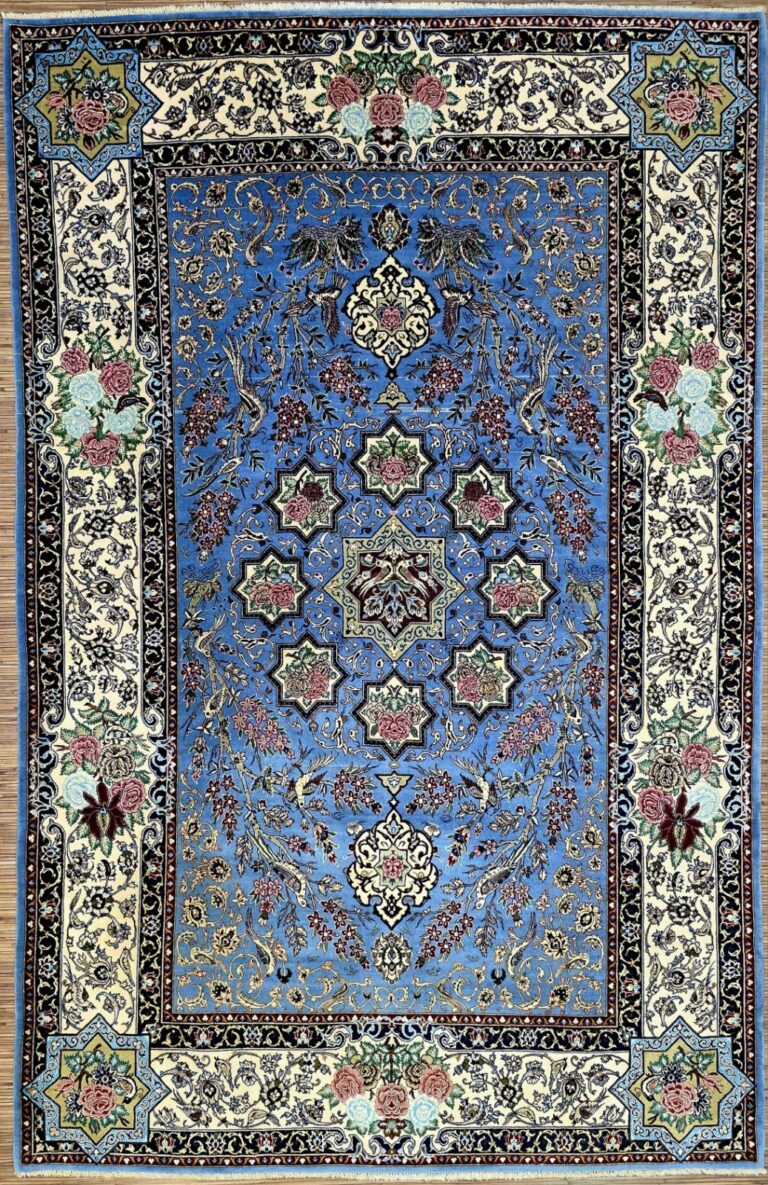
This Nain Persian rug is hand-knotted and made from a blend of 80% wool and 20% silk. Each fibre contributes a different quality to the surface. Wool is valued for its warmth and resilience, while silk is known for its smooth handle, softness and characteristic sheen. Used together, the two materials create a pile that combines the practical qualities associated with wool with the refined surface character associated with silk.
Hand-knotting is a patient, highly skilled process. Rather than being produced as an identical industrial series, the rug is built knot by knot on a loom, with the design developed through the work of the knotter. This piece has a knot density of approximately 400,000 knots per square metre. Such a fine construction provides the technical basis for working out small lines, floral details and traditional ornaments with considerable definition. The density belongs to the workmanship of this individual rug and also reflects the precise approach commonly associated with Nain weaving.
The combination of wool and silk affects both the touch and the way the surface responds to light. Wool gives the pile a warm and naturally robust character; silk adds smoothness and can create subtle changes in lustre across the design. The rug is new. Its construction is therefore presented together with the condition of a new piece, its fine knotting and its natural materials. As a one-off, it has an individual execution rather than being a standardised repeat of another rug.
The making of a hand-knotted rug demands concentration throughout the process. The artisan follows the intended drawing, places the knots, secures the rows and develops the surface gradually. This relationship between material, structure and manual work is central to the character of a Nain rug. Here, the wool-and-silk pile, the fine knotting and the individual handmade execution form the documented basis of the piece.
Origin and Tradition
Nain rugs originate in Nain, a city in Iran’s Isfahan province. Nain is therefore both a place name and a regional designation within the Persian rug tradition. This rug is offered as a Persian rug from Persia and is identified as Nain. The name points to the weaving culture of the city and its surrounding region, where careful workmanship, refined materials and established design principles are brought together.
Persian rug making developed as a textile tradition with its own vocabulary of structure, ornament and composition. Rugs were made as useful household textiles, but also as carefully designed woven artworks in which technical skill and visual order were closely connected. A hand-knotted rug records this process in its construction: every knot contributes to the density, the drawing and the final surface. Regional workshops preserved methods through practice, teaching and repeated work rather than through mechanised production.
Nain is often associated with fine knotting and the use of quality materials. These features help explain the place Nain occupies within the wider history of Iranian carpet weaving. The tradition is not defined by one isolated motif. It is created by the relationship between a controlled layout, floral ornament, balanced borders, refined materials and exacting handwork. Nain designs may draw on classical Persian and Islamic forms while maintaining a distinct regional identity.
Traditional methods are passed from one generation to the next through the knowledge of preparing materials, reading a design and placing knots consistently. The work requires an understanding of proportion as well as manual accuracy. The weaver must maintain the relationship between the central field, surrounding ornaments and border structure as the rug grows. This continuity of method is one reason regional rug traditions remain recognisable even when individual pieces differ in their precise drawing and arrangement.
The designation Nain should not be confused with a general reference to Oriental decoration. It identifies a particular Iranian city and a regional weaving tradition in Isfahan province. The Oriental Persian style of this rug belongs within that context. Its status as a hand-knotted one-off connects the regional tradition with a single, individually made textile rather than with a mass-produced floor covering.
Within Persian carpet history, regional identity is expressed through more than geography. It can also be seen in the balance between materials, knotting technique and the treatment of ornament. Nain is commonly recognised for an approach that gives fine patterning a clear and composed structure. The documented wool-and-silk material blend and the fine knot density of this rug sit naturally within that technical tradition, while the specific execution remains unique to this piece.
Design and Pattern
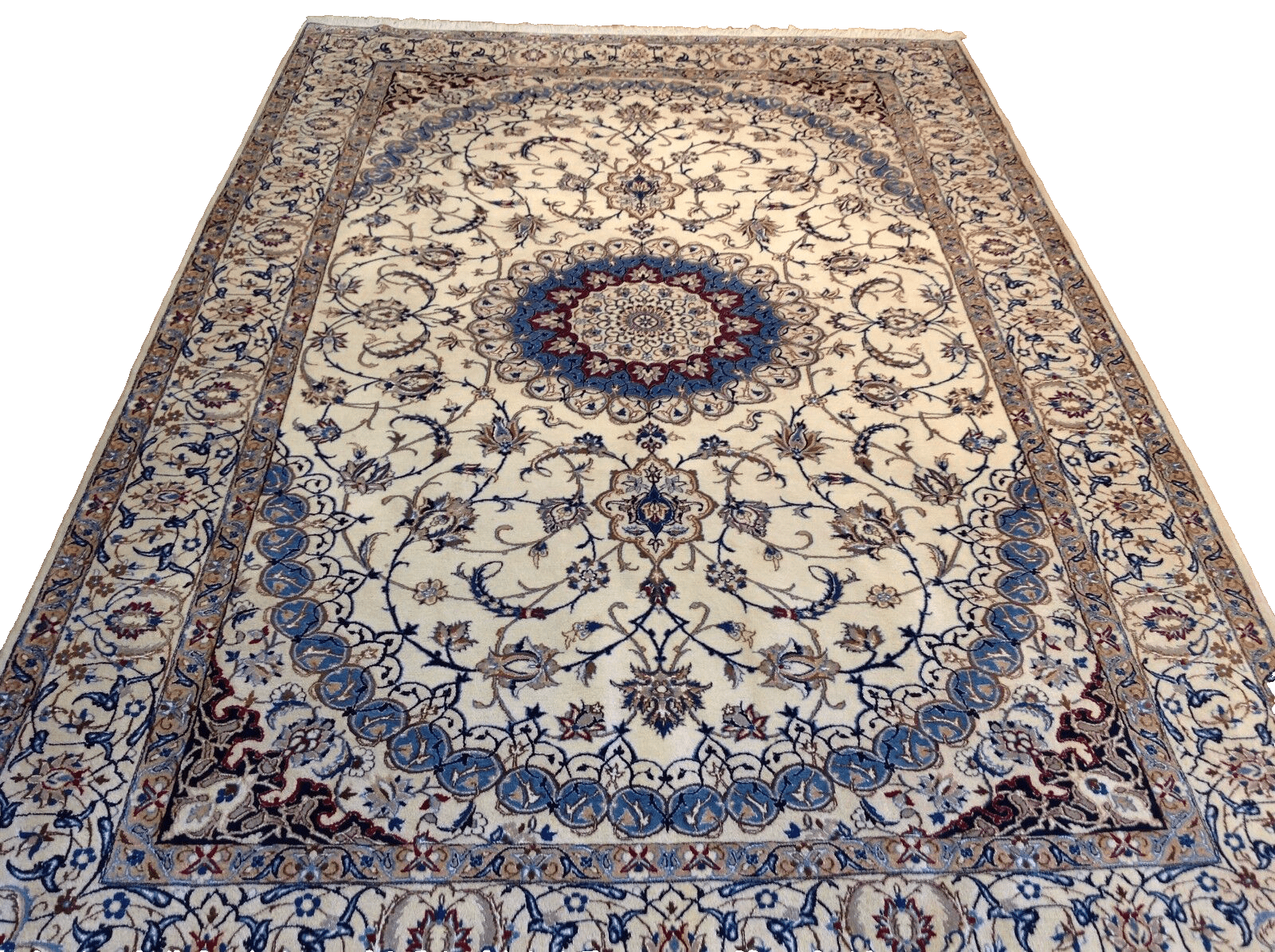
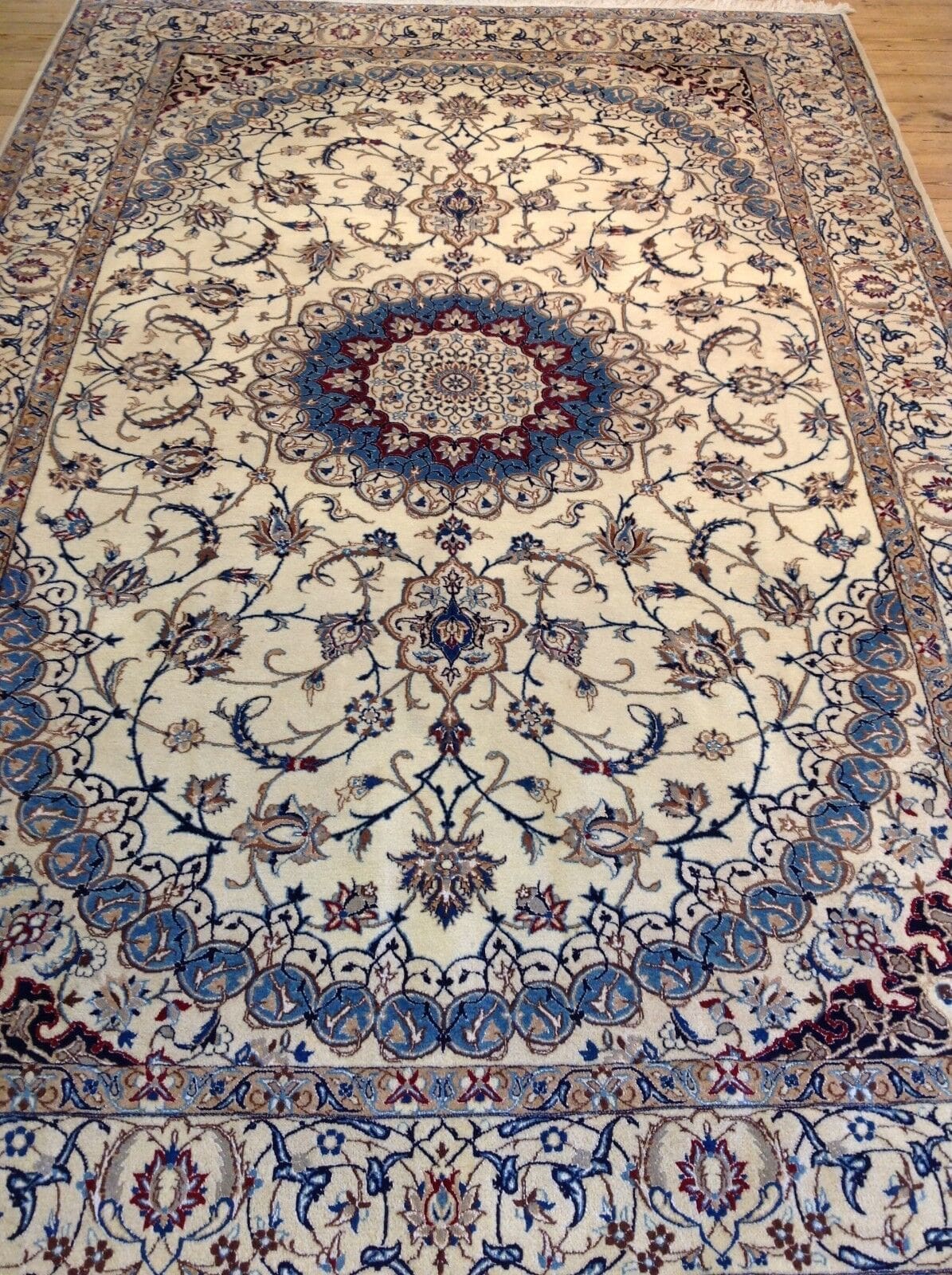
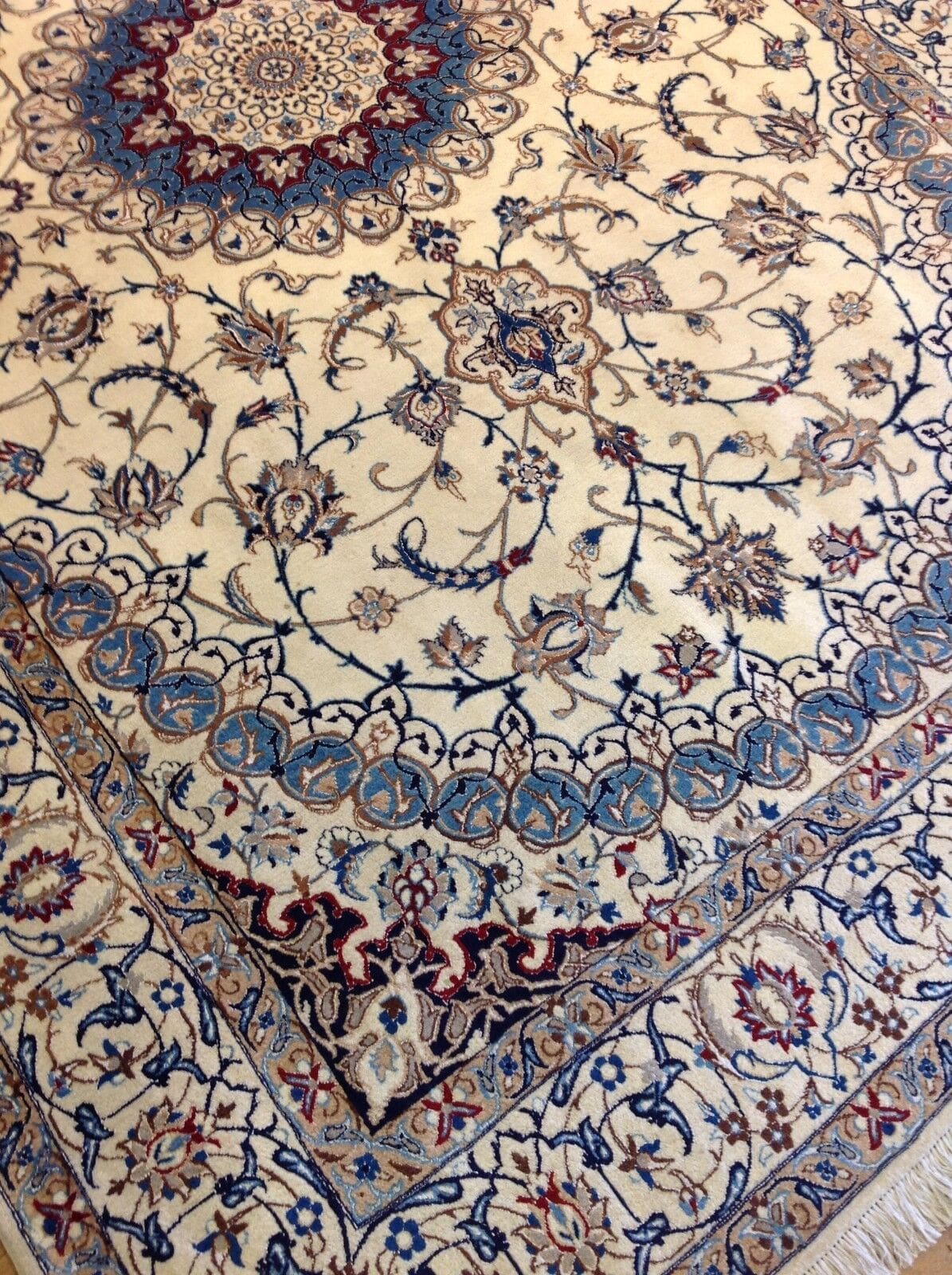
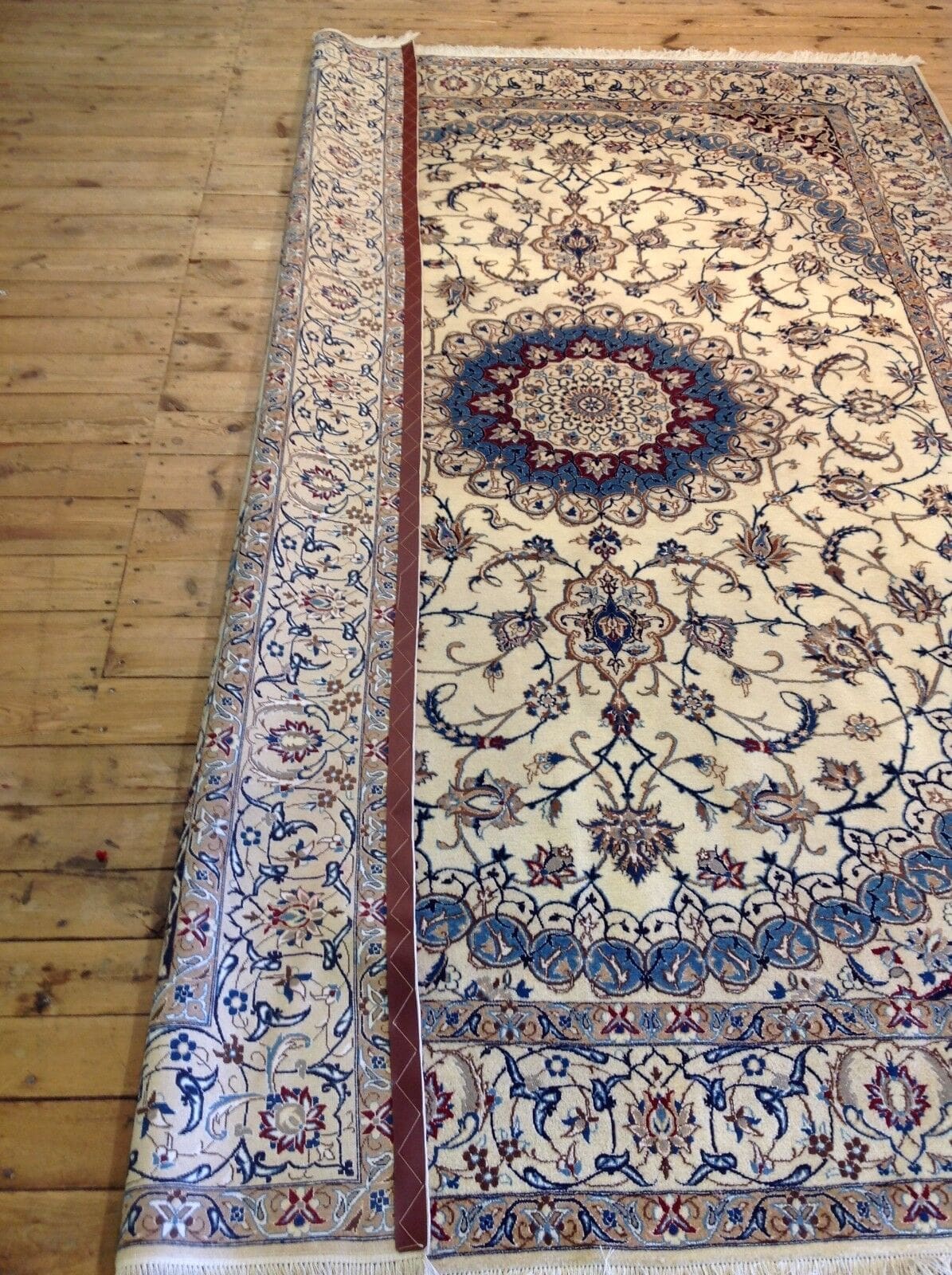
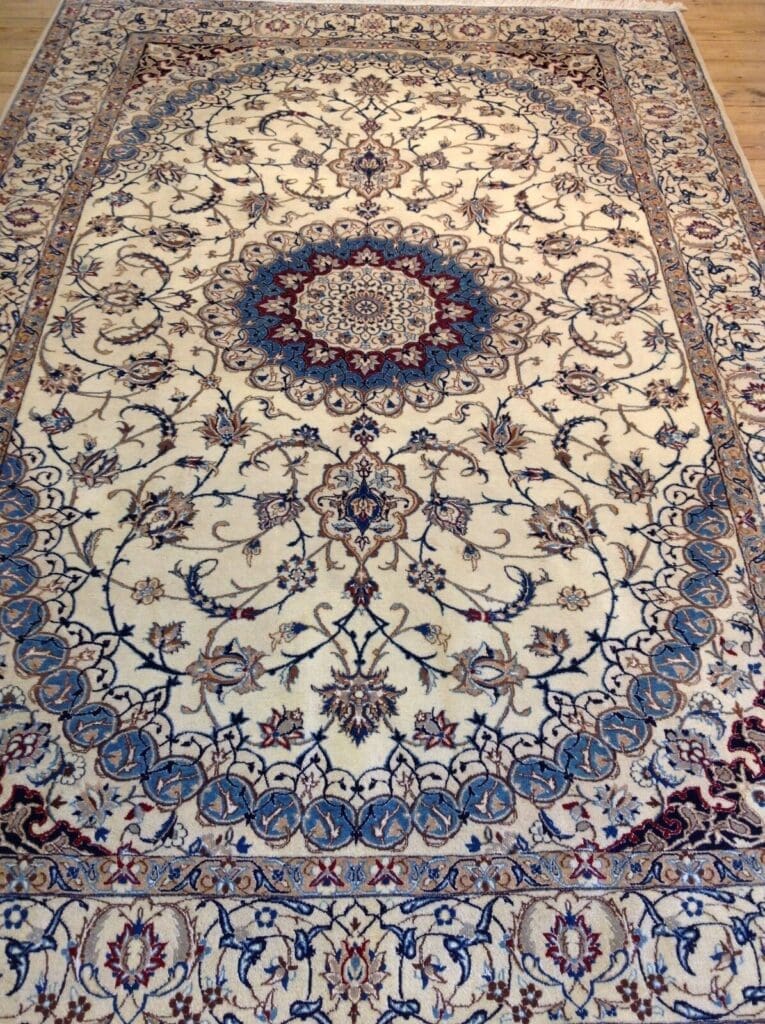
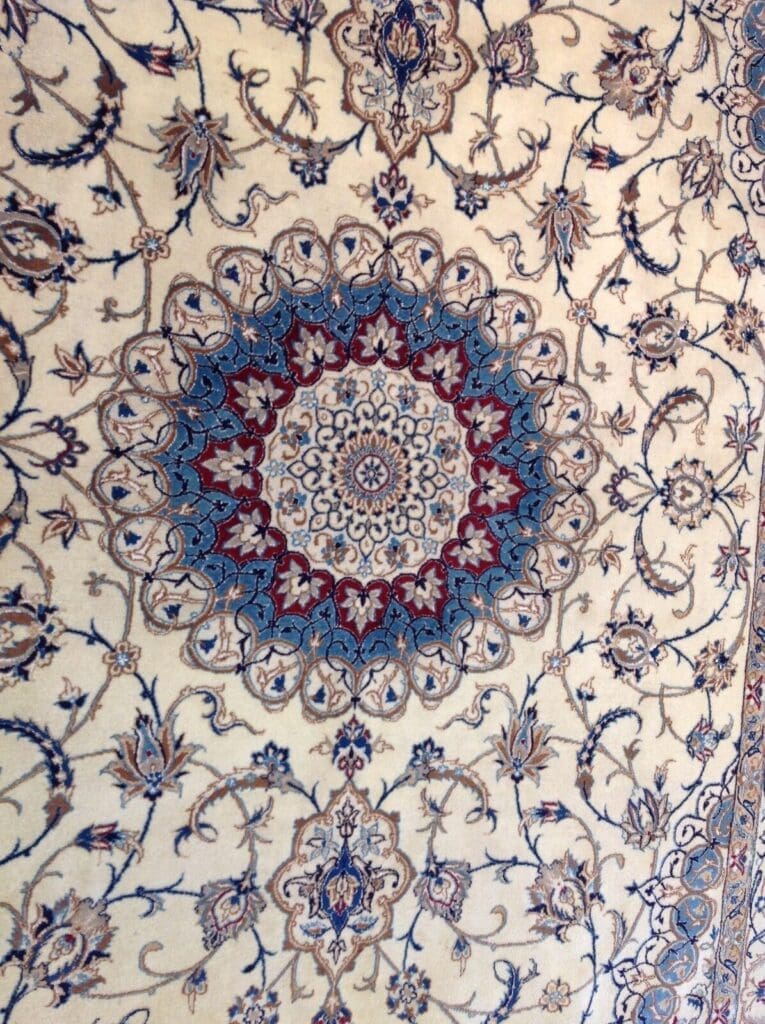
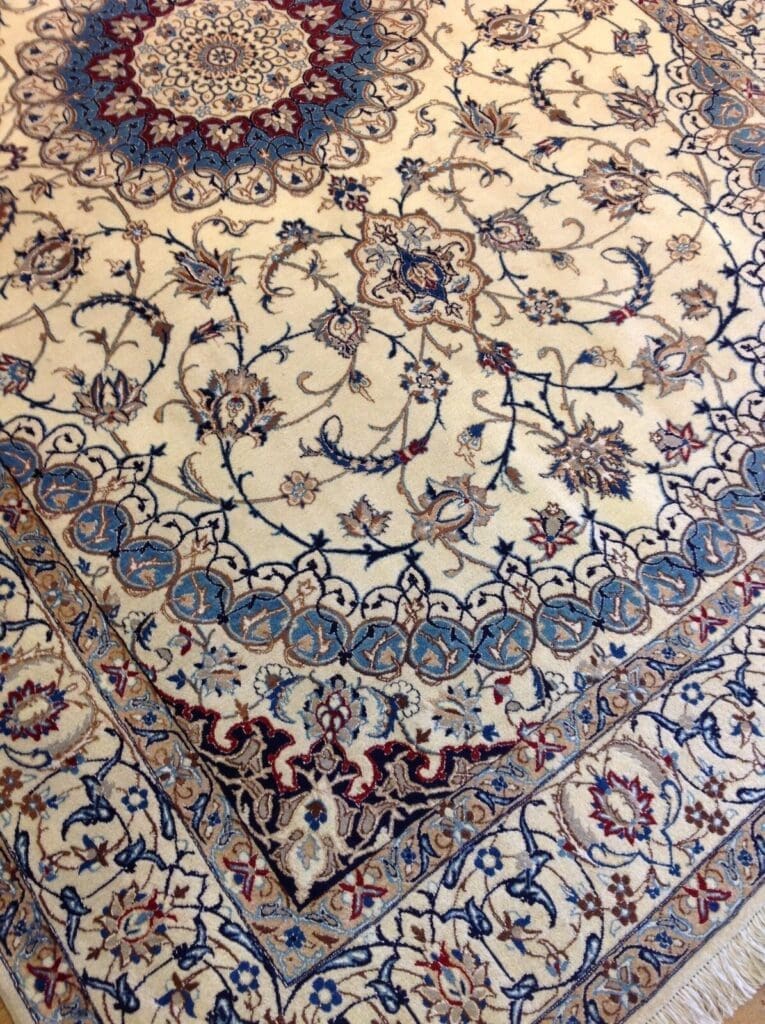
Nain rugs are often characterised by elegant floral designs, harmonious colour arrangements and a strong sense of symmetry. Floral forms may include stylised flowers, leaves, vines and arabesque elements arranged in a carefully controlled rhythm. These motifs are not simply copied from nature; they are shaped into a decorative language of repeated curves, balanced intervals and ordered transitions. The result is a design tradition in which detail remains connected to the overall composition.
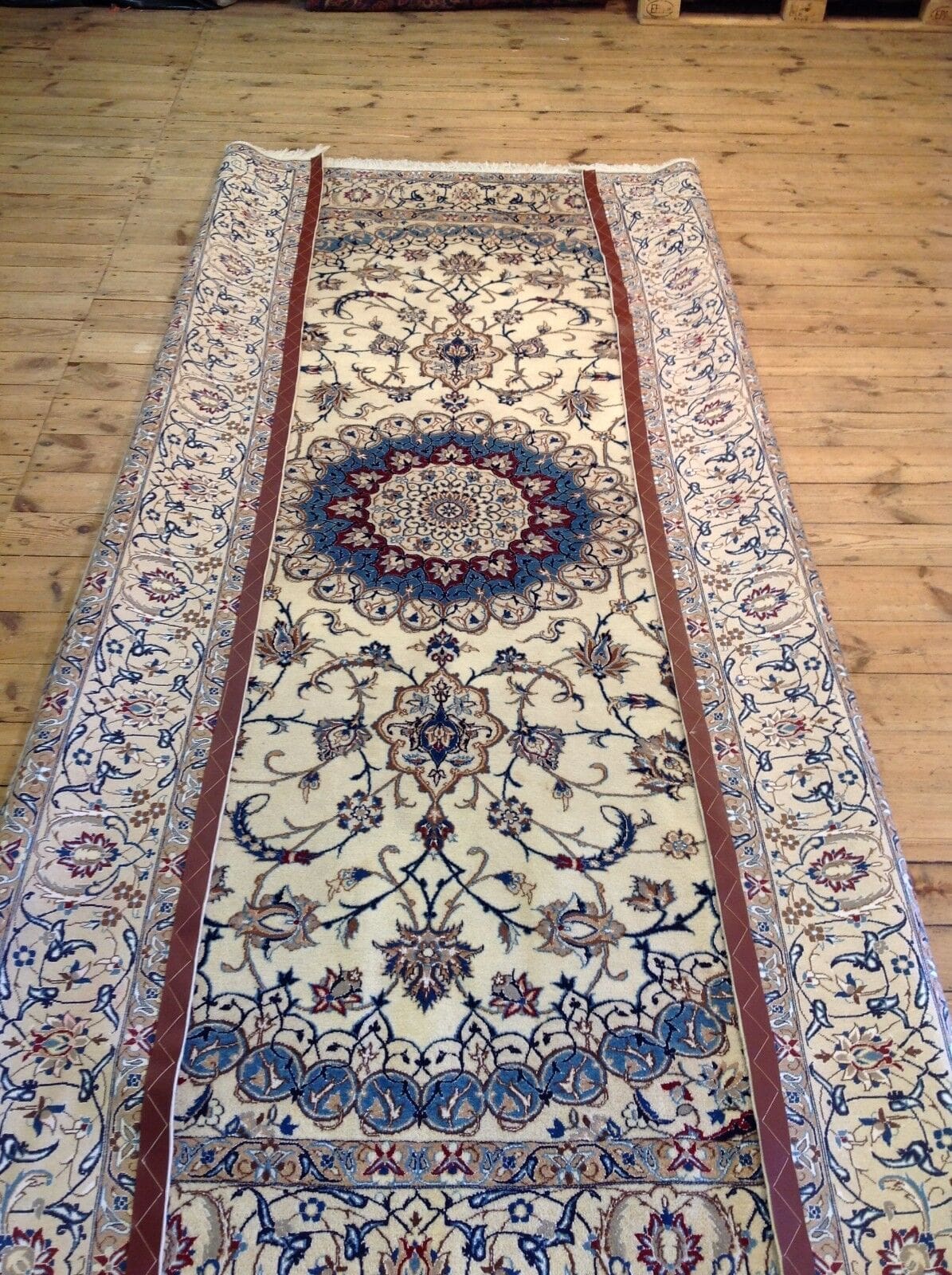
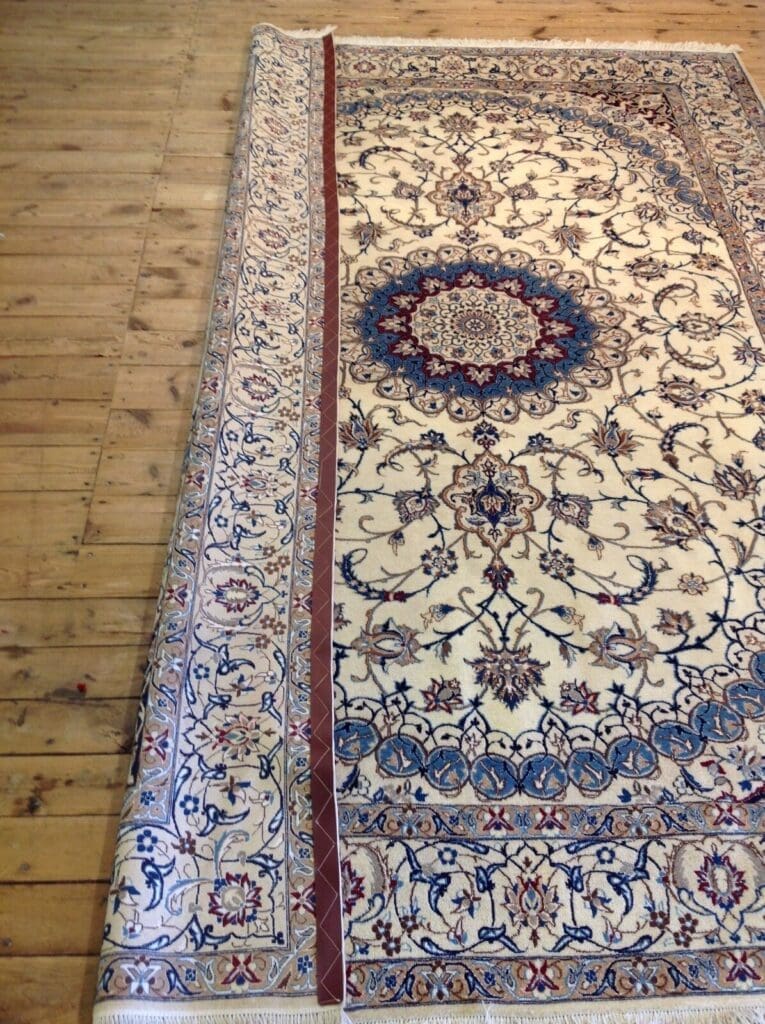
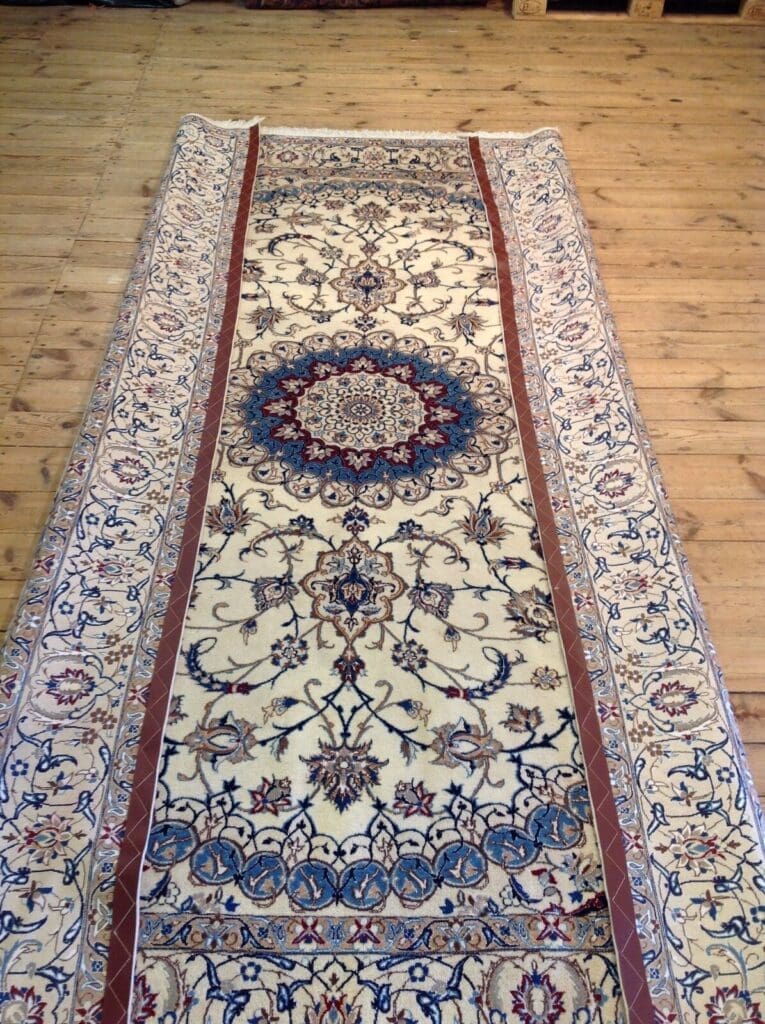
Symmetry gives many Persian rug designs their visual structure. A central field may organise the main drawing, while a border frames the composition and establishes a clear outer edge. Repeated motifs can mirror one another or follow a regular sequence, allowing the eye to move across the rug without losing the underlying order. Classical Islamic ornament often uses this balance between geometry, repetition and stylised natural forms. In Nain designs, these principles may be expressed with particularly fine lines and closely worked details.
The traditional Oriental Persian style brings together decorative richness and compositional restraint. A successful design does not treat each ornament as an isolated mark; flowers, leaves, vines and border elements relate to one another in scale and direction. Colour supports this relationship by separating layers of ornament and giving the field, borders and details their respective roles. The source describes this rug as reflecting traditional craftsmanship and as offering a broad range of colours and forms, without reducing its design to a single modern trend.
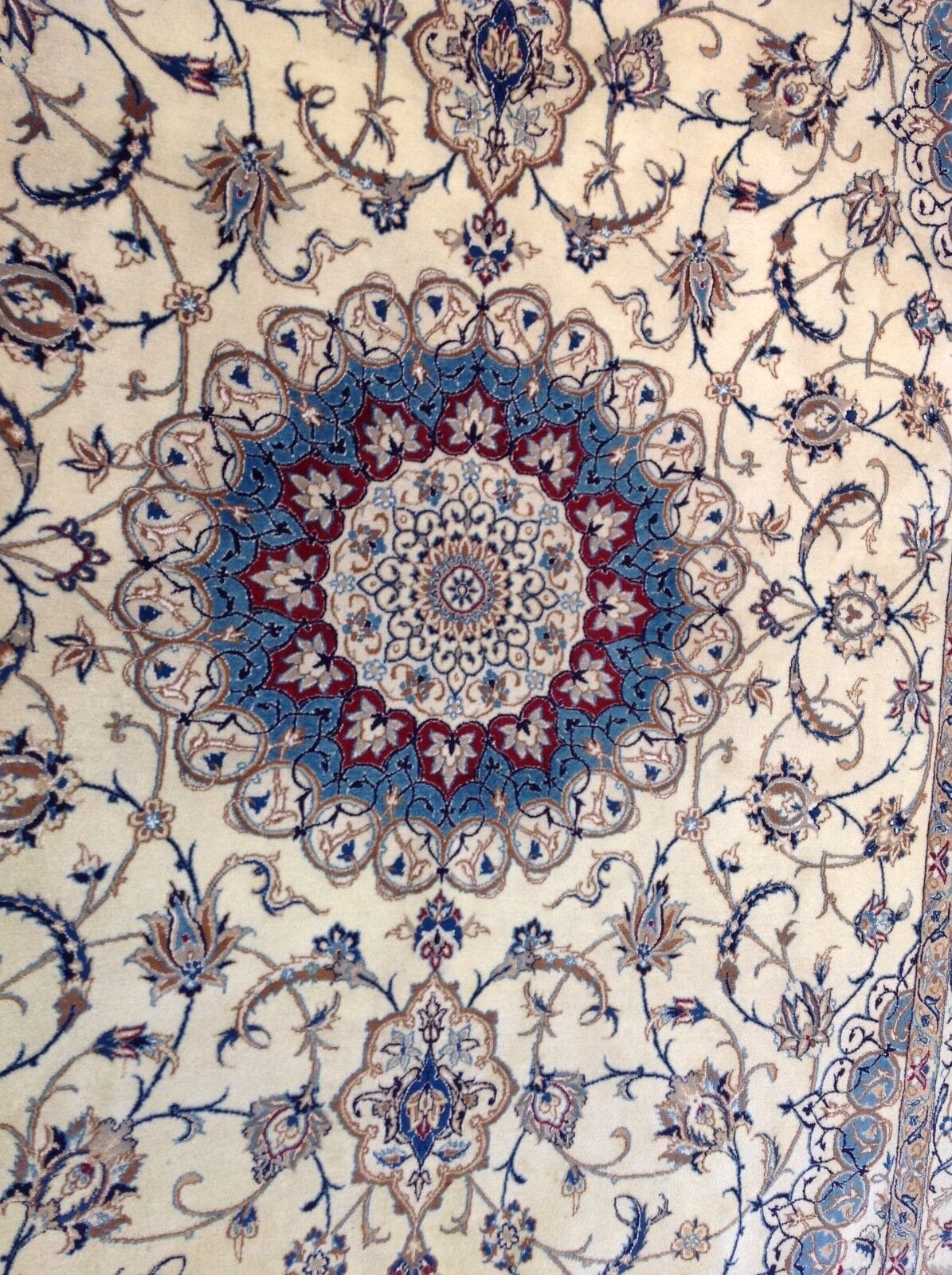
Fine knotting is closely linked to the rendering of pattern. With approximately 400,000 knots per square metre, the construction provides many small points at which a line or curve can change direction. This makes it possible to develop nuanced outlines and precise transitions between motifs. Knot density is a technical feature rather than a decorative motif, but it has a direct role in how clearly a detailed design can be expressed. In a hand-knotted one-off, the final drawing remains specific to that individual rug.
The Nain tradition is often chosen for interiors where a composed, classical pattern is desired. Its floral and Islamic references can be read as part of Persian textile history rather than as a purely contemporary surface decoration. This rug’s traditional Oriental Persian character allows it to sit in a living room, dining room or hallway as a defined design element. The pattern remains connected to Nain through its regional tradition, while the exact arrangement of colours and forms belongs to this particular handmade piece.
The material blend also contributes to the reading of the design. Wool provides a grounded, warm pile, while silk can bring a finer sheen to selected areas and make contrasts in the pattern more visible as the surface catches light. This does not replace the drawing; it works alongside the knotting and the chosen forms. Together, the handwork, the floral vocabulary and the balanced structure create the traditional character described for this Nain Persian rug.
Special Features
This rug combines several stated characteristics in one individual piece: it is a hand-knotted Nain Persian rug, it is new, and it has a knot density of approximately 400,000 knots per square metre. Its pile consists of 80% wool and 20% silk. The wool contributes warmth and resilience, while the silk contributes smoothness and a refined sheen. The fine construction supports the clear working of the detailed pattern.
The rug is also identified as a one-off and is offered with a certificate of authenticity. These details distinguish the piece as an individually made example of the Nain tradition. Its Persian origin, the regional designation Nain, the wool-and-silk composition and the handmade technique belong together in its description. The result is a textile whose material, construction, pattern tradition and individual character can be considered as connected aspects of the same rug.
FAQ
How should I care for my Nain Persian rug?
Regular, careful vacuuming helps keep the rug clean. Direct, strong sunlight should be avoided so that the colours do not fade. If a spill or mark occurs, treat it immediately with a damp cloth and a mild cleaning product. It is sensible to work gently rather than rubbing the pile aggressively, and to use cleaning products sparingly. This approach helps preserve the wool-and-silk surface and the appearance of the hand-knotted rug over time.
Is the rug suitable for allergy sufferers?
Persian rugs made from natural materials are generally considered suitable for allergy sufferers. Natural fibres are less prone to dust mites and allergenic particles than synthetic rugs. Regular cleaning can further support a clean indoor environment. This rug is specified as being made from wool and silk. Individual allergies and medical conditions cannot be assessed from the material description alone, so anyone with a particular sensitivity should seek appropriate professional advice.
Where is the best place to put the rug?
The Nain Persian rug is suitable for a living room, dining room or as an accent in a hallway. Its traditional Oriental Persian design can serve as a clear decorative element in each of these settings. The wool content gives the pile a resilient character, making the rug suitable for areas that are used regularly. It should be laid flat and protected from prolonged direct sunlight. The final placement should also allow the pattern and the individual proportions of the one-off to be seen clearly.
To provide the best experiences, we use technologies like cookies to store and/or access device information. Consenting to these technologies will allow us to process data such as browsing behavior or unique IDs on this site. Not consenting or withdrawing consent, may adversely affect certain features and functions.
Functional Always active
The technical storage or access is strictly necessary for the legitimate purpose of enabling the use of a specific service explicitly requested by the subscriber or user, or for the sole purpose of carrying out the transmission of a communication over an electronic communications network.
Preferences
The technical storage or access is necessary for the legitimate purpose of storing preferences that are not requested by the subscriber or user.
Statistics
The technical storage or access that is used exclusively for statistical purposes.The technical storage or access that is used exclusively for anonymous statistical purposes. Without a subpoena, voluntary compliance on the part of your Internet Service Provider, or additional records from a third party, information stored or retrieved for this purpose alone cannot usually be used to identify you.
Marketing
The technical storage or access is required to create user profiles to send advertising, or to track the user on a website or across several websites for similar marketing purposes.
 SECURE PAYMENT
 SHIPPING PARTNERS