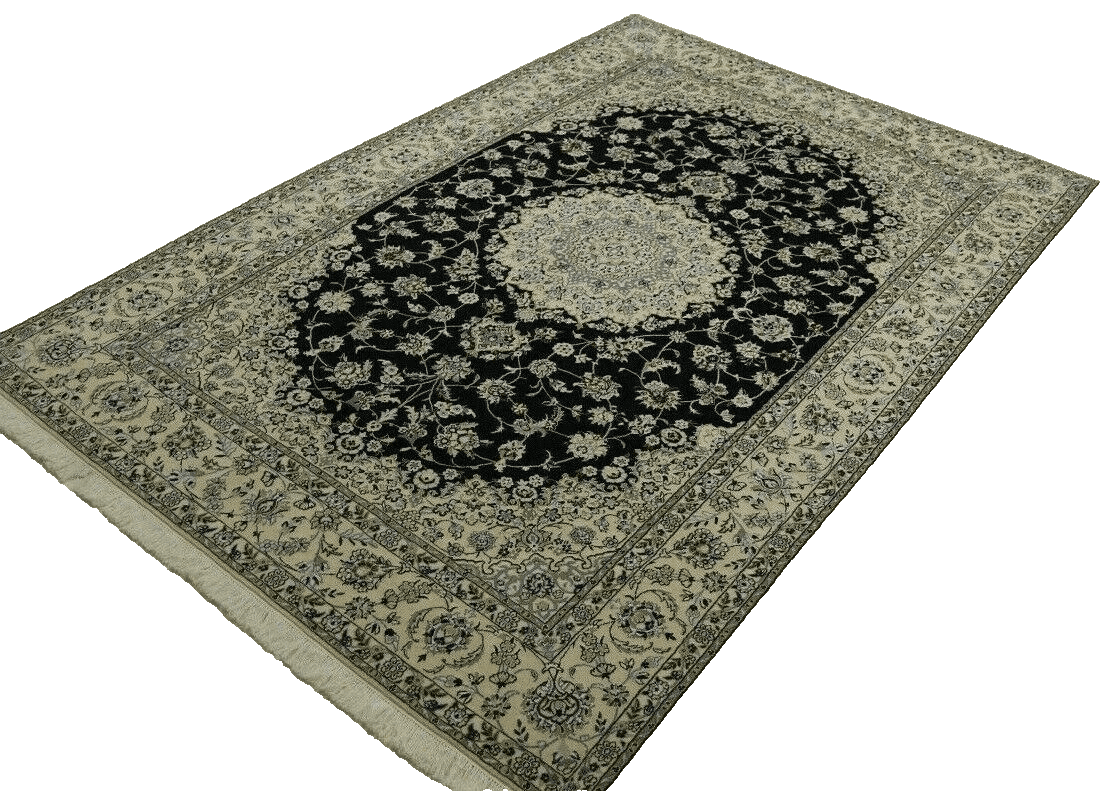
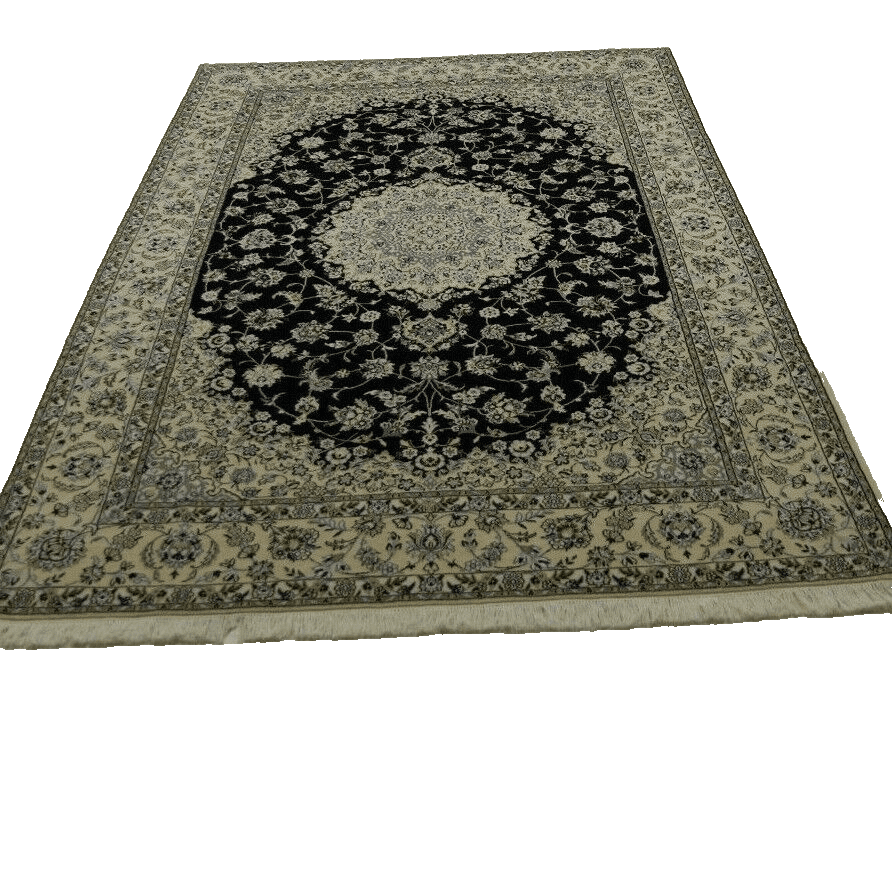
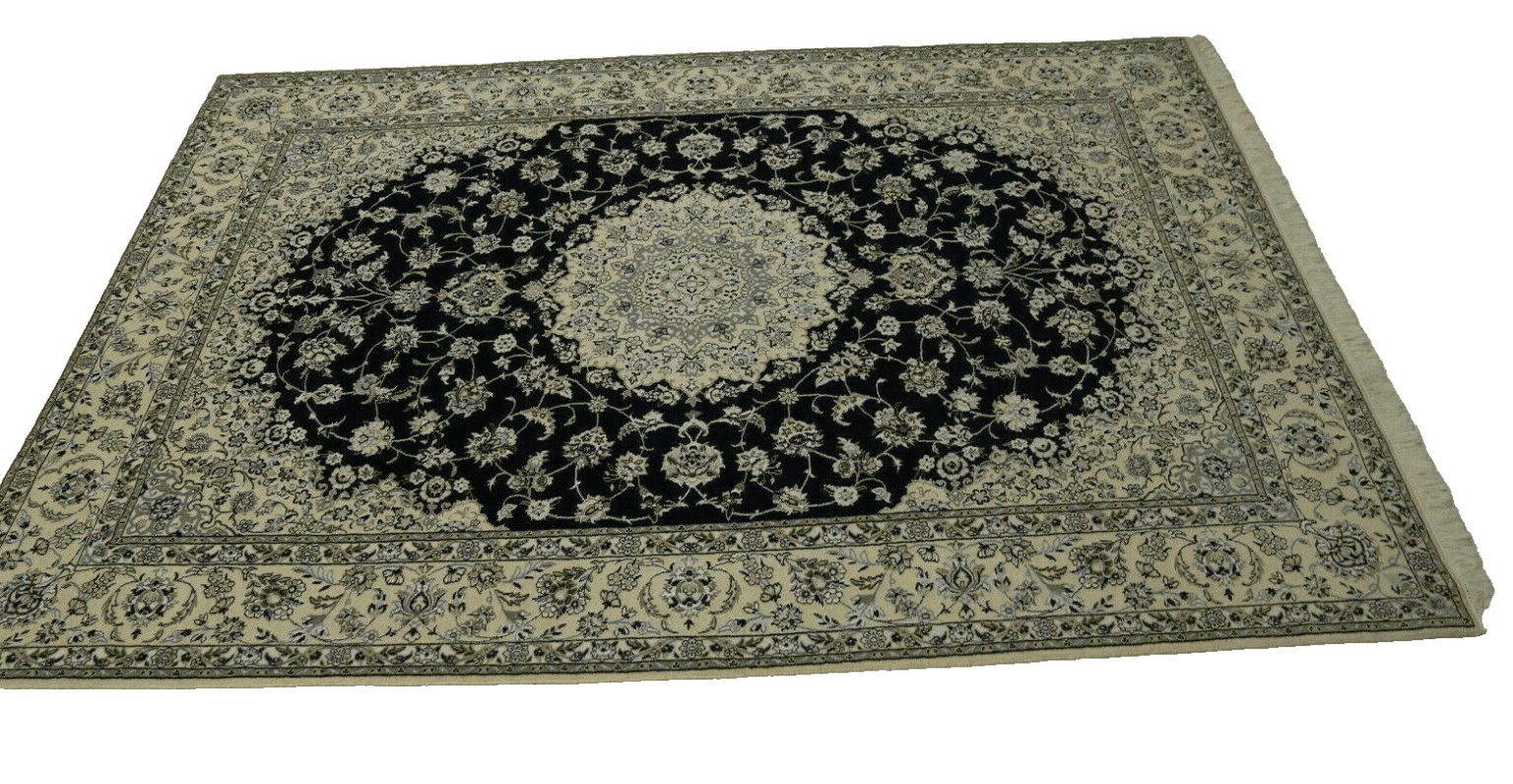
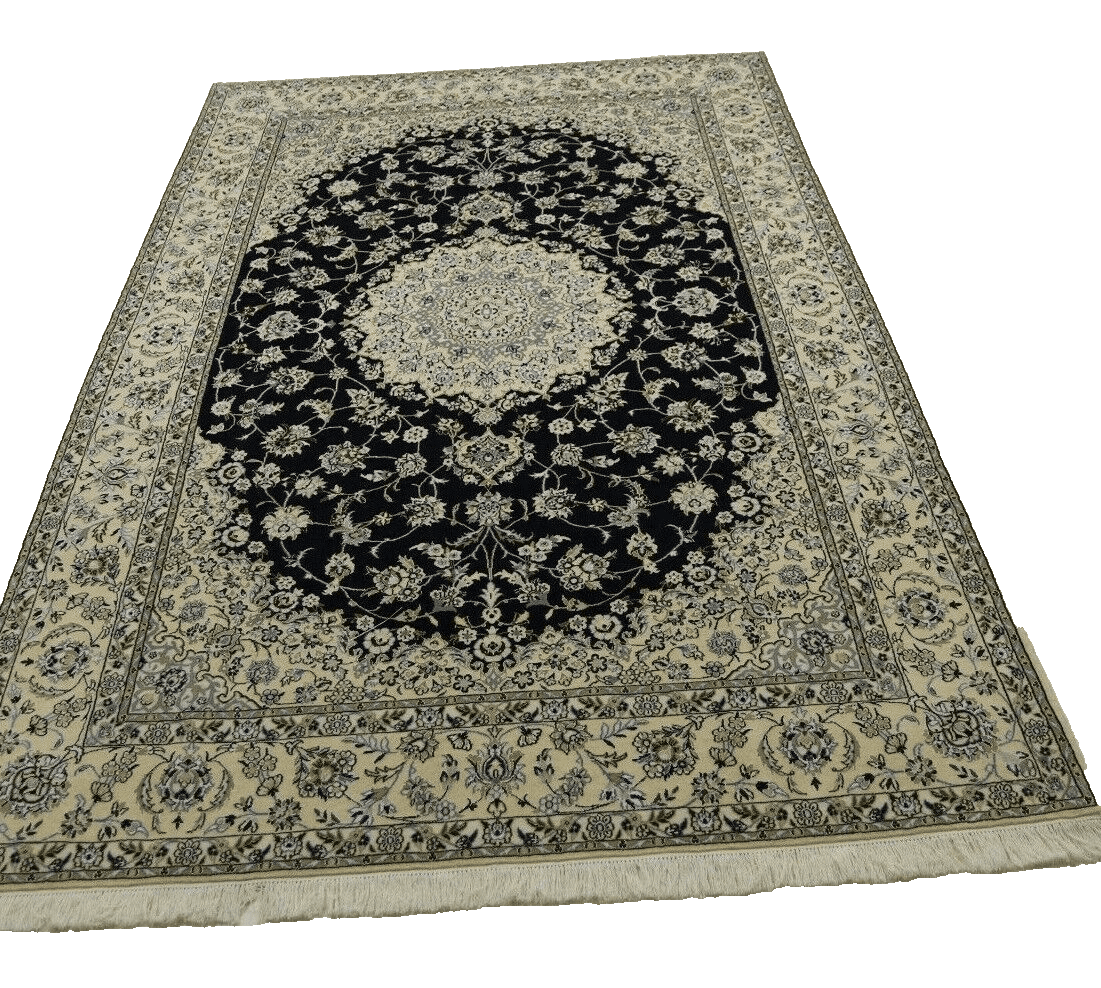
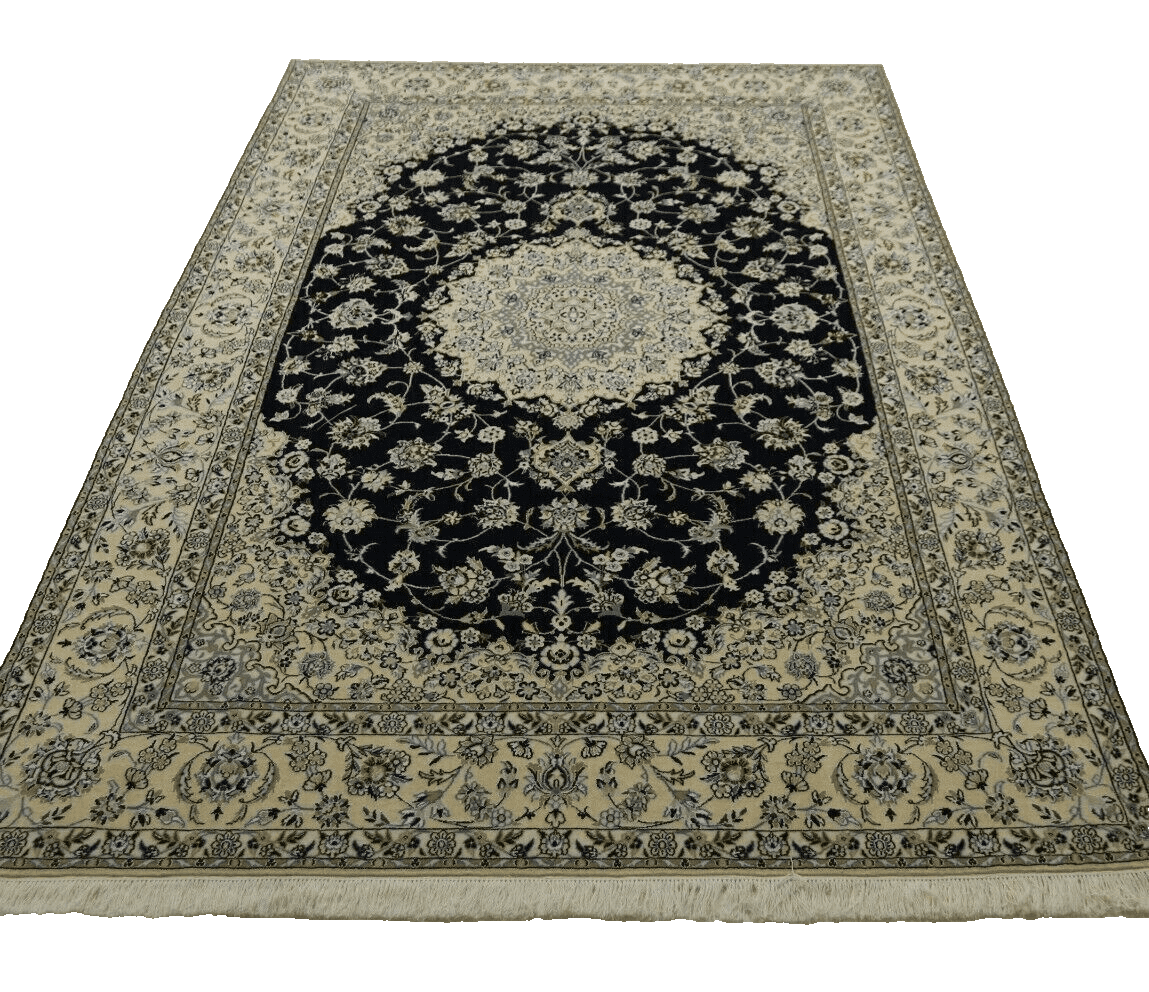
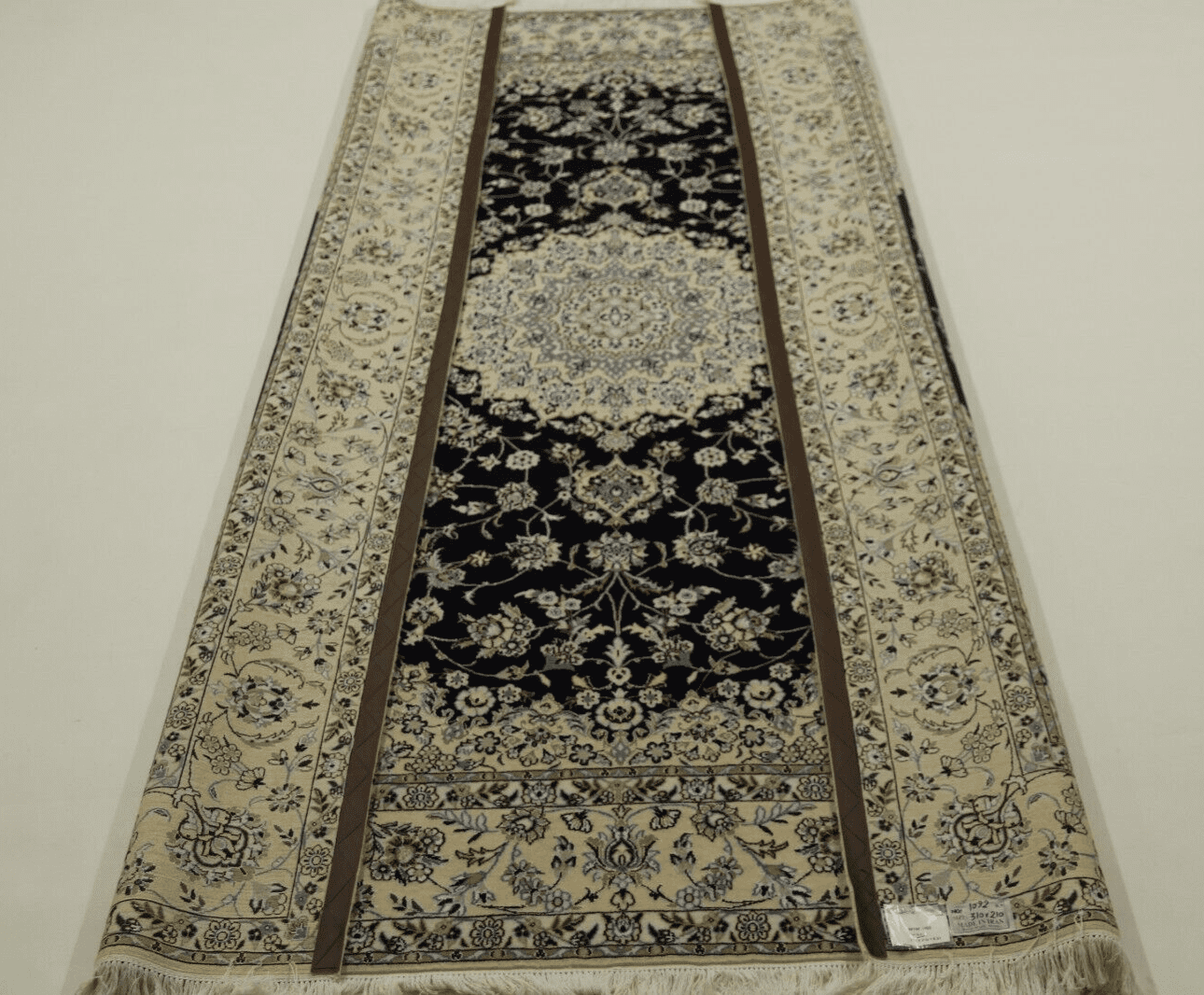
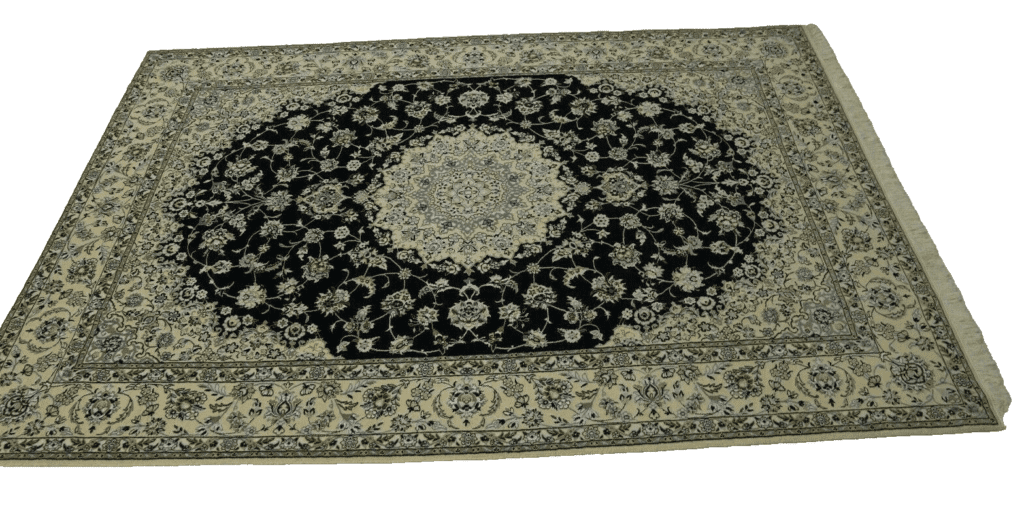
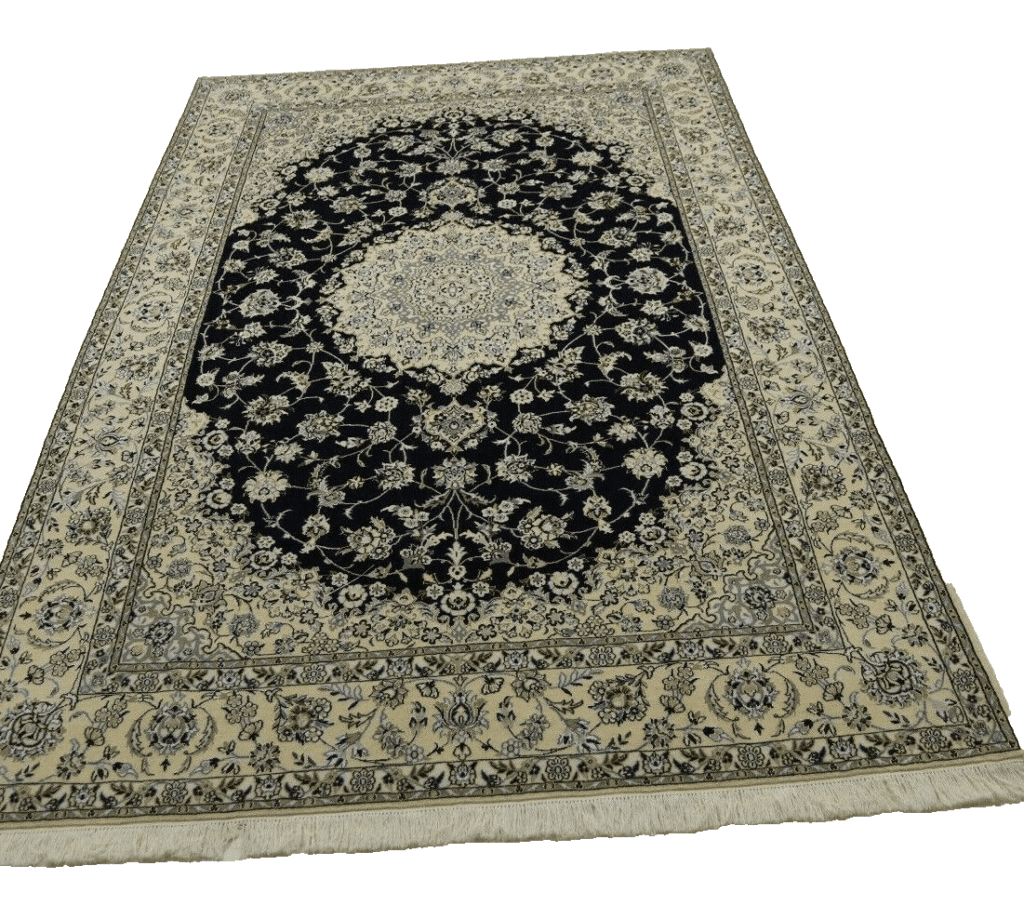
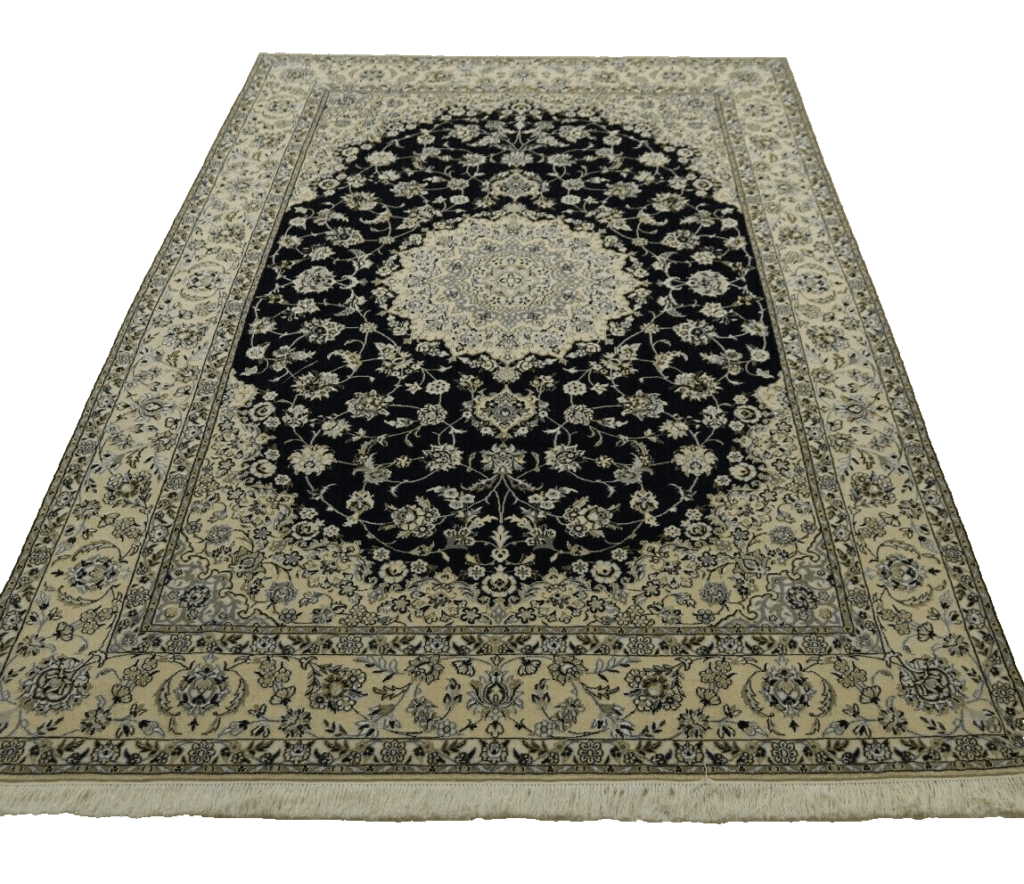
Hand-knotted Nain Persian Rug | Knot density: 500,000 knots/m² | Material: 90% virgin wool, 10% silk | Size: 310 x 210 cm | Pattern: floral and geometric Nain design in beige and blue tones
This Nain Persian rug is hand-knotted from 90% virgin wool and 10% silk. The combination brings together two materials with different natural qualities. Virgin wool provides a warm, resilient foundation and has natural insulating properties. It is traditionally valued in rug making because it can withstand regular use while retaining a comfortable surface character. In this rug, the wool content forms the principal material component and gives the piece its substantial textile body.
The silk content adds a distinct lustre and a finer tactile quality. Silk can reflect light differently from wool, allowing selected details and transitions in the design to appear more defined. Its use alongside wool is a traditional way of introducing contrast between a softer, more matte surface and areas with greater visual sheen. The material combination therefore contributes both to the feel of the rug and to the way its colours and motifs are perceived.
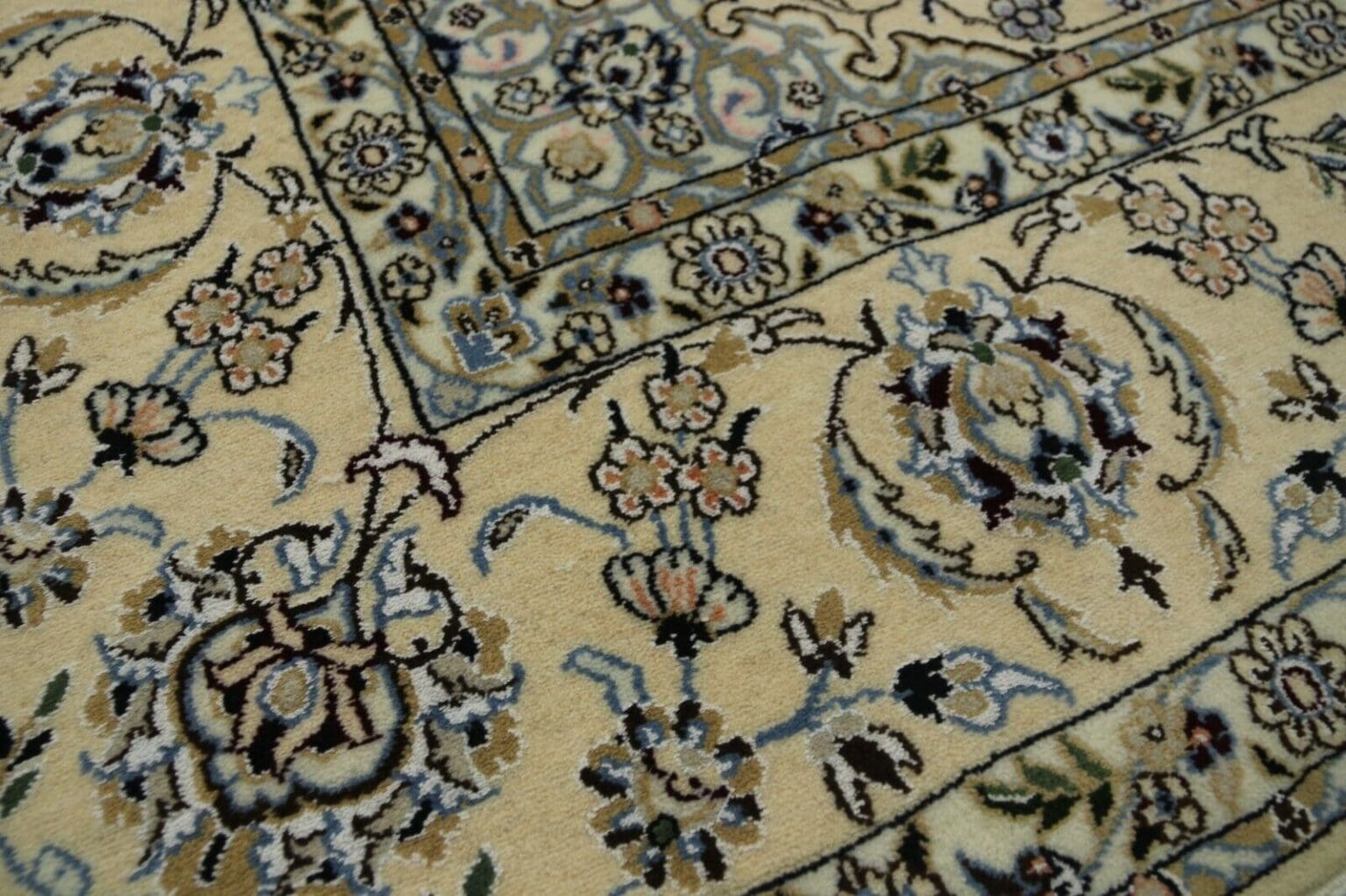
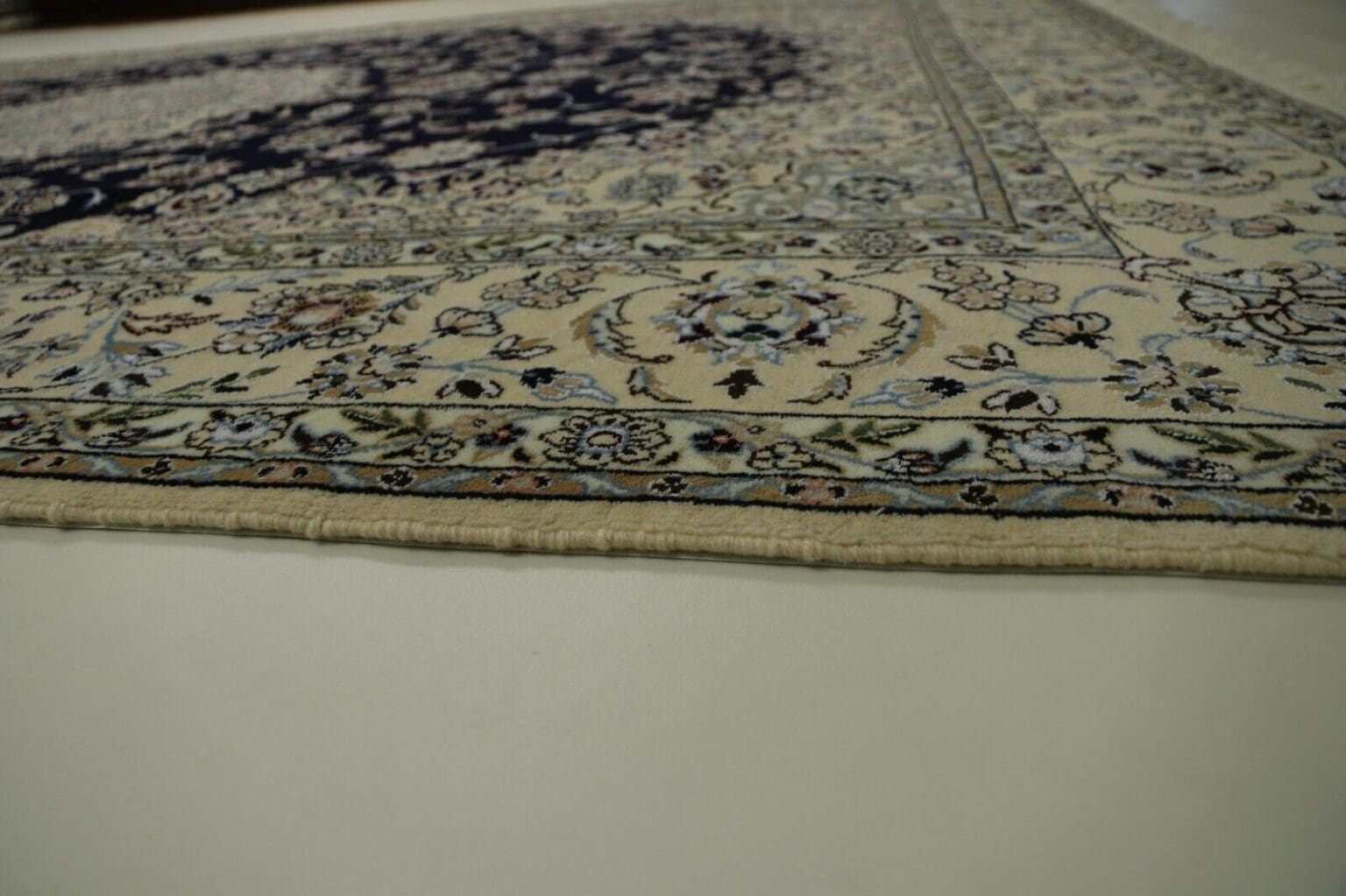
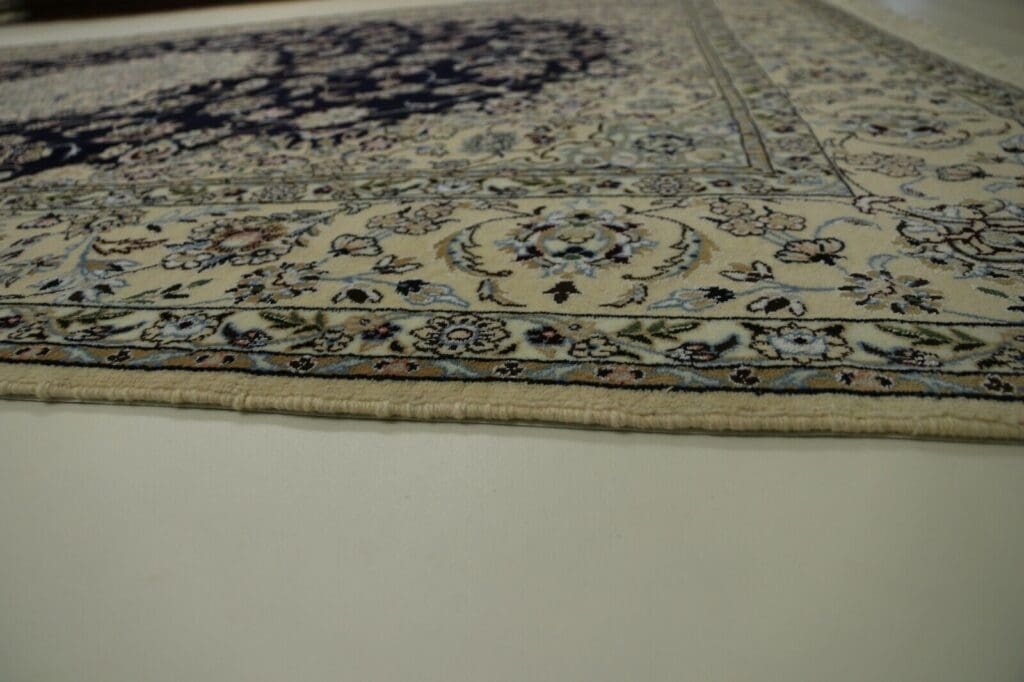
Hand-knotting means that the rug was built knot by knot rather than produced by a mechanical process. Each individual knot is placed and secured by hand, allowing the design to be developed with a high degree of detail. The stated density of 500,000 knots per square metre reflects the fine construction of this particular piece. Because hand-knotting is carried out individually, every completed rug is a one-off with its own precise arrangement of knots, fibres and design details.
Origin and Tradition
The rug comes from Nain, a city in Iran known for its carpet production. Nain is located in Isfahan Province, a region with an important place in the history of Persian art and craftsmanship. The city’s carpet tradition reaches back to the 16th century and has continued through the transmission of weaving knowledge from one generation to the next. Nain rugs are therefore connected not only with a particular place, but also with a long-established working culture.
Persian carpet making developed through the interaction of regional materials, workshop practice and artistic traditions. In Nain, the production of finely detailed rugs became associated with careful drawing, precise knotting and the controlled use of colour. The craft depends on the ability to translate a planned composition into a woven surface, preserving proportion and clarity while the design is formed row by row. This relationship between design planning and manual execution is central to the character of Nain carpets.
The city lies within the wider cultural sphere of Isfahan Province, where architecture, garden design and decorative arts have long influenced visual expression. Nain carpets are commonly associated with compositions that draw on these Persian traditions. Their patterns often balance an ordered central structure with repeated floral or geometric detail, creating a surface in which the individual elements belong to a coherent whole. The regional identity is expressed through this combination of disciplined construction and ornamental drawing.
Nain weaving is also part of the broader Persian tradition in which technical skill is passed on through practice and instruction. The work requires patience, close attention and familiarity with established design vocabulary. A hand-knotted rug does not emerge as a ready-made image; its composition is built gradually through thousands of individual decisions. The high knot density of this rug relates to that tradition of detailed workmanship, while the use of wool and silk reflects the continued importance of natural fibres in Persian carpet production.
The name Nain identifies the rug’s regional origin rather than a single pattern. Within the tradition, rugs can differ in their arrangement, colouring and degree of detail. What connects them is the relationship between the city’s weaving history, its workshop methods and the visual language associated with the region. This piece belongs to that Nain context and presents the tradition through a hand-knotted Persian construction.
Design and Pattern
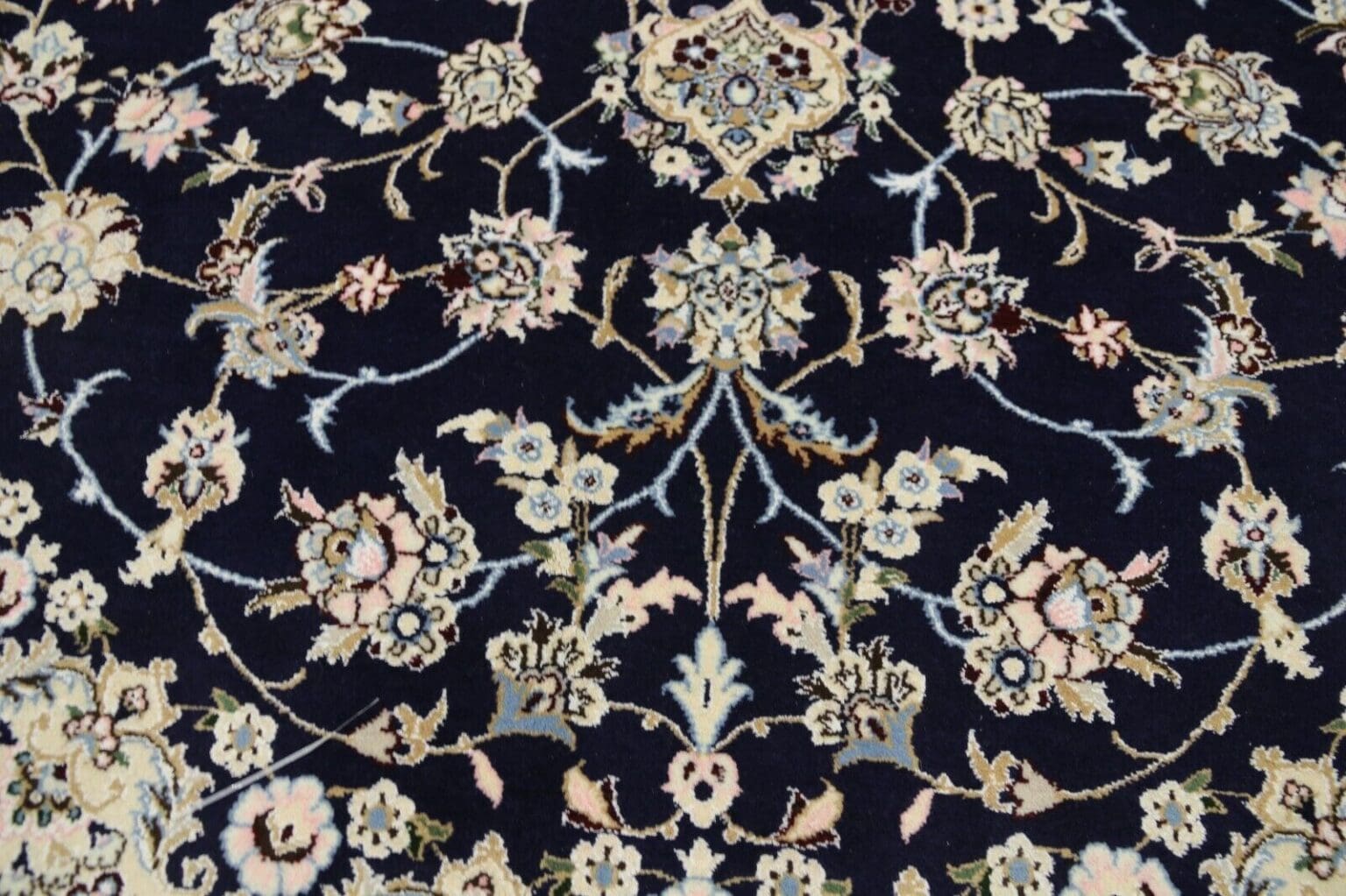
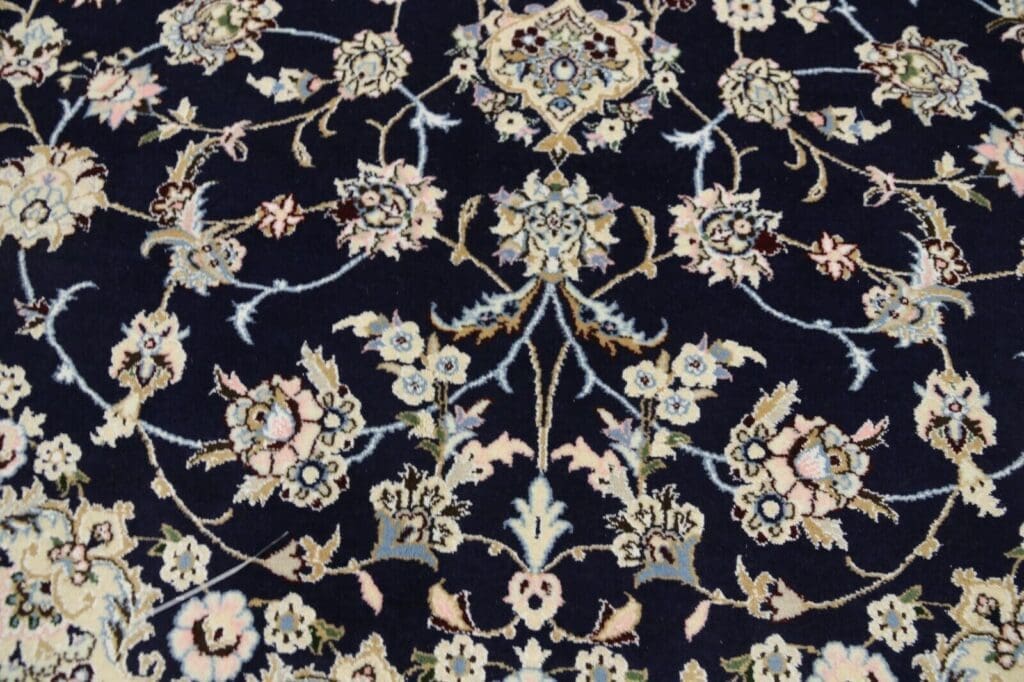
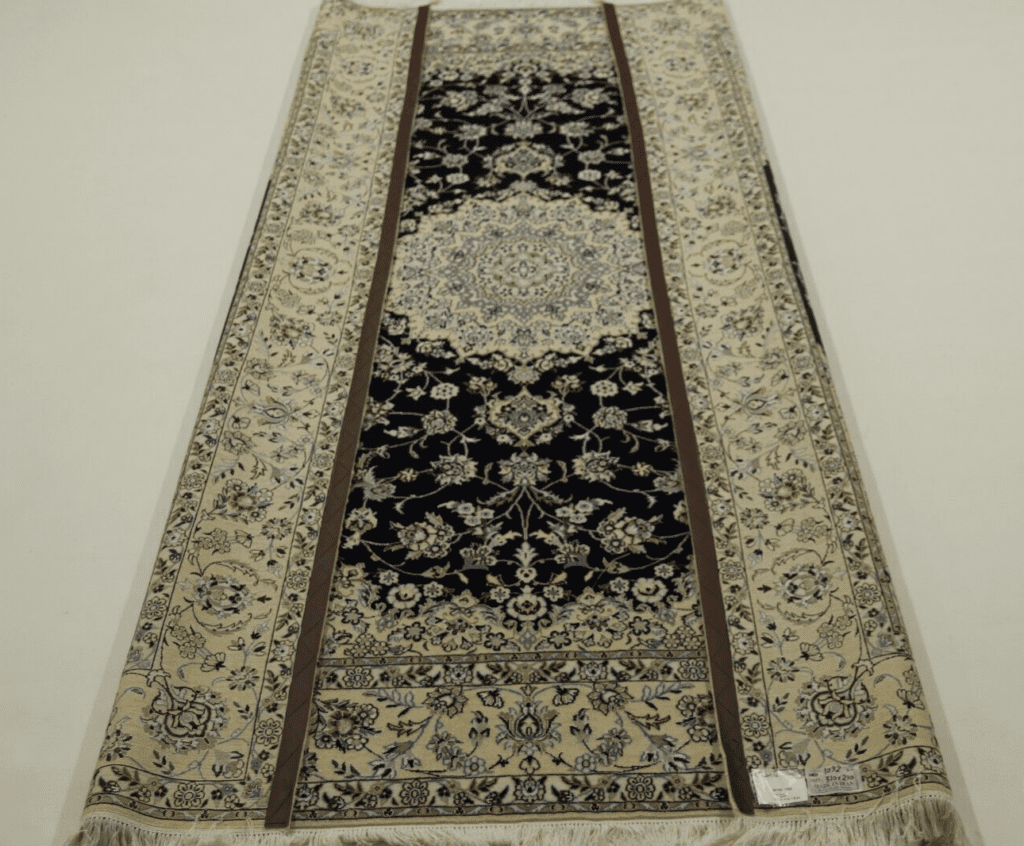
The design combines floral and geometric motifs, elements that are characteristic of the artistic vocabulary associated with Nain. Floral forms introduce curved lines, leaves and ornamental rhythm, while geometric features provide structure and order. Together, these two types of motif create a composition in which organic detail is held within a clearly arranged framework. The result is a pattern that refers to Persian decorative tradition while remaining adaptable to both traditional and modern interiors.
The colour range extends from soft beige tones to more intense shades of blue. Beige provides a restrained ground for the composition and gives the surface a calm visual foundation. Blue introduces stronger points of definition and creates contrast between lighter and darker passages. Used together, these colours form a balanced palette with both quiet areas and more pronounced accents. The silk content can further affect the perception of such colours by catching and returning light differently from the wool.
Floral ornament has a long history in Persian carpet design. Flowers, leaves and scrolling forms are often arranged to suggest an ordered garden or a continuous decorative field. In Nain-related compositions, such forms are frequently treated with precision rather than left as loose impressions. Their outlines, spacing and repetition contribute to the rhythm of the whole surface. The floral vocabulary can thus be read as both decoration and a structured system of repeated visual relationships.
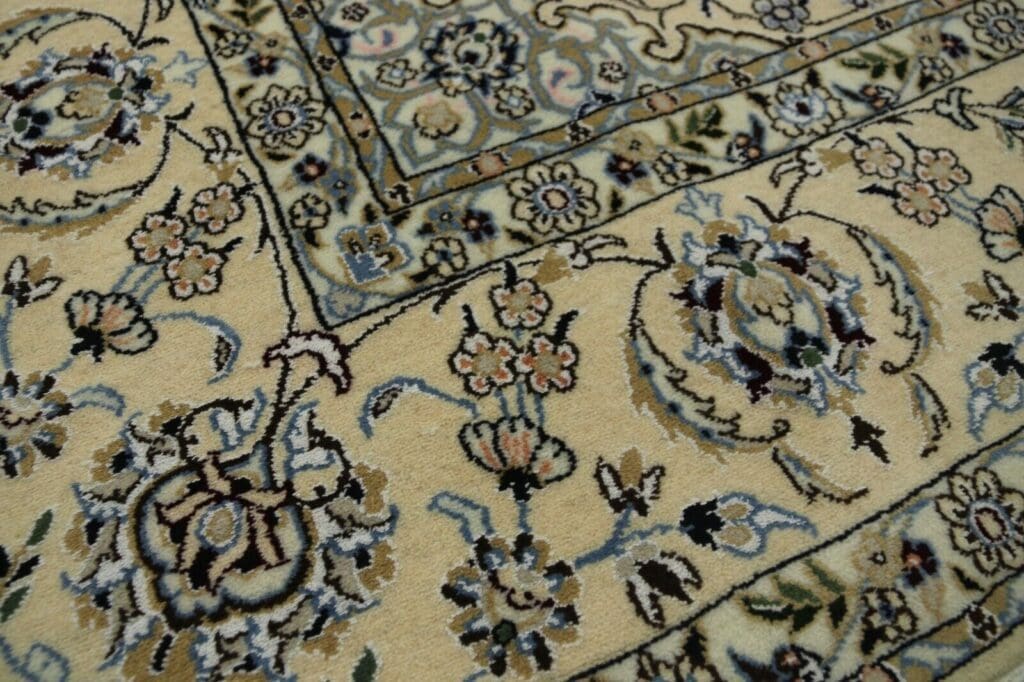
Geometric motifs perform a different but complementary role. They help define direction, establish symmetry or mark transitions within the design. Straight lines, measured shapes and repeated intervals make the composition legible from a distance, while finer details become apparent on closer inspection. This contrast between overall order and small-scale intricacy is an important aspect of many finely knotted Persian rugs.
The combination of floral and geometric elements allows the rug to sit between historical reference and contemporary use. It does not depend on a single decorative feature, but on the relationship of colour, rhythm and structure across the entire surface. The beige and blue palette can work with traditional furnishings as well as with more modern settings, while the Persian motifs preserve the regional character of the design. The pattern is therefore both recognisably connected to Nain and suitable for varied interior arrangements.
Because the rug is hand-knotted, the pattern is physically integrated into the textile rather than printed onto it. The high number of knots supports the rendering of small details and gradual changes within the composition. This technical foundation is part of the visual effect: the design is not separate from the method of making, but depends on the precision with which the motifs were translated into knots and coloured fibres.
Special Features
A defining feature of this rug is its knot density of 500,000 knots per square metre. Such a dense construction allows a detailed pattern to be represented with closely placed knots and carefully controlled transitions. The density is also connected with the rug’s durability, since the compact construction supports regular use. Its hand-knotted character means that the piece is individually made rather than repeated as an identical industrial product.
The material composition is another notable feature. Virgin wool contributes warmth, resilience and natural insulation, while silk adds lustre and a refined tactile quality. The source describes the rug as durable and states that hand-knotted carpets of this type can retain their character and quality over many years. The combination of detailed workmanship and natural materials is also described as giving such rugs lasting value across generations.
FAQ
How should I care for a Nain Persian rug?
Regular vacuuming helps remove loose dust and everyday particles. Use a brush attachment and avoid excessive suction so that the fibres are not subjected to unnecessary strain. If a stain occurs, treat it promptly with a mild cleaning product. Test the product first in a discreet area before applying it more broadly. Careful, moderate cleaning is preferable to aggressive treatment, particularly for a hand-knotted rug made from wool and silk.
Are Persian rugs suitable for people with allergies?
Persian rugs made from natural materials such as wool and silk are often considered a suitable choice for people with allergies. These fibres are described as hypoallergenic and are less likely to attract dust and allergens than synthetic carpet materials. Regular cleaning remains important, since dust can collect on any textile surface. Maintaining a consistent cleaning routine helps support the air quality in the room.
Can this rug be used over underfloor heating?
Yes. This Nain Persian rug is suitable for use with underfloor heating because of its natural wool and its specific hand-knotting technique. Wool has good thermal insulation properties while allowing warmth to pass through the rug. This combination supports the distribution of heat and can contribute to a comfortable room climate when the rug is placed over a heated floor.
To provide the best experiences, we use technologies like cookies to store and/or access device information. Consenting to these technologies will allow us to process data such as browsing behavior or unique IDs on this site. Not consenting or withdrawing consent, may adversely affect certain features and functions.
Functional Always active
The technical storage or access is strictly necessary for the legitimate purpose of enabling the use of a specific service explicitly requested by the subscriber or user, or for the sole purpose of carrying out the transmission of a communication over an electronic communications network.
Preferences
The technical storage or access is necessary for the legitimate purpose of storing preferences that are not requested by the subscriber or user.
Statistics
The technical storage or access that is used exclusively for statistical purposes.The technical storage or access that is used exclusively for anonymous statistical purposes. Without a subpoena, voluntary compliance on the part of your Internet Service Provider, or additional records from a third party, information stored or retrieved for this purpose alone cannot usually be used to identify you.
Marketing
The technical storage or access is required to create user profiles to send advertising, or to track the user on a website or across several websites for similar marketing purposes.
 SECURE PAYMENT
 SHIPPING PARTNERS


