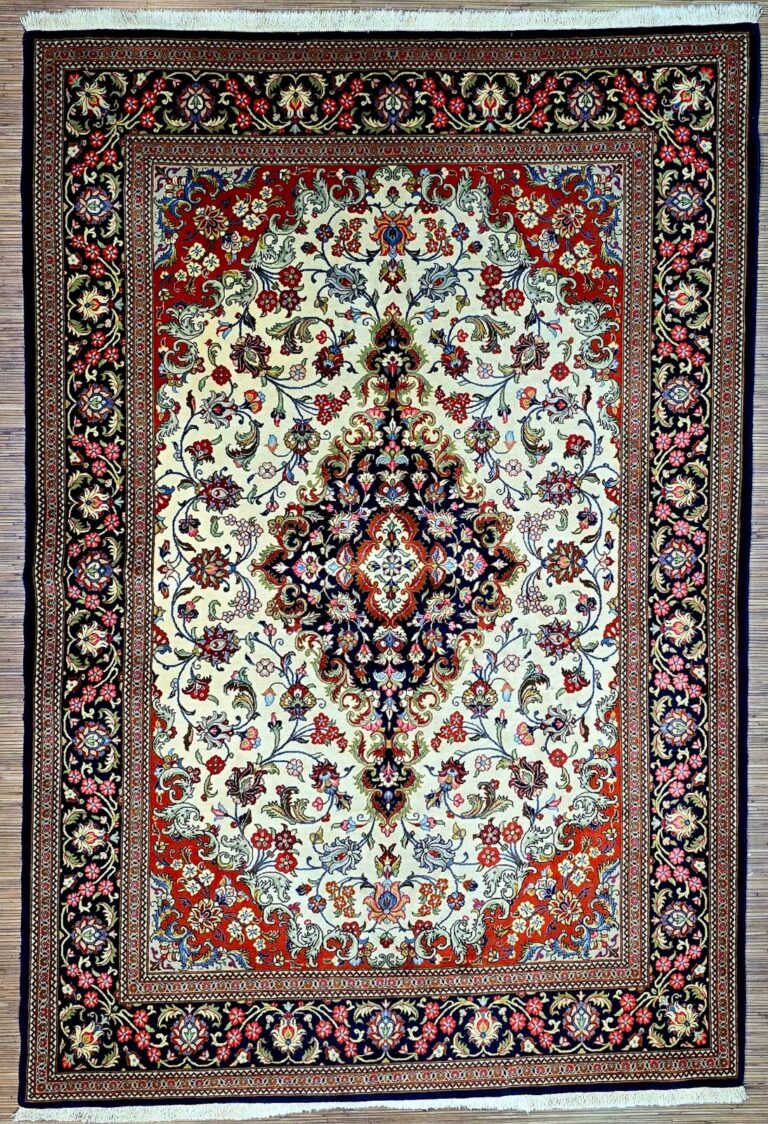
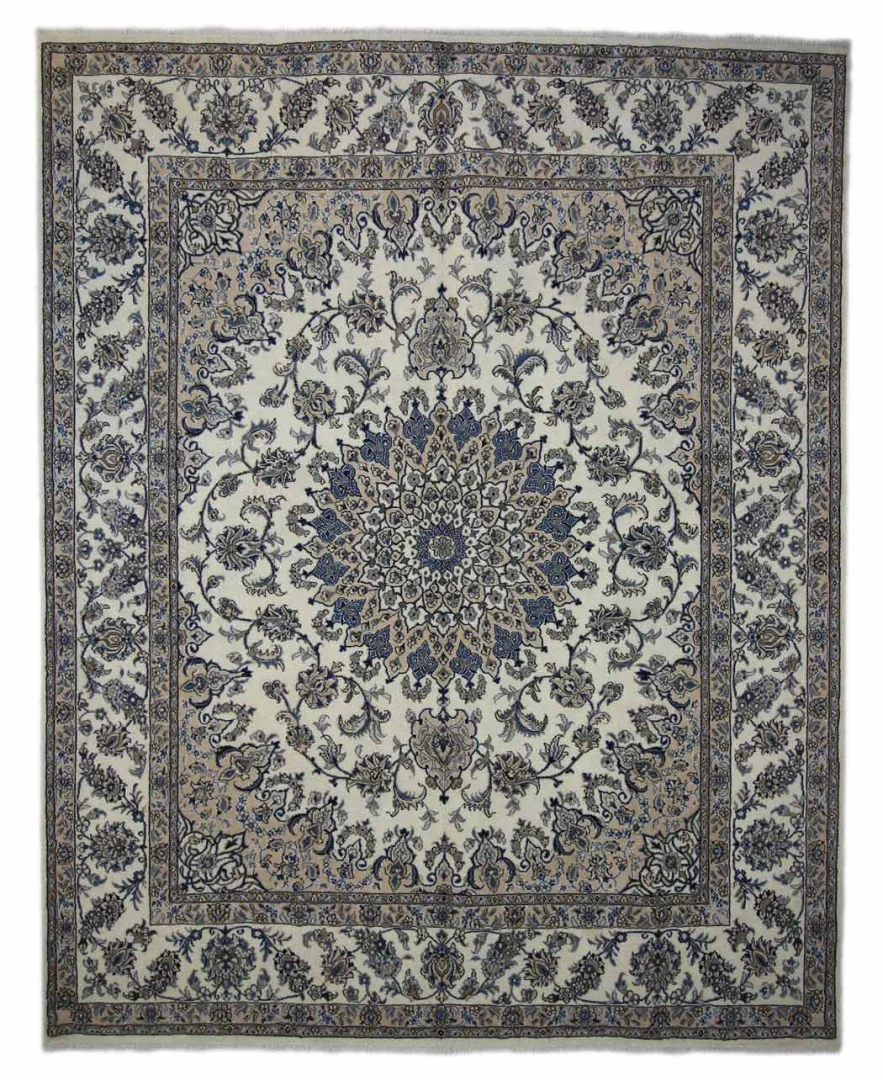
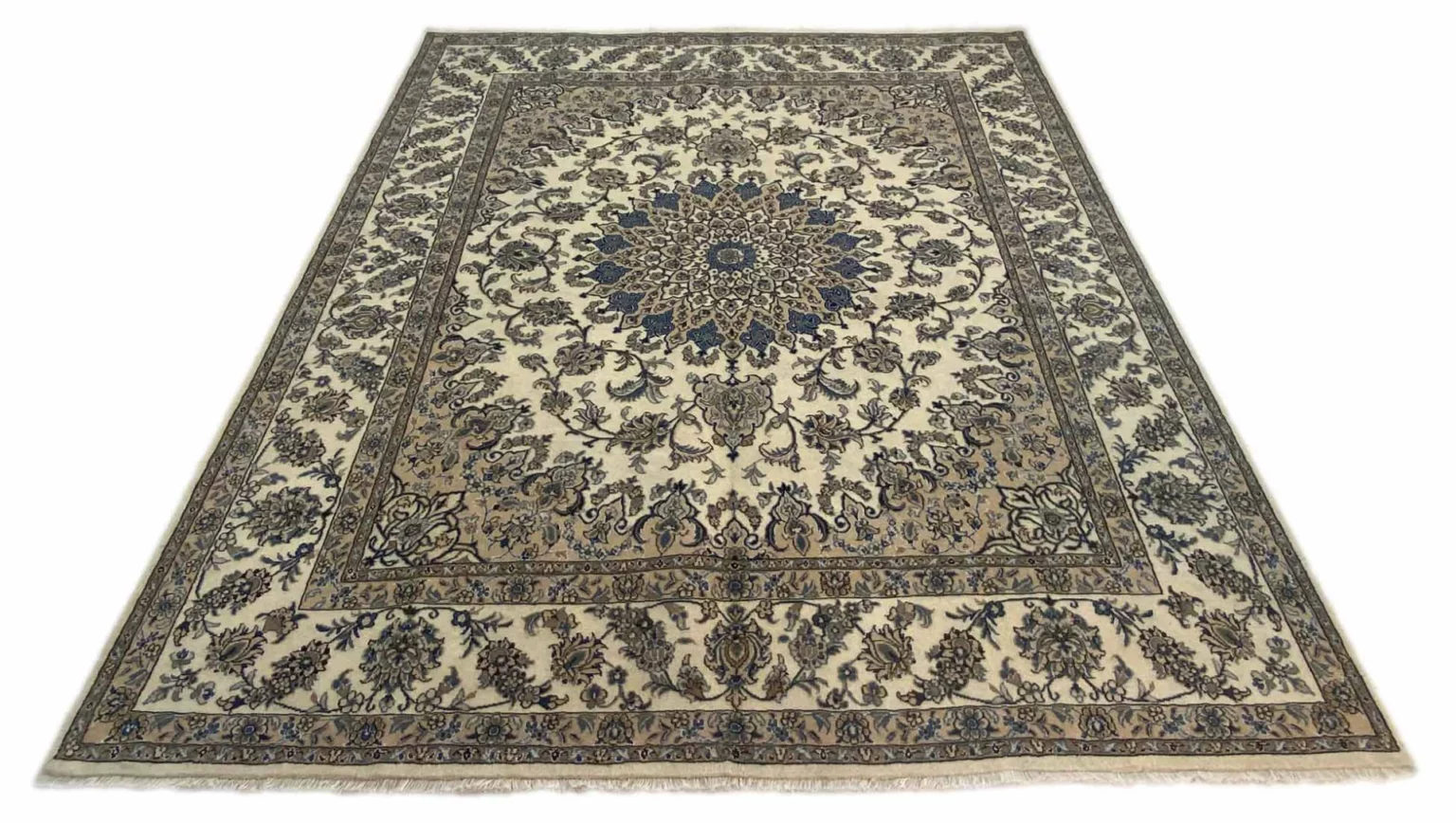
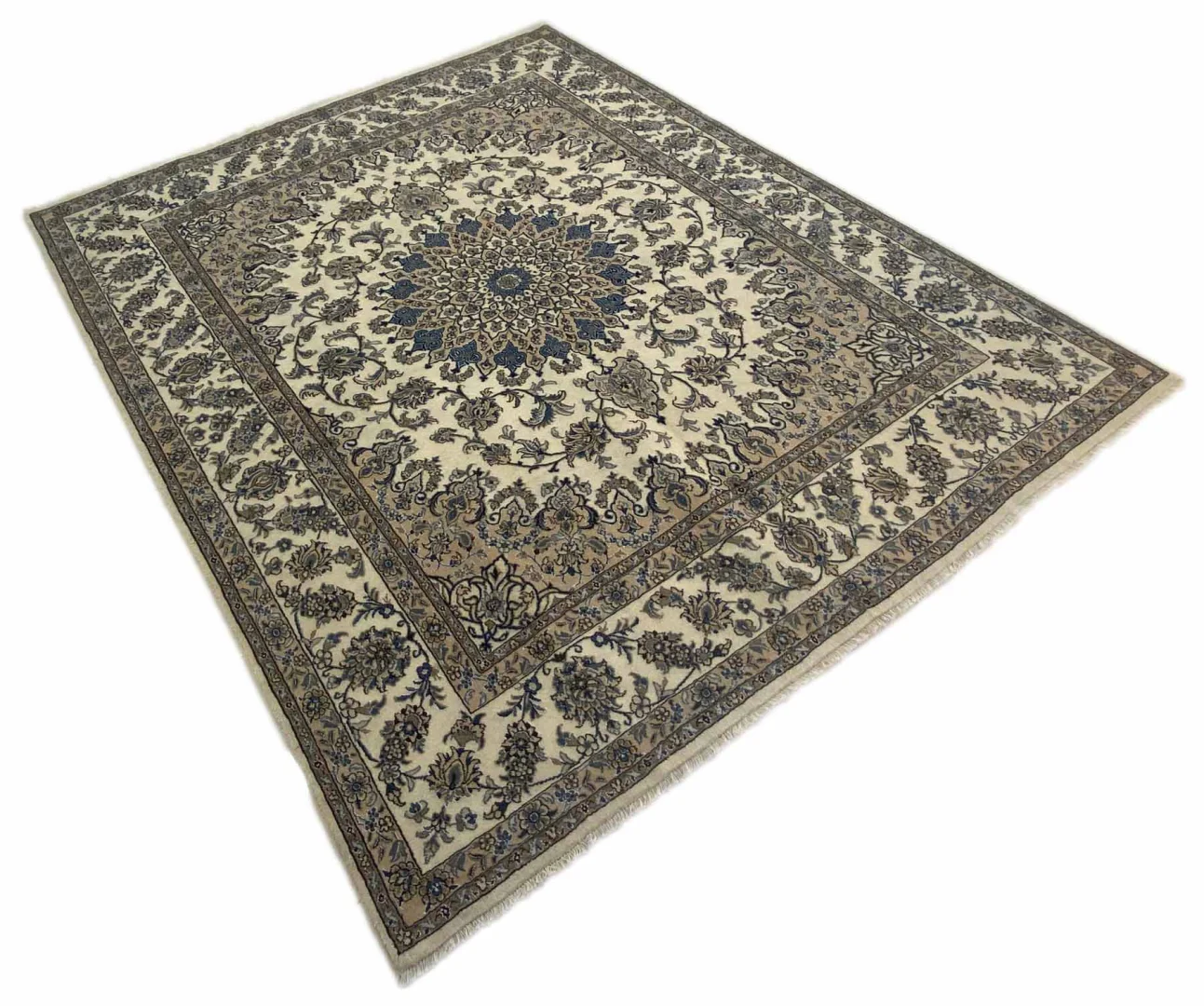
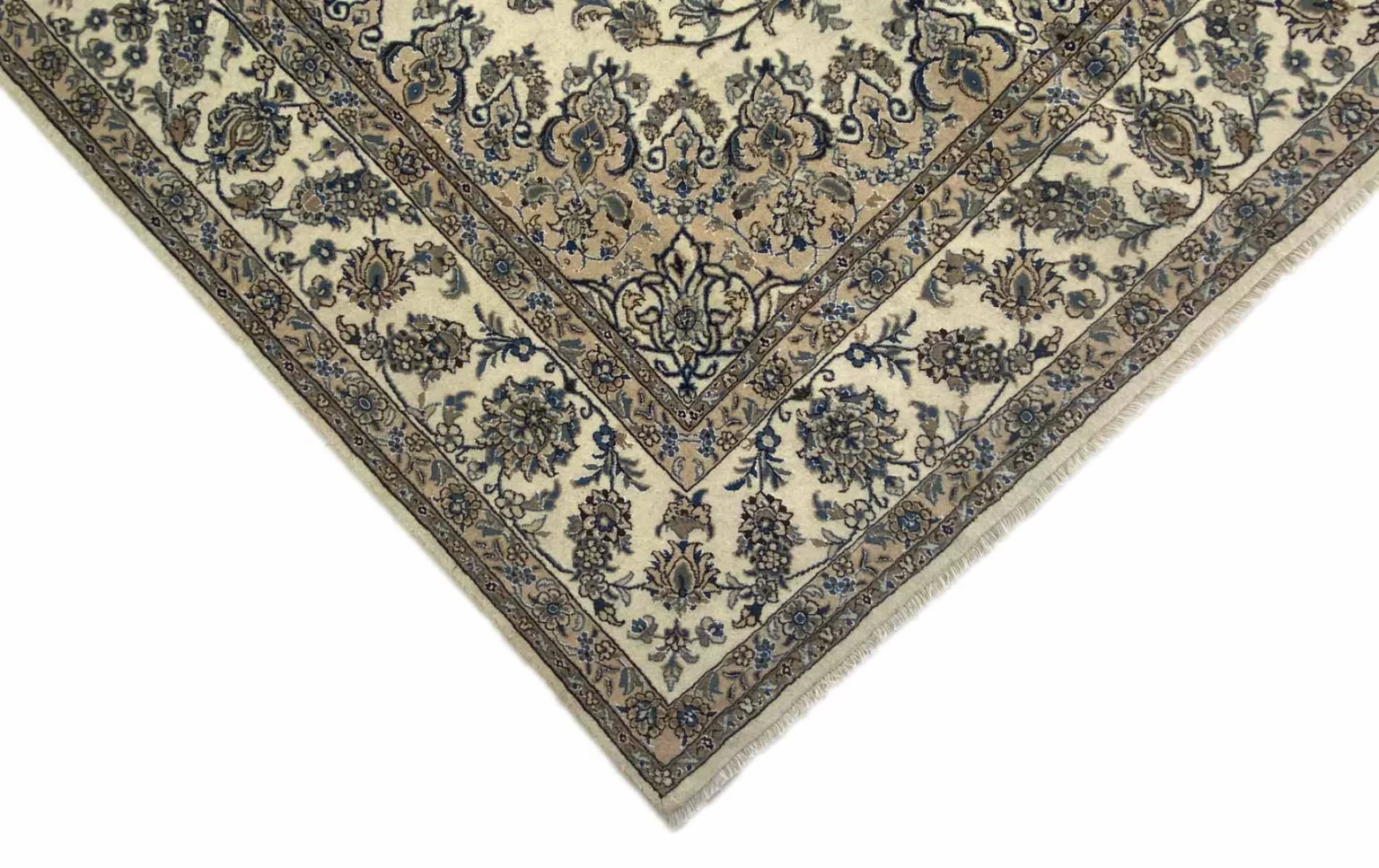
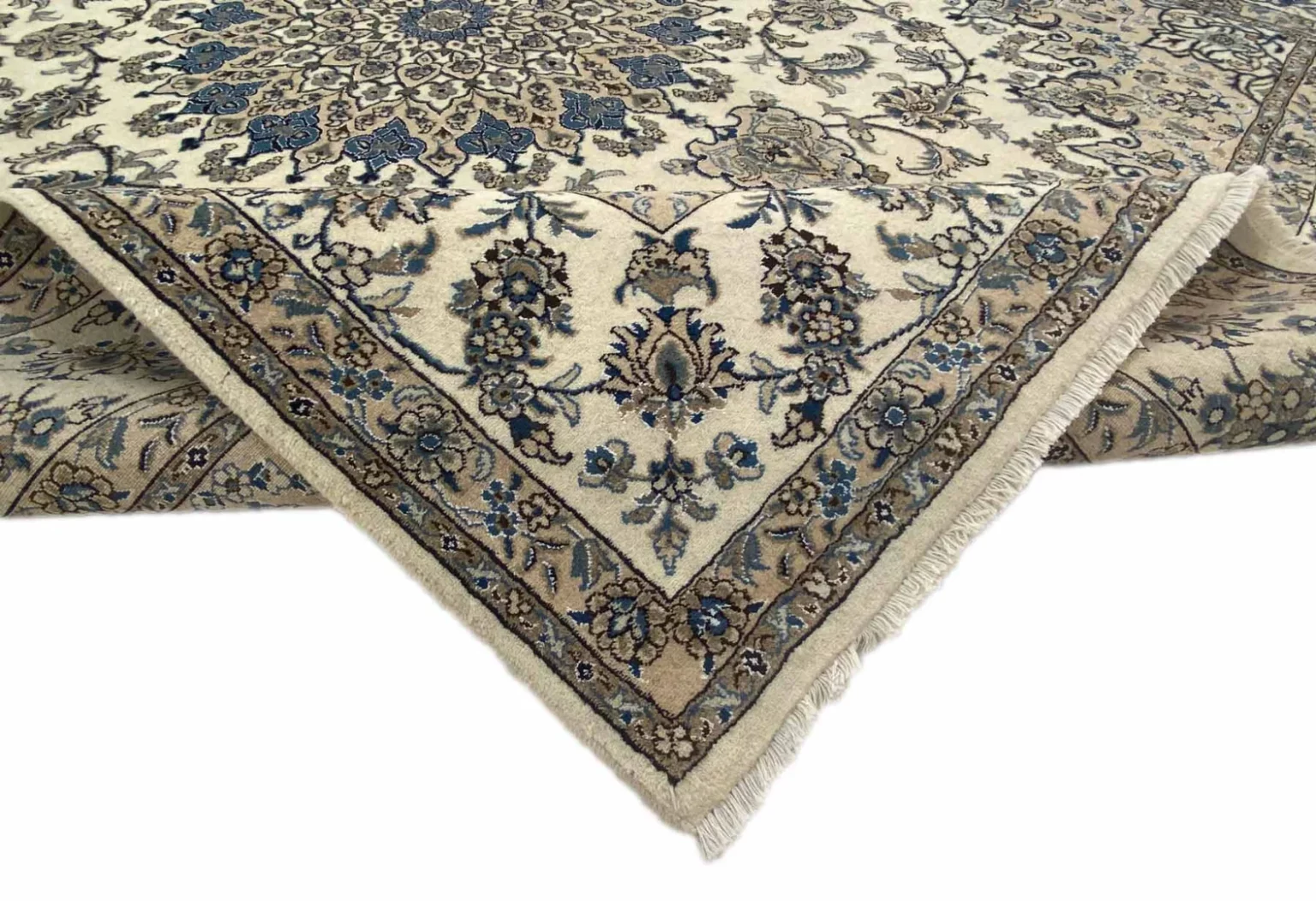
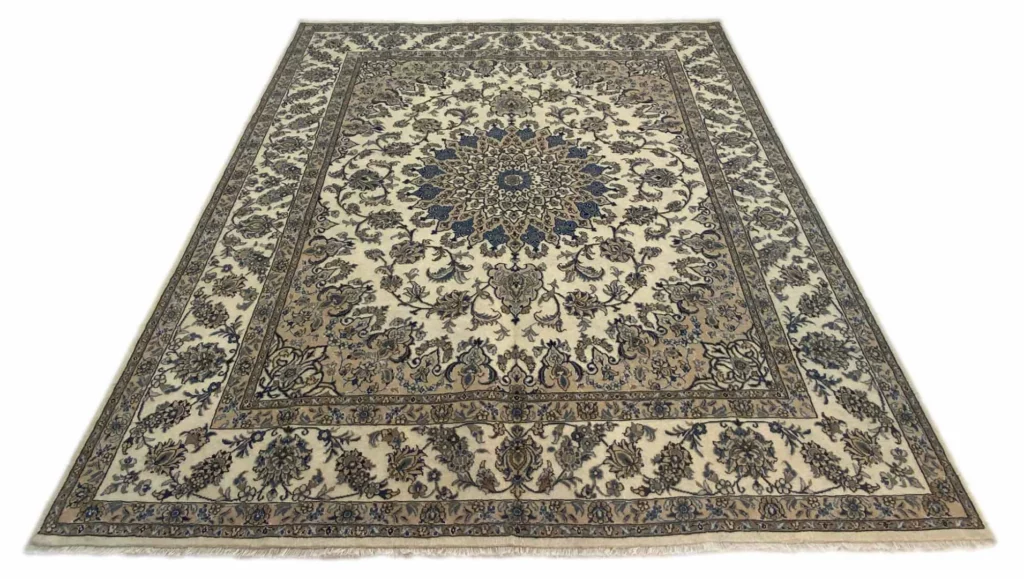
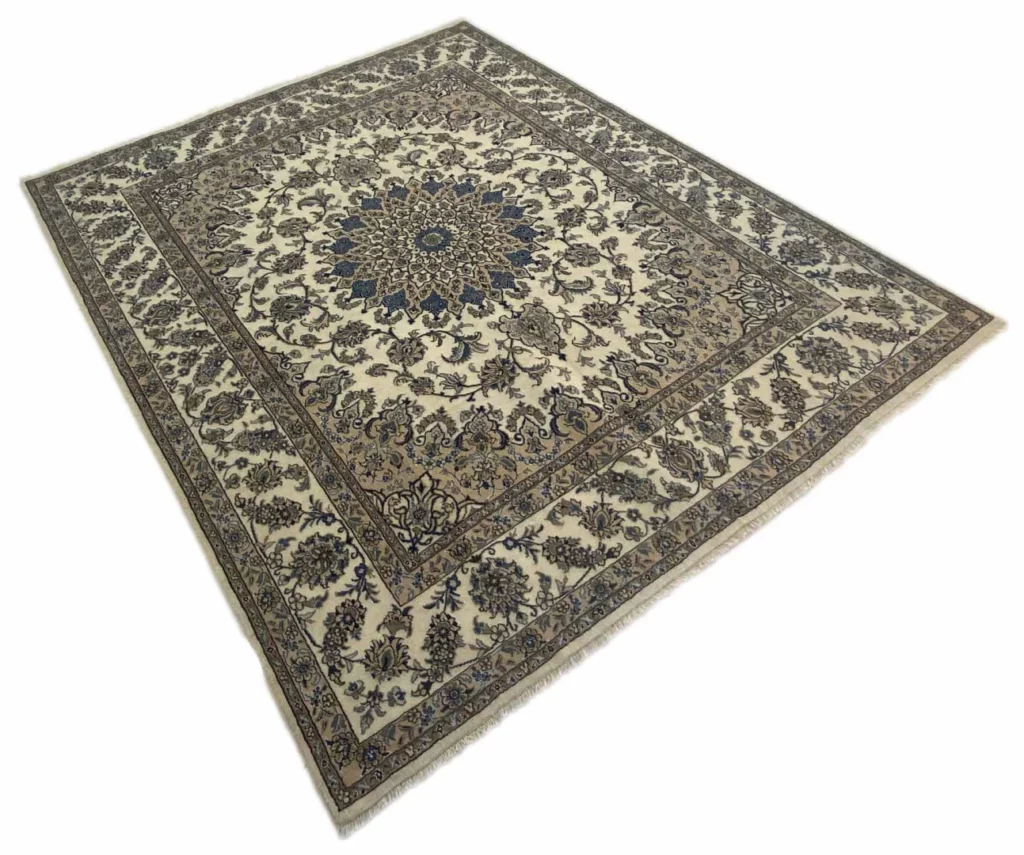
Hand-knotted Nain Persian rug | Knot density: 12-Lah (approx. 250,000 knots/m²) | Material: Wool and silk pile | Size: 300 x 240 cm | Pattern: Classic floral motifs with medallion | Condition: Very well preserved
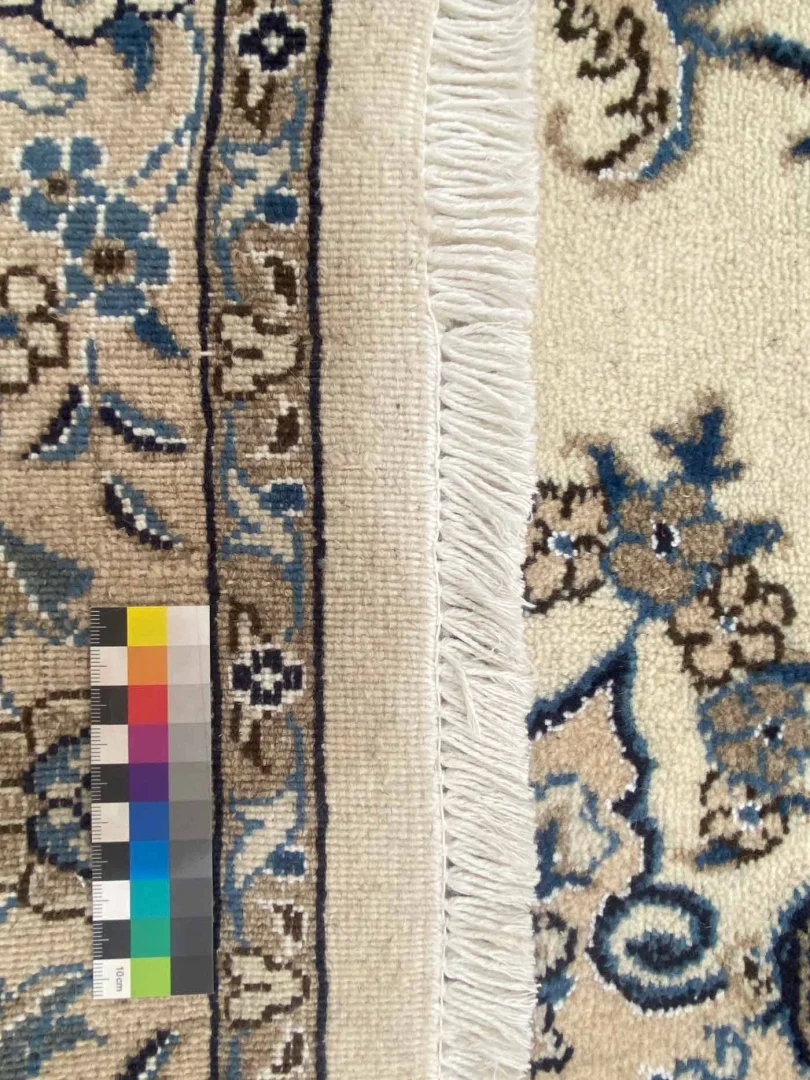
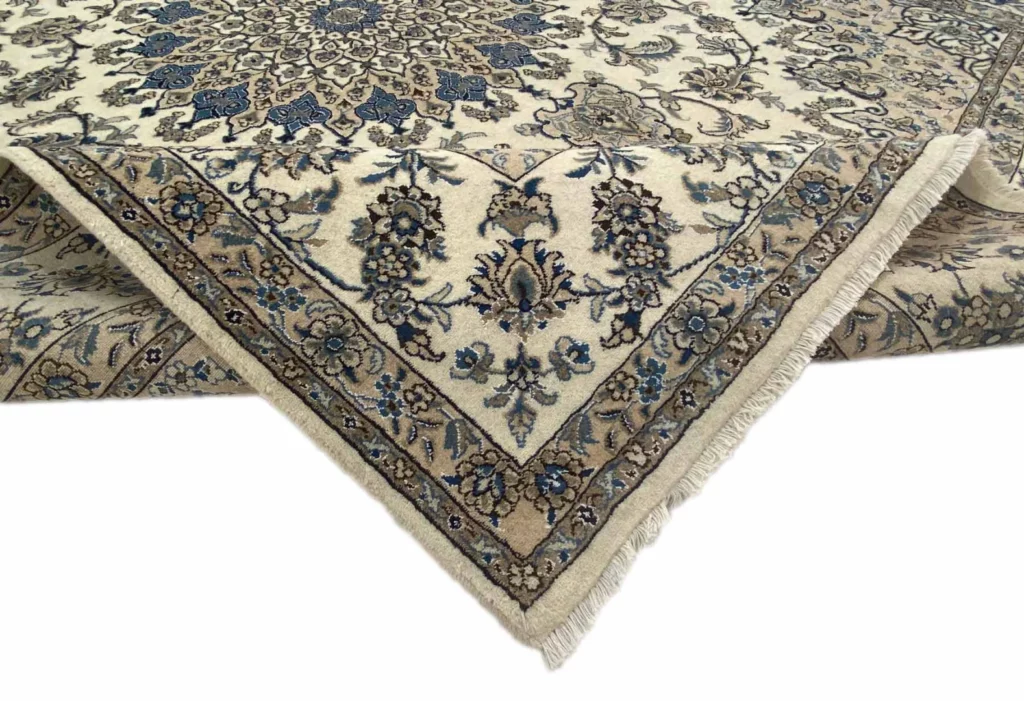
This Nain rug is hand-knotted and has a pile made of wool and silk. Combining these two fibres is part of the established material language associated with fine Nain rugs. Wool gives the pile structure, resilience and a naturally warm feel, while silk is used to create a smooth surface and a measured sheen. Their contrasting properties help distinguish the floral details and give the rug a varied textile character.
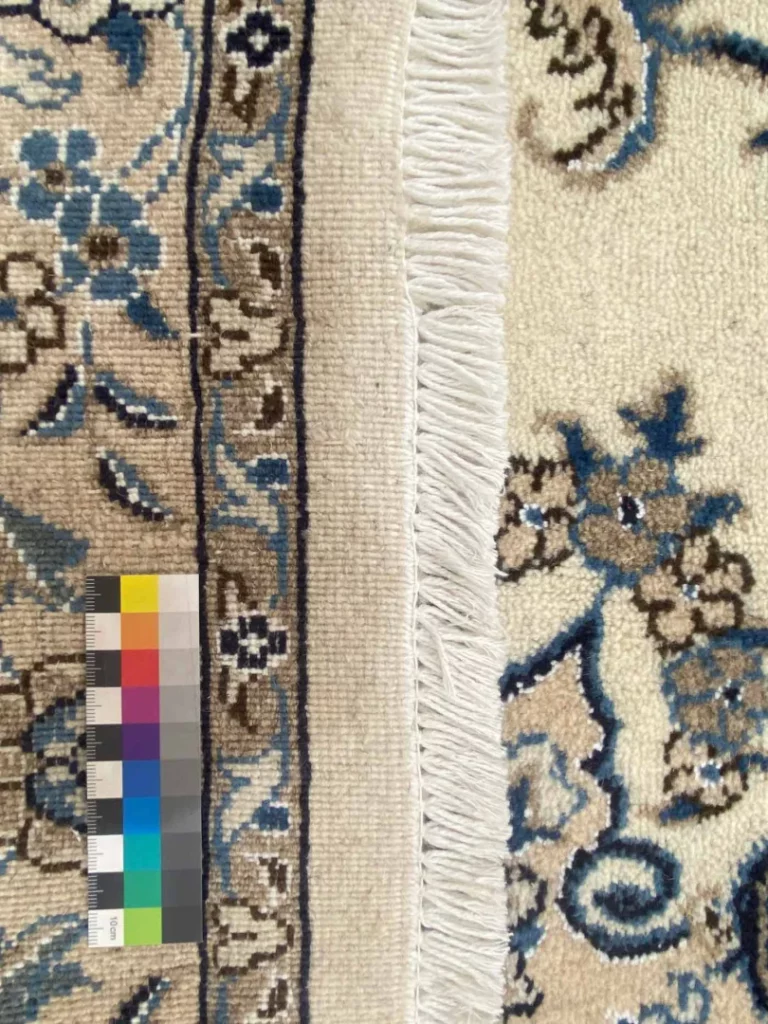
The knot density is specified as 12-Lah, with approximately 250,000 knots per square metre. In Nain rugs, Lah is used as a quality and density classification. A lower Lah number indicates a higher knot density; among the grades named here, 12-Lah represents the less dense end of the scale. The grades 4-Lah, 6-Lah, 9-Lah and 12-Lah illustrate the way Nain rugs are differentiated by fineness. In a hand-knotted construction, individual knots build the detailed pile one by one.
Wool and silk serve different purposes within this type of textile. Wool contributes body and durability to the pile, whereas silk can make fine outlines, blossoms and contours appear more precise. Both materials are identified as pile materials for this rug. The workmanship therefore reflects the Nain combination of classical ornament, careful pattern definition and a differentiated surface created by the two fibres.
Origin and Tradition
Nain is located in central Persia and belongs to the Persian carpet tradition. This rug is identified with Nain and with Isfahan in the central Persian region. Nain rugs are known for a distinct design vocabulary combining light colour effects, delicate drawing and ordered ornament. Within Iranian carpet production, the name Nain therefore indicates a recognisable regional tradition rather than a generic floral style.
The tradition of these rugs is based on the relationship between manual work and a carefully organised pattern structure. In hand knotting, each knot is inserted individually into the prepared foundation. Knot density influences how finely curved stems, leaves and blossoms can be represented. The Lah classification makes different levels of fineness visible within the Nain type. The named grades 4-Lah, 6-Lah, 9-Lah and 12-Lah are commonly used distinctions, with the smaller number indicating the greater density.
The connection with Isfahan is important when placing Nain rugs within the regional history of Persian weaving. Isfahan is a major Persian carpet centre associated with controlled proportions, elaborate designs and differentiated colour arrangements. Nain rugs are often viewed in relation to this central Persian tradition, while remaining a separate type. Their name refers to Nain, the city associated with their production, rather than making them Isfahan rugs.
Persian carpet centres have developed different emphases. Isfahan rugs are described through complex designs and vivid colours. Tabriz rugs often combine geometric organisation with floral motifs. Kerman and Sarough are also recognised for high-quality carpets. These comparisons place Nain among the range of Persian weaving traditions: Nain is particularly associated with light colours, fine patterns, floral compositions and the Lah system of classification.
The handcraft tradition is not tied to one particular format. Nain rugs are made as runners as well as larger room rugs, allowing the same regional type to appear in different settings. Origin, pattern tradition, material choice and knot density remain the relevant points for identifying the type. Format alone does not define a Nain rug.
Design and Pattern
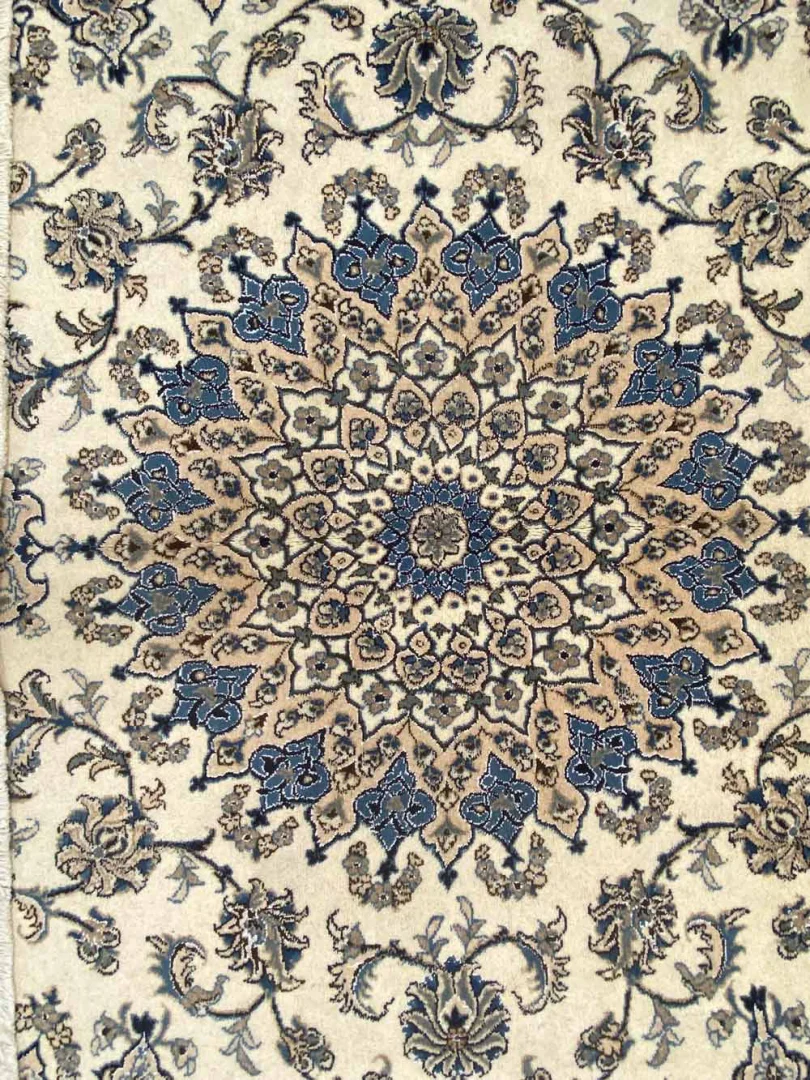
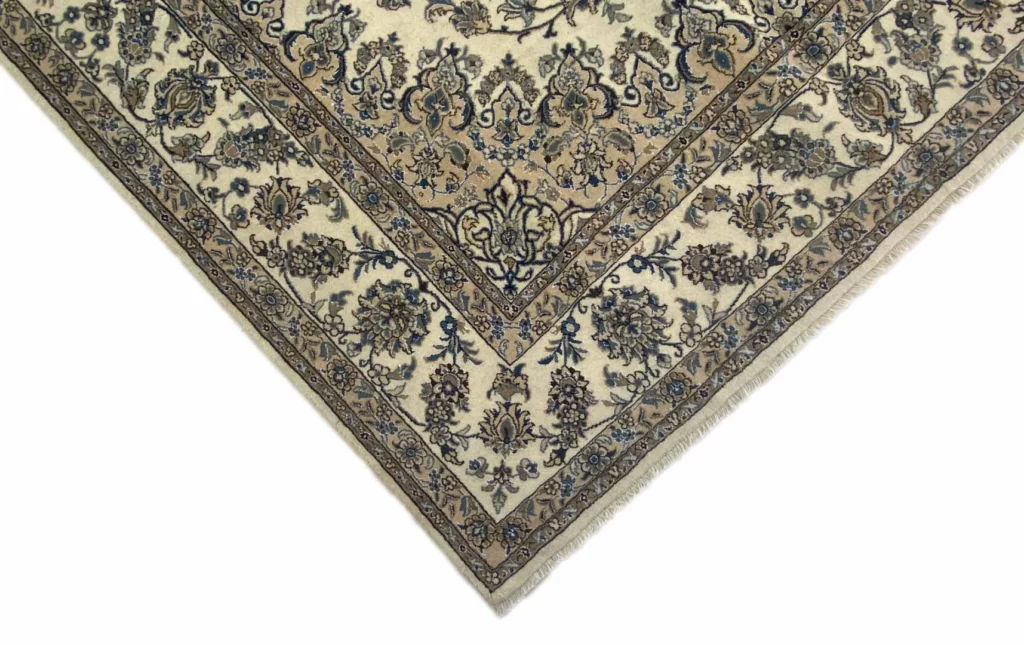
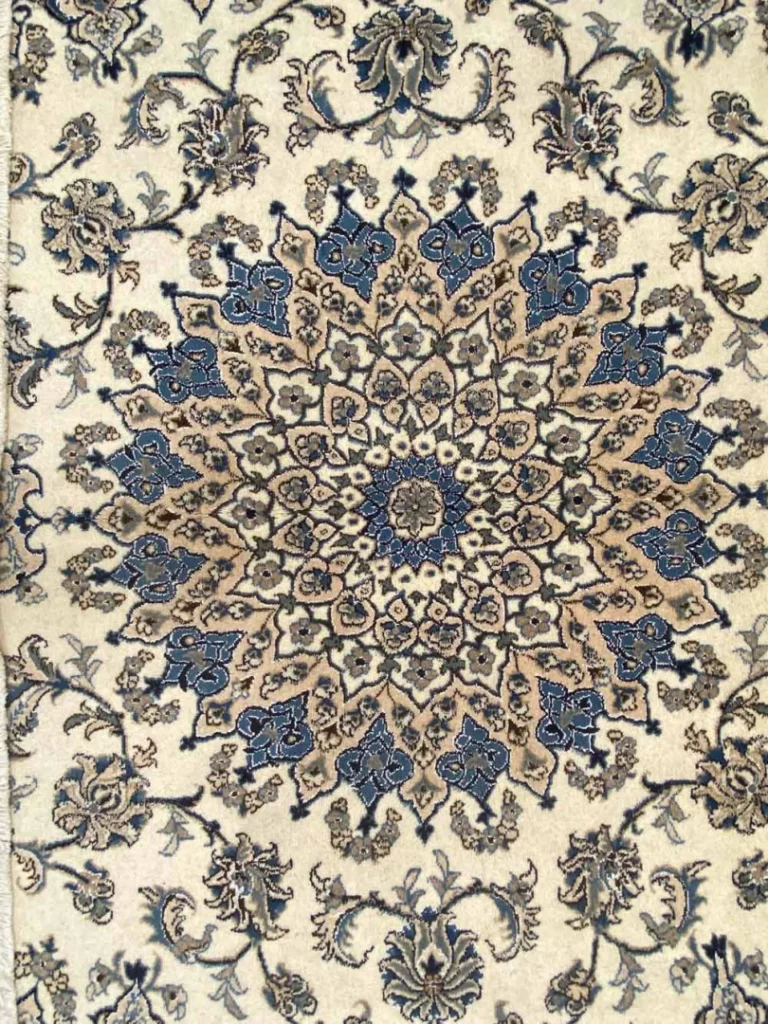
The design of this Nain rug is classically floral and organised around a medallion. A medallion establishes a clearly defined centre, while the surrounding ornament follows and balances that central arrangement. Floral motifs add blossoms, leaves and curving forms to the composition. The result is a design that combines a calm overall structure with numerous smaller drawn elements.
Floral Nain designs are traditionally arranged with attention to balance and distribution. A central medallion can gather the visual focus, while the surrounding field and side areas provide proportion. Blossoms and scrolling stems are set into recurring relationships rather than placed at random. This creates the characteristic combination of fine detail and clear decorative order associated with Nain patterning.
Light colour effects are among the features commonly associated with Nain rugs. A light ground and lighter accents allow the outlines of the floral drawing to remain legible. Silk may distinguish selected contours through its smooth surface and reflective quality, while wool gives the ornament a softer, more textured appearance. The eye consequently moves between broader colour fields and finely drawn floral details.
In Persian carpet design, a medallion is more than an isolated decorative mark. It establishes a visual centre and gives the other elements a proportional point of reference. In a floral Nain, leaves, blossoms and scrolling stems may relate to that centre or extend outward from it into the surrounding field. The composition can therefore appear complete without relying only on strict geometric patterning.
Compared with other Persian pattern traditions, Nain is often recognised by its light, refined and finely divided floral vocabulary. Isfahan designs can also contain complex floral arrangements, while Tabriz frequently combines geometric structure with floral forms. The name Nain nevertheless refers to a separate regional tradition. This rug is described specifically as a classic floral design with a medallion, not as a rug from another named weaving centre.
In a hand-knotted carpet, the resolution of the drawing is related to knot density. More knots within a given area can generally support the representation of smaller details; the Lah classification makes this relationship understandable in Nain rugs. At 12-Lah, the central arrangement and the floral motifs remain clearly readable. Centre, surrounding ornament and repeated botanical forms work together to create the identifiable Nain composition.
Special Features
The specific features of this rug are its hand-knotted construction, its wool and silk pile, its 12-Lah classification and its classic floral design with a medallion. The knot density is approximately 250,000 knots per square metre. The rug belongs to the Nain tradition of central Persia and is very well preserved.
The combination of Nain origin, light floral design and a central medallion makes its regional classification clear. Wool and silk provide different textile qualities within the pile. The stated condition is another specific characteristic of this individual rug and forms part of its product description.
FAQ
How should I care for my Nain Persian rug?
Vacuum the rug regularly and carefully to remove loose dust and everyday particles from the pile. If something is spilled, dab the area immediately with a damp cloth rather than rubbing it. Rubbing can place unnecessary stress on the fibres and on the pattern definition. Because this rug has a wool and silk pile, professional cleaning every few years is recommended. Specialist cleaning can remove accumulated dirt and dust while treating both materials more appropriately than unsuitable household products.
Where can I find authentic Nain rugs?
Authentic Nain rugs can be found at specialist rug dealers and on trustworthy online platforms that focus on handmade carpets. When choosing one, the origin and quality should be described clearly and consistently. Certificates may confirm a rug’s origin and quality. It is also useful to check that the description identifies the material, knot density, pattern and production method. The name Nain should refer to the regional weaving tradition, rather than being used only as a label for a floral design.
How do Nain rugs differ from other Persian rugs?
Nain rugs are distinguished by their characteristic combination of light colours, fine patterning and a particular knot-density classification. Classic floral motifs with a central medallion are among their recognised design forms. Isfahan rugs are more commonly associated with complex designs and vivid colours, while Tabriz rugs often combine geometric patterns with floral motifs. Nain remains identifiable through its own regional vocabulary. Depending on the quality, Nain rugs may be made from wool, silk or a combination of both materials.
To provide the best experiences, we use technologies like cookies to store and/or access device information. Consenting to these technologies will allow us to process data such as browsing behavior or unique IDs on this site. Not consenting or withdrawing consent, may adversely affect certain features and functions.
Functional Always active
The technical storage or access is strictly necessary for the legitimate purpose of enabling the use of a specific service explicitly requested by the subscriber or user, or for the sole purpose of carrying out the transmission of a communication over an electronic communications network.
Preferences
The technical storage or access is necessary for the legitimate purpose of storing preferences that are not requested by the subscriber or user.
Statistics
The technical storage or access that is used exclusively for statistical purposes.The technical storage or access that is used exclusively for anonymous statistical purposes. Without a subpoena, voluntary compliance on the part of your Internet Service Provider, or additional records from a third party, information stored or retrieved for this purpose alone cannot usually be used to identify you.
Marketing
The technical storage or access is required to create user profiles to send advertising, or to track the user on a website or across several websites for similar marketing purposes.

 SECURE PAYMENT
 SHIPPING PARTNERS