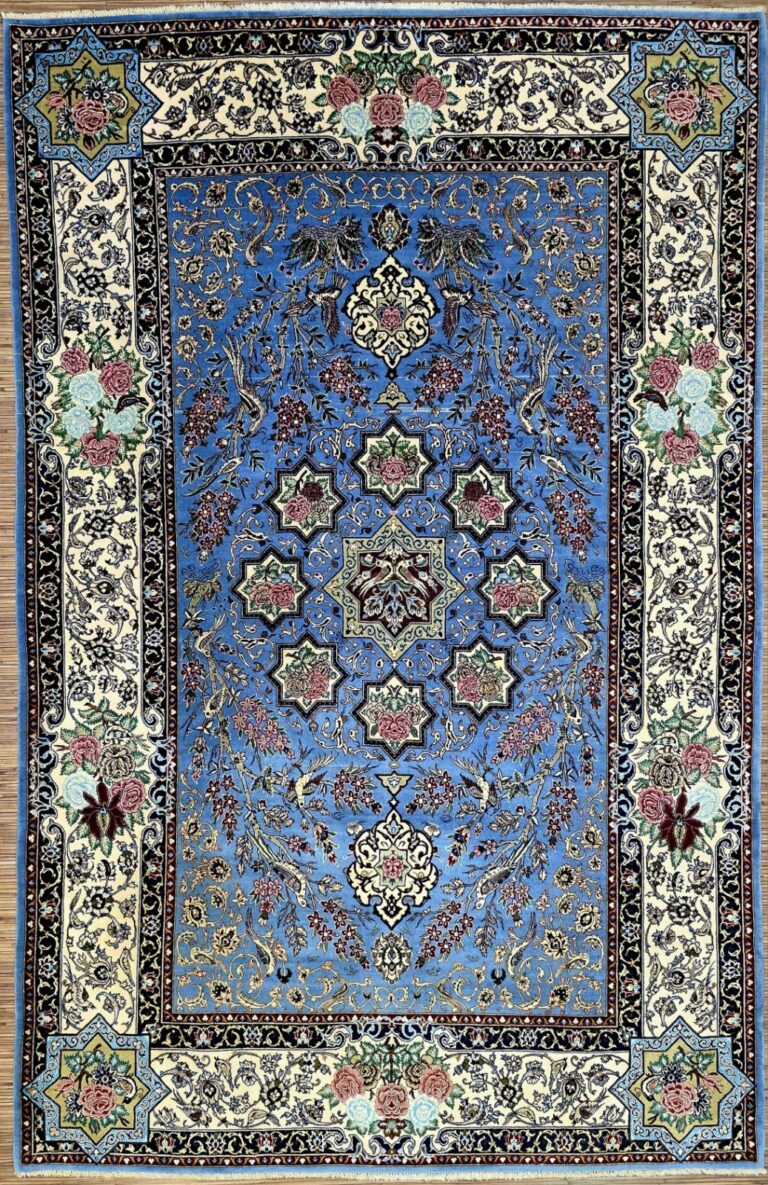
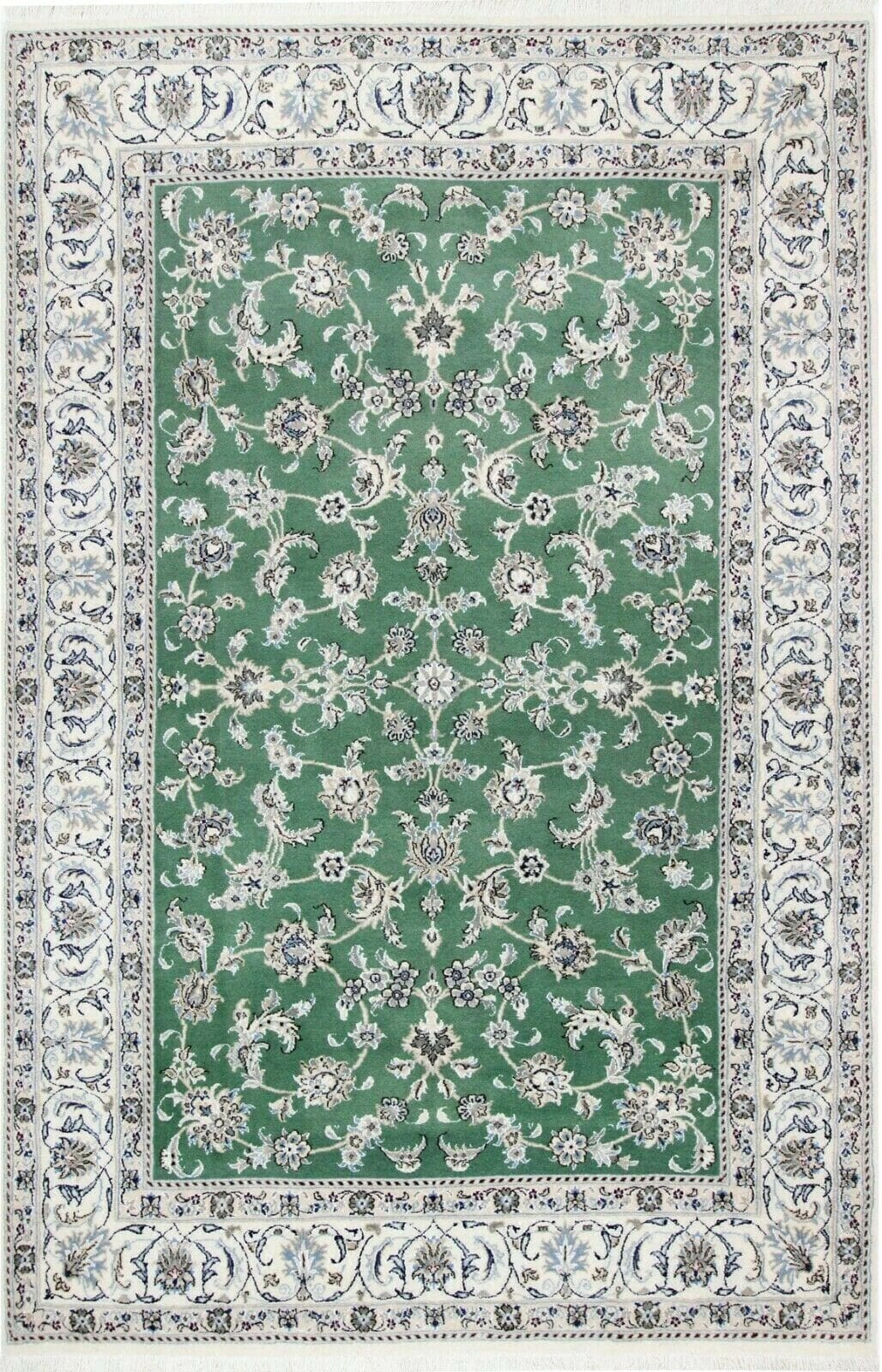
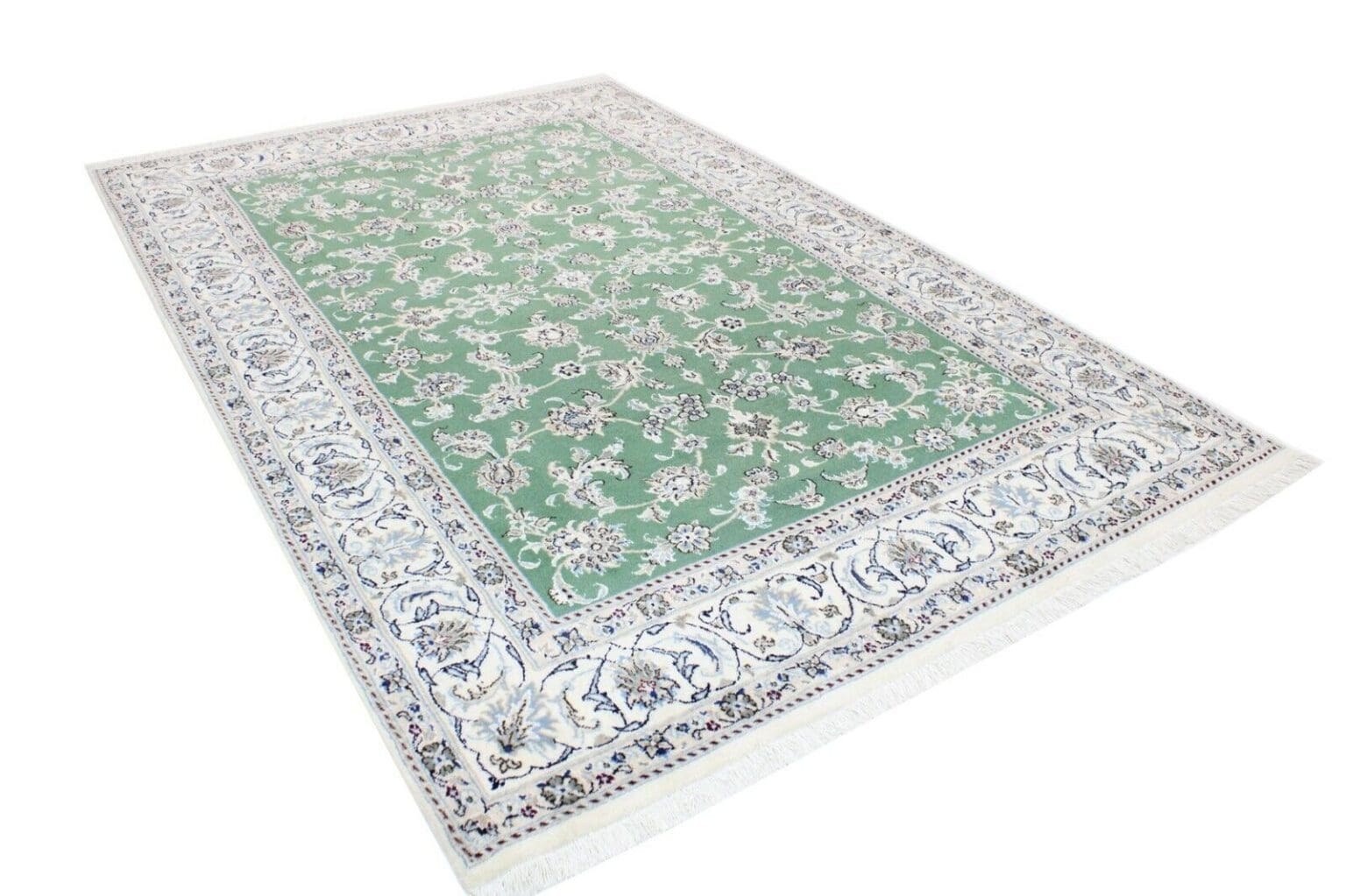
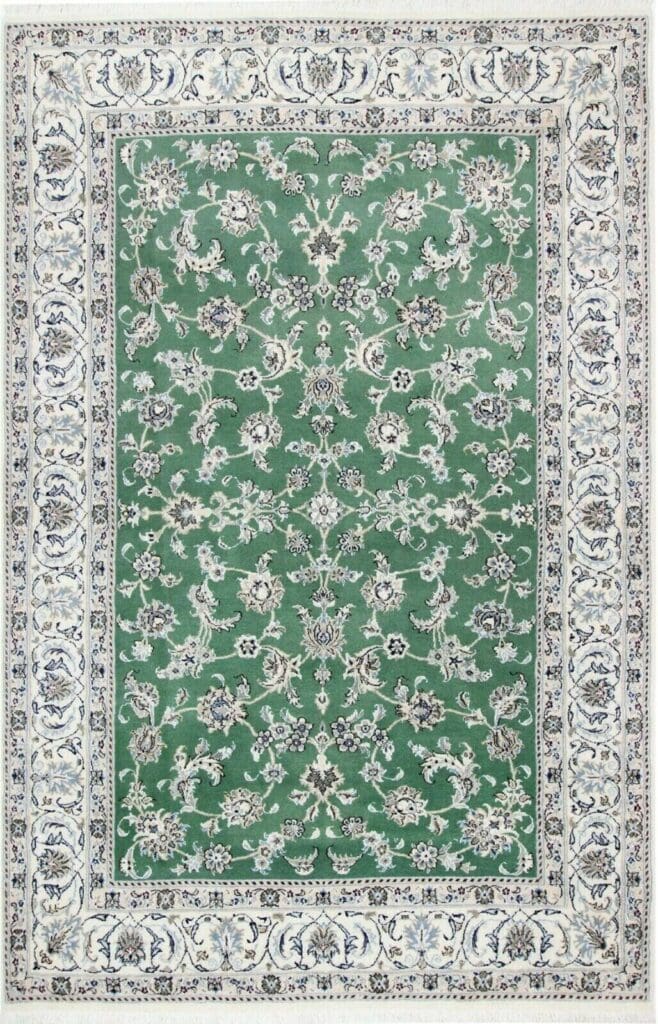
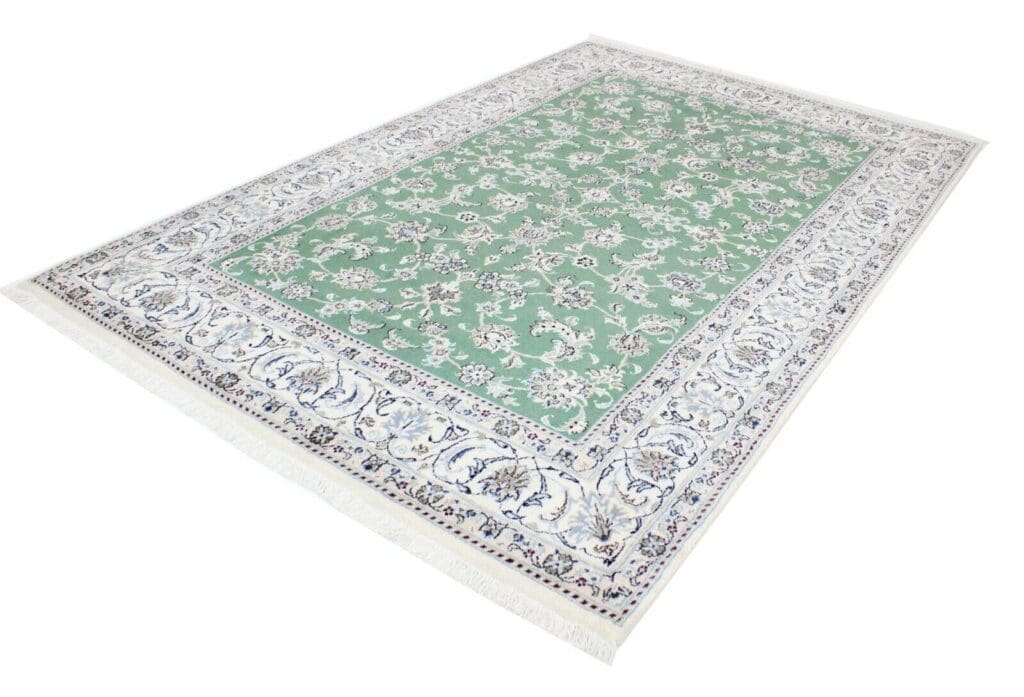
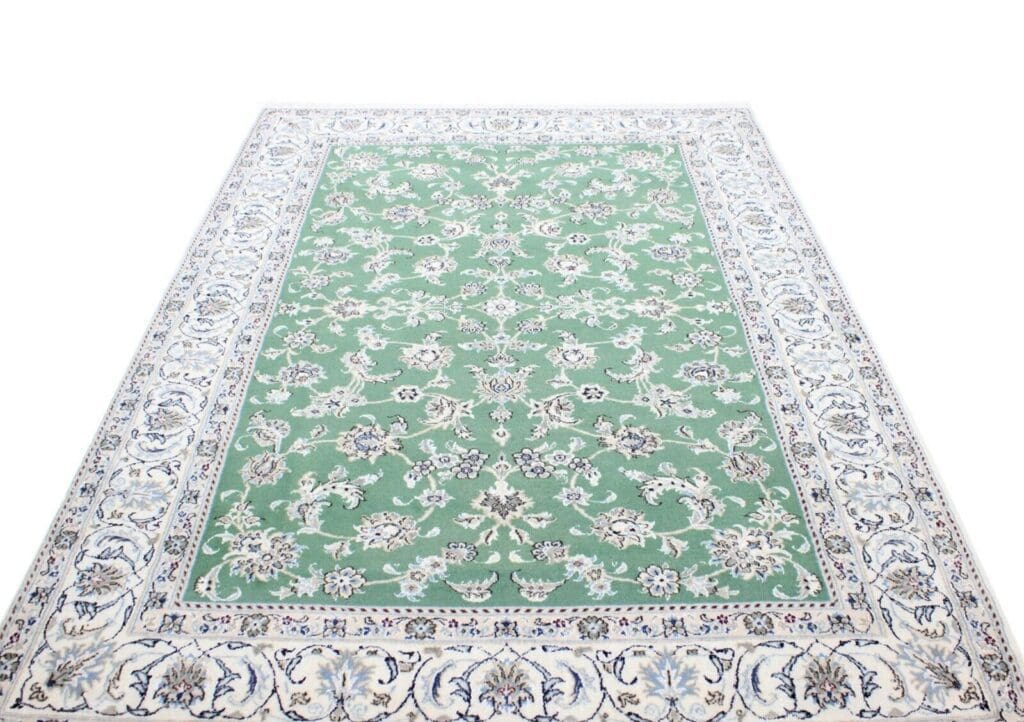
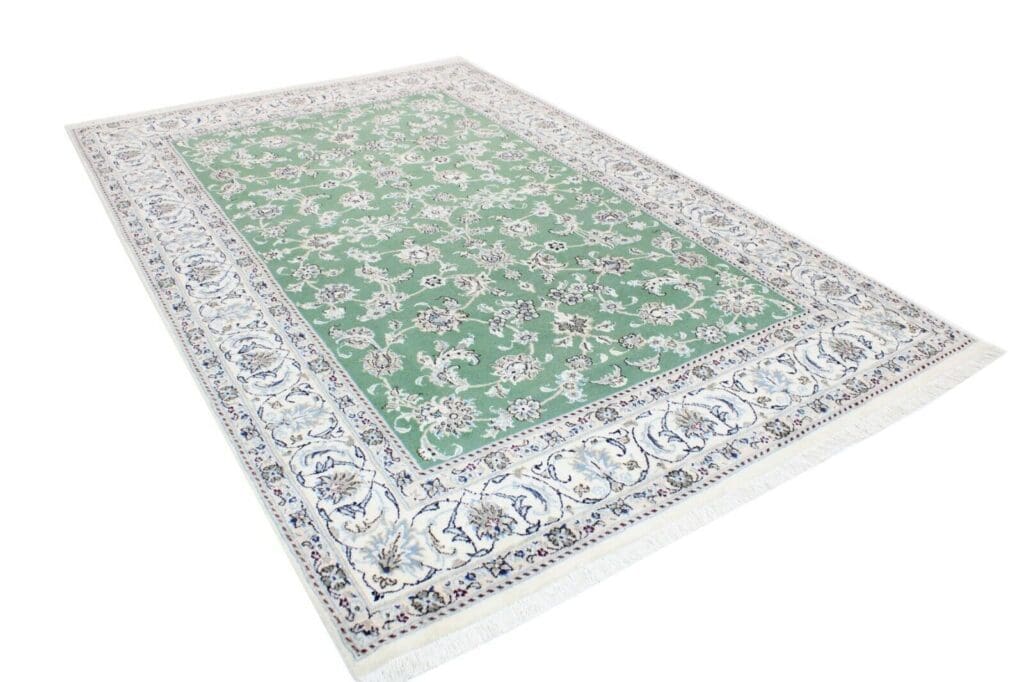
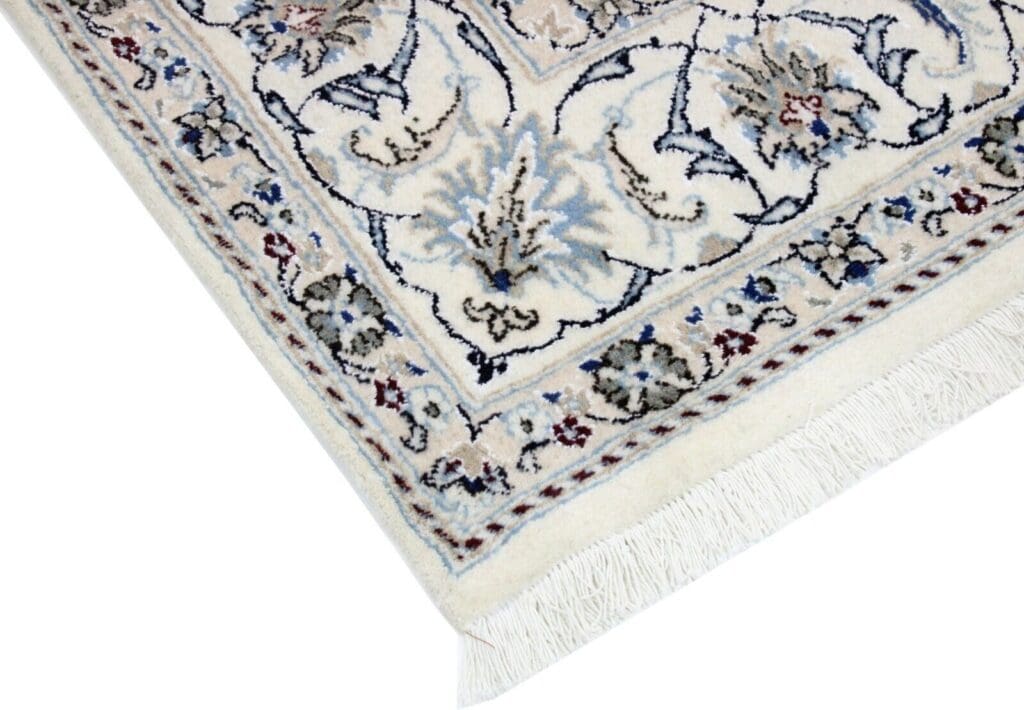
Hand-knotted Nain Persian rug | Knot density: Hand-knotted | Material: Wool and cotton | Size: 299 x 197 cm | Pattern: Oriental floral design | Condition: New without label, top condition
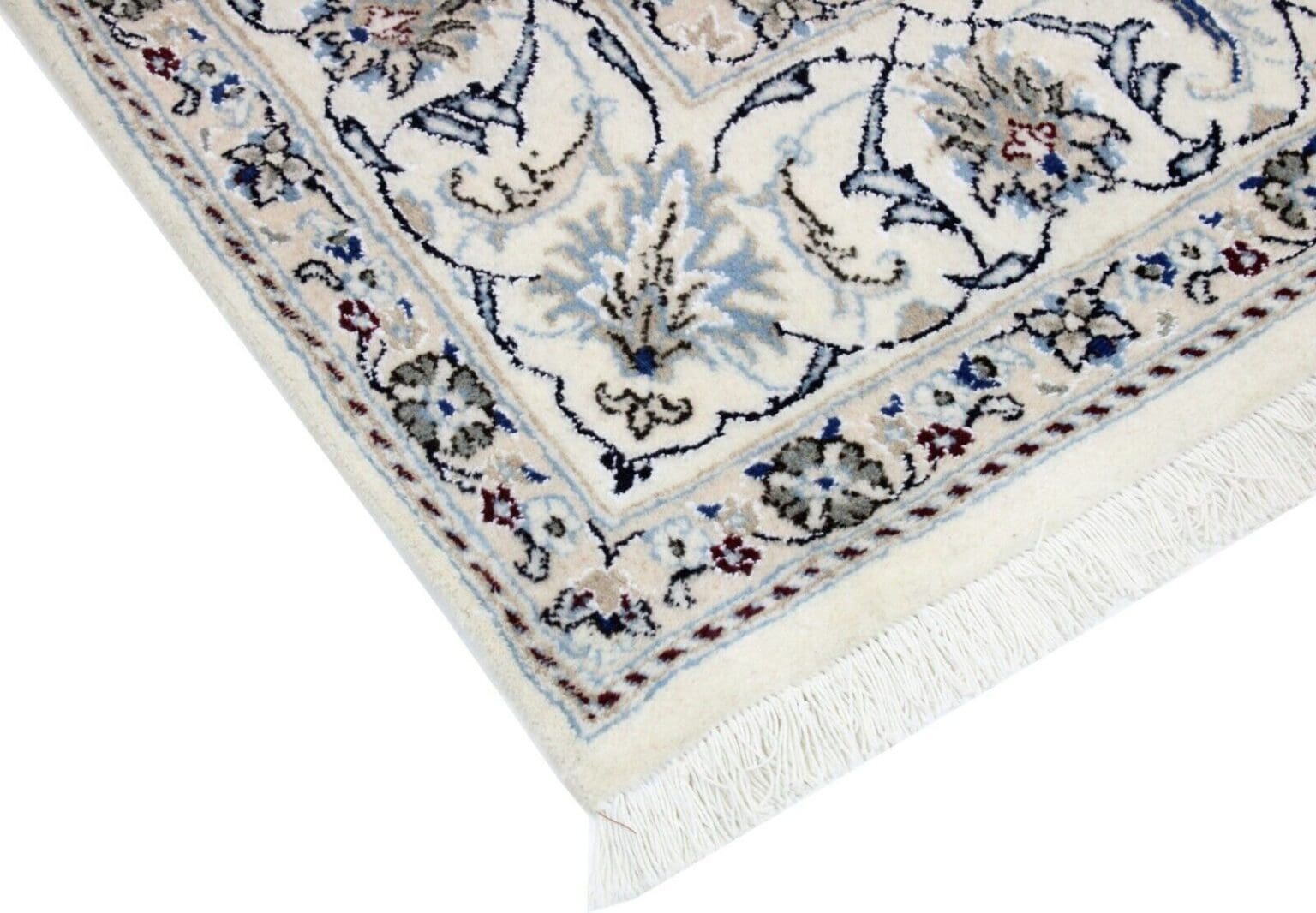
This Nain Persian rug is hand-knotted and made from high-quality wool and cotton. The combination of these two materials belongs to the established textile foundations of many Persian rugs: wool is used for the visible pile, while cotton can form an important part of the underlying textile structure. Because this rug is knotted by hand, its design is built knot by knot rather than produced through a mechanical printing or weaving process.
Hand knotting involves securing individual yarns into a prepared construction. The pile is then arranged and worked row by row. This method requires time and practiced manual work. Minor variations in execution are part of the traditional production of a hand-knotted one-off. The information for this rug identifies the knot density as hand-knotted; no numerical knot count is provided.
Wool is a traditional rug material with a tactile surface and a distinct natural textile character. Cotton contributes an even, stable fibre to the construction and is frequently used in Persian rug making as a structural material. High-quality wool and cotton are specified for this piece. No further fibre content or silk mixture is stated, so no additional material claim is made.
Origin and Tradition
This rug comes from Iran and is described as a Nain Persian rug. Nain is a city and an important rug-weaving centre in central Iran. Its weaving tradition developed within the wider Persian textile culture and is associated with carefully organised rugs and finely articulated ornament. Nain therefore denotes more than a place name: it identifies a regional direction within Persian rug art.
Rug making in Iran brings together local workshops, inherited designs and practical knowledge passed from one generation to the next. Different parts of the country developed their own approaches to drawing, colour, materials and construction. Nain is often associated with balanced compositions, clearly legible ornament and controlled line work. These observations describe the tradition of the region; they do not add unreported details to this individual rug.
Traditional Persian rugs are built on a vertical or horizontal loom. Warp and weft provide the textile framework into which the pile yarns are tied. After several rows, the weft is compacted and the pile is trimmed or adjusted. Knotting methods, yarn thickness, colour arrangements and pattern structure vary according to region, workshop and the intended fineness of the work. The hand-knotted construction connects this rug with Iran’s long-established craft tradition.
Nain lies in an arid part of Iran where textiles and rugs have long formed an important part of regional handicraft. The local design language is often directed towards an orderly overall composition and precise ornament. Persian rugs can serve both decorative and practical purposes: they organise an interior, cover a floor and introduce a woven surface into the room. Their cultural character comes from the combination of use, pattern and manual work.
The term Persian rug is used here because the stated origin is Iran. It distinguishes this piece from Oriental rugs made elsewhere, even though floral and geometric devices appear across many rug cultures. Nain, Isfahan, Tabriz and Kashan each represent different Iranian traditions. Nain is the regional designation given for this rug; no alternative origin is asserted.
Design and Pattern
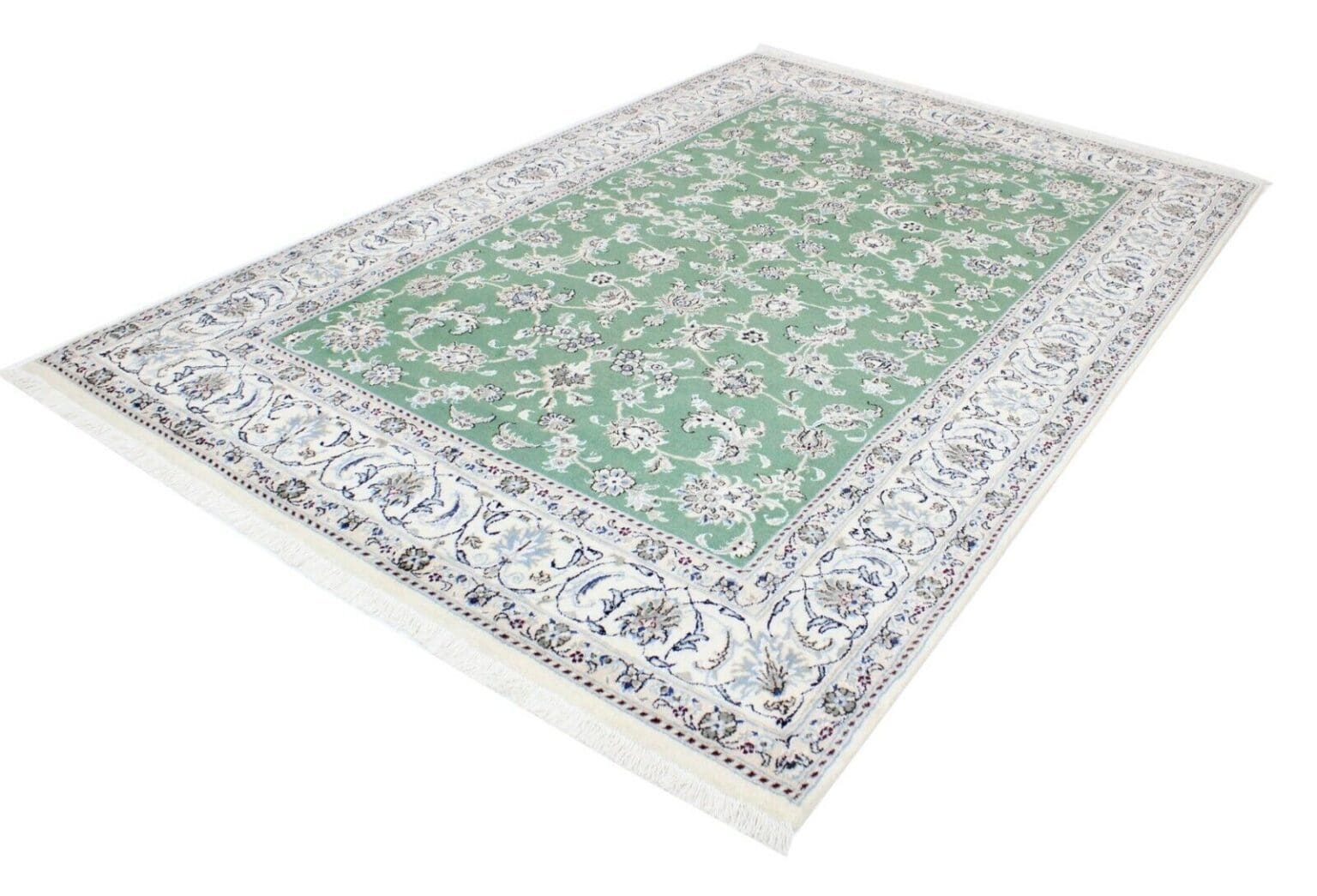
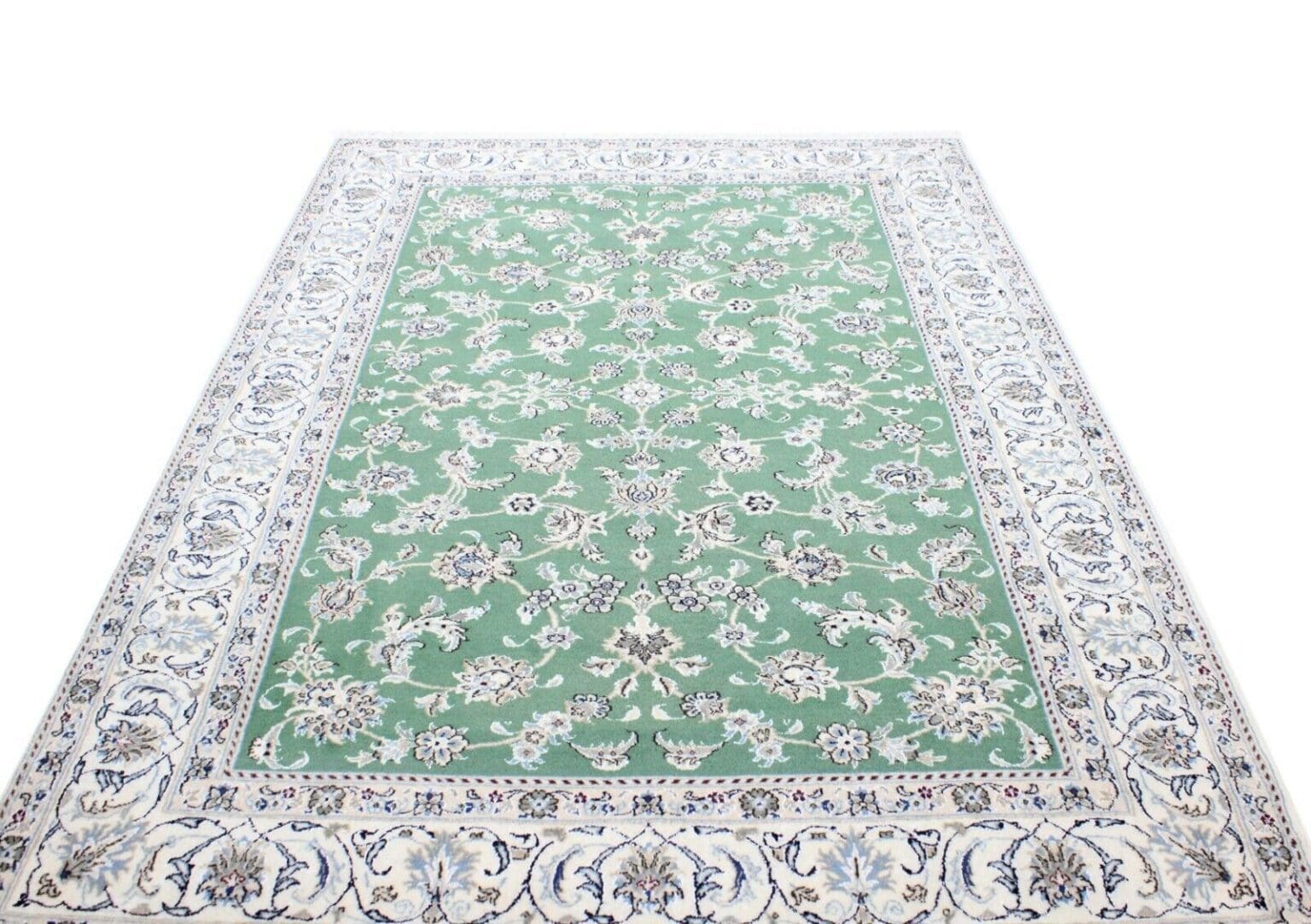
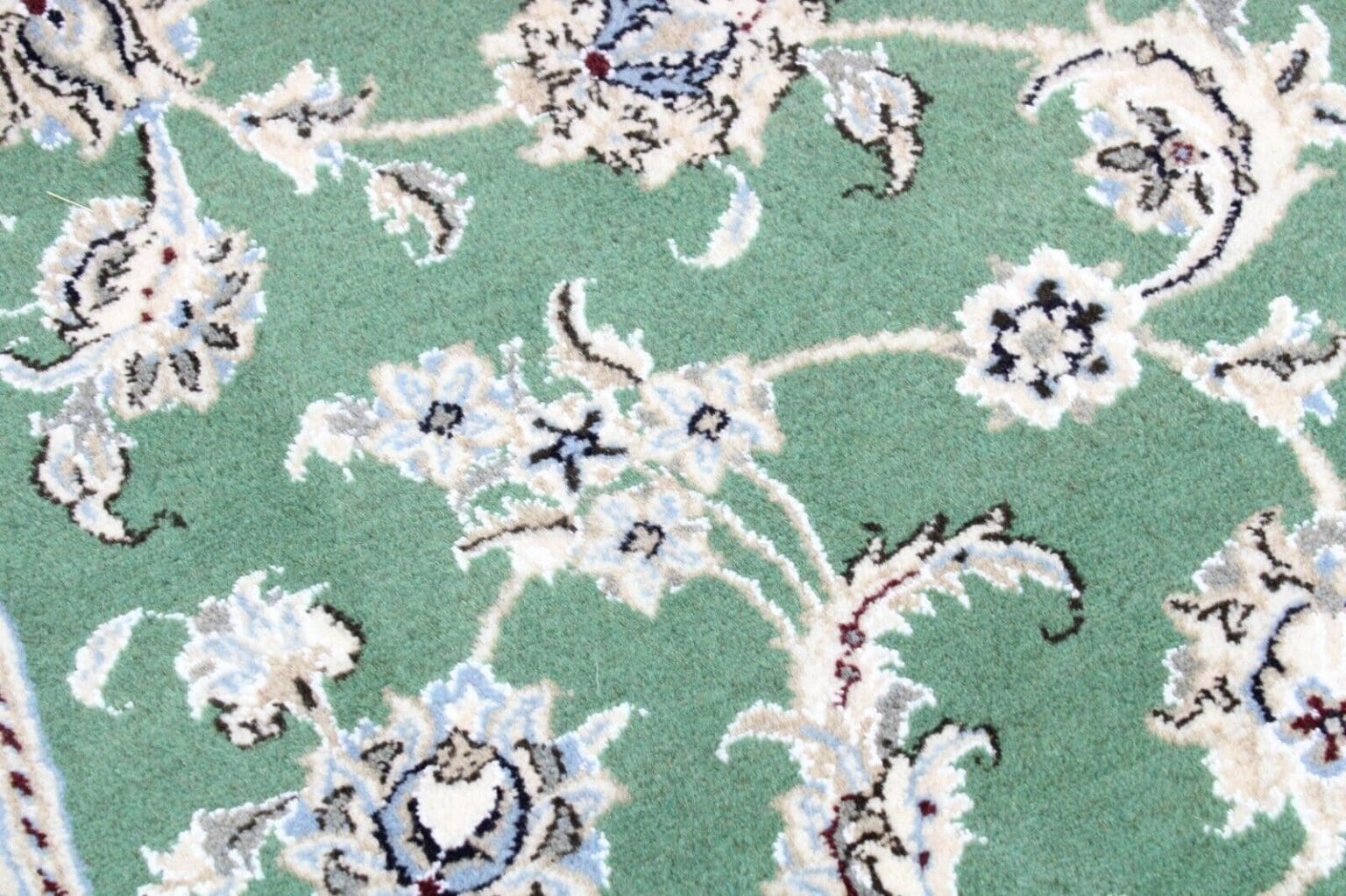
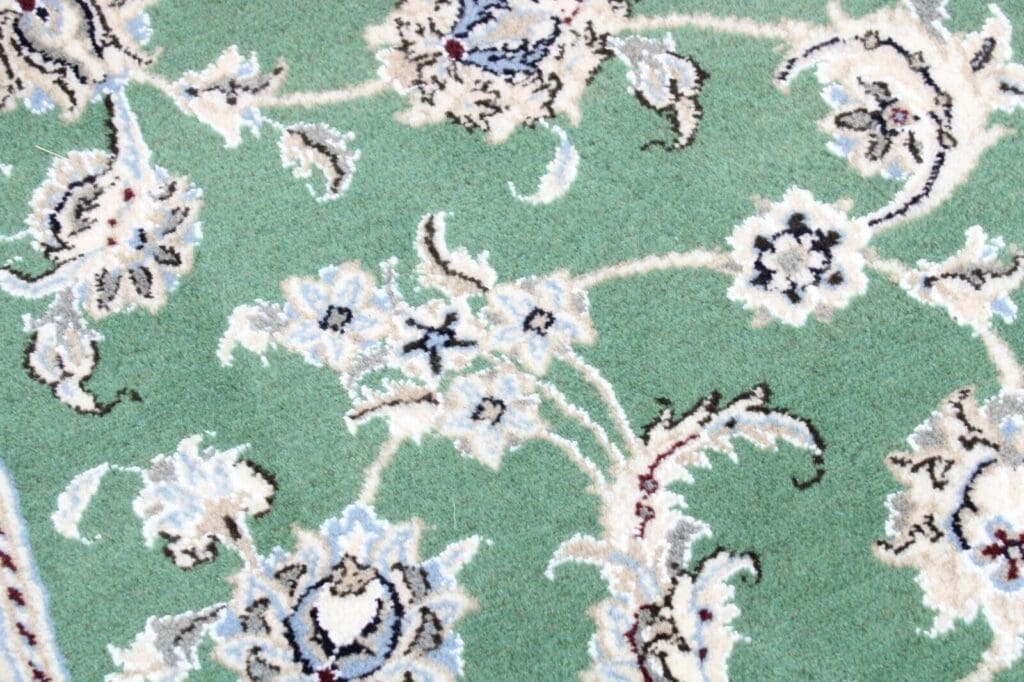
The pattern of this rug is described as oriental with floral motifs. Floral ornament is one of the established design languages of Persian rug art. Leaves, blossoms, vines and curved stems can be linked together to form a continuous field or a structured composition. In such a design, the visual order comes not from one isolated image but from the relationship between many repeated forms.
Persian ornament often turns plant forms into stylised signs rather than naturalistic botanical illustrations. A blossom may appear as a repeating element, part of a vine or the centre of a symmetrical unit. This abstraction makes it possible to organise a broad surface coherently. The phrase floral motifs describes the character of the design without claiming a particular flower species or a specific symbolic meaning.
Oriental rug designs frequently balance repetition with visual movement. Repeated elements provide continuity, while vines and connecting lines lead the eye across the field. In many Persian compositions, floral forms are framed by borders or accompanied by smaller ornaments. The information for this particular rug does not specify a border, medallion or exact field arrangement. What is established is the description of an oriental pattern with floral motifs.
The Nain tradition is often discussed in connection with finely drawn floral compositions. Regional design conventions may include a clearly organised centre, ordered axes and carefully articulated vines. This background helps explain why the origin and the pattern description are considered together. It is an account of Nain’s design tradition, not a claim about details that have not been recorded for this rug.
Colours, borders and individual floral forms can vary between Nain designs, workshops and individual drawings. No specific colours or exact arrangement of the flowers are stated here. The rug is therefore described only through the information available: an oriental design with floral motifs. This keeps the documented pattern separate from broader knowledge of Persian rug design.
Special Features
The recorded characteristics of this piece include its hand-knotted construction, the materials high-quality wool and cotton, its origin in Iran and the Nain designation. Its condition is given as new without a label and also as top condition. This describes the offered condition without adding a production date, previous-use history or other provenance.
The rug is suitable for use with underfloor heating. This statement concerns its intended use in rooms equipped with that type of heating. No additional care instructions or special cleaning requirements are stated for this individual piece. The classification as traditionally Persian or Oriental complements the origin and pattern description, but it does not provide further information about colour, age or signature.
As a hand-knotted rug, this is a single piece made through a traditional process. An individual signature, certificate and precise knot count are not mentioned in the source information. A numerical knot density is likewise not provided. The special features of this offer therefore remain limited to the documented materials, construction, condition, origin, pattern description and suitability for underfloor heating.
FAQ
How should I care for a Persian rug?
Regular, careful vacuuming helps remove loose dirt from the pile. Strong direct sunlight should be avoided so that the colours are protected. If a spill occurs, dab the area immediately with a damp cloth rather than rubbing it forcefully. When a more thorough treatment is needed, professional cleaning is recommended. The correct method depends on the fibres, dyes and type of stain; if there is any doubt, advice from a qualified rug-care professional is appropriate.
How can I tell whether a Persian rug is authentic?
An authentic Persian rug is hand-knotted and often shows a dense knot structure made by hand. Typical patterns and colours may also provide indications of a particular region. With a Nain rug, the regional designation should be considered together with the construction and the design. A certificate can support the assessment. For a reliable examination, a specialist should inspect the material, reverse side, knotting, pattern and any available documentation.
What sizes are available for Persian rugs?
Persian rugs are produced in many formats. The range extends from narrow runners to large rugs intended for living rooms and other spacious areas. When choosing a format, the room dimensions should be considered together with furniture placement, the area to be covered and the available walking space. The right size is the one that suits the intended use and the layout of the room. This rug is offered in a size of 299 x 197 cm.
To provide the best experiences, we use technologies like cookies to store and/or access device information. Consenting to these technologies will allow us to process data such as browsing behavior or unique IDs on this site. Not consenting or withdrawing consent, may adversely affect certain features and functions.
Functional Always active
The technical storage or access is strictly necessary for the legitimate purpose of enabling the use of a specific service explicitly requested by the subscriber or user, or for the sole purpose of carrying out the transmission of a communication over an electronic communications network.
Preferences
The technical storage or access is necessary for the legitimate purpose of storing preferences that are not requested by the subscriber or user.
Statistics
The technical storage or access that is used exclusively for statistical purposes.The technical storage or access that is used exclusively for anonymous statistical purposes. Without a subpoena, voluntary compliance on the part of your Internet Service Provider, or additional records from a third party, information stored or retrieved for this purpose alone cannot usually be used to identify you.
Marketing
The technical storage or access is required to create user profiles to send advertising, or to track the user on a website or across several websites for similar marketing purposes.
 SECURE PAYMENT
 SHIPPING PARTNERS