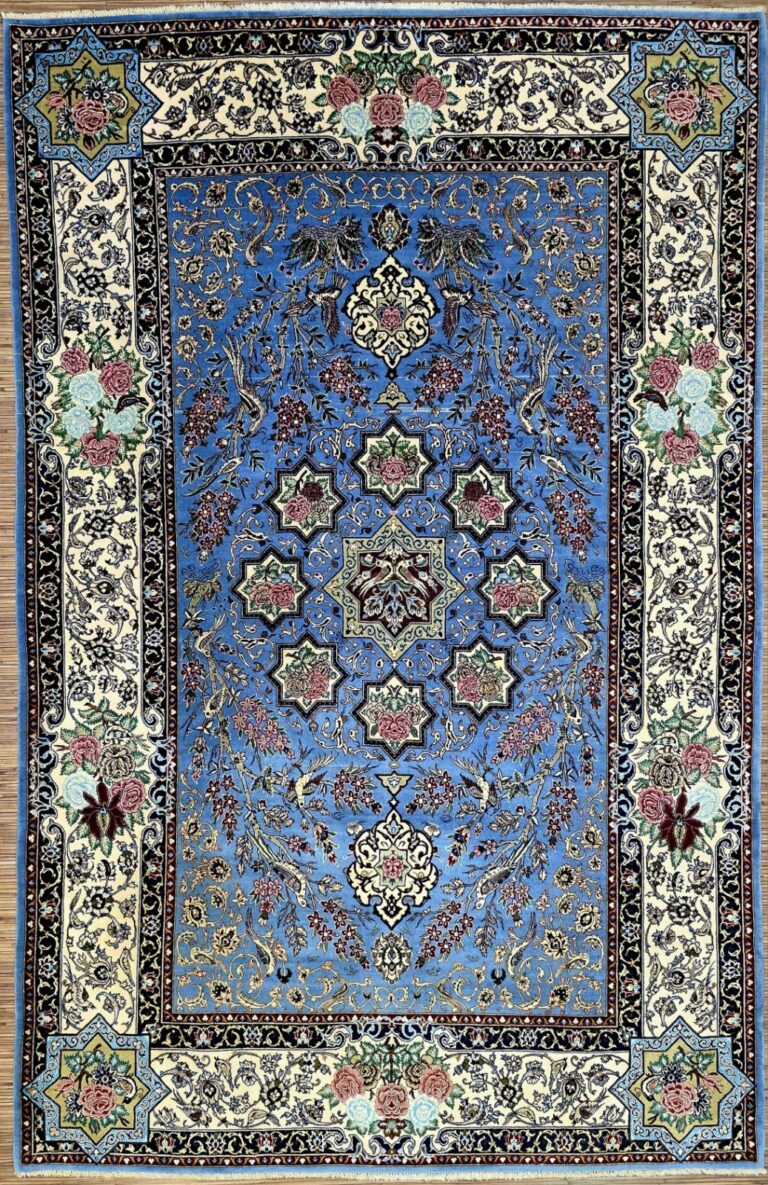
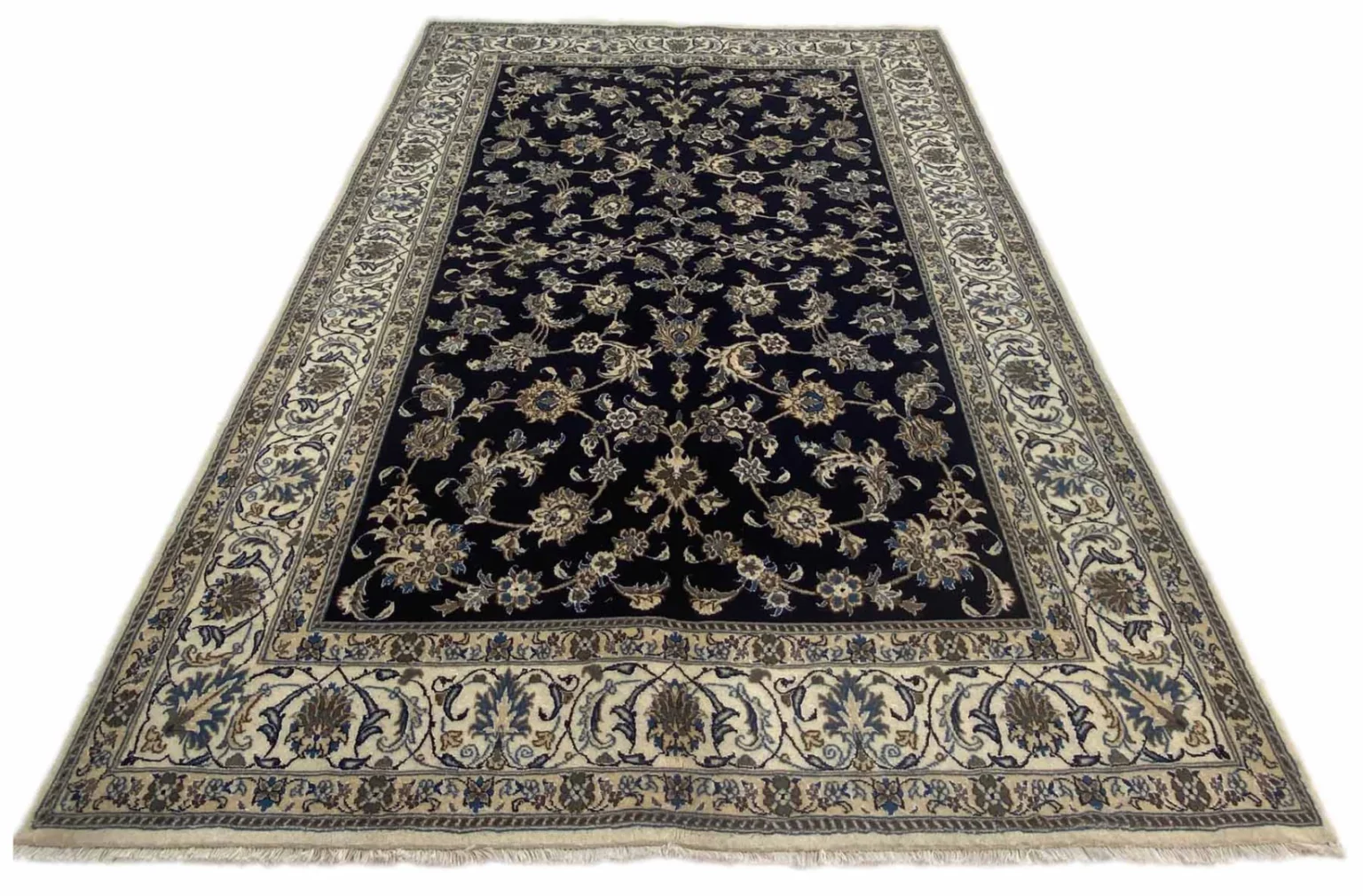
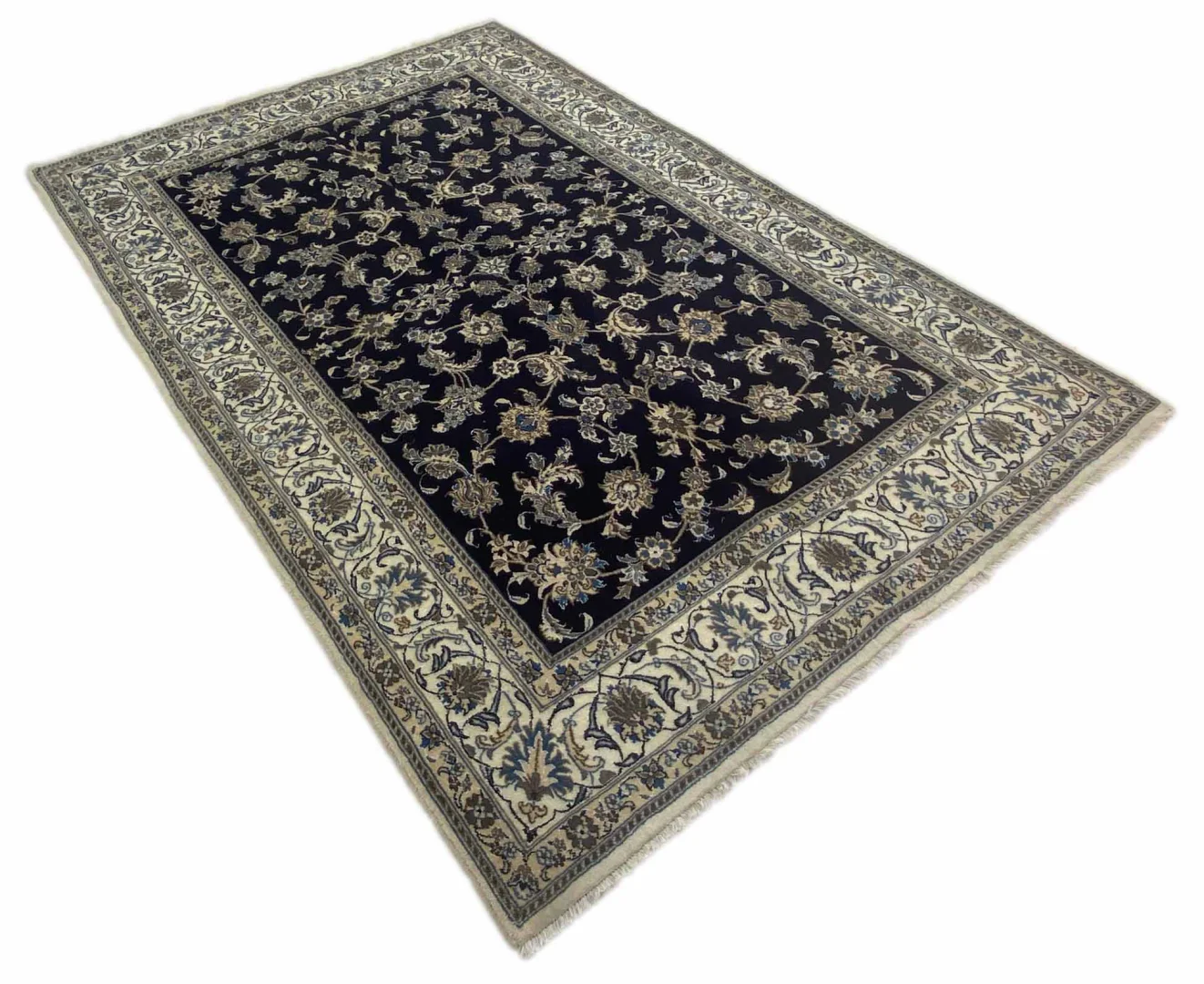
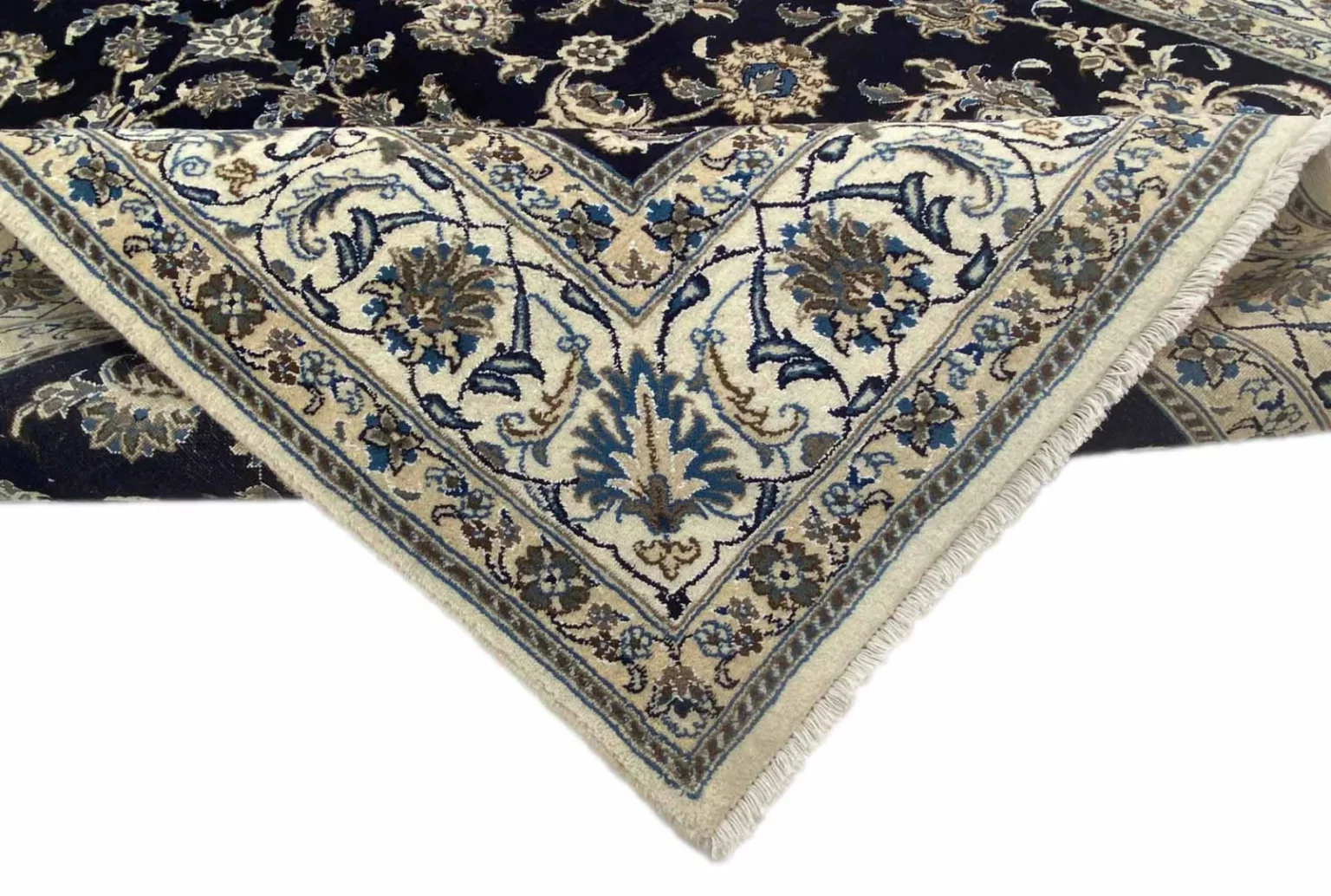
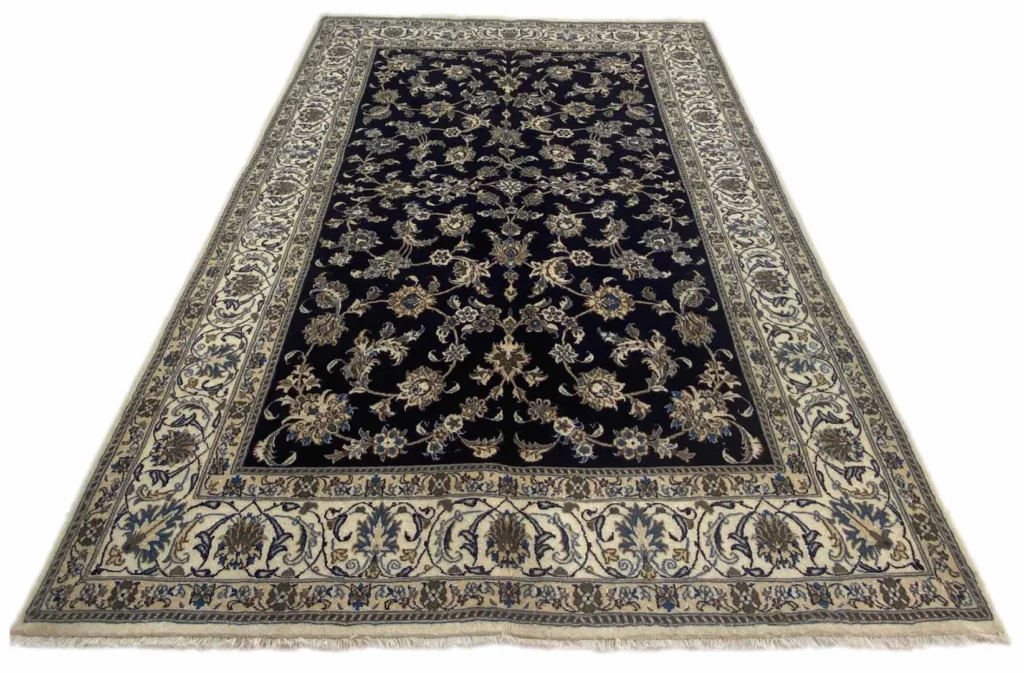
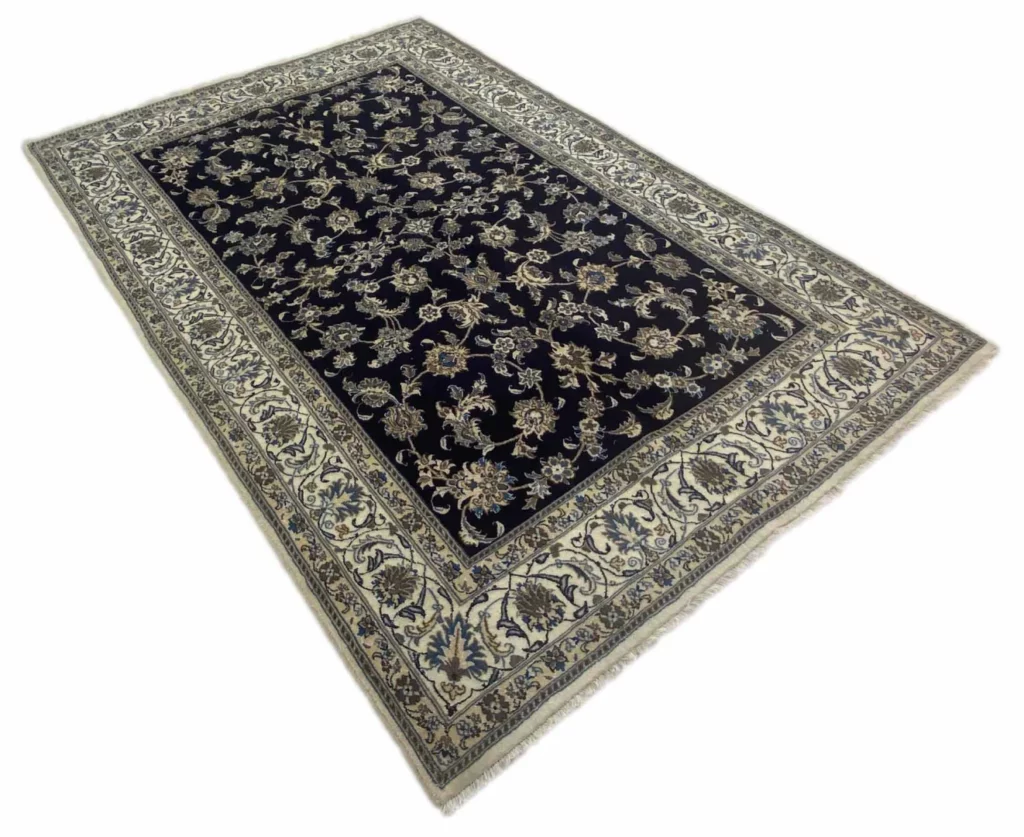
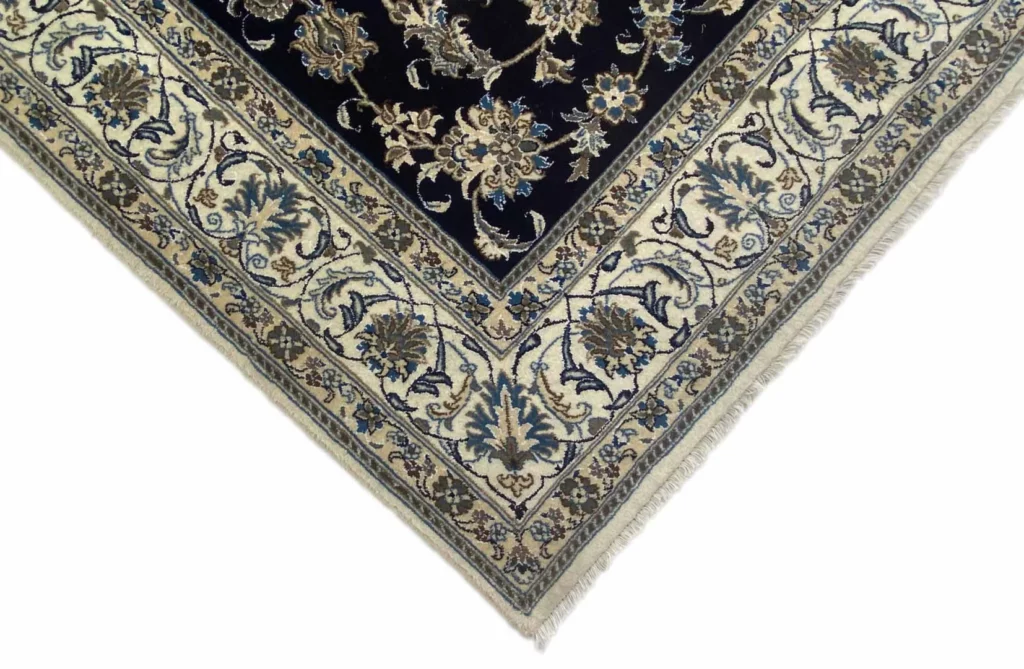
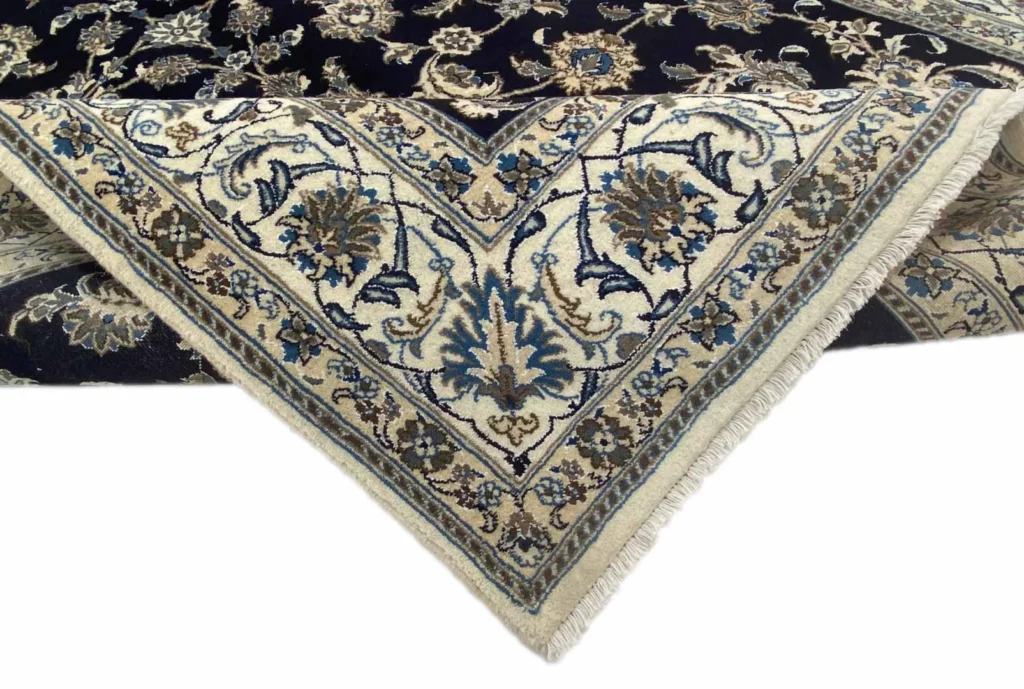
Hand-knotted Nain Persian rug | Knot density: 12-La, approx. 200,000 knots/m² | Material: Wool pile with silk content | Size: 297 x 197 cm | Pattern: Classic floral motifs with central medallion | Condition: Very well preserved
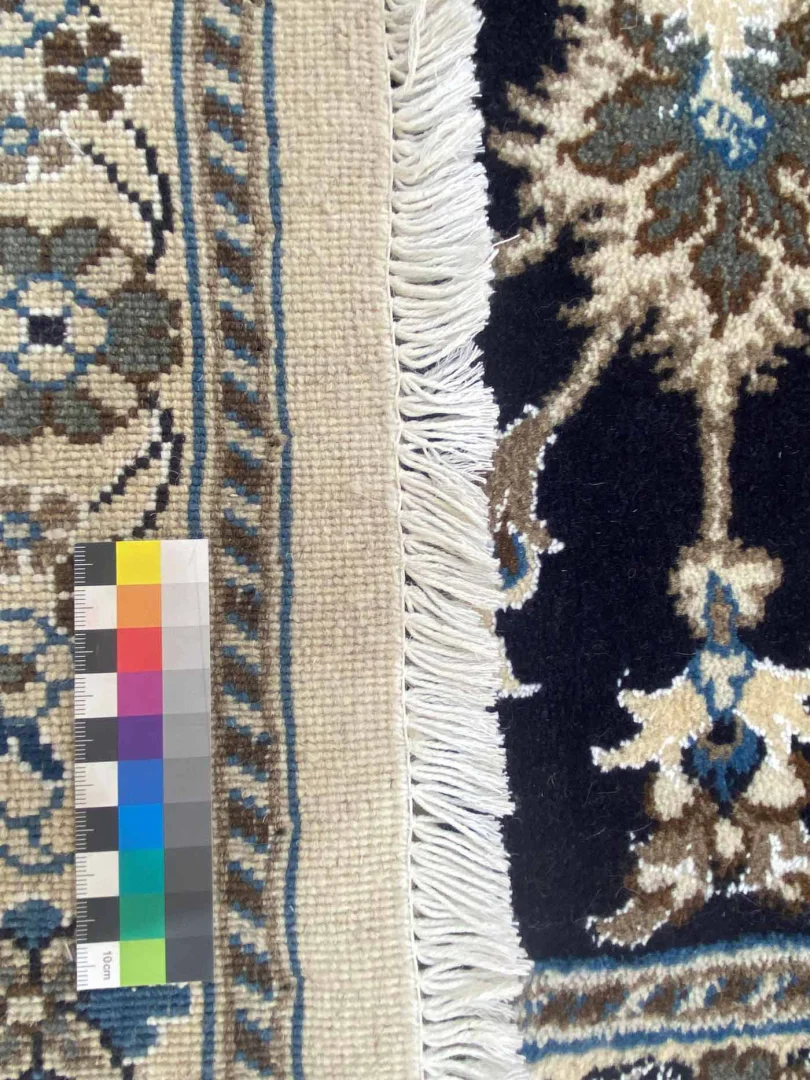
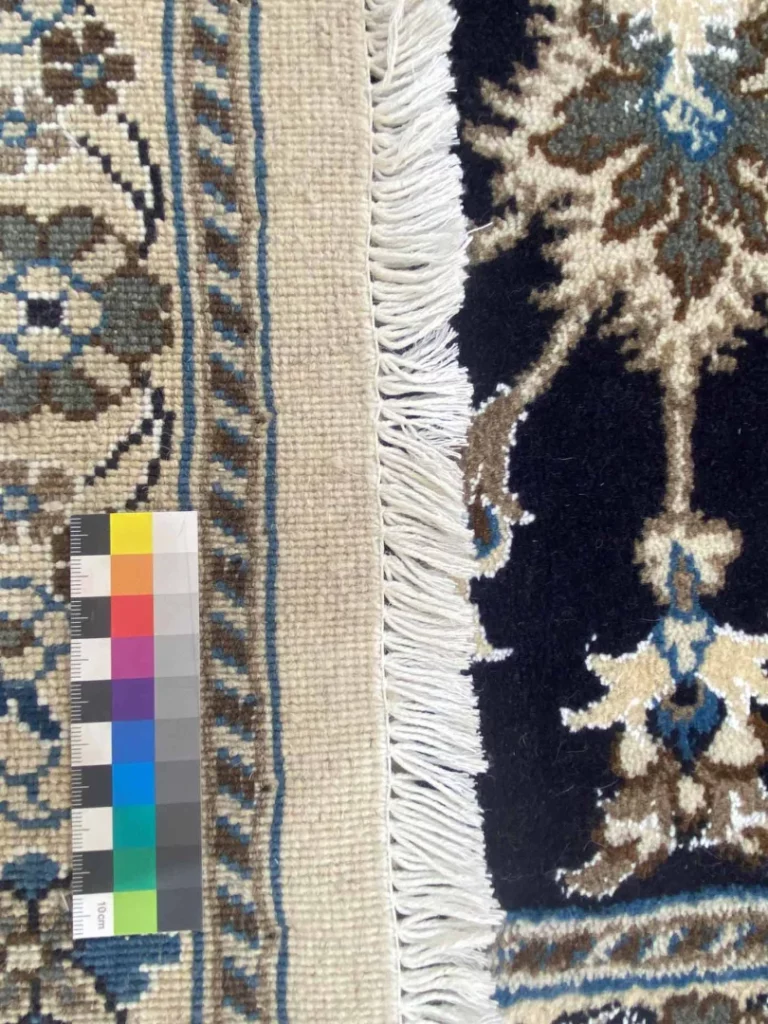
This Nain Persian rug is hand-knotted and has a pile made from high-quality wool with silk content. The combination is associated with the refined construction of many Nain rugs. Wool provides a resilient and pleasantly tactile pile, while silk content can be used to give selected areas greater fineness and a more differentiated surface effect. In a hand-knotted rug, each knot is placed manually in successive rows. The woven structure is then compacted and the pile is carefully finished so that the pattern becomes part of the rug itself rather than being printed onto its surface.
Nain rugs are traditionally classified with the unit La or Lah, which refers to the density of the knotting. This terminology helps describe how finely the knots are arranged and provides a way of comparing different qualities within the Nain tradition. A finer construction can support more precise outlines and smaller ornamental details. For this rug, the construction is identified as 12-La, with a knot density of approximately 200,000 knots per square metre. The Lah classification and the knot-density information complement the material description and the statement that the rug was made by hand.
High-quality wool is valued in rug making for its durability, natural resilience and ability to accept colour evenly. Silk content may add a smoother feel and a subtle variation in the way light is reflected from parts of the pile. The visual effect depends on where the silk occurs within the design and on the surrounding light. In a hand-knotted piece, the material and the technique work together: the pile carries the design, while the rows of knots secure the composition within the textile structure. This gives the floral drawing a constructed, rather than surface-applied, character.
Knot density is an important technical description, but it is not the only aspect used to understand a rug. The quality of the wool, the presence of silk content, the clarity of the outlines, the balance of the colours and the care taken during finishing are also relevant. The 12-La designation places this rug within the established Nain vocabulary for describing fineness. Its material and construction explain how the rug can combine a practical wool pile with the more delicate visual and tactile contribution of silk content.
Hand knotting is a sequence of controlled manual operations. The design is transferred into an organised textile plan, knots are tied row by row, and the developing surface is adjusted so that the field and borders remain legible. The fineness of the construction affects the scale at which floral elements can be drawn. In a Nain composition, this matters because flowers, leaves, vines and border details must remain related to one another. The making process therefore supports both the durability of the rug and the precision of its ornament.
Origin and Tradition
Nain is located in central Persia and is recognised as a centre of Persian rug production. The Nain tradition grew within a long Persian culture of weaving, knotting and ornamental design. Rugs from this area are commonly associated with careful drawing, light and harmonious colours, and finely organised floral compositions. Their identity comes from the relationship between regional practice, technical discipline and a particular approach to arranging motifs across the field.
The origin name Nain refers to more than a town on a map. It also points to a recognised regional vocabulary of construction and design. In the Nain tradition, a rug is planned as a coherent surface in which the central field, medallion, surrounding motifs and borders support one another. The work proceeds through repeated manual steps, and the density of the knotting influences how much detail can be expressed. The result is a style in which precision and overall balance are closely connected.
The Lah system is part of the traditional way Nain rugs are discussed and graded. It describes the fineness of the knotting and helps distinguish levels of technical intricacy. A finer arrangement of knots can make it possible to draw more restrained curves, smaller petals and more closely spaced details. Yet the number alone does not define the whole rug. Materials, colour relationships, drawing quality and finishing all contribute to how a Nain piece is understood. This rug combines the stated 12-La classification with a wool pile containing silk and a classic floral design.
Persian rugs are often named after the place where a particular tradition developed. Nain is therefore a provenance designation as well as a style reference. Central Persian weaving traditions are associated with controlled ornament, balanced layouts and a preference for designs that remain legible across the entire field. Light colour combinations can emphasise the drawing and keep the composition visually ordered. These characteristics place Nain within the broader history of Persian rug making while giving it a distinct regional profile.
Other Persian weaving centres demonstrate why regional names matter. Tabriz rugs are also known for dense knotting and elaborate designs, while their compositions often include stronger geometric organisation. Isfahan rugs are associated with detailed drawing and the use of fine materials. These comparisons do not make the rugs interchangeable; they show the variety of Persian traditions. Each centre has developed its own balance of structure, ornament, colour and technique. Nain is recognised for a lighter, finely articulated approach to floral design.
Persian carpet art has been shaped by the transmission of patterns, workshop knowledge and making methods across generations. Floral forms have been adapted repeatedly, moving between botanical suggestion and decorative abstraction. A central medallion gives the composition a focal point, while vines and blossoms establish continuity between the centre, the field and the border. This combination of inherited conventions and individual execution allows a familiar tradition to appear in many different one-off pieces without losing its regional identity.
The history of Nain is consequently visible through both technique and composition. The hand-knotted structure reflects a labour-intensive craft, while the Lah terminology records the importance placed on fineness. Wool and silk content speak to the material choices used to develop the pile and its details. The floral medallion design belongs to a broader Persian language of order, symmetry and stylised nature. Together, these elements explain why Nain rugs occupy a clearly defined place within Persian textile traditions.
Design and Pattern
The design of this rug is classically floral and organised around a central medallion. In Persian carpet design, a medallion establishes a visual centre and gives the composition a point of orientation. Floral elements may surround it, extend from it or connect it with the rest of the field. The central motif is therefore not an isolated decoration; it forms part of a planned relationship between the middle, the surrounding ornament and the border.
Floral rug designs commonly use stylised blossoms, leaves, vines and smaller decorative forms. They are not intended as a literal depiction of one particular garden. Instead, they transform plant forms into a repeatable ornamental language that can be balanced across a textile surface. Stylisation allows motifs to be varied in scale and placed within a symmetrical or carefully balanced arrangement. The fineness associated with Nain construction supports the clear drawing of petals, stems and transitions between neighbouring forms.
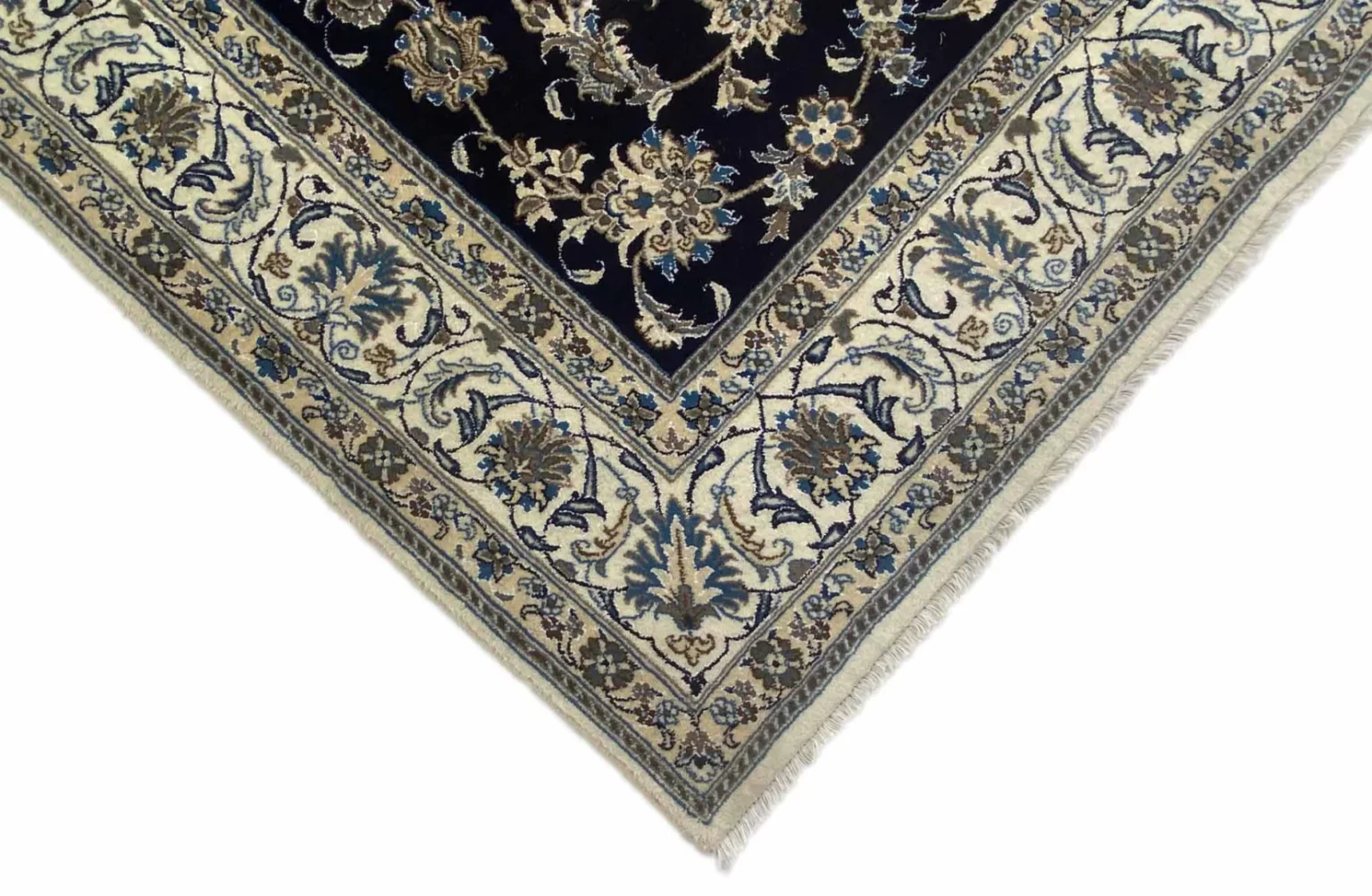
A classic Nain composition depends on the interaction between its central motif and the details around it. The medallion may be framed by floral elements or linked to the field through scrolling vines. This keeps the centre connected to the rest of the rug and prevents the design from appearing divided into unrelated sections. Borders provide another level of organisation. They frame the principal field, repeat selected ornamental ideas and give the overall composition a defined edge.
Nain rugs are traditionally associated with light, harmonious colours. Such a palette can make fine outlines and delicate floral details easier to read. Differences between ground, contour and ornament create visual hierarchy without requiring a heavy or crowded effect. Colour in a Persian rug is therefore structural as well as decorative: it separates areas, highlights the medallion and clarifies the relationship between field and border. The floral pattern gains much of its order from this interaction of colour and line.
Floral ornament has a long history in Persian art. Flowers, leaves and scrolling vegetation are linked with ideas of gardens, cultivated nature and an ordered visual environment. In a rug, these associations are translated into a durable, two-dimensional arrangement. The motifs remain recognisable as plant forms while being shaped to serve symmetry, rhythm and repetition. The medallion adds a geometric principle of central organisation, creating a meeting point between naturalistic suggestion and formal design.
The technical construction influences how the pattern is perceived. Closely controlled knotting allows the weaver to work with smaller visual units and to maintain more delicate contours. The Lah classification refers to this technical fineness, while the design determines how that precision is used. On this rug, the 12-La designation, the wool pile with silk content and the central floral medallion belong to one coherent description. Material, knotting and ornament should therefore be considered together rather than treated as separate decorative features.
The pattern can be read in stages. The eye first encounters the medallion, then follows the floral forms into the surrounding field, and finally meets the border that closes the composition. This layered structure gives the rug a clear visual order. Individual flowers may attract attention, but their meaning within the design comes from their position and relationship to the other motifs. The result is a classical floral arrangement that remains detailed without losing its central structure.
Traditional Persian patterns often preserve familiar motifs while allowing variation in scale, contour and arrangement. That balance between continuity and individual execution is especially relevant to hand-knotted rugs, because the final piece is produced through a specific making process rather than by mechanical duplication. The Nain origin, central medallion and floral vocabulary identify the regional tradition; the particular combination of details belongs to this individual rug.
Special Features
The defining features of this piece are its origin in Nain, central Persia, its hand-knotted construction, its 12-La classification and its stated knot density of approximately 200,000 knots per square metre. The pile is made from high-quality wool with silk content. The design consists of classic floral motifs arranged around a central medallion. These details provide a technical, material and visual description of the rug without separating one feature from the others.
The rug is very well preserved. Appropriate care helps maintain the pile, the colour relationships and the clarity of the floral drawing. Regular gentle vacuuming can remove loose surface dust. A damp cloth may be used carefully for minor spot treatment, while vigorous rubbing and excessive moisture should be avoided. For a thorough cleaning, professional services are recommended so that the treatment can take account of the wool pile, the silk content and the hand-knotted structure.
Wool and silk content require a considered approach to cleaning. Wool should not be exposed to harsh treatment, and silk is particularly vulnerable to unsuitable products or excessive mechanical action. The rug should therefore be handled gently, especially when dealing with spots or moisture. Keeping loose dirt from becoming embedded in the pile supports the preservation of the surface. Its very good condition describes the current state of the piece and forms an important part of its specific characteristics.
FAQ
How can the quality of a Nain Persian rug be assessed?
Knot density is one of the traditional indicators used to assess a Nain rug. The Lah classification describes the fineness of the knotting and helps explain how closely the knots are arranged. A finer structure can support smaller flowers, more controlled curves and more precise outlines. Materials are also important. High-quality wool provides a durable pile, while silk content can contribute a smoother touch and a more nuanced appearance in selected parts of the design. The clarity of the medallion, the balance of the floral motifs, the relationship between field and border, and the quality of the hand-knotted workmanship should be considered as well. This rug is identified as 12-La, with approximately 200,000 knots per square metre, a wool pile with silk content and hand-knotted construction.
Can a Nain Persian rug be cleaned at home?
Basic care can be carried out at home if it is done gently. Regular vacuuming helps remove loose dust from the surface. For a small spot, a damp cloth can be applied carefully without excessive rubbing. Large amounts of water, harsh cleaning agents and aggressive brushing may affect the pile or the colours. Because this rug has a high-quality wool pile with silk content, extra caution is appropriate when treating moisture or stains. A complete cleaning is best entrusted to a professional service. The cleaner can select a method suited to the materials, the hand-knotted construction and the more delicate silk content.
Where can a Nain Persian rug be purchased?
Nain Persian rugs can be found at specialist rug dealers, antique shops and online platforms. When comparing pieces, buyers should look for a clear description of origin, material, knotting technique, Lah classification, knot density, pattern and condition. The name Nain should identify the origin of the rug rather than merely referring to a design inspired by the region. A trustworthy seller describes the individual piece precisely and separates its specific facts from general information about the Nain tradition. For this rug, the relevant details include its origin in Nain, central Persia, the wool pile with silk content, the hand-knotted technique, the 12-La classification, the floral medallion design and its very good condition.
To provide the best experiences, we use technologies like cookies to store and/or access device information. Consenting to these technologies will allow us to process data such as browsing behavior or unique IDs on this site. Not consenting or withdrawing consent, may adversely affect certain features and functions.
Functional Always active
The technical storage or access is strictly necessary for the legitimate purpose of enabling the use of a specific service explicitly requested by the subscriber or user, or for the sole purpose of carrying out the transmission of a communication over an electronic communications network.
Preferences
The technical storage or access is necessary for the legitimate purpose of storing preferences that are not requested by the subscriber or user.
Statistics
The technical storage or access that is used exclusively for statistical purposes.The technical storage or access that is used exclusively for anonymous statistical purposes. Without a subpoena, voluntary compliance on the part of your Internet Service Provider, or additional records from a third party, information stored or retrieved for this purpose alone cannot usually be used to identify you.
Marketing
The technical storage or access is required to create user profiles to send advertising, or to track the user on a website or across several websites for similar marketing purposes.

 SECURE PAYMENT
 SHIPPING PARTNERS