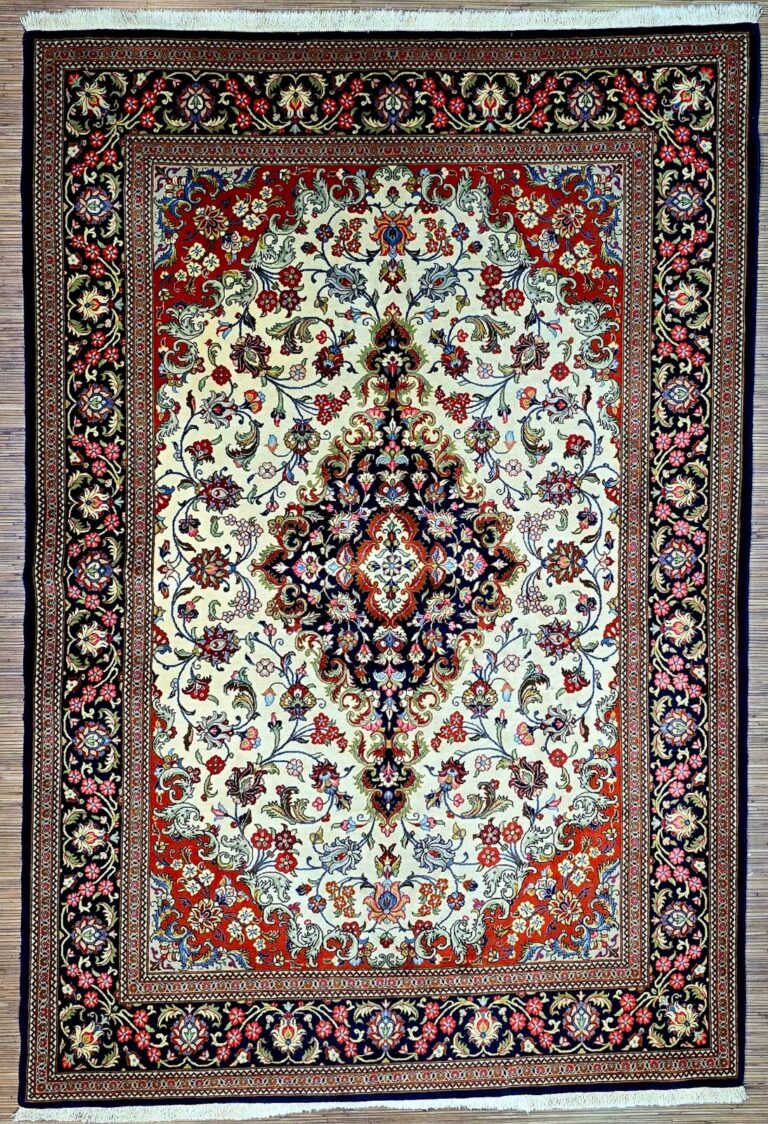
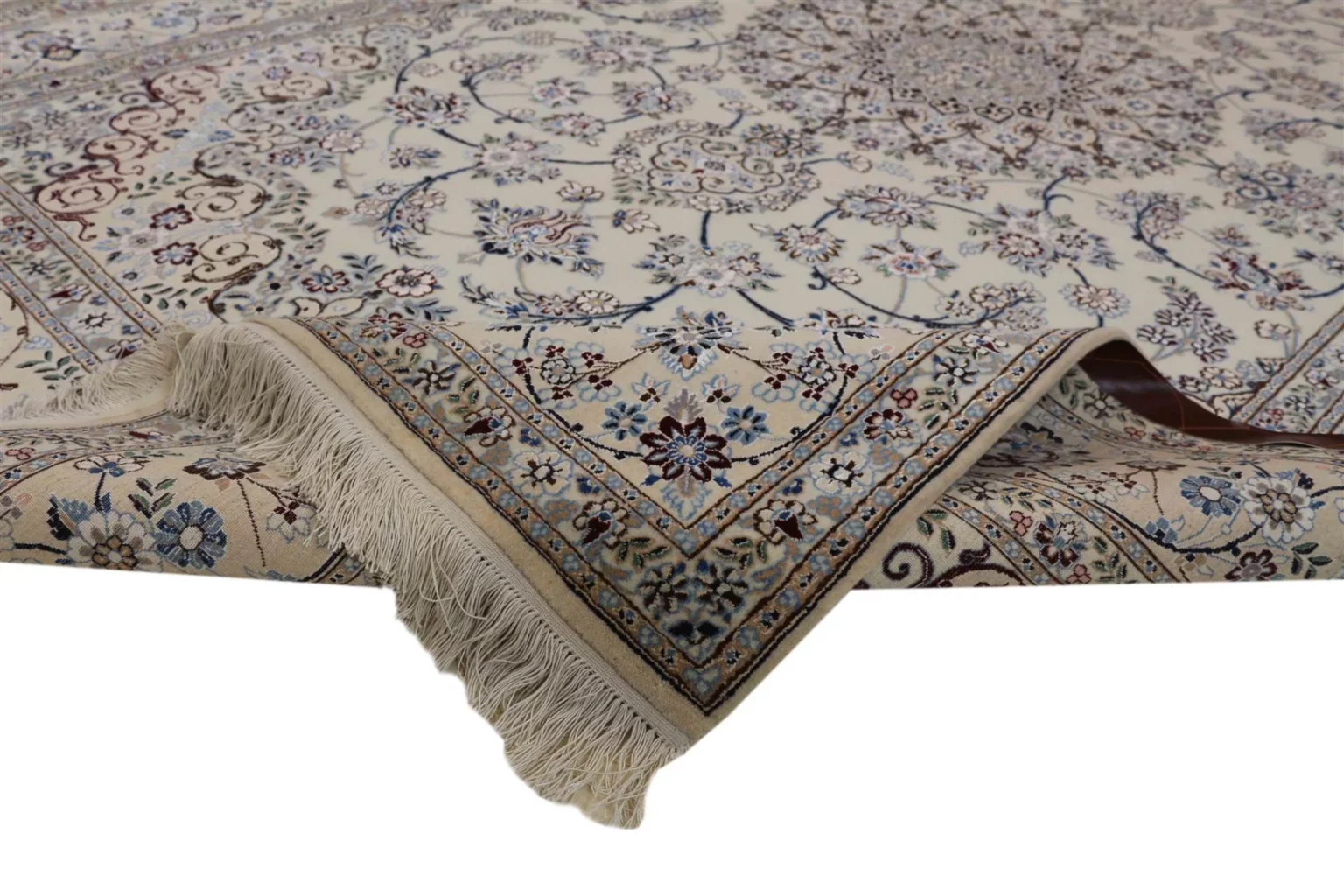
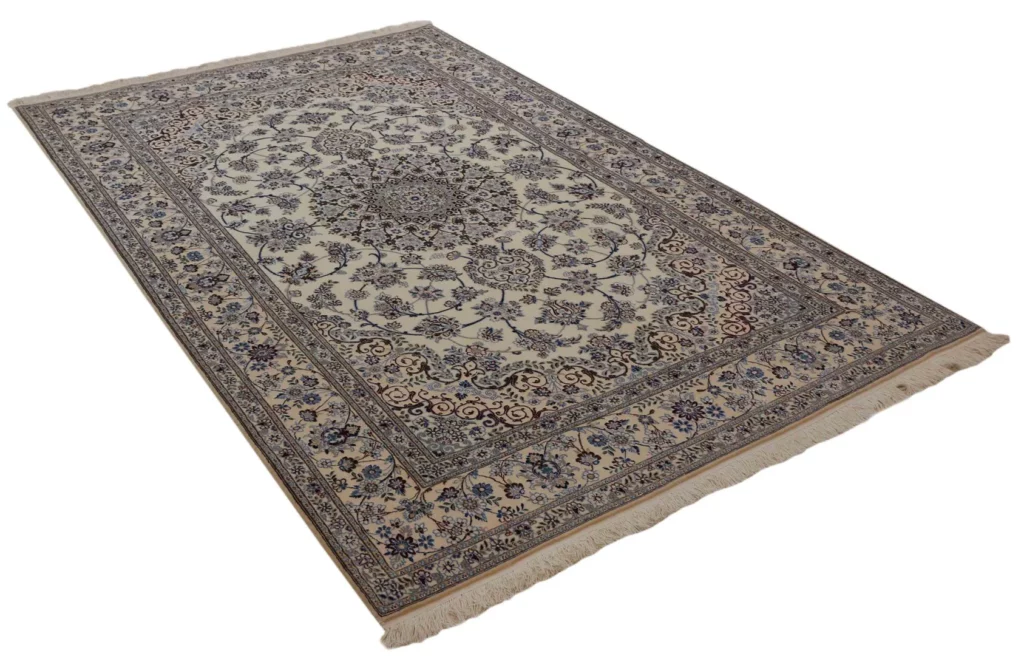
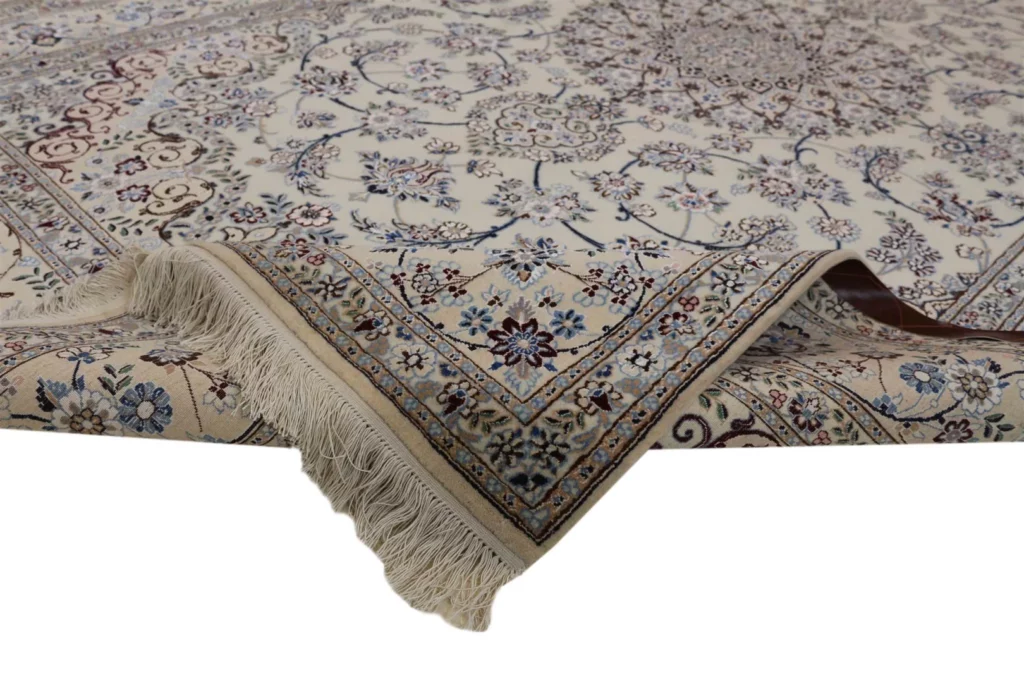
This Nain Persian rug is hand-knotted and made from high-quality wool. In hand-knotting, each knot is tied individually into the prepared foundation. The surface therefore reflects a process in which the structure of the rug is built gradually, knot by knot. Its stated knot density is 600,000 knots per square metre. This figure describes the large number of individual knots used to form the design and is one of the rug’s central technical characteristics.
Wool has long been used in Persian rug making because it combines a resilient character with a pleasant, substantial handle. It accepts dyes evenly and provides a suitable ground for detailed floral drawing. Nain weaving can also involve silk in particular constructions or as an accent, but high-quality wool is the material specified for this rug. The hand-knotted technique and the dense construction together provide the technical basis for the carefully defined surface.
Origin and Tradition
The rug comes from Nain in central Iran. Nain is an important centre of Persian rug production with a long-established weaving tradition. Over generations, local workshops have developed knowledge of wool preparation, dyeing, pattern planning and the execution of fine knotting. Nain is consequently recognised as a distinct group within Persian carpet art rather than merely as a place name.
The Nain tradition is closely connected with the urban production of Persian rugs. Unlike many nomadic weaving traditions, an urban carpet is generally made from a carefully planned drawing. A designer determines the relationship between field, borders, medallion and scrolling motifs. The weaver then transfers this plan into the foundation knot by knot. Such preparation supports symmetry, measured spacing and the controlled repetition of small decorative elements.
Nain is known for finely worked rugs with deliberate, elegant designs. Its tradition often combines a calm overall arrangement with precise ornamental detail. Leaves, blossoms and scrolling stems are kept distinct from one another, while the composition remains coherent across the field. The effect depends not only on knot density, but also on the order of the drawing and the consistency of the workmanship.
The designation La, or Lah, is part of the traditional classification used for Nain rugs. It relates to the fineness and knotting quality of a particular construction. Nain rugs are divided into several Lah grades; a finer grade generally permits denser construction and more detailed drawing. The 6La designation places this rug within that Nain classification. Its stated density of 600,000 knots per square metre provides an additional technical description.
Nain belongs to a wider landscape of important Persian weaving centres. Isfahan is associated with complex designs and vivid colour relationships, Kerman is often known for floral compositions and fine wool, while Tabriz encompasses both traditional and more modern approaches. Each centre has developed its own visual vocabulary. The Nain origin therefore identifies both a geographical source and a particular craft tradition within Iranian carpet making.
Design and Pattern
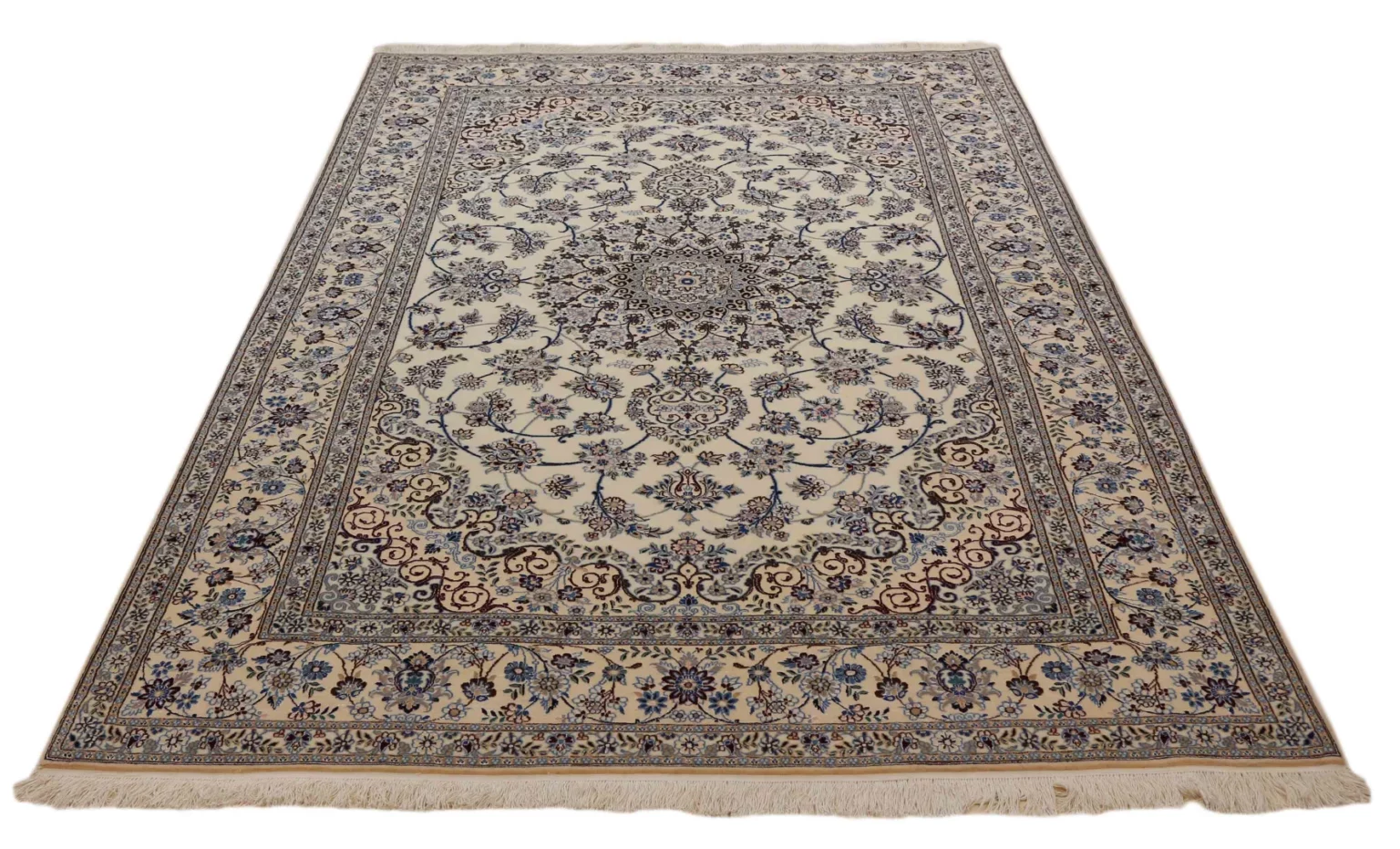
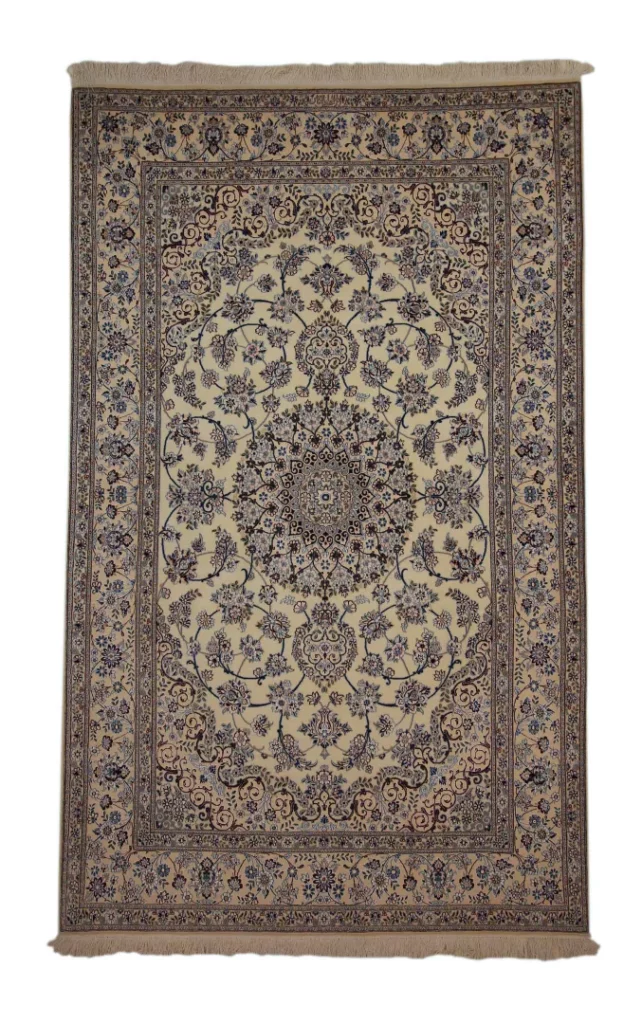
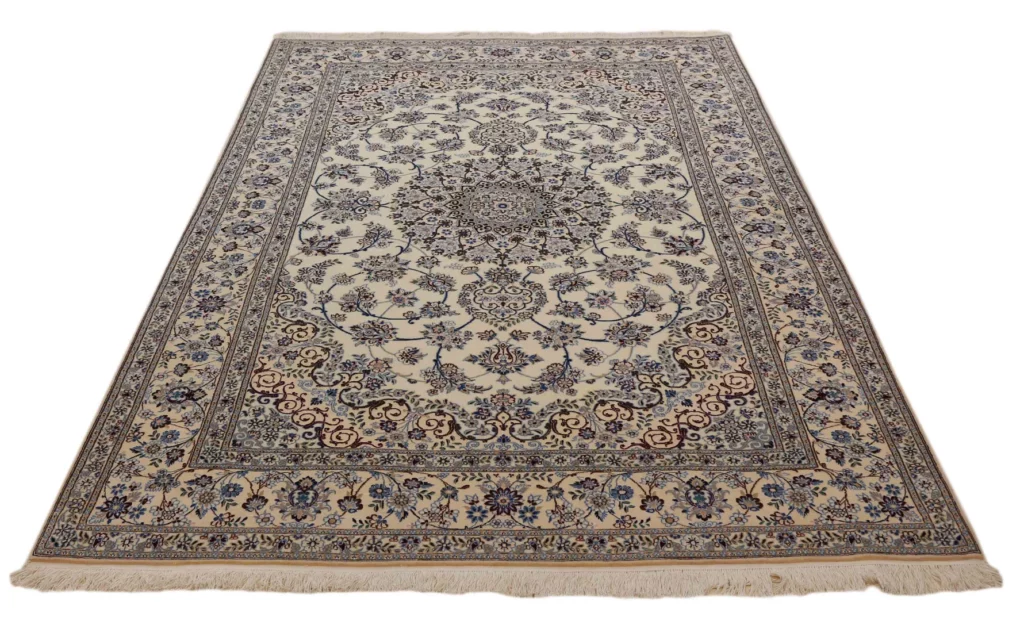
The pattern of this rug is described as a classic floral design. Floral Persian rugs use blossoms, leaves, stems and scrolling forms inspired by vegetation. These elements are not normally intended as a literal botanical view. Instead, they are stylised, repeated rhythmically and arranged as an integrated ornamental system.
Nain designs may use scrolling branches to connect smaller blossoms throughout the central field. A balanced axis often organises the composition, with surrounding motifs responding in a symmetrical manner. Medallion arrangements are also part of the established Persian vocabulary. Depending on the drawing, the visual focus may be a central medallion or a continuous network of floral scrolls. For this rug, the documented description is classic floral design, so no more specific individual motif is assigned to it.
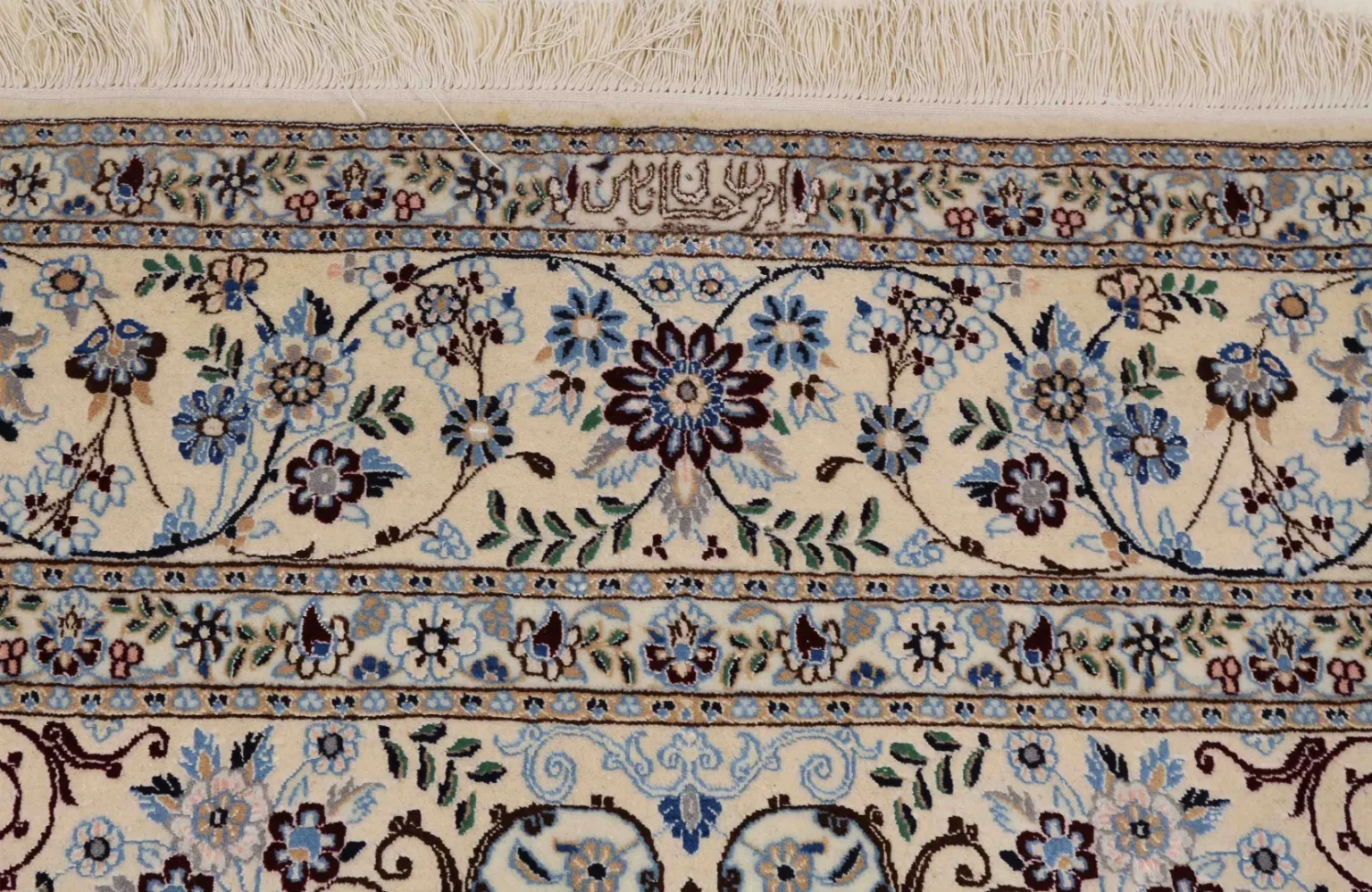
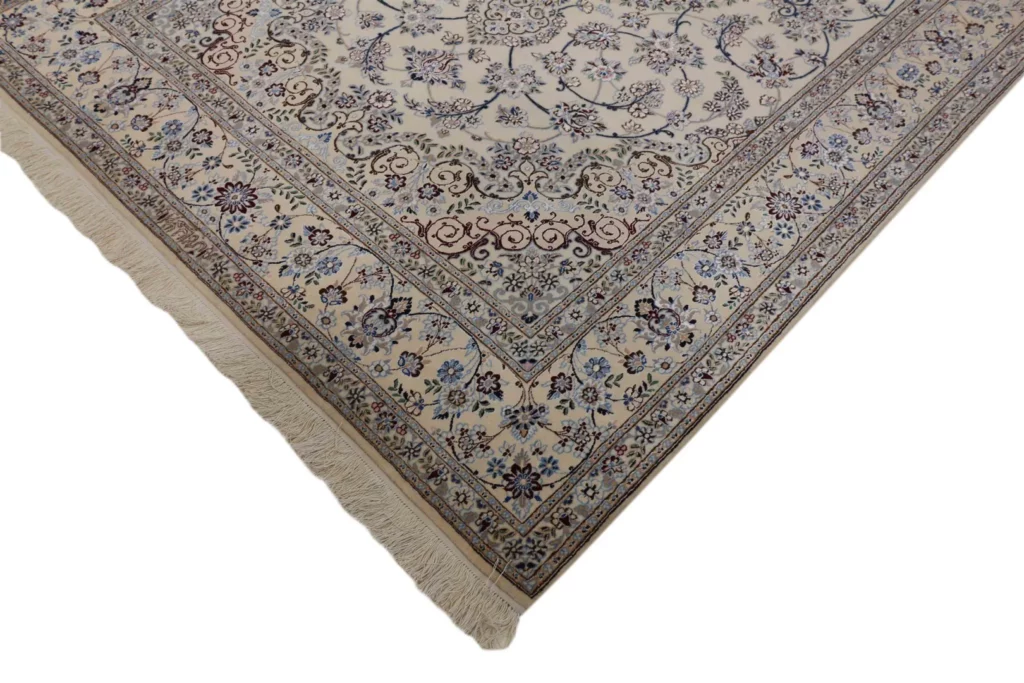
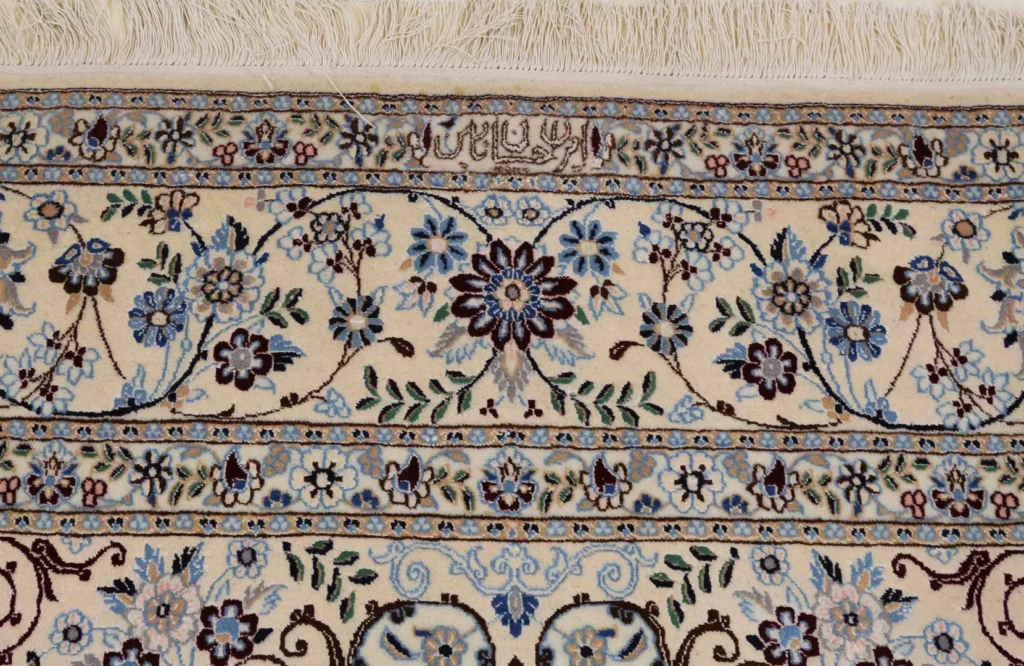
Persian rug design is built through the relationship between the field and the borders. The field carries the principal composition. Borders contain it, provide a visual conclusion and repeat or extend the logic of the central ornament. A broad main border may be accompanied by narrower guard borders, creating a layered frame. In floral designs, this structure helps separate the central arrangement from the surrounding space and keeps the pattern easy to read.
The traditional Nain palette can range from restrained light grounds to stronger contrasting accents. Beige, red and blue are among the colours associated with Persian floral carpet design. Colour is used not only for contrast, but also to distinguish different layers of ornament. A light ground can clarify stems and blossoms, while darker accents give the composition definition. Since the description of this particular rug specifies a classic floral design but does not list its colours, no individual colour scheme is attributed to it here.
Floral ornament has a long history in Persian carpet art. It may suggest gardens, blossoms and ordered plant growth without depicting a particular landscape. Motifs are distributed across the surface and coordinated so that the eye can move from the centre toward the edges. In finely knotted work, small changes in leaf shapes, flower heads and connections between scrolling stems can create a highly differentiated pattern while preserving the textile character of the rug.
A high knot density generally makes it possible to render narrow lines and small transitions with greater precision. On a Nain rug, that technical possibility works together with the urban drawing tradition. The design is planned before it is knotted, and its repeated forms follow a deliberate order. This produces the familiar relationship between precision, symmetry and floral ornament, while the wool surface retains the tactile qualities of a hand-made textile.
Special Features
The notable characteristics of this rug are its origin in Nain in central Iran, its 6La classification, its hand-knotted construction and its density of 600,000 knots per square metre. High-quality wool is specified as the material. The pattern is described as classic floral, and the condition is stated as very good. Together, these details place the piece within the established Nain tradition while also describing its individual construction.
The 6La designation shows that the rug belongs to the differentiated Nain grading system. Combined with its dense knotting, it points to a finely worked construction. The floral design defines its decorative direction, while the place of origin identifies its position within Persian carpet making. For the continued care of wool rugs, regular gentle cleaning is appropriate, with professional cleaning when required to help preserve colour and structure.
FAQ
What distinguishes a Nain Persian rug?
A Nain Persian rug represents the weaving tradition of Nain in central Iran. It is associated with carefully planned designs, often floral, and with a differentiated Lah classification. This piece is identified as 6La, hand-knotted and made from high-quality wool, with a knot density of 600,000 knots per square metre. Its pattern is described as classic floral.
How should a Nain rug be cared for?
Regular gentle vacuuming helps remove dust and loose dirt before they settle into the wool surface. Cleaning should be carried out without harsh treatment or unsuitable chemicals. Occasional professional cleaning can help maintain the colours and structure. Because a hand-knotted wool rug is a carefully made textile, specialist cleaning is advisable whenever deeper treatment is needed.
Which rug types can be compared with Nain?
Isfahan, Kerman and Tabriz are other well-known Persian rug types with long regional traditions. Isfahan is often associated with complex geometric and floral compositions, Kerman with floral motifs and fine wool, and Tabriz with a combination of traditional and more modern designs. Each name represents its own regional design language and should not be confused with the Nain origin of this rug.
To provide the best experiences, we use technologies like cookies to store and/or access device information. Consenting to these technologies will allow us to process data such as browsing behavior or unique IDs on this site. Not consenting or withdrawing consent, may adversely affect certain features and functions.
Functional Always active
The technical storage or access is strictly necessary for the legitimate purpose of enabling the use of a specific service explicitly requested by the subscriber or user, or for the sole purpose of carrying out the transmission of a communication over an electronic communications network.
Preferences
The technical storage or access is necessary for the legitimate purpose of storing preferences that are not requested by the subscriber or user.
Statistics
The technical storage or access that is used exclusively for statistical purposes.The technical storage or access that is used exclusively for anonymous statistical purposes. Without a subpoena, voluntary compliance on the part of your Internet Service Provider, or additional records from a third party, information stored or retrieved for this purpose alone cannot usually be used to identify you.
Marketing
The technical storage or access is required to create user profiles to send advertising, or to track the user on a website or across several websites for similar marketing purposes.

 SECURE PAYMENT
 SHIPPING PARTNERS