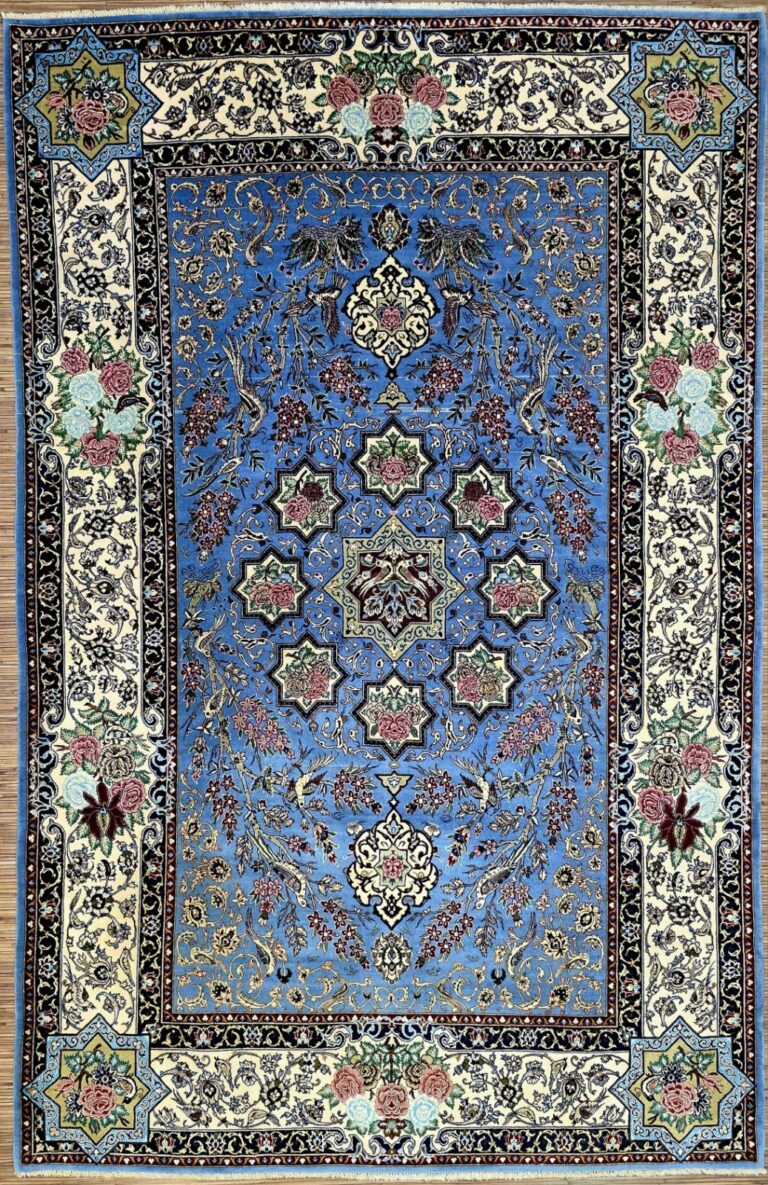
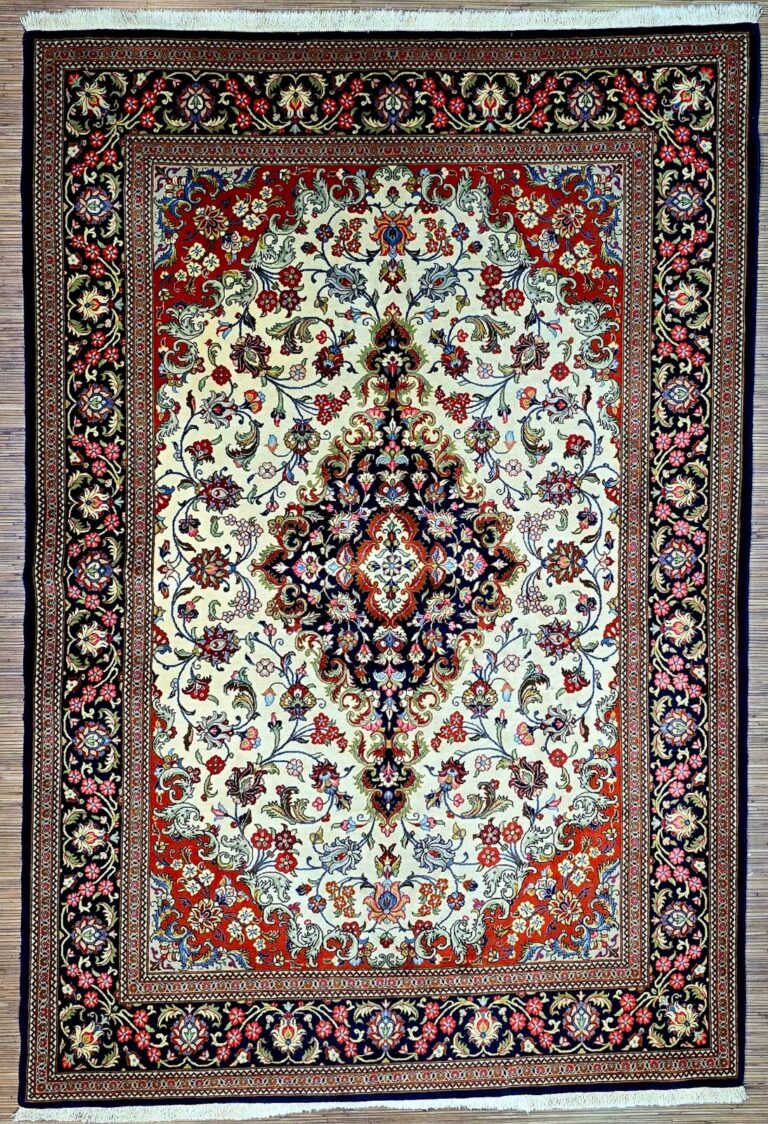
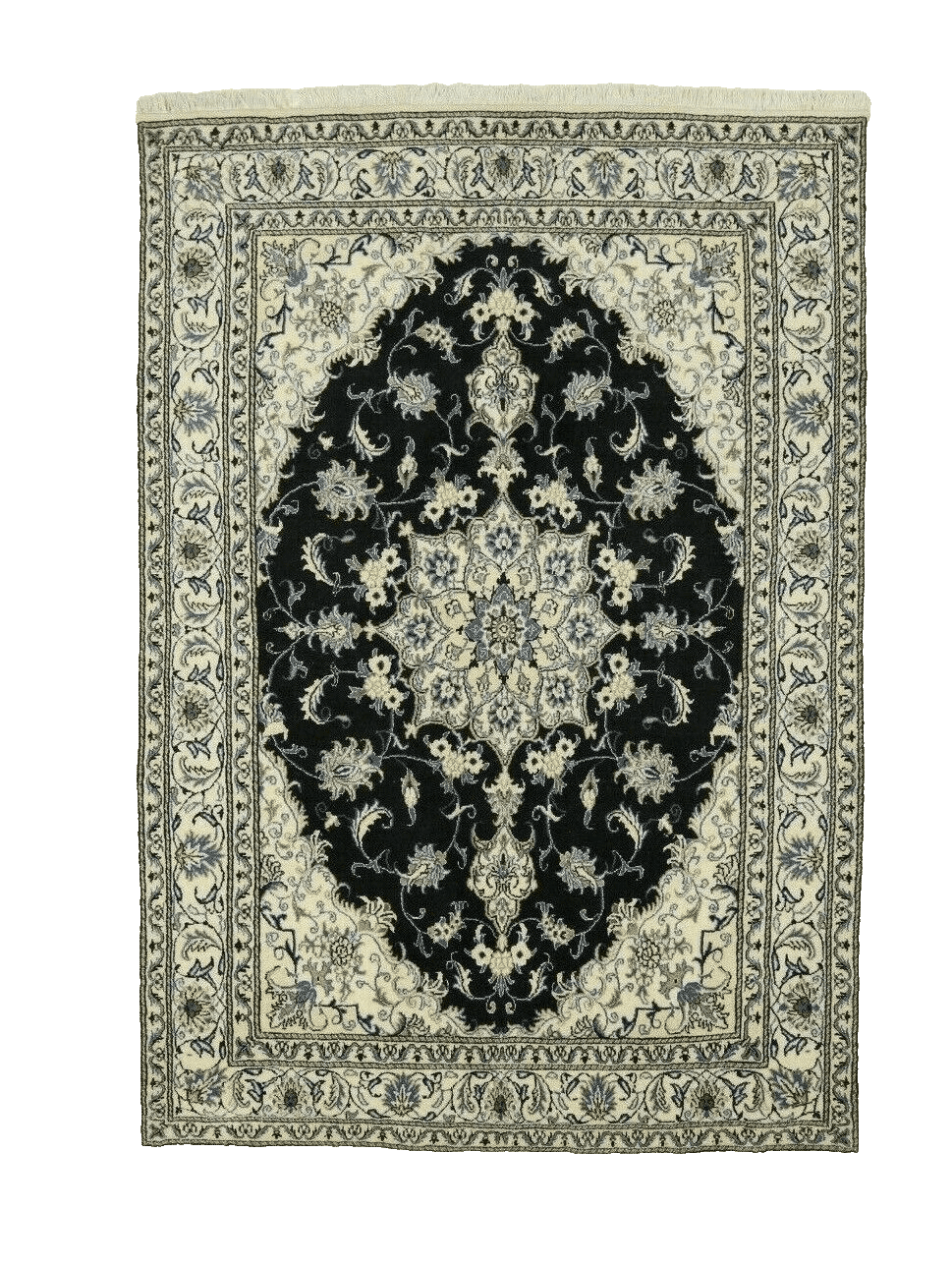
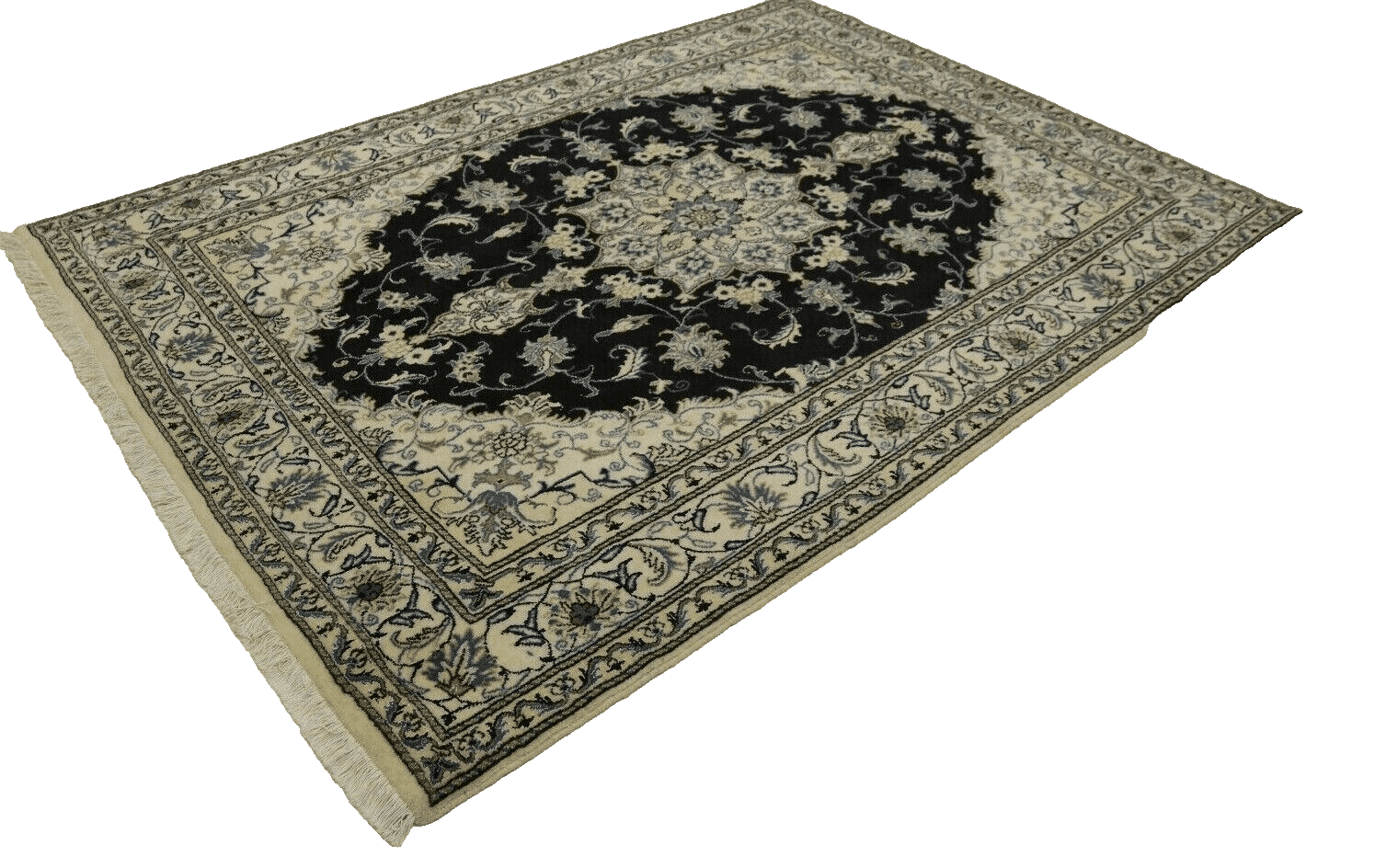
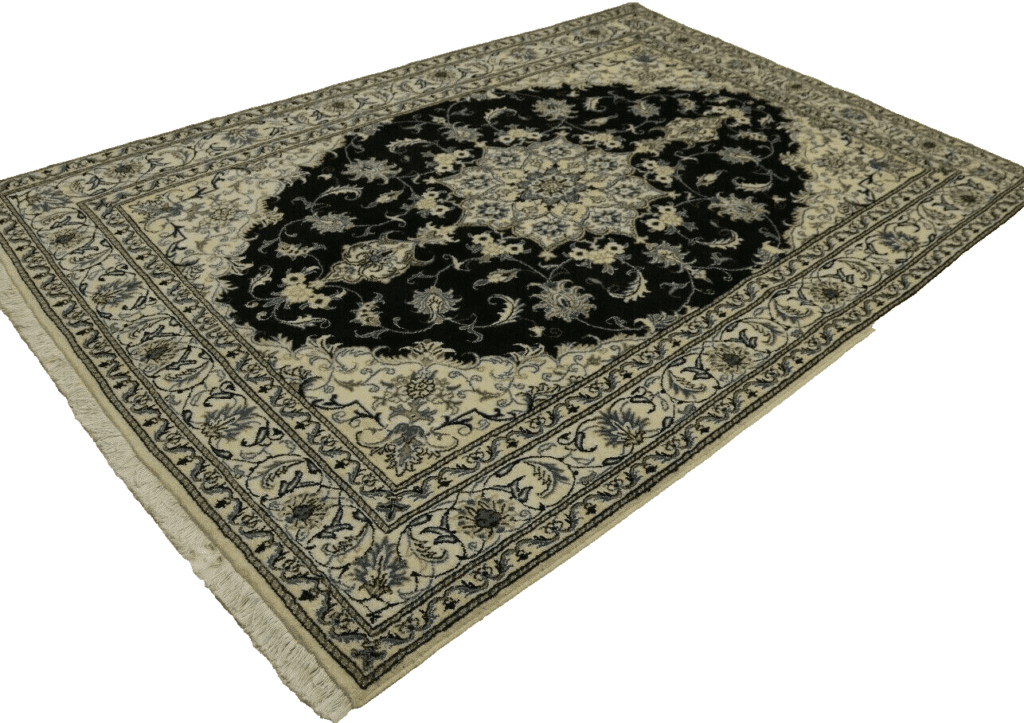
This Nain rug is hand-knotted from 90% virgin wool and 10% silk. Virgin wool forms the greater part of the pile and is known in rugmaking for its resilience, workable texture, and ability to absorb and retain colour. Silk is used as a smaller proportion of the material and contributes a finer surface character and a delicate sheen. Together, the two fibres give the rug a varied tactile quality rather than the uniform feel of a single-fibre pile.
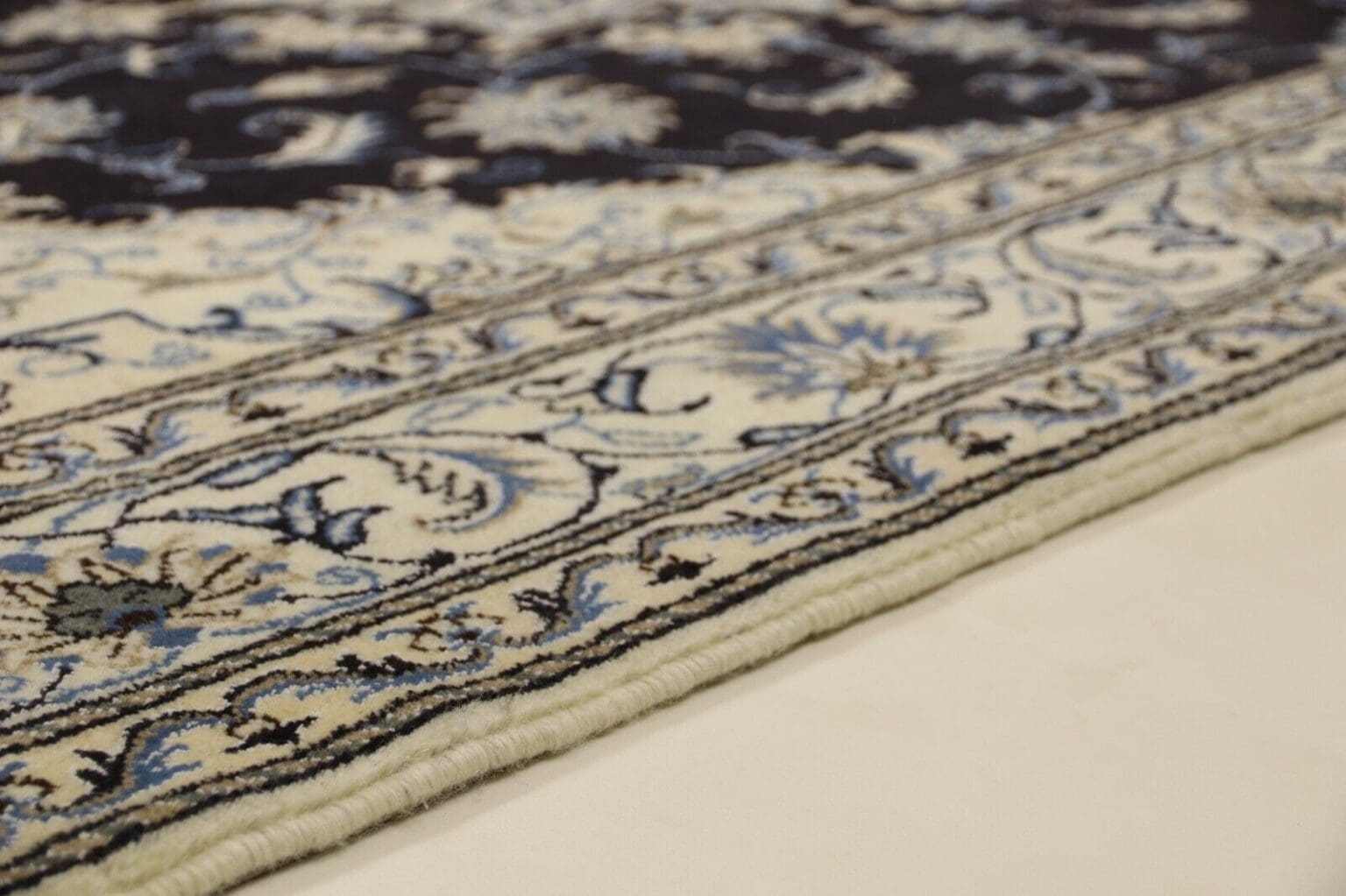
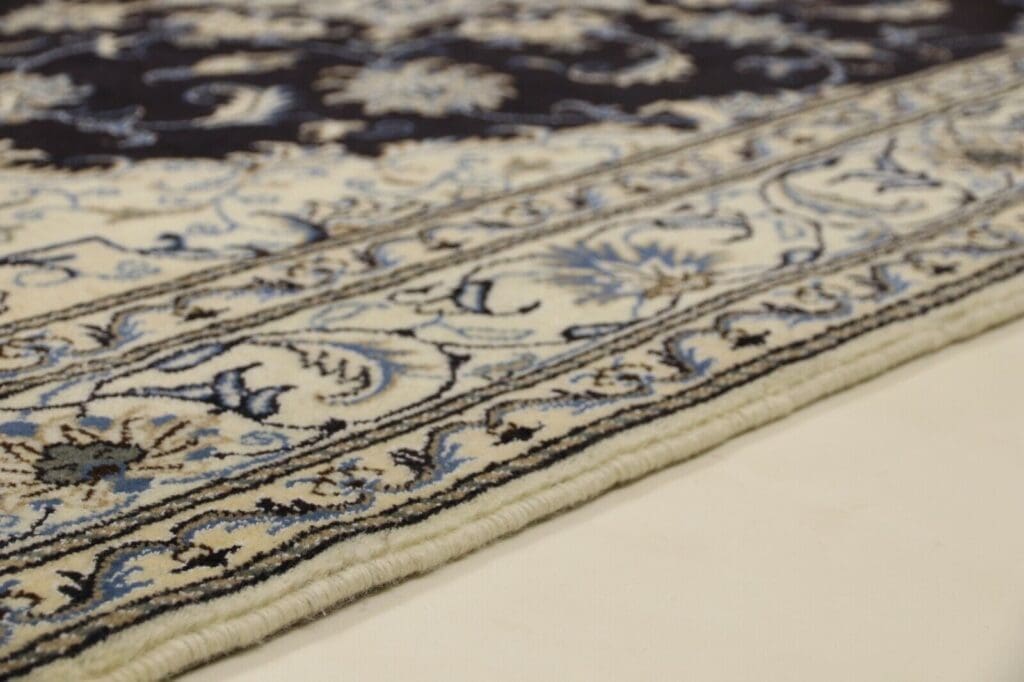
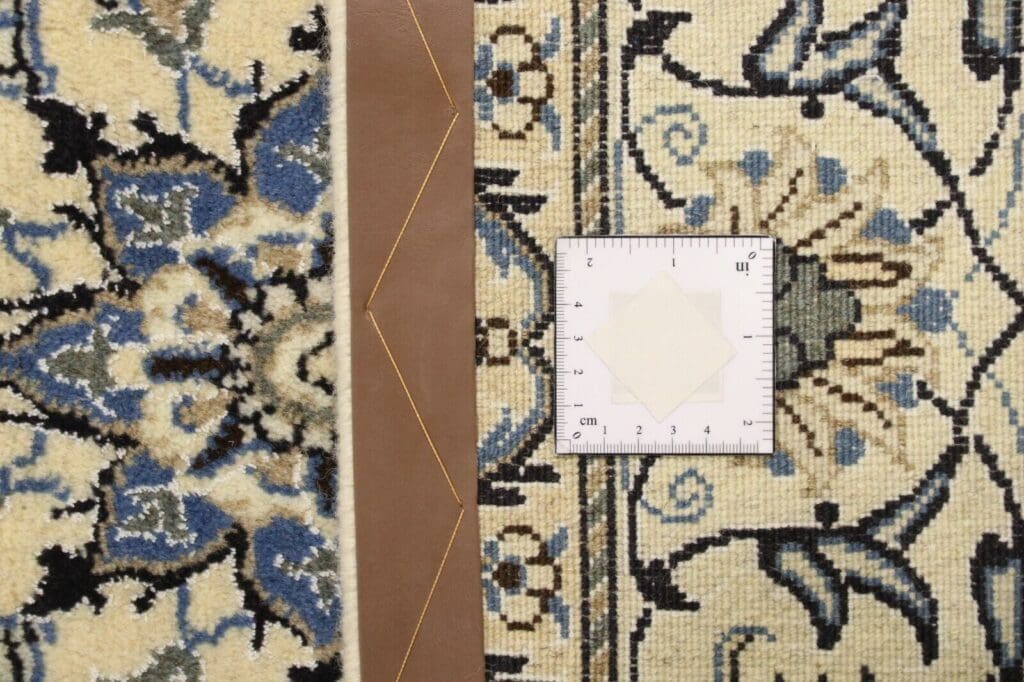
The hand-knotted construction is a piece-by-piece method. Individual knots are tied around the foundation, rows are built up gradually, and the pile is then finished so that the intended pattern becomes readable across the surface. This process allows small decorative elements and balanced outlines to be rendered with precision. It also means that the rug is made as an individual woven object rather than produced as a mechanically repeated surface.
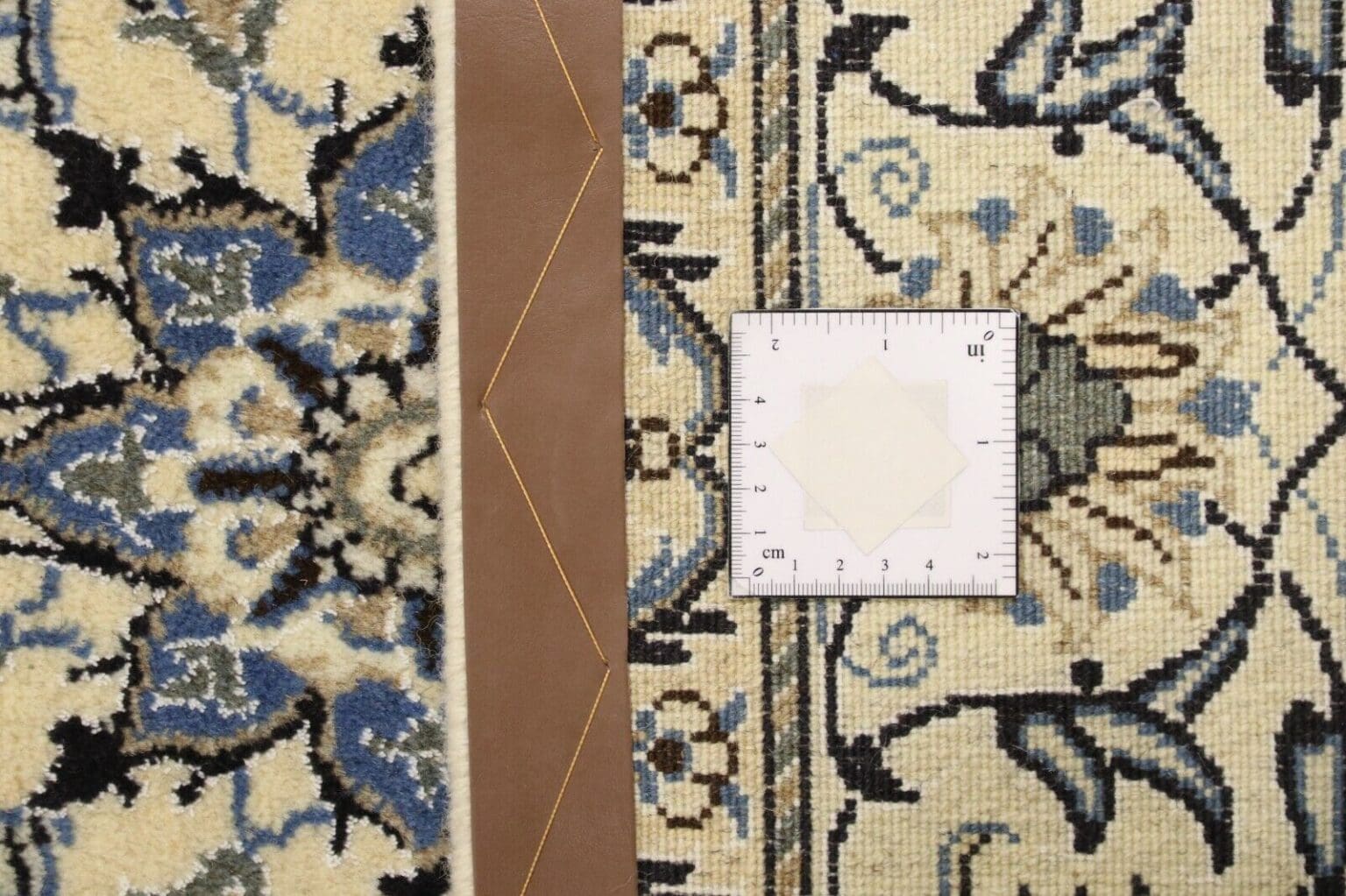
The rug has a knot density of approximately 300000 knots per square metre. Knot density is one of the technical factors that influence the degree of detail possible in a design. A finer field can accommodate smaller floral elements, narrower outlines, and more carefully controlled transitions between adjoining motifs. Density alone does not describe every aspect of a rug, but here it forms part of the stated hand-knotted construction and the fine appearance associated with Super Nain weaving.
Silk can catch the light differently from wool, making selected areas appear more defined as the viewing angle changes. In this rug, the silk content is combined with virgin wool rather than replacing it. The resulting material composition is therefore both a construction detail and an important part of the rug’s visual surface. The source describes the combination as contributing to durability and resistance, while the hand-knotted technique supports the long-term character of the piece.
Origin and Tradition
Nain is a renowned rug-producing region in Iran. Its name is associated with finely worked Persian carpets and with a tradition in which careful drawing, controlled execution, and detailed ornament are central concerns. The regional identity of a Nain rug is not created by a single decorative symbol alone. It arises from the relationship between the design, the precision of the knotting, the selected fibres, and the established practice of producing refined carpets in the area.
Carpet weaving in Nain belongs to the broader Persian tradition, whose history includes both domestic production and specialised workshops. Knowledge of knotting, preparation, colour use, and pattern drawing has often been transmitted through practical instruction from one generation to the next. Such continuity helps explain why regional carpet types can retain a recognisable visual language while still allowing individual weavers and workshops to produce different compositions.
Nain carpets are known for finely articulated patterns and for the use of materials selected for a carefully finished surface. The Super Nain designation in this rug’s description places it within that fine Nain context. It does not replace the rug’s stated origin, but identifies the refined character of the type presented here. The hand-knotted method is particularly suited to the measured repetition and small-scale ornament found in many Nain designs.
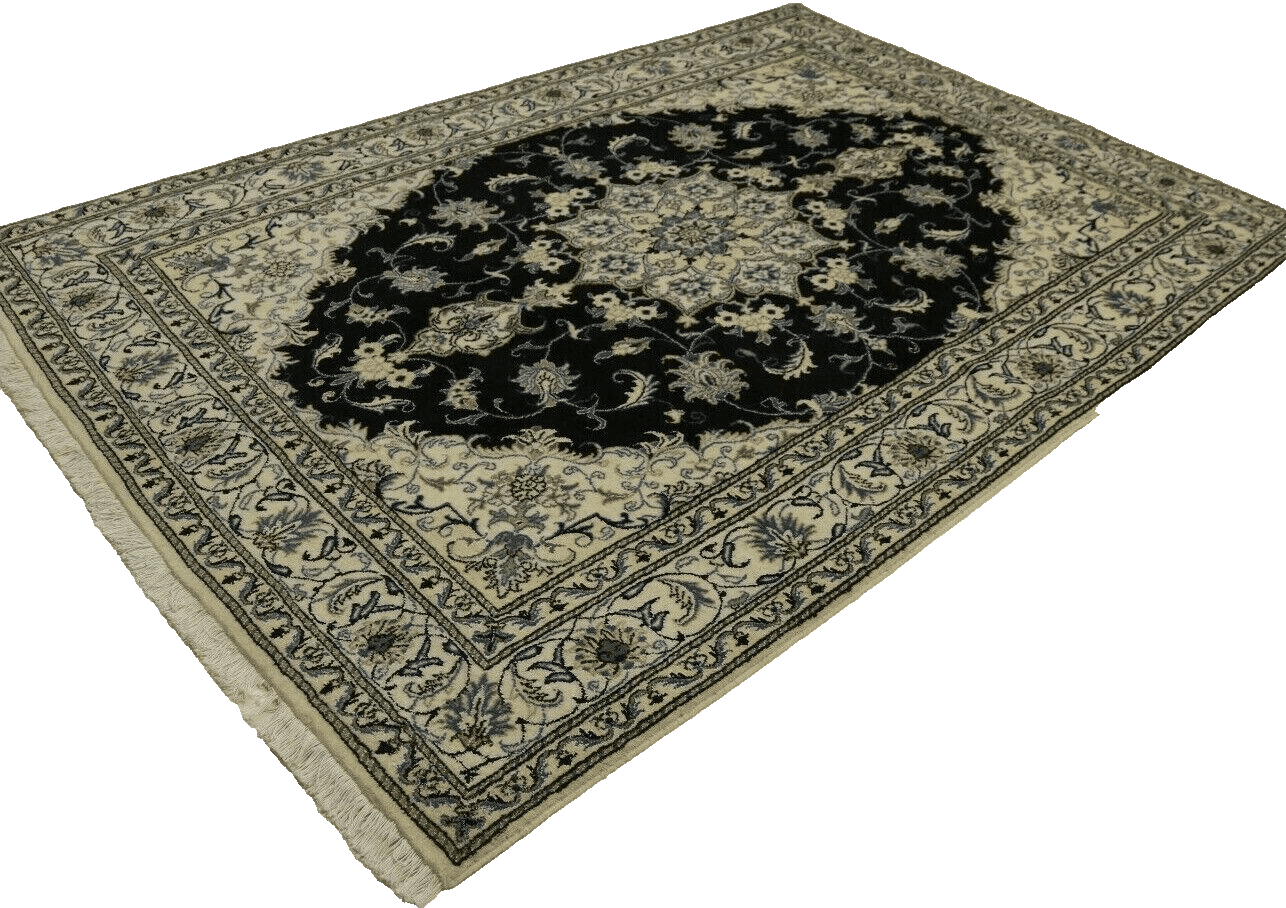
Persian carpet traditions are also connected with the organisation of space. A field may be framed by borders, central elements may establish balance, and repeated motifs may guide the eye across the composition. These principles are not merely technical. They connect the practical work of knotting with an inherited decorative vocabulary that has developed over a long period in Iranian textile culture.
The Nain tradition is therefore best understood as a combination of regional practice and visual discipline. Materials, knotting, drawing, and colour are considered together. In a hand-knotted Nain rug, the final surface records the gradual accumulation of those decisions. The present rug combines that Iranian origin with virgin wool, silk, and a fine knot density, while its design follows the classical Oriental approach described in the source.
Design and Pattern
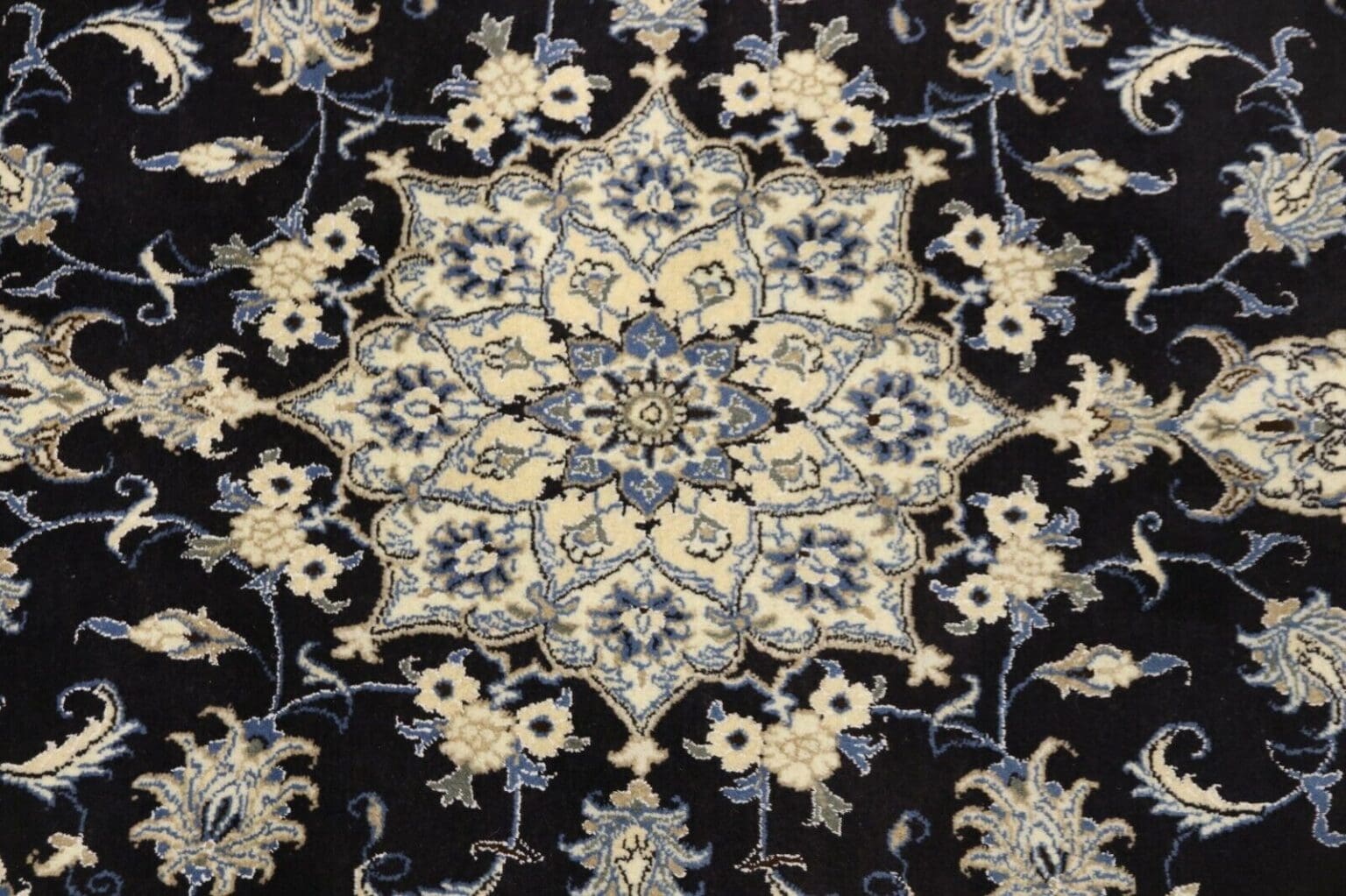
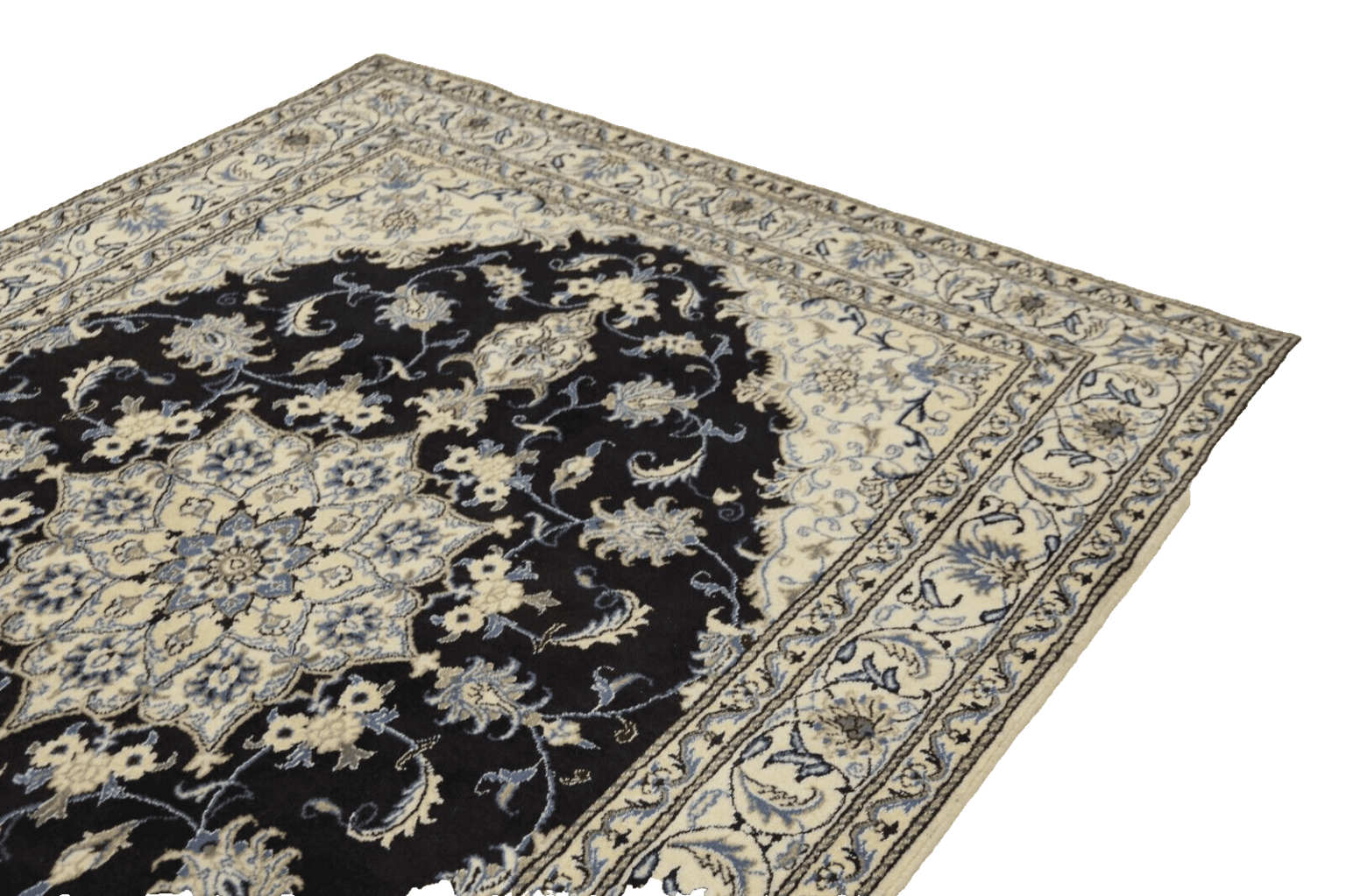
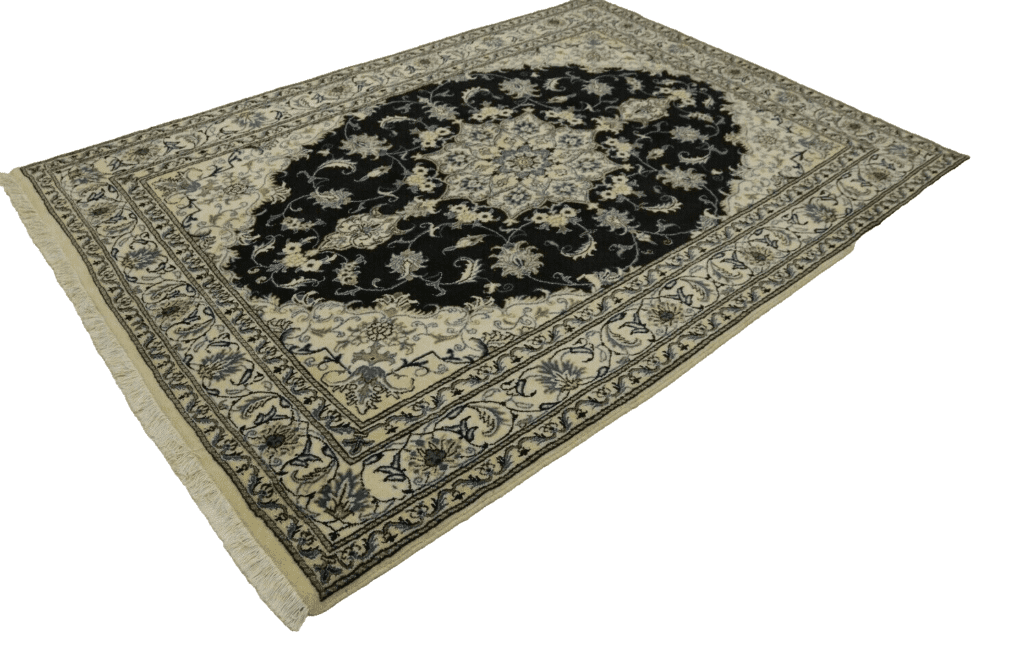
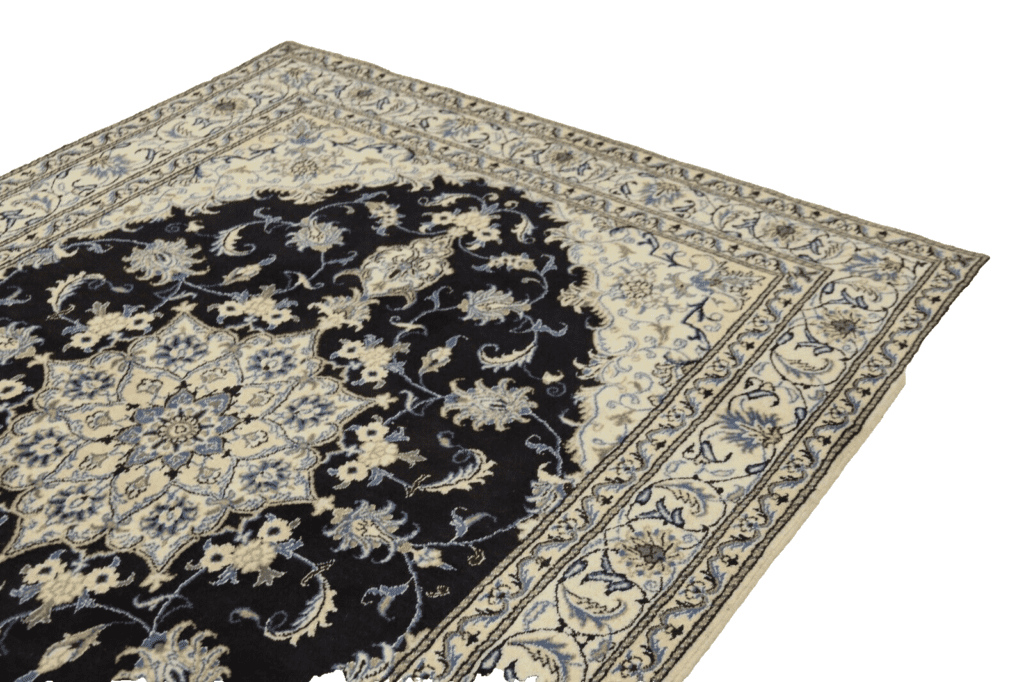
The rug has a classic Oriental design with symmetrical patterns and harmonious colour transitions. Symmetry gives the composition a sense of order: elements on one side relate to elements on the other, while repeated forms help connect the central area with its surrounding ornament. Harmonious transitions prevent the pattern from appearing fragmented and allow adjoining colours and motifs to be read as parts of one balanced arrangement.
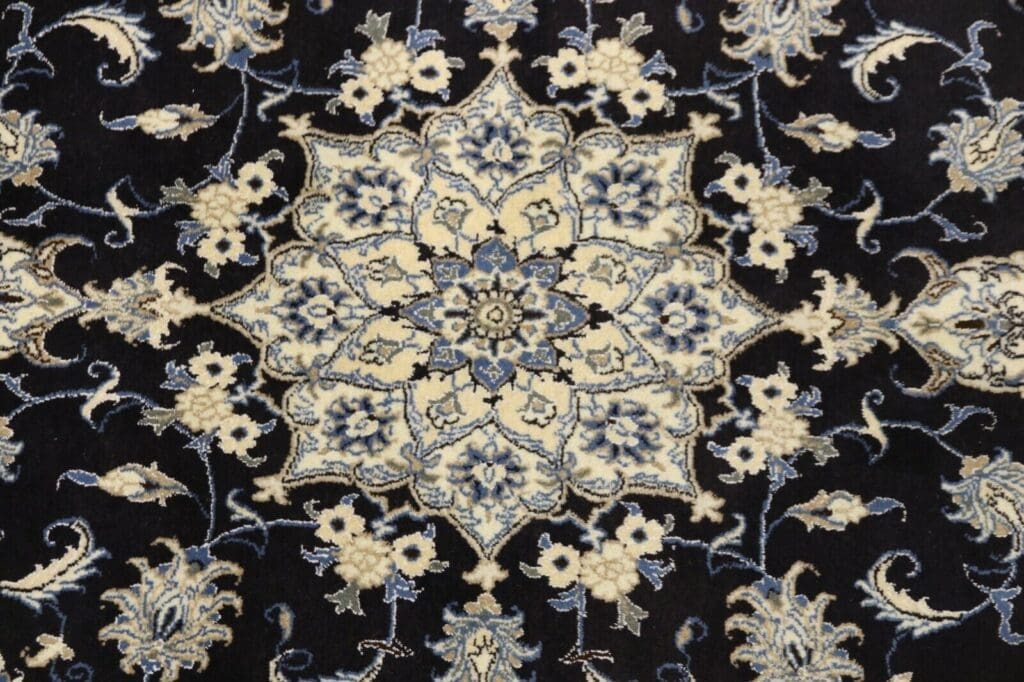
Floral motifs and geometric forms are typical elements associated with Nain carpets. Floral ornament may appear as stylised leaves, blossoms, stems, or branching arrangements, while geometric structure can be expressed through repeated spacing, measured outlines, and carefully organised axes. These two approaches are not opposites. In Persian carpet design they frequently work together, with geometric planning providing order and floral detail softening or enriching the surface.
The pattern language of Persian carpets has traditionally carried cultural associations as well as decorative purpose. An ornament may refer to ideas of balance, continuity, nature, or order, although the meaning of a particular motif is not always fixed and can vary by context. The important point is that the design is not simply random decoration. It belongs to a long-established visual culture in which repeated forms and composed spaces have been used to create structured surfaces.
Fine knotting supports this type of drawing because it permits contours and small motifs to be placed with greater control. The stated density of this rug is consistent with the detailed execution described for the Super Nain type. It allows the eye to distinguish between larger structural elements and smaller accents without losing the overall unity of the composition. The silk content can further add subtle highlights where the surface catches light, while the wool gives the pattern a softer, more grounded presence.
Colour harmony is another important part of the design description. Rather than relying on abrupt contrasts alone, the rug is characterised by coordinated transitions that connect one area to the next. This approach is common to composed Oriental patterns, where the border, field, and individual ornaments are intended to function together. The result is a design that combines symmetry, floral reference, geometric structure, and measured colour relationships within a single Persian rug vocabulary.
Special Features
The rug’s stated special features are its combination of virgin wool and silk, its hand-knotted construction, and its fine knot density. Silk adds a delicate lustre to the surface, while the wool provides the main pile material. The source also describes the combination as durable and resistant. These properties belong to the material and construction described for this rug and are separate from the regional and decorative characteristics of Nain carpets in general.
Hand-knotted Persian rugs such as this Super Nain are also described as having a low tendency to build up static electricity. This can make everyday handling more comfortable. The rug is further described as practical and easy to care for when maintained appropriately. Its visual character comes from the detailed pattern and refined workmanship, while its practical character is connected with the stated fibres and hand-knotted production.
FAQ
How should I care for my Nain Persian rug?
Vacuum the rug regularly to remove loose dust and everyday surface dirt. Deal with spills and other soiling promptly rather than allowing them to remain in the pile. If more extensive cleaning is needed, professional cleaning is recommended. Avoid extreme temperatures and aggressive chemicals, as these can damage the fibres or affect the appearance of the surface. Careful, regular maintenance helps preserve the wool and silk composition and the clarity of the hand-knotted pattern.
Can the rug be used over underfloor heating?
Yes. The Nain rug can be used over underfloor heating. Wool is the main material in the pile and is described as providing good heat conductivity, allowing the room to retain its comfortable character. As with any rug placed over a heated floor, the surface should be kept clean and the rug should lie flat so that it can be used properly in the room.
How can I check whether my Persian rug is genuine?
Look at the knotting technique, feel the wool, and examine whether the pattern contains small irregularities. Genuine hand-knotted Persian rugs often show variations in the pattern because they are made individually, whereas machine-made rugs generally appear more uniform. These observations can help distinguish hand-knotted work from mechanical production. For a formal assessment of authenticity, material, and origin, an experienced rug specialist remains the appropriate source of evaluation.
To provide the best experiences, we use technologies like cookies to store and/or access device information. Consenting to these technologies will allow us to process data such as browsing behavior or unique IDs on this site. Not consenting or withdrawing consent, may adversely affect certain features and functions.
Functional Always active
The technical storage or access is strictly necessary for the legitimate purpose of enabling the use of a specific service explicitly requested by the subscriber or user, or for the sole purpose of carrying out the transmission of a communication over an electronic communications network.
Preferences
The technical storage or access is necessary for the legitimate purpose of storing preferences that are not requested by the subscriber or user.
Statistics
The technical storage or access that is used exclusively for statistical purposes.The technical storage or access that is used exclusively for anonymous statistical purposes. Without a subpoena, voluntary compliance on the part of your Internet Service Provider, or additional records from a third party, information stored or retrieved for this purpose alone cannot usually be used to identify you.
Marketing
The technical storage or access is required to create user profiles to send advertising, or to track the user on a website or across several websites for similar marketing purposes.
 SECURE PAYMENT
 SHIPPING PARTNERS