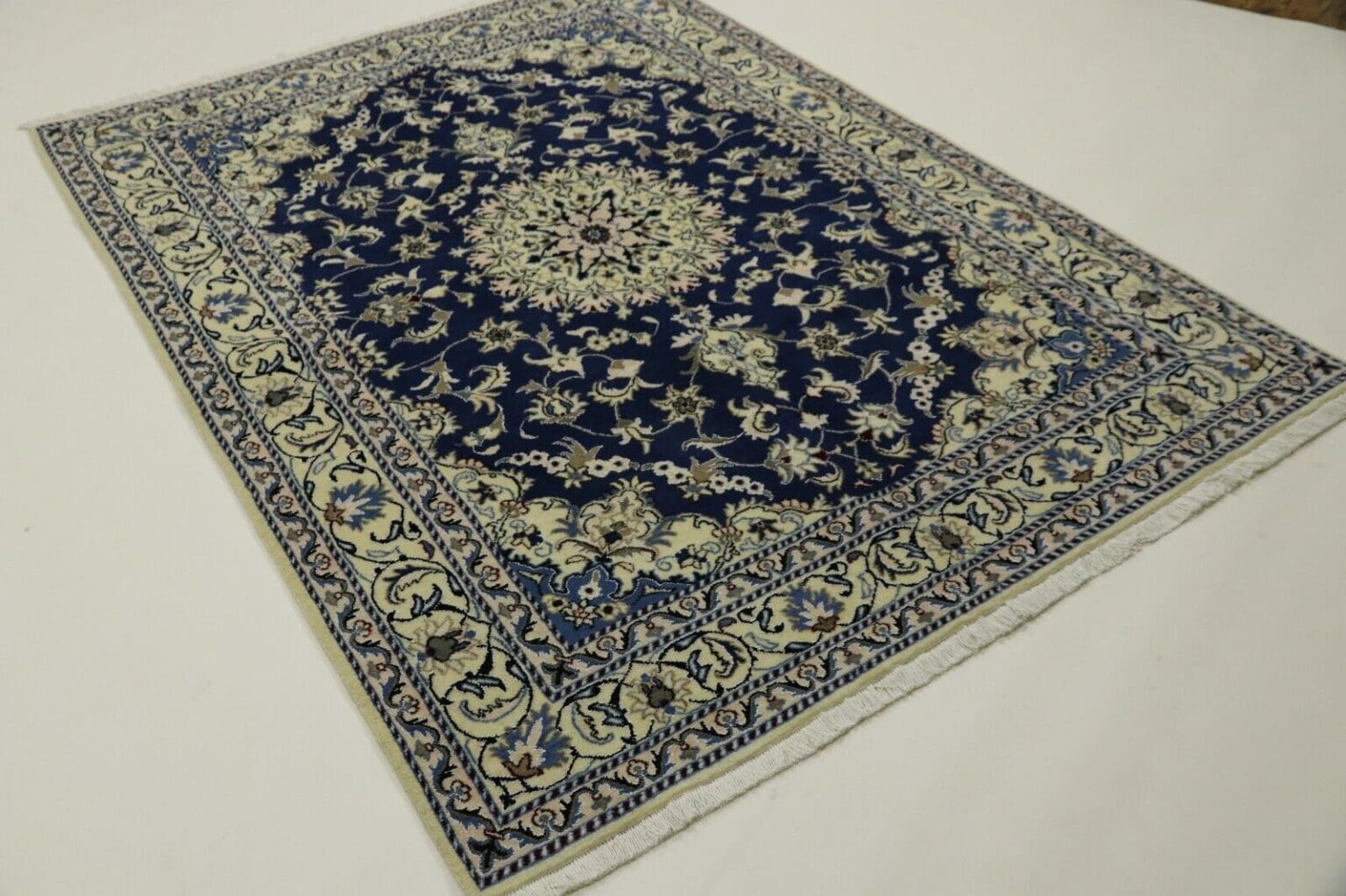
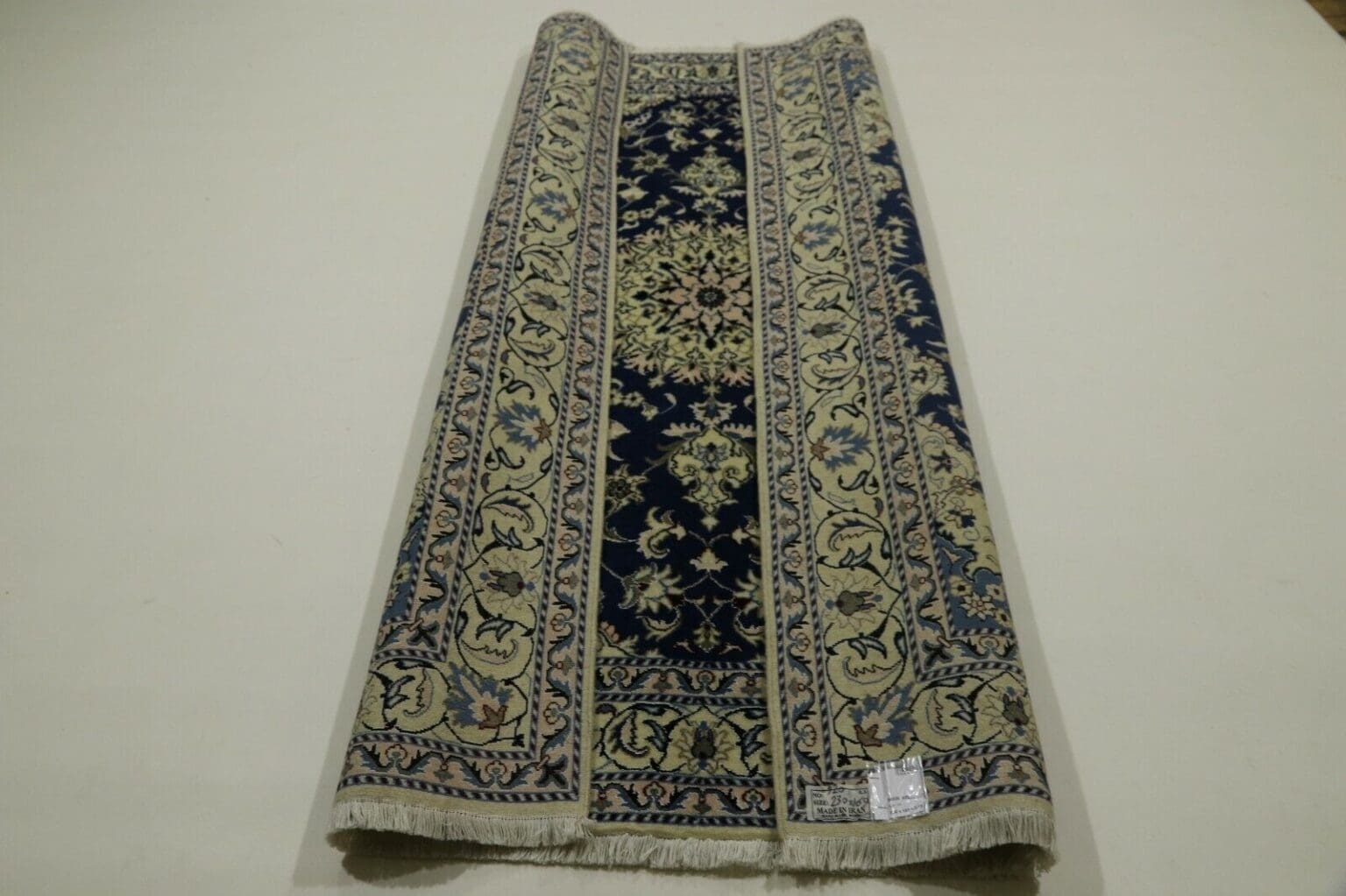
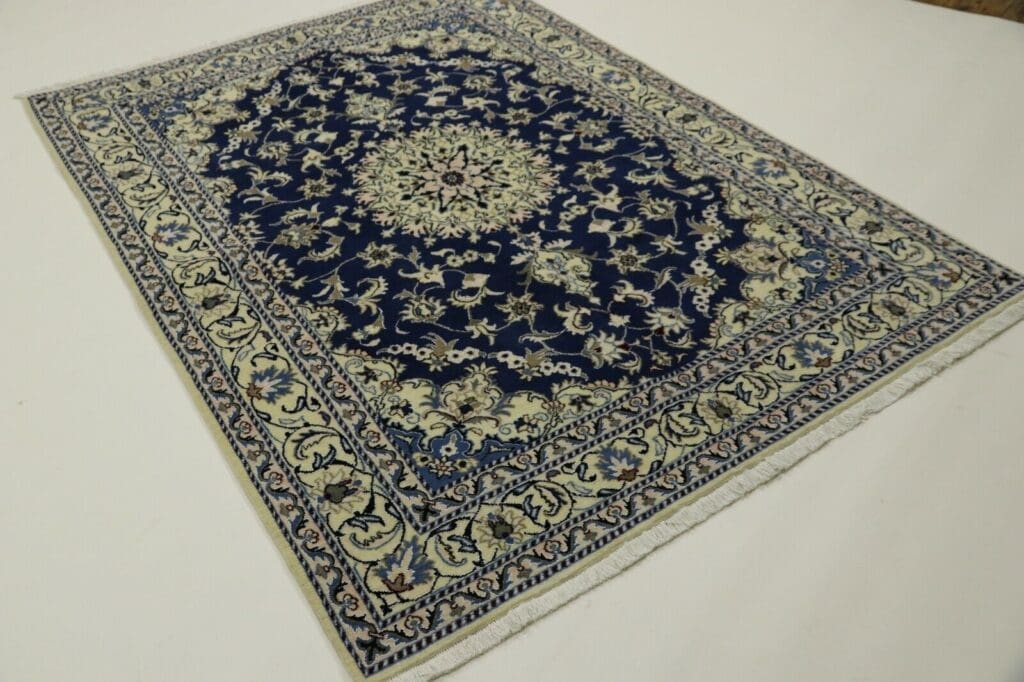
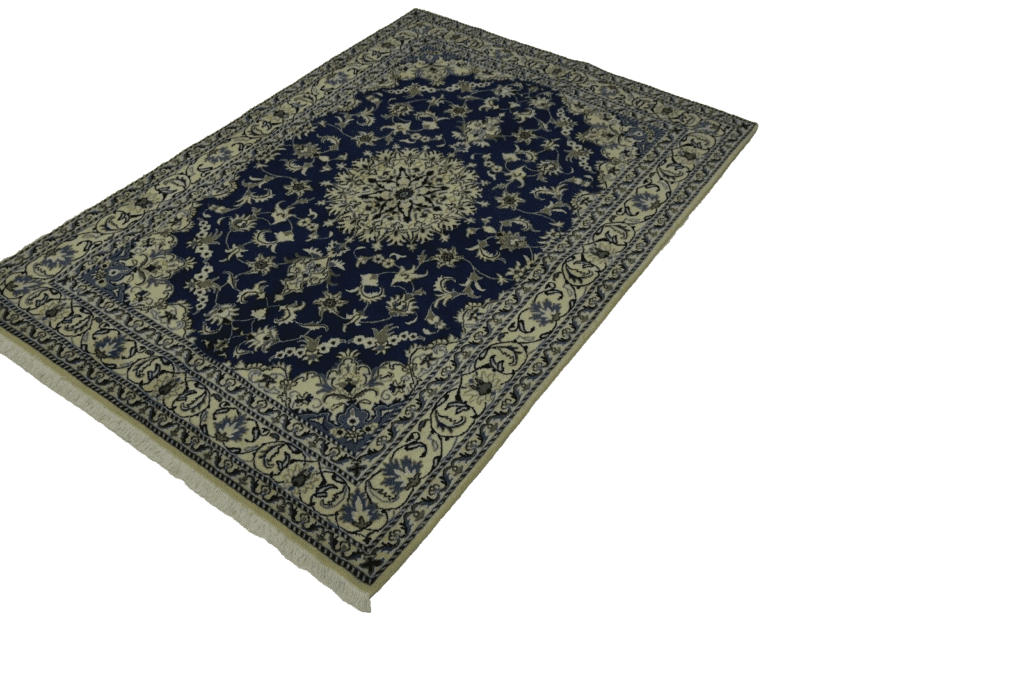
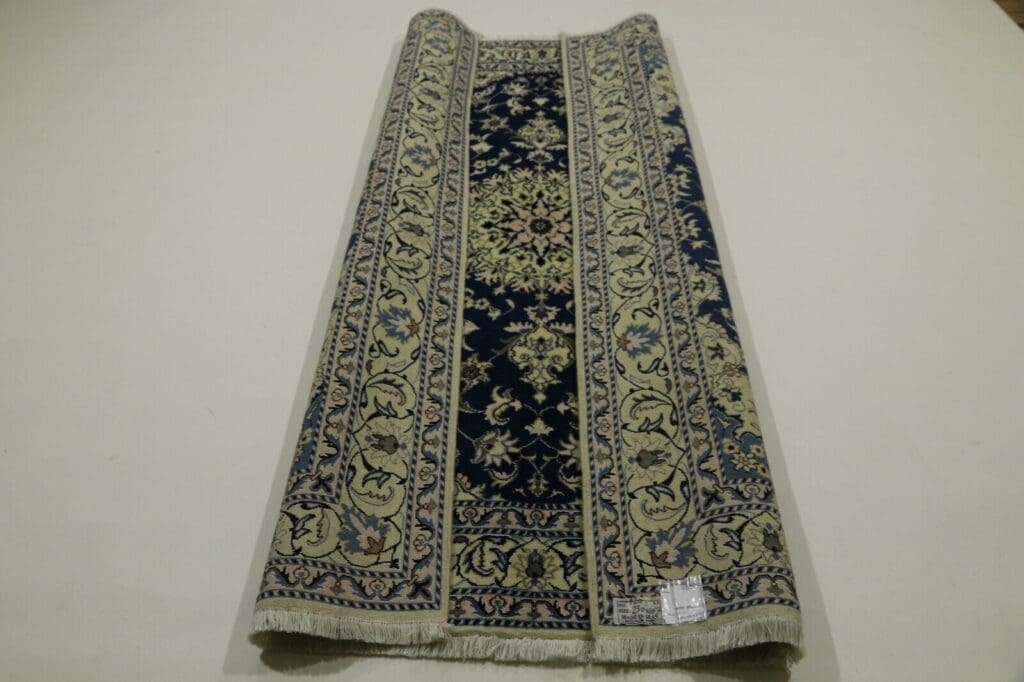
Hand-knotted Nain Persian rug | Knot density: approx. 300,000 knots/m² | Material: pile 90% virgin wool, 10% silk, warp 100% cotton | Size: 230 x 169 cm | Pattern: traditional Oriental and Persian | Condition: new, very good
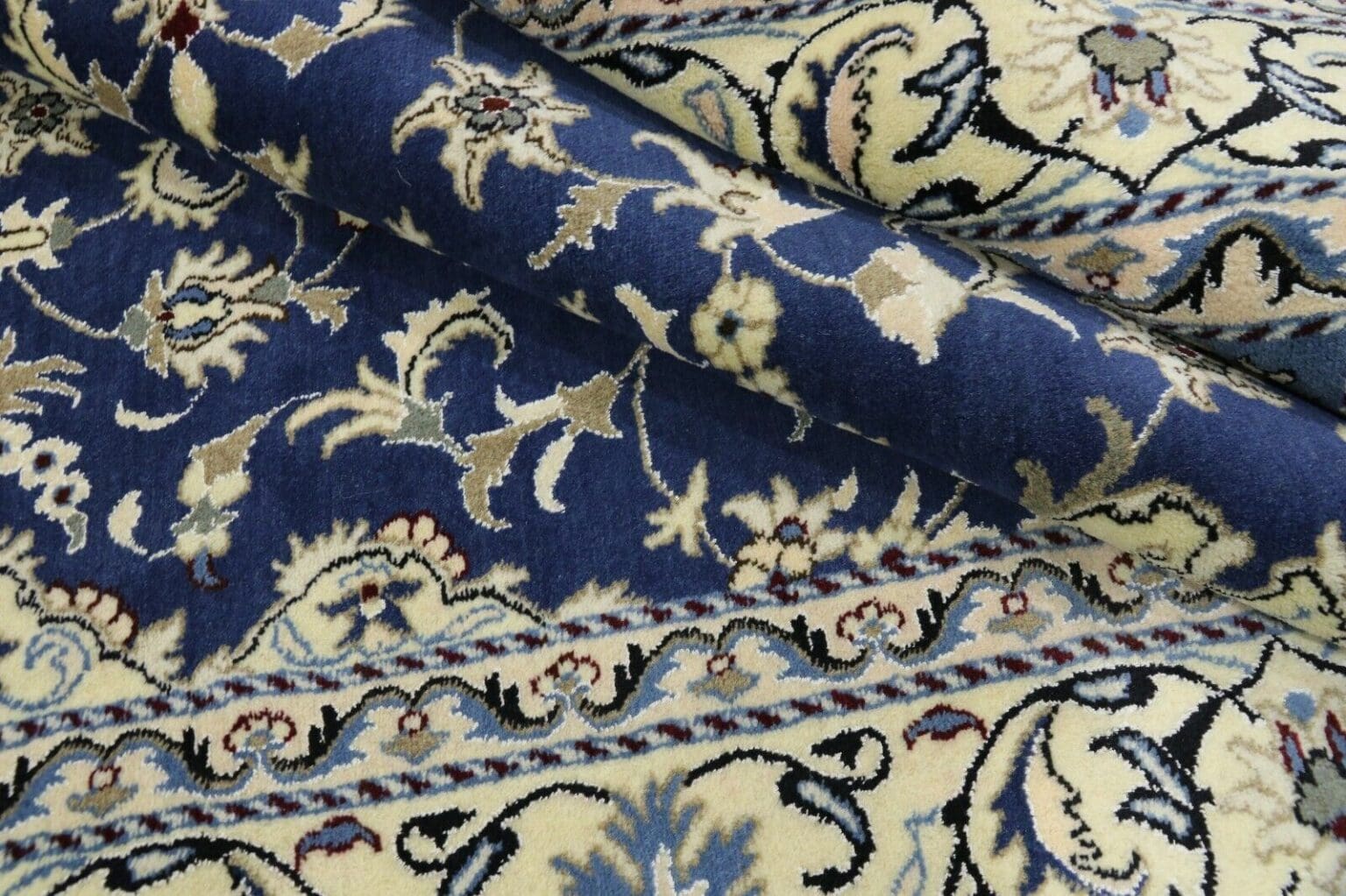
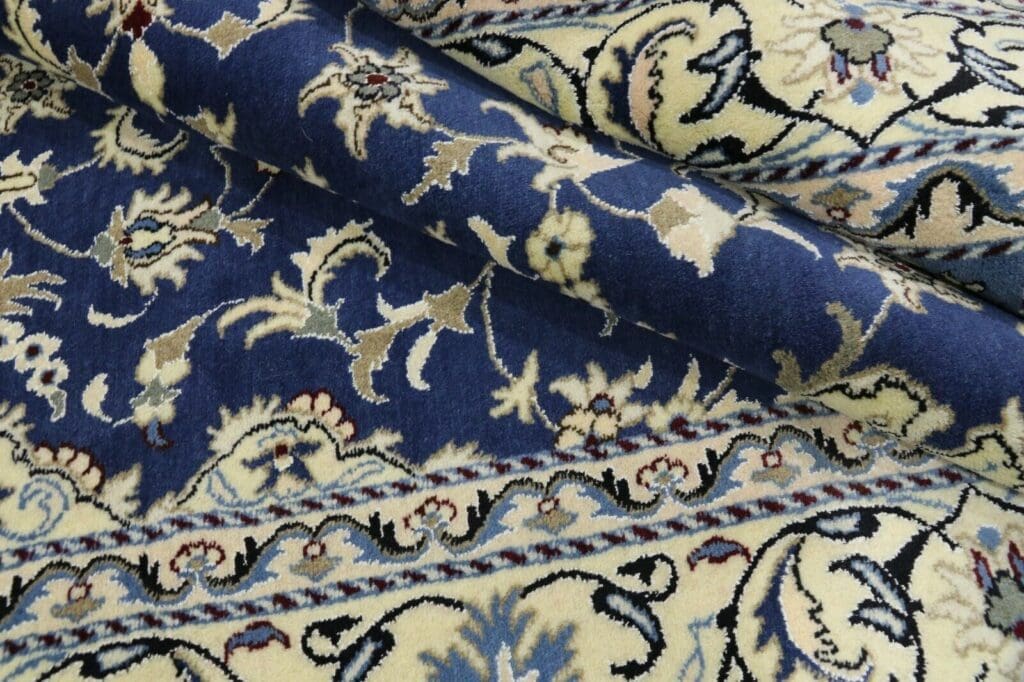
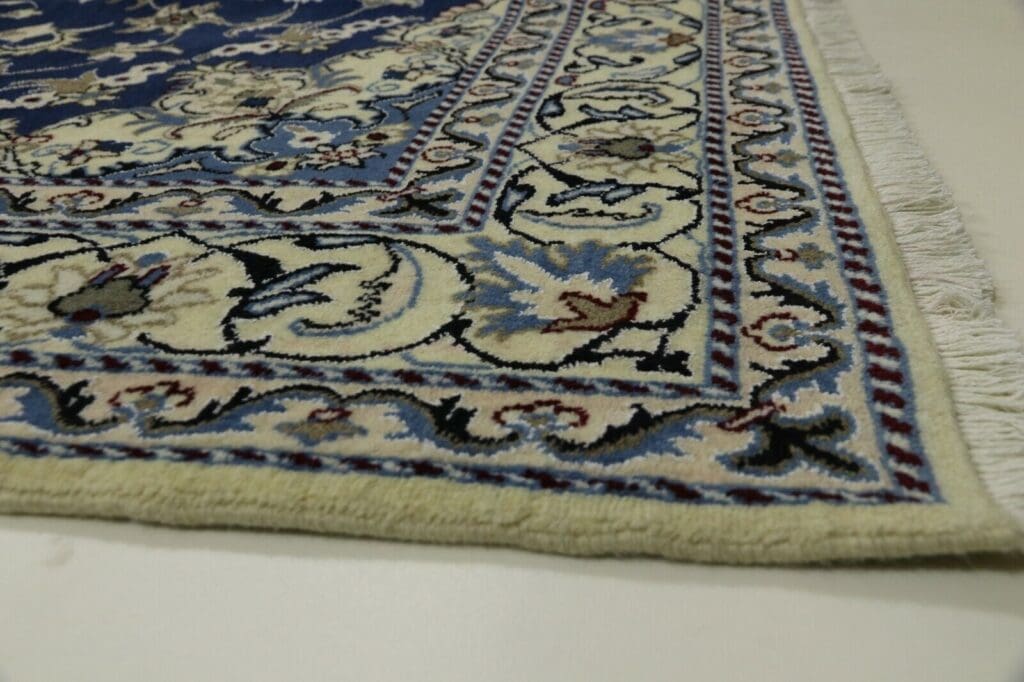
This Nain Persian rug is hand-knotted and combines virgin wool, silk, and cotton in a traditional rug structure. Its pile consists of 90% virgin wool and 10% silk, while the warp is made from 100% cotton. Wool provides the principal pile content, with the qualities associated with warmth, resilience, and a substantial handle. Silk adds a smoother surface and a restrained sheen to the wool-based pile.
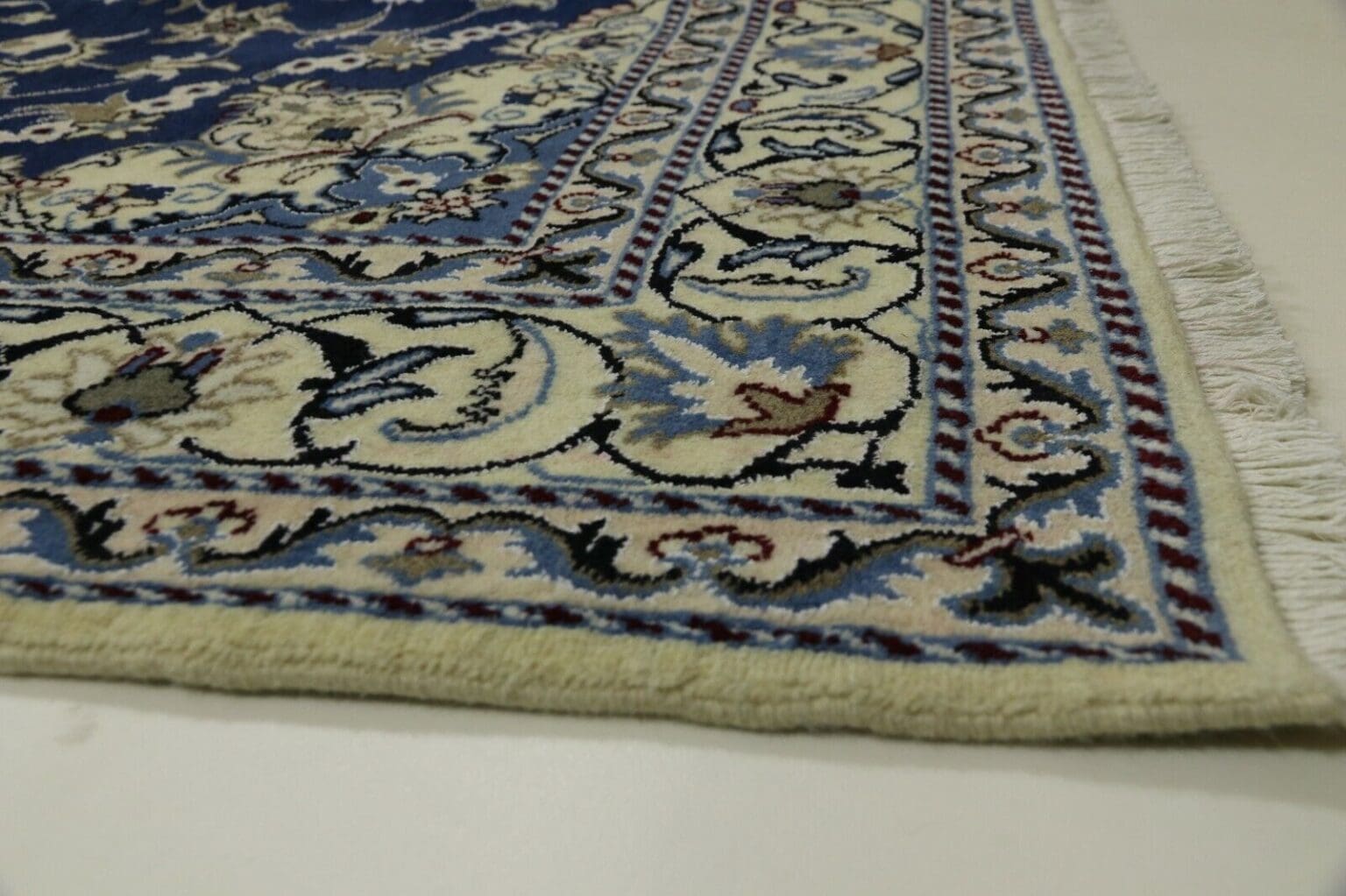
Hand-knotting is built up through the placement of individual knots into a prepared warp rather than through a short industrial production process. The pile develops row by row and is then finished and evened. This method gives each piece its own textile structure. The rug is described with a knot density of approximately 300,000 knots per square metre, a density that supports the rendering of fine outlines and detailed traditional ornament.
The cotton warp forms the supporting framework into which the pile fibres are secured. Wool and silk therefore contribute different qualities to the visible surface: wool supplies body and durability, while silk can refine selected areas through its smoother reflection of light. This combination is associated with finely made Persian rugs. The stated thickness is 8 mm. The piece is identified as a unique rug and comes with a rug certificate.
Origin and Tradition
This rug comes from Persia and is identified as a Nain. Nain is a city in Iran’s Isfahan Province. The city is known for hand-knotted rugs whose construction and visual language belong to the wider Persian rug tradition. Nain developed a distinctive approach to rug making in which careful workmanship, ordered ornament, and selected materials are brought together in a coherent textile surface.
The rug-making tradition of Nain reaches back to the 19th century. Across that period and through later generations, knowledge was passed on concerning the preparation of the warp, the placement of knots, the insertion of weft threads, the shearing of the pile, and the final finishing of the rug. These stages depend on one another. The result is influenced not only by the number of knots, but also by the regularity of the knotting, the choice of fibres, and the clarity with which the design is worked.
Nain lies in a region where Persian rugs have long been made as practical textiles and as works of textile art. Its design tradition is connected with Persian ornament while remaining tied to local production. Floral forms, structured medallions, and finely divided fields are among the visual ideas associated with Nain rugs. The weaving and knotting knowledge of the region is passed from one generation to the next and forms part of its cultural heritage.
A Persian knotted rug differs from a hand-woven Kelim through its pile construction. In a knotted rug, pile yarns are individually secured around the warp and held in place by weft threads. This creates a dense surface that can carry carefully articulated forms. Nain rugs are often made with materials that support a precise drawing. For this piece, the described combination of virgin wool and silk, the cotton warp, and the stated fine knot density are part of its recorded construction.
The name Nain refers here to a regional origin tradition as well as to a particular school of Persian rug design. It is not simply a colour description. The name connects the rug with a city, an established craft tradition, and a way of composing patterns in which fine execution is combined with classical Persian ornament. The term Super Nain is the classification used in the source description.
Design and Pattern
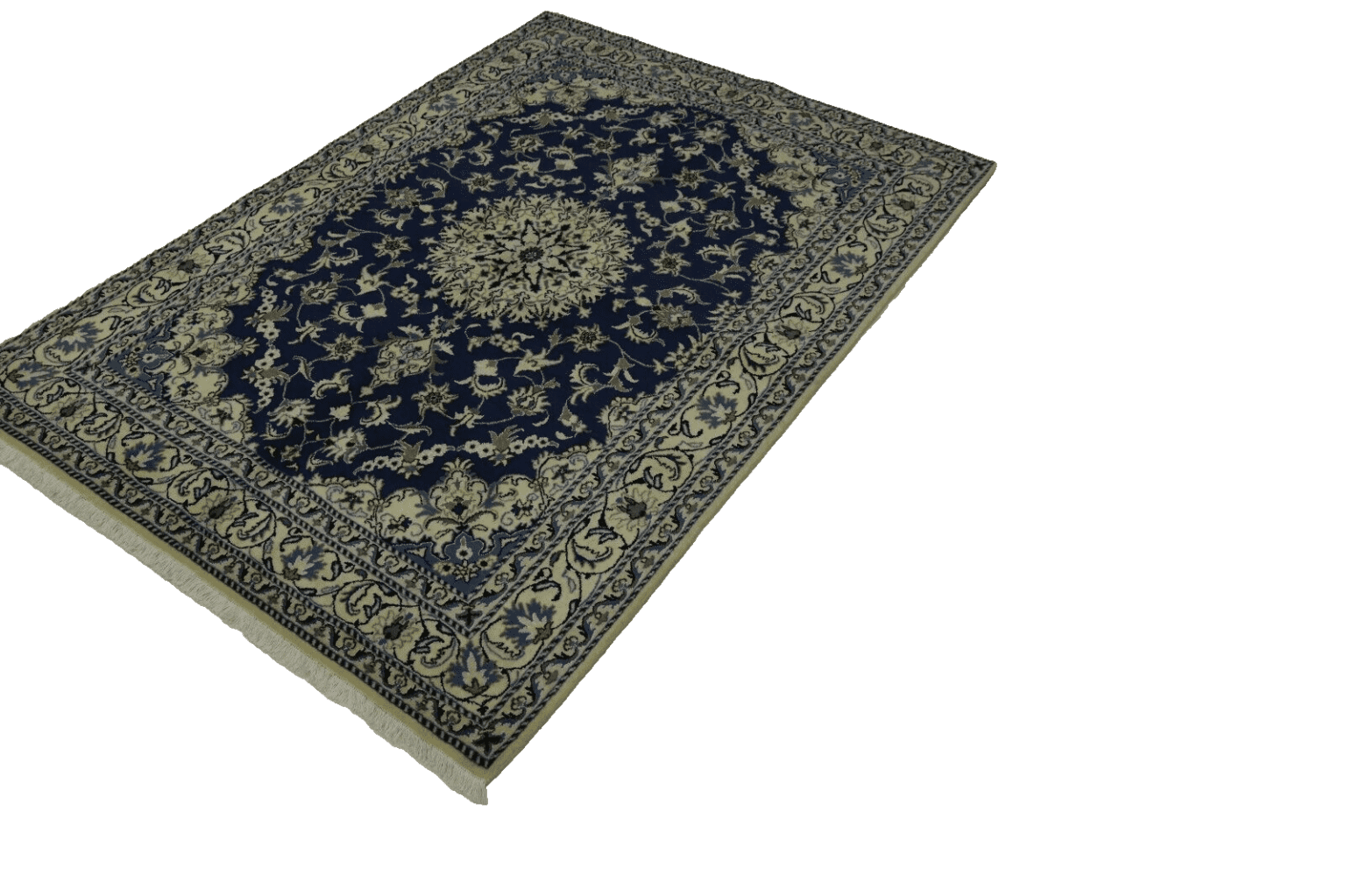
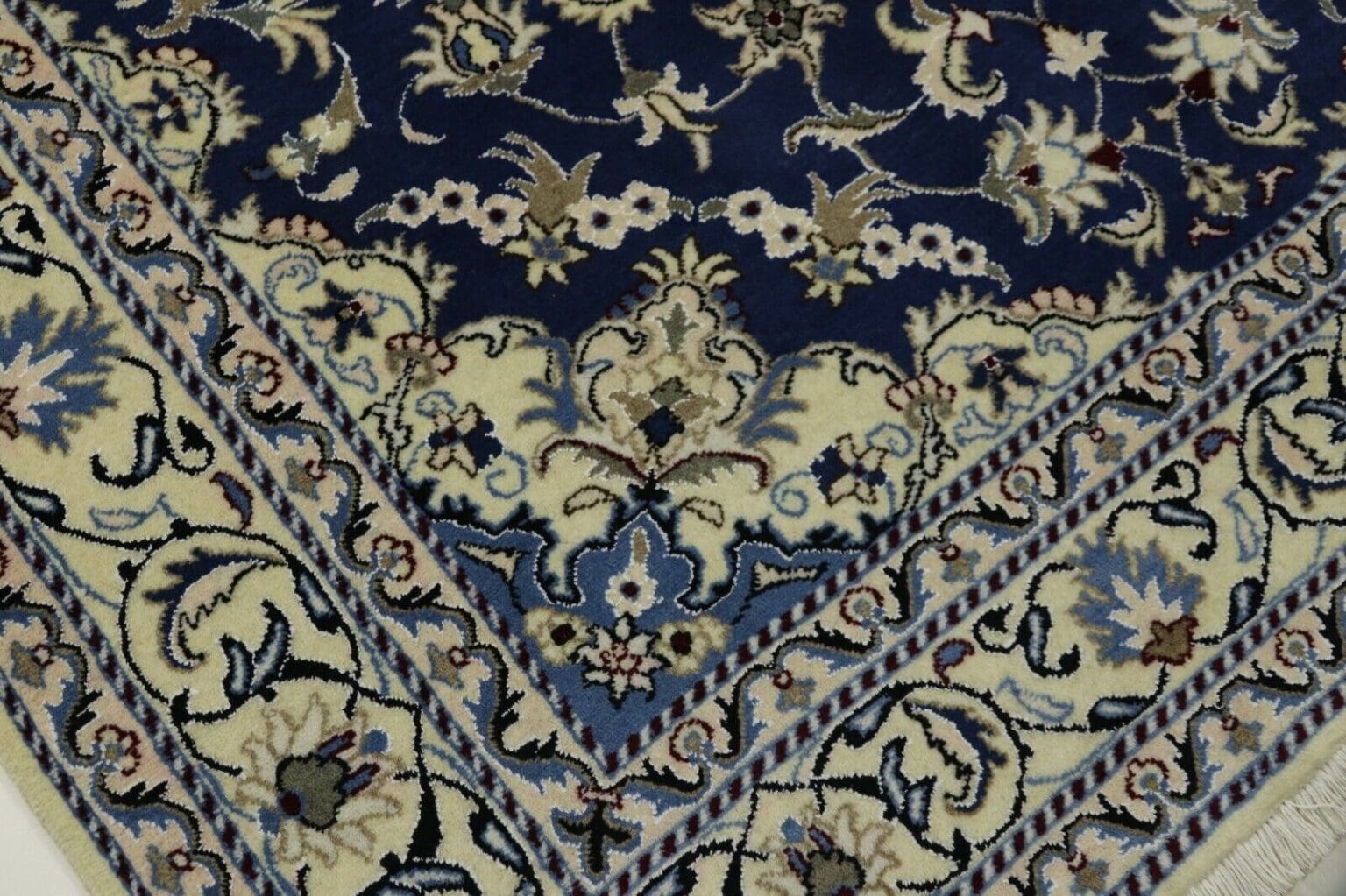
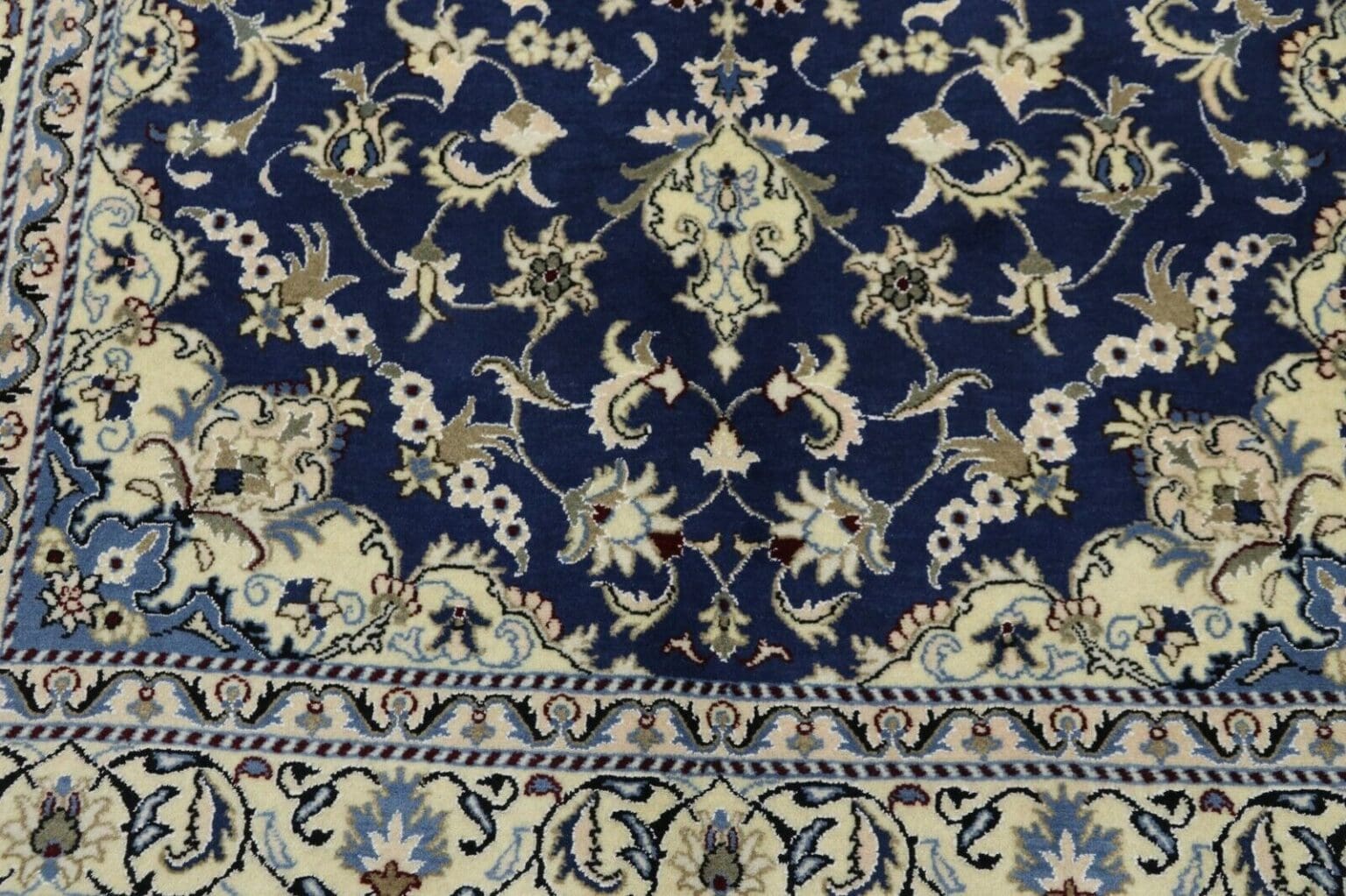
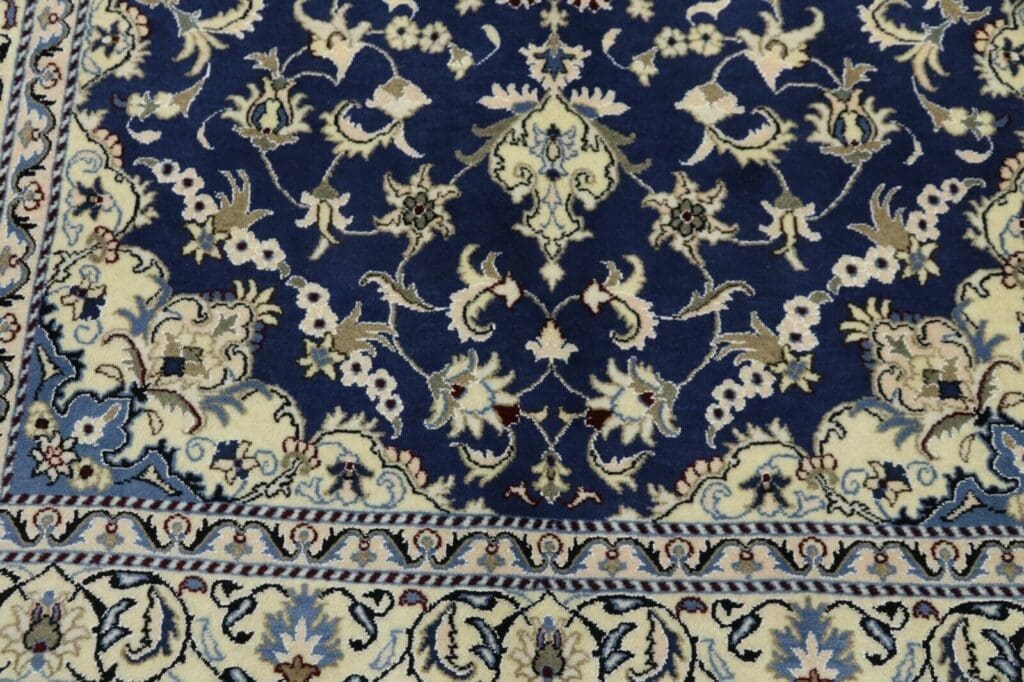
The design of this rug is described as traditional Oriental and Persian. It therefore belongs to a pattern tradition in which the field is organised through ornament rather than relying solely on a plain surface. Classical Persian motifs may include floral elements, geometric forms, and animal representations. Within Persian ornament, such motifs can be decorative while also referring to ideas of nature, order, and the harmony of life.
Floral ornament is one of the recurring devices of Persian rug design. Leaves, blossoms, and vines may be linked into a continuous repeat. Geometric forms provide clear boundaries and help separate one area of the composition from another. Animal figures may appear as individual motifs or as part of a broader visual vocabulary. The source does not itemise the exact motifs on this particular rug; it does, however, place the design within the traditional Persian and Oriental category.
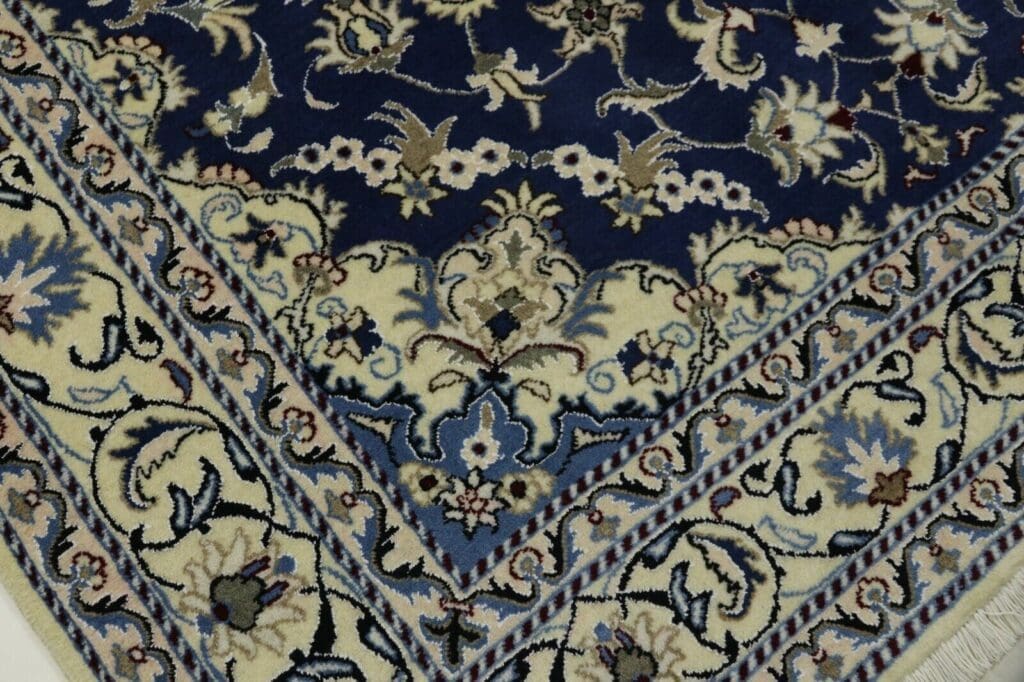
In a finely knotted Nain rug, the relationship between knot density and pattern is significant. A dense construction allows narrow contours, small ornamental passages, and graduated shapes to be worked with greater definition. The visible drawing results from the interaction of pile height, fibre selection, and the distribution of colour. Silk may create a gentle change within a predominantly woollen surface because it reflects light differently from wool.
The colours of this rug are described as harmoniously coordinated. In Persian rug design, a harmonious colour arrangement relates the field, borders, and ornament to one another. This allows a composition containing many individual details to read as a unified whole. The appearance of colour also depends on the relationship between the fibres and the light in the room; silk can accentuate a subtle shift in the surface without changing the traditional character of the design.
Persian rug patterns are often built in several visual levels. A central order may be accompanied by borders, while smaller motifs fill or connect the surrounding spaces. This structure creates a balance between repetition and variation. In a hand-knotted one-off, the design is not printed onto a finished fabric. It is formed during knotting from the arrangement of individual knots, so the pattern is directly connected to the craft process.
Special Features
The rug is described as new and in very good condition. This combines the stated current condition with a hand-knotted construction. A rug certificate is included, and the piece is identified as unique. Its documented features also include the pile composition of 90% virgin wool and 10% silk, the 100% cotton warp, and a knot density of approximately 300,000 knots per square metre.
The traditional design is described as suitable for different interior settings. The rug can be used in living rooms, dining rooms, or as a decorative element in a hallway. Its classification as traditional Oriental and Persian allows it to be placed alongside classic, modern, or Oriental-inspired furnishings. The most suitable position depends on the room layout, the furniture, and the way the pattern is intended to function within the space.
FAQ
How should I care for the Nain Persian rug?
Vacuum the rug regularly and gently to remove loose particles from the pile. Protecting it from direct sunlight helps preserve the surface and its colours. If a spill occurs, dab the affected area promptly with a damp cloth rather than rubbing it vigorously. Professional cleaning every few years is recommended as part of its care and can help maintain the rug over time. Any specialist cleaning should take account of the wool, silk, and cotton components.
Can the rug be used over underfloor heating?
Yes, the Nain Persian rug can be used over underfloor heating. The temperature should not be set too high, so that the fibres are not exposed to unnecessary heat. A moderate heating level is suitable for use. The rug should also lie flat and securely, allowing it to be used safely while the heat reaches the room evenly.
Which room is best suited to this rug?
The rug is suitable for living rooms, dining rooms, and as a decorative feature in a hallway. Its traditional Oriental and Persian design can be combined with classic, modern, or Oriental-inspired interiors. In a living room it can bring a seating area together; in a dining room it can define the dining zone; and in a hallway it can introduce a textile accent. The best placement depends on the room plan, the furniture, and the desired role of the pattern.
To provide the best experiences, we use technologies like cookies to store and/or access device information. Consenting to these technologies will allow us to process data such as browsing behavior or unique IDs on this site. Not consenting or withdrawing consent, may adversely affect certain features and functions.
Functional Always active
The technical storage or access is strictly necessary for the legitimate purpose of enabling the use of a specific service explicitly requested by the subscriber or user, or for the sole purpose of carrying out the transmission of a communication over an electronic communications network.
Preferences
The technical storage or access is necessary for the legitimate purpose of storing preferences that are not requested by the subscriber or user.
Statistics
The technical storage or access that is used exclusively for statistical purposes.The technical storage or access that is used exclusively for anonymous statistical purposes. Without a subpoena, voluntary compliance on the part of your Internet Service Provider, or additional records from a third party, information stored or retrieved for this purpose alone cannot usually be used to identify you.
Marketing
The technical storage or access is required to create user profiles to send advertising, or to track the user on a website or across several websites for similar marketing purposes.

 SECURE PAYMENT
 SHIPPING PARTNERS


