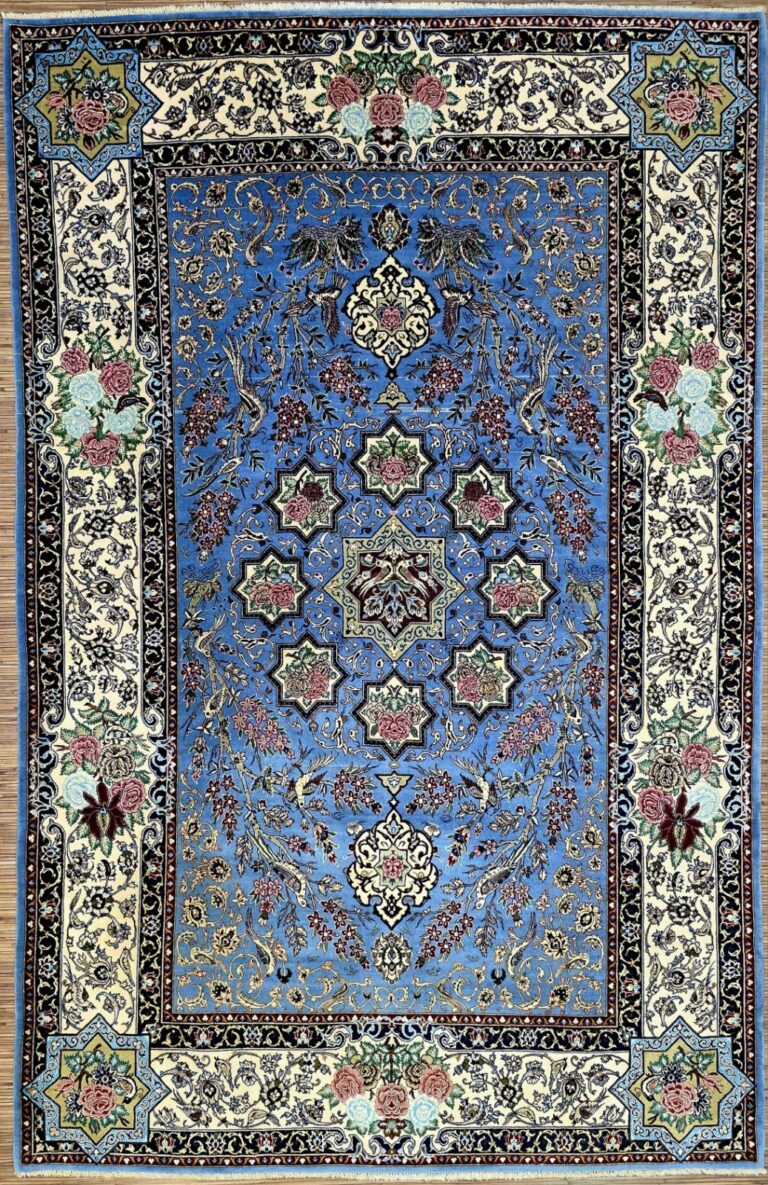
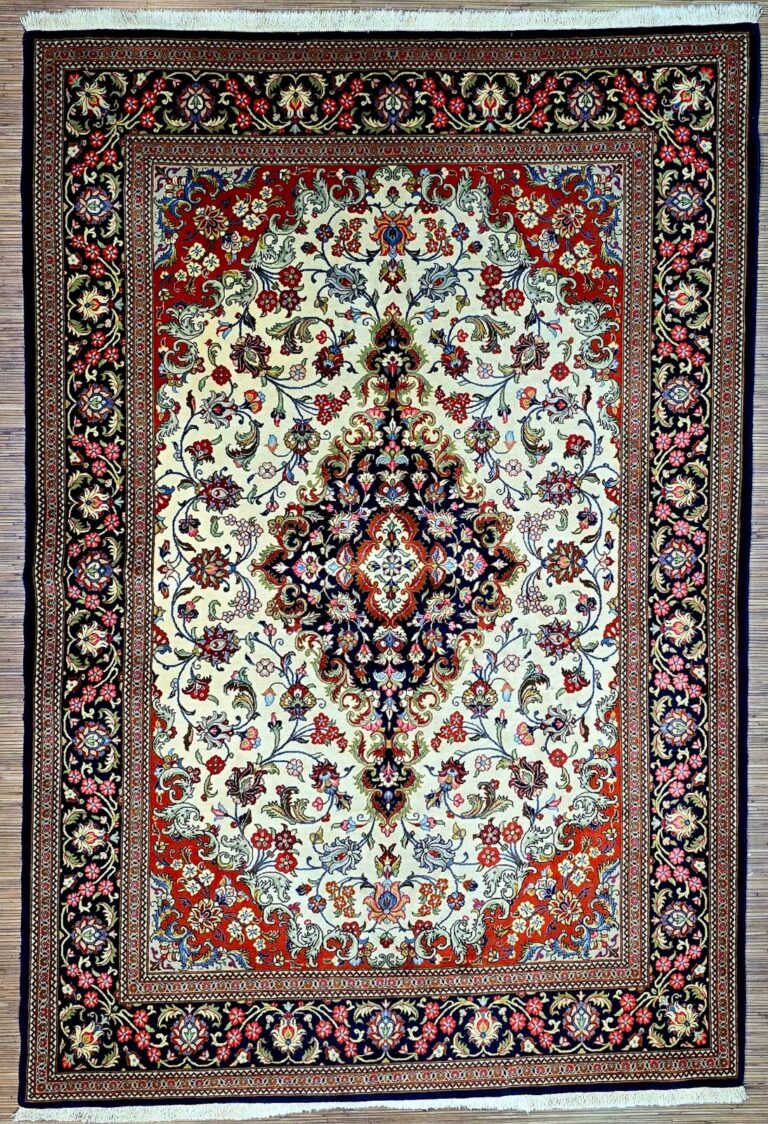
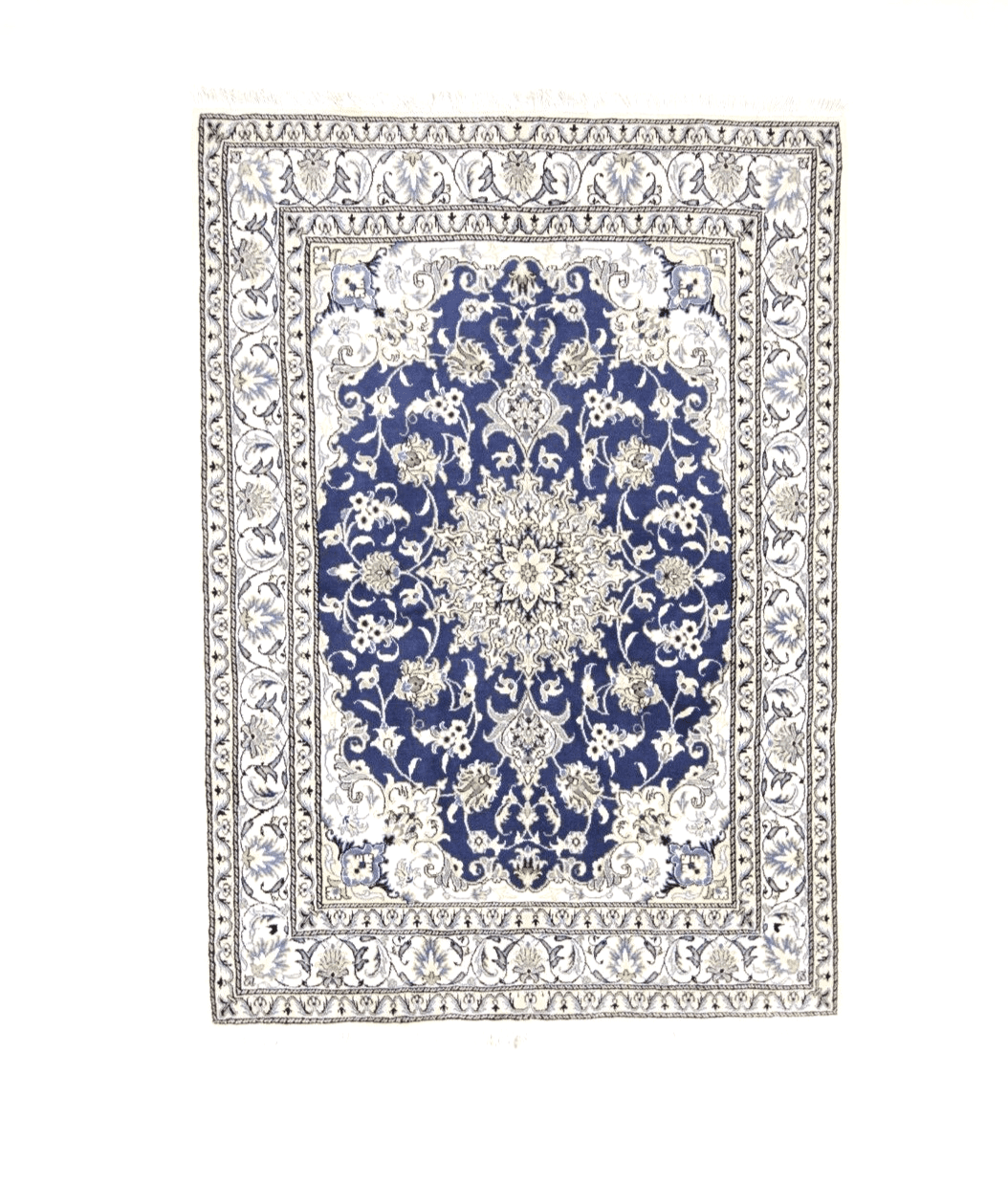
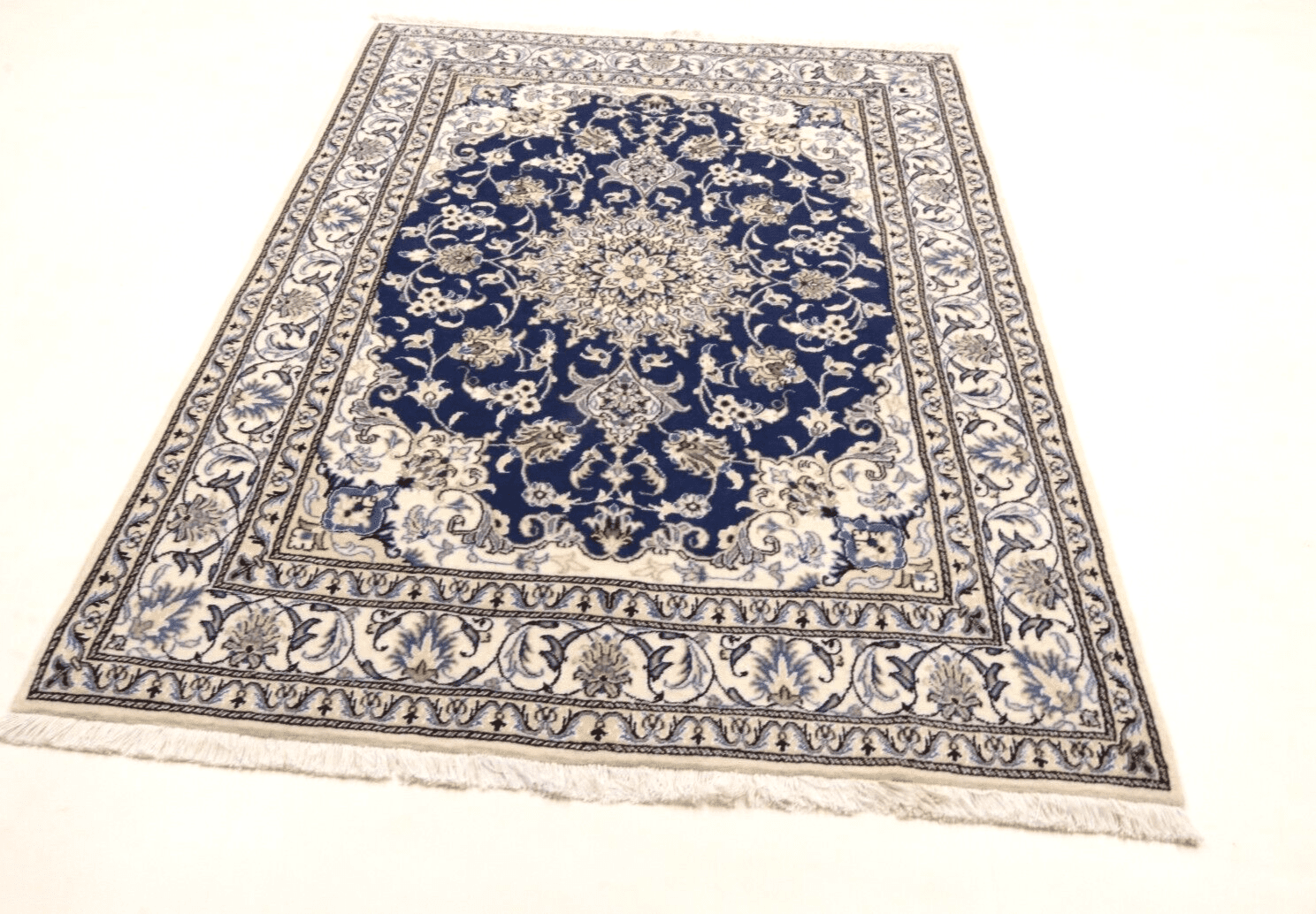
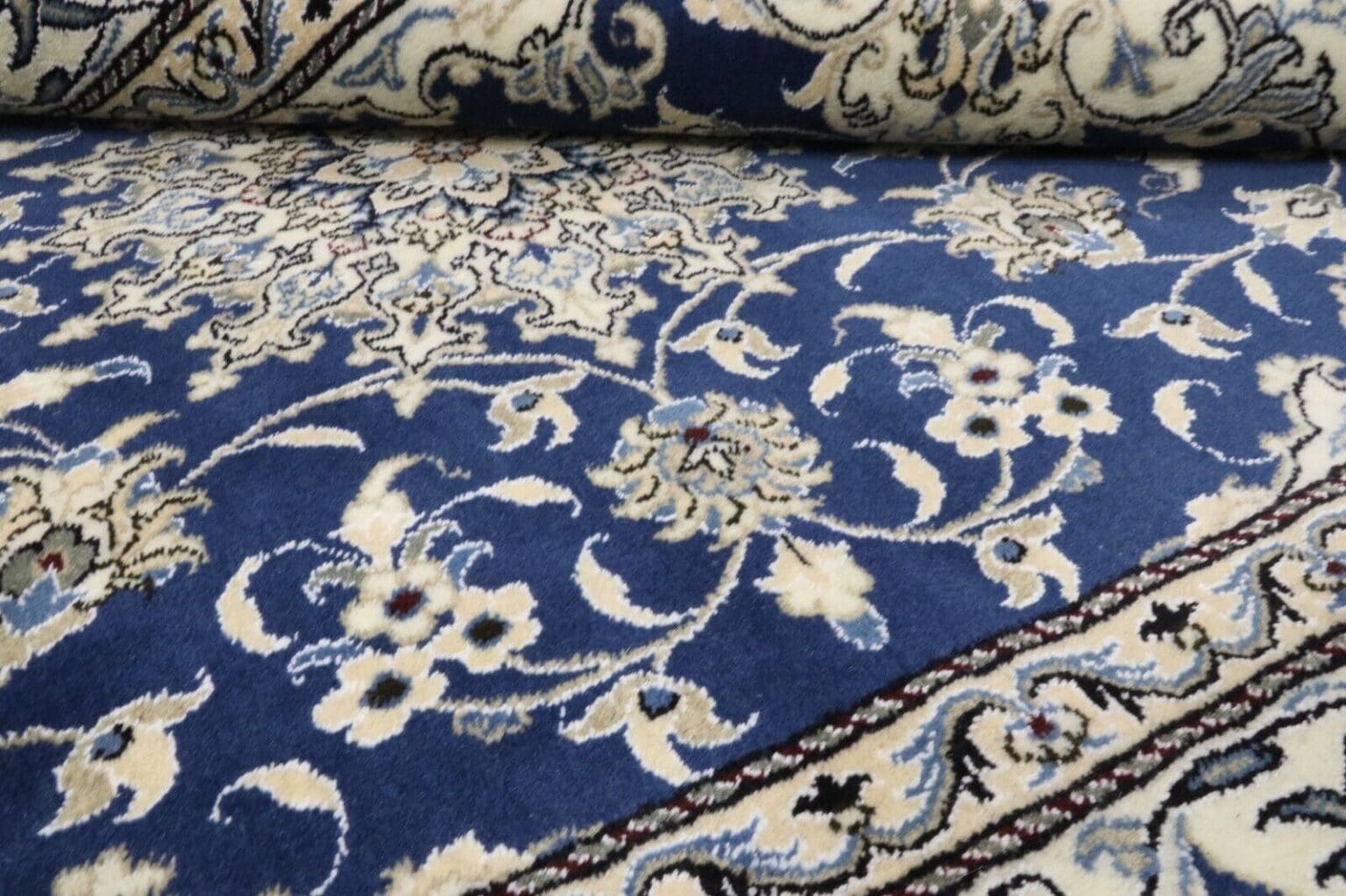
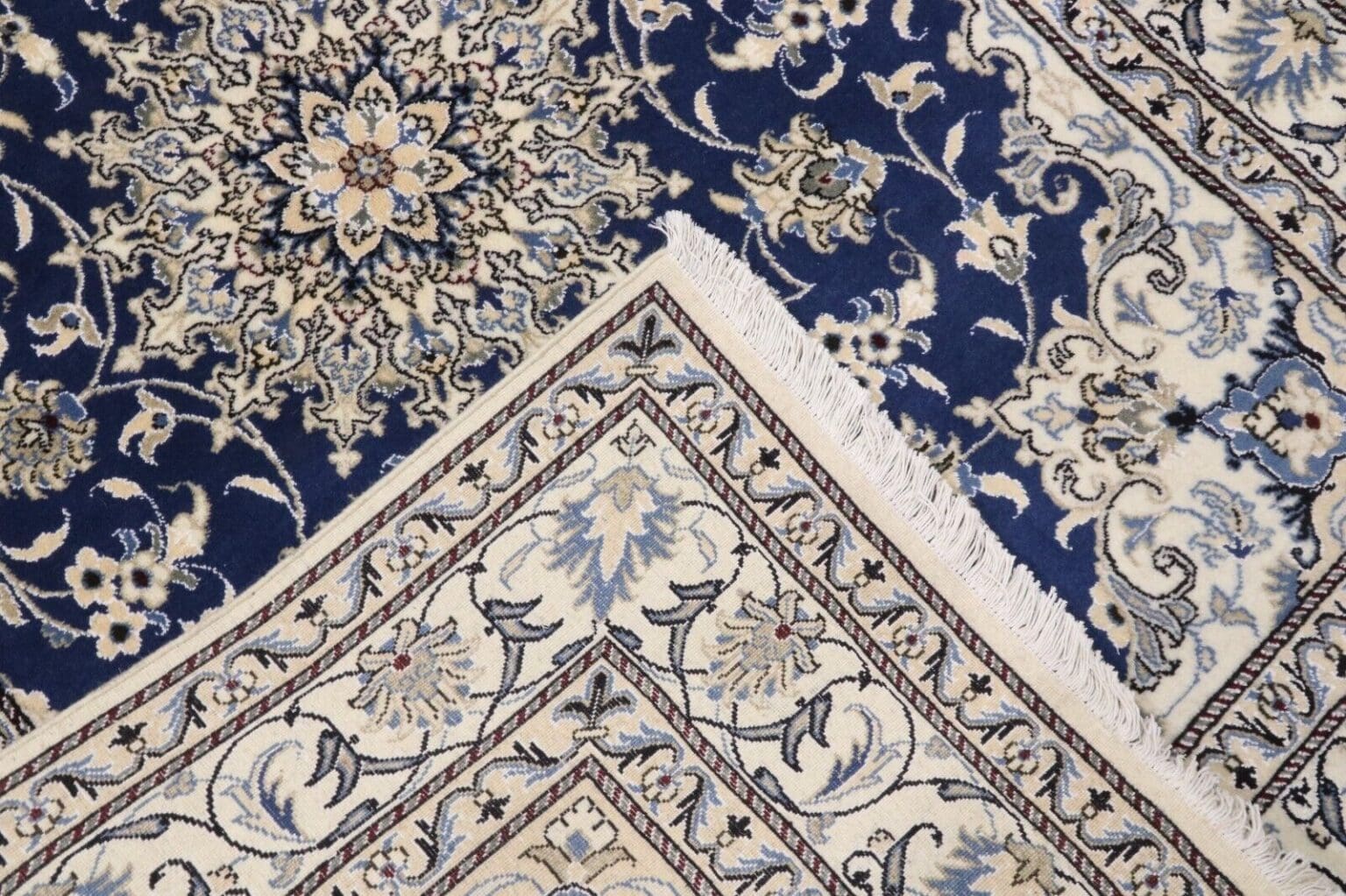
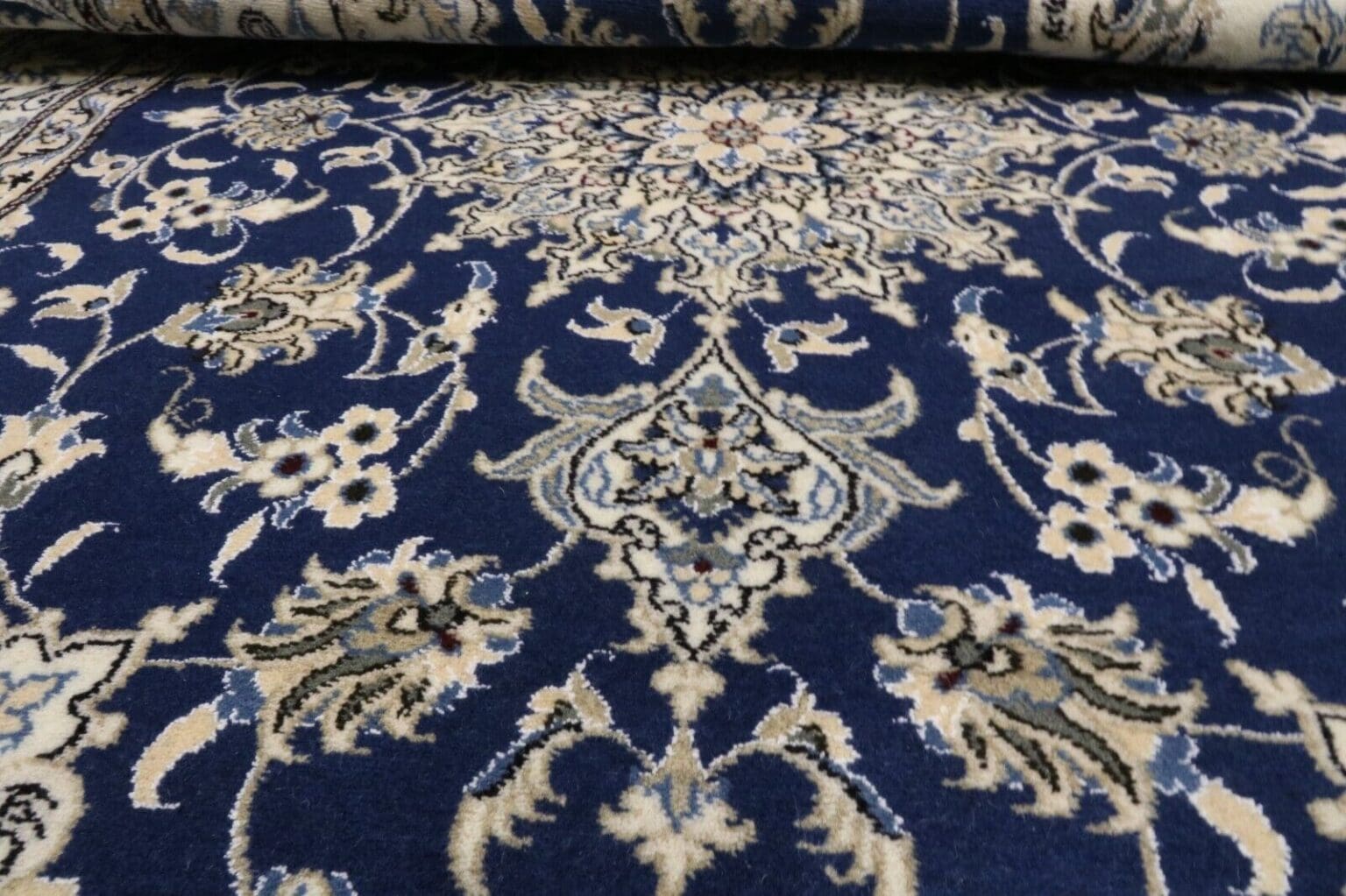
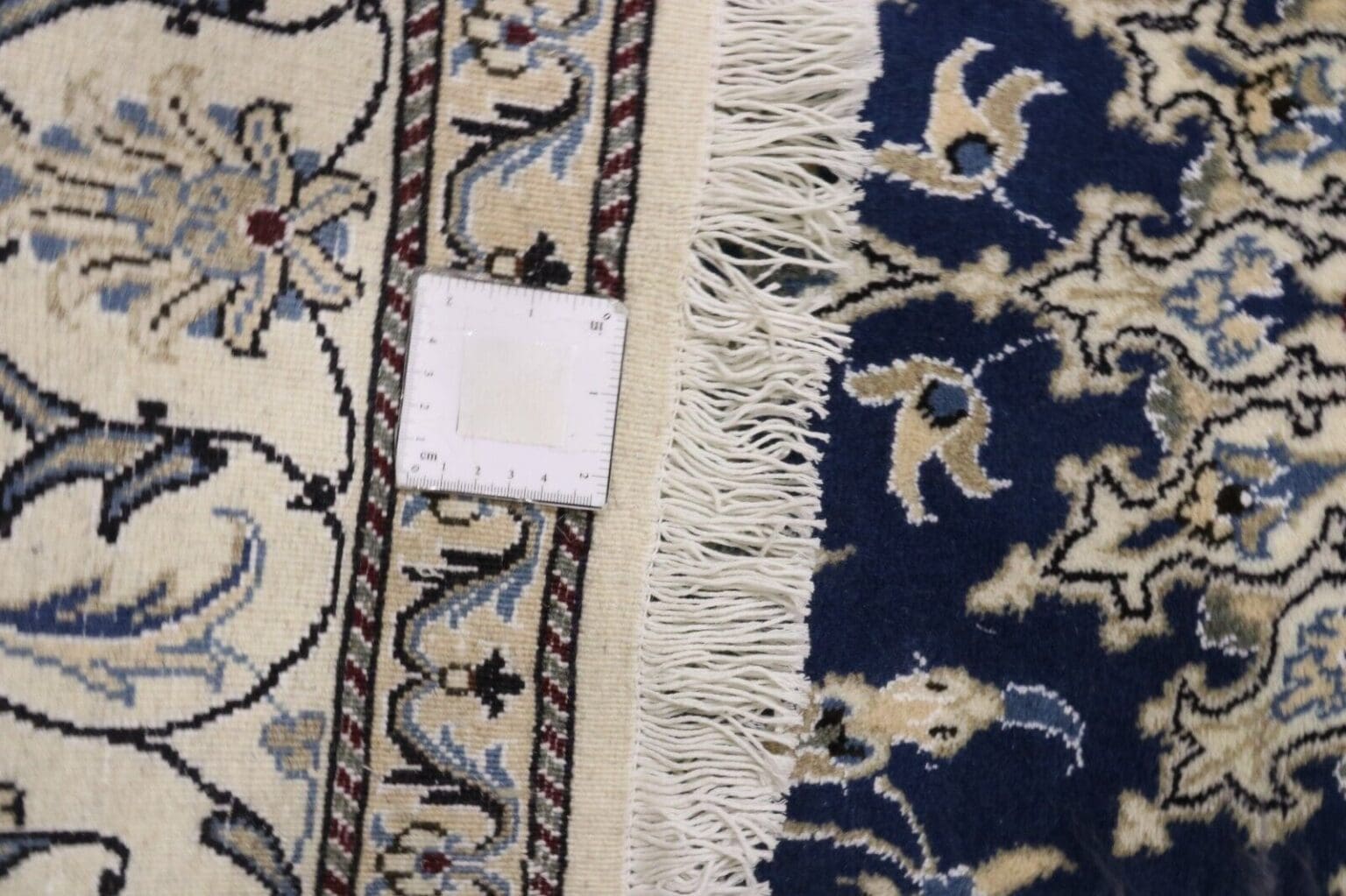
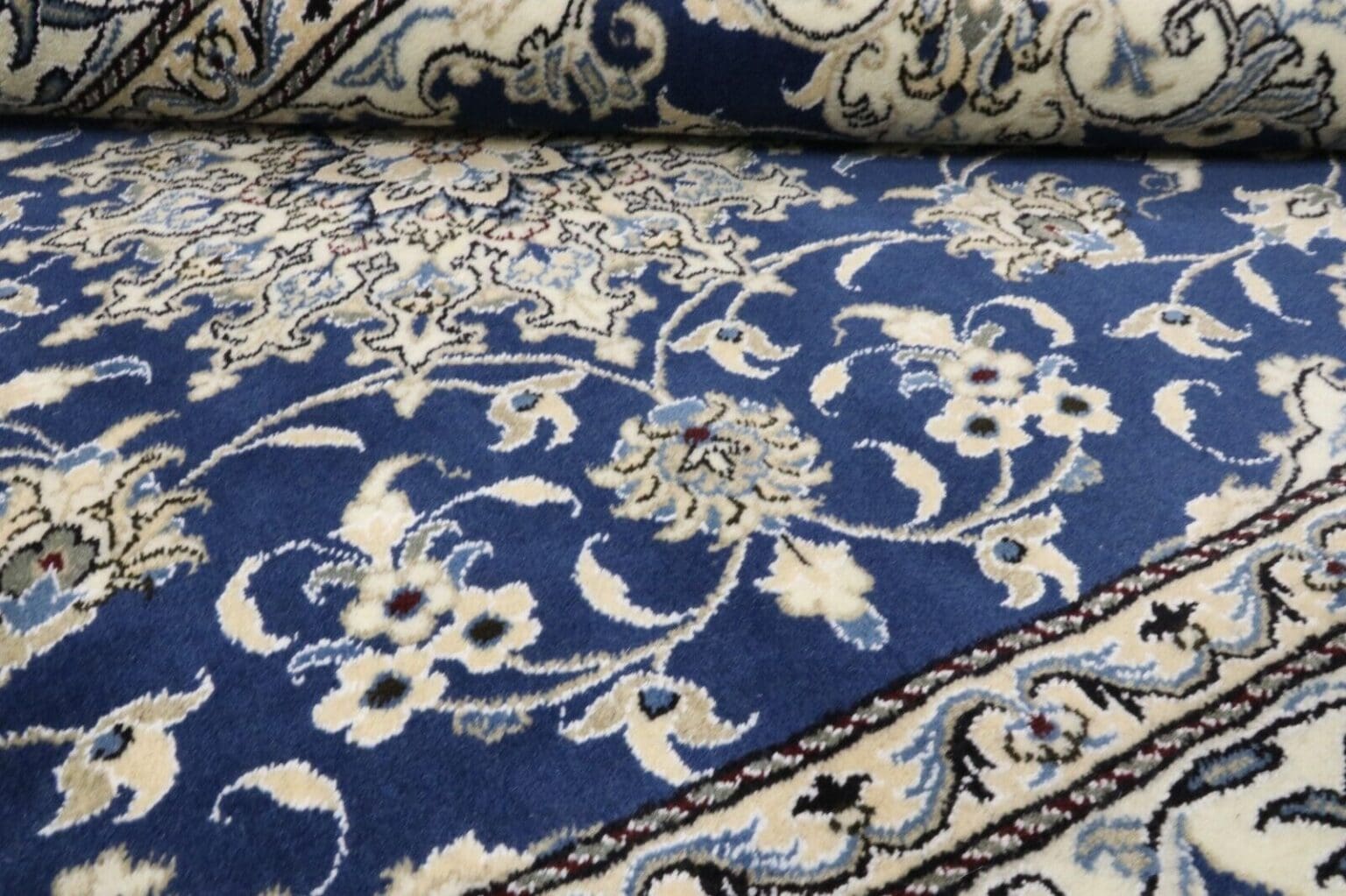
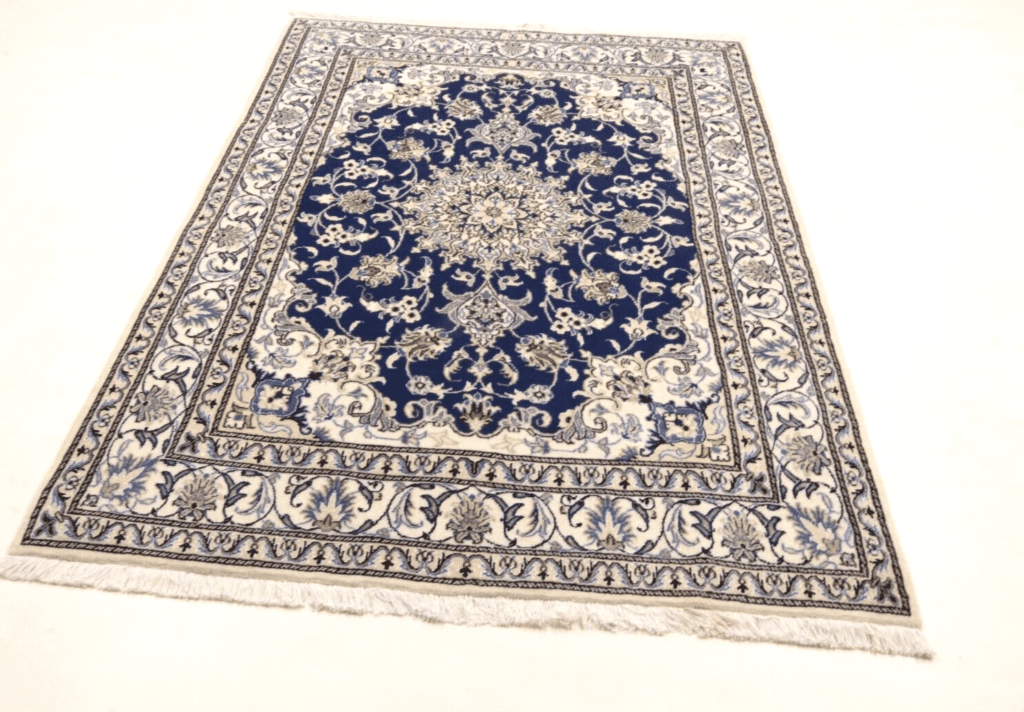
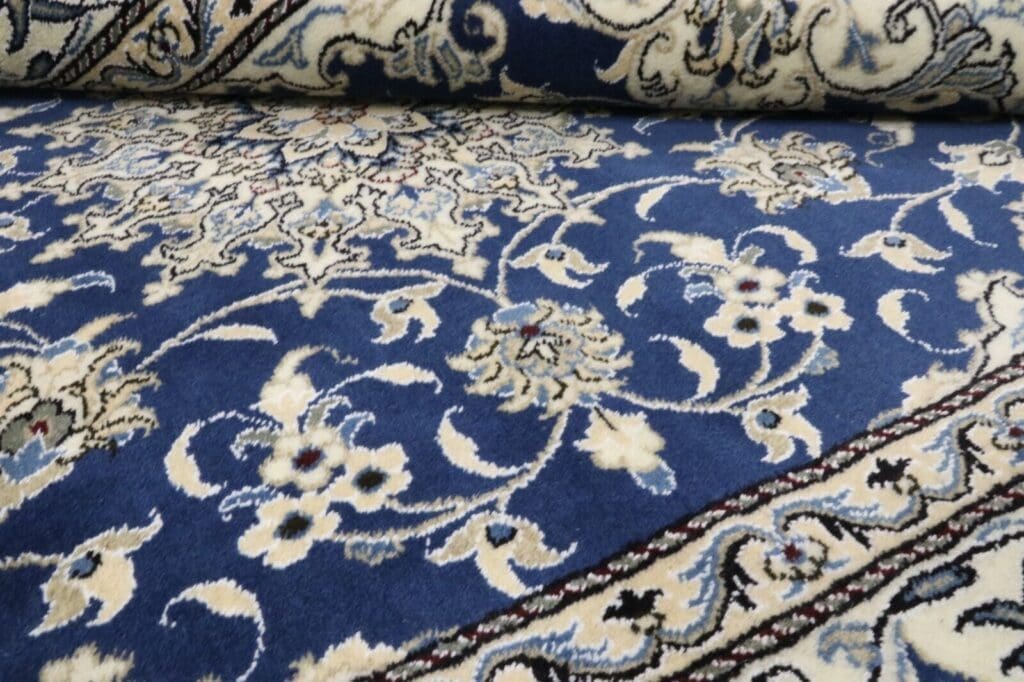
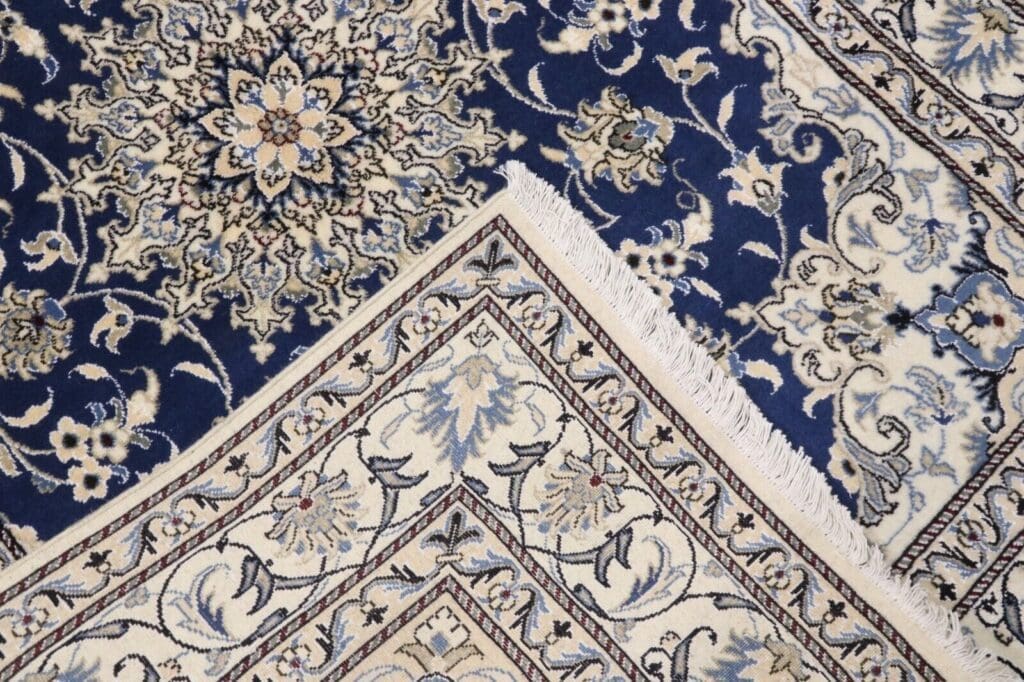
This Nain Persian rug is hand-knotted. Its pile is made from 90% virgin wool and 10% silk, while the warp is 100% cotton. The main pile fibre is virgin wool, with silk used as a complementary fibre in the pile. The cotton warp forms the foundation for the knots. These materials and this construction are the defining material details of this individual rug.
Hand-knotting is a textile process in which knots are tied individually around the warp. The knotting progresses row by row, building the fabric and the visible pile at the same time. Unlike a mechanically produced carpet, a hand-knotted rug is formed through a continuing sequence of manual operations. The completed piece therefore carries the structure of its particular knotting process rather than being one of a series made by an identical machine process.
Virgin wool makes up most of the pile, while silk contributes the smaller stated portion. In rug making, wool is used for its resilient natural fibre structure, and silk can bring a finer surface and a subtle sheen to a pile. Cotton in the warp provides the underlying framework into which the knots are inserted. These are general functions of the named fibres and do not add unstated specifications to this rug.
The condition of this rug is new and perfect. It is described as suitable for underfloor heating and as pet-friendly. Those details concern its intended use in a home and supplement the information about its construction. They do not replace ordinary care, and they do not change the fact that this is a one-off hand-knotted Oriental rug.
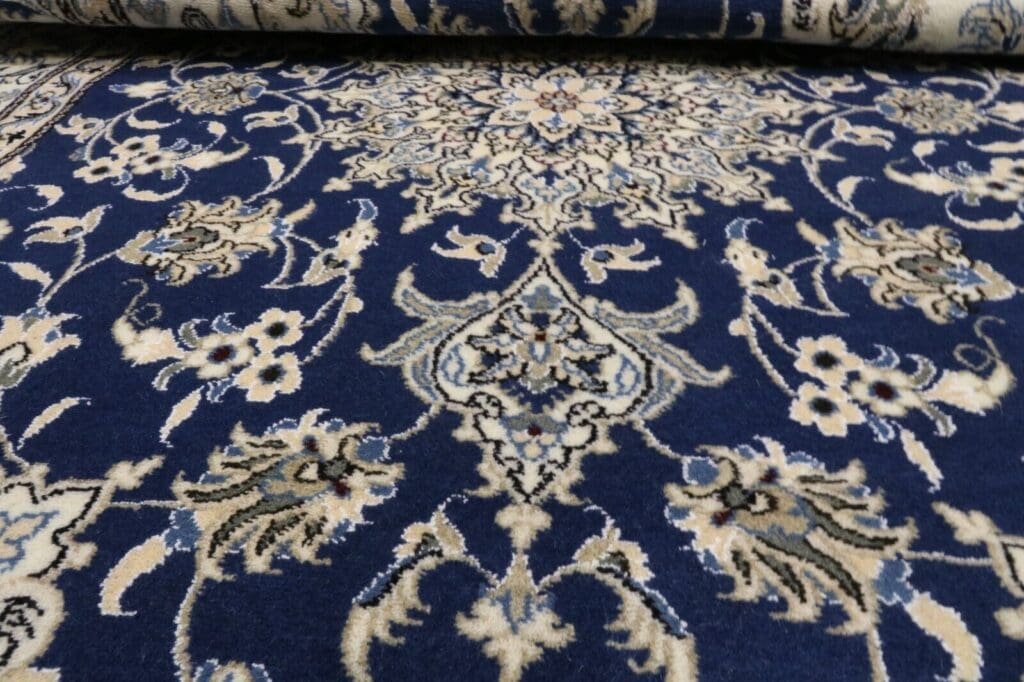
The pile height is given as approximately eight millimetres in the product information. It is a construction detail of the finished pile, alongside the fibre composition, cotton warp and hand-knotted technique. The rug is also described as having an approximate density of 300,000 knots per square metre. Together, these details identify the technical character of the piece without requiring any assumptions about its value or age.
Origin and Tradition
The rug comes from Persia and is identified as Nain. Nain is a city in Iran with an established Persian rug-making tradition. In this description, Nain indicates the rug’s origin rather than merely naming a decorative motif. The piece therefore belongs to the Persian rug tradition and is described as a Persian rug despite the broader Oriental rug wording in the source title.
Nain weaving is associated with carefully organised compositions and fine drawing. Regional rugs commonly place detailed lines, controlled fields and a balanced relationship between centre and border at the heart of the design. The visual order is created through the way motifs are distributed across the field and framed by the surrounding bands. This approach gives the Nain tradition a recognisable place within Iranian carpet culture.
Persian rug production includes many regional vocabularies. Depending on the area and workshop, a composition may use floral forms, geometric structures or a medallion-like arrangement. Nain designs are often discussed in connection with refined drawing and measured ornament. The value of this background is that it explains the regional language of the rug without turning a general Nain convention into an unsupported inventory of every motif present in this particular piece.
The weaving tradition of Nain is passed on through practical knowledge of knotting, outlining, colour placement and the organisation of a field. Such knowledge is not limited to one isolated technique. It includes the preparation of the foundation, the steady construction of the pile and the visual control needed to keep a repeated pattern coherent. Hand-knotting allows the established regional vocabulary to be realised through the individual work of the maker.
Persian rugs are part of the cultural history of Iran and have long served both practical and decorative purposes. A rug can define a usable area, provide a textile surface underfoot and give a room a structured visual centre. It can also preserve regional forms in a durable material. The origin in Persia and the Nain classification place this rug within that wider history of Iranian textile craft.
The dense knotting associated with fine Nain work is connected to the ability to articulate small contours and close pattern relationships. A dense construction can support a detailed drawing when the knots, pile, warp and weft are coordinated carefully. The technique does not exist separately from the design: the intended drawing influences the work of the knotter, while the construction determines how precisely that drawing can be expressed.
Nain is therefore more than a geographic label. It identifies a regional tradition with its own relationship between material, structure and ornament. The Persian origin, the Iranian setting and the hand-knotted method belong to the same historical context. At the same time, this individual rug remains a single finished piece, with its own combination of wool, silk, cotton, blue colour and traditional Persian Oriental styling.
Design and Pattern
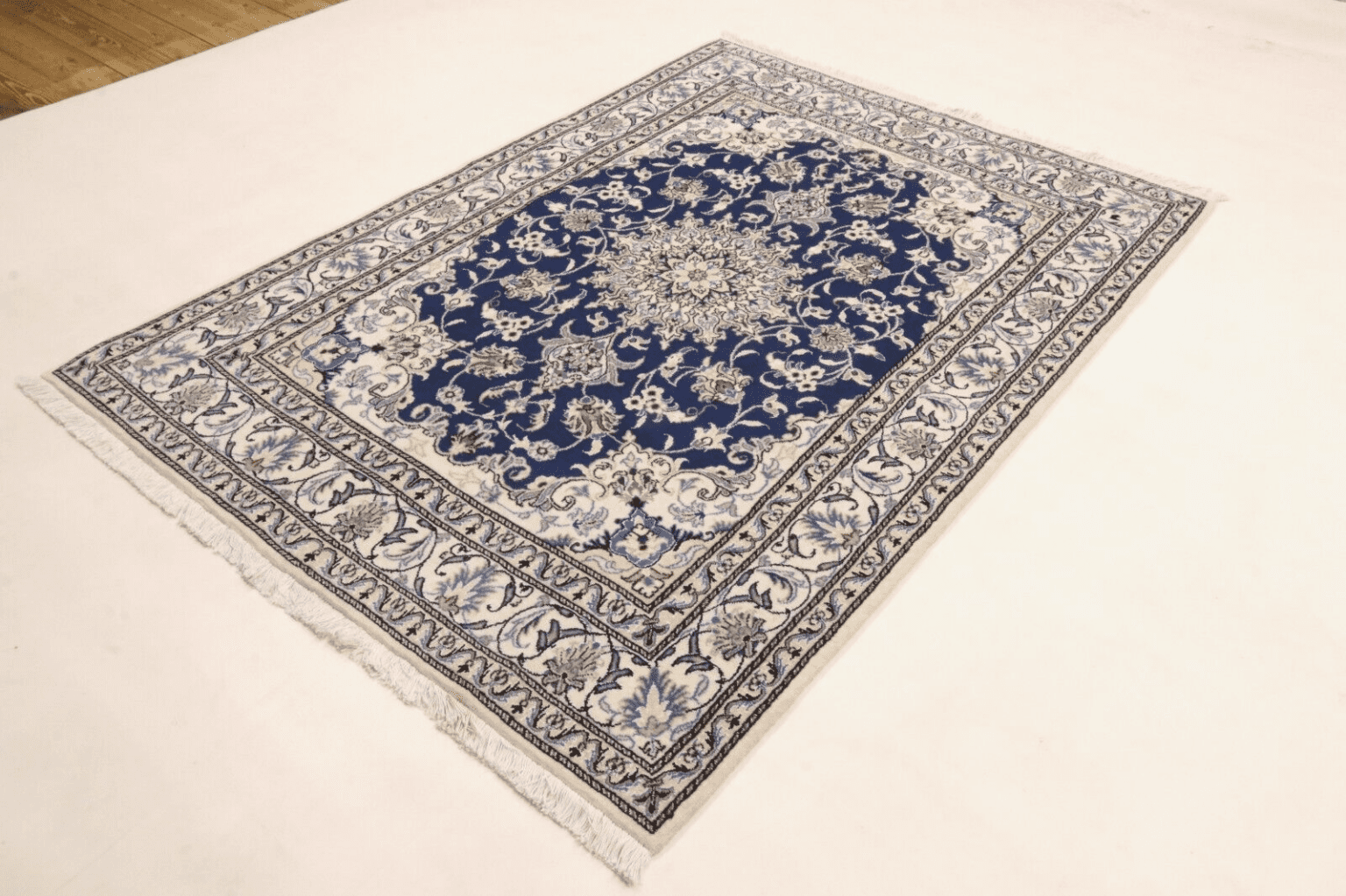
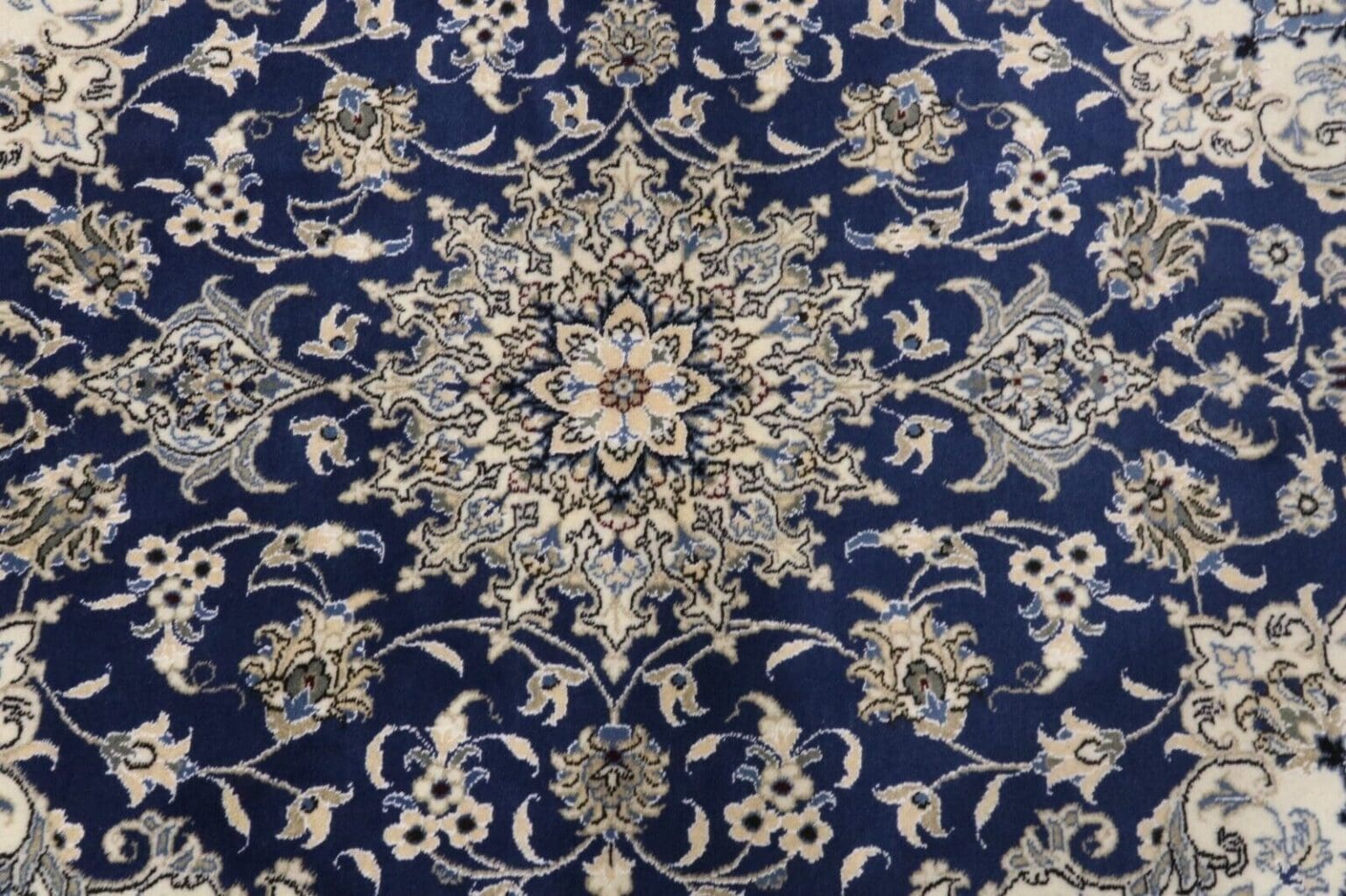
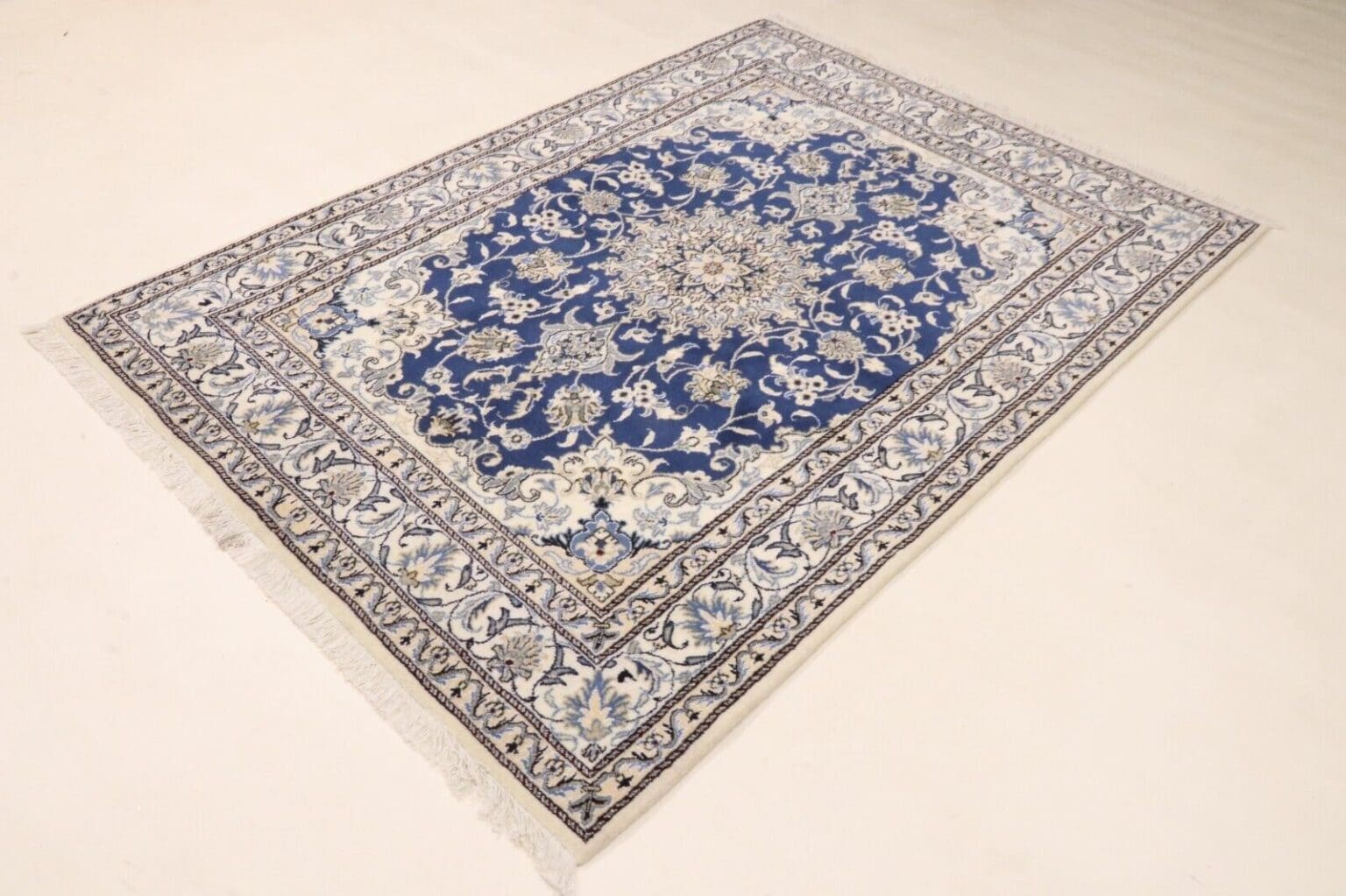
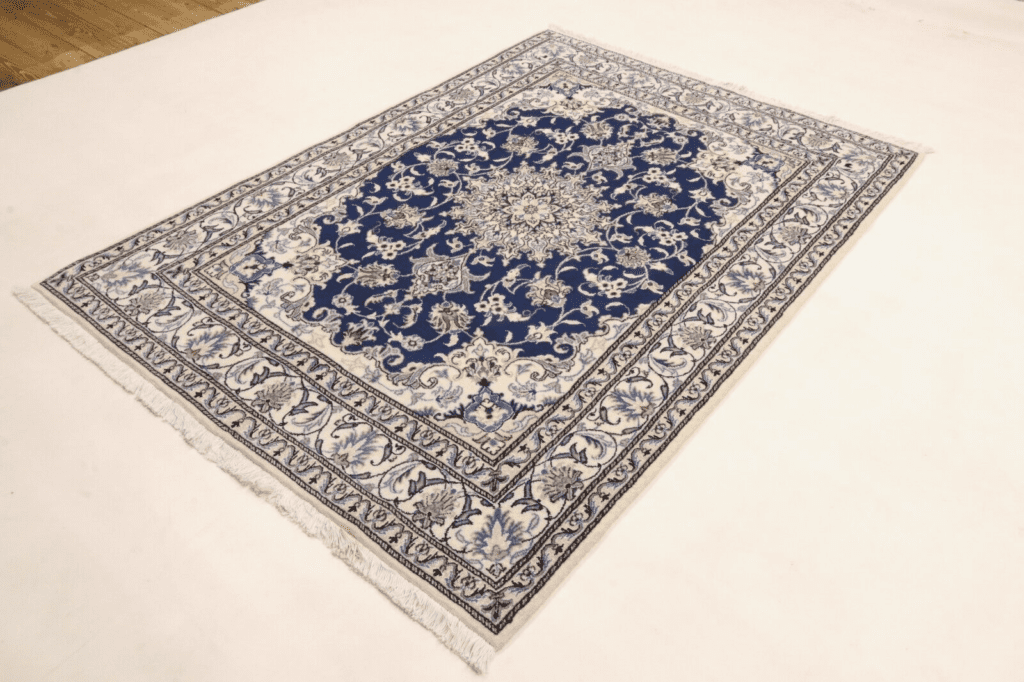
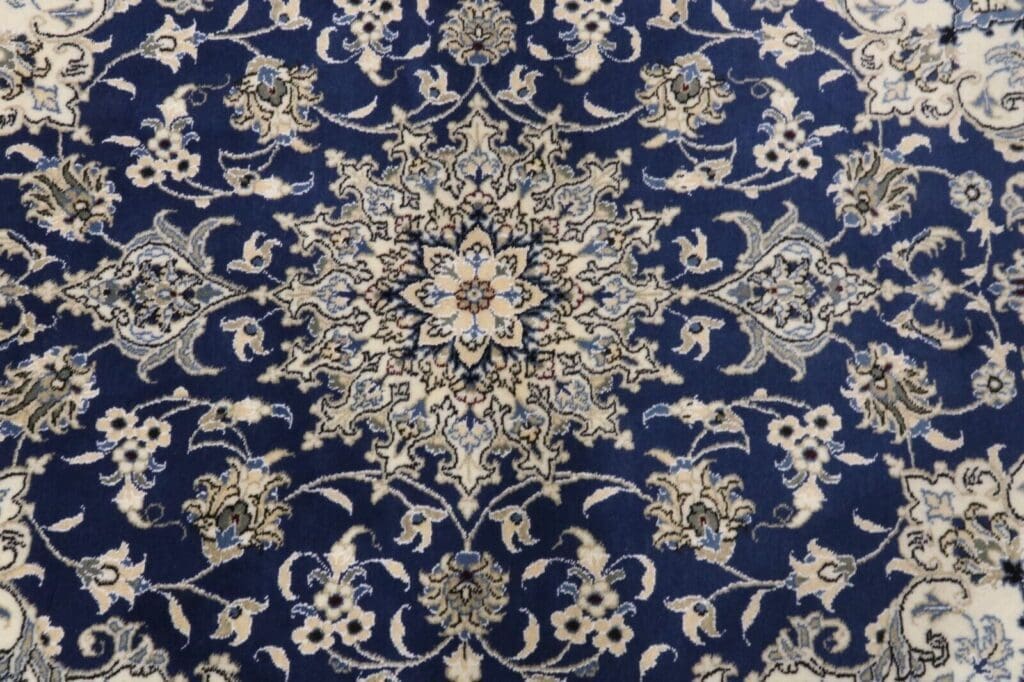
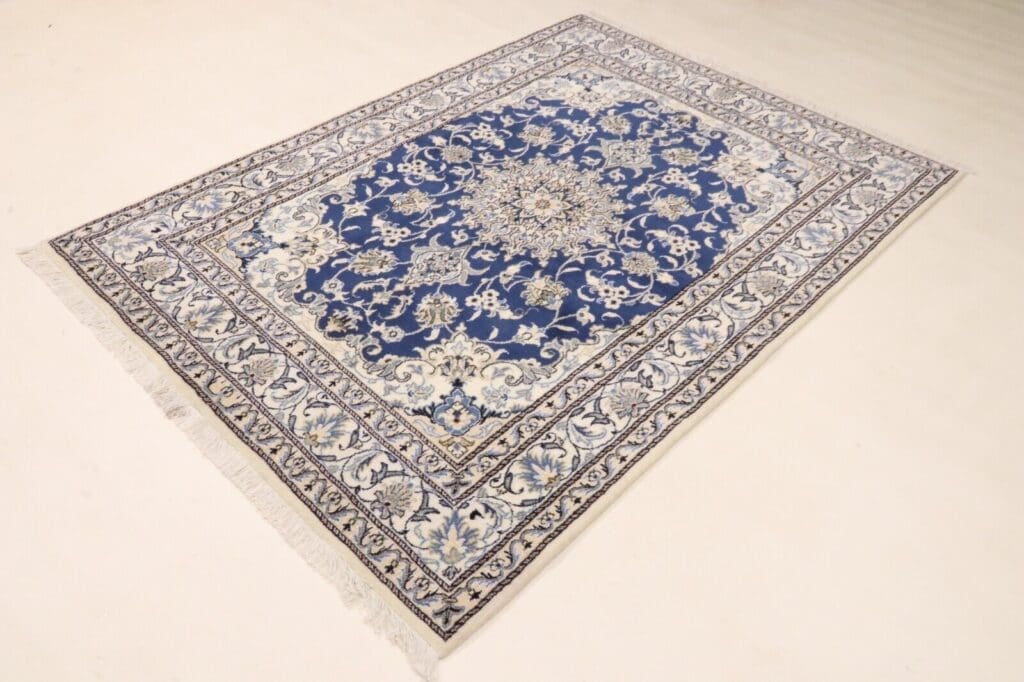
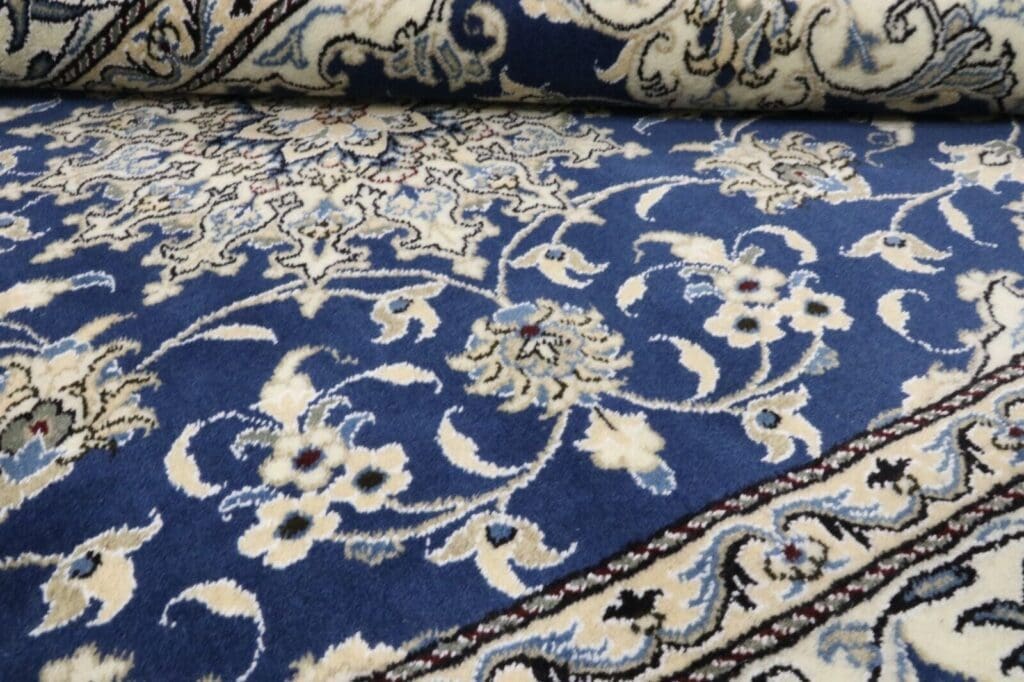
The colour scheme of this rug is blue. Its style is identified as traditional Oriental and Persian. Blue may serve as the main field colour, an accent within floral forms or a connecting tone between the field and the border. The source identifies blue as the colour scheme, but does not provide a full motif-by-motif inventory. The colour statement should therefore remain exactly that: a description of the overall palette.
Nain design traditions often include finely drawn floral elements, curling branches and carefully structured borders. Geometric organisation and medallion-like arrangements are also part of the wider Persian design vocabulary. These forms explain the regional background of Nain rugs. They should not be treated as a claim that every one of these elements appears in this particular rug unless the individual pattern has been described in those terms.
A Persian rug design is frequently built in layers. The central field may be organised through repetition or through a central arrangement, while the main border frames it and narrower borders create transitions at the edges. This hierarchy helps the eye read the whole composition. In a hand-knotted rug, the design is not printed on top of a finished surface; it is constructed through the placement of knots and the changing colours of the pile.
Fine patterning depends on the relationship between outline, open space and colour. In Nain work, small floral details can be arranged within symmetry or repeated movement so that the composition remains ordered rather than scattered. Blue can connect separate areas of a traditional Persian palette and can establish a calm visual continuity across the surface. The precise distribution of tones in this rug is not specified beyond the blue colour scheme.
The traditional Oriental and Persian style allows the rug to be considered alongside both classic and contemporary interiors. That is a stylistic classification, not a claim about a particular room. In a furnished space, the rug’s colour and ordered regional design can define an area without requiring the rest of the room to follow the same historical style. Its use in a living room, hallway or bedroom is consistent with the stated product information.
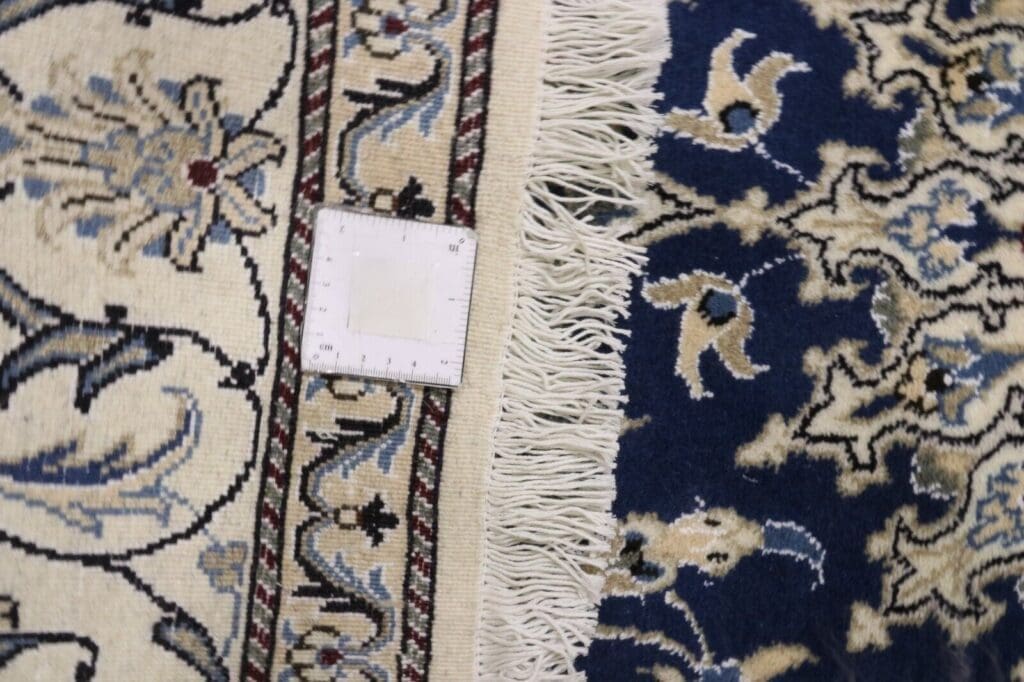
Knot density has a direct relationship with the possible definition of a pattern. The approximate density given for this rug is one of its technical characteristics, alongside the wool and silk pile and the cotton warp. A finely knotted surface can accommodate close contours and small changes in ornament. The visual design and the making process are therefore connected: the pattern is planned for the knotting, and the knotting brings the pattern into the textile surface.
The blue palette, the traditional Persian Oriental classification and the Nain origin together establish the design context of this rug. They describe its colour, regional language and stylistic placement without inventing a particular central motif, border arrangement or secondary colour. This distinction is important for a one-off rug: its documented characteristics should remain separate from the broader vocabulary of the weaving tradition.
Special Features
Several details distinguish this rug within its description. It is a Nain rug from Persia, hand-knotted with a pile of 90% virgin wool and 10% silk over a 100% cotton warp. Its knot density is given as approximately 300,000 knots per square metre. The combination brings together a named Iranian origin, natural fibres and a manual construction method.
The rug is new and in perfect condition. It is suitable for underfloor heating and is described as pet-friendly. These details make it appropriate for different residential settings, including living rooms, hallways and bedrooms. It is presented both as a functional floor covering and as a traditional Persian textile design.
Knot density is a technical way of describing how many knots are placed within a defined area. It can help explain why a design is capable of fine contouring, but it should not be confused with age, rarity or a guaranteed change in market value. Here it is one documented feature among several: the fibre composition, the cotton warp, the hand-knotting and the Nain origin all contribute to the rug’s overall identity.
FAQ
How should I care for my Nain Persian rug?
Vacuum the rug regularly and gently to remove loose dust from the pile. If a mark occurs, use a mild cleaning method and avoid aggressive cleaning products. A slightly damp cloth can be used carefully for spot treatment, but the rug should not be saturated. Professional cleaning is recommended when a more thorough treatment is needed, particularly because the pile combines virgin wool and silk. Proper care helps preserve the colours and structure of the hand-knotted surface.
Where is the best place to use this Nain Persian rug?
The rug can be used in a living room, hallway or bedroom. Its traditional Oriental and Persian style can be placed with classic furnishings or used as a contrasting textile element in a more contemporary interior. The product information describes it as suitable for underfloor heating and pet-friendly, so it can be considered for corresponding residential spaces. The final position should take account of the room layout, furniture and expected level of daily use.
How can the quality of an Oriental rug be assessed?
Knot density, fibre selection and workmanship are useful points of reference when assessing an Oriental rug. A high knot density can support clearer pattern definition, and this rug is listed at approximately 300,000 knots per square metre. Its pile consists of 90% virgin wool and 10% silk, with a 100% cotton warp. The hand-knotted construction is another central feature. These factors should be considered together rather than treating one number or one fibre as a complete assessment of quality.
To provide the best experiences, we use technologies like cookies to store and/or access device information. Consenting to these technologies will allow us to process data such as browsing behavior or unique IDs on this site. Not consenting or withdrawing consent, may adversely affect certain features and functions.
Functional Always active
The technical storage or access is strictly necessary for the legitimate purpose of enabling the use of a specific service explicitly requested by the subscriber or user, or for the sole purpose of carrying out the transmission of a communication over an electronic communications network.
Preferences
The technical storage or access is necessary for the legitimate purpose of storing preferences that are not requested by the subscriber or user.
Statistics
The technical storage or access that is used exclusively for statistical purposes.The technical storage or access that is used exclusively for anonymous statistical purposes. Without a subpoena, voluntary compliance on the part of your Internet Service Provider, or additional records from a third party, information stored or retrieved for this purpose alone cannot usually be used to identify you.
Marketing
The technical storage or access is required to create user profiles to send advertising, or to track the user on a website or across several websites for similar marketing purposes.
 SECURE PAYMENT
 SHIPPING PARTNERS