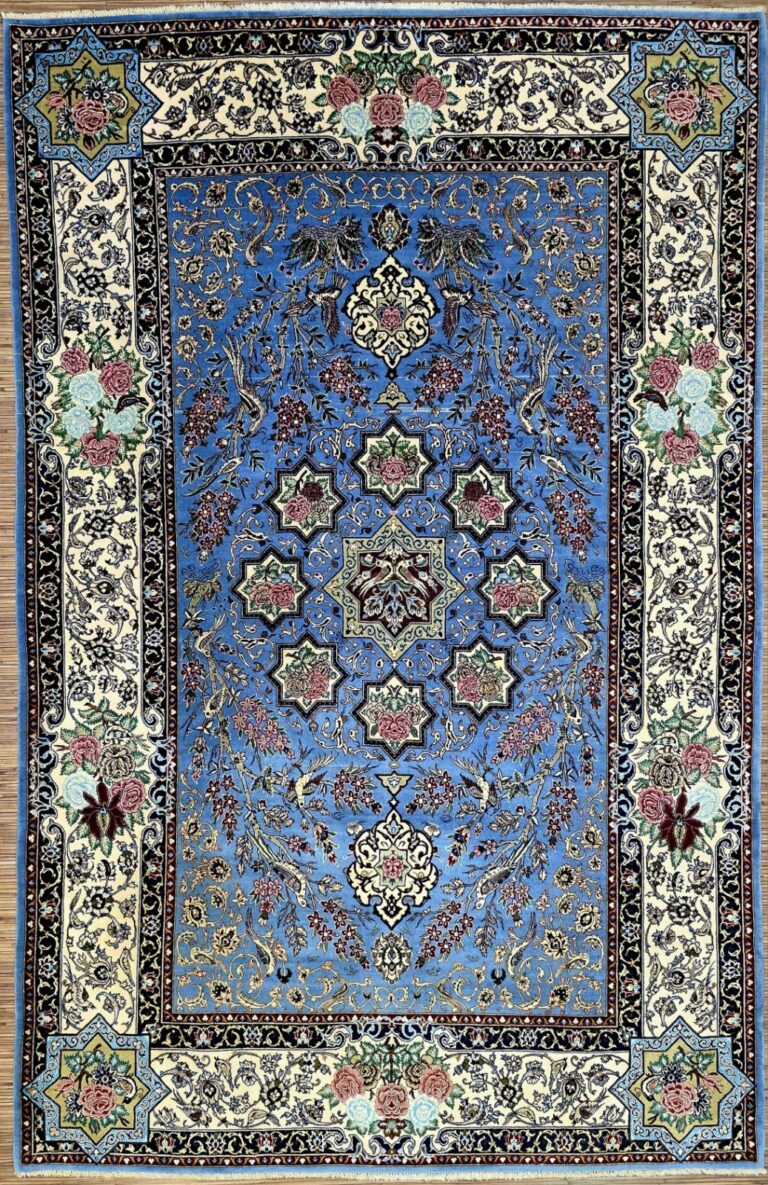
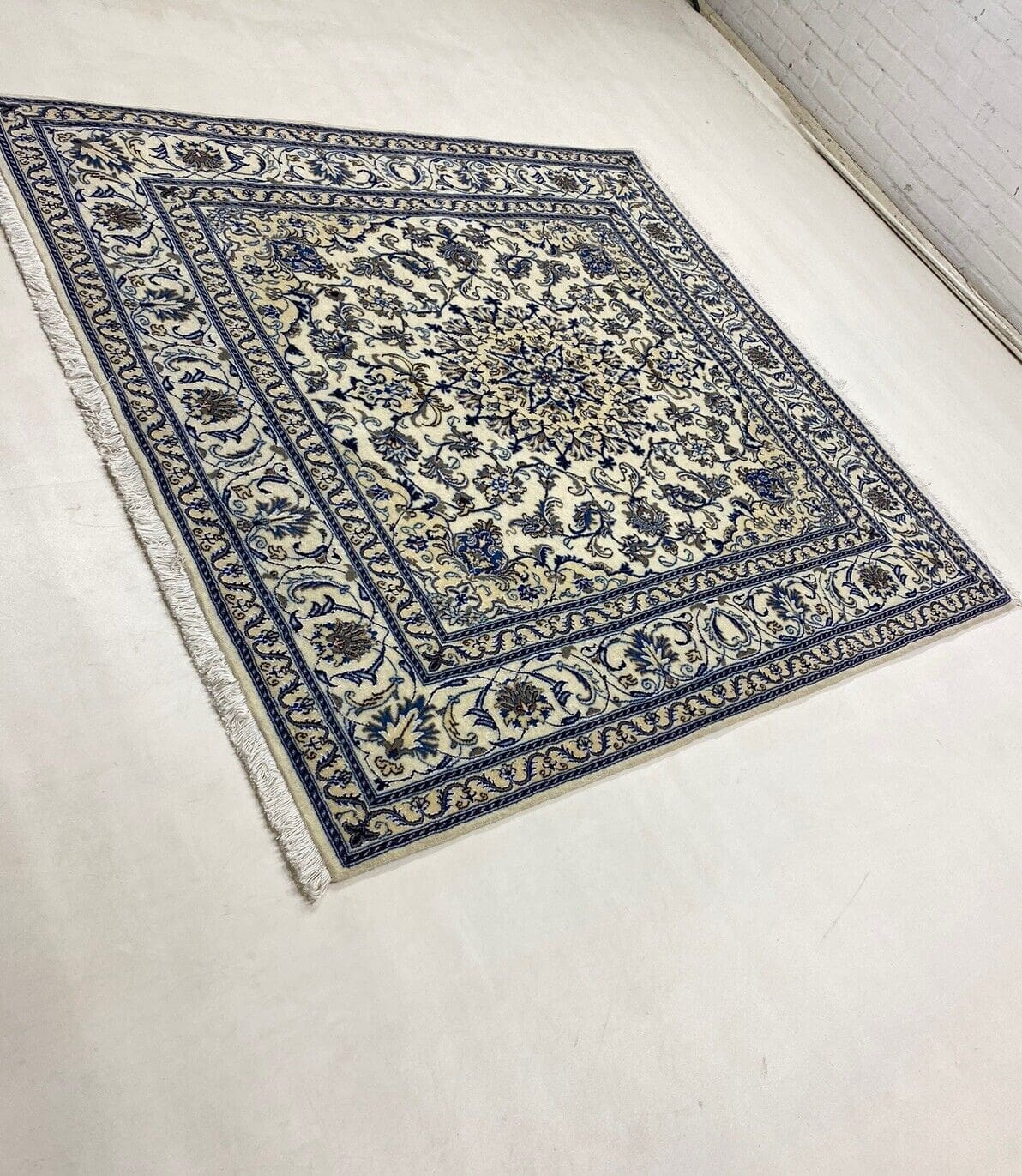
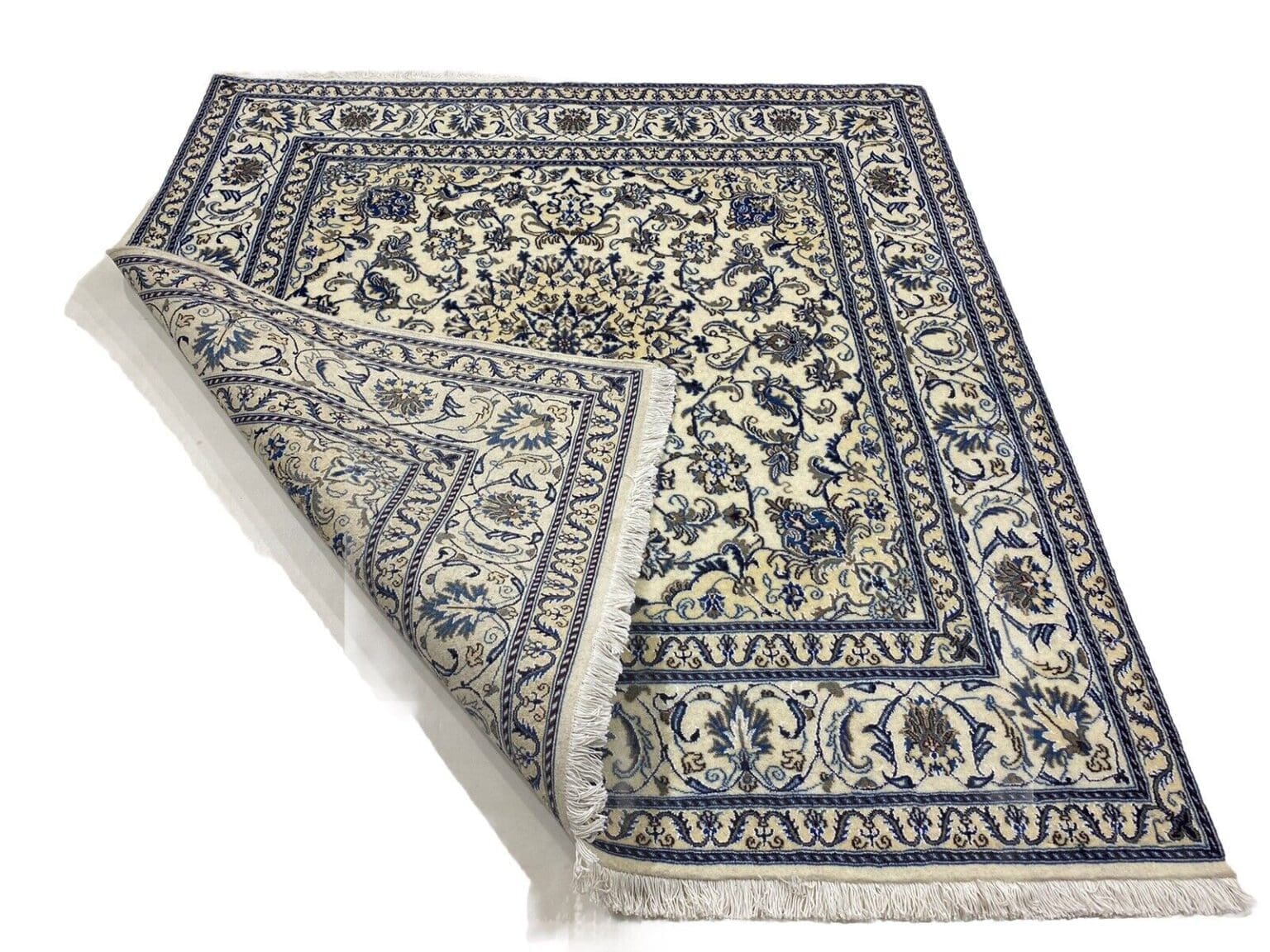
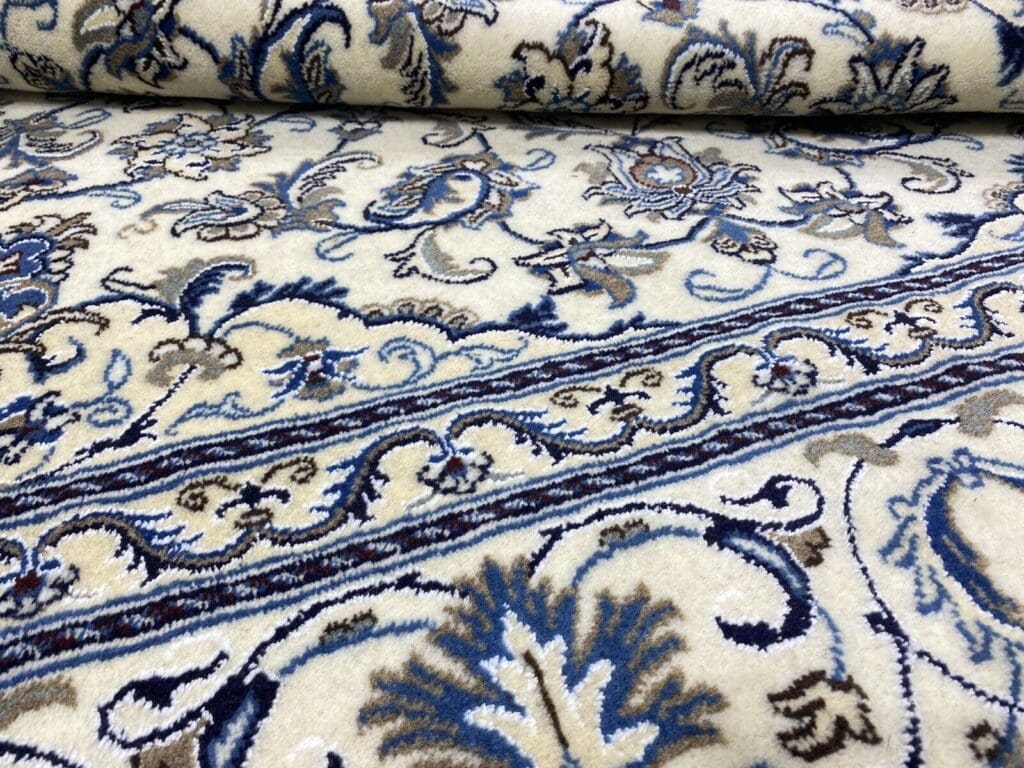
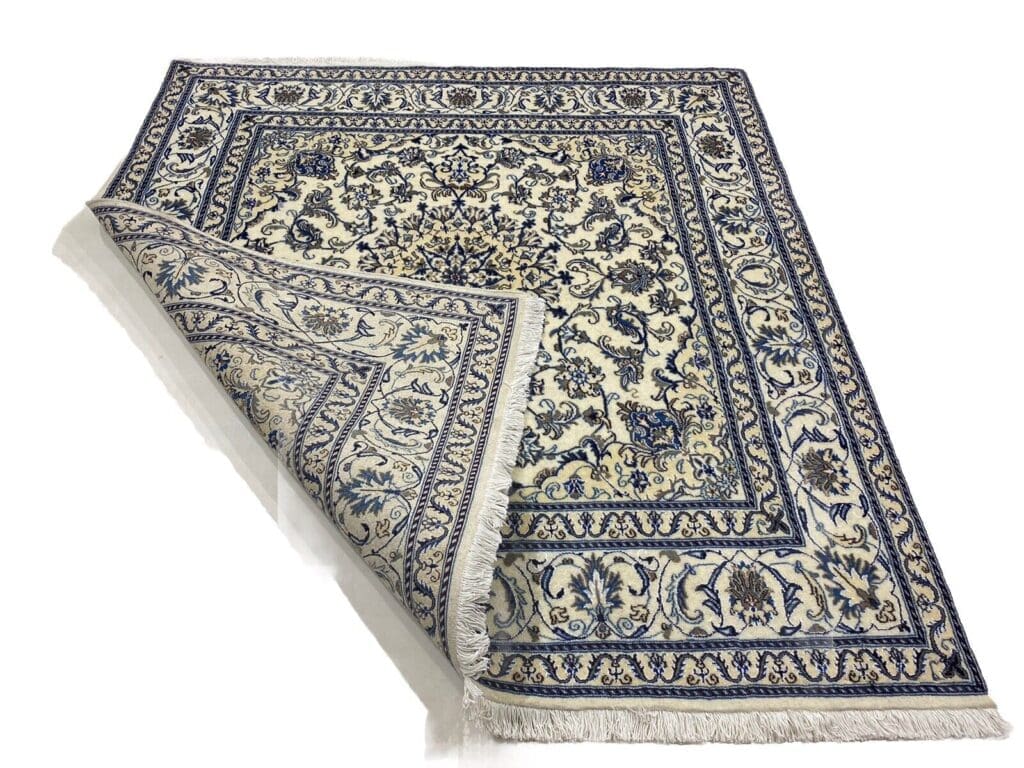
This Nain Persian rug is hand-knotted. Its pile is made from 90% virgin wool and 10% silk, while the warp is made from 100% cotton. Wool gives the surface a firm and resilient textile character; silk contributes a smoother touch and a finer visual presence. The cotton warp forms the structural basis beneath the pile. Each material therefore has a defined role in the construction rather than being used interchangeably.
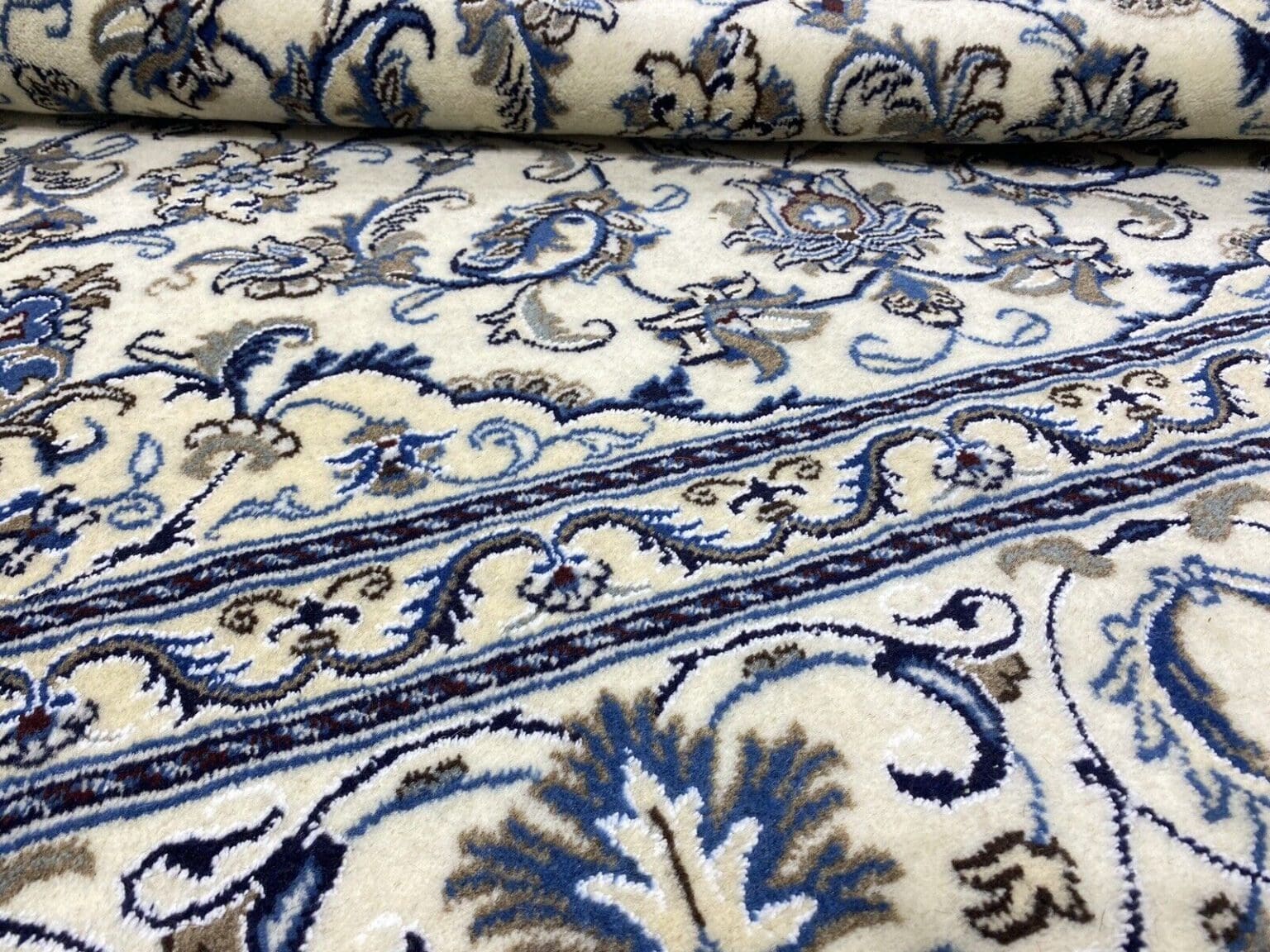
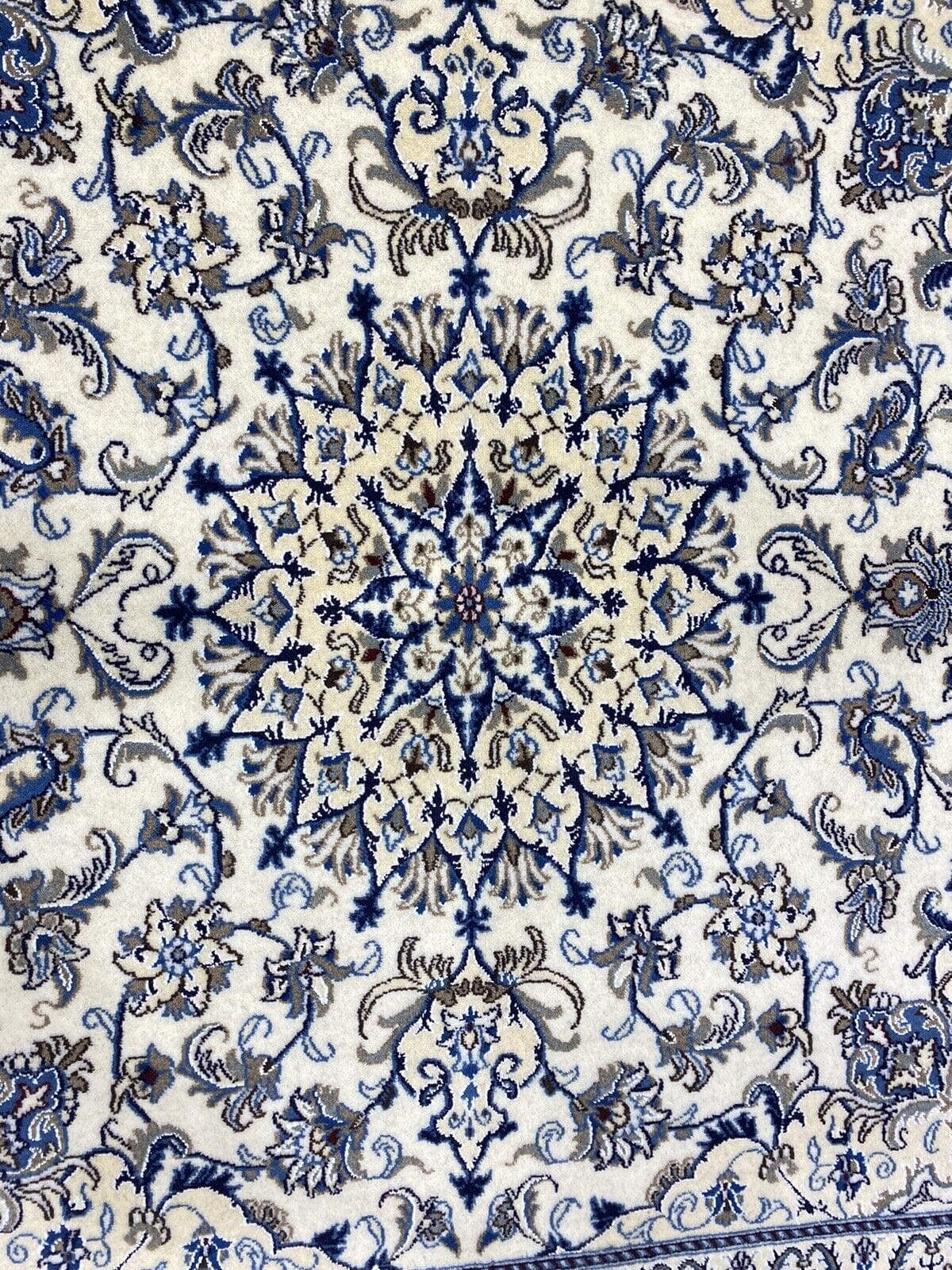
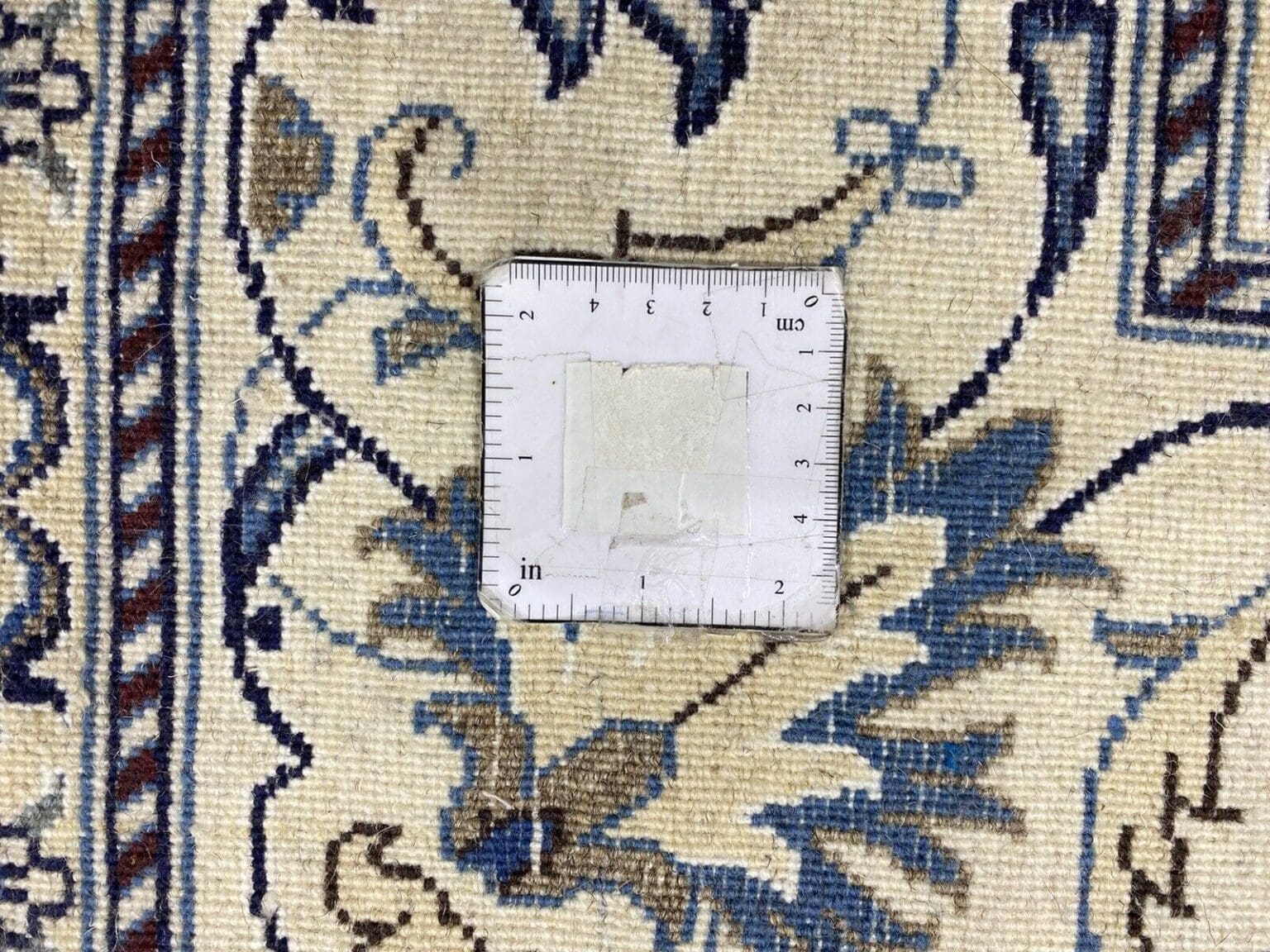
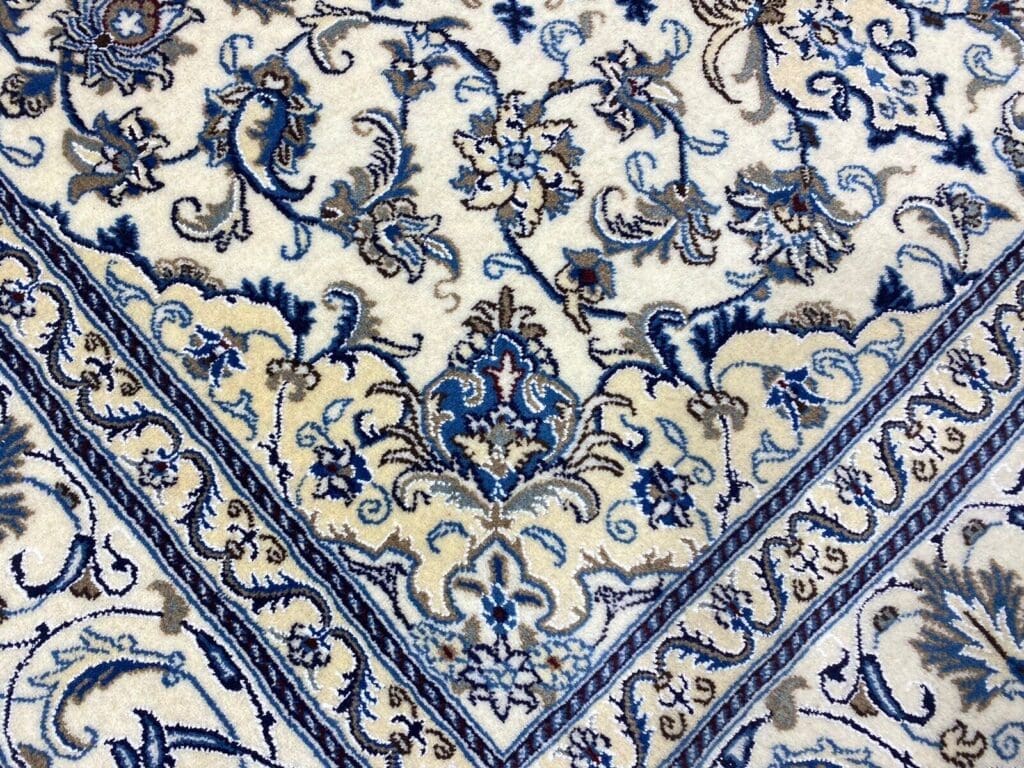
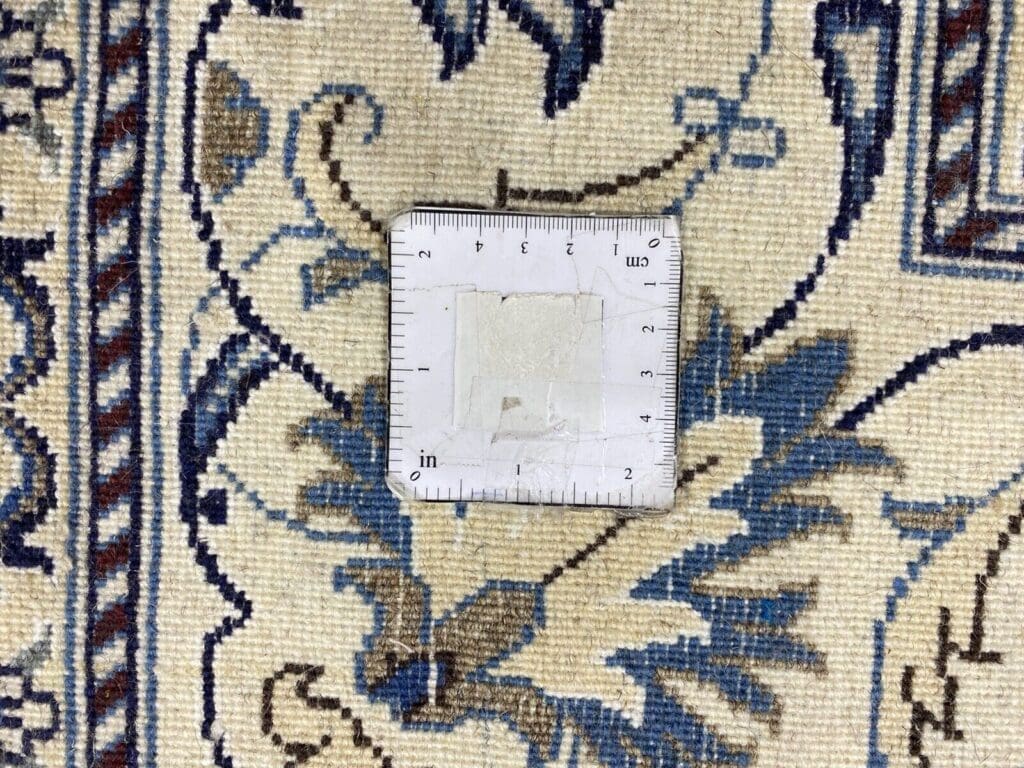
The rug has a knot density of approximately 300,000 knots per square metre. Dense knotting makes it possible to render narrow outlines, small floral elements and carefully controlled transitions in the design. With a hand-knotted rug, these details are built knot by knot as the weaver follows the pattern. The process is distinct from machine production, where the same design is mechanically reproduced across the surface.
Virgin wool contributes durability and a dependable pile structure. Silk adds refinement to the handle and can give selected parts of a pattern a discreet change in light. Together, the fibres suit a rug in which a detailed drawing is combined with a composed surface. The rug has a thickness of approximately 8 mm. It is described as new and in perfect condition.
Origin and Tradition
Nain is an Iranian weaving centre associated with finely worked Persian rugs. Its tradition is recognised for precise knotting, orderly compositions and carefully resolved ornament. Nain rugs are often identified with a balanced appearance in which the field, outlines and border are considered as parts of one design. Their character depends on the relationship between craftsmanship and pattern, not on material alone.
Iranian rug making developed through distinct regional traditions, each with its own vocabulary of motifs and methods. A Nain rug belongs to this Persian tradition while retaining its own regional identity. Workshops draw on established pattern structures and interpret them through the local approach to drawing, colour and knotting. Similar floral ideas may therefore appear in Nain, Isfahan or other Iranian centres without making the rugs identical.
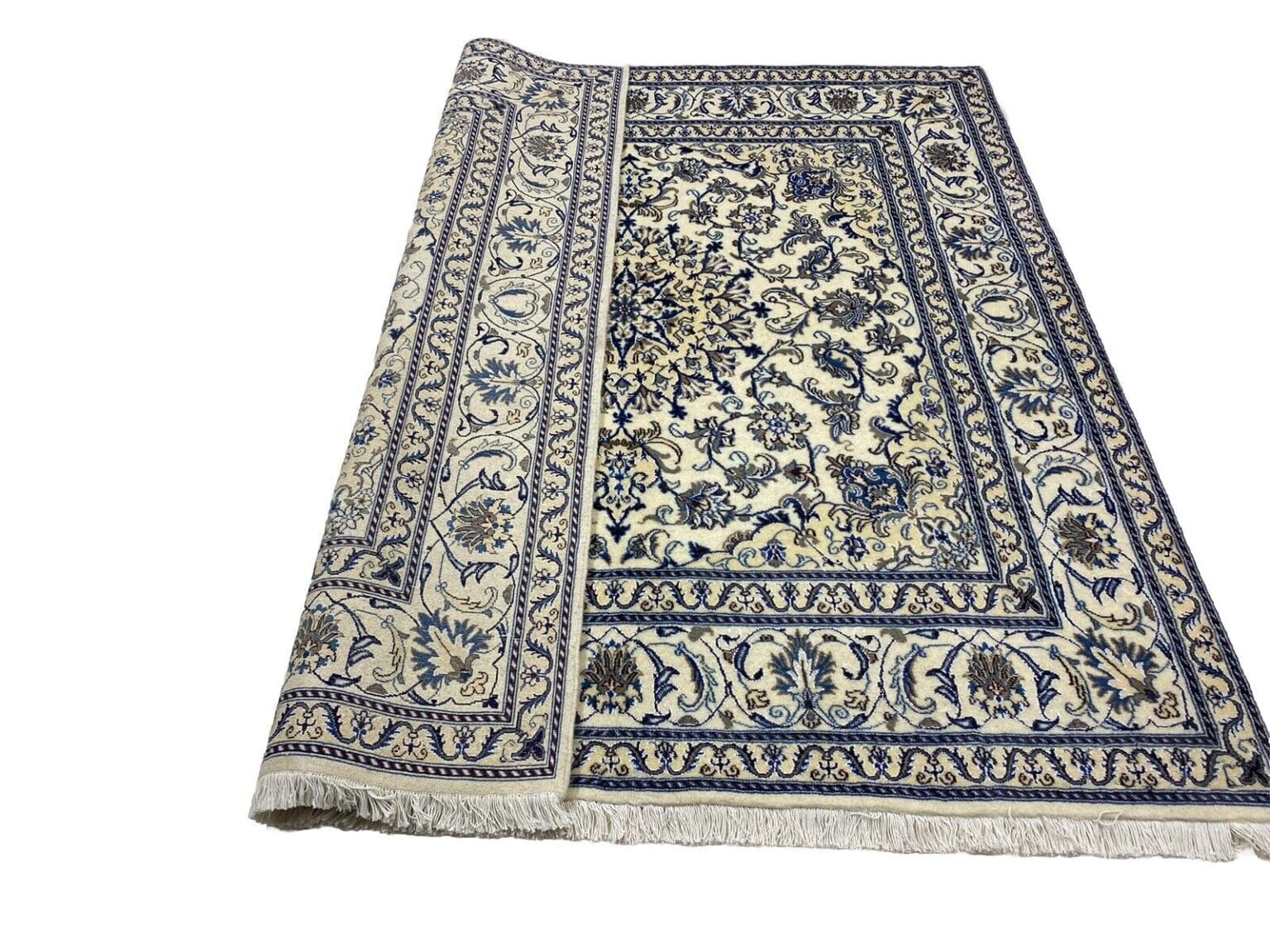
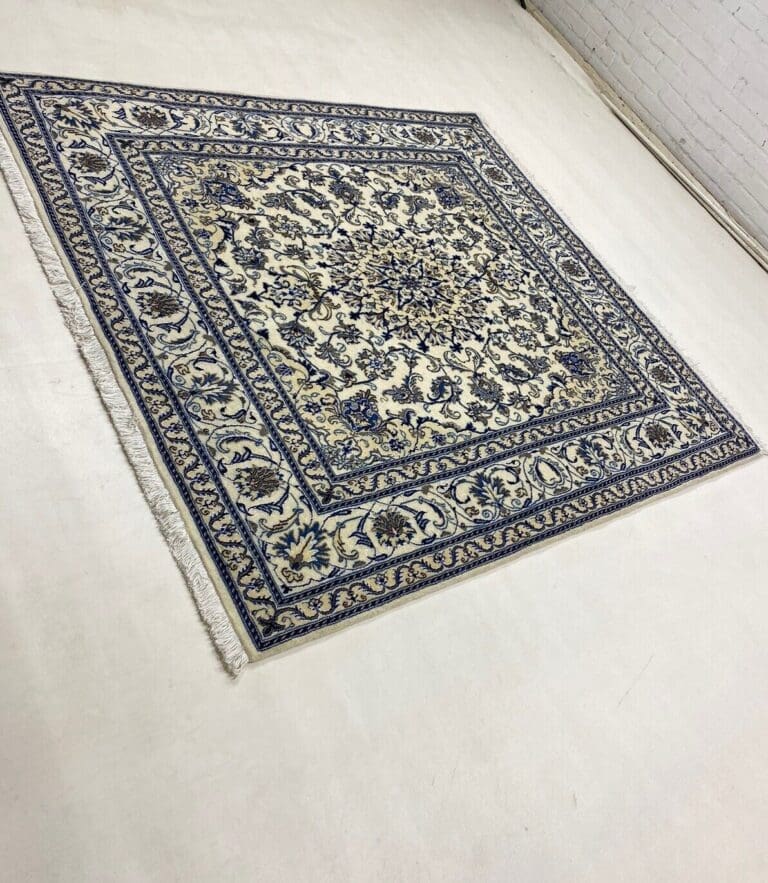
A well-organised design is an important part of the Nain tradition. The composition may be arranged around a central field, framed by one or more borders. The weaver must keep spacing, symmetry and contour under control while translating the drawn design into knots. This requires practical experience as well as a command of the materials. The pattern is not simply placed on top of the rug; it is formed together with the woven foundation.
Persian rugs also carry a cultural tradition in which textile work serves both practical and decorative purposes. Wool, silk and cotton each support a different stage of the process. The warp anchors the structure, the pile creates the usable surface, and knotting turns the selected materials into a durable patterned textile. In a hand-knotted Nain rug, regional knowledge is therefore visible in both the construction and the arrangement of the ornament.
Other Persian centres provide useful points of comparison. Isfahan rugs are often associated with elaborate and colour-rich designs, while Tabriz is known for varied compositions and fine workmanship. Sarough and Kashan likewise have established traditions and recognisable pattern languages. These comparisons help explain the wider Persian context, but they do not alter the Nain origin of this rug.
Design and Pattern
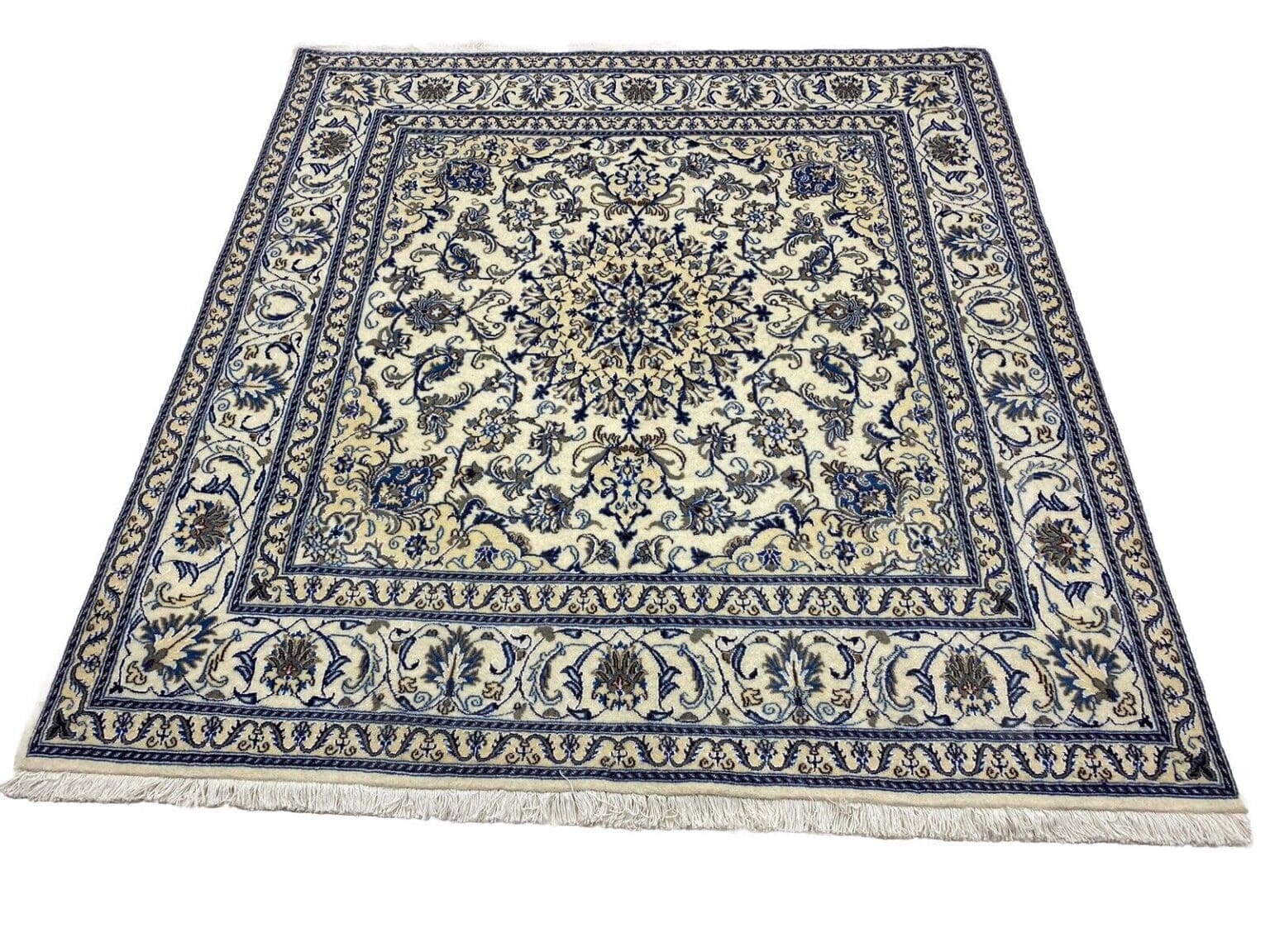
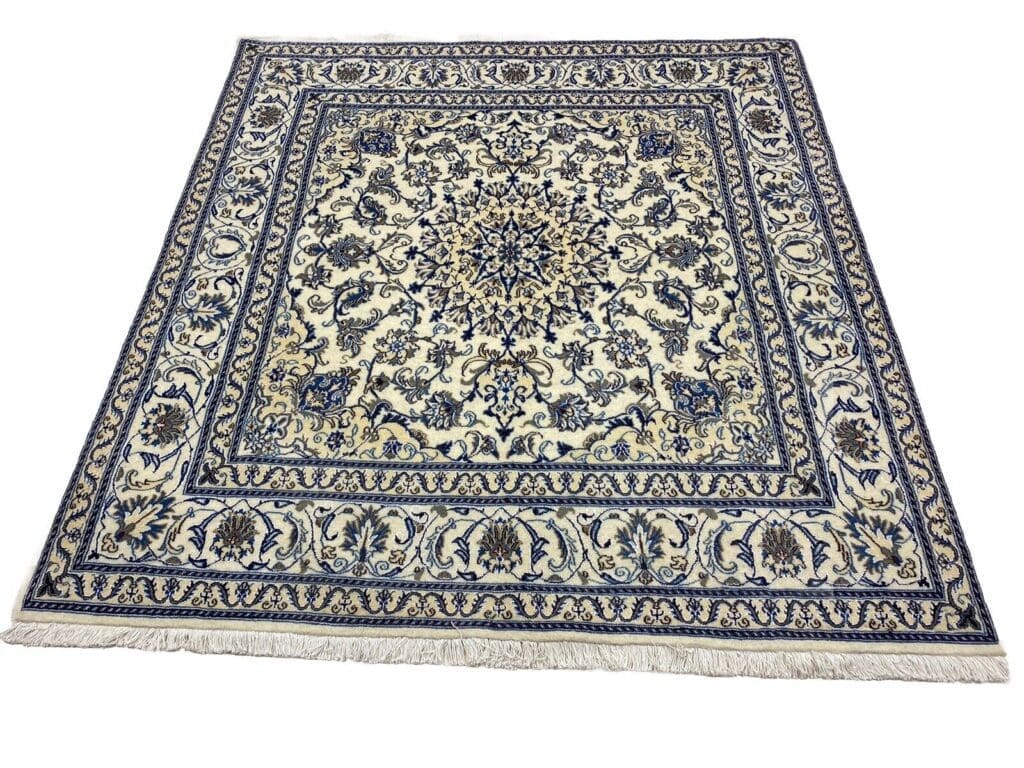
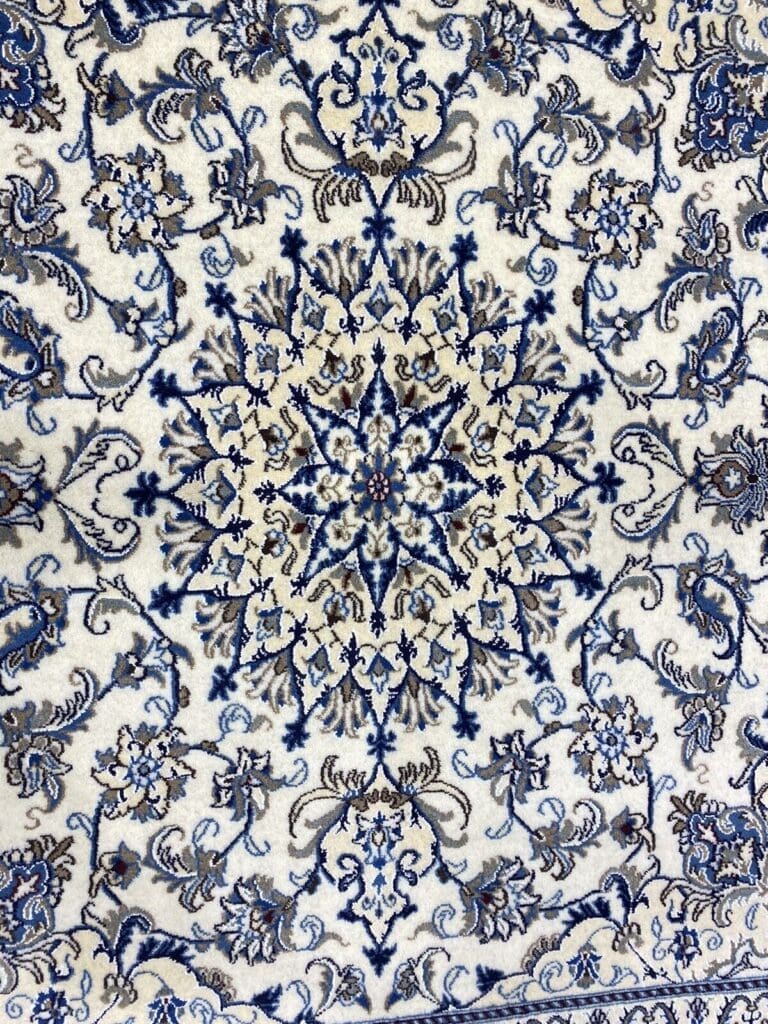
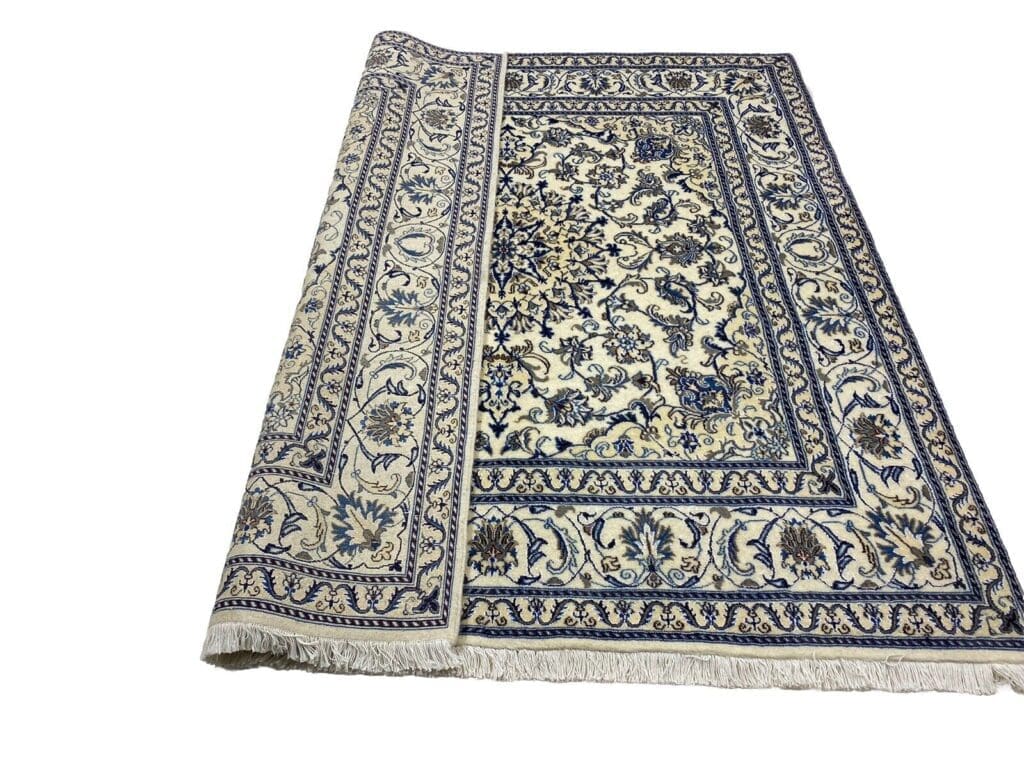
The pattern is described as traditional Oriental Persian. Nain designs frequently use elegant floral ornament and finely divided lines. Blossoms, leaves, stems and curling branches may be arranged into a measured repeat or brought together within a central composition. Their forms are stylised rather than copied directly from nature, allowing them to remain legible when translated into a woven textile.
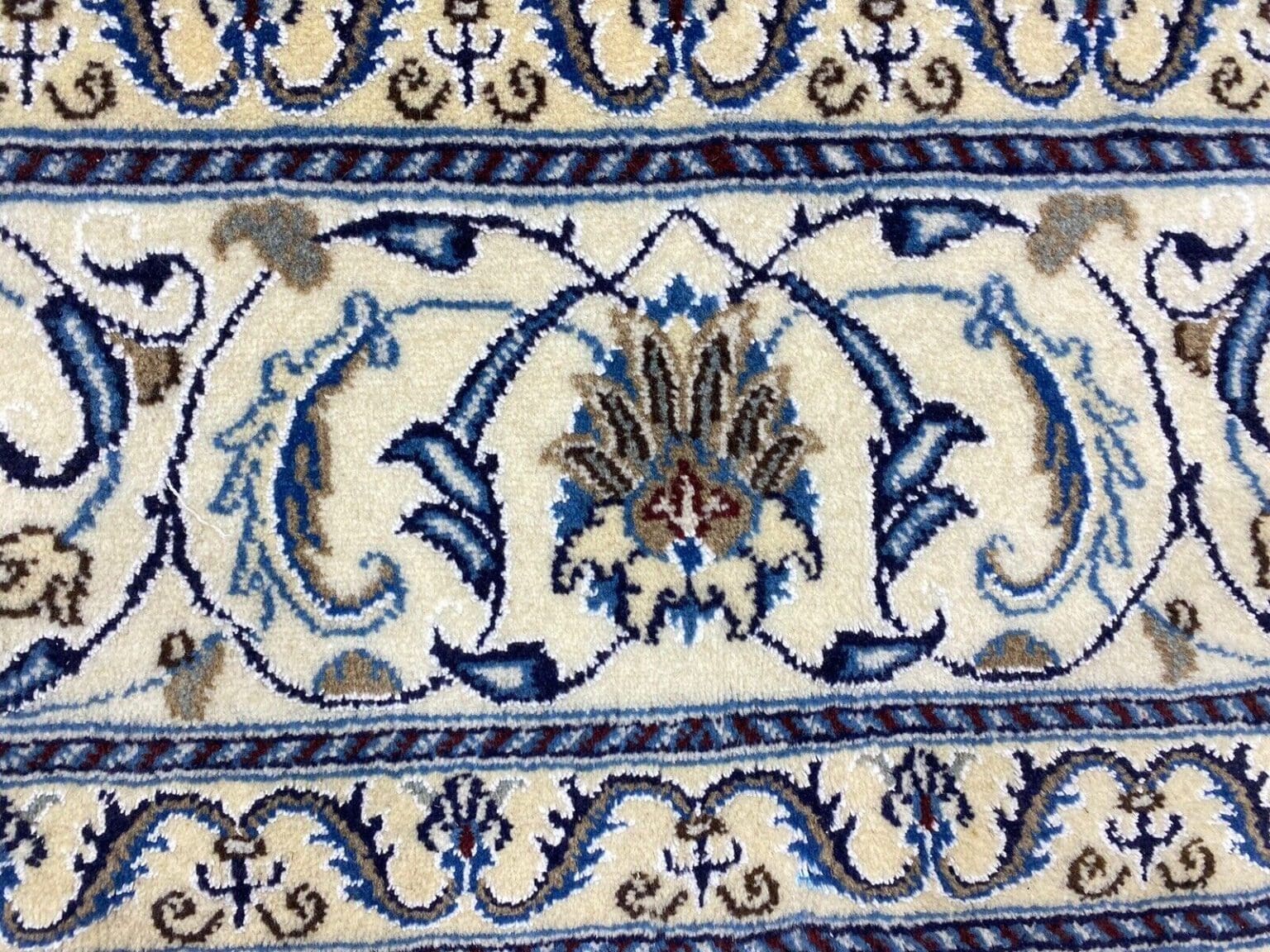
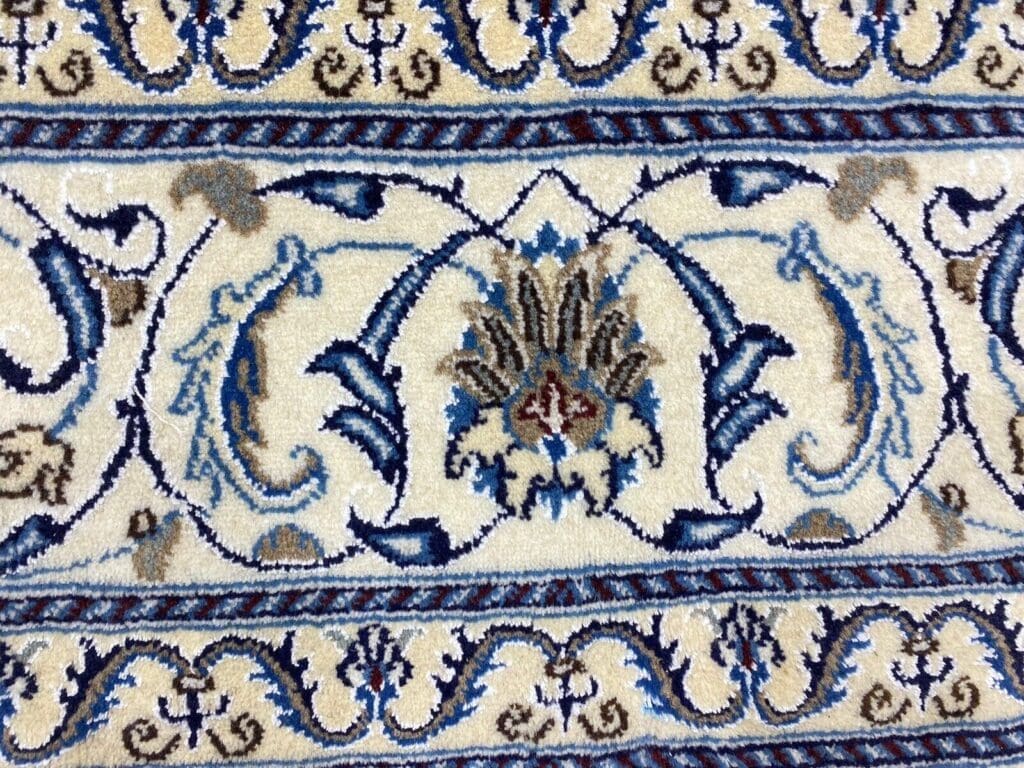
Many Nain layouts create a relationship between an interior field and its surrounding border. The field carries the principal drawing, while the border contains and frames the composition. Some designs use a medallion as a visual centre; others rely on an all-over floral arrangement. The regional style provides a framework for these solutions, but it does not require every Nain rug to use one identical layout.
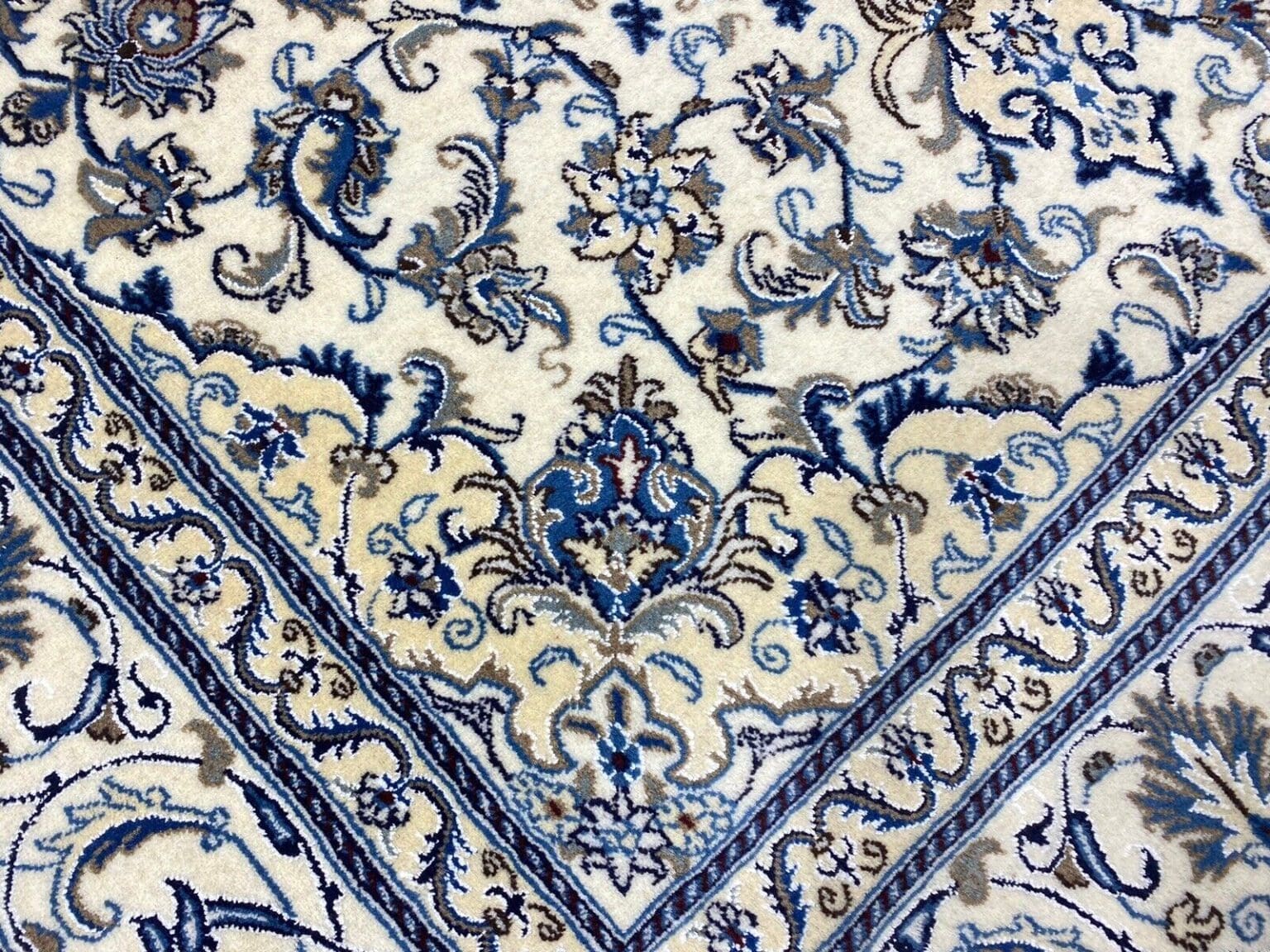
Fine ornament depends on accurate contours and carefully spaced details. A high knot density supports this kind of work by allowing small motifs and narrow colour changes to be represented with greater control. In a floral composition, this precision helps separate petals, leaves and tendrils while keeping them connected within the larger design. The result is a pattern that can be read from both its overall structure and its smaller elements.
Nain rugs are often linked with gentle, restrained colour palettes. Light grounds, softened accents and discreet contrasts can give the ornament a calm and orderly presence. Colour also has a structural function: the difference between ground and motif makes the design easier to follow, while related tones create continuity between neighbouring forms. This measured use of colour is one reason floral Nain compositions are frequently perceived as composed rather than visually aggressive.
Floral Persian ornament has a long history and has been adapted by many weaving centres. In rugs, botanical references become abstract forms that can be repeated, balanced and bordered. The motifs are part of a textile language rather than a literal botanical illustration. In Nain work, this language is combined with controlled hand-knotting, so symmetry, detail and surface texture contribute equally to the finished design.
Special Features
This rug is a one-off and is described as new and in perfect condition. It is suitable for use over underfloor heating and is stated to be pet-friendly. These practical details accompany its hand-knotted construction and traditional Persian design. Suggested settings include living rooms, dining rooms, hallways, offices and reception areas. The best placement still depends on the level of use and on appropriate care of the textile.
Routine care can be carried out by vacuuming without a brush attachment. Fresh marks should be dabbed with a damp cloth rather than rubbed vigorously. Professional cleaning at suitable intervals is recommended for a hand-knotted rug, since specialised treatment can address the pile and foundation appropriately. Prolonged direct sunlight should be avoided in order to reduce the risk of uneven colour change.
FAQ
How should I care for the Nain Persian rug?
Vacuum it regularly without using a brush attachment. If a spill occurs, dab it promptly with a damp cloth and avoid hard rubbing or unsuitable cleaning products. Professional cleaning at longer intervals is advisable to maintain the textile properly.
Where can the rug be used?
It can be placed in a living room, dining room, hallway, office or reception area. The rug is suitable for underfloor heating and is described as pet-friendly. Avoiding strong direct sunlight helps preserve an even appearance of the colours.
What distinguishes Nain Persian rugs?
Nain rugs are associated with fine knotting, detailed traditional ornament and carefully selected materials. Floral designs, balanced compositions and gentle colour relationships are common features of the regional style. In this rug, the hand-knotted construction combines virgin wool, silk and a cotton warp.
To provide the best experiences, we use technologies like cookies to store and/or access device information. Consenting to these technologies will allow us to process data such as browsing behavior or unique IDs on this site. Not consenting or withdrawing consent, may adversely affect certain features and functions.
Functional Always active
The technical storage or access is strictly necessary for the legitimate purpose of enabling the use of a specific service explicitly requested by the subscriber or user, or for the sole purpose of carrying out the transmission of a communication over an electronic communications network.
Preferences
The technical storage or access is necessary for the legitimate purpose of storing preferences that are not requested by the subscriber or user.
Statistics
The technical storage or access that is used exclusively for statistical purposes.The technical storage or access that is used exclusively for anonymous statistical purposes. Without a subpoena, voluntary compliance on the part of your Internet Service Provider, or additional records from a third party, information stored or retrieved for this purpose alone cannot usually be used to identify you.
Marketing
The technical storage or access is required to create user profiles to send advertising, or to track the user on a website or across several websites for similar marketing purposes.

 SECURE PAYMENT
 SHIPPING PARTNERS