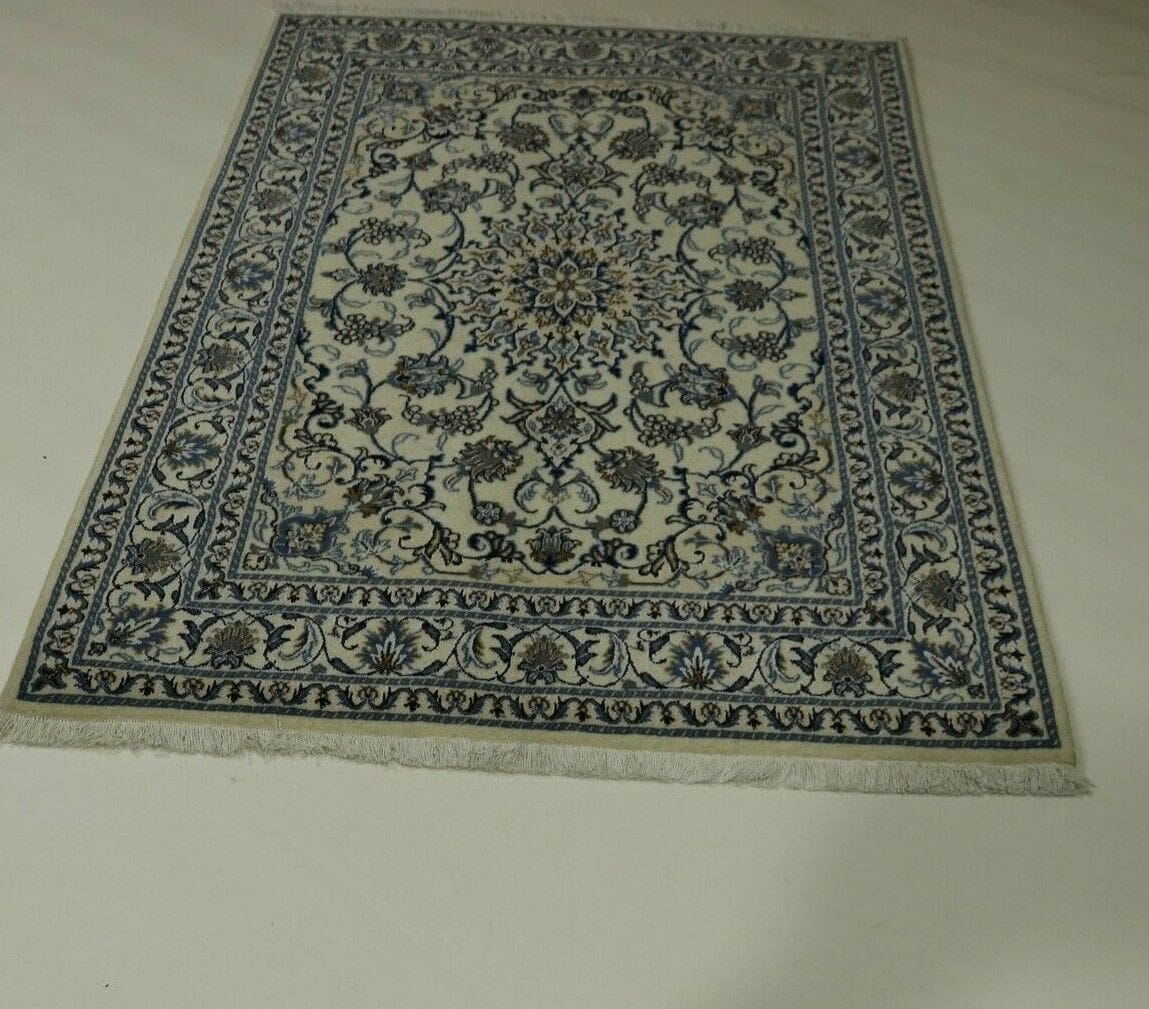
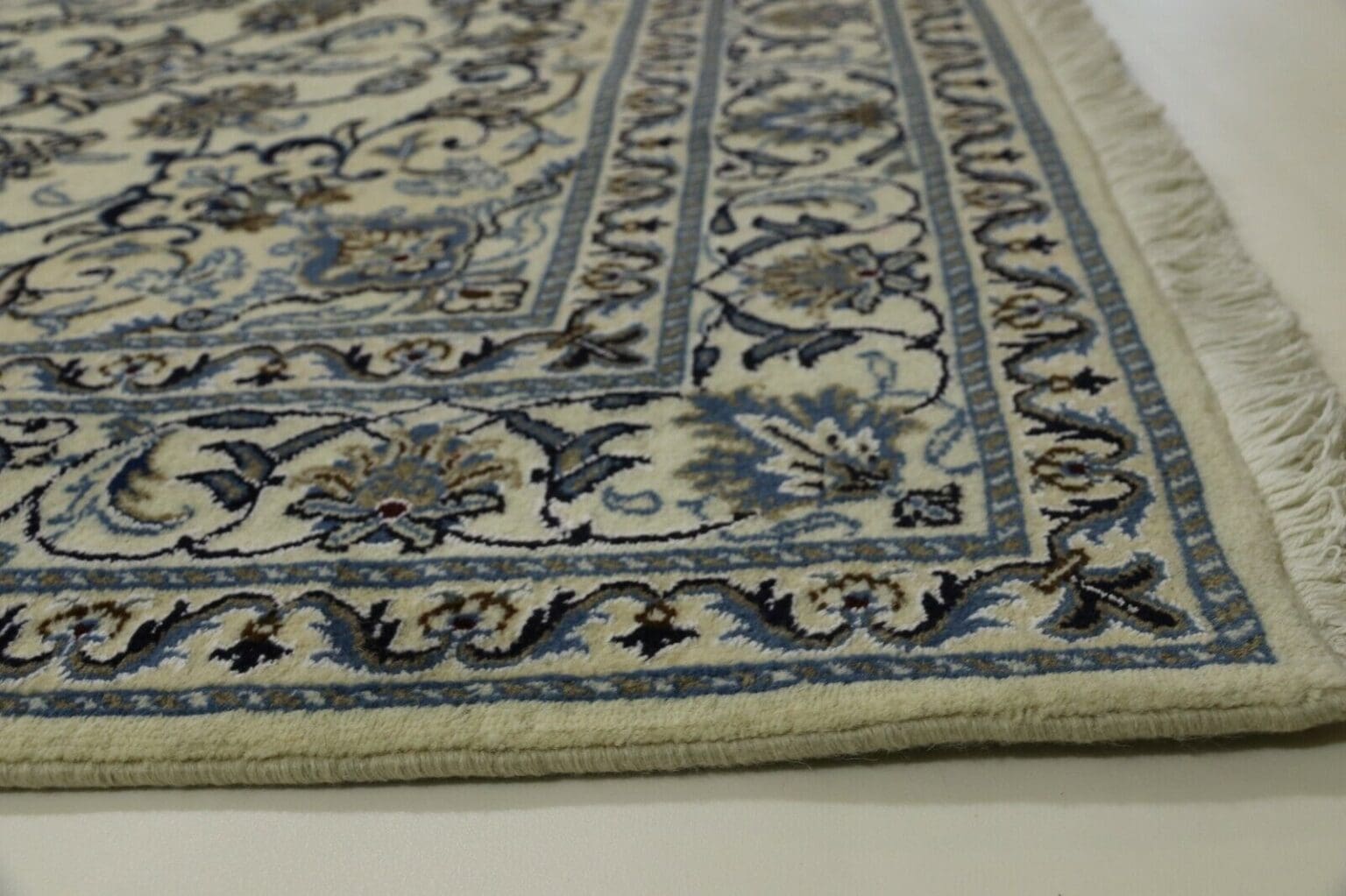
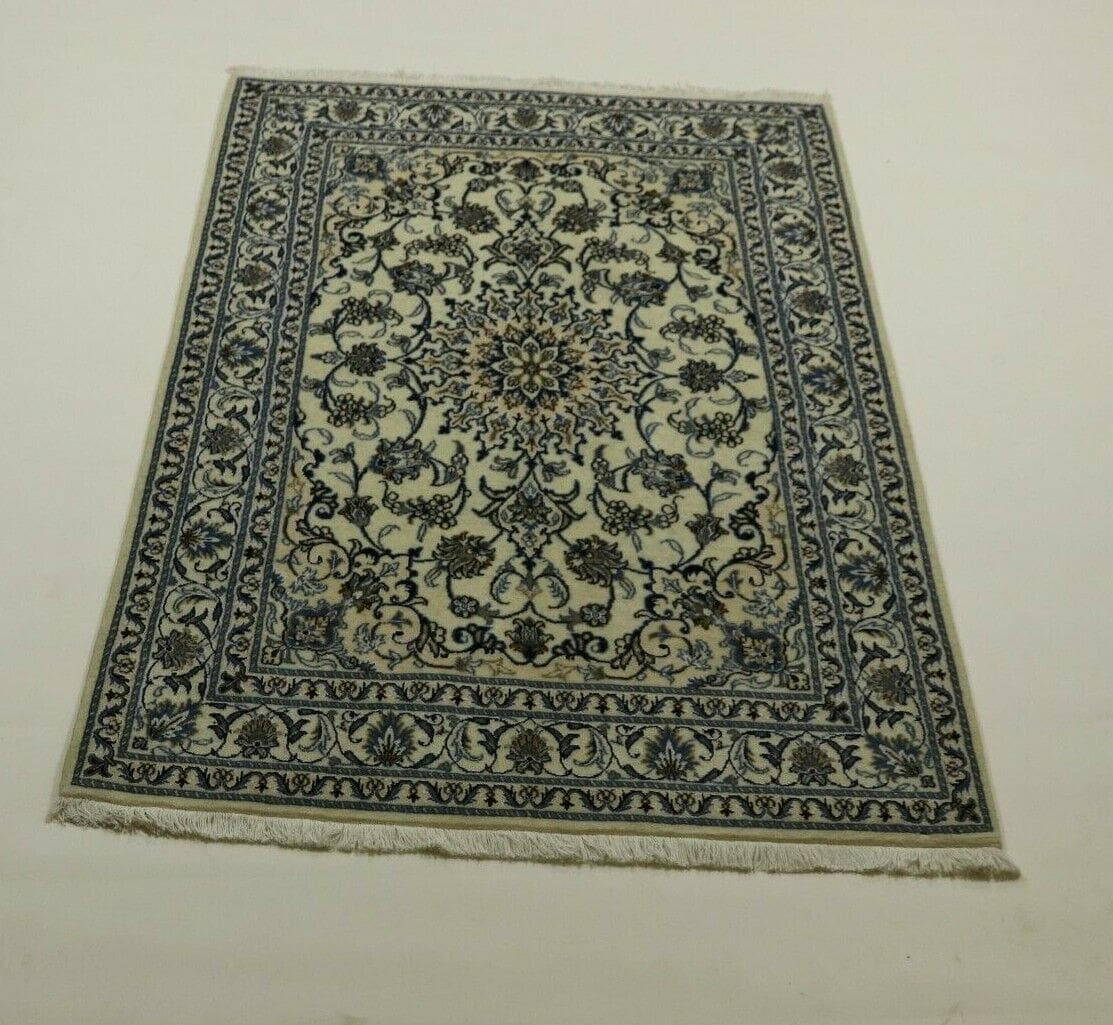
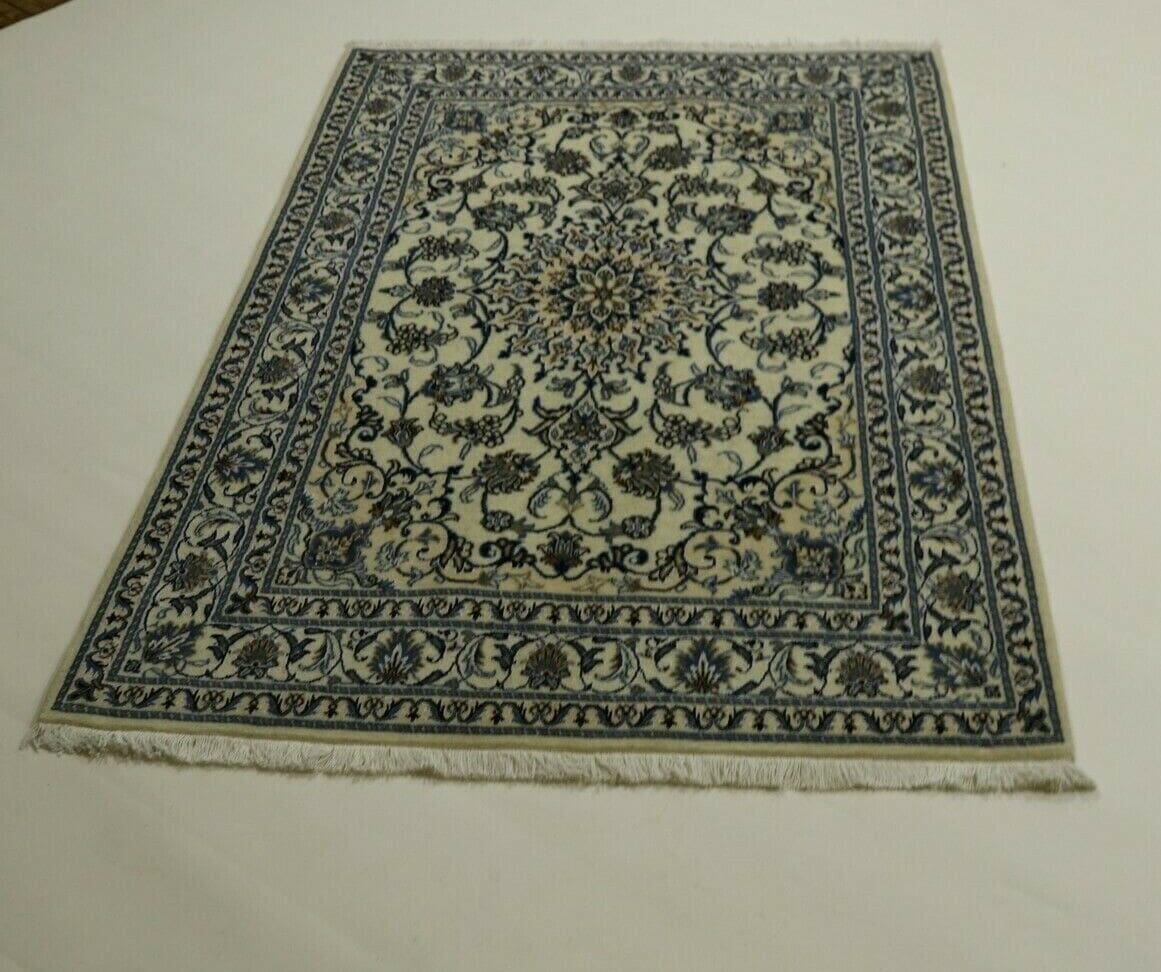
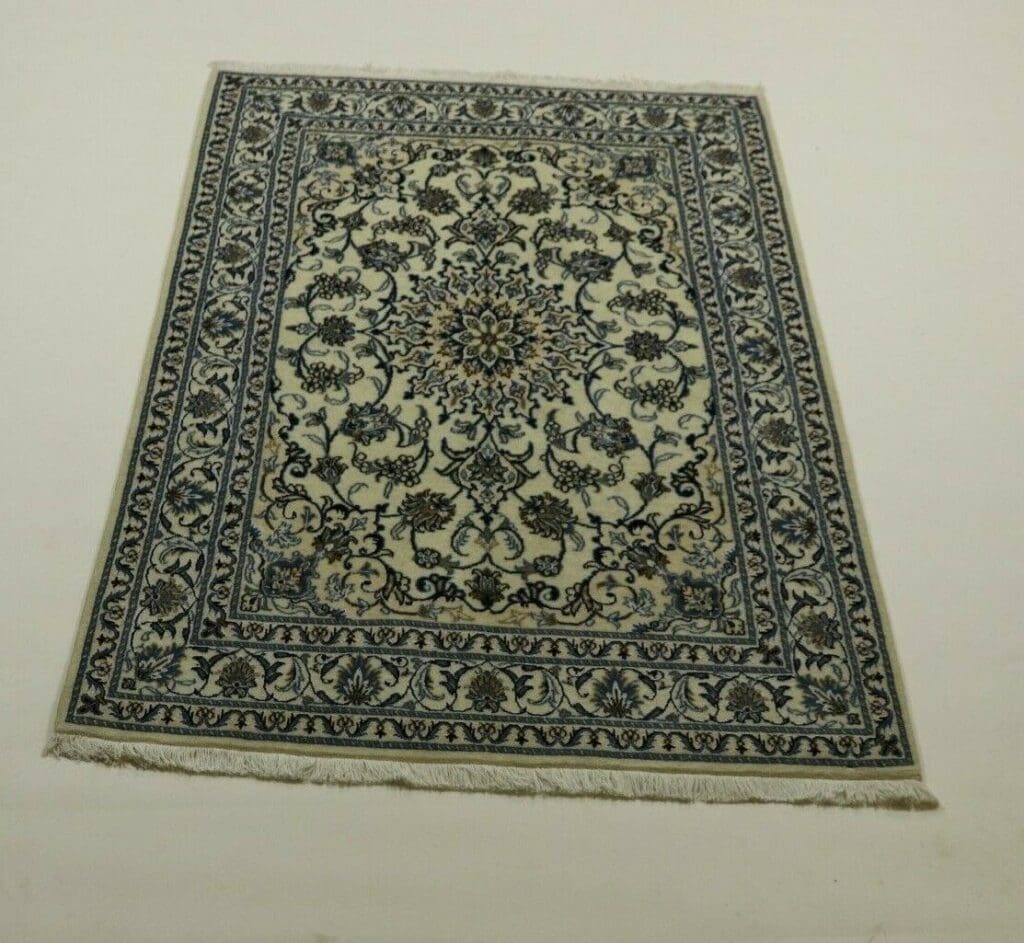
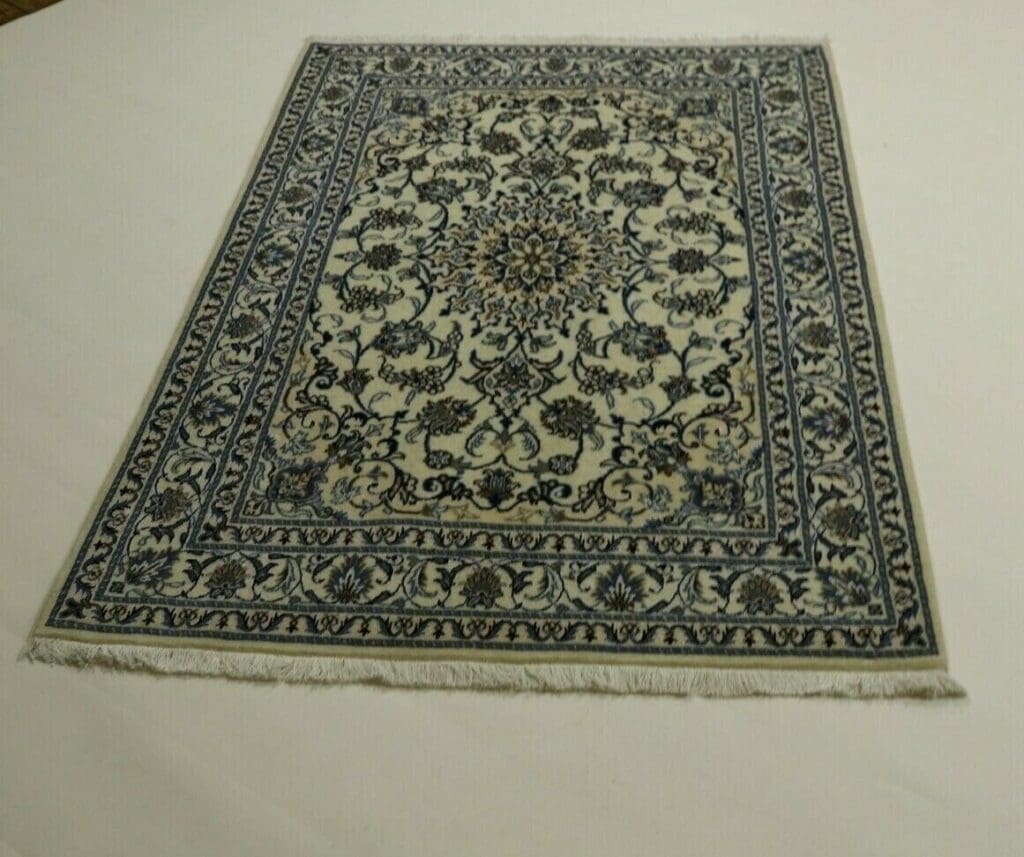
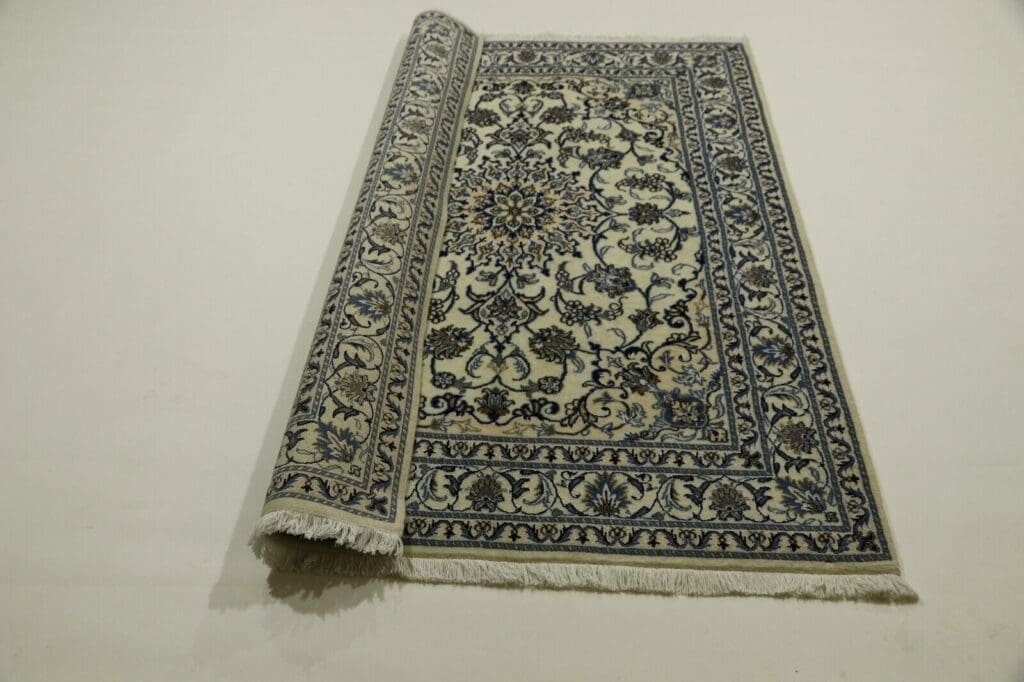
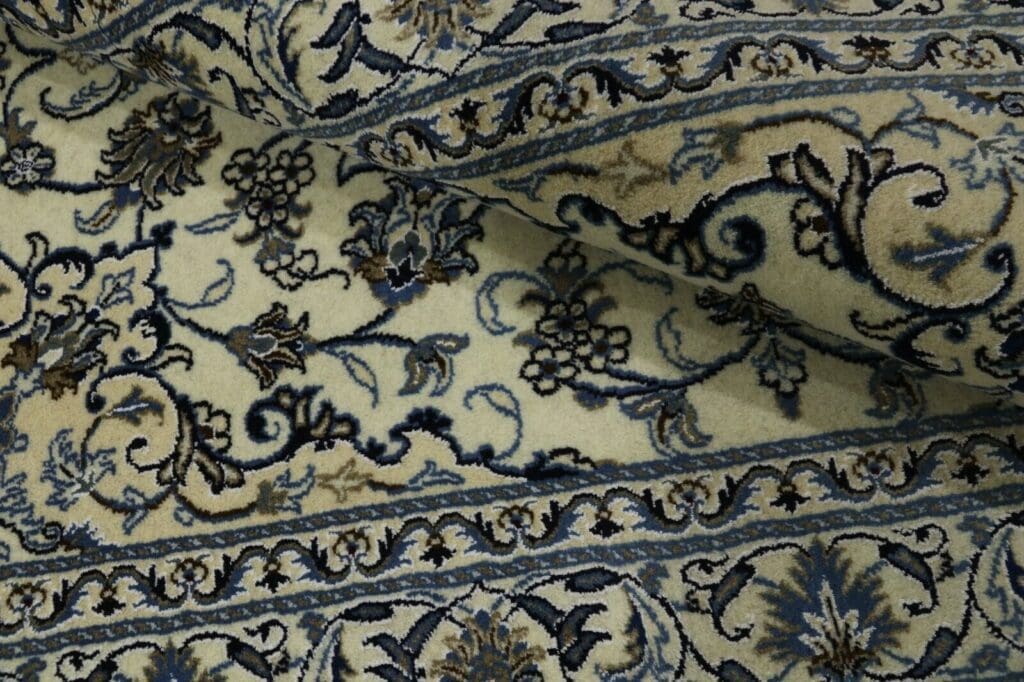
This Nain Persian rug is hand-knotted and made from 90% virgin wool and 10% silk. Virgin wool accounts for the main part of the rug and gives the surface the warmth, resilience, and pleasantly soft handle associated with the fibre. Wool has long been used in hand-knotted rugs because it combines a durable surface with comfortable use underfoot. Here, it is paired with silk so that the practical character of wool and the refined appearance of detailed ornament can work together.
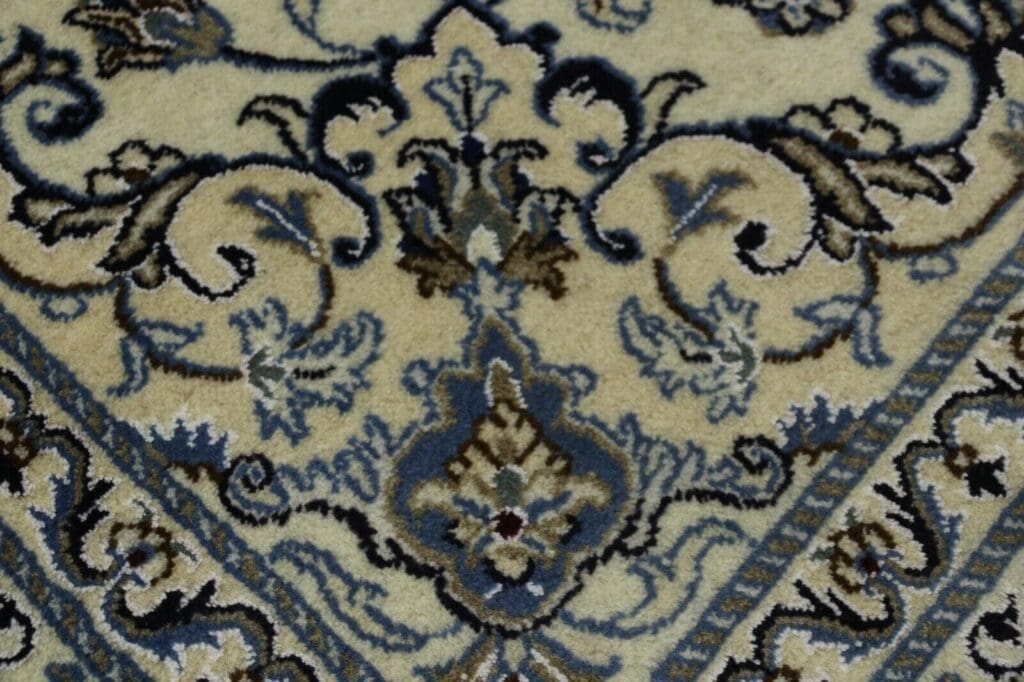
Silk is used in this rug for fine patterns and details. Its smooth fibre reflects light differently from wool and can create a subtle sheen across the design. Individual details may therefore appear differently as the surrounding light changes. The combination is not merely a statement of fibre content: it contributes directly to the way the pattern is drawn and to the contrast between the more restrained wool surface and the silk accents.
Hand-knotting builds the rug knot by knot on a loom. Each knot is made by hand, after which the structure is compacted, the surface is arranged, and the outlines of the design are worked into a coherent whole. This process requires patience and close control of the material, the drawing, and the transitions between motifs. It also makes each piece an individual work rather than a mechanically repeated item from a uniform production run.
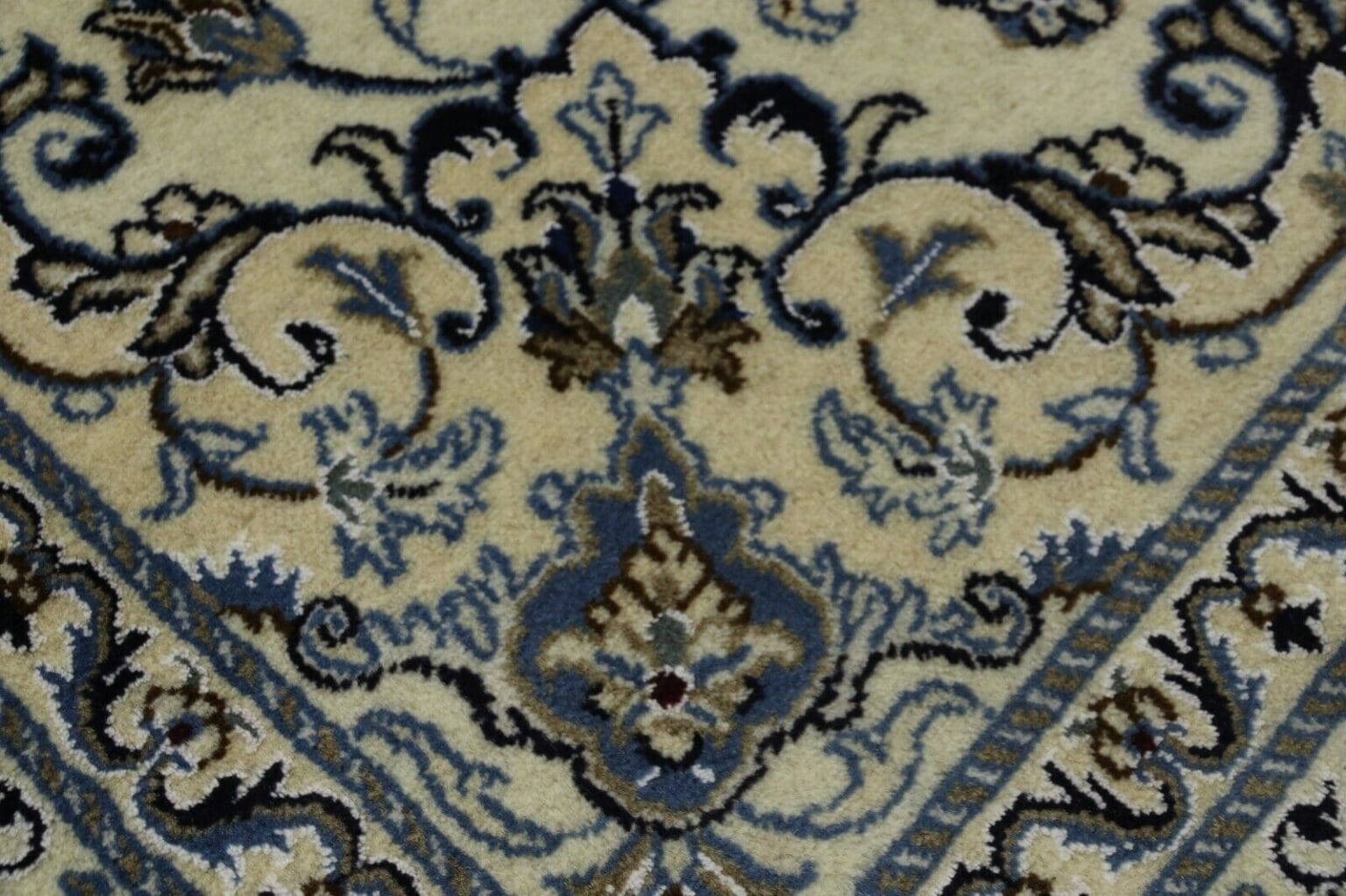
The listed density of approximately 300,000 knots per square metre represents a finely worked construction. A dense knot structure allows small lines, floral forms, and delicate changes within the drawing to be rendered with definition. At the same time, the character of handwork remains part of the rug: it is made as a one-off piece, not as identical series merchandise. The rug is described as new.
Origin and Tradition
Nain is a recognised carpet-producing region in Iran. The name therefore identifies more than a visual category; it points to a regional tradition of weaving and knotting. Nain rugs are commonly associated with fine workmanship, carefully controlled drawing, and richly detailed compositions. Floral and geometric elements frequently appear within this vocabulary, with balance and clarity playing an important role in the arrangement of the field.
The Nain tradition belongs to the wider history of Persian textile and carpet making. The recorded history of Nain as a centre for producing valuable carpets reaches back to the sixteenth century. Over time, knowledge of preparing the warp, placing the knots, securing the wefts, and finishing the surface has been passed on through the craft. The result depends on the coordination of many stages rather than on a single technical action.
Persian carpet regions each have their own approaches to material, structure, colour, and design. Nain is distinguished within this landscape by the relationship between fine knotting and precise ornament. The tradition is transmitted from one generation to the next, preserving its principal methods while leaving room for individual workshops and makers to shape the final expression. This continuity explains why regional identity remains important even when individual patterns vary.
Planning is an essential part of the tradition. Before knotting begins, the weaver must establish the relationship between the border, the central field, and the surrounding ornaments. In a finely drawn Nain composition, this structure keeps small motifs legible and prevents the surface from becoming visually confused. The craft therefore joins textile production with a disciplined understanding of proportion, rhythm, and the use of space.
This rug is identified as a Nain Persian rug with its origin given as Persia/Iran. The designation places it within the Iranian and Persian carpet tradition, while Nain supplies the regional reference and hand-knotting describes the method of manufacture. Together, these details provide a clear description of the rug’s place within Oriental carpet making without confusing a regional design language with a different origin.
Design and Pattern
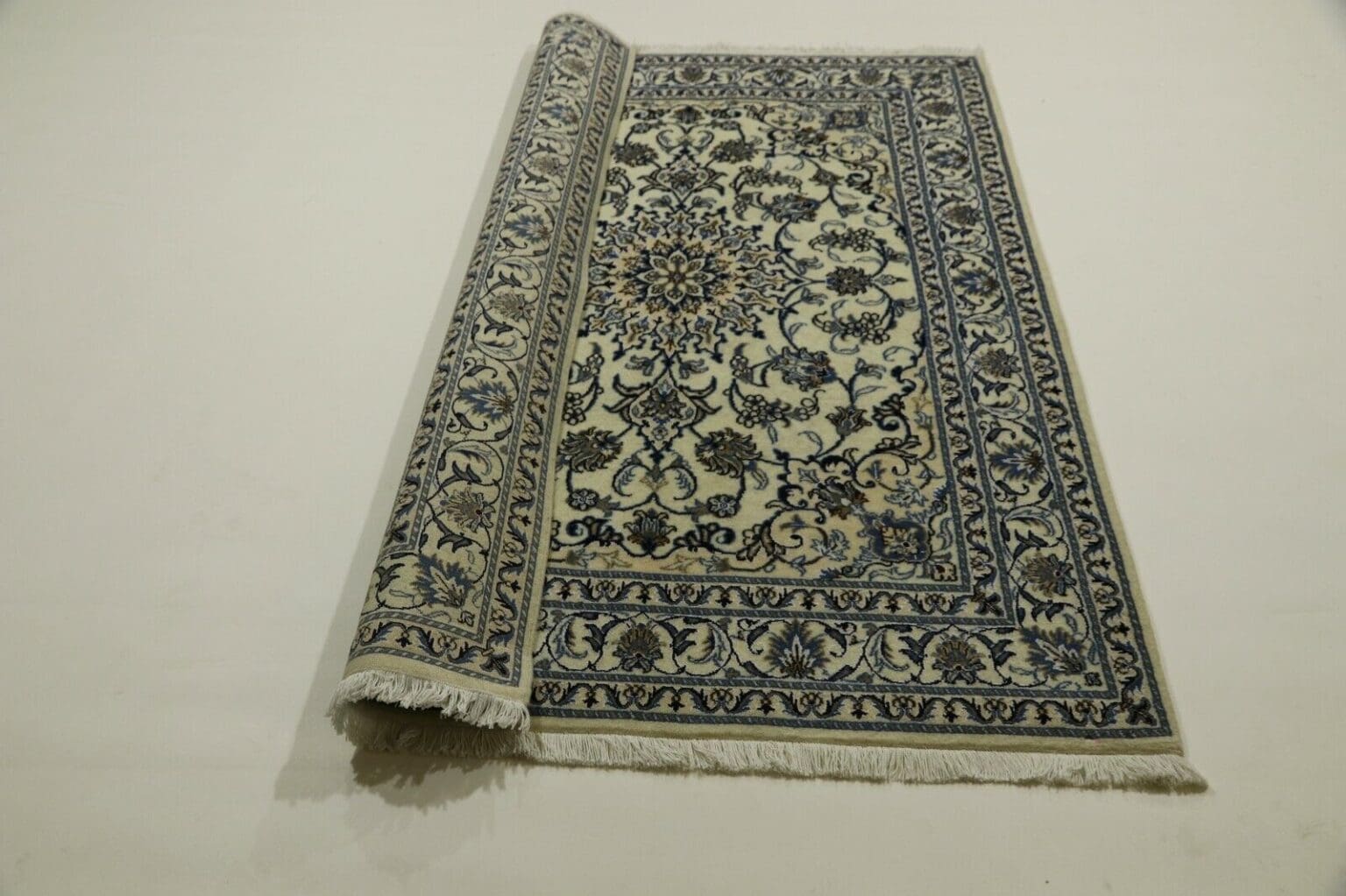
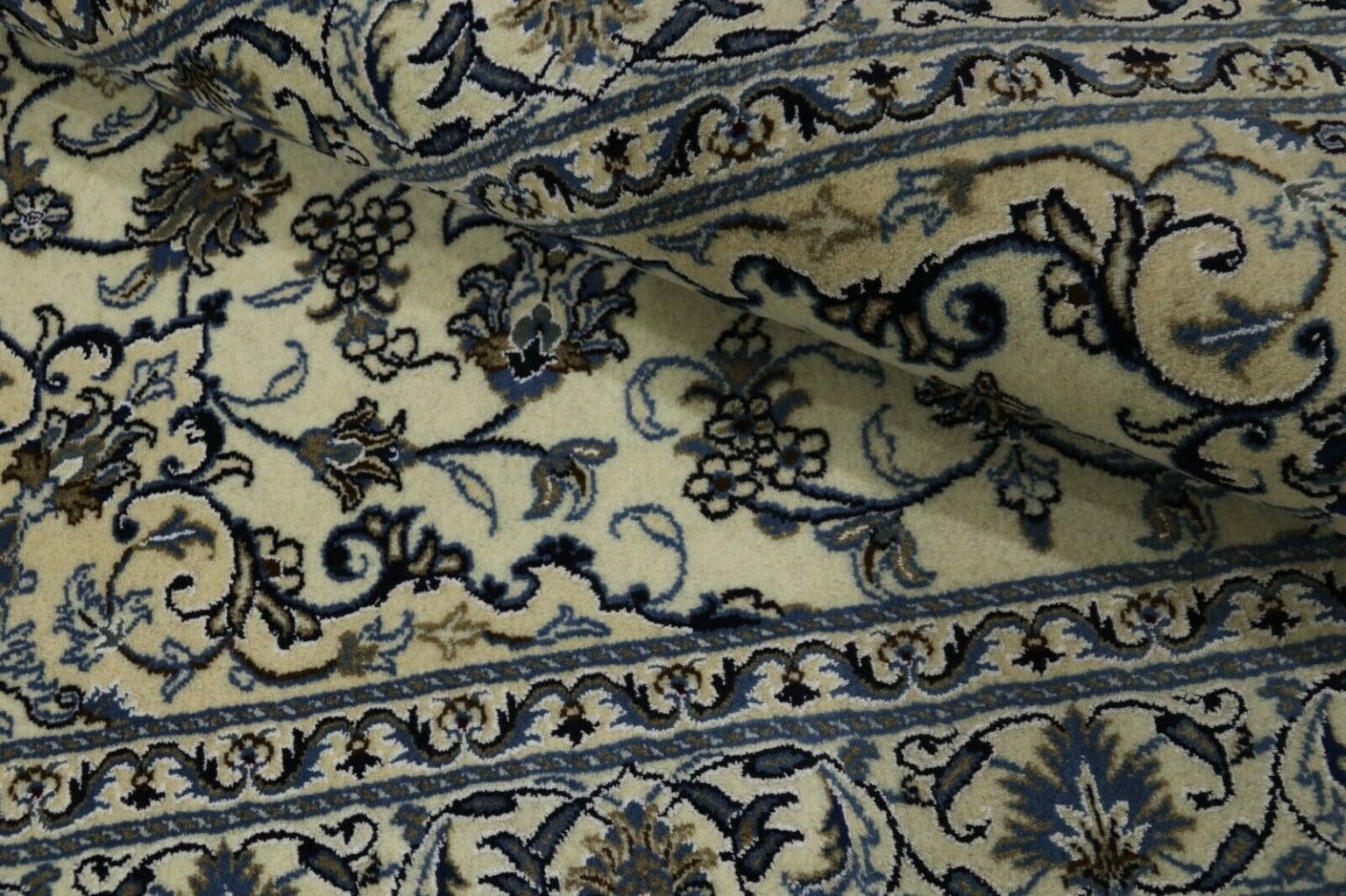
The rug is classified in a traditional Oriental and Persian style. Nain designs are often recognised by finely articulated drawing and an orderly relationship between individual ornaments. Floral elements may be combined with geometric structure, allowing leaves, blossoms, vines, and symmetrical forms to occupy the field in a controlled way. This design tradition gives careful treatment to small details and to the transitions that connect one motif with the next.
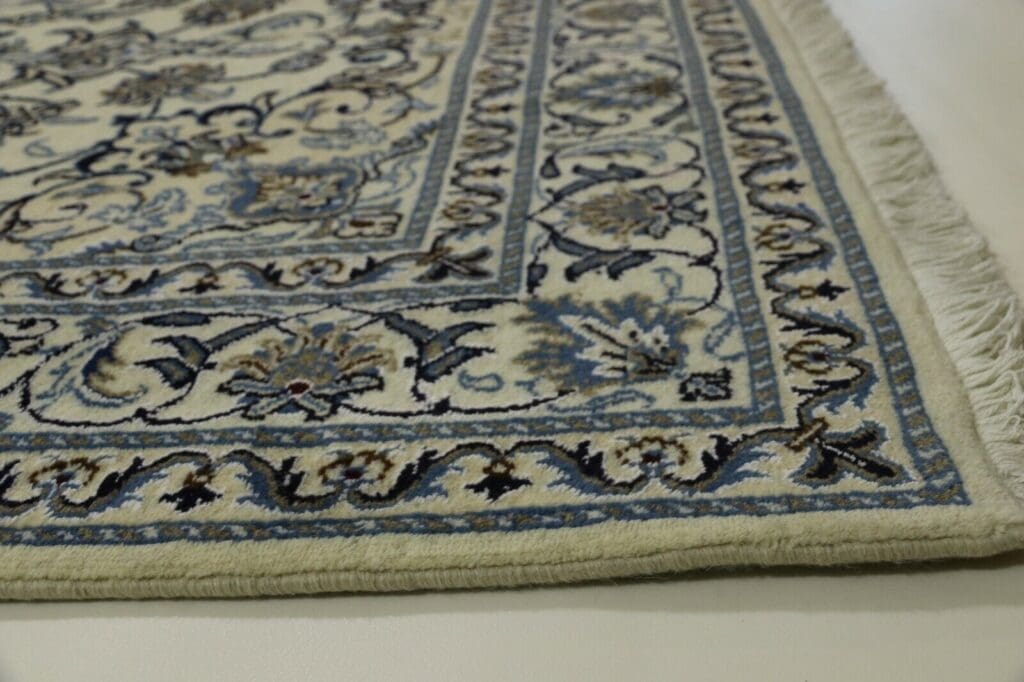
A large central medallion is a common feature in traditional Nain rugs. It may be surrounded by floral ornament and enclosed by one or more borders. The medallion should be understood as a recurring element within the regional design vocabulary, not as a feature that defines every Nain rug. Other compositions may use a more continuous field or a stronger geometric organisation. The tradition includes this range while retaining an emphasis on precision and balance.
Fine drawing and gentle colour relationships, both associated with Nain design, allow such rugs to sit within different interior settings. A classical composition can support a traditionally furnished room, while its ordered structure can also work alongside a more restrained interior. The visual effect comes from the relationship of the field, the border, and the detailed ornament rather than from a single isolated motif.
The material combination reinforces the design. Wool gives the main surface texture and a natural, relatively subdued appearance. Silk can be introduced into fine pattern details, where its different response to light helps selected lines and forms stand apart. This interaction between wool and silk adds definition without changing the underlying structure of the ornament. The pattern remains governed by the regional tradition and by the discipline of hand-knotting.
The Nain designation consequently brings together several layers of meaning: Iranian origin, a tradition of fine knotting, floral and geometric pattern language, and the frequent use of a central medallion within a balanced composition. This particular rug is described as traditional Oriental/Persian in style. Its pattern effect is linked to the hand-knotted construction, the fine knotting, and the use of silk in the detailed areas.
Special Features
A defining feature of this one-off piece is its combination of virgin wool and silk. Wool provides a robust and naturally warm surface, while silk is used in the fine patterns and details and can give them a distinct sheen. The two fibres therefore bring together natural durability and a more reflective decorative effect. The rug is listed as new and as a unique individual piece.
The fine density of approximately 300,000 knots per square metre points to the detailed work invested in the construction. It supports the precise rendering of the pattern and is one of the stated characteristics of this Nain rug. In addition to serving as a floor covering, a hand-knotted Persian rug of this kind may also be regarded as a decorative collector’s piece or a possible investment. That description does not replace an individual valuation; it records the additional role attributed to such hand-knotted Persian craftwork.
As an individual piece, the rug is not presented as an identical series copy. Its hand-knotted construction, fibre combination, and regional identity connect it with an established Iranian craft tradition. It can therefore be used in a living space while also being understood as a textile work with a cultural and historical context.
FAQ
What is the best way to care for my Nain Persian rug?
For routine care, vacuum the rug gently without using a brush attachment. This removes dust and loose dirt while placing less stress on the surface. If more substantial or embedded soiling occurs, the rug should be professionally dry-cleaned. Specialist cleaning helps protect both the colours and the combination of virgin wool and silk. Harsh household products, vigorous rubbing, and unsuitable cleaning equipment should be avoided so that the fibres and fine pattern details remain in good condition.
Can I use the rug in a high-traffic room?
Yes. The resilient wool and the hand-knotted construction make the rug suitable for areas that receive heavier foot traffic. With intensive use, the surface should still be checked regularly for dirt and cleaned carefully when necessary. Consistent gentle care helps preserve the textile structure and the clarity of the fine design. Although wool is robust, the silk used in the details should be treated with appropriate care.
Is the rug suitable for underfloor heating?
Yes, the Nain Persian rug can be used over underfloor heating. Wool is an effective thermal insulator and contributes to a comfortable indoor climate. It can absorb warmth and release it gradually, making the floor pleasant during the heating season, while its natural fibre character also supports a balanced feel in summer. The heating should operate evenly, and the rug should be laid correctly so that the hand-knotted piece rests flat on the floor.
To provide the best experiences, we use technologies like cookies to store and/or access device information. Consenting to these technologies will allow us to process data such as browsing behavior or unique IDs on this site. Not consenting or withdrawing consent, may adversely affect certain features and functions.
Functional Always active
The technical storage or access is strictly necessary for the legitimate purpose of enabling the use of a specific service explicitly requested by the subscriber or user, or for the sole purpose of carrying out the transmission of a communication over an electronic communications network.
Preferences
The technical storage or access is necessary for the legitimate purpose of storing preferences that are not requested by the subscriber or user.
Statistics
The technical storage or access that is used exclusively for statistical purposes.The technical storage or access that is used exclusively for anonymous statistical purposes. Without a subpoena, voluntary compliance on the part of your Internet Service Provider, or additional records from a third party, information stored or retrieved for this purpose alone cannot usually be used to identify you.
Marketing
The technical storage or access is required to create user profiles to send advertising, or to track the user on a website or across several websites for similar marketing purposes.
 SECURE PAYMENT
 SHIPPING PARTNERS


