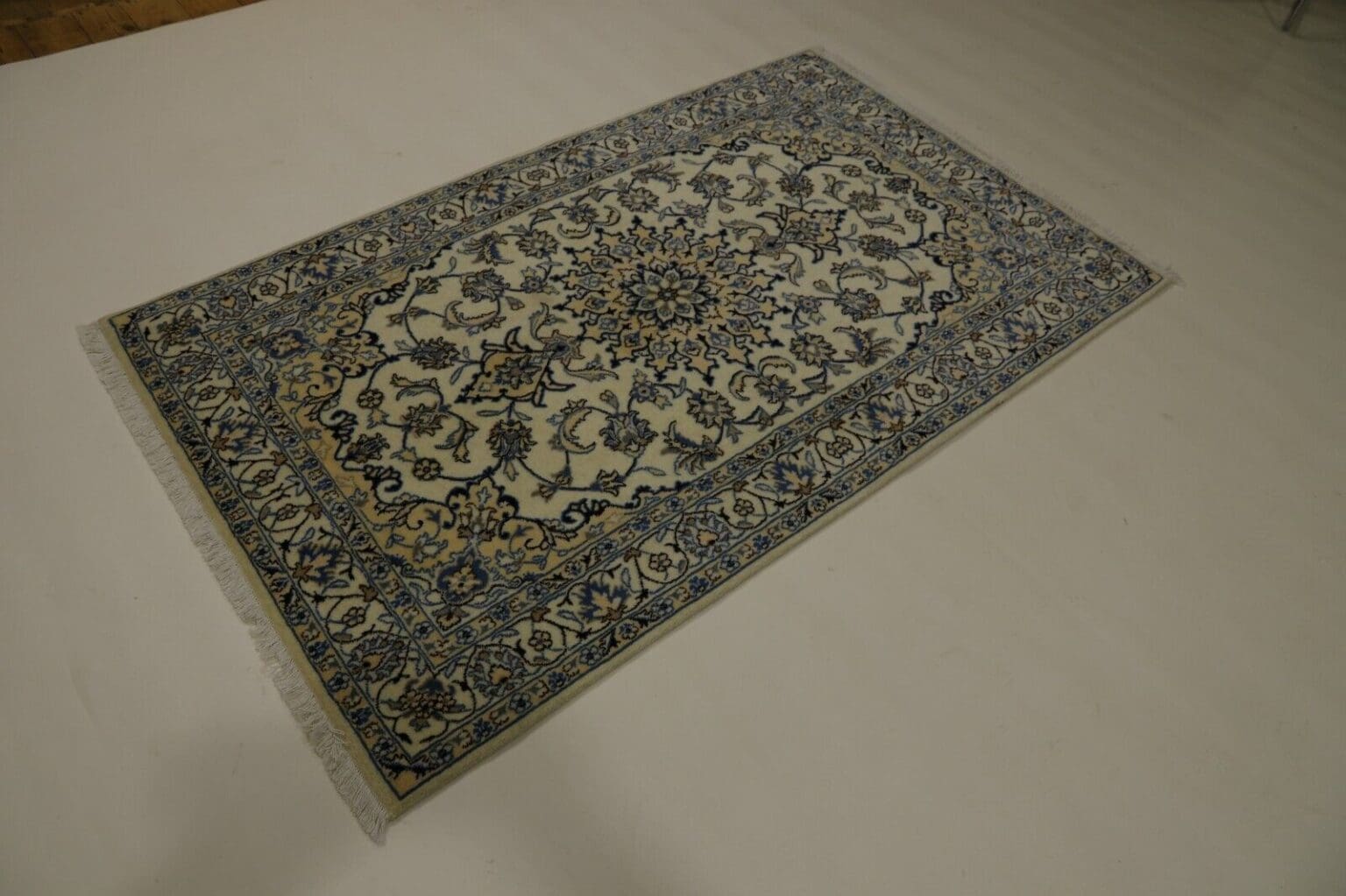
This Super Nain is hand-knotted, with a pile made from virgin wool and silk and a cotton warp. The product description identifies virgin wool as the predominant pile material and silk as the additional fibre. Wool provides the textile foundation of the surface, while silk contributes a smooth touch and a characteristic sheen. Cotton is used in the warp, giving the rug a clearly defined woven structure beneath the pile.
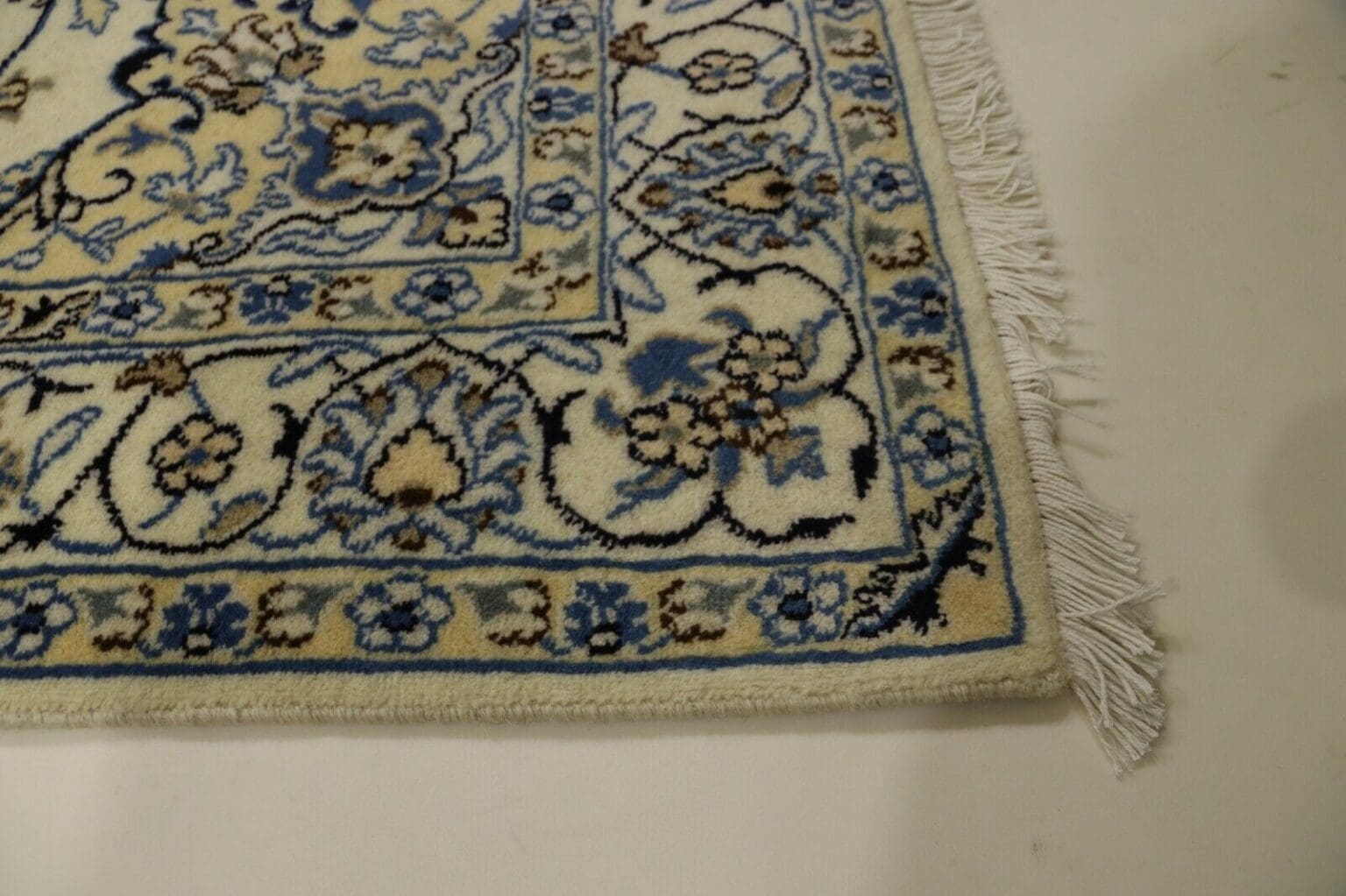
In a hand-knotted rug, the design is built knot by knot rather than printed onto a finished floor covering. Individual knots are inserted in rows and secured with weft threads. This process allows a detailed drawing to be transferred into the textile itself. The rug is expressly described as hand-knotted, so its construction belongs to the traditional craft of assembling a patterned surface through manual work.
The three materials have different roles within the construction. Virgin wool forms the main pile, silk is included in the pile as a refined contrasting fibre, and cotton forms the warp. This division is stated in the material information for the rug. The combination also explains why the surface can be described through both a soft woolly feel and a more lustrous silk effect. These are properties associated with the named materials, not with an added synthetic finish.
The description presents the wool as warm and comfortable and the silk as contributing softness and shine. In hand-knotting, the accuracy of the finished appearance depends on the regular placement of the knots and on the way the pattern is followed during production. The rug is listed as new and in very good condition. Its traditional making method is therefore combined with the supplied condition description and with a material structure based on wool, silk, and cotton.
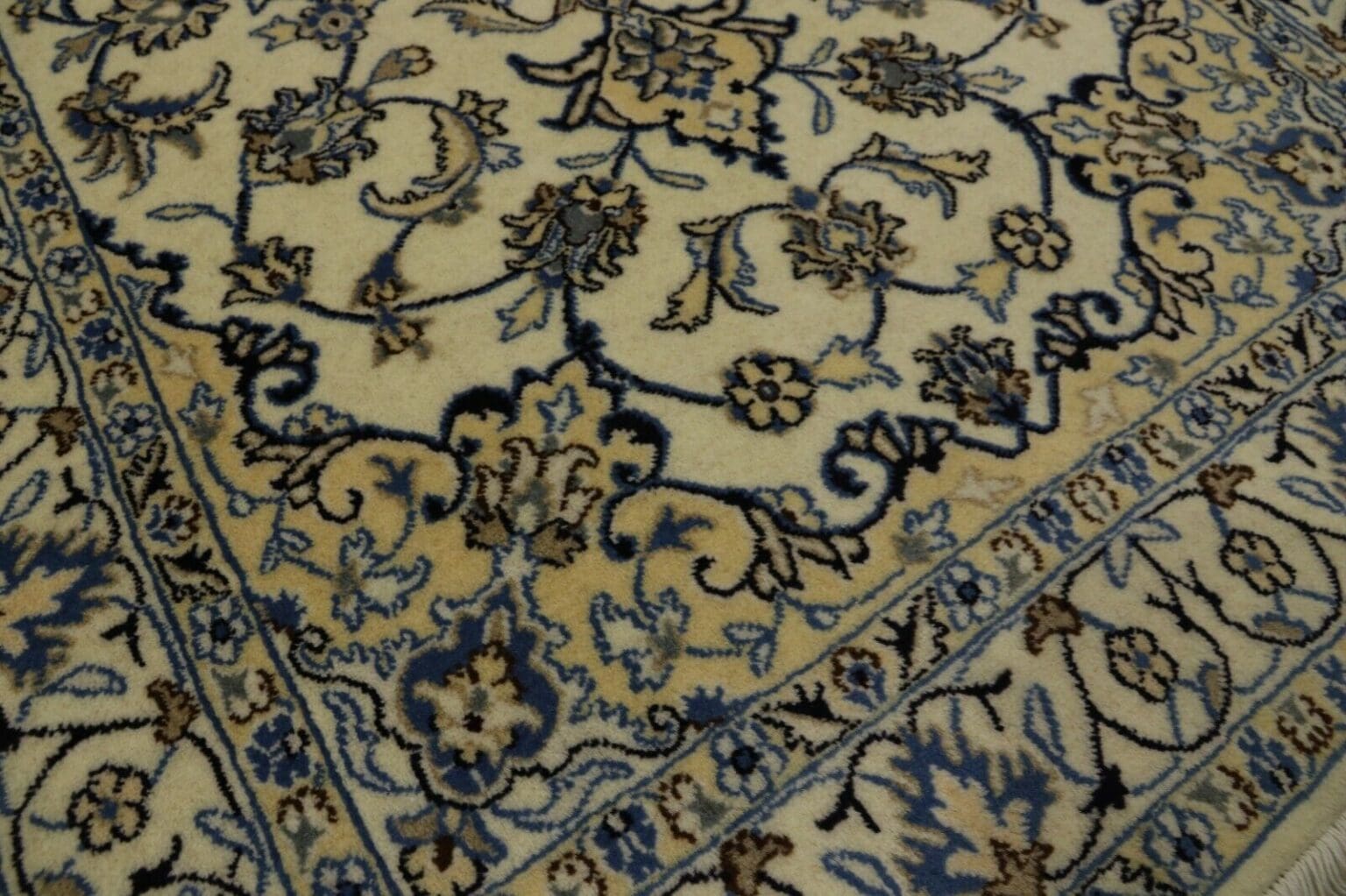
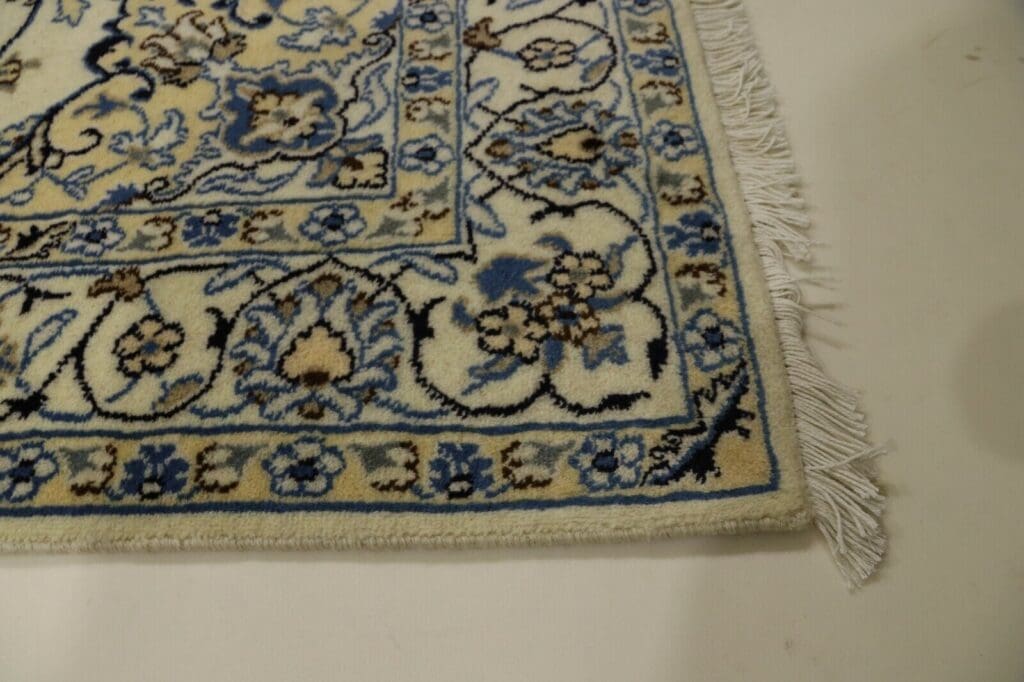
The hand-made process also gives the pile its relationship to the design. Curves, floral details, and geometric borders are not separate decorations placed on top of the rug; they are formed through the arrangement of differently coloured knots. The product text describes the workmanship as careful and the patterns as elegant. Within the limits of the supplied information, the rug can therefore be identified by its hand-knotted construction, its stated fibre combination, and its Nain designation.
Origin and Tradition
The rug is described as a Persian rug from Persia and is presented under the name Super Nain. Nain is a recognised carpet-making region in Iran. Nain rugs are associated with finely organised compositions, delicate knotting, and a restrained sense of balance. The regional name places this piece within Iranian carpet culture rather than within a general, unidentified oriental category.
The tradition of carpet weaving in Nain reaches back to the nineteenth century. Over time, the region developed a recognisable approach to design and construction. Careful material selection, precise knotting, and finely drawn ornament became central to the reputation of Nain carpets. As with other Persian weaving traditions, the rug is both a practical textile and a way of preserving regional forms through a process that passes a design into the structure of the fabric.
Nain carpets are known for the use of fine knots and fine materials. A dense knotting structure permits small details to be represented with greater definition, provided that the weaver maintains a regular sequence throughout the work. Knot density alone does not describe every aspect of a carpet, but it is an important part of the technical language used to discuss finely knotted Nain pieces. The hand-knotted construction connects this rug to that established regional method.
Persian carpet traditions are shaped by the relationship between workshop practice and design. A drawing or pattern plan guides the arrangement of the field, borders, and ornaments, while the weaver translates those elements into rows of knots. The result is a textile in which craft and decoration cannot be separated. In Nain, this process is associated with controlled compositions and fine, carefully articulated details.
The name Nain in this product refers to the stated regional designation and is not merely the name of a decorative motif. The source also identifies the origin as Persia and describes the style as traditionally oriental and Persian. These details place the rug in the Iranian tradition of Persian carpet making. The term Super Nain describes the offered Nain type; it does not introduce a different country of manufacture.
Wool, silk, and cotton also reflect the way Persian rugs can combine materials for different structural and visual tasks. Wool is used for the principal pile, silk adds a smoother and more reflective element, and cotton is used for the warp. In a Nain context, such a combination supports the fine, ordered appearance associated with the region. The rug remains a specific hand-knotted piece, while the regional explanation describes the broader tradition in which its form is situated.
Nain carpets are often regarded as examples of Iranian textile art because their patterns are carefully composed and their construction is technically controlled. Their tradition is not defined by a single isolated symbol, but by the interaction of material, knotting, proportion, and ornament. This Super Nain follows the supplied description through its Persian origin, its hand-knotted technique, its oriental pattern classification, and its association with Nain.
Design and Pattern
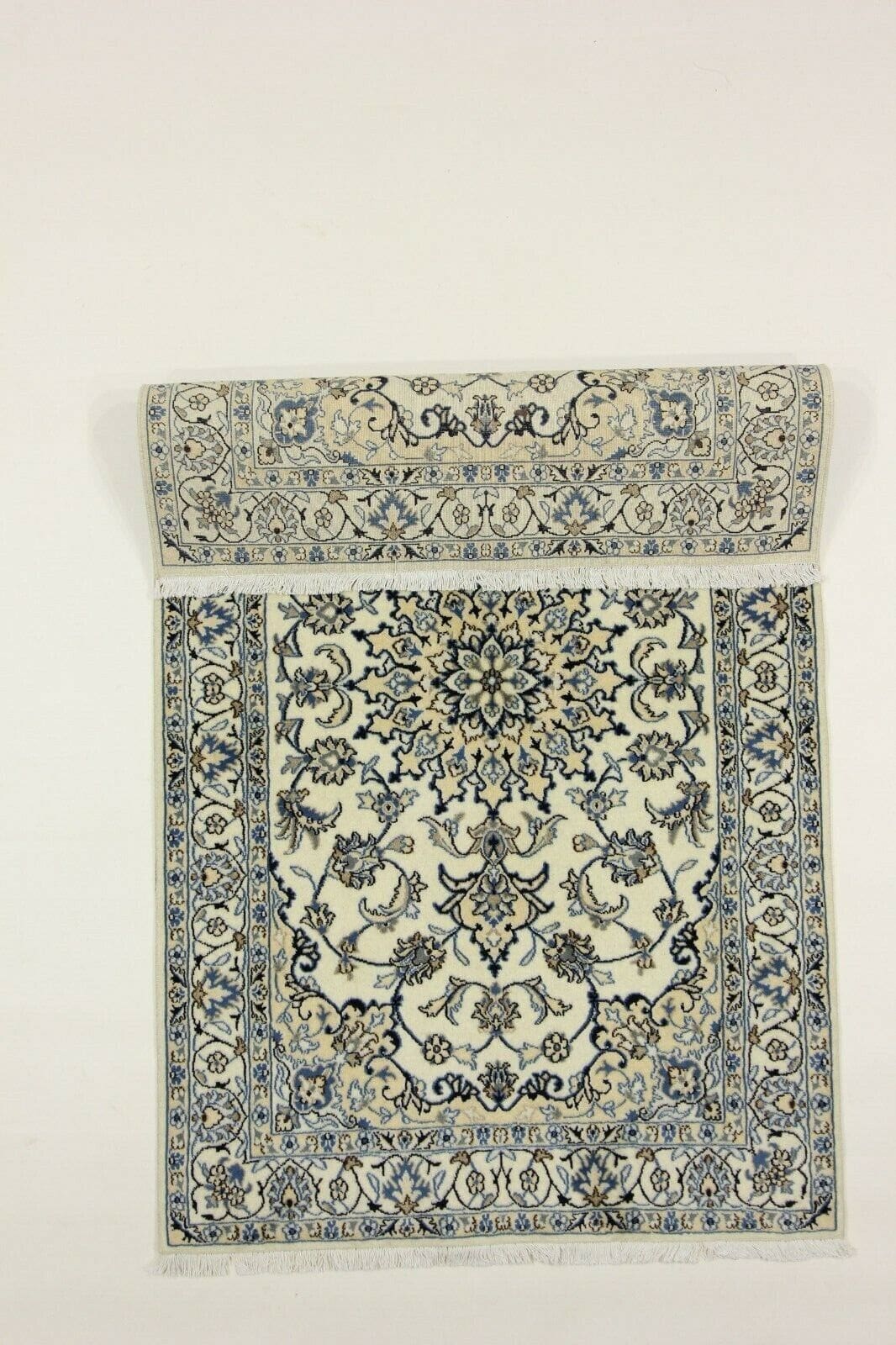
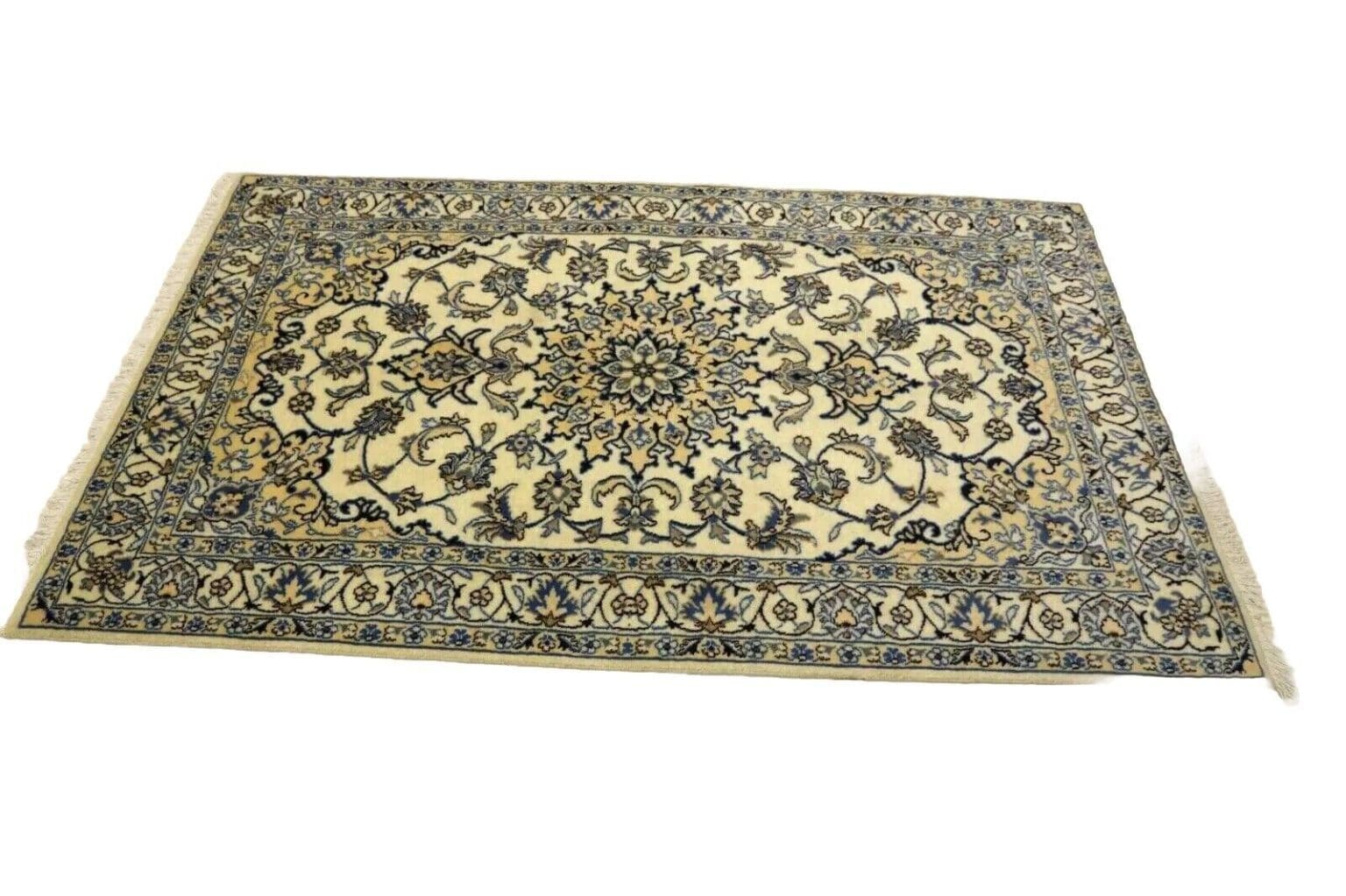
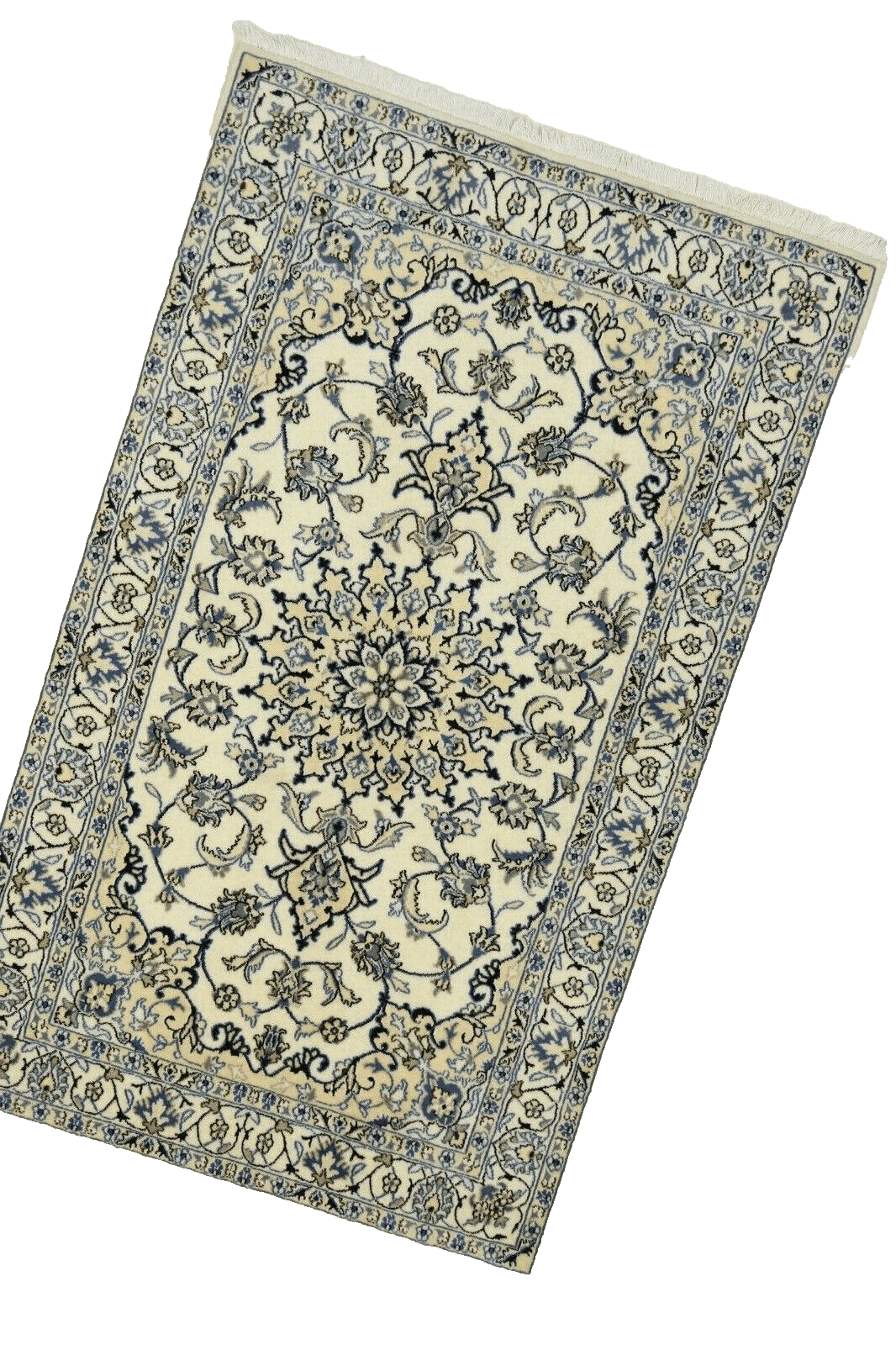
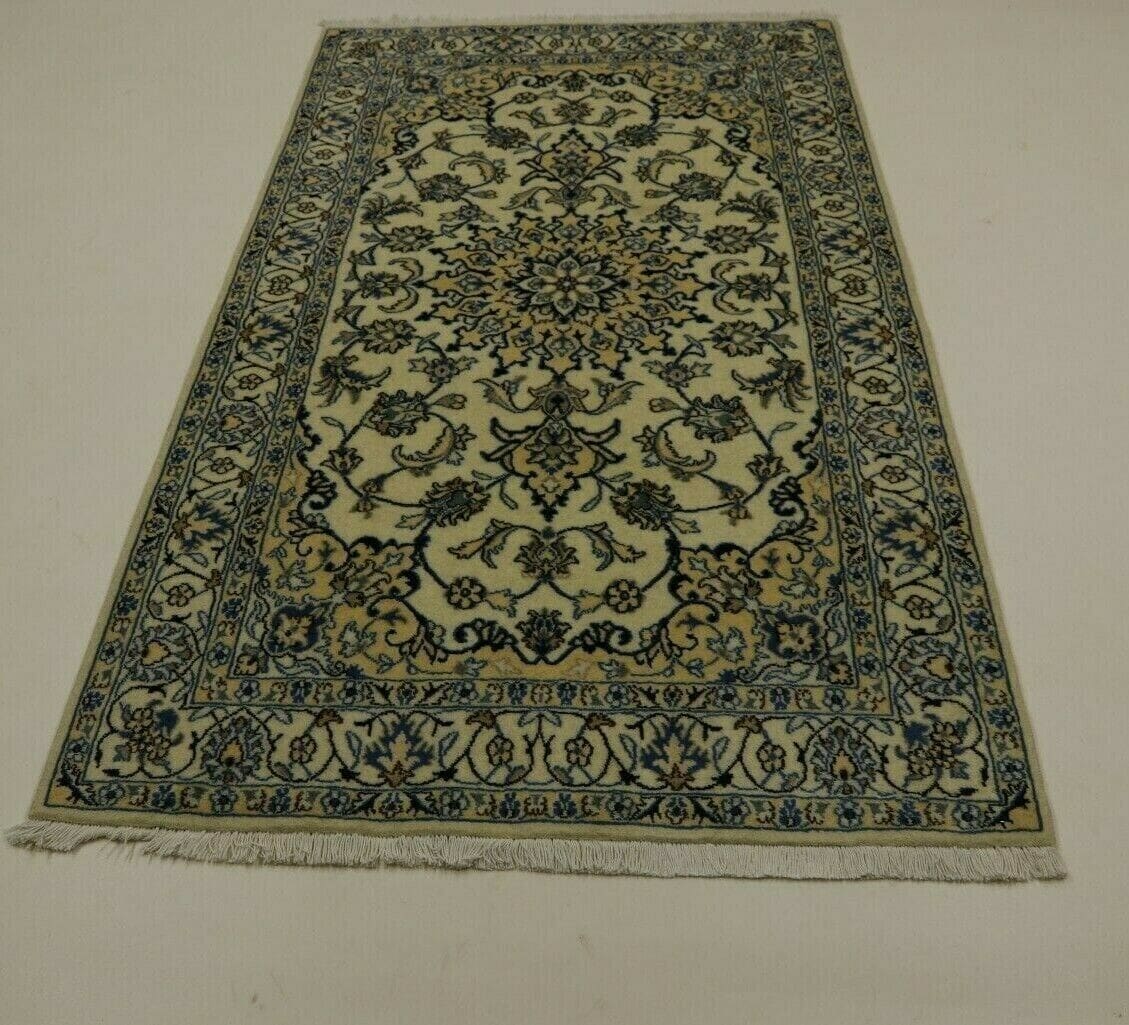
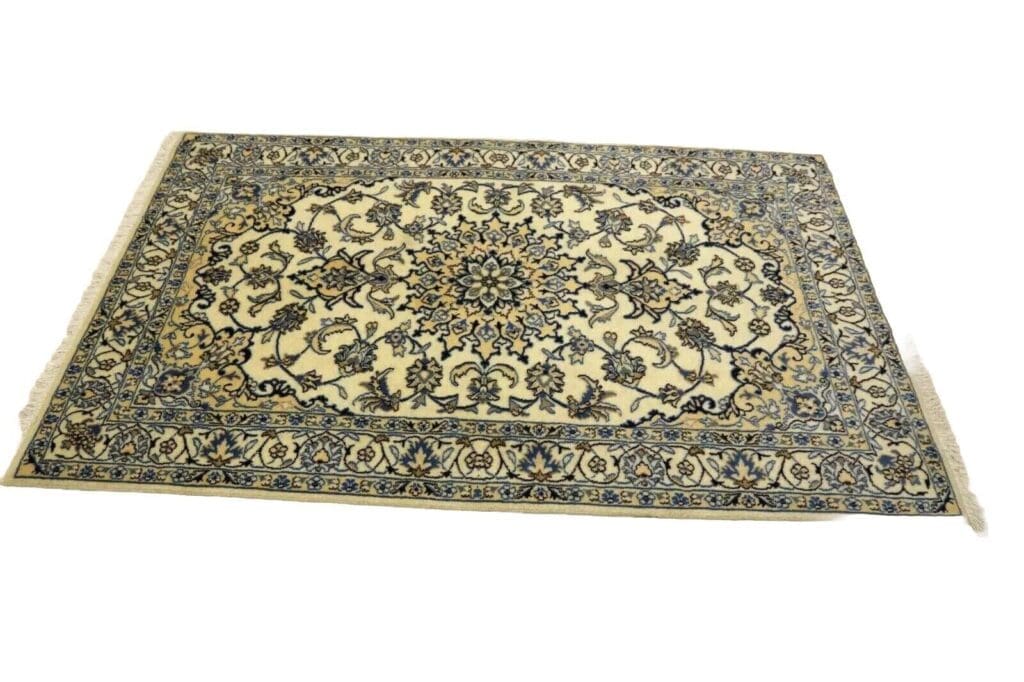
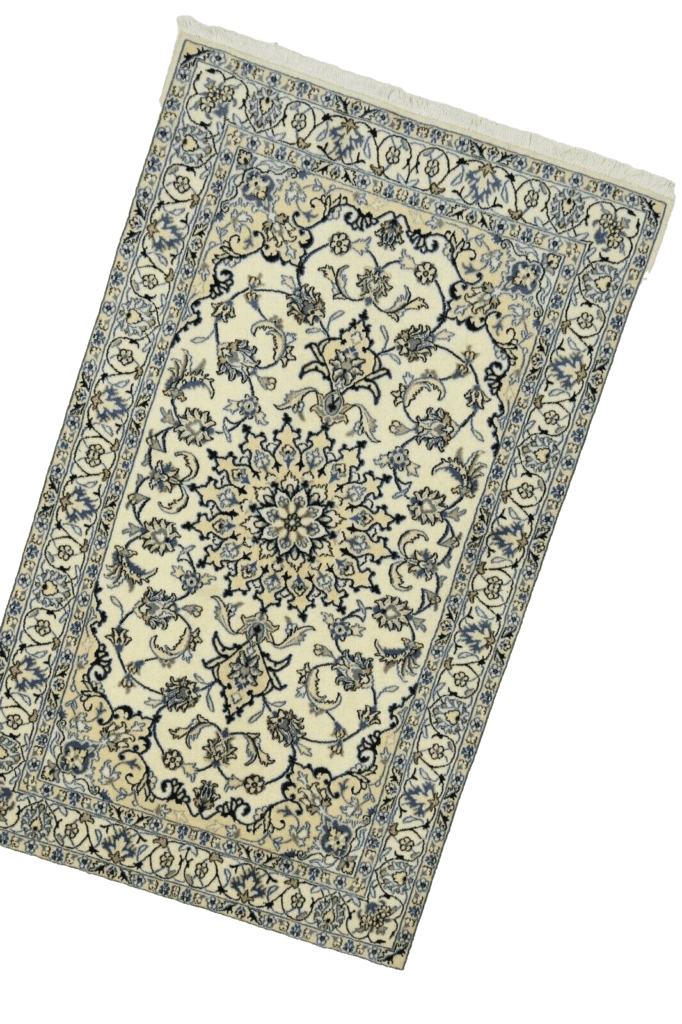
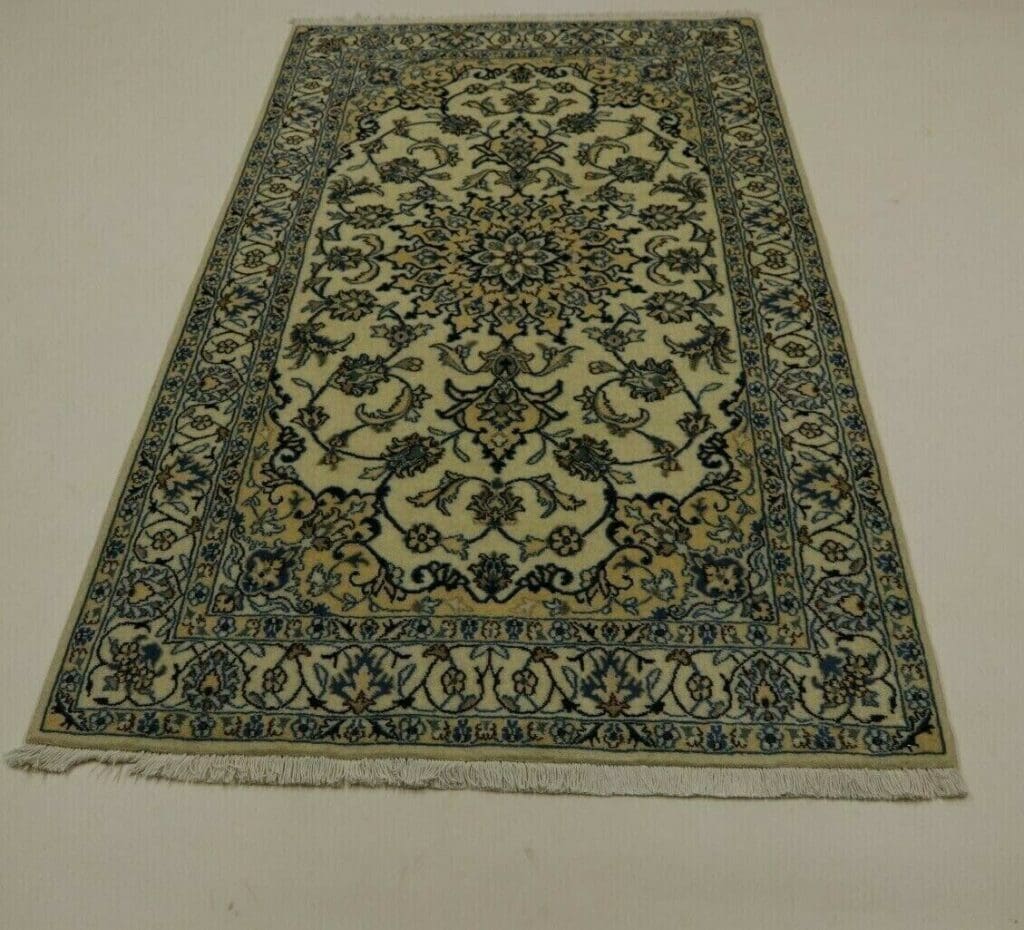
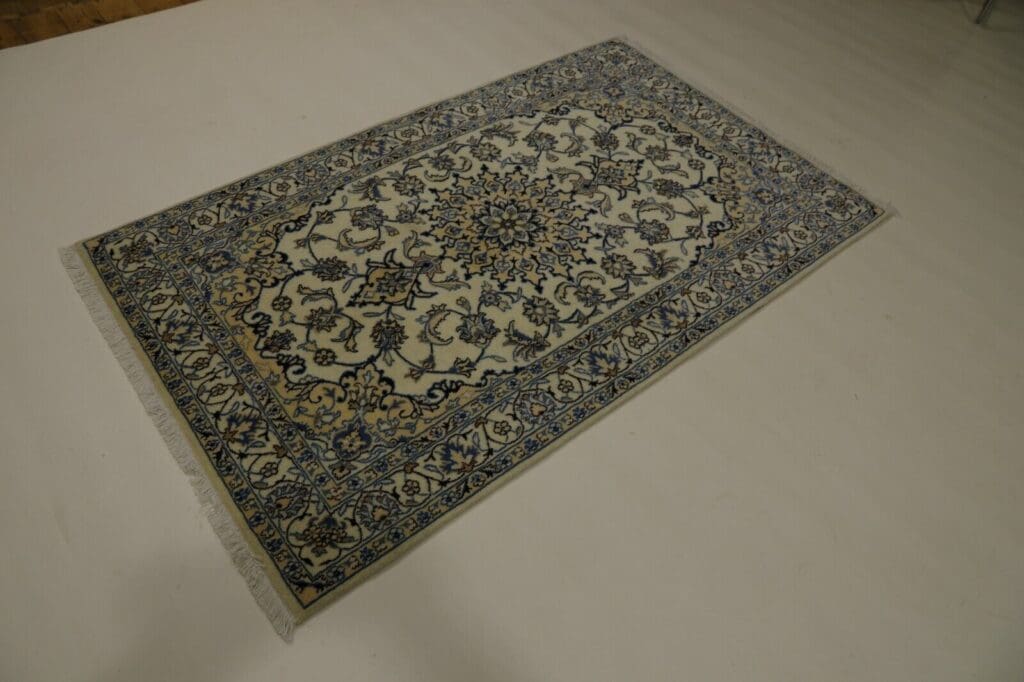
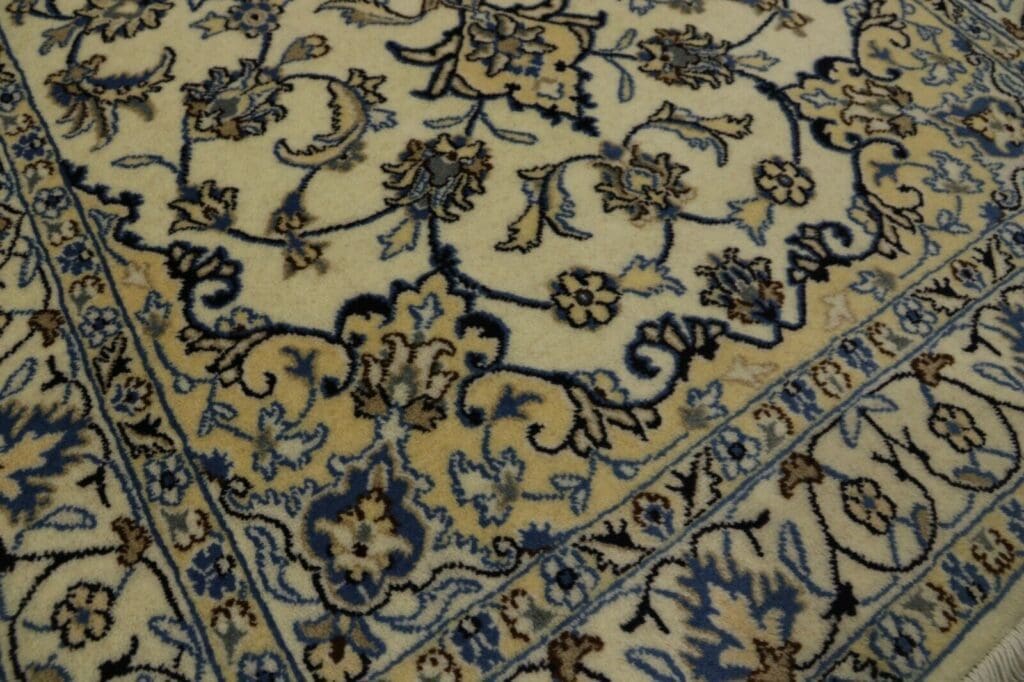
The pattern is classified as Oriental, and the product description refers to elegant designs and artistic ornamentation. Nain carpets commonly use floral patterns together with geometric motifs, arranged in a balanced composition. Such a design is read as a complete structure: a central field, surrounding borders, scrolling elements, and smaller ornaments support one another instead of appearing as unrelated marks.
Floral forms are a long-standing part of Persian carpet design. Leaves, blossoms, vines, and stylised plant shapes can be repeated, connected, or placed in a measured sequence. Geometric motifs add definition and rhythm. They may frame the field, divide sections of the composition, or provide small points of order within a floral drawing. In Nain weaving, these elements are often associated with clear lines and carefully controlled detail.
The wool and silk pile can give different areas of a pattern a distinct visual response. Wool presents a softer, more subdued surface, while silk catches light with a smoother sheen. When the two are incorporated into one pile, selected outlines and ornamental passages may become more noticeable through their differing surface qualities. The supplied description specifically connects the combination with depth and visual effect.
An oriental pattern does not have to depend on a single motif. It can bring together symmetry, repeating vines, floral details, geometric framing, and a relationship between field and border. Persian designers traditionally arrange these components so that the eye can follow the composition across the rug. In a hand-knotted piece, the drawing is created by the sequence of knots, which makes the pattern part of the textile rather than a surface image applied after weaving.
The designation Super Nain refers to the Nain type named for this rug. It should not be confused with a separate motif or with a claim to another province. The product places the rug in the traditional oriental and Persian style and gives its pattern simply as Oriental. The rectangular form is suited to the conventional presentation of a composed field with bordering ornament, while the exact individual motifs of this one-off rug are not named beyond the supplied description.
Harmony in a Persian pattern comes from proportion and repetition as much as from colour. Floral and geometric elements can be balanced so that one part does not overpower the rest. The source describes the colouration of Nain carpets as harmonious and their ornament as artistic. Together with fine hand-knotting, this creates a design language that is ordered, detailed, and connected to Iranian weaving heritage without requiring a modern style label.
The pattern can therefore be understood on two levels. It is the specific oriental design offered on this rug, and it also belongs to the wider visual vocabulary of Nain carpets. The first is the product classification; the second is regional background. Both are consistent with the supplied description: a hand-knotted Super Nain Persian rug with elegant oriental ornament and a design tradition associated with floral and geometric organisation.
Special Features
The stated special features are the fine knotting, the hand-knotted construction, and the pile made from virgin wool and silk over a cotton warp. The high knot density is presented as an indication of careful workmanship and as a basis for reproducing fine details. Silk contributes a soft handle and visible lustre, while wool provides the principal pile material. The rug is listed as new and in very good condition.
It has a rectangular shape and is described as suitable for all rooms. The product text also characterises it as easy to clean and maintain. Regular vacuuming is recommended to remove dust and loose dirt. If a damp cloth is used, care should be taken not to smear the colours. Professional rug cleaning is suggested when a more thorough treatment is required.
These features define the piece without adding an unprovided provenance or a different style attribution. It is a Nain Persian rug, made by hand, with the stated wool, silk, and cotton construction and an Oriental pattern. Its condition, shape, and care information complete the practical description.
FAQ
How can the quality of an Oriental rug be assessed?
Several factors should be considered together: knot density, fibre quality, construction, and the precision of the workmanship. A dense knotting structure can support a more detailed pattern, while the regularity of the knots helps determine how clearly the design is rendered. The materials also matter. This rug combines virgin wool and silk in the pile with cotton in the warp. Its hand-knotted construction shows that the pattern was built manually rather than printed or produced as a machine-made surface. Quality is therefore best judged through the relationship between density, material, structure, and design, not through one feature alone.
How should a Persian rug be cared for?
Regular, careful vacuuming helps remove dust and everyday loose dirt from the pile. For a small area, a damp cloth may be used, but the colours should not be rubbed or smeared. Harsh products, excessive moisture, and aggressive scrubbing are unsuitable for a hand-knotted wool-and-silk surface. When a deeper clean is needed, professional rug cleaning is recommended. This approach respects the pile fibres and the construction while helping preserve the appearance of the Oriental pattern. Care should be adapted to the actual nature of the rug rather than treated like routine cleaning for a synthetic floor covering.
Where is this Oriental rug best placed?
The product description states that the rectangular rug is suitable for all rooms. It can be used in living and dining areas, and it can also serve as a textile accent in a hallway or bedroom. The floor should be clean and suitable so the rug lies securely and can be maintained properly. Direct, intense sunlight should be avoided because prolonged exposure can alter colours over time. The chosen position should also allow sufficient room for regular vacuuming and for the wool-and-silk surface to remain free from unnecessary friction or dampness.
To provide the best experiences, we use technologies like cookies to store and/or access device information. Consenting to these technologies will allow us to process data such as browsing behavior or unique IDs on this site. Not consenting or withdrawing consent, may adversely affect certain features and functions.
Functional Always active
The technical storage or access is strictly necessary for the legitimate purpose of enabling the use of a specific service explicitly requested by the subscriber or user, or for the sole purpose of carrying out the transmission of a communication over an electronic communications network.
Preferences
The technical storage or access is necessary for the legitimate purpose of storing preferences that are not requested by the subscriber or user.
Statistics
The technical storage or access that is used exclusively for statistical purposes.The technical storage or access that is used exclusively for anonymous statistical purposes. Without a subpoena, voluntary compliance on the part of your Internet Service Provider, or additional records from a third party, information stored or retrieved for this purpose alone cannot usually be used to identify you.
Marketing
The technical storage or access is required to create user profiles to send advertising, or to track the user on a website or across several websites for similar marketing purposes.
 SECURE PAYMENT
 SHIPPING PARTNERS


