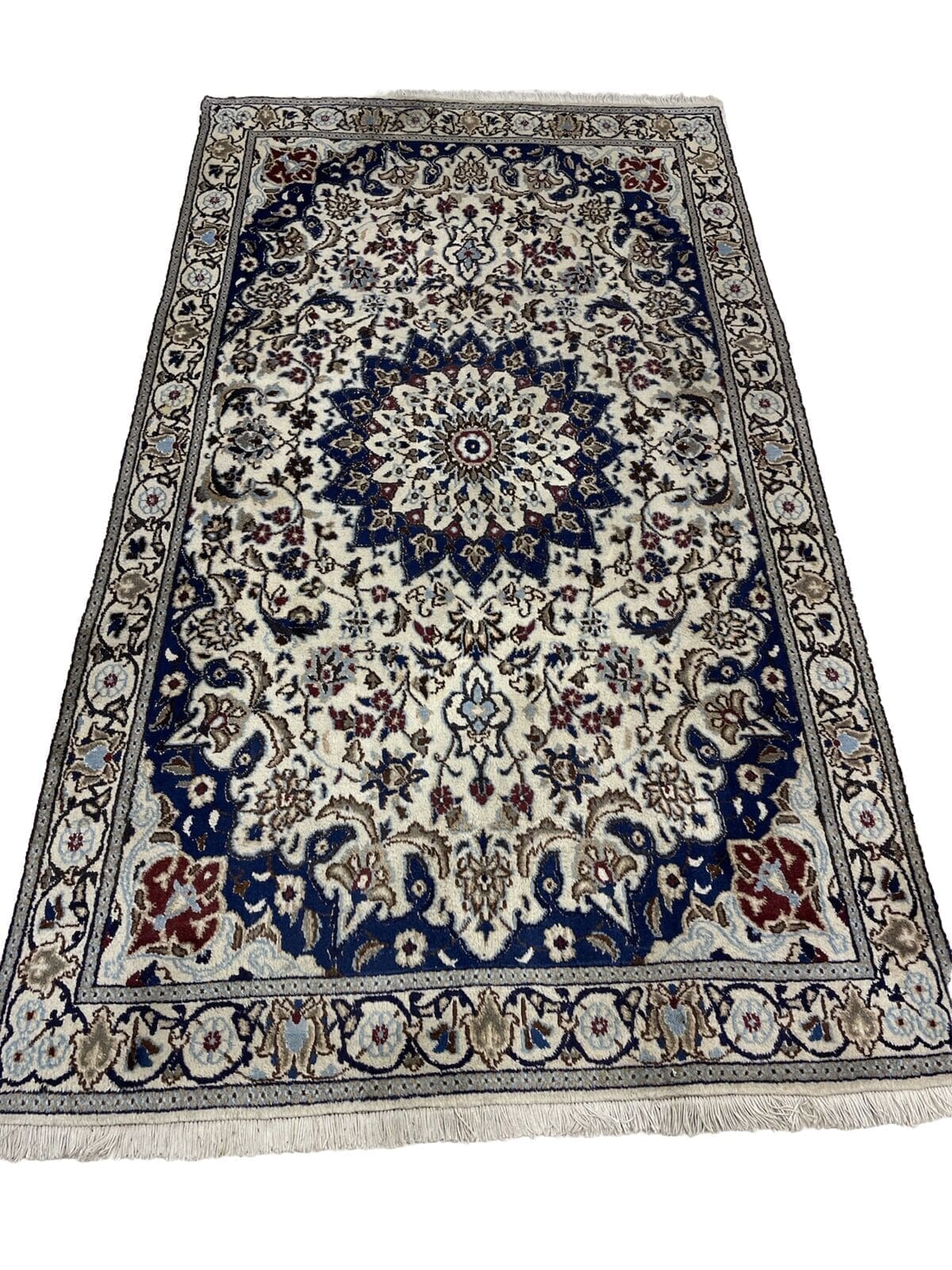
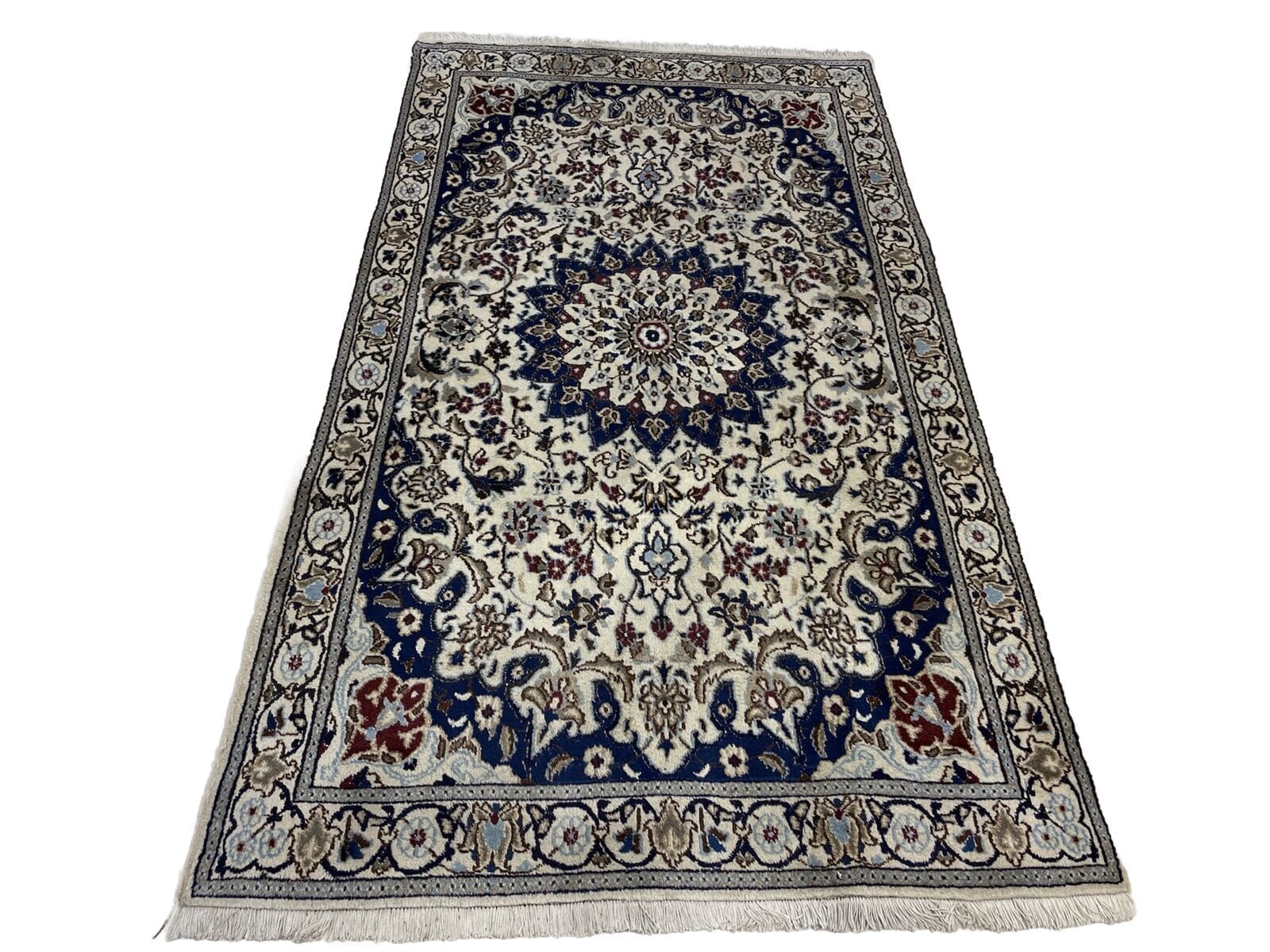
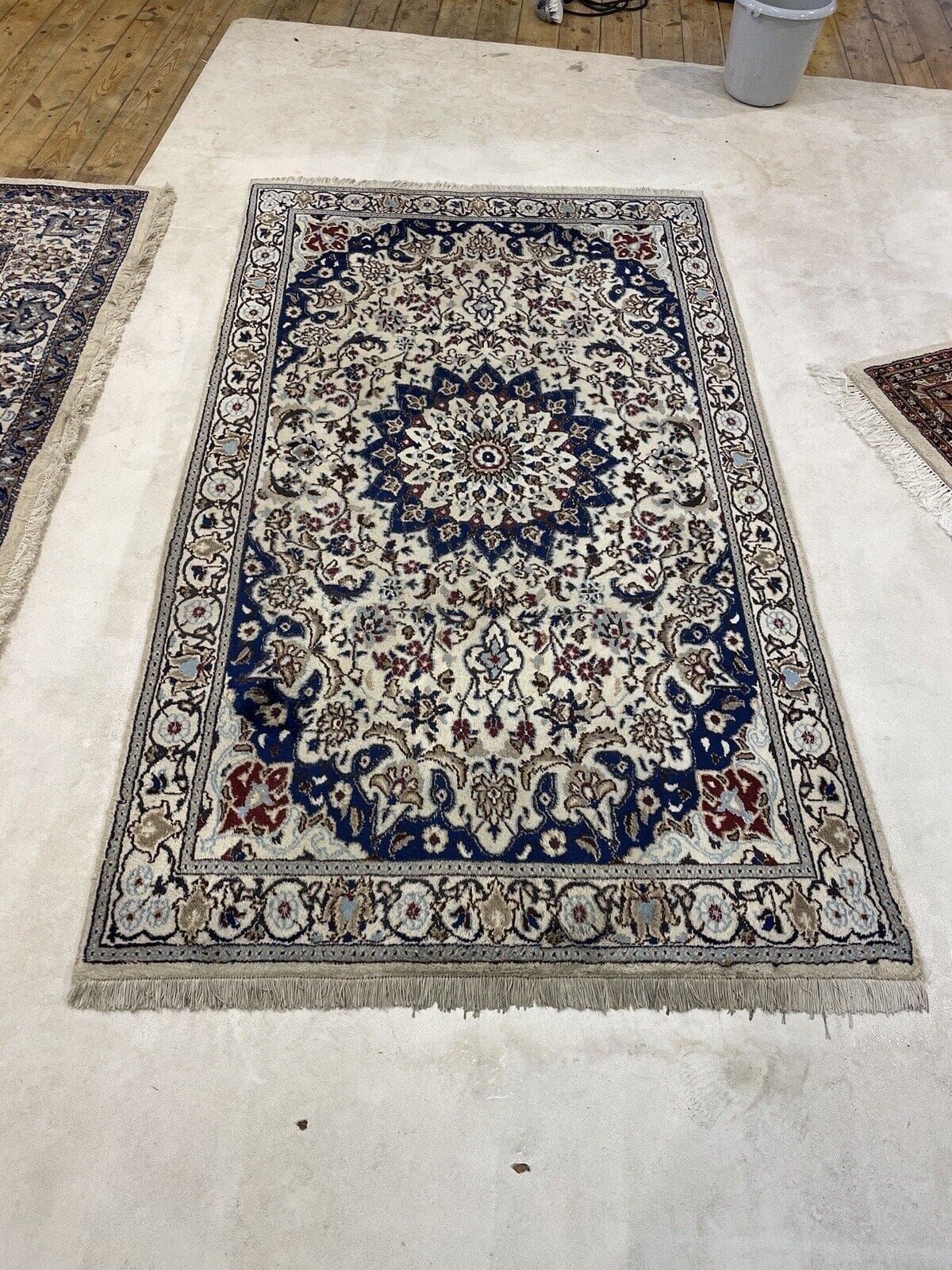
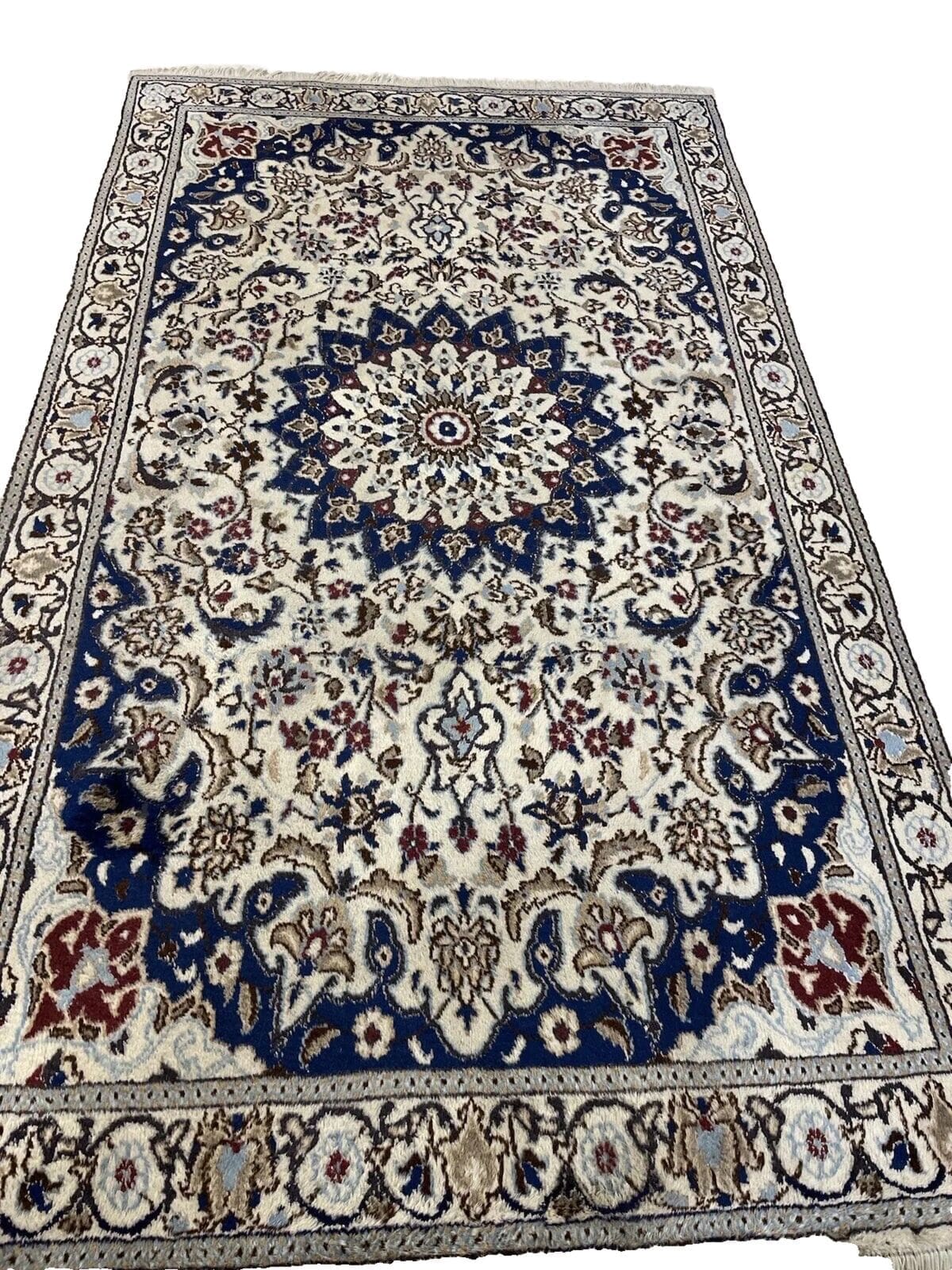
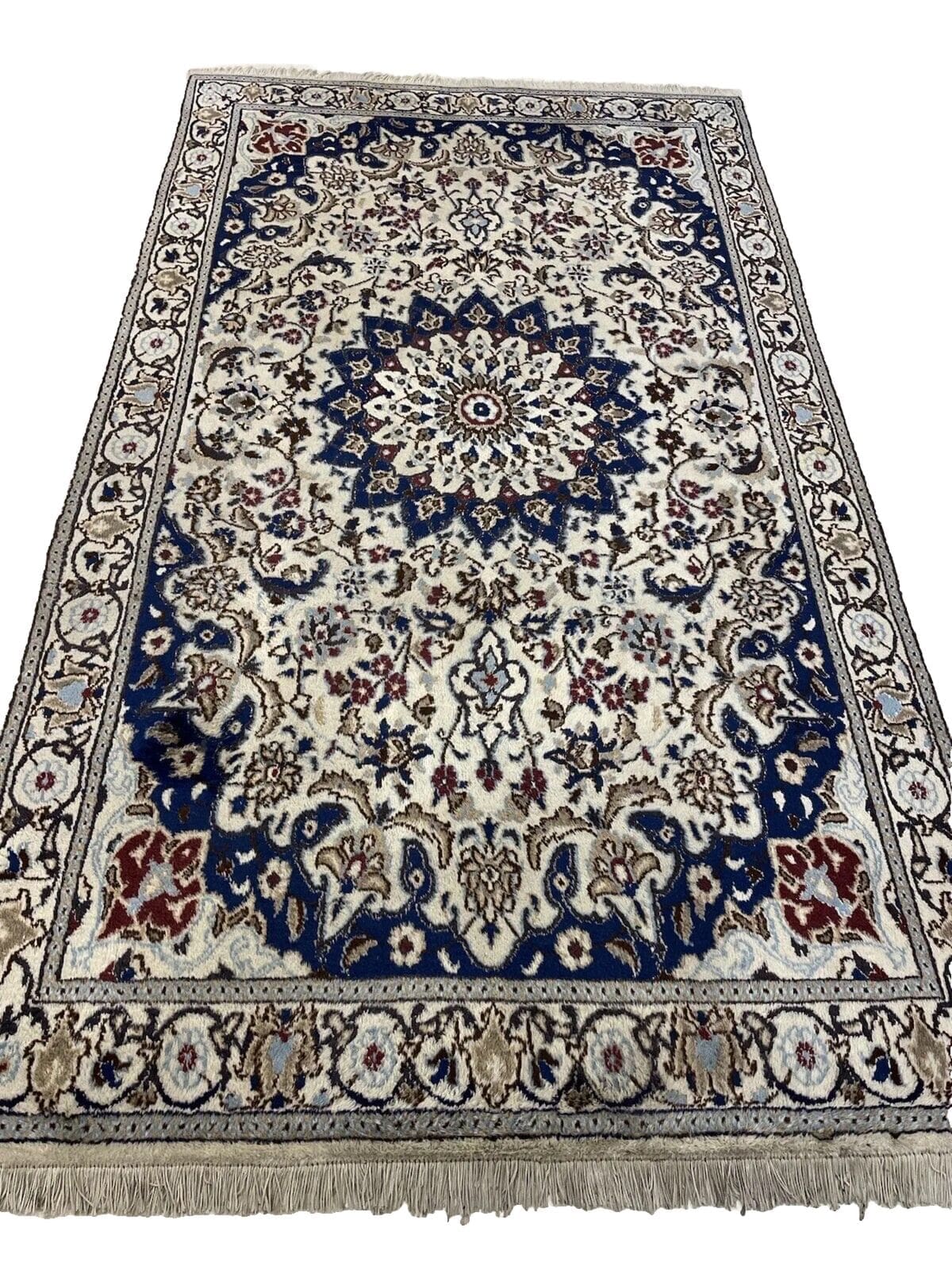
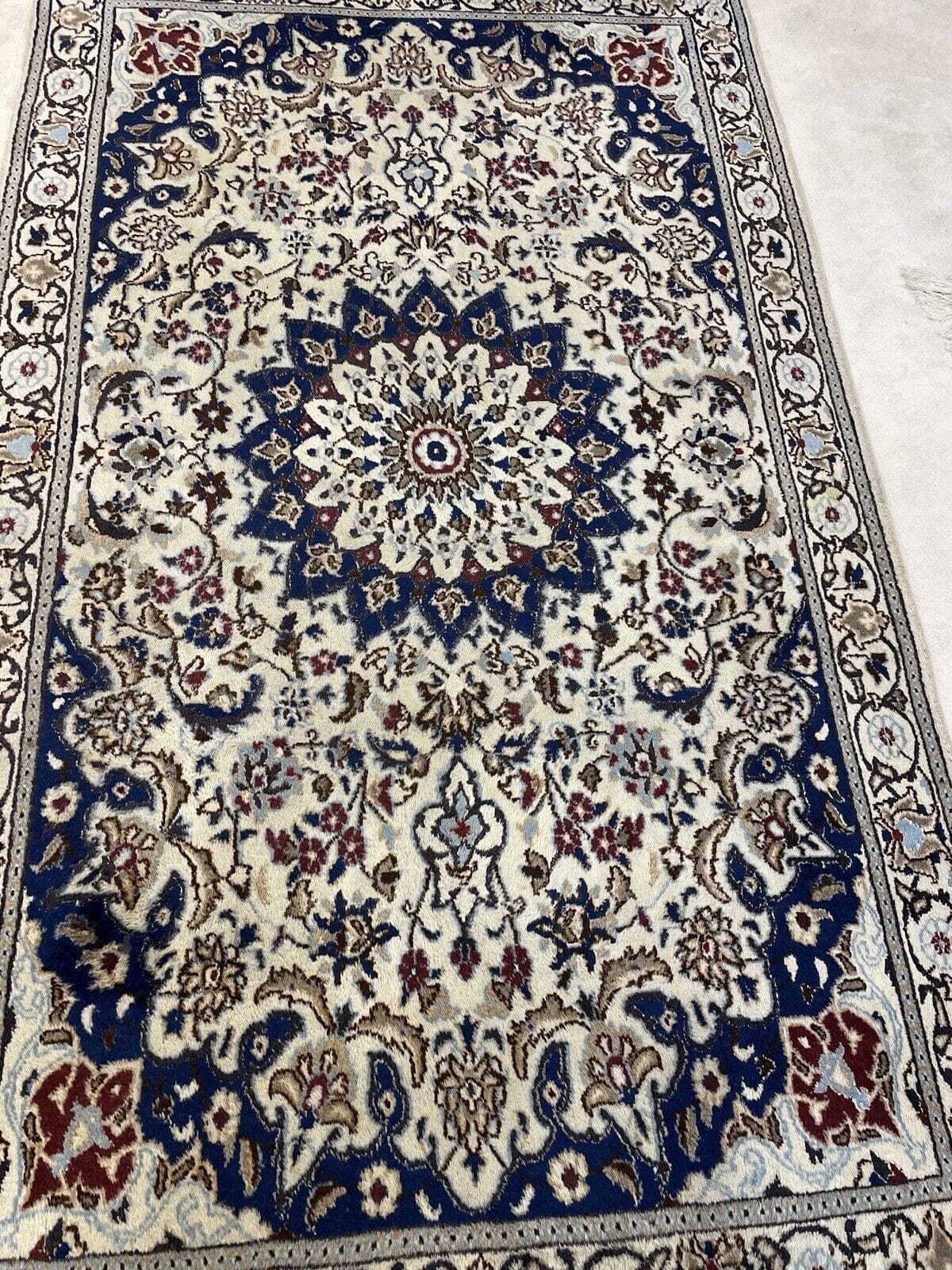
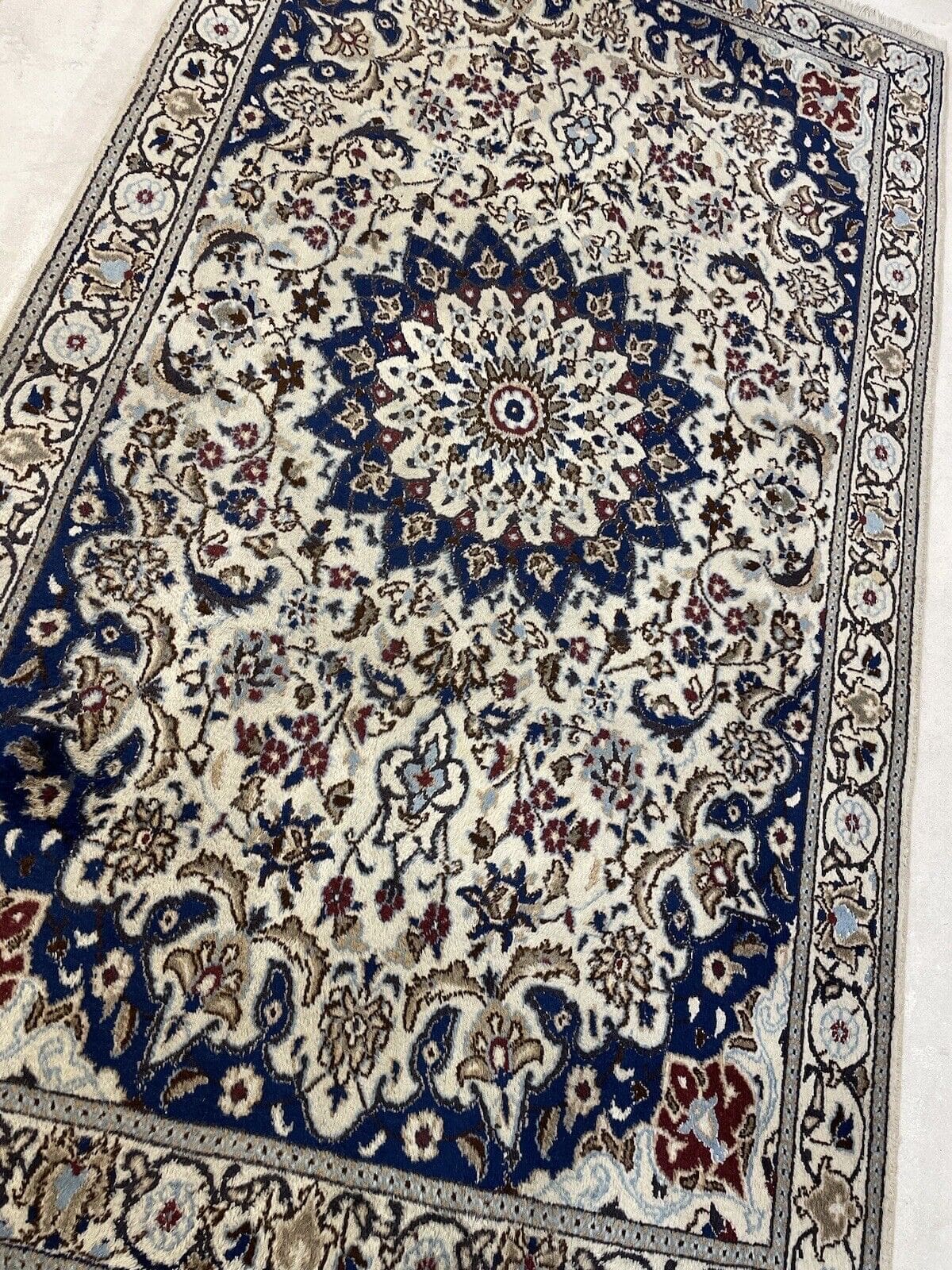
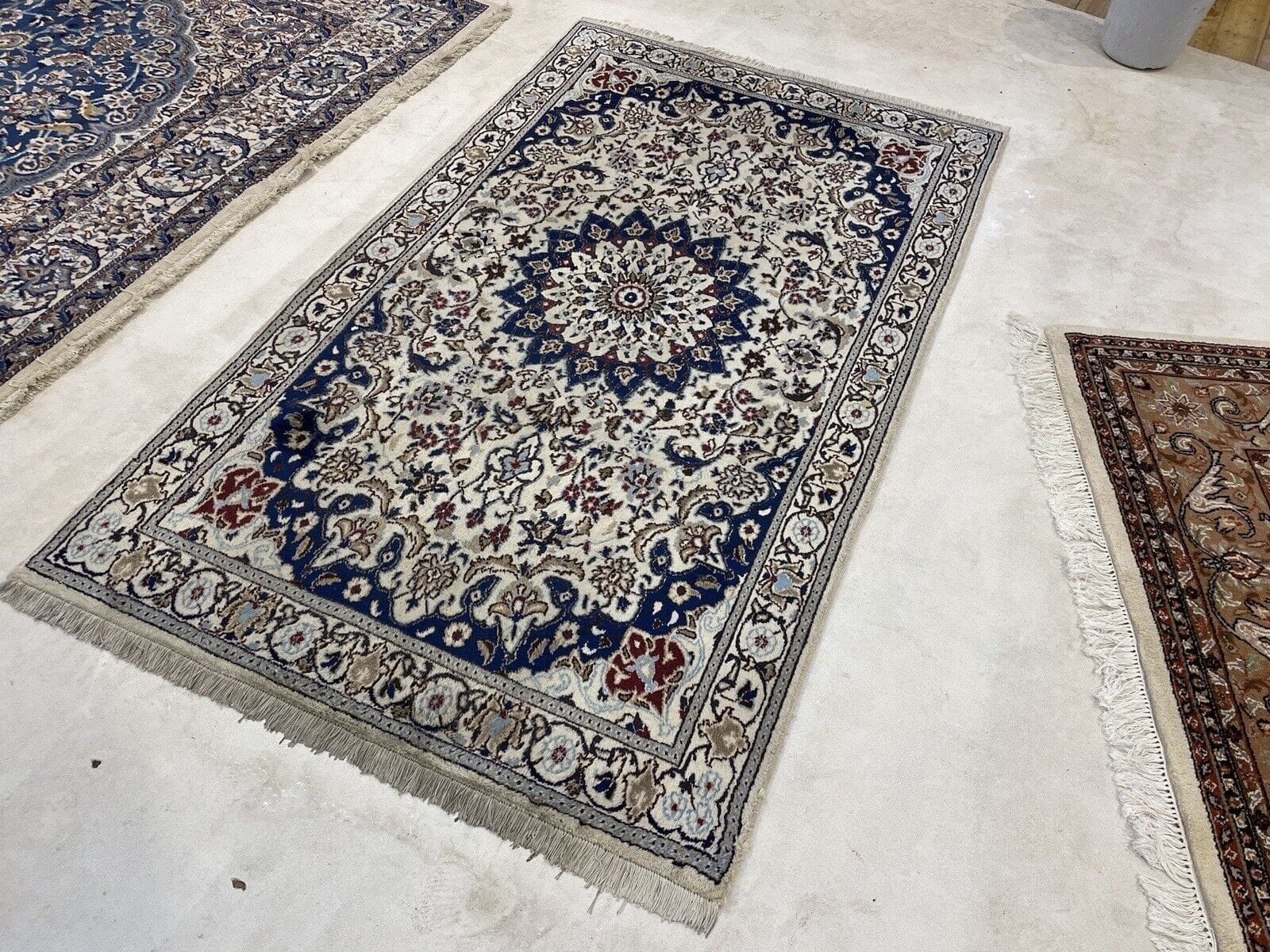
Hand-knotted Nain Persian rug | Material: Wool and cotton | Size: 200×115 cm | Pattern: Floral design with medallion and decorated corners | Condition: New with tag
This Nain Persian rug is hand-knotted and made from high-quality wool and cotton. The combination brings together the properties of both fibres and forms an essential part of the rug’s character. Wool is used in hand-knotted rugs for its soft feel and durable nature. Cotton contributes a firm, even fibre structure to the construction. Together, these materials create a textile floor covering with a tactile surface and a clearly handcrafted finish.
With hand-knotting, each knot is placed individually into the foundation. The knots are built up row by row and compacted before the surface is finished and evened. This process distinguishes a hand-knotted rug from an industrially produced floor covering. Minor variations in the surface or in the alignment of individual motifs belong to this method of manufacture and give each one-off rug its own expression.
Knot density is an important feature of traditional Nain rug making. A high number of knots allows for delicate lines and detailed ornament. It also requires time, experience and careful execution. The work is patient and methodical because the pattern is not printed onto an existing surface; it develops as the rug is knotted. The specific material information for this rug is the combination of wool and cotton, while its defining technique is hand-knotting.
Origin and Tradition
Nain is a well-known rug-producing region in Iran. The city is located in the centre of the country and has been associated with the production of fine rugs for centuries. Nain rugs represent a regional tradition in which established knotting methods are combined with clearly organised floral designs. The name therefore identifies not only a place, but also a distinctive craft and design direction within the wider tradition of Persian rugs.
The art of rug making in Nain belongs to a long Iranian cultural history. Its origins reach back to the fifteenth century. Nain designs may contain spiritual and cultural symbols rooted in Iran’s history. Floral forms, balanced arrangements and finely worked details are among the elements that give Nain rugs their recognisable character. Knowledge is passed on through the craft and can be combined with more contemporary compositions in later work.
Nain workshops traditionally plan the structure of a design with care. A central order keeps the medallion, border areas and corner details related to one another. This produces a balanced composition in which the individual groups of ornament do not appear randomly placed. The combination of organised structure and fine drawing has helped Nain rugs become recognised as a distinct regional form beyond their Iranian place of origin.
The region’s tradition also includes a considered use of classic colours and floral motifs. Nain rugs can unite traditional foundations with room settings that are more modern in character. This rug is identified as a Nain Persian rug and uses that regional vocabulary through a central medallion, floral ornament and decorated corners. Its Persian origin is defined by the Nain designation and by the Iranian rug-making tradition.
Design and Pattern
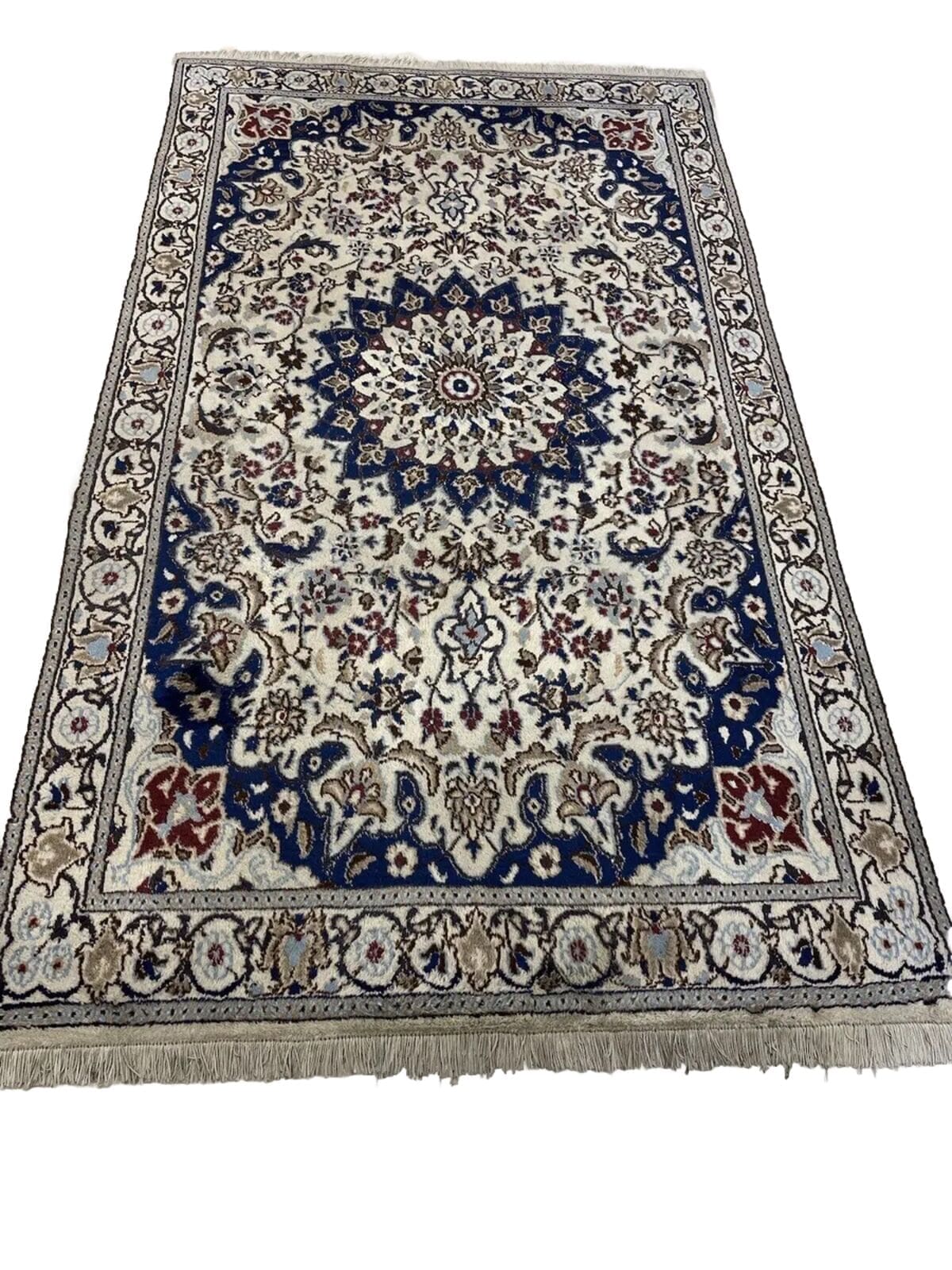
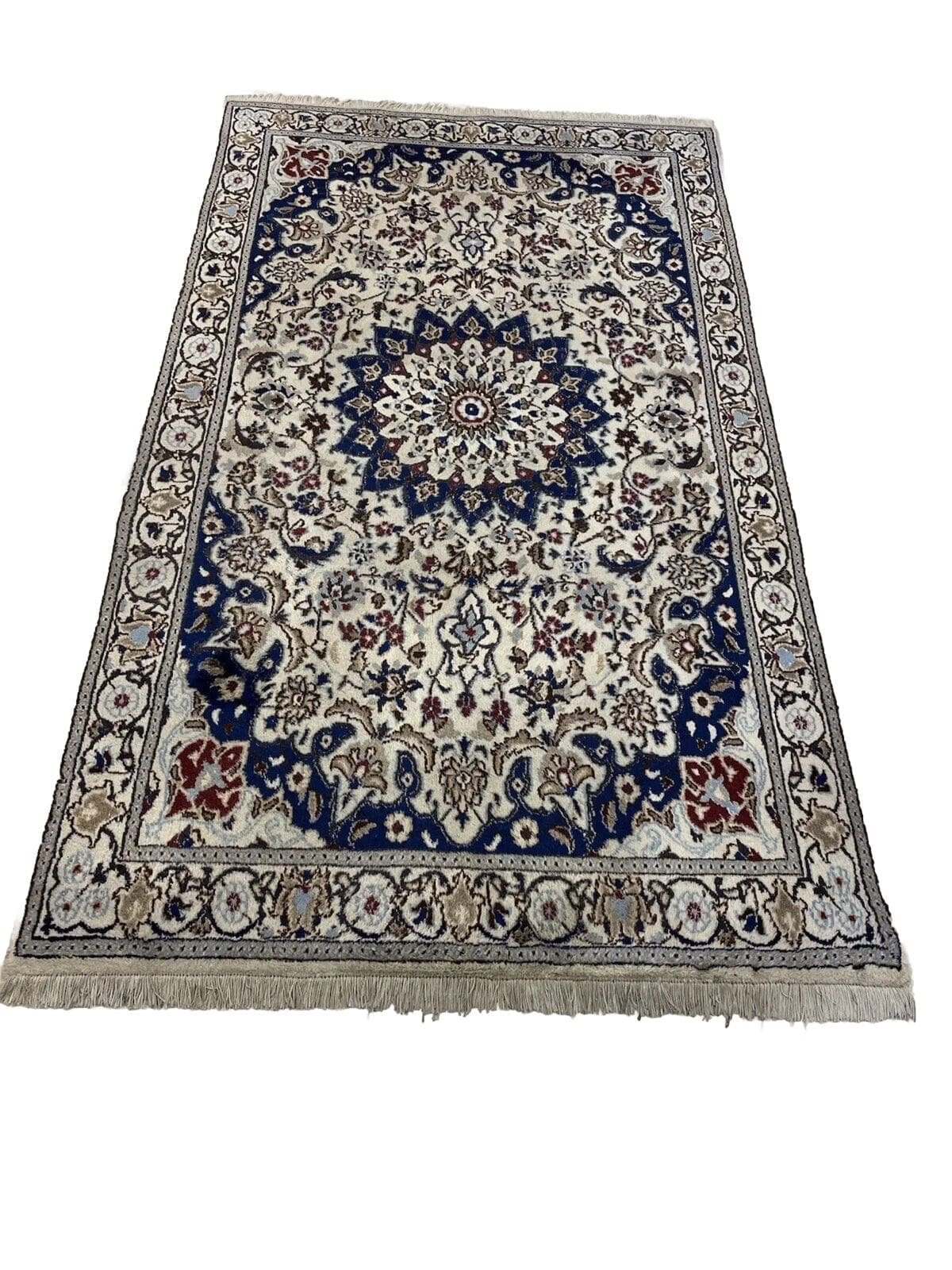
The design of this rug is floral. A medallion occupies the centre and provides the main organising element for the field. Fine floral motifs are arranged around it. The decorated corners continue the central composition towards the edges of the inner field. The result is a design whose structure comes from the relationship between the centre, the corner fields and the surrounding ornamental elements.
In Persian rug design, a medallion can serve as the visual focus of a composition. It gathers the pattern into a clear centre and gives the eye an orientation point. Floral vines, blossoms and leaves are often arranged to surround the medallion or to create a rhythmic movement from it. In this rug, the floral arrangement is central to the design, while the composition remains broader than any single individual motif.
The decorated corners are another important part of the pattern. They frame the medallion and create a transition between the central field and the border. Corner pieces of this kind help a detailed rug appear coherent and balanced. The border of this model is specified as beige. It provides the outer finish and supports the visual separation between the patterned inner field and the edge of the rug.
The colours are described as beige and brown. These tones give the floral design a restrained and warm foundation. The drawing remains visible without being governed by sharp colour contrasts. Nain rugs are known for fine, detailed patterns and classic colour schemes. This design connects that regional tradition with a palette that can sit within both classic and modern interiors.
The pattern is traditionally Persian while remaining clearly structured. The combination of medallion, floral detail and decorated corners is not a random scattering of motifs but a layered arrangement. The centre, corner areas and border each have a recognisable role. This reflects the importance of symmetry, repetition and a balanced relationship between open field and ornament in Persian rug design.
Special Features
A key feature is the hand-knotted construction. Every knot is placed by hand, so the rug is not made as a perfectly uniform series product. Its individual execution is connected with the work of artisans who pass traditional techniques and knowledge from one generation to the next. Production can take months, showing the time involved in creating a knotted rug by hand.
The rug is described as new with a tag. It is rectangular, suitable for use over underfloor heating and has a beige border. The pile height is stated as 1 to 3 cm. Together with the wool and cotton material, the floral medallion design and the decorated corners, these details form the specific profile of this one-off rug.
Hand-knotted rugs are used not only as floor coverings but also as defining textile elements within a room. Their pattern can establish a distinct area in a living room, dining room, hallway or beneath a coffee table. As with other rugs, long-term use depends on suitable care and on the conditions of the room in which it is placed.
FAQ
How should I care for my Persian rug?
Regular vacuuming removes loose dirt and dust from the pile. Spills should be treated promptly so that they do not become permanent marks in the fibres. Professional cleaning once a year is recommended for thorough care and for helping preserve the colours and textile surface. Cleaning should take account of the hand-knotted construction as well as the wool and cotton material combination.
Where is a suitable place for my Nain Persian rug?
The rug is suitable for living rooms and dining rooms, as well as hallways or the area beneath a coffee table. Its rectangular shape supports these uses. Direct sunlight should be avoided to reduce the risk of colour fading. Rooms with lower humidity are preferable. Since the rug is suitable for underfloor heating, it can also be used in appropriately equipped interior spaces.
How does a Nain rug differ from other Persian rugs?
Nain rugs are known for high knot density, fine materials and floral designs that often include silk. Compared with rugs from regions such as Tabriz or Isfahan, they are generally lighter and have a more subtle interplay of colour. Each model has its own character, shaped by its production region and individual design. This particular model is defined by its floral medallion, decorated corners and beige-brown colour scheme.
To provide the best experiences, we use technologies like cookies to store and/or access device information. Consenting to these technologies will allow us to process data such as browsing behavior or unique IDs on this site. Not consenting or withdrawing consent, may adversely affect certain features and functions.
Functional Always active
The technical storage or access is strictly necessary for the legitimate purpose of enabling the use of a specific service explicitly requested by the subscriber or user, or for the sole purpose of carrying out the transmission of a communication over an electronic communications network.
Preferences
The technical storage or access is necessary for the legitimate purpose of storing preferences that are not requested by the subscriber or user.
Statistics
The technical storage or access that is used exclusively for statistical purposes.The technical storage or access that is used exclusively for anonymous statistical purposes. Without a subpoena, voluntary compliance on the part of your Internet Service Provider, or additional records from a third party, information stored or retrieved for this purpose alone cannot usually be used to identify you.
Marketing
The technical storage or access is required to create user profiles to send advertising, or to track the user on a website or across several websites for similar marketing purposes.
 SECURE PAYMENT
 SHIPPING PARTNERS


