This Nain Persian rug is hand-knotted. Its pile contains 90% new wool and 10% silk, while the warp is made from 100% cotton. Wool is the principal pile fibre, giving the surface the substantial, tactile character associated with wool. Silk adds fineness and a distinct sheen. Cotton belongs to the foundation of the rug, where the warp provides the structure around which the knots are formed. The material description therefore distinguishes clearly between the visible pile and the supporting construction.
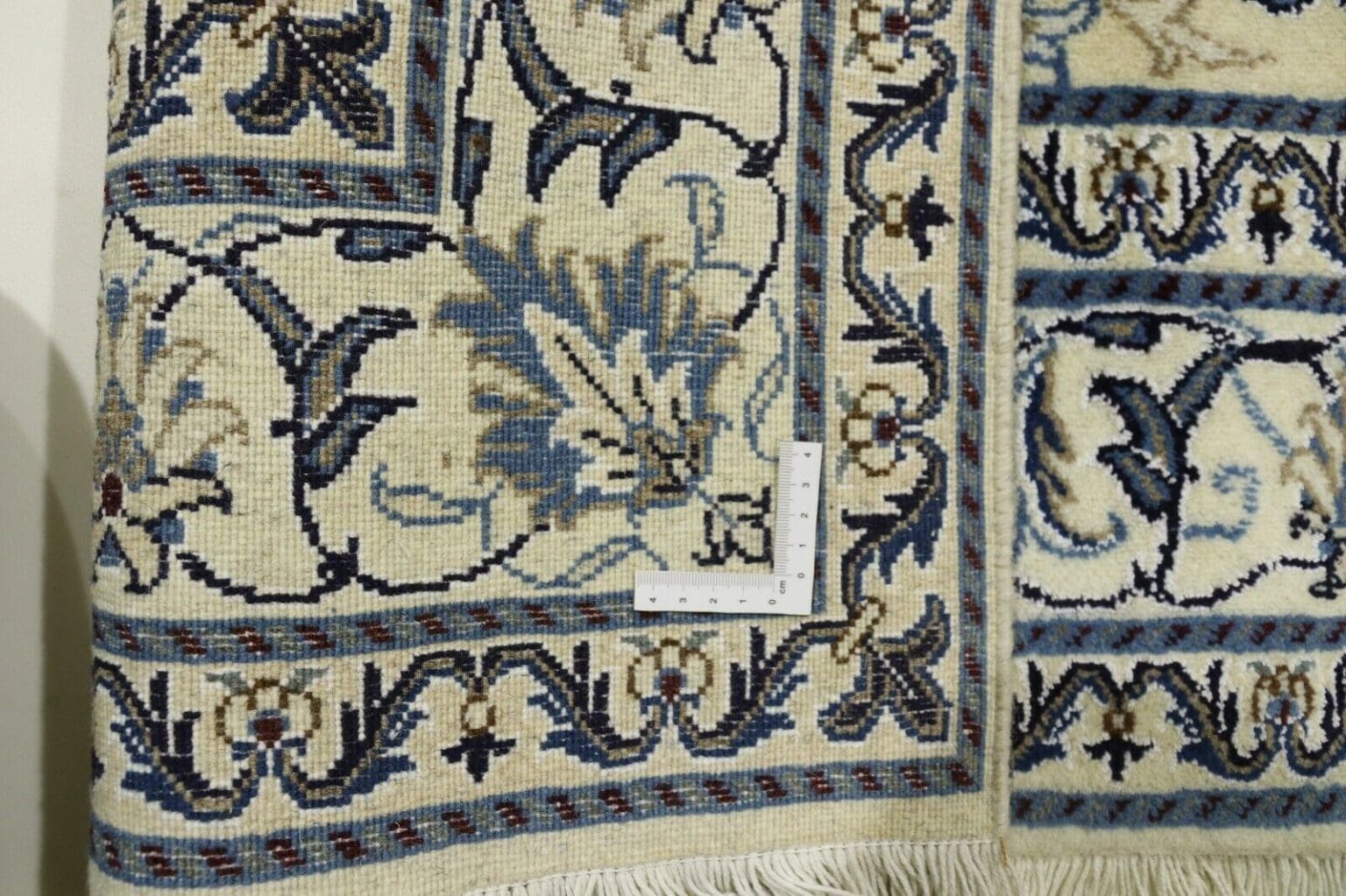
Hand-knotting builds a rug one knot at a time. The warp is prepared on the loom, and the pile fibres are tied manually around the warp threads. Rows of knots are secured with weft threads as the work progresses. Once the knotting is complete, the pile is trimmed so that the drawing can be read across the surface. The process requires steady tension, careful counting and practical knowledge of the relationship between the design and the loom.
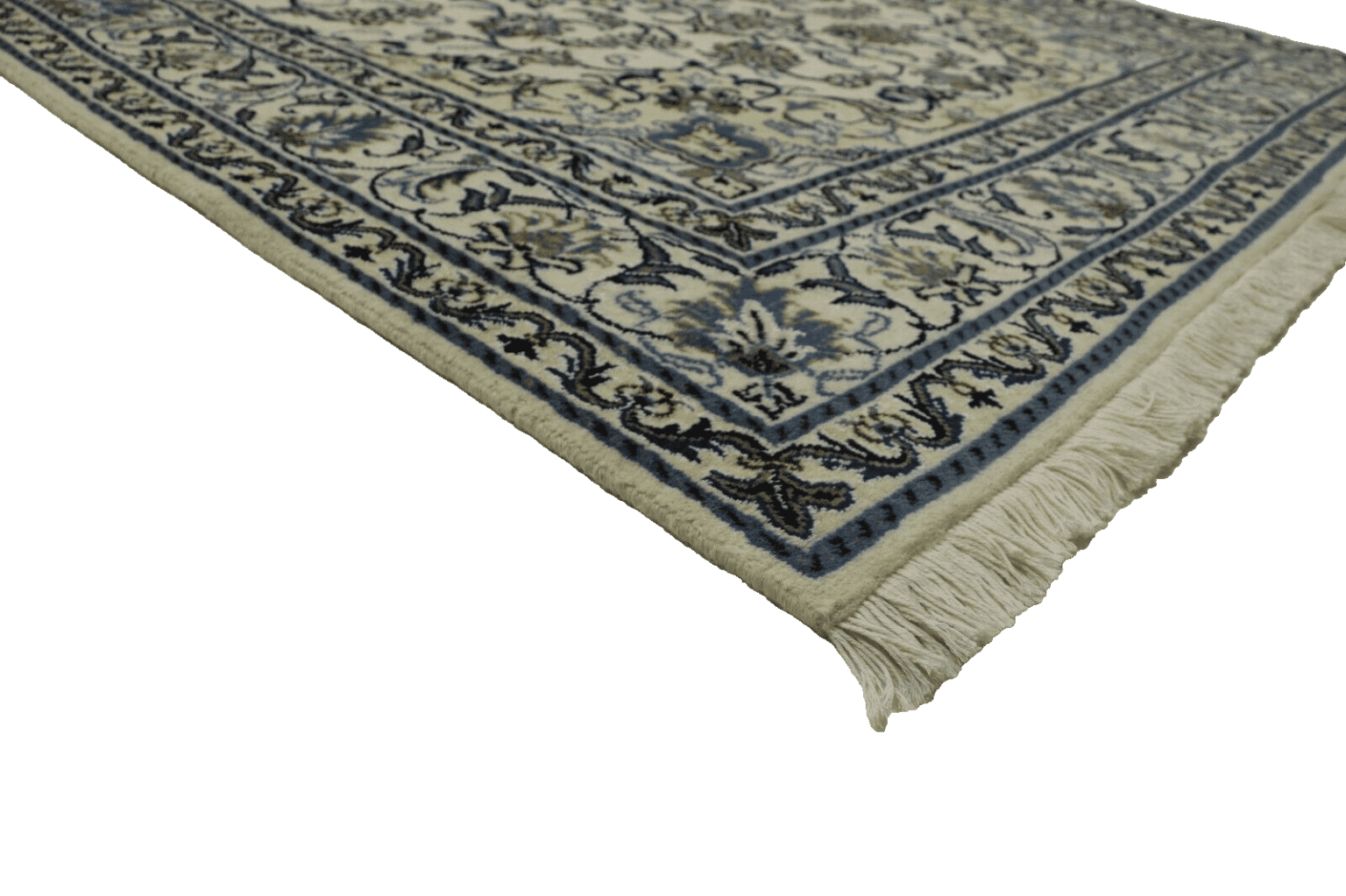
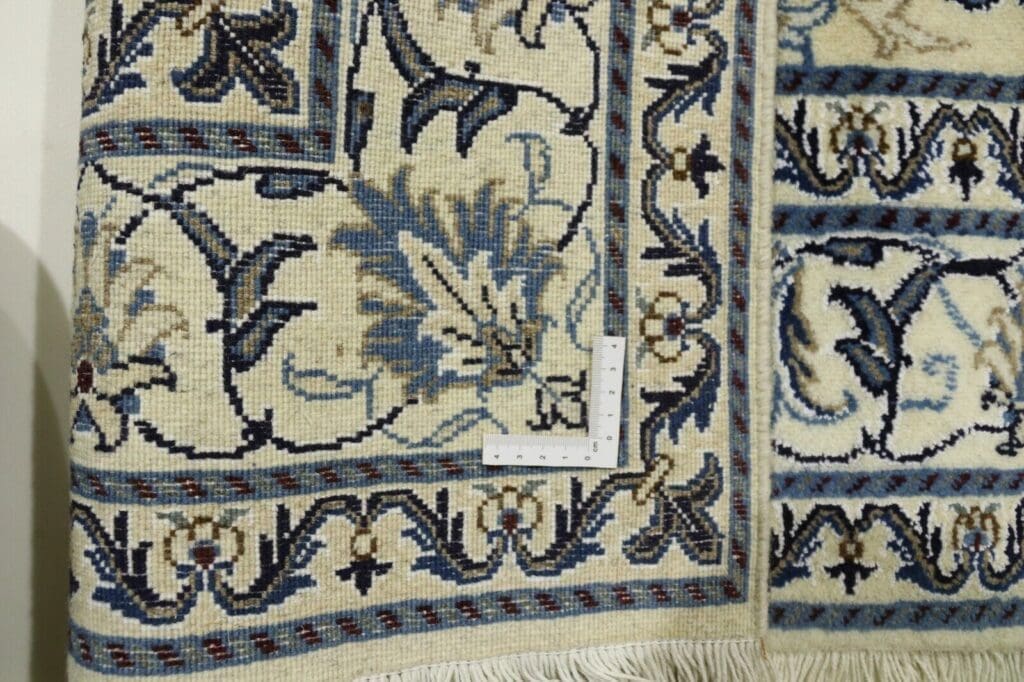
The stated knot density is approximately 300,000 knots per square metre. Knot density is a technical measure of how closely the individual knots are placed. A finer construction can support the drawing of narrow lines, small floral details and carefully controlled curves. Density is only one aspect of a rug, but it is an important part of its construction and helps describe the level of detail that a design can accommodate.
Wool and silk have different textile properties. Wool has a fuller and generally more tactile surface, while silk is finer and reflects light in its own way. Used together in a pile, the two fibres can create changes in texture and subtle variations in the way ornaments are seen. The cotton warp remains largely within the foundation and supports the knotted pile. Combining these fibres is part of the technical vocabulary of finely made Persian rugs.
Handmade construction also distinguishes the rug from a machine-produced floor covering. A machine can reproduce a programmed surface repeatedly, whereas hand-knotting involves many separate manual decisions. Each knot is placed within the developing pattern, and the final result reflects the individual execution of the craft process. This is why hand-knotted rugs are treated as individual textile works rather than identical industrial products.
Origin and Tradition
Nain is a city in Iran and a recognised centre of Persian rug weaving. The local tradition reaches back to the late nineteenth century. Nain rugs are commonly associated with fine fibres, high knot densities and carefully drawn designs. Their regional identity developed within the larger Persian tradition, combining established methods of loom work with a preference for precise ornament and balanced composition.
Nain is located in Isfahan Province. Isfahan has long been an important centre of Persian art, architecture and design. The surrounding cultural environment encouraged a rug tradition in which drawing, material selection and workmanship were treated as connected parts of the finished object. Nain represents a distinct local expression within Iranian rug making. The name identifies a place of origin as well as a particular relationship between fine knotting and controlled decorative structure.
The history of Persian rug weaving depends heavily on the transmission of workshop knowledge. Preparing and stretching the warp, reading a design, tying the knots, inserting the weft, trimming the pile and finishing the edges are all specialised stages. They require different kinds of attention, yet they must work together for the final pattern to remain consistent. Skills were traditionally learned through long practice and passed between generations, workshops and weaving communities.
Iran contains many rug-producing regions, each with its own preferences in structure, colour, border design and ornament. Urban workshops often work from detailed plans and repeat established compositions, while village and nomadic weaving may use more direct interpretations of local motifs. These categories overlap, and the regions have influenced one another over time. Patterns, techniques and materials travelled, were adapted and became part of new local expressions.
Nain is often linked with a refined urban workshop tradition. Medallions, floral vines and finely divided plant forms occur frequently in the broader Nain design vocabulary. These elements may be arranged with strong symmetry or developed in a more flowing composition. The identity of the tradition does not depend on one fixed layout. It lies in the combination of fine execution, measured proportions, detailed drawing and the use of suitable pile materials.
The wider history of Oriental rug weaving includes nomadic, village and city production. Nomadic rugs often preserve bold geometric structures shaped by portable looms and local visual traditions. Village rugs may combine inherited motifs with individual interpretations. City rugs generally allow more elaborate plans and complex floral arrangements. Persian weaving contains all of these approaches, and the distinction between them helps explain why Iranian rugs show such a broad range of designs and constructions.
Making a finely knotted rug involves translating a visual plan into a sequence of individual knots. The weaver must maintain the order of colours and the proportions of the design while working across the loom. Curves are built from small changes in the placement of knots, and repeated motifs must remain aligned. Regular inspection of the developing surface is therefore part of the craft. The technical process and the decorative intention cannot be separated from one another.
Persian rugs have served practical, decorative and cultural roles. They can cover a floor, define a room and provide a surface on which regional art is preserved. Their borders, medallions and plant motifs belong to a long visual history that has been revised in different periods and workshops. A Nain rug participates in this history through the city’s own methods, patterns and material preferences, while remaining part of the wider Persian tradition.
Design and Pattern
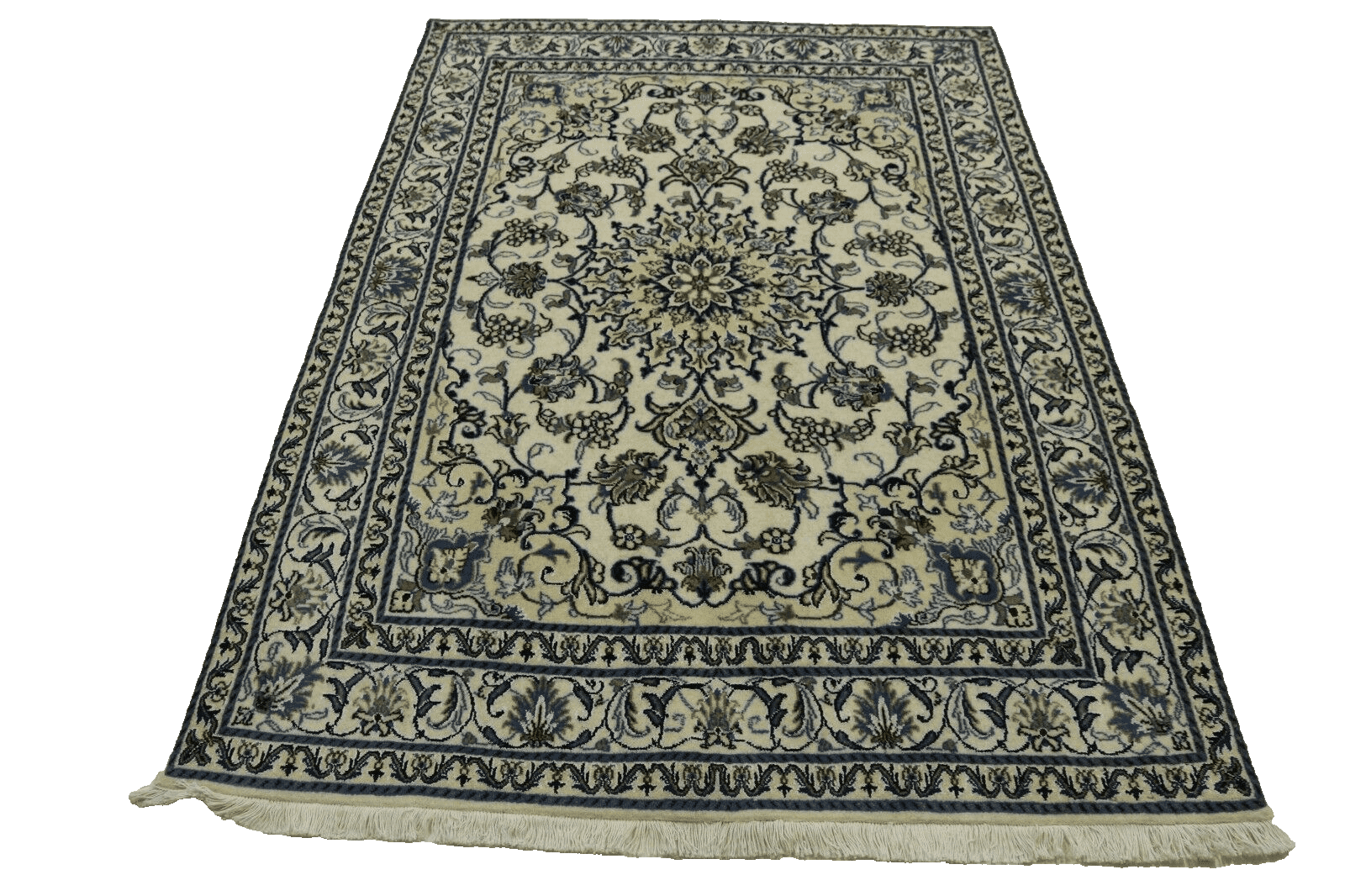
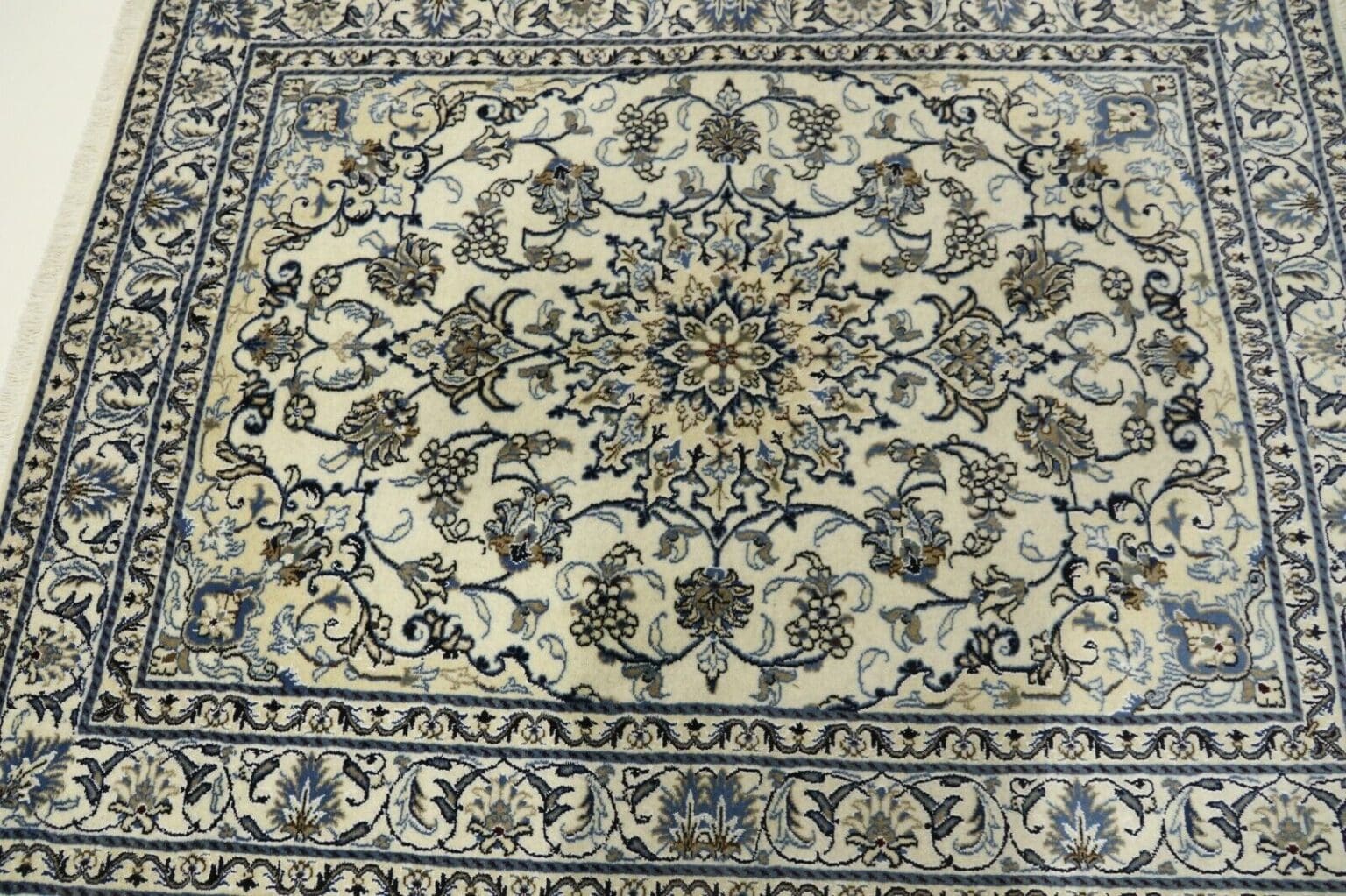
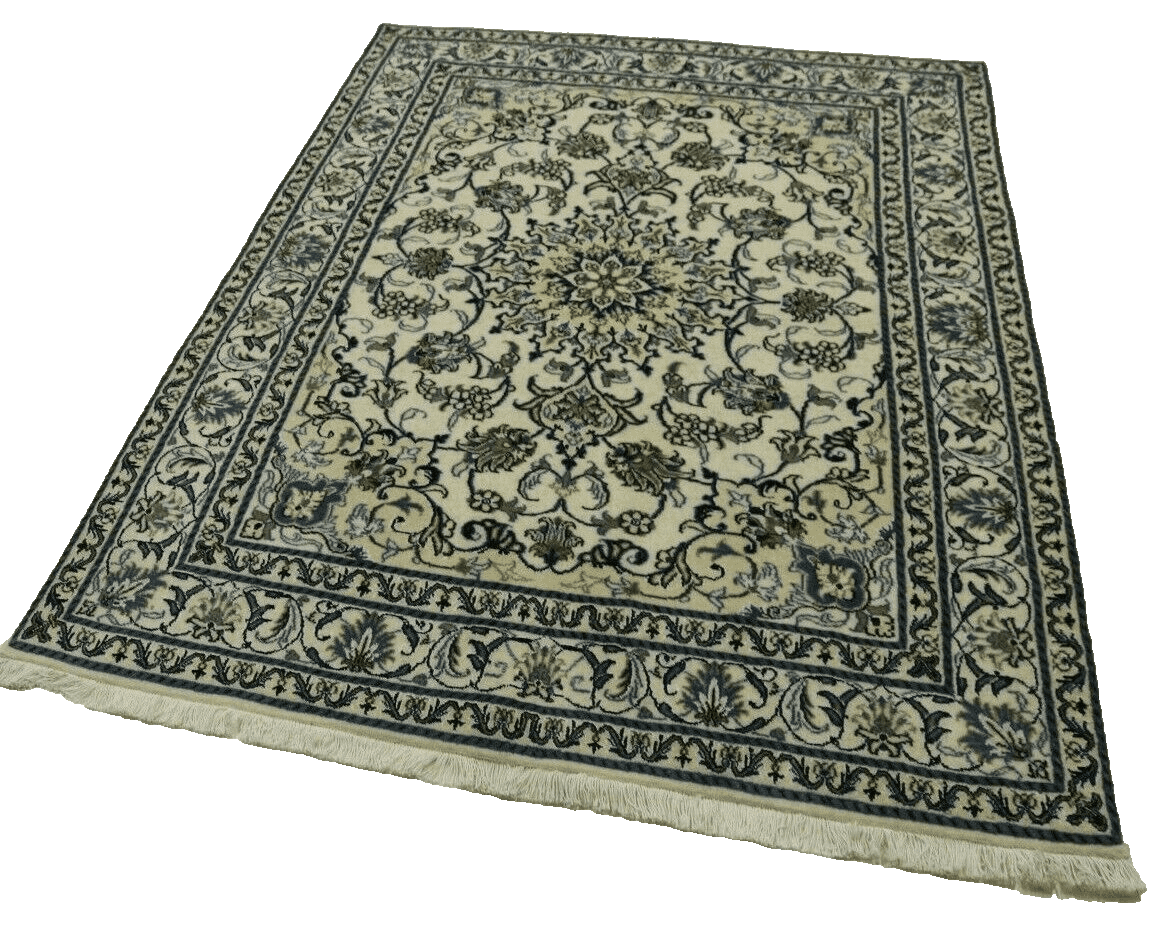
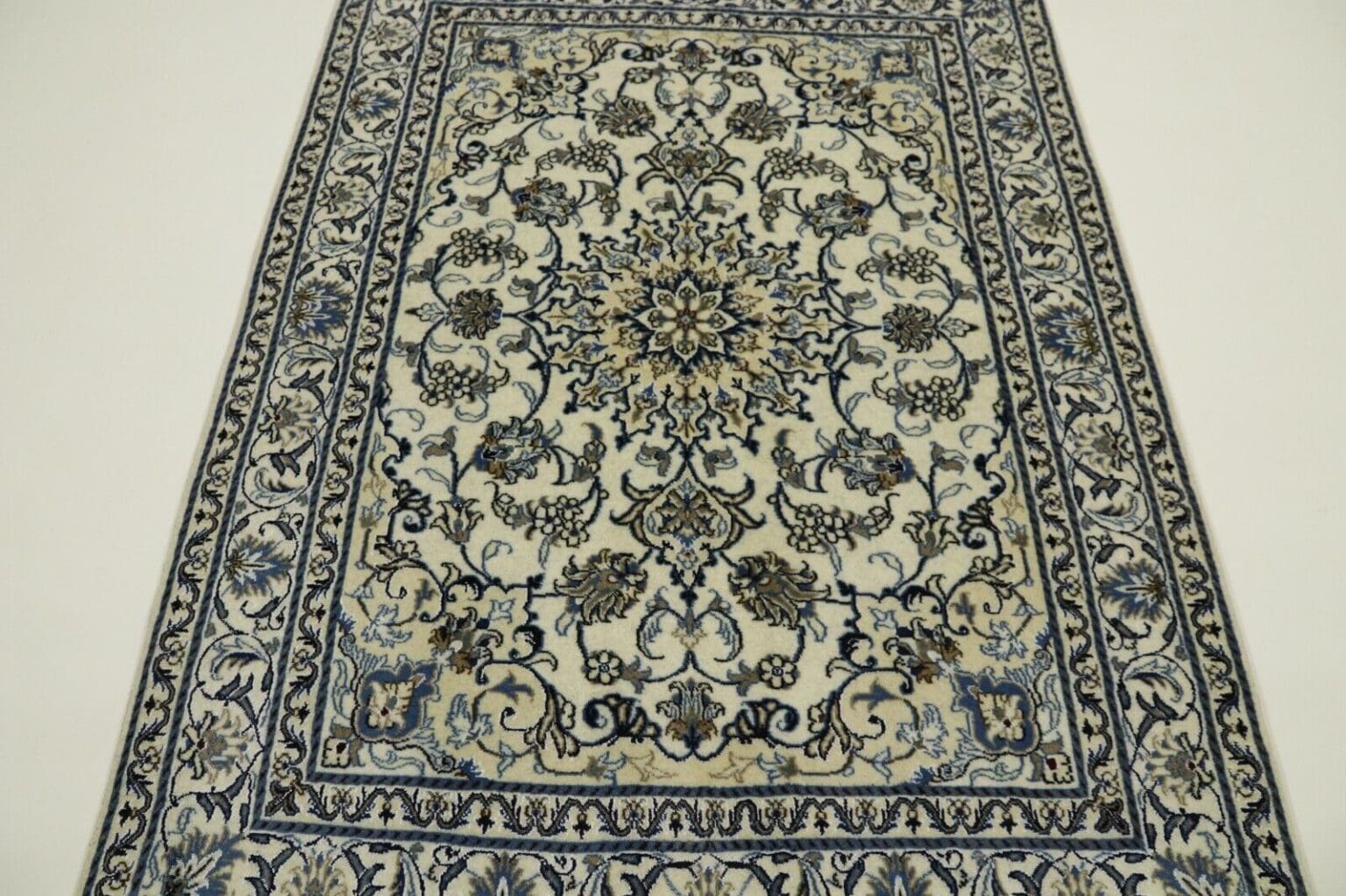
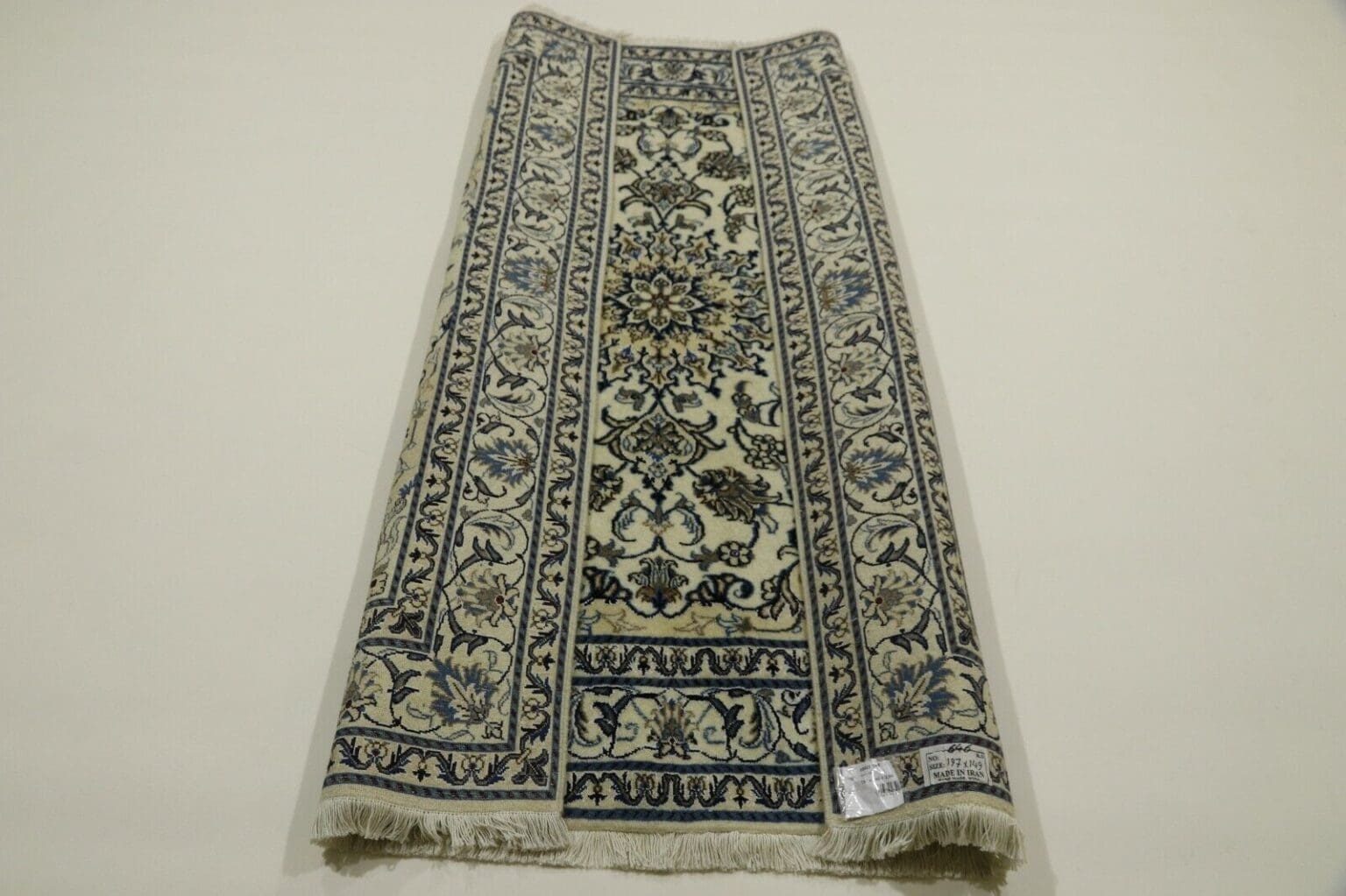
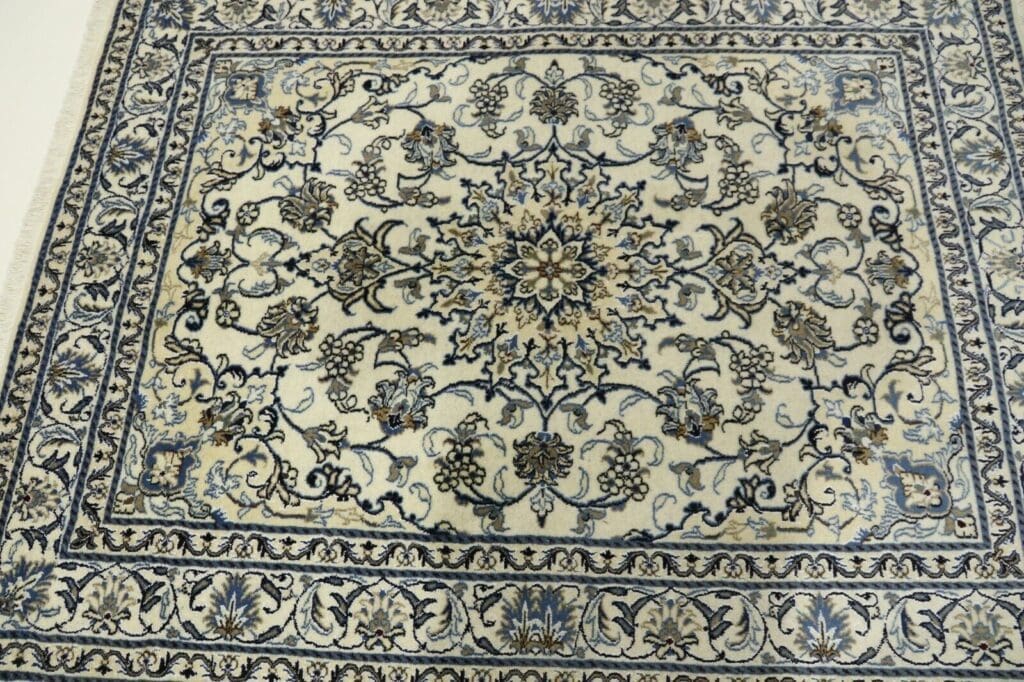
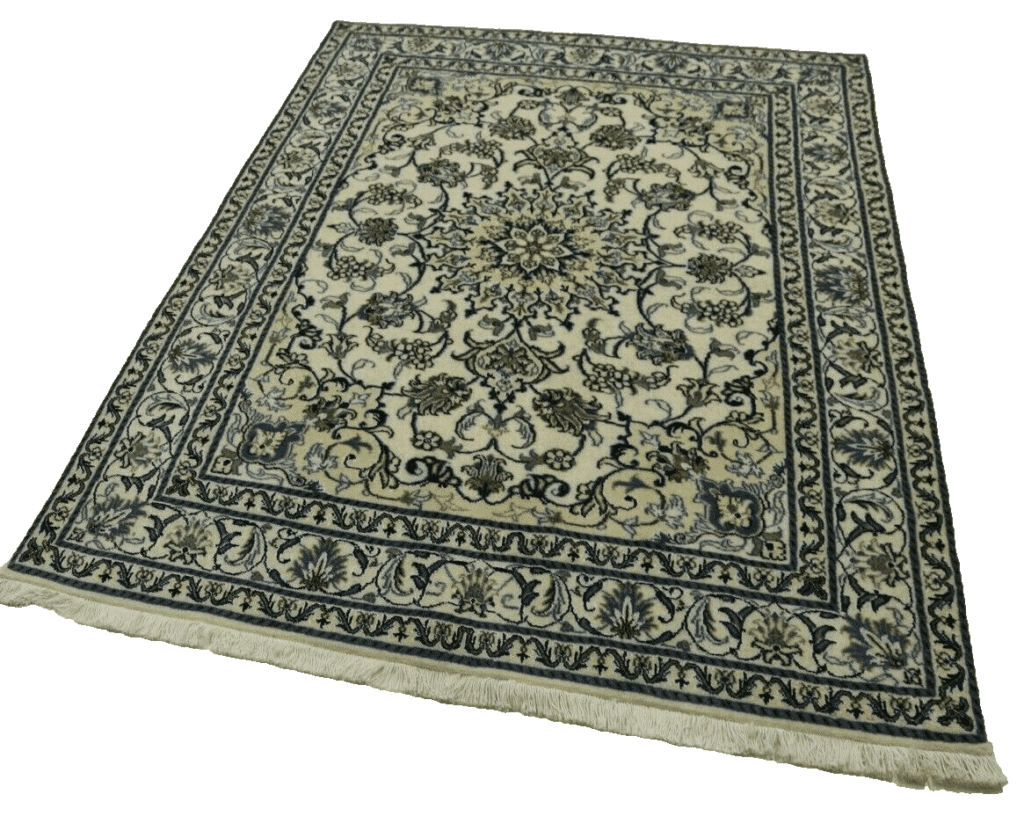
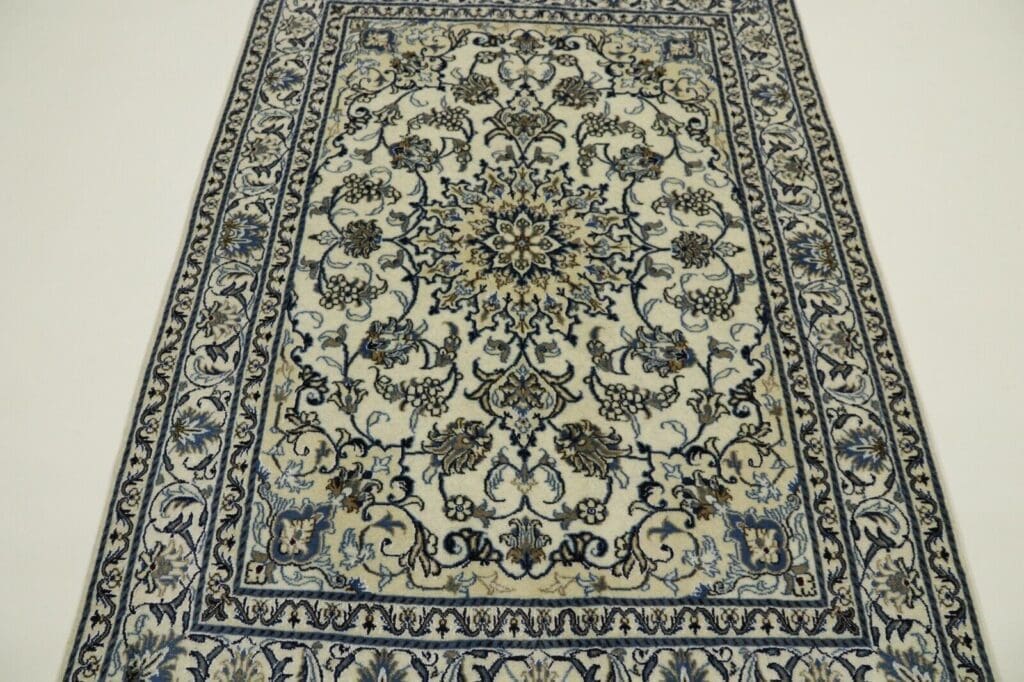
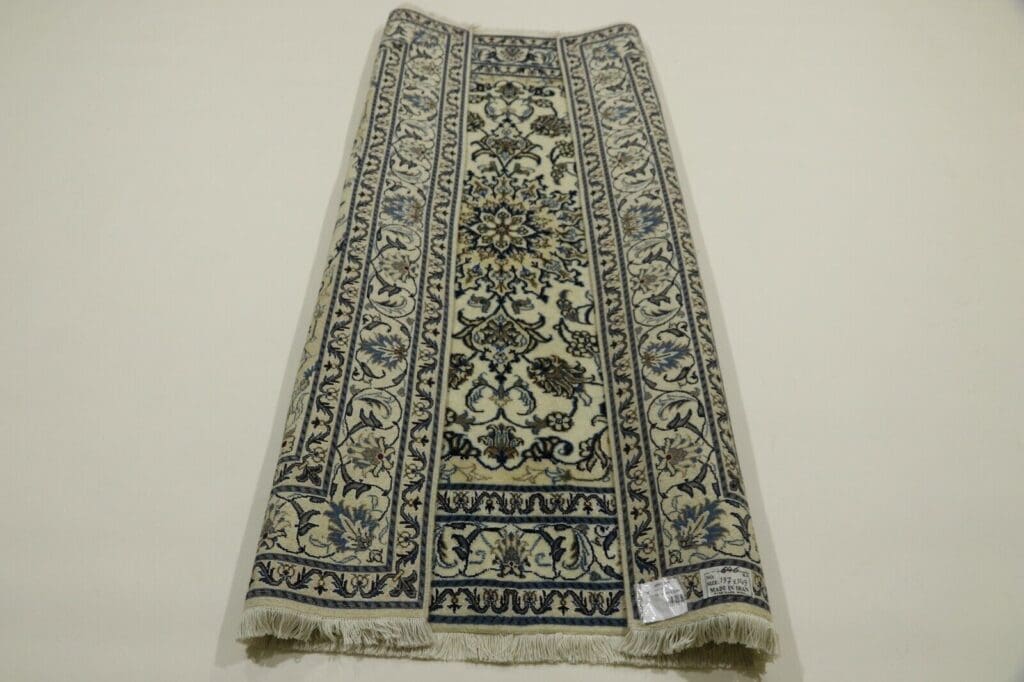
The rug is classified in the traditional Oriental and Persian style. Designs in this tradition are often organised into a central field, surrounding borders and smaller motifs that connect the composition. Nain patterns are frequently associated with medallion layouts, scrolling vines and finely rendered floral ornament. The arrangement may be strongly symmetrical or may allow the plant forms to move more freely across the field. In either case, the design depends on proportion and an ordered relationship between its parts.
A medallion can establish the visual centre of a composition. Vines, leaves and blossoms may extend from it or fill the surrounding field. Border bands frame the interior and create a transition toward the edge of the rug. Repeated details establish rhythm, while variations in scale keep the ornament from becoming a mechanical pattern. The quality of the drawing depends on how these elements are balanced and how clearly their contours are expressed in the pile.
Geometric and floral forms are two fundamental components of Oriental rug design. Straight lines, angles and repeated units create a framework of order. Curved vines, leaves and flowers introduce movement and organic shapes. Persian designers have long combined these visual languages. A composition can therefore appear highly structured while still suggesting plants and natural growth. Fine knotting allows transitions between straight and curved forms to be rendered with greater control.
White is given as the colour of this rug. A light ground can make drawn ornaments easy to distinguish and can give the composition an open visual quality. Nain designs often use pale fields together with defined motifs and carefully arranged borders. The appearance of a colour depends on more than the dye itself. Fibre, pile direction, surface trimming and the light falling on the rug all influence how the field and pattern are perceived.
Silk can reflect light differently from wool. Where silk is present in a pile, it may create finer highlights and changes in appearance as the viewing angle shifts. Wool tends to contribute a fuller and more subdued surface effect. Designers and weavers can use these differences to give selected parts of a pattern additional definition. The result depends on the particular distribution of the fibres and on how the ornament was executed.
Traditional Oriental motifs are often discussed in relation to nature, balance and order. Floral forms may evoke growth, flowering and the abundance of the natural world. Symmetrical arrangements can suggest harmony and stability. Such interpretations belong to the broader history of the motifs and do not reduce every ornament to one universally fixed meaning. The character of a rug emerges from the combined effect of the field, border, repeated details and overall proportion.
A traditional Nain composition can be placed alongside both classical furniture and more contemporary interiors because its visual language is based on balanced structure rather than on one particular period of furnishing. Medallions, borders and floral details can read as historic while still providing a clear graphic organisation. The hand-knotted surface adds another layer to the design, since the pattern is physically built from individual knots rather than printed onto a flat material.
The description connects the use of natural dyes with an environmentally conscious approach. Historically, Persian dyers worked with plant, mineral and other natural sources, preparing them through processes that varied by region and period. The final colour depended on the fibre, the mordant, the dye bath and the conditions of production. Wool and silk do not receive or reflect colour in exactly the same way, so a shared colour family can show different nuances across the pile.
Hand-knotting gives the pattern a specific technical foundation. Every contour consists of many separate knots, and the knot density affects how closely fine details can be placed. Small flowers, narrow vines and delicate outlines require careful coordination between the design plan and the work on the loom. The regional pattern tradition supplies the forms, while the craftsman’s execution determines how those forms appear in the finished textile.
Special Features
The rug is described as new and in very good condition. It has a rectangular form and is white. The listed practical features include suitability for underfloor heating and a pet-friendly designation. These details supplement the information about its origin, style, materials and handmade production and describe aspects relevant to use in a home.
Its hand-knotted construction and approximately 300,000 knots per square metre are also defining characteristics. The pile is made from 90% new wool and 10% silk, while the warp is 100% cotton. Wool provides the main pile material, silk contributes its finer surface character and cotton forms part of the supporting foundation. Manual production means that the individual piece has its own execution rather than the uniformity of a machine-made copy.
The description gives the rug a thickness of approximately 9 mm. It also describes the rug as being traded in an environmentally friendly way and as a sustainable addition to the home. These statements belong alongside the listed rectangular shape, white colour and traditional Oriental/Persian style. Together, they provide practical, material and technical information without separating the rug from its Nain origin and Persian craft context.
FAQ
How should a Nain rug be cared for?
Regular vacuuming removes loose dust and particles before they become embedded in the pile. Fresh spills should be carefully lifted with a damp cloth instead of being rubbed forcefully. Strong friction can place unnecessary stress on the fibres and surface. Harsh cleaning agents should be avoided because they may affect colours, wool and silk. For deeper or more extensive soiling, professional rug cleaning is recommended. A specialist can choose a method suited to the pile fibres, the cotton foundation and the construction of a hand-knotted rug.
Where does the tradition of rug weaving come from?
Rug weaving has roots in the ancient Orient and developed distinctive forms in different regions. Iran, Afghanistan and Turkey each established their own combinations of patterns, fibres and techniques. In Iran, cities such as Nain and Isfahan are strongly associated with the continuation of this craft. Knowledge of preparing the warp, setting knots, inserting wefts, trimming the pile and finishing the borders was passed through generations. Over time, workshops adapted inherited designs and methods, creating the regional variety found across Oriental rugs. Nain belongs to the Persian urban tradition of fine materials, detailed ornament and careful knotting.
What are the advantages of a hand-knotted rug?
A hand-knotted rug is made one knot at a time and consequently has an individually executed surface. Natural fibres such as new wool and silk provide distinct tactile qualities and different forms of sheen. A fine knot structure allows small motifs, floral vines and detailed outlines to be rendered with precision. Each piece is unique because the making process is manual rather than industrially identical. A hand-knotted rug also connects practical use with a long-established craft tradition, allowing the patterns and technical knowledge of its region of origin to remain visible in the finished textile.
To provide the best experiences, we use technologies like cookies to store and/or access device information. Consenting to these technologies will allow us to process data such as browsing behavior or unique IDs on this site. Not consenting or withdrawing consent, may adversely affect certain features and functions.
Functional Always active
The technical storage or access is strictly necessary for the legitimate purpose of enabling the use of a specific service explicitly requested by the subscriber or user, or for the sole purpose of carrying out the transmission of a communication over an electronic communications network.
Preferences
The technical storage or access is necessary for the legitimate purpose of storing preferences that are not requested by the subscriber or user.
Statistics
The technical storage or access that is used exclusively for statistical purposes.The technical storage or access that is used exclusively for anonymous statistical purposes. Without a subpoena, voluntary compliance on the part of your Internet Service Provider, or additional records from a third party, information stored or retrieved for this purpose alone cannot usually be used to identify you.
Marketing
The technical storage or access is required to create user profiles to send advertising, or to track the user on a website or across several websites for similar marketing purposes.
 SECURE PAYMENT
 SHIPPING PARTNERS


