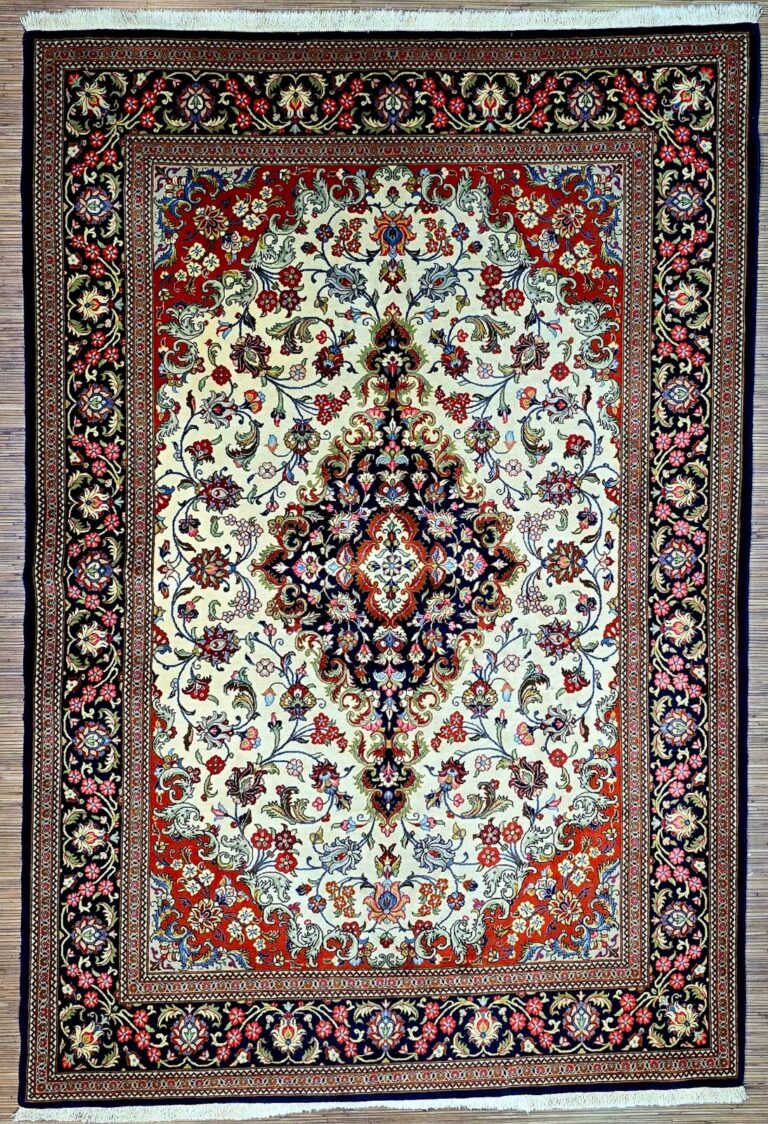
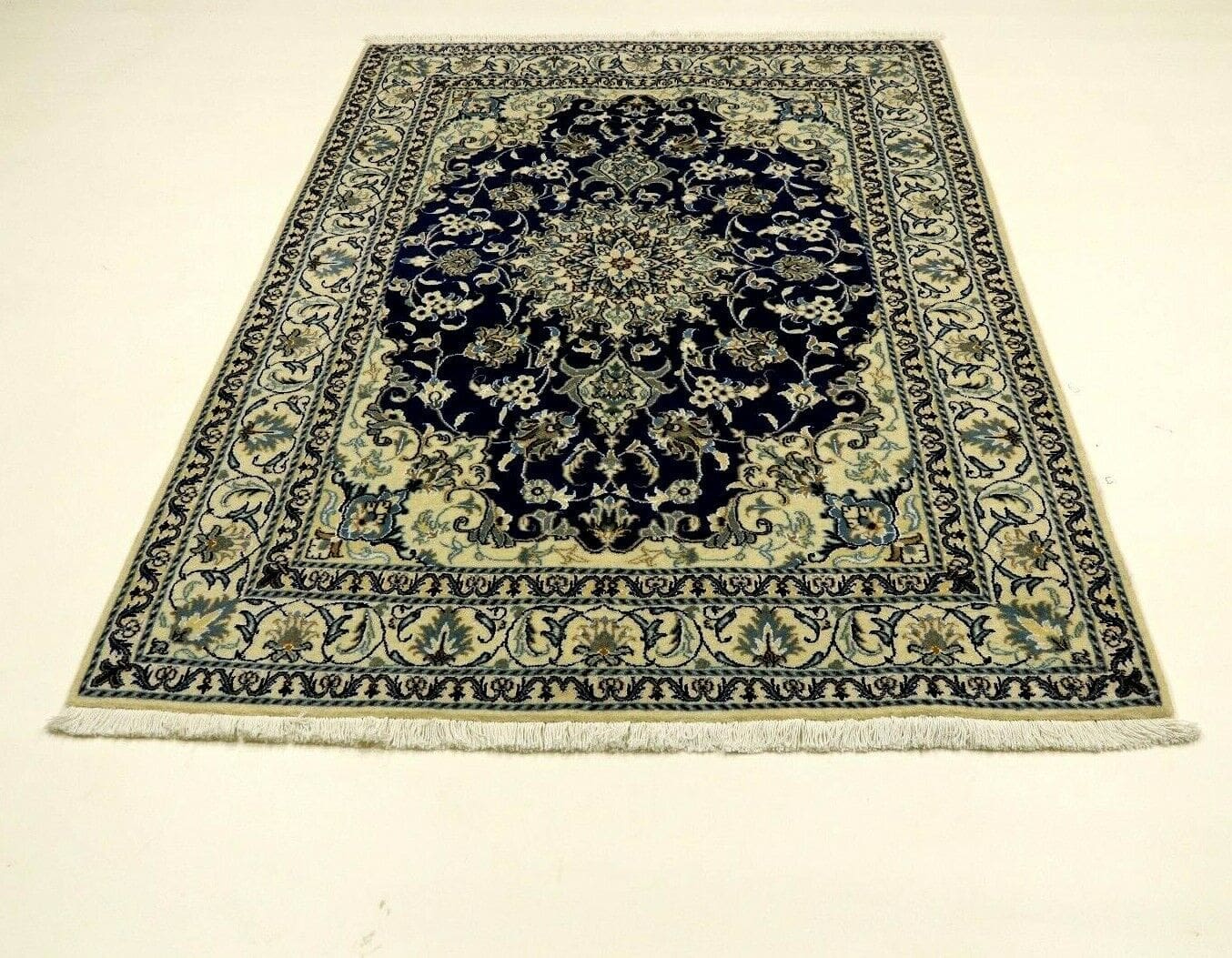
This Nain Persian rug is hand-knotted and made as a one-off piece. Its stated composition is 90% virgin wool and 10% silk. Wool makes up the principal part of the pile and has long been used in rug making for its resilient yet comfortable character. Silk adds a smoother fibre and a restrained play of light to the surface. Used together, the two materials give the rug a tactile and visual character different from that of an all-wool rug.
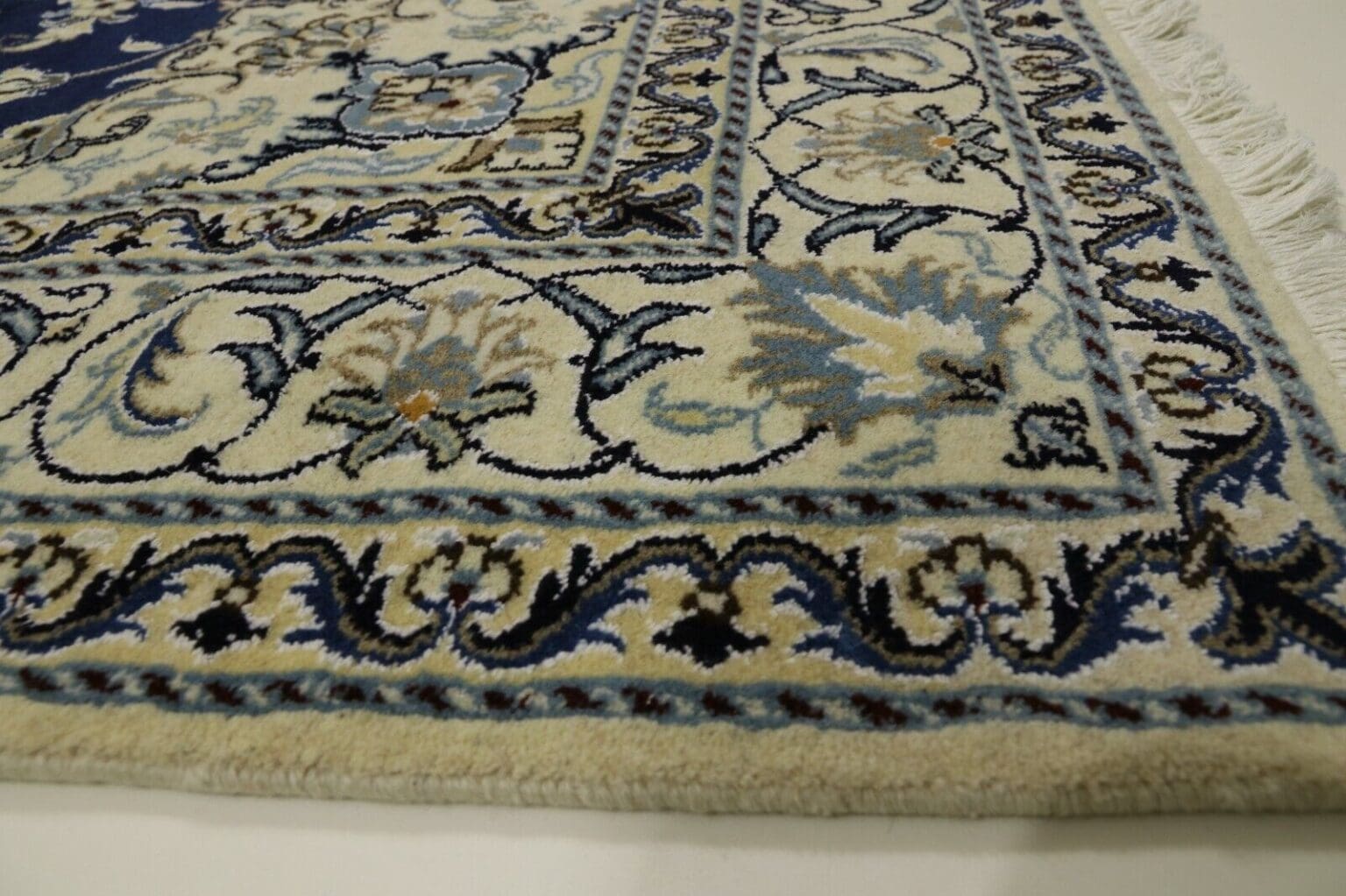
The rug is made by hand. Each knot is placed individually and joined to the surrounding knots as the woven surface develops. This process requires steady tension, close attention to the design and practical knowledge of the craft. A hand-knotted rug is therefore not equivalent to a machine-made floor covering. Minor individual features are part of a manually produced textile and help distinguish one piece from another.
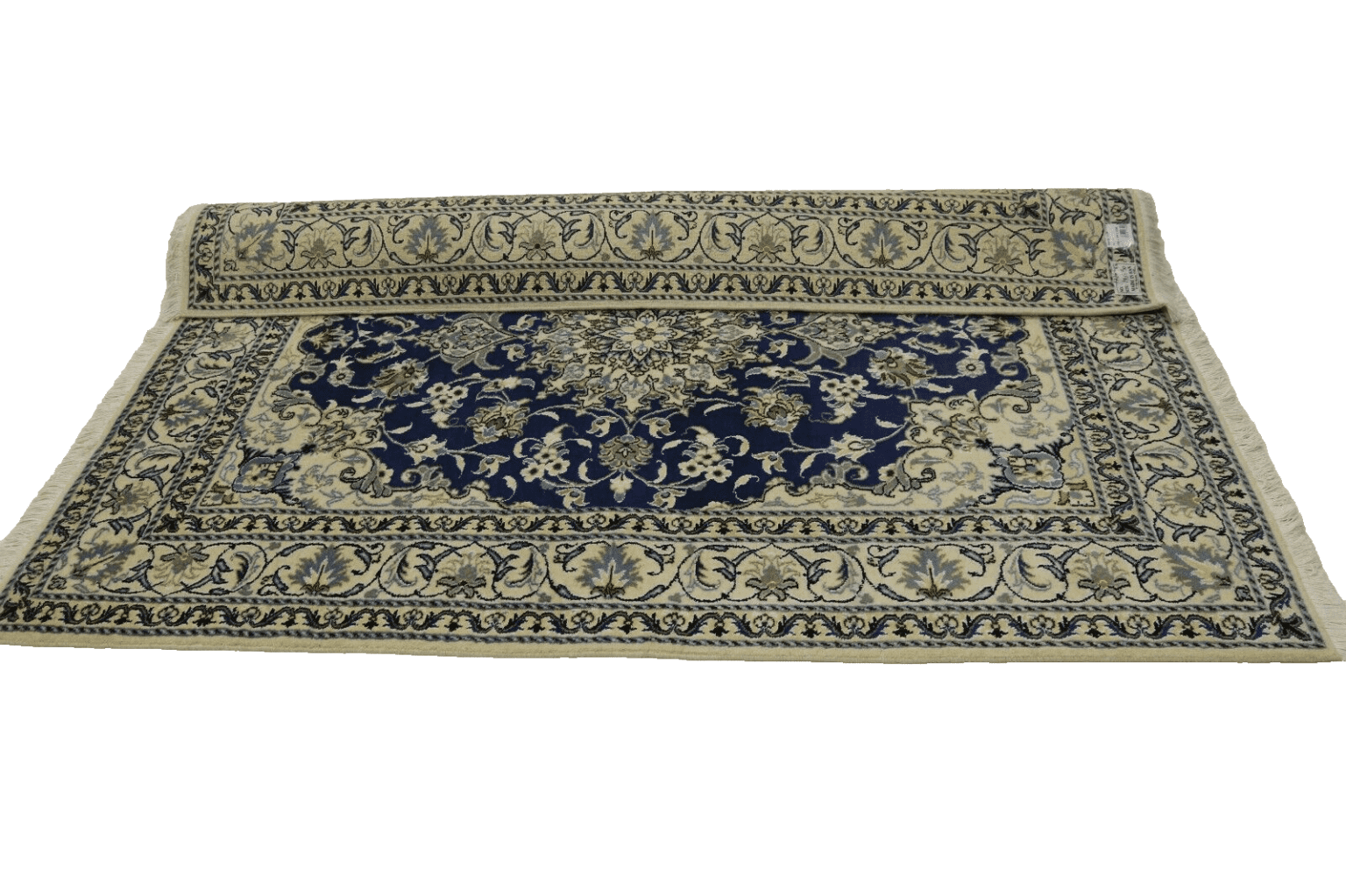
The listed knot density is approximately 300,000 knots per square metre. A dense knot structure allows fine lines and small ornamental details to be rendered with precision. The product description gives the rug a thickness of approximately 8 mm. It is described as new and in very good condition. The rug is also suitable for use with underfloor heating. This suitability should be considered alongside the instructions supplied by the relevant flooring and heating manufacturers.
Origin and Tradition
The rug comes from Persia, present-day Iran, and is identified as a Nain rug. Nain is a recognised centre of Persian rug making in central Iran. The town and its surrounding workshops developed a regional tradition associated with carefully drawn designs and finely executed carpets. In Nain, local workshop knowledge meets the broader ornamental vocabulary of Persian art. The place name therefore refers both to a geographical origin and to an established craft tradition.
Persian rugs are made in many regions, each with its own balance of materials, colour systems, drawing methods and workshop practices. Nain is associated with controlled pattern construction and a clear relationship between the central field and its borders. A design is not simply copied as a decorative picture; it is read and rebuilt through a long sequence of individual knots. The maker must maintain the order of the drawing while keeping the structure of the textile stable. This is what links the visible design to the underlying craft.
The Nain tradition belongs to the larger history of Persian carpet art, in which workshop methods and ornamental forms have been passed from one generation to the next. Floral scrolls, leaves, blossoms and geometric elements frequently appear in Nain designs. They may be arranged symmetrically, connected by winding lines or placed within carefully defined compartments. A border frames the main field, while smaller borders provide transitions and keep the composition visually organised. These conventions give the rug a distinct regional context without reducing every Nain rug to one fixed pattern.
The name Nain covers a range of compositions rather than a single unchanging template. Workshops may vary the arrangement of the field, the scale of individual motifs and the balance between open ground and ornament. What unites the tradition is the relationship to Persian design language and the disciplined execution of the knotted pattern. The designation Super Nain belongs to this context and indicates a finely worked Nain format. For this rug, that designation appears together with a high knot density and a blend of virgin wool and silk.
Iranian rug making also has a long relationship with architecture, domestic interiors and the decorative arts. Designs were preserved and adapted because they offered a visual system capable of organising a large surface. A scrolling vine can create movement, repeated geometry can establish rhythm, and a border can give the field a defined conclusion. Such principles explain why Nain rugs can be read in both traditional and restrained contemporary interiors. They carry a regional design tradition while remaining usable as woven floor textiles.
Hand knotting connects the material, the drawing and the working rhythm. The design is not printed onto a finished surface. It is built knot by knot, so the final textile is the result of the interaction between a planned pattern and manual execution. This distinction is central to the tradition of Persian rugs. It also explains why a one-off hand-knotted piece has its own physical and visual identity, even when it follows established regional forms.
Design and Pattern
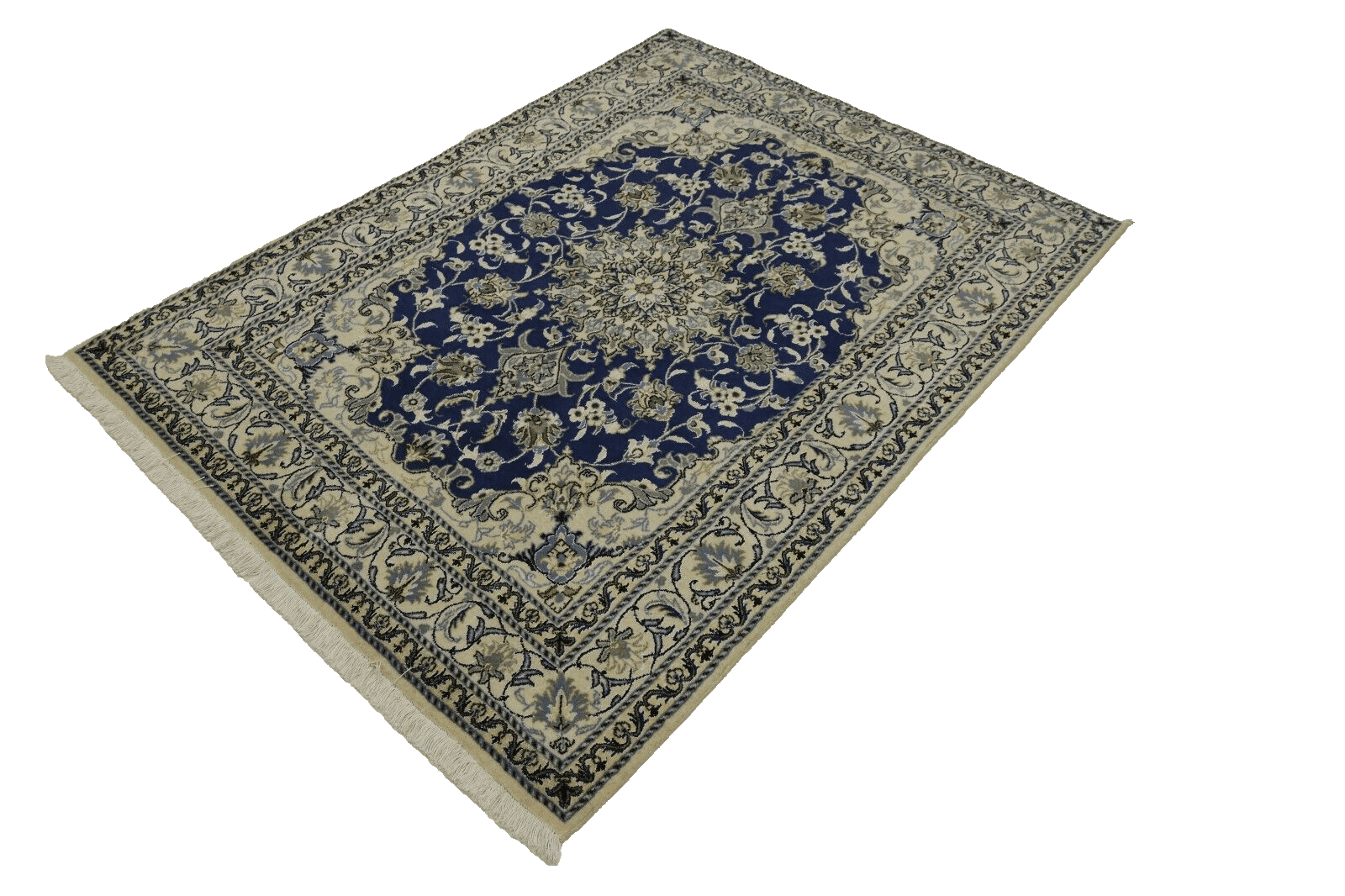
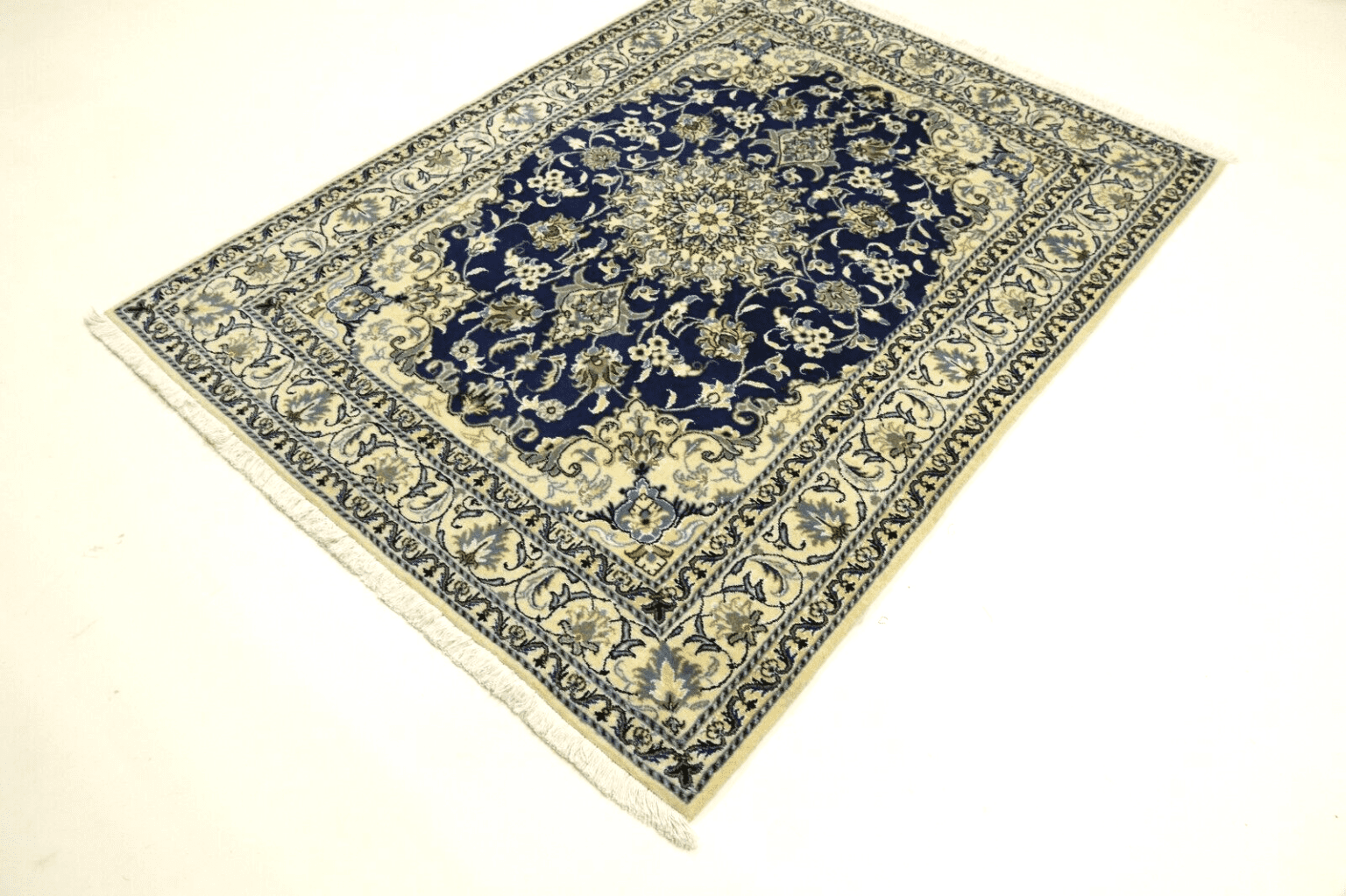
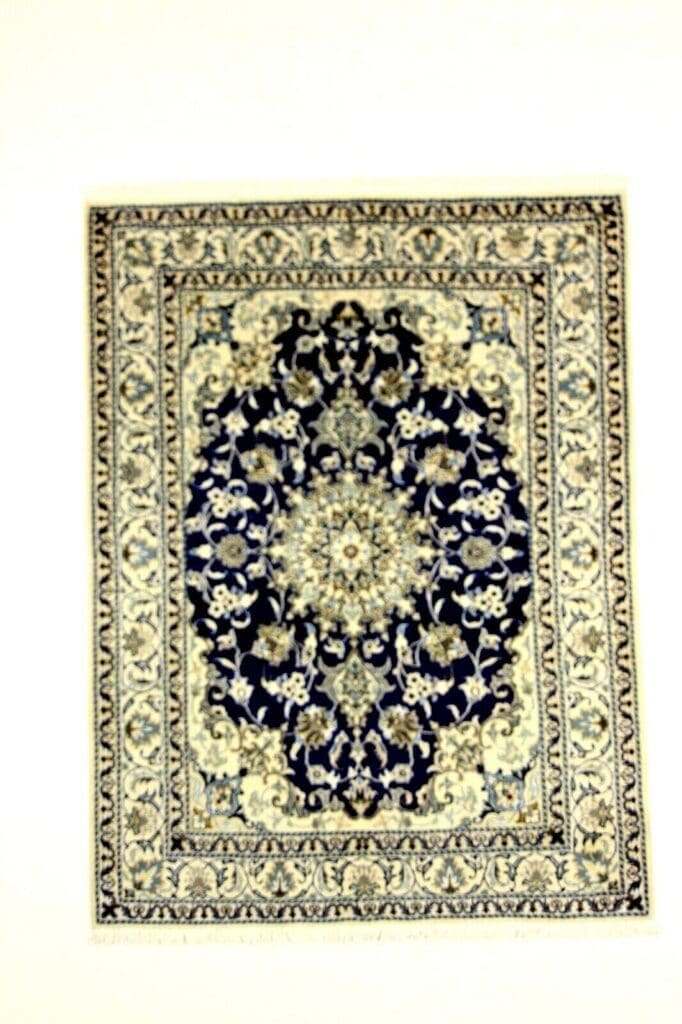
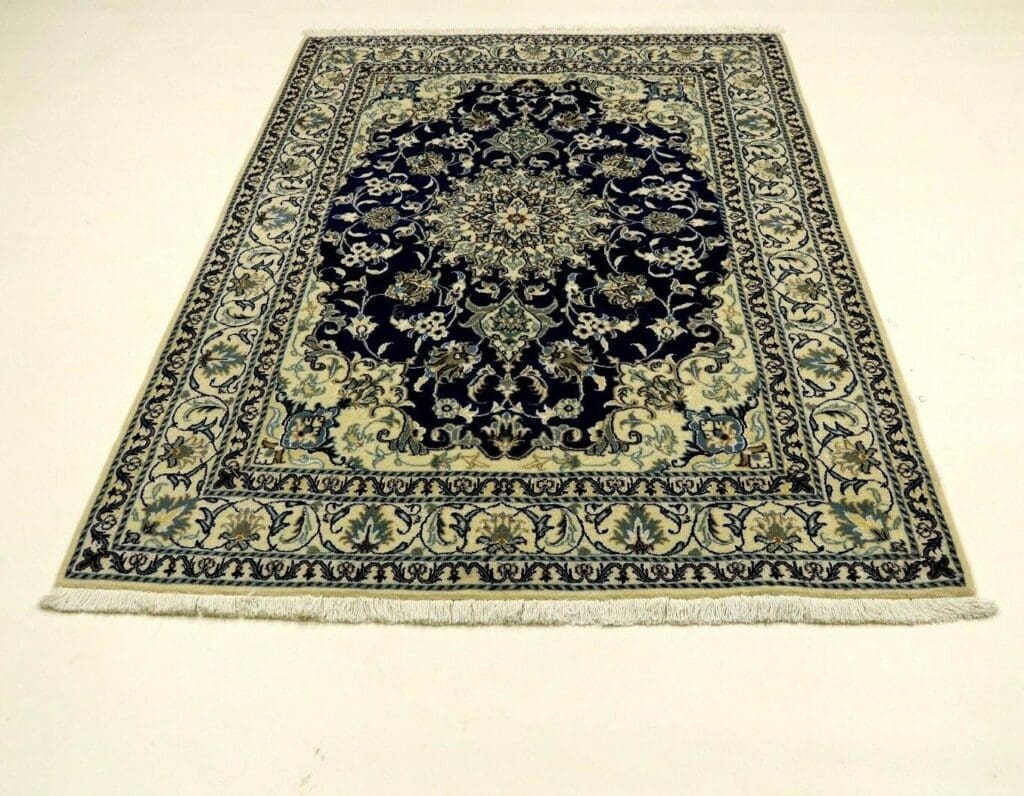
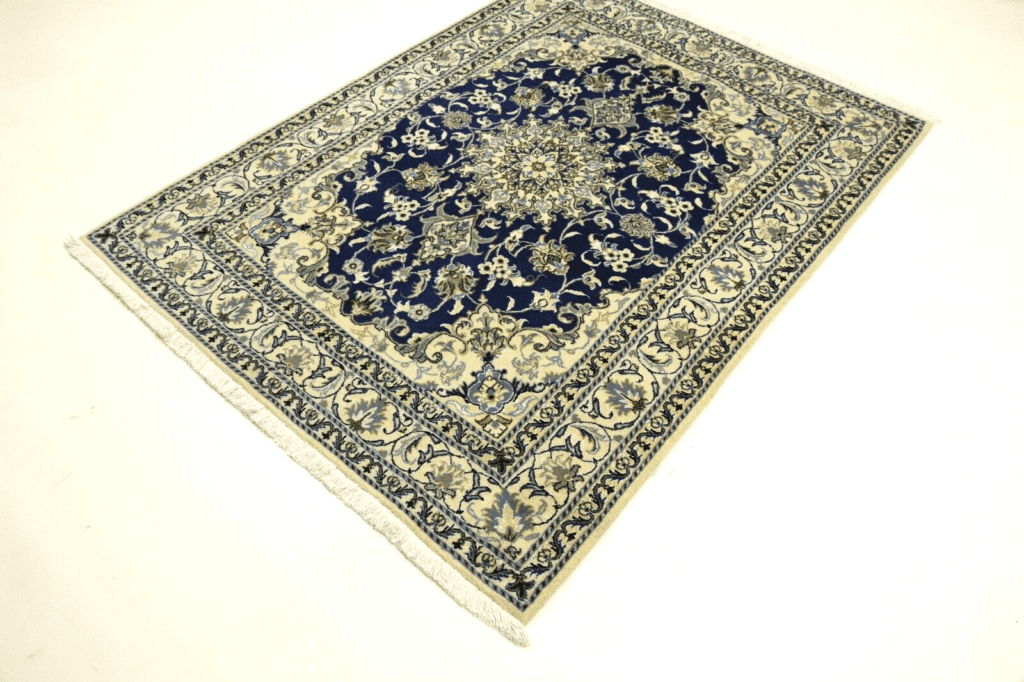
The rug is described as Traditional Oriental/Persian in style. Its design is therefore placed within the Persian ornamental tradition. Nain rugs are often recognised by fine floral drawing and by geometric forms that help organise the composition. A central field may be surrounded by one or more borders, with the surrounding framework creating a clear edge. The overall effect comes from the relationship between the motifs rather than from one isolated emblem.
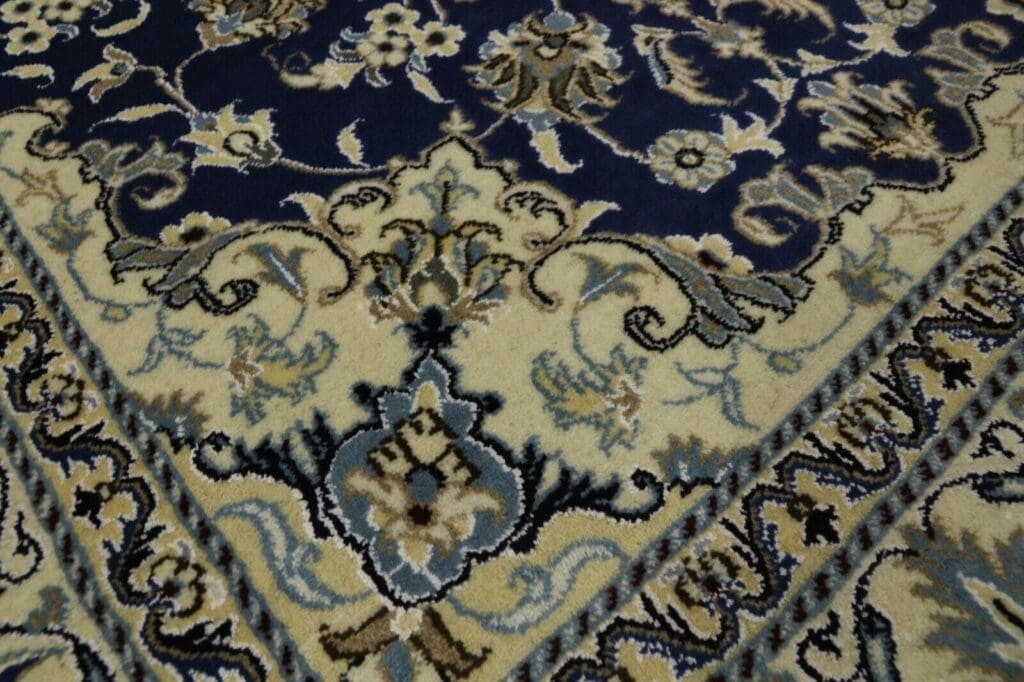
Floral ornament in Persian rugs is generally stylised rather than copied directly from nature. Leaves and blossoms can be linked by scrolling stems, repeated across a field or arranged around a central structure. Geometric details establish intervals and direction. The maker translates these elements into rows of knots, allowing curves, outlines and small internal details to be rendered in textile form. The high knot density supports a finely articulated drawing, while the regional tradition supplies the visual vocabulary.
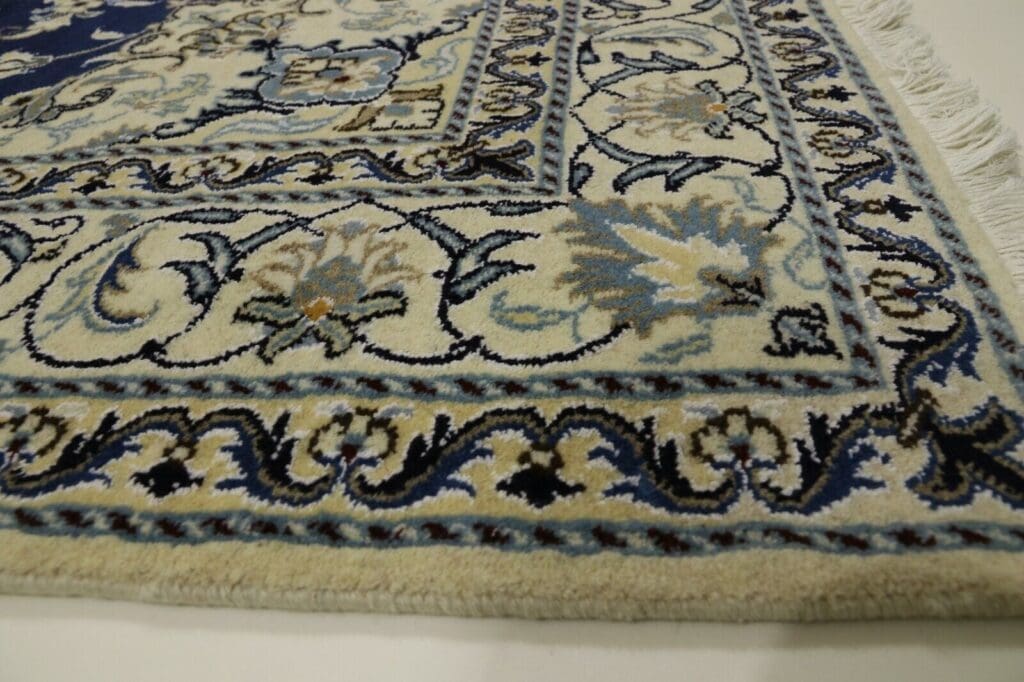
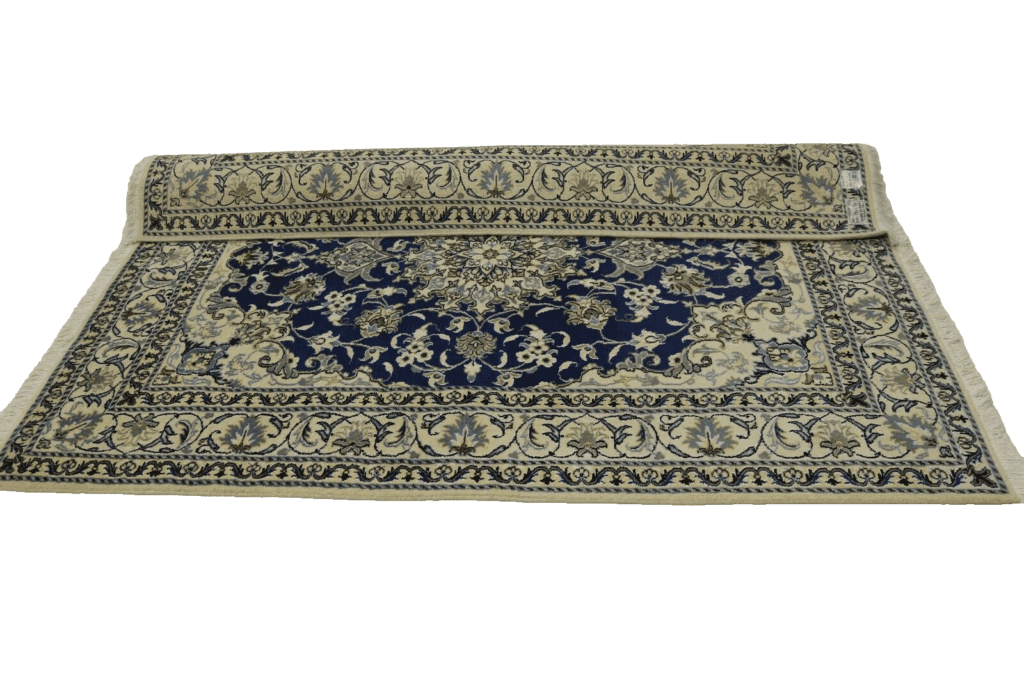
A classical Persian composition often works in several layers. The main field carries the principal design, inner borders provide a transition, and an outer border completes the frame. This hierarchy helps the eye move across the rug without losing the relationship between its parts. Nain designs frequently combine this ordered structure with balanced symmetry and delicate detail. Because the rug is hand-knotted, the design remains a manually executed textile rather than a mechanically repeated image.
Open space is as important to a pattern as the ornament itself. A closely filled field produces a different rhythm from one with broader areas between the motifs. Fine stems may connect separate elements, while defined outlines keep them legible. Persian design uses these contrasts to create cohesion across a large surface. From nearby, the viewer can follow small details in the drawing; from farther away, the same elements merge into a unified arrangement of field, border and repeated forms.
Nain rugs are often associated with harmonious colour relationships. Colour can distinguish the field from the border, separate overlapping forms and reinforce the symmetry of the layout. The source description identifies this rug’s style as Traditional Oriental/Persian but does not specify individual colours. The relevant design statement is therefore the broader one: this is a Nain piece within a Persian tradition of fine drawing, ordered composition and a combination of floral and geometric possibilities.
A traditional design does not require a historically styled room. Its clear division into field and border can work with classic furnishings as well as with a more modern, reduced interior. The rug may be used in living rooms, bedrooms, offices or exhibition spaces. These applications follow from the stated style and do not assign a particular motif that has not been specified. The design remains rooted in Nain and Persian tradition while allowing the surrounding interior to determine how its pattern is read.
Special Features
The stated special features include the Super Nain designation, hand knotting, one-off construction and the combination of virgin wool with silk. The approximate knot density of 300,000 knots per square metre is another product characteristic. The rug is described as new and in very good condition. Its thickness is approximately 8 mm, and it is suitable for underfloor heating.
Care can begin with regular vacuuming to remove loose dust and dirt from the pile. A professional deep clean every few years is recommended. Direct sunlight should be avoided in order to reduce the risk of fading. These instructions are particularly relevant to a hand-knotted rug made from a wool and silk blend, and cleaning methods should be chosen to suit both fibres.
FAQ
How should I care for the Nain Persian rug?
Vacuum the rug regularly to remove loose dust and dirt from the pile. For a more thorough clean, professional rug cleaning is recommended every few years. Avoid direct sunlight so that the colours do not fade. Because the pile combines virgin wool and silk, care should be gentle and any cleaning product or method should be suitable for both materials and for a hand-knotted construction.
Where can the rug be used?
The Nain Persian rug can be used in living rooms, bedrooms and offices. It is also suitable for an exhibition room. Its Traditional Oriental/Persian style can be placed with classic furnishings or with a more contemporary interior. The rug is suitable for underfloor heating as well. The flooring and heating manufacturer’s instructions should be followed for the specific installation.
How long does a hand-knotted Persian rug last?
A well-made hand-knotted Persian rug can remain in use for many years when it is cared for properly. The hand-knotted construction, virgin wool and silk content provide the material basis for durability. Regular removal of dust, appropriate professional cleaning and protection from direct sunlight help preserve the textile. As with any one-off hand-knotted piece, actual service life also depends on how intensively it is used and how it is maintained.
To provide the best experiences, we use technologies like cookies to store and/or access device information. Consenting to these technologies will allow us to process data such as browsing behavior or unique IDs on this site. Not consenting or withdrawing consent, may adversely affect certain features and functions.
Functional Always active
The technical storage or access is strictly necessary for the legitimate purpose of enabling the use of a specific service explicitly requested by the subscriber or user, or for the sole purpose of carrying out the transmission of a communication over an electronic communications network.
Preferences
The technical storage or access is necessary for the legitimate purpose of storing preferences that are not requested by the subscriber or user.
Statistics
The technical storage or access that is used exclusively for statistical purposes.The technical storage or access that is used exclusively for anonymous statistical purposes. Without a subpoena, voluntary compliance on the part of your Internet Service Provider, or additional records from a third party, information stored or retrieved for this purpose alone cannot usually be used to identify you.
Marketing
The technical storage or access is required to create user profiles to send advertising, or to track the user on a website or across several websites for similar marketing purposes.
 SECURE PAYMENT
 SHIPPING PARTNERS