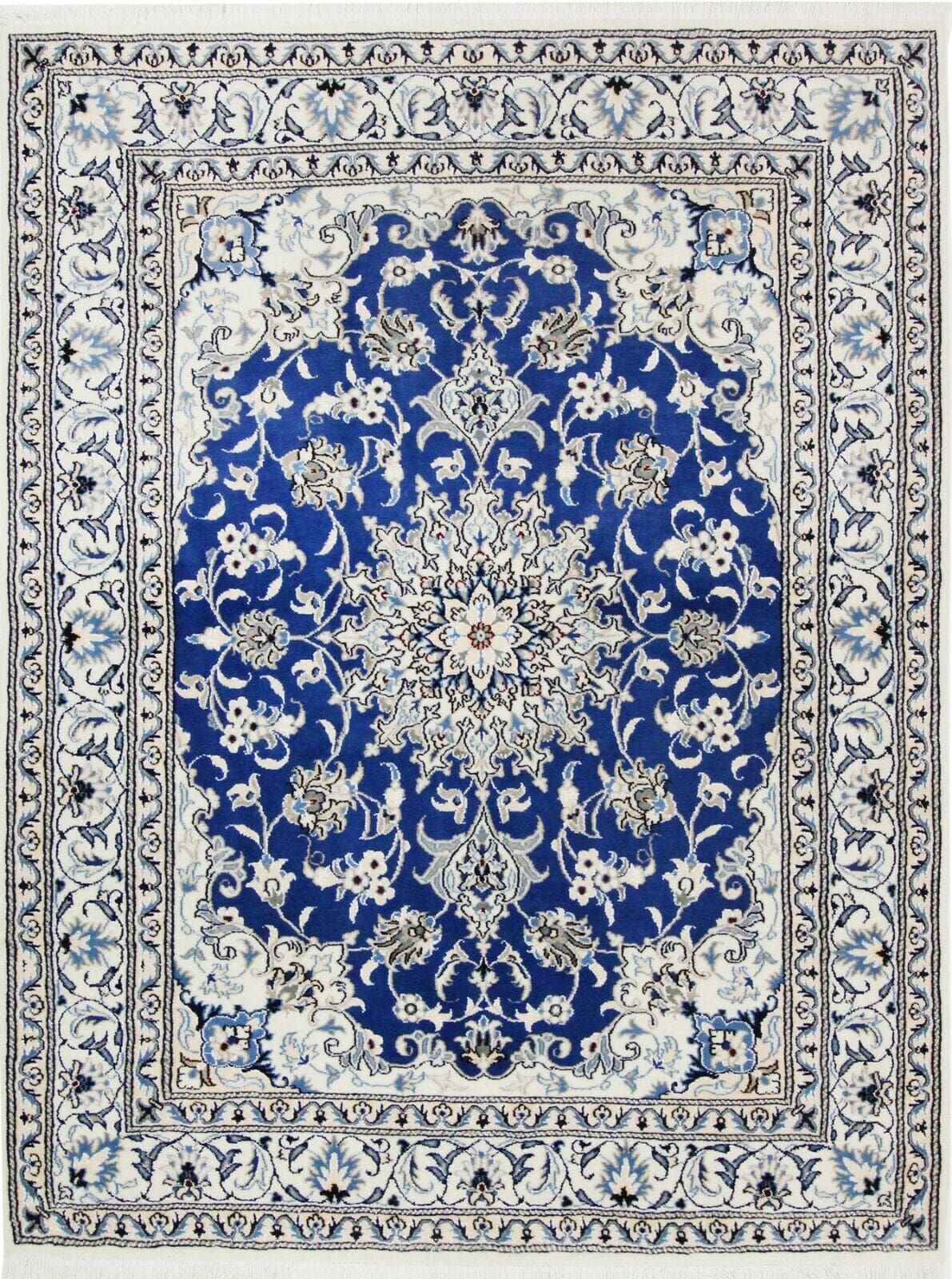
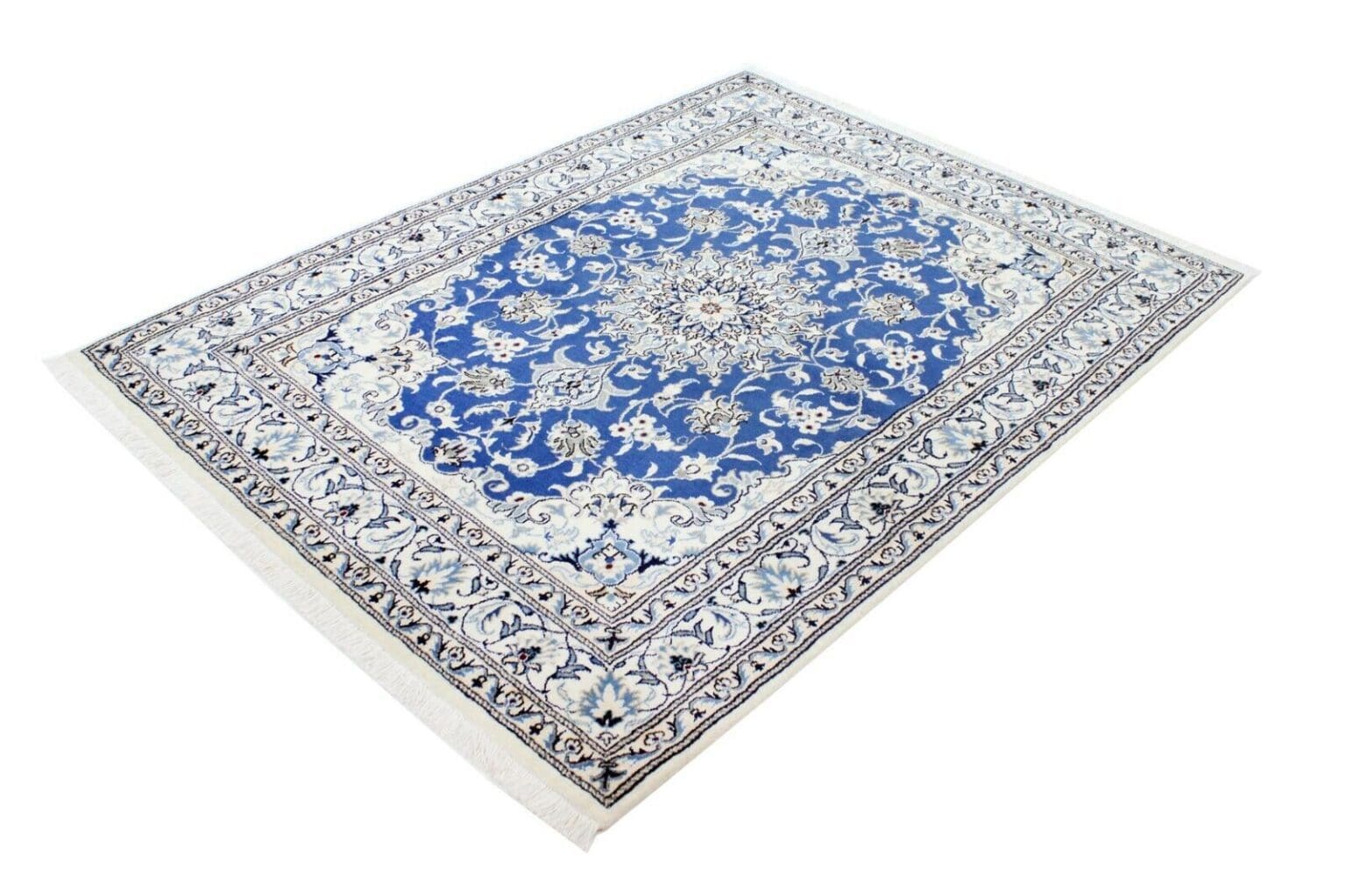
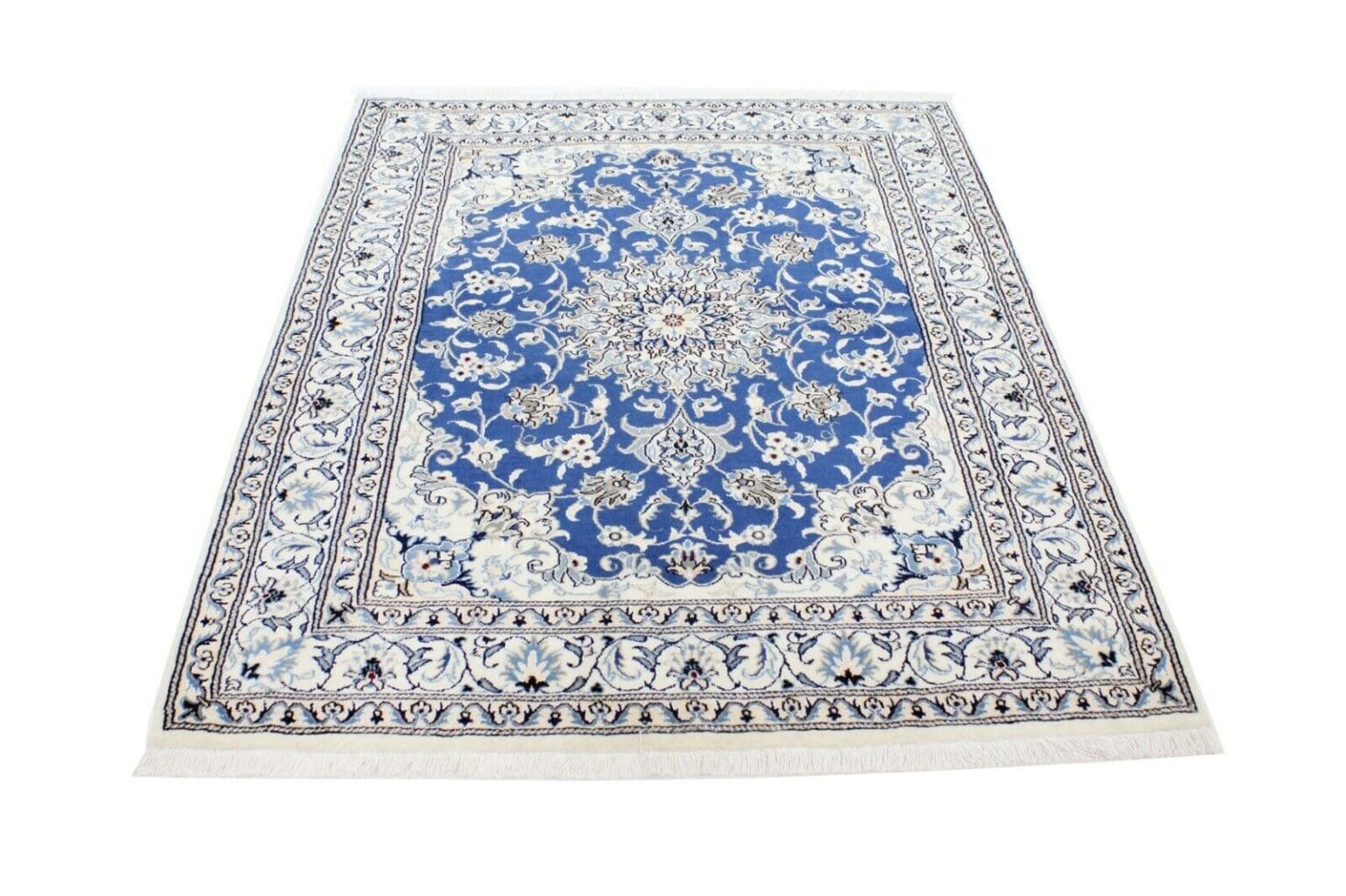
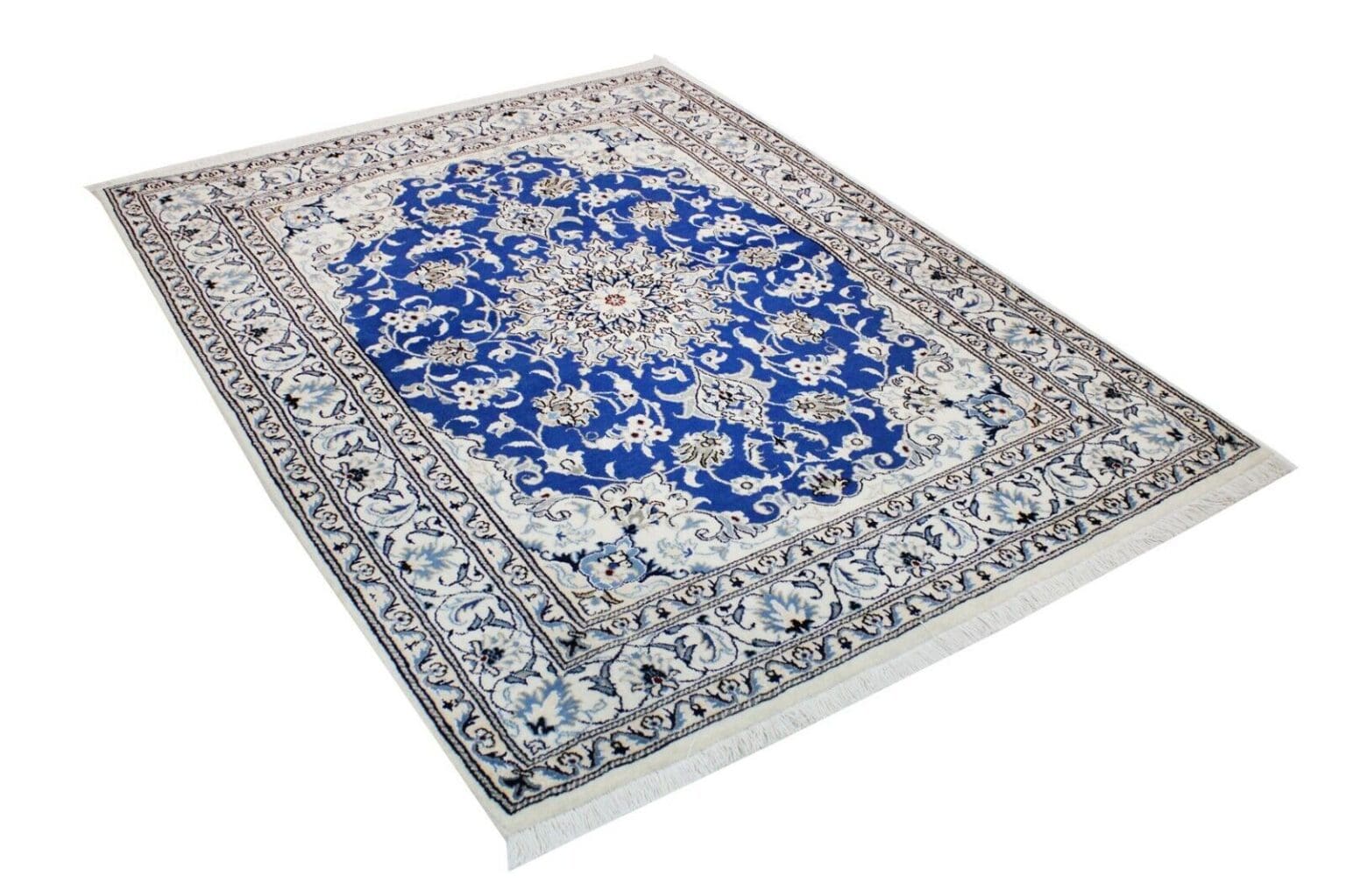
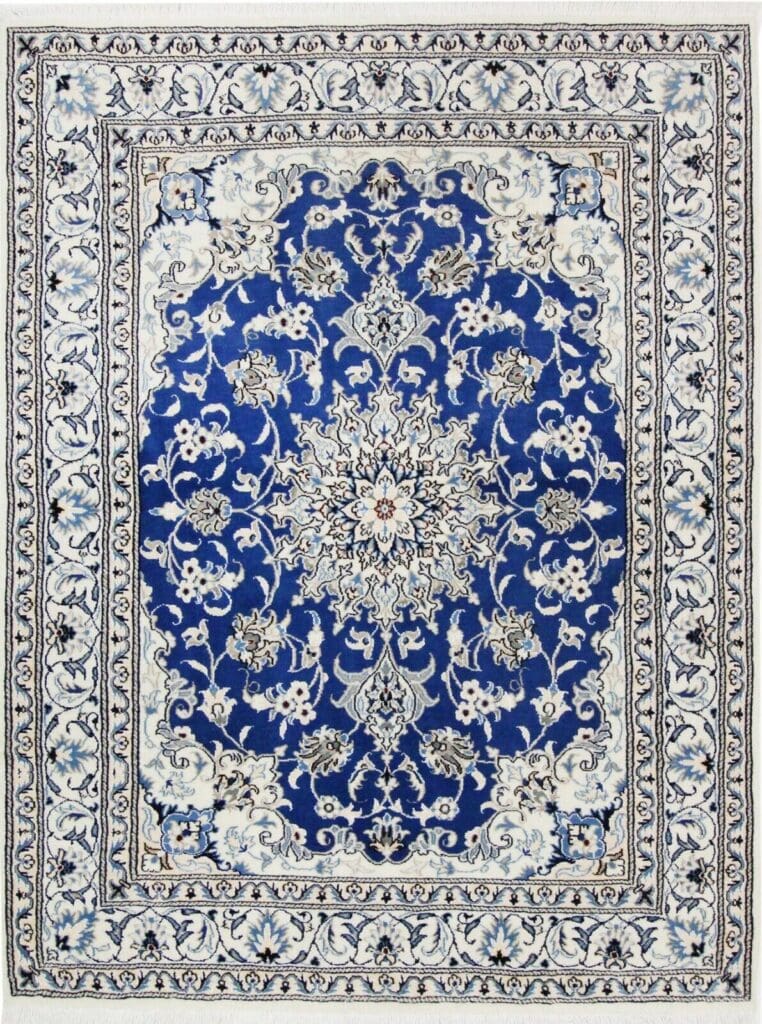
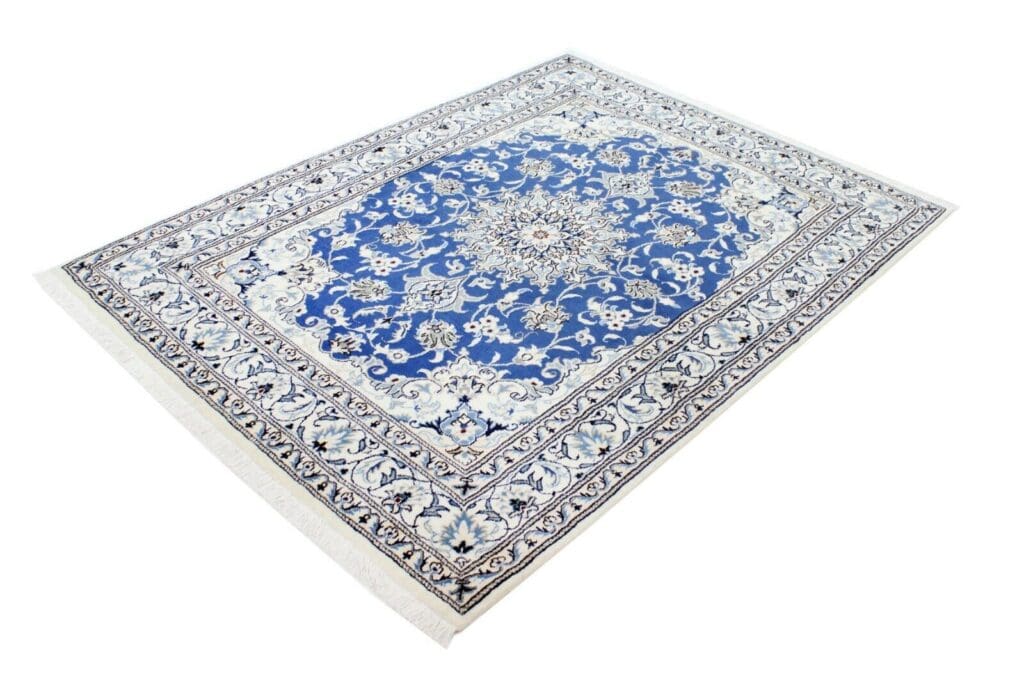
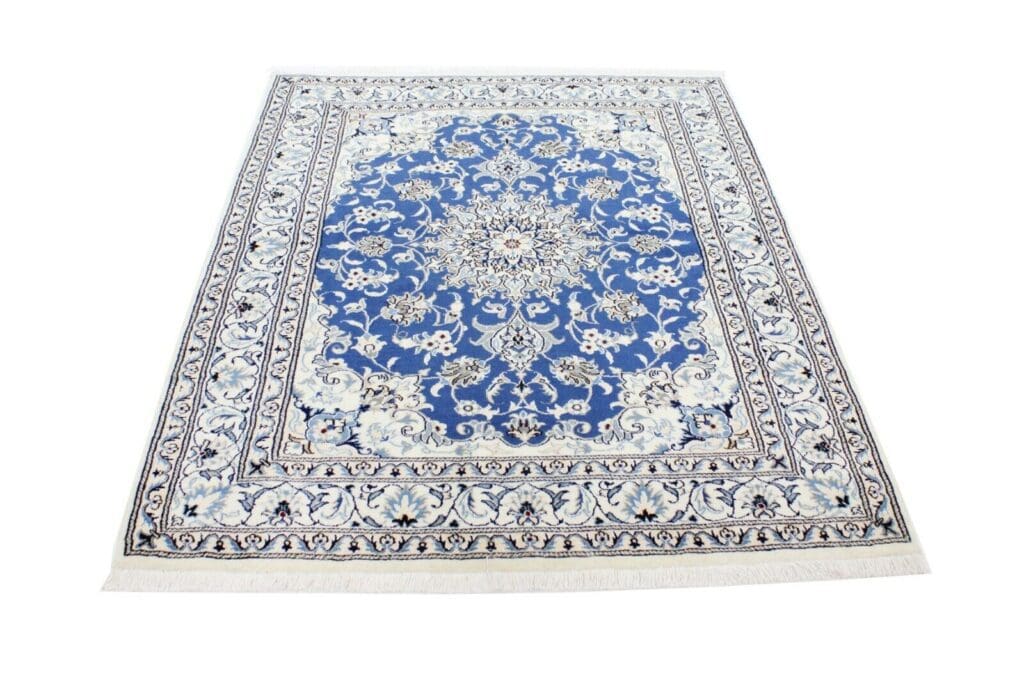
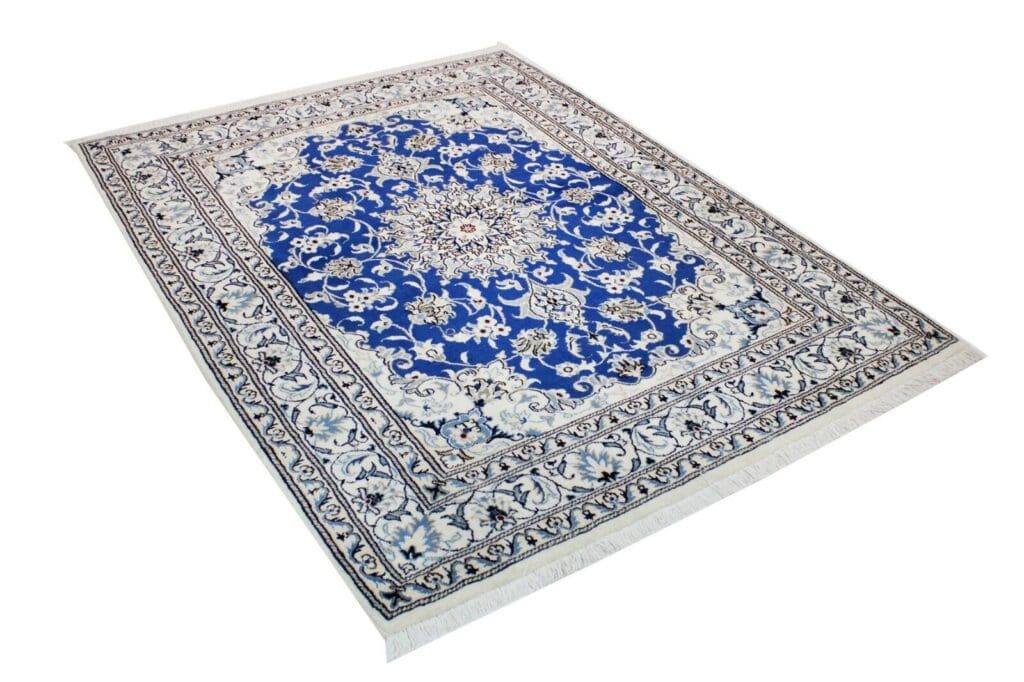
Hand-knotted Nain Persian rug | Knot density: high | Material: pile wool and silk | Size: 195 x 148 cm | Pattern: floral motifs, fine lines and gentle colours | Condition: top condition
This Nain Persian rug is hand-knotted and made from pure wool and silk. The combination of these materials gives the pile a soft, pleasant feel while also providing a resilient surface. Wool has long been used in rug making because its fibres are flexible, durable and able to support a clearly defined pile. Silk is valued for its fine fibre and its ability to lend delicate details a precise appearance. In this rug, wool and silk are identified as the principal materials used in its construction.
Hand-knotting is a method in which individual knots are tied by hand around the warp before the pile is secured and finished. The work requires controlled tension, repeated movements and an understanding of the relationship between material, structure and pattern. Unlike a mechanically repeated surface, a hand-knotted rug is built knot by knot. The process calls for patience and practical skill, and the source describes the making of a single piece as often taking several months.
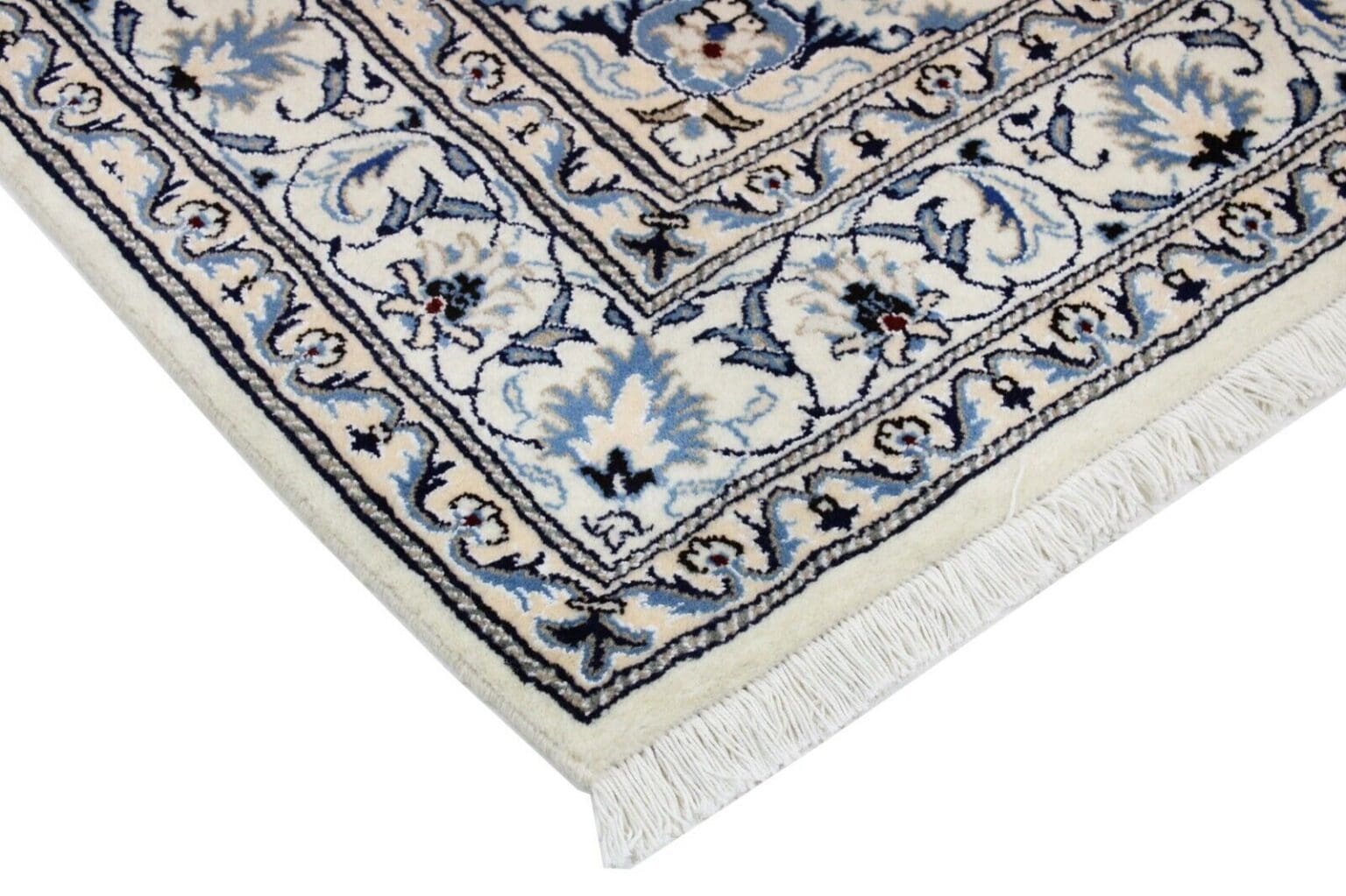
The rug has a high knot density. A dense knot structure allows fine drawing and supports the detailed character associated with Nain rugs. It also contributes to the durability of the finished textile. Knot density is not only a technical feature; it influences how precisely small floral elements, narrow outlines and transitions between parts of a design can be worked. The higher the density, the more closely a weaver can place small areas of colour and contour within the pattern.
Hand-knotted construction also explains why the making of such a rug is a craft process rather than a simple surface treatment. The weaver must follow the design while maintaining an even structure across the field. Wool provides the body of the pile, while silk can be used for especially fine visual definition within the material composition described for this piece. The result is a textile whose appearance depends on both the selected fibres and the accumulated work of many individual knots.
Origin and Tradition
Nain is a city in central Iran and is known for its rugs. Nain rugs belong to the Persian tradition of hand-knotted weaving, a tradition shaped by long experience in working with wool, silk, colour and carefully organised patterns. Their regional identity is connected with a preference for refined drawing, balanced compositions and a controlled use of colour. Nain is therefore not merely a design label: it identifies a recognised Iranian weaving centre and the tradition associated with it.
Persian rug making developed through many regional schools, each with its own approach to materials, structure and ornament. In central Iran, the production of Nain rugs became known for a clear and delicate style. The patterns are commonly organised around a central field and a surrounding border, although individual examples can vary. Floral ornament, measured symmetry and fine linear work are important elements within the broader Nain vocabulary. These characteristics are part of the regional background and help explain why Nain rugs are recognised for detail and visual order.
The history of Persian weaving reaches back over centuries. During the Safavid dynasty, from the sixteenth to the eighteenth century, carpet production in Persia experienced a major period of development. Court workshops, regional weaving communities and the movement of designs between centres all contributed to the refinement of Persian carpet art. Floral schemes, medallion arrangements, scrolling vines and border systems became established parts of the wider tradition. Nain rugs belong to this historical world, while their own regional language developed in central Iran.
Traditional Nain rugs are also associated with gentle colours. Rather than relying only on strong contrasts, the style often uses restrained relationships between light and darker tones so that the pattern remains readable without becoming visually heavy. This approach can be connected with the fine materials and dense knotting for which the region is known. A tightly drawn pattern benefits from colours that distinguish petals, leaves, outlines and ground without obscuring the structure of the design.
Nain rugs are appreciated in Iran and internationally. Their reputation rests on a combination of hand craftsmanship, detailed ornament and the disciplined appearance of the regional style. The history of the region is not a claim about the date of this individual rug; it is the cultural and technical background of the Nain tradition. This rug represents that tradition through its Iranian origin, hand-knotted construction, use of wool and silk, and the detailed floral character described for it.
The designation Persian rug refers to a rug made in Iran or historical Persia. Nain is one of the Iranian names that has become familiar to collectors and interior designers because it connects a place, a weaving tradition and a recognisable design vocabulary. The name does not by itself determine a precise age, workshop or individual weaver. Those details are not specified here. What is established is the rug’s Nain identity and its place within Persian hand-knotting.
Design and Pattern
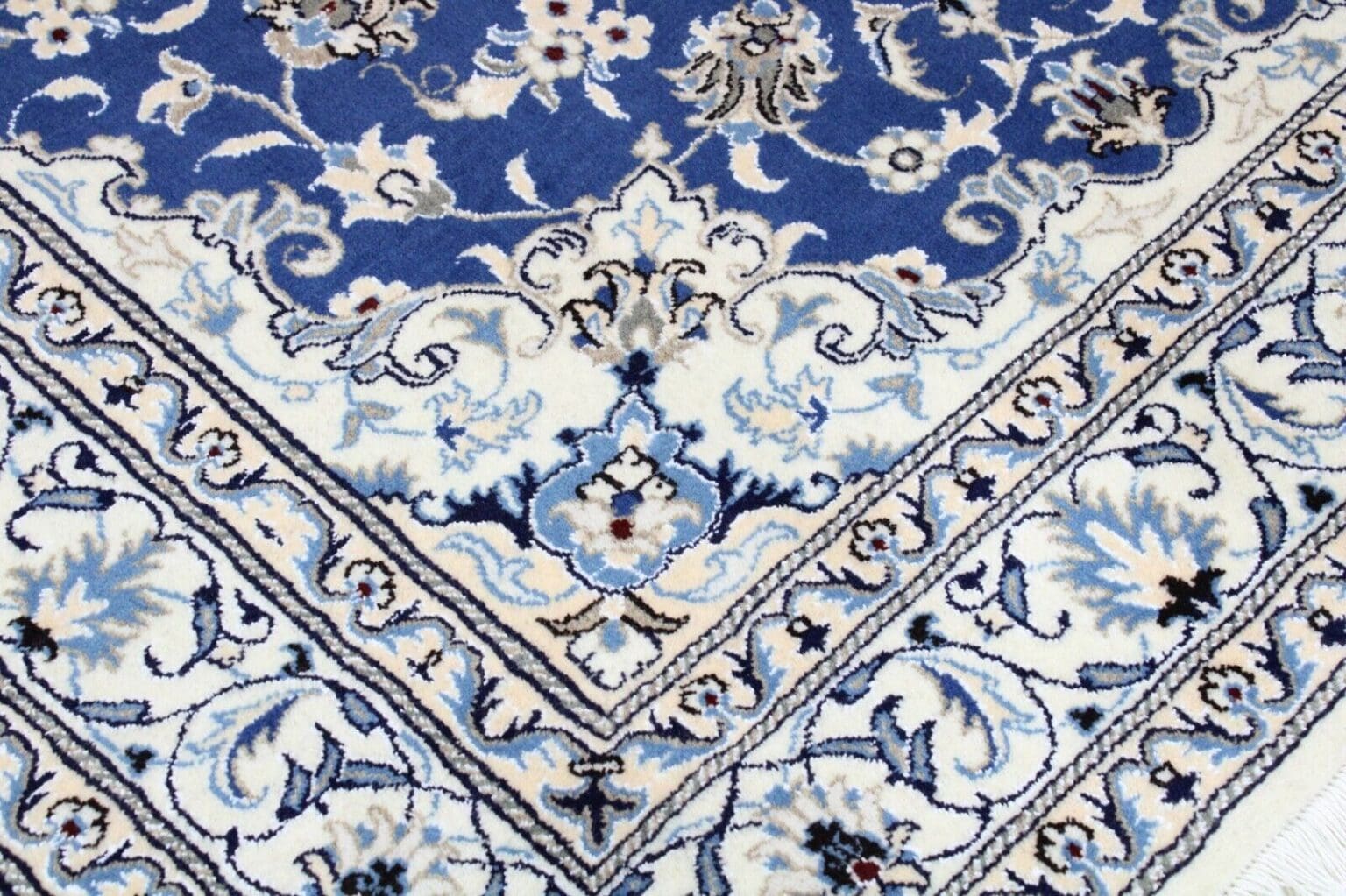
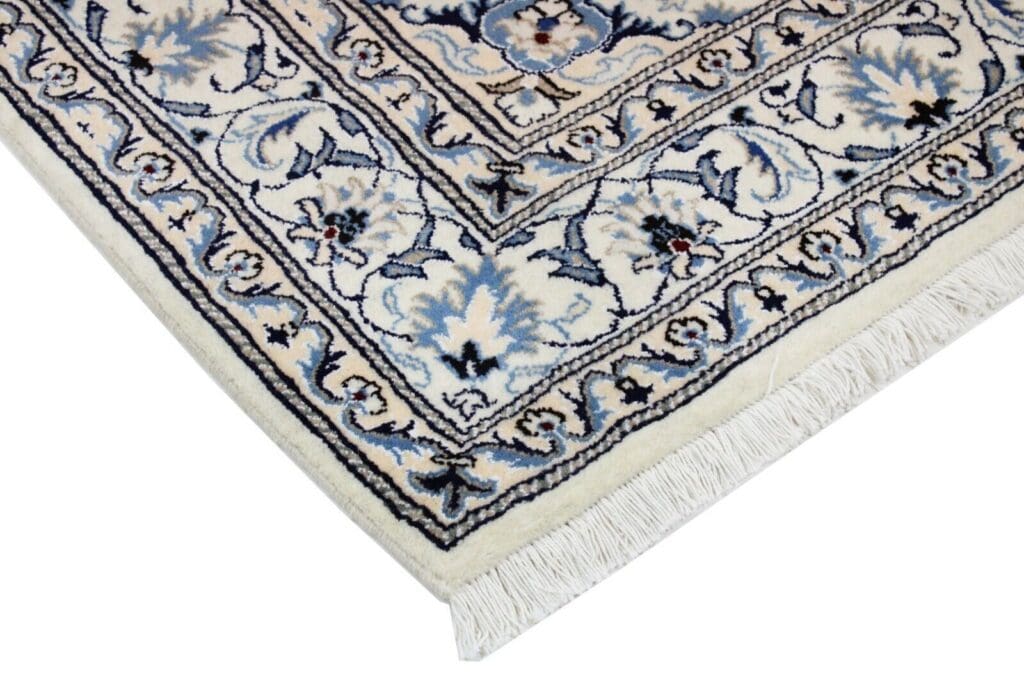
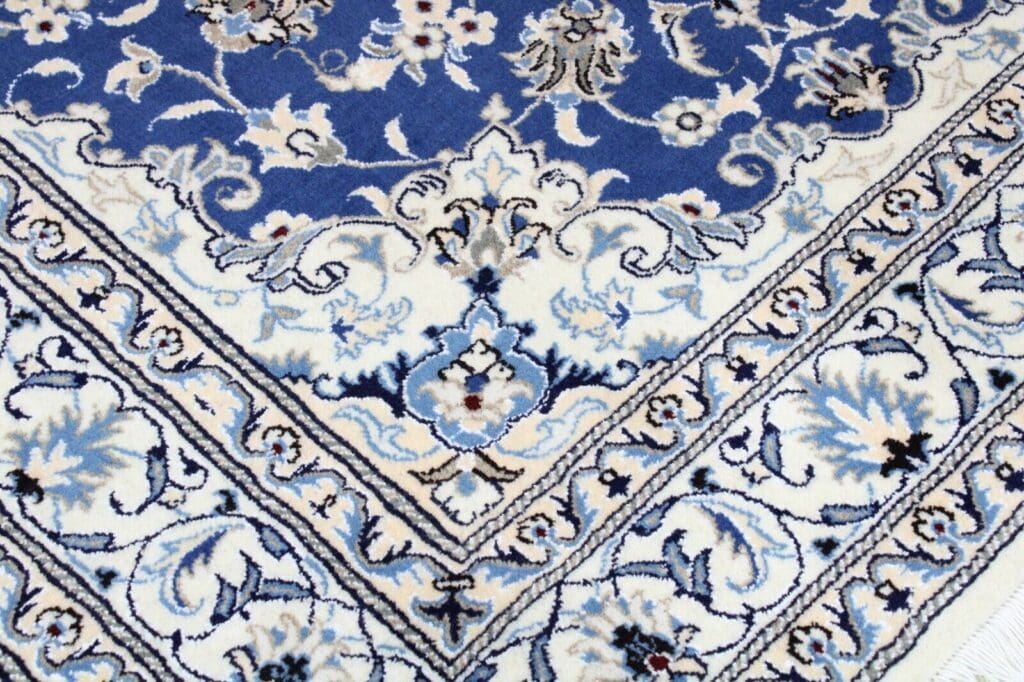
The design of this Nain Persian rug is described as elegant, with a floral character, a range of harmoniously combined colours, fine details and delicate lines. Floral ornament is central to the visual language of many Nain rugs. Flowers, leaves, vines and scrolling forms can be arranged in a disciplined field, allowing the viewer to follow the drawing across the surface. The fine line work gives the design a light and controlled appearance rather than a coarse or strongly geometric effect.
Floral and geometric elements often work together in Persian rug design. A flower may be framed by a regular border, repeated along a vine or balanced against a corresponding element on the opposite side of a field. Geometric organisation provides structure, while floral details soften that structure and add movement. In the design described here, the floral motifs are accompanied by careful lines and a harmonious colour combination. No specific medallion, border layout or individual motif is identified, so those details are not assigned to this one-off rug.
Colour is an important part of the Nain tradition. Gentle tones can separate the field from its ornament and allow small details to remain visible. A restrained palette also supports the sense of delicacy associated with fine Persian drawing. Harmonious colour does not mean that every Nain rug uses the same shades; regional examples differ. It describes the balanced relationship of the colours used in a particular composition. This rug is characterised in the source by gentle colours and a refined design that can be read through its fine lines.
Symbolic meanings are also found in Persian floral ornament. Flowers are often associated with fertility and with the continuing cycle of life. Such interpretations belong to the cultural history of the motif and do not turn every individual floral element into a fixed statement. Designs can be appreciated both as carefully organised decoration and as part of a visual language that has carried symbolic associations through generations of weaving.
The effect of a fine floral design depends on the interaction of drawing and construction. High knot density allows small shapes and narrow contours to be represented with greater precision than a loosely knotted structure would normally permit. Wool gives the pile substance, while silk is associated with fine material definition. These technical qualities help explain the detailed appearance of Nain patterns without requiring a claim about a particular workshop or a specific symbolic motif in this rug.
The pattern language of Nain has remained relevant because it can be read in more than one setting. Traditional floral arrangements relate to the history of Persian interiors, while gentle colours and measured lines can also sit within a more contemporary room. This is a general feature of the design tradition, not a claim that the rug belongs to a particular interior style. The source describes the rug as suitable for different furnishing approaches, from classic to modern, because of its colours and refined pattern.
Special Features
This rug is described as being in top condition. Its materials and robust construction are stated to support a well-maintained appearance over many years when it is handled and cared for appropriately. The use of pure wool and silk, together with hand-knotted workmanship and high knot density, defines its technical character. No further restoration history, age, signature or workshop attribution is provided, so none is added here.
The gentle colours and refined design are described as adaptable to different furnishing styles, including classic and modern interiors. A Persian rug can function as a textile element that influences the character of a room rather than serving only as a covering for the floor. This description concerns the role of the design in interior settings; it does not assign a particular room or placement to this rug.
Care should be regular and careful. Vacuuming removes dust and loose dirt, while a fresh stain should be dabbed promptly with a soft, damp cloth rather than rubbed aggressively. Professional cleaning every few years is recommended in the source to help preserve the colours and structure. For use above underfloor heating, the source states that the rug can be used because the materials are breathable and provide good thermal insulation. The heating should not be set excessively high in order to avoid damage.
FAQ
How should I care for this Nain Persian rug?
Vacuum the rug regularly to remove dust and dirt. If a spill occurs, dab the affected area promptly with a soft, damp cloth. Avoid vigorous rubbing, since this can affect the pile and spread the stain. Professional cleaning every few years is recommended to help maintain the colours and the structure of the hand-knotted textile. Specialist cleaning is particularly appropriate when a stain is persistent or when a deeper clean is required.
Can a Persian rug be used over underfloor heating?
Yes. This Persian rug can be placed over underfloor heating. The materials are breathable and provide good thermal insulation, which makes this type of use possible. The heating should not be set too high, since excessive heat may damage the rug over time. Keeping the temperature moderate and following the instructions for the heating system helps protect the wool and silk materials and the hand-knotted construction.
How can I recognise an authentic Persian rug?
Knot density and material quality are important points of examination. Original Persian rugs are commonly made from wool and silk and have a high number of knots per square metre. Hand-knotted details and slight asymmetries in the pattern can also be indications of manual production, since they are difficult to reproduce exactly by machine. These features should be considered together rather than used as a single test. For a definitive assessment, an experienced rug specialist can examine the construction, fibres and pattern in person.
To provide the best experiences, we use technologies like cookies to store and/or access device information. Consenting to these technologies will allow us to process data such as browsing behavior or unique IDs on this site. Not consenting or withdrawing consent, may adversely affect certain features and functions.
Functional Always active
The technical storage or access is strictly necessary for the legitimate purpose of enabling the use of a specific service explicitly requested by the subscriber or user, or for the sole purpose of carrying out the transmission of a communication over an electronic communications network.
Preferences
The technical storage or access is necessary for the legitimate purpose of storing preferences that are not requested by the subscriber or user.
Statistics
The technical storage or access that is used exclusively for statistical purposes.The technical storage or access that is used exclusively for anonymous statistical purposes. Without a subpoena, voluntary compliance on the part of your Internet Service Provider, or additional records from a third party, information stored or retrieved for this purpose alone cannot usually be used to identify you.
Marketing
The technical storage or access is required to create user profiles to send advertising, or to track the user on a website or across several websites for similar marketing purposes.
 SECURE PAYMENT
 SHIPPING PARTNERS