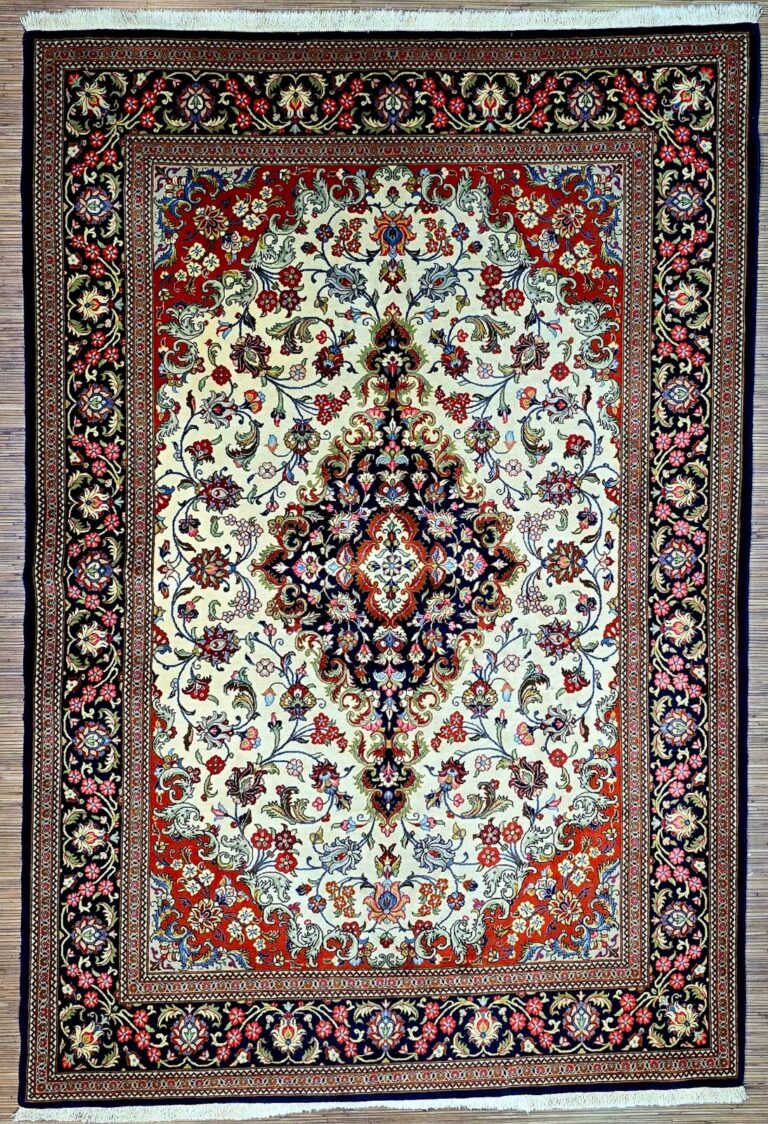
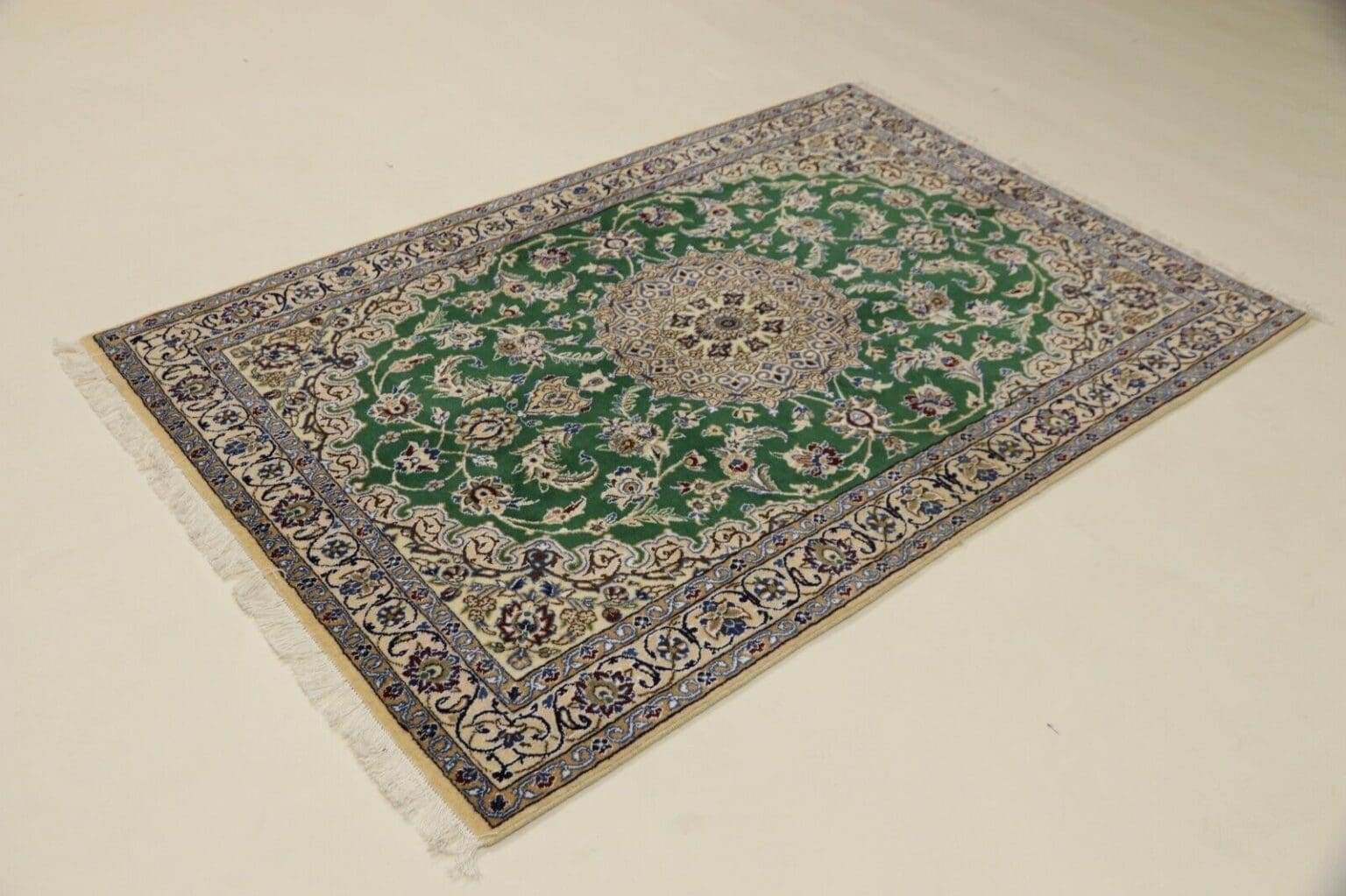
This Nain Persian rug is hand-knotted. Its pile is made primarily from virgin wool with a silk component, while cotton is used for the warp. These materials give the rug its particular surface and textile character. Virgin wool is a traditional pile fibre in hand-knotted rugs. It has a naturally resilient feel and can contribute to a warm, comfortable surface. The silk adds a smoother fibre to the wool pile and introduces a restrained sheen that changes subtly as light reaches the surface.
Wool and silk respond differently to touch and light. The wool provides body and a soft, substantial foundation, while the silk can make selected parts of the pile appear finer and more luminous. The cotton warp forms the structural basis of the rug. Knots are secured to this foundation and built up row by row during the weaving process. Hand-knotting requires continuous attention to tension, placement and pattern progression. It also means that the finished rug is an individual woven object rather than a mechanically repeated floor covering.
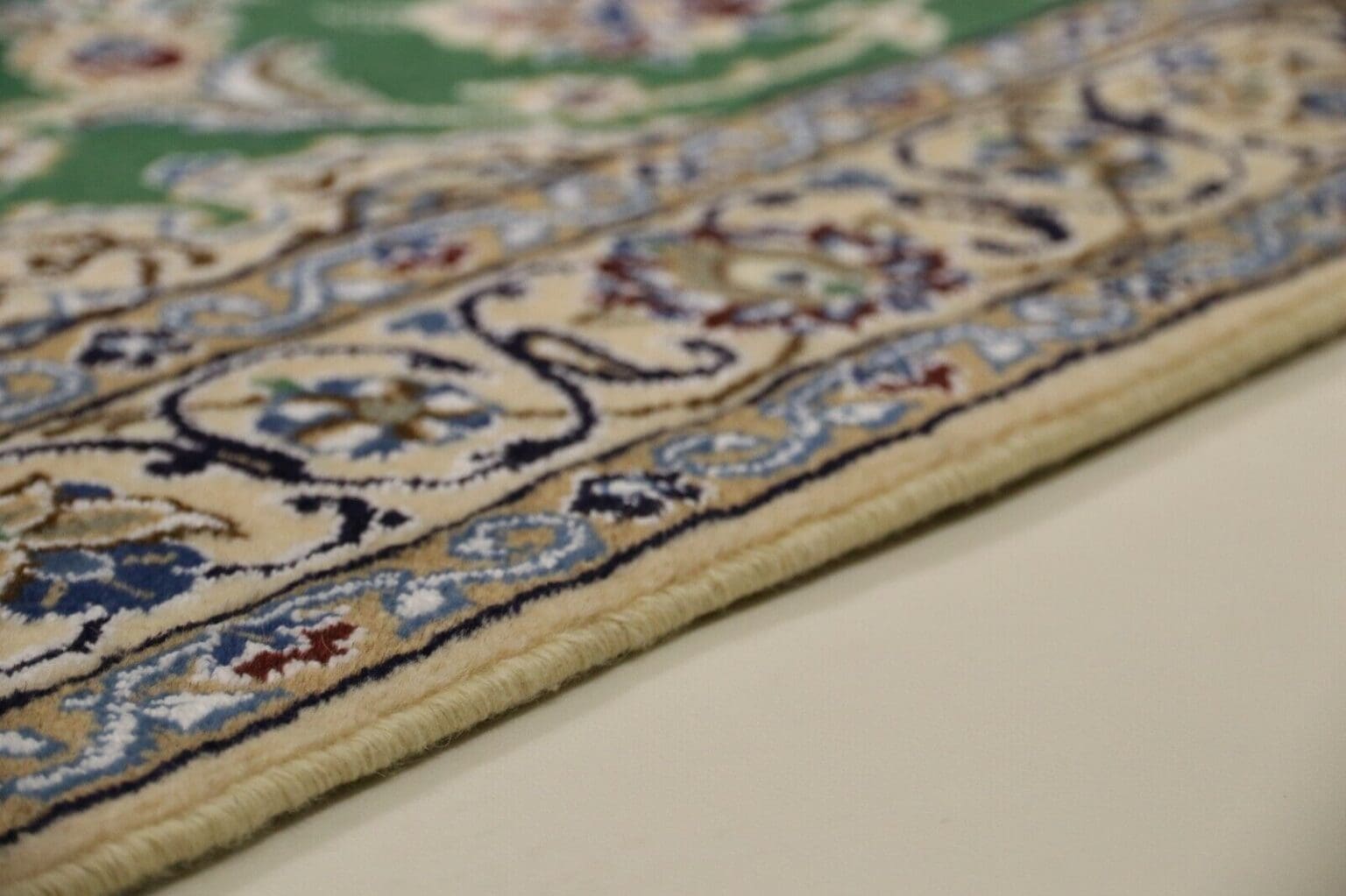
The fine knotting supports a detailed pattern with controlled outlines. It allows small ornamental features to be worked into the design while keeping the composition legible. The pile height is given as 6 mm, creating a relatively low surface on which the pattern remains easy to see. The rug is described as new and in very good condition. It is also suitable for use over underfloor heating. Proper installation and careful maintenance remain important for a natural-fibre rug in any heated room.
The stated material combination is part of the rug’s identity. Wool and silk are not simply interchangeable surfaces: they create different reflections, textures and degrees of softness within the pile. Cotton in the warp is concealed in normal use, but it is essential to the structure created during knotting. Together with the hand-worked construction, these materials explain why the rug has a tactile, finely made character.
Origin and Tradition
This rug comes from Persia and is assigned to Nain in Iran. Nain is located in central Iran and is one of the recognised centres of Persian rug production. The region is associated with carefully drawn designs, fine knotting and balanced compositions. Nain rugs are often identified by their refined treatment of floral ornament and by the way the design is organised across the field and borders. Their visual language is Persian, but it is also distinctly connected with the weaving tradition of Nain.
The history of Nain weaving belongs to the wider development of Persian textile arts. Its traditions are often discussed in connection with older Persian craftsmanship and the Safavid period. Over generations, workshops and families passed on knowledge of fibre preparation, loom setting, knotting, colour handling and pattern construction. These skills are practical as well as artistic. A weaver must maintain a consistent structure while following a detailed drawing, and must understand how the materials behave as the rug develops.
Nain rugs are known for combining technical control with a clear ornamental order. The relationship between the central field, surrounding borders and smaller secondary motifs is carefully considered. This relationship gives the design a sense of balance rather than allowing individual details to compete with one another. Dense knotting can support this precision by providing room for smaller lines and more carefully resolved forms. The result is a rug tradition in which construction and decoration are closely connected.
Hand-knotting also places each rug within a long-established working process. The warp is stretched on the loom, knots are tied individually, and weft threads help secure successive rows. The pile is then trimmed and finished so that the design can be read across the surface. Skilled work is needed at every stage, from maintaining the tension of the foundation to preserving the proportions of the pattern. Minor variations belong to the nature of handmade textiles. They distinguish one individual rug from another without changing its regional identity.
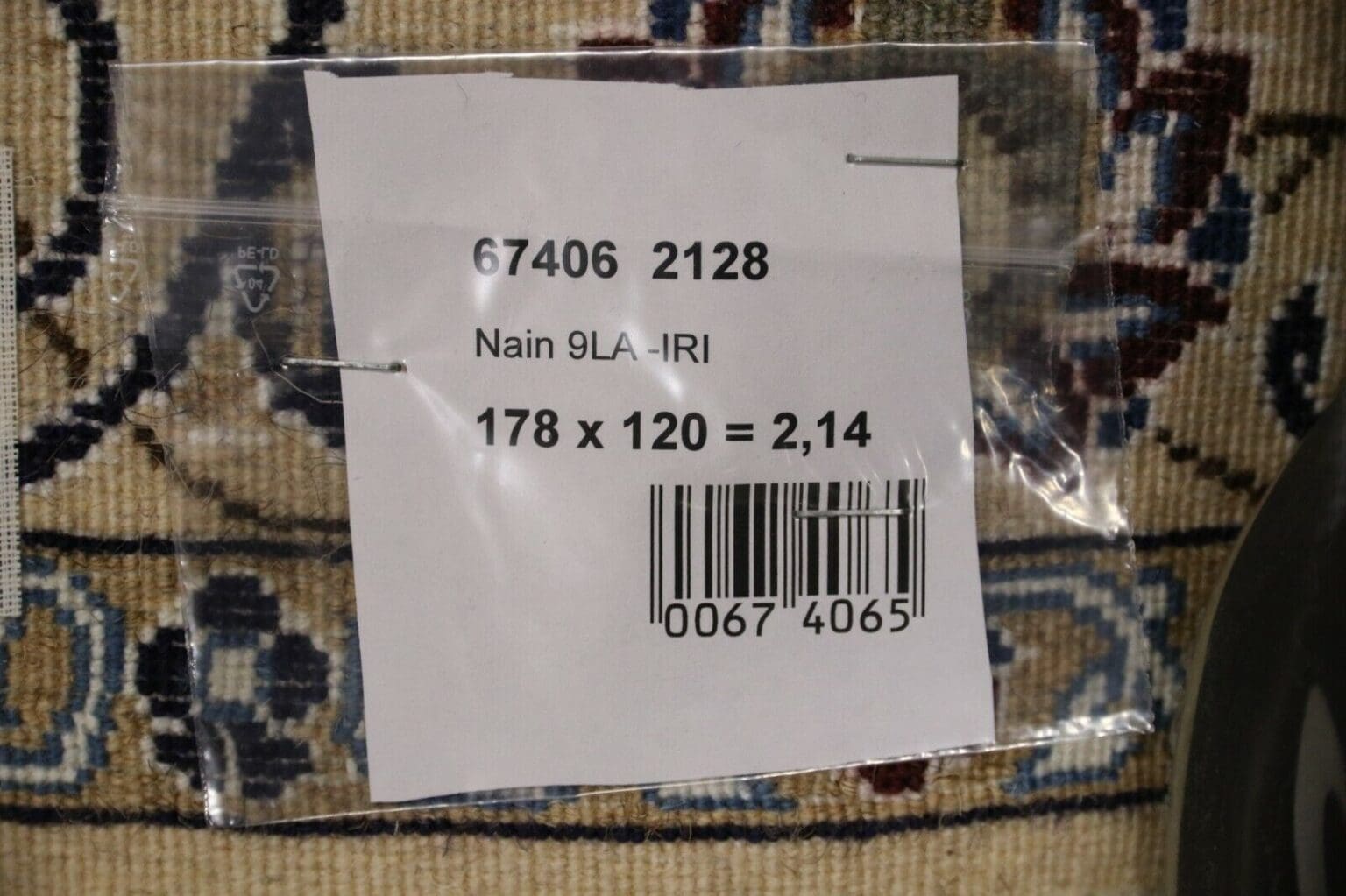
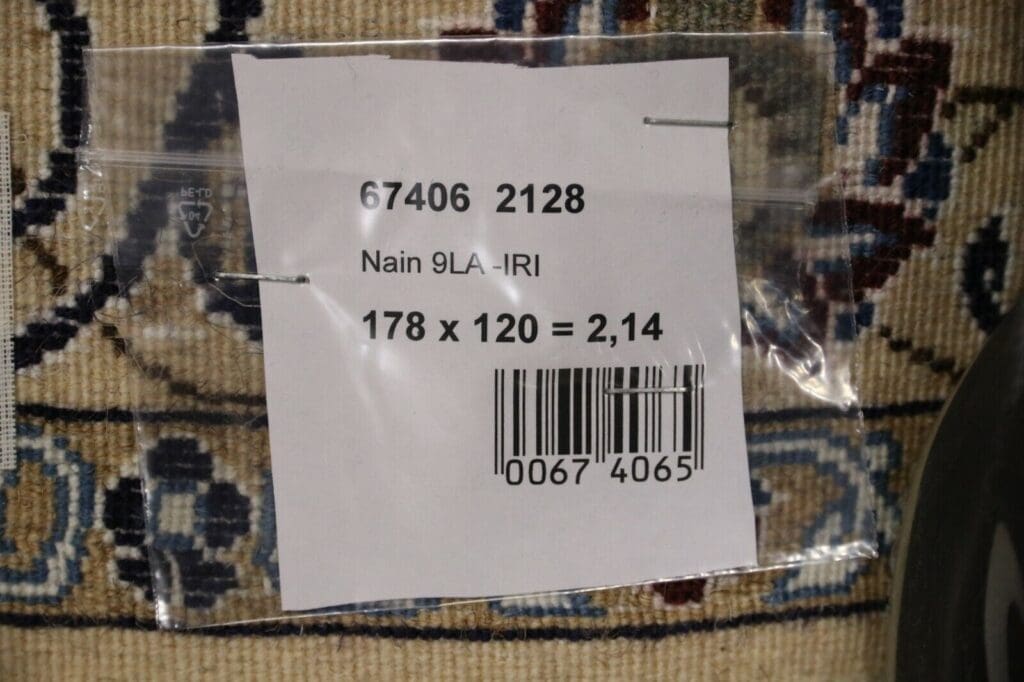
The name Nain therefore describes more than a decorative appearance. It refers to a Persian weaving centre and to a recognisable approach to fine patterning and controlled workmanship. This rug is described as a traditional Oriental and Persian design and as a Super Nain 9 la. That designation places it within a particular Nain format while the individual hand-knotted piece retains its own surface, material balance and pattern expression.
The cultural background of Nain rugs is connected with domestic interiors, formal reception rooms and the preservation of Persian decorative arts. Their compositions are designed to remain ordered across a usable textile surface. The balance of ornament and open areas helps the rug function as a floor covering while also carrying a strong decorative structure. In this piece, the regional origin, the hand-knotted technique and the fine combination of virgin wool and silk belong together as aspects of the same Persian craft tradition.
Design and Pattern
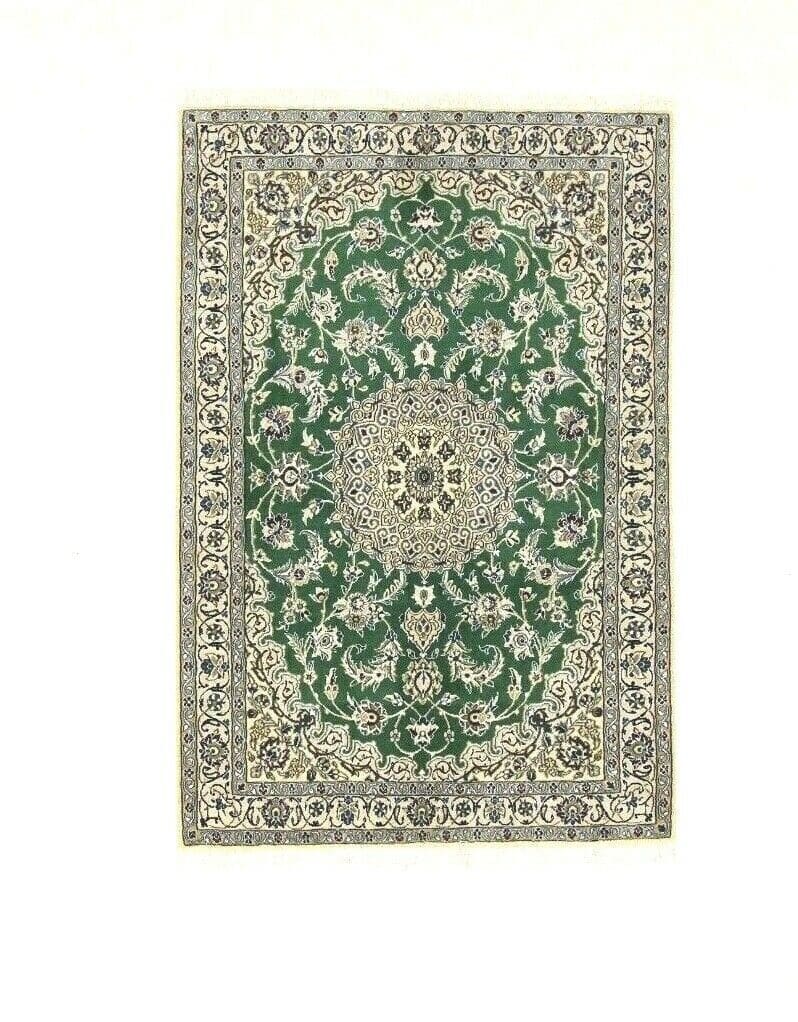
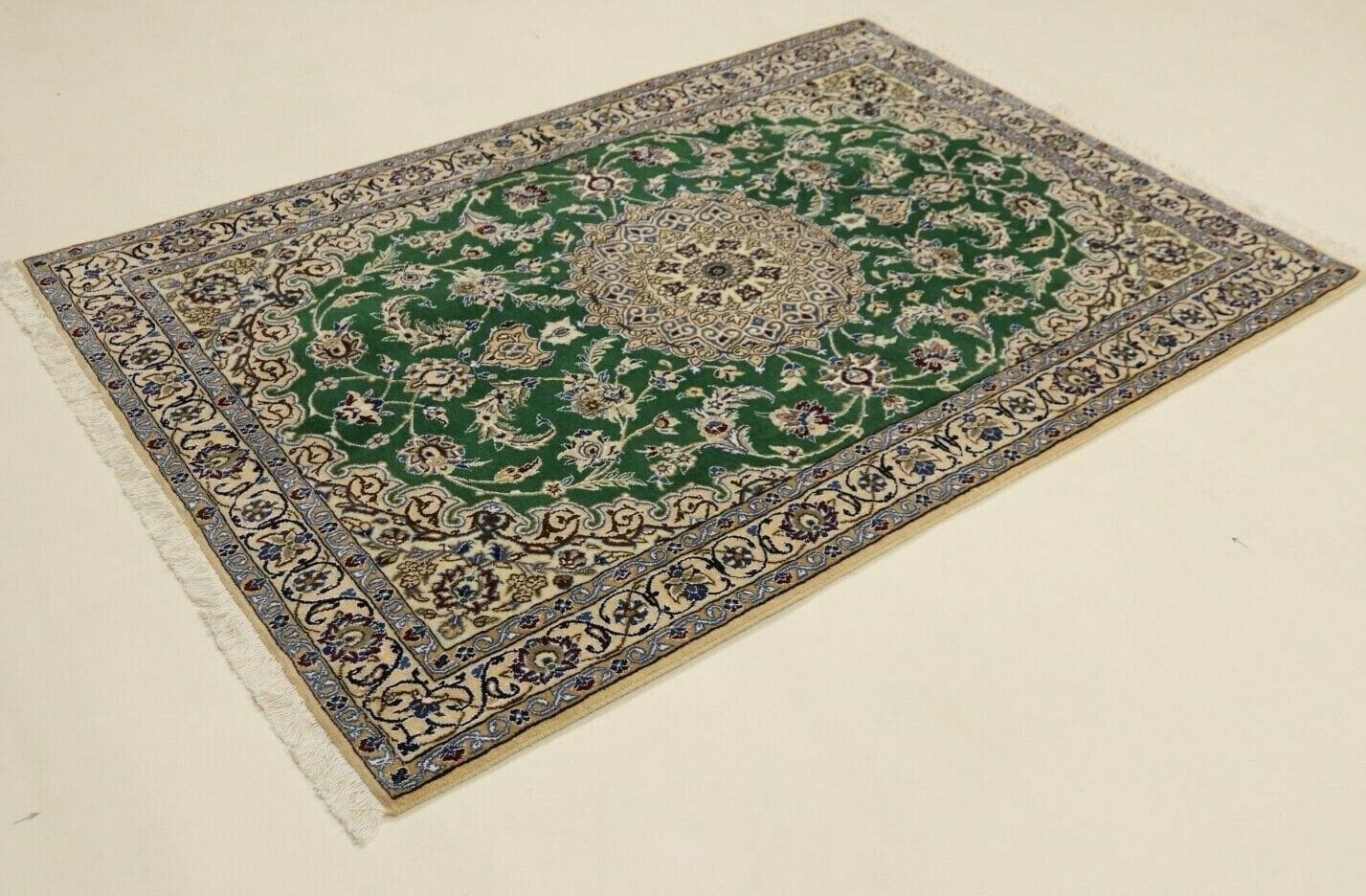
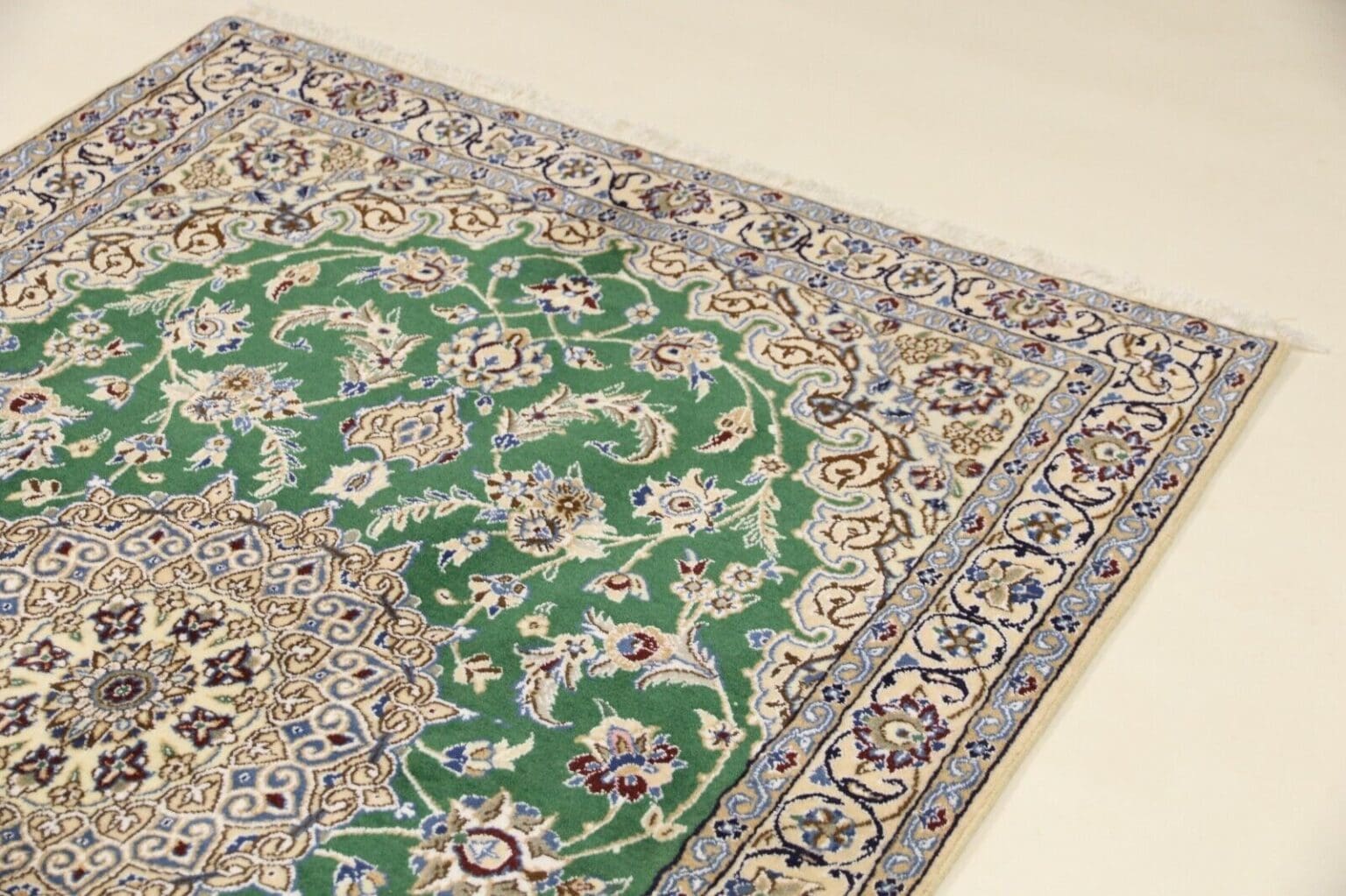
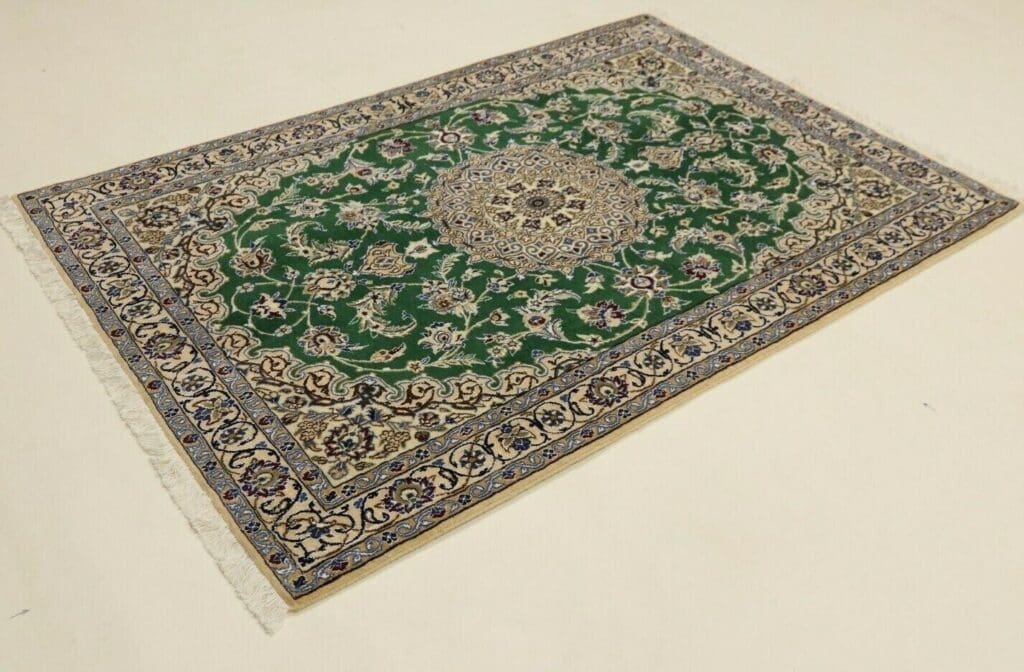
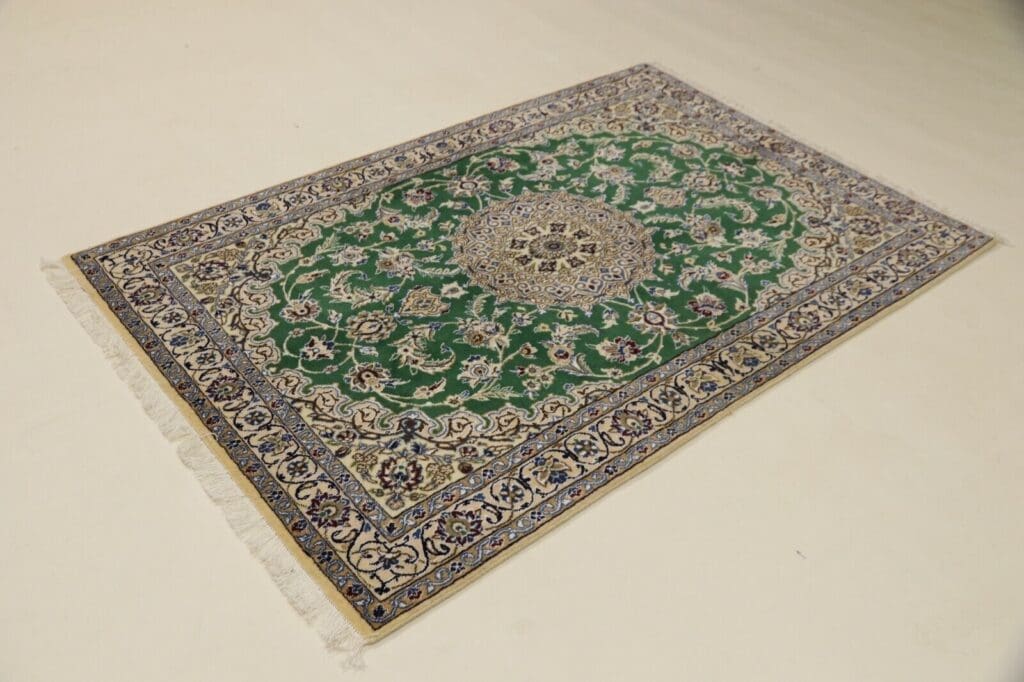
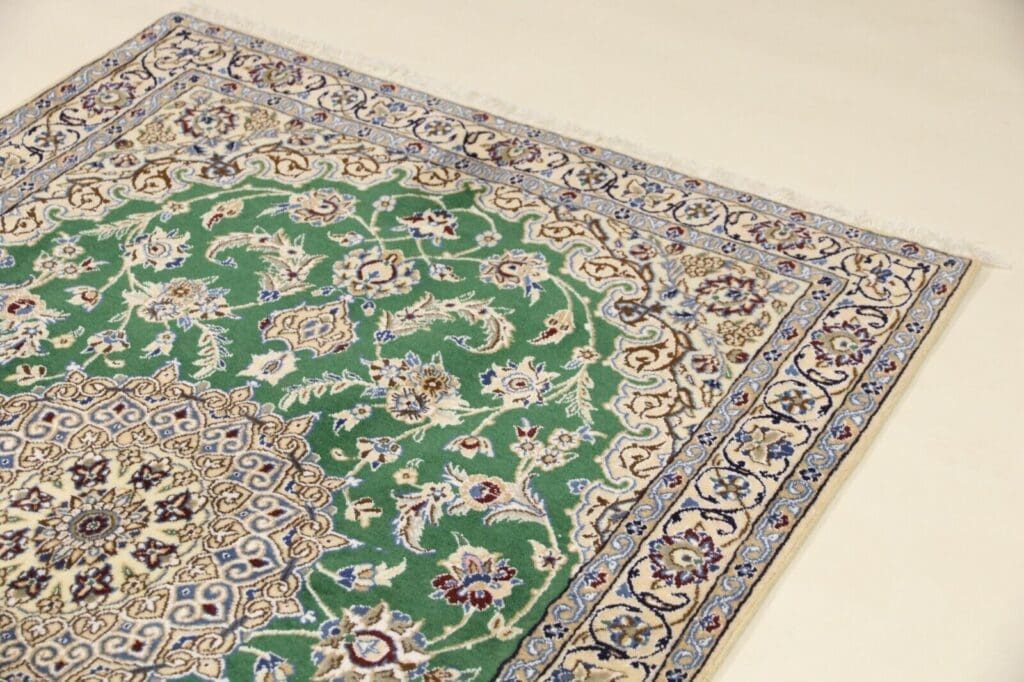
The rug has a traditional Oriental and Persian design. Fine, detailed ornament is characteristic of Nain, where floral and botanical forms are frequently combined with symmetrical geometry. These elements create a pattern that is both decorative and ordered. Rather than relying on a single large image, the design is built from relationships between a field, borders and repeated motifs. Symmetry helps establish a stable framework, while smaller plant-inspired details give the surface variation.
Floral motifs in Persian rug design are usually stylised rather than literal botanical illustrations. Leaves, blossoms and curling stems are adapted into ornamental lines that can be repeated, mirrored or linked across the field. Geometric elements provide a complementary structure. They may define axes, frame motifs or clarify the transition between the inner area and the borders. In a Nain composition, these different forms can be coordinated so that the pattern remains detailed without becoming visually disorganised.
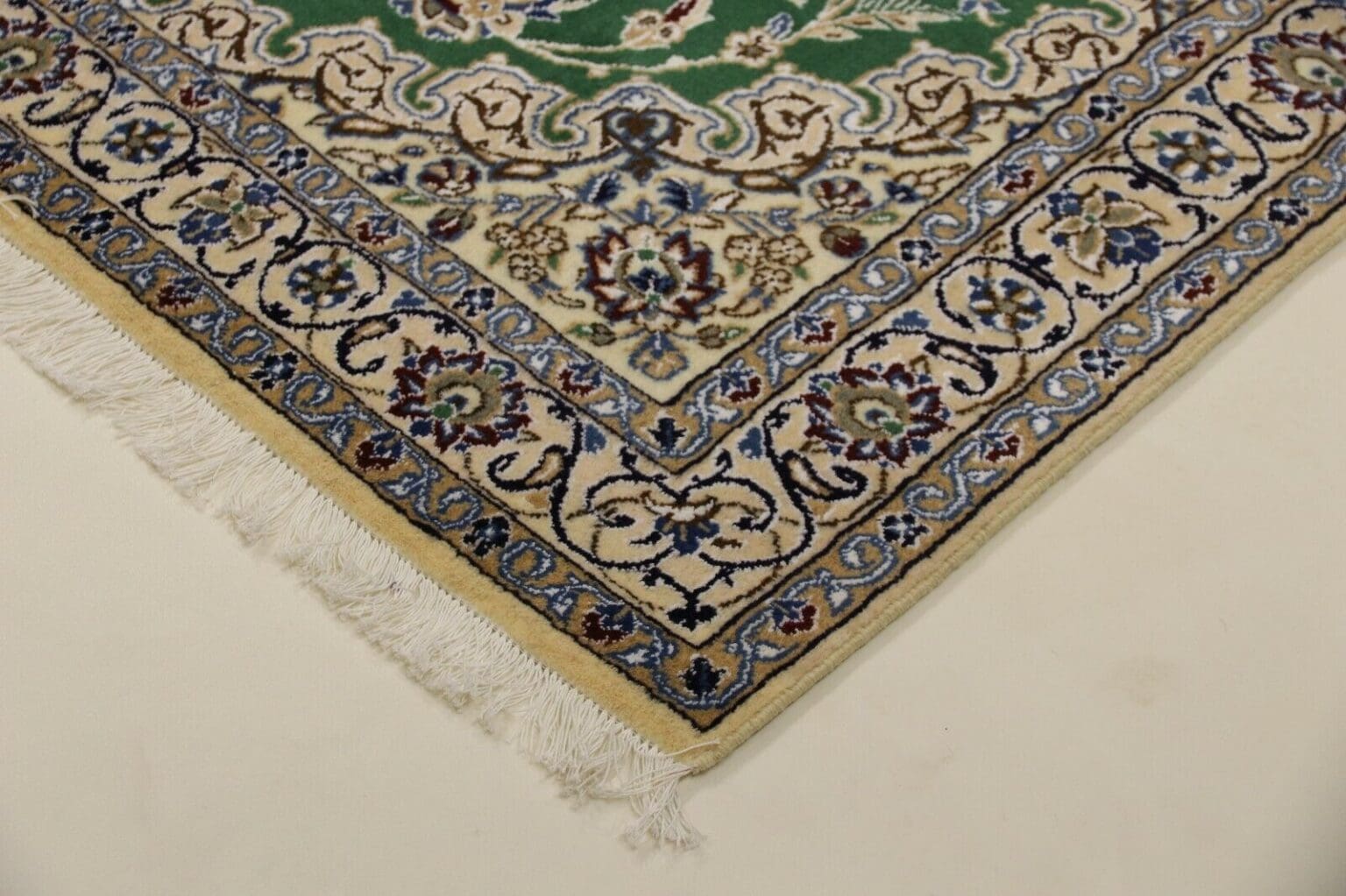
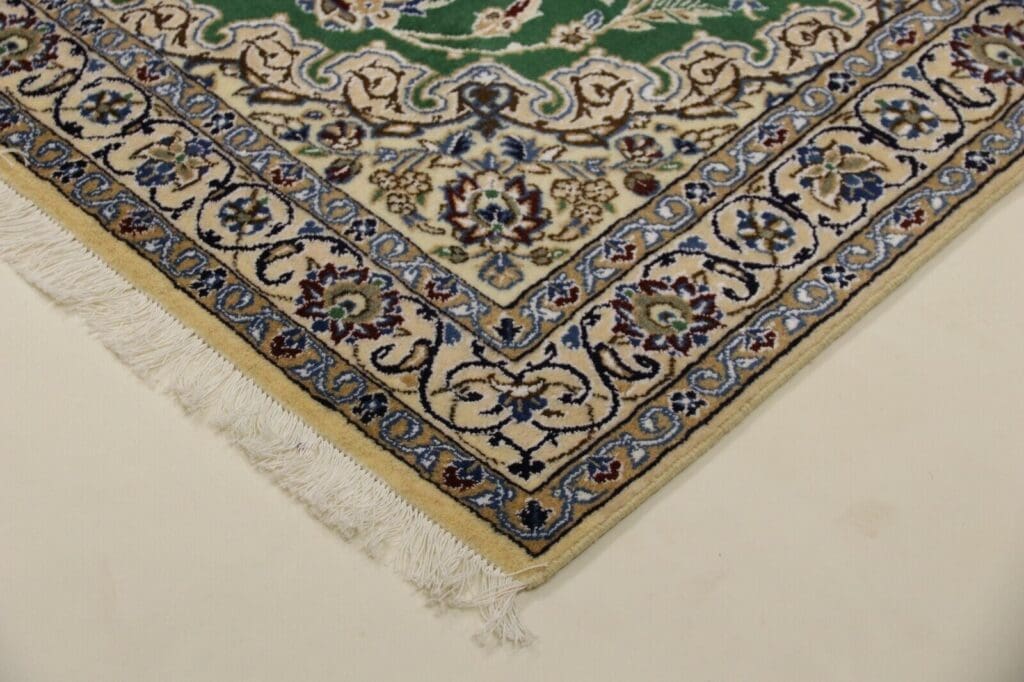
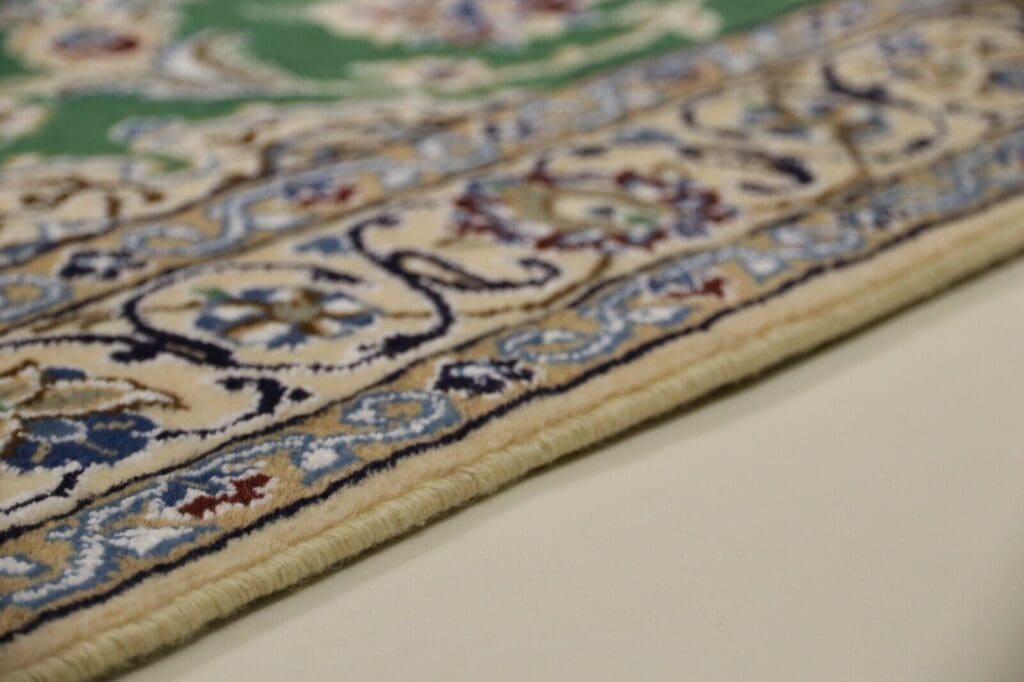
The border is an important part of this visual system. It frames the central area and gives the composition a defined edge. Narrower border bands may echo the main ornament and create a measured transition toward the outer edge. Fine knotting allows such areas to be drawn with small, controlled details. The eye can move from the larger organisation of the field to the finer features of the border while the overall design retains its calm, symmetrical character.
The description of this rug refers to harmonious colour combinations and a gentle, appealing design. It does not identify individual colours, so the pattern should be understood through its balance and ornament rather than through a list of shades. The silk component can add a quiet variation in sheen, making some details respond differently to changing light. Wool gives the surface a softer, more matte foundation. This interaction of fibres can make the design appear subtly varied without altering its traditional structure.
As a floor covering, the pattern can work in a living room, dining room or hallway. Its traditional arrangement allows it to sit naturally among classic furnishings, while the fine drawing can also provide a considered contrast in a more restrained interior. The rug’s decorative role does not replace its function as a textile floor covering. Instead, the organised field and ornamental borders let both functions coexist. The pattern remains recognisably connected to Nain while being suitable for contemporary domestic settings.
The expression 9 la is part of the description of this Nain format. Together with the name Super Nain, it identifies a finely executed variant within the Nain tradition rather than changing the rug’s stated origin. The designation is consistent with an emphasis on detailed knotting and carefully drawn ornament. It should be read alongside the Persian origin, the wool and silk pile, and the hand-knotted construction. The particular rug remains a one-off piece with its own combination of material response and pattern detail.
Special Features
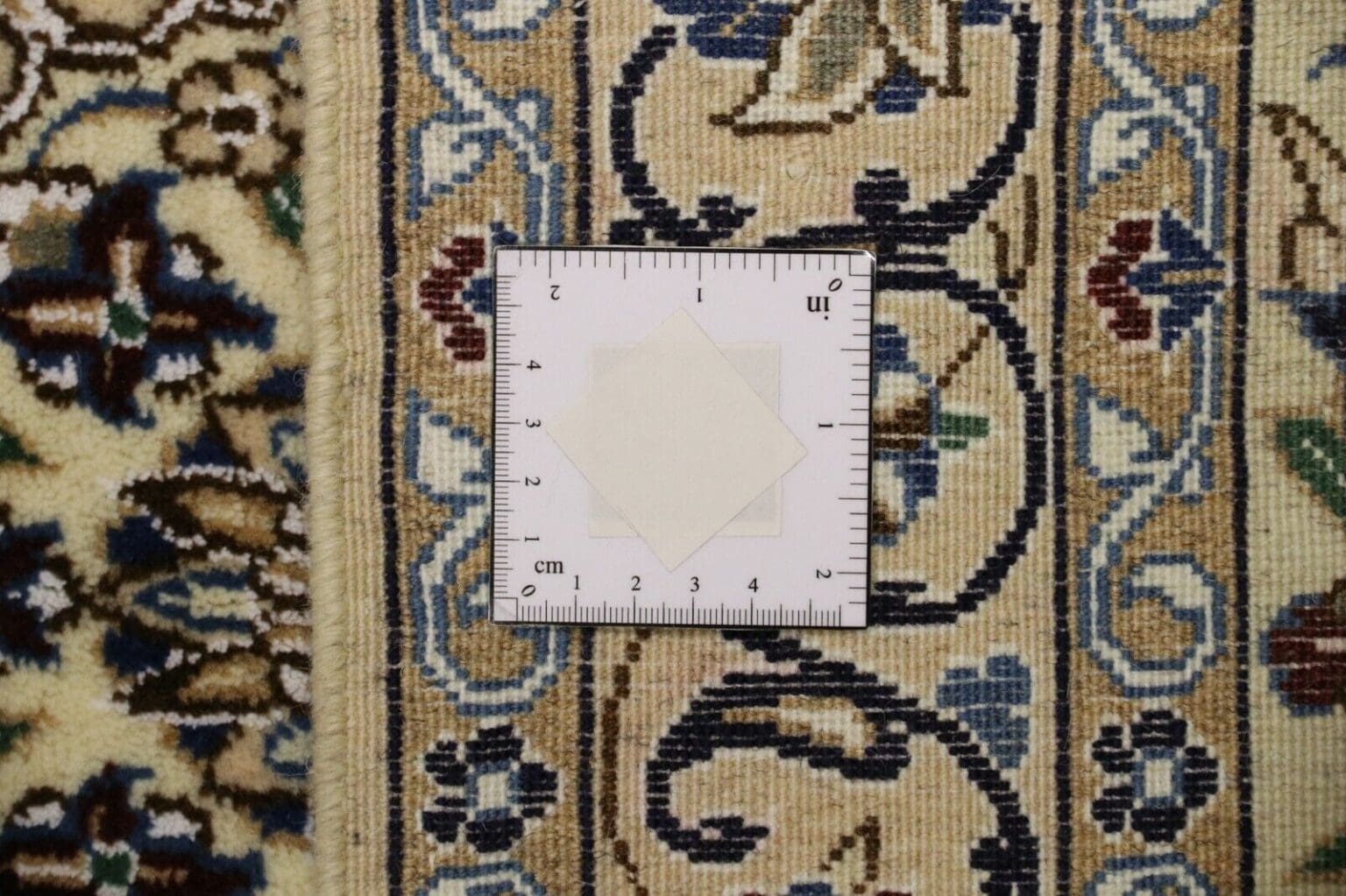
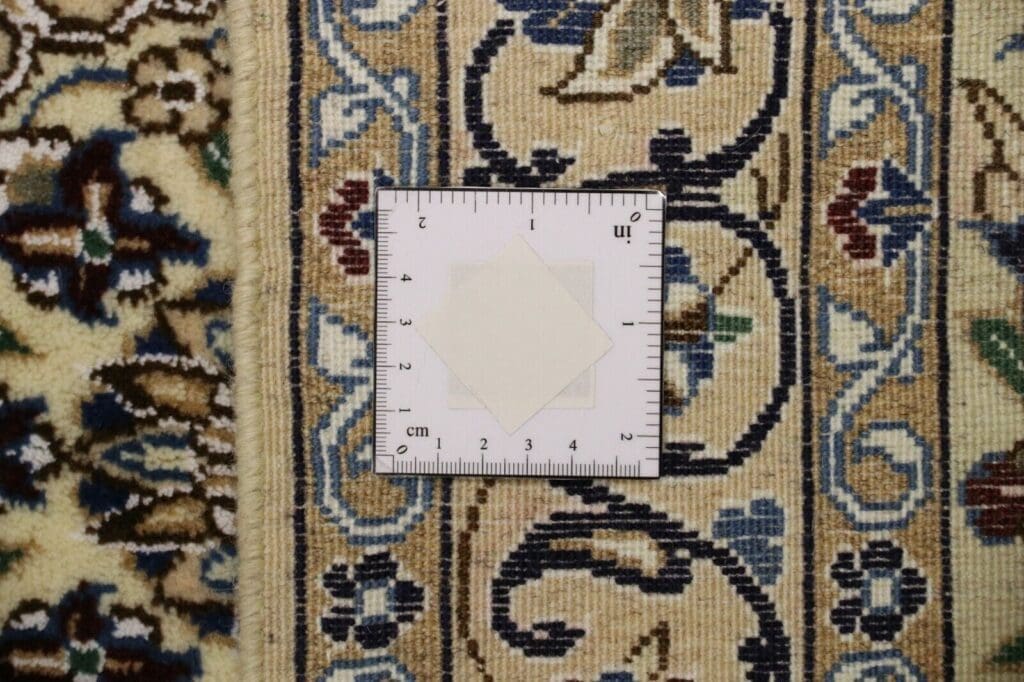
A defining feature of this rug is its high knot density. Dense knotting supports the fine rendering of the traditional Nain pattern and requires a precise working method. Each knot must be integrated into the developing structure with attention to spacing and tension. This makes it possible to preserve small ornamental lines and clean transitions between motifs. The technical character of the rug is therefore directly related to the way its design can be expressed.
The rug is new and in very good condition. It is described as a unique individual piece rather than as an interchangeable production item. Its suitability for underfloor heating is another stated feature and allows use in rooms with that type of heating system. As with any hand-knotted rug made from natural fibres, a level, clean base, suitable placement and gentle care help preserve the pile and the appearance of the design.
The combination of virgin wool and silk also contributes to the rug’s particular identity. Wool supplies the principal pile material, while silk introduces a smoother touch and a subtle reflective quality. The low pile height keeps the ornamental drawing visible and gives the surface a neat profile. These features belong to the individual rug described here and are presented together with its Nain origin, traditional Persian pattern and hand-knotted construction.
FAQ
How should a hand-knotted Nain Persian rug be cleaned?
Regular, gentle vacuuming is suitable for removing loose dust. A soft brush or a gentle vacuum setting should be used so that the wool and silk fibres are not pulled or abraded unnecessarily. If a liquid is spilled, it should be absorbed promptly without rubbing the affected area. Stains, heavier soiling and uncertain cases are best handled by a professional rug cleaner who can assess the natural fibres, pile and construction before choosing a treatment. Strong household cleaners, excessive moisture and vigorous scrubbing can damage the surface or affect its appearance, so they should be avoided.
Where can this rug be placed?
The rug is suitable for living rooms, dining rooms and hallways. It can serve as a floor covering while also bringing the traditional Nain pattern into the room as a decorative element. Its stated suitability for underfloor heating makes use in a heated living area possible. The rug should be placed on a clean, dry and even surface, with enough space for doors and furniture to function safely. Prolonged direct sunlight should be avoided where possible, since strong exposure can cause uneven fading over time. Gentle care and sensible placement support its new, very good condition.
How can the quality of a Persian rug be assessed?
Quality is assessed through several characteristics rather than through one feature alone. Knot density, pile materials, the stability of the warp, the precision of the workmanship and the clarity of the pattern all provide useful information. Dense knotting can support finely drawn motifs, while good virgin wool contributes resilience and a comfortable surface. Silk can add a smoother feel and controlled lustre, and a cotton warp provides the foundation for the knotted structure. The regional design language also matters. In this rug, the Nain origin, hand-knotted construction, wool and silk pile, detailed traditional pattern and new, very good condition form the relevant set of characteristics.
To provide the best experiences, we use technologies like cookies to store and/or access device information. Consenting to these technologies will allow us to process data such as browsing behavior or unique IDs on this site. Not consenting or withdrawing consent, may adversely affect certain features and functions.
Functional Always active
The technical storage or access is strictly necessary for the legitimate purpose of enabling the use of a specific service explicitly requested by the subscriber or user, or for the sole purpose of carrying out the transmission of a communication over an electronic communications network.
Preferences
The technical storage or access is necessary for the legitimate purpose of storing preferences that are not requested by the subscriber or user.
Statistics
The technical storage or access that is used exclusively for statistical purposes.The technical storage or access that is used exclusively for anonymous statistical purposes. Without a subpoena, voluntary compliance on the part of your Internet Service Provider, or additional records from a third party, information stored or retrieved for this purpose alone cannot usually be used to identify you.
Marketing
The technical storage or access is required to create user profiles to send advertising, or to track the user on a website or across several websites for similar marketing purposes.
 SECURE PAYMENT
 SHIPPING PARTNERS