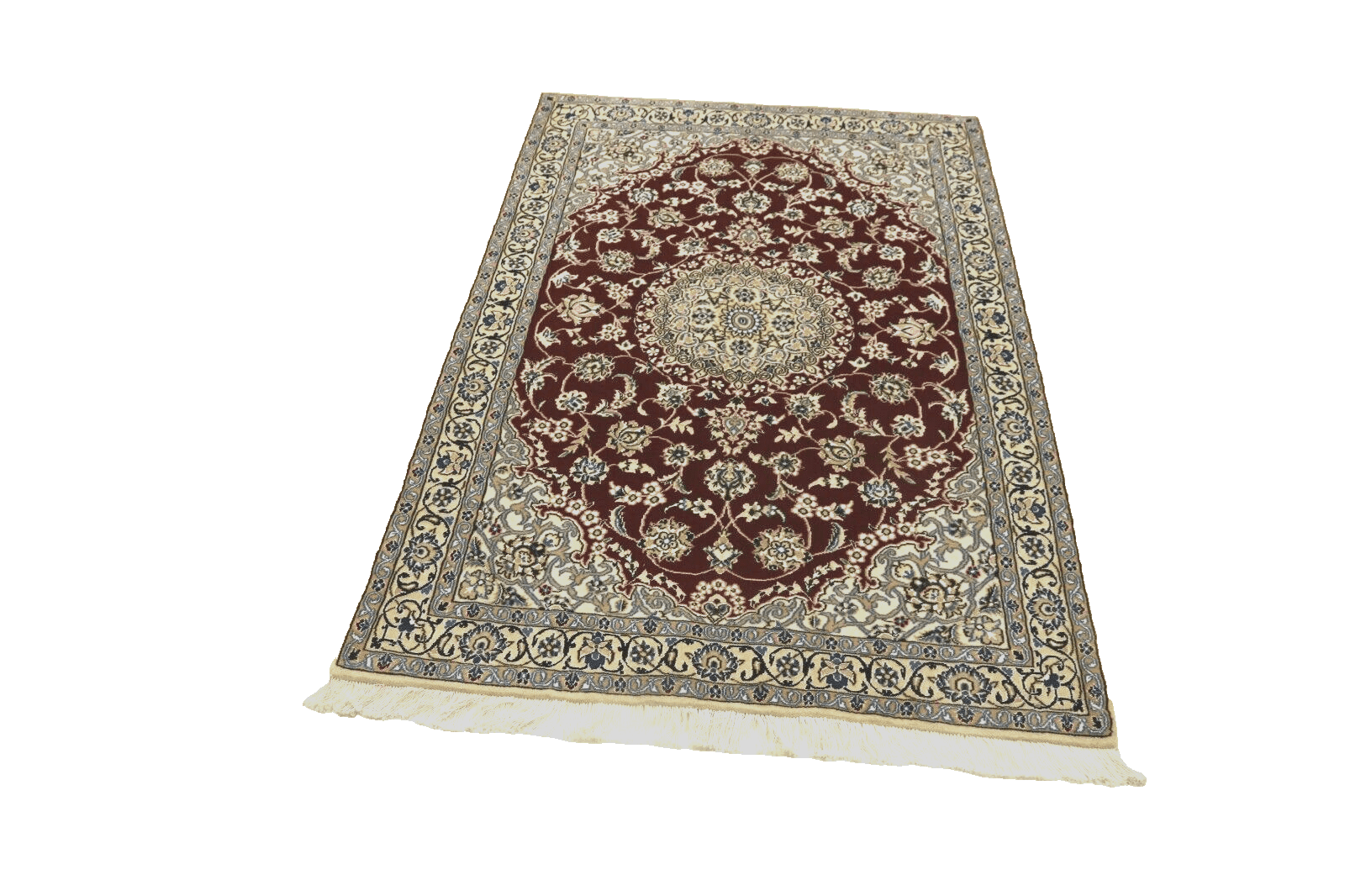
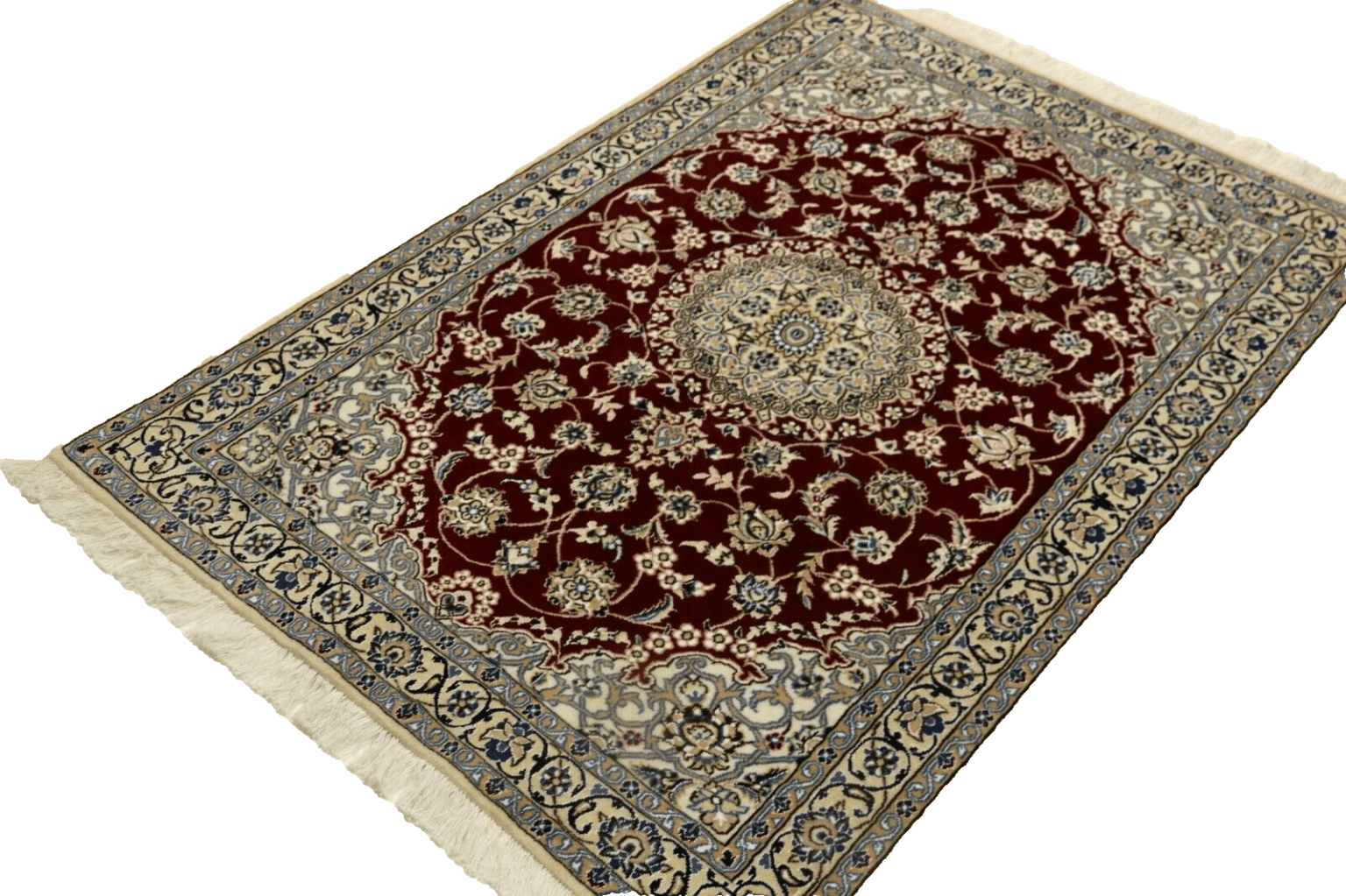
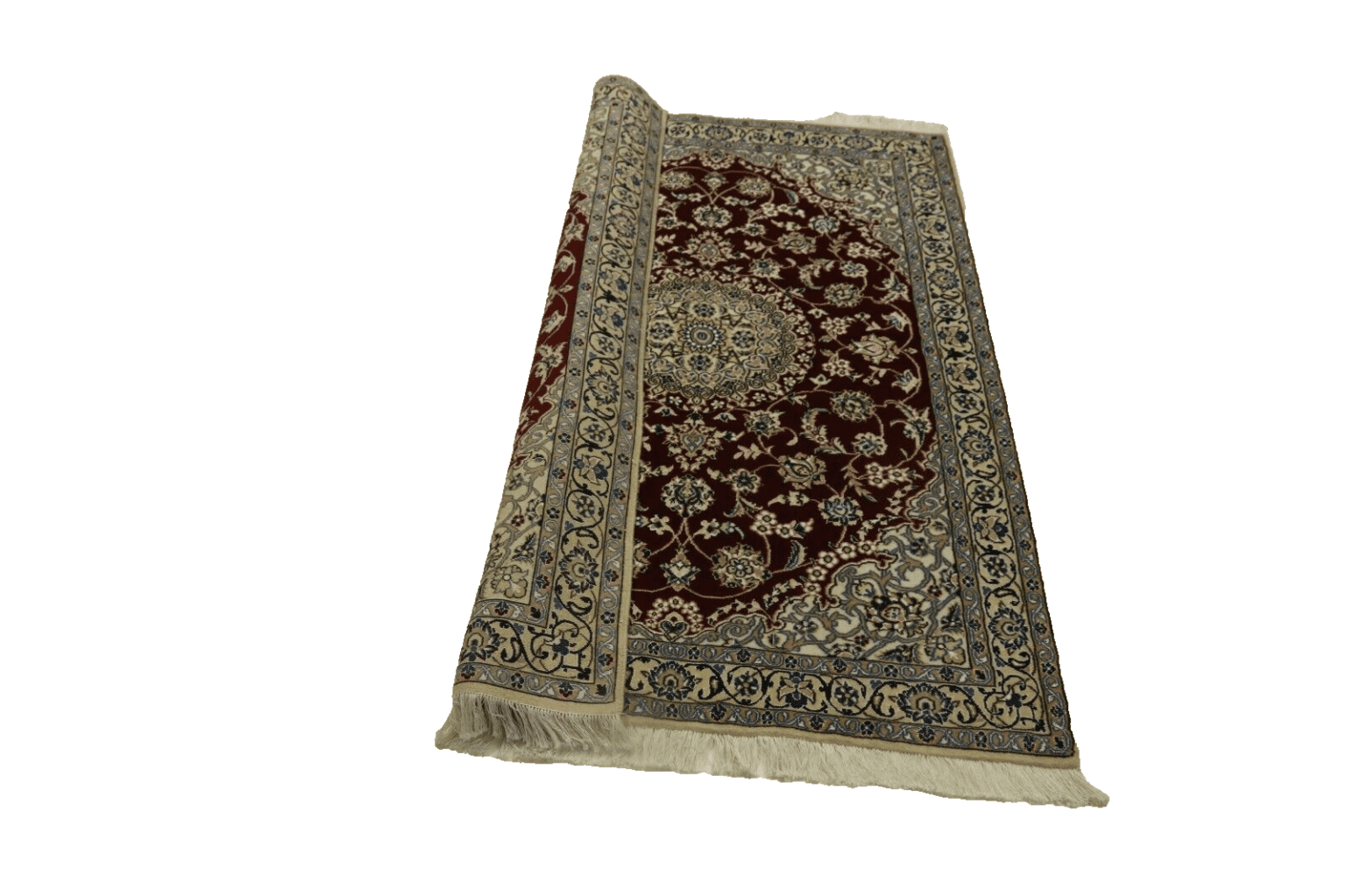
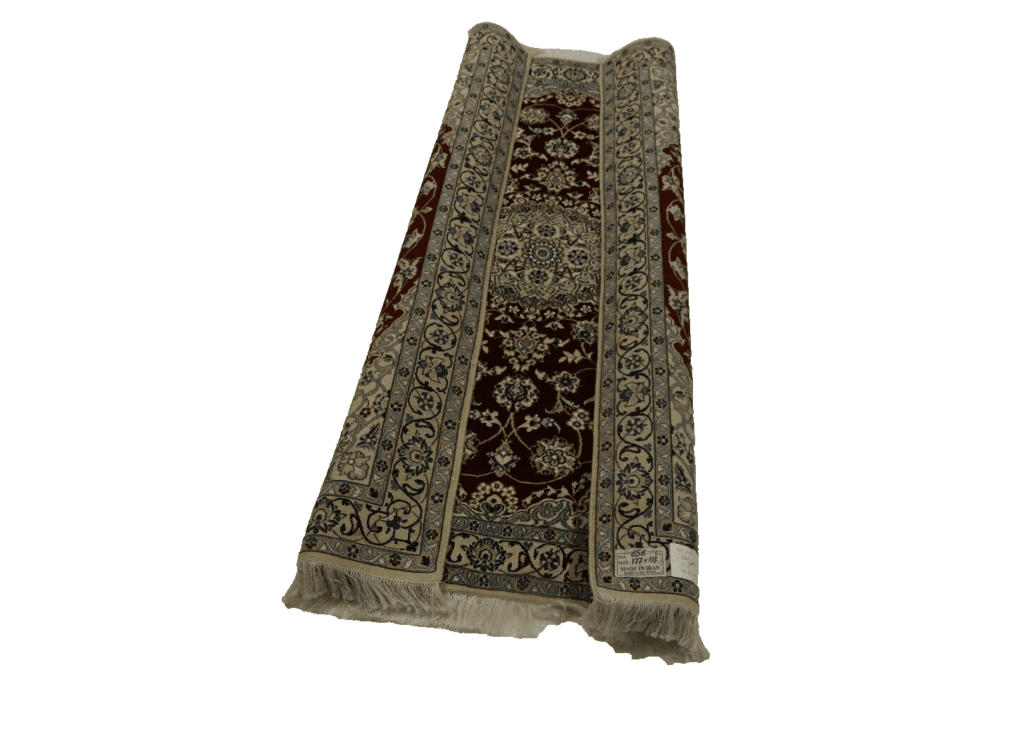
This Nain Persian rug is hand-knotted, with a pile made of 90% virgin wool and 10% silk. The warp is 100% cotton. The combination brings together the resilient character of wool, the smooth sheen of silk and the stable textile foundation provided by cotton. Each material has a distinct role within the construction, while the finished surface remains a coherent hand-made pile.
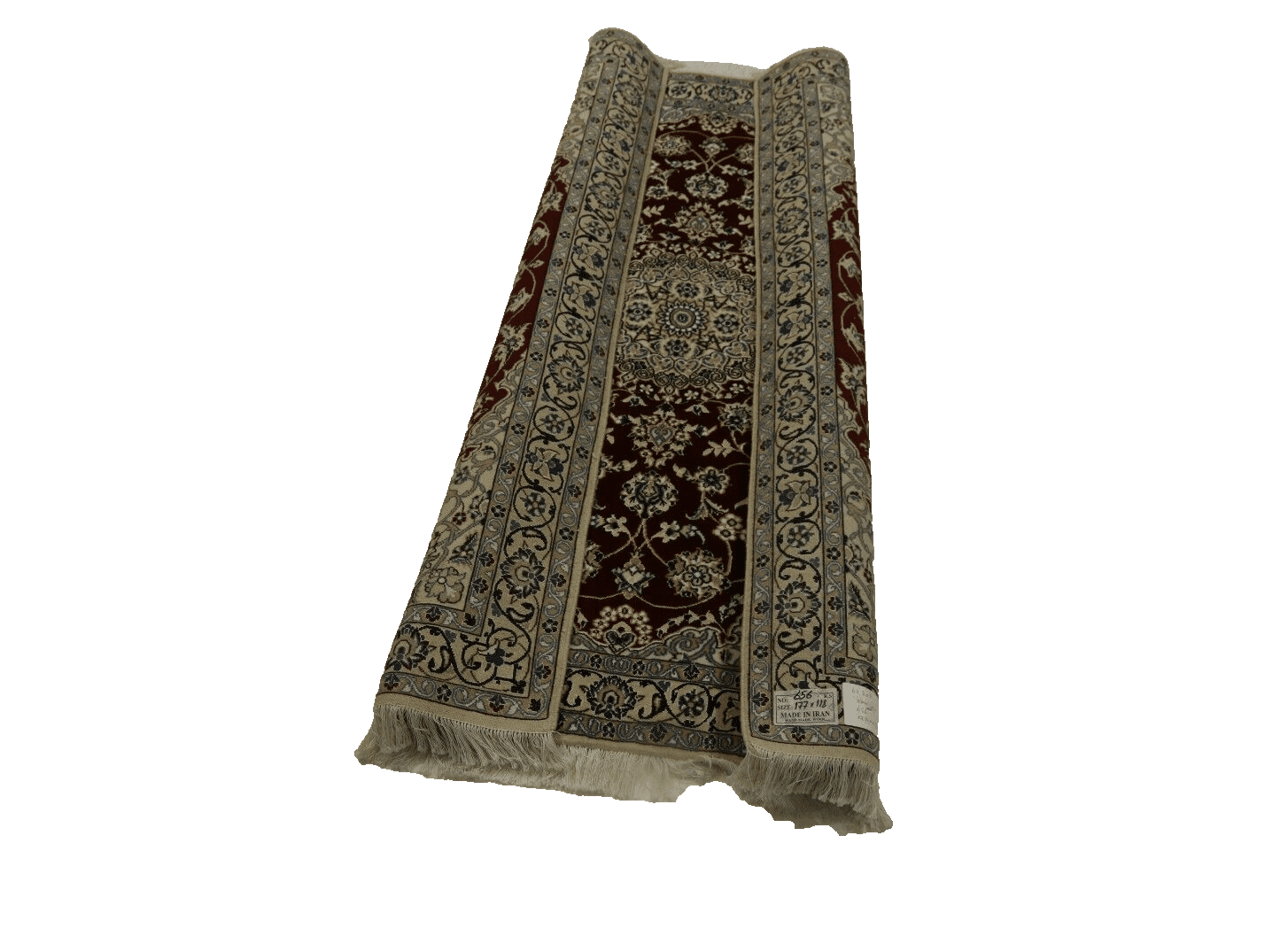
Hand knotting is carried out on a loom. Individual strands of pile are tied by hand around the warp, row by row, and the structure is compacted with weft threads as the work advances. The process calls for patience, precision and practiced control. It is not a single, automated operation: the pile develops gradually through many separate knots. The rug’s high knot density supports a precise rendering of small lines, ornaments and changes within the design.
Virgin wool forms the greater part of the pile. It is valued for durability and for its insulating qualities, giving the surface a pleasant and substantial textile character. The silk content adds a subtle shine and a smoother touch. The wool and silk pile is also described as breathable. The cotton warp provides the underlying framework to which the hand-knotted pile is attached. The rug is new and in very good condition.
Origin and Tradition
The rug comes from Persia, present-day Iran, and is associated with the Nain region. Nain has a long-standing reputation within Persian rug making. Its tradition is linked with finely executed carpets in which close knotting and careful drawing work together. The name Nain therefore identifies both a region of origin and a recognized tradition of detailed Persian craftsmanship.
Iranian rug making developed through the transmission of practical knowledge from one generation to the next. Weavers and knotters learned how to prepare a loom, tension the warp, place and secure the knots, insert the weft and finish the pile. Regional workshops established their own approaches to colour, layout and ornament. Within this wider Persian heritage, Nain is associated with controlled workmanship and designs whose details remain legible because of their fine construction.
The making of a hand-knotted rug begins with the loom. Parallel warp threads are set in place as the structural basis. Pile strands are then tied around them in successive rows. A weft is passed through the construction and beaten into position to secure the rows. Once the knotting is complete, the pile is trimmed and the surface is finished. Repeating these stages across the whole rug requires sustained attention and gives the textile its compact, individually made character.
Nain rugs are commonly connected with floral ornament and ordered geometric elements. These features belong to a Persian design vocabulary in which plant forms, lines and spaces are arranged as a balanced composition. Floral shapes may be stylized rather than copied directly from nature, while geometric lines give the composition definition. The result can combine delicacy with clear organization, allowing numerous details to remain part of one continuous design.
The tradition also reflects the relationship between technical density and visual clarity. A closely knotted surface gives the maker room to articulate narrow contours, small leaves, fine stems and carefully bounded colour areas. Construction and design are therefore inseparable: the way the rug is made affects the degree of detail that can be shown. At the same time, a well-organized pattern prevents the many individual elements from losing their relationship to the whole.
Persian carpet culture is deeply rooted in Iranian craft history. Rugs have served practical, decorative and cultural purposes, and their patterns carry regional conventions without making every piece identical. Workshop practice, materials and individual execution can vary. What remains characteristic is the use of a loom, a hand-worked pile and a structured pattern language. This Nain rug belongs to that tradition through its stated Persian origin, its hand-knotted construction and its regional designation.
Design and Pattern
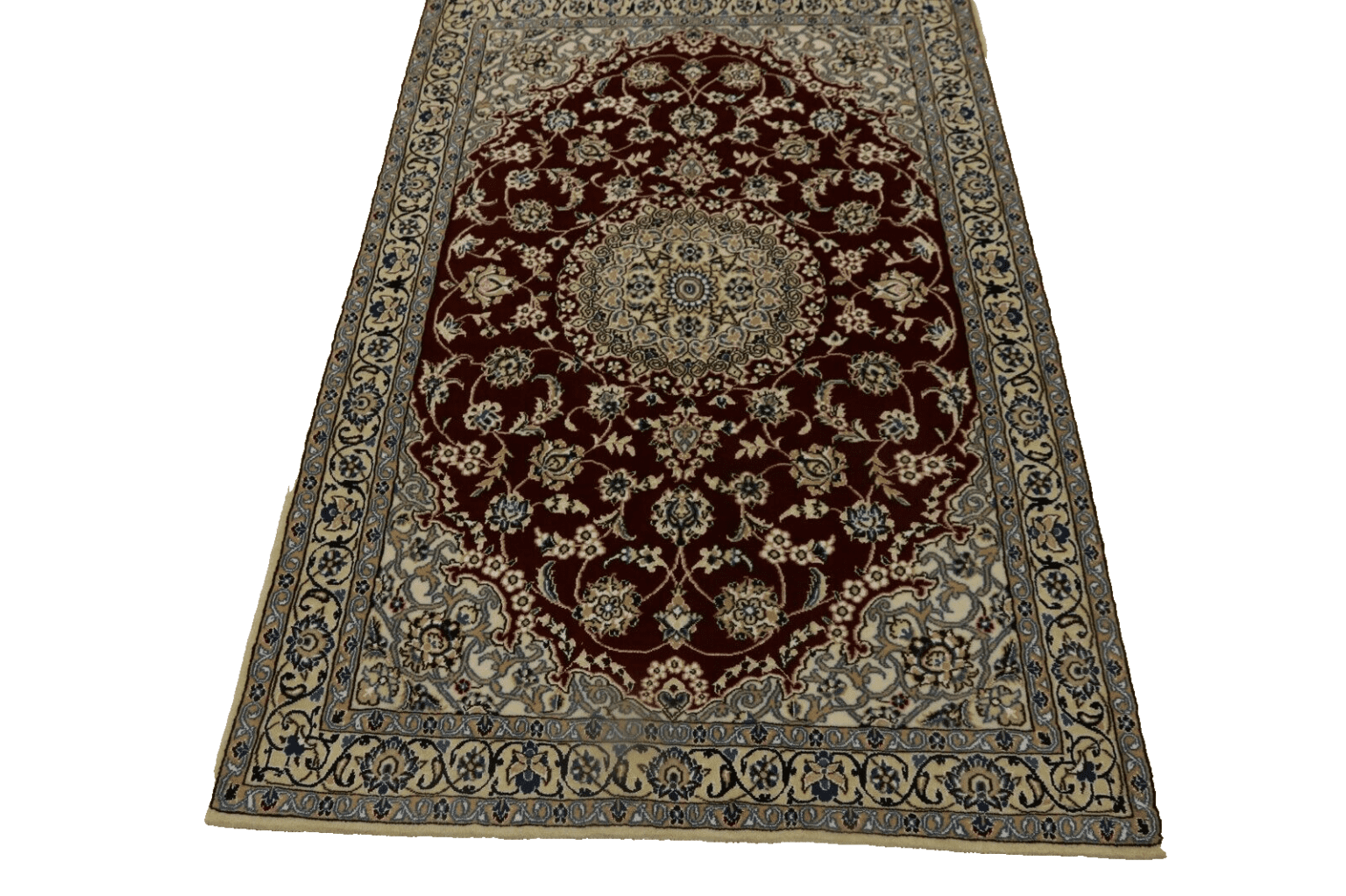
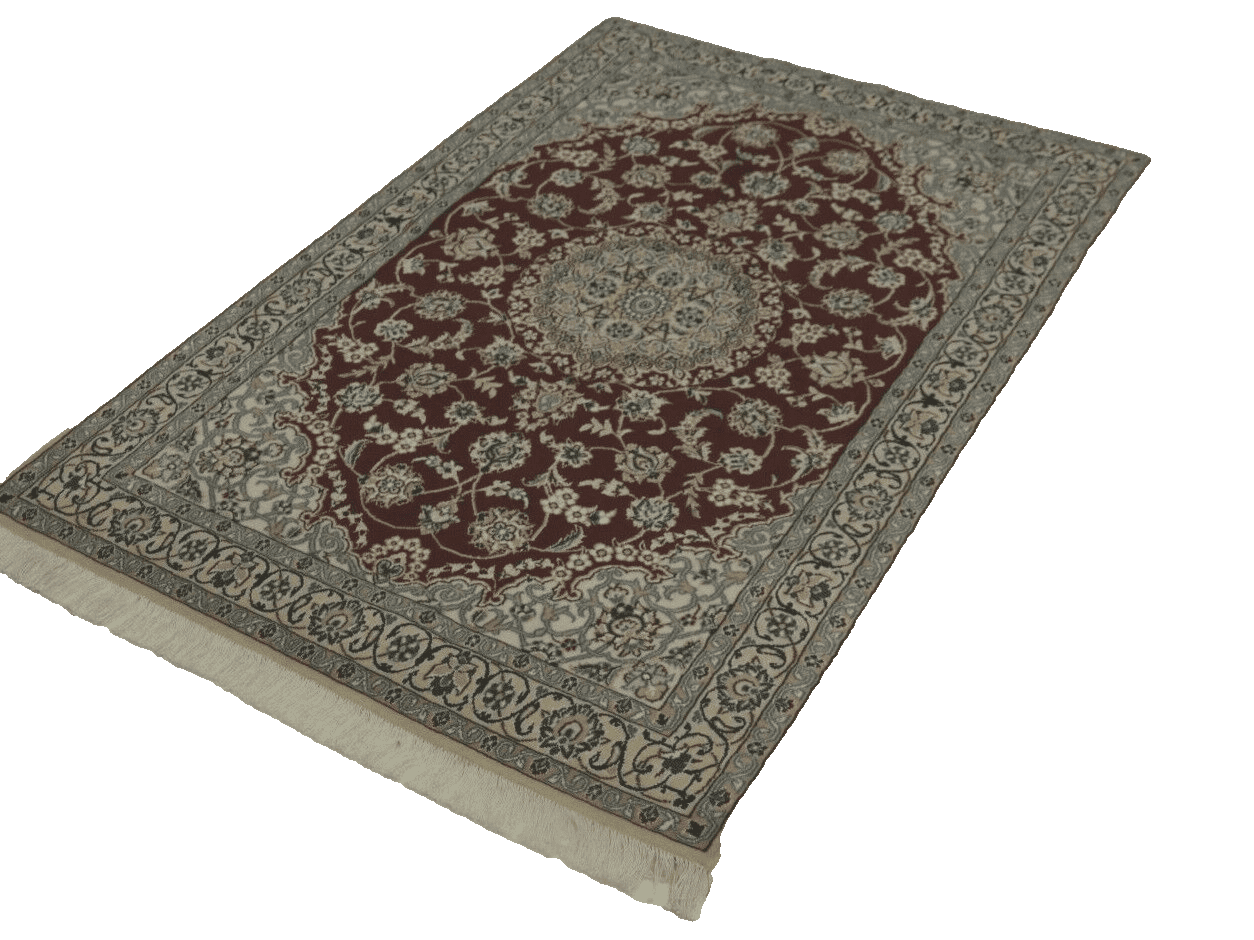
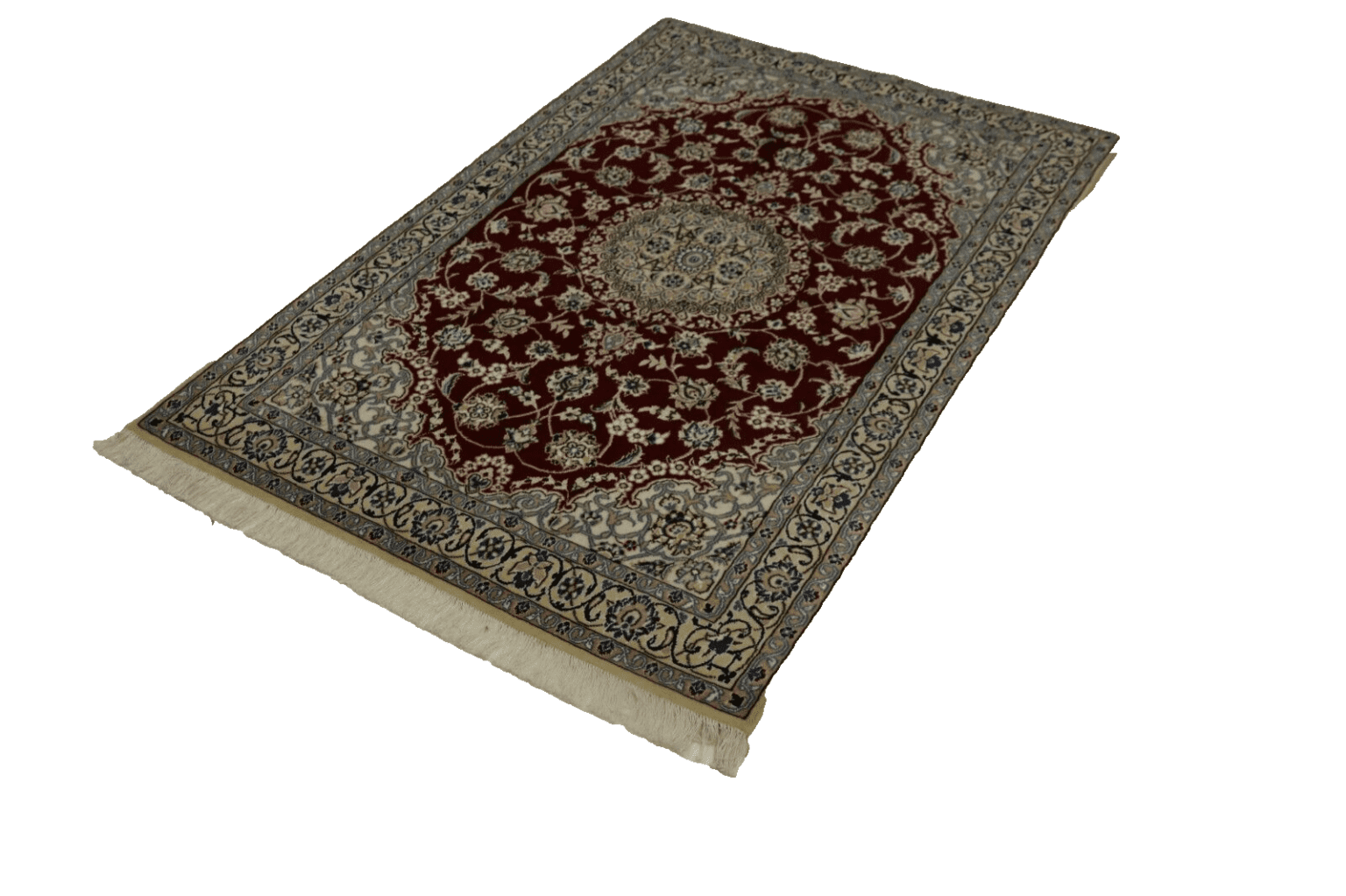
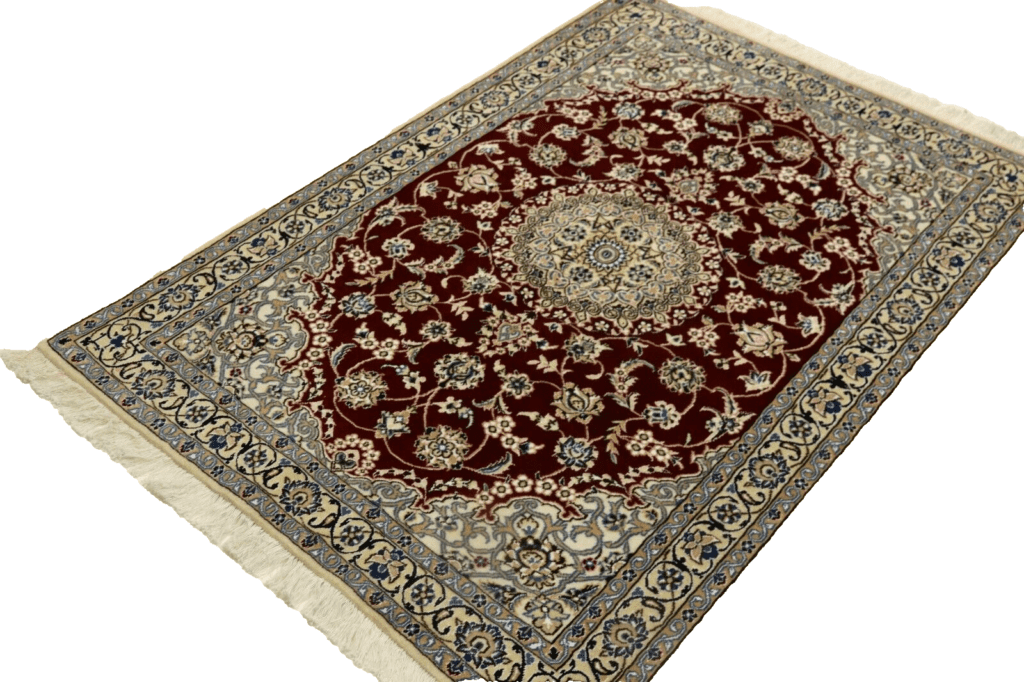
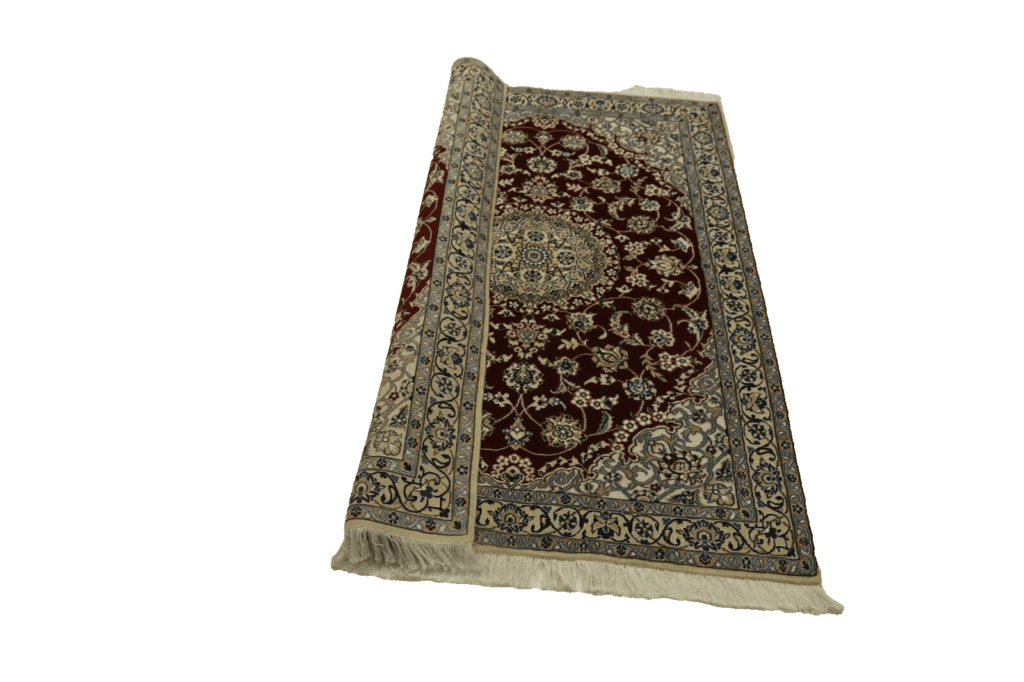
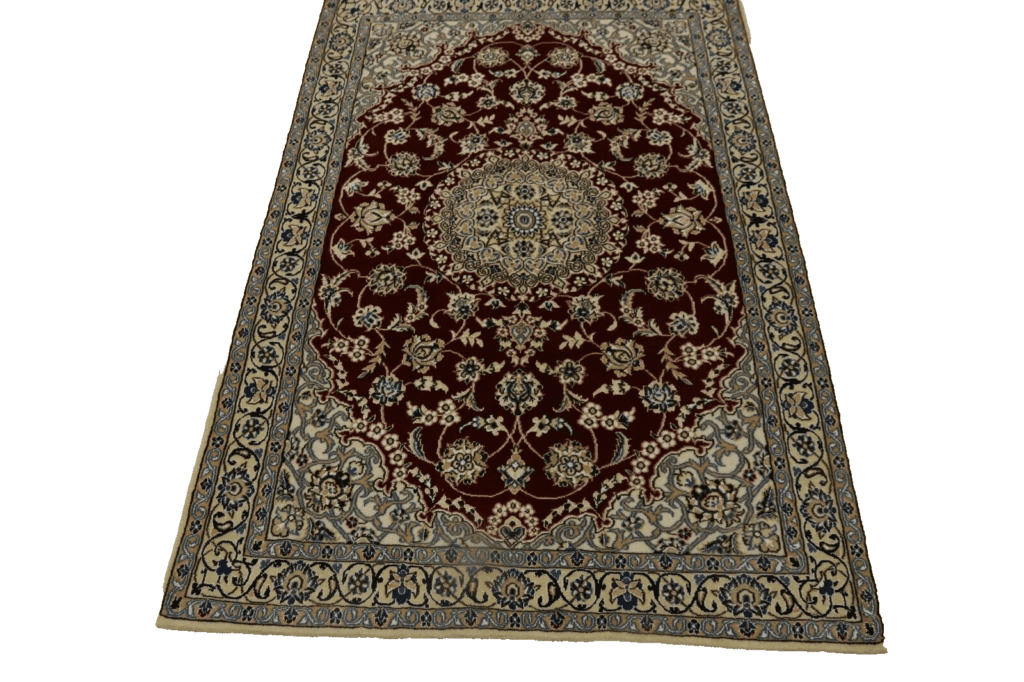
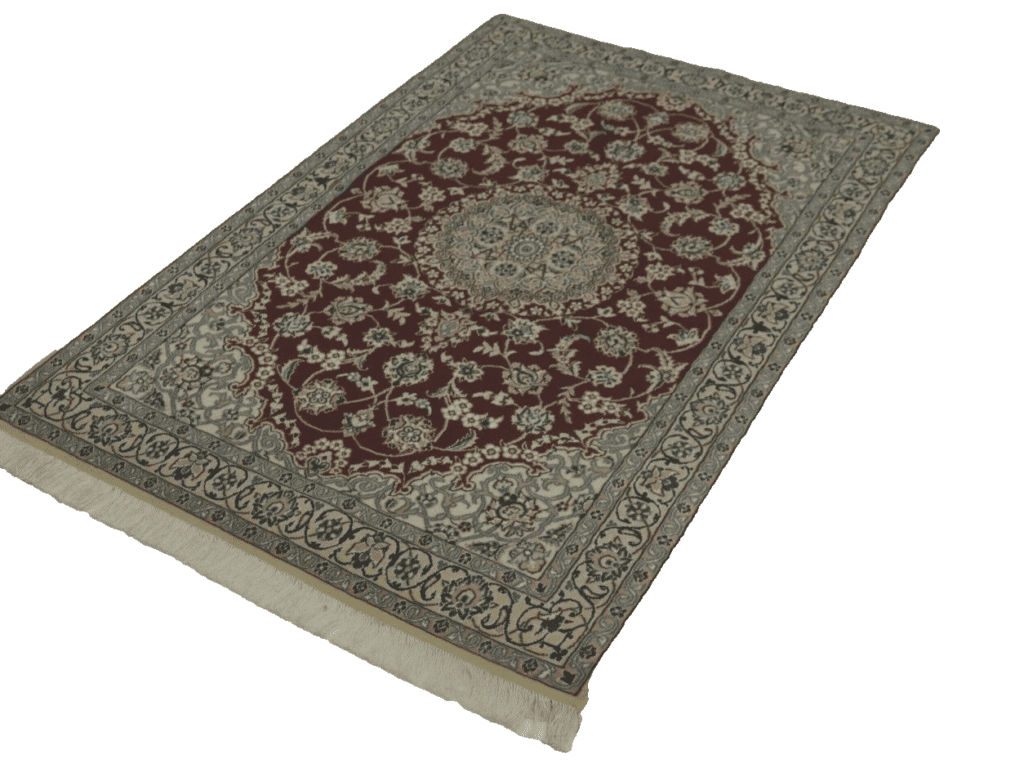
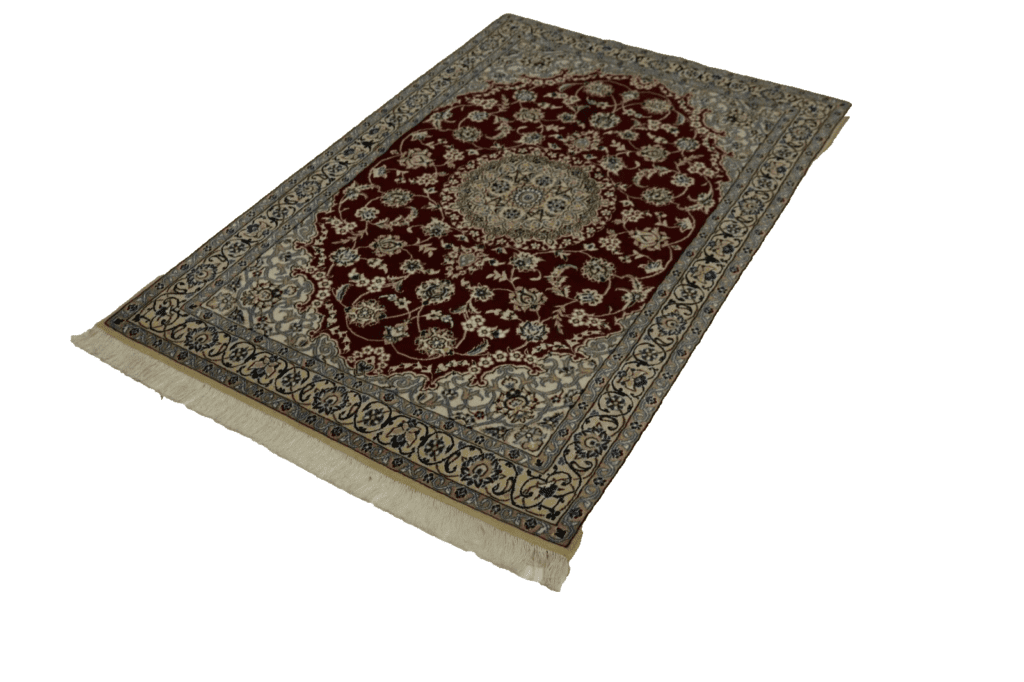
The stated colour pattern is red and oriental. Red gives the rug its defining visual direction and creates a warm overall impression. Here, oriental describes the traditional decorative character of the design; it does not add a separate place of origin. The colour is experienced together with the pattern drawing, the wool pile and the restrained sheen that can come from the silk content.
Floral motifs and geometric forms are both associated with Nain rug design. Stylized blossoms, leaves and scrolling plant shapes may be organized with lines, borders or measured repetitions. Geometric elements provide structure and definition, while floral details soften the arrangement. This relationship between organic and ordered forms is part of the wider Persian tradition and allows a design to be detailed without becoming visually unstructured.
The high knot density is significant for the appearance of the pattern. When many knots are used across the surface, the maker can define smaller contours and more closely spaced colour changes. Fine details can be separated with greater precision than in a more loosely constructed pile. Knotting is therefore not merely a production detail. It influences the sharpness, rhythm and legibility of the ornament that can be achieved.
A Persian rug design depends on the interaction of filled areas, motifs and open spaces. Repeated elements establish rhythm, while borders and internal divisions guide the eye across the surface. Floral forms can be linked into a continuous movement, and geometric features can give the composition a measured framework. The balance of these components helps individual ornaments read as parts of a complete pattern rather than as isolated marks.
Red may function as a dominant ground or as a strong accent within an oriental composition. Its effect changes according to the surrounding motifs, the amount of open field and the distribution of contrasting colours. In this rug, the red oriental colour pattern is joined to the fine Nain tradition and to a hand-knotted surface capable of carrying detailed drawing. The silk in the pile may catch light differently across the surface, giving selected areas a quiet variation in appearance.
The designation Super Nain 9 La is part of the product name. It accompanies the Nain attribution but does not replace the separate facts about Persian origin, materials, hand knotting or colour. Taken together, these characteristics describe a finely knotted Persian rug with a red oriental design and a surface suited to detailed pattern work.
Special Features
The rug combines a pile of 90% virgin wool and 10% silk with a 100% cotton warp. This material structure brings together the strength and insulating quality associated with wool and the smooth sheen associated with silk. Its high knot density supports detailed pattern definition, while the hand-knotted method makes each finished piece an individual one-off.
The rug is new and in very good condition. Its red oriental colour scheme, Persian origin and connection with the Nain region are presented alongside careful hand craftsmanship. The wool and silk pile has a pleasant tactile character and is described as breathable. These materials are also stated to help the rug retain its shape and colour under changing climatic conditions.
FAQ
How is a hand-knotted rug made?
A hand-knotted rug is made on a loom with warp threads stretched from one end to the other. Individual pile strands are tied around the warp by hand, and each row is secured with weft threads before the next row is begun. The process continues across the entire surface. Once the knotting is finished, the pile is trimmed and the rug is cleaned and finished. The work requires skill and patience. A high knot density allows the maker to reproduce narrow outlines, small motifs and fine transitions with greater clarity.
How should I care for my oriental rug?
Regular gentle vacuuming helps remove loose dust and everyday dirt from the pile. The surface should not be subjected to unnecessary force. Professional rug cleaning is appropriate when a deeper treatment is needed, particularly because this rug combines virgin wool and silk. Strong, direct sunlight should be avoided so that the colours do not fade. If liquid is spilled, it should be carefully absorbed promptly rather than rubbed into the pile. Specialist treatment helps preserve the textile structure and the appearance of the colours.
What is the difference between a Persian rug and an oriental rug?
A Persian rug is specifically a rug knotted in Persia or Iran. Oriental rug is a broader term covering rugs made in several regions of the Orient. This piece is described as a Persian rug because its origin is given as Persia and it is associated with Nain in Iran. Nain patterns belong to the regional traditions of Persian carpet art. Origin and style should still be kept distinct: origin identifies the place connected with manufacture, while a style description refers to the visual language and decorative character of the rug.
To provide the best experiences, we use technologies like cookies to store and/or access device information. Consenting to these technologies will allow us to process data such as browsing behavior or unique IDs on this site. Not consenting or withdrawing consent, may adversely affect certain features and functions.
Functional Always active
The technical storage or access is strictly necessary for the legitimate purpose of enabling the use of a specific service explicitly requested by the subscriber or user, or for the sole purpose of carrying out the transmission of a communication over an electronic communications network.
Preferences
The technical storage or access is necessary for the legitimate purpose of storing preferences that are not requested by the subscriber or user.
Statistics
The technical storage or access that is used exclusively for statistical purposes.The technical storage or access that is used exclusively for anonymous statistical purposes. Without a subpoena, voluntary compliance on the part of your Internet Service Provider, or additional records from a third party, information stored or retrieved for this purpose alone cannot usually be used to identify you.
Marketing
The technical storage or access is required to create user profiles to send advertising, or to track the user on a website or across several websites for similar marketing purposes.
 SECURE PAYMENT
 SHIPPING PARTNERS


