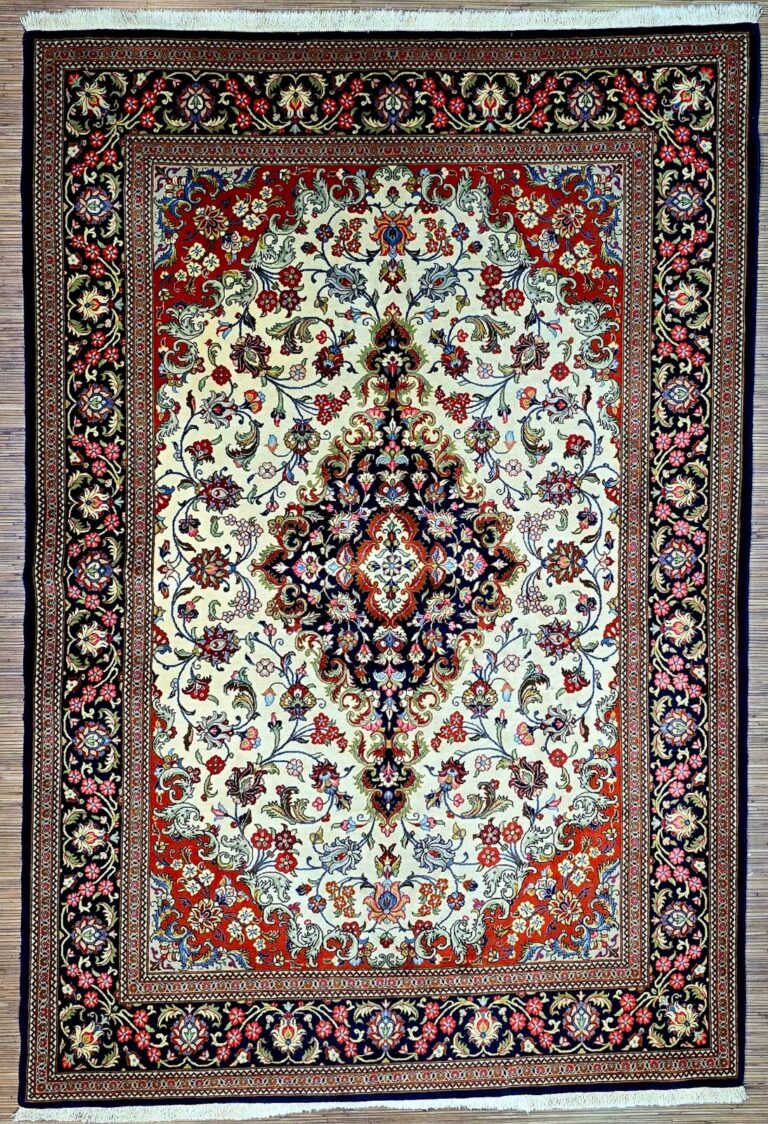
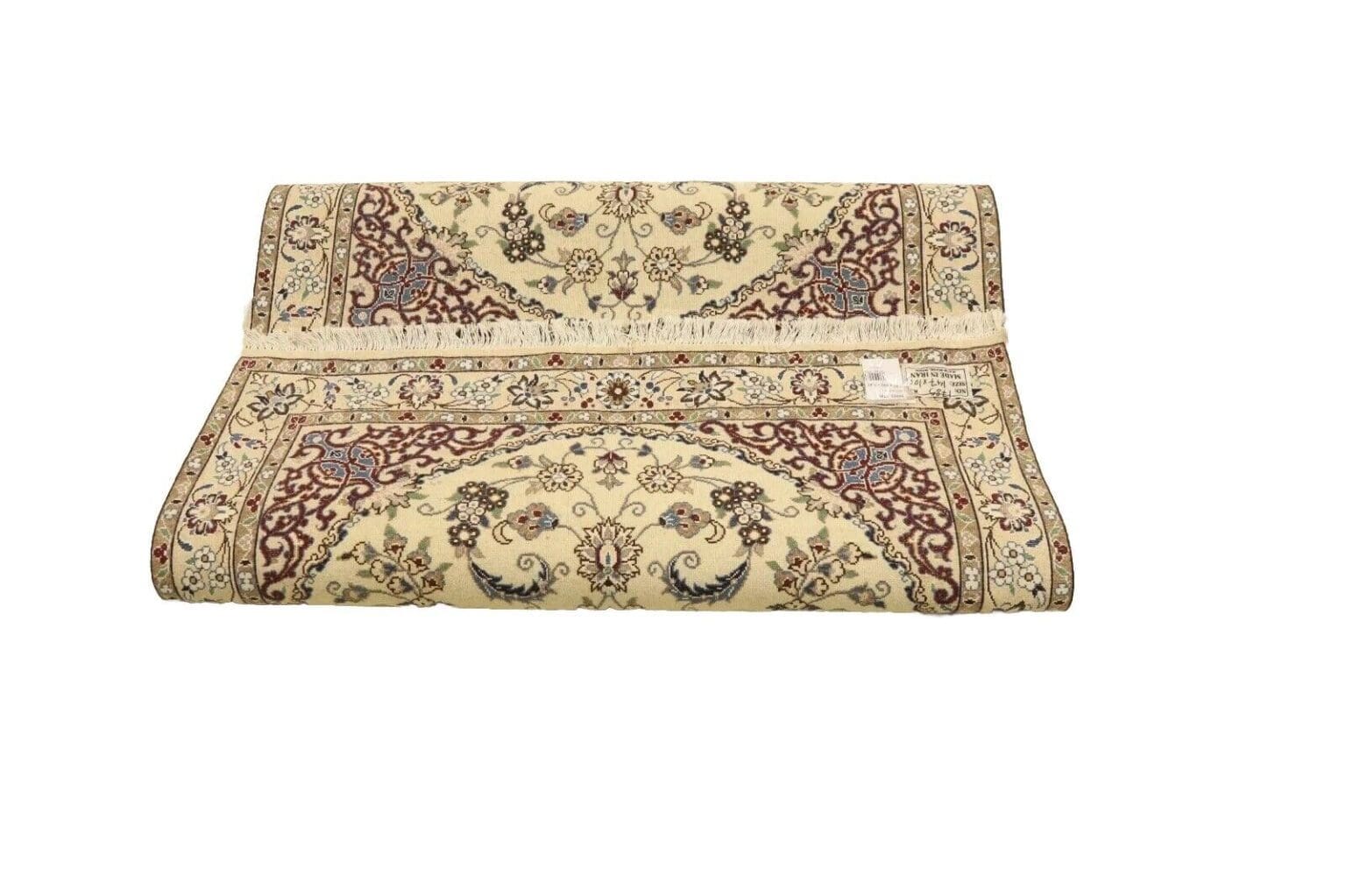
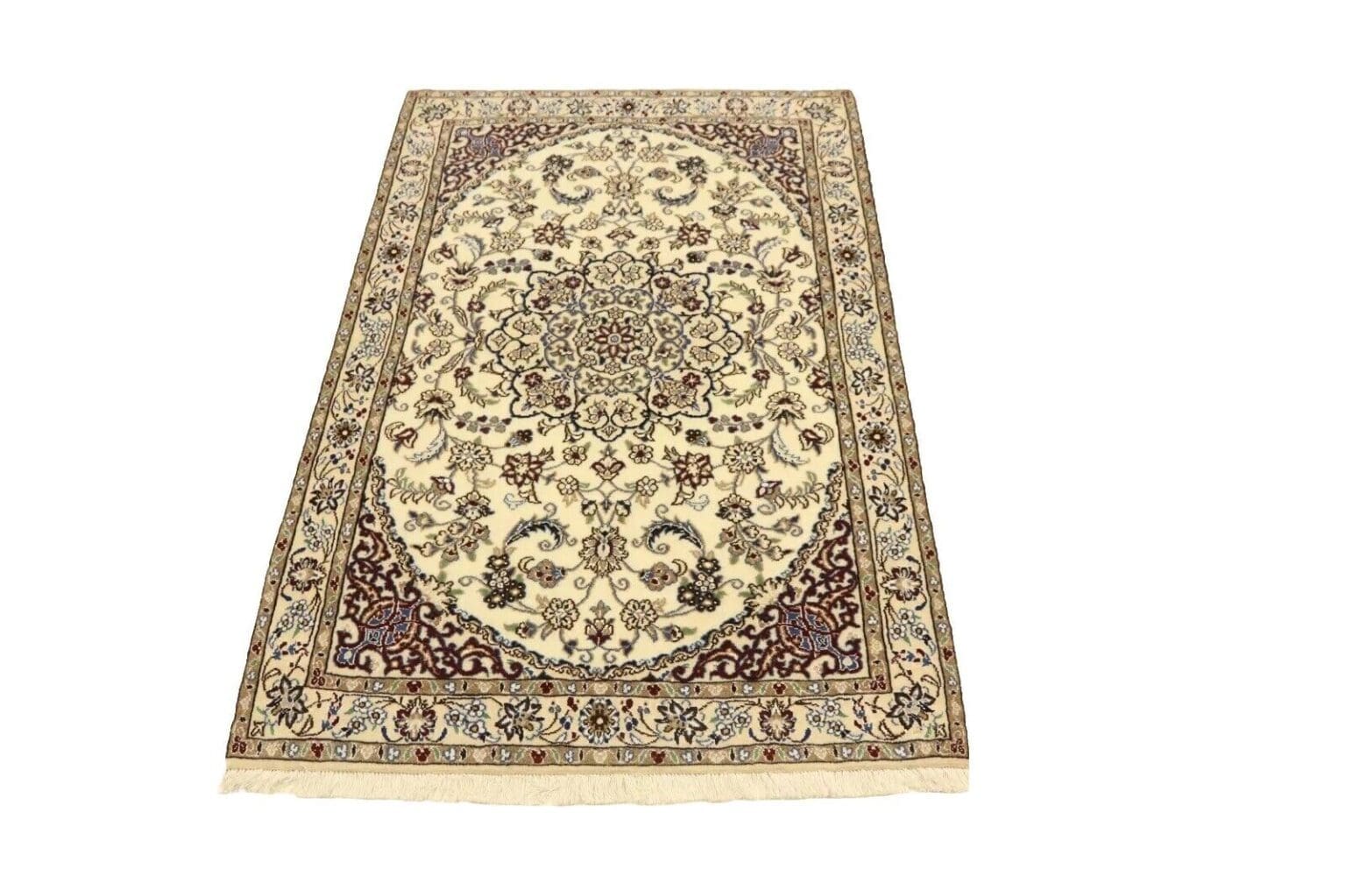
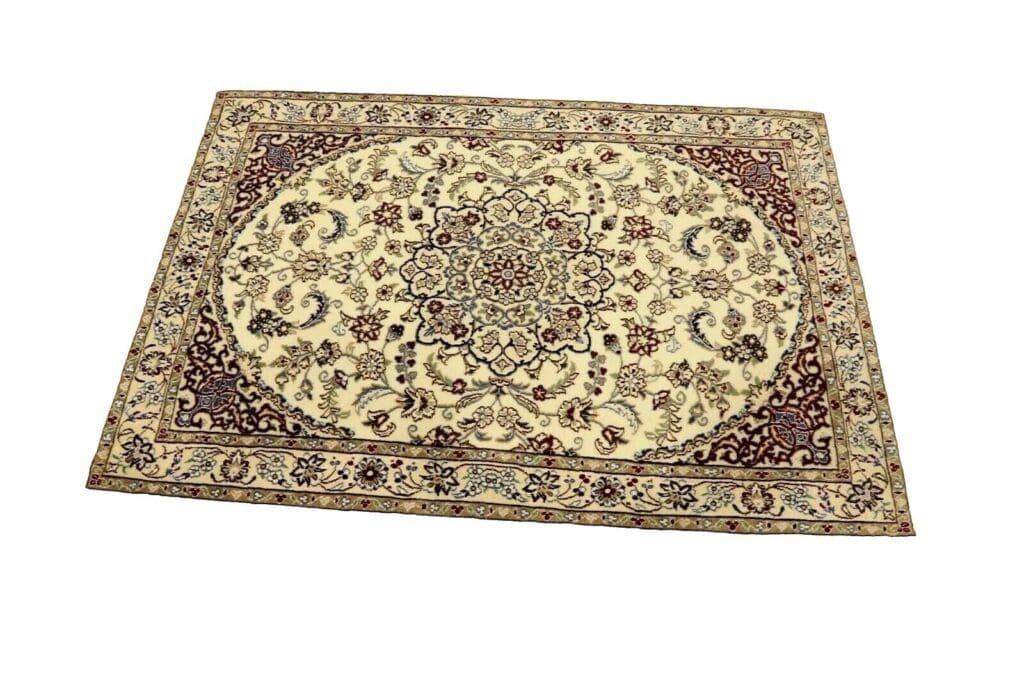
This Super Nain 9 La Persian rug is hand-knotted, with a pile made of 90% cork wool and 10% natural silk. Its warp is 100% cotton. The combination brings together the resilient character of wool with a fine silk component worked into the structure. Cork wool is valued for its hard-wearing and easy-care qualities. Natural silk adds a soft sheen and gives the colours a lively appearance across the pile.
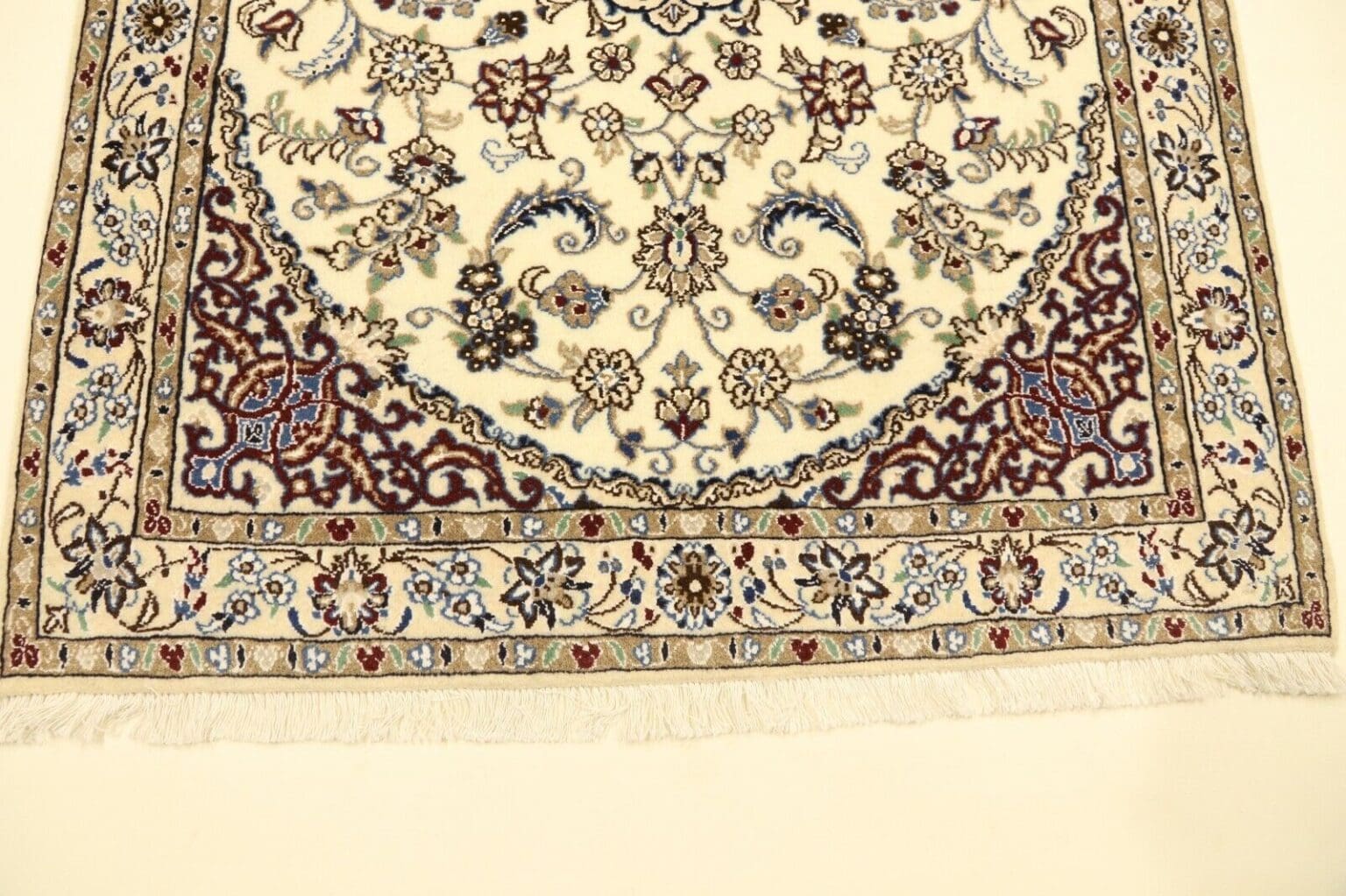
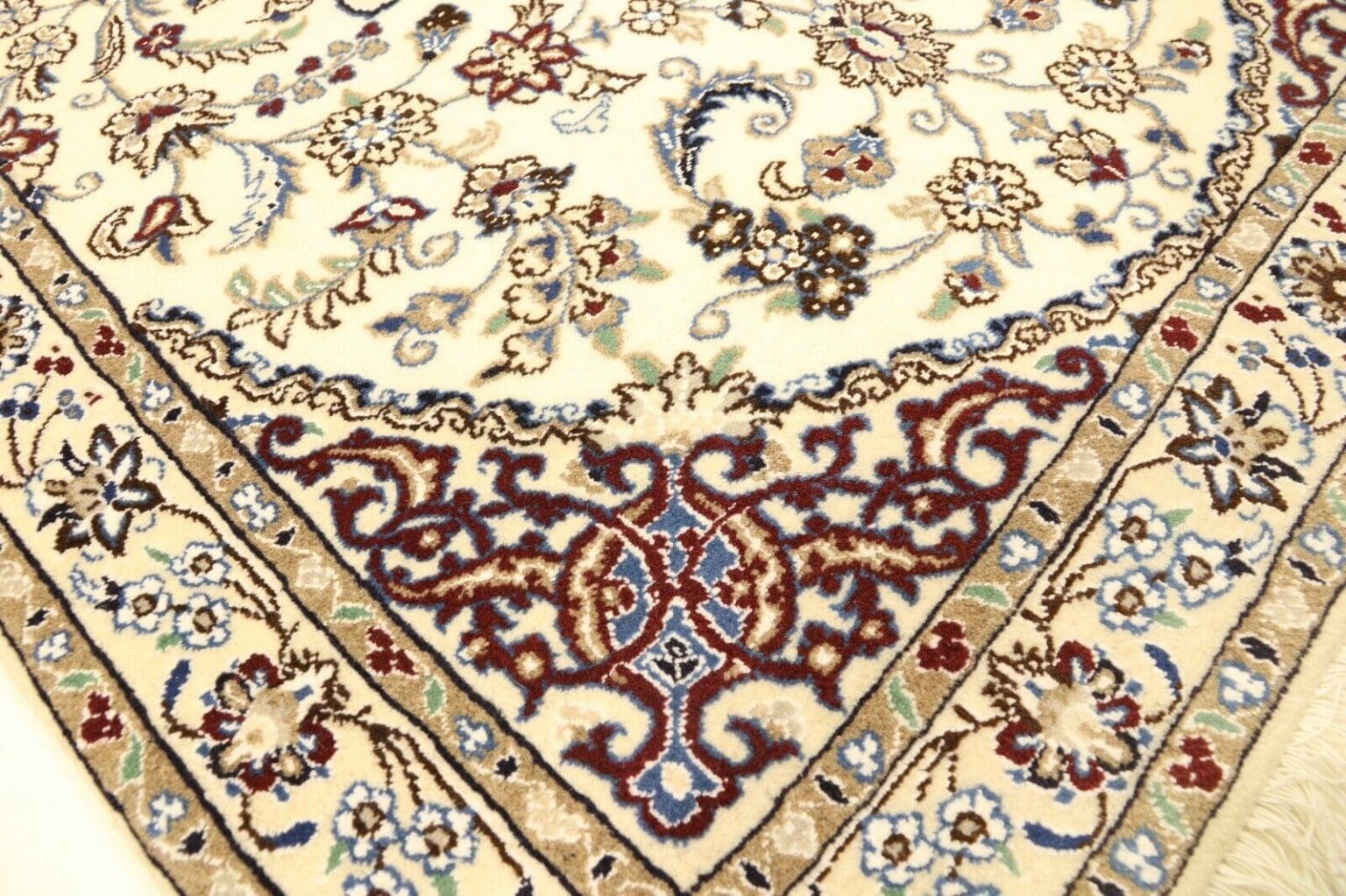
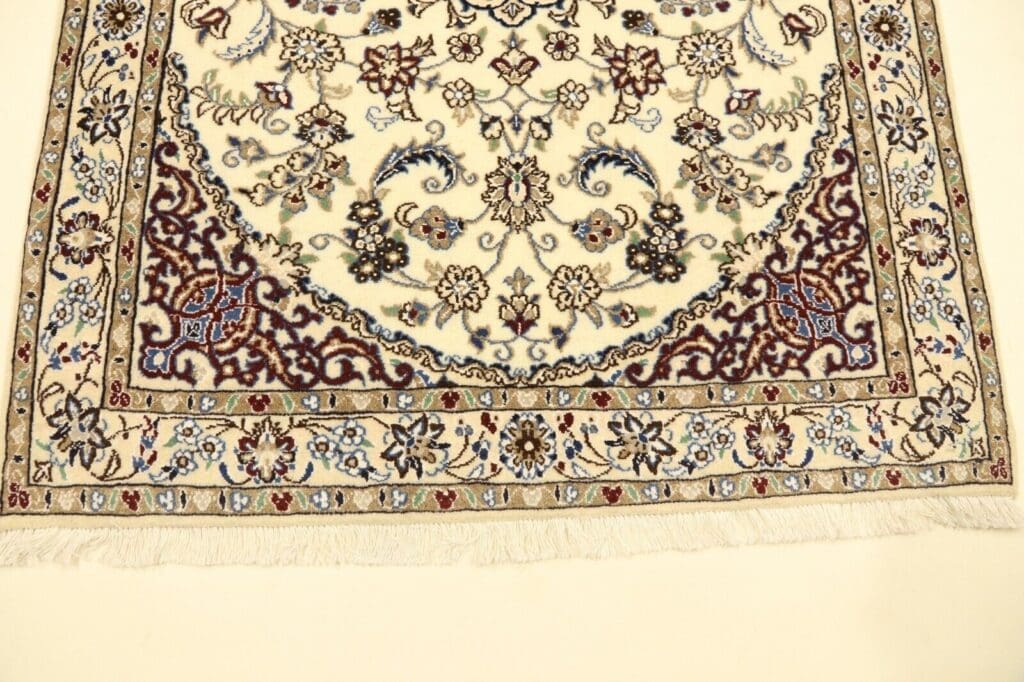
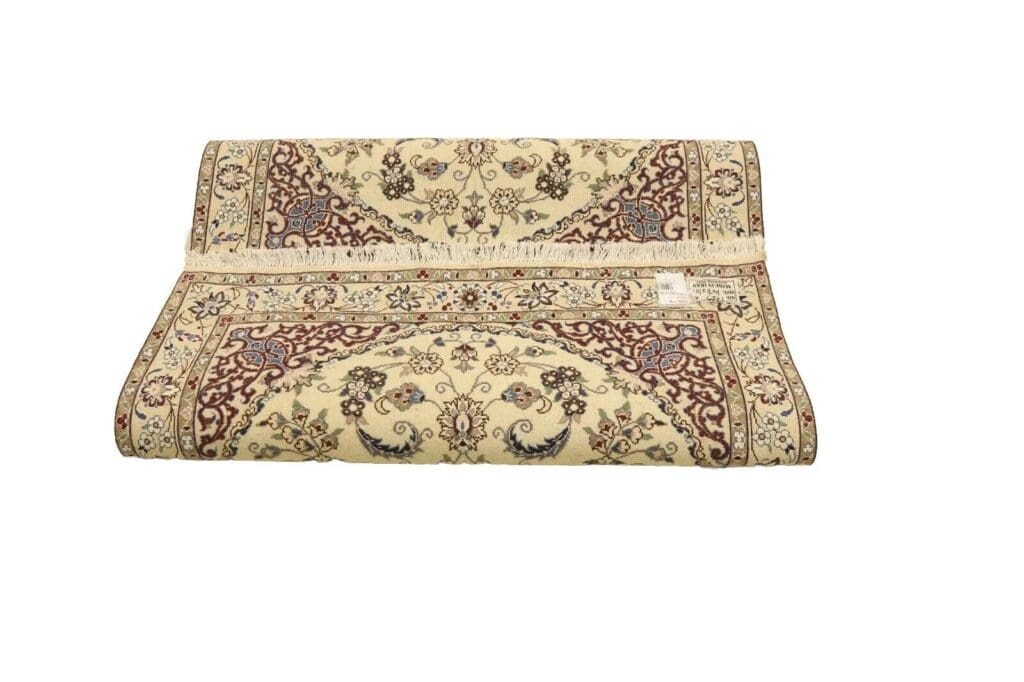
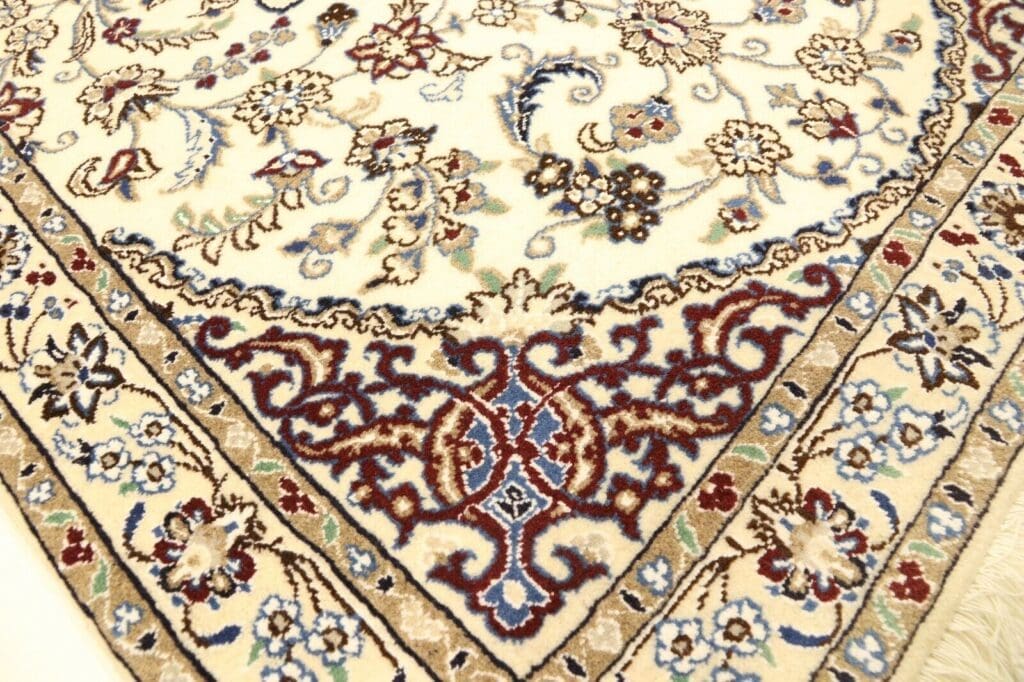
The rug is made by hand, knot by knot. A knot density of approximately 500,000 knots per square metre allows lines and ornaments to be rendered with precision. In a finely knotted Nain, contours can be articulated carefully and small details can remain distinct. The craftsmanship is therefore visible not only in the feel of the surface but also in the legibility of the pattern and its finer divisions.
Wool has a long-established place in Oriental rug making because of its durable fibres and comfortable handle. Cork wool gives the pile a soft, warm character. The silk content introduces delicate accents within that woollen surface. Together, these materials create a textile structure in which different qualities work alongside one another while the hand-knotted construction remains clearly apparent.
Origin and Tradition
The rug comes from Persia, or Iran, and belongs to the Nain tradition. Nain is an Iranian city known for fine Persian rugs. The region is associated with carefully arranged designs, fine wool and controlled treatment of the whole field. Nain rugs are often linked with floral motifs and complex geometric forms. This combination of plant-based ornament and ordered structure is an important part of the regional visual language.
The rug-weaving tradition in Nain reaches back to the nineteenth century. It has continued to develop since then while retaining its craft foundations. Making such a rug requires suitable yarns, a clear understanding of the design and confident control of the knotting process. A pattern is not simply placed on top of a finished surface; it develops through the relationship between warp, weft, pile and the sequence of individual knots.
Knowledge of the craft has been passed from one generation to the next in the region. This knowledge includes handling the fibres, following a design and coordinating colours with contours. Hand-knotting calls for patience, accuracy and practical skill. The high knot density of this rug belongs to that context: it permits a detailed execution in which smaller ornamental passages can be defined rather than reduced to coarse shapes.
Nain is part of the Persian rug tradition, in which different weaving centres have developed their own approaches to pattern and composition. Floral elements can be combined with geometric organisation, while the field is structured through a measured relationship between ornament and ground. The traditional character remains compatible with contemporary interiors. This rug therefore reflects an established weaving tradition while fitting naturally into a range of present-day settings.
Persian rugs are shaped by the interaction of material, technique and regional design. In this piece, the fine knotting, the wool pile with its silk component and the traditional ornament are considered together. That relationship keeps the pattern readable both in its detailed sections and as a complete composition. The rug can be placed in a classic living room, a modern loft, a bedroom or an elegant office without losing the character of its Persian design heritage.
Design and Pattern
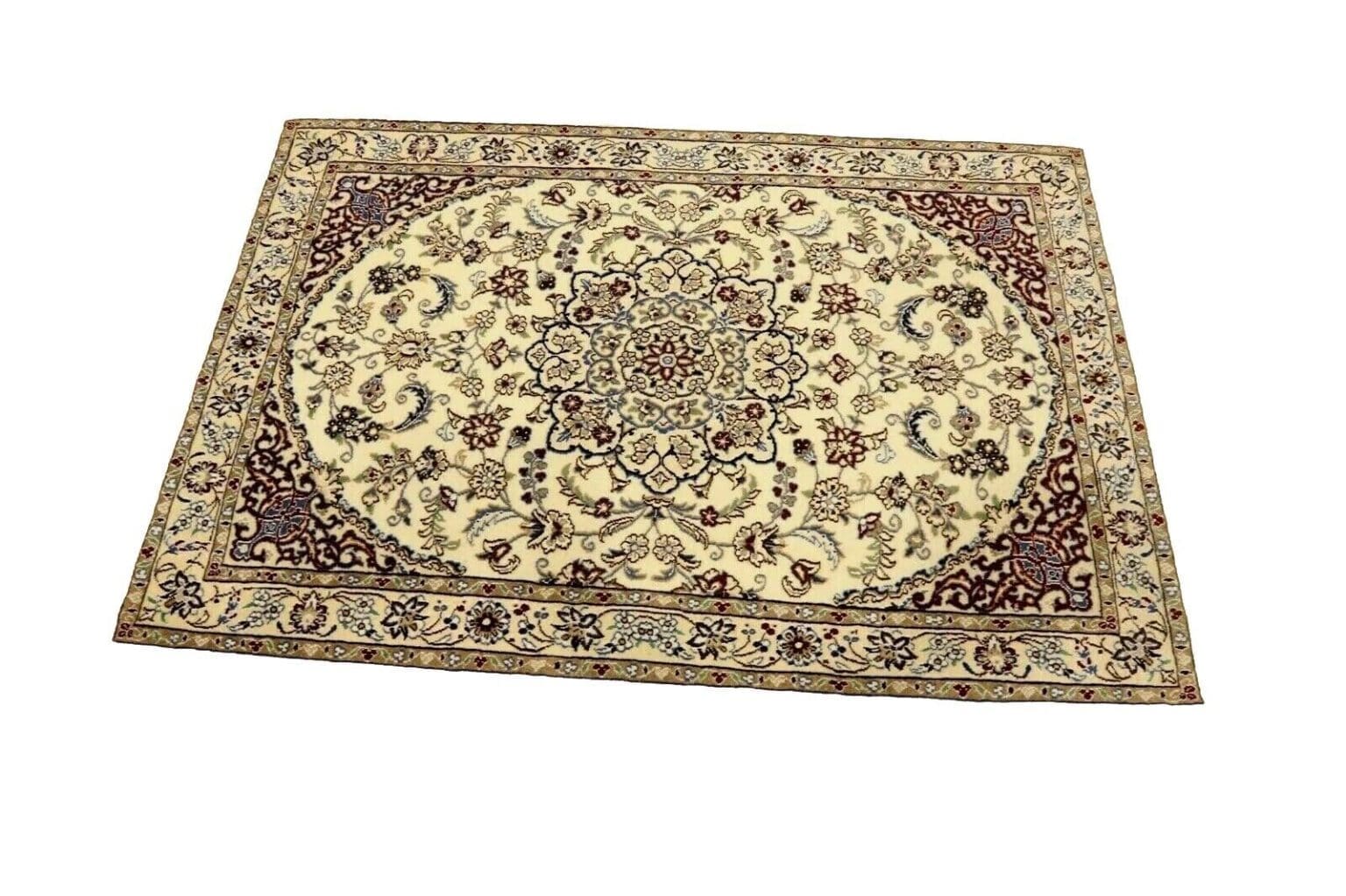
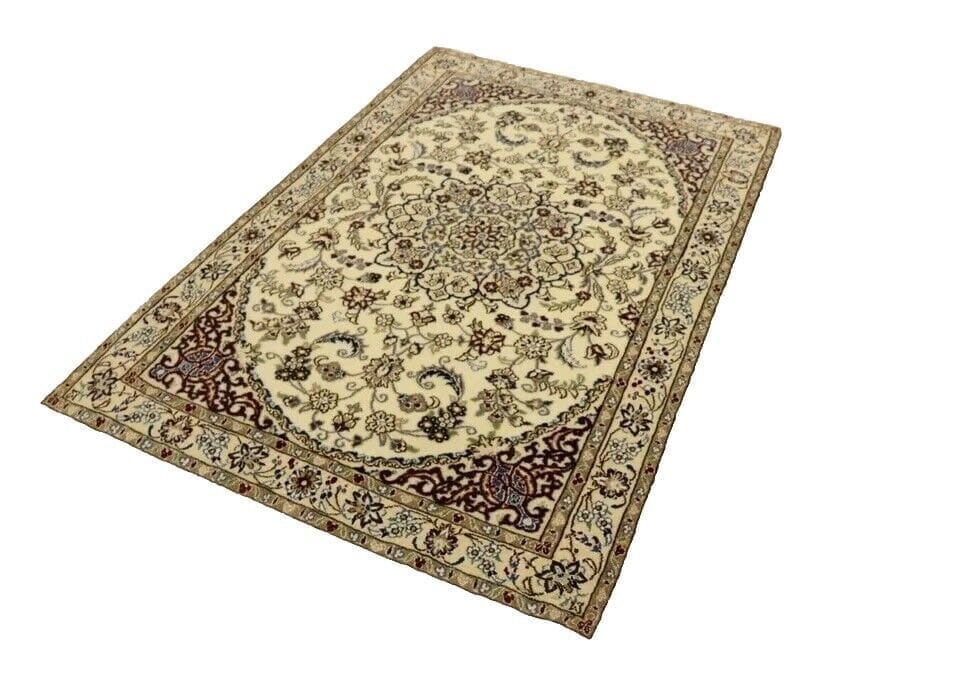
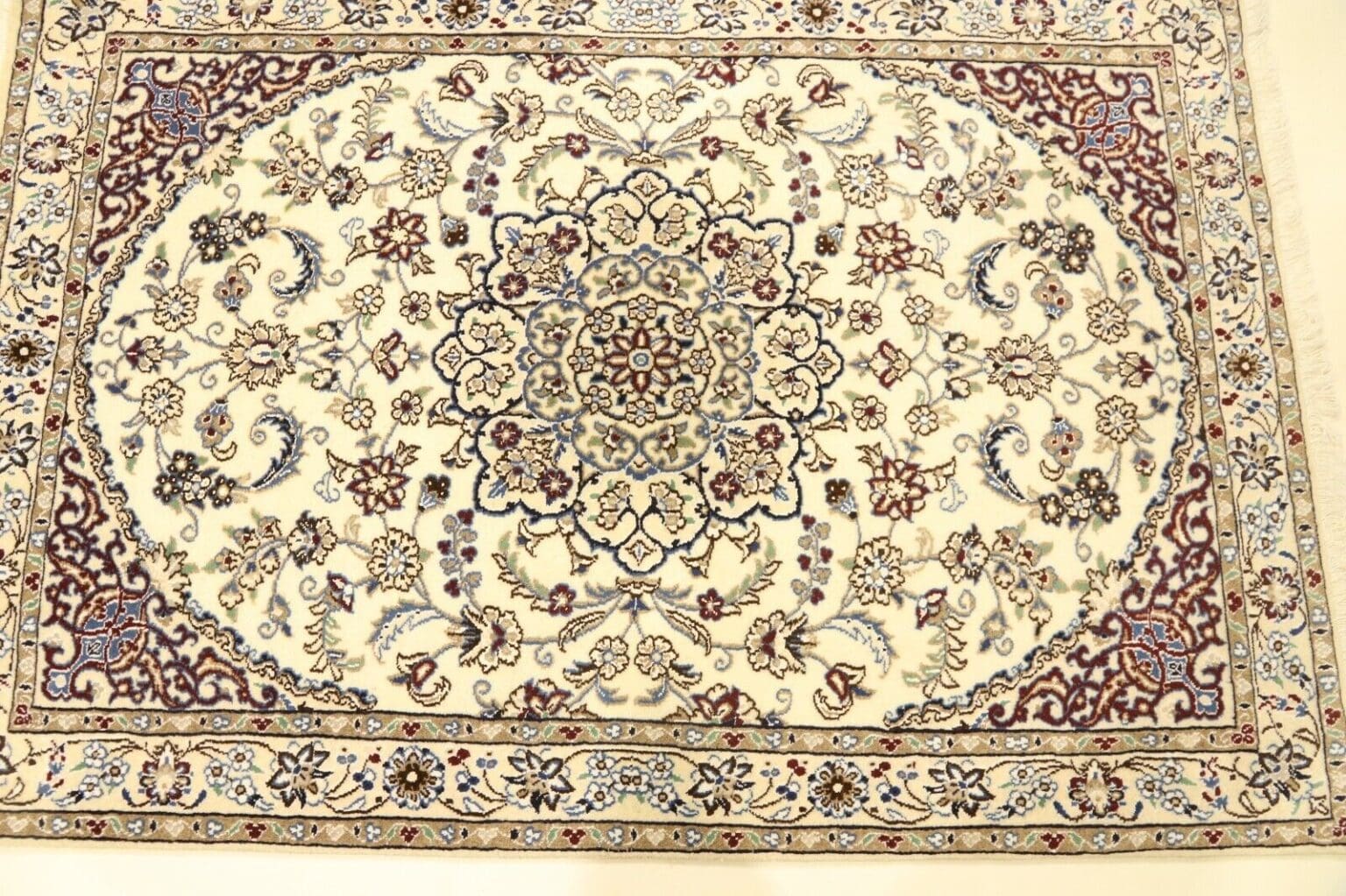
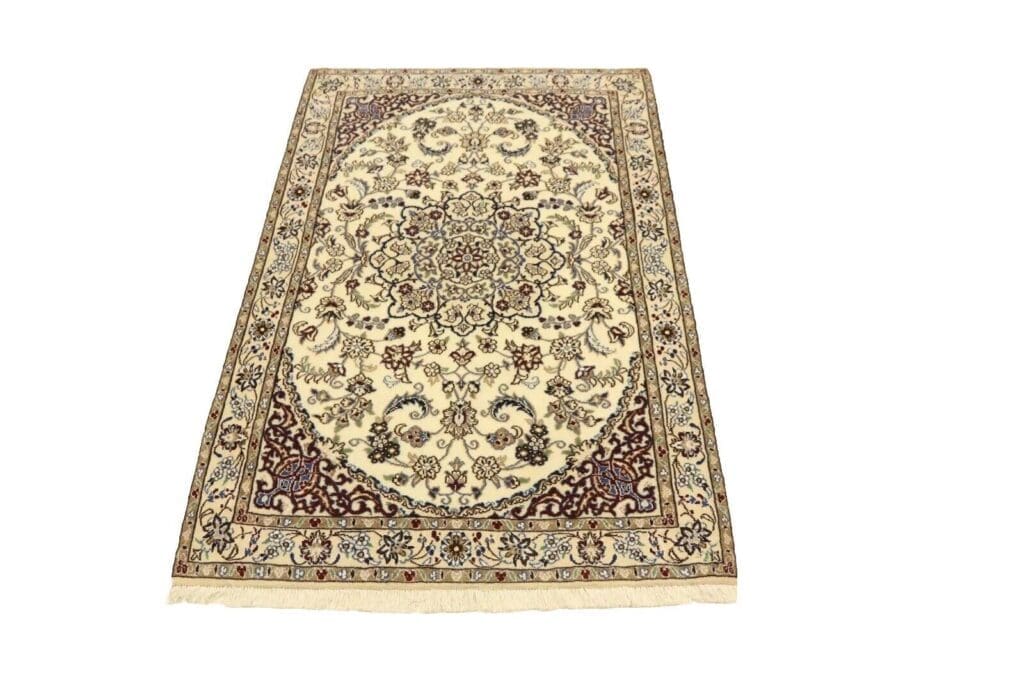
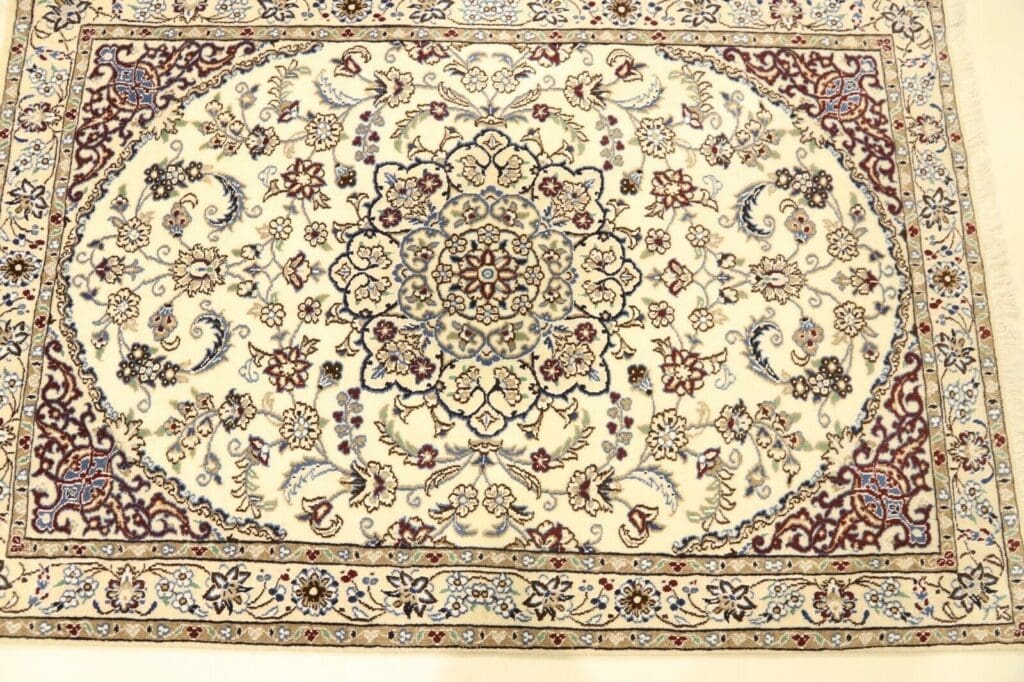
The design combines traditional Persian motifs with a modern touch. Floral imagery is a central part of the composition. In Persian ornament, plant forms are often associated with fertility and life. Flowers, leaves and scrolling forms may be repeated to create rhythm across a field. Geometric elements complement these organic shapes with lines, axes and clearly ordered areas.
The meeting of floral and geometric motifs produces a balanced visual structure. Floral ornaments contribute movement and softness, while geometry gives the design direction and stability. In a finely knotted Nain, these relationships can be articulated with considerable differentiation. The high knot density supports distinct contours and allows the design to contain more than a small number of broad, simplified forms.
The palette is described as rich and balanced. Earth tones are combined with vivid colours, creating a relationship between restrained passages and more noticeable accents. Natural silk can produce a gentle lustre within the surface, so individual colours may appear differently as the light changes. This does not alter the pattern; it makes its transitions and highlights more perceptible within the room.
Persian rug patterns are often understood as more than decorative marks. Depending on the motif, they may express ideas of protection, prosperity and spirituality. Floral representations are also associated with life and fertility. These symbolic associations belong to the cultural tradition of Persian rugs and give the ornaments a meaning beyond their formal role. The Super Nain 9 La takes up this traditional visual vocabulary while presenting it in a clear arrangement suited to contemporary interiors.
A Persian rug is defined by the relationship between pattern, colour and workmanship. Here, the fine knotting, the wool-and-silk pile and the established Persian ornament work together. The result can be read in close detail as well as from a distance. Its traditional design allows it to be used in differently furnished spaces, from a classic sitting room to a modern loft or an elegant office.
Special Features
A defining feature of this rug is the combination of 90% cork wool and 10% natural silk in the pile. The wool is valued for a durable, easy-care surface, while the silk contributes a gentle sheen and a lively perception of colour. Its hand-knotted construction and fine knot density further emphasise the detailed workmanship.
This rug is a one-off and only one is available. Its handmade production makes it an individual piece. It is suitable for use with underfloor heating. The condition is new and perfect. Its traditional design allows it to be used in different interiors, from a classic living area to a modern office.
FAQ
How should I care for my Nain Persian rug?
Vacuum the rug regularly and gently. Any spill should be treated promptly with a damp cloth so that it does not settle into the fibres. Professional cleaning is recommended. Care should take account of the hand-knotted structure and of the different properties of cork wool and natural silk. Harsh cleaning agents and vigorous rubbing can place unnecessary stress on the surface.
Where is the best place to use the rug?
The Nain Persian rug is suitable for a living room, bedroom or as an accent in a hallway. It can also be used in a modern loft, a classically furnished room or an elegant office. Direct sunlight should be avoided so that the colours remain as even as possible. The rug is also suitable for rooms with underfloor heating.
What are the advantages of cork wool compared with other materials?
Cork wool is valued for its durability and easy-care qualities. It provides a pleasant sense of warmth underfoot and is therefore suitable for areas that receive frequent use. In this rug it is combined with natural silk. The silk component complements the wool pile with a gentle lustre and can make the colours appear more vibrant.
To provide the best experiences, we use technologies like cookies to store and/or access device information. Consenting to these technologies will allow us to process data such as browsing behavior or unique IDs on this site. Not consenting or withdrawing consent, may adversely affect certain features and functions.
Functional Always active
The technical storage or access is strictly necessary for the legitimate purpose of enabling the use of a specific service explicitly requested by the subscriber or user, or for the sole purpose of carrying out the transmission of a communication over an electronic communications network.
Preferences
The technical storage or access is necessary for the legitimate purpose of storing preferences that are not requested by the subscriber or user.
Statistics
The technical storage or access that is used exclusively for statistical purposes.The technical storage or access that is used exclusively for anonymous statistical purposes. Without a subpoena, voluntary compliance on the part of your Internet Service Provider, or additional records from a third party, information stored or retrieved for this purpose alone cannot usually be used to identify you.
Marketing
The technical storage or access is required to create user profiles to send advertising, or to track the user on a website or across several websites for similar marketing purposes.

 SECURE PAYMENT
 SHIPPING PARTNERS