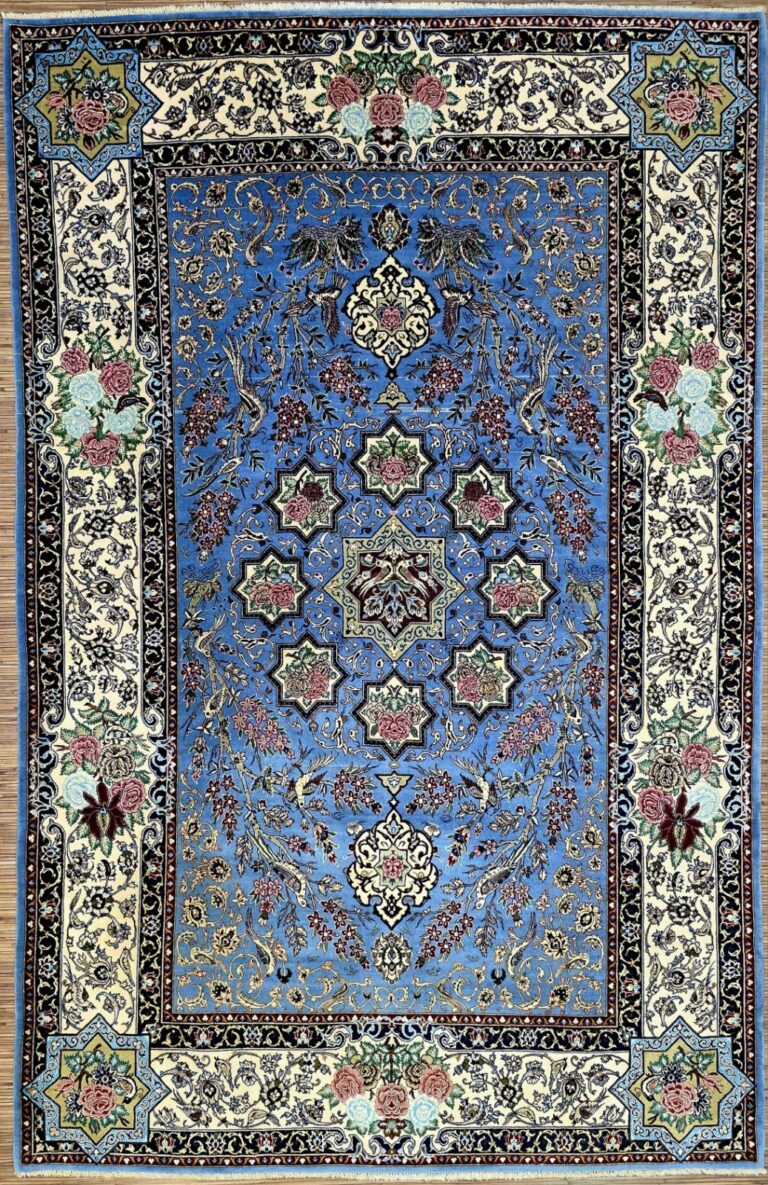
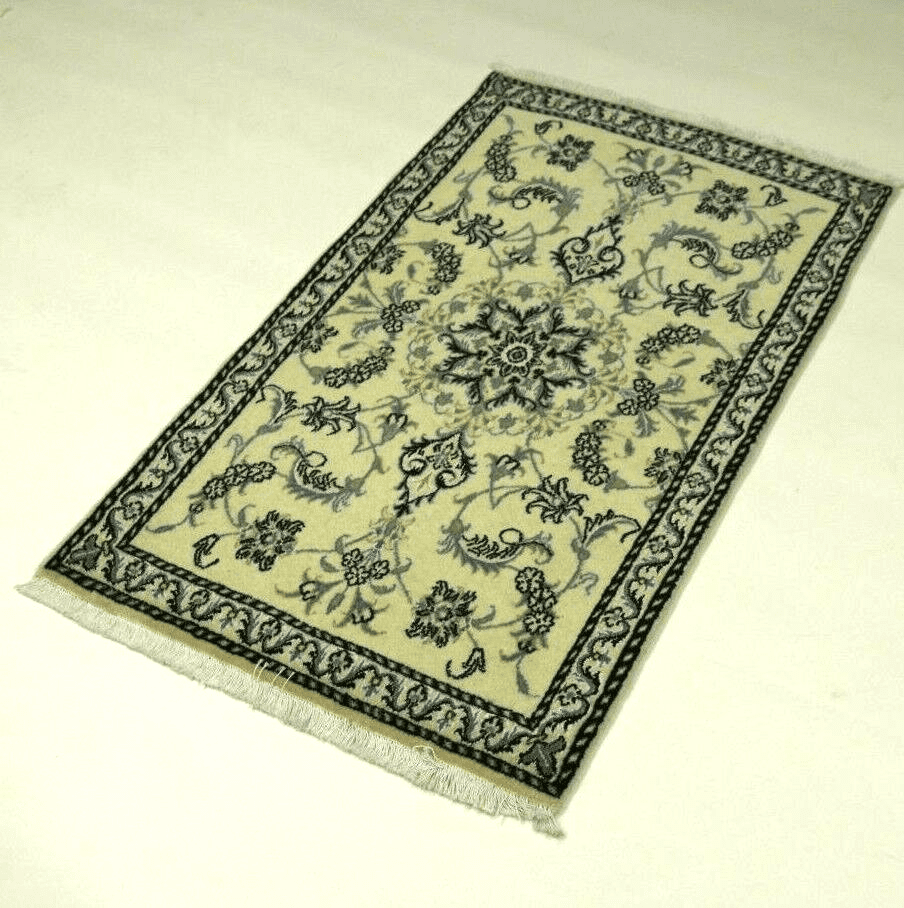
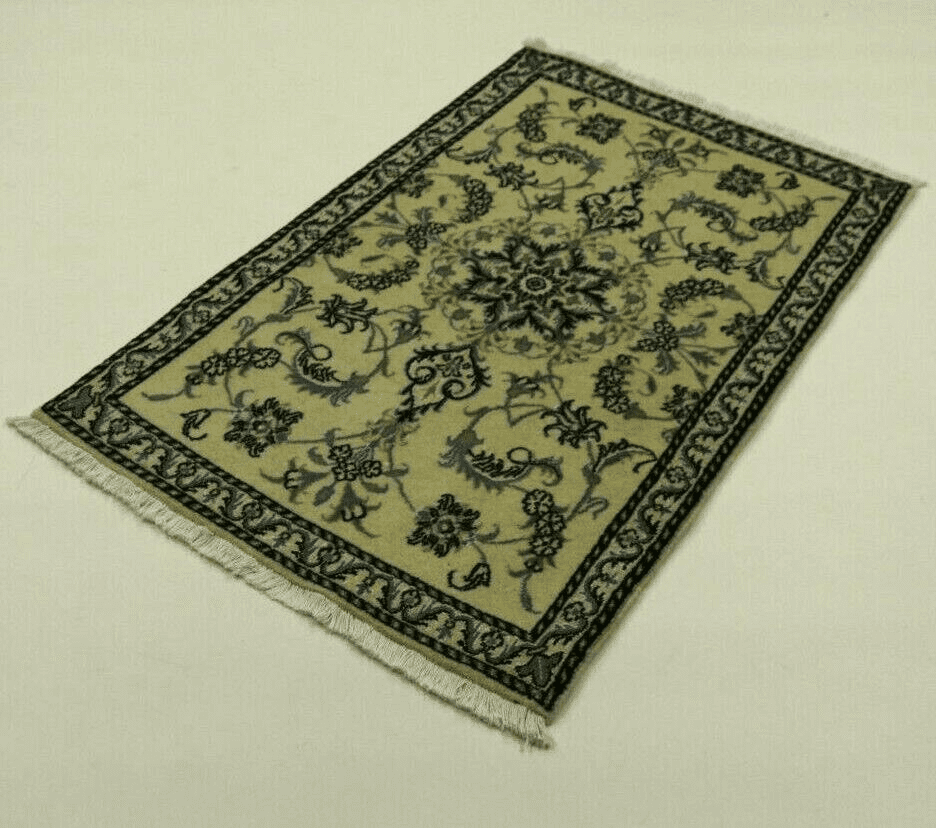
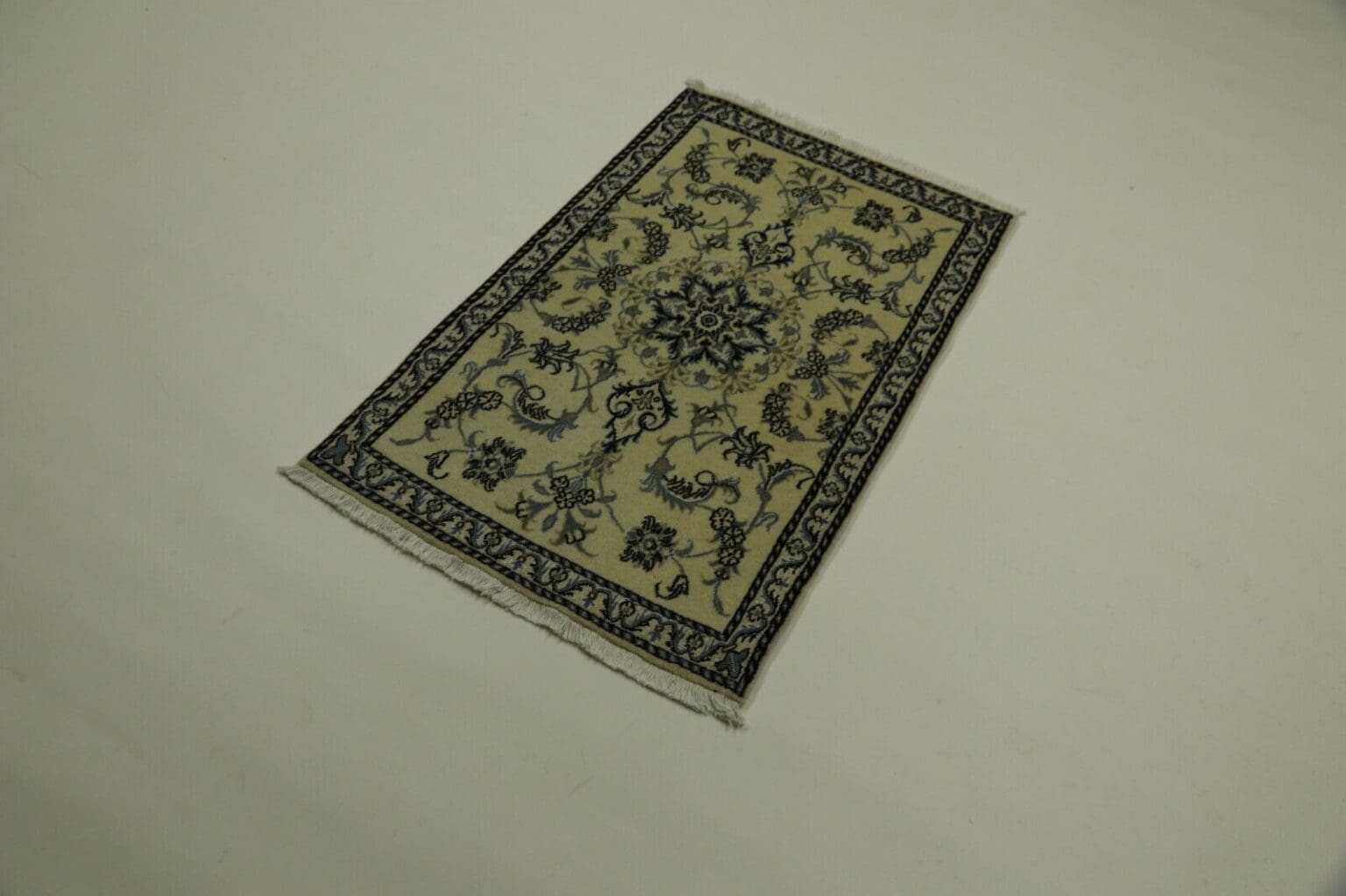
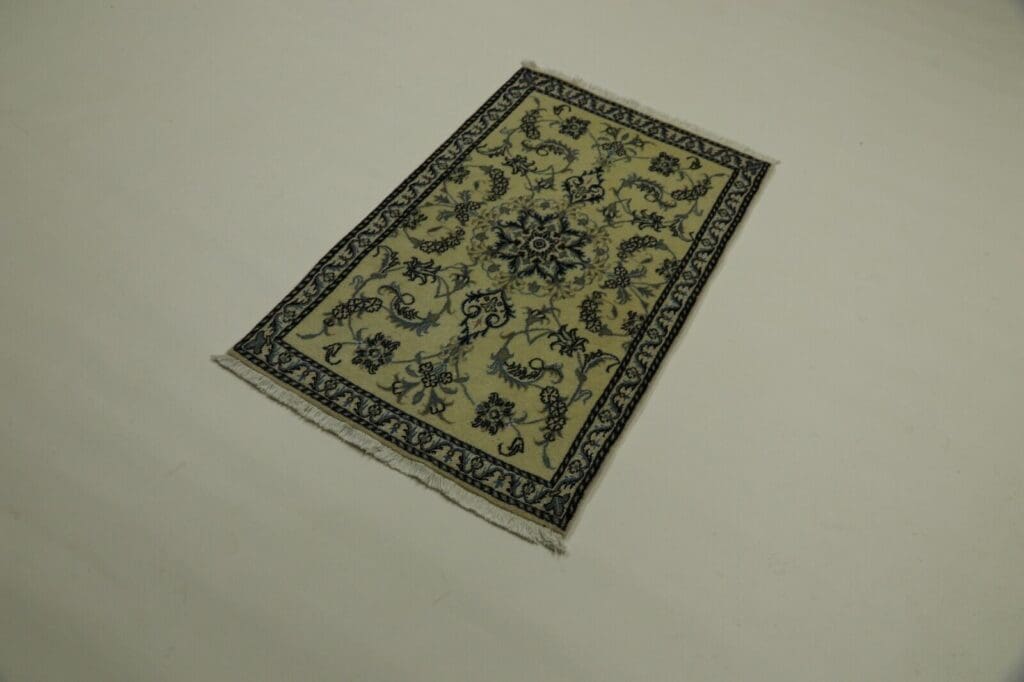
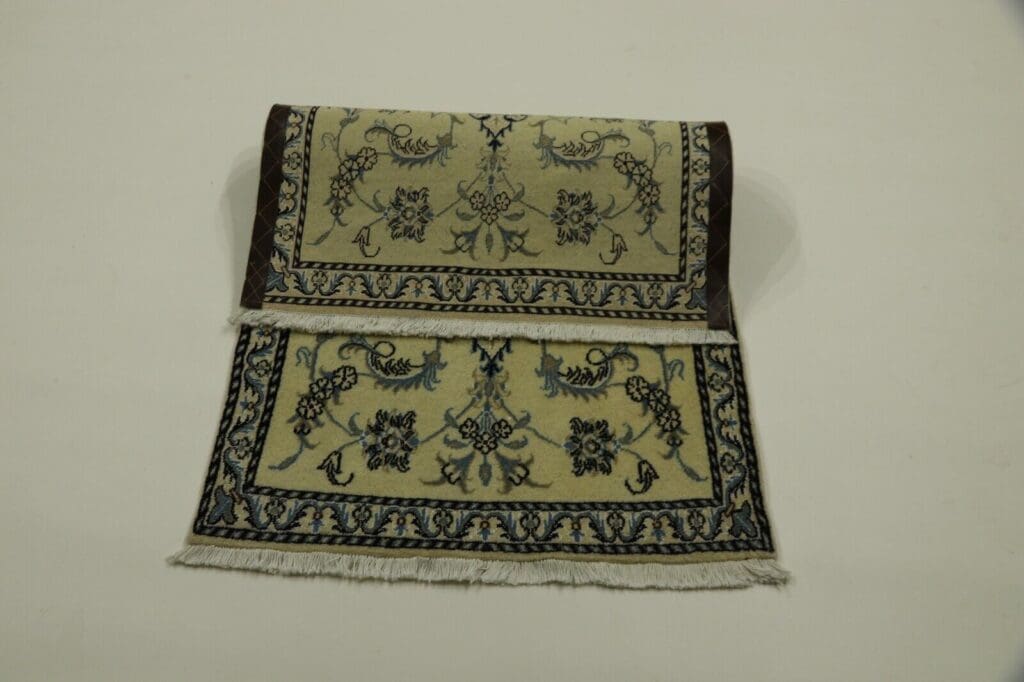
Hand-knotted Nain Persian Rug | Knot density: 200,000 to 250,000 knots/m² | Material: pile 90% virgin wool, 10% silk | Size: 137 x 86 cm | Pattern: traditional Oriental and Persian | Condition: new and perfect
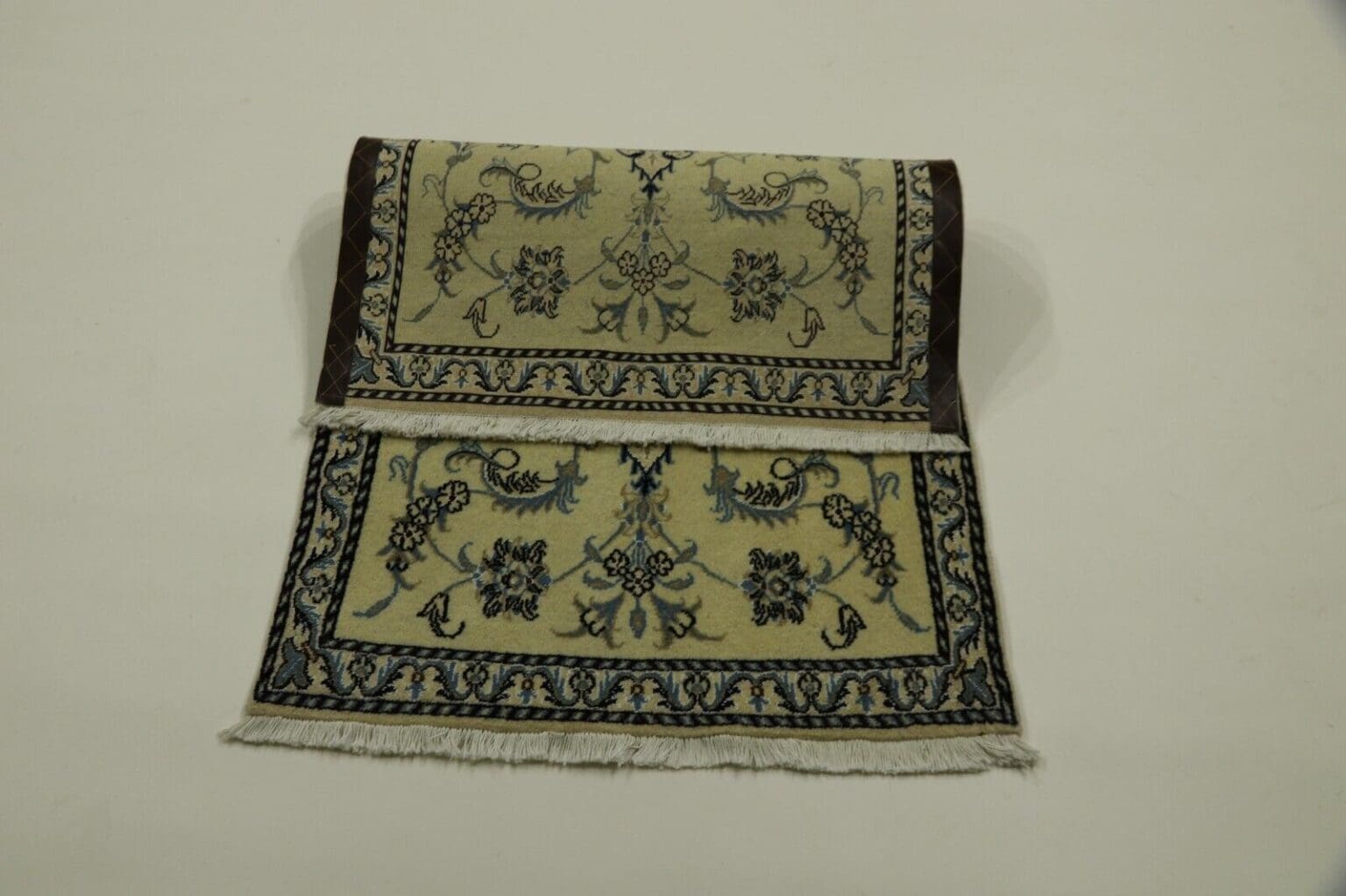
This Nain Persian rug is hand-knotted. The pile is specified as 90% virgin wool and 10% silk. Wool therefore forms the principal part of the pile, while silk is identified as the remaining material component. The rug has a rectangular form. Its construction belongs to a manual tradition in which the surface is built knot by knot rather than produced as a machine-made textile.
Hand-knotting requires the individual placement of knots across the foundation. Rows are formed progressively, with the design taking shape as the knotting advances. This process permits the weaver to translate a planned drawing into lines, fields and ornaments directly within the pile. It also explains why the making of a hand-knotted rug consists of many separate operations, from preparing the materials to completing and arranging the finished surface.
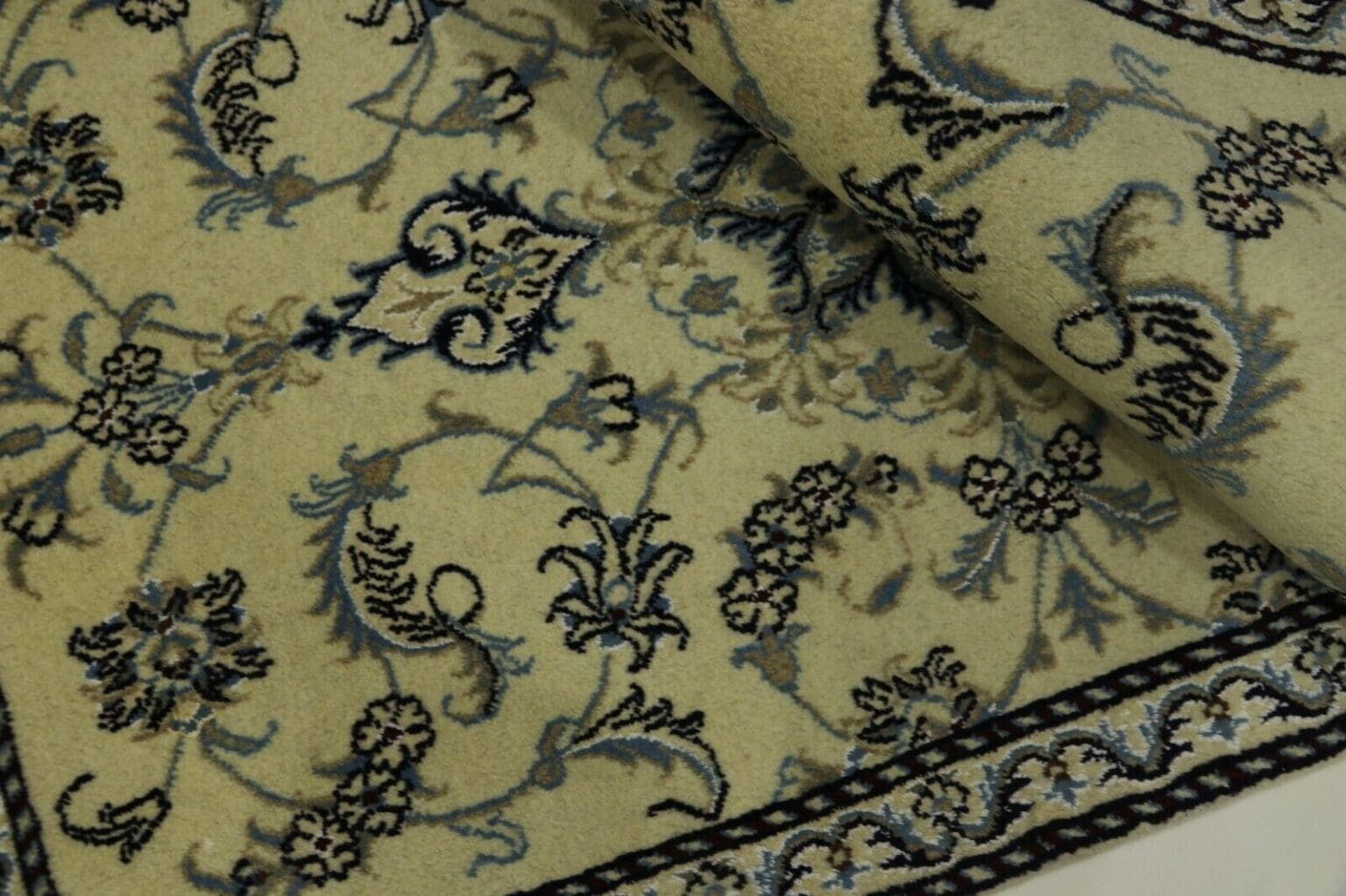
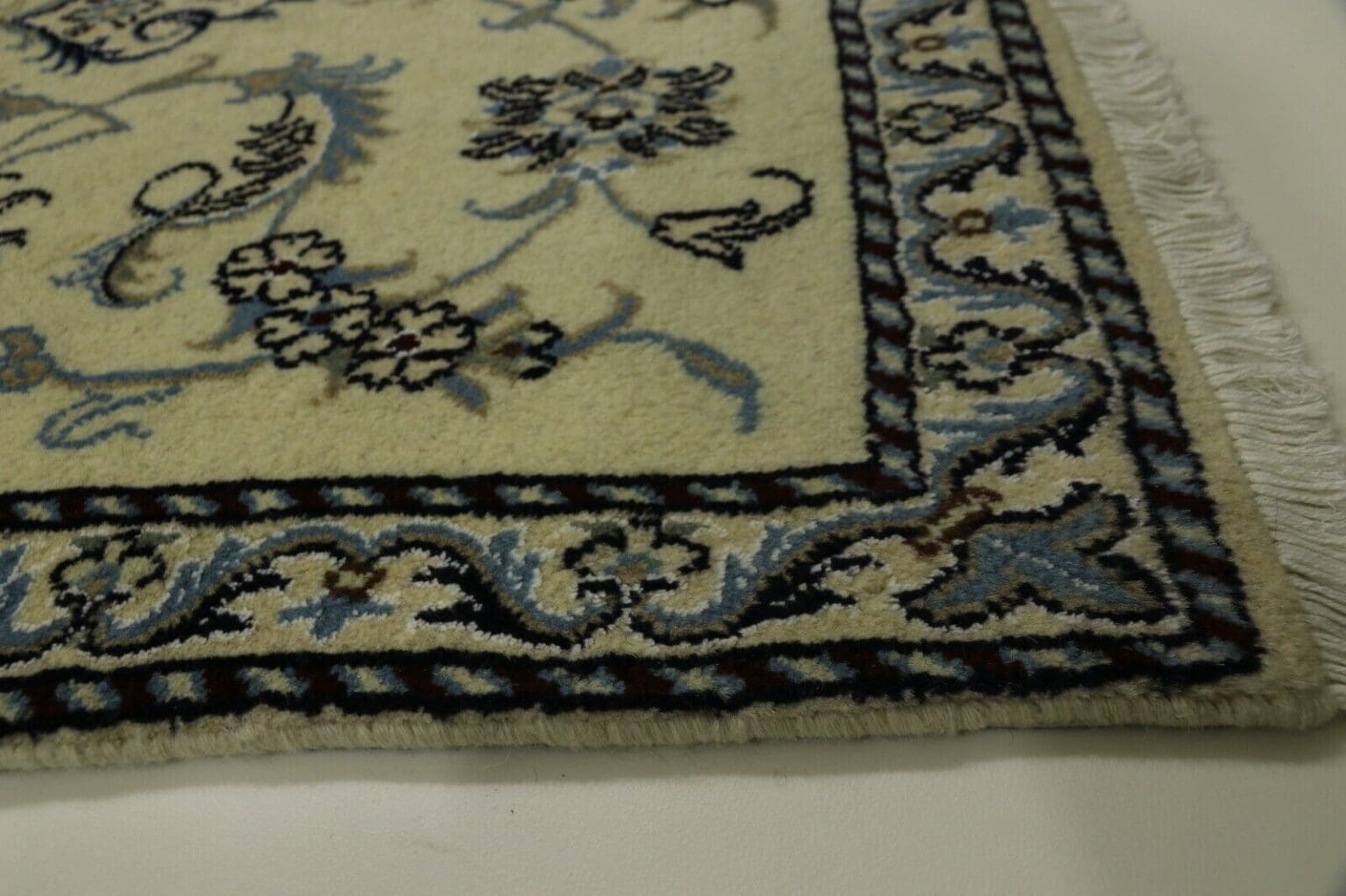
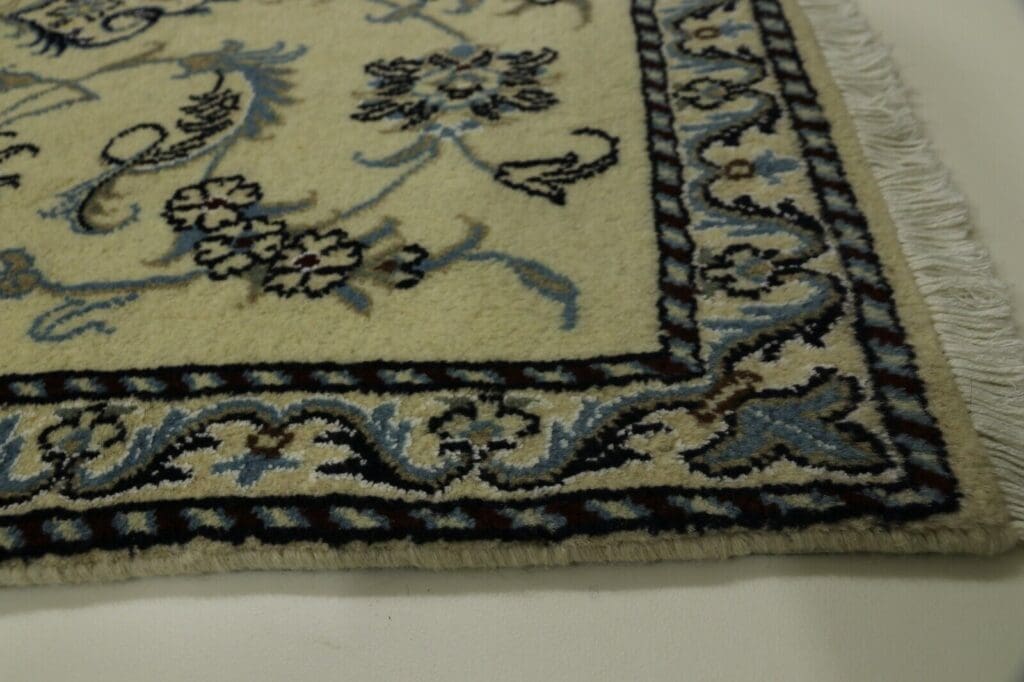
The stated knot density is 200,000 to 250,000 knots per square metre. A density in this range supports a fine construction and allows detailed outlines to be represented with precision. Knot density is a technical description of how closely the knots are set; it does not by itself identify a specific motif. The pile is also described with a height of 6 mm, adding another defined element to the construction of this piece.
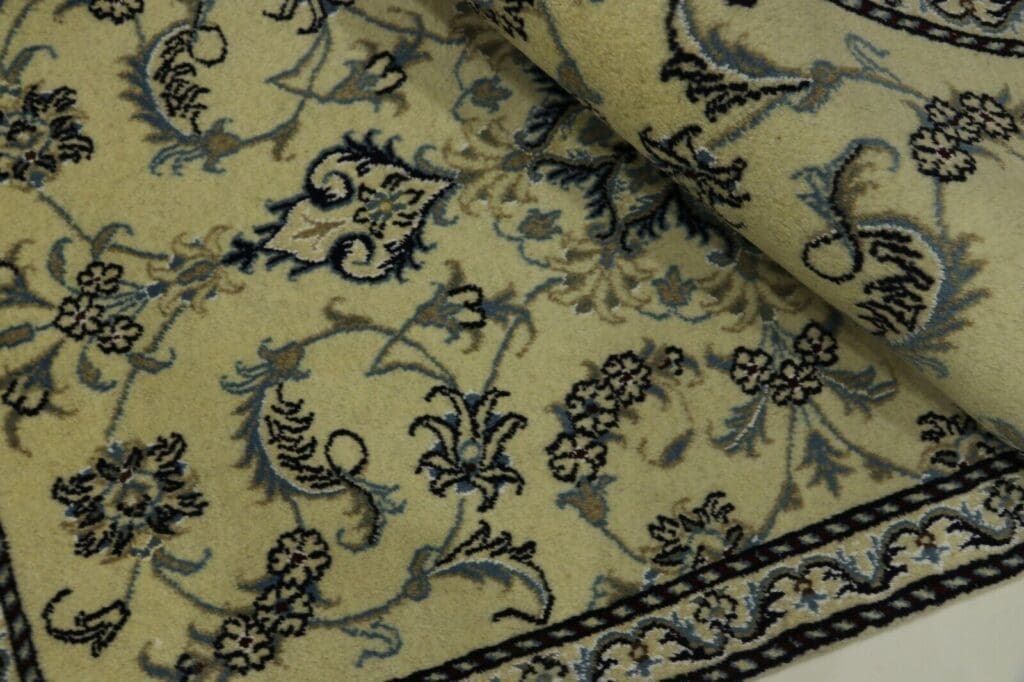
Virgin wool is the dominant pile material. Wool has long been used in Oriental rug making because its fibres are resilient and can accept colour effectively. It also provides the established tactile and structural qualities associated with woollen pile. Silk is present as a ten-percent component in the material description. In this combination, the rug brings together the customary use of wool with the finer fibre traditionally used for delicate details and refined surfaces.
The condition is given as new and perfect. This means the rug is presented as a new piece rather than as a used or restored example. Its hand-made character is therefore connected to the way it was produced, not to a claim about age or previous use. The available description identifies the material, construction, pile height, form and condition without assigning a separate historical age to the rug.
Origin and Tradition
The rug is from Nain in Iran, also described as Persia. Nain is a city in central Iran and the name of a major Persian rug tradition. The city is located in the wider Isfahan region, an area with a significant history of Iranian art, design and craftsmanship. Nain rugs are associated with carefully controlled drawing, fine knotting and patterns in which small details remain legible within an ordered composition.
Persian rug production is based on a combination of technical knowledge and visual design. A weaver must understand the relationship between warp, weft, knots and pile, but must also follow the structure of the pattern. Designs may be planned through a cartoon or inherited workshop scheme, then transferred into the knotting row by row. The result is not simply a surface decoration applied after manufacture: the pattern is part of the rug’s construction from the beginning.
Nain’s tradition developed within the urban workshop culture of Iran. Skills such as selecting suitable fibres, preparing yarn, arranging colours and maintaining the proportions of a design are commonly passed through established teaching and practice. The regional name consequently refers to more than geography. It also evokes a recognizable approach to the balance between a fine surface, controlled ornament and a clearly organized field.
Traditional Persian rugs often use a foundation of longitudinal warps crossed by wefts. Knots are tied around the foundation and then secured as the weaving progresses. The pile is trimmed so that the drawing remains visible and the surface has a consistent appearance. In a finely knotted rug, the available knot structure permits curves, leaves, flowers and other small elements to be rendered with greater definition than in a coarser construction.
Nain rugs are commonly discussed in connection with delicate floral drawing and medallion-based compositions. These characteristics belong to the broader type tradition and describe the visual language associated with Nain. The individual rug is classified as traditional Oriental and Persian in style. Its stated origin is Nain, Iran; Nain is therefore the regional designation of this rug and not merely the name of an isolated decorative symbol.
Iranian carpet traditions also include the use of colour systems developed through workshop practice. Natural dyes have a long place in Persian textile history, and regional makers have worked with colour relationships that keep the pattern readable while preserving an overall balance. The supplied description connects Nain rugs with fine designs, natural dyes, medallions and floral motifs. These are elements of the regional background rather than additional claims about an unlisted colour palette for this particular piece.
The term Persian rug is appropriate here because the stated origin is Persia beziehungsweise Iran. This distinguishes the rug from an Indian-made Oriental rug, even though many Oriental traditions share related decorative vocabulary. Origin, technique and pattern tradition are separate aspects: Nain identifies the Iranian source, hand-knotting identifies the method, and the traditional Persian description identifies the stylistic setting.
Design and Pattern
The design is described as traditional Oriental and Persian. Nain compositions are often organized around a central field with a border system that gives the whole surface a defined framework. A medallion may establish the centre, while floral sprays, vines and smaller ornaments fill the surrounding areas. Other designs distribute floral elements more continuously across the field. In both approaches, the arrangement depends on repetition, proportion and carefully managed lines.
Persian pattern vocabulary includes geometric forms, floral details and medallion-like arrangements. Geometric shapes help establish structure and can frame or connect more organic elements. Flowers, leaves and scrolling branches introduce movement without abandoning the order of the composition. A medallion can act as the visual anchor, while corner pieces and borders complete the relationship between the centre and the outer edge.
Fine drawing is a central feature of the Nain design tradition. A narrow vine may link several blossoms, or a repeated ornament may be scaled and placed to create a gradual transition between larger fields. The high stated knot density is technically suited to this kind of detailed work because the drawing is assembled from many closely positioned knots. It does not, however, provide a name for the exact pattern on this individual rug, which is described only in broader traditional terms.
Many Persian compositions depend on a measured relationship between open ground and ornament. The field must remain readable, while the pattern must contain enough detail to create a coherent visual rhythm. Borders separate the central area from its surroundings and may repeat or reinterpret motifs from the field. This relationship of centre, corners and frame is one reason traditional Persian rugs can retain a strong sense of order even when their ornament is intricate.
The Nain vocabulary is related to the wider art of Iranian carpet making, where floral and medallion designs have been adapted by different regions and workshops. Regional identity comes through the balance of detail, the handling of contour and the preferred organization of the pattern. For this rug, the stated classification is traditional Oriental and Persian, and its regional attribution is Nain. No specific colour names or individual motif title are supplied, so the pattern is not described more narrowly.
Because the rug is hand-knotted, its design is physically integrated into the pile. The weaver builds each visible section while following the intended sequence of knots. A line is therefore created through the placement of many small elements rather than painted, printed or embroidered onto a completed ground. This gives the pattern its direct connection to the construction and explains why the technical fineness of a Nain rug is relevant to its visual drawing.
Special Features
The notable specifications of this rug are its Nain origin in Iran, its hand-knotted construction and its stated knot density of 200,000 to 250,000 knots per square metre. The pile is specified as 90% virgin wool and 10% silk, with a pile height of 6 mm. The rug is rectangular and is listed as new and perfect.
Its material description identifies wool as the main pile fibre and silk as a secondary component. The hand-knotted method and the fine knot density describe how the surface was made, while Nain identifies the regional tradition. The classification as traditional Oriental and Persian refers to the design context. Together, these details distinguish origin, material, technique, pattern tradition and condition without adding an unstated age or provenance.
FAQ
Where does this rug come from?
The rug comes from Nain in Iran, also referred to as Persia in the description. Nain is a city and a recognized Persian rug centre in central Iran. The name identifies the stated regional origin of this piece, not merely a decorative motif used in its design.
How was the rug made?
It was hand-knotted. Individual knots are worked into the pile and built up in rows as the design progresses. The stated density is 200,000 to 250,000 knots per square metre. The pile material is specified as 90% virgin wool and 10% silk.
What is the condition of the rug?
The condition is described as new and perfect. It is offered as a new example rather than as a used or restored rug. The piece is rectangular and has a specified pile height of 6 mm.
To provide the best experiences, we use technologies like cookies to store and/or access device information. Consenting to these technologies will allow us to process data such as browsing behavior or unique IDs on this site. Not consenting or withdrawing consent, may adversely affect certain features and functions.
Functional Always active
The technical storage or access is strictly necessary for the legitimate purpose of enabling the use of a specific service explicitly requested by the subscriber or user, or for the sole purpose of carrying out the transmission of a communication over an electronic communications network.
Preferences
The technical storage or access is necessary for the legitimate purpose of storing preferences that are not requested by the subscriber or user.
Statistics
The technical storage or access that is used exclusively for statistical purposes.The technical storage or access that is used exclusively for anonymous statistical purposes. Without a subpoena, voluntary compliance on the part of your Internet Service Provider, or additional records from a third party, information stored or retrieved for this purpose alone cannot usually be used to identify you.
Marketing
The technical storage or access is required to create user profiles to send advertising, or to track the user on a website or across several websites for similar marketing purposes.
 SECURE PAYMENT
 SHIPPING PARTNERS