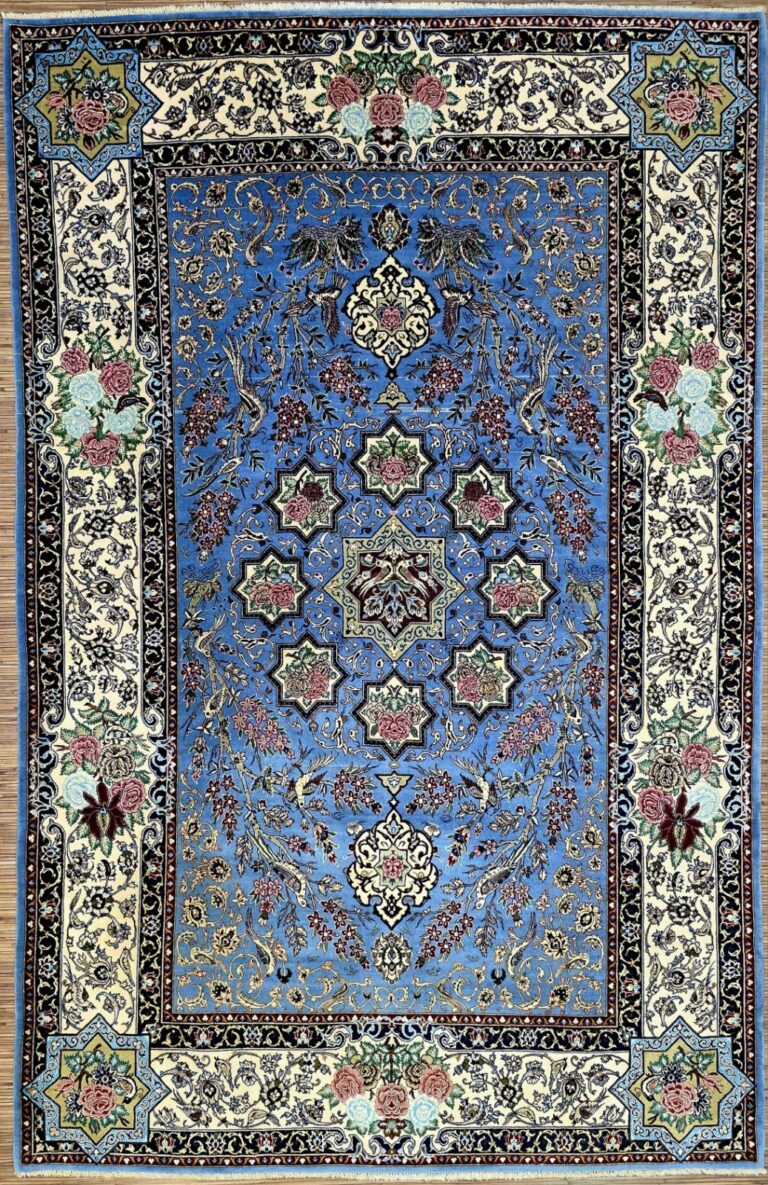
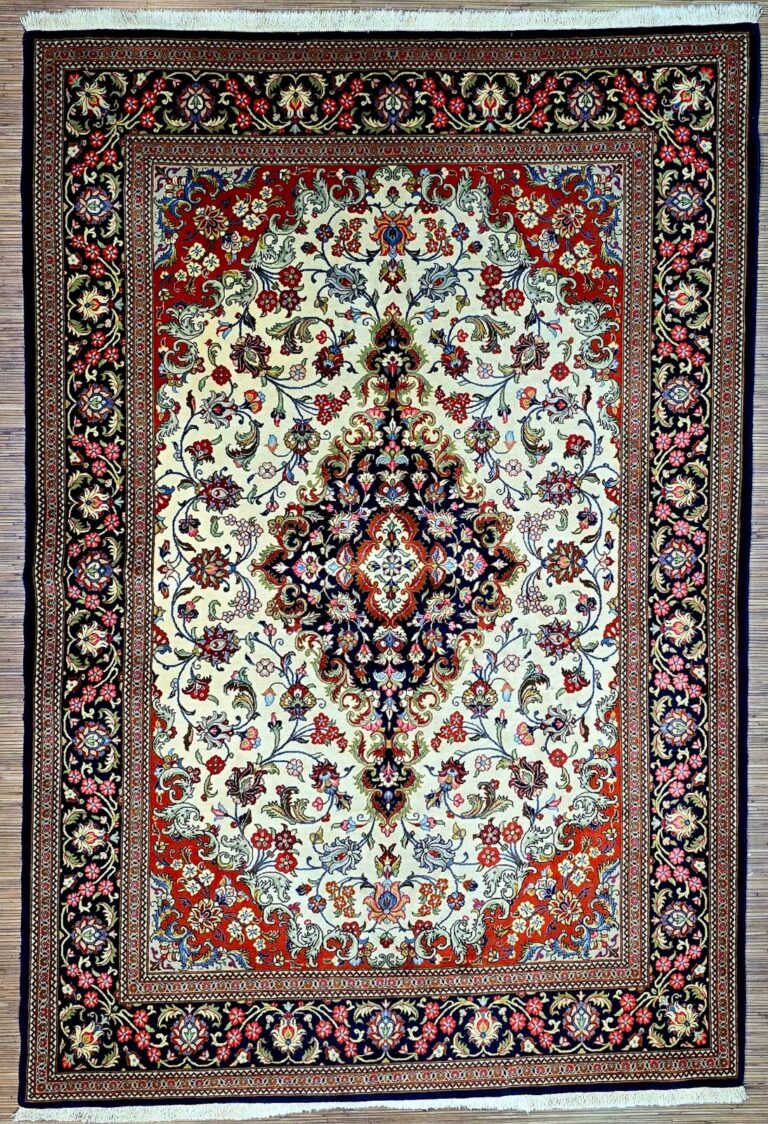
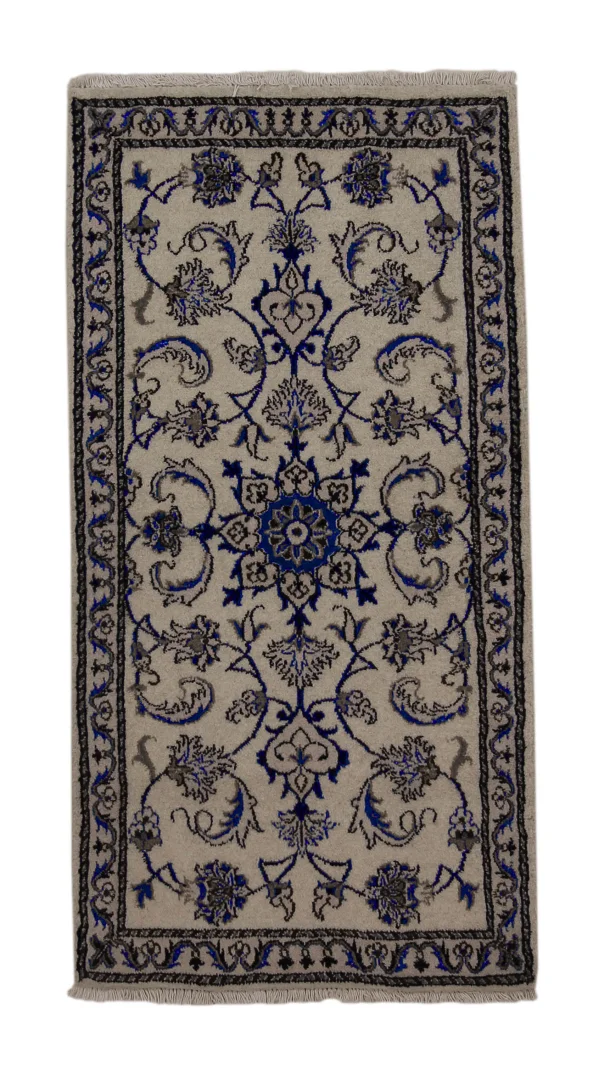
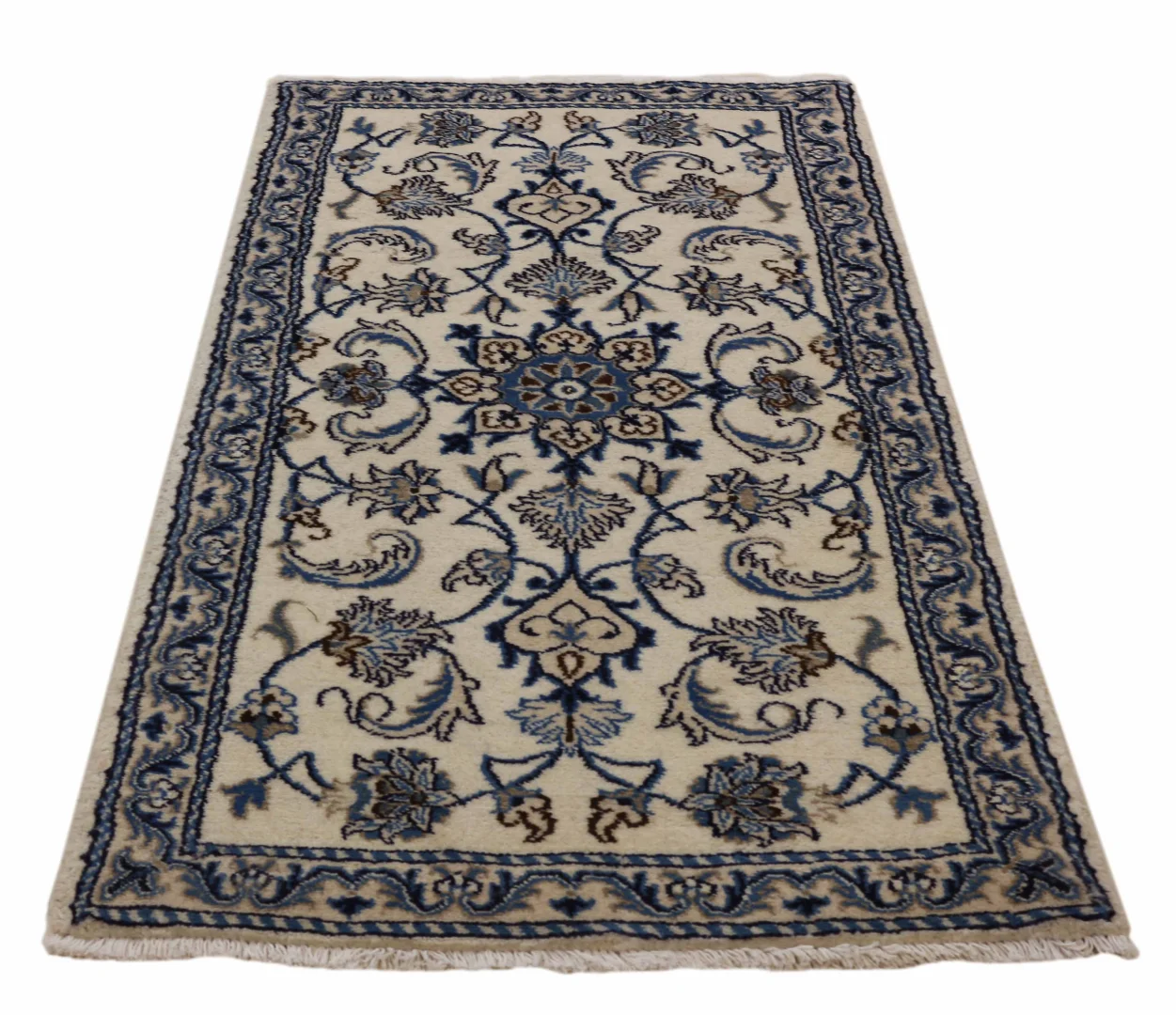
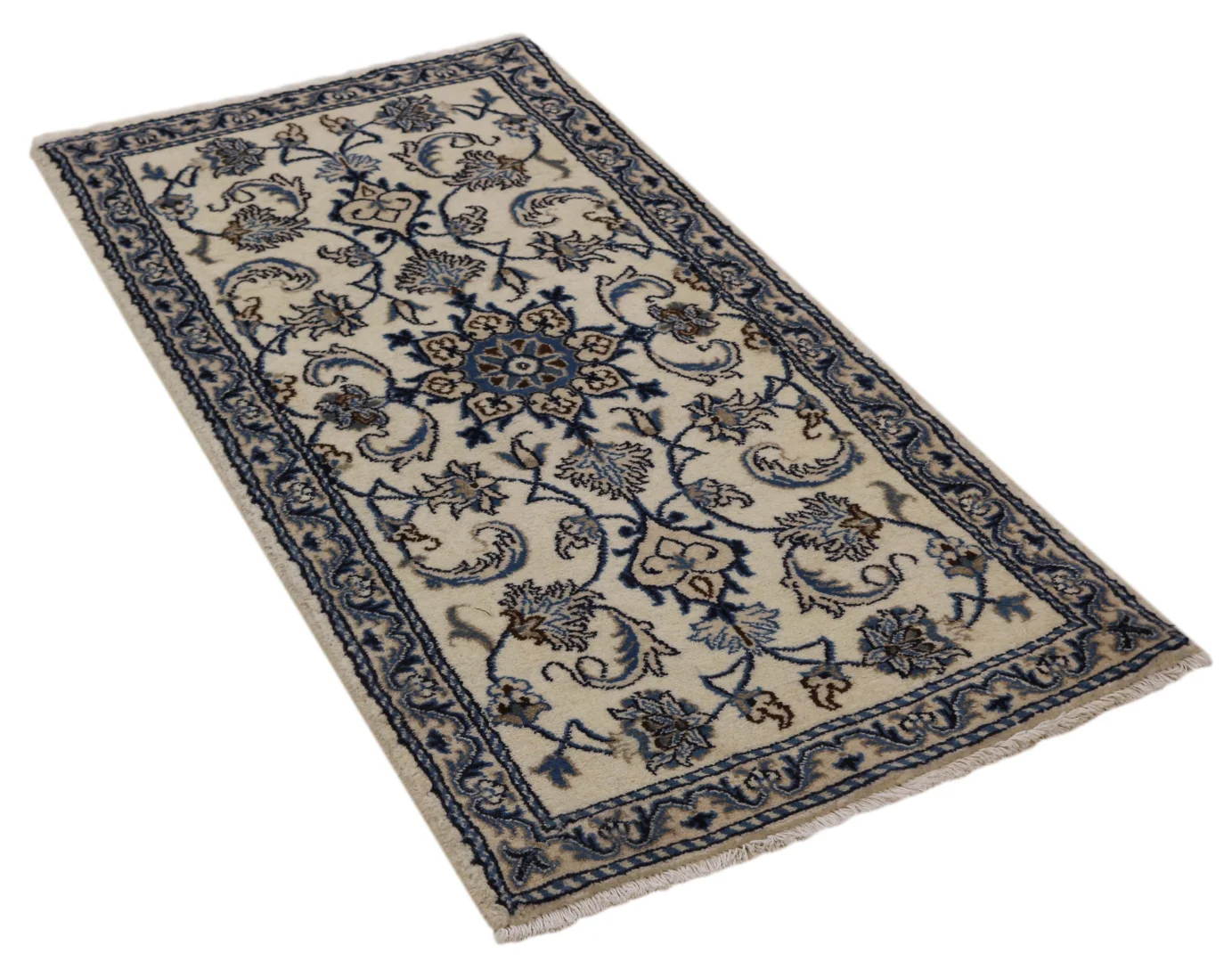
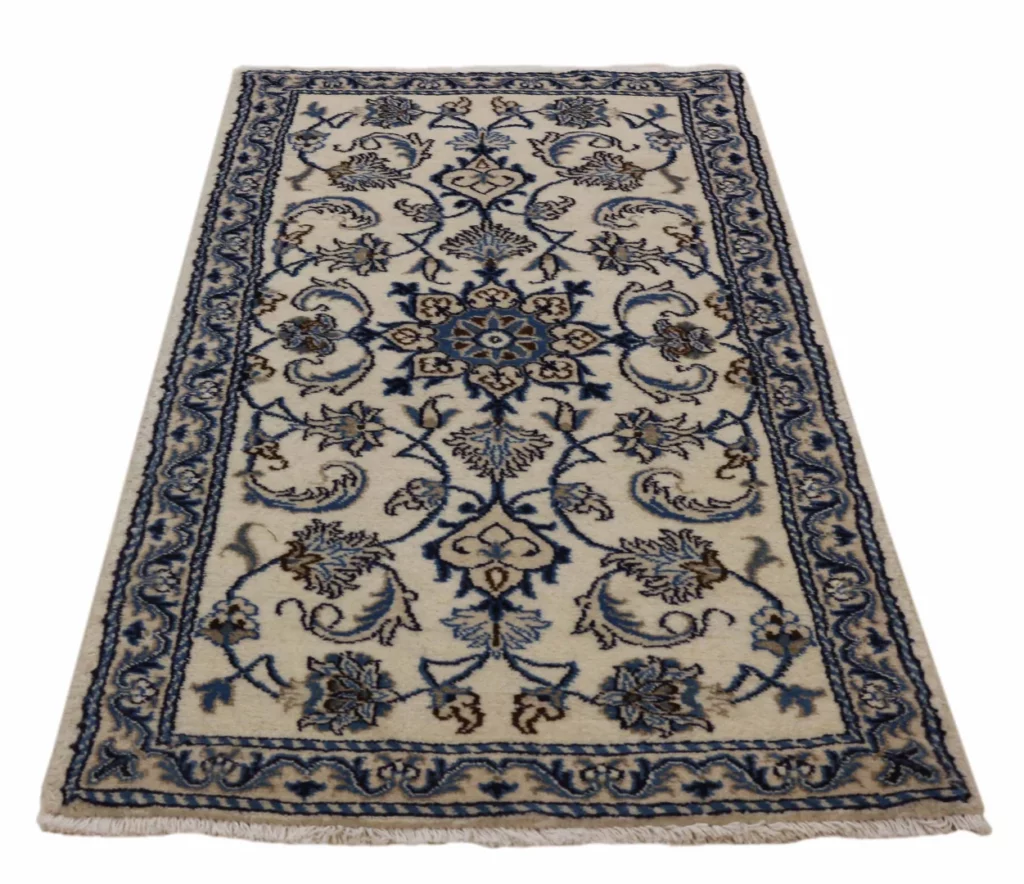
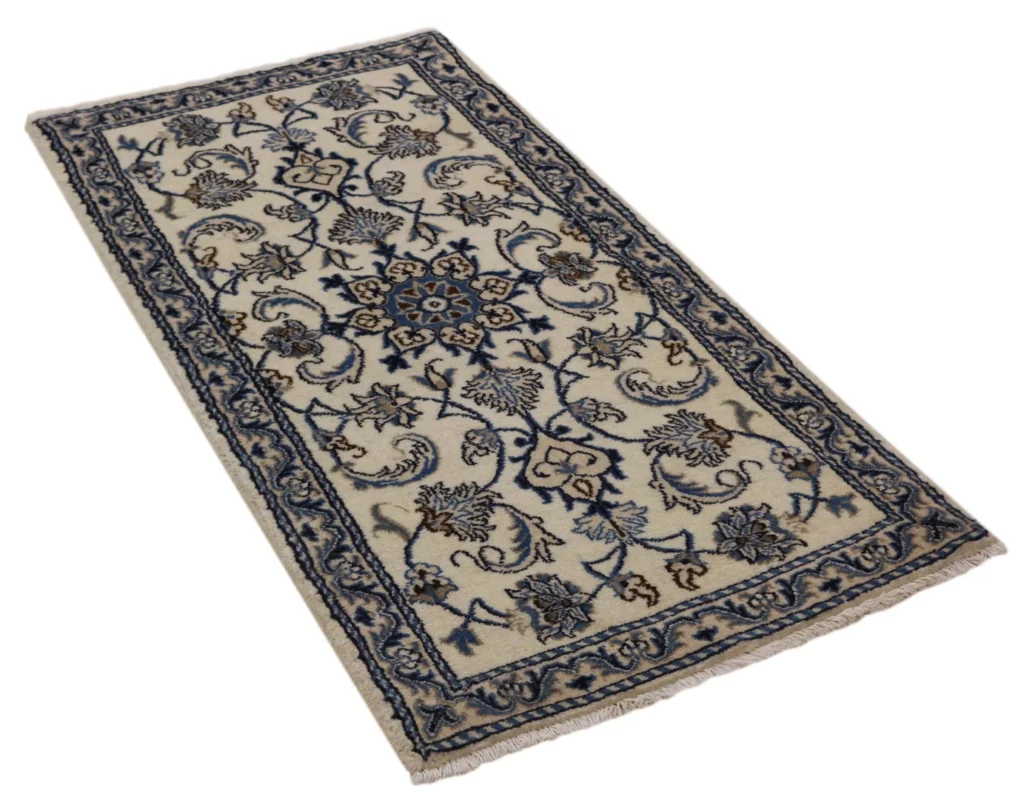
Hand-knotted Nain Persian rug | Knot density: 9-Lah | Material: wool pile with silk | Size: 137 x 70 cm | Pattern: Classical floral motifs | Condition: Very good
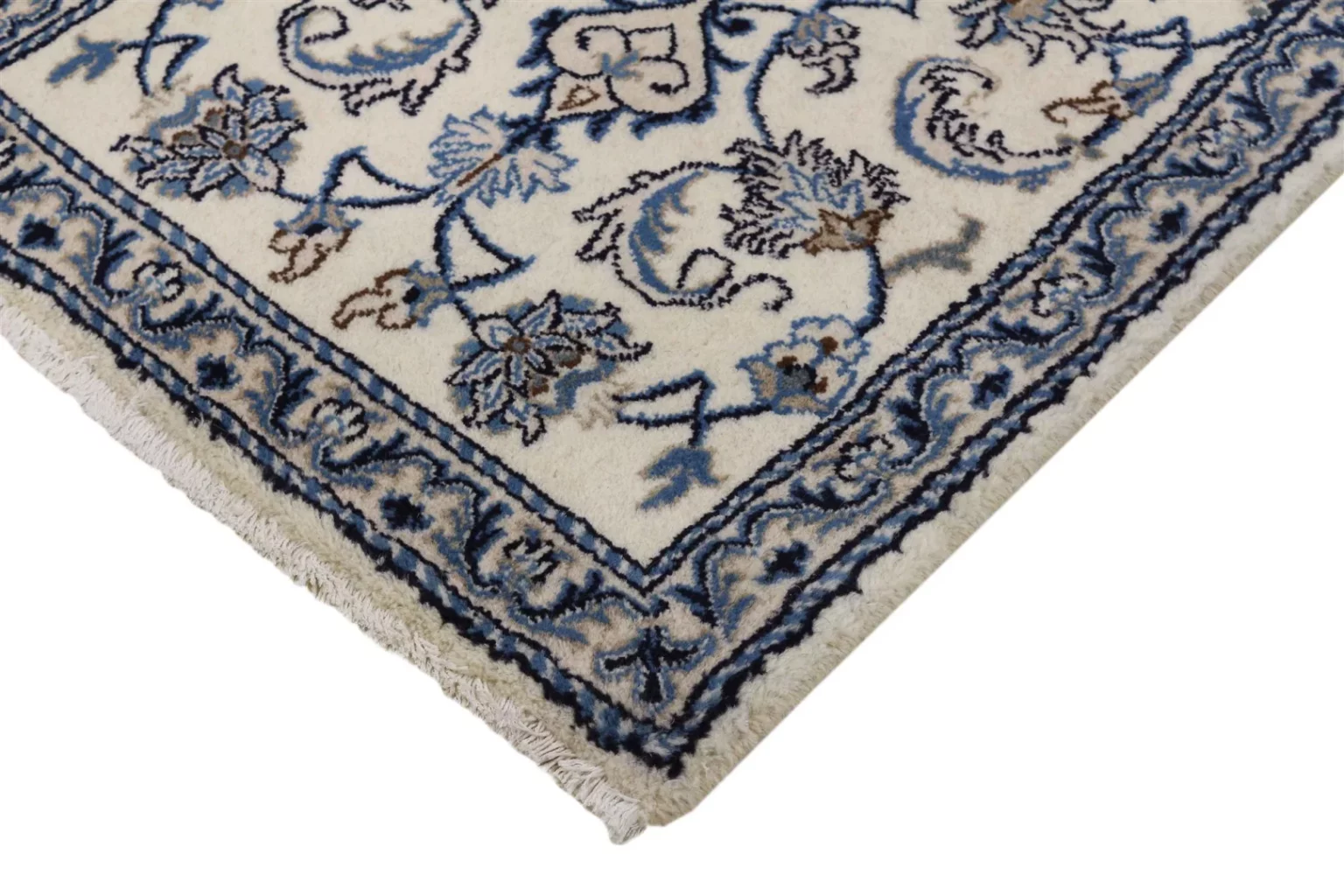
This Nain Persian rug is hand-knotted and made from wool with silk. The combination of these fibres is associated with the finer side of Nain rug production. Wool gives the pile a substantial textile character, while silk can catch the light and create subtle highlights across the surface. Used together, the two materials provide both a grounded pile and a more reflective quality that supports the floral design. The material description therefore points to a construction in which practical textile substance and fine visual detail work together.
Nain rugs are traditionally classified in quality levels using the term Lah. The designation relates to knot density and helps describe differences in fineness between individual qualities. This rug is identified as 9-Lah. That classification forms part of its construction and places it within the established Nain system. A higher Lah number is associated with a greater number of knots per square metre and a finer rendering of the pattern.
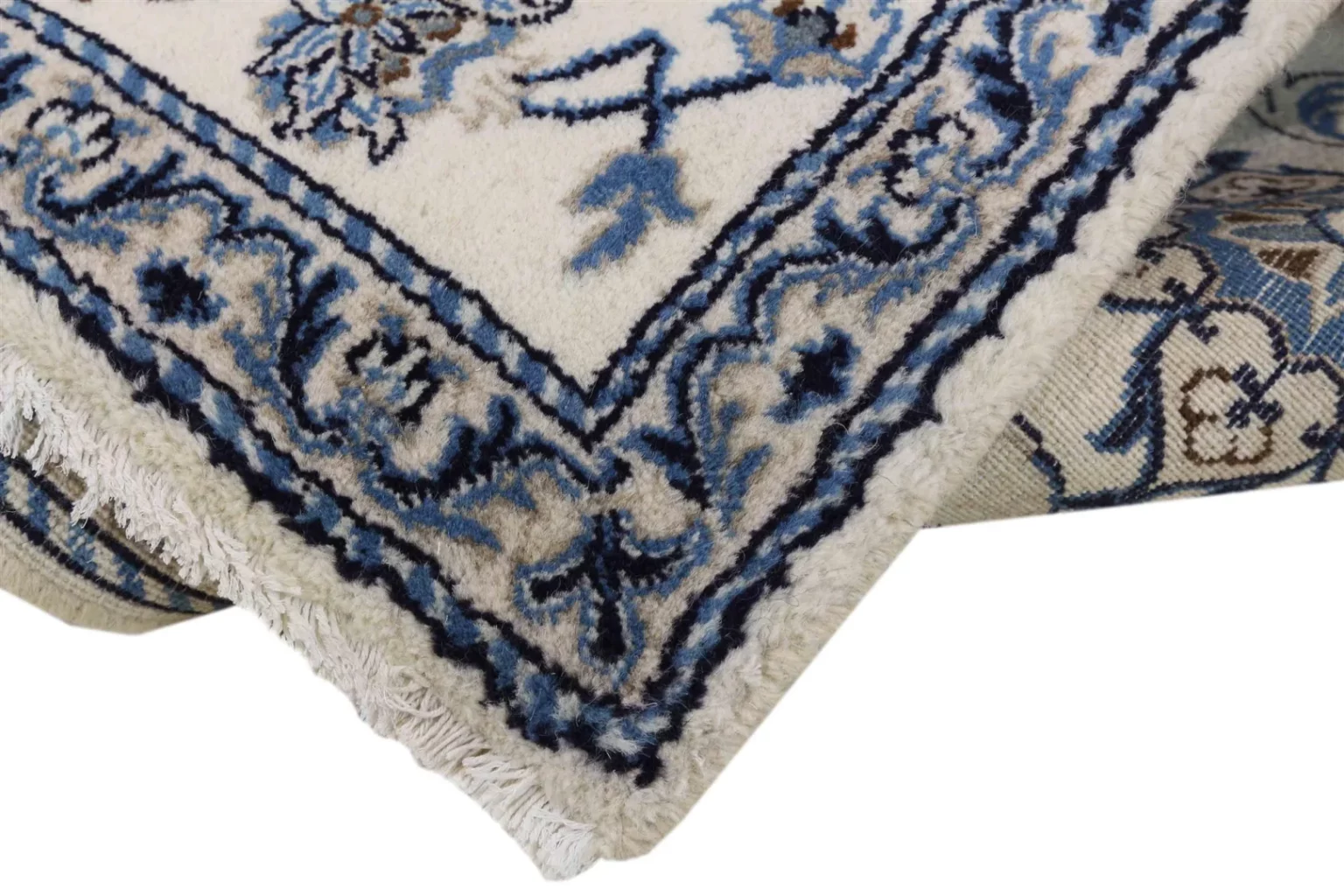
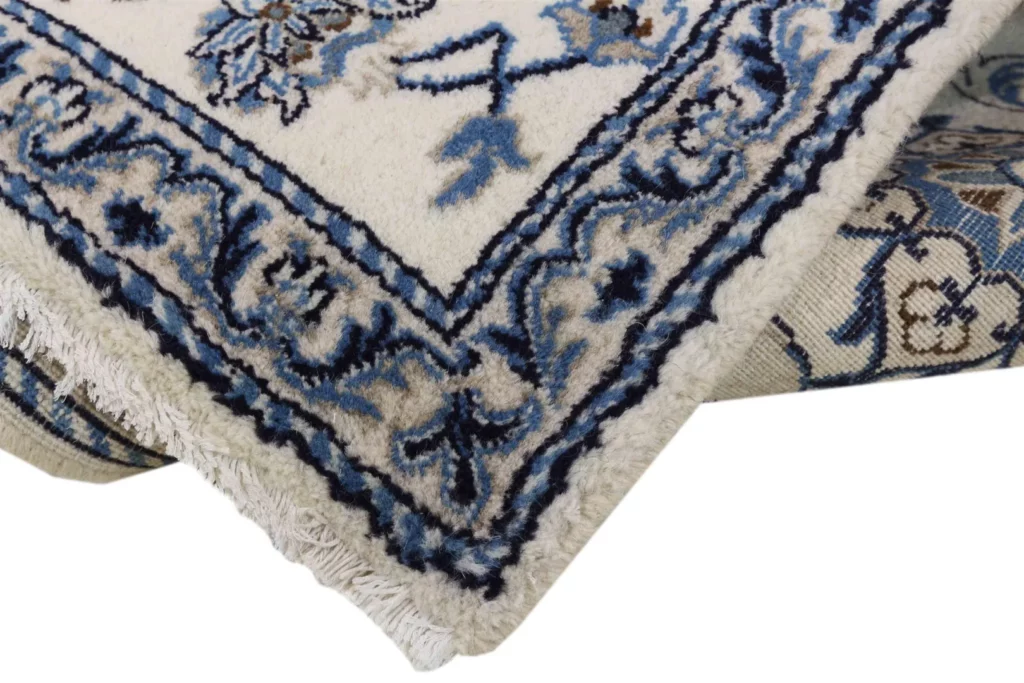
Hand-knotting allows a design to be built knot by knot, with the direction of lines and the placement of individual decorative forms controlled throughout the process. This is especially useful for floral ornament, where small leaves, curved stems and flower shapes need to remain legible. Wool provides the main tactile presence of the pile, while silk fibres can bring selected areas greater brightness. The technique and material combination explain the fine, detailed character commonly linked with Nain rugs.
Origin and Tradition
The rug comes from Nain in Iran. Nain, also known as Naein, is one of Iran’s recognised rug-weaving regions. Its rugs form a distinct regional branch of Persian textile art, with an emphasis on ordered composition, refined knotting and carefully arranged ornament. The name Nain therefore refers to a specific Iranian tradition rather than simply to a general decorative style.
The history of rug making in Nain is associated with a long cultural tradition reaching back to the period of the Sassanid dynasty. This historical reference places the craft within a wider Persian heritage of textile work, ornament and skilled manual production. Knowledge is carried through techniques and design principles that connect later rugs with an older artistic vocabulary. A Nain rug consequently represents both a functional textile and a regional form of Persian craftsmanship.
Different quality levels are made in Nain, and Lah is used to describe their relative fineness. The system gives buyers and specialists a way to discuss knot density without relying only on visual impression. A 4-Lah rug is described as having more than one million knots per square metre, while a 12-Lah rug is described as having approximately 250,000 knots. Within this traditional classification, the higher Lah value indicates a greater density and finer pattern detail. The Lah designation is therefore an important part of how Nain rugs are understood and described.
The 9-Lah quality is associated with a fine execution and with the use of silk fibres. Silk can sharpen the appearance of ornamental contours and introduce changes in brightness as the surface catches the light. The Nain tradition is not defined by knot density alone, however. Balance in the overall layout, controlled drawing of the motifs and the relationship between pile and foundation are also part of the craft. Hand-knotting brings these elements together through a deliberate, labour-intensive process.
Nain belongs to a broader Persian rug culture that includes other traditions from the Isfahan region. Isfahan rugs are known for intricate arabesque designs and vivid colours. Kashan rugs are often associated with richly decorated medallions and floral motifs. These types complement the Nain tradition while retaining their own regional design languages. Seen together, they show the range of Persian rug making in central Iran. Nain remains identifiable through its fine knotting, measured ornament and frequent use of wool together with silk.
Design and Pattern
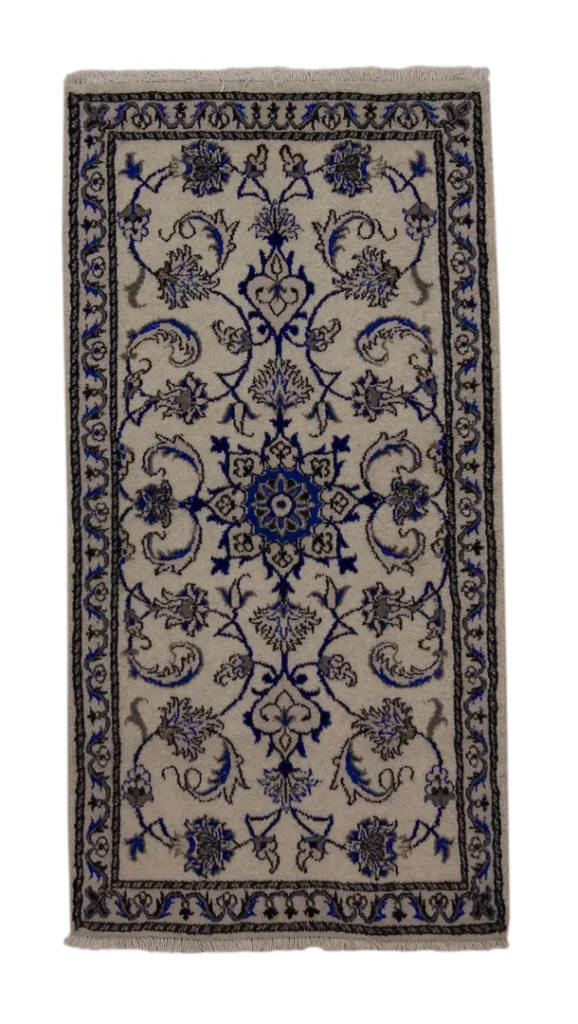
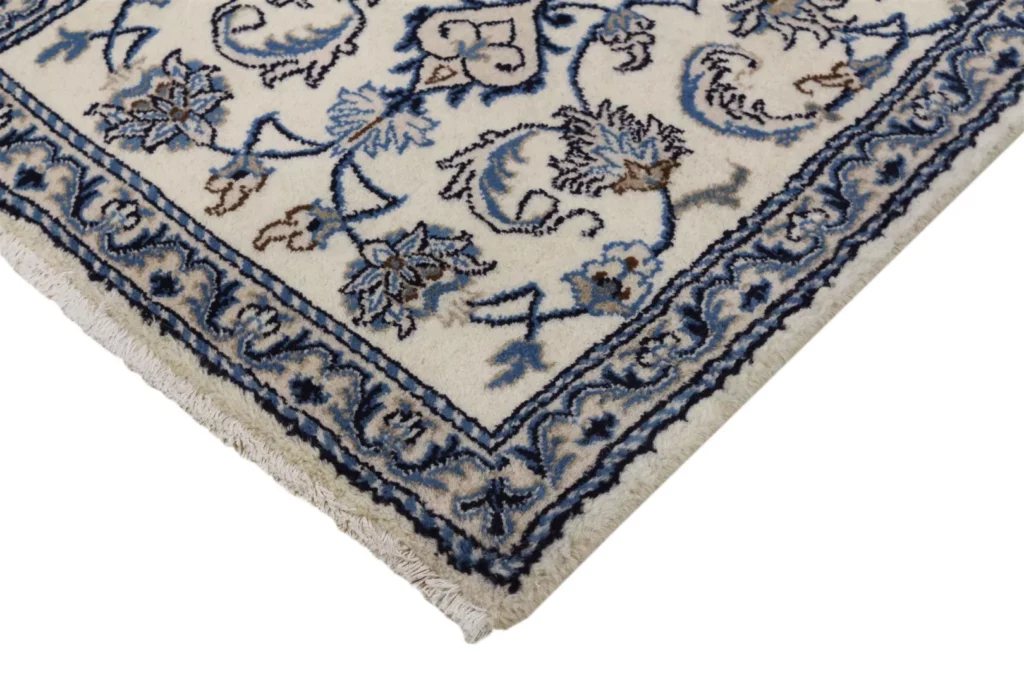
The pattern of this rug is described as classical floral. Floral ornament is one of the characteristic design features associated with Nain rugs. Flowers, leaves and winding stems are arranged as parts of a balanced composition. Rather than being scattered randomly, the motifs are connected through rhythm, repetition and controlled spacing. This gives the design a calm structure while allowing the individual plant forms to remain visible.
Persian floral ornament usually transforms natural forms into decorative symbols rather than reproducing them as literal botanical images. Flowers may be stylised, enlarged or integrated into curling vines. Leaves can follow the movement of a stem and bridge the space between larger motifs. Through this process, organic shapes become part of a measured pattern system. The resulting visual language is one reason classical floral designs remain closely associated with Persian rugs.
Many Nain designs also use medallions as an organising device. A central medallion can act as the focus of the field, with surrounding flowers and branches arranged in relation to it. Other compositions distribute floral ornament more evenly across the entire surface. Both approaches belong to the established vocabulary of the region. The specific description for this rug identifies classical floral motifs, so the defining feature here is the floral character of the design.
Fine knotting supports the depiction of small ornamental details. Narrow stems, leaf shapes and flower outlines can be placed close together while retaining a coherent visual structure. In finer Nain qualities, silk fibres may be used to accentuate selected details and produce a restrained sheen. Wool and silk then contribute in different ways: wool gives the surface body, while silk can make particular lines or motifs appear brighter. The result is a pattern whose detail depends on both drawing and material.
Nain rugs are produced in different formats and can be used in a variety of interiors. Their floral designs may serve as a quiet decorative centre or work as a complementary textile in a room with classical furnishings. The relationship between the ornament, the surrounding colours and the placement of the rug determines how strongly the pattern is perceived. Even when used in a modern setting, the ordered floral language preserves the rug’s connection with the Nain tradition.
Special Features
The defining features of this piece are its origin in Nain, its hand-knotted construction, its wool and silk material, and its 9-Lah classification. Together, these details describe a rug rooted in a specific Iranian weaving tradition. The classical floral pattern gives it a clear decorative identity, while the use of silk supports the finer visual character associated with the 9-Lah quality.
The condition is described as very good. This forms part of the rug’s specific product description. Its character comes from the combination of regional origin, hand craftsmanship, floral ornament and the stated fibre composition. These are the details that distinguish the piece within the wider group of Nain Persian rugs.
FAQ
How can I recognise the quality of a Nain rug?
Knot density is one of the main ways Nain rugs are classified, and it is expressed in Lah. The Lah value relates to the number of knots per square metre and is used to distinguish different levels of fineness. A higher Lah value is associated with a greater knot count and with more finely rendered pattern details. The materials and the precision of the hand-knotting also matter. In finer Nain rugs, silk fibres may be added to emphasise details and create a slight sheen on the surface. This rug is described as a 9-Lah Nain made from wool with silk.
Can I wash a Nain rug?
Yes, Nain rugs can be washed. Because fine materials and hand-knotted construction require careful handling, professional cleaning is recommended. A specialist can choose a method suited to the fibres and help protect the pile, foundation and pattern. For regular care, vacuuming and the use of rug-protection products are recommended. With a wool-and-silk rug, it is sensible to avoid experimental home treatments and have the cleaning process matched to the actual fibre combination.
Where can I find other rug types from the Isfahan region?
Other rug types from the Isfahan region can be found at specialist retailers and on online platforms. Isfahan rugs are known for intricate arabesque patterns and vivid colours, while Kashan rugs often feature richly decorated medallions and floral motifs. When comparing them, consider the regional name, the characteristic pattern and the quality of the handwork. These points make it easier to distinguish the different traditions and to select a style that fits the intended interior.
To provide the best experiences, we use technologies like cookies to store and/or access device information. Consenting to these technologies will allow us to process data such as browsing behavior or unique IDs on this site. Not consenting or withdrawing consent, may adversely affect certain features and functions.
Functional Always active
The technical storage or access is strictly necessary for the legitimate purpose of enabling the use of a specific service explicitly requested by the subscriber or user, or for the sole purpose of carrying out the transmission of a communication over an electronic communications network.
Preferences
The technical storage or access is necessary for the legitimate purpose of storing preferences that are not requested by the subscriber or user.
Statistics
The technical storage or access that is used exclusively for statistical purposes.The technical storage or access that is used exclusively for anonymous statistical purposes. Without a subpoena, voluntary compliance on the part of your Internet Service Provider, or additional records from a third party, information stored or retrieved for this purpose alone cannot usually be used to identify you.
Marketing
The technical storage or access is required to create user profiles to send advertising, or to track the user on a website or across several websites for similar marketing purposes.
 SECURE PAYMENT
 SHIPPING PARTNERS