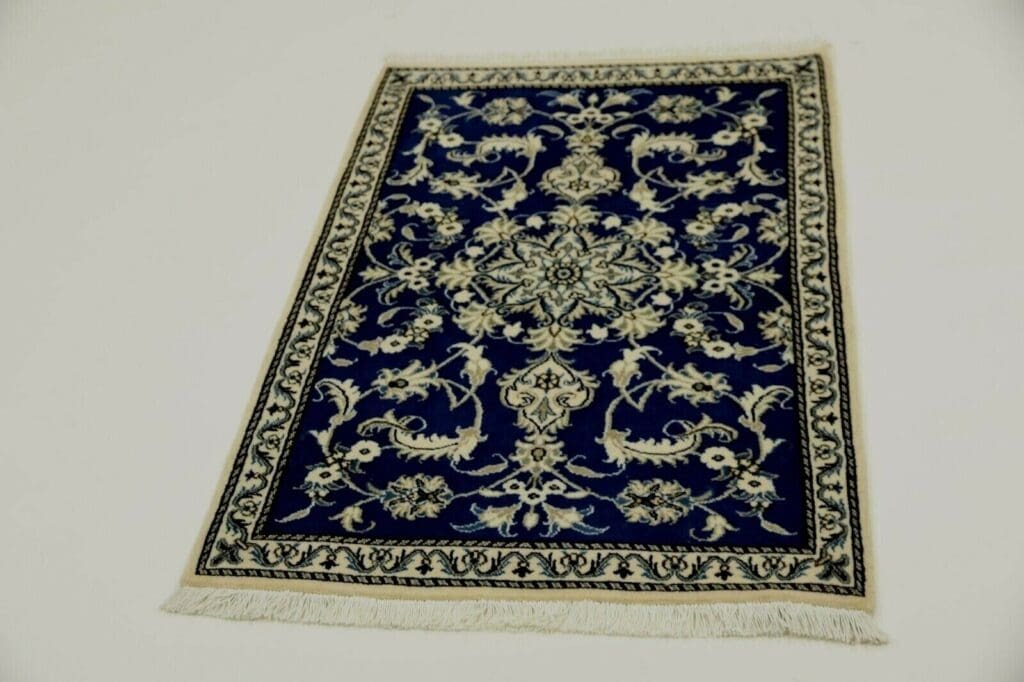
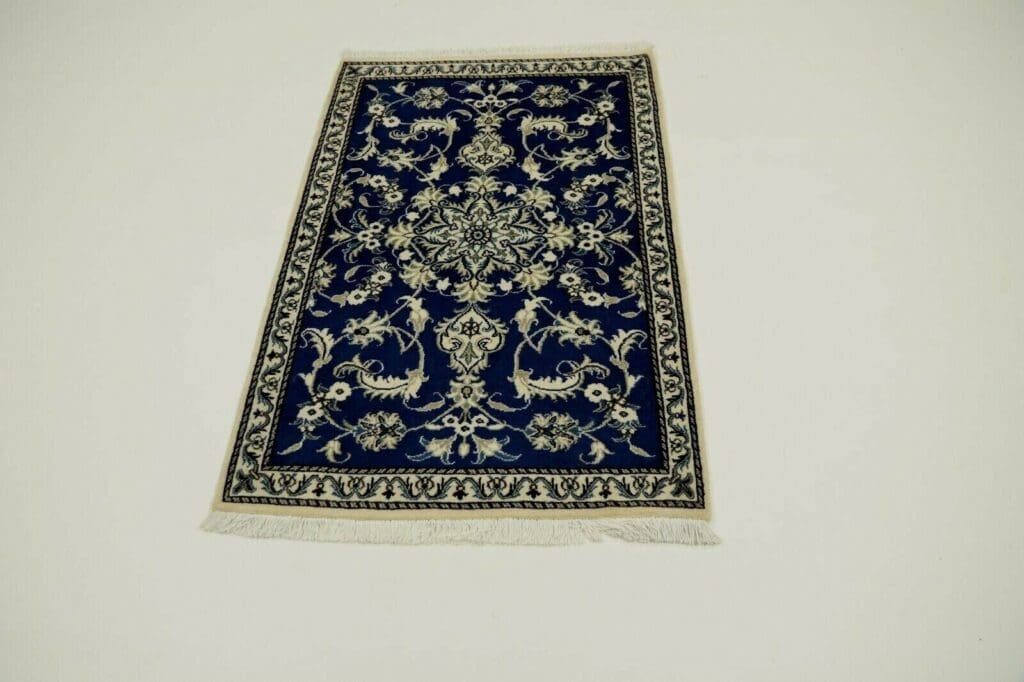
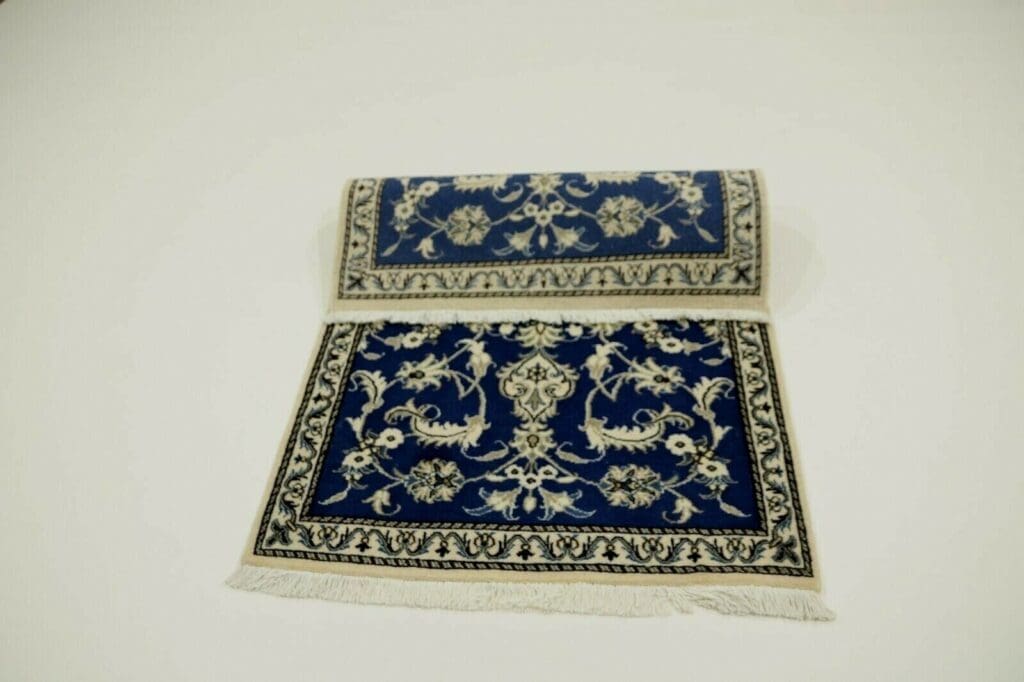
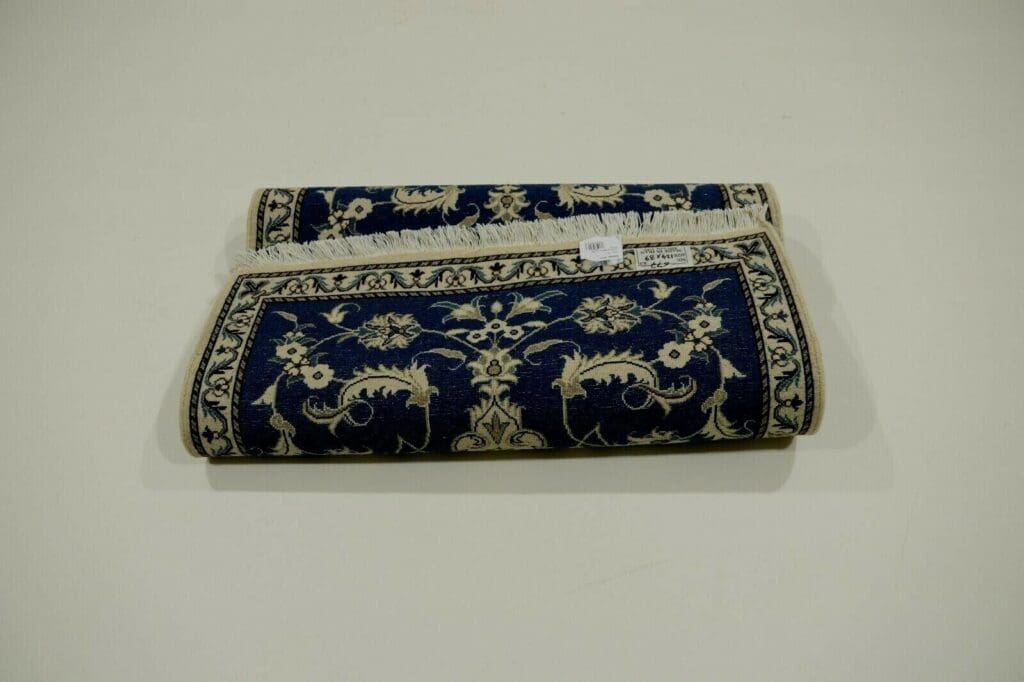
This Super Nain Persian rug is hand-knotted. Its pile consists of 90% virgin wool and 10% silk, while the warp is made from 100% cotton. Each fibre contributes a different quality to the construction. Virgin wool forms the larger part of the pile and gives it a resilient, tactile structure. Silk adds a smoother surface and a restrained lustre. The cotton warp provides the foundation around which the individual knots are secured.
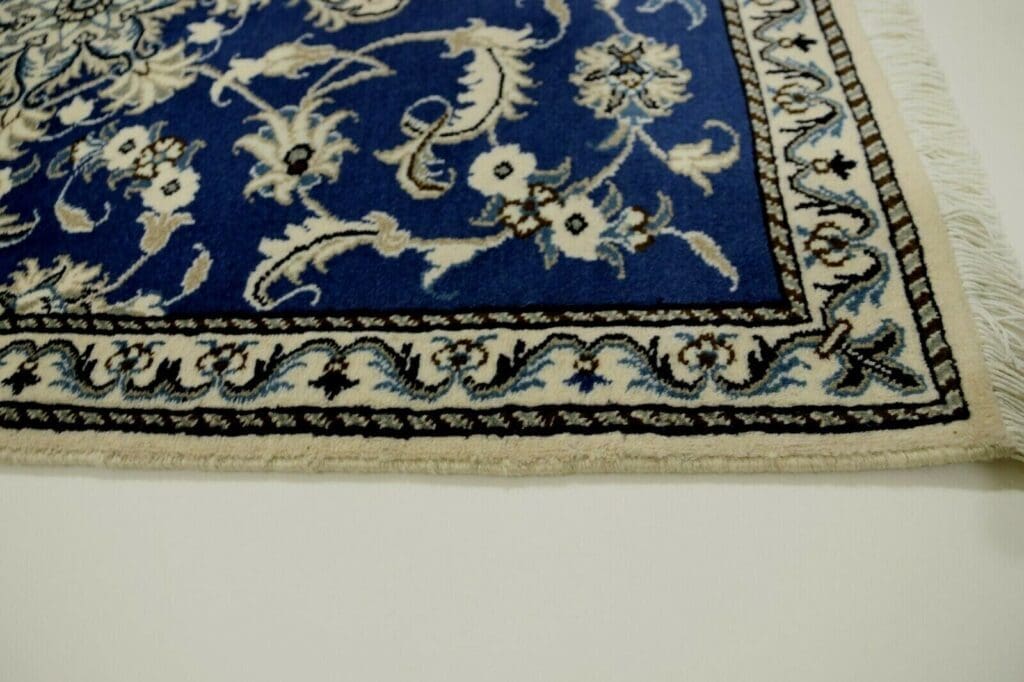
Hand-knotting is a process in which each knot is tied separately around the prepared warp. After a row has been completed, weft threads are inserted and the structure is compacted. The process is repeated until the design has been built across the whole surface. The pile is then trimmed and finished so that its height and appearance are even. A density of approximately 300,000 knots per square metre represents a fine construction and permits precise drawing of narrow lines and small ornamental details.
Virgin wool can retain warmth and help create a comfortable interior climate. It also has a naturally resilient character. Silk reflects light differently from wool and can create a gentle change in appearance as the viewing angle shifts. The combination therefore produces both a soft, tactile surface and a subtle variation in sheen. This rug is described as new and in very good condition. It is also specified as suitable for underfloor heating and pet-friendly.
Because the rug is made by hand, its surface is formed through a sequence of individual operations rather than by a machine applying a finished design. Preparing the warp, keeping the tension even, placing the knots, compacting the rows and trimming the pile all influence the finished textile. The listed material composition is part of this rug’s description: wool is the principal pile fibre, silk is included in the pile, and cotton is used for the warp. The fibres are not interchangeable, as each responds differently to handling and light.
Origin and Tradition
Nain is a city in Iran known for finely made rugs. It is located in Isfahan Province, one of the important regions in the history of Iranian carpet weaving. The name Nain therefore identifies a regional tradition within Persian rug making. Nain rugs are commonly associated with pale colour directions, careful field organisation and fine drawing. Their character comes from the relationship between a precise technical structure and a measured ornamental composition.
The weaving tradition of Nain reaches back to the nineteenth century. As it developed, the city established a recognisable position within Iranian carpet production. Nain became especially associated with rugs whose light grounds, controlled line work and elegant ornament create an ordered visual effect. Making such a rug requires knowledge of warp preparation, yarn selection, tension, knot placement and finishing. The final result depends on how these activities are coordinated rather than on one isolated technical feature.
Isfahan Province has a broad and varied carpet history. Different towns and workshops developed their own approaches to colour, proportion, knotting and ornament. Nain occupies a distinct place within that regional landscape. Light tonal arrangements, floral detail and fine pattern drawing are often connected with its weaving tradition. These qualities describe a recognised regional vocabulary, not a rigid formula. Individual Nain rugs may differ in their field arrangements and ornament while remaining within the same tradition.
Persian rugs are traditionally understood through a combination of origin, design and workmanship. A place name can refer to knowledge passed through generations: how a foundation is prepared, how yarns are handled, how patterns are organised and how the finished surface is treated. In a hand-knotted rug, this knowledge becomes part of the physical structure. The textile is built from warp, weft and knots rather than receiving a pattern only after the surface has been completed.
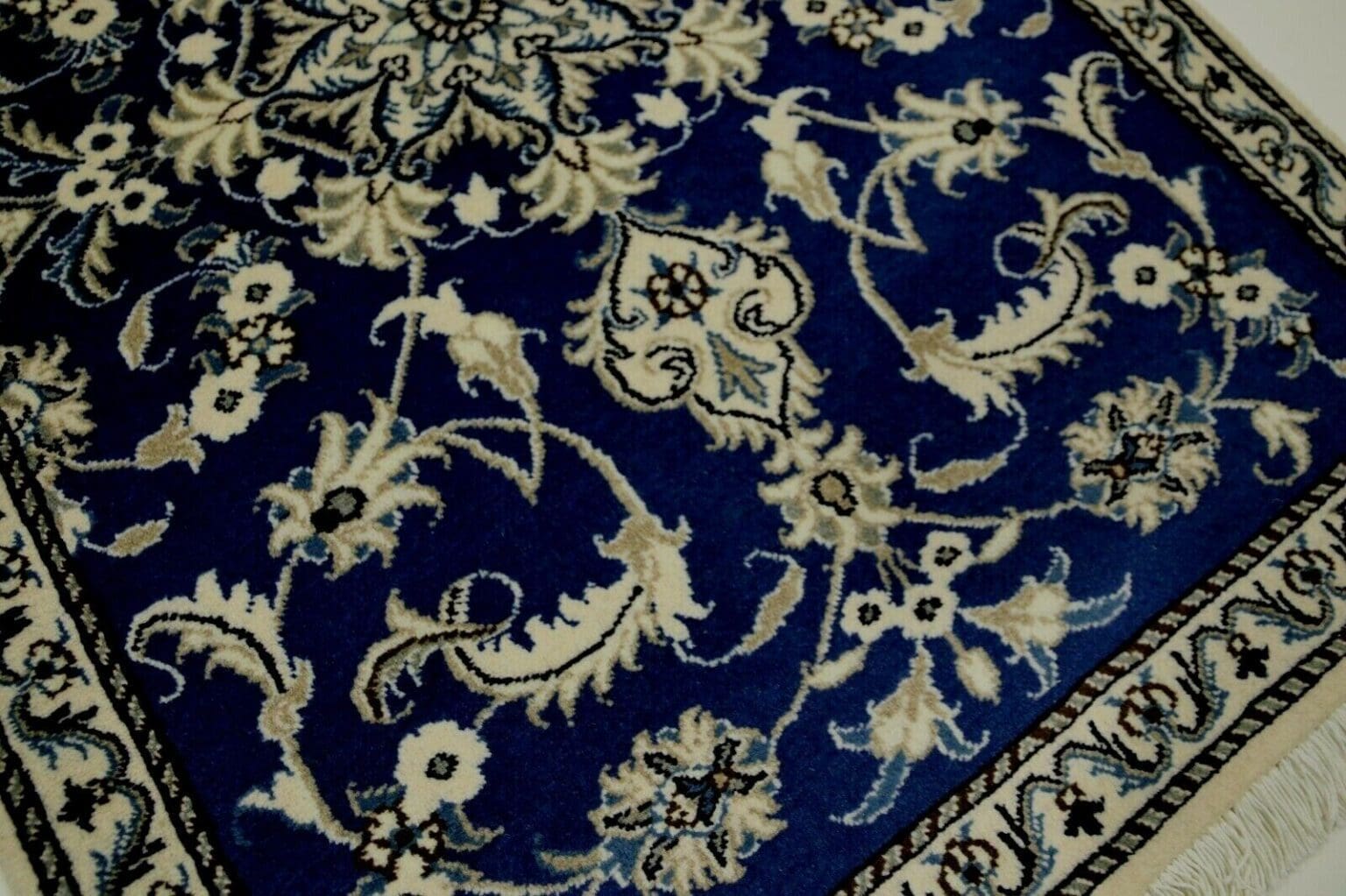
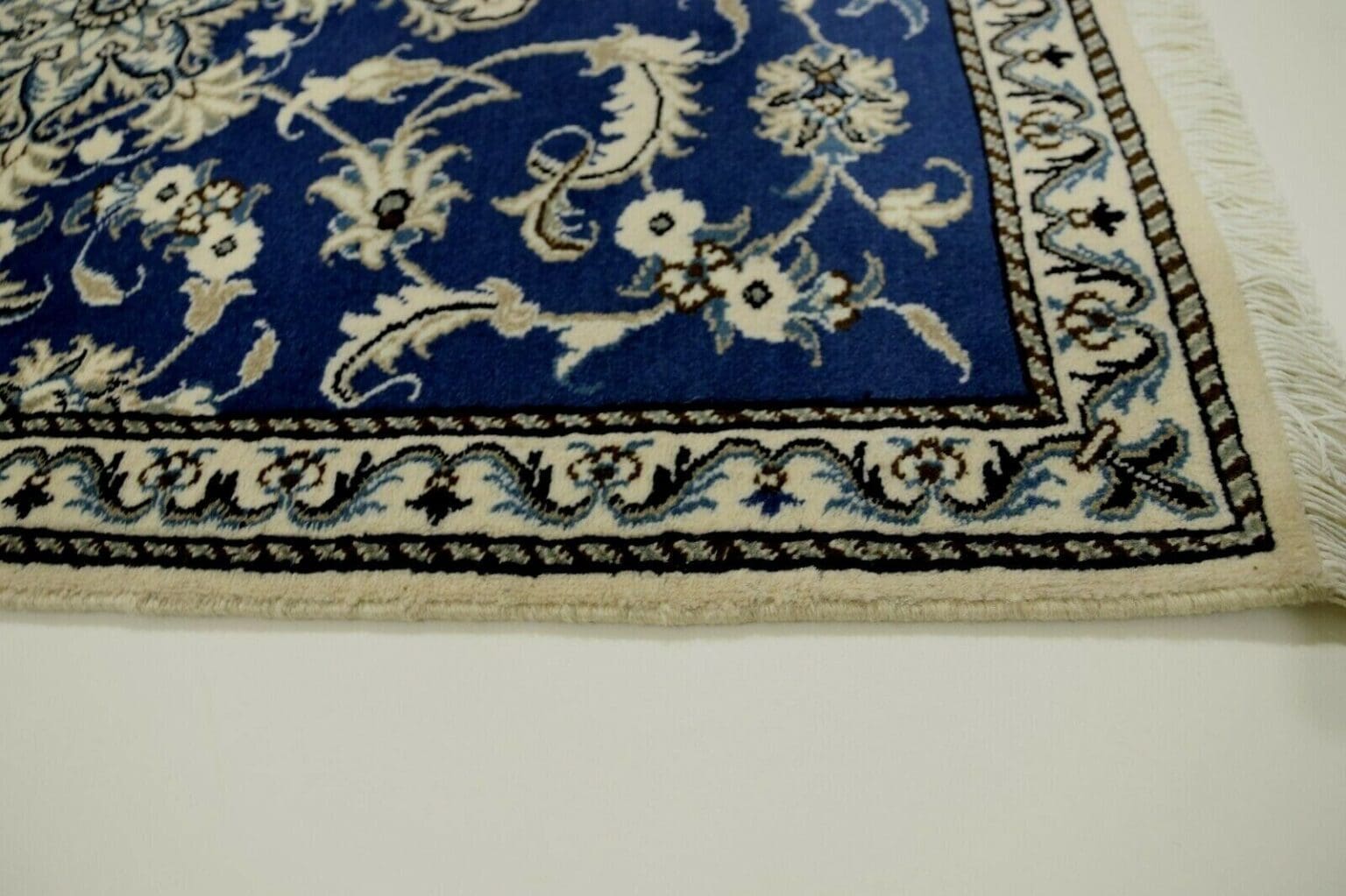
Nain designs are often discussed in connection with light colour effects and refined floral forms. Vines, leaves and blossoms may be linked into a continuous ornamental system. Geometric elements can organise the field and clarify its divisions. Borders frame the central area and establish a transition towards the edge. These devices belong to the wider Persian design tradition and help explain why Nain rugs are frequently described as balanced, detailed and composed.
The origin of a rug must be distinguished from the motifs used in its pattern. A floral or geometric element may be found across several Persian weaving traditions. The Nain designation concerns the regional classification within Iranian carpet making. This piece is identified as a Super Nain Persian rug from Persia or Iran. Its origin places it within Persian production, while the description of its pattern as Oriental identifies its decorative character.
Workshop production generally begins with a prepared design plan. The plan establishes the relationship between the main field, borders and individual ornaments. During weaving, the design must be translated into a sequence of coloured knots and controlled transitions. Finer construction allows smaller forms and narrower lines to be rendered with greater control. Nain tradition consequently combines inherited visual language with a technically demanding method of execution.
Design and Pattern
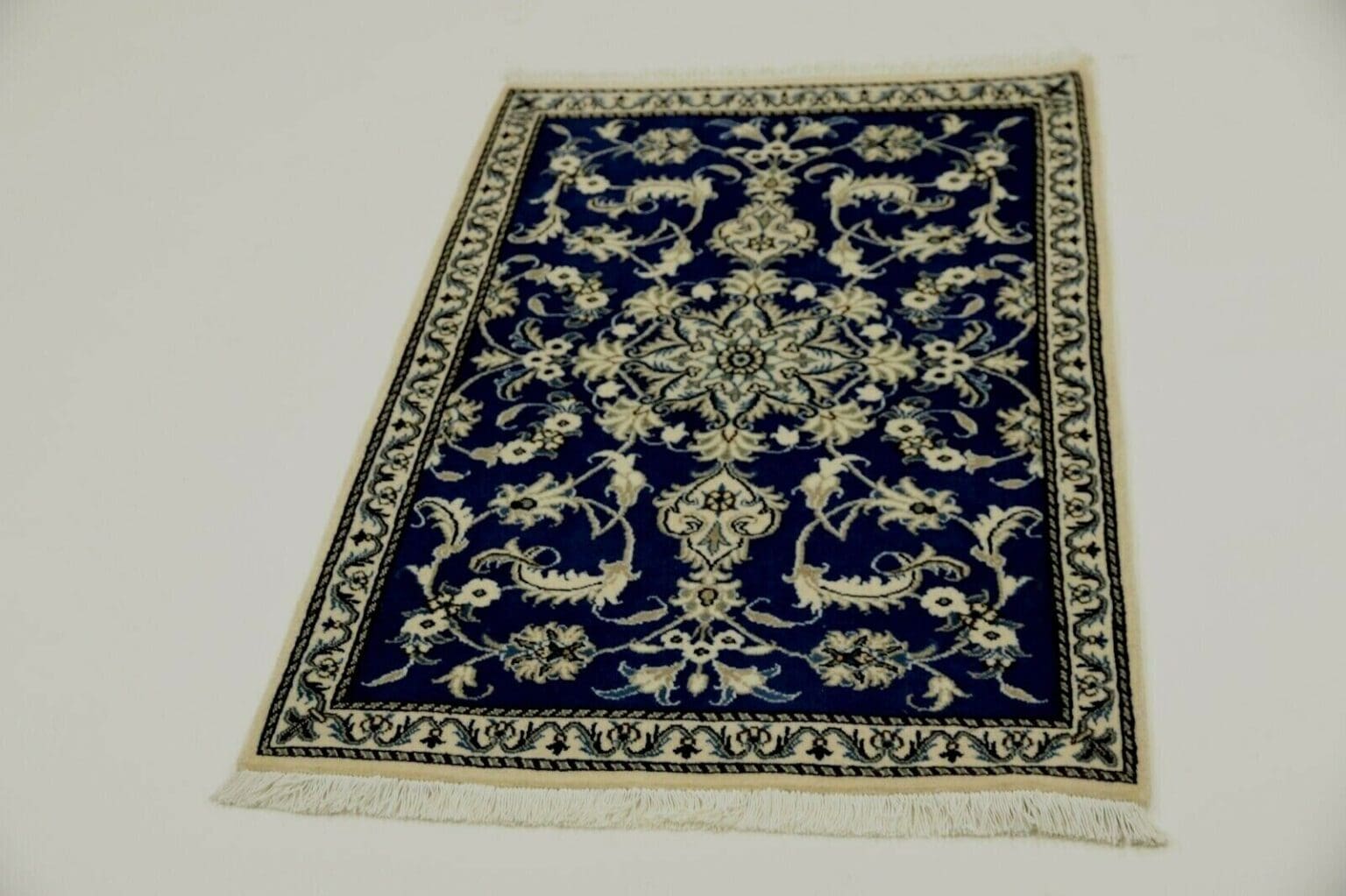
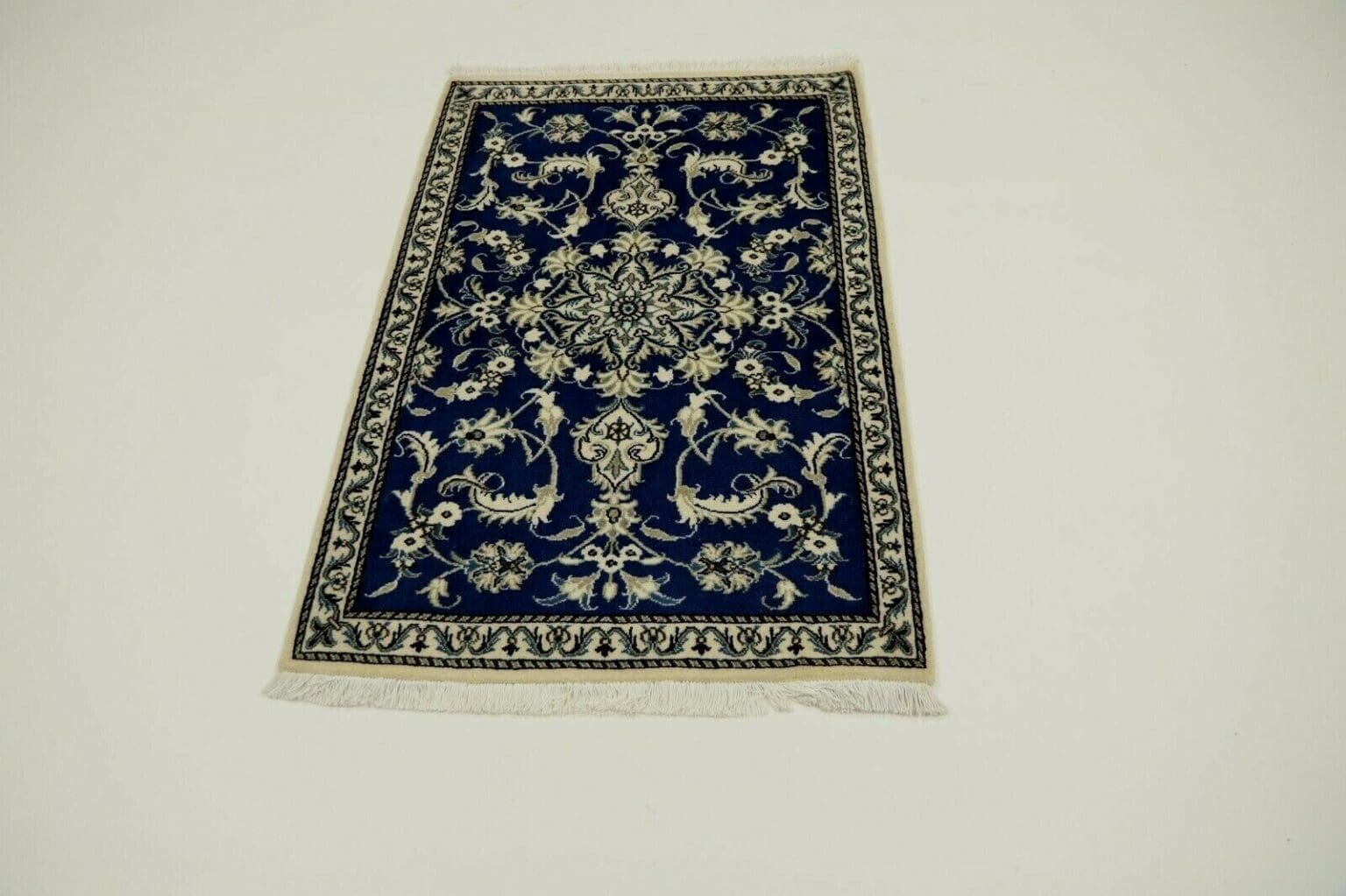
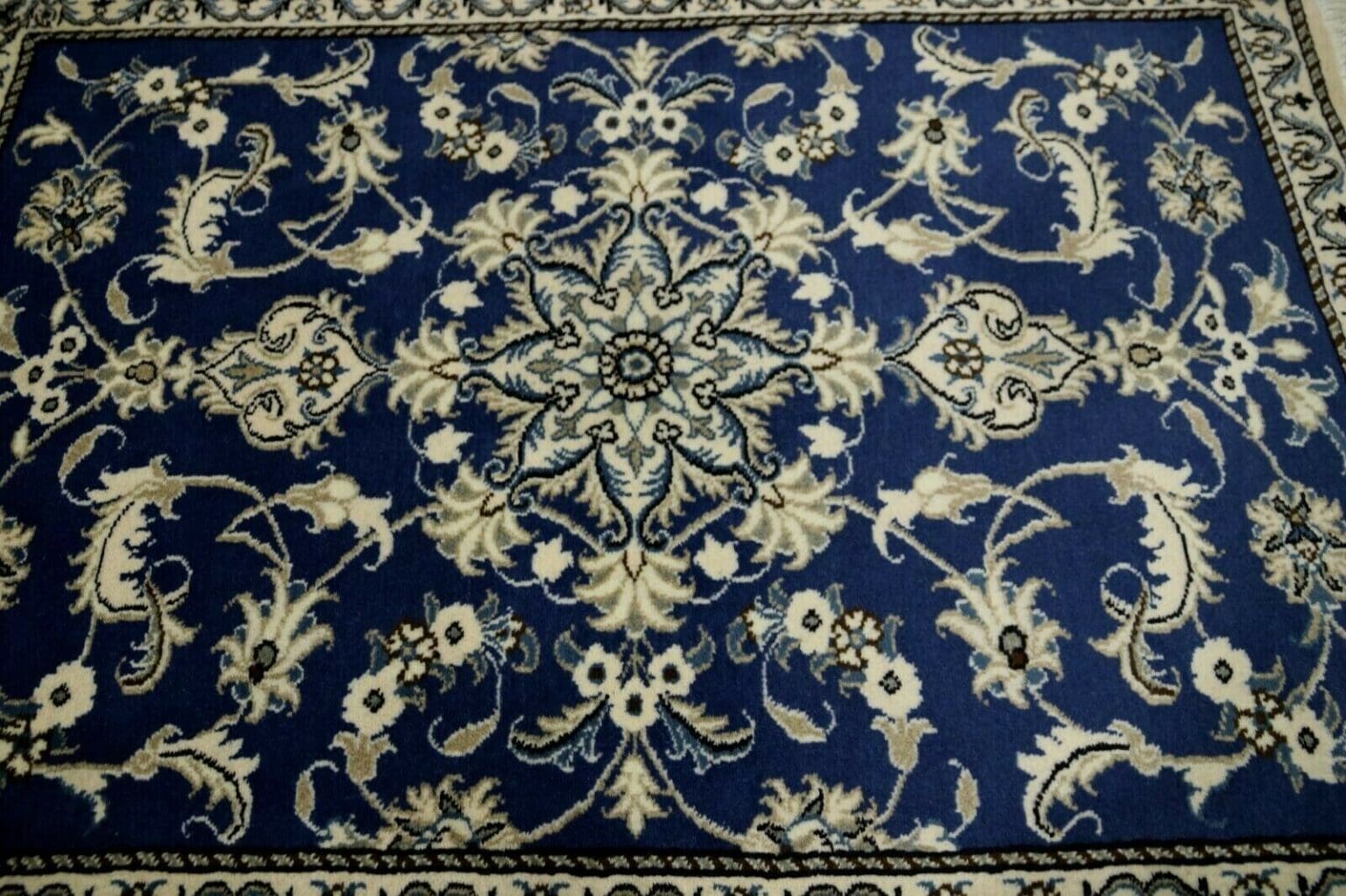
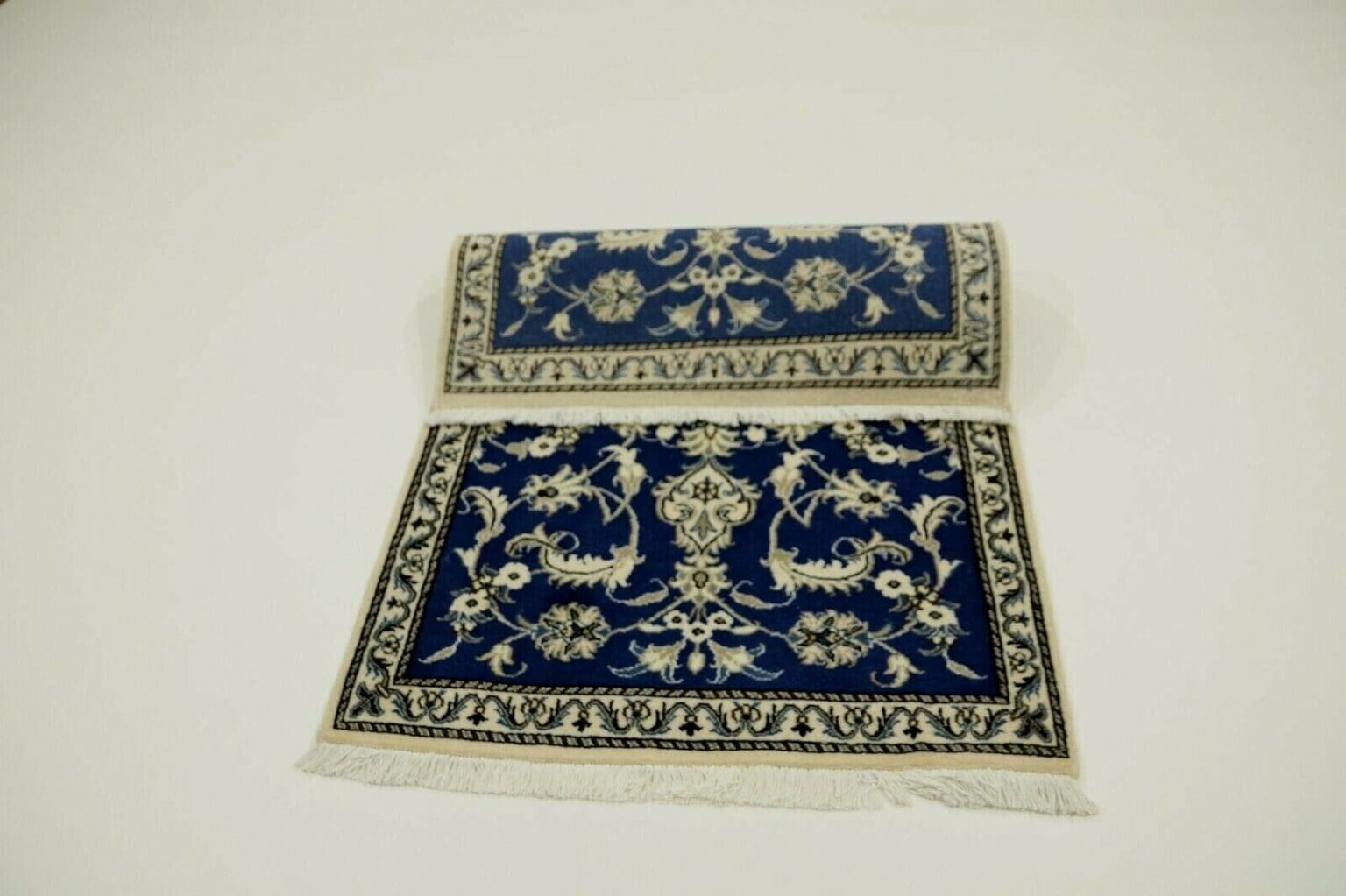
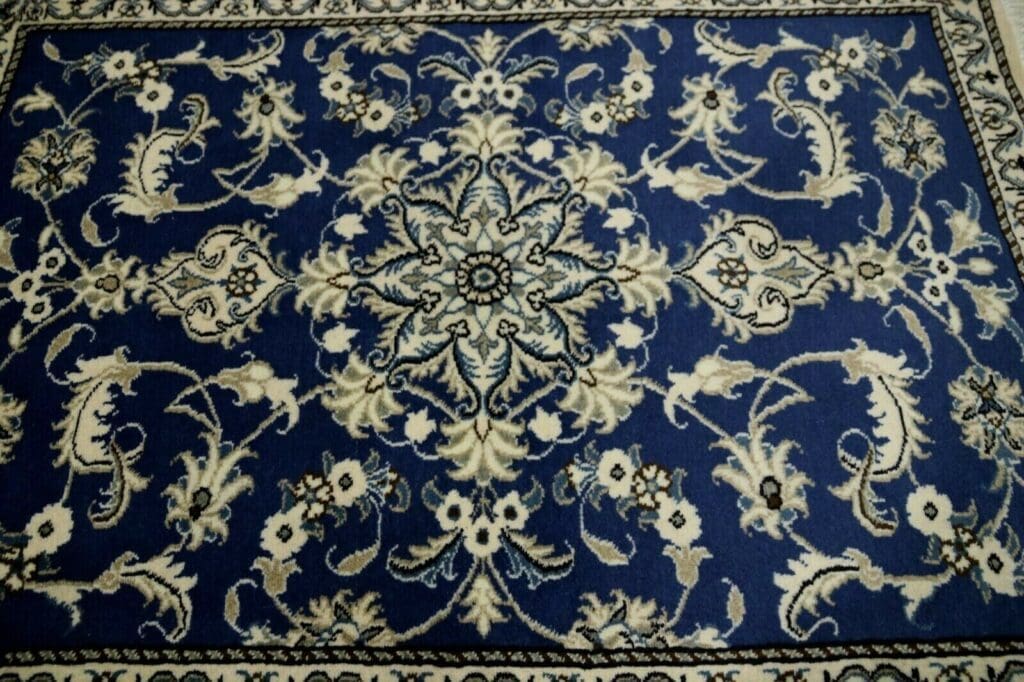
The pattern of this rug is identified as Oriental, and its style is described as traditionally Oriental or Persian. These terms classify the decorative language of the piece. They are separate from the stated origin of Persia or Iran and from the Nain designation. Oriental rug designs commonly establish a relationship between a central field, enclosing borders and recurring ornaments. This structure makes the surface read as one composition rather than as a collection of unrelated decorations.
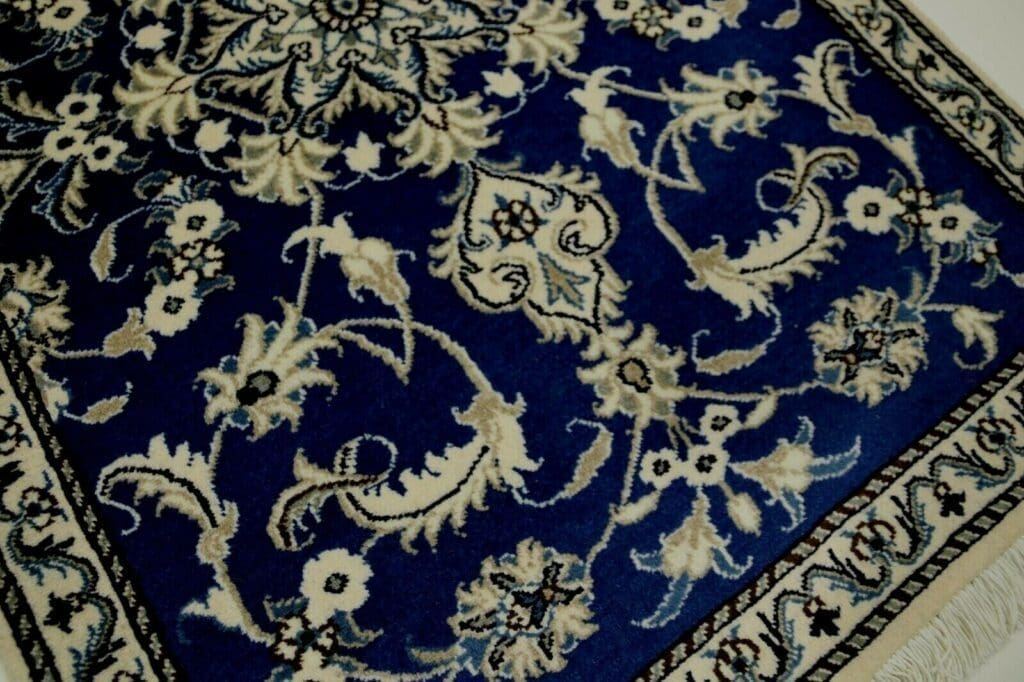
Floral ornament is one of the major forms in Persian carpet design. Leaves, blossoms and vines are usually stylised and arranged in rhythmic sequences rather than copied as literal botanical images. A vine can connect separate motifs, while flowers and leaves create points of emphasis. Repetition, balance and reflection help produce an orderly surface. The exact floral vocabulary of an individual rug depends on its particular design and should not be inferred beyond the description provided.
Geometric organisation can work alongside floral detail. It gives the field a framework and clarifies how the motifs relate to one another. A composition may be centred on a medallion, or it may distribute a repeating pattern throughout the field. Borders frame the design and often echo lines or ornaments from the interior in a more contained arrangement. The chosen structure is determined by the design plan and the individual execution of the rug.
Nain rugs are frequently connected with pale colour schemes and delicate contrasts. A light ground can allow fine drawing to remain visible without relying on harsh differences. The mixed pile also affects the way the pattern is seen. Wool tends to soften and diffuse light, whereas silk can reflect it more directly. As a result, areas containing silk may appear subtly different as illumination or viewing direction changes. This explains a material effect without adding an unlisted colour claim about this specific rug.
Many Persian motifs have a long cultural history. Plant forms may be associated with growth and renewal; balanced compositions can suggest order and continuity. In art-historical discussions, some ornaments are also linked with prosperity, good fortune or protection. These associations belong to the wider history of Persian pattern language. They should not be treated as a statement that this particular rug carries a specific personal message. Its stated pattern remains Oriental, with a traditionally Persian decorative character.
A fine knotting structure supports the rendering of small ornaments and delicate lines. In a hand-knotted rug, the drawing is created within the pile as the knots are placed. It is not printed onto a completed surface. The visual clarity of the finished design therefore depends on the interaction of the plan, yarns, knotting density, row compacting and pile finishing. The pattern is simultaneously an ornamental composition and a record of a manual textile process.
The design can be appreciated as a floor covering or as a textile displayed on a wall. When placed on the floor, the pattern becomes part of the room’s surface and is read across a horizontal field. When displayed vertically, the borders, repeated motifs and fine drawing can be viewed as a textile composition. In either setting, the rug remains connected to the Persian tradition of combining regional design, handwork and a carefully ordered ornamental surface.
Special Features
A central technical feature is the stated knot density of approximately 300,000 knots per square metre. It indicates a fine, detail-oriented construction and helps explain the precise treatment of the Oriental pattern. Together with the hand-knotting technique, the density is an important part of the rug’s craft description. The pile combines virgin wool and silk, while the foundation warp is made from cotton.
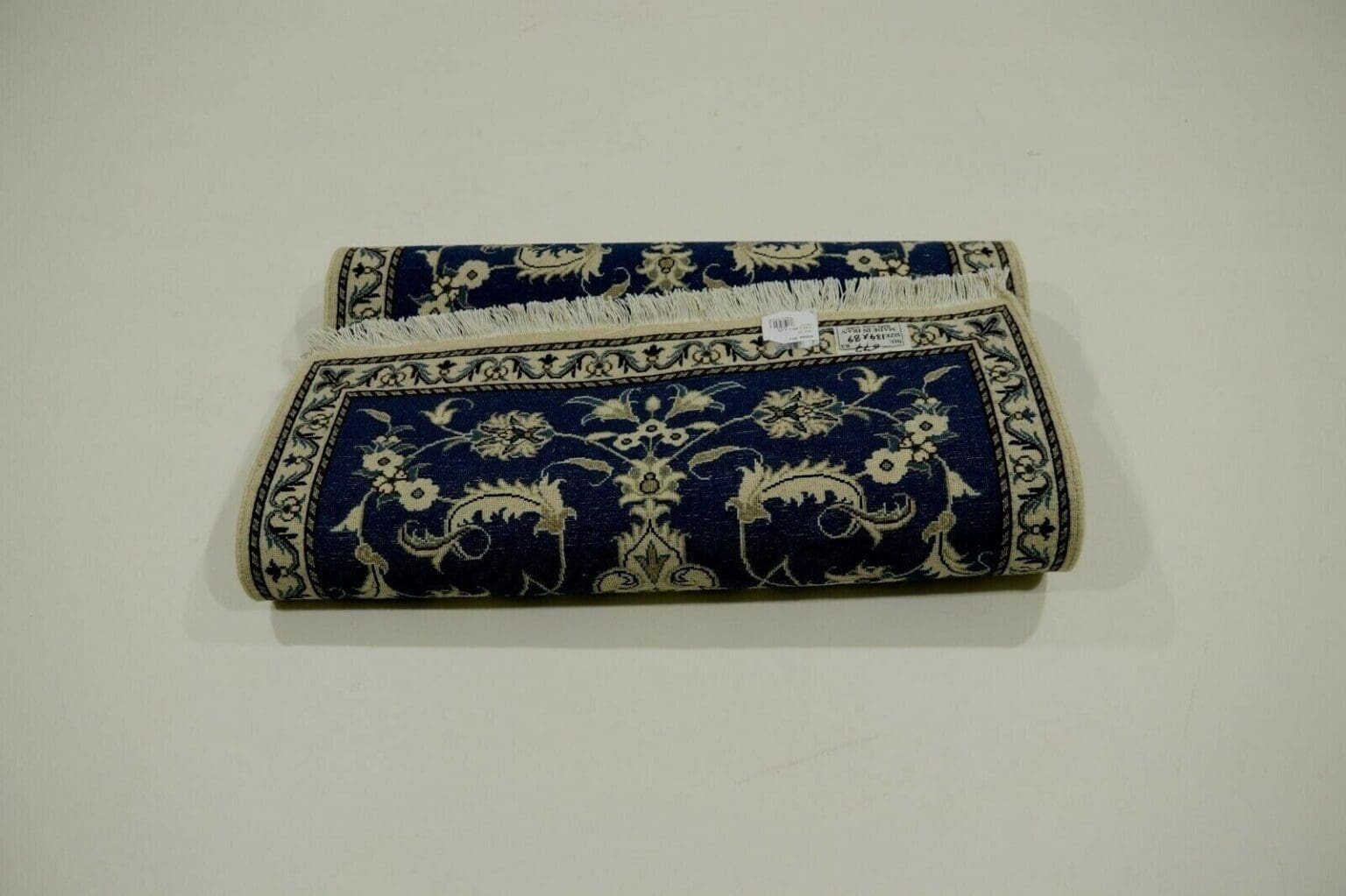
The rug is new and in very good condition. It is described as suitable for underfloor heating and pet-friendly. These practical points complement its material and workmanship details. Since a hand-knotted rug is made through individual manual actions, the concrete execution of each piece has its own character and cannot be reproduced in exactly the same way. This individuality comes from the making process, not from an additional provenance claim.
FAQ
How should the rug be cleaned?
For routine care, vacuum gently without a brush attachment. This removes loose dust while avoiding unnecessary strain on the pile. More substantial soiling should be handled by a professional rug cleaner. Professional cleaning is particularly appropriate because the pile contains both virgin wool and silk, and the two fibres should be treated in ways suited to their different structures.
Can the rug be placed over underfloor heating?
Yes. This Persian rug is specified as suitable for use over underfloor heating. Its wool and silk pile and hand-knotted construction allow it to be used in a room with this type of heating. It should be laid flat and securely so that the surface rests evenly and does not create a trip hazard. Careful placement supports the practical use of the rug while protecting its hand-finished surface.
How can I check whether a Nain rug is authentic?
An authentic Nain rug is often accompanied by a certificate documenting its origin. The hand-knotted construction, the stated knot density and the listed materials can also help with classification. For this piece, the pile is identified as virgin wool and silk, and the warp as cotton. A definitive assessment of authenticity and origin should be made by a qualified specialist, since no single feature can establish every aspect of a rug’s provenance on its own.
To provide the best experiences, we use technologies like cookies to store and/or access device information. Consenting to these technologies will allow us to process data such as browsing behavior or unique IDs on this site. Not consenting or withdrawing consent, may adversely affect certain features and functions.
Functional Always active
The technical storage or access is strictly necessary for the legitimate purpose of enabling the use of a specific service explicitly requested by the subscriber or user, or for the sole purpose of carrying out the transmission of a communication over an electronic communications network.
Preferences
The technical storage or access is necessary for the legitimate purpose of storing preferences that are not requested by the subscriber or user.
Statistics
The technical storage or access that is used exclusively for statistical purposes.The technical storage or access that is used exclusively for anonymous statistical purposes. Without a subpoena, voluntary compliance on the part of your Internet Service Provider, or additional records from a third party, information stored or retrieved for this purpose alone cannot usually be used to identify you.
Marketing
The technical storage or access is required to create user profiles to send advertising, or to track the user on a website or across several websites for similar marketing purposes.

 SECURE PAYMENT
 SHIPPING PARTNERS


