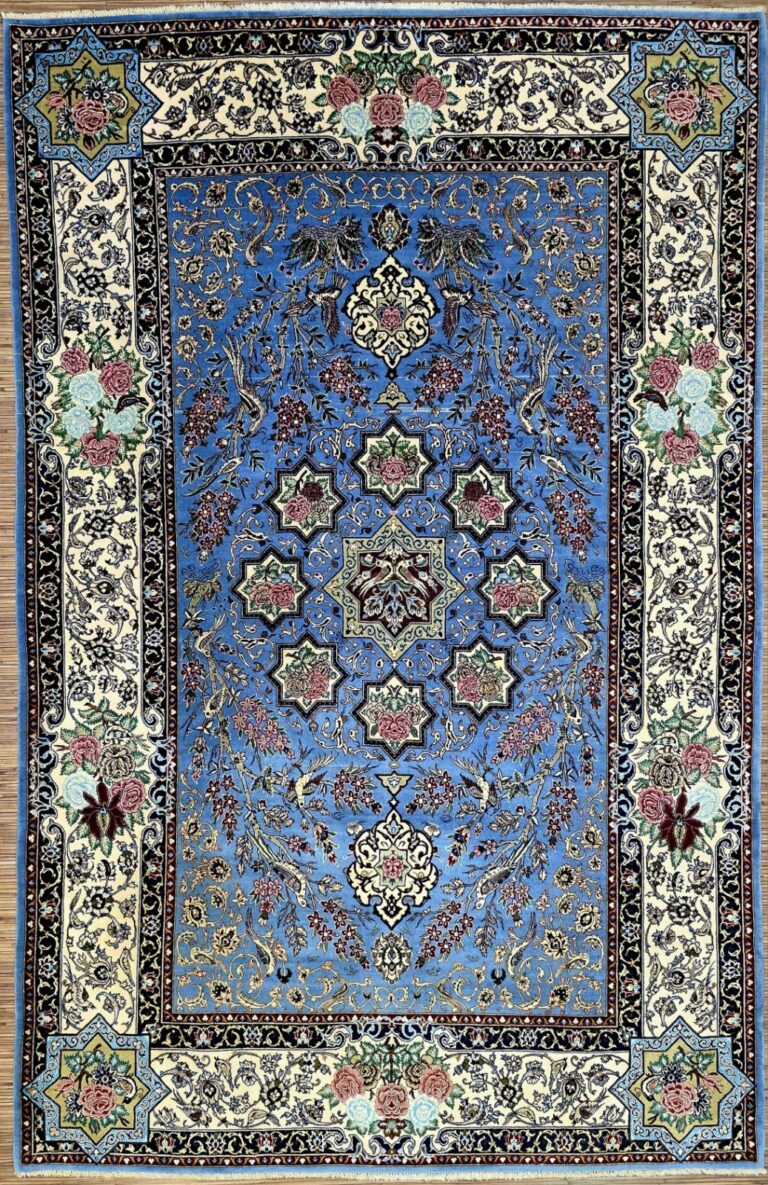
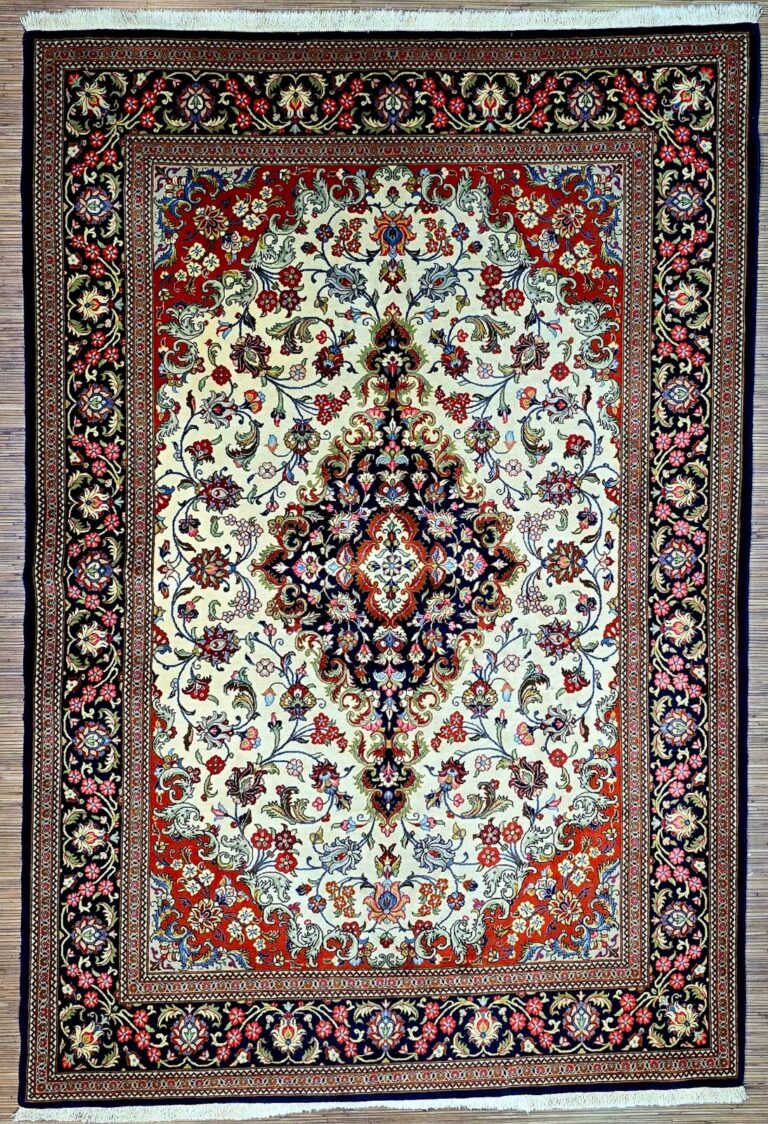
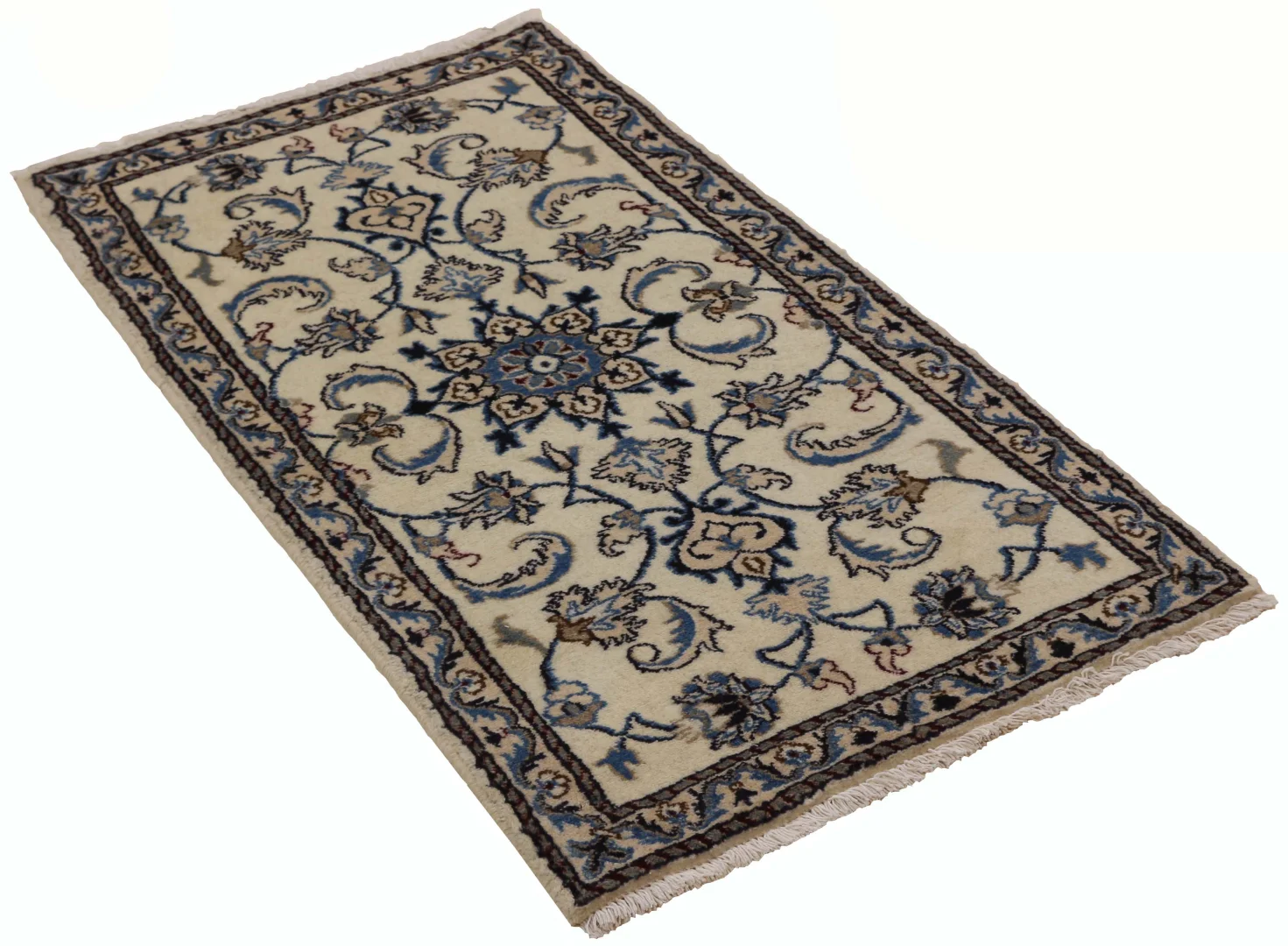
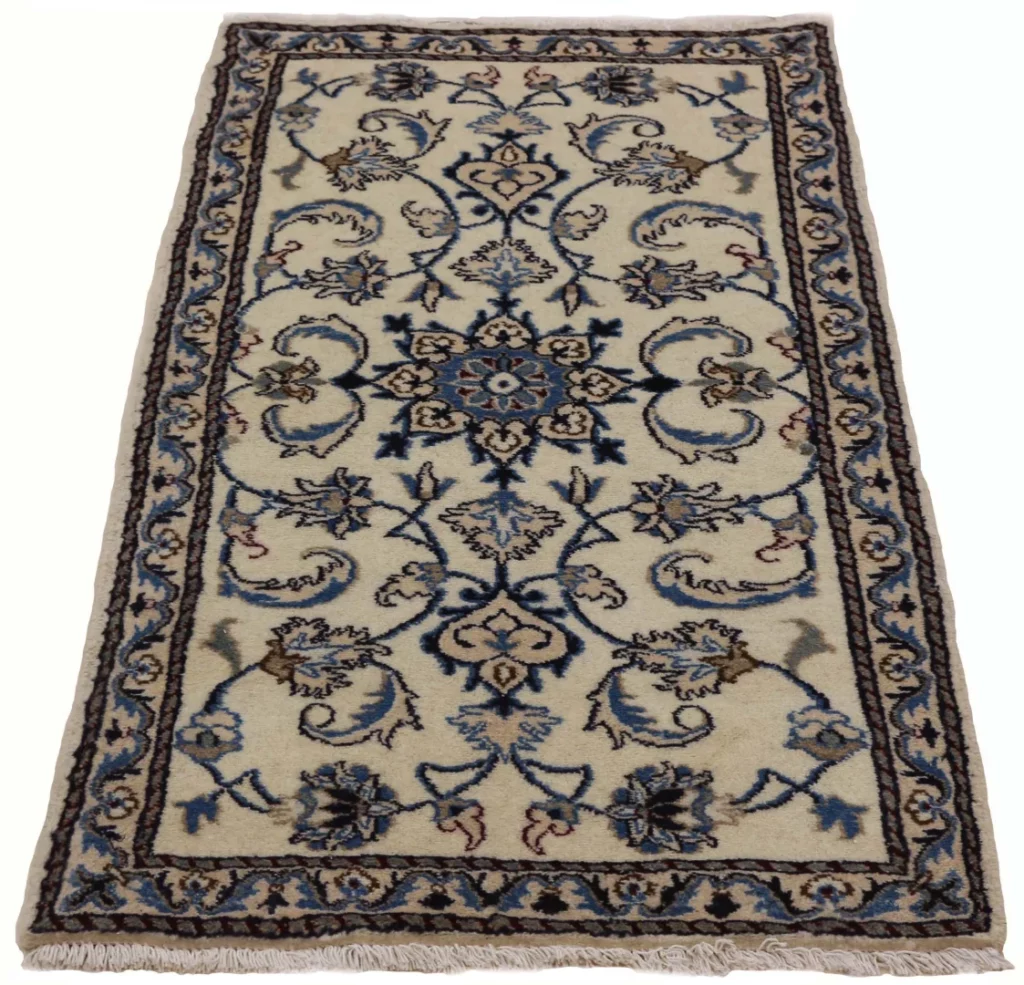
This Nain Persian rug is hand-knotted and made of wool with silk. Wool provides the pile with a resilient and warm textile foundation, while the silk worked into the design can lend selected details a finer appearance and a characteristic sheen. The combination of the two materials is associated with finely made Nain rugs, bringing together a sturdy surface and a more nuanced visual effect.
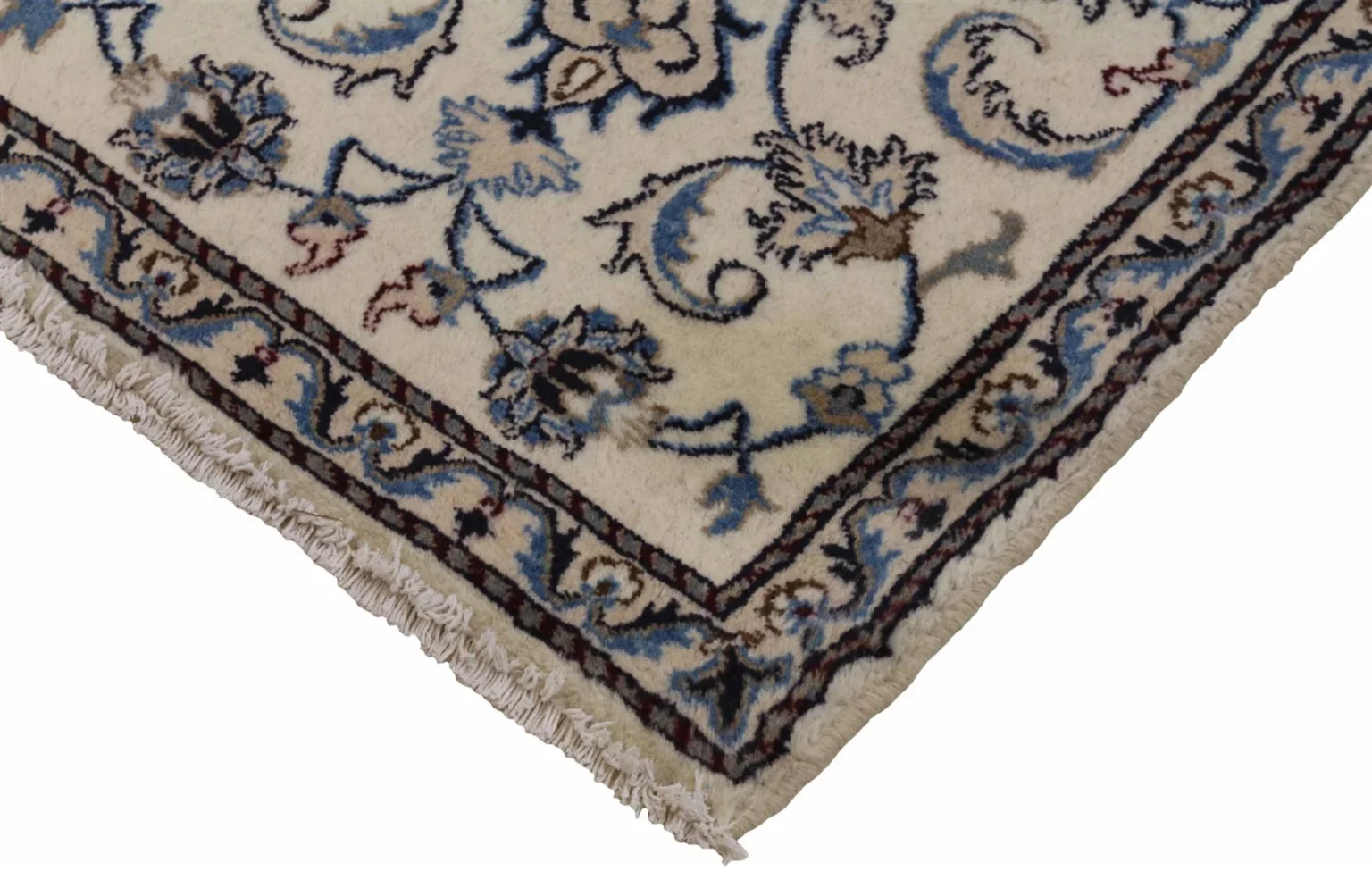
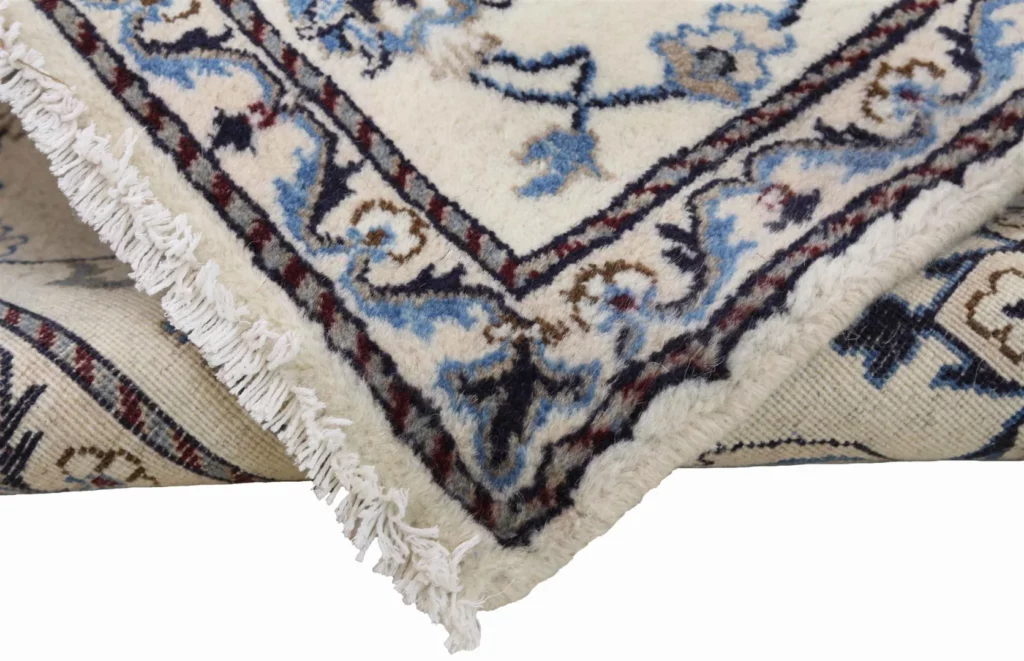
The knot density is given as 9-Lah, at approximately 250,000 knots per square metre. In Nain weaving, Lah is used to describe the fineness or density of the knotting. A denser construction results from a greater number of closely placed knots and allows small shapes to be rendered with greater precision. The 9-Lah classification of this rug therefore identifies a closely worked knot structure.
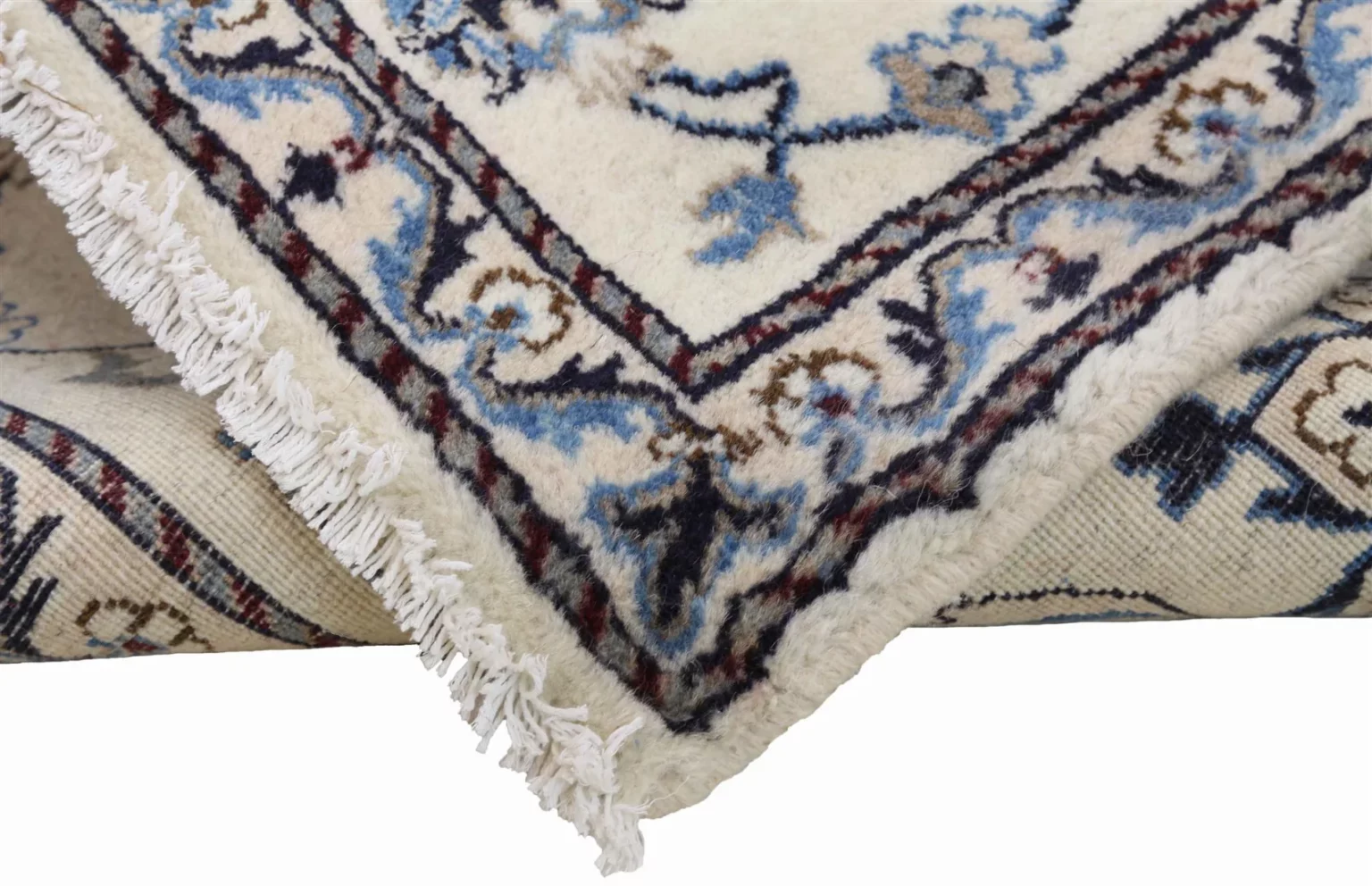
Hand knotting means that the individual knots are placed row by row rather than formed as an industrially uniform surface. This method supports the clear definition of flowers, leaves and connecting lines. Wool and silk also respond differently to light: wool tends to appear calmer and more compact, while silk may catch the light and create brighter accents as the viewing angle changes. Here, the two fibres come together within a traditionally floral composition.
Origin and Tradition
Nain is a city in central Iran with a well-established carpet-making tradition. Nain rugs form part of the Persian weaving heritage and are associated with controlled drawing, fine knotting and carefully selected materials. The history of the city reaches back to the Sassanid dynasty, providing a deep cultural background for a region where textile skills have been passed from one generation to the next.
The Nain tradition is distinguished by the relationship between precise line work, balanced organisation and a refined choice of fibres. Lah classification plays an important role in describing the quality of the knotting. Traditionally, a higher Lah number indicates a finer and denser construction. This system allows different degrees of textile precision to be distinguished while retaining Nain as the regional identity of the rug.
Production begins with an organised design that establishes the placement of the ornaments. During knotting, the composition is built gradually, then the pile is trimmed and finished so that the pattern reads as a unified surface. This controlled process is particularly important for floral designs, where stems, leaves and blossoms must remain in proportion to one another. A close knot structure helps the weaver reproduce narrow lines and smaller decorative elements with clarity.
Within Iranian carpet culture, Nain stands alongside other important regional traditions. Isfahan, Kashan and Kerman are also known for detailed patterns and the use of fine materials. Tabriz and Qom are likewise associated with careful craftsmanship and established Persian design vocabulary. Each region has its own visual and technical character. Nain remains identifiable through its place of origin, its fine knotting tradition and its characteristic approach to floral ornament.
The history of the region also explains why Nain rugs are considered more than purely functional floor coverings. Their production joins practical textile knowledge with a developed decorative language. Because the work is carried out by hand, the final textile results from the interaction of the design, the knotting and the finishing of the pile, rather than from a mechanically repeated surface. This connection between use and craftsmanship is central to the tradition.
Design and Pattern
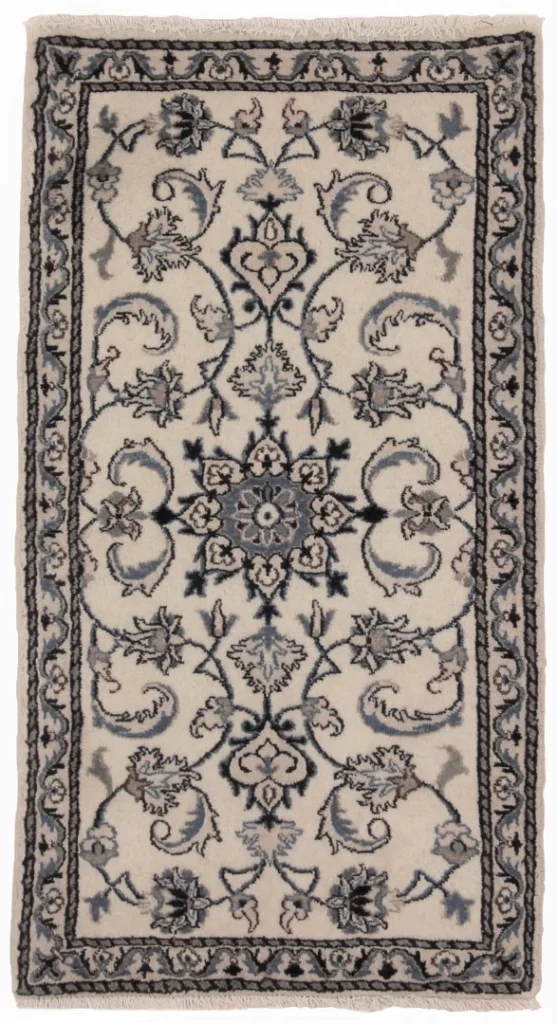
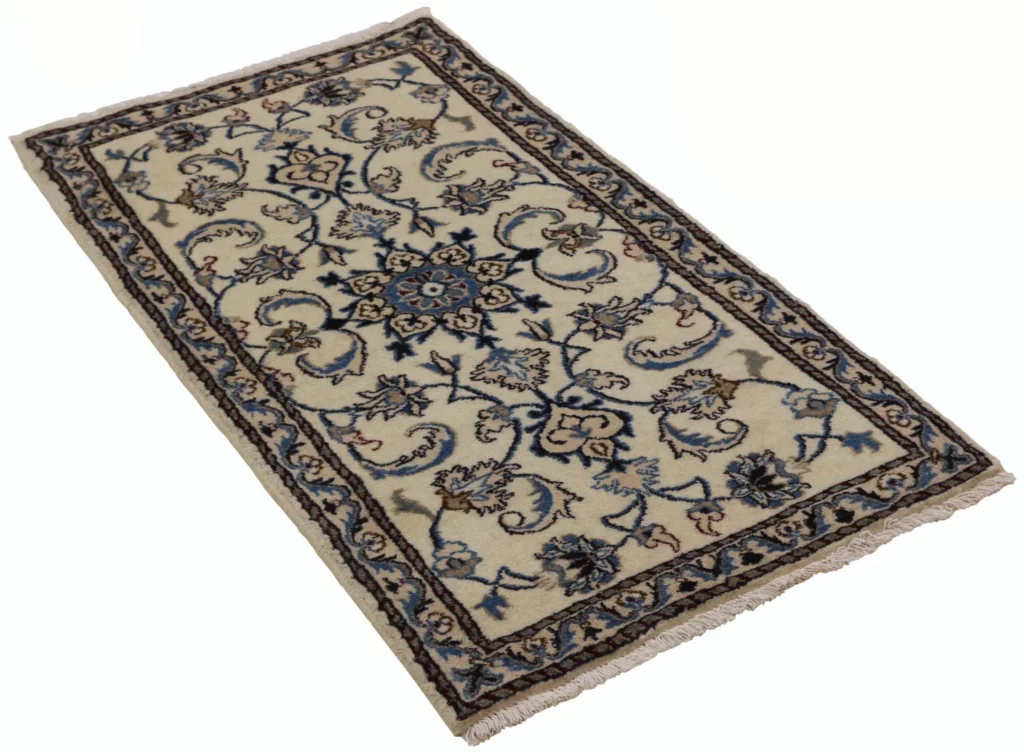
The rug is described as having classic floral motifs. Floral ornament is one of the established design languages associated with Nain rugs. Such motifs may take the form of blossoms, leaves, scrolling vines and finely divided plant shapes. Together they create a structured decorative field without being restricted to one literal botanical subject. The visual effect depends on how the separate elements are arranged and connected within the overall composition.
Nain designs are often organised either as all-over patterns or around a central medallion. In an all-over arrangement, floral forms are distributed across the field and create a continuous rhythm. A medallion composition establishes a visual centre, from which vines and blossoms can extend in a balanced manner. This rug is identified by its classic floral motifs; no more specific statement about a medallion or all-over layout is made here.
The character of a floral design comes from repetition, variation and finely managed transitions. Smaller leaves can connect larger blossoms, while vines lead the eye between individual elements. Close knotting makes it possible to separate these details and to organise them in layers of different scale. Silk within the material can emphasise particular passages through a subtle change in reflectivity, creating a contrast between the quieter surface of wool and brighter textile accents.
Persian ornament frequently relies on symmetry, recurrence and a considered balance between decorated and more open areas. These principles provide order without eliminating detail. Repeated forms can be altered in size, direction and placement, allowing the pattern to remain varied while retaining visual coherence. In Nain rugs, fine knotting supports this approach by allowing delicate floral components to remain legible as parts of one connected design.
A floral Nain rug can therefore be understood as a meeting point between botanical suggestion and geometric organisation. The flowers are not simply scattered across the surface; they are integrated into an ornamental system of lines, leaves and repeated forms. This controlled arrangement is an important part of traditional Nain aesthetics and explains how a design can appear decorative, precise and evenly composed at the same time.
Special Features
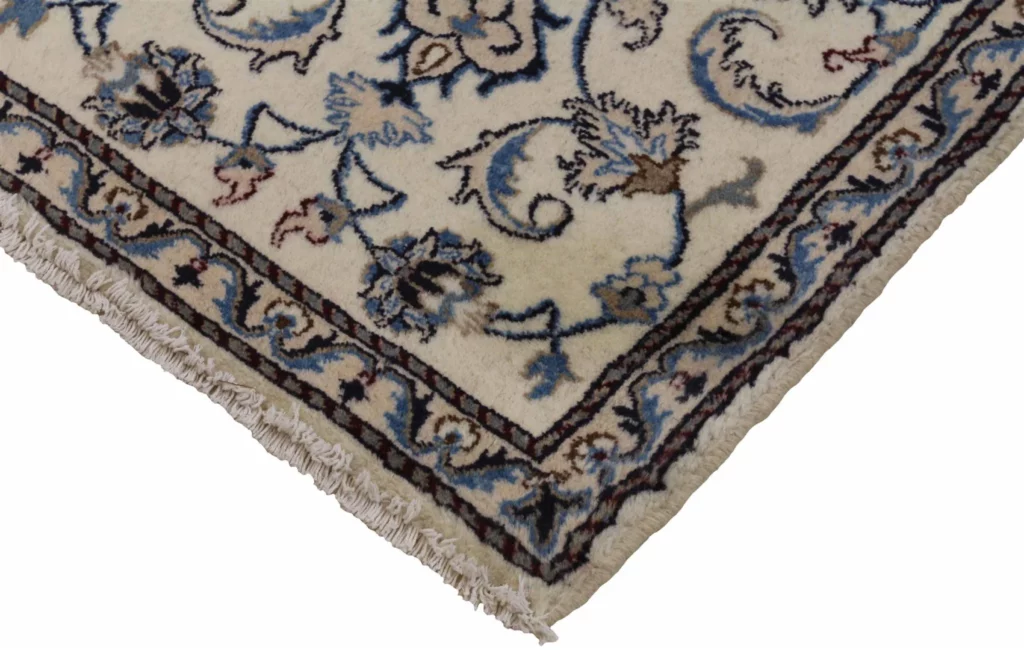
The rug is very well preserved. Its stated features include hand knotting, a material combination of wool and silk, and a 9-Lah knot density. The classic floral motifs correspond to the traditional design language of Nain Persian rugs. Silk may give selected areas a differentiated response to light, while wool contributes a warm and resilient textile character.
The term 9-Lah describes the fineness of the knotting and is not an additional statement of origin. Together with the Nain origin, the Persian weaving tradition and the floral design, it gives the rug a clear technical and stylistic profile. Its condition is described as very well preserved.
FAQ
What distinguishes Nain Persian rugs?
Nain Persian rugs are known for fine knotting, carefully drawn ornament and the use of wool and silk. The Lah classification describes the density and fineness of the construction. Classic floral patterns are part of the established weaving tradition of Nain in central Iran. Wool gives the rug a resilient and warm textile foundation, while silk can add finer accents and a gentle sheen. This rug brings those characteristics together in a hand-knotted form with a 9-Lah knot density.
How should I care for a Nain Persian rug?
Regular, gentle vacuuming helps remove dust and loose particles from the pile. Care should avoid unnecessary strain on the knots and surface. If deeper cleaning is needed, professional carpet cleaning is appropriate. Strong direct sunlight should be avoided because prolonged exposure can encourage colours to fade. A restrained care routine helps preserve the textile surface, the definition of the floral details and the very well preserved condition for as long as possible.
Where can I buy an authentic Nain Persian rug?
Authentic Nain Persian rugs can be found at specialist carpet dealers, art fairs and reputable online platforms that focus on traditional rugs. A clear description should identify origin, material, technique, knot density, pattern and condition. These details help distinguish a rug from Nain from one that merely uses a similar floral design. Specialist dealers can also answer questions about the traditional classification, the wool-and-silk material combination and suitable care for the individual rug.
To provide the best experiences, we use technologies like cookies to store and/or access device information. Consenting to these technologies will allow us to process data such as browsing behavior or unique IDs on this site. Not consenting or withdrawing consent, may adversely affect certain features and functions.
Functional Always active
The technical storage or access is strictly necessary for the legitimate purpose of enabling the use of a specific service explicitly requested by the subscriber or user, or for the sole purpose of carrying out the transmission of a communication over an electronic communications network.
Preferences
The technical storage or access is necessary for the legitimate purpose of storing preferences that are not requested by the subscriber or user.
Statistics
The technical storage or access that is used exclusively for statistical purposes.The technical storage or access that is used exclusively for anonymous statistical purposes. Without a subpoena, voluntary compliance on the part of your Internet Service Provider, or additional records from a third party, information stored or retrieved for this purpose alone cannot usually be used to identify you.
Marketing
The technical storage or access is required to create user profiles to send advertising, or to track the user on a website or across several websites for similar marketing purposes.
 SECURE PAYMENT
 SHIPPING PARTNERS